You are currently on the new version of our website. Access the old version .
SensorsSensors
  • Review
  • Open Access

6 January 2026

Research on Control Strategy of Lower Limb Exoskeleton Robots: A Review

,
,
,
,
and
China Coal Research Institute, Beijing 100013, China
*
Author to whom correspondence should be addressed.
This article belongs to the Special Issue Sensor Fusion for Telemedicine: Advancing Remote Healthcare Through Multi-Modal Data Integration

Abstract

With an aging population and the high incidence of neurological diseases, rehabilitative lower limb exoskeleton robots, as a wearable assistance device, present important application prospects in gait training and human function recovery. As the core of human–computer interaction, control strategy directly determines the exoskeleton’s ability to perceive and respond to human movement intentions. This paper focuses on the control strategies of rehabilitative lower limb exoskeleton robots. Based on the typical hierarchical control architecture of “perception–decision–execution,” it systematically reviews recent research progress centered around four typical control tasks: trajectory reproduction, motion following, Assist-As-Needed (AAN), and motion intention prediction. It emphasizes analyzing the core mechanisms, applicable scenarios, and technical characteristics of different control strategies. Furthermore, from the perspectives of drive system and control coupling, multi-source perception, and the universality and individual adaptability of control algorithms, it summarizes the key challenges and common technical constraints currently faced by control strategies. This article innovatively separates the end-effector control strategy from the hardware implementation to provide support for a universal control framework for exoskeletons.

1. Introduction

With the intensifying trend of an aging population and the continuous rise in the incidence of neurological-related diseases, the number of people suffering from lower limb motor dysfunction caused by conditions such as stroke, spinal cord injury, cerebral palsy, and Parkinson’s disease is increasing annually. Globally, approximately 150 million individuals face varying degrees of motor dysfunction. These patients commonly experience issues including abnormal gait, insufficient muscle strength, and even paralysis, which severely impair their ability to perform daily activities and participate in society [1,2,3,4]. Traditional rehabilitation methods primarily rely on manual assistance from rehabilitation therapists to conduct training. Not only are these methods labor-intensive and poorly repeatable, but they also lack quantitative metrics, making it difficult to meet the current practical demands for efficient and personalized rehabilitation [5,6,7].
As a typical wearable intelligent device, the lower limb exoskeleton controls lower limb joints such as the hip, knee, and ankle via actuators to achieve coordination with the human movement process, thereby assisting patients in completing gait training [8,9]. From a functional perspective, lower limb exoskeletons can be categorized into two main types: rehabilitative and augmentative. Rehabilitative lower limb exoskeletons can be further divided into two subtypes: motion compensation type and gait correction type [10]. Each leg of the human lower limb typically has seven degrees of freedom (DOF). Exoskeleton robots often selectively control some or all of these DOFs based on task requirements. Through coordinated multi-joint movement, they can better simulate natural gait and enhance the wearer’s comfort and interactive compliance [11,12,13,14].
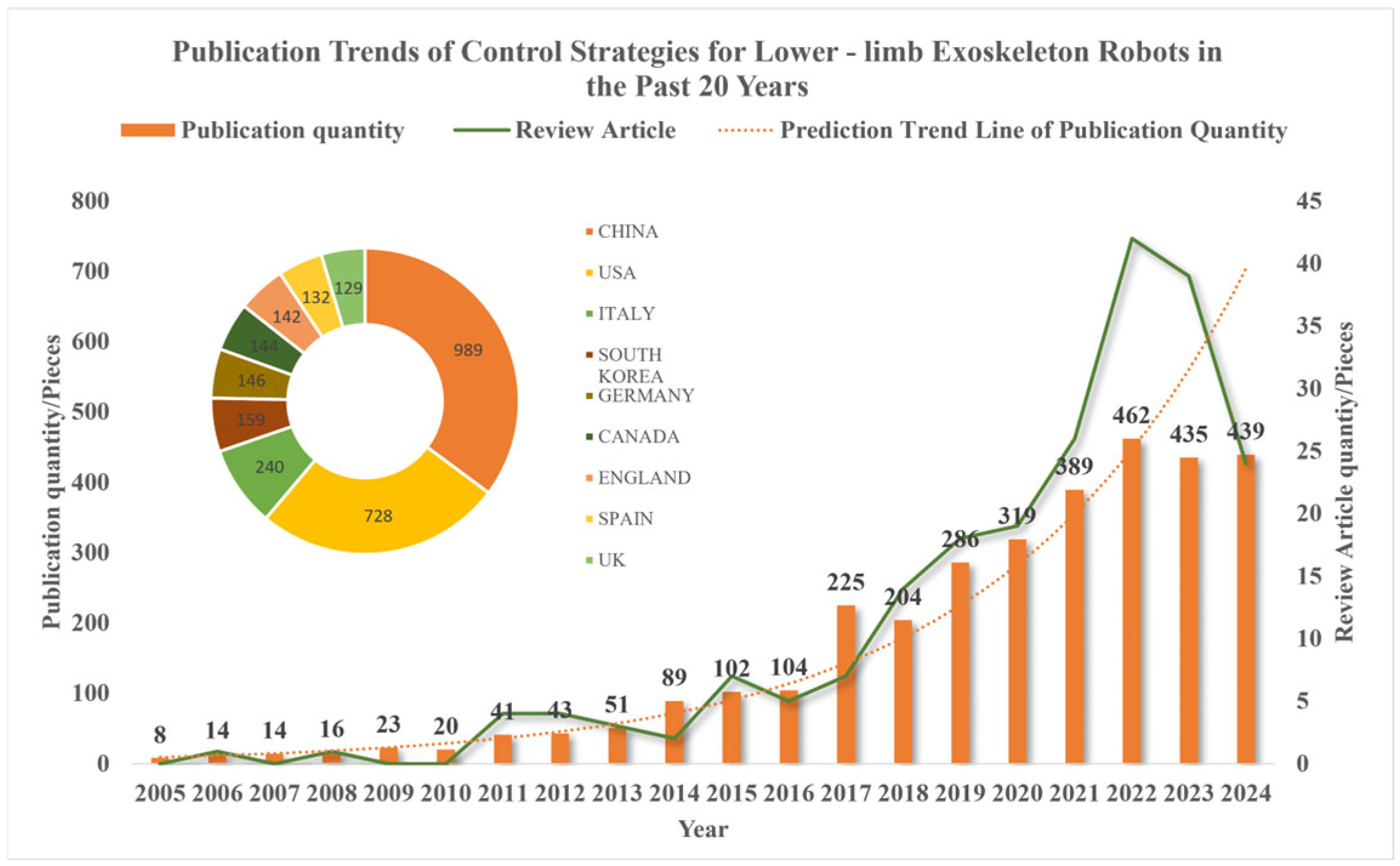
The control system serves as the core of information interaction between the exoskeleton and the human body, undertaking the key roles of perceiving the user’s state, interpreting movement intentions, and implementing responsive control. In recent years, the number of research papers related to the control of lower limb exoskeleton robots has increased significantly, as shown in Figure 1.
Figure 1. Statistical chart of the number of papers related to lower limb exoskeleton robot control.
This paper searches the web of science using the keywords “lower exoskeleton” and “control” for the number of published articles (the core search string is “lower exoskeleton” AND “control”, the search date is 28 May 2025, and the document types are review and article) and the proportion of countries in the past 20 years (2005–2024). The article’s inclusion criteria focus on the following: (1) journal articles and top conference proceedings; (2) research that proposes or verifies lower limb robot exoskeleton control algorithms. Exclusion criteria included the following: (1) studies focusing solely on mechanical structures; (2) upper limb exoskeletons or smart prosthetic devices. All related articles and review articles have shown an overall upward trend in the past 20 years, but have declined in the past two years. Especially with 2017 as the dividing line, the number of published articles has increased significantly.
When viewed on a five-year scale, the number of published articles has maintained a consistent upward trajectory. Among the contributing countries, China, the United States, and Italy are the major ones, accounting for over 50% of the total publications. This indicates that with the growing social emphasis on quality of life and rehabilitation products in recent years, the perception, decision-making, and control aspects of lower limb exoskeleton robots have gradually gained attention, and significant breakthroughs have been achieved in both relevant theoretical and practical research. Based on the statistics of the number of literature, this article extracts relevant research hot issues and difficult issues, and also evaluates the gap between the research content of this article and the published content, thereby providing an important perspective on the practical application of current exoskeleton control strategies.
Currently, a variety of commercial or experimental lower limb exoskeleton products have realized multi-degrees-of-freedom cooperative control, and are equipped with certain adaptive capabilities and biofeedback functions, which have significantly promoted the development of rehabilitation engineering and robot-assisted medical care [15,16]. A summary of some lower limb exoskeleton robot products is as shown in Table 1.
Table 1. Partial table of lower limb exoskeleton robot products.
Although research on lower limb exoskeleton robots has shown an active trend in recent years, they still face three core challenges in practical applications:
Human Intention Detection: How to accurately recognize the user’s movement intention to achieve precise assistance.
Cooperative Motion Control: After acquiring the movement intention, how to achieve DOF and multi-joint coordinated control to assist the user’s movement naturally.
Parameter Optimization: How to dynamically optimize control parameters according to individual physiological differences.
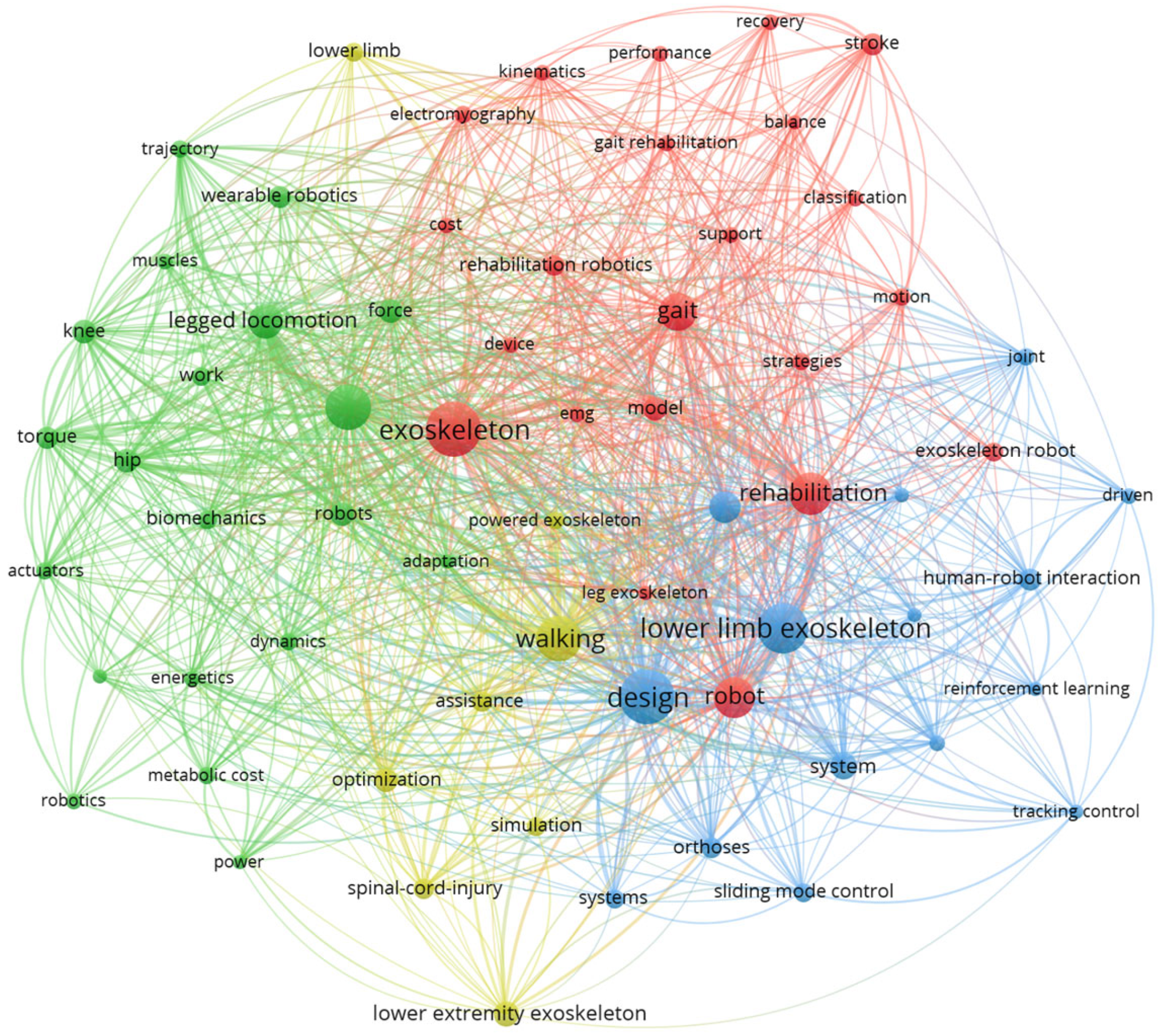
To deeply analyze the research hotspots and development context in the field of lower limb exoskeleton robots, a visual analysis of the literature was conducted on the Web of Science database using “lower limb exoskeleton” as the subject term, and a keyword co-occurrence visualization network was constructed, as shown in Figure 2. The results show that research in this field mainly focuses on four directions: first, rehabilitation and gait reconstruction (red cluster), which focuses on assisting patients with gait recovery through exoskeletons; second, biomechanics and motion analysis (green cluster), which emphasizes control methods based on dynamic modeling to improve the system and the natural movement of the human body in terms of coordination; third, control strategy and intelligent algorithm (blue cluster), which is the core direction of the current research, mainly exploring intelligent control methods such as human–machine collaboration, adaptive control, and deep reinforcement learning; fourth, system design and performance evaluation (yellow cluster), focusing on exoskeleton structure optimization, assistance effect, and energy consumption efficiency evaluation.
Figure 2. Visualization network analysis of keyword co-occurrence.
In summary, it can be seen that control strategy plays a core supporting role in all research directions and is the key to promoting the intelligence and practicality of lower limb exoskeleton robots. Its performance directly determines the naturalness and collaborative efficiency of human–computer interaction.
Traditional open-loop control or fixed-threshold feedback strategies often struggle to adapt to dynamic and variable human states [17]. In recent years, with the rapid development of high-resolution physiological sensing technology, human–robot dynamics modeling technology, and artificial intelligence methods, a series of advanced control strategies have gradually emerged, including proportional electromyography (EMG) control [18,19], variable gain control [20,21], AAN strategies [22,23], physiological model-based torque estimation [24,25], lower limb motion estimation based on physiological signals and muscle synergy [26], and artificial intelligence predictive control [27]. Although artificial intelligence algorithms have demonstrated superior performance in areas such as movement intention recognition, they have rarely been applied in end-control research, leading to a disconnect between the application of artificial intelligence in control and theoretical research [28,29,30].
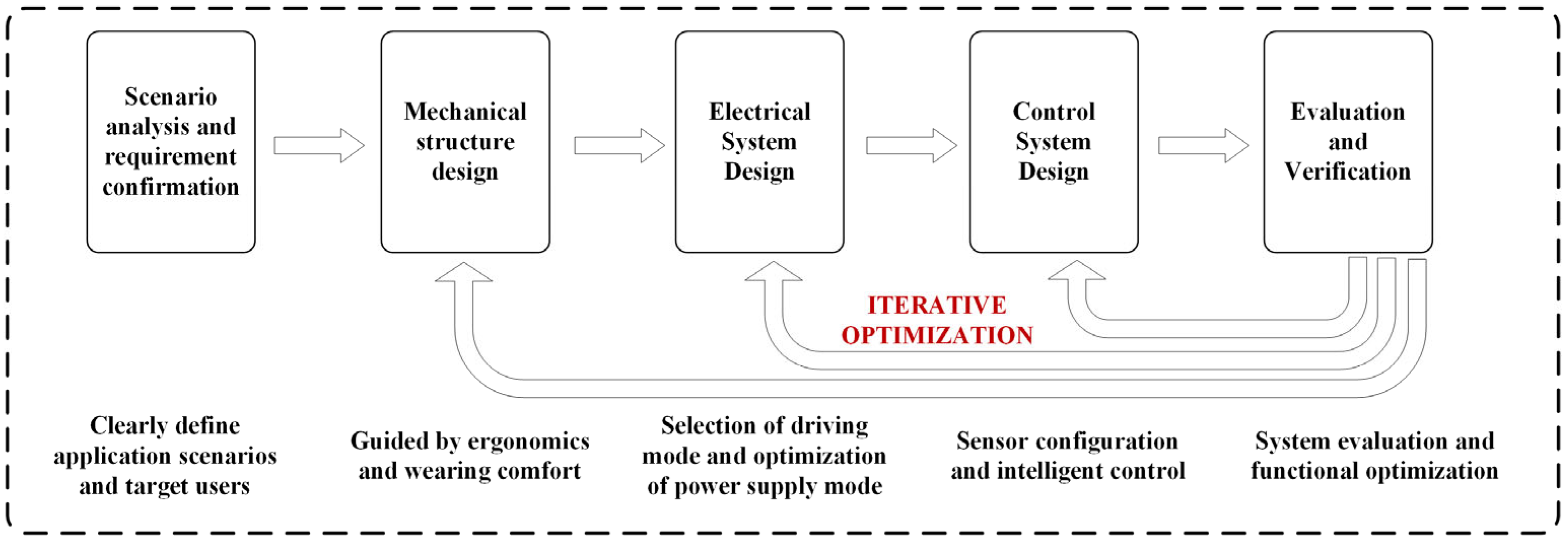
The design of an exoskeleton control system depends not only on the target task but is also strongly influenced by the actuation mode, sensing structure, and human–robot interaction interface [31,32,33,34]. The design concept and design process of a lower limb exoskeleton robot are shown in Figure 3. Particularly in motor-driven systems, there is a high degree of coupling between control strategies and execution structures. The same control method is difficult to reuse across platforms, and it is challenging to elaborate on different actuation modes and their corresponding control strategies in a single article. Most review papers focus on hardware design or a single control method, lacking a synergistic analysis of actuation modes and control strategies.
Figure 3. Design ideas and design process of lower limb exoskeleton robots.
To systematically review the current development of control strategies for rehabilitative lower limb exoskeletons, this paper uses control tasks as the main thread and categorizes them into four types based on clinical rehabilitation progress and human–robot interaction level. These categories are as follows: Trajectory Reproduction corresponds to the early stages of rehabilitation, and its goal is to prevent muscle atrophy through passive, robot-guided movement; Motion Following is an intermediate stage where the robot must follow user guidance to ensure comfort, focusing on motion synchronization; AAN represents the active recovery stage, where the robot dynamically adjusts assistance based on real-time performance to promote neural function remodeling; Motion Intention Prediction represents the advanced stage of daily assistance, where the control logic becomes actively perceptive, combining the horizontal coupling relationship of actuation–perception–execution, and taking “control tasks–control strategies” as the entry point. For different control tasks, it systematically reviews the research progress of lower limb exoskeleton control strategies, with a focus on the control implementation issues in motor-driven systems. The main contributions are as follows:
Horizontally compare the control system architectures and typical application scenarios under different actuation modes (motor drive, hydraulic drive, etc.), and vertically delve into various control strategies in the context of motor drive, systematically summarizing their mechanisms, advantages, disadvantages, and applicable scopes. By quantitatively comparing the tracking errors and response characteristics in recent studies, the trade-offs between control accuracy, system complexity, and human–machine interaction compliance were discussed.
Starting from the hierarchical control of exoskeleton robots, discuss the dependency relationships between control strategies, actuation modes, and sensing structures in combination with practical situations.
The previous research literature has mainly adopted a hardware-centric approach, classifying control strategies according to specific actuation types. This method often correlates control logic with actuators, and the performance of control strategies is liable to be masked by the physical limitations of the actuators. Unlike previous review papers, this article innovatively decouples end-effector control strategies from specific hardware implementations, providing a general framework that allows researchers to apply control theory to different types of actuators. It also focuses on the theoretical advancements and future development trends of end-effector control strategies. In addition to reviewing the existing literature, this paper elucidates the evolutionary trajectory of exoskeleton control—from fixed, non-interactive trajectory tracking control to intelligent, bio-signal-inspired, and human-intention-driven assistive control. By decoupling the control task from specific hardware, it also reveals how control strategies can be correlated with the patient’s motor function recovery stage.

2. Research on Drive Methods and Control System Frameworks for Lower Limb Exoskeleton Robots

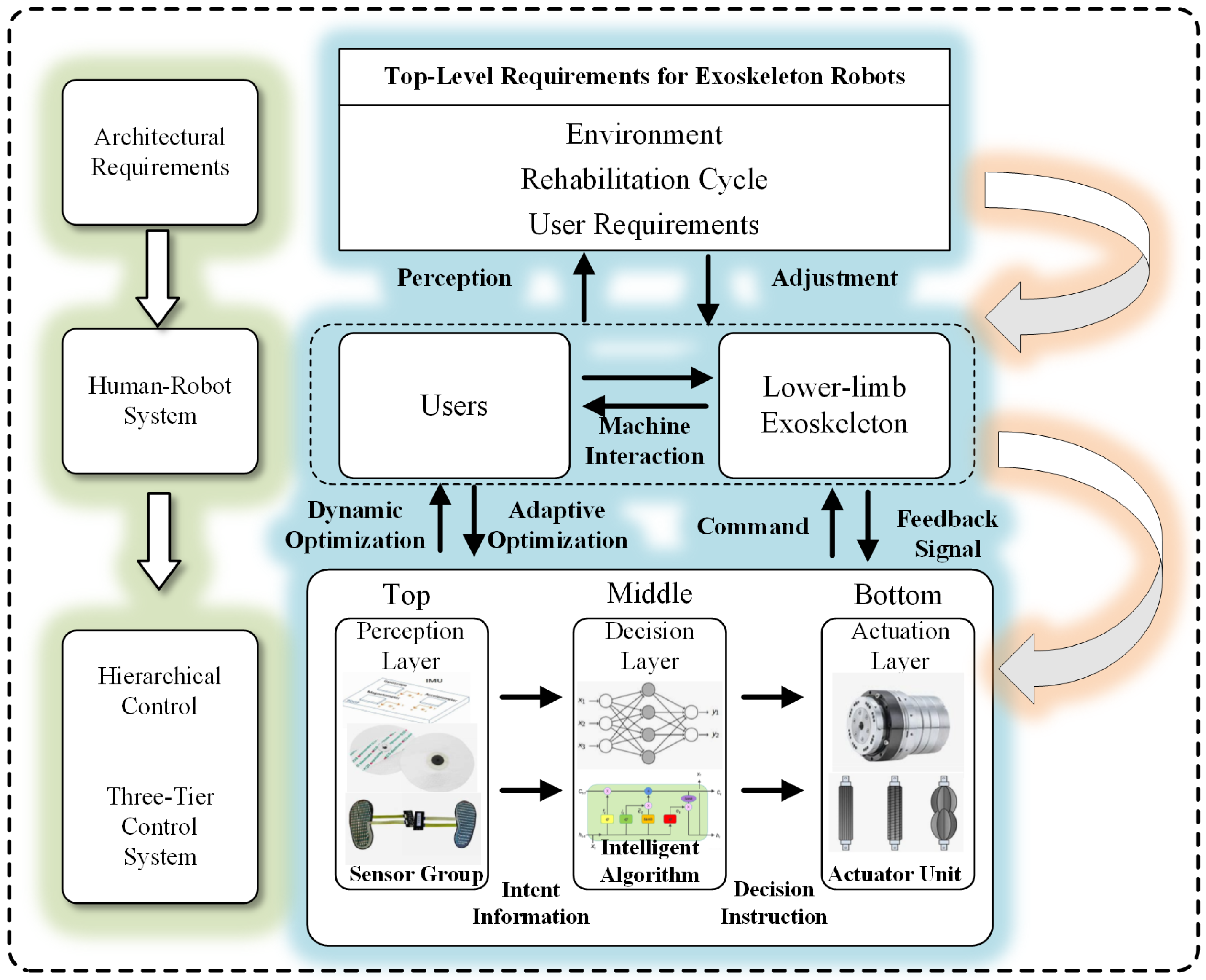
With the widespread application of lower limb exoskeleton robots in fields such as rehabilitation medicine and walking assistance, the design of their control systems has become crucial for achieving efficient human–robot collaboration. Lower limb exoskeletons are categorized into two main types: active control and passive control. Active control typically consists of three levels: perception, decision-making, and execution [35,36,37]. The overall control architecture of the lower limb exoskeleton robot is shown in Figure 4.
Figure 4. Overall control architecture of lower limb exoskeleton robots.
Perception Layer: Through multi-sensor fusion technology, physiological and motion information of the user is collected in real time, providing basic data for subsequent decision-making. For example, user information can be collected in real time through surface electromyography (sEMG) and IMU.
Decision-Making Layer: Using the collected data, combined with intelligent algorithms (such as machine learning, neural networks, etc.), the user’s movement intentions and states are analyzed, and corresponding control strategies are formulated. For example, the detected data can be analyzed to determine when the user transitions from walking on level ground to climbing stairs, planning the corresponding gait curve or controller input curve.
Control Execution Layer: According to the output of the decision-making layer, the drive system is controlled to execute corresponding actions, realizing assistance for the user’s movement or rehabilitation training. For example, the motor ensures precise output of the target torque or angle even under external disturbances.
Control strategies can be classified into three levels based on complexity and automation level:
(a)
High-level control strategies: Can automatically detect terrain and user intentions based on multi-sensors to achieve autonomous control.
(b)
Mid-level control strategies: Realize the analysis and execution of lower limb movements based on manual settings by the user or continuous state estimation.
(c)
Low-level control strategies: Rely entirely on position or torque controllers to execute preset actions, with no ability to modify training trajectories.
The “perception–decision–execution” process is organically coupled. Among them, the physical carrier of the execution layer is the drive system, which directly affects the control effect of the exoskeleton robot. An ideal drive system should have characteristics such as high power density, good compliance, low power consumption, and compact structure. Currently, no single drive technology can meet all these requirements simultaneously. Table 2 systematically compares current typical drive modes across key dimensions, including technical implementation, control complexity, power output, structural compliance, system cost, and applicable scenarios.
Table 2. Comparison of driving methods.
Rotary motors and elastic actuators exhibit the best performance in terms of low cost, lightweight design, and reliability. Hydraulic and pneumatic systems, although capable of providing high driving force, are limited in their popularization by high costs, heavy weight, and high maintenance requirements; they are therefore suitable for high-intensity industrial applications. In contrast, pneumatic artificial muscles or cable-driven systems possess unique advantages in flexible and bionic robot design [57].
In summary, the high bandwidth and precise controllability of motor drives enable the implementation of almost all mainstream control strategies, which is crucial for lower limb exoskeletons in rehabilitation environments. In contrast, hydraulic, pneumatic muscle, and cable drives face significant challenges in implementing complex control strategies. Although these drive methods are beneficial for the compliance of AAN strategies, their highly nonlinear characteristics and time delays greatly increase the difficulty of implementing complex motion intention prediction control and hybrid force/position control. Therefore, motor drives have become the mainstream choice for current research and applications of lower limb exoskeletons. This paper will subsequently focus on motor drive systems and delve into their control tasks and strategy implementation paths.

3. Development Status of Control Strategies for Lower Limb Exoskeleton Robots

Section 2 analyzed the characteristics of different driving methods and clarified that the physical structure determines the overall performance of the exoskeleton robot system. To overcome hardware limitations and constraints and achieve more effective human–robot interaction, this section focuses on control strategies to evaluate how different control strategies adapt to or compensate for the characteristics of the physical structure.
In the application of lower limb exoskeletons, control tasks not only reflect the complexity of human–robot interaction but also directly determine the design depth of control strategies. To provide a structured analysis, this paper categorizes control tasks into four types based on patient treatment progress and the depth of human–machine interaction, as shown in Table 3. Although there is overlap between the boundaries of the four types of control tasks, such as follow-up control and AAN, the former aims to minimize interaction forces, while the latter purposefully adjusts assistance to provide only the necessary support. This classification method focuses more on the main clinical objectives of each task.
Table 3. Comparison of control tasks.
  • Human Motion Reproduction: This task mostly occurs in the early stage of medical rehabilitation, similar to the trajectory control of ordinary robots. It is relatively simple and does not require human feedback, only needing position or torque feedback.
  • Human Motion Following: This refers to ensuring that the exoskeleton’s movement is consistent with the human body. For the exoskeleton to achieve real-time following, human–robot interaction information is required as feedback—for example, using pressure sensors to detect the interaction force between the human body and the exoskeleton structure.
  • Joint Torque Assist-As-Needed: This type of control task is similar to the function of human muscles. The focus of the control strategy is to appropriately provide driving force to drive the movement of human joints.
  • Human Motion Perception-Prediction and Compliant Control: Suitable for high-level intelligent rehabilitation or daily assistance scenarios, this task requires real-time inference of the user’s intention and dynamic adjustment of output, with extremely high requirements for intelligence and compliance.
Correspondingly, the accomplishment of these control tasks also requires matching control strategies. Among them, the first three types of control tasks are mainly exoskeleton-dominated: the exoskeleton robot fully drives or supports human movement, and these are collectively referred to as passive control. The first type of control task is further called pure passive control because it requires no subjective participation from the human body. The second and third types of control tasks are called semi-passive control (human–machine collaborative passive control) because they require human movement parameters or provide additional assistance when the human body exerts active force.
In contrast, the last type of control task is human-dominated: the human body generates movement intentions, which are perceived and interpreted by the exoskeleton’s sensors; the exoskeleton then cooperates with the human body to complete the intended movement. This is also referred to as active control.
The following sections will build upon these four control tasks, systematically analyzing control strategies designed for specific tasks, examining the implementation principles of different control strategies, evaluating how they translate control tasks into robot execution logic, and subsequently analyzing the inherent advantages and limitations of each method.

3.1. Human Motion Reproduction

In the early stages of rehabilitation training, patients do not yet have the ability to actively move, so exoskeleton robots often use purely passive control strategies to drive patients to complete basic gait actions through preset trajectories. This type of control task takes “accurately reproducing human movement trajectories” as its core goal, emphasizing the strong constraint execution of the desired trajectory by the exoskeleton. The parameters pay more attention to high stability and high precision, but it will ignore the differences in the movement abilities of different patients. It is a “robot-led” control method. Although it is less interactive, it can provide initial support to patients throughout the process and help induce neural reconstruction through repetitive movements.
Before control, it is crucial to accurately generate limb motion trajectories. Typically, the main methods for obtaining limb motion trajectories are listed in Table 4.
Table 4. Comparison of motion trajectory acquisition methods.
In the traditional industrial control field, servo control-related methods are often used to make the system output approach the expected value infinitely. These methods are also applicable to the passive control of exoskeleton robots, such as PID control and computed torque control (CTC). Liang et al. [71] adopted the traditional dual-loop PID control method combined with gravity compensation. Without relying on a model-based controller, they achieved stable and precise control of a 4-DOF lower limb exoskeleton robot. Laboratory tests showed that the actual motion trajectory was almost consistent with the preset trajectory (sine curve), with an average angle error of less than 0.01 rad.
Similarly, the optimization of PID algorithms in the industrial field can also be applied to exoskeleton robot control, such as fuzzy control logic, genetic algorithm optimization, and particle swarm optimization (PSO) [72].
For external disturbances and model errors, fuzzy control logic is usually integrated to optimize the PID controller. Based on the idea of fuzzy reasoning, the P, I, and D parameters are dynamically adjusted according to the real-time error and error change rate to achieve adaptive control. The fuzzy rule base enhances robustness, enabling the system to adapt to uncertain factors in exoskeletons and human–robot interaction, such as load changes and nonlinear friction. The dynamically adjustable parameters allow handling nonlinearity and large disturbances.
To address the limited adaptability of exoskeleton robots, Cardona et al. [73] innovatively integrated the dynamic and kinematic data of both the robot and the patient into the PD closed-loop control loop. By real-time acquisition of the patient’s motion kinematics and dynamics data, the gain values were automatically adjusted to achieve multi-functional personalized assistance. This approach considers the conditions of different patients while ensuring stable output. Although the adaptive PD controller can meet the requirements of experimental tests, the system performance can be further improved through sliding mode control (SMC) or robust control in subsequent studies.
In recent years, the use of meta-heuristic algorithms to optimize exoskeleton controllers has attracted increasing interest from academia and researchers. Meta-heuristic algorithms include single-based meta-heuristic algorithms and population-based meta-heuristic algorithms. For parameter optimization of complex, nonlinear control models such as lower limb exoskeleton robots, the latter is usually selected. Common population-based meta-heuristic methods include evolution-based algorithms (genetic algorithm (GA), differential evolution (DE)), swarm intelligence-based algorithms (particle swarm optimization (PSO)), whale optimization algorithm (WOA), and grasshopper optimization algorithm (GOA), etc. Liu et al. [74] combined the search and optimization capabilities of meta-heuristic algorithms with the closed-loop feedback mechanism of PID control, proposing an online adaptive PID controller. They modified the PSO algorithm based on a “leaving and re-searching” mechanism to avoid falling into local optima: the algorithm continuously tests whether the currently converged solution remains optimal; if not, the converged particles are made to leave their current positions and re-search locally to obtain a better solution, ultimately reducing the objective function value. Simulation tests on a 9-DOF exoskeleton robot showed that the exoskeleton could adjust PID gains in real time when disturbed, significantly reducing tracking errors and suppressing chattering. However, the suppression performance still depends on the stability of the exoskeleton itself.
Amiri et al. [75] proposed a method using genetic algorithms and PSO to tune the PID controller of a 4-DOF lower limb exoskeleton. The optimization algorithms automatically searched for the optimal combination of controller parameters to minimize errors, and through global search capabilities, they optimized the adaptability of parameters to system uncertainties. However, only simulations were conducted, without considering the impact of mechanical actuator noise and disturbances to patients. PSO is often used for PID controller parameter optimization due to it having a simple algorithm, few parameters to adjust, and high search efficiency, but it faces difficulties in parameter initialization. Building on this, the research team combined adaptive algorithms with the Ziegler–Nichols (Z-N) method, proposing adaptive particle swarm optimization (APSO) to tune controller gains [76]. The Z-N method was used for parameter initialization, and APSO was applied for further optimization. Simulation experiments on a 3-DOF exoskeleton robot showed that the coefficient of determination for all joints was greater than 99%, which could significantly reduce trajectory errors. However, this model is difficult to apply to different trajectories, requiring repeated parameter optimization and lacking true environmental “adaptability”.
Belkadi et al. [77] proposed a robust adaptive PID controller based on an improved PSO algorithm, aiming to find the optimal PID parameters. This algorithm was verified on a knee joint lower limb exoskeleton robot driven by a brushless DC motor. Compared with the traditional APSO algorithm, it reduced the chattering of control signals in trajectory tracking.
In addition, inspired by the PSO algorithm, Mirjalili et al. [78] proposed the whale optimization algorithm (WOA). By using a mathematical model to simulate the process of humpback whales searching for and catching prey, WOA is also a swarm intelligence optimization algorithm similar to PSO. It can be used for the parameter optimization iteration of PID controllers to improve controller accuracy and avoid falling into local optima. Moharam et al. [79] adjusted the PID controller based on hybrid differential evolution (DE) and PSO, which is more robust and efficient while maintaining fast convergence. Subsequently, inspired by the natural predation behavior of locusts, Saremi et al. proposed the grasshopper optimization algorithm (GOA). The position of a grasshopper is updated based on its current position, the global best position, and the positions of other grasshoppers in the swarm. This helps GOA avoid falling into local optima. Since then, many variants of the GOA have emerged, such as the binary GOA optimization algorithm [80], chaotic GOA [81], dynamic GOA [82], and fuzzy GOA [83], which focus on improving GOA. These optimization algorithms for PID controllers also provide references for the passive control of exoskeleton robots.
This pure passive rehabilitation training strategy is usually used in the early stage of rehabilitation. It does not require active force from the human body and only relies on predefined trajectories to drive the movement of human joints, preventing muscle necrosis. However, the original intention of the exoskeleton robot design is to take the human as the main body, i.e., “Man in Loop”. A human–robot coupled system is formed through the actual interaction between the human and the exoskeleton. Therefore, it is of great significance to fully consider the human in the control strategy.

3.2. Human Motion Following

This control task aims to achieve dynamic collaboration between the exoskeleton robot and the wearer, so that the robot’s movements can be synchronized with the human’s natural movements in real time. When the patient has the intention of autonomous movement, the exoskeleton can respond quickly, greatly enhancing the patient’s subjective participation and autonomy in rehabilitation training movements. This control method not only improves the wearer’s comfort and interactive experience, but also promotes the functional reconstruction of the neuromuscular system.
The two core issues of follow-up control are improving tracking accuracy and reducing control delay. However, the exoskeleton will inevitably be affected by external disturbances during the following process, leading to challenges of modeling uncertainty, external disturbances, and time-varying dynamic parameters in the exoskeleton control process. Researchers have conducted extensive explorations from robust control, adaptive control, intelligent algorithms, and other aspects to enhance the dynamic response capability of the exoskeleton system in complex environments. Khamar et al. used a Nonlinear Disturbance Observer (NDO) to reduce the impact of uncertainty and external disturbances on the modeling of the entire system, and proposed a Backstepping Sliding Control (BSC) method combined with a nonlinear observer, which was applied to the knee joint exoskeleton. This method reduced the tracking error (less than 0.08 rad) caused by external disturbances and the time to eliminate disturbances, effectively reducing the impact of uncertainty and external disturbances [84].
Zhou et al. [85] designed a PD closed-loop control system for an exoskeleton driven by a servo motor, and conducted simulation tests on the control system based on the exoskeleton dynamics model. The average tracking error of the hip joint was approximately 1.5794°, and the average tracking error of the knee joint was approximately 2.1452°, verifying the effectiveness of PD control in low-complexity exoskeleton systems.
During the tracking control of the lower limb exoskeleton, the initial condition deviation, joint resistance, structural vibration, and environmental interference are all time-varying and uncertain, with unknown boundaries. Tian et al. [86] proposed an adaptive robust control method based on the Udwadia–Kalaba theory to solve the trajectory following problem of lower limb exoskeleton robots, expressing the trajectory tracking problem as a servo constraint problem. Without linearization or approximation, under the two degrees of freedom of the hip and knee joints, the trajectory tracking error quickly converges to zero, and the control torque is stable, which is significantly better than traditional methods. However, the parameters need to be tuned before use, and self-adaptation cannot be achieved.
To address the problem of poor motion control models for lower limb exoskeleton robots, Zhu et al. [87] proposed a lower limb assistive exoskeleton control method based on the Virtual Model Control (VMC) algorithm. The overall control goal was decomposed into a single-leg virtual model, the simplified Jacobian matrix was used to calculate joint torque, and model switching was performed in combination with gait rules and ground contact signals. This reduced the human–robot interaction force (the interaction forces in the pitch, horizontal, and vertical directions were reduced by 44.79%, 27.05%, and 56.04%, respectively), significantly improving the wearing experience.
In addition to the above-mentioned control optimization methods for model errors or disturbances, another way to solve nonlinear disturbances is to compensate for disturbances. With the development of machine learning and neural networks, neural networks have become another feasible tool for compensating for nonlinear disturbances or models. Asl et al. [88] used an adaptive feedforward neural network to compensate for the unknown nonlinear dynamics of the system. The neural network weight matrix only requires position information and not velocity information that is difficult to measure accurately. Tests were conducted on the three-degree-of-freedom exoskeleton robot TTI-Knuckle1, and the proposed controller’s tracking performance was comparable to existing methods, but with lower sensor measurement requirements.
To address this problem, Yang et al. [89] not only proposed a neural network to resist external disturbances but also considered the repeatability of system motion. Combined with Repetitive Learning Control (RLC), it learned periodic and non-periodic uncertainties, significantly improving the tracking accuracy of the lower limb exoskeleton robot. Tests were conducted on a two-degree-of-freedom exoskeleton robot, but no actual tests were performed.
In order to resist the influence of external interference and parameter uncertainty, fuzzy logic is often used to design controllers. Fuzzy controller is a control strategy based on fuzzy logic. By mapping input and output into fuzzy sets, fuzzy rules are used for reasoning and decision-making, and finally fuzzy output is generated, and the actual control output is obtained through the defuzzification process. This control method shows strong adaptability and robustness in the case of nonlinearity, complexity, and interference. Wu et al. [90] proposed an adaptive tracking control strategy based on the Fuzzy Cerebellar Model Articulation Controller (FCMAC) to address the control problem of exoskeletons under load changes, external disturbances, and other uncertainties. Computed Torque Control (CTC) was used for tracking, and FCMAC was used to resist model uncertainties and load changes. Accurate trajectory tracking could still be achieved under model parameter changes and load changes, and it had a high tolerance for uncertainties. Zhang et al. [91] proposed a Fuzzy Radial Basis Function Impedance (RBF-FVI) controller, which was applied to a six-degree-of-freedom lower limb rehabilitation exoskeleton robot. The controller adopted a dual-loop structure: the inner loop was a fuzzy position control loop, responsible for achieving precise control of training trajectory tracking and position compensation; the outer loop was a variable impedance control loop, which effectively compensated for nonlinear disturbances and modeling errors in the human–robot interaction process by dynamically adjusting the stiffness/damping parameters of the mechanical system. Experimental results showed that compared with the traditional PID control strategy, this scheme exhibited significant advantages in both gait trajectory following accuracy and system robustness.
Due to the nature of the sliding mode control, which uses a switching control law to make the system state switch at high frequency on both sides of the sliding surface to ensure that the system state moves along the sliding surface, delays in the switching process and external disturbances can cause errors in control. To correct the deviation, the control law will be further adjusted, causing high-frequency oscillations in the control input, and thus chattering occurs. In response to this, Liu et al. [92] designed a fuzzy adaptive sliding mode control system for a lower limb power-assisted exoskeleton. The dynamic model of the lower limb exoskeleton was established based on the Lagrange method, and in view of the difficulty in modeling the system nonlinearity and external disturbances, a fuzzy controller was introduced to adaptively adjust the sliding mode parameters. Simulations showed that this method improved the trajectory tracking accuracy while effectively reducing system chattering and enhancing the robustness and response speed of the control system.
In addition to the above optimizations for the controller, Li et al. [93] estimated the posture based on OpenPose-based visual feedback to achieve real-time and accurate following of the exoskeleton robot. An active human following algorithm was proposed to realize weight support and active human following. Zhang et al. [94] proposed a robust sliding mode adaptive control law to improve the following performance, and analyzed the tracking performance and adaptive characteristics of the lower limb joints based on the control law of a specific trajectory, resulting in strong following performance and anti-external interference ability.
Overall, the control strategies for following human motion are gradually evolving from passive tracking based on rigid trajectories to active perception and collaborative control, and the control goals are also expanding from single-joint tracking to multi-degree-of-freedom dynamic collaboration. Current mainstream research focuses on real-time dynamic collaborative control of multi-degree-of-freedom systems, the design of intelligent control algorithms with high robustness and strong adaptability, and the coupling optimization of exoskeletons and humans. However, in actual deployment, problems such as low modeling accuracy, perception lag, and strong dependence on controller parameters still exist, and there is an urgent need to promote the development of control algorithms toward self-learning, strong generalization, and cross-task transfer.

3.3. Joint Torque Assist-as-Needed

The high-precision trajectory tracking discussed earlier is effective for passive rehabilitation, but this method lacks active patient participation. To address the task of providing on-demand assistance for joint torque, the Assist-as-Needed (AAN) control strategy has gradually become a research hotspot. AAN is an intelligent control method that is centered on the user’s capabilities and dynamically adjusts the assistance force. It aims to provide “just the right amount” of torque support based on the wearer’s immediate state and functional needs.
This strategy breaks away from the limitations of full-time mandatory control, maximizes the user’s autonomous movement potential while ensuring safety, and features high personalization and adaptability. AAN control emphasizes dynamic collaboration between humans and machines and bidirectional information flow: when the patient has sufficient control capabilities, the system reduces intervention to allow them to complete movements actively; when muscle fatigue, gait imbalance, or weakened movement intention is detected, the system immediately intervenes to provide necessary assistance, thereby forming an active-passive integrated training mode. Significant progress has been made in research on AAN for lower limb exoskeleton robots [24,95], but traditional AAN requires complex sensing, prediction, and control methods, as well as precise mechanical structure linkage. In practical applications, AAN is often constrained by sensing burden and tuning dependence. Firstly, AAN relies on high-precision real-world data for feedback, and errors in this feedback are amplified by the algorithm and controller, severely impacting the human–computer interaction. Secondly, AAN has high demands on parameter sets; personalized parameters determine the effectiveness of personalized assistance. Future research should focus on adaptive algorithms and multi-sensor fusion to address these issues.
In addition to the AAN mode, for typical squatting movements, the squatting process does not require assistance from the lower limb exoskeleton robot, and only the standing-up process requires the exoskeleton robot to provide corresponding assistance. In this case, to simplify the exoskeleton structure, the electric actuator can be removed, and shape memory alloys can be used to achieve assistance without external energy input. Such exoskeleton robots are also called passive exoskeleton robots (unpowered exoskeleton robots). Its principle is mainly based on the combination of structural mechanics optimization and ergonomics; it does not require electrical energy and uses a lightweight support frame to directly transfer the load weight to the ground through a vertical transmission path, significantly reducing the load pressure on the human lower limb joints and muscle groups.
The main function of tendons is to transmit force between muscles and bones and they also play a role in energy storage. Therefore, the implementation of passive exoskeleton robots is generally as follows: a spring–damper composite device is integrated at the moving joints to simulate the characteristics of human tendons. When the wearer performs squatting movements, the elastic element absorbs kinetic energy through deformation and stores it as elastic potential energy, which is released at the appropriate stage of the movement cycle to assist limb movement, thereby reducing the need for active muscle force. This type of exoskeleton robot has low cost, lightweight, and a simple structure, and is suitable for simple scenarios that require continuous assistance, such as carrying and transporting on flat ground.
In 1890, Yagn published a “jumping walking” patent, which is known as the pioneer of passive lower limb exoskeletons [96]. Initially, a large spring was used to store energy; with improvements to the structure, a compressed airbag was finally used for energy storage. With the development of technology, current passive exoskeletons often use fluid springs, spiral springs, shape memory alloys, and elastic soft materials as core components to achieve functions including controlling mechanical movement, storing and releasing energy, and absorbing vibrations. However, current passive exoskeleton robots still have many limitations in applications with high movement intensity and complex terrain, including the following:
  • Conflict between assistive effect and human–machine interaction: Load capacity is a key performance indicator of the exoskeleton assist system. Compared with electrically driven exoskeletons, the effective load performance of passive exoskeleton systems still has a significant gap. The load-carrying capacity is directly related to the damping device, but excessive damping can easily cause discomfort to the user, and rigid materials can easily cause harm to the human body. Therefore, how to balance the assistive effect and human–machine interaction experience is one of the urgent problems to be solved for passive exoskeletons.
  • Need for further improvement in control accuracy: The biomechanical characteristics of the human movement system exhibit complex nonlinear features, and the relationship between muscle contraction degree and output force is complex. According to Hooke’s law, a single spring can only achieve linear assistance, which is contrary to the kinematic characteristics of the human body. Thus, control accuracy and assistive effect need to be improved.
In response to the above problems, many experts have made efforts. Based on the principle of human tendons, Wang et al. [97,98] designed a passive spring-driven ankle-foot exoskeleton robot to reduce human energy consumption by mechanically improving walking efficiency. An intelligent clutch without electronic sensors was proposed, which recognized the gait phase in real time through a rigid trigger mechanism and controlled the engagement and release of the spring to achieve precise passive assistance. Experiments showed that the activity of the soleus muscle was reduced by 72.2%, but the calf brace was prone to displacement, and there was still room for optimization in the spring stiffness range and material weight.
Although “intelligent clutch” technology has made important progress in passive exoskeletons, current designs still have shortcomings. First, the movement timing is fixed; the current clutch switching timing is determined by the position of the internal pin, which can only adapt to specific walking rhythms. Second, spring stiffness is single; the ordinary coil springs used currently can only provide fixed tightness and cannot adapt to different walking speeds and parameters. In response to this, Pardoe et al. [99] developed a passive ankle exoskeleton with an elastic pneumatic artificial muscle (PAM) as the energy storage element, weighing only 1.51 kg. At the same time, the clutch structure was improved and designed as a two-layer pawl that interacts with the ratchet gear and the engaging arm. PAM was used to simulate the nonlinear characteristics of human tendons, and precise assistance was achieved by combining an adjustable clutch. Tests were conducted on five participants, and the results showed that the exoskeleton could reduce the activation of the calf muscles; high-pressure PAM reduced the activation degree more than low-pressure PAM, but it would affect the range of motion. Therefore, it is necessary to balance the assistive performance and the range of motion to maximize the human–machine interaction effect. However, the matching degree between PAM stiffness and the user needs further optimization.
To reduce the weight of the exoskeleton robot itself, Leclair et al. [100] also used PAM to design a passive ankle exoskeleton. Unlike other existing devices, this passive exoskeleton can store a large amount of energy and release all the energy at once, accurately outputting a large torque during the push-off phase of the gait cycle.
Guan et al. [101,102] proposed a new passive energy-storing exoskeleton “ES-EXO” for patients with spinal cord injuries. The tension spring at the hip joint stores energy during the gait support phase and releases it during the swing phase to assist the patient in completing hip flexion and extension movements. By optimizing the energy storage element, the hip joint torque during walking was reduced, and experiments showed that the hip flexion torque was reduced by 37.2%.
The human joint is a complex and highly coupled system. Current passive exoskeleton robots pay less attention to the energy superposition effect between joints, the efficient utilization mechanism of gait energy, and the muscle synergy mechanism. Therefore, Wang et al. [103] proposed a passive lower limb exoskeleton robot with muscle force synergy compensation. Using the human lower limb dynamics model, the energy changes during walking were analyzed to obtain the mechanism and law of energy storage and release, simulating the energy cycle of muscles and tendons. The muscle force synergy compensation path for joint muscles was designed, and finally, elastic energy storage elements were designed based on the stiffness of the ankle and hip joints to store and release gait energy in a timely and appropriate amount, providing joint assistance along the muscle force compensation path to maximize the utilization efficiency of gait energy. Simulation analysis showed that the total metabolic energy consumption of the lower limb-related muscles within a single gait cycle was reduced by 15.5%. However, the elastic energy storage element generates vibration during the energy release process, which affects the assistive effect, and the spring stiffness remains unchanged, so the human–machine interaction effect needs to be improved.
During walking, there are significant differences in the force contribution of lower limb muscles; for users with gait problems, this difference is further amplified. The different layout positions of energy storage elements and clutches directly affect the assistive effect. However, passive exoskeletons themselves do not provide energy and are sensitive to their own weight, so their structure must be simplified. Therefore, designing an energy storage element and clutch with strong adaptability for different users is one of the urgent problems to be solved currently.

3.4. Perception–Prediction of Human Motion and Compliant Control

The exoskeleton systems mentioned above essentially do not consider the user’s active intentions. The original intention of the exoskeleton design is to influence the human body’s movement ability; if functions such as perception, decision-making, and adjustment are added, such exoskeleton robots will become intelligent agents capable of interacting with the human body and also become actively controllable exoskeleton robots. By increasing active participation, the patient’s dependence on robot assistance can be reduced by improving the effect of rehabilitation training. To achieve this effect, it is very important to integrate human consciousness or movement intentions into the control system, i.e., “Man in the Loop”. Without humans, signals cannot be perceived, and feedback signals and control signals for decision-making are lost, thus losing intelligent characteristics. Therefore, the human body itself is crucial in the structure of actively controlled exoskeleton robots.
The main difference between active exoskeletons and passive exoskeletons lies in their ability to judge the human body’s movement intentions in real time and modify control strategies in real time, fully considering human–machine interaction to achieve human–machine collaboration. This method mainly has two difficulties: (1) recognition and prediction of human motion intentions, and (2) control of the human–machine coupled dynamic system. There have been many studies on the former; motion intentions are recognized and predicted through sEMG signals, IMU signals, and human–machine contact pressure/torque signals. After correct and real-time prediction of human intentions, how to set the movement trajectory of the limbs and achieve compliant control effects is crucial. However, exoskeleton robots are strongly coupled and highly complex systems, making it difficult to obtain the most ideal control algorithms using classical control theories or modeling methods. At the same time, control strategies are strongly related to perceived signals, and there are currently few studies on universal control strategies. This section will conduct a detailed comparison of control strategies based on different perceived signals, focusing on the end-control part based on EMG and EEG, aiming to reveal the similar control ideas behind different control strategies.
Bioelectric signals can directly obtain the movement intentions of patients with lower limb movement disorders, which are ahead of the movements themselves and help to achieve more natural human–machine interaction. However, the methods for signal acquisition and signal processing are not yet mature and universal. Compared with physiological signals, physical signals have mature methods from perception to processing, but physical signals are only triggered after the human body produces actual movements, lagging behind human movements. Although data-driven methods are currently used to predict movements, combining LSTM or machine learning algorithms to predict future states using historical physical signal data, human movements have strong uncertainty, especially sudden movements. Therefore, using data-driven methods to establish a multi-modal database, combined with physiological signals, historical signals from physical sensors, and machine learning prediction algorithms, has become a solution to compensate for the lag problem of physical sensors [42,104].
EEG is the most commonly used brain signal in BCI applications. Compared with other brain electrical signal measurement methods, this method has the advantages of non-invasiveness and low cost, and only requires placing electrodes on the scalp for measurement. However, its signals are very weak (signal amplitude is at the microvolt level) and prone to artifacts.
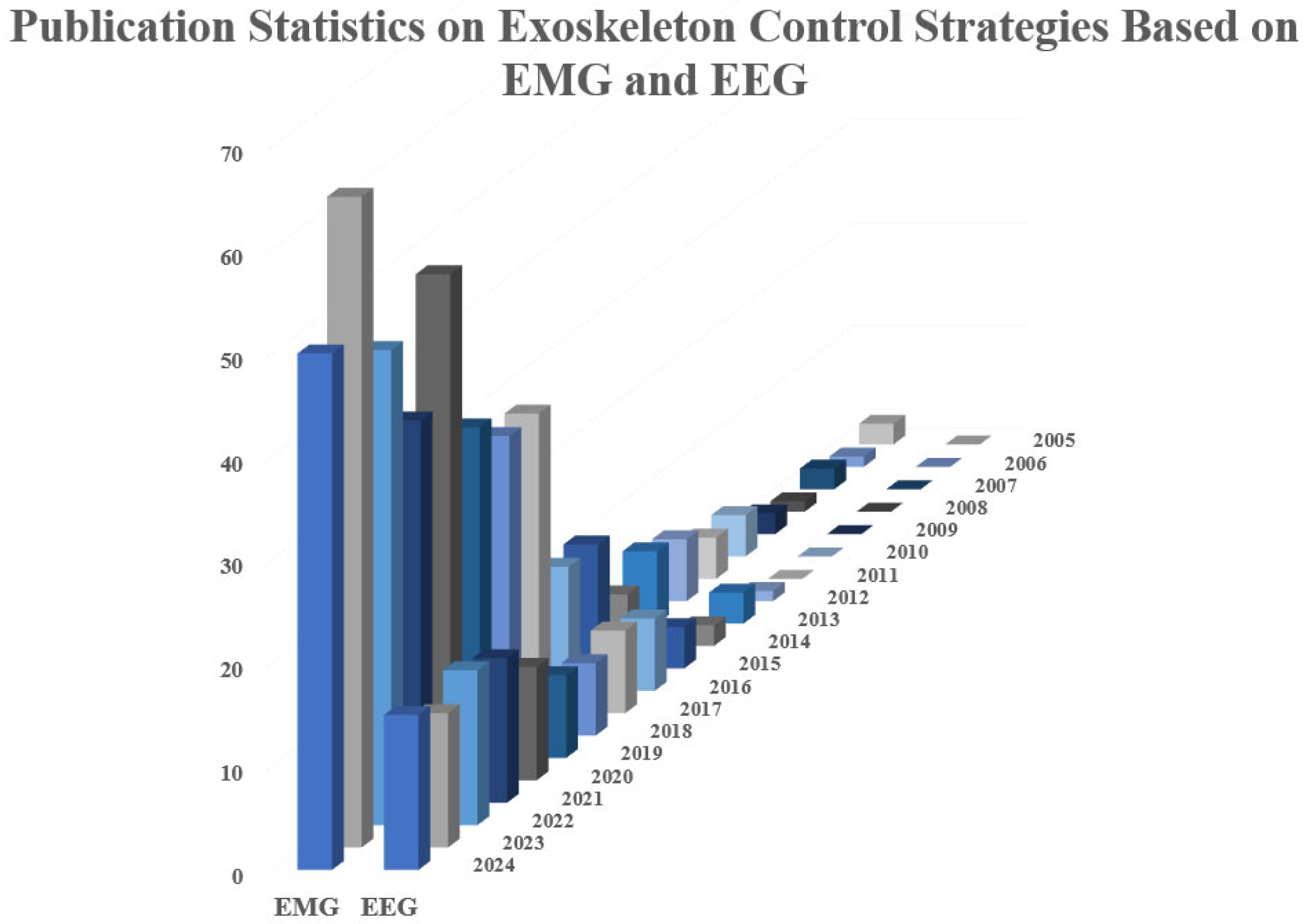
In recent years, with the rapid development of sensing technology and artificial intelligence algorithms, the number of lower limb exoskeleton robot products with real-time perception and motion intention prediction capabilities has grown rapidly, and related research has also shown an explosive growth trend, as shown in Figure 5. In the Web of Science database, searching for published studies in the past 20 years (2005–2024) using keywords such as “lower limb exoskeleton”, “control”, “EMG”, or “EEG” shows that the number of EEG studies is only 18.7% of the number of EMG studies.
Figure 5. Comparison of studies with EMG and EEG as keywords.
This phenomenon not only reflects the current mainstream research direction, but is also related to the differences in the complexity of acquisition and real-time processing of the two types of physiological signals. In contrast, EMG signals can obtain reliable motion information with a lower technical threshold, and are superior to EEG signals in terms of spatial resolution and response timeliness. Therefore, they have been more widely used and verified in motion intention decoding and power assist control.

3.4.1. Based on sEMG Signals

sEMG signals are bioelectric currents generated by the contraction of surface muscles of the human body. The nervous system controls muscle activities (contraction or relaxation); at the same time, different muscle fiber motor units on the surface skin generate different signals, which can map the movement state of the human body. sEMG signals are non-stationary microelectric signals with an amplitude usually ranging from 0 to 1.5 mV. However, sEMG signals generally appear 30–150 ms earlier than limb movements, allowing for advance judgment of movements. Therefore, movements can be predicted through sEMG.
The proportional myoelectric method is an early researched and easy-to-implement method. Its main idea is to quantify the EMG signal, establish a mathematical relationship between it and the kinematics and dynamics of the human lower limbs, and set the input of the controller as the EMG signal, i.e., directly controlling the lower limb exoskeleton robot through the EMG signal, which is divided into fixed gain and variable gain.
Young et al. [105] compared the hip joint torque control strategy and the proportional myoelectric control strategy, verifying the effectiveness of this control strategy in reducing human metabolic consumption. However, the results were obtained using a single exoskeleton device with a specific control configuration when walking at a single speed level, and detailed data in complex terrains or for patients with motor function impairments cannot be tested. Ha et al. [106] proposed a volitional control method for providing powered knee joint assistance. Different from the above methods, instead of directly using EMG signals to control joint movements, the eigenvalues of surface EMG signals after quadratic discriminant analysis and principal component analysis were used in the impedance controller. Tests were conducted on three amputees, and the average root mean square trajectory tracking error was 6.2°.
Although the fixed gain controller is relatively simple in structure and implementation, its assist performance usually lacks flexibility and is difficult to dynamically adjust according to the user’s physiological needs in different exercise states. Therefore, when faced with complex scenarios such as changes in gait stages, load conditions, or user fatigue, its control performance and human–machine synergy will be greatly affected. In order to improve the adaptability and intelligence of the system, researchers have gradually turned their attention to variable gain proportional myoelectric control strategies to achieve more adaptable and flexible power assist control.
Koller et al. [107] proposed an adaptive gain proportional myoelectric control method for an ankle exoskeleton driven by pneumatic muscles, which mapped the myoelectric signal amplitude to the driving signal and dynamically adjusted the control gain according to real-time myoelectric characteristics. This method was experimentally verified in eight healthy subjects. By increasing the ankle joint assist force and reducing the hip joint force, metabolic consumption can be significantly reduced after a short period of training. This study not only verified the effectiveness of the variable gain control strategy in a dynamic environment, but also provided a general control idea for the motor-driven exoskeleton system, that is, a flexible control gain mapping relationship is constructed based on EMG signal changes, thereby achieving a more refined and flexible assist.
Tian et al. [108] proposed a gain-tuned compliance control strategy (EMG-based Gain-Tuned Compliance Control, EGCC) based on surface electromyography signals. By monitoring the sEMG signal in real time, normalizing it and mapping it to the gain parameter of the controller, the robot end-effector control effect can be dynamically adjusted. Experimental results in training modes such as continuous passive motion and straight leg raise show that the EGCC strategy can reduce human–machine contact force and improve training safety and comfort. However, the normalized threshold needs to be set manually, and the training mode is relatively single.
Grazi et al. [109] innovatively used the electromyographic signal from the medial head of the gastrocnemius muscle to control the flexion and extension movements of the hip joint. This method detects the envelope curve of the electromyographic signal during a specific phase of the gait cycle and multiplies it with a gain coefficient to generate assist torque. Experimental results show that this strategy not only avoids the discomfort and signal artifacts caused by placing electrodes at the human–robot interface, but also effectively reduces the muscle activity of the rectus femoris and tibialis anterior muscles, improving the synchronization of power assistance and user comfort.
Chen et al. (Document 24) used sEMG signals as the input of the exoskeleton perception module, used machine learning-based signal classification methods to identify motion states, controlled the exoskeleton robot to make corresponding movements through the upper computer, and fed back real-time data collected by position sensors to achieve closed-loop control and improve the accuracy of motion control. However, due to structural design limitations, there will be oscillating deviations between the actual trajectory and the ideal trajectory, and due to the control signals generated by the upper computer, the control real-time performance is poor.
As the patient’s rehabilitation progress improves, their dependence on the power assistance of the exoskeleton robot will become lower and lower. At the same time, to maximize the patient’s participation, the exoskeleton needs to provide the minimum possible assistance, i.e., the AAN mode. The principle of the AAN controller is that the exoskeleton predicts the subject’s autonomous input torque and then adjusts the motor output to complete the required trajectory. As a typical force–position hybrid control architecture, the AAN controller takes the prediction of human autonomous torque as a key input variable. By establishing a human–machine interaction dynamic model, it ensures trajectory tracking accuracy while accurately matching the actual assistance needs of the patient in the current rehabilitation stage. The torque prediction link, as the core technical support of the AAN controller, directly determines the dynamic adaptability of the assistance output and the efficiency of the human–machine collaboration. Therefore, many scholars directly estimate the joint torque of lower limb exoskeleton robots based on physiological signals.
Torque is divided into active torque and passive torque. Active torque is generated by muscle contraction and is responsible for completing movements; passive torque comes from skeletal muscles and ligaments and is responsible for stabilizing joints. Accurate prediction and output of active torque are crucial for the control of lower limb exoskeleton robots. Torque prediction usually adopts a method based on a biomechanical model.
The Hill muscle model is usually used as the biological model. Karavas et al. [110] proposed an auxiliary control based on remote impedance. Using sEMG signals and combining with the Hill muscle model, they directly calculated the required joint torque and joint stiffness trend, tracked the required stiffness and trajectory through the impedance controller, and studied stability under steady-state and transient conditions through experimental tests. At the same time, this model also allows the exoskeleton to generate auxiliary torque under the user’s command, improving the user’s autonomy. However, the current parameter calibration of the model is relatively complex, and only experiments on healthy subjects have been conducted. To accurately estimate the active torque of the ankle joint complex (AJC), Zhou et al. [111] proposed an online estimation framework based on the Hill musculoskeletal model and sEMG signals. By predicting muscle force through EMG signals and then converting it into joint torque, multi-DOF coupled active torque can be estimated online; combined with biomechanical and anatomical characteristics, the actively applied torque of multi-DOF coupled movements can be accurately estimated through a single-DOF identification–calibration strategy. Experimental results on five healthy subjects showed that this method had high estimation accuracy, with a single-DOF normalized root mean square error (NRMSE) of 10.29% and a multi-DOF NRMSE of 11.35%. However, to improve computational efficiency, the muscle model was simplified, focusing only on superficial muscles.
In addition to the Hill muscle model, Durandru et al. [112] estimated ankle torque in real time based on EMG signals and joint angles and a human neuromechanical model. A controller based on a disturbance observer can convert biological torque into exoskeleton commands. This method can achieve adaptive support for the user’s muscle activity under different gait conditions, significantly reducing biological joint torque (by approximately 22%) and EMG signal intensity (by 13%). Kiguchi et al. [113] correlated human joint movements with muscle activities and introduced a fuzzy neural modifier to adjust the components of the operation matrix to assist hip joint flexion/extension movements and knee joint flexion/extension movements. Experiments showed that the activity level of the tensor fasciae latae muscle was reduced with the help of the exoskeleton, which also proved the effectiveness of the controller.
In addition to model-based joint torque prediction, Meng et al. used EMG signals and joint angle signals to build a prediction model based on a TCN-LSTM hybrid neural network to predict the torque output of the knee joint exoskeleton robot in real time, introducing a joint attention mechanism to improve the accuracy of torque prediction, with an average mean absolute error (MAE) of 1.141 Nm. At the same time, the impedance control strategy was optimized to improve the effect of human–machine interaction. Although the coupling between muscles was not analyzed when building the model, it also provided a research direction for artificial intelligence-based torque prediction. In the future, the accuracy of the model can be further improved by analyzing the coupling between muscles to extract important features.
Although many studies have used EMG signals for real-time joint torque estimation, few studies have focused on how to improve the motion stability of EMG-based control methods and the performance of human–machine collaborative movements. Zhuang et al. [114] proposed an EMG-based Admittance Control Scheme (EACS), which improved stability through closed-loop PD control. Tests on twelve healthy participants and four stroke survivors in the ankle exoskeleton showed that it could stably and accurately track movements. Chen et al. [115] further optimized the admittance control, constructed an inner-outer double-loop admittance control, and proposed a new EMG-based two-layer admittance control. This method allows the subject to control the exoskeleton through the EMG signals of the thigh muscles while adapting to gait, and continuously and smoothly adjusts the gait trajectory through admittance control. In addition, an easy-to-use Myo thigh band and controller were proposed. The EMG signals of the thigh muscles were collected and applied to the hip and knee access control, simplifying the calibration process and significantly improving usability. Tests on six subjects showed that they could adapt to the target within an average of 16 steps, and could reduce muscle activation and human physical energy consumption.
Intention recognition and proportional myoelectric control based on sEMG signals have been put into practice. However, sEMG signals from different parts have different representation characteristics of lower limb joints. There are problems such as the complicated data combinations in the decoding process of multi-DOF joints and sEMG signals, which restrict the accuracy of exoskeleton robot control. Yuan et al. [116] proposed an interpretable multi-degree-of-freedom sEMG decoder based on additive mixed data enhancement. Based on the principle of linear superposition of sEMG signals in different degrees of freedom, the decoder generates synthetic multi-degree-of-freedom data by superimposing 1-DoF sEMG signals and force labels, using the deep forest model to perform decoding. Using only 1-DoF data can reduce regression errors by about 20%. This method has significant advantages in reducing data collection complexity and improving model generalization capabilities, but it still has shortcomings when dealing with degrees of freedom with special distribution or poor independence.

3.4.2. Based on EEG Signals

EEG is a non-invasive technology for recording the electrical activity of neuronal populations in the brain, which is widely used in neurological disease monitoring and cognitive function research. Based on EEG acquisition, the BCI further integrates signal processing, feature extraction, and output control modules to build a closed-loop system for direct human–machine communication. EEG signals are obtained through dry or wet electrodes worn on the head. Their greatest advantage is that the data comes from the activity state between neurons in the patient’s brain, without requiring any feedback from the limbs, making them suitable for patients with severe motor disorders such as lower limb motor function loss and complete spinal cord injury.
Although BCI-based lower limb exoskeleton control has certain theoretical potential to bypass the damaged peripheral nervous system and directly drive movements from brain intentions, there are several challenges in practical applications: first, EEG signals have low spatial resolution, high noise, and are greatly affected by the environment and electrode stability, resulting in limited motion intention decoding accuracy; second, unlike EMG signals, there is a high delay from the generation to detection of EEG signals, which is not conducive to real-time control needs.
Although EMG-based motion intention decoding is subject to many limitations from hardware equipment and signal conditions themselves, it is still the main research and application path in the field of lower limb exoskeleton robot control. Vinoj et al. [117] designed a brain-controlled adaptive 6-DOF lower limb exoskeleton robot, which uses a non-invasive method to collect brain signals from the human scalp. A total of 16 electrodes are used for EEG sensors, and gold plating is used to improve conductivity. The collected signals are amplified and filtered for intention classification, and high-torque motors are driven to perform actions. The steady-state visual evoked potential (SSVEP) method was used to improve the classification accuracy (exceeding 80%), verifying the feasibility of controlling exoskeleton robots based on EEG signals, but the control accuracy and human–machine interaction effects were not discussed.
In the lower limb exoskeleton assistance system, pure EMG signals or pure EEG signals cannot adapt to the decoding of complex human movements, and the problem of mismatch between human–machine interaction control commands and actual actions restricts the effect of exoskeleton human–machine interaction. In response to this, Wang et al. [118] designed a multi-modal lower limb rehabilitation exoskeleton robot. EEG is used to obtain intention signals, and EMG is used to correct movement commands, realizing accurate recognition and correction of the patient’s movement intentions. A robust adaptive PD control system is used to improve the accuracy of action execution.
Targeting the problem of sEMG signals having the difficulty of distinguishing different movement amplitudes of the same movement, Li et al. [119] proposed a multi-modal human–machine interface design based on sEMG and EEG. By integrating the movement intention recognition of EEG and the action amplitude correction of sEMG, tests were conducted on 14 healthy subjects. The recognition accuracy of multi-modal fusion was 12% and 7.8% higher than that of using EEG or sEMG alone, respectively, with a maximum of 89.5%. However, for the exoskeleton robot, a simple state machine was used for control, which only included four actions and did not evaluate the action execution effect.
Overall, the performance of EEG-based exoskeleton control is relatively low, including usability, reliability, and decoding accuracy. Currently, it is mainly used as an auxiliary means to cooperate with EMG signals to achieve more accurate intention classification and intention recognition.
As the patient makes continuous progress in the rehabilitation process, the relevant control strategies will also be adjusted accordingly. In addition, since the perception, decision-making, and control of lower limb exoskeleton robots are an organic whole, the ability to use real and accurate human gait data further improves tracking accuracy and rehabilitation effects.

4. Discussion

Through the comparative analysis of control strategies in Section 3, different control strategies demonstrate varying advantages and limitations depending on the application scenario. Generally speaking, control strategies can be categorized as follows: passive control (PID, CTC), active control (impedance control, admittance control, sliding mode control), AAN control, and intelligent control (neural networks, fuzzy logic, etc.).
(a)
Passive Control: It provides the highest kinematic accuracy and system stability (for example, Liang et al. [71] achieved an angle tracking error of <0.01 rad.), which is suitable for the early stages of rehabilitation where the exoskeleton assists in developing a standard gait pattern. However, it ignores the patient’s active participation, leading to reduced neuroplasticity; furthermore, the fixed trajectory may not perfectly match the user’s physiological structure, potentially causing discomfort.
(b)
Active Tracking Control: It significantly improves human–machine interaction, enhancing comfort and adapting to individual gait differences. However, this method requires high-precision sensors and recognition algorithms, making it highly sensitive to model uncertainties and environmental disturbances (for example, Khamar et al. [84] reduced the impact of disturbances through BSC, resulting in a tracking error of <0.08 rad.).
(c)
AAN (Adaptive Assistance and Navigation): It maximizes human participation. However, this strategy is highly dependent on parameter tuning, meaning that a set of parameters must be determined for each user.
(d)
Intelligent Control: It achieves active control by predicting the user’s next movement, providing a more natural and intuitive user experience. However, it heavily relies on high-quality biological signals, making signal acquisition and decoding difficult.
Sometimes, although traditional passive control can achieve very low tracking errors, it cannot incorporate human intent into the control algorithm, thus failing to achieve optimal human–machine interaction. In contrast, combining control accuracy with human intent can lead to better human–machine collaboration. Currently, despite the wide range of applications offered by artificial intelligence algorithms, the lack of stability proofs and the high computational intensity remain major bottlenecks hindering their transition from simulation to real-world applications. This section provides a detailed review of the control strategies currently used in lower limb exoskeleton robots based on different control tasks. A summary of some control strategies is shown in Table 5.
Table 5. Comparison of control strategies.
When separated from specific control tasks, it can be found that there are similarities in the underlying end-control strategies, which can be specifically categorized into the following main types: PID control, sliding mode control, adaptive control, intelligent control algorithms, and hybrid control algorithms.
Overall, traditional position control methods (e.g., PID, SMC) are typically implemented by measuring motor angles via encoders and precisely adjusting controller outputs through closed-loop negative feedback control. They deliver favorable performance in the Human Motion Reproduction control task, enabling extremely high trajectory tracking accuracy. However, for the Human Motion Following control task, the high rigidity of hardware results in significant interactive resistance when human and robot gaits are inconsistent. As for the AAN control task, traditional control methods are difficult to achieve dynamic on-demand assistance due to their fixed parameters; only by combining traditional control with online adaptive control and intelligent control can on-demand assistance be realized.
The impedance control strategy is usually implemented based on torque feedback, which simulates the motor as a virtual spring–damper system. For the Human Motion Reproduction control task, it can also achieve trajectory tracking, but its accuracy is generally lower than that of PID control. For the Human Motion Following control task, real-time following is achieved by adjusting impedance parameters, which significantly reduces the interactive force. For the AAN control task, impedance control can also provide on-demand torque assistance by adjusting impedance gain parameters; yet, its performance is affected by motor inertia and mechanical structure, which requires continuous evaluation of parameter effectiveness.
Intelligent control strategies leverage neural networks to adjust motor current or gain in real time. They are capable of fulfilling all control tasks and feature strong individual adaptability. Nevertheless, such strategies demand substantial computing resources; delays caused by hardware can severely degrade human–machine interaction performance, and it is also difficult to rigorously prove their stability.
Currently, the unresolved common issues across the four types of tasks are as follows:
(a)
Insufficient universality of control strategies;
(b)
Lack of a standardized evaluation index system;
(c)
Heavy reliance of advanced control methods on computing power/data.
Different control tasks place different emphases on elements such as perception, decision-making, control strategies, and structure. Currently, there are five main bottlenecks and constraints in the development of control strategies:
1. The control performance of exoskeleton robots not only depends on algorithm design, but is also closely related to the dynamic characteristics of the mechanical structure and drive system. Different control algorithms are difficult to use across platforms.
First of all, the driver type, layout, and transmission mechanism directly affect the damping, stiffness, and other structural parameters of the system, thereby changing the dynamic response characteristics and stability of the control system. This strong correlation between hardware and control results in significant differences in the performance of the same control strategy on different exoskeleton platforms, making it difficult to reuse across platforms.
To improve design flexibility, motors are usually placed directly on movable joints. However, the high number of degrees of freedom of leg movement joints leads to a substantial increase in the complexity of control strategies and costs. At the same time, motors also need to generate large auxiliary torques, which complicates the design of transmission mechanisms and reduction mechanisms. In recent years, many scholars have proposed compact design schemes for lower limb exoskeleton robots. Ishmael et al. [121] designed a four-bar linkage mechanism with an integrated composite spring for the motor-driven hip joint actuator of a lower limb exoskeleton. A compact carbon fiber frame surrounds the actuator and can also serve as the thigh link of the exoskeleton. A hierarchical controller was designed to achieve high-precision and high-output torque control. Performance test experiments showed that the device can generate high nominal torque (41.9 Nm repetitive peak torque), high backdrivability (0.16 Nm backdrive torque), high bandwidth (23.8 Hz), and high control precision (2.1% steady-state error). Experiments verified its application potential in daily walking and stair assistance.
In addition to hardware innovation, improving dynamic control performance is also critical. Currently, most experiments focus on optimizing motor control accuracy and torque disturbance suppression, while there is relatively little research on dynamic performance and transition processes. The dynamic performance of the motor’s output torque in the lower limb exoskeleton system directly affects the effect of human–machine interaction. Wu et al. [122] focused on the dynamic execution process of motor-driven exoskeleton robots and designed an improved reaching law sliding mode controller with high control precision and good control quality, which improved the smoothness and response speed of the lower limb exoskeleton during dynamic processes and made human–machine interaction more compliant.
In addition to using algorithms to optimize the control parameters of exoskeleton robots as mentioned above, some scholars have proposed algorithms to optimize the mechanical structure design of exoskeletons in recent years. Genetic algorithms can be used to optimize the mechanical design parameters of exoskeletons. For the case of only one objective function, Du et al. [123] used the GA to optimize the link length, and Tschiersky et al. [124] used the GA to find the best actuator placement position to improve the driving efficiency. For the case of multiple objective functions existing at the same time and needing to be optimized at the same time, the improved GA can also design the optimal mechanical structure parameters. The design optimization of exoskeleton robots covers multiple dimensions such as control strategy, mechanical structure, and parameter configuration. Its core is to achieve multi-objective balance through the optimal combination of design variables, improve output torque, minimize system weight, and improve human–machine adaptation comfort [125]. Traditional optimization methods have obvious limitations in dealing with multi-objective constraints and strong nonlinear characteristics, and it is difficult to break through the dilemma of local optimal solutions. Evolutionary computation (EC) has shown unique advantages in the field of global optimization due to its swarm intelligence characteristics. By combining it with the policy search capabilities of deep learning, it is expected to build a multi-objective collaborative optimization framework, which will promote the systematic optimization of exoskeleton robots in terms of motion performance, structural efficiency, and human–computer interaction.
With the application of methods such as digital twins and reinforcement learning in the industrial field, more and more digital models are being integrated into the information interaction between users and equipment. This allows the control performance of exoskeleton robots to overcome the limitations of the physical environment. Luo et al. [126] achieved this by learning in a purely simulated environment, abandoning traditional data acquisition and curve fitting methods, and integrating the simulation results into a physical model. This reduces reliance on human experiments; by introducing reinforcement learning, it improves control accuracy and training efficiency. Beyond modeling, digital twin technology can also act as a “virtual sensor,” using high-precision simulation models to reduce reliance on physical sensors.
2. A single driving method cannot meet the requirements of complex scenarios.
With the diversification of exoskeleton robot requirements, a single drive mode has encountered bottlenecks in terms of compliance and weight. Different drive modes have their own advantages and limitations. Integrating multiple drive modes to form a hybrid power drive system is expected to bring new breakthroughs to the control of lower limb exoskeleton robots.
Luo et al. [127] introduced pneumatic muscles to provide gravity support on the basis of traditional mechanical support, forming an electro-pneumatic hybrid drive mode, which can not only control torque accurately but also reduce the weight of the exoskeleton itself. Simulation results show that the control error of each joint is less than ±1.5°. Sun et al. [128] used shape memory alloy (SMA) and motors to design a knee–ankle orthosis for lower limb rehabilitation. SMA can provide driving force and reverse damping force without an electrical structure, with a large power density ratio and small volume. It can also be used in flexible wearable exoskeleton design to achieve a rigid–flexible coupled structure. The output of the SMA actuator was evaluated through experiments, and the results were consistent with the theoretical model. Subsequently, the research team proposed an estimation method for determining joint torque for this structure [129], and conducted prototype and human experiments; the torque estimation error during knee joint movement was reduced by 59.1%, 16.5%, and 73%, which can meet the requirements of daily movement assistance for the lower limbs.
Currently, there are relatively few studies on the hybrid drive design of lower limb exoskeleton robots. Wang et al. [130] designed a hybrid multi-degree-of-freedom upper limb exoskeleton rehabilitation training device mainly driven by pneumatic muscles and supplemented by motor drive. Joints with a large range of motion still use motor drive, while the flexion and extension of the shoulder and elbow joints and the rotation of the wrist joint are driven by pneumatic muscles, which balances portability and safety, providing new ideas and research directions for the hybrid drive of lower limb exoskeleton robots. At the same time, developing lightweight pneumatic or low-power high-torque motor drives is the key to reducing costs and one of the focuses of the commercialization of lower limb exoskeleton robots in the future.
Another type of hybrid drive mainly combines functional electrical stimulation with exoskeleton robots. Del-Ama et al. [131] proposed a hybrid FES-robot collaborative control strategy, which uses iterative learning control (ILC) and closed-loop PID control to adjust the electrical stimulation parameters of the knee flexors and extensors, balance the power output of the exoskeleton and muscles, and minimize the interaction torque between the exoskeleton and the user. It was applied to the Kinesis, a single-degree-of-freedom knee exoskeleton robot, and effectively reduced the assistance of the exoskeleton while ensuring accurate motion trajectories. This method is suitable for the gait rehabilitation of patients with low-level spinal cord injuries. However, currently, only healthy subjects have been tested, and there is a gap in its application to patients with spinal cord injuries.
3. Insufficient Universality and Adaptability of Control Strategy Design, with Obvious Innovation Bottlenecks at the Algorithm Level.
When faced with patients with complex terrain, variable speed, or different rehabilitation processes, the controller often cannot automatically adjust the parameters, resulting in a decrease in performance. Online adaptive frameworks can address this problem to some extent. Kang et al. [132] used real-time data streams to continuously update user state estimation models, effectively customizing models for new users by learning user-specific gait patterns. Different models can match both healthy individuals and patients, showing high potential for personalized assistance in clinical applications. However, this method is still limited by the models themselves. The control strategy based on AI algorithm is data-driven and can reduce dependency on the model, which is the “general control strategy”. Lee et al. [133] proposed an AI-driven general lower limb exoskeleton control system, which can capture external and internal states for real-time control, adjust the auxiliary torque according to the user and environmental state, and adapt to the user’s preferences. The experimental results show that compared with the traditional auxiliary method, this method reduces the human metabolic cost by 6.5%, but there is no detailed and in-depth study on the accuracy of gait adjustment. Emerging methods such as deep learning and reinforcement learning can learn control strategies from big data, dynamically adjusting the human–robot interaction force to ensure that the exoskeleton remains compliant with the body’s natural gait during movement. Rose et al. [134] first proposed an end-to-end model-free deep reinforcement learning method that can not only learn to follow desired gait patterns but also consider the user’s existing gait patterns, exhibiting strong disturbance rejection and high robustness, this method has proven effective in the personalization of gait training. At the same time, the calculation process of AI general control algorithm is computationally intensive, and the global stability is difficult to rigorously prove. This makes the interpretability and verifiability of the algorithm an urgent problem to be solved. In addition, there is a gap between the simulation of the general control algorithm and the actual control effect, and theoretical development far exceeds its application in the control layer. Therefore, improving the adaptability and generalization performance of control strategies, combined with real-time perception and intelligent adjustment mechanisms, has become the focus and challenge of the current research. This will not only help enhance the adaptability of exoskeleton systems to diverse usage environments, but also improve user experience and rehabilitation outcomes.
4. Limitations in Testing Scenarios and Inadequate Attention to Human–Machine Interaction Evaluation.
Currently, testing for exoskeleton robots mainly focuses on flat-ground walking and treadmill walking, providing leg assistance to users [135]. Upright walking is one of the main functional requirements for lower limb exoskeletons, but this does not mean that upright walking has low relevance to other lower limb movements—such as running, squatting, jumping, and leg shaking. To cover these movements, exoskeleton control strategies must achieve precise execution of actions in real environments, and must consider balance performance on special terrains (e.g., grass, sand, slopes). This places higher demands on the self-learning and adaptability of lower limb exoskeleton control strategies. Traditional model-based controllers often struggle to cope with the uncertainties of uneven surfaces. Guo et al. [136] used the Twin Delayed Deep Deterministic Policy Gradient (TD3) algorithm to achieve gait training control for an exoskeleton during stair climbing, but this control was limited to the sagittal plane. Guo et al. [137] from the University of Electronic Science and Technology of China used neural network regression to identify slope parameters in urban multi-terrain environments, relying solely on IMUs, providing the exoskeleton with real-time terrain awareness and adaptive assistance during stair climbing and while walking on steep slopes.
In addition to the objective performance description of lower limb exoskeleton robots, the evaluation of human–machine interaction effects is also a key test indicator for exoskeleton robot evaluation. Whether the control effect meets the usage habits of different users and whether compliant control can be achieved should also receive high attention.

5. Conclusions

This paper provides a systematic review of control strategies for the rehabilitation of lower limb exoskeleton robots. Based on a hierarchical control architecture, it comprehensively outlines the technical approaches and implementation mechanisms of core components of exoskeleton robots. The paper begins by summarizing the applications of different drive methods in rehabilitation exoskeletons, focusing on the widely used motor drive method and analyzing the structural characteristics of related control systems.
Subsequently, combined with four types of control tasks—“motion reproduction”, “motion following”, “AAN”, and “intention perception”—it systematically concludes the basic principles, application characteristics, and respective advantages and limitations of different strategies. Based on this, we further extracted and summarized the common technical elements and main constraints in the current exoskeleton control strategy from aspects such as motor installation and system coupling, multi-source sensing and human–machine design, adaptability and universality of control methods, and physical constraints of algorithms.
In summary, the control task has evolved from “open-loop trajectory → human–machine collaboration → intent prediction,” and the driving strategy has transitioned from PID control to adaptive/AI fusion. However, the generalization ability of the control strategy remains a core challenge. This paper aims to provide a structured overview and practical reference for the research of control strategies for lower limb exoskeleton robots, offering theoretical support and technical basis for subsequent control strategy design, performance evaluation, and system integration. Although breakthroughs have been achieved in many aspects of control strategies, challenges such as high cost, technical limitations, and safety issues still exist. Therefore, continuous research and innovation in control strategy optimization are necessary. Solving these problems is crucial to ensuring that advanced control strategies can significantly improve the function of lower limb exoskeletons.

Author Contributions

Conceptualization, C.C., Z.S., L.M., Y.L. and X.X.; methodology, C.C. and X.X.; software, X.X., L.M. and Z.S.; validation, Z.S., W.X. and Y.L.; formal analysis, X.X.; investigation, C.C. and X.X.; resources, C.C. and Y.L.; data curation, X.X. and W.X.; writing—original draft preparation, C.C. and X.X.; writing—review and editing, C.C. and Y.L.; visualization, X.X.; supervision, C.C. and Y.L.; project administration, W.X. and Y.L.; funding acquisition, Y.L. All authors have read and agreed to the published version of the manuscript.

Funding

This research was funded by the Technology Innovation and Entrepreneurship Fund Special Project of CCTEG (grant number 2023-2-TD-KJHZ002).

Institutional Review Board Statement

Not applicable.

Data Availability Statement

No new data were created or analyzed in this study.

Acknowledgments

The authors would like to thank the China Coal Research Institute.

Conflicts of Interest

The authors declare no conflicts of interest.

References

  1. Wang, T.; Zhang, B.; Liu, C.H.; Liu, T.; Han, Y.; Wang, S.Y.; Ferreira, J.P.; Dong, W.; Zhang, X.F. A Review on the Rehabilitation Exoskeletons for the Lower Limbs of the Elderly and the Disabled. Electronics 2022, 11, 388. [Google Scholar] [CrossRef]
  2. Liu, R.; Ouyang, J. Development and Application of Lower Limb Exoskeleton Rehabilitation Robot. J. Sun Yat-Sen Univ. (Med. Sci.) 2023, 44, 354–360. [Google Scholar]
  3. Lakmazaheri, A.; Song, S.; Vuong, B.B.; Biskner, B.; Kado, D.M.; Collins, S.H. Optimizing exoskeleton assistance to improve walking speed and energy economy for older adults. J. Neuroeng. Rehabil. 2024, 21, 1. [Google Scholar] [CrossRef] [PubMed]
  4. He, Y.N.; Xu, Y.X.; Hai, M.H.; Feng, Y.; Liu, P.H.; Chen, Z.; Duan, W.R. Exoskeleton-Assisted Rehabilitation and Neuro-plasticity in Spinal Cord Injury. World Neurosurg. 2024, 185, 45–54. [Google Scholar] [CrossRef] [PubMed]
  5. Fisahn, C.; Aach, M.; Jansen, O.; Moisi, M.; Mayadev, A.; Pagarigan, K.T.; Dettori, J.R.; Schildhauer, T.A. The Effectiveness and Safety of Exoskeletons as Assistive and Rehabilitation Devices in the Treatment of Neurologic Gait Disorders in Patients with Spinal Cord Injury: A Systematic Review. Glob. Spine J. 2016, 6, 822–841. [Google Scholar] [CrossRef]
  6. Chang, S.-H.; Zhu, F.; Patel, N.; Afzal, T.; Kern, M.; Francisco, G.E. Combining robotic exoskeleton and body weight unweighing technology to promote walking activity in tetraplegia following SCI: A case study. J. Spinal Cord Med. 2020, 43, 126–129. [Google Scholar] [CrossRef]
  7. Chen, G.; Chan, C.K.; Guo, Z.; Yu, H. A Review of Lower Extremity Assistive Robotic Exoskeletons in Rehabilitation Therapy. Crit. Rev. Biomed. Eng. 2013, 41, 343–363. [Google Scholar] [CrossRef]
  8. Li, X.; Wang, K.-Y.; Yang, Z.-Y. Design and analysis of a lower limb assistive exoskeleton robot. Technol. Health Care 2024, 32, 79–93. [Google Scholar] [CrossRef]
  9. Yao, Y.; Shao, D.; Tarabini, M.; Moezi, S.A.; Li, K.; Saccomandi, P. Advancements in Sensor Technologies and Control Strategies for Lower-Limb Rehabilitation Exoskeletons: A Comprehensive Review. Micromachines 2024, 15, 489. [Google Scholar] [CrossRef]
  10. Li, M.; Li, H.; Yu, H. Research status of lower limb exoskeleton rehabilitation robot. Sheng Wu Yi Xue Gong Cheng Xue Za Zhi J. Biomed. Eng. Shengwu Yixue Gongchengxue Zazhi 2024, 41, 833–839. [Google Scholar]
  11. Belal, M.; Alsheikh, N.; Aljarah, A.; Hussain, I. Deep Learning Approaches for Enhanced Lower-Limb Exoskeleton Control: A Review. IEEE Access 2024, 12, 143883–143907. [Google Scholar] [CrossRef]
  12. Su, Q.; Pei, Z.; Tang, Z.; Liang, Q. Design and Analysis of a Lower Limb Loadbearing Exoskeleton. Actuators 2022, 11, 285. [Google Scholar] [CrossRef]
  13. Sapiee, M.R.; Marhaban, M.H.M.; Miskon, M.F.; Ishak, A.J. Walking simulation model of lower limb exoskeleton robot design. J. Mech. Eng. Sci. 2020, 14, 7071–7081. [Google Scholar] [CrossRef]
  14. He, Y.; Li, P.; Yan, W.; Zhao, Y. Research on the Walking Model of Lower-Limb Walking Assist Exoskeleton. Control Eng. China 2019, 26, 1803–1809. [Google Scholar]
  15. Shi, D.; Zhang, W.X.; Zhang, W.; Ding, X.L. A Review on Lower Limb Rehabilitation Exoskeleton Robots. Chin. J. Mech. Eng. 2019, 32, 74. [Google Scholar] [CrossRef]
  16. Halim, I.; Zawawi, N.N.; Izzat, M.N.; Abdullah, Z.; Saptari, A.; Salleh, A.F. A systematic review on critical factors affecting usability of passive lower-limb exoskeleton. J. Teknol. 2025, 87, 603–614. [Google Scholar] [CrossRef]
  17. Orekhov, G.; Luque, J.; Lerner, Z.F. Closing the Loop on Exoskeleton Motor Controllers: Benefits of Regression-Based Open-Loop Control. IEEE Robot. Autom. Lett. 2020, 5, 6025–6032. [Google Scholar] [CrossRef]
  18. Li, D.; Kang, P.; Yu, Y.; Shull, P.B. Graph-Driven Simultaneous and Proportional Estimation of Wrist Angle and Grasp Force via High-Density EMG. IEEE J. Biomed. Health Inform. 2024, 28, 2723–2732. [Google Scholar] [CrossRef] [PubMed]
  19. Shafieian, M.; Nougarou, F. Improving simultaneous and proportional control from EMG signals based on a Two-Stage Regression Structure. In Proceedings of the 2023 45th Annual International Conference of the IEEE Engineering in Medicine & Biology Society (EMBC), Sydney, Australia, 24–27 July 2023; pp. 1–5. [Google Scholar]
  20. Gu, S.; Zhang, J. Variable gain ADRC for delta parallel manipulators with disturbances. Control Eng. Pract. 2024, 145, 105877. [Google Scholar] [CrossRef]
  21. Bakhtiari, M.; Haghjoo, M.R.; Taghizadeh, M. Model-free adaptive variable impedance control of gait rehabilitation exoskel-eton. J. Braz. Soc. Mech. Sci. Eng. 2024, 46, 557. [Google Scholar] [CrossRef]
  22. Srivastava, S.; Kao, P.-C.; Kim, S.H.; Stegall, P.; Zanotto, D.; Higginson, J.S.; Agrawal, S.K.; Scholz, J.P. Assist-as-Needed Robot-Aided Gait Training Improves Walking Function in Individuals Following Stroke. IEEE Trans. Neural Syst. Rehabil. Eng. 2015, 23, 956–963. [Google Scholar] [CrossRef]
  23. Asl, H.J.; Katagiri, K.; Narikiyo, T.; Yamashita, M.; Kawanishi, M. Satisfying Task Completion and Assist-as-Needed Per-formance in Robotic Exoskeletons. IEEE Trans. Med. Robot. Bionics 2021, 3, 791–800. [Google Scholar] [CrossRef]
  24. Nagarajan, U.; Aguirre-Ollinger, G.; Goswami, A. Integral admittance shaping: A unified framework for active exoskeleton control. Robot. Auton. Syst. 2016, 75, 310–324. [Google Scholar] [CrossRef]
  25. Bergmann, L.; Lück, O.; Voss, D.; Buschermöhle, P.; Liu, L.; Leonhardt, S.; Ngo, C. Lower Limb Exoskeleton With Compliant Actuators: Design, Modeling, and Human Torque Estimation. IEEE/ASME Trans. Mechatron. 2023, 28, 758–769. [Google Scholar] [CrossRef]
  26. Xu, D.; Zhou, H.; Quan, W.; Gusztav, F.; Baker, J.S.; Gu, Y. Adaptive neuro-fuzzy inference system model driven by the non-negative matrix factorization-extracted muscle synergy patterns to estimate lower limb joint movements. Comput. Methods Programs Biomed. 2023, 242, 107848. [Google Scholar] [CrossRef]
  27. Nagashima, M.; Cho, S.-G.; Ding, M.; Ricardez, G.A.G.; Takamatsu, J.; Ogasawara, T. Prediction of Plantar Forces During Gait Using Wearable Sensors and Deep Neural Networks. In Proceedings of the 2019 41st Annual International Conference of the IEEE Engineering in Medicine & Biology Society (EMBC), Berlin, Germany, 23–27 July 2019; pp. 3629–3632. [Google Scholar]
  28. Coser, O.; Tamantini, C.; Soda, P.; Zollo, L. AI-based methodologies for exoskeleton-assisted rehabilitation of the lower limb: A review. Front. Robot. AI 2024, 11, 1341580. [Google Scholar] [CrossRef]
  29. Lee, H.D.; Han, C.-S. Technical Trend of the Lower Limb Exoskeleton System for the Performance Enhancement. J. Inst. Control Robot. Syst. 2014, 20, 364–371. [Google Scholar] [CrossRef]
  30. Zhang, X.; Tian, S.; Liang, X.; Zheng, M.; Behdad, S. Early Prediction of Human Intention for Human–Robot Collaboration Using Transformer Network. J. Comput. Inf. Sci. Eng. 2024, 24, 051003. [Google Scholar] [CrossRef]
  31. Htet, Y.; Behera, B.; Orlando, M.F. Lower extremity exoskeletons: A systematic review on design, control, and sensing. Eng. Res. Express 2025, 7, 022301. [Google Scholar] [CrossRef]
  32. Sanchez-Villamañan, M.d.C.; Gonzalez-Vargas, J.; Torricelli, D.; Moreno, J.C.; Pons, J.L. Compliant lower limb exoskeletons: A comprehensive review on mechanical design principles. J. Neuroeng. Rehabil. 2019, 16, 55. [Google Scholar] [CrossRef] [PubMed]
  33. Li, J.F.; Zhang, Z.Q.; Tao, C.; Ji, R. Structure design of lower limb exoskeletons for gait training. Chin. J. Mech. Eng. 2015, 28, 878–887. [Google Scholar] [CrossRef]
  34. Cao, H.; Yu, S. Mechanical Design and Kinematics Analysis on a Lower Limb Rehabilitation Exoskeleton Robot. Mach. Des. Res. 2020, 36, 12–17. [Google Scholar]
  35. Song, L.; Ju, C.; Cui, H.; Qu, Y.; Xu, X.; Chen, C. Research on Control Strategy Technology of Upper Limb Exoskeleton Robots: Review. Machines 2025, 13, 207. [Google Scholar] [CrossRef]
  36. Yu, L.; Leto, H.; Bai, S. Design and Gait Control of an Active Lower Limb Exoskeleton for Walking Assistance. Machines 2023, 11, 864. [Google Scholar] [CrossRef]
  37. Narayan, J.; Auepanwiriyakul, C.; Jhunjhunwala, S.; Abbas, M.; Dwivedy, S.K. Hierarchical Classification of Subject-Cooperative Control Strategies for Lower Limb Exoskeletons in Gait Rehabilitation: A Systematic Review. Machines 2023, 11, 764. [Google Scholar] [CrossRef]
  38. Neuhaus, P.D.; Noorden, J.H.; Craig, T.J.; Torres, T.; Kirschbaum, J.; Pratt, J.E. Design and evaluation of Mina: A robotic orthosis for paraplegics. In Proceedings of the 2011 IEEE 12th International Conference on Rehabilitation Robotics, Zurich, Switzerland, 29 June–1 July 2011; pp. 1–8. [Google Scholar]
  39. Lerner, Z.F.; Gasparri, G.M.; Bair, M.O.; Lawson, J.L.; Luque, J.; Harvey, T.A.; Lerner, A.T. An untethered ankle exoskeleton improves walking economy in a pilot study of individuals with cerebral palsy. IEEE Trans. Neural Syst. Rehabil. Eng. 2018, 26, 1985–1993. [Google Scholar] [CrossRef]
  40. Zhang, T.; Tran, M.; Huang, H. Design and experimental verification of hip exoskeleton with balance capacities for walking assistance. IEEE/ASME Trans. Mechatron. 2018, 23, 274–285. [Google Scholar] [CrossRef]
  41. Lee, M.; Kim, J.; Hyung, S.-Y.; Lee, J.; Seo, K.; Park, Y.J.; Cho, J.; Choi, B.-K.; Shim, Y.-B.; Choi, H. A compact ankle exoskeleton with a multiaxis parallel linkage mechanism. IEEE/ASME Trans. Mechatron. 2020, 26, 191–202. [Google Scholar] [CrossRef]
  42. Zoss, A.; Kazerooni, H.; Chu, A. On the mechanical design of the Berkeley Lower Extremity Exoskeleton (BLEEX). In Proceedings of the 2005 IEEE/RSJ International Conference on Intelligent Robots and Systems, Edmonton, AB, Canada, 2–6 August 2005; pp. 3465–3472. [Google Scholar]
  43. Staman, K.; Veale, A.J.; van der Kooij, H. Design, control and evaluation of the electro-hydrostatic actuator, PREHydrA, for gait restoration exoskeleton technology. IEEE Trans. Med. Robot. Bionics 2020, 3, 156–165. [Google Scholar] [CrossRef]
  44. Kim, H.-G.; Lee, J.-W.; Jang, J.; Park, S.; Han, C. Design of an exoskeleton with minimized energy consumption based on using elastic and dissipative elements. Int. J. Control Autom. Syst. 2015, 13, 463–474. [Google Scholar] [CrossRef]
  45. Sun, M.; Ouyang, X.; Mattila, J.; Yang, H.; Hou, G. One novel hydraulic actuating system for the lower-body exoskeleton. Chin. J. Mech. Eng. 2021, 34, 31. [Google Scholar] [CrossRef]
  46. Zheng, H.; Shen, T.; Afsar, R.; Kang, I.; Young, A.J.; Shen, X. A semi-wearable robotic device for sit-to-stand assistance. In Proceedings of the 2019 IEEE 16th International Conference on Rehabilitation Robotics (ICORR), Toronto, ON, Canada, 24–28 June 2019; pp. 204–209. [Google Scholar]
  47. Wu, H.; Kitagawa, A.; Tsukagoshi, H.; Liu, C. Development of a novel pneumatic power assisted lower limb for outdoor walking by the use of a portable pneumatic power source. In Proceedings of the 2007 IEEE International Conference on Control Applications 2007, Singapore, 1–3 October 2007; pp. 1291–1296. [Google Scholar]
  48. Chung, J.; Heimgartner, R.; Oneill, C.T.; Phipps, N.S.; Walsh, C.J. ExoBoot, a soft inflatable robotic boot to assist ankle during walking: Design, characterization and preliminary tests. In Proceedings of the 2018 7th IEEE International Conference on Biomedical Robotics and Biomechatronics (Biorob), Enschede, The Netherlands, 26–29 August 2018; pp. 509–516. [Google Scholar]
  49. Thalman, C.M.; Hertzell, T.; Lee, H. Toward a soft robotic ankle-foot orthosis (SR-AFO) exosuit for human locomotion: Preliminary results in late stance plantarflexion assistance. In Proceedings of the 2020 3rd IEEE International Conference on Soft Robotics (RoboSoft), New Haven, CT, USA, 15 May–15 July 2020; pp. 801–807. [Google Scholar]
  50. Li, C.; Luo, T.; Ma, X.; Fang, S.; Wang, K. Design and Research of Variable Instantaneous Center Exoskeletons Driven by Pneumatic Artificial Muscles. China Mech. Eng. 2024, 35, 1783–1792. [Google Scholar]
  51. Urrea, C.; Agramonte, R. Improving Exoskeleton Functionality: Design and Comparative Evaluation of Control Techniques for Pneumatic Artificial Muscle Actuators in Lower Limb Rehabilitation and Work Tasks. Processes 2023, 11, 3278. [Google Scholar] [CrossRef]
  52. Prasad, R.; El-Rich, M.; Awad, M.I.; Agrawal, S.K.; Khalaf, K. Bi-Planar Trajectory Tracking with a Novel 3DOF Cable Driven Lower Limb Rehabilitation Exoskeleton (C-LREX). Sensors 2023, 23, 1677. [Google Scholar] [CrossRef]
  53. Liu, B.; Liu, Y.W.; Xian, X.M.; Wu, H.Y.; Xie, L.H. Design and Control of a Flexible Exoskeleton to Generate a Natural Full Gait for Lower-Limb Rehabilitation. J. Mech. Robot.-Trans. ASME 2023, 15, 011005. [Google Scholar]
  54. Prasad, R.; El-Rich, M.; Awad, M.I.; Agrawal, S.K.; Khalaf, K. Muscle-inspired bi-planar cable routing: A novel framework for designing cable driven lower limb rehabilitation exoskeletons (C-LREX). Sci. Rep. 2024, 14, 5158. [Google Scholar] [CrossRef]
  55. Song, J.; Zhu, A.; Tu, Y.; Zou, J.; Zhang, X. Cable-Driven and Series Elastic Actuation Coupled for a Rigid–Flexible Spine-Hip Assistive Exoskeleton in Stoop–Lifting Event. IEEE/ASME Trans. Mechatron. 2023, 28, 2852–2863. [Google Scholar] [CrossRef]
  56. Liu, H.; Zhu, C.; Zhou, Z.; Dong, Y.; Meng, W.; Liu, Q. Synergetic gait prediction and compliant control of SEA-driven knee exoskeleton for gait rehabilitation. Front. Bioeng. Biotechnol. 2024, 12, 1358022. [Google Scholar] [CrossRef]
  57. Slucock, T. A systematic review of low-cost actuator implementations for lower-limb exoskeletons: A technical and financial perspective. J. Intell. Robot. Syst. 2022, 106, 3. [Google Scholar] [CrossRef] [PubMed]
  58. Luu, T.P.; Low, K.; Qu, X.; Lim, H.; Hoon, K. An individual-specific gait pattern prediction model based on generalized regression neural networks. Gait Posture 2014, 39, 443–448. [Google Scholar] [CrossRef]
  59. Tung, W.Y.-W.; McKinley, M.; Pillai, M.V.; Reid, J.; Kazerooni, H. Design of a minimally actuated medical exoskeleton with mechanical swing-phase gait generation and sit-stand assistance. In Proceedings of the ASME 2013 Dynamic Systems and Control Conference, Palo Alto, CA, USA, 21–23 October 2013; p. V002T28A004. [Google Scholar]
  60. Zhao, J.; Zhu, L.; Chen, W.; Zhang, B.; Zhao, X. Gait Trajectory Planning and Control Strategy of 6-DOF Lower Limb Exo-skeleton Based on Dynamic Movement Primitives. Inf. Control 2024, 53, 33–46. [Google Scholar]
  61. Zhang, Q.; Wu, Q.; Chen, B.; Zhu, Y. Gait self-learning control based on reference trajectory generation online for an asymmetric limb rehabilitation exoskeleton. Mechatronics 2024, 104, 103262. [Google Scholar] [CrossRef]
  62. Contreras-Vidal, J.L.; Grossman, R.G. NeuroRex: A clinical neural interface roadmap for EEG-based brain machine interfaces to a lower body robotic exoskeleton. In Proceedings of the 35th Annual International Conference of the IEEE EMBS, Osaka, Japan, 3–7 July 2013; pp. 1579–1582. [Google Scholar]
  63. Sanz-Merodio, D.; Sancho, J.; Pérez, M.; García, E. Control architecture of the ATLAS 2020 lower-limb active orthosis. In Advances in Cooperative Robotics; World Scientific: Singapore, 2017; pp. 860–868. [Google Scholar]
  64. Kagawa, T.; Ishikawa, H.; Kato, T.; Sung, C.; Uno, Y. Optimization-based motion planning in joint space for walking assistance with wearable robot. IEEE Trans. Robot. 2015, 31, 415–424. [Google Scholar] [CrossRef]
  65. Kim, W.; Lee, S.; Kang, M.; Han, J.; Han, C. Energy-efficient gait pattern generation of the powered robotic exoskeleton using DME. In Proceedings of the 2010 IEEE/RSJ International Conference on Intelligent Robots and Systems (IROS 2010), Taipei, Taiwan, 18–22 October 2010; pp. 2475–2480. [Google Scholar]
  66. Zheng, T.; Gao, J.; Zhao, S.; Lai, M.; Gao, Y.; Zhao, J.; Zhu, Y. Stable gait generation method for lower-limb exoskeleton based on instrumented crutches. Int. J. Adv. Robot. Syst. 2023, 20, 17298806231191938. [Google Scholar] [CrossRef]
  67. Chong, E.; Park, F.C. Movement prediction for a lower limb exoskeleton using a conditional restricted Boltzmann machine. Robotica 2017, 35, 2177–2200. [Google Scholar] [CrossRef]
  68. Wang, J.; Gao, Y.; Wu, D.; Dong, W. Probabilistic movement primitive based motion learning for a lower limb exoskeleton with black-box optimization. Front. Inf. Technol. Electron. Eng. 2023, 24, 104–116. [Google Scholar] [CrossRef]
  69. Su, B.; Gutierrez-Farewik, E.M. Gait Trajectory and Gait Phase Prediction Based on an LSTM Network. Sensors 2020, 20, 7127. [Google Scholar] [CrossRef]
  70. Yuan, Y.; Li, Z.; Zhao, T.; Gan, D. DMP-Based Motion Generation for a Walking Exoskeleton Robot Using Reinforcement Learning. IEEE Trans. Ind. Electron. 2020, 67, 3830–3839. [Google Scholar] [CrossRef]
  71. Liang, G.; Ye, W.; Xie, Q. PID control for the robotic exoskeleton: Application to lower extremity rehabilitation. In Proceedings of the 2012 IEEE International Conference on Mechatronics and Automation (ICMA), Chengdu, China, 5–8 August 2012; pp. 2345–2350. [Google Scholar]
  72. Durgadevi, S.; Sundari, K.T.; Raaghavi, D.; Akshaya, R.S. Comparative study of Controller Optimisation for CSTR using particle swarm optimization technique. In Proceedings of the 2019 Fifth International Conference on Electrical Energy Systems (ICEES), Chennai, India, 21–22 February 2019; pp. 1–6. [Google Scholar]
  73. Cardona, M.; Cena, C.E.G.; Serrano, F.; Saltaren, R. ALICE: Conceptual development of a lower limb exoskeleton robot driven by an on-board musculoskeletal simulator. Sensors 2020, 20, 789. [Google Scholar] [CrossRef]
  74. Liu, J.; Fang, H.; Xu, J. Online Adaptive PID Control for a multi-joint lower extremity exoskeleton system using improved particle swarm optimization. Machines 2021, 10, 21. [Google Scholar] [CrossRef]
  75. Amiri, M.S.; Ramli, R.; Ibrahim, M.F. Hybrid design of PID controller for four DoF lower limb exoskeleton. Appl. Math. Model. 2019, 72, 17–27. [Google Scholar] [CrossRef]
  76. Amiri, M.S.; Ramli, R.; Ibrahim, M.F.; Wahab, D.A.; Aliman, N. Adaptive particle swarm optimization of PID gain tuning for lower-limb human exoskeleton in virtual environment. Mathematics 2020, 8, 2040. [Google Scholar] [CrossRef]
  77. Belkadi, A.; Oulhadj, H.; Touati, Y.; Khan, S.A.; Daachi, B. On the robust PID adaptive controller for exoskeletons: A particle swarm optimization based approach. Appl. Soft Comput. 2017, 60, 87–100. [Google Scholar] [CrossRef]
  78. Mirjalili, S.; Lewis, A. The whale optimization algorithm. Adv. Eng. Softw. 2016, 95, 51–67. [Google Scholar] [CrossRef]
  79. Moharam, A.; El-Hosseini, M.A.; Ali, H.A. Design of optimal PID controller using hybrid differential evolution and particle swarm optimization with an aging leader and challengers. Appl. Soft Comput. 2016, 38, 727–737. [Google Scholar] [CrossRef]
  80. Pinto, H.; Peña, A.; Valenzuela, M.; Fernández, A. A binary grasshopper algorithm applied to the knapsack problem. In Artificial Intelligence and Algorithms in Intelligent Systems, Proceedings of the 7th Computer Science Online Conference 2018, Volume 2, Online, April 2018; Springer: Berlin/Heidelberg, Germany, 2019; pp. 132–143. [Google Scholar]
  81. Zhang, P.; Ma, W.; Dong, Y.; Rouyendegh, B.D. Multi-area economic dispatching using improved grasshopper optimization algorithm. Evol. Syst. 2021, 12, 837–847. [Google Scholar] [CrossRef]
  82. Zhao, R.; Ni, H.; Feng, H.; Zhu, X. A dynamic weight grasshopper optimization algorithm with random jumping. In Advances in Computer Communication and Computational Sciences, Proceedings of the IC4S 2018, Bangkok, Thailand, 20–21 October 2018; Springer: Berlin/Heidelberg, Germany, 2019; pp. 401–413. [Google Scholar]
  83. Bhukya, L.; Nandiraju, S. A novel photovoltaic maximum power point tracking technique based on grasshopper optimized fuzzy logic approach. Int. J. Hydrogen Energy 2020, 45, 9416–9427. [Google Scholar] [CrossRef]
  84. Khamar, M.; Edrisi, M. Designing a backstepping sliding mode controller for an assistant human knee exoskeleton based on nonlinear disturbance observer. Mechatronics 2018, 54, 121–132. [Google Scholar] [CrossRef]
  85. Zhou, W.; Han, Y.; Zhu, S.; Li, S.; Zhou, Y. Research on design and follow-up control of lower extremity exoskeleton booster robot. Mod. Manuf. Eng. 2020, 3, 47–53. [Google Scholar]
  86. Tian, J.; Yuan, L.; Xiao, W.; Ran, T.; He, L. Trajectory following control of lower limb exoskeleton robot based on Udwadia–Kalaba theory. J. Vib. Control 2022, 28, 3383–3396. [Google Scholar] [CrossRef]
  87. Zhu, X.; Chen, J.; Yu, Z.; Zuo, Z.; Zhao, Z.; Zhang, Z. Virtual Model Control Algorithm Simulation for Lower Limb Assist Exoskeleton. In Proceedings of the Chinese Intelligent Systems Conference; Springer: Berlin/Heidelberg, Germany, 2023; pp. 63–72. [Google Scholar]
  88. Asl, H.J.; Narikiyo, T.; Kawanishi, M. Neural network-based bounded control of robotic exoskeletons without velocity measurements. Control Eng. Pract. 2018, 80, 94–104. [Google Scholar]
  89. Yang, Y.; Huang, D.; Dong, X. Enhanced neural network control of lower limb rehabilitation exoskeleton by add-on repetitive learning. Neurocomputing 2019, 323, 256–264. [Google Scholar] [CrossRef]
  90. Wu, H.; Lang, L.; An, H.; Wei, Q.; Ma, H. Fuzzy cerebellar model articulation controller-based adaptive tracking control for load-carrying exoskeleton. Meas. Control 2020, 53, 1472–1481. [Google Scholar] [CrossRef]
  91. Zhang, P.; Zhang, J.; Elsabbagh, A. Fuzzy radial-based impedance controller design for lower limb exoskeleton robot. Robotica 2023, 41, 326–345. [Google Scholar] [CrossRef]
  92. Liu, J.M.; Liu, M.; Zhong, P.S.; Zhang, C.; Zhu, X.C. Design of fuzzy adaptive synovial control system for lower limb exoskeleton. In Proceedings of the International Conference on Intelligent Equipment and Special Robots (ICIESR 2021), Qingdao, China, 29–31 October 2021; pp. 112–119. [Google Scholar]
  93. Li, G.; Li, Z.; Su, C.-Y.; Xu, T. Active human-following control of an exoskeleton robot with body weight support. IEEE Trans. Cybern. 2023, 53, 7367–7379. [Google Scholar] [CrossRef] [PubMed]
  94. Zhang, H.; Liu, M.; Zhu, X.; Liu, J.; Zhong, P. Research on adaptive trajectory following of lower limb rehabilitation exoskeleton based on sliding mode control. In Proceedings of the International Conference on Intelligent Equipment and Special Robots (ICIESR 2021), Qingdao, China, 29–31 October 2021; pp. 268–275. [Google Scholar]
  95. Wang, Y.; Wang, H.; Tian, Y. Adaptive interaction torque-based AAN control for lower limb rehabilitation exoskeleton. ISA Trans. 2022, 128, 184–197. [Google Scholar] [CrossRef]
  96. Yagn, N. Apparatus for Facilitating Walking, Running, and Jumping. U.S. Patent US420179A, 28 January 1890. [Google Scholar]
  97. Wang, X.; Guo, S.; Qu, B.; Song, M.; Qu, H. Design of a passive gait-based ankle-foot exoskeleton with self-adaptive capability. Chin. J. Mech. Eng. 2020, 33, 49. [Google Scholar] [CrossRef]
  98. Wang, X.; Guo, S.; Qu, H.; Song, M. Design of a purely mechanical sensor-controller integrated system for walking assistance on an ankle-foot exoskeleton. Sensors 2019, 19, 3196. [Google Scholar] [CrossRef]
  99. Pardoel, S.; Doumit, M. Development and testing of a passive ankle exoskeleton. Biocybern. Biomed. Eng. 2019, 39, 902–913. [Google Scholar] [CrossRef]
  100. Leclair, J.; Pardoel, S.; Helal, A.; Doumit, M. Development of an unpowered ankle exoskeleton for walking assist. Disabil. Rehabil. Assist. Technol. 2020, 15, 1–13. [Google Scholar] [CrossRef] [PubMed]
  101. Guan, X.; Ji, L.; Wang, R.; Huang, W. Optimization of an unpowered energy-stored exoskeleton for patients with spinal cord injury. In Proceedings of the 2016 38th Annual International Conference of the IEEE Engineering in Medicine and Biology Society (EMBC), Orlando, FL, USA, 16–20 August 2016; pp. 5030–5033. [Google Scholar]
  102. Guan, X.; Ji, L.; Wang, R. Optimization of an unpowered energy-stored exoskeleton spring stiffness for spinal cord injuries. J. Tsinghua Univ. (Sci. Technol.) 2017, 57, 1179–1184. [Google Scholar]
  103. Wang, Y.; Zhao, G.; Kong, X.; Zheng, K.; Li, G. Design and analysis of unpowered lower-limb exoskeleton with muscle strength synergistic compensation. J. Eng. Des. 2021, 28, 764–775. [Google Scholar]
  104. Fang, B.; Zhou, Q.; Sun, F.; Shan, J.; Wang, M.; Xiang, C.; Zhang, Q. Gait neural network for human-exoskeleton interaction. Front. Neurorobot. 2020, 14, 58. [Google Scholar] [CrossRef]
  105. Young, A.J.; Gannon, H.; Ferris, D.P. A Biomechanical comparison of proportional electromyography control to biological torque control using a powered hip exoskeleton. Front. Bioeng. Biotechnol. 2017, 5, 37. [Google Scholar] [CrossRef] [PubMed]
  106. Ha, K.H.; A Varol, H.; Goldfarb, M. Volitional control of a prosthetic knee using surface electromyography. IEEE Trans. Biomed. Eng. 2010, 58, 144–151. [Google Scholar] [CrossRef]
  107. Koller, J.R.; Jacobs, D.A.; Ferris, D.P.; Remy, C.D. Learning to walk with an adaptive gain proportional myoelectric controller for a robotic ankle exoskeleton. J. Neuroeng. Rehabil. 2015, 12, 1–14. [Google Scholar] [CrossRef] [PubMed]
  108. Tian, J.; Wang, H.; Zheng, S.; Ning, Y.; Zhang, X.; Niu, J.; Vladareanu, L. sEMG-based gain-tuned compliance control for the lower limb rehabilitation robot during passive training. Sensors 2022, 22, 7890. [Google Scholar] [CrossRef]
  109. Grazi, L.; Crea, S.; Parri, A.; Molino Lova, R.; Micera, S.; Vitiello, N. Gastrocnemius myoelectric control of a robotic hip exo-skeleton can reduce the user’s lower-limb muscle activities at push off. Front. Neurosci. 2018, 12, 71. [Google Scholar] [CrossRef]
  110. Karavas, N.; Ajoudani, A.; Tsagarakis, N.; Saglia, J.; Bicchi, A.; Caldwell, D. Tele-impedance based assistive control for a compliant knee exoskeleton. Robot. Auton. Syst. 2015, 73, 78–90. [Google Scholar] [CrossRef]
  111. Zhou, Y.; Li, J.; Zuo, S.; Zhang, J.; Dong, M.; Sun, Z. An online estimating framework for ankle actively exerted torque under multi-DOF coupled dynamic motions via sEMG. IEEE Trans. Neural Syst. Rehabil. Eng. 2024, 33, 81–91. [Google Scholar] [CrossRef]
  112. Durandau, G.; Rampeltshammer, W.F.; van der Kooij, H.; Sartori, M. Neuromechanical model-based adaptive control of bilateral ankle exoskeletons: Biological joint torque and electromyogram reduction across walking conditions. IEEE Trans. Robot. 2022, 38, 1380–1394. [Google Scholar] [CrossRef]
  113. Kiguchi, K.; Imada, Y. EMG-based control for lower-limb power-assist exoskeletons. In Proceedings of the 2009 IEEE Workshop on Robotic Intelligence in Informationally Structured Space (RIISS), Nashville, TN, USA, 31 March–1 April 2009; pp. 19–24. [Google Scholar]
  114. Zhuang, Y.; Leng, Y.; Zhou, J.; Song, R.; Li, L.; Su, S.W. Voluntary control of an ankle joint exoskeleton by able-bodied individuals and stroke survivors using EMG-based admittance control scheme. IEEE Trans. Biomed. Eng. 2020, 68, 695–705. [Google Scholar] [CrossRef]
  115. Chen, W.; Lyu, M.; Ding, X.; Wang, J.; Zhang, J. Electromyography-controlled lower extremity exoskeleton to provide wearers flexibility in walking. Biomed. Signal Process. Control 2023, 79, 104096. [Google Scholar] [CrossRef]
  116. Yuan, Y.; Dai, C.; Fan, J.; Chou, C.; Liu, J.; Jiang, X. Training explainable and effective multi-DoF EMG decoder using additive 1-DoF EMG. IEEE Trans. Med. Robot. Bionics 2024, 6, 1212–1219. [Google Scholar] [CrossRef]
  117. Vinoj, P.G.; Jacob, S.; Menon, V.G.; Rajesh, S.; Khosravi, M.R. Brain-controlled adaptive lower limb exoskeleton for rehabilitation of post-stroke paralyzed. IEEE Access 2019, 7, 132628–132648. [Google Scholar] [CrossRef]
  118. Wang, Y.; Fang, Y.; Huang, W.; Liu, Z.; Zhao, C.; Du, M.; Zhu, L. Development of lower limb exoskeleton rehabilitation robot framework based on multi-modal motion intent detection. IEEE Access 2025, 13, 58152–58163. [Google Scholar] [CrossRef]
  119. Li, W.; Ma, Y.; Shao, K.; Yi, Z.; Cao, W.; Yin, M.; Xu, T.; Wu, X. The human–machine interface design based on sEMG and motor imagery EEG for lower limb exoskeleton assistance system. IEEE Trans. Instrum. Meas. 2024, 73, 6502914. [Google Scholar] [CrossRef]
  120. Zhou, X.; Luo, S.; Androwis, G.; Adamovich, S.; Nunez, E.; Su, H. Robust Neural Network Controllers for Lower Limb Exoskeletons: A Deep Reinforcement Learning Approach, International Conference on NeuroRehabilitation; Springer: Berlin/Heidelberg, Germany, 2024; pp. 555–559. [Google Scholar]
  121. Ishmael, M.K.; Archangeli, D.; Lenzi, T. A powered hip exoskeleton with high torque density for walking, running, and stair ascent. IEEE/ASME Trans. Mechatron. 2022, 27, 4561–4572. [Google Scholar] [CrossRef]
  122. Wu, G.; Zhou, C. A Sliding Mode Control Algorithm of Improved Reaching Law in Lower Limb Exoskeleton System. J. Phys. Conf. Ser. 2018, 1069, 012160. [Google Scholar] [CrossRef]
  123. Du, J.; Tian, Y.; Zhang, D.; Wang, H.; Zhang, Y.; Cheng, B.; Niu, J. Mechanism design and performance analysis of a wearable hand rehabilitation robot. Machines 2022, 10, 1211. [Google Scholar] [CrossRef]
  124. Tschiersky, M.; Hekman, E.E.G.; Brouwer, D.M.; Herder, J.L.; Suzumori, K. A Compact McKibben muscle based bending actuator for close-to-body application in assistive wearable robots. IEEE Robot. Autom. Lett. 2020, 5, 3042–3049. [Google Scholar] [CrossRef]
  125. Stroppa, F.; Soylemez, A.; Yuksel, H.T.; Akbas, B.; Sarac, M. Optimizing exoskeleton design with evolutionary computation: An intensive survey. Robotics 2023, 12, 106. [Google Scholar] [CrossRef]
  126. Luo, S.; Jiang, M.; Zhang, S.; Zhu, J.; Yu, S.; Dominguez Silva, I.; Wang, T.; Rouse, E.; Zhou, B.; Yuk, H. Experiment-free exo-skeleton assistance via learning in simulation. Nature 2024, 630, 353–359. [Google Scholar] [CrossRef] [PubMed]
  127. Luo, Y.; Zhang, M.; Yu, B.; Xu, W.; Wu, J. Hybrid-Driven Lower Limb Exoskeleton Robot. In Proceedings of the 2021 4th International Conference on Robotics, Control and Automation Engineering (RCAE), Wuhan, China, 4–6 November 2021; pp. 266–271. [Google Scholar]
  128. Sun, Z.; Li, Y.; Zi, B.; Chen, B. Design, modeling, and evaluation of a hybrid driven knee-ankle orthosis with shape memory alloy actuators. J. Mech. Des. 2023, 145, 063301. [Google Scholar] [CrossRef]
  129. Sun, Z.; Li, Y.; Zi, B.; Chen, B. Development and dynamic state estimation for robotic knee–ankle orthosis with shape memory alloy actuators. J. Mech. Des. 2024, 146, 013302. [Google Scholar] [CrossRef]
  130. Wang, Q.M.; Zou, G.A. Development and research of upper limb rehabilitation device based on hybrid-driven pneumatic artificial muscles. Chin. J. Med. Phys. 2019, 36, 1221–1234. [Google Scholar]
  131. Del-Ama, A.J.; Gil-Agudo, Á.; Pons, J.L.; Moreno, J.C. Hybrid FES-robot cooperative control of ambulatory gait rehabilitation exoskeleton. J. Neuroeng. Rehabil. 2014, 11, 27. [Google Scholar] [CrossRef]
  132. Kang, I.; Molinaro, D.D.; Park, D.; Lee, D.; Kunapuli, P.; Herrin, K.R.; Young, A.J. Online Adaptation Framework Enables Personalization of Exoskeleton Assistance During Locomotion in Patients Affected by Stroke. IEEE Trans. Robot. 2025, 41, 4941–4959. [Google Scholar] [CrossRef]
  133. Lee, D.; Lee, S.; Young, A.J. AI-driven universal lower-limb exoskeleton system for community ambulation. Sci. Adv. 2024, 10, eadq0288. [Google Scholar] [CrossRef]
  134. Rose, L.; Bazzocchi, M.C.; Nejat, G. End-to-end deep reinforcement learning for exoskeleton control. In Proceedings of the 2020 IEEE International Conference on Systems, Man, and Cybernetics (SMC), Toronto, ON, Canada, 11–14 October 2020; pp. 4294–4301. [Google Scholar]
  135. Pinto-Fernandez, D.; Torricelli, D.; Sanchez-Villamanan, M.d.C.; Aller, F.; Mombaur, K.; Conti, R.; Vitiello, N.; Moreno, J.C.; Pons, J.L. Performance Evaluation of Lower Limb Exoskeletons: A Systematic Review. IEEE Trans. Neural Syst. Rehabil. Eng. 2020, 28, 1573–1583. [Google Scholar] [CrossRef] [PubMed]
  136. Guo, Y.; He, M.; Tong, X.; Zhang, M.; Huang, L. Research on the Motion Control Strategy of a Lower-Limb Exoskeleton Rehabilitation Robot Using the Twin Delayed Deep Deterministic Policy Gradient Algorithm. Sensors 2024, 24, 6014. [Google Scholar] [CrossRef] [PubMed]
  137. Guo, R.; Li, W.; He, Y.; Zeng, T.; Li, B.; Song, G.; Qiu, J. Terrain slope parameter recognition for exoskeleton robot in urban multi-terrain environments. Complex Intell. Syst. 2024, 10, 3107–3118. [Google Scholar] [CrossRef]
Disclaimer/Publisher’s Note: The statements, opinions and data contained in all publications are solely those of the individual author(s) and contributor(s) and not of MDPI and/or the editor(s). MDPI and/or the editor(s) disclaim responsibility for any injury to people or property resulting from any ideas, methods, instructions or products referred to in the content.

Article Metrics

Citations

Article Access Statistics

Multiple requests from the same IP address are counted as one view.