Advances in Crosstalk Reduction Techniques for Ultrasonic Transducer Arrays

 , , , and
Abstract
1. Introduction
2. Crosstalk Phenomenon in Ultrasonic Transducer Arrays
2.1. Definition and Relevance
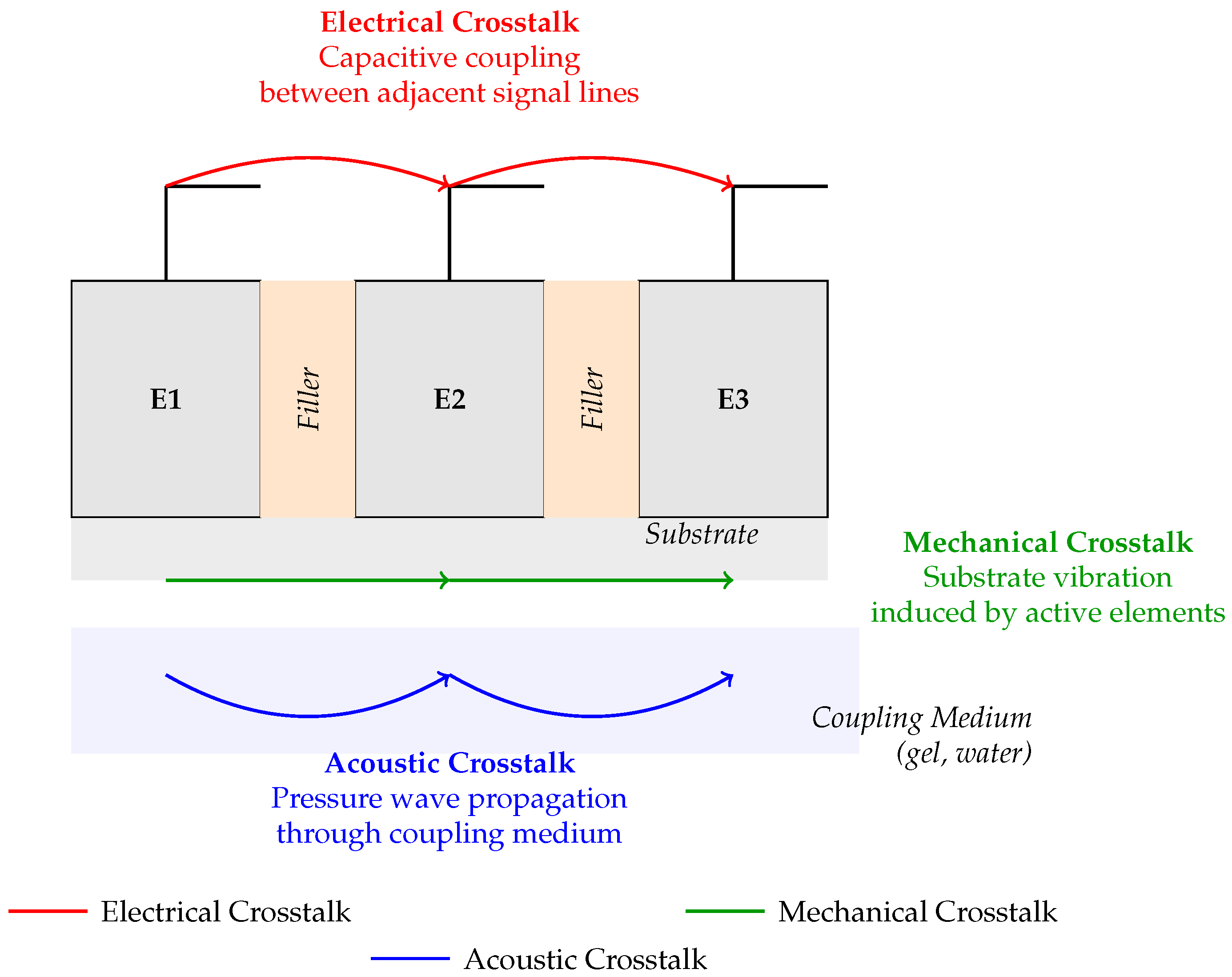
2.2. Physical Mechanisms
2.3. Crosstalk in Acoustic Levitation and Particle Manipulation
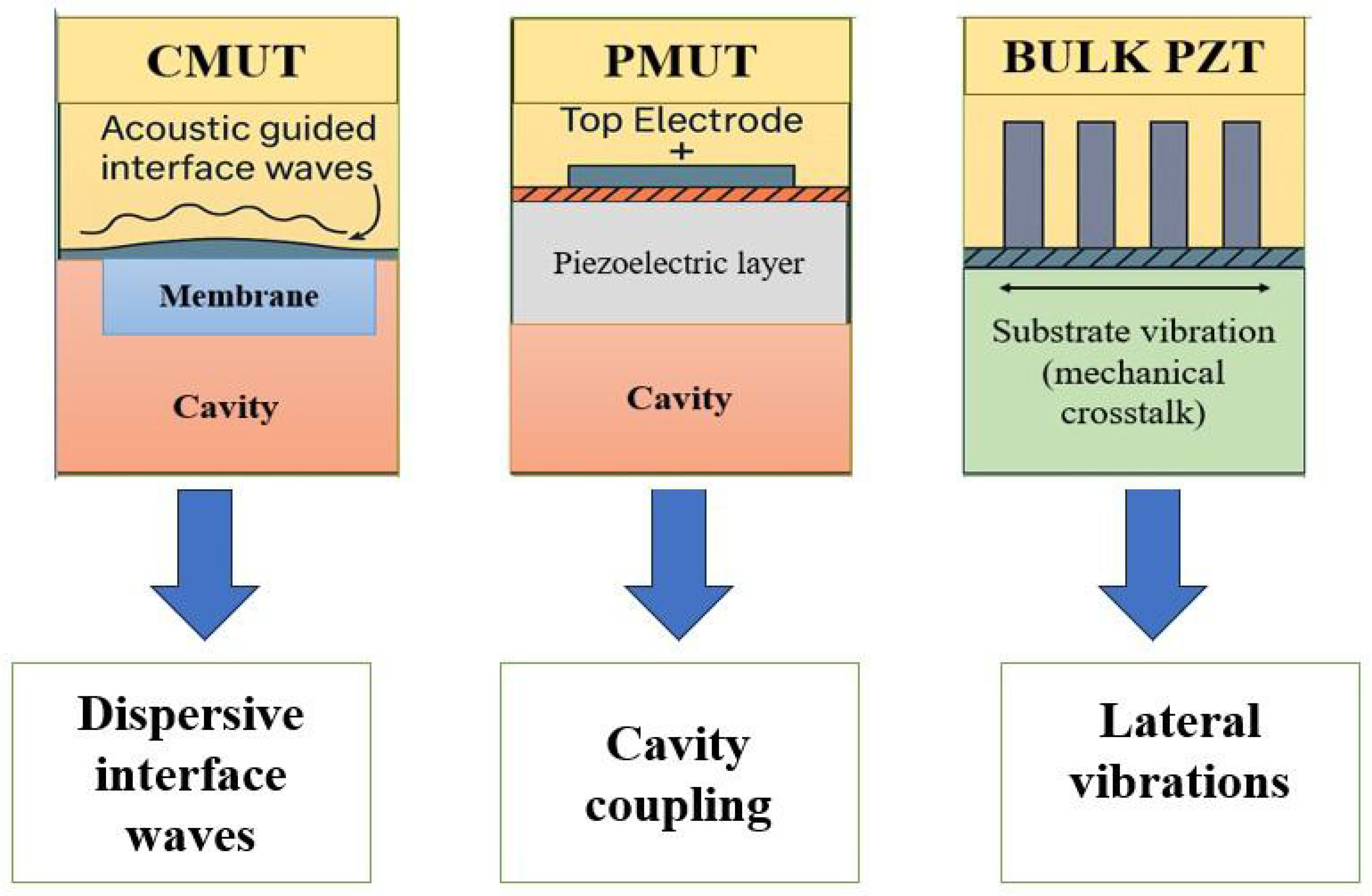
3. Influence of Array Technology on Crosstalk
3.1. Capacitive Micromachined Ultrasonic Transducers (CMUT)
3.2. Piezoelectric Micromachined Ultrasonic Transducers (PMUT)
3.3. Bulk Piezoelectric Transducer Arrays
3.4. Emerging Technologies
3.5. Ferroelectret-Based Transducers
4. Characterization Techniques
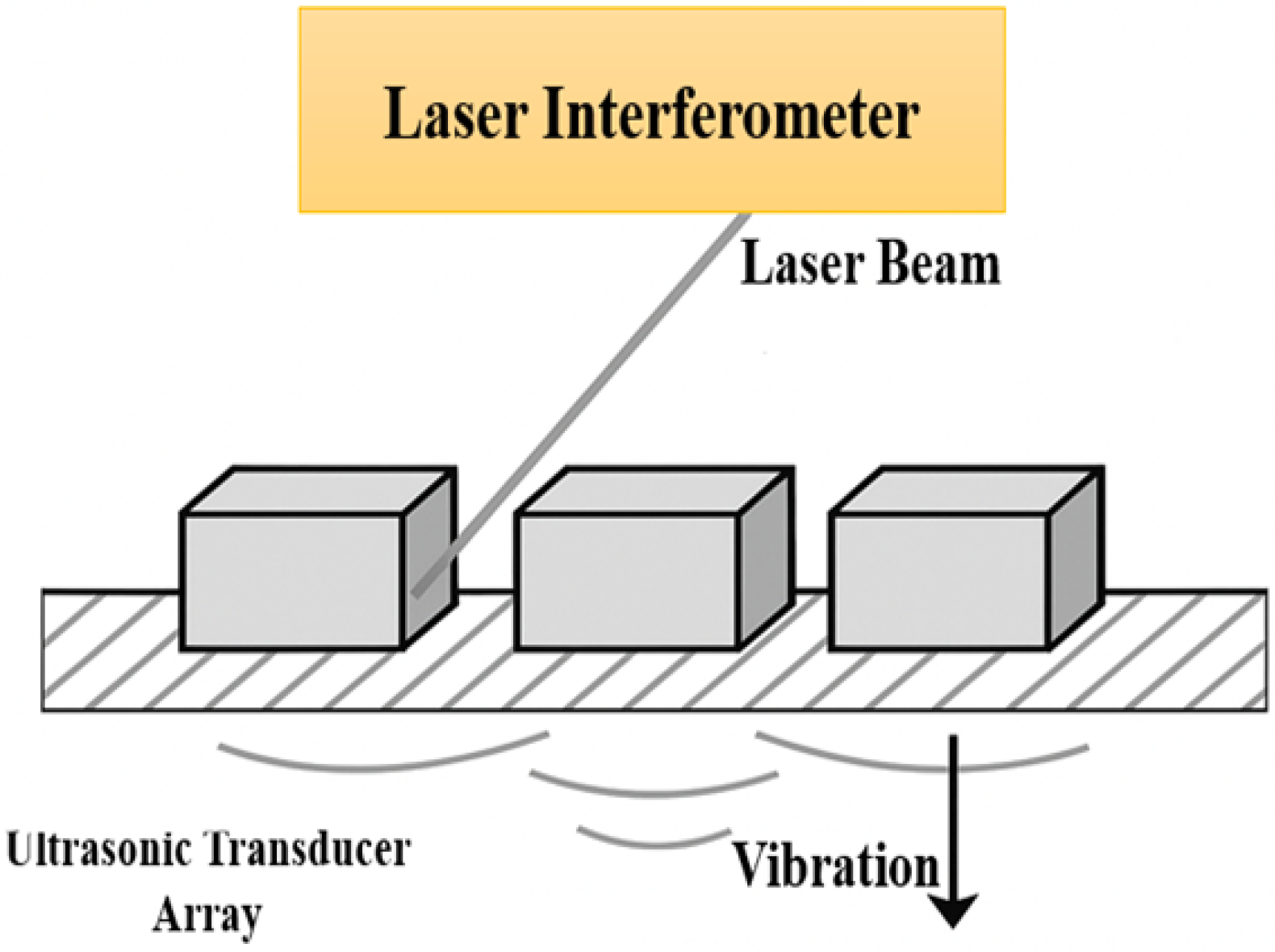
4.1. Experimental Approaches
4.2. Numerical Methods (FEM, BEM, HPC)
4.3. Simplified Analytical Models and Equivalent Circuits
4.4. Directivity-Based Models
4.5. Quantitative Metrics for Crosstalk Evaluation
- Decay Rate of Parasitic Signals: used to quantify how rapidly unintended signals diminish over distance or time, offering insight into spatial or temporal leakage characteristics [13].
- Directivity Pattern Distortion: evaluated by comparing the ideal and perturbed beam patterns, this metric helps identify spatial deviations caused by mutual interactions among elements [27].
- Amplitude Variation Between Neighboring Elements: a practical and intuitive indicator, especially in array configurations, where unintended excitation of adjacent elements can be directly measured.
- Parasitic Resonance Levels Across Frequency: the presence of resonances unrelated to the desired operating mode, as a function of frequency, serves as a strong indicator of structural or acoustic crosstalk [97].
5. Crosstalk Reduction Strategies
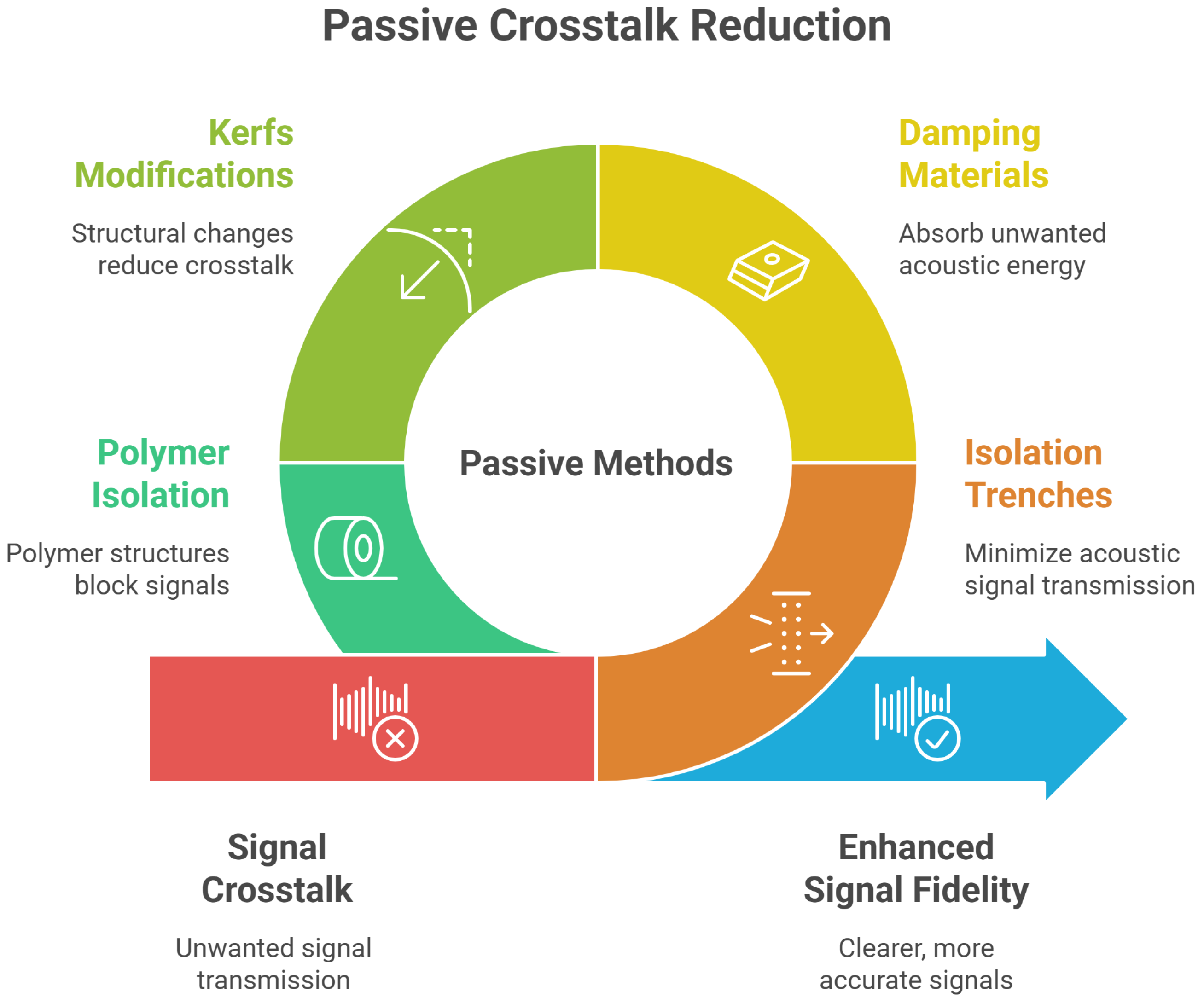
5.1. Passive Crosstalk Reduction Techniques
5.1.1. Isolation Trenches
5.1.2. Kerfs and Structural Modifications
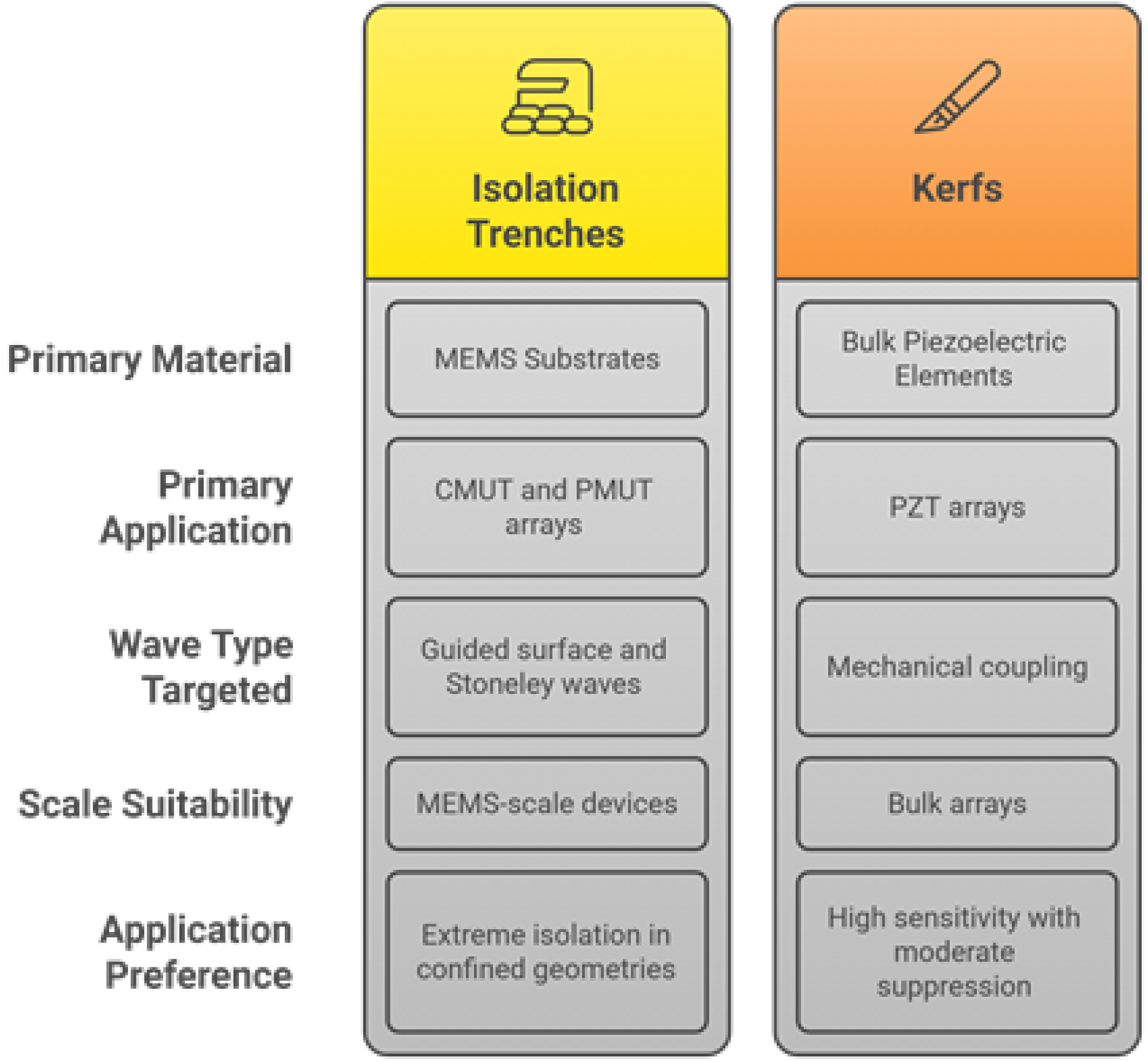
Isolation Trenches vs. Kerfs
5.1.3. Damping Materials
5.1.4. Polymer-Based Isolation Structures
5.1.5. Recent Material and Structural Innovations
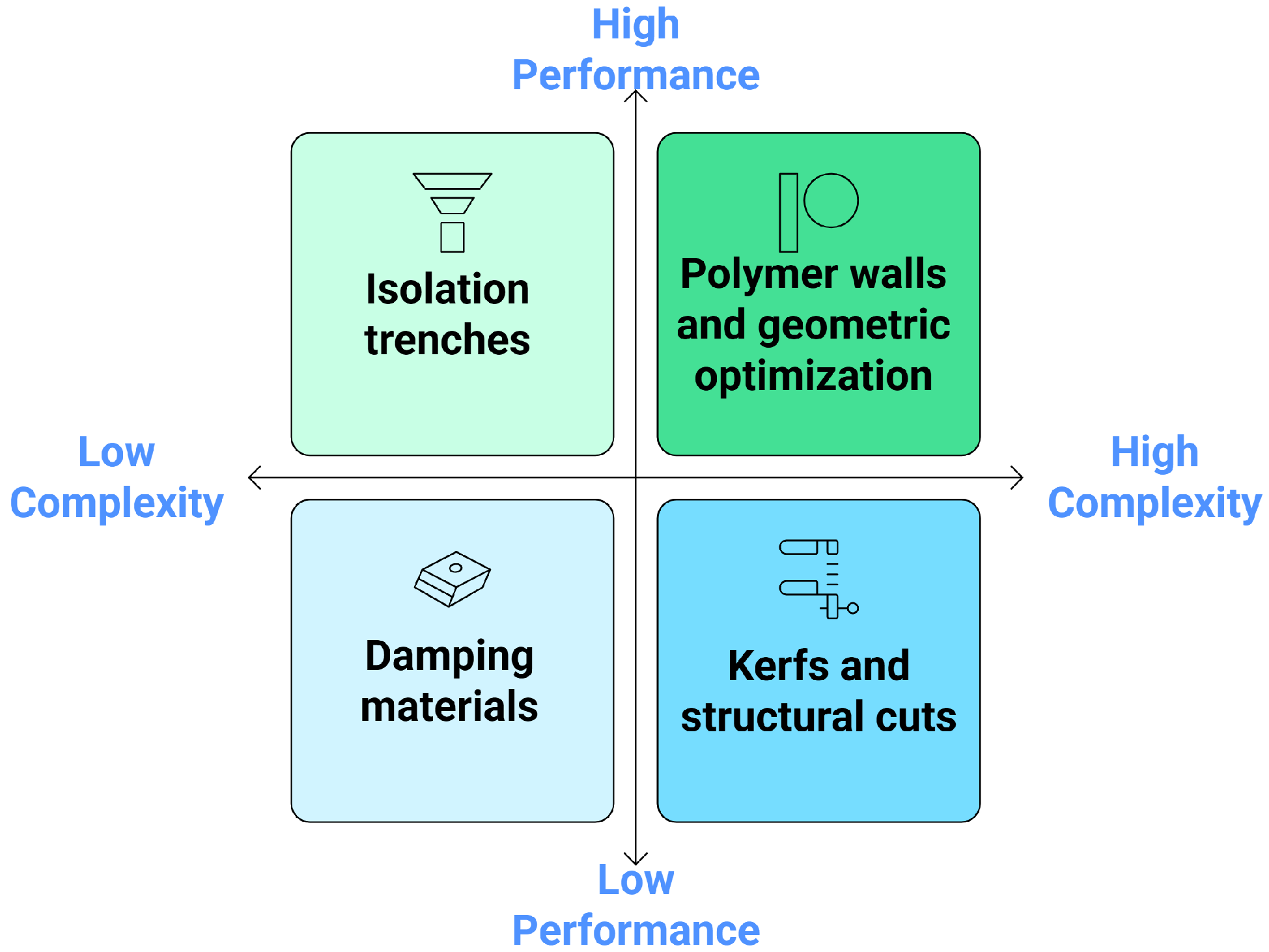
5.1.6. Comparative Analysis
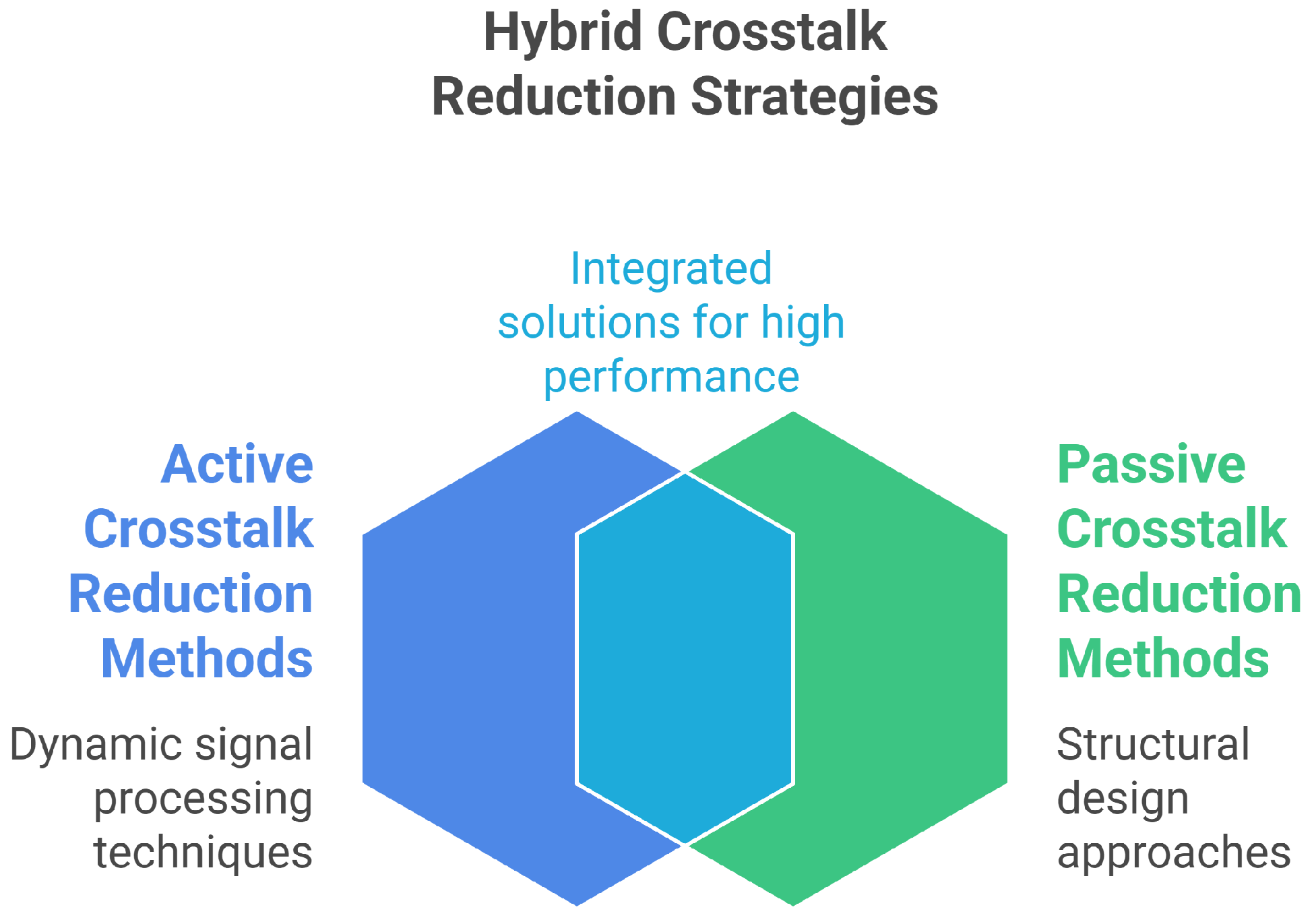
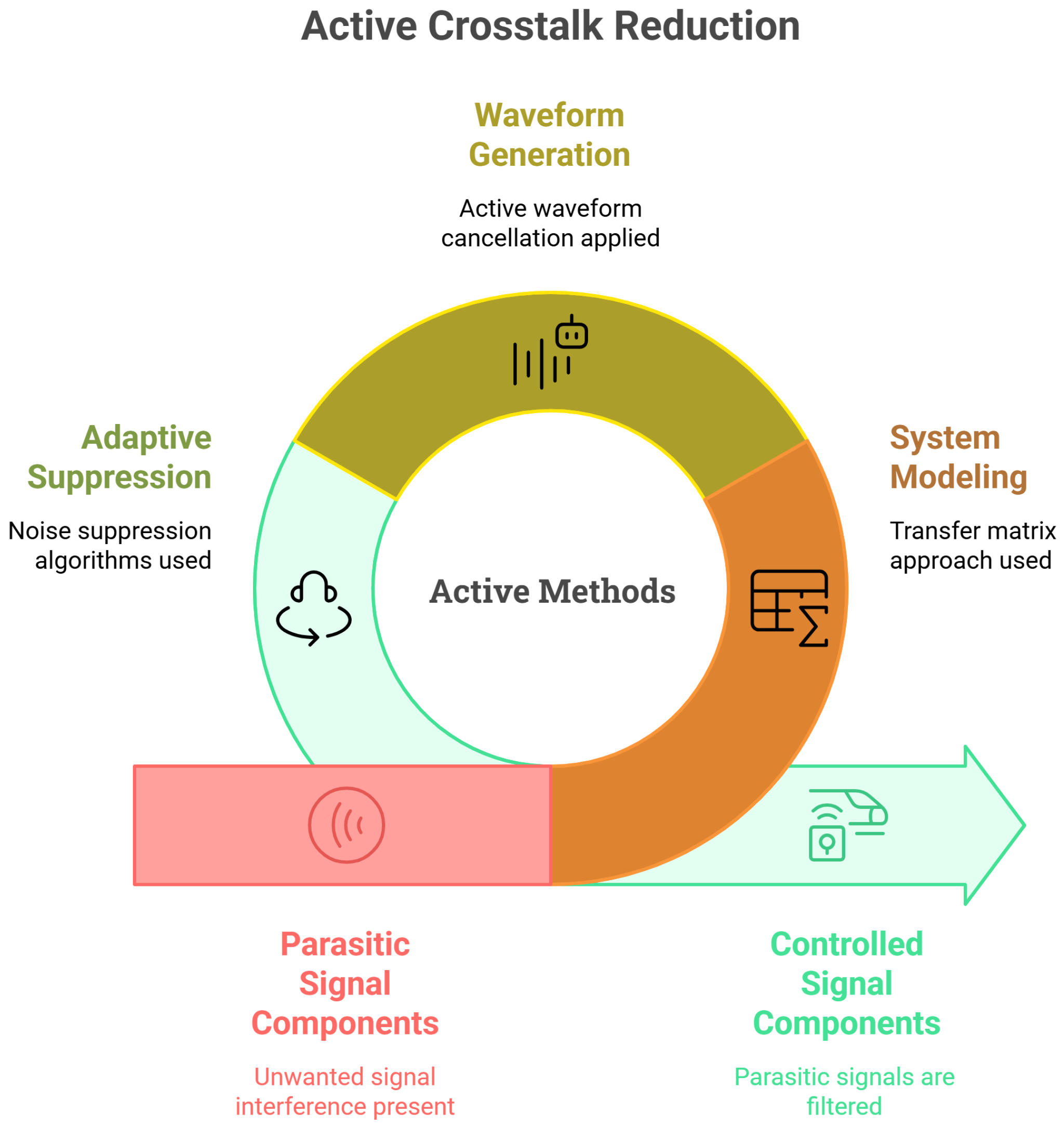
5.2. Active Crosstalk Reduction Methods
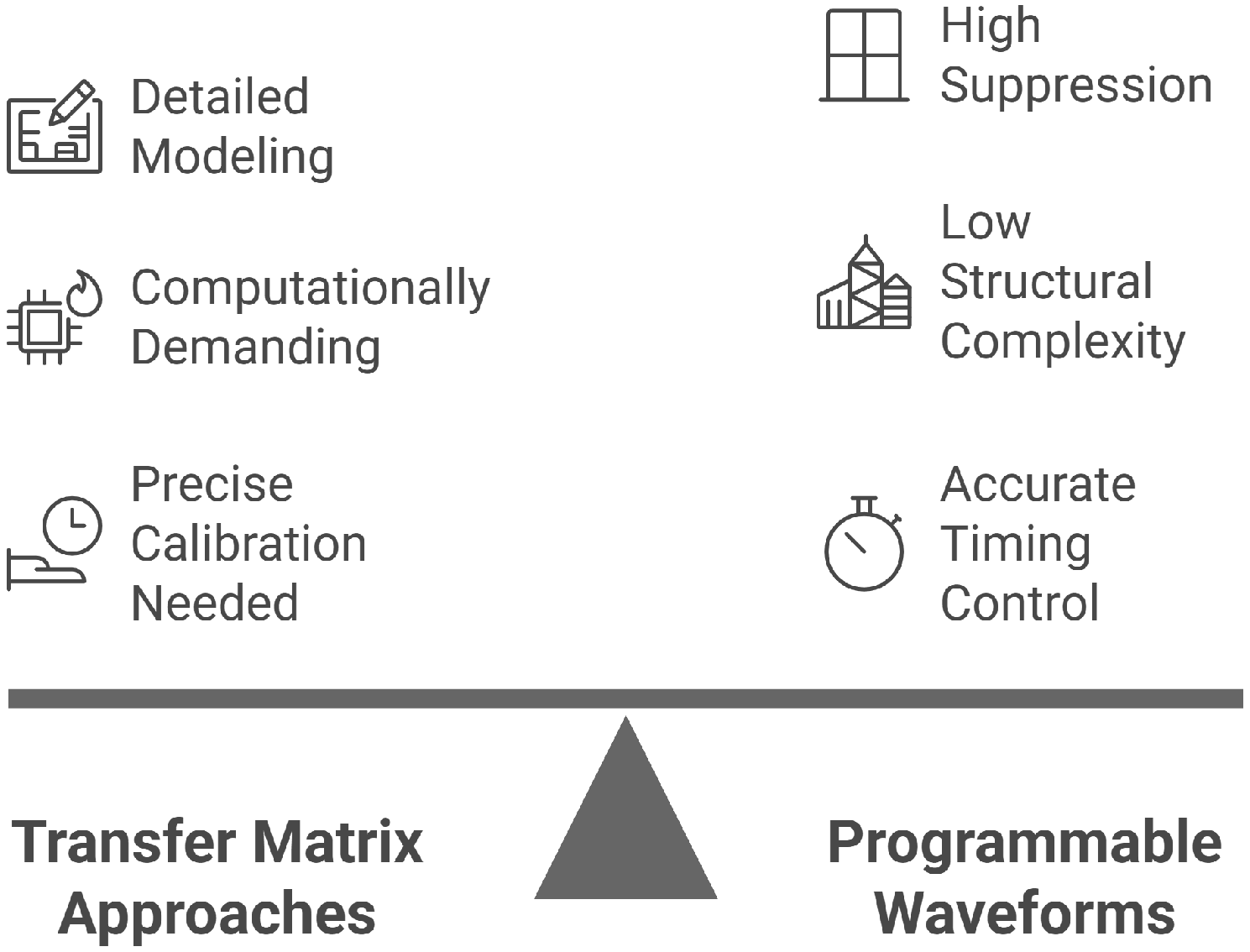
5.2.1. Transfer Matrix-Based Modeling
5.2.2. Active Waveform Generation and Cancellation Techniques
5.2.3. Active Reduction Using Corrective Voltages
5.2.4. Active Impedance Matching/Latching Techniques
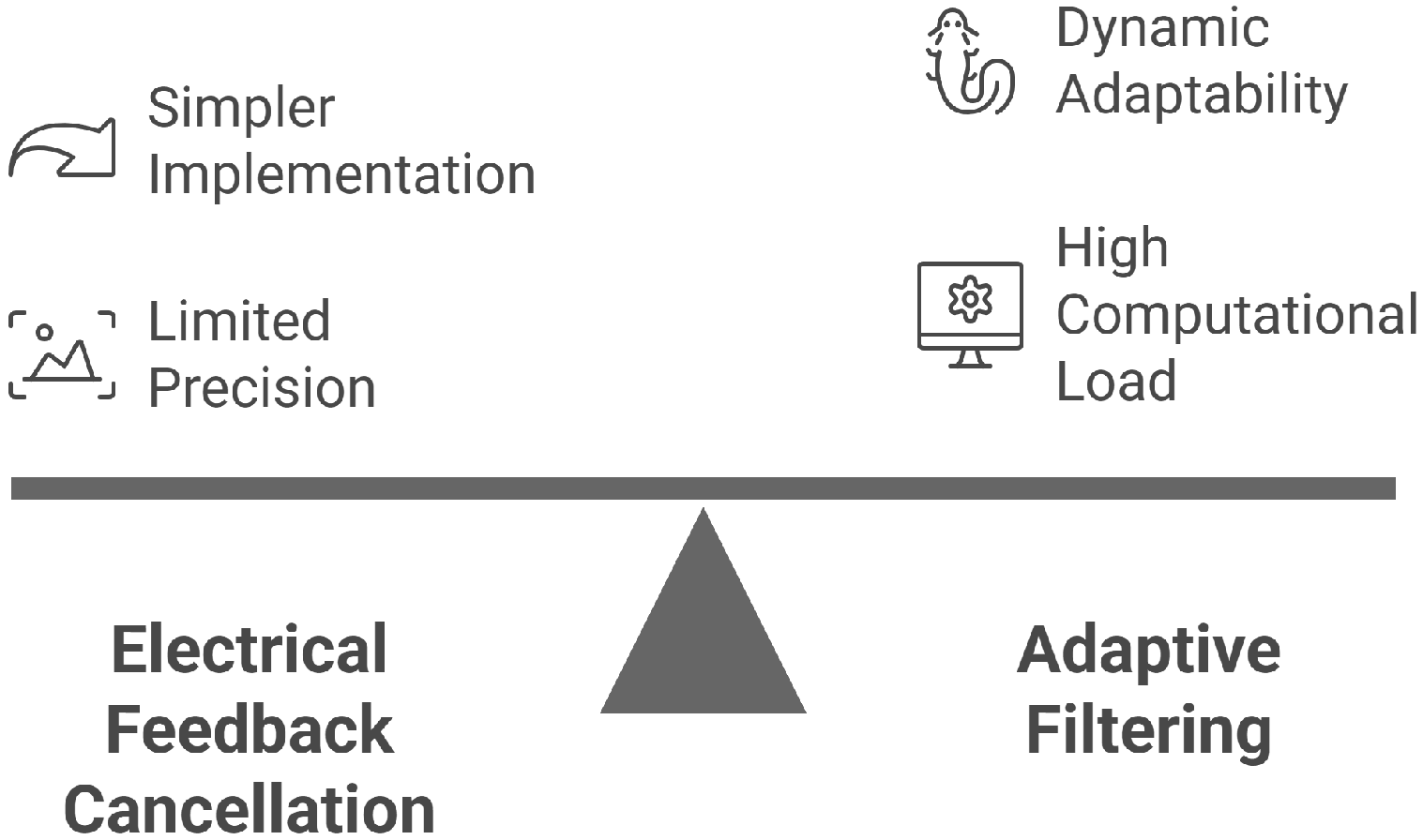
5.2.5. Adaptive Crosstalk Cancellation
6. Conclusions
Author Contributions
Funding
Institutional Review Board Statement
Informed Consent Statement
Data Availability Statement
Conflicts of Interest
References
- Jiang, X. High Frequency Piezo-Composite Micromachined Ultrasound Transducer Array Technology for Biomedical Imaging; ASME Press: New York, NY, USA, 2017. [Google Scholar]
- Baum, M.; Saeidi, N.; Vogel, K.; Schroeder, T.; Selvam, K.G.; Wiemer, M.; Otto, T. An improved design for 2D arrays of capacitive micromachined ultrasound transducers: Modeling, fabrication, and characterization. In Proceedings of the 2018 IEEE International Ultrasonics Symposium (IUS), Kobe, Japan, 22–25 October 2018; pp. 1–4. [Google Scholar]
- Bai, X.; Wang, D.; Zhen, L.; Cui, M.; Liu, J.; Zhao, N.; Lee, C.; Yang, B. Design and micromanufacturing technologies of focused piezoelectric ultrasound transducers for biomedical applications. Int. J. Extrem. Manuf. 2024, 6, 062001. [Google Scholar] [CrossRef] [Scilit]
- Reskal, H.; Bybi, A.; El Atlas, N.; Boujenoui, A.; Khalfi, H.; Elmaimouni, L. Numerical Study and Simulation of the Crosstalk Effects on the Electroacoustic Performance of Ultrasonic Transducer Arrays Utilized in Medical Imaging Applications. In Proceedings of the International Conference on Advanced Intelligent Systems for Sustainable Development, Casablanca, Morocco, 15–17 October 2023; Springer: Cham, Switzerland, 2023; pp. 417–426. [Google Scholar]
- Taghaddos, E.; Hejazi, M.; Safari, A. Lead-free piezoelectric materials and ultrasonic transducers for medical imaging. J. Adv. Dielectr. 2015, 5, 1530002. [Google Scholar] [CrossRef] [Scilit]
- Ren, D.; Yin, Y.; Li, C.; Chen, R.; Shi, J. Recent advances in flexible ultrasonic transducers: From materials optimization to imaging applications. Micromachines 2023, 14, 126. [Google Scholar] [CrossRef] [Scilit] [PubMed]
- Wang, X.B.; He, L.M.; Ma, Y.C.; Liu, W.J.; Xu, W.J.; Ren, J.Y.; Riaud, A.; Zhou, J. Development of broadband high-frequency piezoelectric micromachined ultrasonic transducer array. Sensors 2021, 21, 1823. [Google Scholar] [CrossRef] [Scilit]
- Wang, N.; Qiang, Y.; Qiu, C.; Chen, Y.; Wang, X.; Pan, Y.; Liu, R.; Wu, W.; Zheng, H.; Qiu, W.; et al. A multiplexed 32 × 32 2d matrix array transducer for flexible sub-aperture volumetric ultrasound imaging. IEEE Trans. Biomed. Eng. 2023, 71, 831–840. [Google Scholar] [CrossRef] [Scilit]
- Ling, J.; Chen, Y.Q.; Chen, Y.; Wang, D.Y.; Zhao, Y.F.; Pang, Y.; Yang, Y.; Ren, T.L. Design and characterization of high-density ultrasonic transducer array. IEEE Sens. J. 2018, 18, 2285–2290. [Google Scholar] [CrossRef] [Scilit]
- van Neer, P.L.; Peters, L.C.; Verbeek, R.G.; Peeters, B.; de Haas, G.; Hörchens, L.; Fillinger, L.; Schrama, T.; Merks-Swolfs, E.J.; Gijsbertse, K.; et al. Flexible large-area ultrasound arrays for medical applications made using embossed polymer structures. Nat. Commun. 2024, 15, 2802. [Google Scholar] [CrossRef] [Scilit]
- Elloian, J.; Jadwiszczak, J.; Arslan, V.; Sherman, J.D.; Kessler, D.O.; Shepard, K.L. Flexible ultrasound transceiver array for non-invasive surface-conformable imaging enabled by geometric phase correction. Sci. Rep. 2022, 12, 16184. [Google Scholar] [CrossRef] [Scilit]
- Hossack, J.A.; Woicik, G.L. Method and System for Reducing Undesirable Cross Talk in Diagnostic Ultrasound Arrays. U.S. Patent 6,918,877, 19 July 2005. [Google Scholar]
- Ramalli, A.; D’hooge, J.; Lovstakken, L.; Tortoli, P. A Direct Measurement of Inter-Element Cross-Talk in Ultrasound Arrays. In Proceedings of the 2019 IEEE International Ultrasonics Symposium (IUS), Glasgow, UK, 16–19 October 2019; pp. 1301–1303. [Google Scholar]
- Zhou, S.; Hossack, J.A. Reducing inter-element acoustic crosstalk in capacitive micromachined ultrasound transducers. IEEE Trans. Ultrason. Ferroelectr. Freq. Control 2007, 54, 1217–1228. [Google Scholar] [CrossRef] [Scilit] [PubMed]
- Roh, Y.R.; Kim, Y.; Kang, K. Finite element analysis on reduction of the cross talk in ultrasonic transducers. In Proceedings of the Smart Structures and Materials 2002: Modeling, Signal Processing, and Control, San Diego, CA, USA, 17–21 March 2002; Volume 4693, pp. 214–221. [Google Scholar]
- Yang, H.C.; Chiu, C.T.; Choi, H.; Zheng, F.; Liu, C.; Qiu, W.; Kim, H.H.; Shung, K.K. Low cross-talk kerfless annular array ultrasound transducers using 1–3 piezocomposites with pseudo-random pillars. In Proceedings of the 2012 IEEE International Ultrasonics Symposium, Dresden, Germany, 7–10 October 2012; pp. 1560–1563. [Google Scholar]
- Cheng, D.; Li, J.; Yue, Q.; Liang, R.; Dong, X. Crosstalk optimization of 5 MHz linear array transducer based on PZT/epoxy piezoelectric composite. Sens. Actuators A Phys. 2022, 341, 113500. [Google Scholar] [CrossRef] [Scilit]
- Mo, J.H.; Fowlkes, J.; Robinson, A.; Carson, P. Crosstalk study of an integrated ultrasound transducer array, with a micromachined diaphragm structure. In Proceedings of the TRANSDUCERS’91: 1991 International Conference on Solid-State Sensors and Actuators, Digest of Technical Papers. San Francisco, CA, USA, 24–27 June 1991; pp. 258–261. [Google Scholar]
- Mo, J.H.; Fowlkes, J.B.; Robinson, A.L.; Carson, P.L. Crosstalk reduction with a micromachined diaphragm structure for integrated ultrasound transducer arrays. IEEE Trans. Ultrason. Ferroelectr. Freq. Control 2002, 39, 48–53. [Google Scholar] [CrossRef] [Scilit] [PubMed]
- Hajati, A.; Latev, D.; Gardner, D.; Law, H.F.S. Micromachined Ultrasonic Transducer Devices with Metal-Semiconductor Contact for Reduced Capacitive Cross-Talk. U.S. Patent 9,375,850, 28 June 2016. [Google Scholar]
- Wu, L.; Moridi, M.; Wang, G.; Zhou, Q. Microfabrication and characterization of dual-frequency piezoelectric micromachined ultrasonic transducers. In Proceedings of the 2021 IEEE International Symposium on Applications of Ferroelectrics (ISAF), Virtual, 16–21 May 2021; pp. 1–4. [Google Scholar]
- Abdalla, O.M.O.; Massimino, G.; D’Argenzio, C.; Colosio, M.; Soldo, M.; Quaglia, F.; Corigliano, A. Numerical simulation of crosstalk effects in PMUT arrays. In Proceedings of the 2023 24th International Conference on Thermal, Mechanical and Multi-Physics Simulation and Experiments in Microelectronics and Microsystems (EuroSimE), Graz, Austria, 16–19 April 2023; pp. 1–5. [Google Scholar]
- Bybi, A.; Khouili, D.; Granger, C.; Garoum, M.; Mzerd, A.; Hladky, A.C. Experimental characterization of a piezoelectric transducer array taking into account crosstalk phenomenon. Int. J. Eng. Technol. Innov. 2020, 10, 1–14. [Google Scholar] [CrossRef] [Scilit]
- Bybi, A.; Ammar, A.; Garoum, M.; Grondel, S.; Mzerd, A.; Hladky, A.C. Effects of the electrical limit conditions on the electromechanical behavior of piezoelectric transducer arrays. In Proceedings of the 2020 International Conference on Electrical and Information Technologies (ICEIT), Rabat, Morocco, 4–7 March 2020; pp. 1–6. [Google Scholar]
- Celmer, M.; Opieliński, K. Research and modeling of mechanical crosstalk in linear arrays of ultrasonic transducers. Arch. Acoust. 2016, 41, 599–612. [Google Scholar] [CrossRef] [Scilit]
- Opielinski, K.J.; Celmer, M.; Pruchnicki, P.; Roguski, W.; Gudra, T.; Majewski, J.; Bulkowski, M.; Piotrowski, T.; Wiktorowicz, A. The effect of crosstalk in a circular transducer array on ultrasound transmission tomography of breast. Proc. Meet. Acoust. 2014, 21, 075001. [Google Scholar] [CrossRef] [Scilit]
- Bybi, A.; Assaad, J.; Hladky-Hennion, A.C.; Benmeddour, F.; Grondel, S.; Rivart, F. Numerical study of the cross-talk effects in acoustical transducer arrays and correction. Proc. Meet. Acoust. 2013, 19, 030049. [Google Scholar]
- Opieliński, K.J.; Celmer, M.; Bolejko, R. Crosstalk effect in medical ultrasound tomography imaging. In Proceedings of the 2018 Joint Conference-Acoustics, Ustka, Poland, 11–14 September 2018; pp. 1–6. [Google Scholar]
- Guess, J.; Oakley, C.G.; Douglas, S.; Morgan, R. Cross-talk paths in array transducers. In Proceedings of the 1995 IEEE Ultrasonics Symposium. Proceedings. An International Symposium, Seattle, WA, USA, 7–10 November 1995; Volume 2, pp. 1279–1282. [Google Scholar]
- Zhang, T.; Seshia, A.A. Acoustic coupling and remote excitation in an array of multi-mode piezoelectric micromachined ultrasonic transducers. In Proceedings of the 2023 Joint Conference of the European Frequency and Time Forum and IEEE International Frequency Control Symposium (EFTF/IFCS), Toyama, Japan, 15–19 May 2023; pp. 1–4. [Google Scholar]
- Celmer, M.; Opieliński, K.J. Model of multipath propagation of ultrasonic pulses generated in soft tissue by linear arrays. Hydroacoustics 2016, 19, 37–48. [Google Scholar]
- DeAngelis, D.A.; Schulze, G.W. Mechanical Impedance Matching for Ultrasonic Transducers and their Tools. In Proceedings of the 2024 52nd Annual Ultrasonic Industry Association Symposium (UIA), Dublin, Ireland, 8–10 April 2024; pp. 1–9. [Google Scholar]
- Brown, D.A. Multidomain modeling of acoustical transducers and arrays using electrical network theory. J. Acoust. Soc. Am. 2024, 155, A107. [Google Scholar] [CrossRef] [Scilit]
- Bruestle, R.; Chartrand, D.A.; Rittenschober, T.; Easterbrook, S.W.; Schoenauer, M.; Kremsl, A. Ultrasound Transducer Array with Separated Acoustic and Electric Module. U.S. Patent 12,207,970, 2 February 2025. [Google Scholar]
- Leung, H.F.; Hu, A.P. Modeling the contact interface of ultrasonic power transfer system based on mechanical and electrical equivalence. IEEE J. Emerg. Sel. Top. Power Electron. 2017, 6, 800–811. [Google Scholar] [CrossRef] [Scilit]
- Puskas, W.L. Ultrasound Transducer Arrays and Associated Systems and Methods. U.S. Patent 10,327,736, 25 June 2019. [Google Scholar]
- Brown, N.M.; VanSaders, B.; Kronenfeld, J.M.; DeSimone, J.M.; Jaeger, H.M. Direct measurement of forces in air-based acoustic levitation systems. Rev. Sci. Instrum. 2024, 95, 094901. [Google Scholar] [CrossRef] [Scilit] [PubMed]
- Wang, X.; Chang, Q.; Wu, P.; Xu, D.; Lin, W.; Chen, H. On the instability of single-axis acoustic levitation under radial perturbations. J. Appl. Phys. 2024, 136, 114901. [Google Scholar] [CrossRef] [Scilit]
- Contreras, V.; Volke-Sepúlveda, K. Enhanced standing-wave acoustic levitation using high-order transverse modes in phased array ultrasonic cavities. Ultrasonics 2024, 138, 107230. [Google Scholar] [CrossRef] [Scilit]
- Koroyasu, Y.; Ochiai, Y.; Hoshi, T.; Fushimi, T. Mid-Air Single-Sided Acoustic Levitation in High-Pressure Regions. arXiv 2024, arXiv:2412.15539. [Google Scholar]
- Hunter-Brown, G.; Sampara, N.; Scase, M.M.; Hill, R.J. Sonomaglev: Combining acoustic and diamagnetic levitation. Appl. Phys. Lett. 2023, 122, 014103. [Google Scholar] [CrossRef] [Scilit]
- Li, X.; Cui, W.; Liu, S.; Xu, X.; Reed, M.A. Crosstalk Analysis to GHz Bulk-Acoustic-Wave Array for Addressable Micro/Nanoscale Particle Trapping. J. Microelectromech. Syst. 2021, 31, 158–166. [Google Scholar] [CrossRef] [Scilit]
- Dumy, G.; Hoyos, M.; Aider, J.L. Observation of selective optical manipulation of particles in acoustic levitation. J. Acoust. Soc. Am. 2019, 146, 4557–4568. [Google Scholar] [CrossRef] [Scilit] [PubMed]
- Gao, L.; Christopoulos, G.; Mittal, P.; Hirayama, R.; Subramanian, S. StableLev: Data-Driven Stability Enhancement for Multi-Particle Acoustic Levitation. In Proceedings of the 2024 CHI Conference on Human Factors in Computing Systems, Honolulu, HI, USA, 11–16 May 2024; pp. 1–11. [Google Scholar]
- Gonze, E.; Gonthier, Y.; Boldo, P.; Bernis, A. Standing waves in a high frequency sonoreactor: Visualization and effects. Chem. Eng. Sci. 1998, 53, 523–532. [Google Scholar] [CrossRef] [Scilit]
- Muelas-Hurtado, R.D.; Contreras, V. Electro-acoustic study of airborne standing-wave acoustic levitators based on arrays of ultrasonic transducers. Ultrasonics 2025, 151, 107606. [Google Scholar] [CrossRef] [Scilit] [PubMed]
- Salim, M.S.; Abd Malek, M.; Heng, R.; Juni, K.; Sabri, N. Capacitive micromachined ultrasonic transducers: Technology and application. J. Med. Ultrasound 2012, 20, 8–31. [Google Scholar] [CrossRef] [Scilit]
- Lemmerhirt, D.F.; Borna, A.; Alvar, S.; Rich, C.A.; Kripfgans, O.D. CMUT-in-CMOS 2D arrays with advanced multiplexing and time-gain control. In Proceedings of the 2014 IEEE International Ultrasonics Symposium, Chicago, IL, USA, 3–6 September 2014; pp. 582–586. [Google Scholar]
- Bayram, B.; Kupnik, M.; Yaralioglu, G.G.; Oralkan, O.; Ergun, A.S.; Lin, D.-s.; Wong, S.H.; Khuri-yakub, B.T. Finite element modeling and experimental characterization of crosstalk in 1-D CMUT arrays. IEEE Trans. Ultrason. Ferroelectr. Freq. Control 2007, 54, 418–430. [Google Scholar] [CrossRef] [Scilit]
- Khuri-Yakub, B.; Yaralioglu, G.G.; Bayram, B.; Kupnik, M. 5f-4 acoustic crosstalk reduction method for cmut arrays. In Proceedings of the 2006 IEEE Ultrasonics Symposium, Vancouver, BC, Canada, 2–6 October 2006; pp. 590–593. [Google Scholar]
- Caronti, A.; Fiasca, D.; Caliano, G.; Pappalardo, M.; Cianci, E. Experimental study of acoustic coupling in CMUT arrays by optical interferometry. In Proceedings of the IEEE Symposium on Ultrasonics, Honolulu, HI, USA, 5–8 October 2003; Volume 2, pp. 1960–1969. [Google Scholar]
- Eccardt, P.C.; Lohfink, A.; Garssen, H.G. Analysis of crosstalk between fluid coupled CMUT membranes. In Proceedings of the IEEE Ultrasonics Symposium, Rotterdam, The Netherlands, 18–21 September 2005; Volume 1, pp. 593–596. [Google Scholar]
- Caronti, A.; Savoia, A.S.; Caliano, G.; Pappalardo, M. Acoustic coupling in capacitive microfabricated ultrasonic transducers: Modeling and experiments. IEEE Trans. Ultrason. Ferroelectr. Freq. Control 2005, 52, 2211–2219. [Google Scholar] [CrossRef]
- Yashvanth, V.; Chowdhury, S. An investigation of silica aerogel to reduce acoustic crosstalk in CMUT arrays. Sensors 2021, 21, 1459. [Google Scholar] [CrossRef] [Scilit] [PubMed]
- Bayram, B.; Khuri-Yakub, B.T. Acoustic Crosstalk Reduction for Capacitive Micromachined Ultrasonic Transducers in Immersion. U.S. Patent 7,745,973, 29 June 2010. [Google Scholar]
- Birjis, Y.; Swaminathan, S.; Nazemi, H.; Raj, G.C.A.; Munirathinam, P.; Abu-Libdeh, A.; Emadi, A. Piezoelectric micromachined ultrasonic transducers (PMUTs): Performance metrics, advancements, and applications. Sensors 2022, 22, 9151. [Google Scholar] [CrossRef] [Scilit] [PubMed]
- Abdalla, O.M.O.; Massimino, G.; D’Argenzio, C.; Colosio, M.; Soldo, M.; Quaglia, F.; Corigliano, A. An experimental and numerical study of crosstalk effects in PMUT arrays. IEEE Sens. J. 2023, 23, 29029–29041. [Google Scholar] [CrossRef] [Scilit]
- Baer, R.; Kino, G. Theory for cross coupling in ultrasonic transducer arrays. Appl. Phys. Lett. 1984, 44, 954–956. [Google Scholar] [CrossRef] [Scilit]
- Park, J.S.; Jung, S.Y.; Kim, D.H.; Park, J.H.; Jang, H.W.; Kim, T.G.; Baek, S.H.; Lee, B.C. Dual-frequency piezoelectric micromachined ultrasound transducer based on polarization switching in ferroelectric thin films. Microsyst. Nanoeng. 2023, 9, 122. [Google Scholar] [CrossRef] [Scilit] [PubMed]
- Smith, W.A.; Shaulov, A.A.; Auld, B.A. Design of piezocomposites for ultrasonic transducers. Ferroelectrics 1989, 91, 155–162. [Google Scholar] [CrossRef] [Scilit]
- Domínguez, I.S.; Contla, P.A.; Hernández, E.M.; Von Kruger, M. Crosstalk effects caused by the geometry of piezoelectric elements in matrix ultrasonic transducers. Braz. J. Biomed. Eng. 2011, 27, 90–97. [Google Scholar] [CrossRef] [Scilit]
- Laasri, I.; Bybi, A.; Mouhat, O.; Jamal, M.; Hladky, A.C.; Ettahir, A.; Kettani, K. Investigation of the electrical limit conditions effects in piezoelectric transducer arrays utilized in medical imaging. Appl. Acoust. 2020, 170, 107509. [Google Scholar] [CrossRef] [Scilit]
- Kaplan, D.; Forrest, S. Electrical crosstalk in pin arrays-Part I: Theory. J. Light. Technol. 2003, 4, 1460–1469. [Google Scholar] [CrossRef] [Scilit]
- Hu, Z.; Ramalingame, R.; Yahia, K.A.; Gerlach, C.; Kanoun, O. Crosstalk suppression for piezoresistive tactile sensor arrays with a large resistance measurement range. In Proceedings of the Sensors and Measuring Systems, 19th ITG/GMA-Symposium. Online, 26–27 June 2018; pp. 1–5. [Google Scholar]
- Wang, Y.; Lv, N.; He, L.; Xu, W.; Zhou, J.; Ren, J. Modeling and Simulation of a Piezoelectric-Capacitive Hybrid Micromachined Ultrasonic Transducer. In Proceedings of the 2024 IEEE Ultrasonics, Ferroelectrics, and Frequency Control Joint Symposium (UFFC-JS), Taipei, Taiwan, 22–26 September 2024. [Google Scholar]
- Valappil, S.V.; Goosen, J.F.; Aragón, A.M. Phononic Crystals for Suppressing Crosstalk in Ultrasonic Flowmeters. IEEE Trans. Instrum. Meas. 2023, 72, 7504711. [Google Scholar] [CrossRef] [Scilit]
- Xu, T.; Zhao, L.; Jiang, Z.; Guo, S.; Li, Z.; Yang, P.; Sun, L.; Luo, G.; Zhang, L. Array design of piezoelectric micromachined ultrasonic transducers with low-crosstalk and high-emission performance. IEEE Trans. Ultrason. Ferroelectr. Freq. Control 2019, 67, 789–800. [Google Scholar] [CrossRef] [Scilit]
- Tanabe, M.; Sato, K.; Uda, T.; Kobayashi, M. Thin, flexible, and biocompatible medical ultrasound array transducer using a sol–gel composite spray technique. Jpn. J. Appl. Phys. 2023, 62, SJ1034. [Google Scholar] [CrossRef] [Scilit]
- Oh, C.; Kim, Y.M.; Lee, T.; Lee, S.M.; Jung, J.; Bae, H.M.; Kim, C.; Lee, H.J. Patch-type capacitive micromachined ultrasonic transducer for ultrasonic power and data transfer. Microsyst. Nanoeng. 2025, 11, 124. [Google Scholar] [CrossRef] [Scilit]
- Álvarez-Arenas, T.E.G.; Díez, L. Ferroelectret transducers for water immersion and medical imaging. In Proceedings of the 2016 IEEE International Ultrasonics Symposium (IUS), Tours, France, 18–21 September 2016; pp. 1–4. [Google Scholar]
- Fillinger, L.; Hörchens, L.; Peters, L.C.; Verbeek, R.G.; Peeters, B.; Schrama, T.; Merks-Swolfs, E.J.; van der Steen, J.L.; Volker, A.W.; Gelinck, G.H.; et al. Demonstration of medical imaging using flexible polymer ultrasound technology. J. Acoust. Soc. Am. 2023, 154, A140. [Google Scholar] [CrossRef] [Scilit]
- Ng, J.H.G.; Flynn, D.; Lacrotte, Y.; Desmulliez, M.P.; Ssekitoleko, R.; Démoré, C.; Cochran, S. Progress towards the development of novel fabrication and assembly methods for the next generation of ultrasonic transducers. In Proceedings of the 3rd Electronics System Integration Technology Conference ESTC, Berlin, Germany, 13–16 September 2010; pp. 1–6. [Google Scholar]
- Li, C.F.; Yang, M.Y.; Hong, G.W.; Liu, H.L. Design and Implementation of a FPGA-Based Airborne Ultrasound Sensing and Radiation Phased Array Device. In Proceedings of the 2024 IEEE Ultrasonics, Ferroelectrics, and Frequency Control Joint Symposium (UFFC-JS), Taipei, Taiwan, 22–26 September 2024. [Google Scholar]
- Ealo, J.L.; Camacho, J.J.; Fritsch, C. Airborne ultrasonic phased arrays using ferroelectrets: A new fabrication approach. IEEE Trans. Ultrason. Ferroelectr. Freq. Control 2009, 56, 848–858. [Google Scholar] [CrossRef] [Scilit] [PubMed]
- Gaal, M.; Schadow, F.; Nielow, D.; Trappe, V. Air-coupled ultrasonic ferroelectret transducers with additional bias voltage for testing of composite structures. In Proceedings of the 10th International Symposium on NDT in Aerospace, Dresden, Germany, 24–26 October 2018; pp. 1–6. [Google Scholar]
- Altmann, A.A.; Suppelt, S.; Ruhl, M.; Schaumann, S.; Latsch, B.; Dali, O.B.; Zhukov, S.; Flachs, D.; Zhang, X.; Thielemann, C.; et al. Monolithic wideband air-coupled ultrasonic transducer based on additively manufactured ferroelectrets. In Proceedings of the 2024 IEEE Ultrasonics, Ferroelectrics, and Frequency Control Joint Symposium (UFFC-JS), Taipei, Taiwan, 22–26 September 2024. [Google Scholar]
- Blackshire, J.L.; Sathish, S. Scanning laser interferometric evaluation of individual elements and an entire micro-electro-mechanical ultrasonic array transducer. In Proceedings of the 2001 IEEE Ultrasonics Symposium. Proceedings. An International Symposium (Cat. No. 01CH37263), Atlanta, GA, USA, 7–10 October 2001; Volume 2, pp. 883–886. [Google Scholar]
- Wang, K.; Xing, G.; Yang, P.; Wang, M.; Wang, Z.; Tian, Q. High-Bandwidth Heterodyne Laser Interferometer for the Measurement of High-Intensity Focused Ultrasound Pressure. Micromachines 2023, 14, 2225. [Google Scholar] [CrossRef] [Scilit]
- Felix, N.; Certon, D.; Ratsimandresy, L.; Lethiecq, M.; Patat, F. 1D ultrasound array: Performance evaluation and characterization by laser interferometry. In Proceedings of the 2000 IEEE Ultrasonics Symposium. Proceedings. An International Symposium (Cat. No. 00CH37121), San Juan, PR, USA, 22–25 October 2000; Volume 2, pp. 1191–1194. [Google Scholar]
- Rosenthal, A.; Kellnberger, S.; Bozhko, D.; Chekkoury, A.; Omar, M.; Razansky, D.; Ntziachristos, V. Sensitive Interferometric Detection of Ultrasound for Minimally Invasive Clinical Imaging Applications. Laser Photonics Rev. 2018, 12, 1800062. [Google Scholar] [CrossRef] [Scilit]
- Zhang, D.; Yan, M.; Li, G.; Wang, Y.; Li, F. Frequency-modulated continuous-wave laser interferometry measurement method based on cross-correlation. Meas. Sci. Technol. 2024, 35, 085203. [Google Scholar] [CrossRef] [Scilit]
- Wen, T.; Hu, J.; Zhu, Y.; Hua, G.; Xu, D.; Zhang, M. A signal processing method for homodyne laser interferometer based on model parameter self-calibration with redundant information. IEEE Trans. Instrum. Meas. 2022, 71, 9509711. [Google Scholar] [CrossRef] [Scilit]
- Wang, X.; Wang, C.; Qian, L.; Xin, Y.; Hu, C.; Jin, L.; Li, M.; Geng, L.; Zhang, B. Two-dimensional optical micro displacement sensing and crosstalk elimination based on the self-imaging effect of a grating pair. Opt. Express 2024, 32, 38679–38689. [Google Scholar] [CrossRef] [Scilit]
- Pandithurai, O.; Karthik, S. Optical Grating Diffraction and Optical Beat Frequency Principle-Based Ultrahigh Resolution Displacement Measurement System. Int. J. Recent Innov. Trends Comput. Commun. (IJRITCC) 2023, 11, 400–404. [Google Scholar] [CrossRef] [Scilit]
- Thao, P.N. Development of linear pMUT array with low mechanical crosstalk toward ultrasonography applications. In Proceedings of the 2021 21st International Conference on Solid-State Sensors, Actuators and Microsystems (Transducers), Online, 20–25 June 2021; pp. 659–662. [Google Scholar]
- Savoia, A.S.; Mauti, B.; Caliano, G. Accurate evaluation of the electro-mechanical and parasitic parameters of CMUTs through electrical impedance characterization. In Proceedings of the 2017 IEEE International Ultrasonics Symposium (IUS), Washington, DC, USA, 6–9 September 2017; pp. 1–4. [Google Scholar]
- Ventura, P.; Ferrara, P.; Desbois, J.; Lagier, Y.; de Fraguier, S.; Gelly, J.F. 2D mixed finite element/analytical model of the mechanical coupling in ultrasonic array. In Proceedings of the IEEE 1992 Ultrasonics Symposium Proceedings, Tucson, AZ, USA, 20–23 October 1992; pp. 575–579. [Google Scholar]
- Pirouz, A.; Magruder, R.; Harvey, G.; Tweedie, A.; Diestelhorst, R. Crosstalk study of large PMUT array using FEA and cloud HPC. In Proceedings of the 2019 IEEE International Ultrasonics Symposium (IUS), Glasgow, UK, 6–9 October 2019; pp. 788–791. [Google Scholar]
- Shieh, B.; Sabra, K.G.; Degertekin, F.L. Efficient broadband simulation of fluid-structure coupling for membrane-type acoustic transducer arrays using the multilevel fast multipole algorithm. IEEE Trans. Ultrason. Ferroelectr. Freq. Control 2016, 63, 1967–1979. [Google Scholar] [CrossRef] [Scilit]
- Boujenoui, A.; Bybi, A.; Reskal, H.; Khalfi, H.; Elmaimouni, L.; Hladky-Hennion, A.C. Development and validation of a 2D Mason model for ultrasonic transducer arrays: A simplified approach simulating crosstalk and dissipation mechanisms. Appl. Acoust. 2025, 241, 110991. [Google Scholar] [CrossRef] [Scilit]
- Bybi, A.; Mouhat, O.; Garoum, M.; Drissi, H.; Grondel, S. One-dimensional equivalent circuit for ultrasonic transducer arrays. Appl. Acoust. 2019, 156, 246–257. [Google Scholar] [CrossRef] [Scilit]
- Pyo, S.; Roh, Y. Analysis of the crosstalk in an underwater planar array transducer by the equivalent circuit method. Jpn. J. Appl. Phys. 2017, 56, 07JG01. [Google Scholar] [CrossRef] [Scilit]
- Sim, M.J.; Hong, C.; Jeong, W.B. Hybrid equivalent circuit/finite element/boundary element modeling for effective analysis of an acoustic transducer array with flexible surrounding structures. Appl. Sci. 2021, 11, 2702. [Google Scholar] [CrossRef] [Scilit]
- Li, J.; Wu, Z.; Li, J.; Xiao, Z.; Li, Z.; Zhao, Y.; Luo, G.; Yuan, J.; Li, Z.; Qin, S.; et al. Array Equivalent Circuit Model and Experimental Analysis of Square CMUTs. IEEE Sens. J. 2024, 24, 41045–41056. [Google Scholar] [CrossRef] [Scilit]
- Wang, W.Z.; Xu, W.J.; Zhou, J.; Liu, W.J.; Xu, Z.; Ren, J.Y. Electrical impedance and radiation modes Determination for LiNbO3 MEMS ultrasonic array transducer using KLM and FEM modelling. In Proceedings of the 2016 13th IEEE International Conference on Solid-State and Integrated Circuit Technology (ICSICT), Hangzhou, China, 25–28 October 2016; pp. 688–690. [Google Scholar]
- Roh, Y.R.; Kim, Y.S. Analysis and reduction of the cross talk in micro-machined piezoelectric ultrasonic transducers. Key Eng. Mater. 2004, 270, 1071–1076. [Google Scholar] [CrossRef] [Scilit]
- Zhao, Y.; Li, Z.; Li, J.; Zhao, L.; Liu, Z.; Lu, D.; Li, Z.; Yuan, J.; Yang, P.; Jiang, Z.; et al. Coupling effects of crosstalk and parasitic loss on capacitive micromachined ultrasonic transducers. IEEE Sens. J. 2022, 22, 3281–3297. [Google Scholar] [CrossRef] [Scilit]
- Zhou, S.; Wojcik, G.L.; Hossack, J.A. An approach for reducing adjacent element crosstalk in ultrasound arrays. IEEE Trans. Ultrason. Ferroelectr. Freq. Control 2003, 50, 1752–1761. [Google Scholar] [CrossRef] [Scilit]
- Cugnet, B.; Hladky, A.; Assaad, J. Numerical technique to reduce cross-coupling in acoustical arrays. Ultrasonics 2002, 40, 503–506. [Google Scholar] [CrossRef] [Scilit]
- Bybi, A.; Grondel, S.; Assaad, J.; Hladky-Hennion, A.; Granger, C.; Rguiti, M. Reducing crosstalk in array structures by controlling the excitation voltage of individual elements: A feasibility study. Ultrasonics 2013, 53, 1135–1140. [Google Scholar] [CrossRef] [Scilit] [PubMed]
- Bybi, A.; Grondel, S.; Assaad, J.; Hladky-Hennion, A.C. Extension of the crosstalk cancellation method in ultrasonic transducer arrays from the harmonic regime to the transient one. Ultrasonics 2014, 54, 720–724. [Google Scholar] [CrossRef] [Scilit]
- Lu, W.; Wu, Y.; Ye, F.; Ren, J. A Broadband LMS-based Band-split Crosstalk Cancellation Method for Ultrasound Systems. In Proceedings of the 2022 IEEE 65th International Midwest Symposium on Circuits and Systems (MWSCAS), Fukuoka, Japan, 7–10 August 2022; pp. 1–4. [Google Scholar]
- Liu, D.L.; Waag, R.C.; Oakley, C.G. Compensation for array nonidealities by electronics. J. Acoust. Soc. Am. 1997, 101, 3115. [Google Scholar] [CrossRef] [Scilit]
- Kargary, S.; Mahloojifar, A. Crosstalk reduction in Multi Line Transmission in 3D ultrasound imaging using different excitations: A comparison study. In Proceedings of the 2017 Iranian Conference on Electrical Engineering (ICEE), Tehran, Iran, 2–4 May 2017; pp. 82–85. [Google Scholar] [CrossRef] [Scilit]
- Tong, L.; He, Q.; Ortega, A.; Ramalli, A.; Tortoli, P.; Luo, J.; D’hooge, J. Coded Excitation for Crosstalk Suppression in Multi-line Transmit Beamforming: Simulation Study and Experimental Validation. Appl. Sci. 2019, 9, 486. [Google Scholar] [CrossRef] [Scilit]
- Zhuang, X.; Ergun, A.S.; Oralkan, O.; Huang, Y.; Wygant, I.O.; Yaralioglu, G.G.; Yeh, D.T.; Khuri-Yakub, B.T. Through-wafer trench-isolated electrical interconnects for CMUT arrays. In Proceedings of the IEEE Ultrasonics Symposium, Rotterdam, The Netherlands, 18–21 September 2005; Volume 1, pp. 475–478. [Google Scholar]
- Wang, M.; Zhou, Y.; Randles, A. Enhancement of the transmission of piezoelectric micromachined ultrasonic transducer with an isolation trench. J. Microelectromech. Syst. 2016, 25, 691–700. [Google Scholar] [CrossRef] [Scilit]
- Hawryluk, A.M.; Ceglio, N.M. EUV Lithography Cost of Ownership Analysis. In Proceedings of the Extreme Ultraviolet Lithography, Monterey, CA, USA, 19–21 September 1994; Technical Digest Series. Optica Publishing Group: Washington, DC, USA, 1994; p. 13. [Google Scholar] [CrossRef] [Scilit]
- Evanschitzky, P.; Burenkov, A.; Lorenz, J. Double patterning: Simulating a variability challenge for advanced transistors. In Proceedings of the International Conference on Simulation of Semiconductor Processes and Devices, Glasgow, UK, 3–5 September 2013; pp. 105–108. [Google Scholar] [CrossRef] [Scilit]
- Zhuang, X.; Wygant, I.O.; Lin, D.S.; Kupnik, M.; Oralkan, O.; Khuri-Yakub, B.T. 6F-1 Trench-Isolated CMUT Arrays with a Supporting Frame: Characterization and Imaging Results. In Proceedings of the International Ultrasonics Symposium, New York, NY, USA, 28–31 October 2007; pp. 507–510. [Google Scholar] [CrossRef] [Scilit]
- Ackermann, D.; Schmitz, G. Investigation of kerfless PZT and PVDF based ultrasound arrays. Biomed. Tech. 2012, 57, 119–122. [Google Scholar] [CrossRef] [Scilit]
- Polvino, S.M.; Siddiqui, S. High-K Dielectric Structure for Deep Trench Isolation. U.S. Patent 9,224,740, 29 December 2015. [Google Scholar]
- Liao, W.; Zhang, E.X.; Alles, M.L.; Zhang, C.X.; Gong, H.; Ni, K.; Sternberg, A.L.; Xie, H.; Fleetwood, D.M.; Reed, R.A.; et al. Total-ionizing-dose effects on piezoelectric micromachined ultrasonic transducers. IEEE Trans. Nucl. Sci. 2016, 64, 233–238. [Google Scholar] [CrossRef]
- Sherlock, N.P.; Meyer, R.J. Electromechanical nonlinearities and losses in piezoelectric sonar transducer materials. IEEE Trans. Ultrason. Ferroelectr. Freq. Control 2012, 59, 1618–1623. [Google Scholar] [CrossRef] [Scilit] [PubMed]
- Dekker, R.; Henneken, V.A.; Louwerse, M.C.; Carisey, A.A. Intraluminal Ultrasound Imaging Device and Related Devices, Systems, and Methods. U.S. Patent US11413008B2, 16 August 2022. [Google Scholar]
- Siewe, S.T.; Félix, N.; Voisin, D.; Spigelmyer, M.; Stoup, W.; Legros, M. Analysis of Mechanical and Electrical Cross-Talk Effects in Advanced Single Crystal and Standard Piezocomposite Transducers Using B-Scan Measurements. In Proceedings of the 2024 IEEE Ultrasonics, Ferroelectrics, and Frequency Control Joint Symposium (UFFC-JS), Taipei, Taiwan, 22–26 September 2024. [Google Scholar] [CrossRef] [Scilit]
- Ao, X.; Lynnworth, L.; Li, X.S. Ultrasonic Damping Material. U.S. Patent App. 10/335,493, 1 July 2004. [Google Scholar]
- Doß, R.D.I.; Schubert, M.; Seidel, P. Acoustic Damping Backing Material Used for Ultrasound Converters Comprises a Base Gel Containing an Additive Whose Acoustic Impedance Is as Large as an Ultrasound Converter Material. DE10142563A1, 30 August 2001. [Google Scholar]
- Cushman, W. Acoustic absorption and damping material with piezoelectric energy dissipation. Acoust. Soc. Am. J. 1998, 104, 3153. [Google Scholar] [CrossRef] [Scilit]
- Sams, W.; Satir, S.; Zahorian, J.S.; Esteve, S. Acoustic Damping for Ultrasound Imaging Devices. U.S. Patent 11,779,304, 10 October 2023. [Google Scholar]
- Silva, L.L.; Rodrigues, J.R.; Passaro, A.; Almeida, V.R. Dynamic Sensitivity Study of MEMS Capacitive Acceleration Transducer Based on Analytical Squeeze Film Damping and Mechanical Thermoelasticity Approaches. arXiv 2017, arXiv:1708.01812. [Google Scholar] [CrossRef] [Scilit]
- Dixon, S.; Kang, L.; Feeney, A.; Somerset, W.E. Active damping of ultrasonic receiving sensors through engineered pressure waves. J. Phys. D Appl. Phys. 2021, 54, 13LT01. [Google Scholar] [CrossRef] [Scilit]
- Rodriguez-Pardo, L.; Farina, J.; Gabrielli, C.; Perrot, H.; Brendel, R. Resolution in quartz crystal oscillator circuits for high sensitivity microbalance sensors in damping media. Sens. Actuators B Chem. 2004, 103, 318–324. [Google Scholar] [CrossRef] [Scilit]
- Balasubramanian, A.B.; Sastry, K.V.K.; Magee, D.P.; Taylor, D.G. Transmitter and Receiver Enhancements for Ultrasonic Distance Sensing Systems. IEEE Sens. J. 2022, 22, 10692–10698. [Google Scholar] [CrossRef] [Scilit]
- Lee, S.M.; Cha, B.; Okuyama, M. The influence of acoustic damping on the transformation efficiency of capacitive micromachined ultrasonic transducer in air. J. Appl. Phys. 2010, 108, 074512. [Google Scholar] [CrossRef] [Scilit]
- Van Spengen, W.M. The electromechanical damping of piezo actuator resonances: Theory and practice. Sens. Actuators A Phys. 2022, 333, 113300. [Google Scholar] [CrossRef] [Scilit]
- Khanicheh, A.; Mintzopoulos, D.; Weinberg, B.; Tzika, A.A.; Mavroidis, C. Evaluation of Electrorheological Fluid Dampers for Applications at 3-T MRI Environment. IEEE ASME Trans. Mechatron. 2008, 13, 286–294. [Google Scholar] [CrossRef] [Scilit]
- Drobnitzky, M. Magnetic Resonance Tomography Device Having a Noise-Suppressing Function by Damping Mechanical Vibrations. U.S. Patent US6917200, 12 July 2005. [Google Scholar]
- Wulfrank, T.; Jurkiewicz, Y.; Kahle, E. Design-focused acoustic analysis of curved geometries using a differential raytracing technique. Build. Acoust. 2014, 21, 87–95. [Google Scholar] [CrossRef] [Scilit]
- Yang, H.C.; Cannata, J.; Williams, J.; Shung, K.K. Crosstalk reduction for high-frequency linear-array ultrasound transducers using 1-3 piezocomposites with pseudo-random pillars. IEEE Trans. Ultrason. Ferroelectr. Freq. Control 2012, 59, 2312–2321. [Google Scholar] [CrossRef] [Scilit]
- Liu, L.; Ji, W.; Xing, Z.; Sun, X.; Chen, Y.; Du, Y.; Qin, F. A dual-frequency piezoelectric micromachined ultrasound transducer array with low inter-element coupling effects. J. Micromech. Microeng. 2021, 31, 045005. [Google Scholar] [CrossRef] [Scilit]
- Joshi, S.V.; Sadeghpour, S.; Kraft, M. Polyimide-on-silicon 2D piezoelectric micromachined ultrasound transducer (PMUT) array. Sensors 2023, 23, 4826. [Google Scholar] [CrossRef] [Scilit]
- Pal, M.; Maity, N.P.; Maity, R. Silicon carbide membranes for micro-electro-mechanical-systems based CMUT with influence factors. Mater. Phys. Mech. 2022, 49, 85–96. [Google Scholar] [CrossRef]
- Sherwood, G.R.; Chronopoulos, D.; Marini, A.; Ciampa, F. 3D-printed phononic crystal waveguide transducers for nonlinear ultrasonic damage detection. NDT E Int. 2021, 121, 102456. [Google Scholar] [CrossRef] [Scilit]
- Chen, Y.Y.; Huang, L.C.; Wu, T.T.; Sun, J.H. Isolation of bulk acoustic waves in a sensor array with phononic crystals. In Proceedings of the 2011 IEEE International Ultrasonics Symposium, Orlando, FL, USA, 18–21 October 2011; pp. 2487–2490. [Google Scholar]
- Lynnworth, L.C. Ultrasonic Transducer System with Temporal Crosstalk Isolation. U.S. Patent 5,437,194, 1 August 1995. [Google Scholar]
- Lambert, W.; Cobus, L.A.; Fink, M.; Aubry, A. Ultrasound matrix imaging. I. The focused reflection matrix and the F-factor. arXiv 2021, arXiv:2103.02029. [Google Scholar]
- Rezvanitabar, A.; Kilinc, M.S.; Tekes, C.; Arkan, E.F.; Ghovanloo, M.; Degertekin, F.L. An adaptive element level impedance-matched ASIC with improved acoustic reflectivity for medical ultrasound imaging. IEEE Trans. Biomed. Circuits Syst. 2022, 16, 492–501. [Google Scholar] [CrossRef] [Scilit]
- Jin, Z.; Huo, L.; Long, T.; Guo, X.; Tu, J.; Zhang, D. An online impedance analysis and matching system for ultrasonic transducers. IEEE Trans. Ultrason. Ferroelectr. Freq. Control 2018, 66, 591–599. [Google Scholar] [CrossRef] [Scilit]
- Nguyen, K.; Le, L.H.; Sacchi, M.D.; Huynh, L.; Lou, E. Adaptive noise cancellation in the intercept time-slowness domain for eliminating ultrasonic crosstalk in a transducer array. In Proceedings of the 5th International Conference on Biomedical Engineering in Vietnam; Springer: Cham, Switzerland, 2015; pp. 32–35. [Google Scholar]
- Zhou, S.; Hossack, J.A. A cancellation-based approach for reducing acoustic cross-talk in ultrasound arrays. In Proceedings of the IEEE Symposium on Ultrasonics, Honolulu, HI, USA, 5–8 October 2003; Volume 1, pp. 676–679. [Google Scholar]
- Kim, J.S.; Kim, S.G.; Yoo, C.D. A novel adaptive crosstalk cancellation using psychoacoustic model for 3D audio. In Proceedings of the 2007 IEEE International Conference on Acoustics, Speech and Signal Processing-ICASSP’07, Honolulu, HI, USA, 15–20 April 2007; Volume 1, pp. I185–I188. [Google Scholar]
- Shaik, M.S.; Prasad, K.S.; Shaik, R.A.; Rao, D.V. Acoustic echo cancellation using computationally efficient adaptive algorithm techniques. Aptikom J. Comput. Sci. Inf. Technol. 2016, 1, 57–62. [Google Scholar] [CrossRef] [Scilit]
- Voelz, M.; Schröder, A.; Kreischer, T.; Fischer, A.; Eckardt, B. Highly Sensitive Phased Array Probes Based on CMUT with Integrated Preamplifiers. In Proceedings of the 20th World Conference on Non-Destructive Testing (WCNDT 2024), Incheon, Republic of Korea, 27–31 May 2024; Volume 29, p. 30306. [Google Scholar] [CrossRef] [Scilit]
- Brock-Fisher, G.A. Integrated Circuit Arrangement for a Hexagonal CMUT Ultrasound Transducer Array with Offset Columns. U.S. Patent 10,828,671 B2, 10 November 2020. [Google Scholar]
- Bayram, B.; Yaralioglu, G.G.; Ergun, A.S.; Oralkan, O.; Khuri-Yakub, B.T. Dynamic FEM analysis of multiple CMUT cells in immersion. In Proceedings of the 2004 IEEE Ultrasonics, Ferroelectrics, and Frequency Control Joint 50th Anniversary Conference (IEEE Ultrasonics Symposium), Montreal, QC, Canada, 23–27 August 2004; Volume 1, pp. 252–255. [Google Scholar]
- Christiansen, T.L.; Rasmussen, M.F.; Jensen, J.A.; Thomsen, E.V. Row–column addressed 2-D CMUT arrays with integrated apodization. In Proceedings of the 2014 IEEE International Ultrasonics Symposium (IUS), Chicago, IL, USA, 3–6 September 2014; pp. 600–603. [Google Scholar] [CrossRef] [Scilit]
- He, L.; Xu, W.; Liu, W.; Wang, X.; Zhou, J.; Ren, J. Performance and Crosstalk Evaluation of 2-D Array Piezoelectric Micromachined Ultrasonic Transducer with 3-D Finite Element Simulation. In Proceedings of the 2019 IEEE International Ultrasonics Symposium (IUS), Glasgow, UK, 6–9 October 2019; pp. 792–795. [Google Scholar] [CrossRef] [Scilit]
- Oliver, N.H.; Walters, W.B.C. Electrical Isolation for Ultrasound Transducer Stacks. U.S. Patent US2007/0013263A1, 18 January 2007. [Google Scholar]
- Démoré, C.E.; Cochran, S.; Reynolds, P. 3F-2 Investigation of Element Cross Talk in Arrays Using 1-3 Piezocomposite Substrates. In Proceedings of the IEEE Ultrasonics Symposium, New York, NY, USA, 28–31 October 2007; pp. 187–190. [Google Scholar] [CrossRef] [Scilit]
- Fei, L.; Haumesser, L.; Tran-Huu-Hué, L. Crosstalk reduction in a piezoelectric phononic plate induced by electrical boundary conditions: Application to multi-element transducers. Ultrasonics 2021, 119, 106638. [Google Scholar] [CrossRef] [Scilit]
- Guo, X.; Han, Y.; Nie, P. Ultrasound Imaging Algorithm: Half-Matrix Focusing Method Based on Reciprocity. Math. Probl. Eng. 2021, 2021, 8888469. [Google Scholar] [CrossRef] [Scilit]
- Wu, C.-H. Microstrip Isolation Structure for Reducing Crosstalk. U.S. Patent US2017/0062893A1, 2 March 2017. [Google Scholar]
- Guo, X.; Palczewska, G.; Sheljaskow, T.; Rowland, E.; Wang, H. Grounded Interleaved Flex for Ultrasound Transducer Array. U.S. Patent US2006/0173343A1, 3 August 2006. [Google Scholar]



| Technology | Key Characteristics | Crosstalk Type | Main Causes | Mitigation Techniques |
|---|---|---|---|---|
| CMUT | MEMS-based, wide bandwidth, fluid-coupled | Acoustic | Dispersive guided modes, interface waves | Aerogel layers, waveform shaping, structural decoupling |
| PMUT | CMOS-compatible, low impedance, air-backed | Acoustic | Coupling via air cavities, pressure waves | Partial/full decoupling, cavity redesign |
| Bulk PZT | High power, robust ceramics, solid state | Mechanical | Substrate vibration, poor isolation | Mechanical damping, element spacing, isolation materials |
| Method | Main Description | Target Technologies | References |
|---|---|---|---|
| Direct Measurement | Time/frequency domain analysis (e.g., decay rate, ToF, impulse response) | CMUT, PMUT, Bulk | Ramalli et al., 2019 [13]; Opielinski et al., 2014 [26] |
| Impedance Characterization | Detection of parasitic electromechanical effects | CMUT, MEMS | Savoia et al., 2017 [86]; Wang et al., 2016 [95] |
| Finite Element Method (FEM) | Coupled mechanical–electrical simulations for resonance and vibration modes | Bulk, CMUT, PMUT | Celmer and Opielinski, 2016 [25]; Reskal et al., 2024 [4] |
| HPC + FEA | Large-scale simulation of MEMS arrays using high-performance computing | PMUT | Pirouz et al., 2019 [88] |
| Fast Multipole Algorithm (FMA) | Accelerated boundary element modeling for large systems | CMUT | Shieh et al., 2016 [89] |
| Hybrid FEM/Analytical Models | Efficient modeling of periodic/infinite structures | Bulk | Ventura et al., 1992 [87] |
| Equivalent Circuit Models | Compact models with electrical analogs of mechanical behavior | CMUT, Bulk, PMUT | Pyo and Roh, 2017 [92]; Li et al., 2024 [94] |
| Directivity Pattern Analysis | Angular response mapping to detect field distortion | All | Bybi et al., 2013 [27]; Mo et al., 1990 [18] |
| Method | Targeted Crosstalk Type | Best Suited For | Advantages | Limitations |
|---|---|---|---|---|
| Isolation Trenches | Acoustic and Electrical | CMUTs, PMUTs | Strong isolation; compatible with MEMS integration | Performance sensitive to trench depth and material selection |
| Damping Materials | Acoustic | Imaging, flow metering | Broad-band attenuation; helps control resonances | May cause over-damping, reducing device sensitivity |
| Kerfs and Structural Cuts | Acoustic and Electrical | Bulk PZT Arrays | Simple to fabricate; effective crosstalk reduction | Alters resonance characteristics and may introduce mechanical stress |
| Polymer Walls and Geometry | Acoustic | High-frequency dense arrays | Precise design control; enables flexible and compact layouts | Requires complex modeling and careful layout optimization |
| Method/Study | Crosstalk Reduction Efficiency | Implementation Complexity | Impact on Image Quality/Advantages | References |
|---|---|---|---|---|
| Transfer matrix approach | 9–25 dB | Moderate; requires transfer function matrix and waveform optimization | Reduced sidelobes and improved angular response | Zhou et al. [98] |
| Programmable waveforms | 20–25.5 dB | High; involves programmable waveform transmit circuits | Significant crosstalk suppression maintaining linear operation | Zhou et al. [14] |
| Corrective Voltages—FEM (theoretical) | 15 dB (simulated) | Low; numerical validation only | Early concept of active cancellation | Cugnet et al. [99] |
| Corrective Voltages—Experimental CW | 6–10 dB | Low; validated on PZT27 prototypes | Robust to fabrication defects, improved directivity | Bybi et al. [100] |
| Corrective Voltages—Transient Regime | up to 30 dB | High; FFT-based signal computation | Improved beam directivity | Bybi et al. [101] |
| Adaptive filtering (NLMS, LMS) | 88.9–98.5% noise elimination | Moderate; requires adaptive filtering and band-split processing | Clear imaging optimization, robust to propagation | Lu et al. [102] |
| Bias-switching in ferroelectric arrays | 6.25–7.25 dB | Moderate; uses orthogonal biasing and voltage control | Reduced electrical crosstalk, enhanced dynamic displacement | Park et al. [59] |
| Neighbor excitation (Golay-coded or opposing signals) | 6–9 dB | Low to moderate; waveform shaping | Reduced arrival time fluctuation, improved waveform similarity | Liu et al., Kargary et al., Tong et al. [103,104,105] |
| Authors | Year | Technology | Crosstalk Mitigation Method/Result |
|---|---|---|---|
| CMUT Arrays | |||
| Voelz et al. [144] | 2024 | CMUT | Reception CMUT + preamplifier; intrinsic mechanical isolation. |
| Brock-Fisher [145] | 2020 | CMUT | ASIC phase compensation in hexagonal array; optimized synchronization. |
| Hossack and Wojcik [12] | 2005 | MEMS (Si) | Low-cost transmit/receive structure; improved resolution. |
| Bayram and Khuri-Yakub [146] | 2004 | CMUT | Membrane between adjacent elements to reduce coupling. |
| Zhou and Hossack [14] | 2007 | CMUT | Transfer matrix + programmable waveforms; −25 to −25.5 dB. |
| Bayram, Kupnik et al. [49] | 2007 | CMUT | Periodic membranes to create acoustic band gaps; up to −39 dB. |
| Hajati et al. [20] | 2016 | CMUT | Ground plane coupled to substrate; capacitive coupling reduced. |
| Yongrae Roh et al. [96] | 2004 | CMUT + Piezo | Structural trenches with polymer walls; 2D FEA validated. |
| Thomas Lehrmann et al. [147] | 2014 | CMUT | Row–column addressing architecture. |
| PMUT Arrays | |||
| Joshi et al. [132] | 2023 | PMUT | Polyimide/Si rigid PMUTs + physical isolation; crosstalk. |
| Leming He et al. [148] | 2017 | PMUT (7 × 7) | 3D FEM + dual active layers for performance boost. |
| Xu et al. [67] | 2019 | PMUT | Resonant cavity design: +259% sensitivity, reduced crosstalk. |
| Omer M. et al. [57] | 2023 | PMUT (4 × 4) | Cavity decoupling via FEM and experiments. |
| Bulk Piezoelectric Arrays (incl. PZT, PZ27) | |||
| Cheng et al. [17] | 2022 | PZT linear | PZT/epoxy with kerf optimization (PZFlex); −24.1 dB. |
| Bybi et al. [24] | 2020 | PZ27 | FEM under different electrical boundary conditions; active cancellation. |
| Lynnworth [136] | 1995 | Generic piezo | Acoustic/time isolation and packaging; effective separation. |
| Oliver and Walters [149] | 2005 | Piezoelectric | Anodic/electrochemical etching for electrical isolation. |
| S. Zhou et al. [98] | 2003 | PZT-5H linear | FEM-based corrective tensions on adjacent elements. |
| Mo et al. [19] | 2002 | PVDF | Micromachined diaphragm (SW/OW/DW); SW offers low crosstalk. |
| Cugnet et al. [99] | 2002 | PZT-5H linear | Transfer function-based excitations for pressure cancellation. |
| Bybi et al. [100] | 2013 | Piezoelectric | Corrective voltages on neighbors (FEM-validated). |
| Bybi et al. [101] | 2014 | PZ27 linear | Electrical model using motional currents. |
| Roh and Kim [15] | 2002 | Convex Piezo | Polymer walls + kerf variation; shape more effective. |
| Reskal et al. [4] | 2023 | PZ27 | SU8-Epoxy filler + layers; sensitivity/isolation trade-off. |
| 1–3 Piezocomposite Arrays | |||
| Démoré et al. [150] | 2007 | 1–3 Composite | Oblique electrodes reduce periodicity and spurious modes. |
| Chang Yang et al. [16] | 2012 | 1–3 Composite | Pseudo-random pillar layout to reduce coupling. |
| Hybrid/Phononic/Other Advanced Structures | |||
| Valappil et al. [66] | 2023 | Hybrid (PnC) | 3D phononic waveguide; 40 dB crosstalk reduction. |
| Fei et al. [151] | 2021 | Phononic Piezo plate | Passive isolation via shunts and bandgaps. |
| Signal Processing/Sparse/Imaging Techniques | |||
| Park et al. [59] | 2023 | CDMA multi-array | Phase-based demodulator; improved multi-sensor rejection. |
| Guo et al. [152] | 2021 | Imaging (TFM) | Half-Matrix Focusing (HFM); faster with less crosstalk. |
| Ramalli et al. [13] | 2019 | Sparse array | Topology optimization; sidelobe and crosstalk reduction. |
| Celmer et al. [31] | 2016 | Standard ultrasound | FEM with PCB/structural modifications. |
| Opielinski et al. [26] | 2014 | Ring array | Crosstalk path/source identification. |
| Wu Jiahe [153] | 2016 | Microstrip | Slotted lines + resistors; EM coupling inhibition. |
| Guo et al. [154] | 2004 | Flexible ultrasound | Ground traces between lines; reduced electric crosstalk. |
Disclaimer/Publisher’s Note: The statements, opinions and data contained in all publications are solely those of the individual author(s) and contributor(s) and not of MDPI and/or the editor(s). MDPI and/or the editor(s) disclaim responsibility for any injury to people or property resulting from any ideas, methods, instructions or products referred to in the content. |
© 2025 by the authors. Licensee MDPI, Basel, Switzerland. This article is an open access article distributed under the terms and conditions of the Creative Commons Attribution (CC BY) license (https://creativecommons.org/licenses/by/4.0/).
Share and Cite
Boujenoui, A.; El Atlas, N.; Bybi, A.; Reskal, H.; Elmaimouni, L. Advances in Crosstalk Reduction Techniques for Ultrasonic Transducer Arrays. Sensors 2025, 25, 7666. https://doi.org/10.3390/s25247666
Boujenoui A, El Atlas N, Bybi A, Reskal H, Elmaimouni L. Advances in Crosstalk Reduction Techniques for Ultrasonic Transducer Arrays. Sensors. 2025; 25(24):7666. https://doi.org/10.3390/s25247666
Chicago/Turabian StyleBoujenoui, Anouar, Nadia El Atlas, Abdelmajid Bybi, Hayat Reskal, and Lahoucine Elmaimouni. 2025. "Advances in Crosstalk Reduction Techniques for Ultrasonic Transducer Arrays" Sensors 25, no. 24: 7666. https://doi.org/10.3390/s25247666
APA StyleBoujenoui, A., El Atlas, N., Bybi, A., Reskal, H., & Elmaimouni, L. (2025). Advances in Crosstalk Reduction Techniques for Ultrasonic Transducer Arrays. Sensors, 25(24), 7666. https://doi.org/10.3390/s25247666