A Miniaturized Dual-Band Frequency Selective Surface with Enhanced Capacitance Loading for WLAN Applications

Abstract
1. Introduction
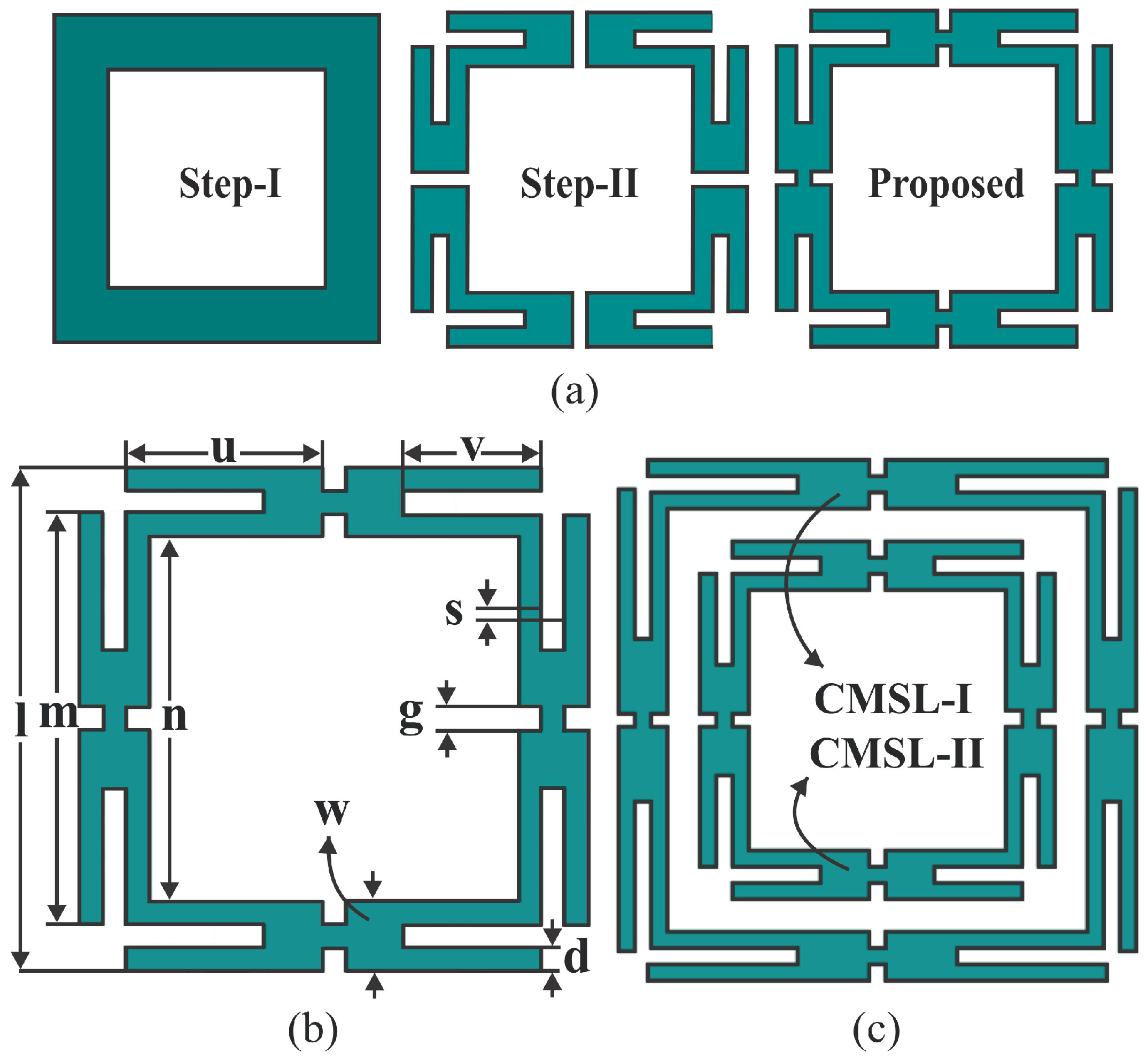
- The anticipated FSS has a compact and simple structure, lightweight, easy fabrication, and provides a cost-effective EMI shielding solution. It outperforms the conventional square loop to accomplish miniaturization and high-angular stability.
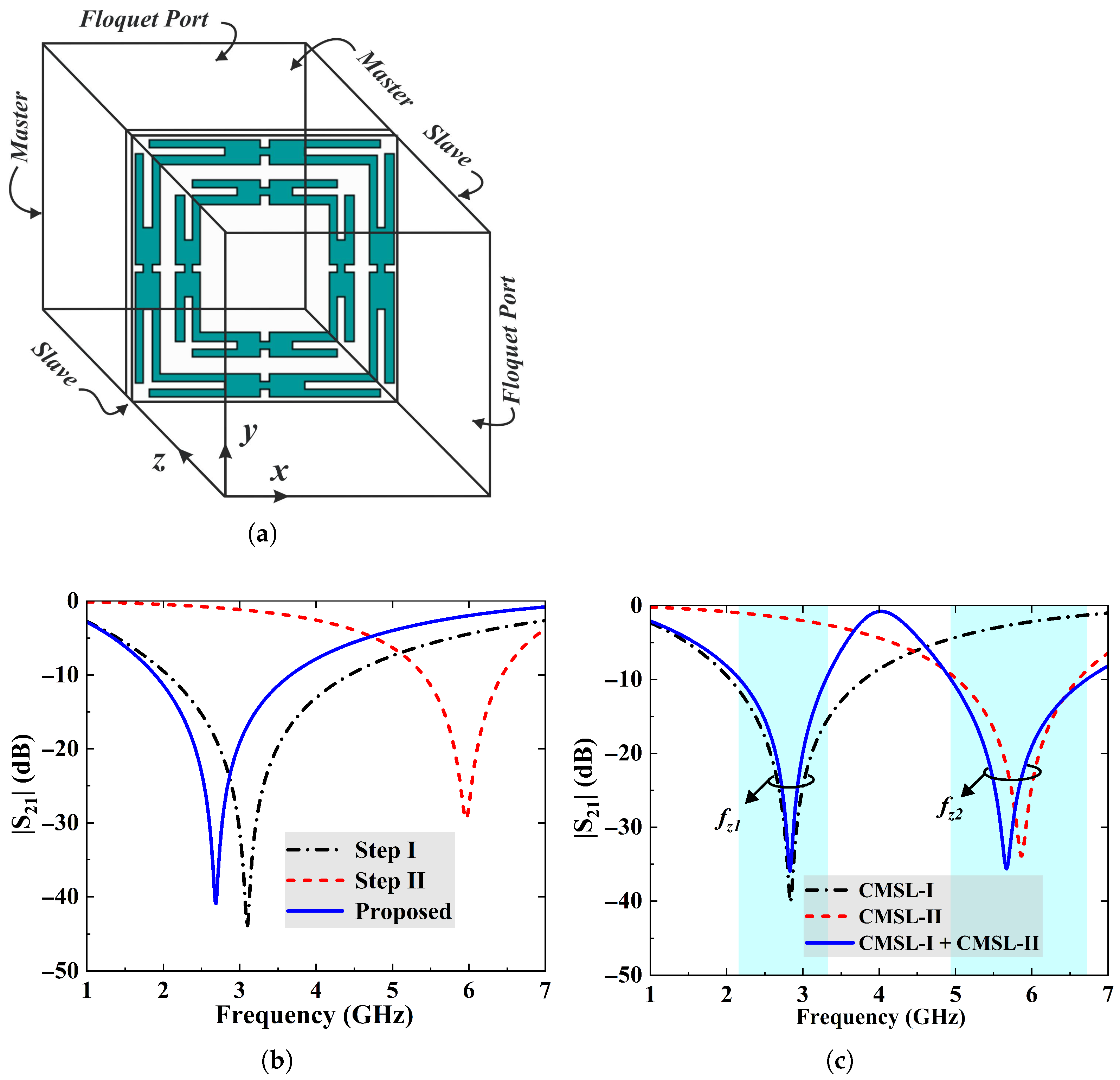
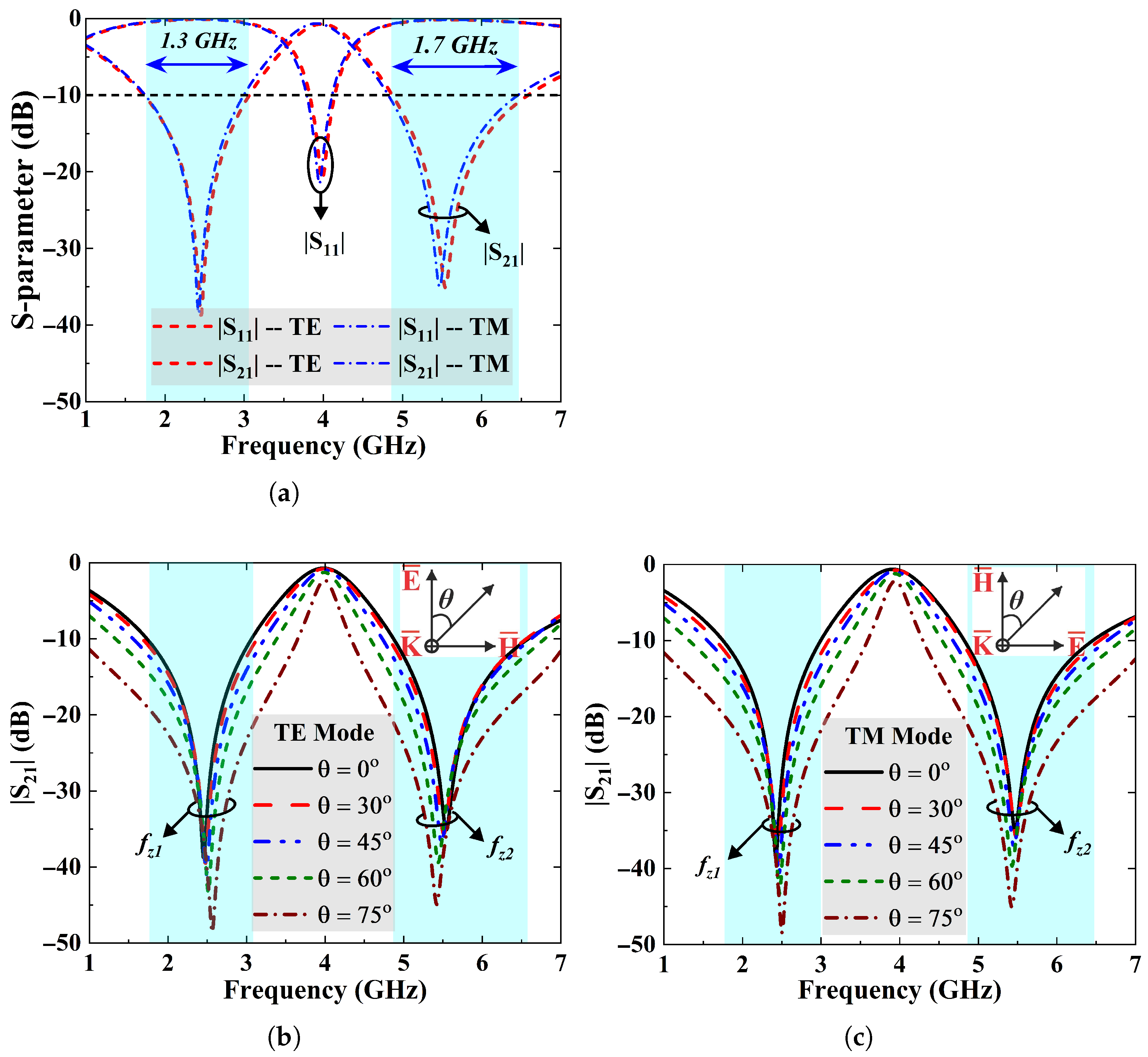
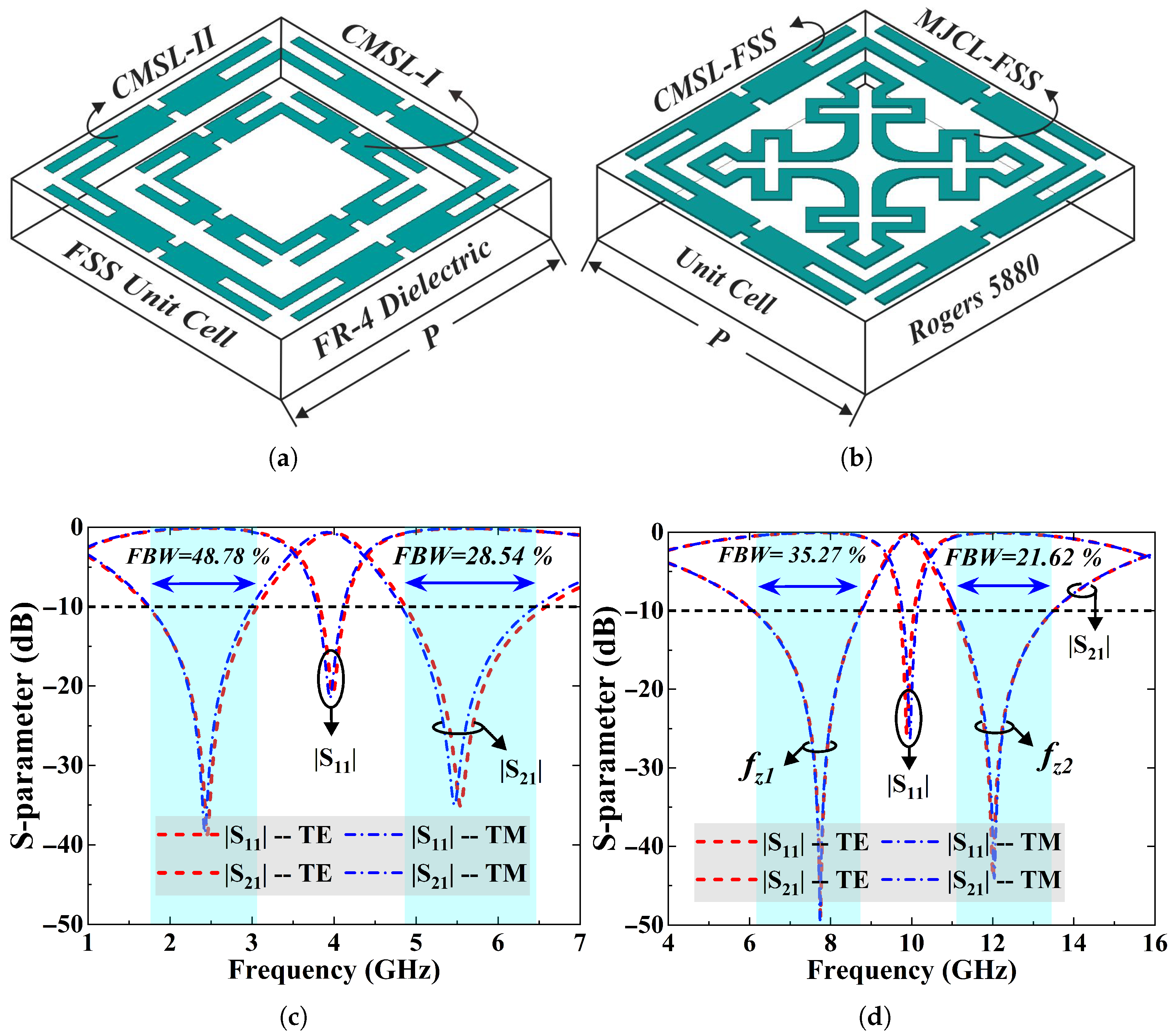
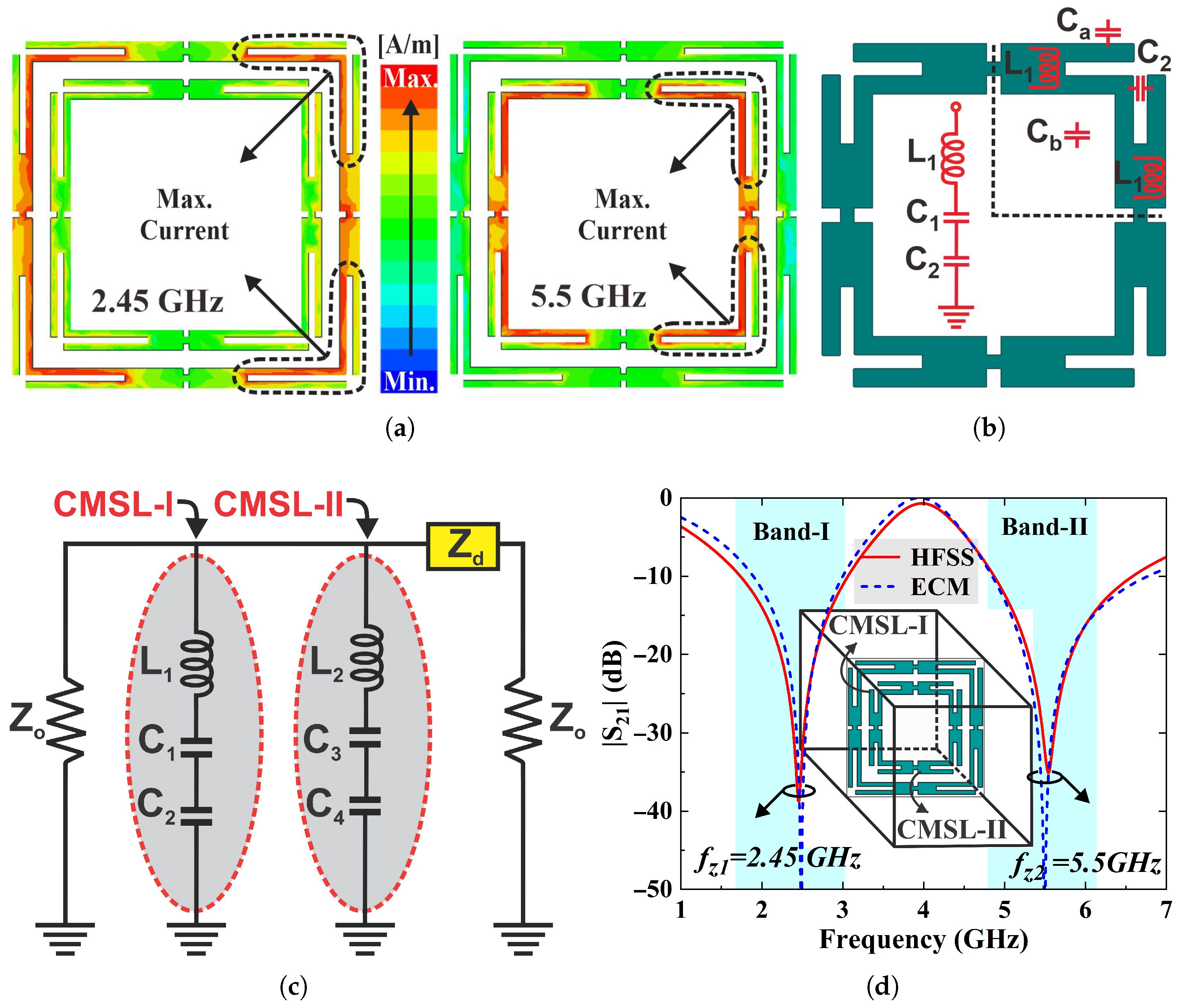
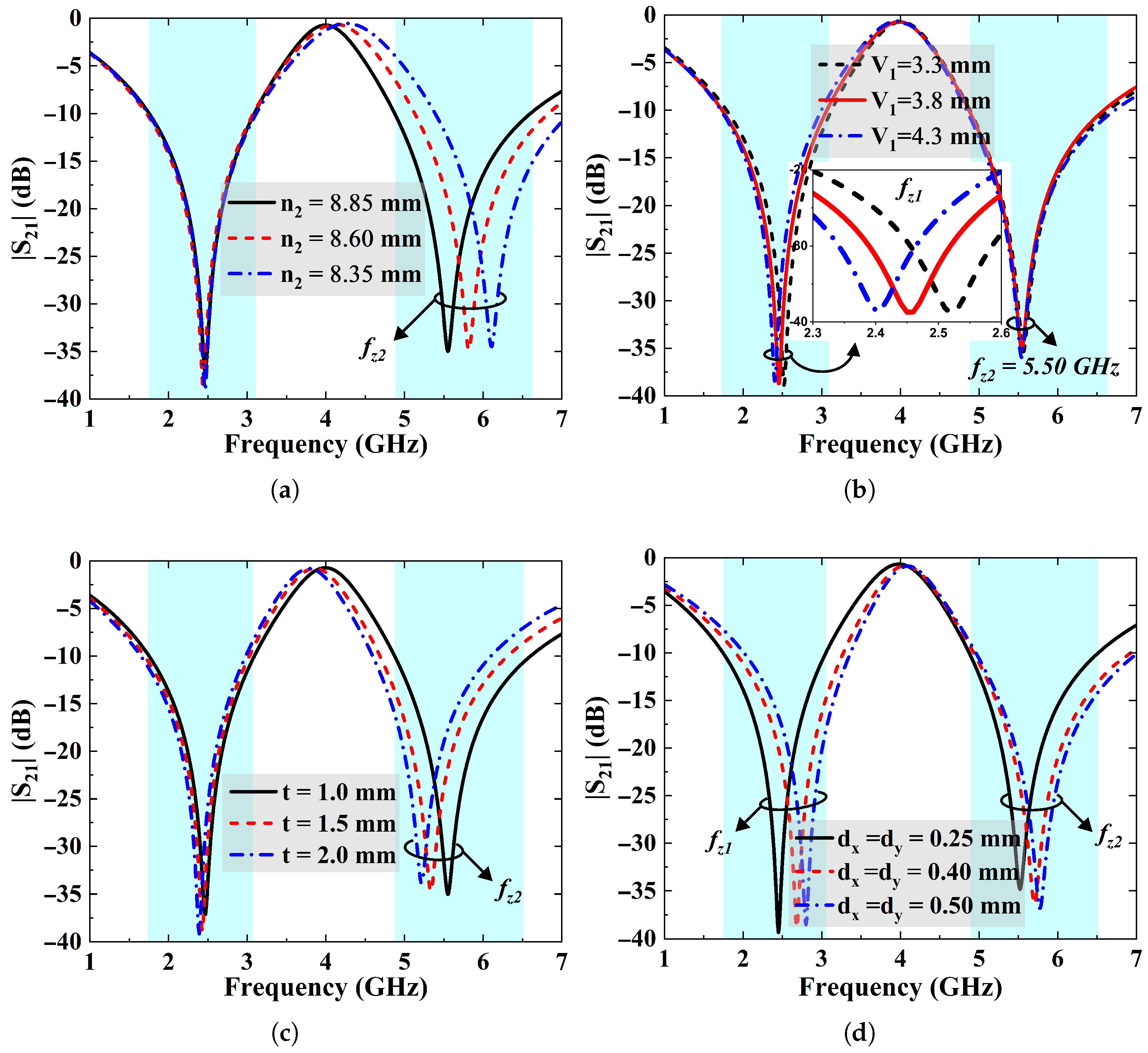
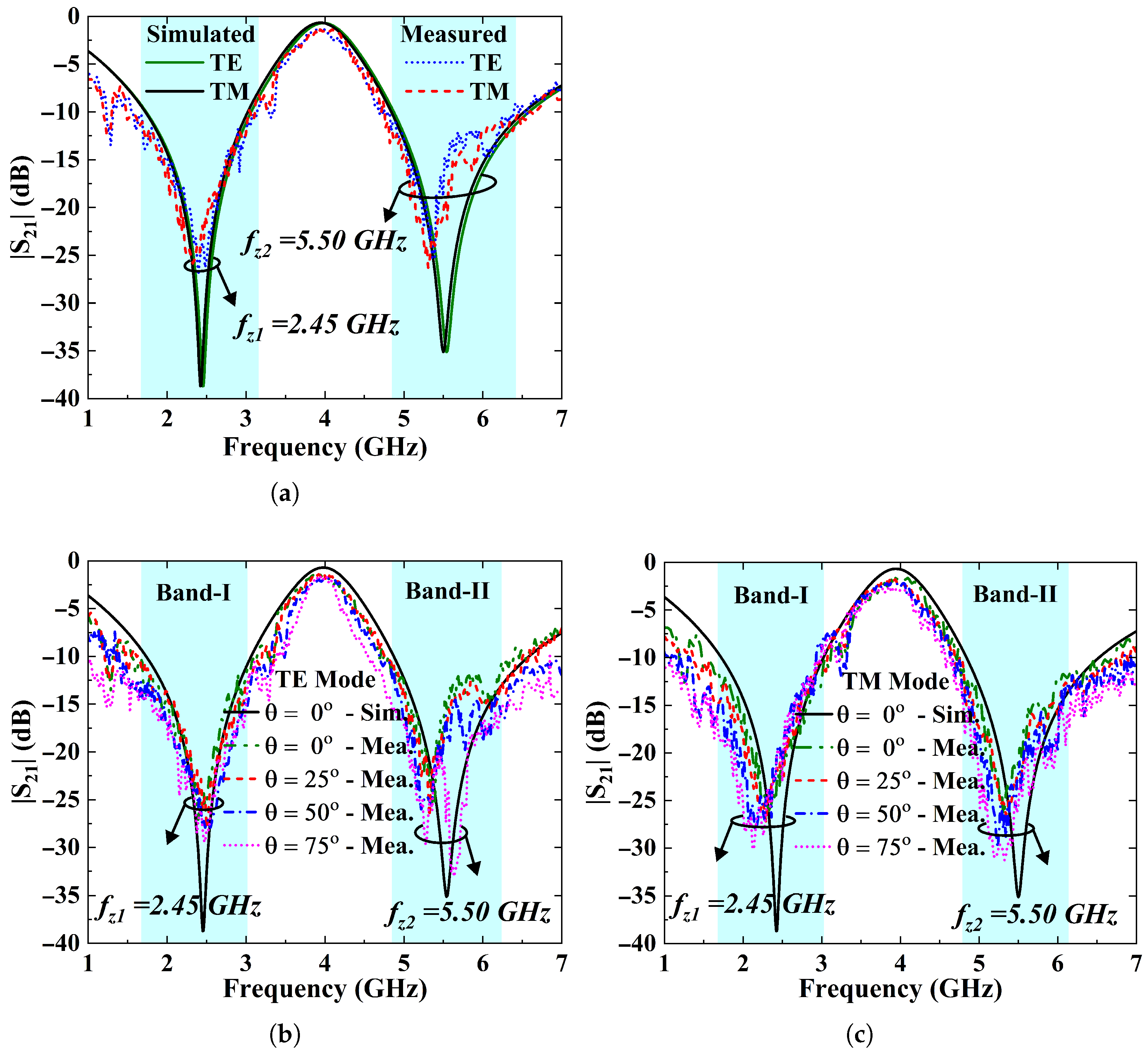
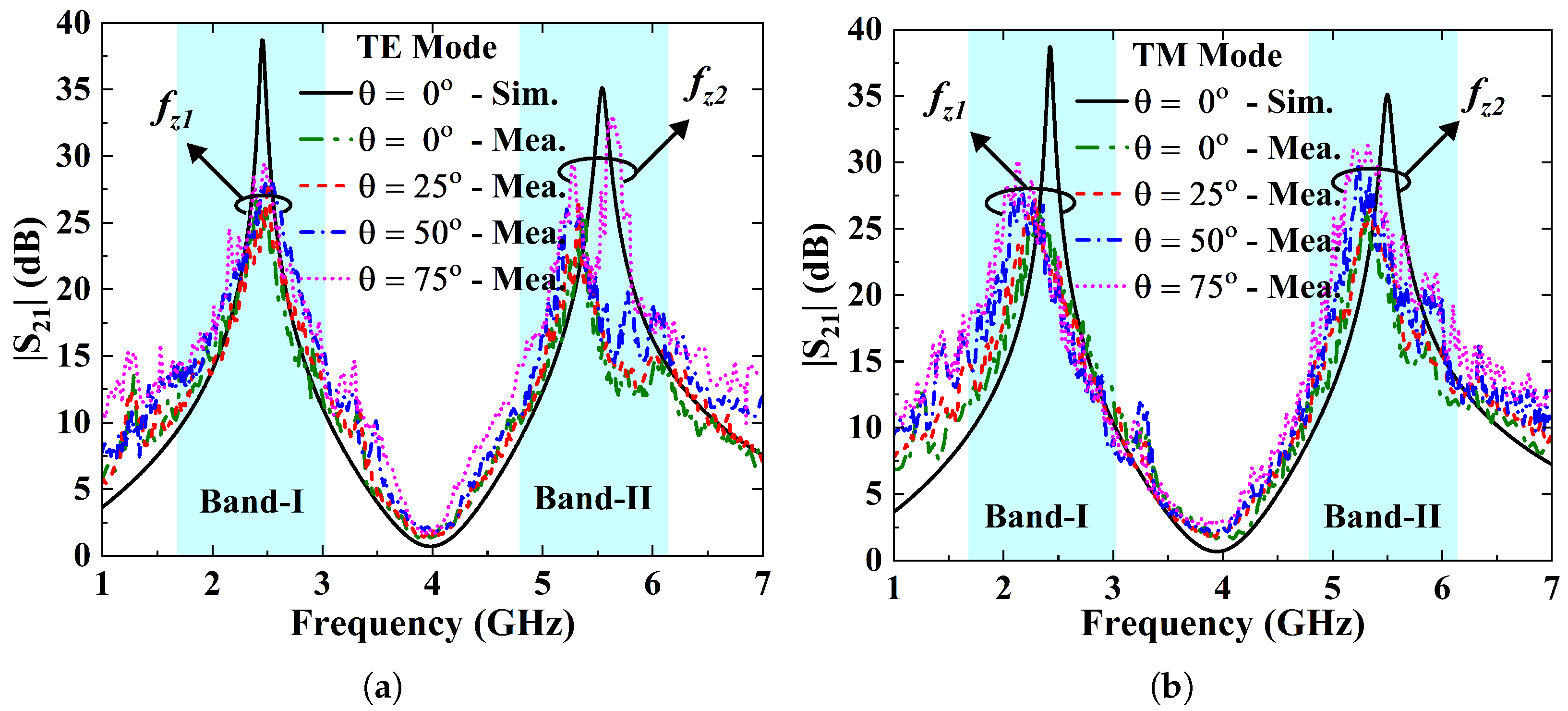
- The FSS is designed based on a capacitance-enhancing technique without using additional lumped elements. It enables the obtaining of miniaturized cell size, high angle stability, and wider suppression bandwidth. The design achieves reflection characteristics at 2.45 GHz WiFi and 5.5 GHz WLAN bands, and a passband at about 4 GHz frequency. It achieves a size reduction of 40.2% and offers wider fractional stop-bandwidth than [23] by 13.5% and 7.0% at the lower and upper bands, respectively.
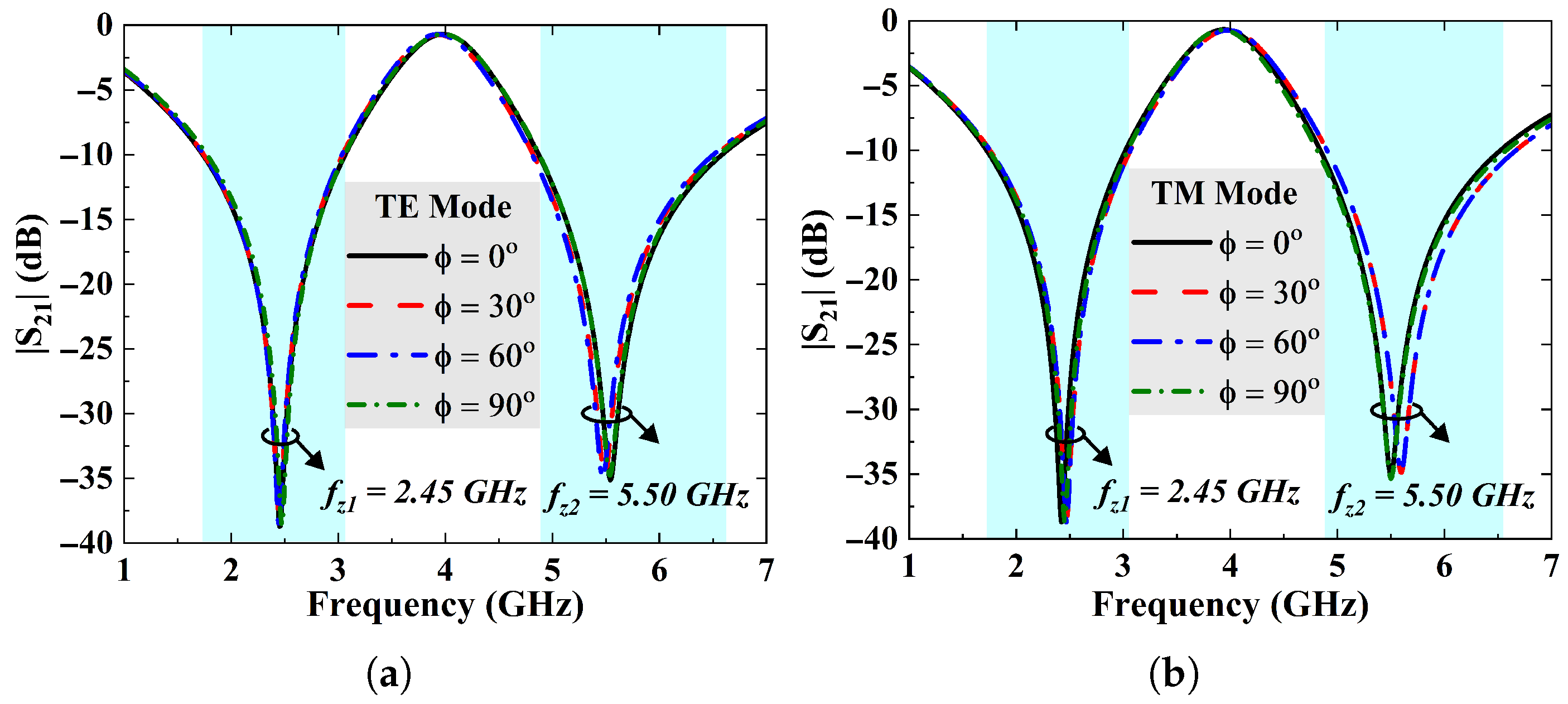
- It overcomes a well-known angular dependence issue that degrades the TM mode performance in many FSS designs [9,16,18,19,21]. The design offers independent control of both operating bands and wide oblique angle stability of up to 75°. It reveals identical spectral characteristics for the TE and TM modes, ensuring complete polarization independence, making it highly versatile in selectively mitigating the undesired EMI.
2. Design of Proposed FSMS
3. Filtering Response of the FSMS
3.1. Angle Stability and Polarization Insensitivity Analysis
3.2. Comparison of the Proposed FSS Structure with the FSS Shield Introduced in [23]
3.3. Surface Current Distribution (J-Surf) Analysis and Equivalent Circuit Model of the FSS Shield

3.4. Parametric Analysis
4. Prototype Fabrication and Experimental Verification
4.1. Fabrication and Test Setup
4.2. Measurement Results
4.3. Shielding Effectiveness (SE)
5. Comparison with Recent Literature
6. Conclusions
Author Contributions
Funding
Institutional Review Board Statement
Informed Consent Statement
Data Availability Statement
Conflicts of Interest
References
- Sheng, X.; Wang, H.; Liu, N.; Wang, K. A Conformal Miniaturized Band-Pass Frequency Selective Surface with Stable Frequency Response for Radome Applications. IEEE Trans. Antennas Propag. 2024, 72, 2423–2433. [Google Scholar] [CrossRef]
- Qu, M.; He, Z.; Su, J.; Nayyeri, V. A Rasorber with Energy-Selective Passband and Ultrawideband Absorptive Out-of-Band. IEEE Trans. Microw. Theory Techn. 2024, 72, 5643–5652. [Google Scholar] [CrossRef]
- Wen, Y.; Wong, S.-W.; Ji, C.; Liu, R.; He, Y. A Hybrid Frequency Selective Absorber with Dual-Polarized Wireless Communication and Ultra-Wideband Absorption. IEEE Open J. Antennas Propag. 2025, 6, 110–119. [Google Scholar] [CrossRef]
- Zhang, P.-P.; Zhao, Y.; Zhu, X.-C.; Chen, R.; Chu, P. A Single-Layer Vialess Polarization Rotation Reflective Surface with High-Frequency Selectivity. IEEE Antennas Wirel. Propag. Lett. 2023, 22, 1089–1093. [Google Scholar] [CrossRef]
- Sheng, X.; Lu, X.; Liu, N.; Liu, Y. Design of Broadband High-Gain Fabry–Pérot Antenna Using Frequency-Selective Surface. Sensors 2022, 22, 9698. [Google Scholar] [CrossRef]
- Chen, Y.; Chernogor, L.F.; Jin, Z.; Zheng, Y.; Yao, Z. Dual-Band Dual-Polarized Antenna Based on TDLS Metasurface for 4G/5G Base Station Applications. IEEE Trans. Circuits Syst. II Exp. Briefs. 2024, 71, 577–581. [Google Scholar] [CrossRef]
- Shi, C.; Zou, J.; Gao, J.; Liu, C. Gain Enhancement of a Dual-Band Antenna with the FSS. Electronics 2022, 11, 2882. [Google Scholar] [CrossRef]
- Idrees, M.; He, Y.; Wen, Y.; Majeed, A. Design of a Miniaturized and Polarization-Independent Frequency-Selective Surface for Targeted EMI Shielding. Appl. Sci. 2025, 15, 4534. [Google Scholar] [CrossRef]
- Hakim, M.L.; Islam, M.T.; Alam, T. Ultra-Miniaturized Conformal Polarization Insensitive and Incident Angle Stable FSS for n257 Band 5G EMI Shielding Applications. IEEE Trans. Antennas Propag. 2024, 72, 7905–7915. [Google Scholar] [CrossRef]
- Idrees, M.; He, Y.; Wong, S.-W.; You, C.; Khalid, S. Band-Notched Polarization-Insensitive Frequency Selective Surface for RF Shielding Applications. In Proceedings of the 2022 IEEE MTT-S International Microwave Workshop Series on Advanced Materials and Processes for RF and THz Applications (IMWS-AMP), Guangzhou, China, 27–29 November 2022; pp. 1–3. [Google Scholar]
- De Sabata, A.; Matekovits, L.; Buta, A.; Dassano, G.; Silaghi, A. Frequency Selective Surface for Ultra-Wide Band Filtering and Shielding. Sensors 2022, 22, 1896. [Google Scholar] [CrossRef]
- Ünaldi, S.; Çimen, S.; Çaiir, G.; Ayten, U.E. A novel dual-band ultrathin FSS with closely settled frequency response. IEEE Antennas Wirel. Propag. Lett. 2017, 16, 1381–1384. [Google Scholar] [CrossRef]
- Lira, R.V.A.; Silva, B.S.; Campos, A.L.P.S.; Neto, A. A Dual-Band Complementary Frequency Selective Surface Combining Structures that Provides Narrow and Wide Stop-Band Frequency Responses. Microw. Opt. Technol. Lett. 2023, 65, 3107–3112. [Google Scholar] [CrossRef]
- Kanagasabai, M.; Viswanathan, L.; Alsath, M.G.N.; Priya, K.H. A Novel Closely Spaced Multiband Complementary Frequency-Selective Surface for Shielding Wireless Communication. IEEE Trans. Electromagn. Compat. 2024, 66, 1917–1921. [Google Scholar] [CrossRef]
- Ali, H.; Riaz, L.; Naeem, U.; Shafique, M.F. A compact band-stop frequency selective surface for dual band Wi-Fi applications. Microw. Opt. Technol. Lett. 2017, 59, 1920–1927. [Google Scholar] [CrossRef]
- Ali, H.; Shafique, M.F.; Riaz, L.; Khan, M.A. A compact stable and angular independent dual band frequency selective surface for Wi-Fi applications. Microw. Opt. Technol. Lett. 2018, 60, 2451–2456. [Google Scholar] [CrossRef]
- Liu, N.; Sheng, X.; Zhang, C.; Fan, J.; Guo, D. A Miniaturized Triband Frequency Selective Surface Based on Convoluted Design. IEEE Antennas Wirel. Propag. Lett. 2017, 16, 2384–2387. [Google Scholar] [CrossRef]
- Venkatesh, G.; Thottappan, M.; Singh, S.P. Highly Angularly Stable Dual-Band Stop FSS for Blocking Satellite Downlink Frequencies. IEEE Trans. Electromagn. Compat. 2022, 64, 2055–2059. [Google Scholar] [CrossRef]
- Farooq, U.; Iftikhar, A.; Shafique, M.F.; Mughal, M.J. A miniaturized and polarization insensitive FSS and CFSS for dual band WLAN applications. AEU Int. J. Electron. Commun. 2019, 105, 124–134. [Google Scholar] [CrossRef]
- Ma, Y.; Wu, W.; Yuan, Y.; Zhang, X.; Yuan, N. A Convoluted Structure for Miniaturized Dual-Bandstop Frequency Selective Surface. IEEE Antennas Wirel. Propag. Lett. 2019, 18, 328–332. [Google Scholar] [CrossRef]
- Jawad, N.; Markley, L. A Single-Layer Frequency Selective Surface with Dual Wideband Band-Stop Response. IEEE Antennas Wirel. Propag. Lett. 2020, 19, 916–920. [Google Scholar] [CrossRef]
- Dey, S.; Dey, S. Conformal Multifunction FSS with Enhanced Capacitance Loading for High Angle Stable Stopband Filtering and Microwave Absorption. IEEE Trans. Electromagn. Compat. 2022, 64, 315–326. [Google Scholar] [CrossRef]
- Idrees, M.; He, Y.; Ullah, S.; Wong, S.W. A dual-band polarization-insensitive frequency selective surface for electromagnetic shielding applications. Sensors 2024, 24, 3333. [Google Scholar] [CrossRef]
- Farooq, U.; Iftikhar, A.; Shafique, M.F.; Babar Abbasi, M.A.; Clendinning, S.; Fida, A.; Mughal, M.J.; Khan, M.S. Ultraminiaturised polarisation selective surface (PSS) for dual-band Wi-Fi and WLAN shielding applications. IET Microw. Antennas Propag. 2020, 14, 1514–1521. [Google Scholar] [CrossRef]
- Chen, X.; Liu, T.; Guo, D.; Zhu, H. Design of single-layer bandstop fractal frequency selective surface based on WLAN applications. Microw. Opt. Technol. Lett. 2024, 66, e33880. [Google Scholar] [CrossRef]
- Khajevandi, S.; Oraizi, H.; Poordaraee, M. Design of Planar Dual-Bandstop FSS Using Square-Loop-Enclosing Superformula Curves. IEEE Antennas Wirel. Propag. Lett. 2018, 17, 731–734. [Google Scholar] [CrossRef]
- Hussaini, M.A.; Sulaiman, M.I.; Kiani, G.I.; Khan, J. Frequency selective window blinds for indoor WLAN shielding. Microw. Opt. Technol. Lett. 2024, 66, e33926. [Google Scholar] [CrossRef]
- Wang, H.; Qu, S.; Wang, J.; Yan, M.; Zheng, L. Dual-band miniaturised FSS with stable resonance frequencies of 3.4/4.9 GHz for 5G communication systems applications. IET J. Microw. Antennas Propag. 2020, 14, 1–6. [Google Scholar] [CrossRef]
- Qin, T.; Huang, C.; Cai, Y.; Lin, X. Dual-Band Frequency Selective Surface with Different Polarization Selectivity for Wireless Communication Application. Sensors 2023, 23, 4264. [Google Scholar] [CrossRef]
- Munk, B.A. Frequency Selective Surfaces: Theory and Design; Wiley: Hoboken, NJ, USA, 2005. [Google Scholar]
- Dey, S.; Dey, S. Conformal Miniaturized Angular Stable Triband Frequency Selective Surface for EMI Shielding. IEEE Trans. Electromagn. Compat. 2022, 64, 1031–1041. [Google Scholar] [CrossRef]
- Costa, F.; Monorchio, A.; Manara, G. Efficient analysis of frequency-selective surfaces by a simple equivalent-circuit model. IEEE Antennas Propag. Mag. 2012, 54, 35–48. [Google Scholar] [CrossRef]
- Costa, F.; Monorchio, A.; Manara, G. An overview of equivalent circuit modeling techniques of frequency selective surfaces and metasurfaces. Appl. Comput. Electromagn. Soc. J. 2014, 29, 960–976. [Google Scholar]
- Bagci, F.; Mulazimoglu, C.; Can, S.; Karakaya, E.; Yilmaz, A.E.; Akaoglu, B. A glass based dual band frequency selective surface for protecting systems against WLAN signals. AEU Int. J. Electron. Commun. 2017, 82, 426–434. [Google Scholar] [CrossRef]
- Celozzi, S.; Araneo, R.; Lovat, G. Electromagnetic Shielding; Wiley-IEEE Press: New York, NY, USA, 2008. [Google Scholar]
- Ferreira, D.; Cuinas, I.; Caldeirinha, R.F.; Fernandes, T.R. Dual-band single-layer quarter ring frequency selective surface for Wi-Fi applications. IET Microw. Antennas Propag. 2016, 10, 435–441. [Google Scholar] [CrossRef]



| CMSL-I | CMSL-II | ||||||
|---|---|---|---|---|---|---|---|
| Variable | Value | Variable | Value | Variable | Value | Variable | Value |
| d1 | 0.25 | s1 | 0.25 | d2 | 0.25 | s2 | 0.25 |
| g1 | 0.25 | u1 | 6.0 | g2 | 0.25 | u2 | 6.0 |
| l1 | 13.25 | v1 | 3.8 | l2 | 13.25 | v2 | 3.8 |
| m1 | 12.25 | w1 | 0.75 | m2 | 12.25 | w2 | 0.75 |
| n1 | 11.75 | P | 13.5 | n2 | 11.75 | dx = dy | 0.5 |
| Angle (θ°) | Attenuation Level (dB) | Fractional Bandwidth (%) | ||||||
|---|---|---|---|---|---|---|---|---|
| Band-I | Band-II | Band-I | Band-II | |||||
| TE | TM | TE | TM | TE | TM | TE | TM | |
| 0 | 38.07 | 38.82 | 35.26 | 35.41 | 48.78 | 51.35 | 28.52 | 28.87 |
| 30 | 38.85 | 39.91 | 35.83 | 35.76 | 54.17 | 56.36 | 30.04 | 30.56 |
| 45 | 40.24 | 41.27 | 36.98 | 37.24 | 62.57 | 67.78 | 32.94 | 34.72 |
| 60 | 42.93 | 43.76 | 39.47 | 39.74 | 80.33 | 84.97 | 39.14 | 40.84 |
| 75 | 48.35 | 49.13 | 44.87 | 44.68 | 120.53 | 123.07 | 49.95 | 51.34 |
| CMSL-I | CMSL-II | ||||
|---|---|---|---|---|---|
| 1.12 nH | 6.9 pF | 7.8 pF | 0.72 nH | 2.32 pF | 2.34 pF |
| Ref. No. | Unit Cell Periodicity | Substrate Material | Operating Bands | SE (dB) Band-I/II | FBW (%) Band-I/II | Angle Stability | TM Mode Stability | Polarization Insensitive |
|---|---|---|---|---|---|---|---|---|
| [13] | 0.16 × 0.16 | FR-4 | 2.5/5.5 | 35/30 | 35/30 | 45° | Yes | Yes |
| [15] | 0.33 × 0.33 | FR-4 | 2.41/5.71 | NR | NR | 30° | N/A | NR |
| [19] | 0.11 × 0.11 | FR-4 | 2.4/5.9 | 38/32 | 18/10.3 | 45° | N/A | Yes |
| [21] | 0.25 × 0.25 | PET and Paper | 2.1/5.1 | 22/20 | 24.5/9.4 | 45° | N/A | NR |
| [23] | 0.18 × 0.18 | Rogers 5880 | 7.8/11.9 | 48.7/49.0 | 35.2/21.6 | 75° | Yes | Yes |
| [24] | 0.06 × 0.06 | FR-4 | 2.5/5.45 | 32/33 | 24/21.6 | 60° | Yes | Yes |
| [25] | 0.12 × 0.12 | Float glass | 2.4/5.4 | N/A | 39.6/30.5 | 60° | N/A | NR |
| [27] | 0.20 × 0.20 | Polyester | 2.4/5.0 | 35/42 | 20.7/13.6 | 60° | N/A | Yes |
| [36] | 0.31 × 0.31 | FR-4 | 2.4/5.2 | 45/43 | NR | 45° | N/A | NR |
| This Work | 0.11 × 0.11 | FR-4 | 2.45/5.5 | 38.1/35.2 | 48.7/28.5 | 75° | Yes | Yes |
Disclaimer/Publisher’s Note: The statements, opinions and data contained in all publications are solely those of the individual author(s) and contributor(s) and not of MDPI and/or the editor(s). MDPI and/or the editor(s) disclaim responsibility for any injury to people or property resulting from any ideas, methods, instructions or products referred to in the content. |
© 2025 by the authors. Licensee MDPI, Basel, Switzerland. This article is an open access article distributed under the terms and conditions of the Creative Commons Attribution (CC BY) license (https://creativecommons.org/licenses/by/4.0/).
Share and Cite
Idrees, M.; Wong, S.-W.; Majeed, A.; Zhang, S.-Q.; He, Y. A Miniaturized Dual-Band Frequency Selective Surface with Enhanced Capacitance Loading for WLAN Applications. Sensors 2025, 25, 7421. https://doi.org/10.3390/s25247421
Idrees M, Wong S-W, Majeed A, Zhang S-Q, He Y. A Miniaturized Dual-Band Frequency Selective Surface with Enhanced Capacitance Loading for WLAN Applications. Sensors. 2025; 25(24):7421. https://doi.org/10.3390/s25247421
Chicago/Turabian StyleIdrees, Muhammad, Sai-Wai Wong, Abdul Majeed, Shu-Qing Zhang, and Yejun He. 2025. "A Miniaturized Dual-Band Frequency Selective Surface with Enhanced Capacitance Loading for WLAN Applications" Sensors 25, no. 24: 7421. https://doi.org/10.3390/s25247421
APA StyleIdrees, M., Wong, S.-W., Majeed, A., Zhang, S.-Q., & He, Y. (2025). A Miniaturized Dual-Band Frequency Selective Surface with Enhanced Capacitance Loading for WLAN Applications. Sensors, 25(24), 7421. https://doi.org/10.3390/s25247421