Robust Navigation in Multipath Environments Using GNSS/UWB/INS Integration with Anchor Position Estimation Toward eVTOL Operations

Abstract
1. Introduction
2. Range Estimation Using Time of Flight Technology
3. Anchor Position Estimation
4. GNSS/UWB/INS Combined Navigation Overview
- State Equation
- Observation Equation
5. Outdoor Positioning Experiment
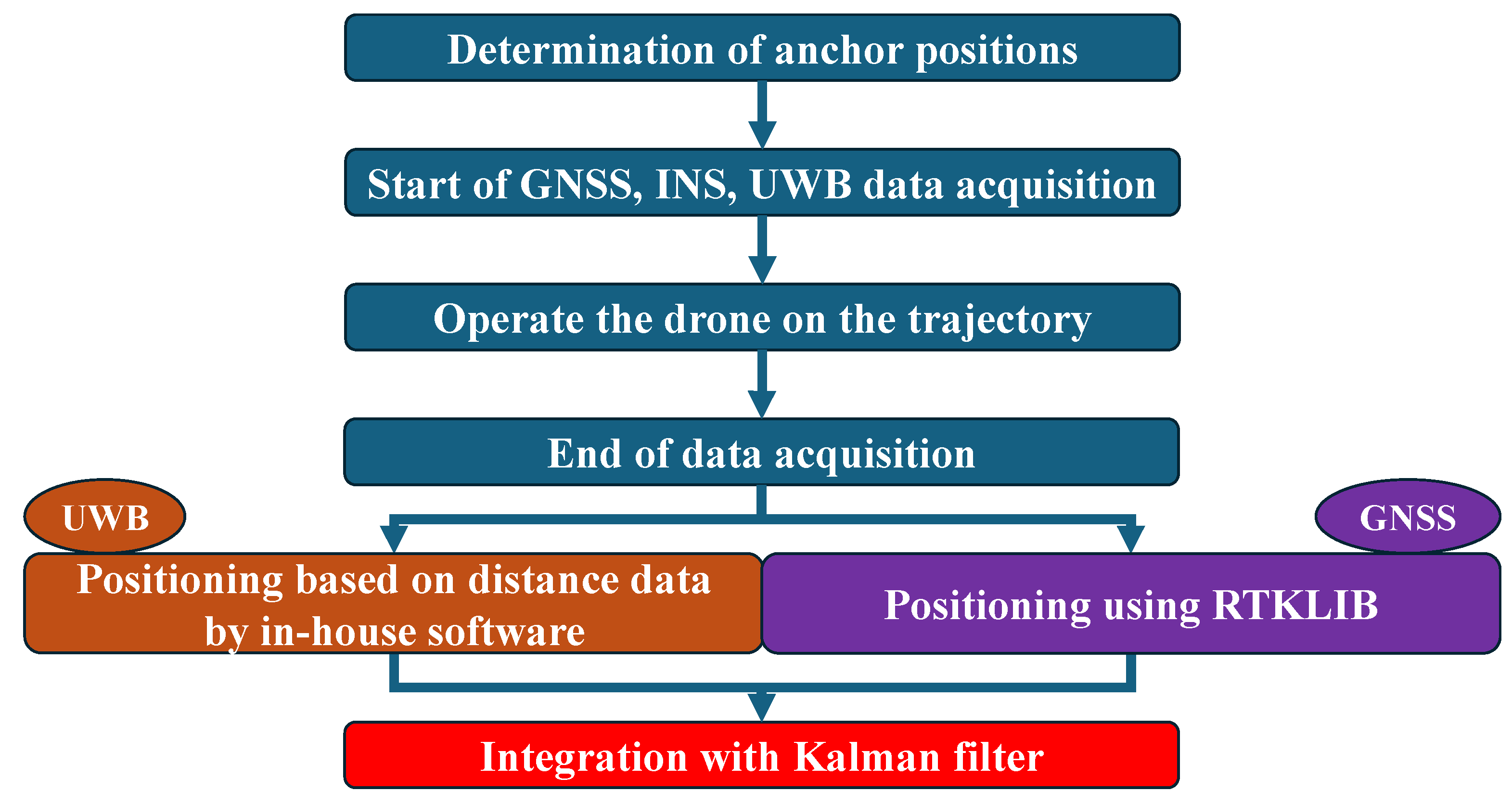
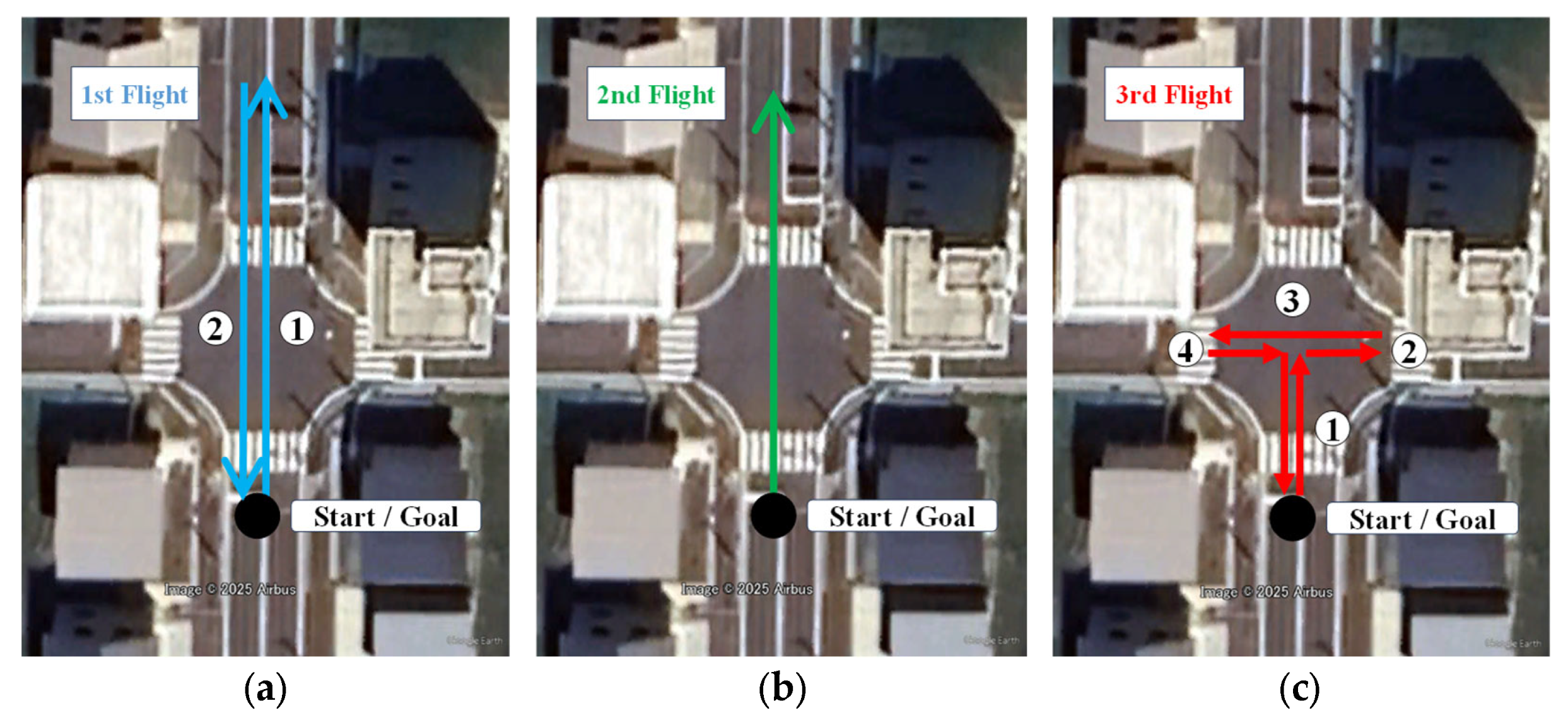
5.1. Experimental Objective and Methods
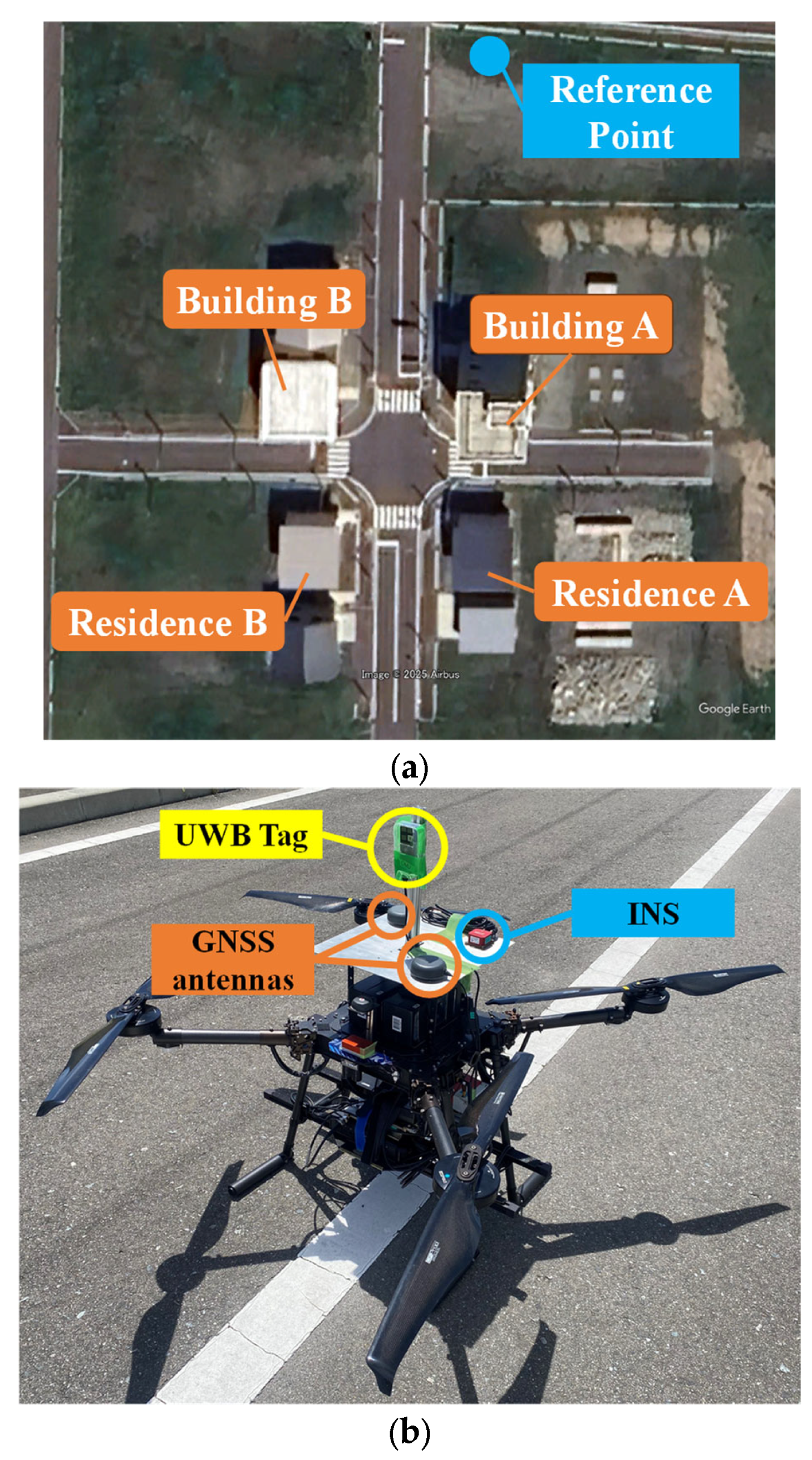
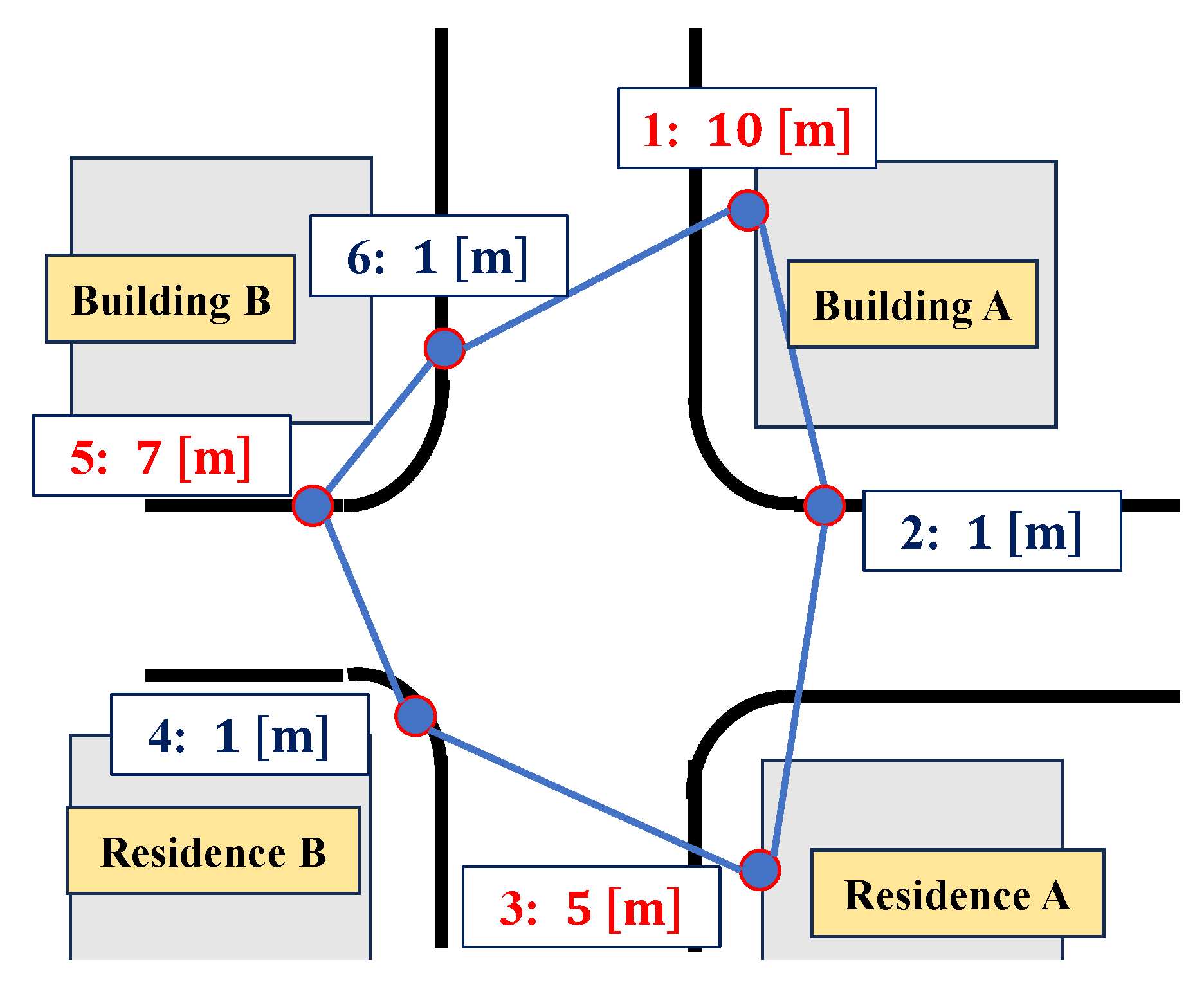
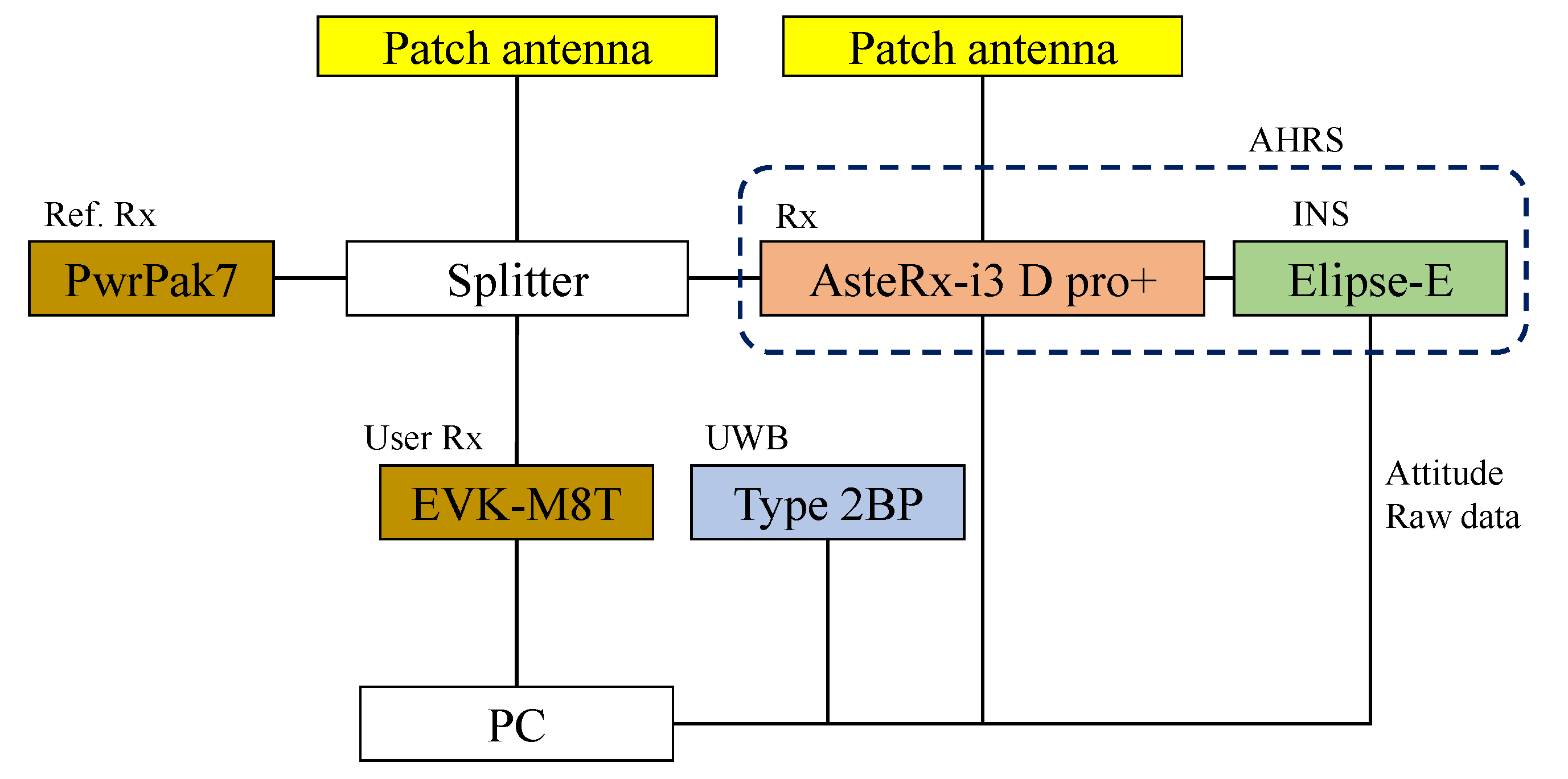
5.2. Experimental Setup
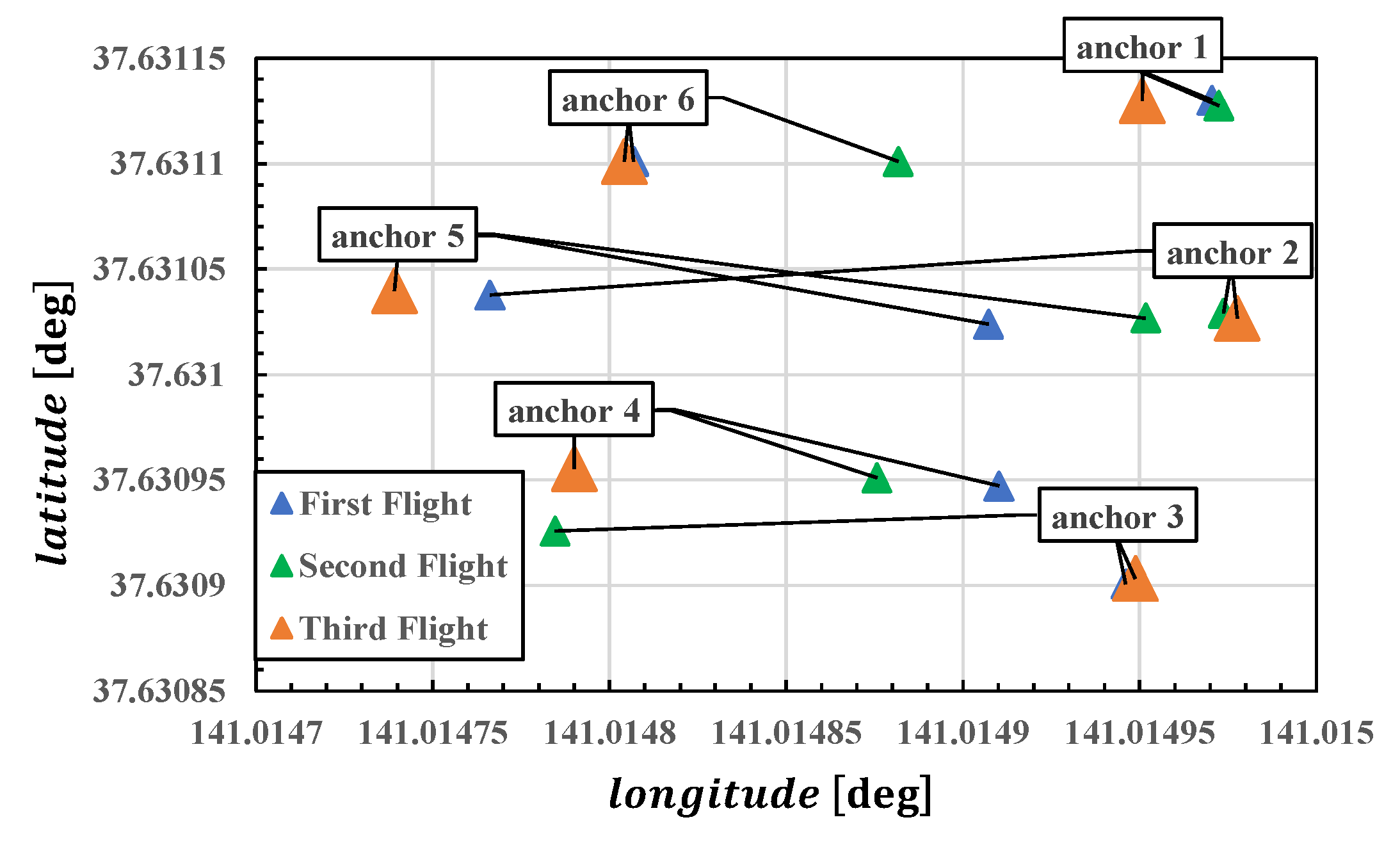
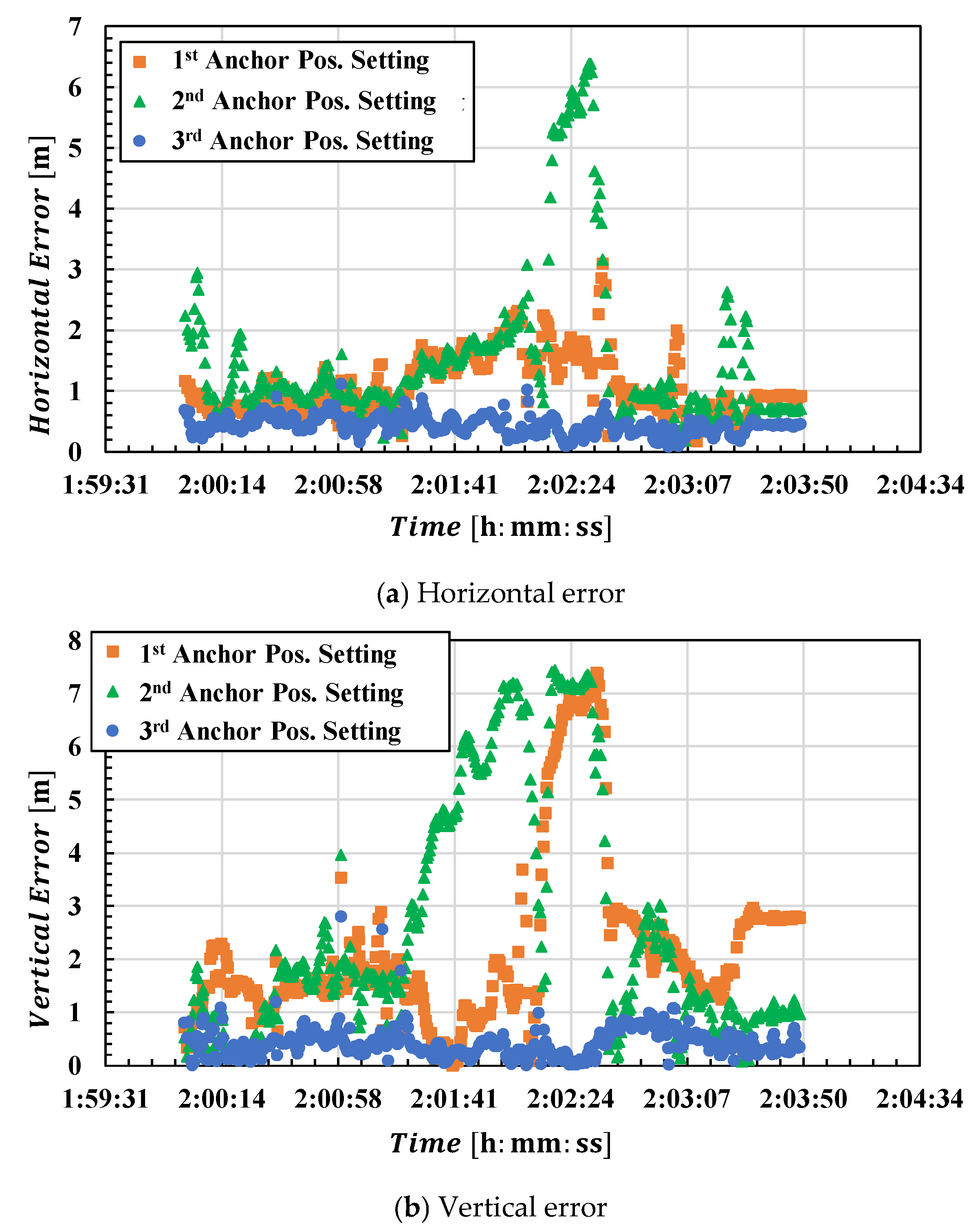
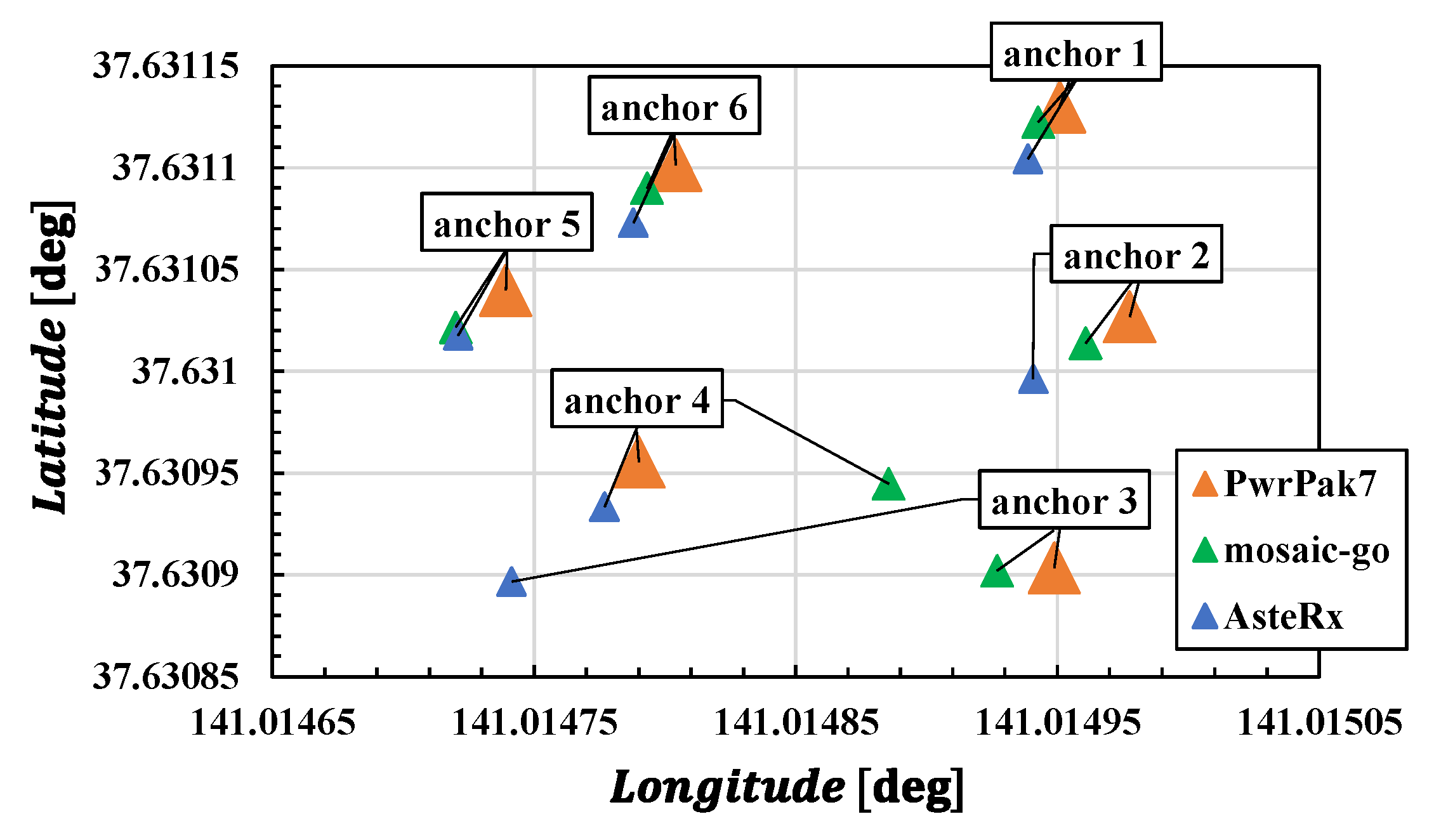
5.3. Results and Analysis
6. Conclusions
Author Contributions
Funding
Data Availability Statement
Acknowledgments
Conflicts of Interest
Abbreviations
| GNSS-RTK | GNSS–Real-Time Kinematic |
| AHRS | Attitude Heading Reference System |
| NLOS | Non-Light Of Sight |
References
- Federal Aviation Administration. Engineering Brief No. 105A, Vertiport Design, Supplemental Guidance to Advisory Circular 150/5390-2D, Heliport Design; U.S. Department of Transportation: Washington, DC, USA, 2024. [Google Scholar]
- Stouffer, V.L.; Cotton, W.B.; DeAngelis, R.A.; Devasirvatham, D.M.; Irvine, T.B.; Jennings, R.E.; Lehmer, R.D.; Nguyen, T.C.; Shaver, M. Reliable, Secure, and Scalable Communications, Navigation, and Surveillance Options for Urban Air Mobility (UAM); NASA Glenn Research Center: Cleveland, OH, USA, 2020; Contract Number GS00Q14OADU130, Delivery Order 80GRC019D0017. [Google Scholar]
- Lu, Y.; Zeng, W.; Wei, W.; Wu, W.; Jiang, H. Vertiport Location Selection and Optimization for Urban Air Mobility in Complex Urban Scenes. Aerospace 2025, 12, 709. [Google Scholar] [CrossRef]
- U.S. Department of Defense. Global Positioning System Standard Positioning Service (SPS) Performance Standard (5th ed.). 2020. Available online: https://www.navcen.uscg.gov/sites/default/files/pdf/gps/geninfo/2020SPSPerformanceStandardFINAL.pdf (accessed on 17 October 2025).
- Kwon, B.; Yoo, H.; Han, S.; Jang, B.-J. Implementation of High-speed Indoor Positioning System based on IEEE802.15.4z UWB. In Proceedings of the Work-in-Progress Papers at the 13th International Conference on Indoor Positioning and Indoor Navigation (IPIN-WIP 2023), Nuremberg, Germany, 25–28 September 2023; Available online: https://ceur-ws.org/Vol-3581/ (accessed on 17 October 2025).
- Pagès, G.; Vilà-Valls, J. UWB-based Indoor Navigation with Uncertain Anchor Nodes Positioning. In Proceedings of the 32nd International Technical Meeting of the Satellite Division of the Institute of Navigation (ION GNSS+ 2019), Miami, FL, USA, 16–20 September 2019; Institute of Navigation: Manassas, VA, USA; pp. 2598–2610. [Google Scholar] [CrossRef]
- Jao, C.-S.; Abdallah, A.A.; Chen, C.; Seo, M.; Kia, S.S.; Kassas, Z.M.; Shkel, A.M. Sub-Meter Accurate Pedestrian Indoor Navigation System with Dual ZUPT-Aided INS, Machine Learning-Aided LTE, and UWB Signals. In Proceedings of the 35th International Technical Meeting of the Satellite Division of the Institute of Navigation (ION GNSS+ 2022), Denver, CO, USA, 19–23 September 2022; Institute of Navigation: Manassas, VA, USA; pp. 1108–1126. [Google Scholar] [CrossRef]
- Al-Okby, M.F.R.; Junginger, S.; Roddelkopf, T.; Thurow, K. UWB-Based Real-Time Indoor Positioning Systems: A Comprehensive Review. Appl. Sci. 2024, 14, 11005. [Google Scholar] [CrossRef]
- Bi, J.; Wang, J.; Cao, H.; Yao, G.; Wang, Y.; Li, Z.; Sun, M.; Yang, H.; Zhen, J.; Zheng, G. Inverse distance weight-assisted particle swarm optimized indoor localization. Appl. Soft Comput. 2024, 164, 112032. [Google Scholar] [CrossRef]
- Xu, X.; Che, X.; Meng, X.; Li, L.; Liu, Z.; Shao, S. WIPIHT: A WiFi-Based Position-Independent Passive Indoor Human Tracking System. Sensors 2025, 25, 3936. [Google Scholar] [CrossRef] [PubMed]
- Chen, Y.; Wang, Y.; Zhao, Y. A Room-Level Indoor Localization Using an Energy-Harvesting BLE Tag. Electronics 2024, 13, 4493. [Google Scholar] [CrossRef]
- Li, P.; Singh, J.; Cui, H.; Boano, C.A. BmmW: A DNN-based joint BLE and mmWave radar system for accurate 3D localization with goal-oriented communication. Pervasive Mob. Comput. 2024, 102, 101944. [Google Scholar] [CrossRef]
- Campaña Bastidas, S.E.; Espinilla Estévez, M.; Medina Quero, J. Review of ultra wide band (UWB) for indoor positioning with application to the elderly. In Proceedings of the 55th Hawaii International Conference on System Science (HICSS), Maui, HI, USA, 4–7 January 2022; pp. 2145–2154. [Google Scholar]
- He, S.; Chan, S.H.G. A survey of indoor positioning systems for wireless devices. IEEE Commun. Surv. Tutor. 2016, 18, 420–440. [Google Scholar] [CrossRef]
- Lee, C.; Kim, E. Tightly Coupled GNSS/IMU/UWB Kalman Filter Supporting UAS Autoland in GNSS Harsh Environment. In Proceedings of the 35th International Technical Meeting of the Satellite Division of the Institute of Navigation (ION GNSS+ 2022), Denver, CO, USA, 19–23 September 2022; Institute of Navigation: Manassas, VA, USA; pp. 1326–1337. [Google Scholar] [CrossRef]
- Sun, Z.; Gao, W.; Tao, X.; Pan, S.; Wu, P.; Huang, H. Semi-Tightly Coupled Robust Model for GNSS/UWB/INS Integrated Positioning in Challenging Environments. Remote Sens. 2024, 16, 2108. [Google Scholar] [CrossRef]
- Wang, J.; Gao, Y.; Li, Z.; Meng, X.; Hancock, C.M. A Tightly-Coupled GPS/INS/UWB Cooperative Positioning Sensors System Supported by V2I Communication. Sensors 2016, 16, 944. [Google Scholar] [CrossRef] [PubMed]
- Villien, C.; Denis, B. UWB-aided GNSS/INS Fusion for Resilient Positioning in GNSS Challenged Environments. In Proceedings of the 2022 IEEE 96th Vehicular Technology Conference (VTC2022-Fall), London, UK, 26–29 September 2022; pp. 1–7. Available online: https://ieeexplore.ieee.org/document/10139961 (accessed on 29 September 2025).
- Neirynck, D.; Luk, E.; McLaughlin, M. An alternative double-sided two-way ranging method. In Proceedings of the 2016 13th Workshop on Positioning, Navigation and Communications (WPNC), Bremen, Germany, 19–20 October 2016; Available online: https://ieeexplore.ieee.org/document/7822844 (accessed on 18 November 2023).
- Tsujii, T.; Harigae, M.; Barnes, J.; Wang, J.; Rizos, C. Experiments of Inverted Pseudolite Positioning for Airship-Based GPS Augmentation System. In Proceedings of the 15th International Technical Meeting of the Satellite Division of The Institute of Navigation, Portland, OR, USA, 24–27 September 2002; pp. 1689–1695. [Google Scholar]
- Dai, L.; Wang, J.; Tsujii, T.; Rizos, C. Inverted Pseudolite Positioning and its Applications. Surv. Rev. 2002, 36, 602–611. [Google Scholar] [CrossRef]
- Wen, W.; Pfeifer, T.; Bai, X.; Hsu, L.-T. “Factor graph optimization for GNSS/INS integration: A comparison with the extended Kalman filter,” NAVIGATION. J. Inst. Navig. 2021, 68, 315–331. [Google Scholar] [CrossRef]
- Hu, X.; Assaad, R.H. Cloud-Enabled Indoor Thermal Comfort Assessment and Visualization Using Digital Twins, IoT, Robotics, and Indoor Positioning Technology. In Computing in Civil Engineering 2023; American Society of Civil Engineers: Reston, VA, USA, 2023; pp. 807–814. [Google Scholar] [CrossRef]
- Angarano, S. Deep Learning Methodologies for UWB Ranging Error Compensation. Master’s Thesis, Politecnico di Torino, Turin, Italy, 2020. Available online: https://webthesis.biblio.polito.it/15875/ (accessed on 6 October 2025).
- Takasu, T. RTKLIB: An Open Source Program Package for GNSS Positioning. Available online: https://www.rtklib.com/ (accessed on 20 June 2025).
- Fukushima Prefecture. Indoor Testing Field. Fukushima Robot Test Field. Available online: https://www.fipo.or.jp/robot/facility/detail#in (accessed on 3 August 2025).



| Parameter | ||
|---|---|---|
| Value |
| No. | Latitude [Deg] | Longitude [Deg] | Altitude [m] |
|---|---|---|---|
| 1 | |||
| 2 | |||
| 3 | |||
| 4 | |||
| 5 | |||
| 6 |
| No. Flight | Anchor Position Error Relative to the Anchor Position Calculated from the Third Flight Data | ||
|---|---|---|---|
| E [m] | N [m] | U [m] | |
| 1 | |||
| 2 | |||
| Receiver | Tag Pos. Error (RMSE) [m] | Percentage of Number of Solutions Relative to PwrPak7 Data [%] | |
|---|---|---|---|
| Horizontal | Vertical | ||
| AsteRx-i3 D pro+ | |||
| mosaic-go | |||
| Receiver | Anchor Pos. Error Relative to the Anchor Position Calculated from the PwrPak7 Data | ||
|---|---|---|---|
| E [m] | N [m] | U [m] | |
| AsteRx-i3 D pro+ | |||
| mosaic-go | |||
| No. Flight | Type | Positioning RMSE [m] | Max Error [m] | ||
|---|---|---|---|---|---|
| Horizontal | Vertical | Horizontal | Vertical | ||
| 1 | GNSS/INS | ||||
| GNSS/UWB/INS | |||||
| Improvement [%] | |||||
| 2 | GNSS/INS | ||||
| GNSS/UWB/INS | |||||
| Improvement [%] | |||||
| 3 | GNSS/INS | ||||
| GNSS/UWB/INS | |||||
| Improvement [%] | |||||
| No. Flight | Type | Positioning RMSE [m] | Max Error [m] | ||
|---|---|---|---|---|---|
| Horizontal | Vertical | Horizontal | Vertical | ||
| 1 | Before NLOS exclusion | ||||
| After NLOS exclusion | |||||
| Improvement (After NLOS exclusion vs. before NLOS exclusion) [%] | |||||
| No. Flight | Anchor Position Calculation Method | Positioning RMSE | |
|---|---|---|---|
| Horizontal [m] | Vertical [m] | ||
| 1 | GNSS | ||
| Estimated | |||
| Improvement [%] | |||
| 2 | GNSS | ||
| Estimated | |||
| Improvement [%] | |||
| 3 | GNSS | ||
| Estimated | |||
| Improvement [%] | |||
Disclaimer/Publisher’s Note: The statements, opinions and data contained in all publications are solely those of the individual author(s) and contributor(s) and not of MDPI and/or the editor(s). MDPI and/or the editor(s) disclaim responsibility for any injury to people or property resulting from any ideas, methods, instructions or products referred to in the content. |
© 2025 by the authors. Licensee MDPI, Basel, Switzerland. This article is an open access article distributed under the terms and conditions of the Creative Commons Attribution (CC BY) license (https://creativecommons.org/licenses/by/4.0/).
Share and Cite
Osaka, A.; Tsujii, T. Robust Navigation in Multipath Environments Using GNSS/UWB/INS Integration with Anchor Position Estimation Toward eVTOL Operations. Sensors 2025, 25, 7419. https://doi.org/10.3390/s25247419
Osaka A, Tsujii T. Robust Navigation in Multipath Environments Using GNSS/UWB/INS Integration with Anchor Position Estimation Toward eVTOL Operations. Sensors. 2025; 25(24):7419. https://doi.org/10.3390/s25247419
Chicago/Turabian StyleOsaka, Atsushi, and Toshiaki Tsujii. 2025. "Robust Navigation in Multipath Environments Using GNSS/UWB/INS Integration with Anchor Position Estimation Toward eVTOL Operations" Sensors 25, no. 24: 7419. https://doi.org/10.3390/s25247419
APA StyleOsaka, A., & Tsujii, T. (2025). Robust Navigation in Multipath Environments Using GNSS/UWB/INS Integration with Anchor Position Estimation Toward eVTOL Operations. Sensors, 25(24), 7419. https://doi.org/10.3390/s25247419