RG-SAPF: A Scheme for Cooperative Escorting of Underwater Moving Target by Multi-AUV Formation Systems Based on Rigidity Graph and Safe Artificial Potential Field



Abstract
1. Introduction
- 1.
- Owing to the limitations of electromagnetic communication in underwater environments, only acoustic wave communication or laser communication can be adopted for underwater data transmission.
- 2.
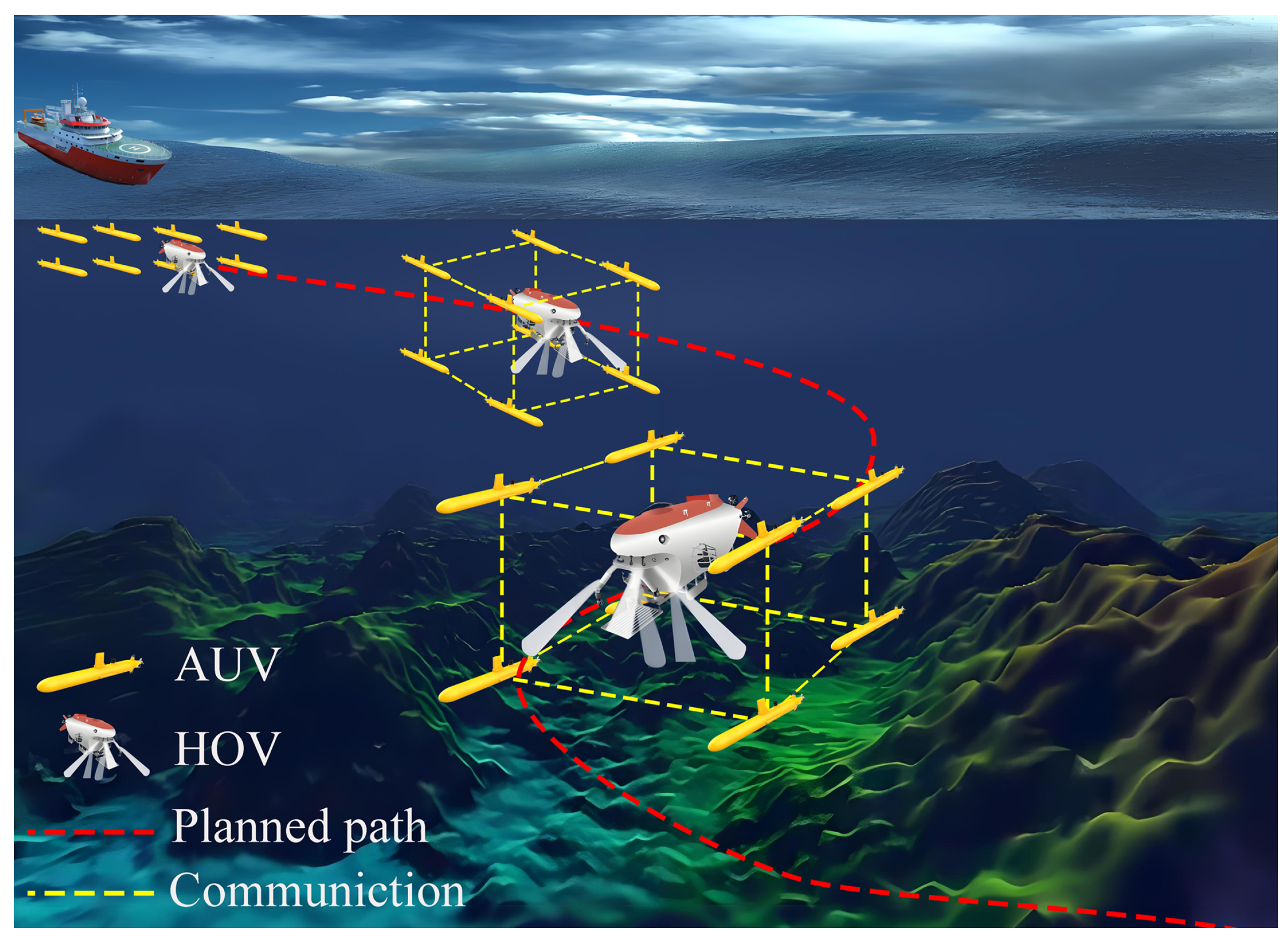
- The underwater environment is far more complex than the terrestrial and aerial environments. This complexity is reflected not only in the challenges of seabed environment monitoring, such as seabed terrain scanning and moving obstacle perception, but also in the difficulties of controlling the three-dimensional (3D) topological movement of the escort formation.
- 1.
- Proposed the RG-SAPF comprehensive target escort mechanism: To enhance the practical applicability of multi-AUV cooperative systems in underwater target escort scenarios, this research integrates rigid graph (RG) theory, a safe artificial potential field (SAPF) algorithm, and the Widrow–Hoff rule. This integrated mechanism addresses three core challenges in escort missions: formation acquisition and maintenance, real-time collision-free path planning, and flexible formation reconfiguration, providing a systematic solution for multi-AUV cooperative escort tasks.
- 2.
- Developed a novel RG-based formation control and affine transformation-driven reconfiguration method: Combines rigidity graph (RG)-based formation design with affine transformation-based reconfiguration. This approach enables AUV formations to be reconfigured using only relative position information, with minimal inter-vehicle communication. The method ensures that the moving target remains at the geometric center of the formation at all times, thereby improving monitoring coverage and formation stability during escort missions.
- 3.
- Designed an adaptive path planning algorithm integrating SAPF and the Widrow–Hoff rule: To overcome the limitations of traditional artificial potential field (APF) methods, such as the “Goal Non-reachable With Obstacle Nearby (GNWON)” problem and excessive initial attractive force, a new adaptive path planning algorithm is designed by integrating the APF with the Widrow–Hoff rule. This algorithm enables real-time and flexible route planning for the formation, effectively addressing issues such as local minima and goal non-reachability in the presence of obstacles (GNWON).
2. Preliminaries and Problem Formulation
2.1. Rigid Graph Theory
2.2. Submersible Model
2.3. Traditional Artificial Potential Field
2.4. Problem Formulation
3. Formation Obstacle Avoidance
3.1. Modified Attractive Potential Field
3.2. Modified Repulsive Potential Field
3.3. Adaptive Scaling Factor Adjustment
- 1.
- When the distance between the current waypoint and an obstacle equals the safety margin , the algorithm should generate a repulsive force that causes the waypoint to move at the maximum reverse velocity (away from the obstacle). This gives
- 2.
- When the current waypoint’s distance to an obstacle equals (where was given in (13), which denotes the obstacle reaction margin, and is a small buffer distance), the algorithm must ensure that the waypoint can still move towards the goal at the maximum forward velocity . This giveswithwhere m represents the mass of the submersible. Defining upper and lower limits for enables the algorithm to stop adaptation in two scenarios: (a) when there are no obstacles around the formation (rendering repulsive force unnecessary), and (b) when the formation is in narrow corridors with nearby obstacles (preventing excessive repulsive force from trapping the formation).
4. Cooperative Escorting Formation Control Scheme
4.1. Design of the Formation Controller
4.2. Stability Analysis
5. Simulation and Results Analysis
5.1. Simulation Setup and Sarameters
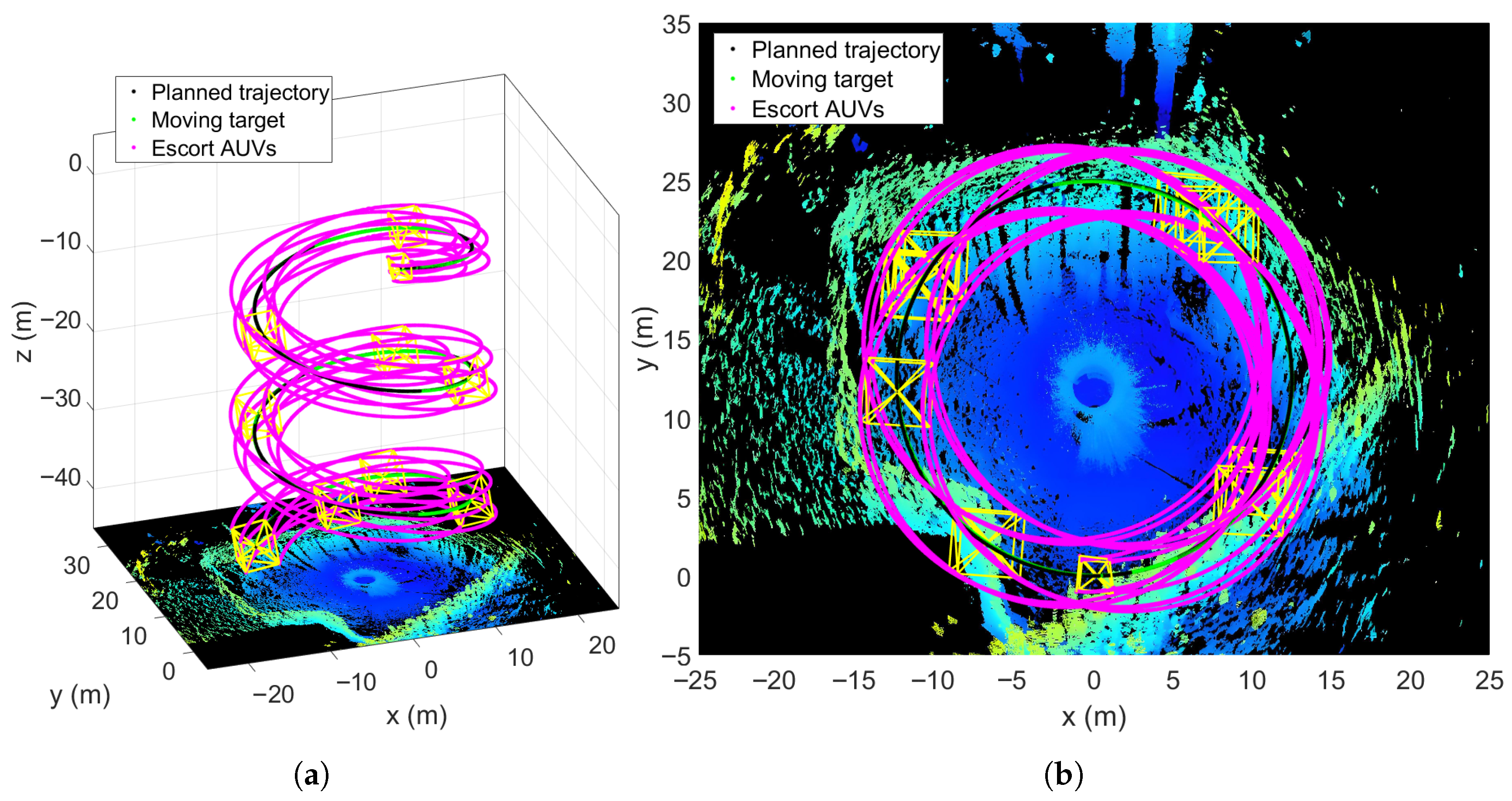
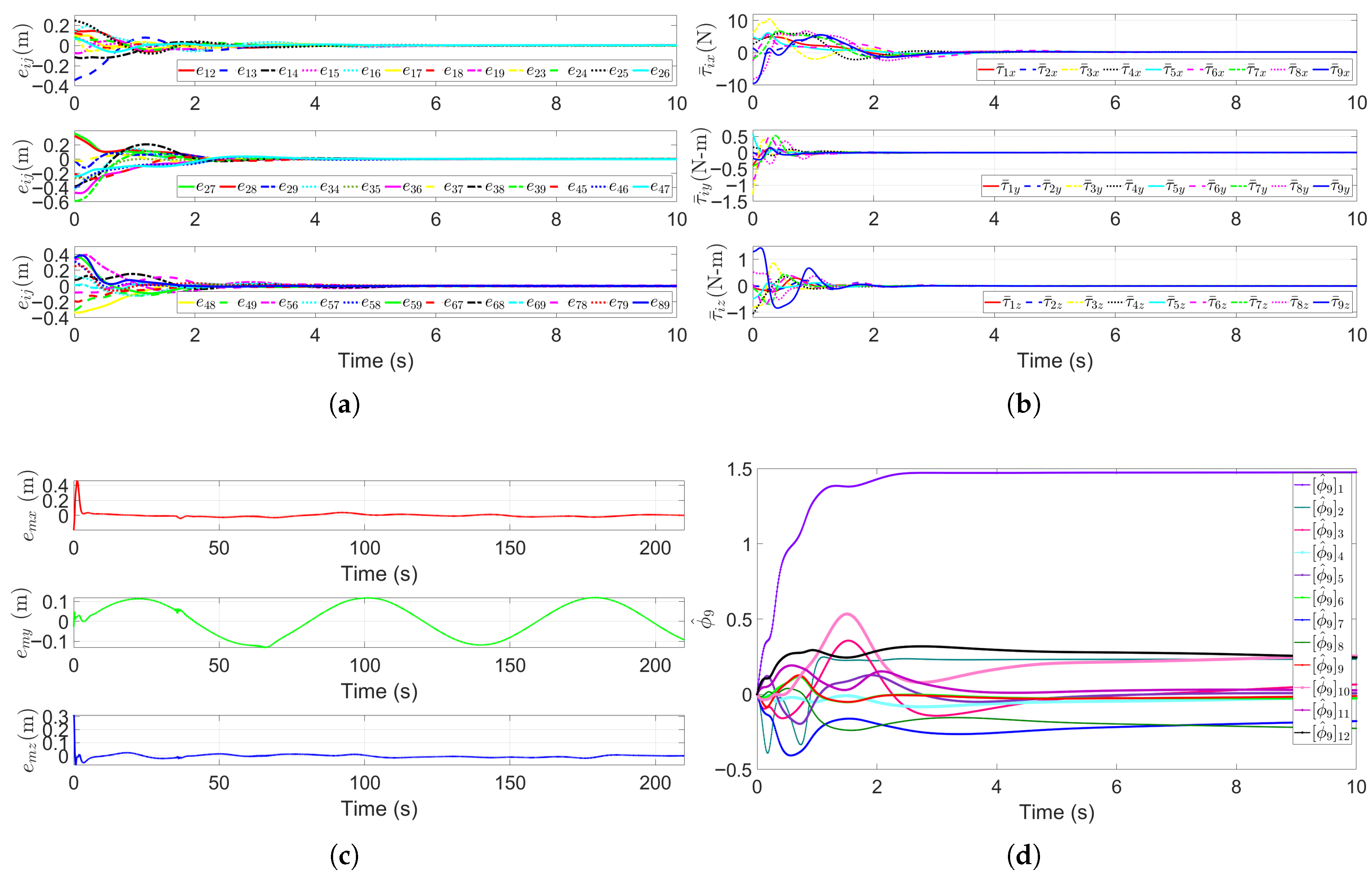
5.2. Escorting Formation Spiral Descent
5.3. Escort Formation Maneuvers in a Simple Obstacle Environments
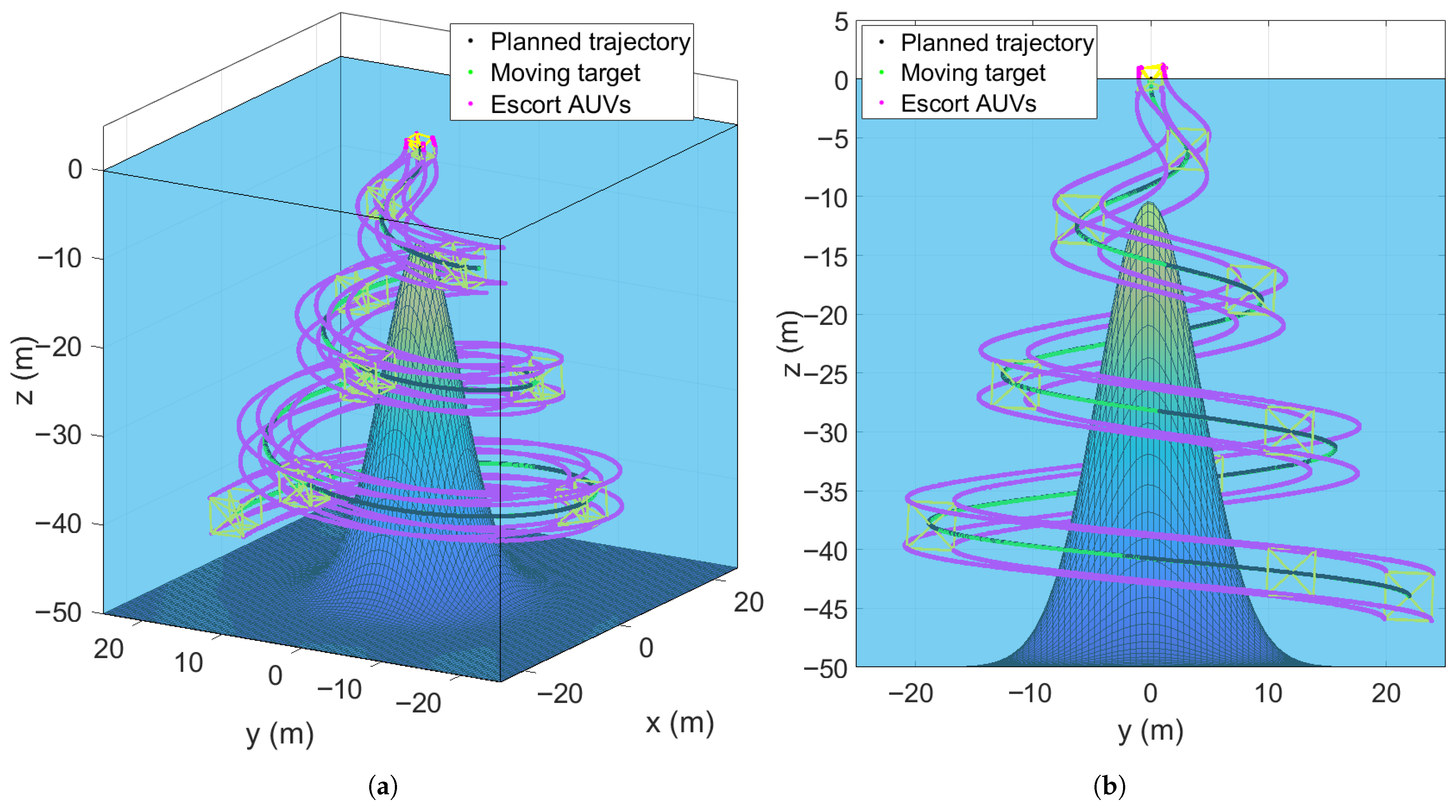
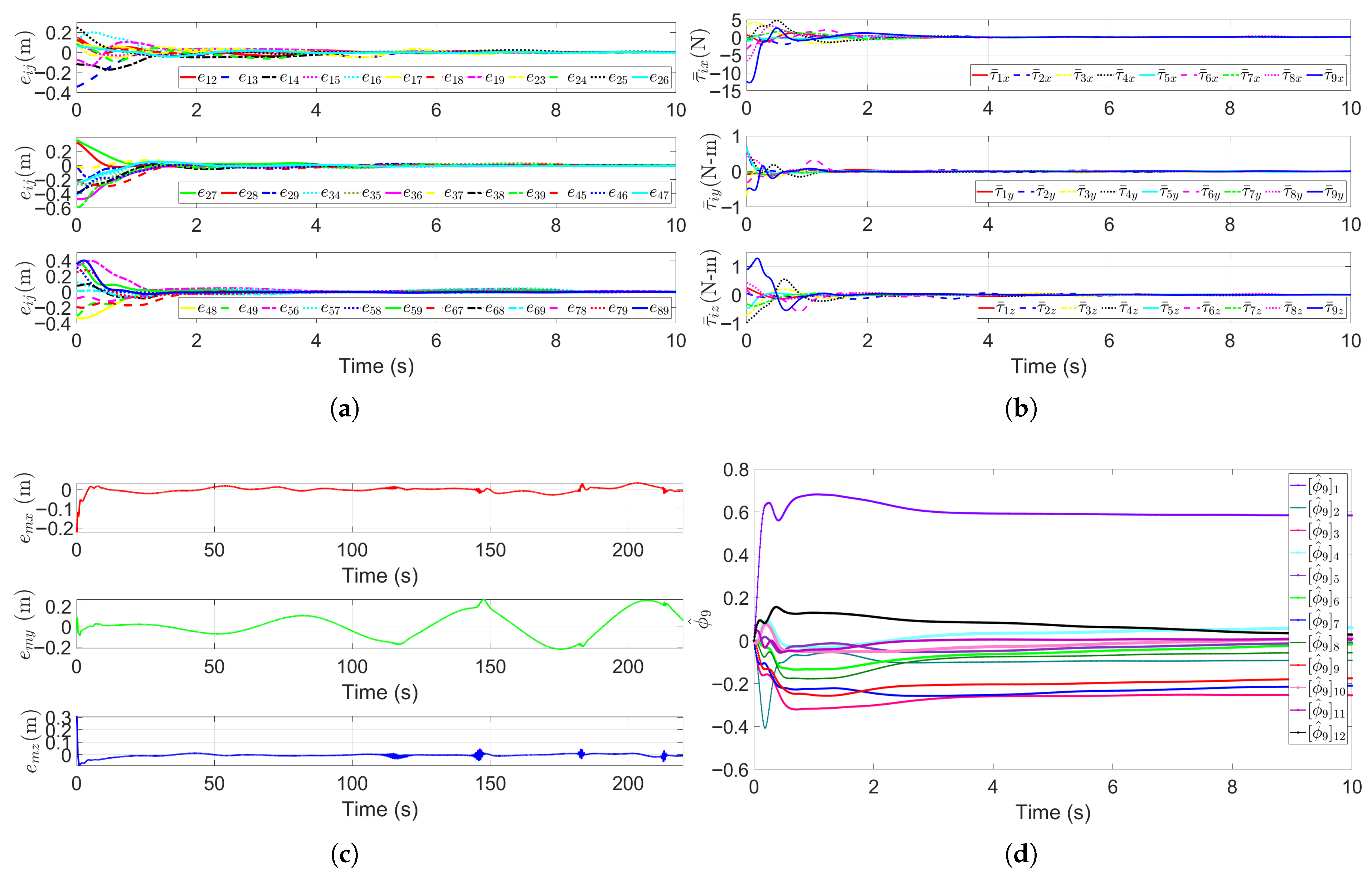
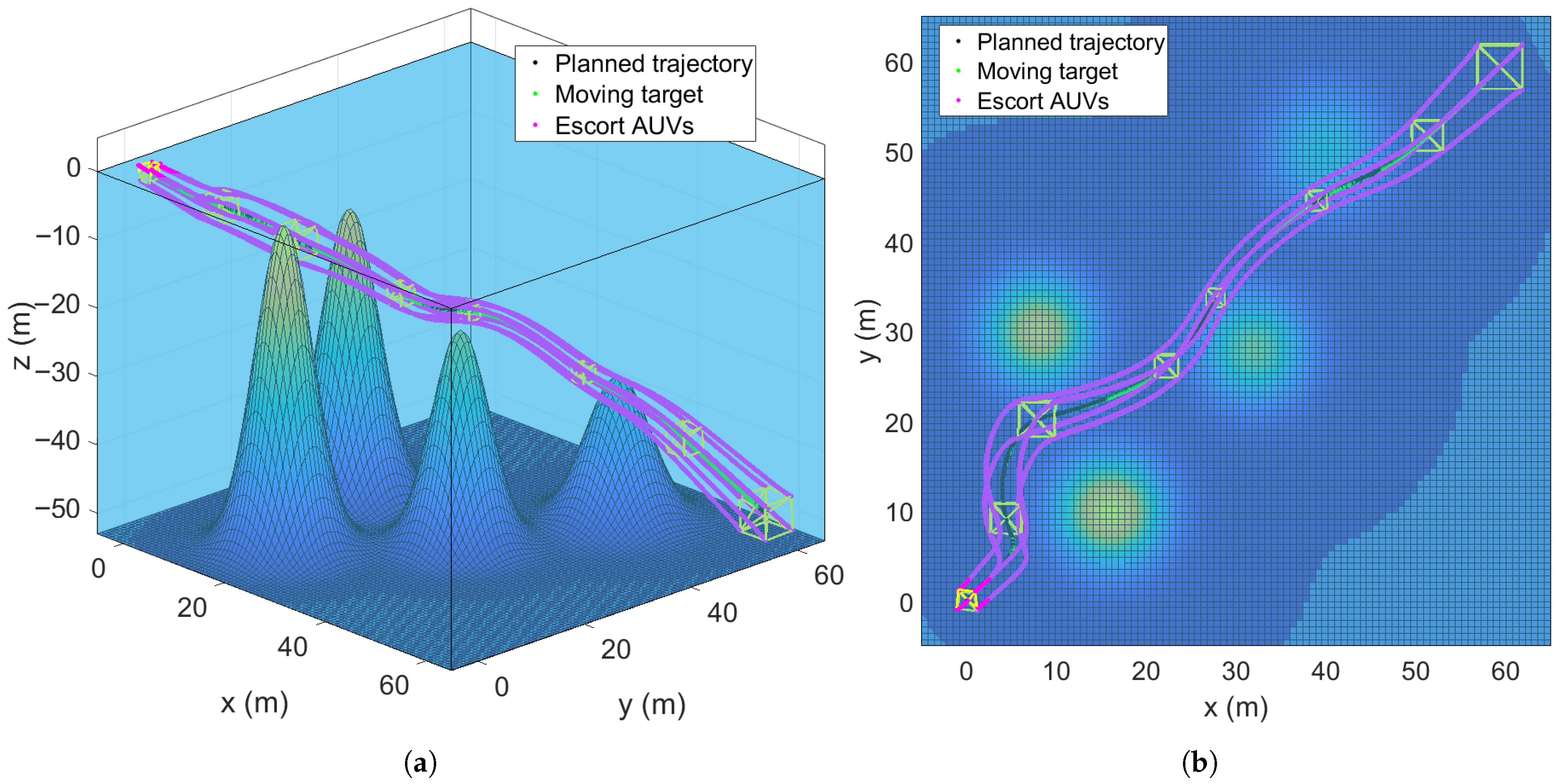
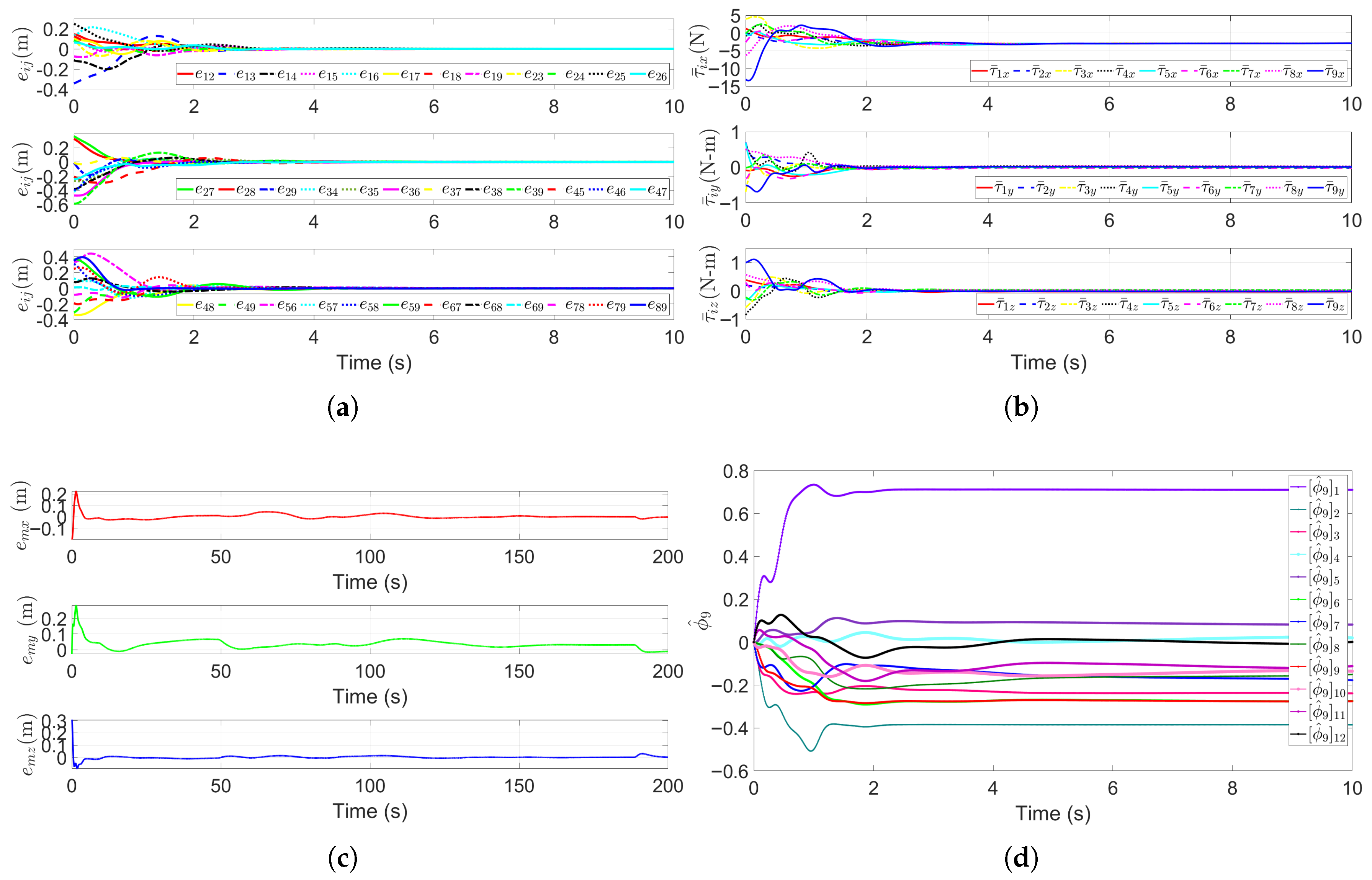
5.4. Escorting Formation Maneuvering in a Static Multi-Obstacle Environment
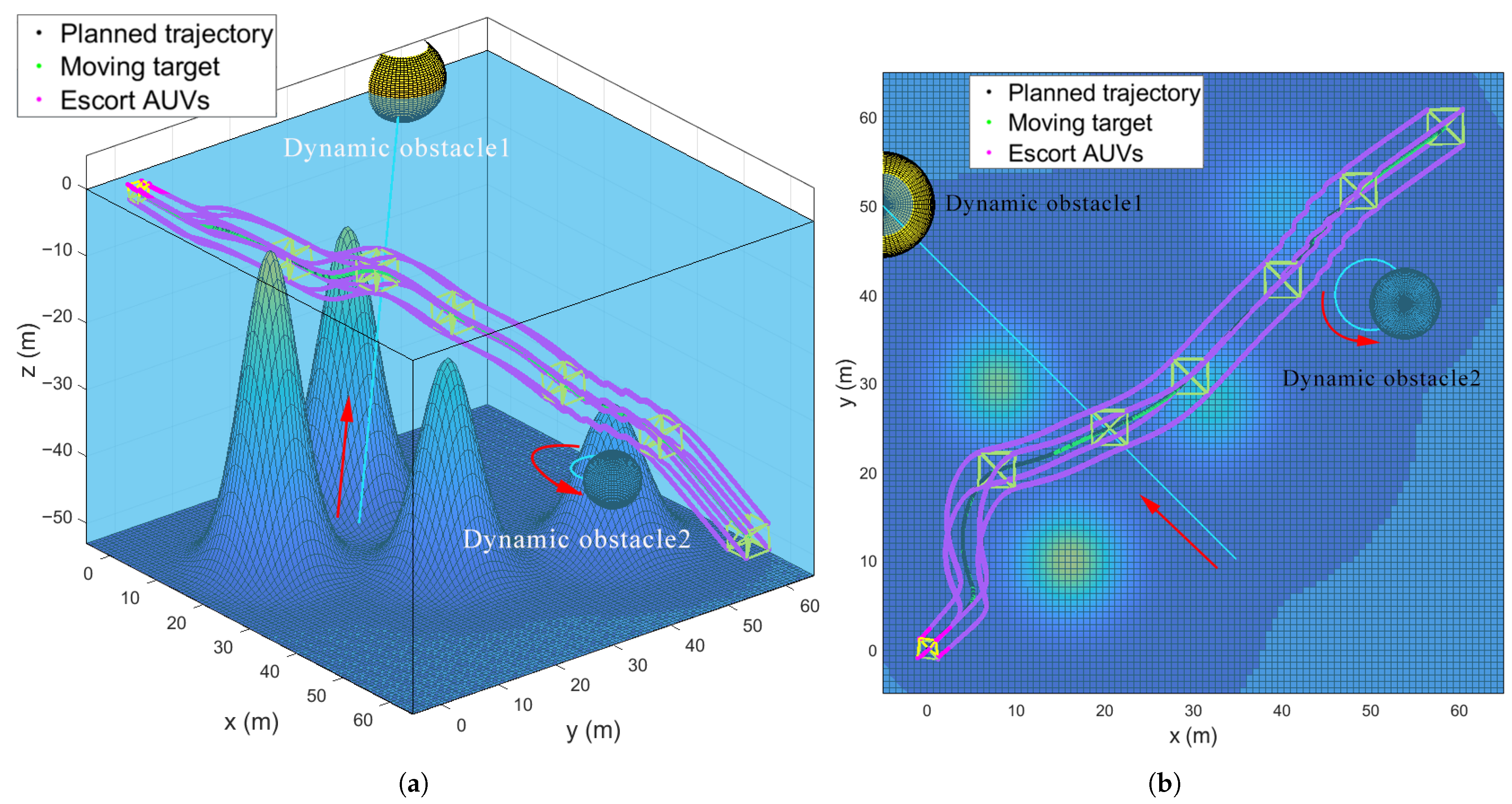
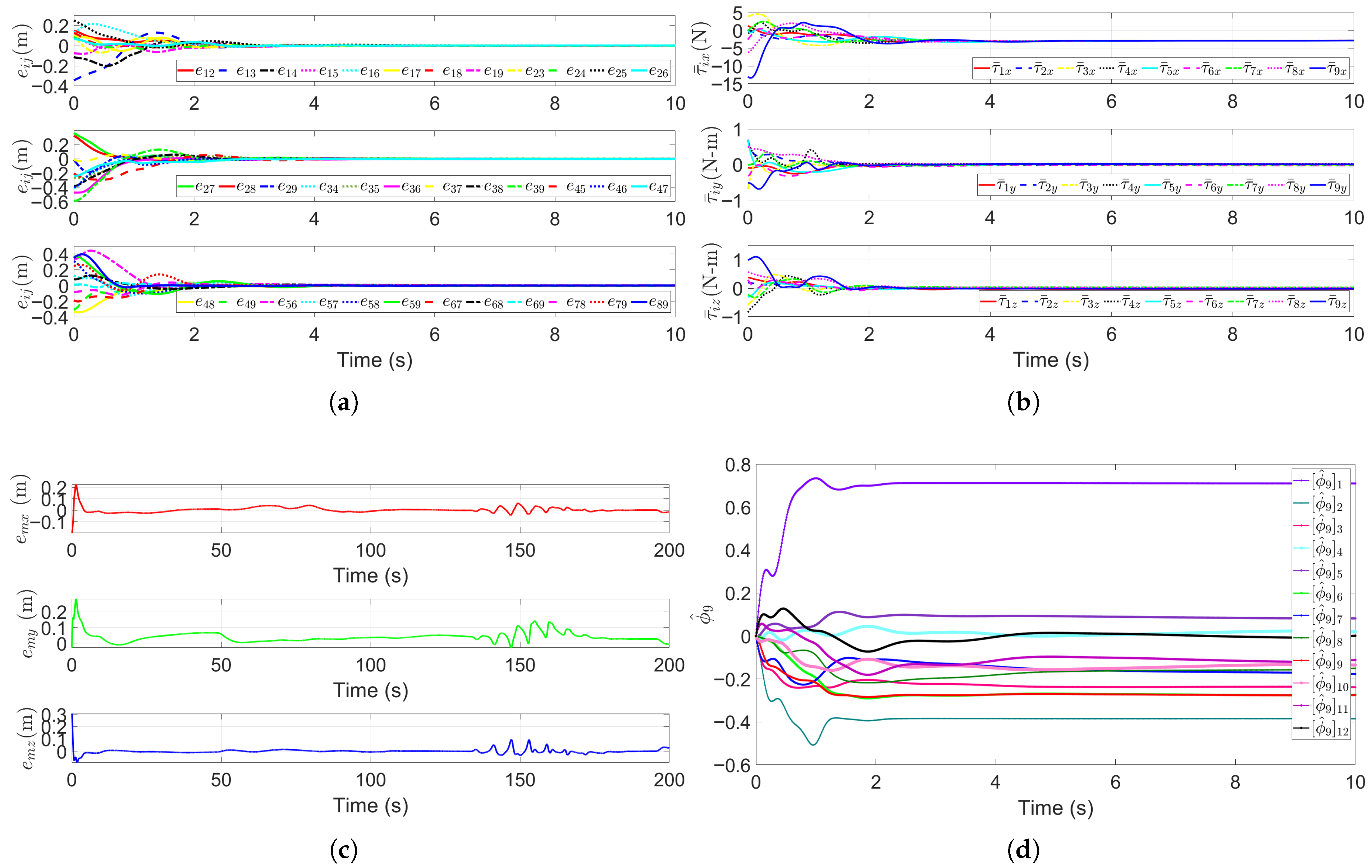
5.5. Escorting Formation Maneuvering in a Dynamic Obstacle Environment
5.6. Comparison with the Traditional APF Algorithm
6. Experimental Results
6.1. Experimental Platform
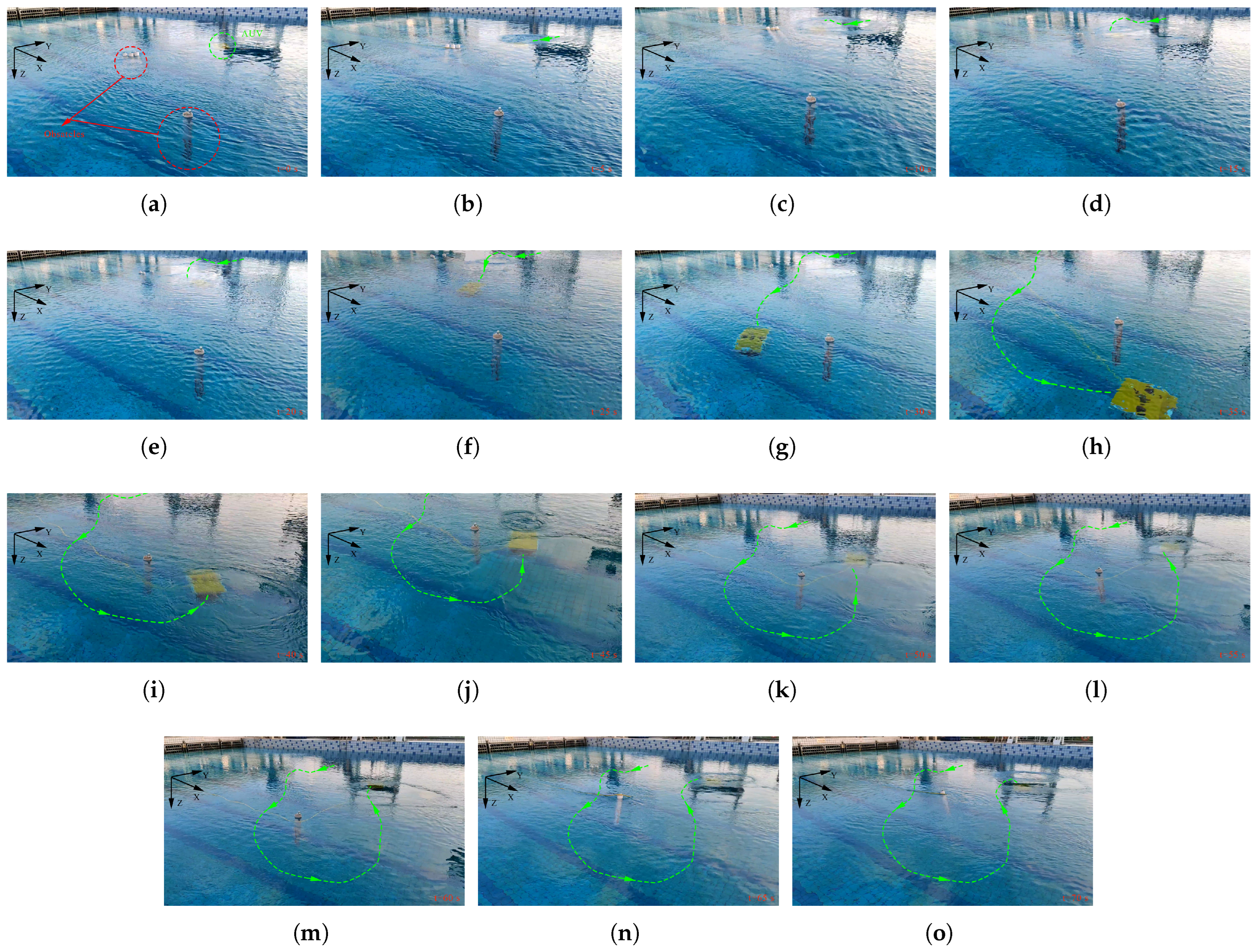
6.2. Path Planning and Obstacle Avoidance Experiment
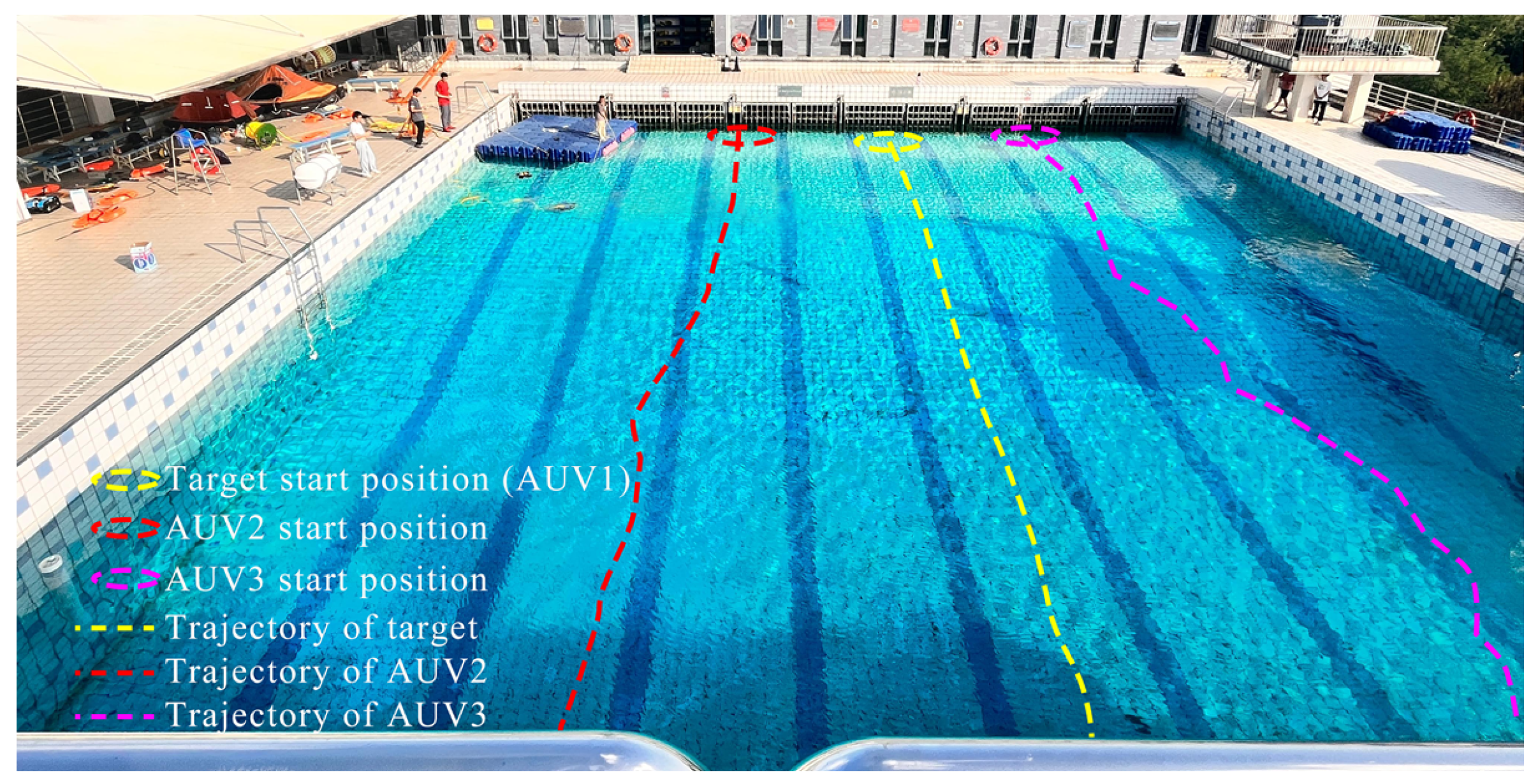
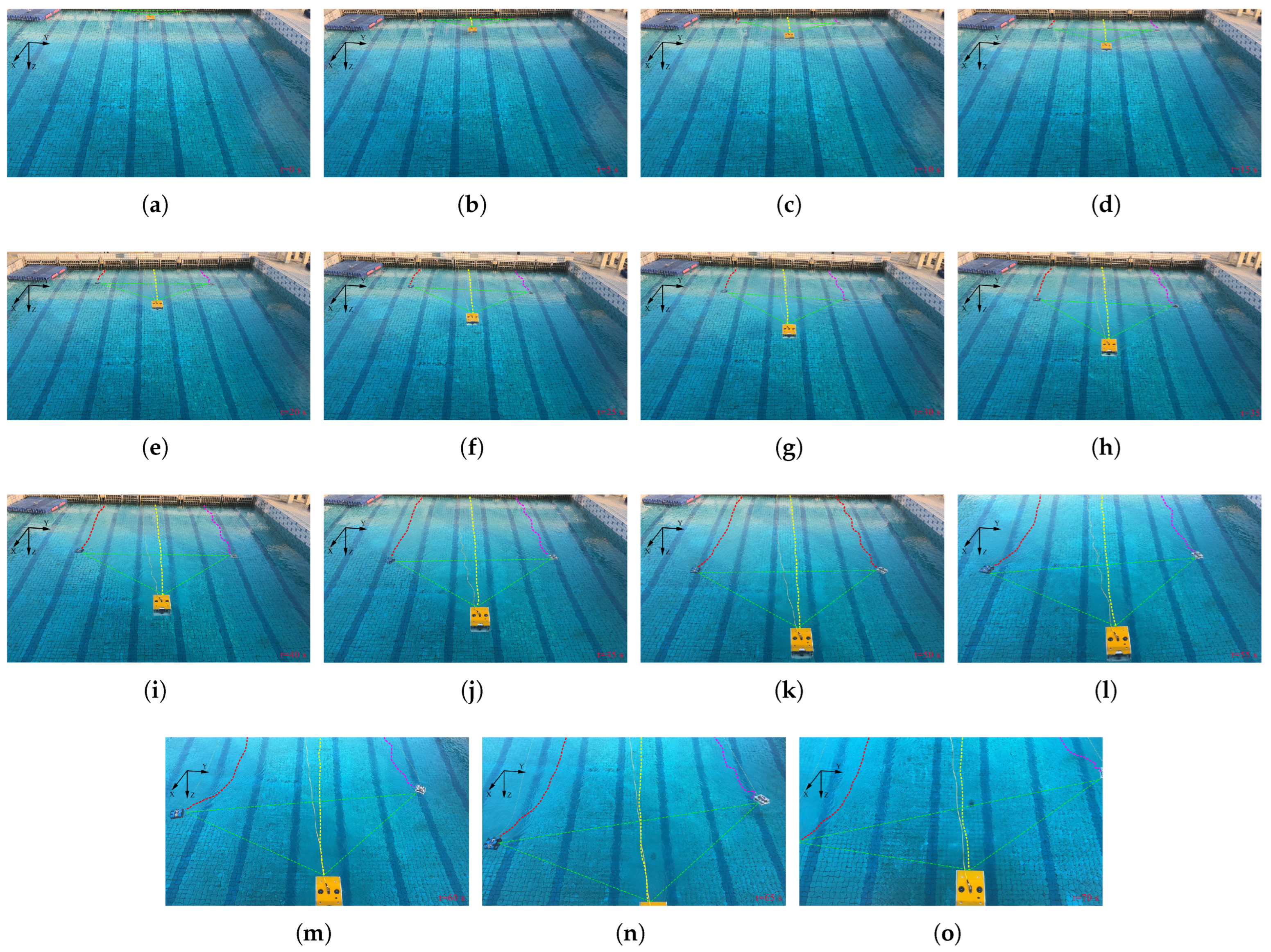
6.3. Multi-AUV Formation Escort Experiment
7. Conclusions
Author Contributions
Funding
Institutional Review Board Statement
Informed Consent Statement
Data Availability Statement
Conflicts of Interest
References
- Heshmati-Alamdari, S.; Karras, G.; Marantos, P.; Kyriakopoulos, K. A Robust Predictive Control Approach for Underwater Robotic Vehicles. IEEE Trans. Control Syst. Technol. 2020, 28, 2352–2363. [Google Scholar] [CrossRef]
- Zheng, K.; Fu, J.; Liu, X. Relay Selection and Deployment for NOMA-Enabled Multi-AAV-Assisted WSN. IEEE Sens. J. 2025, 25, 16235–16249. [Google Scholar] [CrossRef]
- Chen, Q.; Sun, D.J.; Xia, J.; Liu, X.; An, C. String stable and robust optimal longitudinal control for vehicle platoons: A finite time disturbance observer-based tube MPC. Nonlinear Dyn. 2025, 113, 16593–16610. [Google Scholar] [CrossRef]
- Vedachalam, N.; Ramadass, G.; Atmanand, M. Reliability centered modeling for development of deep water Human Occupied Vehicles. Appl. Ocean Res. 2014, 46, 131–143. [Google Scholar] [CrossRef]
- Tao, Q.; Han, G.; Lin, C.; Wang, L.; Huang, S.; Lu, C. A Scheme for Cooperative-Escort Multi-Submersible Intelligent Transportation System Based on SDN-Enabled Underwater IoV. IEEE Trans. Intell. Transp. Syst. 2023, 24, 13472–13485. [Google Scholar] [CrossRef]
- Zhu, D.; Zhang, H.; Wang, L.; Hu, Z. Fault-Tolerant Trajectory Tracking Based on Improved Chaotic Firefly Algorithm Model Prediction Control for Human-Occupied Vehicle with Ocean Current. IEEE Trans. Syst. Man Cybern. Syst. 2023, 53, 2875–2886. [Google Scholar] [CrossRef]
- Zhang, M.; Chen, H.; Cai, W. Collaborative Hunting Method of Multi-AUV in 3-D IoUT: Searching, Tracking, and Encirclement Keeping. IEEE Internet Things J. 2025, 12, 10958–10973. [Google Scholar] [CrossRef]
- Wang, Z.; Du, J.; Jiang, C.; Xia, Z.; Ren, Y.; Han, Z. Task scheduling for distributed AUV network target hunting and searching: An energy-efficient AoI-aware DMAPPO approach. IEEE Internet Things J. 2023, 10, 8271–8285. [Google Scholar] [CrossRef]
- Simetti, E.; Casalino, G. Manipulation and Transportation with Cooperative Underwater Vehicle Manipulator Systems. IEEE J. Ocean. Eng. 2017, 42, 782–799. [Google Scholar] [CrossRef]
- Vasilijević, A.; Nađ, D.; Mandić, F.; Mišković, N.; Vukić, Z. Coordinated Navigation of Surface and Underwater Marine Robotic Vehicles for Ocean Sampling and Environmental Monitoring. IEEE/ASME Trans. Mechatron. 2017, 22, 1174–1184. [Google Scholar] [CrossRef]
- Liu, Z.; Liu, C.; Qu, W.; Qiu, T.; Zhao, Z.; Hu, Y.; Dong, H. Deep reinforcement learning-based multi-AUV task allocation algorithm in underwater wireless sensor networks. IEEE Sens. J. 2025, 25, 3909–3922. [Google Scholar] [CrossRef]
- Su, H.; Zhu, S.; Chen, C.; Yang, Z.; Guan, X. Bearing-Based Robust Formation Tracking Control of Underactuated AUVs with Optimal Parameter Tuning. IEEE Trans. Cybern. 2024, 54, 4049–4062. [Google Scholar] [CrossRef] [PubMed]
- Cui, R.; Li, Y.; Yan, W. Mutual Information-Based Multi-AUV Path Planning for Scalar Field Sampling Using Multidimensional RRT*. IEEE Trans. Syst. Man Cybern. Syst. 2016, 46, 993–1004. [Google Scholar] [CrossRef]
- Yao, M.; Yu, L.; Guo, K.; Lu, Y.; Zhang, W.; Qiao, L. Distributed Two-Layered Leader–Follower Affine Formation Control for Multiple AUVs in 3-D Space. IEEE Trans. Syst. Man Cybern. Syst. 2025, 55, 85–95. [Google Scholar] [CrossRef]
- Li, X.; Zhu, D. An Adaptive SOM Neural Network Method for Distributed Formation Control of a Group of AUVs. IEEE Trans. Ind. Electron. 2018, 65, 8260–8270. [Google Scholar] [CrossRef]
- Zhang, A.; Wang, Z.; Qin, H.; Xue, Y. Underactuated Autonomous Underwater Vehicle Time-Varying Formation Consensus Control with Multiple Actuator Constraints. IEEE J. Ocean. Eng. 2025, 50, 2822–2840. [Google Scholar] [CrossRef]
- Xin, B.; Zhang, J.; Chen, J.; Wang, Q.; Qu, Y. Overview of Research on Transformation of Multi-AUV Formations. Complex Syst. Model. Simul. 2021, 1, 1–14. [Google Scholar] [CrossRef]
- Fu, B.; Zhu, D.; Chen, M.; Yang, S. Formation Control of Autonomous Underwater Vehicles with Unknown Absolute Position Using Rigid Graph-Based MPC. IEEE Internet Things J. 2025, 12, 29061–29072. [Google Scholar] [CrossRef]
- Pang, W.; Zhu, D.; Sun, C. Multi-AUV Formation Reconfiguration Obstacle Avoidance Algorithm Based on Affine Transformation and Improved Artificial Potential Field Under Ocean Currents Disturbance. IEEE Trans. Autom. Sci. Eng. 2024, 21, 1469–1487. [Google Scholar] [CrossRef]
- Yang, Y.; Xiao, Y.; Li, T. A Survey of Autonomous Underwater Vehicle Formation: Performance, Formation Control, and Communication Capability. IEEE Commun. Surv. Tutor. 2021, 23, 815–841. [Google Scholar] [CrossRef]
- Yan, J.; Wang, H.; Yang, X.; Luo, X.; Guan, X. Optimal Rigid Graph-Based Cooperative Formation Control of AUVs in Anchor-Free Environments. IEEE Trans. Intell. Veh. 2024, 9, 5922–5938. [Google Scholar] [CrossRef]
- Pang, W.; Zhu, D.; Chu, Z.; Chen, Q. Distributed Adaptive Formation Reconfiguration Control for Multiple AUVs Based on Affine Transformation in Three-Dimensional Ocean Environments. IEEE Trans. Veh. Technol. 2023, 72, 7338–7350. [Google Scholar] [CrossRef]
- Antonelli, G.; Arrichiello, A.; Chiaverini, S. The Entrapment/Escorting Mission. IEEE Robot. Autom. Mag. 2008, 15, 22–29. [Google Scholar] [CrossRef]
- Hasan, Y.; Garg, A.; Sugaya, S.; Tapia, L. Defensive Escort Teams for Navigation in Crowds via Multi-Agent Deep Reinforcement Learning. IEEE Robot. Autom. Lett. 2020, 5, 5645–5652. [Google Scholar] [CrossRef]
- Wen, G.; Fang, X.; Shen, H.; Zhou, J.; Zheng, D. Distributed Leader Escort Control for Multiple Autonomous Surface Vessels: Utilizing Signed Graph to Model Interaction Relationships. IEEE/ASME Trans. Mechatron. 2025, 30, 2574–2585. [Google Scholar] [CrossRef]
- Lioa, Y.; Ge, Y.; Song, Z.; Qian, R.; Yu, W.; Xu, Y.; Li, Y.; Pang, S. Research on improved null space based unmanned surface vehicle formation maneuver control method for merchant ship escort. Ocean Eng. 2025, 319, 120225. [Google Scholar] [CrossRef]
- Wu, J.; Yu, Y.; Ma, J.; Wu, J.; Han, G.; Shi, J. Autonomous Cooperative Flocking for Heterogeneous Unmanned Aerial Vehicle Group. IEEE Trans. Veh. Technol. 2021, 70, 12477–12490. [Google Scholar] [CrossRef]
- Jia, Y.; Yang, Y.; Li, Q.; Zhang, W. Aerial escort task using networked miniature unmanned aerial vehicles. Int. J. Control 2021, 94, 1556–1566. [Google Scholar] [CrossRef]
- Stolfi, D.; Danoy, G. Escorting drone swarm formation: A swarm intelligence and evolutionary optimisation approach. Swarm Intell. 2025, 19, 245–272. [Google Scholar] [CrossRef]
- Zhang, J.; Sha, J.; Han, G.; Liu, J.; Qian, Y. A Cooperative-Control-Based Underwater Target Escorting Mechanism with Multiple Autonomous Underwater Vehicles for Underwater Internet of Things. IEEE Internet Things J. 2021, 8, 4403–4416. [Google Scholar] [CrossRef]
- Zhang, P.; He, X.; Yu, J. A Distributed Fixed-Time Neurodynamic Algorithm and Its Application in Multi-Autonomous Underwater Vehicle Collaborative Escorting. IEEE Trans. Netw. Sci. Eng. 2025, 12, 4140–4151. [Google Scholar] [CrossRef]
- Maboudi, M.; Homaei, M.; Song, S.; Malihi, S.; Saadatseresht, M.; Gerke, M. A Review on Viewpoints and Path Planning for UAV-Based 3-D Reconstruction. IEEE J. Sel. Top. Appl. Earth Obs. Remote Sens. 2023, 16, 5026–5048. [Google Scholar] [CrossRef]
- Guo, Y.; Guo, Z.; Wang, Y.; Yao, D.; Li, B.; Li, L. A Survey of Tra jectory Planning Methods for Autonomous Driving-Part I: Unstructured Scenarios. IEEE Trans. Intell. Veh. 2024, 9, 5407–5434. [Google Scholar] [CrossRef]
- Cao, Y.; Cheng, X.; Mu, J. Concentrated Coverage Path Planning Algorithm of UAV Formation for Aerial Photography. IEEE Sens. J. 2022, 22, 11098–11111. [Google Scholar] [CrossRef]
- Zheng, H.; Sun, Y.; Zhang, G.; Zhang, L.; Zhang, W. Research on Real Time Obstacle Avoidance Method for AUV Based on Combination of ViT-DPFN and MPC. IEEE Trans. Instrum. Meas. 2024, 73, 1–15. [Google Scholar] [CrossRef]
- Gao, X.; Jia, D.; Liu, X.; Du, J.; Zhang, H. AUV Path Planning Based on the Flow Field Method and Dynamic Window Approach. IEEE Access 2025, 13, 88484–88498. [Google Scholar] [CrossRef]
- Cai, X.; Queiroz, M. Adaptive Rigidity-Based Formation Control for Multirobotic Vehicles with Dynamics. IEEE Trans. Control Syst. Technol. 2015, 23, 389–396. [Google Scholar] [CrossRef]
- Li, X.; Wen, C.; Chen, C. Adaptive Formation Control of Networked Robotic Systems with Bearing-Only Measurements. IEEE Trans. Cybern. 2021, 51, 199–209. [Google Scholar] [CrossRef] [PubMed]
- Paliotta, C.; Lefeber, E.; Pettersen, K.; Pinto, J.; Costa, M.; Figueiredo Borges de Sousa, J. Trajectory Tracking and Path Following for Underactuated Marine Vehicles. IEEE Trans. Control Syst. Technol. 2019, 27, 1423–1437. [Google Scholar] [CrossRef]
- Szczepanski, R. Safe Artificial Potential Field—Novel Local Path Planning Algorithm Maintaining Safe Distance from Obstacles. IEEE Robot. Autom. Lett. 2023, 8, 4823–4830. [Google Scholar] [CrossRef]
- Anderson, B.; Yu, C.; Fidan, B.; Hendrickx, J. Rigid graph control architectures for autonomous formations. IEEE Control Syst. Mag. 2008, 28, 48–63. [Google Scholar]
- Ramazani, S.; Selmic, R.; Queiroz, M. Rigidity-Based Multiagent Layered Formation Control. IEEE Trans. Cybern. 2017, 47, 1902–1913. [Google Scholar] [CrossRef]
- Li, K.; Fang, X.; Zhao, K.; Song, Y. Angle-Constrained Adaptive Formation Control with Prescribed Performance for Multiple Nonholonomic Mobile Robots. IEEE Trans. Ind. Electron. 2025, 72, 6307–6316. [Google Scholar] [CrossRef]
- Pan, Z.; Zhang, C.; Xia, Y.; Xiong, H.; Shao, X. An Improved Artificial Potential Field Method for Path Planning and Formation Control of the Multi-UAV Systems. IEEE Trans. Circuits Syst. II Express Briefs 2022, 69, 1129–1133. [Google Scholar] [CrossRef]
- Nair, R.; Behera, L.; Kumar, V.; Jamshidi, M. Multisatellite Formation Control for Remote Sensing Applications Using Artificial Potential Field and Adaptive Fuzzy Sliding Mode Control. IEEE Syst. J. 2015, 9, 508–518. [Google Scholar] [CrossRef]
- Gazi, V.; Passino, K.M. Swarm Stability and Optimization; Springer Science and Business Media: Berlin/Heidelberg, Germany, 2011. [Google Scholar]
- Guo, Y.; Liu, X.; Zhang, W.; Liu, X.; Yang, Y. Obstacle Avoidance Planning for Quadrotor UAV Based on Improved Adaptive Artificial Potential Field. In Proceedings of the Chinese Automation Congress (CAC), Hangzhou, China, 22–24 November 2019; pp. 2598–2603. [Google Scholar]
- Zhang, Y.; Gong, P.; Hu, W. Mobile Robots Path Planning Based on Improved Artificial Potential Field. In Proceedings of the 6th International Conference on Wireless Communications and Applications (ICWCAPP), Haikou, China, 20–21 August 2022; pp. 41–45. [Google Scholar]
- Zhang, S.; Sang, H.; Sun, X.; Liu, F.; Zhou, Y.; Yu, P. A real-time local path planning algorithm for the wave glider based on time-stamped collision detection and improved artificial potential field. Ocean Eng. 2023, 283, 115139. [Google Scholar] [CrossRef]
- Widrow, B.; Hoff, M. Adaptive Switching Circuits; Engineering, Computer Science: Cambridge, MA, USA, 1988. [Google Scholar]
- Malarczyk, M.; Zychlewicz, M.; Stanislawski, R.; Kaminski, M. Speed control based on state vector applied for electrical drive with elastic connection. Automation 2022, 3, 337–363. [Google Scholar] [CrossRef]
- Oh, K.; Ahn, H. Formation control of mobile agents based on inter-agent distance dynamics. Automatica 2011, 47, 2306–2312. [Google Scholar] [CrossRef]
- Aryankia, K.; Selmic, R. Neural Network-Based Formation Control with Target Tracking for Second-Order Nonlinear Multiagent Systems. IEEE Trans. Aerosp. Electron. Syst. 2022, 58, 328–341. [Google Scholar] [CrossRef]
- Bai, J.; Zhu, D.; Chen, M.; Luo, C. SIO-UV: Rapid and Robust Sonar Intertial Odometry for Underwater Vehicles. IEEE Trans. Ind. Electron. 2025, 72, 11530–11540. [Google Scholar] [CrossRef]


Disclaimer/Publisher’s Note: The statements, opinions and data contained in all publications are solely those of the individual author(s) and contributor(s) and not of MDPI and/or the editor(s). MDPI and/or the editor(s) disclaim responsibility for any injury to people or property resulting from any ideas, methods, instructions or products referred to in the content. |
© 2025 by the authors. Licensee MDPI, Basel, Switzerland. This article is an open access article distributed under the terms and conditions of the Creative Commons Attribution (CC BY) license (https://creativecommons.org/licenses/by/4.0/).
Share and Cite
Pang, W.; Zhu, D.; Chen, M.; Xu, W. RG-SAPF: A Scheme for Cooperative Escorting of Underwater Moving Target by Multi-AUV Formation Systems Based on Rigidity Graph and Safe Artificial Potential Field. Sensors 2025, 25, 6823. https://doi.org/10.3390/s25226823
Pang W, Zhu D, Chen M, Xu W. RG-SAPF: A Scheme for Cooperative Escorting of Underwater Moving Target by Multi-AUV Formation Systems Based on Rigidity Graph and Safe Artificial Potential Field. Sensors. 2025; 25(22):6823. https://doi.org/10.3390/s25226823
Chicago/Turabian StylePang, Wen, Daqi Zhu, Mingzhi Chen, and Wentao Xu. 2025. "RG-SAPF: A Scheme for Cooperative Escorting of Underwater Moving Target by Multi-AUV Formation Systems Based on Rigidity Graph and Safe Artificial Potential Field" Sensors 25, no. 22: 6823. https://doi.org/10.3390/s25226823
APA StylePang, W., Zhu, D., Chen, M., & Xu, W. (2025). RG-SAPF: A Scheme for Cooperative Escorting of Underwater Moving Target by Multi-AUV Formation Systems Based on Rigidity Graph and Safe Artificial Potential Field. Sensors, 25(22), 6823. https://doi.org/10.3390/s25226823