RETRACTED: A Novel Framework for Reconstruction and Imaging of Target Scattering Centers via Wide-Angle Incidence in Radar Networks



Abstract
1. Introduction
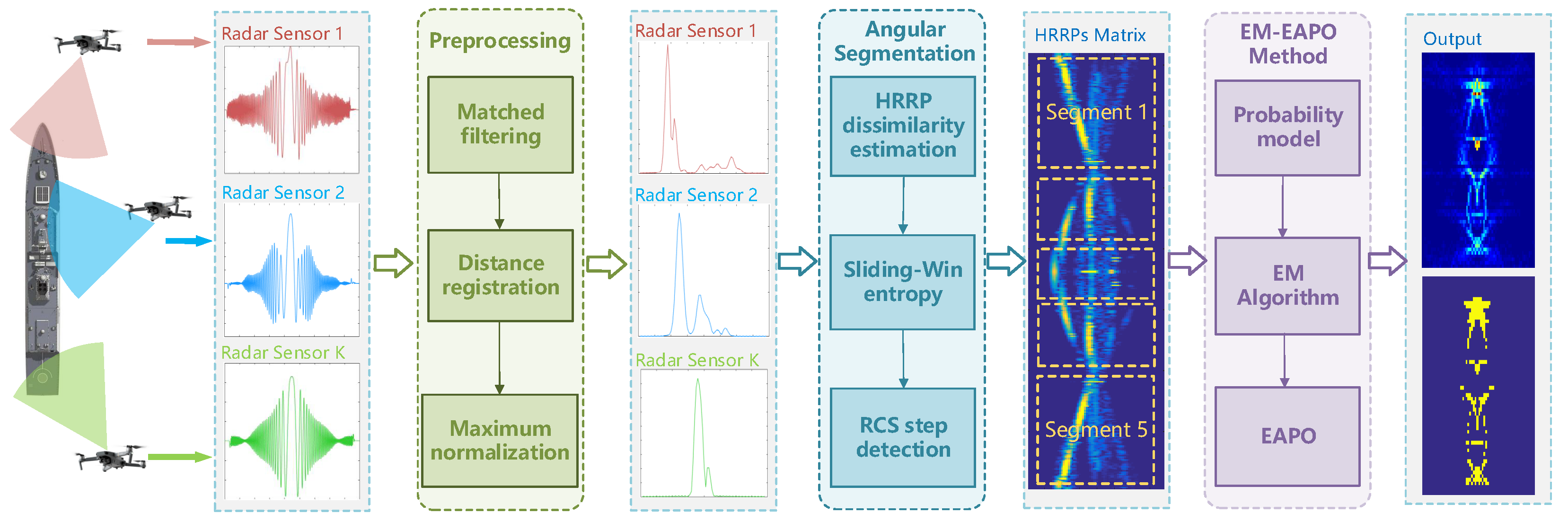
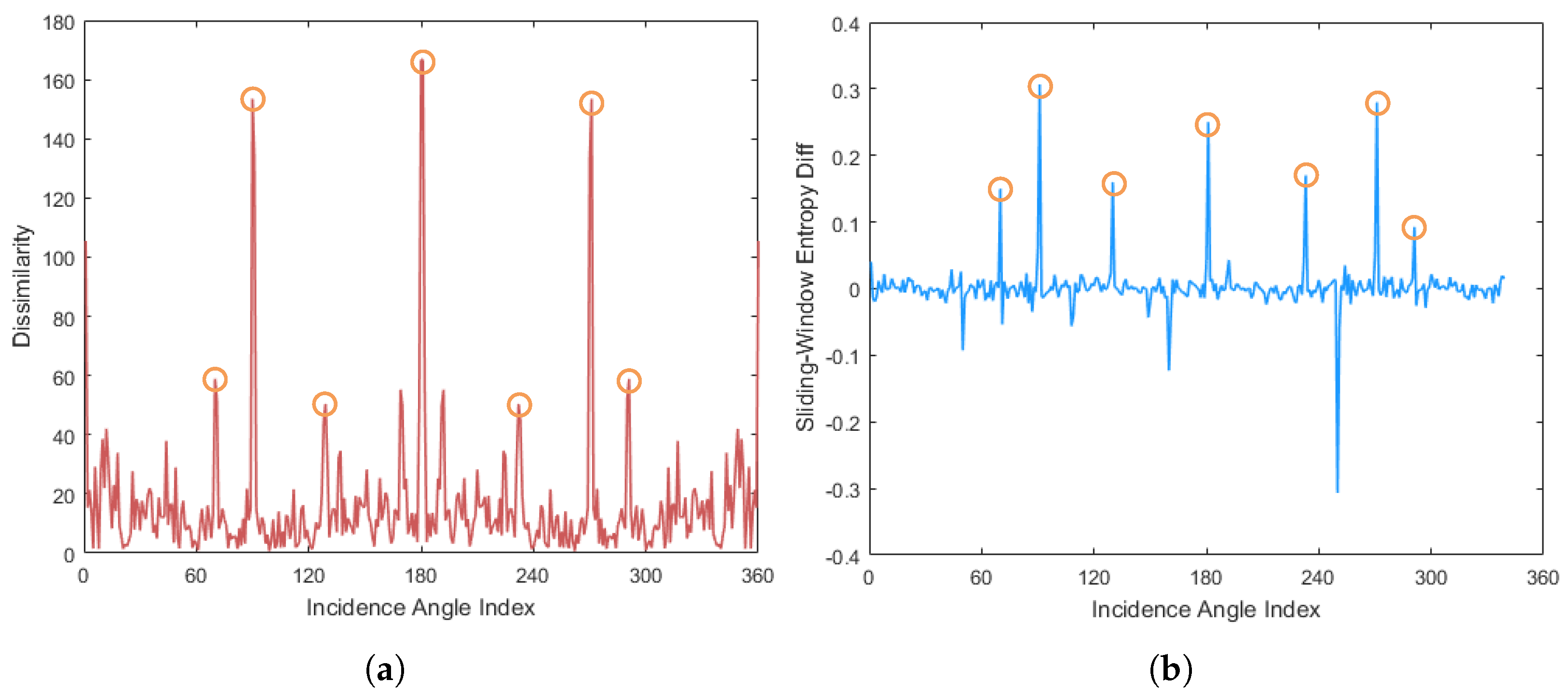
- A modular framework for TSC estimation and imaging: The framework begins with preprocessing to obtain the HRRP signal matrix from the RSN. In the angular segmentation stage, we introduce a multi-angle HRRP dissimilarity estimation method and a step detection method using sliding-window entropy. This enables adaptive angular segmentation of HRRPs, explicitly modeling the angular sensitivity of RCS. During the core processing stage, the integration of the EM algorithm and the EAPO method allows robust and accurate estimation of TSC parameters across wide angular variations.
- Relaxed spatiotemporal registration requirements: The proposed framework operates in a non-coherent manner, significantly relaxing synchronization requirements from wavelength-level to resolution-level precision. This reduction mitigates the stringent spatiotemporal constraints typical in fully coherent distributed systems, thereby enhancing practical deployability.
- Enhanced processing capability: For non-coherent integration, the EM-EAPO iterative optimization mechanism effectively improves the signal-to-noise ratio (SNR) by exploiting the inherent coherence of angular energy. Compared to conventional Back Projection methods, high-quality imaging is achieved with fewer radar nodes. Furthermore, the proposed approach requires only single-snapshot echoes, eliminating the need for long-term data accumulation and significantly mitigating the adverse impact of target maneuvers on processing performance.
- Comprehensive validation: The effectiveness and adaptability of the proposed framework are validated through both simulation experiments and real-data tests. The method demonstrates superior performance in estimation accuracy, stability, and robustness to complex target scattering behaviors.
2. Materials and Methods
2.1. Target Scattering Centers and Echo Signal Model
2.1.1. Target Scattering Center Model Using Segmented Gaussian Distributions
2.1.2. Baseband Echo Signal Model
2.2. Preprocessing
2.3. Adaptive Angular Segmentation
2.3.1. Multi-Angle HRRP Dissimilarity Estimation
2.3.2. RCS Step Detection Using Sliding-Window Entropy
2.4. EM-EAPO Method
2.4.1. Joint Probability Model
2.4.2. Hyperparameter Estimation and Solution-Space Screening Using EM
2.5. Enhanced APO Algorithm for Precise Target Scattering Center Estimation
2.5.1. Algorithm Integration and Target Scattering Center Estimation
- 1.
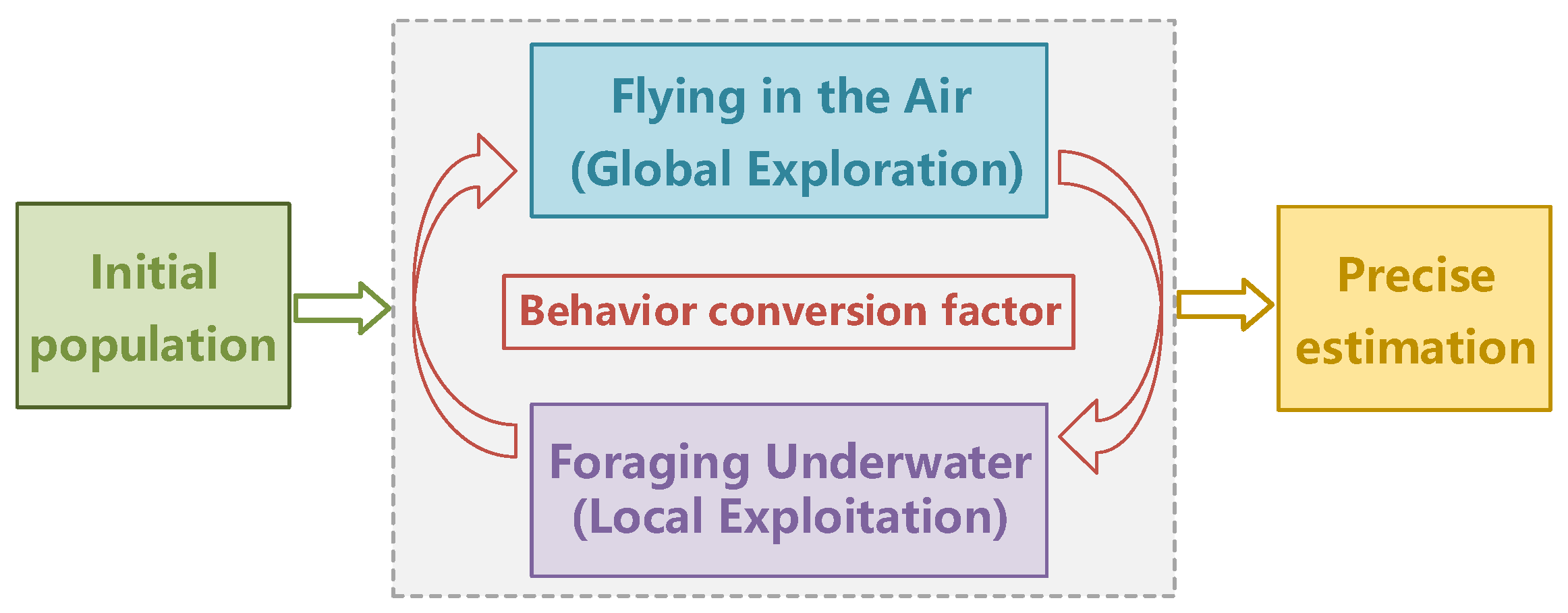
- Flying in the Air (Global Exploration)The flying behavior mode includes two motion types: aerial search and dive predation. Aerial search achieves long-range random jumps in high-dimensional space by introducing Levy flight to avoid local traps. Dive predation accelerates movement toward potential high-quality regions by introducing a speed factor S, improving search efficiency. The update formulas are as follows:represents the update result from aerial search, is the update result from dive predation, r is a random index not equal to i, represents random motion generated by Levy flight, and R is a Gaussian random perturbation.The final parameter update in the flying phase requires fitness sorting of the update results from both aerial search and dive predation motions, taking the top M to form the new population . The procedure is as follows:
- 2.
- Foraging Underwater (Local Exploitation)The foraging behavior mode includes three motion types: collective foraging, intensified search, and predator avoidance. Foraging underwater guides concentrated fine search toward the current optimal direction by introducing a cooperation factor and an adaptive variation factor. The update formulas are as follows:where , , and denote the update results from collective foraging, intensified search, and predator avoidance motions, respectively; , , and are random indices not equal to i; F is the cooperation factor; h is the adaptive variation factor; is a random number between 0 and 1. The update formula is calculated as
- 3.
- Behavior ConversionThe behavior conversion factor determines the behavior mode in the current iteration. Global exploration is emphasized in the early stages, while local exploitation is emphasized in the later stages. In the original APO algorithm, the behavior conversion factor is defined by the calculation process:where T is the preset maximum number of iterations. When , global exploration is executed; when , local exploitation is executed.
2.5.2. Algorithm Enhancements
- 1.
- Adjusting Initial Population DistributionGenerate initial value points based on the prior distribution of TSCs, so that the initial population is more densely distributed in intervals with high probability density. We achieve this by taking uniform values on the prior cumulative distribution of each TSC. The adjusted initial population values can be defined bywhere and are the mean and variance hyperparameter estimates obtained in the EM algorithm phase.
- 2.
- Improving the Flight ModelAssign different impact factors to the displacement amounts of each scattering center during iteration based on their distribution variances. Larger variance results in larger displacement, and vice versa. Thus, the displacement amount of Levy flight is adjusted to
- 3.
- Adaptive Behavior Mode ConversionAdaptively calculate the behavior conversion factor based on the change in the best fitness during iteration. If the fitness value is close to convergence, it tends to conduct local development to approach the optimal solution; otherwise, it tends to conduct global search. The specific expressions are as follows:where denotes the local standard deviation of the best fitness from the x-th to the y-th iteration, and is the local sequence length, which can be flexibly adjusted.
3. Results and Discussion
3.1. Simulation Experiment
3.1.1. Simulation Parameter Settings
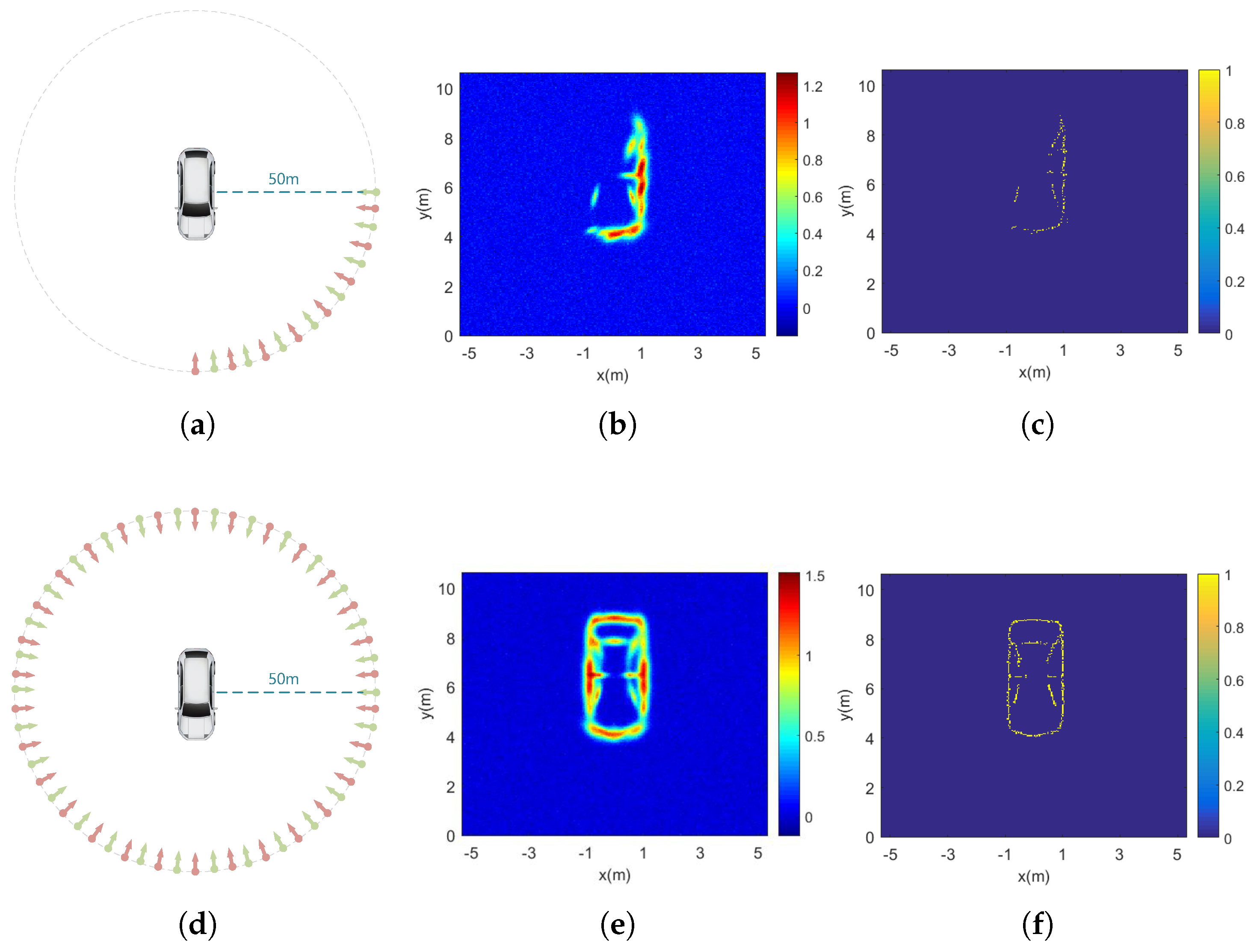
3.1.2. Simulation of Randomly Distributed Scattering Point Composite Target
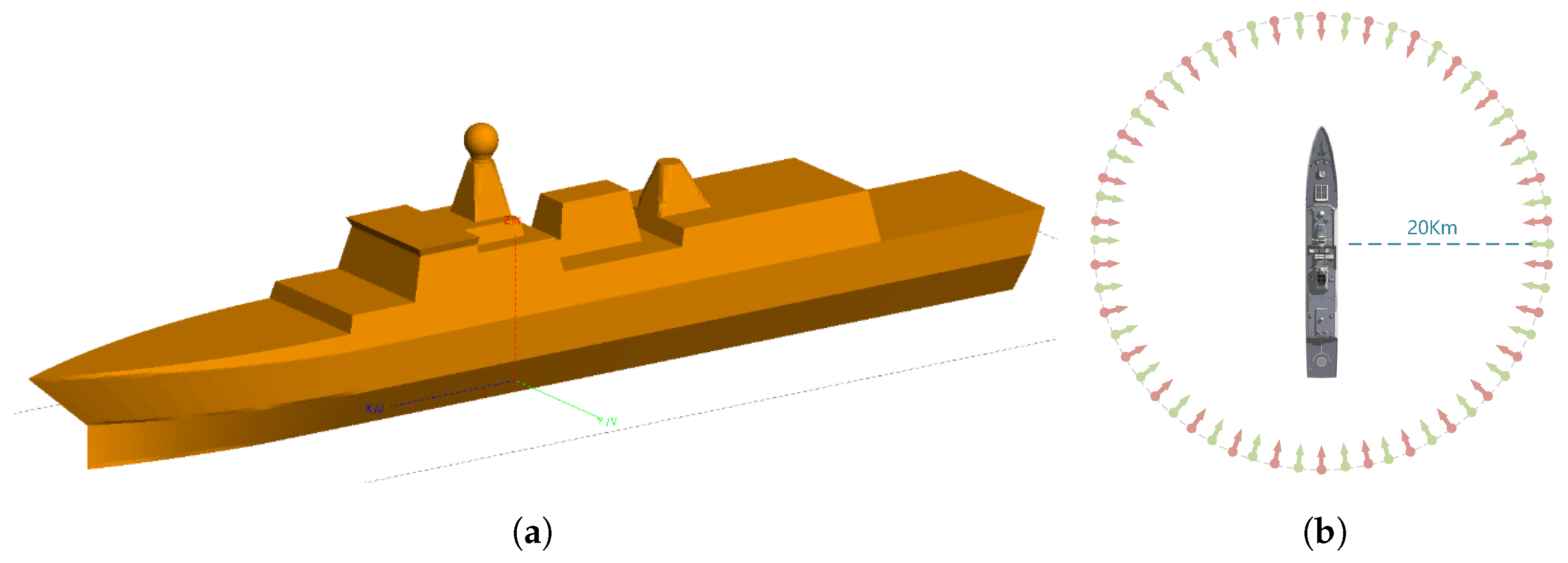
3.1.3. Ship Model Simulation
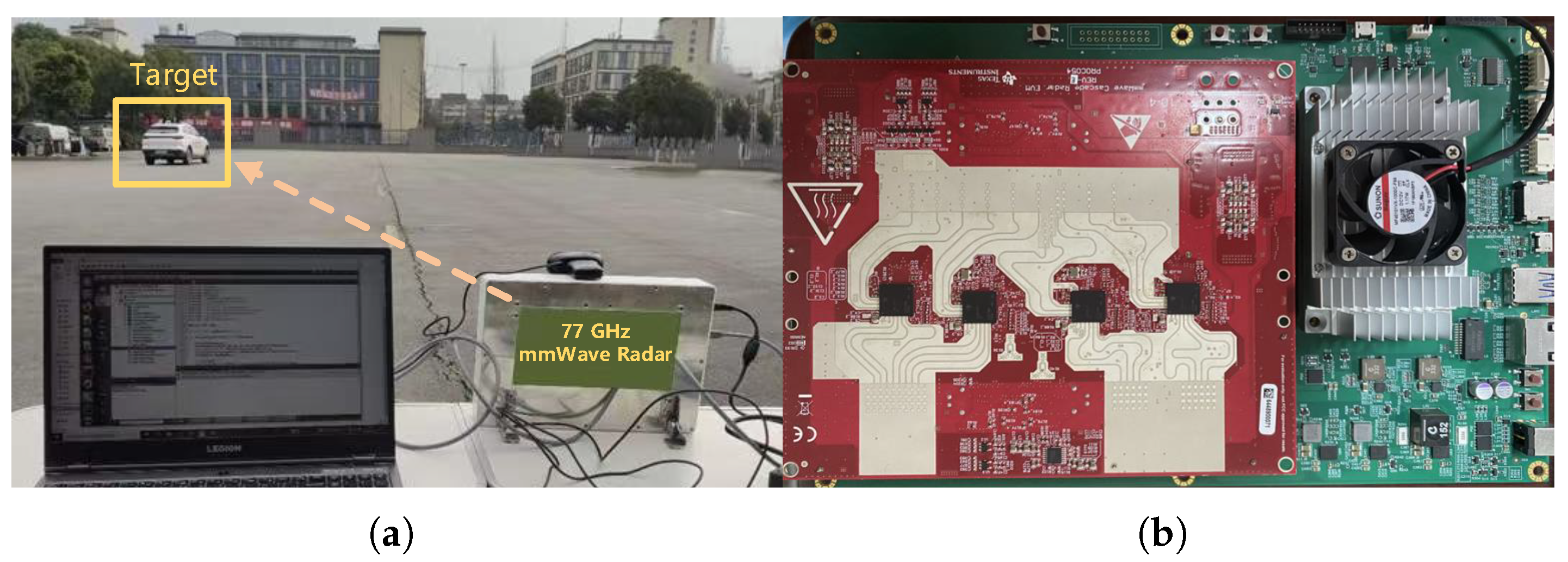
3.2. Field Experiment
4. Conclusions
Author Contributions
Funding
Institutional Review Board Statement
Informed Consent Statement
Data Availability Statement
Acknowledgments
Conflicts of Interest
Abbreviations
| TSC | Target Scattering Center |
| RSN | Radar Sensor Network |
| RCS | Radar Cross-Section |
| HRRP | High-Resolution Range Profile |
| EM | Expectation–Maximization |
| APO | Arctic Puffin Optimization |
| EAPO | Enhanced Arctic Puffin Optimization |
| UAV | Unmanned Aerial Vehicle |
| NCTR | Non-Cooperative Target Recognition |
| BP | Back Projection |
| FBP | Fast Back Projection |
| FFBP | Fast Factorized Back Projection |
| SAR | Synthetic Aperture Radar |
| CS | Compressive Sensing |
| DL | Deep Learning |
| SNR | Signal-to-Noise Ratio |
| AWGN | Additive White Gaussian Noise |
| RMSE | Root Mean Square Error |
References
- Liang, J.; Liang, Q. Design and analysis of distributed radar sensor networks. IEEE Trans. Parallel Distrib. Syst. 2011, 22, 1926–1933. [Google Scholar] [CrossRef] [Scilit]
- Mao, C.; Liang, J. HRRP recognition in radar sensor network. Ad Hoc Netw. 2017, 58, 171–178. [Google Scholar] [CrossRef] [Scilit]
- Yan, J.; Jiao, H.; Pu, W.; Shi, C.; Dai, J.; Liu, H. Radar sensor network resource allocation for fused target tracking: A brief review. Inf. Fusion 2022, 86, 104–115. [Google Scholar] [CrossRef] [Scilit]
- Coluccia, A.; Parisi, G.; Fascista, A. Detection and classification of multirotor drones in radar sensor networks: A review. Sensors 2020, 20, 4172. [Google Scholar] [CrossRef] [Scilit] [PubMed]
- Le, C.; Dogaru, T.; Nguyen, L.; Ressler, M.A. Ultrawideband (UWB) radar imaging of building interior: Measurements and predictions. IEEE Trans. Geosci. Remote Sens. 2009, 47, 1409–1420. [Google Scholar] [CrossRef]
- Guerra, A.; Dardari, D.; Djuric, P.M. Dynamic radar networks of UAVs: A tutorial overview and tracking performance comparison with terrestrial radar networks. IEEE Veh. Technol. Mag. 2020, 15, 113–120. [Google Scholar] [CrossRef] [Scilit]
- Miccinesi, L.; Beni, A.; Pieraccini, M. UAS-borne radar for remote sensing: A review. Electronics 2022, 11, 3324. [Google Scholar] [CrossRef] [Scilit]
- Zhang, G.; Shi, W.; Shen, X.; Miao, Q.; Xie, C.; Chen, L. A Novel Algorithm for Adaptive Detection and Tracking of Extended Targets Using Millimeter-Wave Imaging Radar. Sensors 2025, 25, 3029. [Google Scholar] [CrossRef] [Scilit]
- Zhang, G.; Wang, Y.; Miao, Q.; Liang, J. Data-Driven Back Projection for Target Scattering Modeling VIA Radar Sensor Network. In Proceedings of the IGARSS 2024—2024 IEEE International Geoscience and Remote Sensing Symposium, Athens, Greece, 7–12 July 2024; pp. 10650–10654. [Google Scholar]
- Sagayaraj, M.J.; Jithesh, V.; Roshani, D. Comparative study between deep learning techniques and random forest approach for HRRP based radar target classification. In Proceedings of the 2021 International Conference on Artificial Intelligence and Smart Systems (ICAIS), Coimbatore, India, 25–27 March 2021; pp. 385–388. [Google Scholar]
- Ash, J.; Ertin, E.; Potter, L.C.; Zelnio, E. Wide-angle synthetic aperture radar imaging: Models and algorithms for anisotropic scattering. IEEE Signal Process. Mag. 2014, 31, 16–26. [Google Scholar] [CrossRef] [Scilit]
- Duquenoy, M.; Ovarlez, J.P.; Ferro-Famil, L.; Pottier, E. Characterization of scatterers by their energetic dispersive and anisotropic behaviors in high-resolution laboratory radar imagery. In Proceedings of the EUSAR 2014; 10th European Conference on Synthetic Aperture Radar, Berlin, Germany, 3–5 June 2014; pp. 1–4. [Google Scholar]
- Jackson, J.A.; Rigling, B.D.; Moses, R.L. Canonical scattering feature models for 3D and bistatic SAR. IEEE Trans. Aerosp. Electron. Syst. 2010, 46, 525–541. [Google Scholar] [CrossRef] [Scilit]
- Liu, Q.; Cheng, Y.; Cao, K.; Liu, K.; Wang, H. Radar 3-D forward-looking imaging for extended targets based on attribute scattering model. IEEE Geosci. Remote Sens. Lett. 2023, 20, 1–5. [Google Scholar] [CrossRef] [Scilit]
- Potter, L.C.; Moses, R.L. Attributed scattering centers for SAR ATR. IEEE Trans. Image Process. 1997, 6, 79–91. [Google Scholar] [CrossRef] [Scilit]
- Ding, B.; Wen, G.; Huang, X.; Ma, C.; Yang, X. Data augmentation by multilevel reconstruction using attributed scattering center for SAR target recognition. IEEE Geosci. Remote Sens. Lett. 2017, 14, 979–983. [Google Scholar] [CrossRef] [Scilit]
- Liu, Y.; Chen, K.S.; Liu, Y.; Zeng, J.; Xu, P.; Li, Z.L. On angular features of radar bistatic scattering from rough surface. IEEE Trans. Geosci. Remote Sens. 2017, 55, 3223–3235. [Google Scholar] [CrossRef] [Scilit]
- Ding, B.; Wen, G. Target reconstruction based on 3-D scattering center model for robust SAR ATR. IEEE Trans. Geosci. Remote Sens. 2018, 56, 3772–3785. [Google Scholar] [CrossRef] [Scilit]
- Zhang, Q.; Liu, X.W.; Yin, Y.F.; Ma, Z.Q.; Lu, Y.J. 3D Scattering Distribution Reconstruction for Air Targets VIA Radar Network. In Proceedings of the IGARSS 2019—2019 IEEE International Geoscience and Remote Sensing Symposium, Yokohama, Japan, 28 July–2 August 2019; pp. 3689–3692. [Google Scholar]
- Wang, S. Frequency Agility-Based Back Projection Algorithm for SAR Imaging. In Proceedings of the 2025 IEEE 5th International Conference on Electronic Technology, Communication and Information (ICETCI), Changchun, China, 23–25 May 2025; pp. 521–526. [Google Scholar]
- Meng, Z.; Wang, J.; Xi, Z.; Zhang, L.; Lu, J.; Wang, G. GSFBP: An Interpolation-Free Fast Back-Projection Algorithm with Ground Squint Coordinate for High-Squint Stripmap SAR Imaging. IEEE Trans. Geosci. Remote Sens. 2025, 63, 1–15. [Google Scholar] [CrossRef] [Scilit]
- Li, H.; Suo, Z.; Zheng, C.; Li, Z.; Zhang, Q. Improved back-projection algorithm on small time bandwidth product SAR imaging. IEEE Geosci. Remote Sens. Lett. 2020, 19, 1–5. [Google Scholar] [CrossRef] [Scilit]
- Yang, Z.M.; Sun, G.C.; Xing, M.D. A new fast back-projection algorithm using polar format algorithm. In Proceedings of the Conference Proceedings of 2013 Asia-Pacific Conference on Synthetic Aperture Radar (APSAR), Tsukuba, Japan, 23–27 September 2013; pp. 373–376. [Google Scholar]
- Wu, J.; Li, Y.; Pu, W.; Li, Z.; Yang, J. An effective autofocus method for fast factorized back-projection. IEEE Trans. Geosci. Remote Sens. 2019, 57, 6145–6154. [Google Scholar] [CrossRef] [Scilit]
- Li, Y.; Wei, F.; Wang, F. Non-parametric Bayesian Learning for Geometric Reconstruction of Scattering Primitives from Multi-Dimensional SAR Images. In Proceedings of the 2019 6th Asia-Pacific Conference on Synthetic Aperture Radar (APSAR), Xiamen, China, 26–29 November 2019; pp. 1–4. [Google Scholar]
- Kang, L.; Luo, Y.; Zhang, Q.; Liu, X.W.; Liang, B.S. 3-D scattering image sparse reconstruction via radar network. IEEE Trans. Geosci. Remote Sens. 2020, 60, 1–14. [Google Scholar] [CrossRef] [Scilit]
- Duan, J.; Zhang, L.; Hua, Y. Modified ADMM-net for attributed scattering center decomposition of synthetic aperture radar targets. IEEE Geosci. Remote Sens. Lett. 2023, 20, 1–5. [Google Scholar] [CrossRef] [Scilit]
- Lai, J.; Yuan, D.; Pei, J.; Mao, D.; Zhang, Y.; Tuo, X.; Huang, Y. Scanning Radar Scene Reconstruction with Deep Unfolded ISTA Neural Network. In Proceedings of the 2023 IEEE Radar Conference (RadarConf23), San Antonio, TX, USA, 1–5 May 2023; pp. 1–6. [Google Scholar]
- Javadi, S.H.; Farina, A. Radar networks: A review of features and challenges. Inf. Fusion 2020, 61, 48–55. [Google Scholar] [CrossRef] [Scilit]
- Teng, F.; Lin, Y.; Wang, Y.; Shen, W.; Feng, S.; Hong, W. An anisotropic scattering analysis method based on the statistical properties of multi-angular SAR images. Remote Sens. 2020, 12, 2152. [Google Scholar] [CrossRef] [Scilit]
- Bhalla, R.; Moore, J.; Ling, H. A global scattering center representation of complex targets using the shooting and bouncing ray technique. IEEE Trans. Antennas Propag. 1997, 45, 1850–1856. [Google Scholar] [CrossRef] [Scilit]
- Zhou, J.; Shi, Z.; Cheng, X.; Fu, Q. Automatic target recognition of SAR images based on global scattering center model. IEEE Trans. Geosci. Remote Sens. 2011, 49, 3713–3729. [Google Scholar]
- Trintinalia, L.C.; Bhalla, R.; Ling, H. Scattering center parameterization of wide-angle backscattered data using adaptive Gaussian representation. IEEE Trans. Antennas Propag. 1997, 45, 1664–1668. [Google Scholar] [CrossRef] [Scilit]
- Li, Y.; Jin, Y.Q. Target decomposition and recognition from wide-angle SAR imaging based on a Gaussian amplitude-phase model. Sci. China Inf. Sci. 2017, 60, 062305. [Google Scholar] [CrossRef] [Scilit]
- De Palma, G.; Marvian, M.; Trevisan, D.; Lloyd, S. The quantum Wasserstein distance of order 1. IEEE Trans. Inf. Theory 2021, 67, 6627–6643. [Google Scholar] [CrossRef] [Scilit]
- Wang, W.C.; Tian, W.C.; Xu, D.M.; Zang, H.F. Arctic puffin optimization: A bio-inspired metaheuristic algorithm for solving engineering design optimization. Adv. Eng. Softw. 2024, 195, 103694. [Google Scholar] [CrossRef] [Scilit]
- Fakhouri, H.N.; Alkhalaileh, M.S.; Hamad, F.; Sirhan, N.N.; Fakhouri, S.N. Hybrid arctic puffin algorithm for solving design optimization problems. Algorithms 2024, 17, 589. [Google Scholar] [CrossRef] [Scilit]






| Parameter Estimation | Proposed/FBP | Proposed/RSN-CS |
|---|---|---|
| scattering strength | 0.00053 | 0.00041 |
| position | 0.0017 | 0.0011 |
| Method | NN | RMSE (m) |
|---|---|---|
| Proposed | 60 | 1.22 |
| FBP | 60 | 1.41 |
| RSN-CS | 60 | 1.84 |
| Proposed | 30 | 1.75 |
| FBP | 30 | 2.18 |
| RSN-CS | 30 | 2.73 |
| NN | 15 | 20 | 25 | 30 | 35 | 40 | 45 | 50 | 55 | 60 |
| RMSE | 6.97 | 2.32 | 2.01 | 1.75 | 1.51 | 1.35 | 1.26 | 1.23 | 1.22 | 1.22 |
| Symbol | Parameter | Value |
|---|---|---|
| Carrier frequency | 76–80 GHz | |
| B | Bandwidth | 1 GHz |
| Sampling rate | 1.5 GHz |
| Method | NN | RMSE (m) | Computational Times (ms) |
|---|---|---|---|
| Proposed | 60 | 0.09 | 15.86 |
| FBP | 60 | 0.11 | 10.09 |
| RSN-CS | 60 | 0.127 | 14.48 |
| Proposed | 30 | 0.11 | 7.33 |
| FBP | 30 | 0.137 | 4.15 |
| RSN-CS | 30 | 0.165 | 6.51 |
| Parameter Estimation | Proposed/FBP | Proposed/RSN-CS |
|---|---|---|
| position | 0.00083 | 0.00055 |
Disclaimer/Publisher’s Note: The statements, opinions and data contained in all publications are solely those of the individual author(s) and contributor(s) and not of MDPI and/or the editor(s). MDPI and/or the editor(s) disclaim responsibility for any injury to people or property resulting from any ideas, methods, instructions or products referred to in the content. |
© 2025 by the authors. Licensee MDPI, Basel, Switzerland. This article is an open access article distributed under the terms and conditions of the Creative Commons Attribution (CC BY) license (https://creativecommons.org/licenses/by/4.0/).
Share and Cite
Zhang, G.; Shi, W.; Miao, Q.; Shen, X. RETRACTED: A Novel Framework for Reconstruction and Imaging of Target Scattering Centers via Wide-Angle Incidence in Radar Networks. Sensors 2025, 25, 6802. https://doi.org/10.3390/s25216802
Zhang G, Shi W, Miao Q, Shen X. RETRACTED: A Novel Framework for Reconstruction and Imaging of Target Scattering Centers via Wide-Angle Incidence in Radar Networks. Sensors. 2025; 25(21):6802. https://doi.org/10.3390/s25216802
Chicago/Turabian StyleZhang, Ge, Weimin Shi, Qilong Miao, and Xiaofeng Shen. 2025. "RETRACTED: A Novel Framework for Reconstruction and Imaging of Target Scattering Centers via Wide-Angle Incidence in Radar Networks" Sensors 25, no. 21: 6802. https://doi.org/10.3390/s25216802
APA StyleZhang, G., Shi, W., Miao, Q., & Shen, X. (2025). RETRACTED: A Novel Framework for Reconstruction and Imaging of Target Scattering Centers via Wide-Angle Incidence in Radar Networks. Sensors, 25(21), 6802. https://doi.org/10.3390/s25216802