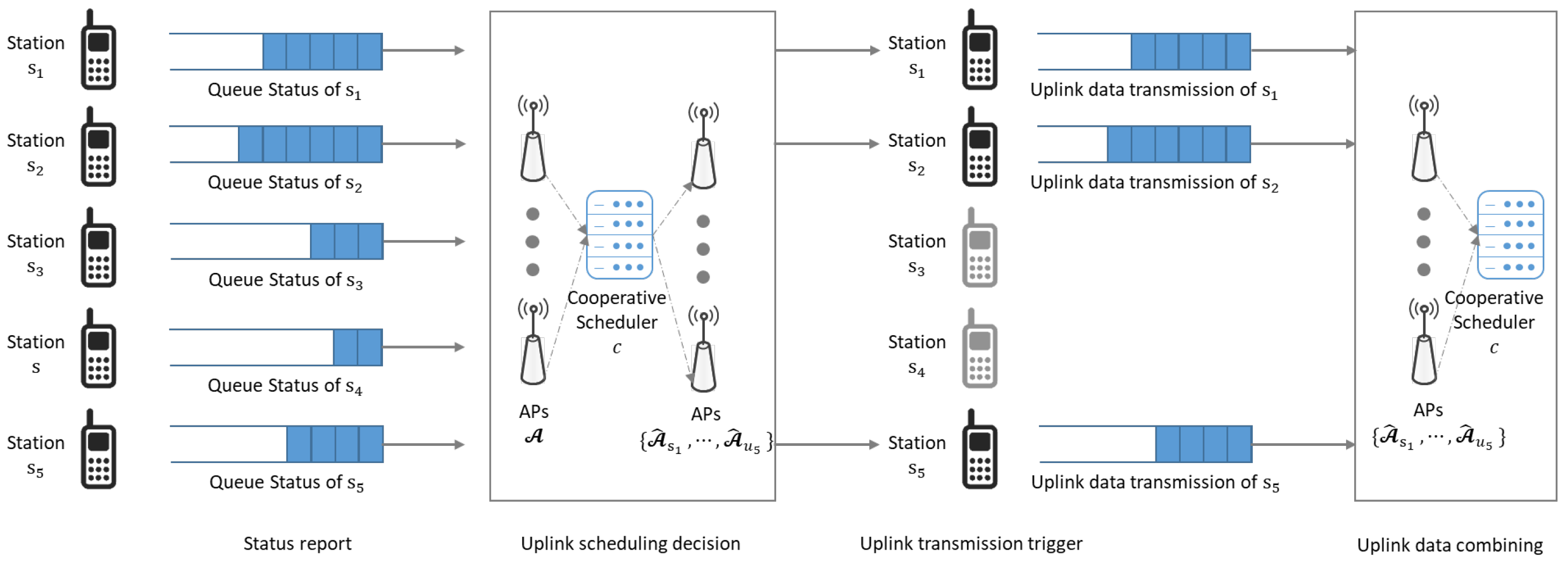
1. Introduction
To facilitate wireless connectivity for devices such as mobile phones, vehicles, or IoT devices, Wi-Fi networks are established through the deployment of access points (APs). These APs independently handle uplink transmissions, collecting information from associated stations within their coverage area and scheduling the uplink transmissions accordingly. In densely populated areas where multiple APs and stations are distributed, the independent operation of multiple APs can significantly degrade the network performance due to interference originating from nearby communications. One strategy to improve per-node throughput in such congested environments is to leverage alternative wireless networks, such as cellular networks, to offload transmission requests [
1]. However, integrating and efficiently utilizing heterogeneous network architectures can present deployment challenges due to the complexity of managing multiple network types. Without relying on other network infrastructures, an alternative approach involves the joint design and adjustment of the transmission power of Wi-Fi-enabled nodes to enhance throughput [
2]. Additionally, transmission requests could be adjusted to balance the load among APs for improved stability and throughput [
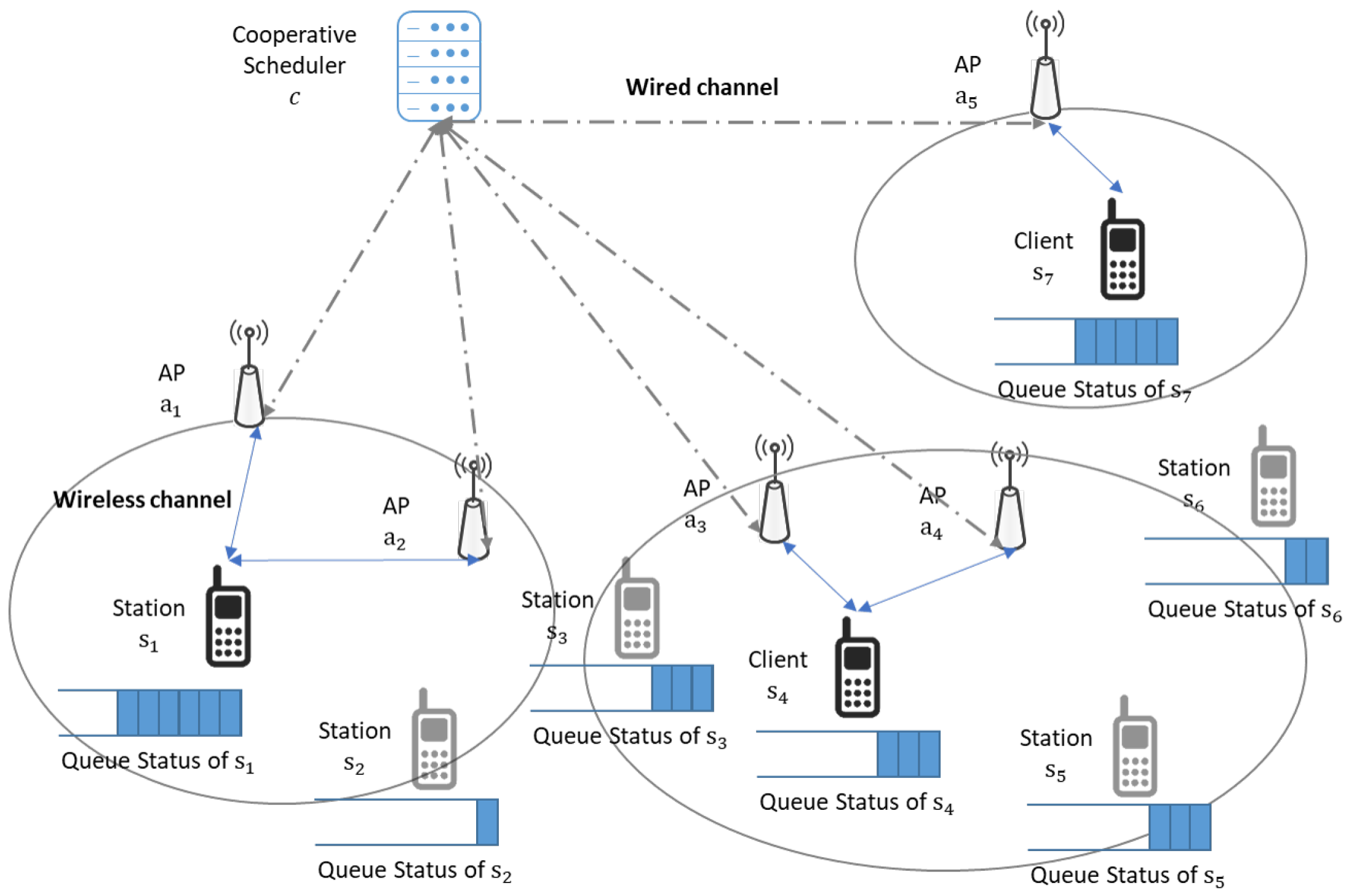
3]. However, achieving efficient and enhanced network performance becomes challenging when there is a lack of shared information on channel states or scheduling decisions among the APs and stations. In such scenarios, uplink transmissions from stations are particularly vulnerable to being significantly degraded by interference from nearby communications between other APs and stations. To alleviate the performance degradation issue in such congested areas, a cooperative scheduler or a central coordinating entity could be deployed to aggregate the uplink information and coordinate uplink scheduling. By centralizing the functions, such as baseband signal processing and uplink scheduling, more efficient network-wise scheduling decisions can be made. This centralized or cooperative approach is anticipated to outperform traditional non-cooperative Wi-Fi networks, especially in areas with intense uplink requests. For instance, rather than processing all uplink requests independently as performed in non-cooperative Wi-Fi systems, the cooperative scheduler could selectively manage the numerous uplink requests in areas where network coverage overlaps among densely deployed proximate APs. Moreover, to enhance the signal-to-interference-plus-noise ratio (SINR), multiple neighboring APs could be allocated to a single station, utilizing diversity combining techniques to improve the quality of the received signal. This cooperative approach to network management is likely to be more effective than independent network management by individual APs, particularly in densely populated network environments with numerous APs and stations.
Previous research has delved into medium access control (MAC) protocols that support diversity combining for uplink transmissions by the collaborative efforts of multiple APs [
4]. In vulnerable wireless channel environments, a central unit could allocate several APs in proximate to support the uplink transmission from a single station. The signals received by these cooperative APs are then combined to improve SINR, facilitating successful decoding. Such cooperative uplink scheduling has been shown to potentially yield better SINR and data rates for uplink transmissions. However, previous research focused on many-to-one scenarios where multiple APs support a single station without considering the presence of other APs and stations. This paper investigates cooperative uplink scheduling within the context of dense Wi-Fi networks with multiple APs and stations. In such networks, the aim is to enhance both the success probability of individual uplink transmissions and the provision for the high volume of uplink requests from multiple stations. In scenarios where a cooperative scheduler is employed, the cooperative uplink scheduling is performed in consideration of the anticipated success probability of each feasible uplink transmission candidate and the corresponding network-wise stability. Note that additional delays for aggregating information and disseminating scheduling decisions are required in cooperative uplink scheduling. The proposed method employs a Lyapunov drift-plus-penalty framework to model the network-wide stability of uplink transmissions across multiple stations and the delay inherent in cooperative scheduling.
The remainder of this paper is organized as follows.
Section 2 reviews related work on uplink transmission methods in Wi-Fi networks.
Section 3 describes the system model for cooperative uplink transmission scenarios.
Section 4 details the proposed Lyapunov drift-plus-penalty-based cooperative uplink scheduling method.
Section 5 presents an evaluation of performance, and
Section 6 concludes the paper.
2. Related Work
The increasing demand for wireless connectivity services in densely populated areas, where numerous APs and stations are present, necessitates efficient network management to enhance user experience and throughput performance. Kosek-Szott and Domino investigated the issue of performance degradation due to excessive contention in dense Wi-Fi networks [
5]. The authors proposed a novel back-off mechanism that adjusts window size based on the ratio of unsuccessful and unallocated resource units, thereby reducing collision likelihood. However, the independent operation of APs may prove inadequate due to heightened channel uncertainty caused by a growing number of independently operating nodes. Thus, cooperative or centralized strategies have garnered significant research interest because they have the potential to enhance wireless service performance in densely populated networks. Focusing on implementing cooperative management, Zhang et al. underscore the benefits of collaborative resource management within a software-defined Wi-Fi network architecture in [
6]. The authors demonstrated the feasibility of establishing a software-defined architecture that decouples the control and data planes for efficient network management within densely populated areas. By deploying global and local controllers for collaborative resource management, the authors showed that the well-designed control mechanism of coexistence between centralized and distributed network management could improve the throughput performance. Previous studies have presented the issues of providing wireless connectivity services in densely populated areas, suggesting that cooperative or centralized management could significantly improve Wi-Fi services in such environments with practical implementation. Based on the findings in these studies, we focus on cooperative management and related considerations regarding transmission success probability, stability, and required delay for cooperation.
The cooperative resource management facilitated by information sharing among deployed nodes has the potential to efficiently improve the throughput performance of Wi-Fi services in densely populated areas. Shen et al. explored queue-aware resource allocation in centralized Wi-Fi networks, where a primary AP manages other APs, aiming to maximize the aggregate rate of uplink and downlink transmissions [
7]. The proposed method prioritizes stations with longer queue lengths while concurrently reducing collision risks. Furthermore, with the advent of learning technologies, learning-based resource management has been investigated in Wi-Fi networks. Zhang et al. delved into deep reinforcement learning for AP coordination in dense overlapping Wi-Fi networks, advocating for a centralized AP controller that employs deep reinforcement learning to refine back-off decisions and mitigate collision frequency [
8]. Wydmański and Szott presented deep reinforcement learning approaches for contention window optimization, introducing two centralized control methods based on deep Q network (DQN) and deep deterministic policy gradient (DDPG) to maintain stable throughput as the number of station surges [
9]. The issue of channel assignment in dense Wi-Fi networks was also investigated. Kinoshita et al. addressed the learning-based channel assignment system managed by a central broker to enhance user throughput and fairness across mobile and Wi-Fi networks [
10]. The broker employs a genetic algorithm for channel allocation between the two network types in the considered heterogeneous networks. Sangdeh and Zeng investigated deep learning for channel sounding and downlink resource allocation [
11]. The proposed method allocates resource units and transmission power to improve downlink performance by utilizing channel reciprocity and limited state information to train models. On the other hand, the proposed method takes into account the trade-off relationships in modeling the scheduling problem. As more APs are incorporated into cooperative management, performance enhancement of transmission stability and the probability of successful transmission for each scheduled transmission could be achieved with the increased diversity in scheduling decisions. However, the increase in cooperation also brings about a rise in delays due to the time required for information aggregation and decision broadcasting. Note that such an increase in delay may impede the feasibility of cooperative Wi-Fi systems in real-world environments. To design the scheduling decisions with consideration of transmission stability and cooperation delay, we employ a Lyapunov drift-plus-penalty-based framework, which efficiently models the balancing problem between two metrics with respect to the queue changes of the nodes. Furthermore, the proposed Lyapunov drift-plus-penalty-based method has the potential to be combined with other methods from previous studies in problem formulation and solving.
The cooperative scheduling approach has also been investigated for various applications and scenarios beyond Wi-Fi networks. Mwakwata et al. investigated a cooperative scheduler-based interference avoidance method in NB-IoT systems [
12]. In the considered scenario, cellular base stations supporting NB-IoT services share their scheduling table for inter-cell interference avoidance scheduling. Mwakwata et al. also investigated the impact of a designed cooperative scheduler for orthogonal multiple access and non-orthogonal multiple access scenarios in cellular networks with massive connectivity [
13]. Li and Cai investigated cooperative control methods for uplink transmissions in cellular networks by considering device-to-device relay transmissions and network coding in dense areas [
14]. Based on the stochastic geometry modeling and density, multiple user devices are cooperatively and randomly utilized for relaying for uplink transmissions, or network coding is further adopted. Hua et al. investigated cooperative scheduling for pilot reuse among neighboring cells in massive MIMO systems [
15]. The proposed method cooperatively schedules users to share the limited orthogonal pilots among neighboring cells. As noted in related studies, cooperative scheduling has been shown to effectively enhance network performance, particularly in congested or densely populated areas. Although Wi-Fi networks have distinct characteristics compared to cellular networks, such as differences in backhaul connections, deploying a cooperative scheduler or a central coordinating entity for cooperative scheduling could lead to improved Wi-Fi performance.
Cooperative resource management indeed shows promise for enhancing connectivity services in dense Wi-Fi networks, where the coordination of resources can lead to improved uplink throughput and overall network performance. However, the introduction of cooperative strategies often brings about additional delays due to the need for information sharing and decision-making among APs. This can counteract some of the benefits gained from cooperation. In an effort to address these delays, the previous study has explored MAC protocols for cooperative uplink transmissions that accommodate delay constraints by preemptively sending immediate ACK manages based on the anticipated uplink success probability [
4]. The designed MAC protocol transmits ACK messages before completing the data reception under the specific criteria to reduce delays required for cooperative transmissions. However, while these solutions may work well in scenarios where multiple APs assist a single station, there is a gap in addressing network-wide scheduling decisions in more complex many-to-many scenarios. These involve densely deployed APs and stations where multiple APs may have to cooperate with multiple stations.
In this paper, we propose a new method for cooperative uplink scheduling that leverages a Lyapunov drift-plus-penalty framework, specifically designed for dense Wi-Fi networks. Lyapunov drift-plus-penalty-based optimization is a well-known method used to solve problems that are formulated based on trade-off relationships in stochastic systems [
16]. The problem is formulated to minimize the upper bound of the objective function based on the stochastic change model for the considered objectives, such as stability or utility, and the trade-off parameter between the objectives. We utilize the Lyapunov drift-plus-penalty framework and take into consideration both the probability of successful uplink transmissions and the expected delays from cooperative scheduling. With this approach, we aim to enable efficient scheduling decisions that can handle the complexity of many-to-many interactions between APs and stations. By applying the Lyapunov drift-plus-penalty-based framework, we strive to strike a balance between enhancing uplink throughput performance and managing the incremental delays introduced by the necessity for cooperation. The framework helps to ensure that the network remains stable and that queues at stations do not grow indefinitely while alleviating the time required for information aggregation and scheduling decisions. Through the proposed Lyapunov drift-plus-penalty-based framework, we achieve an effective balance between improved uplink throughput performance and the incremental delays necessitated by cooperation.
5. Performance Evaluation
We conduct performance evaluations using MATLAB-based simulations to compare the throughput and delay performance in IEEE 802.11ax-compliant networks [
19]. The simulation was implemented using the WLAN system toolbox of MATLAB, which provides IEEE 802.11ax channel configurations. In a square area of 50 m on the side, 20 APs and 10 to 30 clients are randomly deployed in the network. Note that a single wireless channel without channel bonding or channel hopping is considered in the simulation scenario for simplicity. The simulation parameters are listed in
Table 1. The carrier frequency and channel bandwidth are specified at 5.25 GHz and 40 MHz, respectively. A low-density parity-check code (LDPC) is adopted, with dual antennas at both the transmitter and receiver nodes. The path loss exponent is determined to be 2 for distances less than or equal to 5 m between the transmit-receive nodes and set to 3.5 for distances longer than 5 m. Rayleigh fading is employed to model the small-scale fading effects. The wireless signal transmissions are performed with a power of 25 dBm, the modulation and coding scheme (MCS) at 3, and the physical layer convergence procedure (PLCP) service data unit (PSDU) size of 1024 bytes. The background noise level is established at −80 dBm. Given that each transmitter transmits wireless signals at a power level of 25 dBm, the interference from nearby signals significantly outweighs the impact of the background noise. The propagation delays between nodes in the considered cooperative networks follow the gamma distribution with shape parameter
and scale parameter
[
4]. The mean and variance of delay are calculated as
and
, respectively. We set the shape parameter
as 4 and the scale parameter
as 2. Hence, the mean and variance of delays required for cooperative uplink transmission are 8 μs and 16 μs, respectively. In the established network topology, we compare the proposed cooperative scheduling method with other uplink scheduling methods, such as the random and non-cooperative methods. The random method randomly decides the cooperation among APs. Except for the AP associated with the station trying to transmit uplink data, the cooperative scheduler randomly selects the additional APs for uplink cooperation. The scheduling decision of the random method is based on the expected throughput without consideration of stability or cooperation delay. For fair performance comparison with the proposed Lyapunov drift-plus-penalty-based cooperative uplink scheduling method described in Algorithm 1, the random method selects the best solution among the feasible candidates obtained after
random trials. On the other hand, for the non-cooperative method, APs independently support wireless connectivity service to the associated stations without cooperation. For various trade-off parameters,
V, the proposed method is compared to other methods.
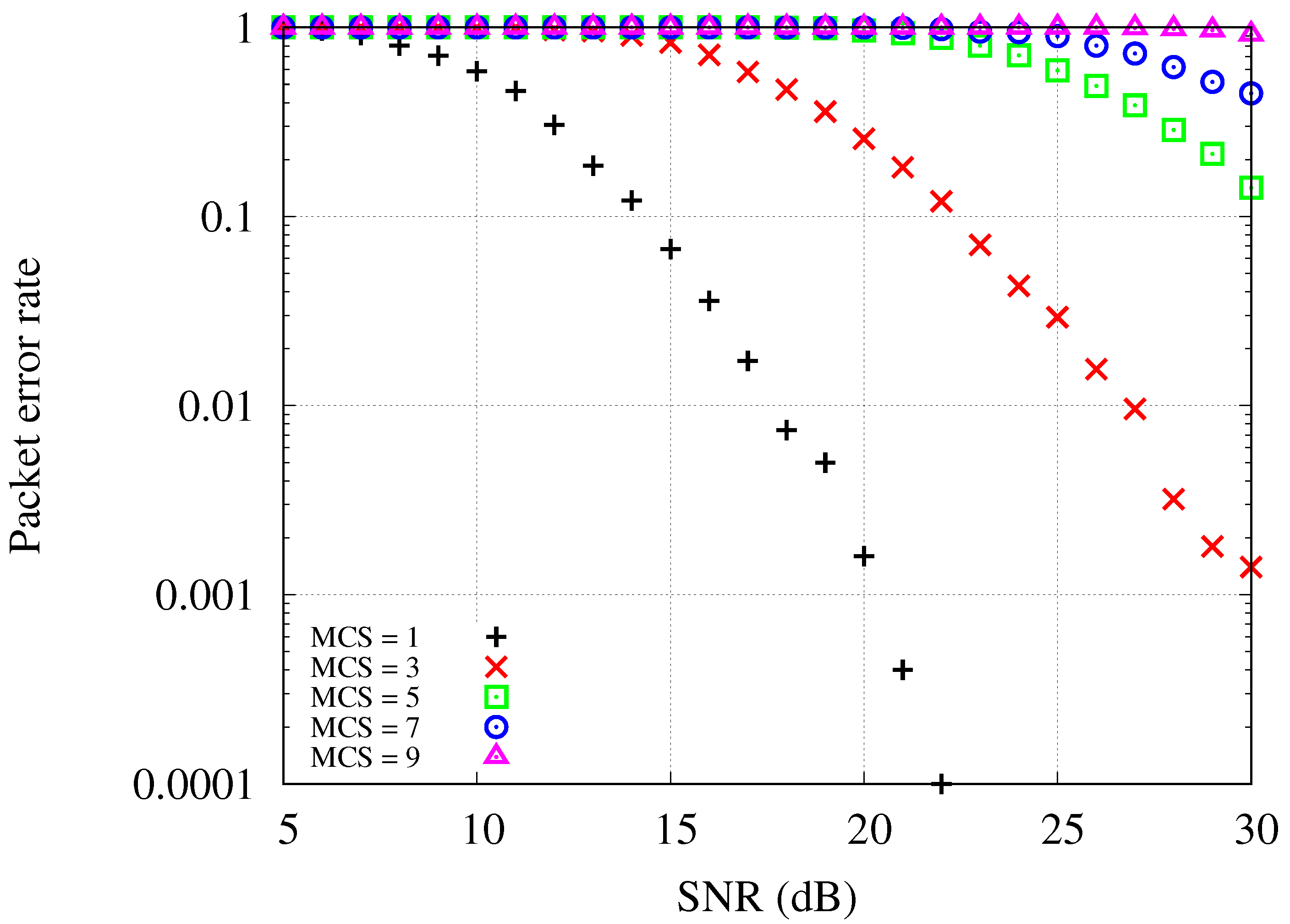
Figure 3 shows the packet error rate with regard to signal-to-noise ratio (SNR) in the constructed simulation environments. As shown in the figure, a low packet error rate can be achieved with high SNR or by adopting a lower MCS level. Note that in the network areas with densely populated stations and APs, interference among uplink transmissions may significantly lower the throughput performance. When multiple APs independently provide wireless connectivity services to their associated stations, each uplink transmission could work as an interferer to other uplink transmissions. Instead of non-cooperative uplink transmissions, we propose to utilize a cooperative uplink method that centrally manages uplink scheduling decisions.
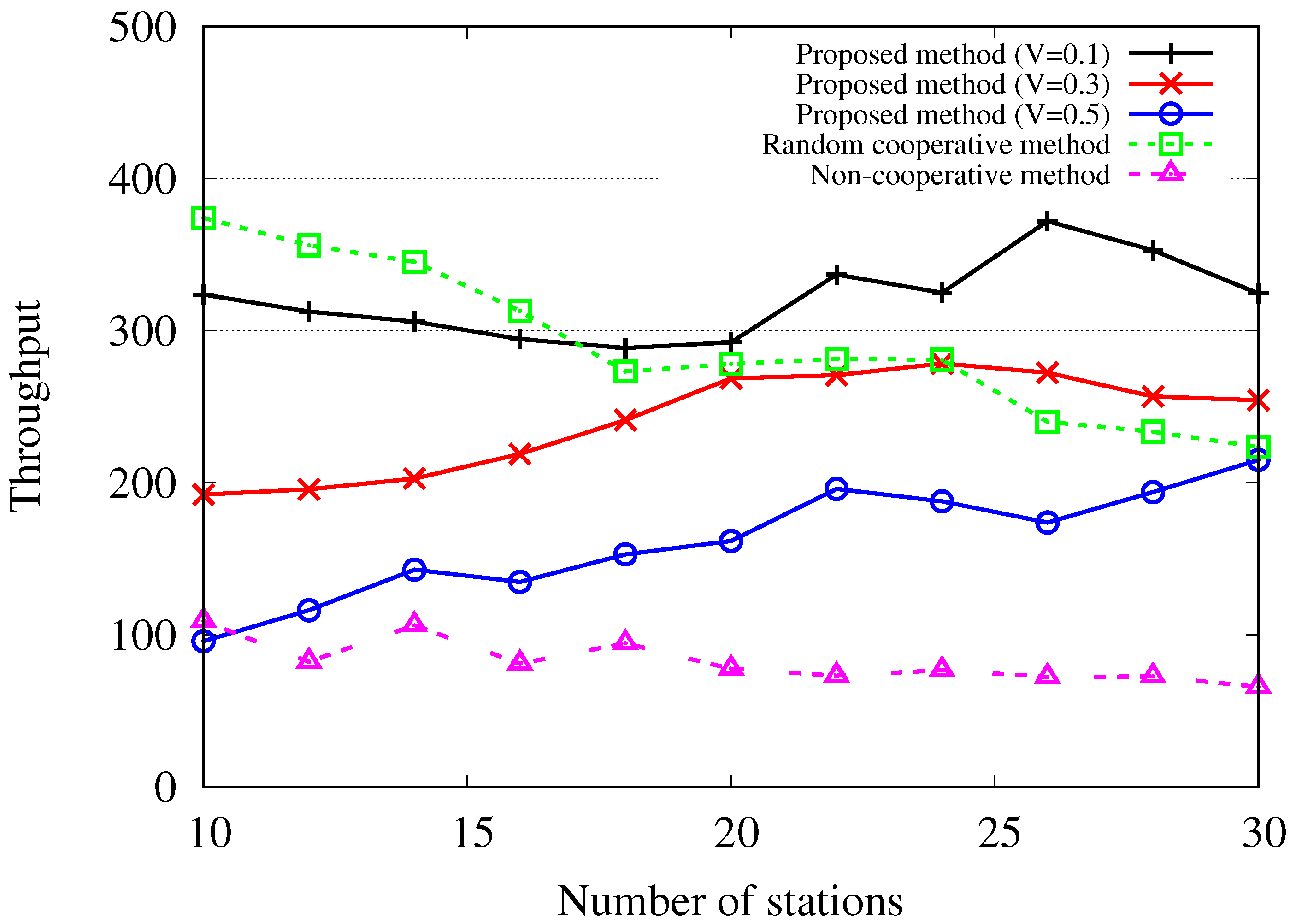
Figure 4 illustrates the average network throughput performance per time slot concerning the number of stations attempting to transmit uplink data. In the simulation setup, 20 APs are deployed in the network to offer uplink connectivity services to stations. Consequently, the simulation outcomes reveal different trends for scenarios with fewer than 20 stations and those with more than 20 stations. When the number of stations is less than 20, the random cooperative method shows better performance than the proposed Lyapunov drift-plus-penalty-based method on average. This is attributed to the random method’s ability to select the solution with the highest expected throughput from a randomly chosen feasible set of solutions, whereas the proposed method focuses on optimizing Lyapunov drift, which accounts for transmission stability based on queue status and anticipated uplink success probability. Furthermore, the proposed method considers the required cooperation delay, leading to decreased throughput performance compared to the random method. In non-congested network areas, where stations and APs are sparsely deployed for wireless connectivity services, the constraints involved in uplink cooperation, such as cooperation delay and stability, may impose strict limitations on viable solutions. This can lead to a reduction in throughput performance. The rationale behind this is that in such environments, the influence of interfering signals from nearby areas does not substantially compromise throughput performance. However, as the network experiences increased congestion due to a higher number of stations, the performance of the random method deteriorates, while the proposed method demonstrates stable or improved performance. Specifically, the proposed method with a trade-off parameter of
exhibits superior throughput compared to other methods when the number of stations is 18 or more in the simulated environments. For scenarios with over 24 stations, the proposed method with a trade-off parameter of
shows better throughput performance than the random method. Note that decreasing
V places more emphasis on stability represented by Lyapunov drift, while increasing
V prioritizes the required cooperation delay at the fronthaul network in scheduling decisions as represented in (
12). The results highlight that the proposed cooperative scheduling method with well-adjusted trade-off parameter
V enhances network throughput performance in dense networks. Conversely, the non-cooperative scheduling method consistently exhibits the lowest throughput performance across different numbers of stations. This implies the potential of cooperation to enhance network performance in densely populated areas with numerous APs and stations.
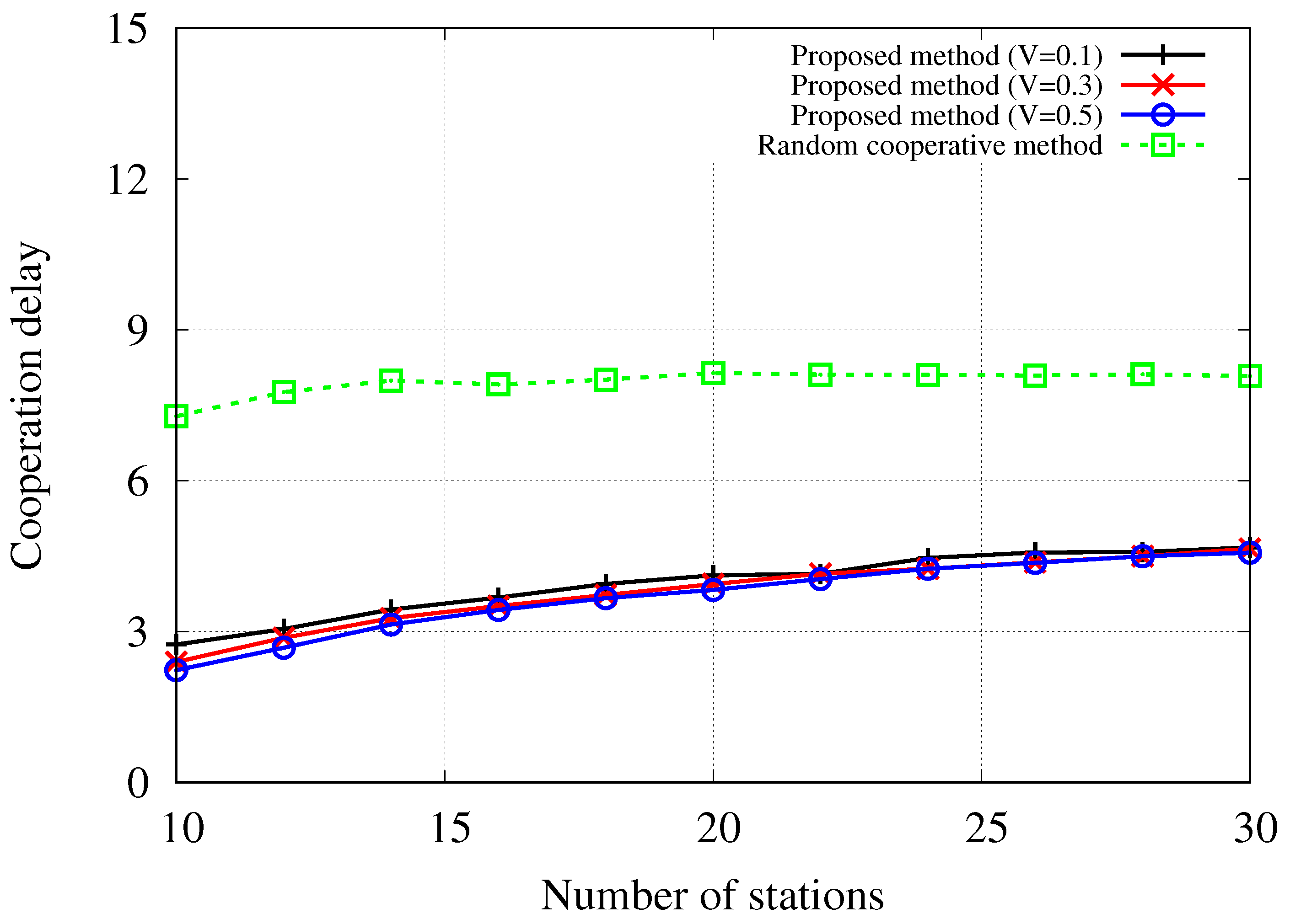
Figure 5 depicts the cooperation delay of the proposed method with different trade-off parameters and the random cooperative method in relation to the number of stations. The simulation results for the non-cooperative method are not included as this method does not entail additional delays for cooperation. As previously mentioned, an increase in the trade-off parameter
V results in lower delay because the proposed method prioritizes delay more significantly during the scheduling process. Consequently, the proposed method with
exhibits a longer delay compared to the methods with
and
. On the other hand, across all three cases with varying trade-off parameters, the proposed method demonstrates a shorter cooperation delay than the random cooperative method. In the simulated environments, the delay follows the gamma distribution with a shape parameter of
and a scale parameter of
, resulting in a mean delay value of 8. The observed cooperation delay of the random method displaying values close to 8 aligns with expectations, as the random distribution selects solutions without taking into account delay considerations. The results also indicate that if the fronthaul network connecting the cooperative scheduler and the cooperative APs experiences congestion from heavy traffic or expands with additional switches, cooperation could encounter challenges. Therefore, it is essential to consider the required delay for information exchange when implementing cooperative scheduling in dense networks.
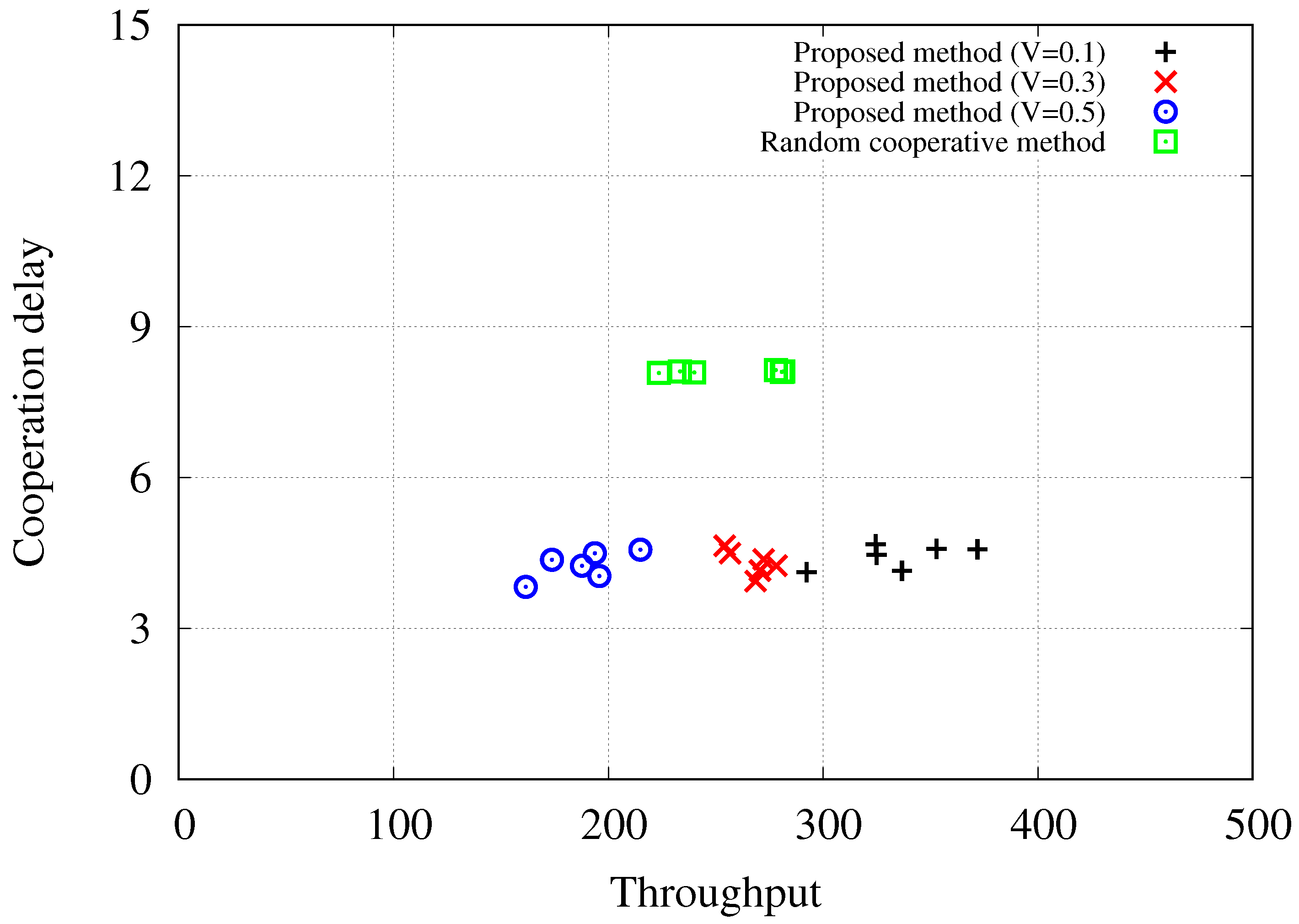
Figure 6 illustrates the trade-off relationships of the proposed Lyapunov drift-plus-penalty-based cooperative method with varying trade-off parameters,
V, and the random cooperative method when the number of stations,
, is equal to or greater than 20 in the simulated scenarios, i.e.,
. The results demonstrate that the proposed method with
exhibits comparable throughput performance to the random cooperative method, achieving throughput levels ranging from 200 to 300 bytes per time slot. However, there are significant differences in the required cooperation delay to achieve these throughput levels. While the proposed method necessitates delay values of around 4, the random cooperative method averages delay values of 8. On the other hand, the proposed method with a trade-off parameter of
requires delay values of around 4 to achieve even higher throughput performance exceeding 300 bytes per time slot. This analysis, based on the trade-off considerations, highlights that the proposed Lyapunov drift-plus-penalty-based cooperative uplink scheduling effectively enhances network performance.
6. Conclusions
In this manuscript, we present a cooperative uplink scheduling method utilizing the Lyapunov drift-plus-penalty framework. In environments densely populated with independently functioning APs and stations, the independent transmission activities of each AP-station pair can cause substantial interference with other concurrent transmissions. To address this issue, a cooperative scheduler or a central coordinating entity can be implemented to control uplink scheduling decisions, thereby promoting more effective network management. To enhance the uplink transmission capability of the network, a specific subset of stations may be chosen, with several proximate APs allocated to support the uplink transmissions from a singular station. While cooperative scheduling has the potential to augment network throughput, it necessitates additional delays due to the requisite coordination. The Lyapunov drift-plus-penalty-based approach we propose takes into account both the anticipated probabilities of successful uplink transmissions and the associated cooperation delays within its scheduling considerations, thereby balancing these trade-offs. The IEEE 802.11ax standard grounded simulations demonstrate that the proposed method substantially enhances network performance by effectively balancing throughput gains and delay costs. In future research, we intend to apply the insights obtained from this study to the development of learning-based scheduling algorithms for cooperative or cloud Wi-Fi networks. The Lyapunov-drift-plus-penalty-based scheduling from this research could serve as the basis for designing a reward function in reinforcement learning models. Alternatively, the aspects of transmission stability and cooperation delays could be features for a deep learning-based scheduling decision. To evaluate the practical application of such models, we plan to conduct real-world experiments using a test bed configured with software-defined radio hardware and a cloud server for cooperative scheduler implementation. We aim to evaluate the performance of scheduling decisions influenced by the Lyapunov drift-plus-penalty framework, particularly in congested environments with a high density of stations and APs.