Abstract
This paper introduces an adaptive trajectory-tracking control method for uncertain nonlinear systems, leveraging a time-varying threshold event-triggered mechanism to achieve predefined-time tracking. Compared to conventional time-triggering approaches, the employment of a time-varying threshold event-triggered mechanism significantly curtails communication resource wastage without compromising the system’s performance. Furthermore, a novel adaptive control algorithm with predefined timing is introduced. This method guarantees that tracking errors converge to within a small vicinity of the origin within a predefined timeframe, ensuring all signals in the closed-loop system remain bounded. Moreover, by adjusting a controller-related parameter, we can predefine the upper bound of the convergence time. Finally, the efficacy of the control scheme is corroborated by simulation results obtained from a nonlinear manipulator system.
1. Introduction
Robotic manipulators, which are complex mechanical systems that mimic human arm movements, exhibit high nonlinearity, strong coupling, and superior controllability. Their applications are significant across various fields, including industrial manufacturing, medical treatment, military, semiconductor production, and space exploration [1,2]. Consequently, the challenges of controlling robotic manipulators have garnered considerable interest and research from numerous scholars [3,4].
As control technology has advanced, a multitude of control algorithms have been successfully implemented in robotic manipulator control, yielding significant achievements. For instance, PID control stands as one of the most extensively deployed control algorithms [5,6]. The a PID controller adjusts robotic manipulators’ movement by calculating the control inputs based on the error between the desired and the actual positions, along with the error’s integral and derivative. However, its complex parameter tuning process during control complicates the controller design and debugging. Additionally, in the presence of disturbances or when a rapid response is required, the PID control may fail to adjust control inputs in a timely manner, resulting in system response delays or overshooting. Consequently, developing more robust control algorithms becomes imperative.
To enhance control performance, numerous control algorithms prioritize addressing the uncertainties inherent in robotic manipulator systems [7]. Adaptive control offers semi-global or global stability for nonlinear systems with parameter uncertainties [8,9]. However, as demands for higher performance escalate and system uncertainties intensify, applying adaptive control to increasingly complex systems presents challenges, including the complexity of adaptive controller structures and the inability of adaptive control systems to guarantee steady-state errors against disturbances. The emergence of adaptive neural network control in recent years has offered fresh perspectives on surmounting the constraints of conventional adaptive control approaches [10]. Leveraging neural networks’ robust capabilities for approximating nonlinear functions, adaptive neural network control strategies can precisely emulate the dynamic behaviors of complex systems, enhancing control accuracy and adaptability. Consequently, adaptive control strategies utilizing neural network approximations have been extensively applied in nonlinear systems [11,12]. An adaptive impedance controller utilizing a radial-basis-function neural network (RBFNN) is presented for robotic manipulator systems characterized by uncertainties and input saturation, with the goal of facilitating precise control, in [11]. The authors of [12] leverage RBFNN to approximate and compensate for uncertainties in the model, introducing an adaptive robust control algorithm based on RBFNN. This algorithm utilizes robust control to significantly diminish approximation errors, culminating in successful trajectory tracking for robotic manipulators. On the other hand, given that robotic manipulator systems can be suitably transformed into strict feedback systems, the adaptive backstepping control approach emerges as superior. It designs control laws in an iterative manner, skillfully managing the strict feedback configuration and effectively addressing the system’s nonlinearities and uncertainties, thereby ensuring the stability of the entire closed-loop system [13]. Consequently, the adaptive backstepping control method is employed in complex nonlinear systems, such as robotic manipulators and wheeled mobile robots, to achieve precise position control and trajectory tracking [14,15]. Leveraging backstepping technology introduces an adaptive controller based on the least squares support vector machine, aimed at precise robotic manipulator positioning. This method exhibits enhanced robustness, reduced tracking error, and improved response speed relative to traditional PD control. The authors explored a backstepping control approach for robotic manipulators with flexible joints in [14,15]. The former approach eliminates the need for measuring joint angular acceleration, while the latter addresses system vibrations. Both strategies facilitate effective position control.
The studies mentioned above have yielded positive outcomes in enhancing the performance and efficacy of robotic manipulators’ trajectory tracking. However, the transmission of control signals typically operates at fixed time intervals, necessitating shorter sampling periods for stability and effectiveness, but excessively high sampling rates lead to unnecessarily frequent updates following system stabilization. This often results in the wastage of communication resources. The event-triggered mechanism has effectively addressed the aforementioned issue [16]. The core principle behind event-triggered mechanisms is that communication data for measurement signals are transmitted only upon satisfying the design criteria of the event-driven strategy, thereby conserving communication resources while maintaining system control performance. To date, event-triggered control, as a strategy significantly reducing signal communication, has garnered extensive research [17,18,19]. The study in [17], focusing on robotic manipulator systems, explores the interplay between sliding mode controllers and event-triggered mechanisms. This approach enables precise trajectory tracking with fewer communication and signal updates, effectively eliminating Zeno phenomena. The authors of [18] introduced a periodic event-triggered control design tailored for nonlinear robotic manipulator systems. This design notably decreases the controller update frequency by minimizing the need for continuous state measurements, thereby conserving computational resources. The authors developed various event-triggered mechanisms to enhance the flexibility and energy efficiency of the system in [20,21]. However, the uncertainty of robotic manipulator models, external disturbances, and the imperative to avert Zeno phenomena during control present significant challenges in applying event-triggered strategies to robotic manipulator systems.
Importantly, the control methods discussed primarily focus on the system’s asymptotic stability or uniform ultimate boundedness. This suggests that achieving system stability within a finite timeframe or reaching a stable control objective within a specified period might not be feasible. In scenarios requiring precise timing for robotic manipulator operations, traditional incremental control algorithms fall short of meeting these practical needs. To overcome this challenge, robotic manipulator control has incorporated finite-time [22,23] and fixed-time [24,25] control theory. However, the convergence efficacy of finite-time control significantly depends on the initial condition of the system, often making it challenging to attain satisfactory convergence in practical scenarios [26]. The adoption of fixed-time control effectively addresses this issue by decoupling convergence time from initial conditions. However, fixed-time control does not facilitate a direct relationship between convergence time and controller parameters, potentially complicating the design and adjustment of parameters to align with real-world system requirements. Recently, a predefined-time control strategy has successfully addressed the limitations associated with finite-time and fixed-time control [27,28,29,30]. This approach is able to predetermine the upper bound for settling time, ensuring a high-performance temporal response from the system. Consequently, this emerging technology possesses significant developmental potential in the context of robot applications [31,32]. The authors of [31] concentrated on the issue of predefined-time stability in the posture control of multi-segment cable-driven spatial continuous robotic systems, introducing an effective solution via an adaptive controller employing the non-singular terminal sliding mode. Reference [32] introduces a novel adaptive predefined-time tracking control strategy for robotic manipulators facing input saturation challenges. By incorporating an auxiliary dynamic system, this approach adeptly navigates input constraints, securing the posture convergence of the manipulator within a predetermined timeframe. Consequently, based on the aforementioned analysis, investigating adaptive predefined-time stability for robotic manipulator systems with uncertainties is of substantial practical significance.
Analyzing the above literature reveals that in robotic manipulator systems with inherent uncertainty, we face the critical challenge of reducing communication resource usage while maintaining system control performance. Thus, incorporating an event-triggered mechanism holds significant value but presents certain challenges. Moreover, designing an attitude controller that meets convergence time requirements is crucial for the practical use of robotic arms in real-world applications. However, to the best of our knowledge, research on adaptive neural network-based event-triggered mechanisms and predefined-time robotic arm control remains underexplored. These issues warrant further investigation.
Drawing inspiration from prior research, this study focuses on an adaptive predefined-time trajectory tracking control problem with an event-triggered mechanism for robotic manipulator systems. The devised control law guarantees tracking error convergence to a small vicinity of the origin within a predefined period, while ensuring all closed-loop signals stay bounded within the same timeframe. The key contributions and highlights of this study are summarized as follows:
- (1)
- Diverging from finite-time [22,23] and fixed-time [24,25] control theories, the controller introduced in this study guarantees tracking error convergence to a designated area within a predefined time. Adjusting a single control parameter allows for the precise setting of the settling time’s upper bound, independent of initial conditions, aligning with practical engineering demands for system convergence time and precision.
- (2)
- Departing from the conventional adaptive predefined-time controls in [27,28,29], this work introduces a novel adaptive law, where a unique adaptive parameter is determined by the norm of neural network weights, thereby significantly simplifying computational complexity.
- (3)
- Contrasting with traditional event-triggered control approaches in [11,12,13], this study integrates a time-varying threshold event-triggered mechanism, effectively conserving communication resources without compromising system control efficacy.
The remainder of this manuscript is structured as follows: Section 2.1, Section 2.2 and Section 2.3 outline the mathematical model and preliminaries. Section 2.4 demonstrates the controller design and stability analysis. Section 2.5 proves the feasibility of the proposed method. Section 3 presents simulation results that validate the effectiveness of the designed controller. Section 4 provides a detailed analysis and discussion of the simulation results. Section 5 provides a comprehensive summary of the document.
Notations: In this paper, denotes the Euclidean two-dimensional norm. We define , with and a constant , where serves as the sign function.
2. Methods
2.1. Model of a Robotic Manipulator System
Consider a robotic manipulator system, with its dynamical model describable as follows:
where represents the arm angle, denotes angular velocity, is angular acceleration, refers to input torque, denotes moment of inertia, m shows the arm’s weight, l is the arm’s length, denotes the viscous friction coefficient, d represents continuous bounded input disturbances, and g stands for the gravitational acceleration.
Let and ; then, system (1) can be reformulated as follows:
where denotes the system input, and represents the system output, with being an uncertain nonlinear function and a known constant.
This paper aims to devise an adaptive predefined-time control scheme utilizing an event-triggered mechanism for nonlinear robotic manipulator systems, ensuring that
- (1)
- The position of the robotic manipulator joint can precisely follow the reference angle , with the tracking error rigorously confined within a compact set;
- (2)
- All signals within the closed-loop robotic manipulator system remain bounded within the predefined timeframe;
- (3)
- According to the proposed controller, it can significantly reduce the consumption of communication resources without compromising control precision.
2.2. Preparatory Work
Lemma 1
(See [19]).
where , and are constants.
Lemma 2
(See [29]). For conditions and , the following inequalities are valid.
Lemma 3
(See [30]).
where and .
Lemma 4
(See [30]). For system , we define a continuous function and establish parameters , , and to fulfill the condition
consequently, the trajectory of is practically predefined-time stable , and its convergence zone is
where represents the settling time and meets condition , with as its upper bound.
Remark 1.
is a predefined time parameter. According to Lemma 4, if a Lyapunov function exists in the form of Equation (6), then the system is predefined-time stable. In this scenario, the upper bound of the system’s settling time is . Clearly, this upper time bound is entirely artificially set and independent of system parameters and initial conditions. By adjusting , we can directly alter the upper bound of the system’s settling time, indicating that the error-convergence time can be preset by parameter adjustment.
Lemma 5
(See [33]).
where is a constant, with .
Lemma 6
(See [34]).
where are constants, and is a non-negative function. Consequently, if , then for any , holds.
Lemma 7
(See [35]).
where .
Assumption 1.
The ideal reference signal , its derivative , and its second derivative are continuous and bounded.
2.3. Radial Basis Neural Network (RBFNN)
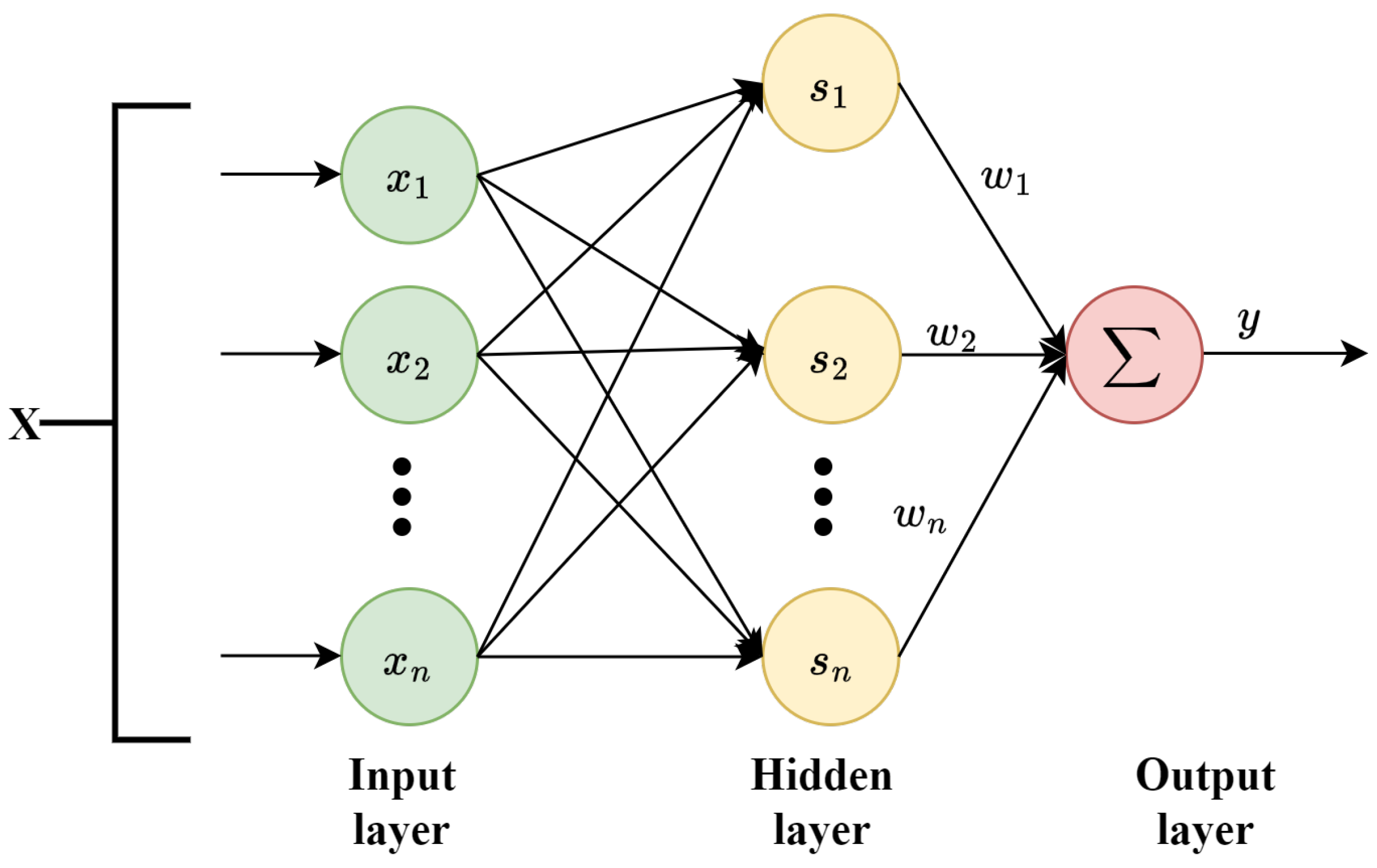
The RBFNN, a prevalent three-layer feedforward architecture, comprises an input layer, a hidden layer, and an output layer. The input layer, formed by source nodes, receives raw data. The hidden layer applies radial basis functions for nonlinear data transformation, while the output layer linearly weights and sums the hidden layer’s outputs to produce the outcome. Its network structure is shown in Figure 1.
Figure 1.
RBF neural network.
In this paper, an RBFNN defined over the compact set is employed to approximate the uncertain nonlinear function . The specific formulation is as follows:
where represents the input vector, with . The term signifies the neural network’s intrinsic approximation error, and , given that . The vector represents the radial basis functions, and denotes the number of nodes in the neural network’s hidden layer.
In this study, the Gaussian function is utilized as the radial basis function; thus,
where denotes the center of the domain for the Gaussian function, and represents the ith column component of , where . The constant denotes the width of the Gaussian function. The ideal weight vector is defined as follows:
where represents the estimated value of W.
2.4. Controller Design
In the previous section, we introduced the system model, mathematical lemmas, and RBFNN, which are essential for the design of the controller algorithm. Next, in this section, we will use the backstepping technique to develop an adaptive predefined-time control strategy based on an event-triggered mechanism.
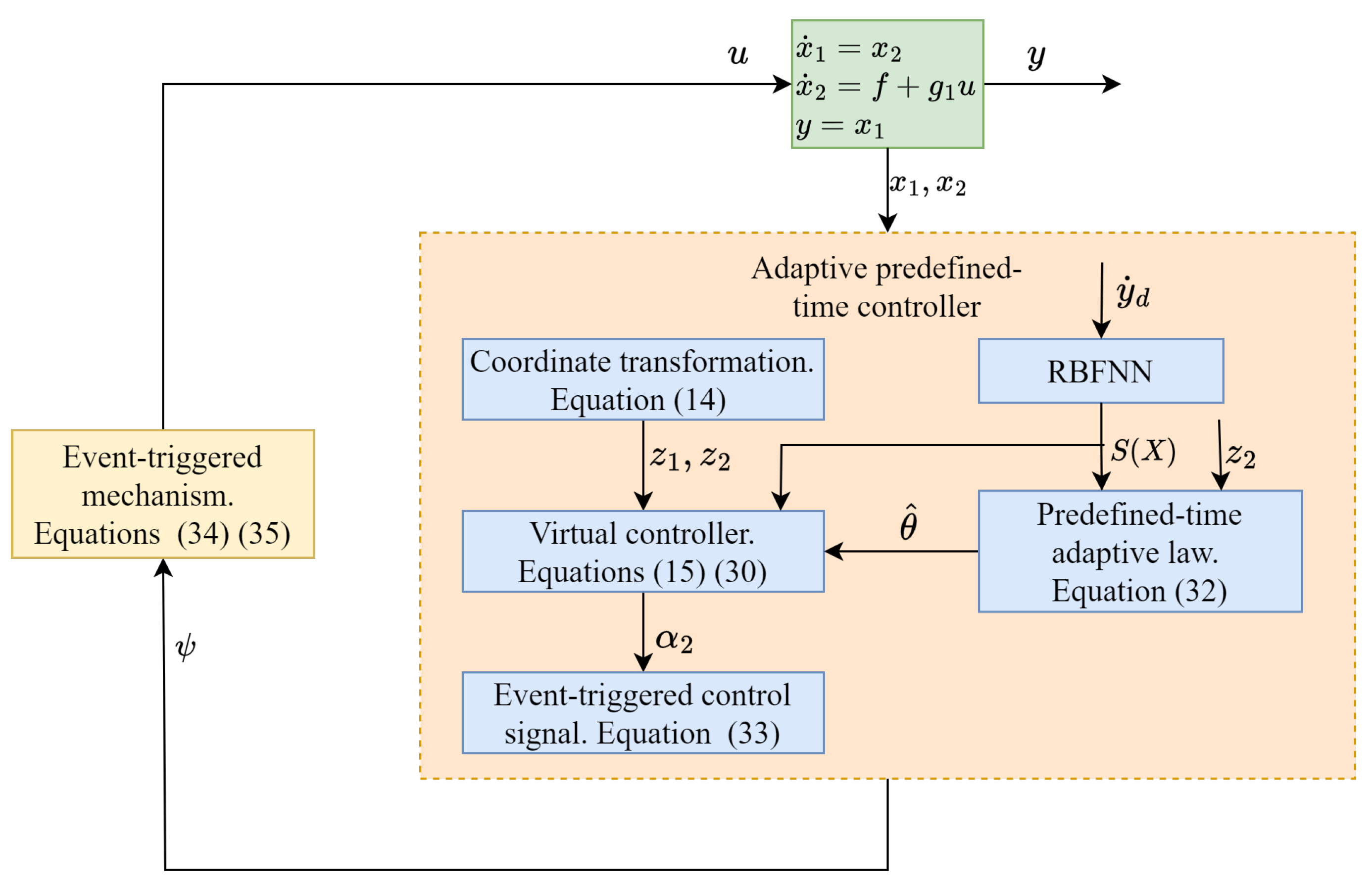
To clearly and intuitively present the adaptive predefined-time tracking control algorithm under the event-triggered mechanism proposed in this section, the following control scheme block diagram is provided in Figure 2.
Figure 2.
Control block diagram.
2.4.1. Adaptive Predefined-Time RBFNN Control Design
In this section, we employ backstepping techniques to design a predefined-time virtual controller and construct the corresponding Lyapunov functions. Additionally, RBFNN is used to estimate the uncertainties in the robotic manipulator system, and suitable adaptive laws are designed accordingly.
Initially, considering system (2), the coordinate transformation is defined as follows:
where represents the ideal tracking signal, and denotes the first virtual control term, as specified by the subsequent equation:
where , are positive constants, and represents a predefined constant.
Remark 2.
In backstepping control approaches, ensuring the boundedness of the virtual controller and its first derivative is imperative. In traditional control strategies, the existence of , with , leads to the first derivative of the virtual controller approaching infinity as approaches 0. Consequently, singularity issues arise in the first derivative of the virtual controller. Consequently, this study designs a virtual controller (15), addressing the issue. At this stage, consistently exhibits the property . This demonstrates the boundedness of . Thus, the singularity issue has been effectively addressed.
We design the following Lyapunov function:
Integrating Lemma 5 with Equation (16), we derive
The Lyapunov function selected is as follows:
where denotes the adaptive parameter error, and represents a constant.
The first derivative of yields
Using Lemma 1, we obtain
where , with representing a constant. Furthermore, serves as the input to the RBFNN, and denotes the output vector from the hidden layer nodes of the RBFNN.
Utilizing RBFNN to approximate yields
Furthermore, we can design the second virtual controller and the predefined-time adaptive law as follows:
where represents a constant, . Invoking Lemma 6 and defining , the analysis of the tanh function’s graph indicates that if , then leads to , denoted as ; if , then leads to , denoted as . Thus, is determined to be a non-negative function. Moreover, selecting ensures that for any , invariably holds.
Remark 3.
Employing the analytical approach outlined in Remark 2, it can be established that is bounded. Moreover, this methodology is similarly utilized to demonstrate that the first derivative of the continuous controller (33) is bounded.
2.4.2. Event-Triggered Mechanism Design
In conventional approaches, thresholds for event-triggered strategies are typically constants [36,37]. To enhance communication efficiency and control accuracy in practical applications, time-varying thresholds are indispensable. Therefore, this section introduces an event-triggered mechanism utilizing time-varying thresholds. By employing this mechanism along with the adaptive predefined-time backstepping control strategy described in Section 2.4.1, the proposed controller ensures system stability while avoiding the Zeno phenomenon.
The event-triggered controller has been designed as follows:
The event-triggered mechanism is designed as follows:
where denotes the measurement error, and represent positive parameters, with the constraints and . Upon meeting the trigger condition (35), the current time is set to , and then the updated control signal is implemented in the system. The time signifies the moment an event is triggered, while indicates the time at which the controller is updated.
As indicated by (34) and (35), there exists a continuous time-varying coefficient , fulfilling conditions and , leads to :
where . Given and it follows that .
Consequently, we derive
The inequality invariably holds, and ; we obtain
Rearranging the last term in (38), we obtain:
According to Lemma 1, we obtain
2.4.3. Stability Analysis
In this section, we will utilize the Lyapunov function, in conjunction with Section 2.4.1 and Section 2.4.2 and relevant mathematical lemmas, to theoretically demonstrate the predefined-time stability of the system.
Theorem 1.
Considering the robotic manipulator system (2), virtual controllers (15) and (30), actual controller (37), and the adaptive law (32), under the event-triggered mechanisms (34) and (35) and Lemma 4, the system is PPTS with the system’s error signals converging within to a compact set, where denotes the settling time, satisfying , with all signals in the closed-loop robotic manipulator system being bounded.
Proof.
According to (47), we obtain
Utilizing Young’s inequality, we derive
Applying Lemma 3, we obtain
Applying Lemma 7, we derive the following inequality:
Applying Lemma 2 yields the following inequalities:
Reapplying Lemma 2 yields the following inequalities:
Integrating inequalities (59) and (60) allows (58) to be reformulated as
where is regarded as a bounded positive constant.
Following Lemma 4 and (61), the system is PPTS, and the error signals are capable of converging to the compact set:
where denotes the settling time and meets the condition , clearly indicating that are bounded. Given that is a constant and assuming conditions for , the boundedness of is guaranteed. Furthermore, given that are bounded, and under the conditions of , it follows that are also bounded. Further, from Equations (33) and (37), it is derived that controllers are bounded. Moreover, given Equation (14) and the boundedness of , it follows that and are bounded. Consequently, all signals within the closed-loop robotic manipulator system are bounded, concluding the proof of Theorem 1. □
Remark 4.
Based on the stability analysis, by adjusting the predefined parameter , we can establish an upper bound for the settling time of the closed-loop system at . Additionally, decreasing results in an accelerated convergence rate.
2.5. Feasibility Analysis
Subsequently, the proposed event-triggered mechanism’s feasibility is substantiated by the exclusion of the Zeno phenomenon.
Theorem 2.
Proof.
Given , and with as a constant, coupled with , it can be deduced that . Further analysis yields that holds true. Following the preceding analysis and Remark 3, we conclude that the first derivative of is bounded. Consequently, a positive constant s exists, ensuring that . With , alongside and , it can be inferred that . Further deduction reveals that . Hence, a positive constant necessarily exists, ensuring , which in turn circumvents the Zeno phenomenon. □
3. Results
In this section, the effectiveness of the proposed control strategy is verified through simulation for a single-arm robotic system characterized by uncertainty. The dynamic model of the single-arm robot is presented in (1), with the arm parameters and the target reference signal given in Table 1. The system states are initially set to , with the adaptive parameter initialized at . The comprises seven nodes, with Gaussian function centers uniformly distributed across the interval , and the Gaussian function width is . The design parameters for the virtual controllers (15) and (30), actual controller (37), event-triggered mechanism (35), and adaptive law (32) are selected as , , . To further ascertain the efficacy of the developed predefined-time schemes, two distinct values were chosen, specifically 3 s and 6 s. A simulation duration of 20 s was chosen, using degrees to show the tracking errors, which can clearly represent the tracking performance. The simulation results are presented in Figure 3, Figure 4, Figure 5, Figure 6, Figure 7, Figure 8 and Figure 9.
Table 1.
Model parameters.
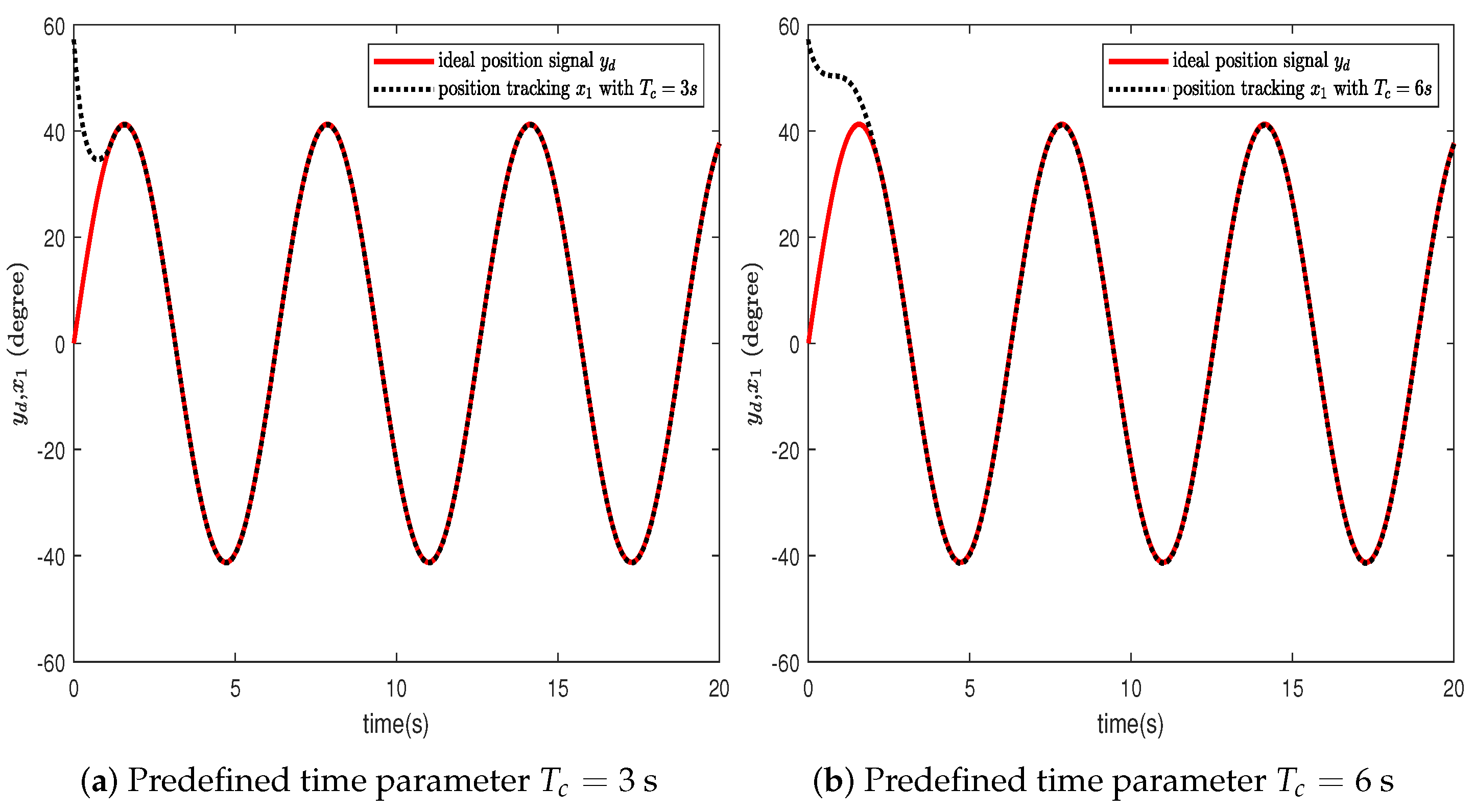
Figure 3.
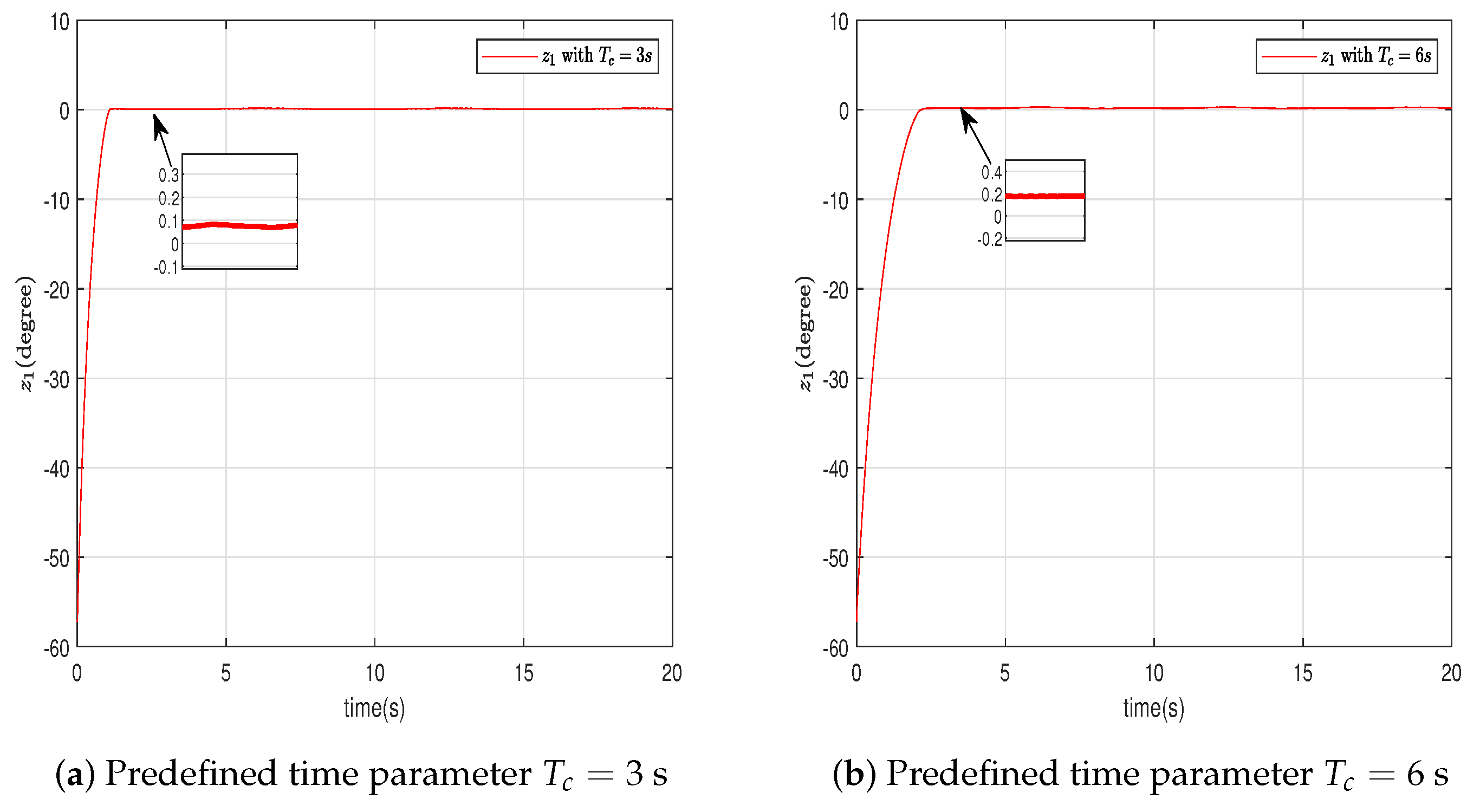
Trajectory of the angular tracking error .
Figure 4.
Trajectories of the ideal reference signal and the actual system output signal .
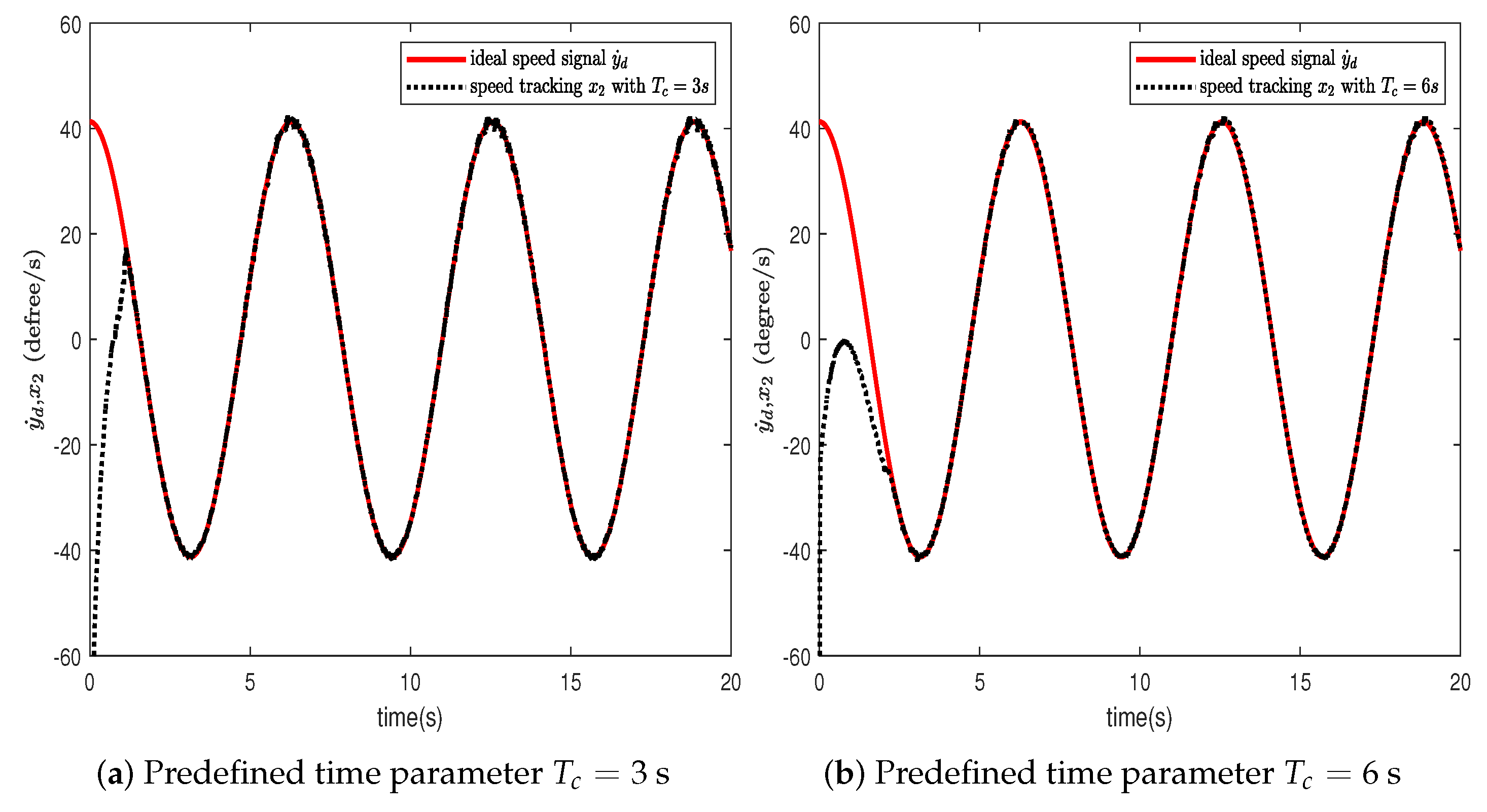
Figure 5.
Trajectories of the ideal angular speed signal and the actual angular speed signal .
Figure 6.
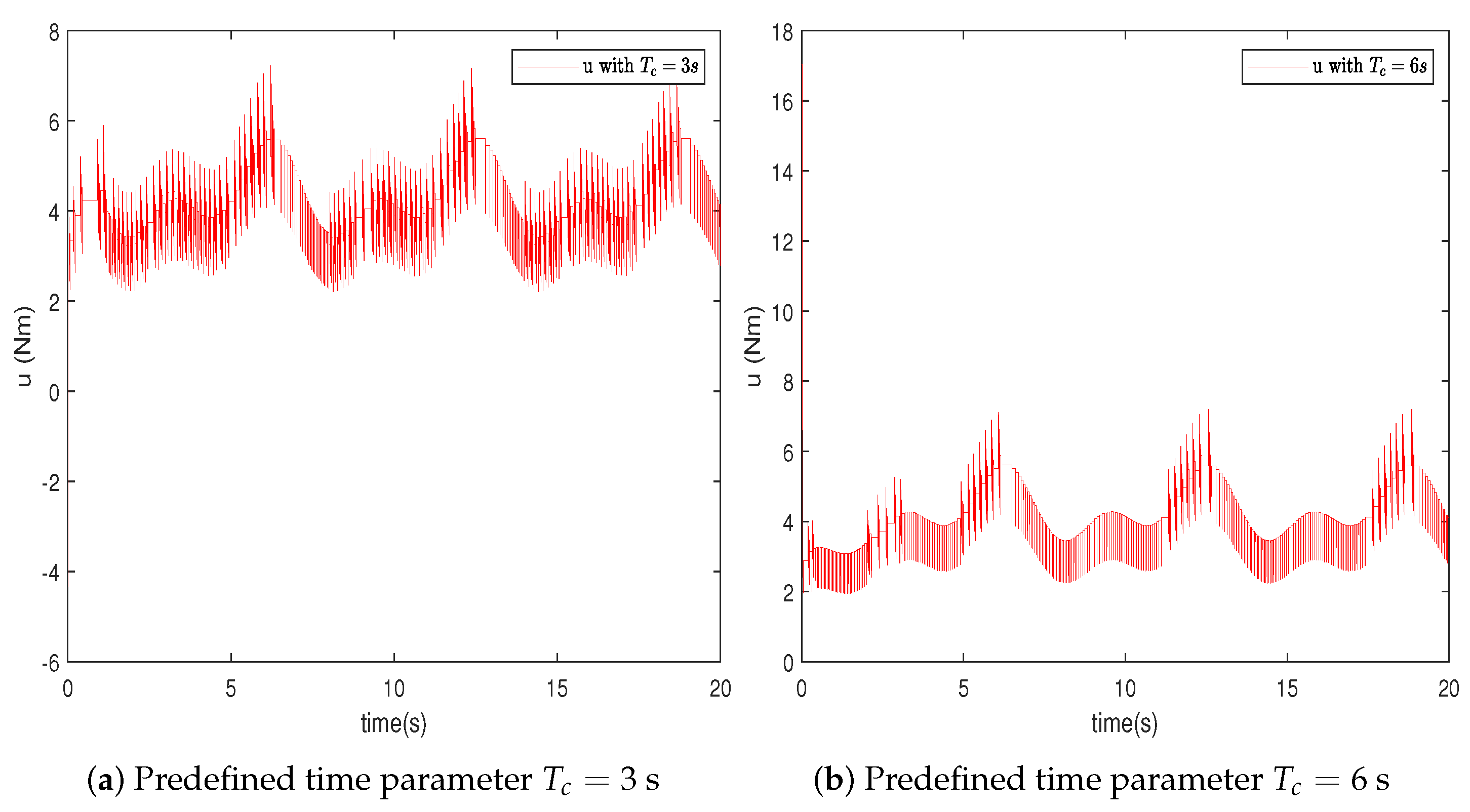
Trajectory of the controller output u.
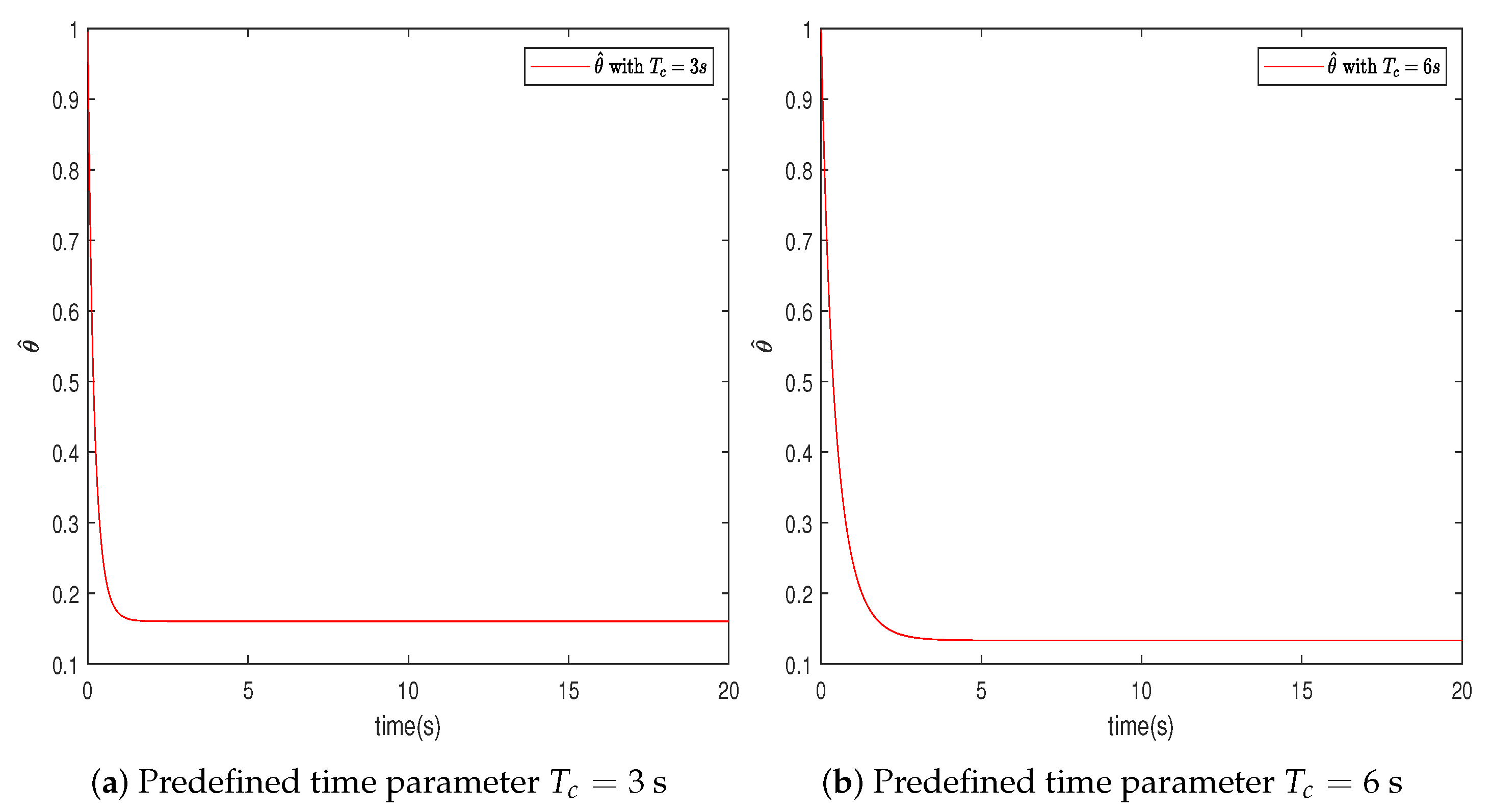
Figure 7.
Trajectory of the adaptive parameter .
Figure 8.
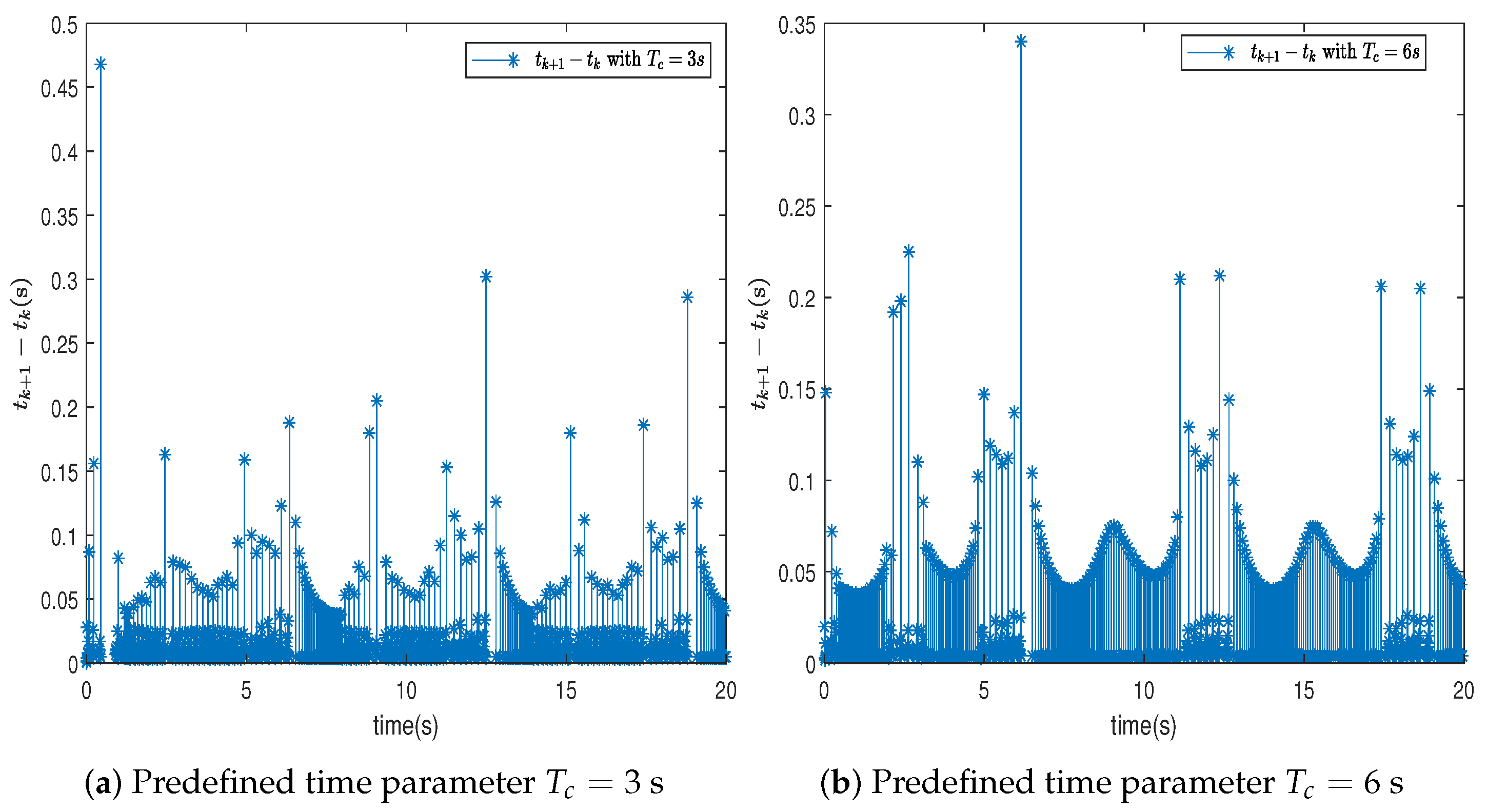
The triggering instants and time intervals .
Figure 9.
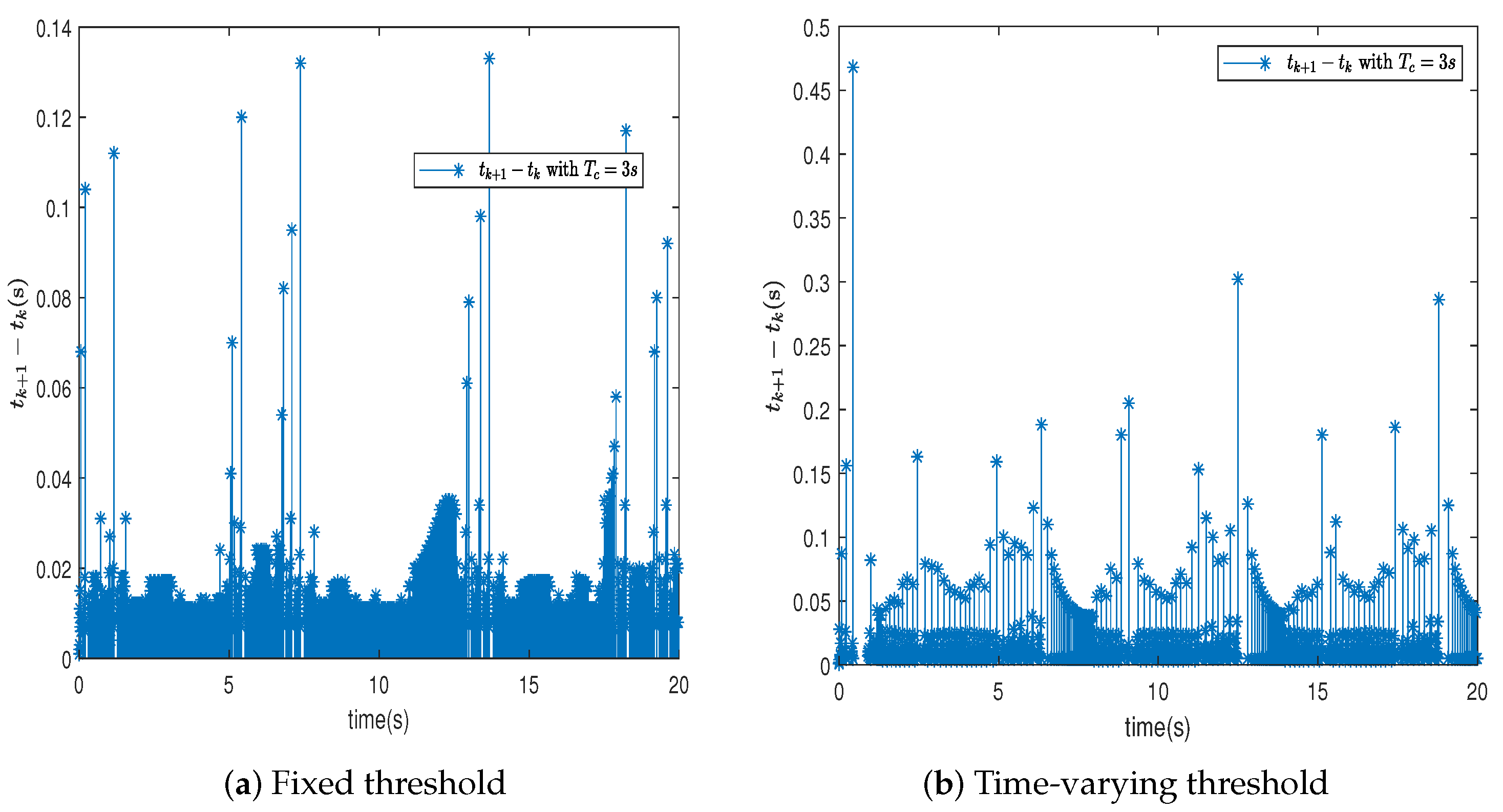
Comparison of adjacent event trigger time interval with fixed threshold and variable threshold with .
4. Discussion
In this section, we further describe and analyze the simulation results of Section 3. Figure 3 illustrates the trajectory of the tracking error for the system’s output signal across various predefined times. It is observed that the tracking error converges to a small vicinity around the origin before the designated upper bound of the settling time , meeting the anticipated control objective. Furthermore, a smaller value of the parameter correlates with a faster convergence speed of the tracking error. Figure 4 and Figure 5 depict the trajectories of the ideal signal and the actual position signal , along with the trajectories of the ideal angular speed signal and the actual angular speed signal , under various predefined time parameters. From Figure 3, Figure 4 and Figure 5, it is evident that when the parameter is set to 6 s, the actual stabilization time of the system increases. Additionally, the boundary of the system’s settling time can be clearly determined in advance by specifying the parameter . This verifies the effectiveness of the proposed predefined-time controller. Figure 6 presents the trajectory of the control signal. This demonstrates the effective role of the event-triggered mechanism. Figure 7 illustrates the trajectory curve of the adaptive parameter . The analysis in Figure 3, Figure 4, Figure 5, Figure 6 and Figure 7 reveals that the control strategy ensures boundedness of the closed-loop system’s angles, angular velocities, controller outputs, and adaptive parameter signals while also guaranteeing that tracking errors converge to a small neighborhood near the origin within the predefined time frame. Figure 8 displays the time intervals between successive event triggers. Statistical analysis reveals that the trigger counts were 986 and 735 for values of 3 s and 6 s, respectively. When = 3 s is used as an example, the total simulation time is 20 s. It is known that the sampling frequency of classic robotic arm controllers ranges between 500 and 1000/s. Therefore, employing the event-triggered mechanism with time-varying thresholds can save at least = 90.14% of communication resources. Figure 9 displays the event-triggering images for fixed and variable thresholds at = 3 s. According to statistics, using a fixed threshold resulted in 1582 event triggers, while using a variable threshold resulted in 986 event triggers. Based on the calculations, using fixed and variable thresholds can save at least 84.18% and 90.14% of communication resources, respectively. Moreover, based on the graphs, it is evident that throughout the entire control process, the fixed threshold event-triggering mechanism wastes more communication resources (more triggers with shorter intervals between them), which leads to larger control errors. This further emphasizes the superiority of our variable threshold-triggering mechanism. In conclusion, the simulation outcomes align with the theoretical predictions, demonstrating that the designed controller effectively achieves the control objectives and meets the system’s performance specifications.
5. Conclusions
This paper introduces an event-triggered, adaptive predefined-time tracking control method for a robotic manipulator system characterized by uncertainty. This approach ensures that the tracking error converges to a neighborhood near the origin within a predefined time while allowing for the predetermination of the settling time’s upper bound through the adjustment of a straightforward control parameter, thus favoring compliance with real system demands. Additionally, this method conserves communication resources effectively without compromising system control performance. The efficacy of the proposed control approach was substantiated through simulations. While the control strategy exhibits strong convergence and timely responses, its actual performance in real-world scenarios may be compromised by overlooked factors, such as inadequate system modeling or failures in the robotic manipulators’ actuators, thus failing to meet the anticipated standards. Moreover, future work should focus on developing a more precise mathematical model while addressing additional challenges the robotic manipulator might face in practical applications, such as state error constraints and actuator failures, with the goal of devising an enhanced control strategy.
Author Contributions
Conceptualization: Y.W. and Y.S.; methodology: Y.W., Y.S. and J.H.; software: Y.Z.; validation: Y.S., Y.Z., and J.H.; writing—original draft preparation: Y.W. and Y.S.; writing—review and editing: Y.W. and Y.Z.; supervision: J.H. All authors have read and agreed to the published version of the manuscript.
Funding
This research was funded by Jiangsu Funding Program for Excellent Postdoctoral Talent (No. 2023ZB246).
Institutional Review Board Statement
Not applicable.
Informed Consent Statement
Not applicable.
Data Availability Statement
Data sharing is not applicable to this article because no datasets were generated or analyzed during this study.
Acknowledgments
The authors sincerely appreciate the editors’ and reviewers’ kind attention and valuable comments dedicated to this paper.
Conflicts of Interest
The authors declare no conflicts of interest.
References
- Johannsmeier, L.; Haddadin, S. A Hierarchical Human-Robot Interaction-Planning Framework for Task Allocation in Collaborative Industrial Assembly Processes. IEEE Robot. Autom. Lett. 2017, 2, 41–48. [Google Scholar] [CrossRef]
- Zhao, Y.M.; Lin, Y.; Xi, F.; Guo, S. Calibration-Based Iterative Learning Control for Path Tracking of Industrial Robots. IEEE Trans. Ind. Electron. 2015, 62, 2921–2929. [Google Scholar] [CrossRef]
- Chen, W.H.; Ballance, D.; Gawthrop, P.; O’Reilly, J. A nonlinear disturbance observer for robotic manipulators. IEEE Trans. Ind. Electron. 2000, 47, 932–938. [Google Scholar] [CrossRef]
- Liu, Y.; Zhan, W.; Xing, M.; Wu, Y.; Xu, R.; Wu, X. Boundary Control of a Rotating and Length-Varying Flexible Robotic Manipulator System. IEEE Trans. Syst. Man Cybern. Syst. 2022, 52, 377–386. [Google Scholar] [CrossRef]
- Rocco, P. Stability of PID control for industrial robot arms. IEEE Trans. Robot. Autom. 1996, 12, 606–614. [Google Scholar] [CrossRef]
- Luo, G.; Saridis, G. L-Q design of PID controllers for robot arms. IEEE J. Robot. Autom. 1985, 1, 152–159. [Google Scholar] [CrossRef]
- Xiao, B.; Cao, L.; Xu, S.; Liu, L. Robust Tracking Control of Robot Manipulators with Actuator Faults and Joint Velocity Measurement Uncertainty. IEEE/ASME Trans. Mechatronics 2020, 25, 1354–1365. [Google Scholar] [CrossRef]
- Sun, Y.; Yan, B.; Shi, P.; Lim, C.C. Consensus for multiagent systems under output constraints and unknown control directions. IEEE Syst. J. 2022, 17, 1035–1044. [Google Scholar] [CrossRef]
- Hu, Y.; Gu, W.; Zhang, H.; Chen, H. Adaptive Robust Triple-Step Control for Compensating Cogging Torque and Model Uncertainty in a DC Motor. IEEE Trans. Syst. Man Cybern. Syst. 2019, 49, 2396–2405. [Google Scholar] [CrossRef]
- Zhang, Y.; Tao, G.; Chen, M. Adaptive Neural Network Based Control of Noncanonical Nonlinear Systems. IEEE Trans. Neural Netw. Learn. Syst. 2016, 27, 1864–1877. [Google Scholar] [CrossRef] [PubMed]
- He, W.; Dong, Y.; Sun, C. Adaptive Neural Impedance Control of a Robotic Manipulator with Input Saturation. IEEE Trans. Syst. Man Cybern. Syst. 2016, 46, 334–344. [Google Scholar] [CrossRef]
- Zhang, L.; Cheng, L. An Adaptive Neural Network Control Method for Robotic Manipulators Trajectory Tracking. In Proceedings of the 2019 Chinese Control and Decision Conference (CCDC), Nanchang, China, 3–5 June 2019; pp. 4839–4844. [Google Scholar] [CrossRef]
- Huang, X.; Gao, H.; Li, J.; Mao, R.; Wen, J. Adaptive back-stepping tracking control of robot manipulators considering actuator dynamic. In Proceedings of the 2016 IEEE International Conference on Advanced Intelligent Mechatronics (AIM), Banff, AB, Canada, 12–15 July 2016; pp. 941–946. [Google Scholar] [CrossRef]
- Lee, J.; Yeon, J.S.; Park, J.H.; Lee, S. Robust back-stepping control for flexible-joint robot manipulators. In Proceedings of the 2007 IEEE/RSJ International Conference on Intelligent Robots and Systems, San Diego, CA, USA, 29 October–2 November 2007; pp. 183–188. [Google Scholar] [CrossRef]
- Zouari, L.; Abid, H.; Abid, M. Flexible joint manipulator based on backstepping controller. In Proceedings of the 2014 15th International Conference on Sciences and Techniques of Automatic Control and Computer Engineering (STA), Hammamet, Tunisia, 21–23 December 2014; pp. 330–334. [Google Scholar] [CrossRef]
- Thaler, J.J.; Simaitis, V.J.; Becker, J.J.; Wisniewski, W.J. Event Trigger for the MARK-III Detector at SPEAR. IEEE Trans. Nucl. Sci. 1983, 30, 236–239. [Google Scholar] [CrossRef]
- Kameyama, T.; Zhao, X.; Yang, Z.J. Event-triggered sliding mode control of a robot manipulator. In Proceedings of the 2022 International Conference on Advanced Mechatronic Systems (ICAMechS), Toyama, Japan, 17–20 December 2022; pp. 16–20. [Google Scholar] [CrossRef]
- Benitez-Garcia, S.E.; Villarreal-Cervantes, M.G.; Guerrero-Castellanos, J.F.; Sánchez-Santana, J.P. Periodic Event-Triggered Control for the Stabilization of Robotic Manipulators. IEEE Access 2020, 8, 111553–111565. [Google Scholar] [CrossRef]
- Yuxiao, L.; Wenjing, Y.; Linqi, W.; Xueliang, W.; Jianwei, X. Adaptive neural network tracking control for a class of nonstrict-feedback nonlinear systems based on event-triggering mechanism. Nanjing Xinxi Gongcheng Daxue Xuebao 2021, 13, 59–65. [Google Scholar]
- Wei, B.; Xiao, F.; Shi, Y. Dynamic event-triggered control for networked Euler-Lagrange systems. In Proceedings of the 2019 IEEE 28th International Symposium on Industrial Electronics (ISIE), Vancouver, BC, Canada, 12–14 June 2019; pp. 1245–1250. [Google Scholar] [CrossRef]
- Kumar, N.; Porwal, A.; Singh, A.R.; Naskar, R.; Purwar, S. Event Triggered Control of Robot Manipulator. In Proceedings of the 2019 6th International Conference on Signal Processing and Integrated Networks (SPIN), Noida, India, 7–8 March 2019; pp. 362–366. [Google Scholar] [CrossRef]
- Li, G.; Chen, X.; Yu, J.; Liu, J. Adaptive Neural Network-Based Finite-Time Impedance Control of Constrained Robotic Manipulators With Disturbance Observer. IEEE Trans. Circuits Syst. II Express Briefs 2022, 69, 1412–1416. [Google Scholar] [CrossRef]
- Yang, C.; Jiang, Y.; He, W.; Na, J.; Li, Z.; Xu, B. Adaptive Parameter Estimation and Control Design for Robot Manipulators With Finite-Time Convergence. IEEE Trans. Ind. Electron. 2018, 65, 8112–8123. [Google Scholar] [CrossRef]
- Zhang, L.; Wang, Y.; Hou, Y.; Li, H. Fixed-Time Sliding Mode Control for Uncertain Robot Manipulators. IEEE Access 2019, 7, 149750–149763. [Google Scholar] [CrossRef]
- Zhang, L.; Liu, H.; Tang, D.; Hou, Y.; Wang, Y. Adaptive Fixed-Time Fault-Tolerant Tracking Control and Its Application for Robot Manipulators. IEEE Trans. Ind. Electron. 2022, 69, 2956–2966. [Google Scholar] [CrossRef]
- Zhang, S.; Yuan, S.; Yu, X.; Kong, L.; Li, Q.; Li, G. Adaptive Neural Network Fixed-Time Control Design for Bilateral Teleoperation With Time Delay. IEEE Trans. Cybern. 2022, 52, 9756–9769. [Google Scholar] [CrossRef] [PubMed]
- Sánchez-Torres, J.D.; Sanchez, E.N.; Loukianov, A.G. Predefined-time stability of dynamical systems with sliding modes. In Proceedings of the 2015 American Control Conference (ACC), Chicago, IL, USA, 1–3 July 2015; pp. 5842–5846. [Google Scholar] [CrossRef]
- Zhou, S.; Song, Y.; Wen, C. Event-Triggered Practical Prescribed Time Output Feedback Neuroadaptive Tracking Control Under Saturated Actuation. IEEE Trans. Neural Netw. Learn. Syst. 2023, 34, 4717–4727. [Google Scholar] [CrossRef] [PubMed]
- Wang, Q.; Cao, J.; Liu, H. Adaptive Fuzzy Control of Nonlinear Systems With Predefined Time and Accuracy. IEEE Trans. Fuzzy Syst. 2022, 30, 5152–5165. [Google Scholar] [CrossRef]
- Xie, S.; Chen, Q. Adaptive Nonsingular Predefined-Time Control for Attitude Stabilization of Rigid Spacecrafts. IEEE Trans. Circuits Syst. II Express Briefs 2022, 69, 189–193. [Google Scholar] [CrossRef]
- Ding, M.; Wu, H.; Zheng, X.; Guo, Y. Adaptive Predefined-Time Attitude Stabilization Control of Space Continuum Robot. IEEE Trans. Circuits Syst. II Express Briefs 2024, 71, 647–651. [Google Scholar] [CrossRef]
- Fang, H.; Wu, Y.; Xu, T.; Wan, F. Adaptive neural sliding mode control of uncertain robotic manipulators with predefined time convergence. Int. J. Robust Nonlinear Control 2022, 32, 9213–9238. [Google Scholar] [CrossRef]
- Wang, H.; Xu, K.; Qiu, J. Event-Triggered Adaptive Fuzzy Fixed-Time Tracking Control for a Class of Nonstrict-Feedback Nonlinear Systems. IEEE Trans. Circuits Syst. I Regul. Pap. 2021, 68, 3058–3068. [Google Scholar] [CrossRef]
- Zhang, Y.; Chadli, M.; Xiang, Z. Predefined-time adaptive fuzzy control for a class of nonlinear systems with output hysteresis. IEEE Trans. Fuzzy Syst. 2022, 31, 2522–2531. [Google Scholar] [CrossRef]
- Qian, C.; Lin, W. Non-Lipschitz continuous stabilizers for nonlinear systems with uncontrollable unstable linearization. Syst. Control Lett. 2001, 42, 185–200. [Google Scholar] [CrossRef]
- Zhang, Z.; Wen, C.; Xing, L.; Song, Y. Event-Triggered Adaptive Control for a Class of Nonlinear Systems With Mismatched Uncertainties via Intermittent and Faulty Output Feedback. IEEE Trans. Autom. Control 2023, 68, 8142–8149. [Google Scholar] [CrossRef]
- Tang, L.; Li, Y.; Liu, Y.J. Adaptive Event-Triggered Vibration Control for Crane Bridge System with Trolley. IEEE Trans. Instrum. Meas. 2023, 72, 1–10. [Google Scholar] [CrossRef]
Disclaimer/Publisher’s Note: The statements, opinions and data contained in all publications are solely those of the individual author(s) and contributor(s) and not of MDPI and/or the editor(s). MDPI and/or the editor(s) disclaim responsibility for any injury to people or property resulting from any ideas, methods, instructions or products referred to in the content. |
© 2024 by the authors. Licensee MDPI, Basel, Switzerland. This article is an open access article distributed under the terms and conditions of the Creative Commons Attribution (CC BY) license (https://creativecommons.org/licenses/by/4.0/).