You are currently viewing a new version of our website. To view the old version click .
Sensors
  • Article
  • Open Access

24 March 2023

Scalable Lightweight Protocol for Interoperable Public Blockchain-Based Supply Chain Ownership Management

,
and
1
Department of Electrical and Electronic Engineering, University of Southampton Malaysia, Iskandar Puteri 79100, Malaysia
2
Department of Computer Science (IDI), Norwegian University of Science and Technology, 7034 Trondheim, Norway
3
School of Electronics and Computer Science, University of Southampton, Southampton SO17 IBJ, UK
*
Author to whom correspondence should be addressed.
This article belongs to the Topic Next Generation of Security and Privacy in IoT, Industry 4.0, 5G Systems and Beyond

Abstract

Scalability prevents public blockchains from being widely adopted for Internet of Things (IoT) applications such as supply chain management. Several existing solutions focus on increasing the transaction count, but none of them address scalability challenges introduced by resource-constrained IoT device integration with these blockchains, especially for the purpose of supply chain ownership management. Thus, this paper solves the issue by proposing a scalable public blockchain-based protocol for the interoperable ownership transfer of tagged goods, suitable for use with resource-constrained IoT devices such as widely used Radio Frequency Identification (RFID) tags. The use of a public blockchain is crucial for the proposed solution as it is essential to enable transparent ownership data transfer, guarantee data integrity, and provide on-chain data required for the protocol. A decentralized web application developed using the Ethereum blockchain and an InterPlanetary File System is used to prove the validity of the proposed lightweight protocol. A detailed security analysis is conducted to verify that the proposed lightweight protocol is secure from key disclosure, replay, man-in-the-middle, de-synchronization, and tracking attacks. The proposed scalable protocol is proven to support secure data transfer among resource-constrained RFID tags while being cost-effective at the same time.

1. Introduction

Scalability is the main concern for public blockchain-based Internet of Things (IoT) applications. As the number of IoT devices increases each year, coupled with the emergence of the 5G network, this trend is expected to accelerate, driven by the release of a new generation of IoT devices. Existing public blockchains try to solve scalability issues by using different approaches such as on-chain (e.g., sharding) and off-chain (e.g., using sidechain, layer-2 scaling) methods, or by completely using different data structures (e.g., Direct Acyclic Graph used in IOTA), as discussed in [1]. Ethereum 2.0, currently known as the Consensus Layer, is expected to offer a throughput of up to 100,000 transactions per second (TPS) when sharding is implemented. One of its existing technologies—rollups—is already used to improve scalability through layer-2 protocols [2]. This is achieved by offloading heavy computational processes from MainNet to a rollup-specific chain which, in turn, speeds up the transactions. Two types of rollups were introduced by the Ethereum 2.0 blockchain: optimistic rollups and zk-rollups. The former rollups have a long transaction finality time due to their fraud-proof mechanism, which is used to detect incorrectly calculated transactions. In contrast, zk-rollups offer fast finality but require heavy computation for the proving system (e.g., Zk-SNARK) [3]. Both of these rollup solutions have their own weaknesses; therefore, instead of improving them, there is a need for an alternative scaling solution that can be supported by IoT devices. There are several challenges, including the use of resource-constrained IoT devices themselves. Typically, supply chain management solutions use proprietary low-cost Radio Frequency Identification (RFID) tags for goods tracking and ownership management. These tags are classified as Class I IoT devices, meaning they have limited resources and processing capabilities to support complex cryptographic algorithms [1]. In order to enable more transparent, secure, and efficient supply chain management of RFID-tagged goods, this paper proposes a scalable protocol that allows for a secure batch ownership transfer of these tagged goods using an Ethereum public blockchain. While Ethereum 2.0 with rollups significantly reduces overall transaction fees, the proposed solution can further decrease them, as only a single fee is charged for managing a batch of IoT devices, ensuring increased scalability. The proposed scalable protocol is designed using a lightweight cryptographic algorithm to protect resource-limited IoT devices from common security attacks. These security attacks include key disclosure, replay, man-in-the-middle, de-synchronization, and tracking attacks [4]. The protocol is scalable with the help of an InterPlanetary File System (IPFS), and is integrated with a public blockchain to perform transparent IoT device ownership data transfer in batches using only a single transaction. The integration of a public blockchain with this proposed solution is essential for transparent ownership data transfer, data integrity, and access to on-chain data. The main contributions of this paper are as follows:
1.
A novel scalable public blockchain-based lightweight protocol using bitwise exclusive-OR and simple permutation operations is presented. Its purpose is to perform a secure batch ownership data transfer associated with resource-limited RFID tags;
2.
The proposed scalable lightweight protocol is able to protect RFID-tagged goods in the supply chain system from key disclosure, replay, man-in-the-middle, de-synchronization, and tracking attacks;
3.
The proposed lightweight protocol offers partial transparency for interoperable supply chains wherein the public can only view transaction records. Only legitimate owners are allowed to view the full supply chain details through the IPFS;
4.
The proposed protocol allows offline data transfer in batches, which further reduces transaction costs.
The remainder of the paper is organized as follows: Section 2 describes related work. Section 3 presents the designed scalable lightweight protocol together with a proof of concept in Section 4. Section 5 and Section 6 demonstrate the theoretical and formal analysis of the designed protocol. Section 7 analyzes the performance of the proposed protocol, and Section 8 concludes the paper.

3. Scalable Lightweight Protocol for Public Blockchain-Enabled Supply Chains

3.1. Lightweight Permutation Operation

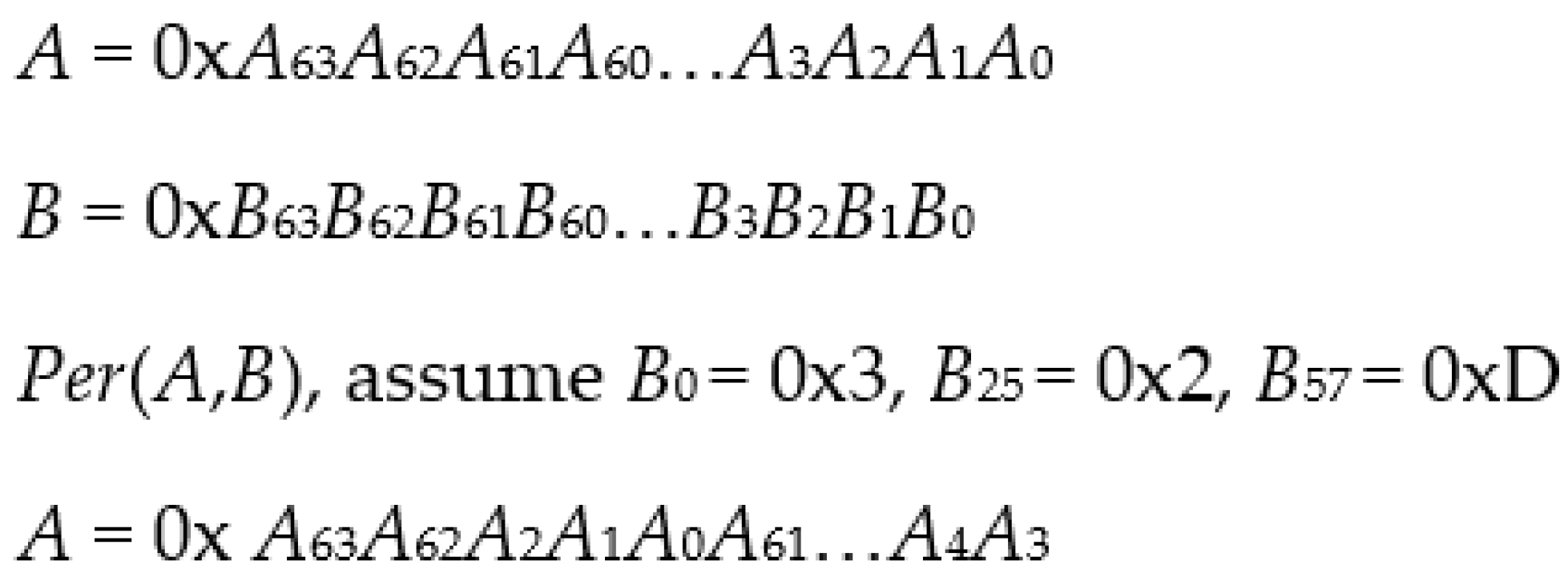
Several proposed solutions use the concept of permutation to enhance the security of RFID protocols [20,21,22]. However, [20] requires heavy computations that are unsuitable for resource-constrained passive RFID tags. In [21,22], the permutation operations must analyze every bit in a string to rearrange another string. These operations have a complexity of O(n) according to Big O notation. A lightweight permutation operation is introduced in this paper that analyzes 3 characters for a 64-character hexadecimal string. This operation removes a certain number of characters from a string and inserts them into a specific position, as shown in Figure 1. Each of these three indexing operations has a complexity of O(1) only. Suppose there are two 256-bit A and B strings (two hexadecimal strings of length 64). A newly proposed lightweight permutation operation Per(A,B) refers to a process in which a certain length of characters from string A are removed from either the left- or right-hand side based on string B, and then inserted into a specific position of string A, as described in Table 2.
Figure 1. Proposed lightweight permutation operation.
Table 2. Permutation operation description.

3.2. Scalable Lightweight Protocol

Ethereum blockchain was used in the proof of concept stage of this work since it supports smart contracts at its core. This further allowed creating a decentralized web application for the proposed supply chain system that interacts with these smart contracts. The current system involves five parties: tag, reader, supply chain node, public blockchain, and IPFS. Basic supply chain nodes consist of manufacturers, distributors, retailers, and end-users. The functionality of supply chain nodes is described in Table 3. The proposed protocol is designed using bitwise exclusive-OR and lightweight permutation operations that allow it to be used with resource-constrained low-cost RFID tags. In contrast, resource-rich supply chain nodes are designed to perform heavier computations, such as hashing Content Identifiers (CID) using the SHA-256 function. In addition, the supply chain node is required to perform the Elliptic Curve Integrated Encryption Scheme using the secp256k1 curve to encrypt or decrypt CIDs and files uploaded to the IPFS. An assumption is made that the communication channel between supply chain nodes is secure, whereas the communication channel between the reader and a tag is insecure. Notations used in the proposed protocol are described in Table 4.
Table 3. Supply chain nodes and their functionality.
Table 4. Notations used in the proposed protocol.
The proposed scalable lightweight protocol consists of two phases: the initial phase and the authentication phase. The initial phase involves steps that need to be performed before the authentication phase can take place. These steps are as follows:
1.
Each supply chain node creates an account in the Ethereum blockchain and obtains a public key and a private key;
2.
The manufacturer node generates ID and K for each RFID tag and stores the ID and K pairs, and two generated random numbers, n and q, in a text file called the DATA file;
3.
The manufacturer node hashes q||n to compute Hq. It then stores the Hq string as well as ID and K pair in each RFID tag;
4.
The manufacturer node encrypts the DATA file with its public key and uploads the encrypted DATA file to the IPFS. A CID, Qm, generated by the IPFS is returned to the manufacturer node;
5.
The manufacturer supply chain node encrypts the Qm with its public key to obtain H. A transaction is then made using the Ethereum blockchain, where the H string is included as input data in the transaction. A transaction hash, Tx, is generated once the transaction is completed;
6.
The manufacturer supply chain node can include supply chain data to be shared with other supply chain nodes in the DATA file.
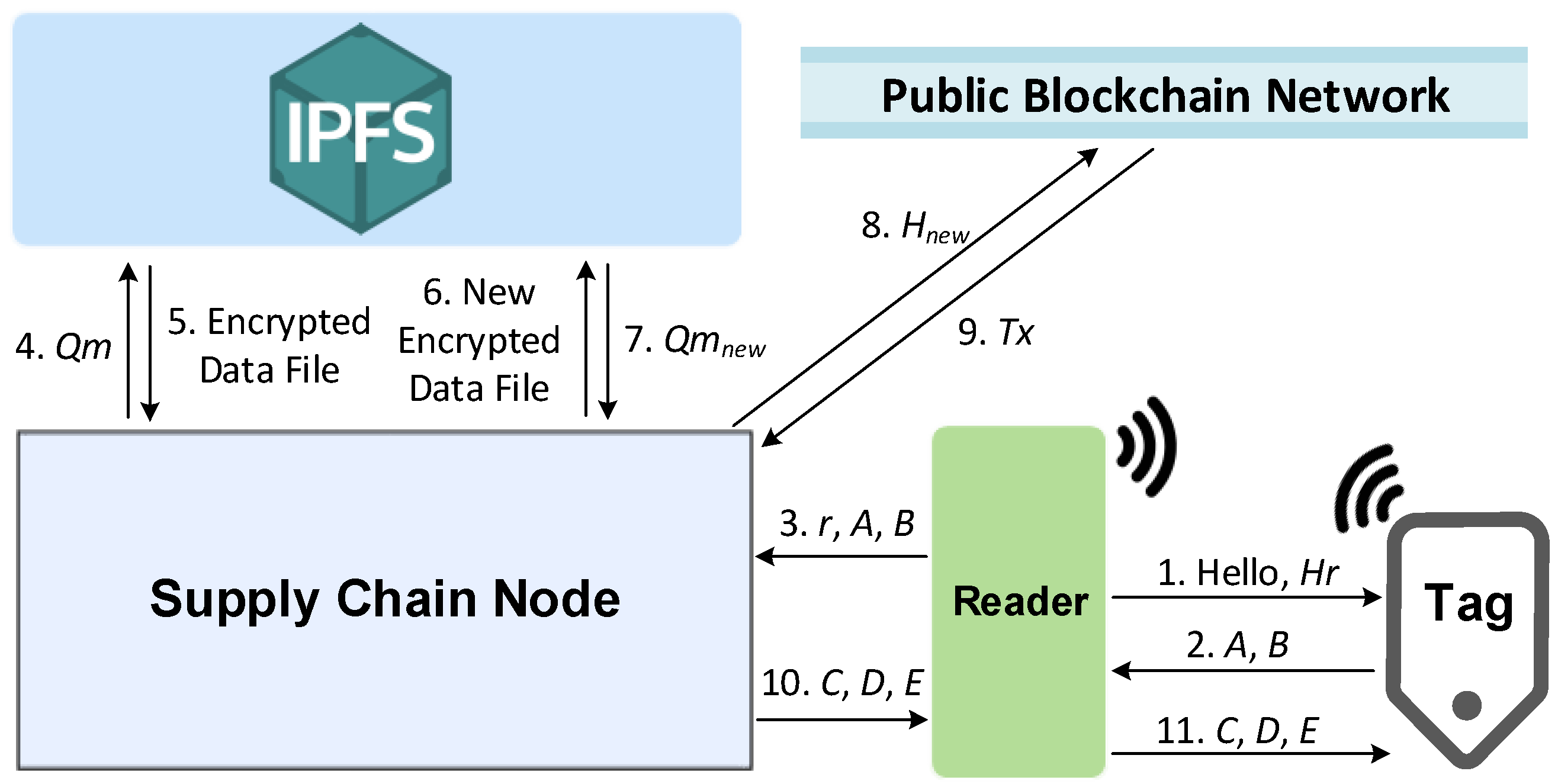
The authentication phase is conducted when RFID tags communicate with the supply chain node’s reader. Data transfer happens during the authentication phase when the DATA file is encrypted with the next supply chain node’s public key. In order to prevent the old owner from tracking the RFID transaction, the DATA file is encrypted using the current supply chain node’s public key as listed in steps 5–9 below. In this case, no ownership data transfer happens. The description of the proposed lightweight protocol shown in Figure 2 is as follows:
Figure 2. Authentication phase of the proposed lightweight protocol.
1.
The reader generates a random number, r, and computes Hr to initiate a session by hashing the r value. It then sends a Hello message and the Hr value to the tag;
2.
After receiving both of the messages, the tag generates a random number m. The tag then computes IDF and KF from its stored ID and K. Next, the tag computes messages A and B using IDF, KF, and Hq values, as well as the m and Hr values. The tag sends the computed messages, A and B, to the reader;
IDF = Per(ID,Hr)
KF = Per(K,Hr)
A = HqIDFmHr
B = HqKFm
3.
The reader forwards r and messages A and B to the supply chain node X (i.e., manufacturer supply chain node);
4.
The supply chain node X obtains the information using the latest H value stored on the blockchain from the decentralized web application. It then decrypts the H value to obtain its Qm value using its private key;
5.
The supply chain node X obtains the encrypted DATA file from the IPFS. Next, it decrypts the file and computes Hq′ by hashing q||n, where q and n are obtained from the file. In order to obtain the correct ID and K pair, the supply chain node X needs to compute IDF′ and KF′ using all ID and K values stored in the DATA file. It then extracts m′ from message B using the computed Hq′ and KF′ values. It then computes A′ using the computed Hq′, the hash value of r, the extracted m′ value, and the IDF′ value paired with the KF′ value. If the computed A′ is equal to the received A, then the correct ID and K pair is found in the DATA file. Otherwise, the current session is terminated;
m′= BHq′⊕KF
A′ = Hq′⊕IDF′⊕m′⊕Hr
6.
The supply chain node X generates a random number, s. It then updates the ID and K pair and stores them in the DATA file. In addition, the random value r is also added to the DATA file as a new n value. The node then computes Hqnew by hashing q||r.
IDnew = IDms
Knew = Km⊕s
Supply chain node X encrypts the DATA file with the public key of supply chain node Y (i.e., distributor supply chain node), and uploads the encrypted DATA file to the IPFS.
7.
IPFS generates an IPFS CID, Qmnew, and returns it to the supply chain node X;
8.
Supply chain node X encrypts the Qmnew with the public key of supply chain node Y to obtain Hnew;
9.
Supply chain node X performs a transaction on the Ethereum blockchain and sends the transaction with the Hnew string as input data to supply chain node Y;
10.
The supply chain node X computes IDS and KS. Next, it computes messages C, D, and E, and sends the messages to the reader;
IDS = Per(ID, Hqnew)
KS = Per(K, Hqnew)
C = Hqnewm
D = KSs
E = HqnewIDSs
11.
The reader forwards messages C, D, and E to the tag. After receiving the messages, the tag extracts Hqnew′ from message C using its m value. Based on its computed Hqnew′ value, it then computes IDS′ and KS′. It extracts s′ from message D using its computed KS′ value. The tag then computes E′ using the extracted Hqnew′ and s′, together with its computed IDS′ value. If the computed E′ is equal to the received E, then the tag proceeds with updating its ID and K pair as well as its Hq string. Otherwise, the session is terminated.
Hqnew′ = C′⊕m
s′ = D′⊕Ks
Supply chain nodes, such as manufacturers, distributors, and retailers, often would prefer to perform multiple tag ownership transfers since a large number of RFID tags are involved in the process. In a single tag transfer, i.e., when a tagged object is transferred from the retailer supply chain node to the end-user node, a single tag K and ID are stored in the DATA file and encrypted with the end-user’s public key. In contrast, multiple tag K and ID values are stored in the DATA file and encrypted using the supply chain node’s public key for batch transfers. Since all of the tags in a batch use the same q and r values, they have the same Hqnew value. After the reader has finished reading all of the tags, the DATA file is encrypted and uploaded to the IPFS. A new Qm returned from the IPFS is encrypted and stored on the blockchain to enable the supply chain node to retrieve the encrypted DATA file during the next authentication phase.

4. Proof of Concept

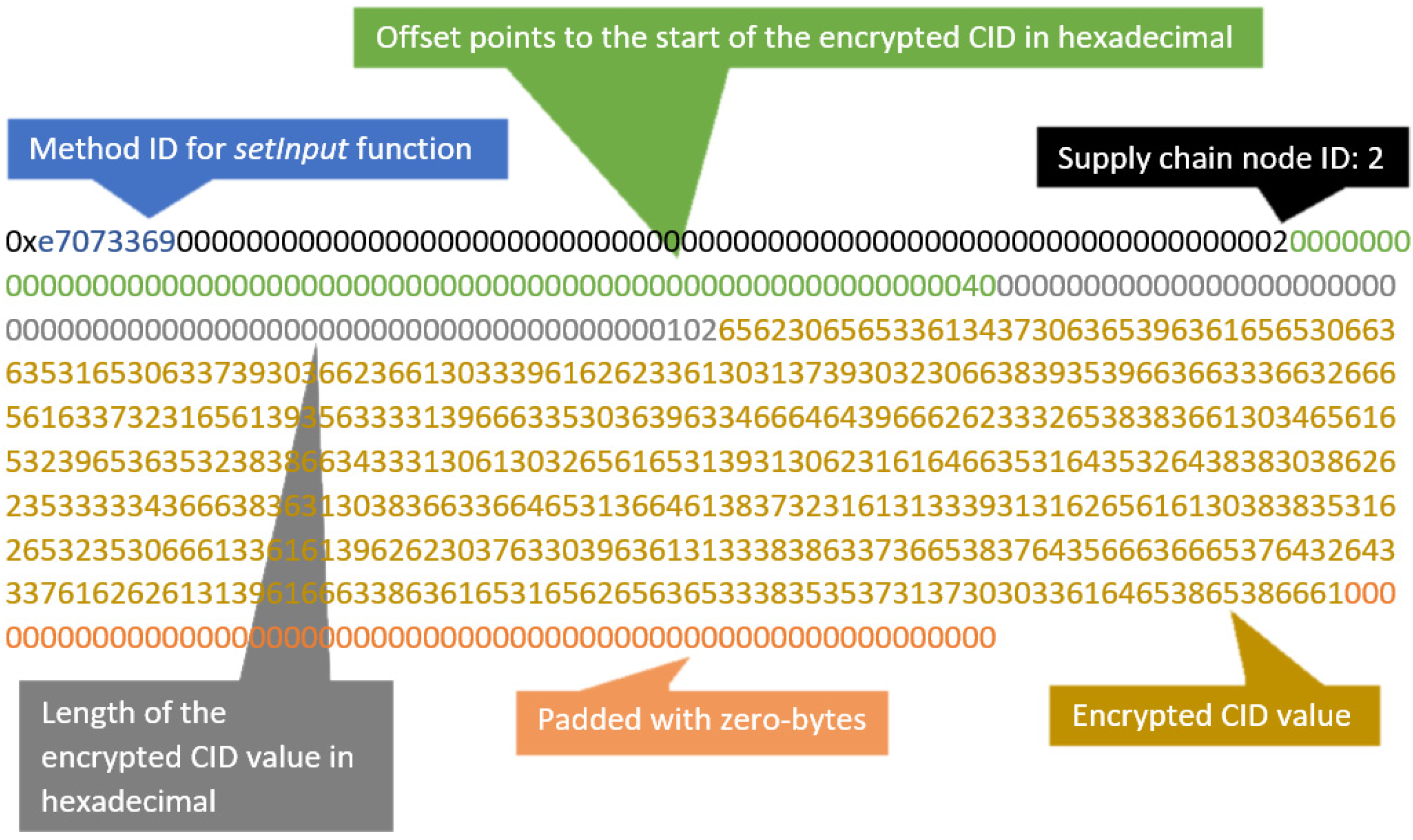
A proof of concept for the proposed scalable lightweight protocol was developed and deployed on the Ethereum Goerli testnet. The smart contract was written in Solidity. Its purpose is to manage RFID tag ownership transfer in a supply chain system. The smart contract consists of one external setValue() and one public custom-defined node structure. The setValue() is a mutator function to store the node ID (unsigned integer data type) and the encrypted CID, also known as H (byte array data type), as shown in Figure 3.
Figure 3. Transaction input.
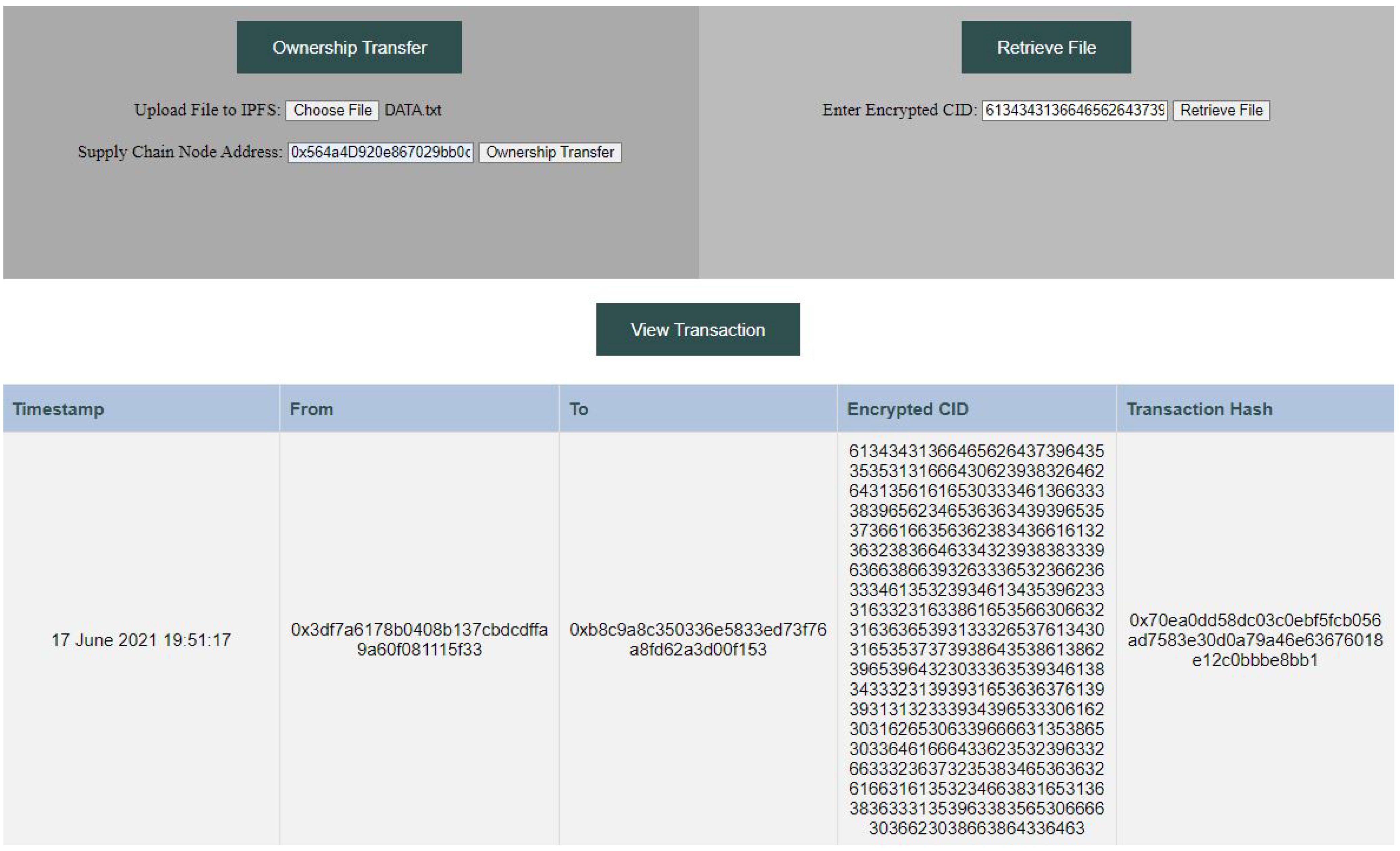
The decentralized web application shown in Figure 4 consists of three sections described below:
Figure 4. Decentralized web application for RFID tag transfer in a supply chain system.
1.
Ownership Transfer:
(a)
File encryption: the uploadipfs() function is called to encrypt the DATA file and upload it to the IPFS. The resultant CID generated from the IPFS is encrypted to obtain H;
(b)
Ownership transfer: A transaction is made using the setValue() function. The supply chain node ID and the H values are sent as input in the transaction to a designated address.
2.
View Transaction: the getvalue() function is called where data, including timestamp, sender and receiver addresses, and H, are obtained using Etherscan Ethereum Developers Application Programming Interfaces (APIs);
3.
Retrieve File: the getfile() function is called to decrypt H and obtain the CID plaintext, Qm. The uploaded encrypted DATA file is downloaded from the IPFS based on the CID value. The encrypted DATA file is then decrypted using a private key.

5. Security Analysis of the Proposed Protocol

The security of the proposed protocol was analyzed against five attacks. Certain assumptions are made based on the Dolev–Yao intruder model to aid in this analysis, described as follows:
1.
It is possible for the attacker to initialize the communication both with the tag and the reader;
2.
It is possible for the attacker to eavesdrop, block, and modify the messages sent during the communication sequence between the tag and the reader;
3.
An attacker is unable to obtain the private key of asymmetric cryptography for each supply chain node.

5.1. Key Disclosure Attack

An attacker is unable to retrieve the secret information, ID, and K pairs from the DATA file because asymmetric encryption is used to encrypt the file. The same applies to the IPFS CID, where Qm is also encrypted with the supply chain node’s public key to prevent the attacker from obtaining the encrypted DATA file in the IPFS. This is an additional level of protection for secret ID and K pairs. A random number m is used to encrypt the permutated ID and K values for each new session in a communication channel between the tag and the reader. This random number is not sent in plaintext, as explained previously. In order to limit the number of random guesses, the attacker has to identify the value of m; a threshold of three attempts is set. The reader terminates the session in case this threshold is exceeded, and a new session is initialized with a new random number r. The tag then has to use the hash value of r and the newly generated random number, m, to compute messages A and B.
The attacker cannot perform brute-force attacks to obtain ID and K values due to the limited number of trials. Furthermore, guessing the values of ID and K solely from messages C, D, and E is out of the question since random numbers s, m, and Hqnew are used to encrypt these messages, respectively. The Hqnew number is different for each session since it is computed by hashing a concatenation of q and a random number, r. In addition, ID and K are updated for each new successful session. This increases the difficulty for the attacker to obtain the ID and K values.

5.2. Replay Attack

An attacker may try to perform a replay attack. The process typically involves capturing and delaying messages, A and B or C, D, and E in this case, and then fraudulently replaying them to the reader. Two scenarios are possible, described below; however, they are ineffective.
1.
The attacker captures messages A and B and replays them to the reader at the next session. Since the messages are encrypted with new random numbers Hr and m for every new session, the supply chain node is not be able to authenticate them;
2.
The attacker captures messages C, D, and E and replays them to the tag during the next session. The tag is unable to authenticate the messages because they are encrypted with different Hqnew, m, and s random numbers for each new session.
The attacker fails to convince both the reader and the tag to authenticate the replayed messages based on the above. Therefore, the protocol is resistant to replay attacks.

5.3. Man-in-the-Middle Attack

Man-in-the-middle (MITM) attacks are eavesdropping attacks and are accomplished by the adversary inserting themselves between the tag and the reader in order to impersonate both parties. The following scenarios demonstrate that the attack would be unsuccessful:
1.
For example, an attacker captures messages A and B and blocks them from being sent to the reader. These messages are modified and only then sent to the reader. However, since the attacker was unable to obtain the correct values of K, ID, m, and Hq, the supply chain node is unable to authenticate the modified messages;
2.
An attacker captures messages C, D, and E and blocks them from being sent to the tag. These messages are modified and only then sent to the tag. However, the original messages were encrypted with m, s, and Hqnew, respectively, which are unknown to the attacker. Therefore, the tag is unable to authenticate the modified messages.
Based on the above, the proposed protocol is considered to be secure from man-in-the-middle attacks.

5.4. De-Synchronization Attack

A de-synchronization attack is a type of an attack wherein the attacker tries to break synchronization between the tag and the reader. Several scenarios are possible; however, all of these are ineffective since RFID tags and readers can still communicate during the following sessions either using the current or previous versions of stored values. For example:
1.
The attacker interferes and blocks messages A and B from reaching the reader. In this scenario, the reader keeps waiting for messages from the tag. If the messages are not received, the current session is terminated after a certain period of time;
2.
The attacker blocks messages C, D, and E from reaching the tag. Thus, the tag is unable to update its data, including the ID and K pair, and the Hq string. As a result, the ID and K values stored in the tag differ from those stored in the latest DATA file uploaded by the supply chain node. The supply chain node can obtain the previously encrypted DATA file using the previous H string obtained from the decentralized web application. The supply chain node proceeds with steps 5–11 in order to confirm the Hq, IDS, and K are synchronous between the tag and supply chain node. The same processes apply to attacks that happen during data transfer between supply chain node X and supply chain node Y.
This method, unlike other state-of-the-art solutions, allows secret data to be re-synchronized without sending back RFID-tagged goods to the old owner.

5.5. Tracking Attack

This type of attack is typically used for unauthorized tracking of RFID-tagged goods. We considered several scenarios that show that the attack is ineffective.
Attackers might eavesdrop on a session and obtain KFIDFHr by performing AB. They can then obtain KFIDF by performing KFIDFHr with Hr obtained during the beginning of the session. The KF and IDF are computed using the proposed lightweight permutation algorithm in Section 3.1, where K and ID are restructured based on the Hr value to compute KF and IDF. The Hr is obtained by the hashing of the r value, which is a random number generated at the beginning of each communication session. Thus, Hr as well as the computed KF and IDF are different for each session. Therefore, attackers are unable to trace any tags from the eavesdropped messages. In addition, the attackers are unable to extract KF and IDF from KFIDF and, subsequently, are unable to extract K and ID from the proposed permutation algorithm.
Attackers might obtain messages C, D, and E by eavesdropping on the communication channel between a RFID tag and a reader. Attackers can then obtain KSIDSm by XORing messages C, D, and E. Since m is a random number freshly generated by the tag for each session, attackers cannot extract KS and IDS from these messages. In addition, all messages C, D, and E are encrypted using random numbers m or s; thus, attackers cannot perform tracking attacks on RFID tags.
Furthermore, ID and K are updated at the end of the protocol by XORing random numbers m and s. Note that although IDK is equivalent to IDnewKnew, ID is not equal to IDnew, and K is not equal to Knew. Since newly generated random numbers and permutated ID and K values (i.e., IDF, KF, IDS, KS) are used to compute transmitted messages for each new session, attackers are unable to track a tag because the tag returns no constant response.

6. Formal Analysis of the Proposed Protocol

Theoretical analysis and formal analysis tools, rather than experimental analysis, have always been broadly used to analyze security protocols [23]. Thus, in addition to the theoretical security analysis presented in Section 5, the proposed protocol was further analyzed using the formal analysis tool AVISPA. The protocol is written using the High-Level Protocol Specification Language (HLPSL).
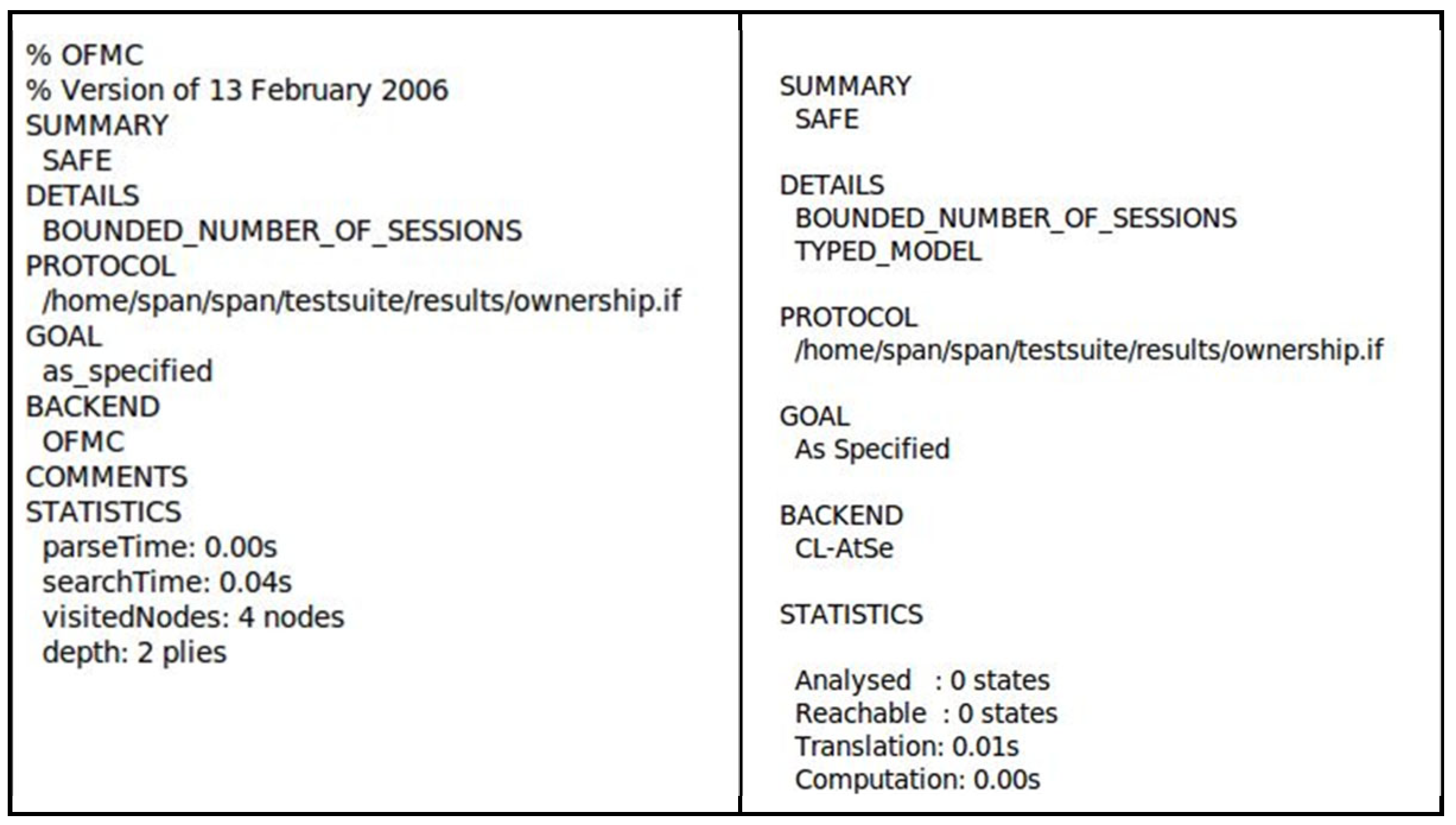
Two back-ends of this AVISPA tool are selected to verify the security of the proposed protocol—On-the-Fly Model-Checker (OFMC) and the Constraint Logic-based Attack Searcher (CL-AtSe) [24]. The other two back-ends are not included in this formal security verification because they are unable to support the exclusive-OR operations used in the proposed protocol. AVISPA uses the Dolev–Yao model for its analysis, where attackers obtain knowledge of normal sessions after its first run. As shown in Figure 5, the OFMC back-end shows that no attack trace was found after searching four nodes in 0.04 s with a search depth of 2. CL-AtSe checks whether there is any reachable state wherein attackers might attack and obtain secret keys. If there are reachable states, it analyzes each state to determine whether the safety condition holds or not. The safety condition refers to the situation where attackers are unable to obtain secret keys. The CL-AtSe back-end result shows that no states were reachable to perform security attacks; thus, it implies that it is safe, as indicated in Figure 5. The summary of results of OFMC and CL-AtSe prove that the proposed protocol is secure from replay and man-in-the-middle attacks.
Figure 5. OFMC and CL-AtSe simulation results.

7. Performance Analysis

The proposed protocol is compared with the performance of the existing supply chain solution in terms of scalability, transaction cost, interoperability, computational complexity, storage, and security.

7.1. Scalability Analysis

Blockchain scalability can be analyzed based on the number of TPS. Currently, Ethereum 2.0 blockchain allows for approximately 36.09 TPS. The scalability of this proposed public blockchain-based supply chain management solution can be improved further by performing batch ownership data transfer associated with RFID tags.
As explained in Section 3.2, the DATA file is used for storing secret RFID tag data, and CID is generated after uploading the DATA file to the IPFS. As transaction input consists of the supply chain node ID and encrypted CID, this makes the transaction number independent from the number of RFID tags. Therefore, the time needed to perform a transaction does not depend on the number of RFID tags. An experiment was conducted using a Lenovo T14s laptop equipped with an AMD Ryzen™ 5 Pro 4650U central processing unit running at 2.10 GHz base clock speed, with 16 GB of DDR4 random access memory, to analyze the time needed for a transaction to be included in the Ethereum Goerli testnet. For a DATA file with RFID data from a random number of tags between 1 and 1000, the transaction time is consistently between 10 and 20 s. The time needed to scan the 1000 RFID tags and update the DATA file is not analyzed in this section, as this is outside the scope of public blockchain scalability.

7.2. Transaction Fee Analysis

Assuming a supply chain line with 1000 RFID tag-attached goods, a transaction was made with the proposed solution to perform the data transfer of those 1000 tags using the Ethereum Goerli testnet. A total of 292,781 gas was used to execute this setInput() function from the Supply.sol smart contract. The transaction fee needed was 0.014053488 Ether, which is approximately 16.8 USD at the time of writing. The proposed solution supports the transfer of RFID tags in batches instead of 1000 individual transactions. As a result, this significantly reduces the transaction costs, e.g., by 99% compared to individual transaction costs required for 1000 RFID tags.

7.3. Interoperability

The proposed solution provides efficient data management by enabling the sharing of specific data from one supply chain node to another. The proposed solution needs to meet three fundamental privacies: new ownership privacy, old ownership privacy, and a solution to the windowing problem to achieve efficient interoperability. New ownership privacy is preserved by restricting the old owner’s access to the new DATA file uploaded by the new owner. This privacy is achieved by encrypting the DATA file with the new owner’s public key and then uploading it to IPFS. The proposed protocol also guarantees that the new owner cannot track the previous transactions of the tag because the new owner cannot decrypt the old IPFS CID encrypted using another supply chain node’s public key. In order to avoid the windowing problem wherein there should be no time slot for both the old and new owners to access the tag, the new owner should update the ID and K of the tags once tagged objects are received from the old owner.

7.4. Computational Complexity Analysis

Since the proposed system targets resource-constrained IoT devices, the performance of the RFID tags was analyzed to prove that the tags can support the proposed lightweight protocol. According to [1], IoT devices can be categorized intofour classes, mainly depending on their processing capabilities and power consumption. Passive RFID tags are Class I devices, which are resource-limited devices. The total storage cost to store the data that the tags need for the data transfer process is merely the cost of storing ID, K, and Hq values, which amount to 768 bits. This storage size can be supported by passive RFID tags with a chip memory capacity of more than 768 bits. These RFID tag chips include ATA5590 with 1024 bits of user memory and UCODE HSL with 2048 bits of user memory. In addition, Class I devices have low computation capabilities. They cannot support heavy computation outside of simple bitwise operations, such as one-way hash functions and asymmetric encryption supported by Class II devices [4]. The computational cost of an exclusive-OR operation, Txor, is negligible as the cost is less than that for the aforementioned heavy computation [25]. During the authentication process, an RFID tag has a total computational cost of 13 Txor.

7.5. Security of Raw Data Storage

The security of raw data storage is vital and can be analyzed in terms of data confidentiality, integrity, and availability. In order to protect data confidentiality, the DATA file that stores ID and K pairs is encrypted using asymmetric encryption before uploading to the IPFS. Although attackers might be able to obtain the encrypted DATA file through the CID, they are not be able to decrypt the DATA file because it can only be decrypted using the private key that was assigned to a specific supply chain node. In addition, the IPFS CID is encrypted, and this encrypted string is stored on the Ethereum blockchain to protect its integrity. In order to guarantee data availability upon being requested, all supply chain nodes need to participate as an IPFS node to ensure that at least some IPFS nodes stay online at all times to handle the IPFS process. All supply chain nodes also need to pin the CID to ensure important data is retained.

7.6. Smart Contract Security Analysis

Smart contracts are immutable. Thus, before deployment, it is vital to ensure that a smart contract is free from vulnerabilities, such as integer overflow/underflow, reentrancy, denial of service, etc. The designed smart contract, Supply.sol, is analyzed using three security tools—Mythx, Slither, and SmartCheck. Supply.sol passed all checks by the aforementioned tools. Mythx is a software-as-a-service platform that provides a higher performance and vulnerability coverage compared to standalone tools such as Slither and SmartCheck. Mythx has three analyzers, where its static analyzer parses the Solidity abstract syntax tree, the symbolic analyzer detects vulnerable states, and the greybox fuzzer detects vulnerable execution paths. Both Slither and SmartCheck belong to static analyzers, which are able to detect simple vulnerabilities faster than Mythx. The details of checks for vulnerabilities covered by these security tools can be found in [26,27,28].
Other related solutions do not provide much information on storage and computation cost. However, as shown in Table 5, our proposed system supports Class I IoT devices and outperforms all other systems in terms of security and transaction fees. Furthermore, our proposed protocol allows both batch and solitary data transfer; thus, it provides more flexible and efficient data transfer compared to existing state-of-the-art proposals.
Table 5. State-of-the-art and proposed protocol comparison.

8. Conclusions

This paper presented a scalable lightweight protocol for public blockchain-based supply chain systems that uses resource-constrained RFID tags and can transfer RFID tags offline in batches. A lightweight RFID protocol was designed with bitwise exclusive-OR and permutation operations to enable secure communication between RFID readers and tags. A proof of concept was created consisting of a decentralized application deployed on the Ethereum public blockchain and an IPFS for full performance evaluation in a real-world environment. A smart contract was designed and analyzed using formal security tools. The proposed protocol has been proven safe against five attacks using both theoretical and formal analyses. The attacks include those of key disclosure, replay, man-in-the-middle, de-synchronization, and tracking. The proposed lightweight protocol has proven to be efficient in terms of security, transaction cost, scalability, interoperability, storage, and computational cost. Future research will include developing ownership transfer decentralized applications using Non-Fungible Tokens.

Author Contributions

Conceptualization, J.H.K. and M.S.; data curation, M.S.; formal analysis, J.H.K.; funding acquisition, J.H.K. and M.S.; investigation, J.H.K., M.S. and S.A.B.Z.; methodology, J.H.K. and S.A.B.Z.; project administration, M.S.; software, J.H.K. and S.A.B.Z.; supervision, J.H.K. and M.S.; validation, J.H.K.; visualization, J.H.K., M.S. and S.A.B.Z.; writing—original draft, J.H.K., M.S. and S.A.B.Z.; writing—review and editing, M.S. and S.A.B.Z. All authors have read and agreed to the published version of the manuscript.

Funding

This work was supported by the International Scholar Exchange Fellowship program at the Chey Institute for Advanced Studies. This work was carried out during the tenure of an ERCIM ‘Alain Bensoussan’ Fellowship Programme.

Institutional Review Board Statement

Not applicable.

Data Availability Statement

Relevant data are contained within the article.

Conflicts of Interest

The authors declare no conflict of interest.

References

  1. Khor, J.H.; Sidorov, M.; Woon, P.Y. Public Blockchains for Resource-Constrained IoT Devices—A State-of-the-Art Survey. IEEE Internet Things J. 2021, 8, 11960–11982. [Google Scholar] [CrossRef]
  2. Millman, R. What is Ethereum 2.0 and Why Does It Matter? Decrypt. Available online: https://decrypt.co/resources/what-is-ethereum-2-0 (accessed on 7 June 2021).
  3. Khor, J.H.; Sidorov, M.; Ho, N.T.M.; Chia, T.H. Public Blockchain-based Lightweight Anonymous Authentication Platform Using Zk-SNARKs for Low-power IoT Devices. In Proceedings of the IEEE International Conference on Blockchain, Espoo, Finland, 22–25 August 2022; pp. 370–375. [Google Scholar] [CrossRef]
  4. Khor, J.H.; Sidorov, M. Weakness of Ultra-Lightweight Mutual Authentication PRotocol for IoT Devices Using RFlD Tags. In Proceedings of the Eighth International Conference on Information Science and Technology, Granada, Cordoba, Seville, Spain, 30 June–6 July 2018; pp. 91–97. [Google Scholar] [CrossRef]
  5. Vechain Whitepaper 2.0. Vechain. Available online: https://www.vechain.org/whitepaper/#bit_65sv8 (accessed on 5 June 2021).
  6. Waltonchain White Paper V2.0, Waltonchain. 2020. Available online: http://www.waltonchain.org/en/Waltonchain_White_Paper_2.0_EN.pdf (accessed on 7 June 2021).
  7. Chen, L.; Zhang, X.; Sun, Z. Scalable Blockchain Storage Model Based on DHT and IPFS. KSII Trans. Internet Inf. Syst. 2022, 16, 2286–2304. [Google Scholar] [CrossRef]
  8. Jayabalan, J.; Jeyanthi, N. Scalable blockchain model using off-chain IPFS storage for healthcare data security and privacy. J. Parallel Distrib. Comput. 2022, 164, 152–167. [Google Scholar] [CrossRef]
  9. Rožman, N.; Diaci, J.; Corn, M. Scalable framework for blockchain-based shared manufacturing. Robot. Comput. Manuf. 2021, 71, 102139. [Google Scholar] [CrossRef]
  10. Javaid, U.; Aman, M.N.; Sikdar, B. A Scalable Protocol for Driving Trust Management in Internet of Vehicles with Blockchain. IEEE Internet Things J. 2020, 7, 11815–11829. [Google Scholar] [CrossRef]
  11. Sohrabi, N.; Tari, Z. ZyConChain: A Scalable Blockchain for General Applications. IEEE Access 2020, 8, 158893–158910. [Google Scholar] [CrossRef]
  12. Lei, K.; Du, M.; Huang, J.; Jin, T. Groupchain: Towards a Scalable Public Blockchain in Fog Computing of IoT Services Computing. IEEE Trans. Serv. Comput. 2020, 13, 252–262. [Google Scholar] [CrossRef]
  13. Pawar, M.K.; Patil, P.; Sharma, M.; Chalageri, M. Secure and Scalable Decentralized Supply Chain Management Using Ethereum and IPFS Platform. In Proceedings of the International Conference on Intelligent Technologies, Hubli, India, 25–27 June 2021; pp. 1–5. [Google Scholar] [CrossRef]
  14. Mani, V.; Manickam, P.; Alotaibi, Y.; Alghamdi, S.; Khalaf, O.I. Hyperledger Healthchain: Patient-Centric IPFS-Based Storage of Health Records. Electronics 2021, 10, 3003. [Google Scholar] [CrossRef]
  15. Ahmad, R.W.; Salah, K.; Jayaraman, R.; Yaqoob, I.; Omar, M.; Ellahham, S. Blockchain-Based Forward Supply Chain and Waste Management for COVID-19 Medical Equipment and Supplies. IEEE Access 2021, 9, 44905–44927. [Google Scholar] [CrossRef] [PubMed]
  16. Yin, L.; Xu, J.; Tang, Q. Sidechains with Fast Cross-Chain Transfers. IEEE Trans. Dependable Secur. Comput. 2021, 19, 3925–3940. [Google Scholar] [CrossRef]
  17. Yakovenko, A. Solana A New Architecture for A High Performance Blockchain Solana, 2021, vol. v0.8.13. Available online: https://solana.com/solana-whitepaper.pdf (accessed on 20 June 2021).
  18. Popov, S. The Tangle, Berlin Germany. 2017. Available online: https://assets.ctfassets.net/r1dr6vzfxhev/2t4uxvsIqk0EUau6g2sw0g/45eae33637ca92f85dd9f4a3a218e1ec/iota1_4_3.pdf (accessed on 10 July 2021).
  19. Nailwal, S. Polygon (MATIC): The Swiss Army Knife of Ethereum Scaling. Cryptopedia. Available online: https://www.gemini.com/cryptopedia/polygon-crypto-matic-network-dapps-erc20-token (accessed on 16 June 2021).
  20. Huang, T.; Ding, Y.; Wang, Z.; Wang, H. Ultralightweight RFID Authentication Protocol Based on Permutation Matrix Encryption. In Proceedings of the International Conference on Cyber-Enabled Distributed Computing and Knowledge Discovery, Guilin, China, 17–19 October 2019; pp. 417–423. [Google Scholar] [CrossRef]
  21. Krishna, R.G.; Sarath, G. UltraLightweight MAC protocol for RFID security using Permutation with double rotation. In Proceedings of the International Conference on Technological Advancements in Power and Energy, Kollam, India, 21–23 December 2017; pp. 1–6. [Google Scholar] [CrossRef]
  22. Gao, L.; Ma, M.; Shu, Y.; Wei, Y. An ultralightweight RFID authentication protocol with CRC and permutation. J. Netw. Comput. Appl. 2014, 41, 37–46. [Google Scholar] [CrossRef]
  23. Ferrag, M.A.; Shu, L. The Performance Evaluation of Blockchain-Based Security and Privacy Systems for the Internet of Things: A Tutorial. IEEE Internet Things J. 2021, 8, 17236–17260. [Google Scholar] [CrossRef]
  24. Dua, A.; Kumar, N.; Das, A.K.; Susilo, W. Secure Message Communication Protocol Among Vehicles in Smart City. IEEE Trans. Veh. Technol. 2018, 67, 4359–4373. [Google Scholar] [CrossRef]
  25. Lee, C.; Chen, C.; Wu, P.; Chen, T. Three-factor control protocol based on elliptic curve cryptosystem for universal serial bus mass storage devices. IET Comput. Digit. Tech. 2013, 7, 48–55. [Google Scholar] [CrossRef]
  26. Mythx—Smart Contract Security Service for Ethereum Consensys. Available online: https://mythx.io/ (accessed on 31 May 2021).
  27. Feist, J.; Grieco, G.; Groce, A. Slither: A Static Analysis Framework for Smart Contracts. In Proceedings of the 2nd International Workshop on Emerging Trends in Software Engineering for Blockchain, Montreal, QC, Canada, 27 May 2019; pp. 8–15. [Google Scholar] [CrossRef]
  28. Tikhomirov, S.; Voskresenskaya, E.; Ivanitskiy, I.; Takhaviev, R.; Marchenko, E.; Alexandrov, Y. SmartCheck: Static Analysis of Ethereum Smart Contracts. In Proceedings of the 1st International Workshop on Emerging Trends in Software Engineering for Blockchain, Gothenburg, Sweden, 27 May–3 June 2018; pp. 9–16. [Google Scholar]
Disclaimer/Publisher’s Note: The statements, opinions and data contained in all publications are solely those of the individual author(s) and contributor(s) and not of MDPI and/or the editor(s). MDPI and/or the editor(s) disclaim responsibility for any injury to people or property resulting from any ideas, methods, instructions or products referred to in the content.

Article Metrics

Citations

Article Access Statistics

Multiple requests from the same IP address are counted as one view.