Enhancing Data Protection in Dynamic Consent Management Systems: Formalizing Privacy and Security Definitions with Differential Privacy, Decentralization, and Zero-Knowledge Proofs



Abstract
:1. Introduction
1.1. Using Subject’s Confidential Data
1.2. Dynamic Consent
1.3. Actors in a Dynamic Consent Management System
- Data Subject (DS);
- Data Controller (DC);
- Data Auditor (DA);
- Data Requester (DR).
- Data Subject: A data subject is a person who submits her data and the corresponding consent to a data controller. She can be directly or indirectly identified.
- Data Controller: A data controller is an entity working as a mediator and receiving information, possibly in some encoded form, from data subjects and providing data to data requesters. Notice that, in general, a data controller does not simply store the personal data of the data subject since this could already be a confidentiality violation. Indeed, notice that while a data subject might not want to share personal data with a DC, they might want to share personal data with a data requester through a data controller. A data controller is usually also accountable for keeping and correctly using the data subject’s consent.
- Data Auditor: A data auditor is an entity with the authority and responsibility to inspect the operations performed by the data controller (e.g., to check if a DC is correctly implementing its role).
- Data Requester: A data requester is an individual or organization that would like to process the private data of the data subject through a data controller. The data requester can be a researcher who wants to employ the subject’s data for research-associated tasks. Figure 1 depicts all the actors and their interactions in a dynamic consent management system.
1.4. Privacy by Design
1.5. Dynamic Consent Management Systems (DCMSs)
1.6. Access Controls in Dynamic Consent Management Systems
1.7. Why Previous Works in Access Controls Are Insufficient to Resolve the Problems Faced by This Paper
1.8. Research Questions This Work has Addressed
- What data protection issues are related to all the dynamic consent management system entities?
- What is the current state of the art in dynamic consent management systems regarding implementations considering privacy and security properties?
- Which procedures are run by two parties, i.e., DS, DC-DC, DR, where two parties interact to perform a joint computation in a dynamic consent management system, and what do both parties get in output?
- How do we state the correctness of a dynamic consent management system when there are no attacks on such systems, and what does each party get from these systems upon giving input?
- What vital security and privacy properties are crucial to ensure robust data protection for all the dynamic consent management system entities, and how to formally define these security and privacy properties?
- How to address the essential tools and techniques to ascertain the robustness and resilience against diverse attacks in dynamic consent management systems, and how the latest tools and techniques could be utilized in dynamic consent management systems?
1.9. Our Contributions
- We have proposed a model in terms of defining what a dynamic consent management system (DCMS) is, and then we have described all the procedures that are run by each of the entities in a dynamic consent management system while interacting with each other. In this procedure’s description model, we have mainly stressed the procedures where two actors interact with each other to perform a joint computation.
- We elaborate on what ideally (i.e., without considering adversaries) a DCMS should provide to the involved parties. Here, we mainly address the correctness of a dynamic consent management system when there are no attacks, and the system provides correct and accurate output to each interacting party.
- We have discussed the definitions aiming at capturing privacy and security properties for a dynamic consent management system in the presence of adversaries that can attack the system. We have formally discussed privacy and security properties to have precise insights into the robustness of a dynamic consent management system (DCMS).
- Next, we emphasize limits in both definitions and constructions of existing dynamic consent management systems (DCMSs) from the state of the art. We highlighted with appropriate clarifications how the existing studies in dynamic consent management systems lack security and privacy for all the entities of these dynamic consent management systems.
- We propose the use of specific techniques and tools that could be used to mitigate security and privacy risks in dynamic consent management systems (DCMSs).
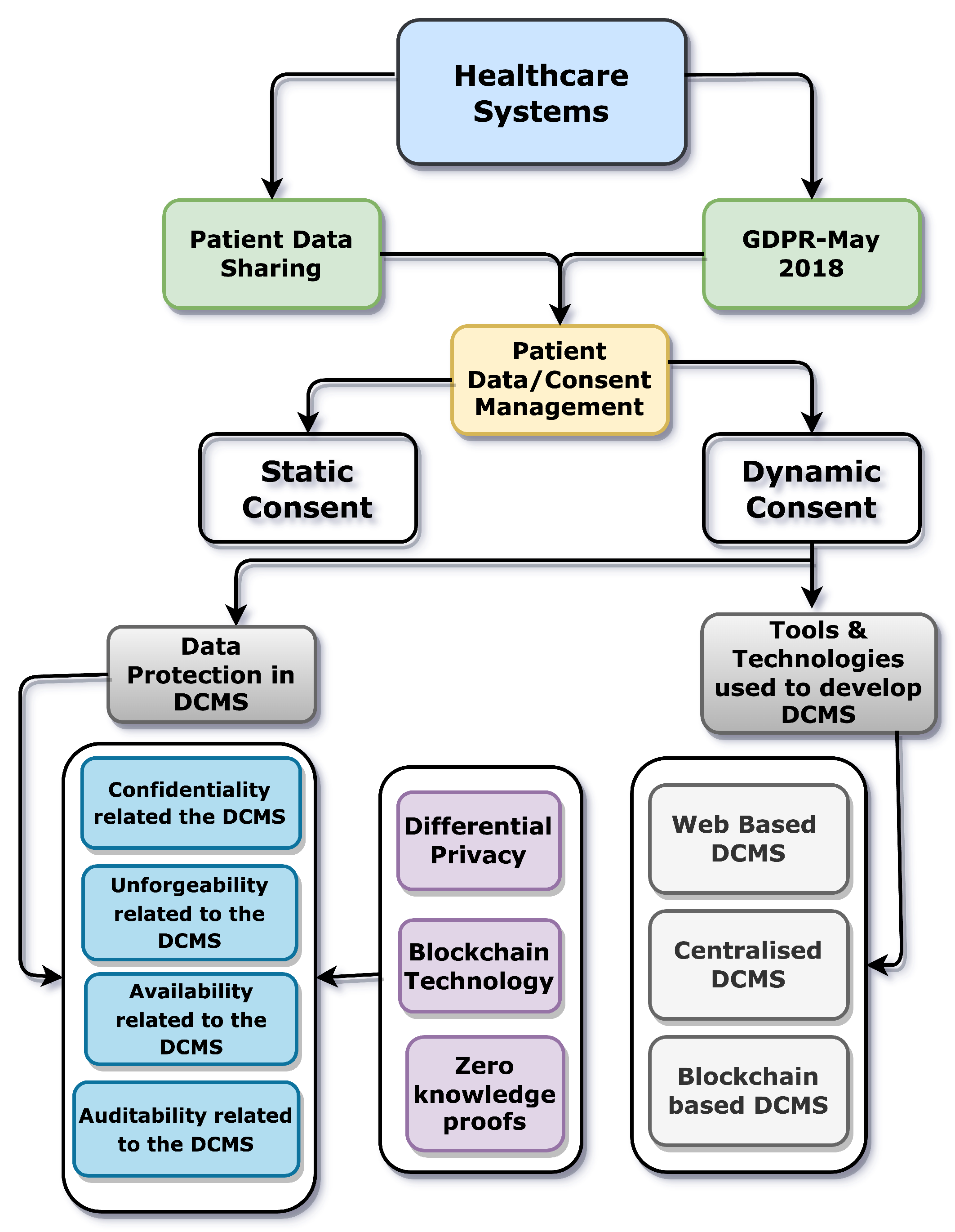
- We have mainly studied the potential of differential privacy to increase the robustness of the dynamic consent management systems in terms of fulfilling the needs of all the involved entities such as Data Subject and Data Requester. The code for these experiments is available here Differential-Privacy-for-DCMS: https://github.com/Khalid-Muhammad-Irfan/Differntial-Privacy-for-DCMS (accessed on 3 July 2023). Furthermore, we have also discussed the implications of zero-knowledge proofs along with blockchains where only an abstract entity Data Controller should be decentralized to have enhanced data protection for all the entities.
2. State-of-the-Art on Existing Solutions for Dynamic Consent Management Systems
2.1. Explanation of the Referenced Paper(s) in Table 2
2.2. Motivation behind Considering Security and Privacy Properties for DCMSs
3. Defining Dynamic Consent Management System (DCMS)
- DS Sharing Data/Consent:In this procedure, DS and DC are involved since DS wants to share its data/consent, and DC is supposed to update its state according to the interaction with DS.
- Adding Data/ConsentHere, DS would like to share some data and consent with DC.Input for DS: Data, consent, and access control policies related to data and consent.Input for DC: The current state associated to DS.Output for DS: A receipt about the executed procedure (both in case the outcome has been positive or negative).Output for DC: An updated state associated to DS.
- Updating Data/ConsentIn this scenario, DS and DC are involved since DS shared some data and consent with DC and now DS wishes to make some updates to her shared data and consent.Input for DS: A receipt issued by DC upon receiving DS data/consent.Input for DC: The current state associated to DS.Output for DS: A receipt about the updated executed procedure (both in case the outcome has been positive or negative).Output for DC: The updated state associated to DS.
- DA Verifying DC:Here, DA and DC are involved since DA wants to audit whether DC has done all the operations related to DS’s data/consent honestly.Input for DA: Credentials proving the right to audit the DC.Input for DC: The current states associated to all DS.Output for DA: A receipt about the verified information (both in case the outcome has been positive or negative).Output for DC: The current state associated to DS.
- DR Requesting Data/Consent from DC:Here, DR would like to access DS’s data and consent. Notice that due to our discussion in Section 3.1, regarding the choice of discouraging the direct communication between DR and DS, DR must ask DC for DS’s data/consent.
- Requesting Data/Consent:In this procedure, DR and DC are involved. DR wishes to get DS’s data/consent to perform his research-related tasks. DC is supposed to update its state according to the interactions with DR.Input for DR: Credentials proving the right to access DS’s data/consent.Input for the DC: The current state associated to DS.Output for DR: A receipt about the executed procedure (both in case the outcome has been positive or negative).Output for DC: The updated state associated to DS.
3.1. Correctness of a Dynamic Consent Management System (DCMS)
- DS Adding data/consent:Output for DS: Receipt about the correctly executed procedure (in result of correct input).Output for DC: The updated state associated to DS.
- DS Updating data/consent:Output for DS: Receipt about the correctly executed procedure (in result of correct input).Output for DC: The Updated state associated to DS.
- DA Verifying DC:Output for DA: A receipt about the verified information (in result of correct input).Output for DC: The current state associated to DS.
- DR Requesting Data/Consent from DC:Output for DR: A receipt about the executed procedure (in result of correct input).Output for DC: The updated state associated to DS.
4. Attackers Model
- Possible Attackers: It has been evident from the literature that the threats to every system start for two types of reasons. An internal user with legal system access, such as a data subject, controller, auditor, or requester, will access the subject’s data. On the other hand, there is an external agent. Although external agents are not allowed to enter the systems, there is always a higher likelihood that a critical opponent from the external environment can offer various threats to the system. In DCMSs, we have recognized four kinds of actors who can play with the system.
- Data Subject: In a DCMS, the data subject providing her data and giving consent could also be permitted to access and interact with the system in diverse ways. This could be for recreational purposes or other motivations.
- Data Controller: In a DCMS, the data controller is one of the most critical actors with a substantial stake in the system’s operation. The data controller has access to the system throughout the process, from data collection and storage of consent in the server to monitoring all system activities from a central position. However, the data controller could also pose a risk as a potential attacker who may attempt to compromise the system. For instance, data controllers may unlawfully access and sell data subject’s confidential information or share it with unauthorized organizations. Apart from that, since the data controller is a centralized entity that is processing data/consent, it is crucial to avoid a single point of failure due to a corrupted data controller; thus, this must be an abstract entity which should be decentralized only. We will be giving a follow-up work to this paper that will essentially consist of studying the techniques to decentralize the data controller in a DCMS.
- Data Auditor: A data auditor can be a potential DCMS attacker. Although the primary role of a data auditor is to ensure that the data controller complies with the policies and regulations related to data privacy and security, he may still have access to sensitive data that could be used for malicious purposes. Suppose a data auditor gains unauthorized access to the system. In that case, they may be able to manipulate data, compromise the integrity of the audit trail, or interfere with the consent management process.
- Data Requester: The data requester may have access to data and consent of the data subject through DCMS, and there is a severe risk that he may misuse the subject’s data for harmful purposes. For example, a requester could use the subject’s data for identity theft, fraud, or other illegal activities. In addition, the data requester may not have the necessary security measures to protect the data, leading to the potential exposure of the subject’s data to unauthorized parties. This can significantly harm the data subject, including through financial loss, reputational damage, and emotional distress.
5. Defining Security and Privacy in Dynamic Consent Management Systems
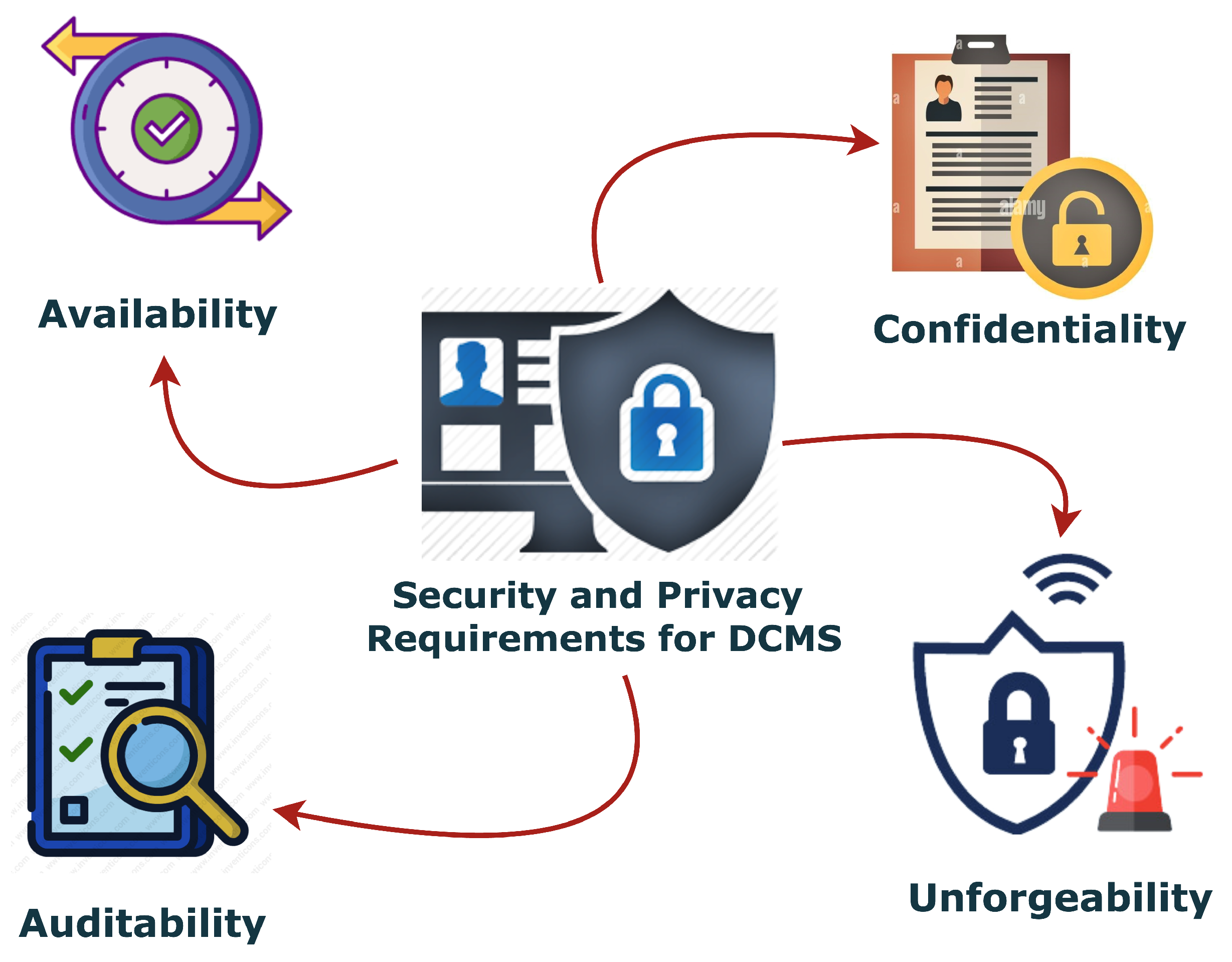
- Confidentiality: The confidentiality property in a dynamic consent management system should be guaranteed, e.g., for an honest DS when DC is dishonest, when DA is dishonest, or when DR is dishonest, or maybe when all are dishonest. The system provides the minimum amount of data required by the requester according to the consent released by the data subject, and unauthorized access to the data of any actors in a DCMS should be infeasible. Confidentiality of honest parties (i.e., DS, DC, DA, DR) is defined as follows:
- Confidentiality for DS:According to the procedures defined in Section 3, in a DCMS parties are involved in procedures and a DS provides her data in input to some of those procedures (e.g., sharing or updating data/consent). As motivated when discussing the threat model in Section 4, we can expect players to misbehave and thus deviate from the expected steps specified by the procedures (e.g., providing incorrect inputs) with the goal of obtaining unauthorized information. In the context of a DCMS ensuring the confidentiality of the honest DS from a dishonest DC, we can describe the confidentiality for the DS with the help of an experiment that will illustrate the formal specification of the definition. In addition, in the following experiment, we assume that in a dynamic consent management system only the adversary operates within polynomial time. We acknowledge that is an adversary and may select the encrypted message from DS with a probability slightly more significant than 1/2.Experiment:We write , to denote the experiment being run with security parameter n:, The experiment is defined for any private-key encryption scheme , any adversary DC, and any value n for the security parameter:The adversarial indistinguishability experiment
- −
- In the DCMS, the adversary , is given input (), and outputs a pair of messages , with || = ||.
- −
- A key k is generated by running Gen (), and a uniform bit is chosen. Cipher-text c←) is computed in a dynamic consent management system and sent to the adversary . We refer to c as the challenge cipher-text, which is a message essentially consisting of the data/consent of the data subject (DS).
- −
- outputs a bit .
- −
- The output of the experiment is defined to be 1 if = b, and 0 otherwise. If , we say that succeeds.
Here, we are considering adversary running in polynomial time, and we accept that the might determine the encrypted message from the data subject (DS) with a probability negligibly better than . In the context of a dynamic consent management system ensuring the confidentiality of the honest data subject from a dishonest data controller, we can describe it as follows:Formal Definition: A DCMS has indistinguishable encryptions in the presence of a dishonest , or is secure, if, for all probabilistic polynomial-time dishonest data controllers (DCs), there is a negligible function such that, for all n:, Here, the idea is that an adversary must not be able to get information about the plain text that essentially contains the data/consent of the data subject (DS) encrypted using an encryption key K and is in cipher-text form. secure refers to the Indistinguishable encryptions, which is a property of the security definition, and represents the dynamic consent management system (DCMS) comprising three algorithms:Gen: The key generation algorithm generates a secret key for the data subject (DS) and the data controller (DC) to securely communicate and establish trust.Share: The data sharing algorithm allows the DS to share her data/consent with the DC securely. This algorithm takes the data/consent and secret key K as input and produces a ciphertext consisting of encrypted data.Access: The access algorithm enables DC to access and process the subject’s (DSs) shared data/consent. The access algorithm takes the cipher-text, which is actually encrypted data/consent, and the secret key K as input and produces the plain-text data of DS.Indistinguishable encryptions: Indistinguishable encryptions are the property of the security definition. A DCMS is said to have indistinguishable encryptions if it is computationally hard for a dishonest to differentiate between two instances of encrypted data by observing the encrypted data.Probabilistic polynomial-time dishonest data controllers (DCs): The dishonest DCs are computationally bounded algorithms that attempt to break the security of a DCMS by giving incorrect input to one of the procedures run by the DS to share/update her data/consent. DCs can access public algorithms (Share and Access) and perform polynomial-time computations.Negligible function (): A negligible function is a minimal function that approaches zero as its input size increases. In the context of DCMS security analysis, a negligible function represents a level of DCMS security that is considered practically impossible to break.: This inequality expresses the security property of DCMS. It states that for all probabilistic polynomial-time dishonest , the probability that the adversary correctly determines whether a given encrypted data corresponds to a specific data/consent is at most a negligible function . In other words, the advantage of the dishonest data controllers (DCs) distinguishing the shared data is minimal, approaching zero as n (the security parameter) increases.The above description defines the requirement for a dynamic consent management system to have indistinguishable encryptions, ensuring the confidentiality of the data subjects (DSs) data/consent from dishonest data controllers . Fundamentally, in the above scenario, DS is an honest entity giving correct inputs to procedures as specified in Section 3, and expecting correct output from the dynamic consent management system. In this situation, the confidentiality property of DCMS will come into play to preserve an honest DS’s sensitive data/consent when DC, DA, or DR may act as adversaries while deviating from the procedures. Since DA and DR also have direct or indirect contact with DS’s data/consent, they might also be believed as possible foes for the confidentiality of DS’s data/consent. Hence, to satisfy confidentiality for DS, a DCMS should have strong security and privacy tools in place to ensure that DS’s data/consent are not misused by dishonest parties. Confidentiality can be foreseen in a given construction of DCMS by employing useful tools and techniques such as advanced encryption schemes (as the indistinguishability property can be achieved using advanced encryption schemes), zero-knowledge proofs, and differential privacy. - Confidentiality for DC:According to the above procedures in Section 3, the data controller (DC) takes part in procedures the Data Auditor (DA) runs to verify the DC. Initially, DA runs a procedure to verify the DC. The DC behaves as an honest party by giving the procedure the correct input (i.e., the current state of all data subjects (DSs)). Keeping in view the experiment that is explained in defining the confidentiality of an honest data subject (DS), we are now stating the confidentiality for an honest DC when a DA may misbehave as follows:Experiment:We write , to denote the experiment being run with security parameter n:, The experiment is defined for any private-key encryption scheme , any adversary , and any value n for the security parameter:The adversarial indistinguishability experiment
- −
- The adversary , is given input (), and outputs a pair of messages , with || = ||.
- −
- A key K is generated by running (), and a uniform bit is chosen. Ciphertext c←) is computed and given to the adversary . We refer to c as the challenge ciphertext.
- −
- outputs a bit .
- −
- The output of the experiment is defined to be 1 if b = b, and 0 otherwise. If , we say that succeeds.
Here, we are considering adversary running in polynomial time, and we accept that the might determine the encrypted message, which is the data/consent of all DSs from the DC with a probability negligibly better than . In the context of a dynamic consent management system ensuring the confidentiality of the honest DC from a dishonest , we can describe it as follows:Formal Definition: A DCMS has indistinguishable encryptions in the presence of a dishonest , or is secure, if for all probabilistic polynomial-time dishonest data auditors , there is a negligible function such that, for all n:, Here, the idea is that an adversary must not be able to get information about the plain-text that essentially contains the data/consent of all DSs that is encrypted using an encryption key K and is in cipher-text form and being held by the honest DC. secure refers to the Indistinguishable encryptions, which is a property of the security definition, and represents the DCMS comprising three algorithms: . - Confidentiality for DA:As specified in Section 3, the DA is supposed to verify whether all the operations performed by the DC related to the DS’s data/consent have been performed honestly or not. For these verifications, for instance, when the DA wishes to verify the DC, he runs a procedure in DCMS where the DA gives correct input that is essentially his right to access and audit the DC. Likewise, the DC needs to feed input to this procedure by stating the current state associated with all DSs. In this procedure, the DA acts as an honest player and provides the correct credentials to audit the DC. Still, at the same time, DC can deviate from the procedure by feeding the wrong input.So, the DC is one of the potential attackers for the confidentiality of DA’s data. The confidentiality property of a dynamic consent management system will ensure the inputs and outputs of an honest DA when is acting as an adversary. Being a dishonest party, will be sharing the wrong data/consent records with the DA. Keeping in view the experiment that is explained in defining the confidentiality of an honest DS, we are now stating the confidentiality for an honest DA as follows:Experiment:We write , to denote the experiment being run with security parameter n:, The experiment is defined for any private-key encryption scheme , any adversary , and any value n for the security parameter:The adversarial indistinguishability experiment
- −
- The adversary , is given input (), and outputs a pair of messages , with || = ||.
- −
- A key K is generated by running Gen (), and a uniform bit is chosen. Ciphertext c ←) is computed and given to the adversary . We refer to c as the challenge ciphertext.
- −
- outputs a bit .
- −
- The output of the experiment is defined to be 1 if = b, and 0 otherwise. If , we say that succeeds.
Here, we are considering adversary running in polynomial time, and we accept that the might determine the encrypted message from the DA with a probability negligibly better than . In the context of a DCMS ensuring the confidentiality of the honest DA from a dishonest , we can describe it as follows:Formal Definition: A DCMS has indistinguishable encryptions in the presence of a dishonest DC, or is secure, if, for all probabilistic polynomial-time dishonest , there is a negligible function such that, for all n:, Here, the idea is that an adversary must not be able to get information about the plain text that essentially contains the confidential information of an honest DA. secure refers to the Indistinguishable encryptions, which is a property of the security definition, and represents the DCMS comprising three algorithms: . - Confidentiality for DR:According to the procedures described in Section 3, DR runs a procedure to ask for the DS’s data/consent from DC. Here, we assume that the DR is an honest entity feeding correct input, i.e., correct credentials proving the right to access the DS’s data/consent. Meanwhile, the DR expects the DC to also give correct input (i.e., the current state associated with DS) to the procedure. If, somehow, the DC is not providing correct input, the DC is deviating from the procedure run by the DR. Hence, the DC is a possible adversary who can misuse the information of the DR. Since the DR would be sharing his credentials to access the DS’s data/consent, the DC may use this information.In addition, the DR does not want to share his access request information with any other player, i.e., DS and DA, but lawful DC should see the requests from DR. Now, if the DC misbehaves, then the DR’s data would also be compromised by the dishonest DC. The confidentiality property of DCMS will ensure that the requests made by honest DRs have been protected efficiently in the sense that both the input and output of a genuine DR shall be maintained by the confidentiality property of DCMS. Keeping in view the experiment that is explained in defining the confidentiality of an honest DS, we are now stating the confidentiality for an honest DR as follows:Experiment:We write , to denote the experiment being run with security parameter n:, The experiment is defined for any private-key encryption scheme , any adversary , and any value n for the security parameter:The adversarial indistinguishability experiment
- −
- The adversary , is given input (), and outputs a pair of messages , with || = ||.
- −
- A key K is generated by running Gen (), and a uniform bit is chosen. Ciphertext c←) is computed and given to the adversary . We refer to c as the challenge ciphertext.
- −
- outputs a bit .
- −
- The output of the experiment is defined to be 1 if = b, and 0 otherwise. If , we say that succeeds.
Here, we are considering adversary running in polynomial time, and we accept that the might determine the encrypted message from the DR with a probability negligibly better than . In the context of a DCMS ensuring the confidentiality of the honest DR from a dishonest DC, we can describe it as follows:Formal Definition: A DCMS has indistinguishable encryptions in the presence of a dishonest , or is secure, if for all probabilistic polynomial-time dishonest , there is a negligible function such that, for all n:, Here, the idea is that an adversary must not be able to get information about the plain text that essentially contains the confidential information of an honest DR. secure refers to the Indistinguishable encryptions, which is a property of the security definition and represents the DCMS comprising three algorithms: .
- 2.
- Unforgeability:The dynamic consent management system should be able to provide correct outputs to honest players, i.e., DS, DC, DA, and DR, even in the presence of adversaries who can misbehave during the executions of the procedures specified in Section 3. We now consider the unforgeability for each player of a DCMS.Experiment: Dynamic-Consent-OutputForge A,
- Gen () is run to obtain keys for the DCMS.
- Adversary A is given and access to the DCMS, including the player DS.
- The adversary A interacts with the DCMS, providing inputs and receiving outputs.
- The adversary A outputs a forged output for the honest entity, i.e., DS, DC, DA, or DR. The adversary A succeeds if and only if the forged output is accepted as a valid output by the DCMS.
- In this case, the output of the experiment is defined to be 1.
Definition: Dynamic-Consent-Output-Unforgeability for an honest party:A DCMS is considered output secure for the honest entity like DS, DC, DA, and DR, if for all probabilistic polynomial-time adversaries A, there exists a negligible function such that the probability of the adversary A successfully forging the output of the honest entity in the experiment Dynamic-Consent-OutputForge A, is negligible:[A, = 1]Here A is denoted as dishonest party that might act as an adversary. So, a DCMS is an output secure for an honest entity (DS, DC, DA, and DR) if the probability of an adversary A forging a valid output that a legitimate entity would receive is extremely low (negligible) when faced with a computational adversary A who has access to the DCMS functionalities. The output refers to the correctness of an honest entity in the form of receipts or any other relevant information generated by the DCMS. We now map the above experiment to each of the involved parties’ interactions in a DCMS below:- Unforgeability for DS:Here, DS is an honest party providing correct input to the procedures executed with DC. Being an honest party, DS has the privilege of getting the correct output from the system, even if any adversary, such as a DC, tries to forge the output of DS. In the defined procedures in Section 3, while interacting with DC, the outcomes for DS are receipts about the executed procedures that state that data/consent have been received, stored, and processed correctly by the DC. Even though other players in DCMS (such as DA, DR, and DC) will still be accessing DS data/consent directly or indirectly, the output (essentially the correctness of DS’s data/consent) must be guaranteed by the DCMS. In this experiment, two parties, i.e., DS and DC, are involved since both these parties are interacting with each other in a couple of procedures that have been stated in Section 3.Experiment: Dynamic-Consent-OutputForge DC,
- −
- Gen () is run to obtain keys for the DCMS.
- −
- Adversary is given and access to the DCMS, including the player DS.
- −
- interacts with the DCMS, providing inputs and receiving outputs.
- −
- The adversary outputs a forged output for the honest DS. succeeds if and only if the forged output is accepted as a valid output by the DCMS.
- −
- In this case, the experiment’s output is defined to be 1.
Formal Definition: Dynamic-Consent-Output-Unforgeability for honest DS:A dynamic consent management system is considered output secure for the honest DS if, for all probabilistic polynomial-time adversaries like , there exists a negligible function such that the probability of the adversary successfully forging the output of DS in the experiment Dynamic-Consent-OutputForge , is negligible:[, = 1]A DCMS is an output secure for the honest DS if the probability of a dishonest forging a valid output that DS would receive is extremely low (negligible) when faced with a computational adversary DC with access to the system functionalities and DS. The output refers to the correctness of DS’s data and consent in the form of receipts or any other relevant information generated by the DCMS. - Unforgeability for DC:In the defined procedures in Section 3, the possible outputs for DCs are the current and updated states associated with all DSs in DCMS. Here, we have to protect the correctness of the output of DC when DS, DA, or DR misbehaves. Unforgeability for DC means that output for an honest DC should be correct in the sense that when a DC is honest, then the output for DC should be correct regardless of the honesty or dishonesty of other players, i.e., DS, DA, and DR that are interacting with DC. Since DC is considered an honest player, he must be guaranteed the correct output from DCMS even if the other players misbehave.So, here we are concerned with protecting the unforgeability of outputs for a DC being an honest party. Hence, the states corresponding to all DSs must not be altered or modified by any misbehaving player in DCMS. Since DC is first interacting with DS to receive data/consent, being an honest party providing the correct input to the procedures, DC must be ensured to get the correct output from the system. In the sense that even if DS tries to modify the output for DC, the DCMS should provide the correct output to DC.In this experiment, two parties, i.e., DC and DA, are involved since both these parties are interacting with each other in a couple of procedures that have been stated in Section 3.Experiment: Dynamic-Consent-OutputForge DA,
- −
- Gen () is run to obtain keys for the DCMS.
- −
- Adversary DA is given and access to the DCMS.
- −
- Adversary DA interacts with the DCMS, providing inputs and receiving outputs.
- −
- The adversary then outputs a forged output for the honest DC. Hence, the DA succeeds if and only if the forged output is accepted as a valid output by the DCMS.
- −
- In this case, the experiment’s output is defined to be 1.
Formal Definition: Dynamic-Consent-Output-Unforgeability for honest DC:A dynamic consent management system is considered output secure for the honest DC, if for all probabilistic polynomial-time adversaries like DA, there exists a negligible function negl such that the probability of the adversary DA successfully forging the output of DC in the experiment Dynamic-Consent-OutputForge A, is negligible:[, = 1] ≤In simpler terms, a DCMS is an output secure for the honest DC if the probability of an adversary DA forging a valid output that DC would receive is extremely low (negligible) when faced with a computational adversary DA who has access to the system functionalities and DC. The output refers to the correctness of DCs data in the form of receipts or any other relevant information generated by the DCMS. - Unforgeability for DA:Here, we need to protect the correctness of the output of the DA when DC misbehaves. As detailed in Section 3, the DA is an honest entity feeding correct input while executing a procedure with DC. So, DA must be ensured to get correct output from DCMS even if DC misbehaves, providing incorrect input to the procedure. The output for DA is the receipt that states all the procedures related to DS’s data/consent have been performed honestly by the DC. For a DA, unforgeability mainly refers to any audit report generated by the DCMS that should be genuine and accurately reflect the system’s state and cannot be tampered with or modified by any malicious party such as DC or DR.Since adversaries such as DC or DR may try to forge the output for the DA, i.e., making modifications in audit records, the integrity property of DCMS will ensure that an honest DA should always get a correct output, even if other interacting players try to forge the output for DA by giving incorrect input to the procedure with DA. In this experiment, two parties, i.e., DA and DC, are involved since both these parties are interacting with each other in a couple of procedures that have been stated in Section 3.Experiment: Dynamic-Consent-OutputForge DC,
- −
- Gen () is run to obtain keys for the DCMS.
- −
- Adversary DC is given and access to the DCMS.
- −
- Adversary DC interacts with the DCMS, providing inputs and receiving outputs.
- −
- The adversary then outputs a forged output for the honest DA. DC succeeds if and only if the forged output is accepted as a valid output by the DCMS.
- −
- In this case, the experiment’s output is defined to be 1.
Formal Definition: Dynamic-Consent-Output-Unforgeability for honest DA:A dynamic consent management system is considered output secure for the honest DA, if for all probabilistic polynomial-time adversaries like DC, there exists a negligible function negl such that the probability of the adversary DC successfully forging the output of DA in the experiment Dynamic-Consent-OutputForge A, is negligible:[, = 1]In simpler terms, a DCMS is output secure for the honest DA if the probability of an adversary forging a valid output that would receive is extremely low (negligible) when faced with a computational adversary with access to the system functionalities and DA. The output refers to the correctness of DAs data in the form of receipts or any other relevant information generated by the DCMS. - Unforgeability for DR:Here, the DR is an honest party running a procedure with the DC to have the DS’s data/consent. Being a legitimate party, the DR is providing the correct input to the procedure. Still, there is a possibility that the DC may give an incorrect input to the procedure, i.e., providing the wrong states associated with DS. In this case, the integrity of outputs for an honest DR will be protected by the DCMS. Hence, the correctness of the output of DR shall be protected when the DC misbehaves.The possible outputs for the DR are required DS’s data/consent according to his credentials. We need to preserve the integrity of the outputs for a DR to be an honest party. In the sense that even though adversaries (such as DA and DC) are present inside the DCMS, a DR must be able to get the correct data/consent for which he requested to a DC. If, for instance, an adversary tries to modify the output for the DR, the DCMS should implement robust tools and techniques that can hinder these malicious modifications. More formally, the unforgeability for a DR states that any data/consent as an output obtained from the DCMS must be genuine and accurate and cannot be tampered with or modified by any malicious or unauthorized player.In this experiment, two parties, i.e., DR and DC, are involved since both these parties are interacting with each other in a couple of procedures that have been stated in Section 3.Experiment: Dynamic-Consent-OutputForge DC,
- −
- Gen () is run to obtain keys for the DCMS.
- −
- Adversary DC is given and access to the DCMS.
- −
- Adversary DC interacts with the DCMS, providing inputs and receiving outputs.
- −
- The adversary then outputs a forged output for the honest DR. DA succeeds if and only if the forged output is accepted as a valid output by the DCMS.
- −
- In this case, the experiment’s output is defined to be 1.
Formal Definition: Dynamic-Consent-Output-Unforgeability for honest DR:A dynamic consent management system is considered output secure for the honest DR, if for all probabilistic polynomial-time adversaries like DC, there exists a negligible function negl such that the probability of the adversary DC successfully forging the output of DR in the experiment Dynamic-Consent-OutputForge A, is negligible:[, = 1]Hence, a DCMS is output secure for the honest DR if the probability of an adversary forging a valid output that DR would receive is extremely low (negligible) when faced with a computational adversary with access to the system functionalities and DR. The output refers to the correctness of DRs data in the form of receipts or any other relevant information generated by the DCMS.
- 3.
- Availability:Access to the dynamic consent management system should only be granted to authenticated actors (DS, DC, DA, and DR). The DCMS must be designed so that it should be highly available. Highly available means that there should be no interruption or downtime in the system, even due to hardware or software failures, which may result in delays or errors in data processing and communication among peers. If there are any delays or interruptions, these can ultimately impact the privacy and security of the data and the players involved in DCMS. High availability of the DCMS must be ensured to remain accessible to actors at all times.The system should be designed to be resilient to denial of service (DoS) and distributed denial of service (DDoS) attacks, ensuring that it remains up and running even during a large-scale attack. There should be no server downtime to ensure that actors such as DSs have timely and reliable access to their data/consent. DSs should be able to view, update, or delete their data/consent and provide or withdraw consent for collecting, using, and disclosing their data. DSs should also be informed about data processing, including privacy or security breaches. Adversaries such as DS, DC, DA, and DR should not be able to compromise the system’s high availability.
- 4.
- Auditability:Each DC in a dynamic consent management system is associated with a DA that has access to information specific to that DC. Auditability is an essential aspect of transparency that ensures the system’s smooth operation. The DCMS must be auditable to ensure that all processes within the system are functioning correctly. Auditability allows for the verification of actions taken by all actors within the system. Essentially, auditability is a technique to construct reliable DCMS. To facilitate this, the DCMS should maintain detailed event logs for all operations performed by each actor. These logs will enable actors such as DS and DC to trace audit logs to verify if DRs have used their data following consent granted by the DS.

6. Mitigations to Avoid Potential Adversaries and Attacks on DCMSs
- Confidentiality:The confidentiality of the honest parties (i.e., DS, DC, DA, DR) must be protected effectively in DCMS when some dishonest parties can compromise the confidentiality of the honest parties. Tools and techniques (mentioned below) could be vital in ascertaining the confidentiality of the involved parties data (e.g., the subject’s data) when shared with the data controller and requester. Tools and techniques are: Anonymization, Pseudonymization, and Data Masking, Differential Privacy, Zero Knowledge Proofs, Homomorphic Encryption, Secure Multi-party Computation. Below, we only discuss that tool and the technique that seems promising in mitigating severe threats in DCMS.
- Differential Privacy (DP):According to [45], differential privacy assures data subjects (DSs) (whose data will be utilized for research-related tasks by DRs) that when a DS provide consent to authorize her healthcare data to be employed by any researcher, data subjects (DSs) will not have severe outcomes by permitting their data to be dispersed to the data requesters (DRs). The data controller (DC) must also obey what data subjects (DSs) have agreed to about their data usage. Differential privacy can be used to make DCMSs more resilient to severe attacks. For instance, DSs can utilize data perturbation mechanisms, i.e., Laplacian or Gaussian, to make their data noisy before sharing with DCs. This noise addition will strictly safeguard the privacy of the DS’s data, and at the same time, DRs could also be able to analyze this noisy data to perform their research tasks.However, when noise is added, there is a substantial trade-off between data privacy and its utility. Yet, DP can have features that, if carefully followed, mean this trade-off can be relaxed [46]. Moreover, there is often a parameter in differential privacy: the probability of information being leaked accidentally. More formally, DP can be stated as: (, Differential Privacy). L here is the randomized method that meets () differential privacy even though there is () > 0, () > 0, in such a way that:where and are privacy parameters: the closer to 0 they are, the higher the privacy level is. The (, )-differential privacy is often achieved by adding noise to the output of a function . The above equation stands for each range and for any data sets and which vary just one portion and everything S⊆ Range . In a randomized system, L achieves (,0)-differential privacy while =0. After a thorough investigation into integrating differential privacy framework in DCMS to achieve robust privacy for DS data while confirming its required utility for the DR, we have found a significant trade-off between the utility and privacy of DS data. This trade-off concerns the protection of DSs’ privacy when sharing sensitive data containing personal information with the DR while ensuring that the data stays deferentially private to allow DRs to examine it for research purposes. Taking these aspects into consideration, we have made the following findings.Using Differential Privacy in Dynamic Consent Management System:Differential privacy has been employed broadly to protect the privacy of data owners/patients in data sharing scenarios [47,48,49,50], even without DCMS. However, no research currently has used DP in a DCMS setting to ensure robust privacy for data subjects (DSs) while preserving the utility of data for data requesters (DRs). DCMS provides individuals with more control over their data, allowing them to dynamically set preferences on how their data is shared and with whom [14,16]. Combining DP with DCMS can give DSs more control over their data privacy. Data subjects can set different privacy levels (i.e., varying values for privacy budget ) for different data types, specifying the purpose of data sharing and revoking consent at any time. This setting allows DSs to make more informed decisions about how their data are being used and to have greater transparency and control over the data-sharing process. Implementing DP in a DCMS can also increase trust in data-sharing by providing mathematical guarantees of DSs’ privacy protection. In summary, while DP has been used without a DCMS, using DP in a DCMS setting offers greater control and transparency for DSs over their data privacy and can increase trust in the data-sharing process. The noise level added to the data in DCMS can vary case by case.
- Contribution employing DP to concrete settings in DCMS:Based on the available works on differential privacy frameworks such as local and global DP, we suggest that a DCMS can be used to map patient data management by hospitals (DCs) and the subsequent access of this data by researchers (DRs). In this setting, DSs can enjoy privacy while hospitals (DCs) can process and share sensitive data with DRs who need patient data for their research. By using DP in DCMS, DSs privacy can be maintained while allowing for the efficient processing and sharing of sensitive data. The precise and step-by-step depiction of the Differential Privacy implications can be seen in Figure 3.
- DS shares her data/consent with the DC, and DR requests for the DS Data to DC:A patient (DS) shares their data after adding noise using either the Gaussian or Laplacian noise addition mechanism. The hospital (DC) receives and stores this data, aggregating multiple patients’ data in the DCMS database server. When a data requester (DR) requests the DS’s data, the DC checks its authenticity before sharing the accumulated and necessary data. Due to the intrinsic features of DCMS and the goal of ensuring security and privacy guarantees for DS’s data, no involved entities are trusted (as we explained in Section 4). So, we believe that DS must be able to share her data after adding sufficient noise so that no one can extract more than the required information from her data. We will now discuss the steps necessary to utilize DP in a DCMS setting, which will be considered one of the contributions of this work. Notice that, keeping the setting of DCMS in mind, here we are only taking patient data (DSs) that would be processed through DCMS. We also state that we have tested the possibility of using DP for (DSs) patient data so that the privacy of the patient’s data is ensured during its transmission to the hospital (DC) and finally to the researcher (DR) who would also be able to analyze this noisy data for his research-related tasks.Differential privacy is a framework for providing privacy in data analysis by adding noise to the data [45]. So, our primary goal is to protect the privacy of individual patient (DS) data while allowing a researcher (DR) to analyze the aggregated data properly. The available research studies in patient data privacy have considered differential privacy as one of the essential frameworks in healthcare since patient data are highly sensitive and must be protected to comply with regulations such as the General Data Protection Regulations (GDPR) in Europe [49]. Apart from that, it is important to note that testing differential privacy-based noise addition methods on patient data requires careful consideration of privacy regulations and ethical concerns as well [51]. To test various differential privacy-based noise addition methods on patient data, we followed the below steps:
- (a)
- Collection of patient data:In the first step, we took a patient data set from Kaggle. This data set consisted of 25 attributes, i.e., patient ID, gender, obesity, etc. Intrinsically, healthcare data contains categorical data (such as diagnosis codes, laboratory tests ordered, and geographical information about the patients) and numerical data (such as age in years and duration of stay in hospital). So, there is a dire need for research to agree on a DP-based data pollution method to ascertain privacy and utility concerning patient data.
- (b)
- Identity sensitive attributes in the patient data:Next, out of all 25 attributes, we took three attributions, i.e., age, gender, and obesity, as sensitive attributes in the data set that need to be protected. Among all 25 features, we believe attributes (age, gender, and obesity) could be used to identify an individual patient from all the patients in the data set.
- (c)
- Choosing privacy models:In the current studies that are going on in patient data privacy while permitting its secondary use (for research-related tasks), both Laplacian and Gaussian mechanisms are being utilized to perturb the patient data (obviously, that exact choice varies according to the setup). Other techniques, e.g., anonymization, data masking, K anonymization, etc., are inappropriate when protecting patients’ data [48]. According to Li et al. [48], k-anonymity is syntactic and weak. At the same time, on the other side, differential privacy is entirely based on algorithms and provides semantic privacy guarantees for the privacy and utility of the data. Similarly, Sweeney demonstrated in [50] that a person’s gender, date of birth, and zip code are enough to identify most Americans.She proved this by matching supposedly anonymous healthcare data to public voter records, which allowed her to identify the health records of the Governor of Massachusetts. These types of attacks, known as linkage attacks, stress the need for a robust privacy definition that can withstand attacks using additional knowledge, including knowledge that a data curator may not anticipate. So, in our paper, we came up with an approach where we used both Laplacian and Gaussian mechanisms to assess the suitability of the noise addition method to patient data when using DCMS. Obviously, in DCMSs, there is a great need to tackle privacy and utility of patient data when sharing to DC and DR, so we performed tests having Laplacian and Gaussian mechanisms.
- (d)
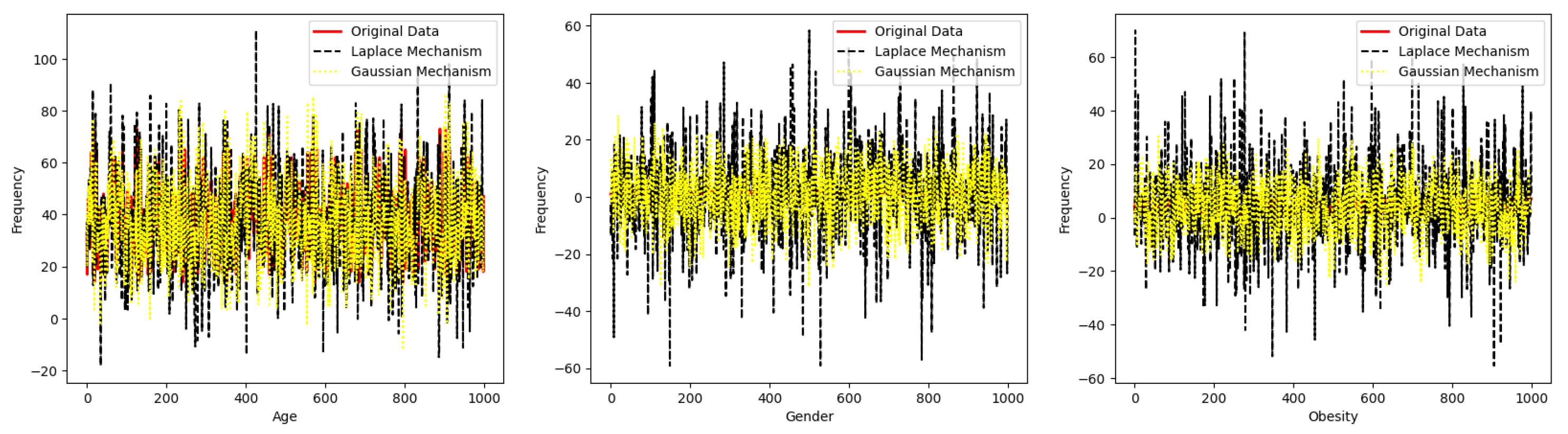
- Implement the noise addition method:After choosing both privacy models for patient data perturbation in DCMS, we implement the noise addition method in Python. The code for these experiments is available here Differential-Privacy-for-DCMS: https://github.com/Khalid-Muhammad-Irfan/Differntial-Privacy-for-DCMS (accessed on 3 July 2023). We wrote a code snippet using that “patient data CSV file”. Exploiting this implementation, we added random noise to the sensitive attributes (age, gender, and obesity) in the patient data and noted the results at different values of privacy parameter . The added noise, privacy, and utility effects for the patient data with the different values of can be seen in Figure 4 and Figure 5.
- (e)
- Evaluating the privacy guarantee: After adding noise to the patient-sensitive attributes, i.e., age, gender, and obesity, we evaluated the privacy guarantee of each of the noise addition mechanisms (Laplacian and Gaussian). This step gave us valuable insights into the suitability of methods that can confirm the privacy of the patient data, along with measuring the amount of privacy loss that occurs when the data requester (DR) analyzes the data.
- (f)
- Evaluating the utility of the data:In addition to evaluating the privacy guarantee, we also evaluated the utility of the patient data for the DR. This step involved measuring the benefit of patient data for a researcher who is the ultimate user of patient data.
- (g)
- Comparing employed DP noise addition mechanisms:Finally, in this step, we compared both Laplacian and Gaussian methods for different values to predict which one provides the best trade-off between privacy and utility of the sensitive patient data.So, in a DCMS, the patient’s data (DS) can be protected by adding moderate noise using the Gaussian mechanism before it is shared with the hospital (DC). It is assumed that the DC is collecting data from multiple patients. The DC then accumulates and stores the data in the DCMS database server. When a researcher (DR) requests access to the patient’s data, the DC shares the aggregated data with the researcher. The Y-axis represents the frequency of occurrence of each data point for the attributes (age, gender, and obesity) present in the CSV file. The X-axis displays the attributes (age, gender, and obesity). Dyda and Canonne et al. state in their papers [47,52] that in situations where data of many individuals need to be shared with various entities, the sensitivity of the data is generally significant. However, in cases where only a small number of individuals’ data needs to be shared, the Laplace mechanism is a better choice as it provides stronger privacy guarantees. However, the Gaussian mechanism is more appropriate in scenarios where the data has both high sensitivity and many individuals, such as patient data. In the view of Dong et al. [53], the Gaussian mechanism can provide strong privacy guarantees while adding less noise to the data and maintaining higher utility for the data users. The Gaussian mechanism adds random noise to the data to keep privacy while maintaining the overall utility of the data.
- (h)
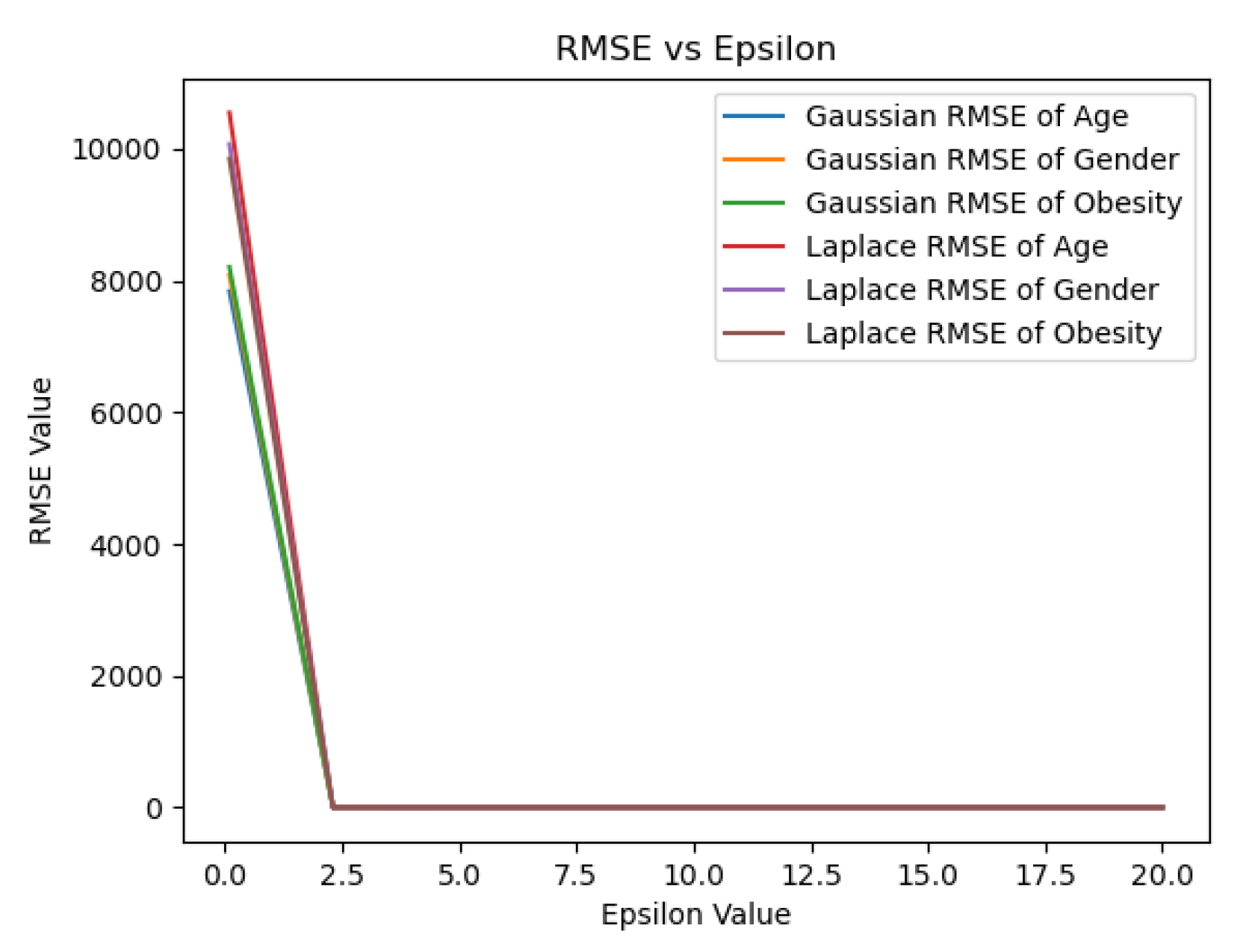
- Calculating Root Mean Square Error (RMSE) for both Laplacian and Gaussian Mechanism at different values of:Root mean square error (RMSE) is a commonly used metric to evaluate the accuracy of a privacy model in terms of the error it introduces to the data. In this case, we are using RMSE to assess the accuracy of the Laplace and Gaussian mechanisms in adding noise to the sensitive attributes of the patient data. The RMSE measures the difference between the values predicted by the privacy mechanisms and the original values of the sensitive attributes. By plotting the RMSE against the different epsilon values, we evaluated the accuracy of the noise addition mechanisms across a range of privacy levels. We are using RMSE specifically because it provides a way to measure the error in the same units as the data, which makes it easy to interpret the accuracy of the mechanisms.Additionally, it is sensitive to positive and negative errors, making it a valuable measure for assessing the precision of models that can under or over-predict values. We calculated the RMSE values against various values of . This analysis can be seen in Figure 6. Our study evaluated the Laplace and Gaussian mechanisms for obscuring sensitive patient attributes such as age, gender, and obesity. We varied the epsilon values from 0.1 to 20 to determine the optimal level of privacy preservation with reasonable accuracy. By analyzing the RMSE values, we identified the range of epsilon values where the Laplacian and Gaussian methods only moderately perturbed the data attributes. Our findings suggest that the Gaussian mechanism performed better than the Laplace mechanism, resulting in significantly lower RMSE values for the polluted patient data attributes.
- Our Findings regarding DP Implications in DCMS:
- −
- When the value of is increased, the amount of noise added by Laplacian and Gaussian mechanisms is reduced. This decrease in noise comes at the cost of decreased privacy protection provided by these mechanisms. However, noise reduction benefits the DR in data analysis. For example, if , less noise is added compared to smaller values of , resulting in more minor discrepancies between the noisy and original data.
- −
- When random noise is introduced to three attributes (age, gender, obesity) of patient data, both Laplacian and Gaussian mechanisms were used with the same value. Our findings indicate that the Gaussian mechanism is better than the Laplacian, as it adds less noise, making the data more usable for researchers and maintaining the confidentiality of patient data attributes. For instance, when the same value is used for both mechanisms, the Laplacian mechanism adds excessive noise to the patient data attributes, such as age, gender, and obesity, while making data unsuitable for secondary tasks.
- −
- As the value of is increased, there is a decrease in RMSE error. This states that the noise added to the data attributes is slightly reduced, resulting in a minor deviation between the original data and the perturbed data and lower privacy.
- −
- Our findings suggest that for the Gaussian mechanism, adding moderate noise preserves patient data privacy and enables a researcher to analyze this data. A Gaussian mechanism with lower values of also improves the RMSE values.
Hence, choosing a concrete epsilon value is a complex task. It requires more careful considerations, depending on the data one wants to pollute using the DP framework.In this paper, we demonstrated the possible contribution of differential privacy (DP) after doing simulations with patient data. Later, we will be giving a follow-up work with the above-described scenario where we will study the more specific aspects of patient data perturbations, and ultimately, we will give our findings in the form of a design for the privacy and, at the same time, utility of the patient data in a dynamic consent management system (DCMS). - Zero Knowledge Proofs (ZKP’s):Goldwasser and colleagues first conceived zero-knowledge proofs [54]; their question was, “How much knowledge should be conveyed to show proof of some knowledge”. With the help of zero-knowledge proofs in DCMS, the data subject could provide aggregated information to the controller without exposing the underlying details. At the same time, the data controller can ensure that the aggregated data is correct (i.e., it corresponds to the aggregation of accurate data generated by certified data generators).ZKP could be one of the essential tools that can extend the resilience of DCMS when there is a need for extensive confidentiality while hiding the identities of actors in a DCMS. For instance, the data subject can prove to a data controller that she is a legitimate party to access and share data and consent inside DCMS. In this case, the DS can provide some aggregated information to the DC, and the DC comprehends the validity of the DS; likewise, when a DR has to prove to the DC that he has the right to access data and consent of the DS. DR will be furnishing some aggregated information to DC, and with this information, DC will learn about the legitimacy of DR. More formally, the requirements for ZKP for a DCMS can be stated as follows:
- (a)
- Data subject proving the possession of credentials that guarantee that the subject is the genuine entity:Regarding DCMS, zero-knowledge proofs empower the data controller to verify that a data subject knows the discrete logarithms and of the public values and and that they comply with a linear equationwhere A, , and are public points on G. This is done by not exposing any data concerning or .Completeness: Whenever the aggregated information supplied by the data subject to the data controller stands TRUE, the subject convinces the controller in a DCMS.Soundness: Whenever the aggregated information delivered by the data subject to the data controller exists FALSE, a dishonest data subject will not be capable of persuading the data controller in a DCMS.Zero-knowledge: The data controller will not learn anything from the aggregated information given by the subject, whereas the statement provided by the subject is either true or false.
- (b)
- Data requester proving the possession of credentials to get subject’s consented data.Regarding DCMS, zero-knowledge proofs empower the data controller to verify that a data subject knows the discrete logarithms and of the public values = and = and that they comply with a linear equationCompleteness: Whenever the aggregated information delivered by the data requester to the data controller stands TRUE, the data requester convinces the data controller to have the subject’s data in a DCMS.Soundness: Whenever the aggregated information provided by the data requester to the data controller is FALSE, a dishonest data requester will not be able to convince the data controller to have the subject’s data in a DCMS.Zero-knowledge: The data controller will not learn anything from the aggregated information the data requester provides. Still, the statement provided by the data request is either true or false.Contribution applying ZKP to concrete settings in DCMS:Using Zk-SNARKs in a blockchain-based DCMS: In addition to the implications mentioned above regarding the use of zero-knowledge proofs in DCMS, we can also see substantial contributions of ZKPs when we apply DCMS to real-life systems, such as patient data/consent sharing with researchers who require patient data for their research assignments.DCMS scenario: In this context, a patient can be considered as a DS whose data/consent is being shared from a DC with DR. The healthcare organization acts as a centralized entity responsible for receiving, storing, and sharing the DS’s data/consent.
- −
- Decentralizing the DC:Firstly, to avoid a single point of failure in this scenario, decentralization of the DC can be achieved through the hyper ledger fabric blockchain. Since we have known entities in patient data management through DCMS, a modular architecture provided by hyper-ledger fabric would be beneficial. A modular approach can be employed by putting only the DC on the blockchain, with peers on the blockchain network representing the DC, such as endorsing peers and committing peers [55]. In addition, it is essential to note that DC is a healthcare organization that only exists as a virtual entity implemented through a group of hospitals on the fabric blockchain. In a healthcare system built on the hyper ledger blockchain, a group of endorsing peers can manage patient consent and data sharing. The endorsing peers receive patient data/consent, and when a patient provides data/consent, an endorsing peer initiates a transaction, which is then broadcast to the blockchain network. The transaction is then validated by other available endorsing peers using a consensus algorithm, such as PBFT, commonly used in hyper ledger blockchain. This consensus algorithm ensures that most of the network’s peers agree on the transaction’s validity. Once the transaction is validated, it is sent to the committing peers, which update the blockchain with the new transaction.
- −
- Zk-SNARKs in blockchain powered DCMS:Zk-SNARKs (Zero-Knowledge Succinct Non-Interactive Argument of Knowledge) is a cryptographic technique used in blockchain to provide privacy and confidentiality in transactions [56]. Utilizing zk-SNARKs in a blockchain-powered DCMS can guarantee the confidentiality of sensitive patient (DSs) sensitive data while permitting researchers (DRs) to access the necessary patient data for their research tasks. According to Anusuya et al. [56], zk-SNARKs enable the creation of a proof of knowledge that verifies the validity of transmitted data without exposing the actual data. This technology can securely transmit sensitive patient data over a blockchain network while remaining private. In a blockchain-based DCMS, patient data can be encrypted and stored on the blockchain, and zk-SNARKs can be utilized to prove the data’s validity without revealing its contents. This ensures that patient privacy is maintained while enabling the DR to use the data for research. The blockchain can serve as a decentralized and distributed database, with all network participants having access to a copy of the data. Meanwhile, the current studies on zk-SNARKs have outlined the improved efficiency and robust privacy protection when using them with blockchain technology [57].Huang et al. [57] offered a method known as ZKchain, which uses zk-SNARKs in blockchain technology to improve privacy and efficiency. Additionally, zk-SNARKs have been successfully applied in developing Zcash, a cryptocurrency known for its robust privacy protections. [58]. All those studies cited in [57,58,59] did not focus on a DCMS scenario, unlike our proposal, which leverages zk-SNARKs in a blockchain-based DCMS. In our approach, zk-SNARKs play a crucial role in ensuring that patient data is securely stored on the blockchain without any reliance on the trustworthiness of the involved parties, i.e., DCs. Zk-SNARKs enable data sharing while keeping patient information confidential. Additionally, zk-SNARKs can verify patient data’s integrity, increasing trust in the research results. This approach can also instill confidence in patients that their data is safe and has not been compromised. Therefore, implementing zk-SNARKs in a blockchain-based DCMS can enhance patient privacy, ensure data security, and facilitate valuable research.In this paper regarding data protection in DCMS, we discuss a theoretical approach to the design of a privacy-preserving DCMS. In the future, we plan to study practical implementations that utilize zk-SNARKs within a hyper-ledger fabric blockchain system. This approach would help to decentralize the abstract entity responsible for data control and processing while ensuring the confidentiality of the subject’s data and the integrity of the overall process.
- Unforgeability:The dynamic consent management system should be able to provide correct data to honest players, i.e., DS, DC, DA, and DR, even in the presence of adversaries who can attack and change the output. In addition, in a DCMS, the emulation and copying of valid login credentials from any player (i.e., DS, DC, DA, DR) end should be infeasible. In a DCM system, with unforgeability, we mean that the expected output from the DCMS will not change even in the presence of adversaries. In a DCMS, the emulation and copying valid login details/credentials from any actor’s side should be infeasible. We summarize the security goals for DCMS as follows, and we only describe those highly relevant to DCMS. Cryptographic Security, End-to-End Encryption, Blockchain-Based Security, and Authentication, and Authorization.
- −
- Cryptographic Security: For a DCMS, where a few entities are communicating with each other, and there is an exchange of the data of a data subject, cryptography can be used to have the critical features for the integrity of the data of all the entities while communicating.
- −
- Homomorphic Encryption (HE):According to [60], homomorphic encryption encompasses several categories of encryption procedures to get various analyses of encrypted data. For the confidentiality of the data, HE emphasized that if the processing of the subject’s data is approvingly required, then the sharing and processing of the subject’s data should be accomplished in an encrypted format so that at any level, no one can interpret that sensitive data of a data subject. The outcomes of any analysis remain encrypted, and only the actors in a DCMS can decrypt their data. Furthermore, homomorphic encryption can also be utilized in a DCMS when a data subject desires to disseminate the processing of their data without disclosing personal details in plain text. In the same way, when a data requester needs to have the subject’s data for his research-related tasks, utilizing the HE, the controller can share the subject’s data without revealing personal details of the subject in plain text.The computing circumstances would not be capable of comprehending the data and outcomes, which both stay encrypted. Hence, homomorphic encryption facilitates secured computation on an untrusted computing platform, i.e., dynamic consent management systems.More Formally: A dynamic consent management system may need an add-on homomorphic cryptosystem. For instance, if we utilize Elliptic Curve El Gamal [61], that empowers the effective management of zero-knowledge proofs for correctness [62]. Elliptic Curve El Gamal depends on how hard it is to calculate a discrete logarithm in a particular zone; now, an elliptical curve is a subset of Zp from p large prime. The encoding of a declaration by which m ∈ Zp is.where r is uniformly incidental nonce around , B remains a reference position regarding the elliptical curve G, as is the public key. The additive’s homomorphic property determines that thefor messages m1 and m2 and for any scalars and . Decrypting encrypted text(rB,mB + r), the owner of associated private key ( = B) multiplies rB and yielding (rB) = r and subtracts this point from mB + r. The result mB is then plotted back to m using a hash table. For DCMS, symmetric homomorphic encryption schemes could guarantee the confidentiality of subject, controller, and requester data in the presence of unauthorized parties by allowing end-to-end encryption.
- −
- Multi-Party Computation (MPC):Multi-party computation is the underlying domain of cryptography to produce strategies for players to calculate a function over their inputs while keeping them confidential [63]. A DCMS is a perfect scenario to implement secure multi-party computation as the entities would be interacting with each other. Unlike traditional cryptographic tasks, cryptography in secure multi-party computation guarantees the integrity and confidentiality of communication or storage, and the adversary is outside the participants’ system. Cryptography in a secure multi-party computation model protects the actor’s privacy from each other in a DCMS. In the DCMS, we are assuming that all the actors (subject, controller, and requester) can be harmful to each other. Keeping this fact in mind, the secure multi-party computation must be utilized so that all the actors can jointly compute a function over their inputs to the DCMS while keeping those inputs private; hence, their confidentiality is rigorously protected.More formally: MPC can be expressed in DCMS as we have three players, i.e., DS, DC, and DR, with respective inputs indicating their messages in DCMS. Before sending data to the requester, the data controller wants to find out the legitimate requester among them without revealing much information to each other.
- −
- Blockchain-Based Security:Blockchain can impact meaningful results in a DCMS. For instance, while sharing subject data and consent in a DCMS, blockchain can ensure the integrity, availability, and transparency of the shared data and consent. In a DCMS, the data controller is the sole entity that will hold an enormous amount of data. This controller, intrinsically, is a centralized entity. If, for some reason, the server where data and consent of the subjects are being stored is hacked or damaged, then there is a high probability that the data will be gone. So, to overcome this alarming problem, the data controller can be decentralized in DCMS using blockchain technologies.Furthermore, the architecture of the DCMS exhibits that only known entities will interact with a DCMS; hence, using a private blockchain is highly recommended where the miners are known, and all the entities in a DCMS should enjoy all the security features. Apart from that, to record all the requests from the data requester in a distributed ledger, the data requester can also be a node in the blockchain and record all the actions from the requester’s end in a permanent ledger of transactions. In the detailed analysis of using blockchain technology to have robust privacy and security in a DCMS, we have elaborated in detail on the Zero-knowledge proof implications of DCMS.
6.1. Tension among the Defined Properties
6.2. Real Life Use-Case in Relation to the Implications of DCMS
7. Discussion
- (a)
- Decentralization of Data Controller: In our contributions to this article, we have realized the potential issues that are linked with the abstract entity “Data controller”. Instead of all these four entities, i.e., “DS, DC, DA, and DR”, only the data controller must be decentralized using permissioned/private blockchains such as hyper-ledger fabric. It is clear that when these dynamic consent management systems (DCMSs) are utilized in practical scenarios such as in hospital management systems to tackle the data protection issues for the data subject, there will be plenty of data controllers, and only these controllers will be on the blockchain. We did not explore this challenge in this work, which stands as a limitation of our study, but for future researchers, this is an obvious open problem.
- (b)
- Zero-knowledge Proofs: In this work, we have theoretically elaborated on the relevance of zero-knowledge proofs, but we did not perform any experimentation to have some results. We have elaborated on the requirements for applying ZKPs to the dynamic consent management systems. This is also another limitation of our study in the sense that our work provides suggestions to use blockchain, preferably private blockchain, along with the promising application of zero-knowledge proofs, that is, zk-snarks. For future research, this could be another open challenge to test the implacability of one of the promising applications of zero-knowledge proofs to have more precise and accurate results where there should be a minimum amount of data-sharing among all these four actors of dynamic consent management systems.
- (c)
- Cryptographic Techniques in Relation to DCMSs: In our work, we studied mainly the implications of privacy-preserving technologies (PETs) such as Homomorphic Encryption and Multiparty Computations that certainly are much more relevant to dynamic consent management systems, especially when two parties need to interact with each other in a privacy-preserving manner. We have suggested the suitability of these cryptographic tools concerning DCMS with some concrete feasibility assessment. This is another open challenge for further researchers and is one of the limitations of our study.
8. Conclusions, and Future Work
- (a)
- We have studied the potential of one of the most promising applications of zero-knowledge proofs, which is “Zero-Knowledge Succinct Non-Interactive Argument of Knowledge” (zk-SNARK). We have found that the data controller is placed onto the hyper-ledger fabric blockchain while zk-SNARK is used by the parties, i.e., use of zk-SNARK by the data subject while sending data/consent to the data controller. Use of zk-SNARK by the data controller allows the data auditor to audit the operations made by the data controller, and finally, use of zk-SNARK by the data requester while asking for the subject’s data and consent. In all these interactions, each party can share proof, and the other party will be convinced that the other party is the legitimate one to have the required data. Future researchers can make use of our study. They may produce more fruitful results that can mature the practical viability of dynamic consent management systems, especially in those real work scenarios where sensitive data must be shared, i.e., sharing patient data with the researcher to gain good research results.
- (b)
- In this work, we have tested the validity of differential privacy for dynamic consent management systems and found its amazing implications with the core of dynamic consent management systems. For future research, it may be fruitful to use both the differential privacy mechanisms to have more results and develop a study on top of this work.
Author Contributions
Funding
Institutional Review Board Statement
Informed Consent Statement
Data Availability Statement
Acknowledgments
Conflicts of Interest
References
- Asghar, M.R.; Russello, G. Flexible and dynamic consent-capturing. In Proceedings of the Open Problems in Network Security: IFIP WG 11.4 International Workshop, iNetSec 2011, Lucerne, Switzerland, 9 June 2011; Revised Selected Papers. Springer: Berlin/Heidelberg, Germany, 2012; pp. 119–131. [Google Scholar]
- Steinsbekk, K.S.; Kåre Myskja, B.; Solberg, B. Broad consent versus dynamic consent in biobank research: Is passive participation an ethical problem? Eur. J. Hum. Genet. 2013, 21, 897–902. [Google Scholar]
- Almeida, B.A.; Doneda, D.; Ichihara, M.Y.; Barral-Netto, M.; Matta, G.C.; Rabello, E.T.; Gouveia, F.C.; Barreto, M. Personal data usage and privacy considerations in the COVID-19 global pandemic. Cienc. Saude Coletiva 2020, 25, 2487–2492. [Google Scholar]
- Ekong, I.; Chukwu, E.; Chukwu, M. COVID-19 mobile positioning data contact tracing and patient privacy regulations: Exploratory search of global response strategies and the use of digital tools in Nigeria. JMIR mHealth uHealth 2020, 8, e19139. [Google Scholar]
- Voigt, P.; Von dem Bussche, A. The EU General Data Protection Regulation (gdpr), 1st ed.; A Practical Guide; Springer International Publishing: Cham, Switzerland, 2017; Volume 10, p. 10-5555. [Google Scholar]
- Gstrein, O.J.; Zwitter, A. Extraterritorial application of the GDPR: Promoting European values or power? Internet Policy Rev. 2021, 10, 1–30. [Google Scholar] [CrossRef]
- Utz, C.; Degeling, M.; Fahl, S.; Schaub, F.; Holz, T. (Un) informed consent: Studying GDPR consent notices in the field. In Proceedings of the 2019 ACM Sigsac Conference on Computer and Communications Security, London, UK, 11–15 November 2019. [Google Scholar] [CrossRef]
- Tokas, S.; Owe, O. A formal framework for consent management. In Proceedings of the Formal Techniques for Distributed Objects, Components, and Systems: 40th IFIP WG 6.1 International Conference, FORTE 2020, Held as Part of the 15th International Federated Conference on Distributed Computing Techniques, DisCoTec 2020, Valletta, Malta, 15–19 June 2020; Proceedings 40. Springer International Publishing: Berlin/Heidelberg, Germany, 2020; pp. 169–186. [Google Scholar]
- Goncharov, L.; Suominen, H.; Cook, M. Dynamic consent and personalised medicine. Med. J. Aust. 2022, 216, 547–549. [Google Scholar]
- Wee, R.; Henaghan, M.; Winship, I. Ethics: Dynamic consent in the digital age of biology: Online initiatives and regulatory considerations. J. Prim. Health Care 2013, 5, 341–347. [Google Scholar]
- Belli, L.; Schwartz, M.; Louzada, L. Selling your soul while negotiating the conditions: From notice and consent to data control by design. Health Technol. 2017, 7, 453–467. [Google Scholar]
- Merlec, M.M.; Lee, Y.K.; Hong, S.P.; In, H.P. A smart contract-based dynamic consent management system for personal data usage under gdpr. Sensors 2021, 21, 7994. [Google Scholar] [PubMed]
- Rupasinghe, T. Blockchain-Based Dynamic Consent for Secondary Use of Electronic Medical Records. Ph.D. Thesis, Department of Software Systems & Cybersecurity, Monash University, Melbourne, VIC, Australia, 2021. [Google Scholar]
- Budin-Ljøsne, I.; Teare, H.J.; Kaye, J.; Beck, S.; Bentzen, H.B.; Caenazzo, L.; Collett, C.; D’Abramo, F.; Felzmann, H.; Finlay, T.; et al. Dynamic consent: A potential solution to some of the challenges of modern biomedical research. BMC Med. Ethics 2017, 18, 4. [Google Scholar]
- Kaye, J.; Whitley, E.A.; Lund, D.; Morrison, M.; Teare, H.; Melham, K. Dynamic consent: A patient interface for twenty-first century research networks. Eur. J. Hum. Genet. 2015, 23, 141–146. [Google Scholar]
- Spencer, K.; Sanders, C.; Whitley, E.A.; Lund, D.; Kaye, J.; Dixon, W.G. Patient perspectives on sharing anonymized personal health data using a digital system for dynamic consent and research feedback: A qualitative study. J. Med. Internet Res. 2016, 18, e5011. [Google Scholar] [CrossRef]
- Hils, M.; Woods, D.W.; Böhme, R. Measuring the emergence of consent management on the web. In Proceedings of the ACM Internet Measurement Conference, Virtual Event, 27–29 October 2020; pp. 317–332. [Google Scholar]
- Santos, C.; Nouwens, M.; Toth, M.; Bielova, N.; Roca, V. Consent Management Platforms under the GDPR: Processors and/or controllers? In Proceedings of the Privacy Technologies and Policy: 9th Annual Privacy Forum, APF 2021, Oslo, Norway, 17–18 June 2021; Springer International Publishing: Cham, Switzerland, 2021; pp. 47–69. [Google Scholar]
- Langford, J.; Poikola, A.; Janssen, W.; Lähteenoja, V.; Rikken, M.; Understanding MyData Operators. MyData Global. 2020. Available online: https://mydata.org/wpcontent/uploads/sites/5/2020/04/Understanding-Mydata-Operators-pages.pdf (accessed on 3 July 2023).
- OneTrust. OneTrust Privacy Management Software. OneTrust User Guide; OneTrust: Atlanta, GA, USA, 2018; Available online: https://www.onetrust.com/products/ (accessed on 3 July 2023).
- Ethyca. Accessed 2022. About Privacy by Design. Available online: https://ethyca.com/aboutprivacy-by-design (accessed on 3 July 2023).
- Asghar, M.R.; Lee, T.; Baig, M.M.; Ullah, E.; Russello, G.; Dobbie, G. A review of privacy and consent management in healthcare: A focus on emerging data sources. In Proceedings of the 2017 IEEE 13th International Conference on e-Science (e-Science), Auckland, New Zealand, 24–27 October 2017; pp. 518–522. [Google Scholar]
- Samarati, P.; de Vimercati, S.C. Access control: Policies, models, and mechanisms. In International School on Foundations of Security Analysis and Design; Springer: Berlin/Heidelberg, Germany, 2000; pp. 137–196. [Google Scholar]
- Prictor, M.; Lewis, M.A.; Newson, A.J.; Haas, M.; Baba, S.; Kim, H.; Kokado, M.; Minari, J.; Molnár-Gábor, F.; Yamamoto, B.; et al. Dynamic consent: An evaluation and reporting framework. J. Empir. Res. Hum. Res. Ethics 2020, 15, 175–186. [Google Scholar] [CrossRef] [PubMed]
- Mont, M.C.; Sharma, V.; Pearson, S. EnCoRe: Dynamic Consent, Policy Enforcement and Accountable Information Sharing within and across Organisations; Technical Report HPL-2012-36; HP Laboratories: Bristol, UK, 2012. [Google Scholar]
- Genestier, P.; Zouarhi, S.; Limeux, P.; Excoffier, D.; Prola, A.; Sandon, S.; Temerson, J. Blockchain for consent management in the ehealth environment: A nugget for privacy and security challenges. J. Int. Soc. Telemed. eHealth 2017, 5, GKR-e24. [Google Scholar]
- Rupasinghe, T.; Burstein, F.; Rudolph, C. Blockchain based dynamic patient consent: A privacy-preserving data acquisition architecture for clinical data analytics. In Proceedings of the Fortieth International Conference on Information Systems, Munich, Germany, 15–18 December 2019. [Google Scholar]
- Jaiman, V.; Urovi, V. A consent model for blockchain-based health data sharing platforms. IEEE Access 2020, 8, 143734–143745. [Google Scholar] [CrossRef]
- Albanese, G.; Calbimonte, J.; Schumacher, M.; Calvaresi, D. Dynamic consent management for clinical trials via private blockchain technology. J. Ambient. Intell. Humaniz. Comput. 2020, 11, 4909–4926. [Google Scholar] [CrossRef]
- Mamo, N.; Martin, G.M.; Desira, M.; Ellul, B.; Ebejer, J. Dwarna: A blockchain solution for dynamic consent in biobanking. Eur. J. Hum. Genet. 2020, 28, 609–626. [Google Scholar] [CrossRef]
- Bhaskaran, K.; Ilfrich, P.; Liffman, D.; Vecchiola, C.; Jayachandran, P.; Kumar, A.; Lim, F.; Nandakumar, K.; Qin, Z.; Ramakrishna, V.; et al. Double-blind consent-driven data sharing on blockchain. In Proceedings of the 2018 IEEE International Conference on Cloud Engineering (IC2E), Orlando, FL, USA, 17–20 April 2018; pp. 385–391. [Google Scholar]
- Kim, T.M.; Lee, S.J.; Chang, D.J.; Koo, J.; Kim, T.; Yoon, K.H.; Choi, I.Y. DynamiChain: Development of medical blockchain ecosystem based on dynamic consent system. Appl. Sci. 2021, 11, 1612. [Google Scholar] [CrossRef]
- DNV GL. Dynamic Consent in Clinical Genetics: Implementation Barriers. 2018. Available online: https://www.dnv.com/Publications/dynamic-consent-in-clinical-geneticsimplementation-barriers-196592 (accessed on 3 July 2023).
- Wiewiorówski, W. A Preliminary Opinion on Data Protection and Scientific Research; European Data Protection Supervisor: Brussels, Belgium, 2020. [Google Scholar]
- Schuler Scott, A.; Goldsmith, M.; Teare, H.; Webb, H.; Creese, S. Why we trust dynamic consent to deliver on privacy. In Proceedings of the Trust Management XIII: 13th IFIP WG 11.11 International Conference, IFIPTM 2019, Copenhagen, Denmark, 17–19 July 2019; Proceedings 13. Springer International Publishing: Berlin/Heidelberg, Germany, 2019; pp. 28–38. [Google Scholar]
- Chen, C.; Lee, P.I.; Pain, K.J.; Delgado, D.; Cole, C.L.; Campion, T.R., Jr. Replacing paper informed consent with electronic informed consent for research in academic medical centers: A scoping review. AMIA Summits Transl. Sci. Proc. 2020, 80, 80–88. [Google Scholar]
- Pearce, C.; Goettke, E.; Hallowell, N.; McCormack, P.; Flinter, F.; McKevitt, C. Delivering genomic medicine in the United Kingdom National Health Service: A systematic review and narrative synthesis. Genet. Med. 2019, 21, 2667–2675. [Google Scholar] [CrossRef]
- Parra-Calderón, C.L.; Kaye, J.; Moreno-Conde, A.; Teare, H.; Nuñez-Benjumea, F. Desiderata for digital consent in genomic research. J. Community Genet. 2018, 9, 191–194. [Google Scholar] [CrossRef]
- Shabani, M.; Marelli, L. Re-identifiability of genomic data and the GDPR: Assessing the re-identifiability of genomic data in light of the EU General Data Protection Regulation. EMBO Rep. 2019, 20, e48316. [Google Scholar] [CrossRef] [PubMed]
- Chow-White, P.A.; MacAulay, M.; Charters, A.; Chow, P. From the bench to the bedside in the big data age: Ethics and practices of consent and privacy for clinical genomics and personalized medicine. Ethics Inf. Technol. 2015, 17, 189–200. [Google Scholar] [CrossRef]
- Kogetsu, A.; Ogishima, S.; Kato, K. Authentication of patients and participants in health information exchange and consent for medical research: A key step for privacy protection, respect for autonomy, and trustworthiness. Front. Genet. 2018, 9, 167. [Google Scholar] [CrossRef] [PubMed]
- Thiel, D.B.; Platt, J.; Platt, T.; King, S.B.; Fisher, N.; Shelton, R.; Kardia, S.L. Testing an online, dynamic consent portal for large population biobank research. Public Health Genom. 2015, 18, 26–39. [Google Scholar] [CrossRef]
- Horgan, D.; Hajduch, M.; Vrana, M.; Soderberg, J.; Hughes, N.; Omar, M.I.; Lal, J.A.; Kozaric, M.; Cascini, F.; Thaler, V.; et al. European Health Data Space—An Opportunity Now to Grasp the Future of Data-Driven Healthcare. Healthcare 2022, 10, 1629. [Google Scholar] [CrossRef]
- Kouroubali, A.; Katehakis, D.G. The new European interoperability framework as a facilitator of digital transformation for citizen empowerment. J. Biomed. Inform. 2019, 94, 103166. [Google Scholar] [CrossRef]
- Dwork, C. Differential privacy: A survey of results. In Proceedings of the Theory and Applications of Models of Computation: 5th International Conference, TAMC 2008, Xi’an, China, 25–29 April 2008; Proceedings 5. Springer: Berlin/Heidelberg, Germany, 2008; pp. 1–19. [Google Scholar]
- Alvim, M.S.; Andrés, M.E.; Chatzikokolakis, K.; Degano, P.; Palamidessi, C. Differential privacy: On the trade-off between utility and information leakage. In Proceedings of the Formal Aspects of Security and Trust: 8th International Workshop, FAST 2011, Leuven, Belgium, 12–14 September 2011; Revised Selected Papers 8. Springer: Berlin/Heidelberg, Germany, 2012; pp. 39–54. [Google Scholar]
- Canonne, C.L.; Kamath, G.; Steinke, T. The discrete gaussian for differential privacy. Adv. Neural Inf. Process. Syst. 2020, 33, 15676–15688. [Google Scholar] [CrossRef]
- Li, N.; Qardaji, W.H.; Su, D. Provably private data anonymization: Or, k-anonymity meets differential privacy. CoRR 2011, 49, 55. [Google Scholar]
- Quinn, P.; Malgieri, G. The Difficulty of Defining Sensitive Data—The Concept of Sensitive Data in the EU Data Protection Framework. Ger. Law J. 2021, 22, 1583–1612. [Google Scholar] [CrossRef]
- Sweeney, L. Simple demographics often identify people uniquely. Health 2000, 671, 1–34. [Google Scholar]
- Wang, S.; Jiang, X.; Singh, S.; Marmor, R.; Bonomi, L.; Fox, D.; Dow, M.; Ohno-Machado, L. Genome privacy: Challenges, technical approaches to mitigate risk, and ethical considerations in the United States. Ann. N. Y. Acad. Sci. 2017, 1387, 73–83. [Google Scholar] [CrossRef] [PubMed]
- Dyda, A.; Purcell, M.; Curtis, S.; Field, E.; Pillai, P.; Ricardo, K.; Weng, H.; Moore, J.C.; Hewett, M.; Williams, G.; et al. Differential privacy for public health data: An innovative tool to optimize information sharing while protecting data confidentiality. Patterns 2021, 2, 100366. [Google Scholar] [CrossRef] [PubMed]
- Dong, J.; Roth, A.; Su, W.J. Gaussian differential privacy. J. R. Stat. Soc. Ser. B Stat. Methodol. 2022, 84, 3–37. [Google Scholar] [CrossRef]
- Goldwasser, S.; Micali, S.; Rackoff, C. The knowledge complexity of interactive proof-systems. In Providing Sound Foundations for Cryptography: On the Work of Shafi Goldwasser and Silvio Micali; ACM: New York, NY, USA, 2019; pp. 203–225. [Google Scholar]
- Elli, A.; Barger, A.; Bortnikov, V.; Cachin, C.; Christidis, K.; Caro, A.D.; Enyeart, D.; Ferris, C.; Laventman, G.; Manevich, Y.; et al. Hyperledger fabric: A distributed operating system for permissioned blockchains. In Proceedings of the Thirteenth EuroSys Conference, Porto, Portugal, 23–26 April 2018; pp. 1–15. [Google Scholar]
- Anusuya, R.; Karthika Renuka, D.; Ghanasiyaa, S.; Harshini, K.; Mounika, K.; Naveena, K.S. Privacy-Preserving Blockchain-Based EHR Using ZK-Snarks. In International Conference on Computational Intelligence, Cyber Security, and Computational Models; Springer International Publishing: Cham, Switzerland, 2021; pp. 109–123. [Google Scholar]
- Huang, J.; Huang, T.; Zhang, J. zkChain: An Efficient Blockchain Privacy Protection Scheme Based on zk-SNARKs. In International Conference on Machine Learning for Cyber Security; Springer: Cham, Switzerland, 2023; pp. 400–410. [Google Scholar]
- Rasheed, A.; Mahapatra, R.N.; Varol, C.; Narashimha, K. Exploiting zero knowledge proof and blockchains towards the enforcement of anonymity, data integrity and privacy (adip) in the iot. IEEE Trans. Emerg. Top. Comput. 2021, 10, 1476–1491. [Google Scholar] [CrossRef]
- Piao, Y.; Ye, K.; Cui, X. A data sharing scheme for gdpr-compliance based on consortium blockchain. Future Internet 2021, 13, 217. [Google Scholar] [CrossRef]
- Armknecht, F.; Boyd, C.; Carr, C.; Gjøsteen, K.; Jäschke, A.; Reuter, C.A.; Strand, M.; A guide to fully homomorphic encryption. Cryptology ePrint Archive. 2015. Available online: https://eprint.iacr.org/2015/1192 (accessed on 3 July 2023).
- ElGamal, T. A public key cryptosystem and a signature scheme based on discrete logarithms. IEEE Trans. Inf. Theory 1985, 31, 469–472. [Google Scholar] [CrossRef]
- Camenisch, J.; Stadler, M. Proof Systems for General Statements about Discrete Logarithms; Technical Report; ETH Zurich, Department of Computer Science: Zurich, Switzerland, 1997; p. 260. [Google Scholar]
- Bogetoft, P.; Christensen, D.L.; Damgård, I.; Geisler, M.; Jakobsen, T.; Krøigaard, M.; Nielsen, J.D.; Nielsen, J.B.; Nielsen, K.; Pagter, J.; et al. Secure multiparty computation goes live. In International Conference on Financial Cryptography and Data Security; Springer: Berlin/Heidelberg, Germany, 2009. [Google Scholar]
- Hussein, R.; Scherdel, L.; Nicolet, F.; Martin-Sanchez, F. Towards the European Health Data Space (EHDS) ecosystem: A survey research on future health data scenarios. Int. J. Med. Inform. 2023, 170, 104949. [Google Scholar] [CrossRef]
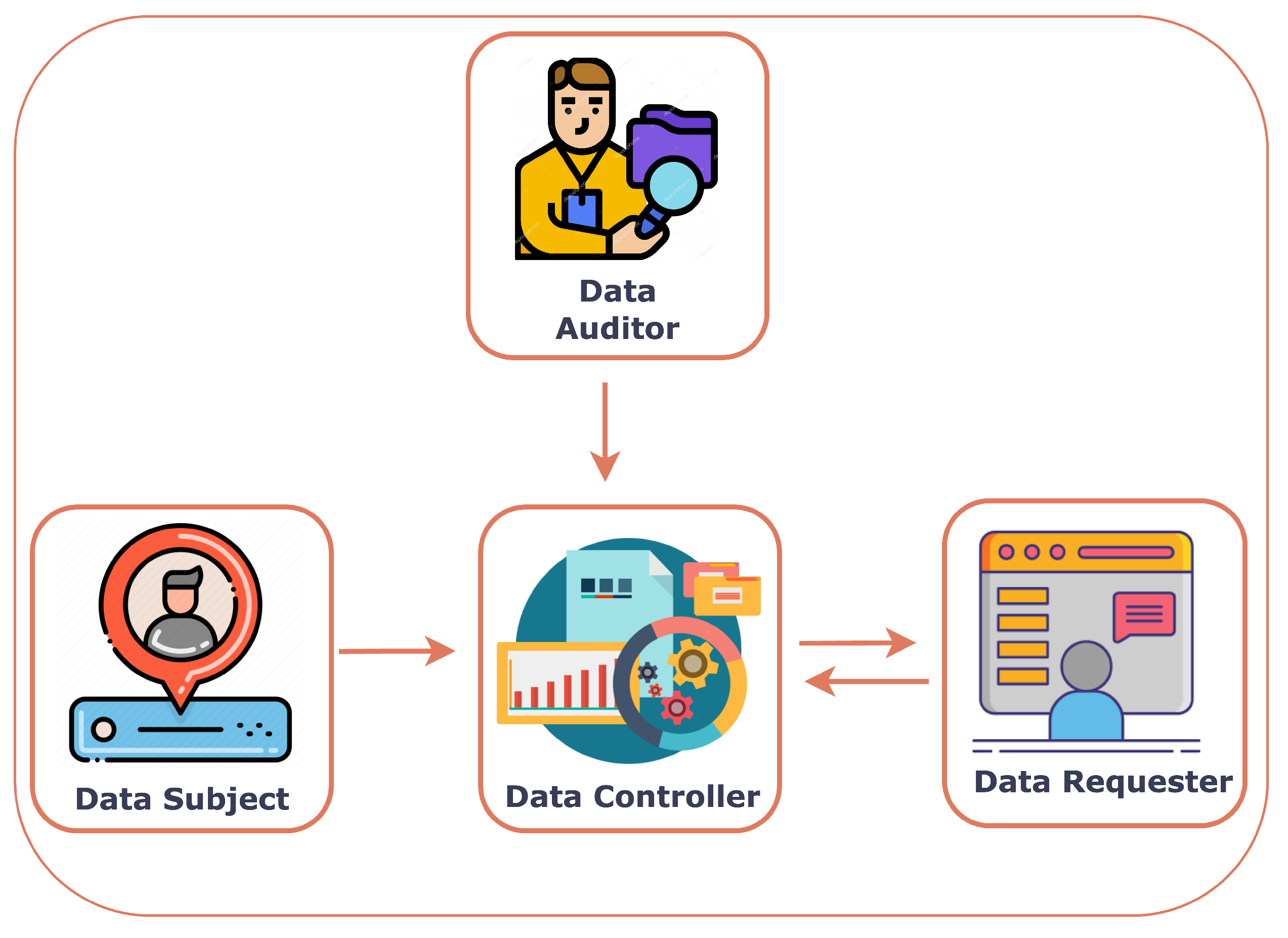
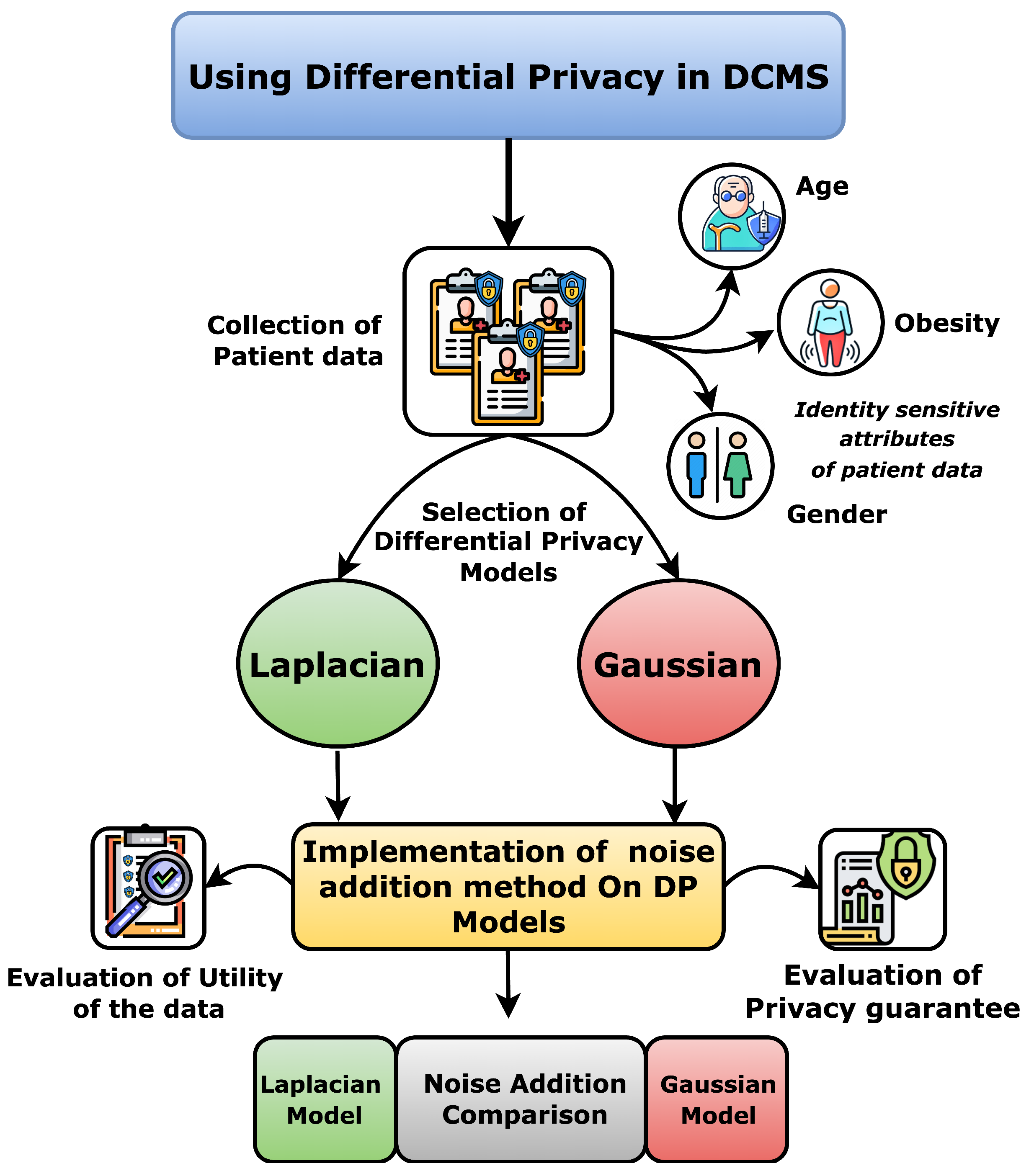


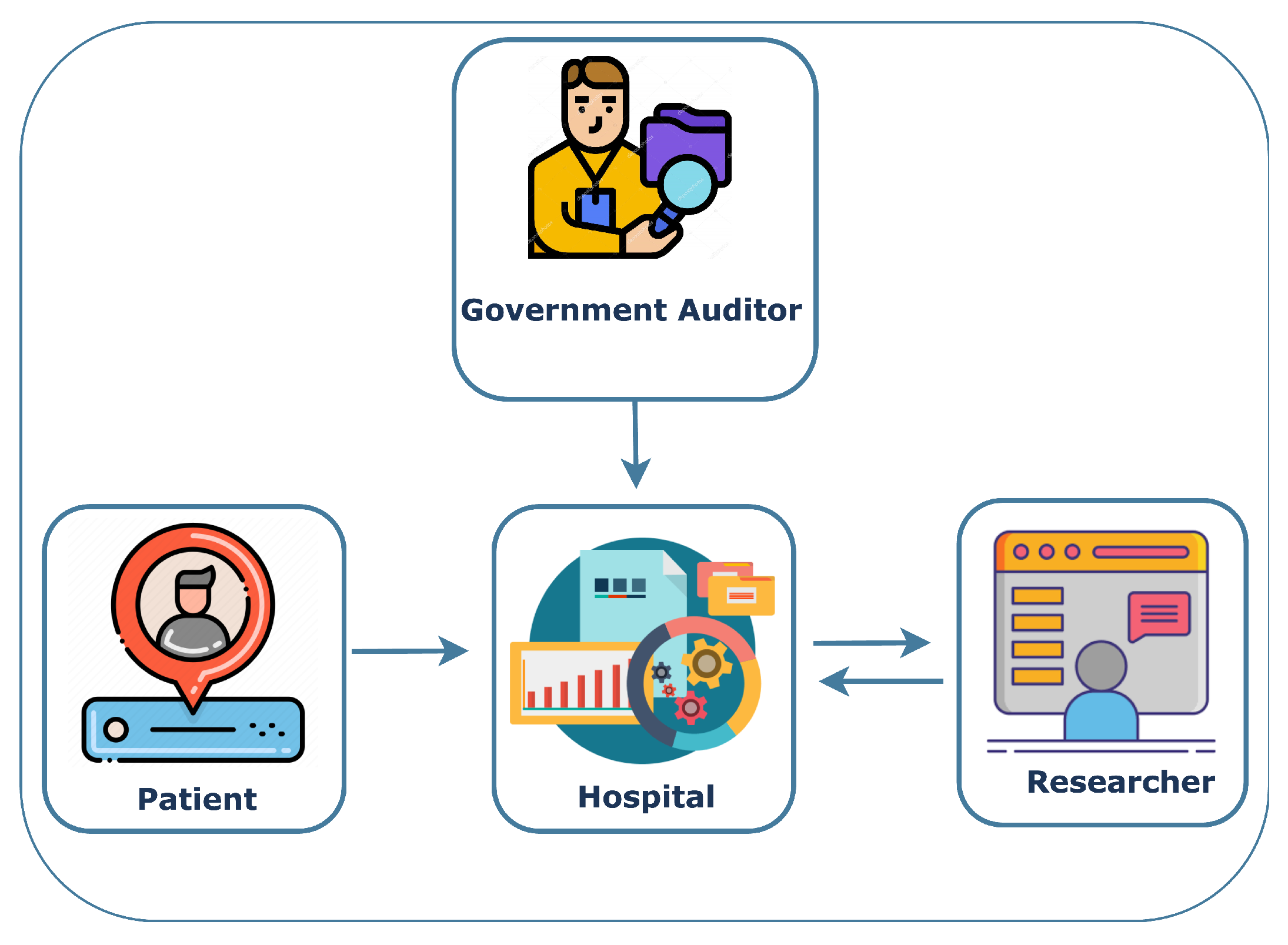


| Acronym | Description |
|---|---|
| DS | Data Subject |
| DC | Data Controller |
| DA | Data Auditor |
| DR | Data Requester |
| DCMS | Dynamic Consent Management System |
| PrivKdcms | Private-key encryption scheme experiment within DCMS |
| Protocol used within the context of DCMS comprising some algorithms | |
| n | Security parameter |
| Pr | The probability of the event |
| PrivKdcmsA | Private-key encryption scheme experiment involving a specific participant within DCMS |
| A | Probabilistic polynomial-time adversaries, i.e., DC, DA, DR |
| gen | The key generation algorithm |
| sign | The message signing algorithm |
| vrfy | The key verification algorithm |
| access | Access algorithm in experiment |
| share | The data sharing algorithm |
| negl | A negligible function |
| IND | Security property of DCMS |
| pk | Public key |
| sk | Secret key |
| k | Encryption key used to encrypt the messages |
| Enc | Encryption function that takes a message |
| DP | Differential Privacy |
| ZKPs | Zero Knowledge Proofs |
| G | A generator point on an elliptic curve |
| RMSE | Root Mean Square Error |
| zk-SNARK | Zero-Knowledge Succinct Non-Interactive Argument of Knowledge |
| HE | Homomorphic Encryption |
| MPC | Multiparty Computation |
| E (m) | The encoding of a message or value ’m’ using a public key |
| r | A randomly chosen nonce |
| Zp | The set of integers modulo a prime number p |
| B | A reference point on an elliptic curve G |
| GDPR | General Data Protection Regulation |
| EHDS | European Health Data Space |
| PBFT | Practical Byzantine Fault Tolerance |
| HIPAA | Health Insurance Portability and Accountability Act |
| OutputForge A | Output associated with adversary A |
| A unary representation 1 | |
| c | The resulting cipher-text |
| m | Plain-text message that is being encrypted |
| Reference | Confidentiality | Unforgeability | Availability | Auditability |
|---|---|---|---|---|
| [12] | × | × | × | × |
| [24] | × | × | × | × |
| [25] | ||||
| [26] | × | × | × | × |
| [27] | × | × | × | |
| [28] | × | × | × | |
| [29] | × | × | × | |
| [30] | × | × | × | |
| [31] | × | × | ||
| [13] | × | × | × | |
| [32] | × | × | × |
| References | Comments by the Authors |
|---|---|
| [33,35] | Various technological barriers exist to DCMS implementation; security and privacy concerns are significant. This paper elaborates on the security and privacy of the DCMS question as follows: How can security practices be addressed to ensure patient privacy in DCMS? Traceability and transparency: How can patient preferences be tracked across complex landscapes where patient data are shared? Interoperability: How can a DCMS be integrated effectively into clinical genetics environments? |
| [36] | The utilization of DCMS for administering the right to access scientific genetics data can be similar to data security and privacy problems, like the other software used in this domain. In particular, the confidentiality, integrity, and availability of personal information concerning consent are crucial. |
| [37,38] | Software sellers/developers must be obliged to respect both optional and needed security and privacy requirements in the product, which would be dynamic consent software. |
| [39,40] | Different security administrations may put security and privacy concerns in circumstances that could manufacture data from a clinical perspective but store or transfer it to research-related tasks. |
| [41] | Transferring clinical data to high-performance computing clusters outside the hospital network is commonplace today. In such a situation, the security and privacy concerns are not unique to dynamic consent. Using DCMS, the increased mobility and volumes of data access in a setting stress the importance of addressing security problems purposefully. |
| [42] | Cross-organization or cloud-based networks of access to personal data can challenge existing security roles. Moreover, this also raises questions about the competence of the interested parties and the authority they belong to. A DCMS must also bear a trusted identity management process, including identity proofing, credentialing, authentication, and authorization, to confirm the security and privacy of patient data. |
| [43] | The EU health data space committee agrees on the security and privacy enhancement in the current systems that share patient data for research/secondary use. In future designs, patients will be at the system’s heart and have complete control over their data. The Commission proclaimed the utilization and advances in cybersecurity for health data-sharing practices. |
| [44] | The EU made another initiative to enhance the technical realization of DCMS to enable citizens to give informed consent and manage access rights and permissions to personal health data for sharing unique, identifiable health data with healthcare professionals and others. |
Disclaimer/Publisher’s Note: The statements, opinions and data contained in all publications are solely those of the individual author(s) and contributor(s) and not of MDPI and/or the editor(s). MDPI and/or the editor(s) disclaim responsibility for any injury to people or property resulting from any ideas, methods, instructions or products referred to in the content. |
© 2023 by the authors. Licensee MDPI, Basel, Switzerland. This article is an open access article distributed under the terms and conditions of the Creative Commons Attribution (CC BY) license (https://creativecommons.org/licenses/by/4.0/).
Share and Cite
Khalid, M.I.; Ahmed, M.; Kim, J. Enhancing Data Protection in Dynamic Consent Management Systems: Formalizing Privacy and Security Definitions with Differential Privacy, Decentralization, and Zero-Knowledge Proofs. Sensors 2023, 23, 7604. https://doi.org/10.3390/s23177604
Khalid MI, Ahmed M, Kim J. Enhancing Data Protection in Dynamic Consent Management Systems: Formalizing Privacy and Security Definitions with Differential Privacy, Decentralization, and Zero-Knowledge Proofs. Sensors. 2023; 23(17):7604. https://doi.org/10.3390/s23177604
Chicago/Turabian StyleKhalid, Muhammad Irfan, Mansoor Ahmed, and Jungsuk Kim. 2023. "Enhancing Data Protection in Dynamic Consent Management Systems: Formalizing Privacy and Security Definitions with Differential Privacy, Decentralization, and Zero-Knowledge Proofs" Sensors 23, no. 17: 7604. https://doi.org/10.3390/s23177604
APA StyleKhalid, M. I., Ahmed, M., & Kim, J. (2023). Enhancing Data Protection in Dynamic Consent Management Systems: Formalizing Privacy and Security Definitions with Differential Privacy, Decentralization, and Zero-Knowledge Proofs. Sensors, 23(17), 7604. https://doi.org/10.3390/s23177604