You are currently on the new version of our website. Access the old version .
SensorsSensors
  • Article
  • Open Access

22 February 2022

Area Coverage Maximization under Connectivity Constraint in Wireless Sensor Networks
,
,
,
and
1
ImViA Laboratory, University of Bourgogne Franche-Comté, 21000 Dijon, France
2
LETIA Laboratory, University of Abomey-Calavi, Abomey-Calavi BP 2549, Benin
3
LIB Laboratory, University of Bourgogne Franche-Comté, 21000 Dijon, France
4
Institute for Color Science and Technology, Tehran 1668836471, Iran
This article belongs to the Special Issue The Sensor Location-Allocation Problem for Environmental Sensing

Abstract

Wireless sensor networks (WSNs) have several important applications, both in research and domestic use. Generally, their main role is to collect and transmit data from an ROI (region of interest) to a base station for processing and analysis. Therefore, it is vital to ensure maximum coverage of the chosen area and communication between the nodes forming the network. A major problem in network design is the deployment of sensors with the aim to ensure both maximum coverage and connectivity between sensor node. The maximum coverage problem addressed here focuses on calculating the area covered by the deployed sensor nodes. Thus, we seek to cover any type of area (regular or irregular shape) with a predefined number of homogeneous sensors using a genetic algorithm to find the best placement to ensure maximum network coverage under the constraint of connectivity between the sensors. Therefore, this paper tackles the dual problem of maximum coverage and connectivity between sensor nodes. We define the maximum coverage and connectivity problems and then propose a mathematical model and a complex objective function. The results show that the algorithm, called GAFACM (Genetic Algorithm For Area Coverage Maximization), covers all forms of the area for a given number of sensors and finds the best positions to maximize coverage within the area of interest while guaranteeing the connectivity between the sensors.

1. Introduction

Wireless sensor networks (WSN) have been the subject of numerous research studies since the first known deployment of the SOund SUrveillance System (SOSUS) 1950s [1,2]. Until the 1990s, except for a few radio beacons to route data from a sensor to the central controller expensive and cumbersome cabling was required. New sensor networks appeared in the 1990s, thanks to advances in the field of wireless techniques. As new wireless technologies progress, their range of applications increases. Among these innovative technologies, wireless sensor networks (WSN) have become very flexible and dynamic facets deployed in almost all types of environments whether rural, suburban, or urban [1].
A WSN is a collection of sensor nodes that communicate using wireless technologies. WSNs are made up of small nodes that differ from traditional networks in their communication and detection ranges. Sensor nodes detect the physical phenomena located in the area and transmit the data in collaboration with the receiver node [3]. The data captured by the nodes are routed through a multi-hop routing to a node, considered to be a “collection point”, called sink-node (or sink). The latter can be connected to the network user (via the Internet, a satellite, or another system). A sensor node can be a detection node, a transmission node, a relay node, or a combination of theses nodes.
Initially used in the army, this kind of network is now found in several fields, varying from industrial surveillance to the measurement of environmental data, agriculture, home automation, fire detection, medical sector, etc. [1,4,5,6,7,8,9,10]. These applications are responsible for monitoring a target point or area by recording a reaction and communicating it. Consequently, WSN applications play critical roles whether deployed in industry or in everyday life and must be effective. However, the weak capacities of the sensors both at the level of the detection and communication range constitute one of the first weaknesses of this type of network. The consequences are areas or targets with little or no coverage in the detection region reducing the effectiveness of the network.
Due to the constraining characteristics of the WSNs, one of the first challenges they face is figuring out how to perfectly cover a surveillance area. Coverage and connectivity are the two most fundamental problems of the WSN [6]. One of the solutions that have long been considered to increase the global network coverage has been to increase the number of sensors. However, this solution is not efficient in terms of deployment, coverage, connectivity, and network lifetime. In fact, deployment and collaboration of sensors are some of the major features that directly influence the performance of the WSN. WSN deployment schemes can be classified into two main groups; deterministic and non-deterministic [8,11]. The main performance measures that come into play during the deployment of a WSN include coverage, connectivity, and network lifetime. Among these measures, we focus on coverage and connectivity.
For practical design and use of sensor networks in various application scenarios, coverage depends on several parameters. The coverage reflects how well a sensor monitors a point or an area. In most cases, to obtain maximum coverage a massive number of sensor nodes is required. In [12], coverage is defined as how an area is covered by the sensor or to what extent each point is under of a sensor node. Depending on the kind of application, the coverage can take several forms [11,12,13], including barrier coverage, point coverage and area coverage, which is divided into two types including full area coverage and partial area coverage [3].
In addition to coverage, connectivity is an equally vital element of wireless sensor networks. The network in a defined area is connected if each deployed sensor node has at least one neighboring node with which it is connected. Khoufi, I. et al. [6] explained that two sensor nodes are connected if and only if they can communicate directly (one-hop connectivity) or indirectly (multi-hop connectivity). In [14], network connectivity is defined as the communication capacity between the different nodes of the network where data are transmitted to the base station by a single hop or by several hops. In this transmission process, if a sensor node communicates directly with the base station, it is a single-hop communication. On the other hand, the sensed data are transmitted to the base station via other intermediate sensor nodes, which is called multi-hop communication. When a WSN has single connectivity between sensor nodes, it is called single connectivity or 1-connectivity. The breakdown of a single node in such a scenario can lead to a failure of communication in the network. In the case of k-connectivity ( k > 1), despite the failure of one node, the network remains connected. Connectivity is therefore vital for the transmission of sensed data to the base station [6,15]. It has a significant impact on the WSN, as the failure of a link between sensor nodes can result in communication failure in the network.
In real-life situations, usually for cost reasons, the number of sensors is generally restricted but there is a need to cover a large area and provide connectivity. It is also important to cover an area regardless of its shape and the way it is presented geometrically. The issue of coverage and connectivity can be described in various ways. Still, in our case, we are concerned with how to cover more of the area regardless of its geometric shape, with a given number of sensors of the same type while ensuring connectivity. This paper attempts to cover our area of interest (regular and irregular shape) using a genetic algorithm (GA) rather than circular wrapping algorithms [16,17]. Moreover, due to the random deployment of the sensors, causing an overlap, we propose a new fitness function, to know the exact area covered by the sensors.
The rest of the paper is organized as follows: in Section 2, we provide related work on maximum coverage and connectivity. Then, in Section 3, we present the network model by defining the problem and proposing a mathematical model with a detailed objective function. In Section 4, the proposed GA approach is described in detail, and in Section 5, we present and discuss the results. In Section 6, we concludes this paper and gives an overview of some future works.

3. System Model

3.1. Network Model and Assumptions

This article examines the double problem of maximizing area coverage while ensuring connectivity in the WSN as formulated above. We consider a WSN application scenario where a set of N sensor nodes, S = { s 1 , s 2 , s 3 , . . . . . , s N } , are randomly deployed within a region of interest. We are dealing with many types of regions, so the area to be covered with sensors may or may not be regular in shape. We assume that all the sensors are homogeneous and that the computing and power capacities of all these devices are the same. We also assume that each sensor has an omnidirectional antenna and that the detection range r s and the communication range r c are equal and arbitrary. The detection area of each sensor is modeled by a circle; the center of the circle indicates the position of the sensor and its radius indicates its detection and communication range. The sensing range parameter is the same as in the literature, [18,20,26] and the cover model is boolean. The boolean disk coverage model is the most widely used in the literature [3,18,20,26,27,28] and is defined by Equation (1):
f ( s , p ) = 1 if d ( s , p ) r s 0 otherwise .
where r s is the sensing range and d ( s , p ) the Euclidean distance from the sensor s to a point p is given by Equation (2):
d ( s , p ) = ( s x p x ) 2 + ( s y p y ) 2

3.2. Coverage and Connectivity Model

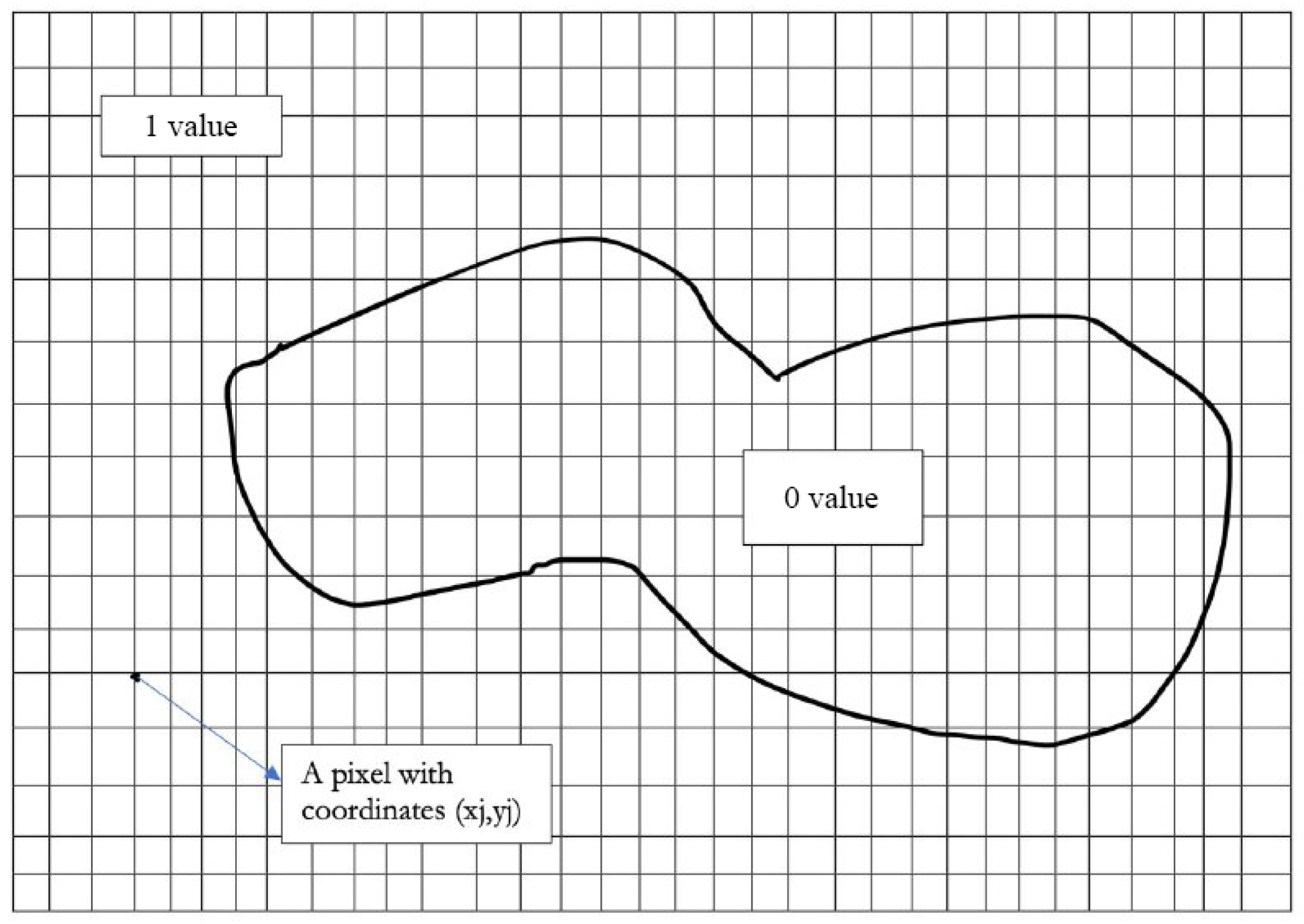
Figure 1 shows a map that represents an area of interest. This area is represented in a grid containing pixels. The pixel is the basic unit of programmable color on a computer display or in a computer image. The “1 value” area represents the area where the pixels are at 1 while “0 value” area represents the area where the pixels are at 0. There are n × n pixels in the grid. Suppose that the map consists of the number m of pixels. The pixels inside the map are set to 0 while everywhere else is set to 1, as shown in Figure 1.
Figure 1. Area to cover in a grid.
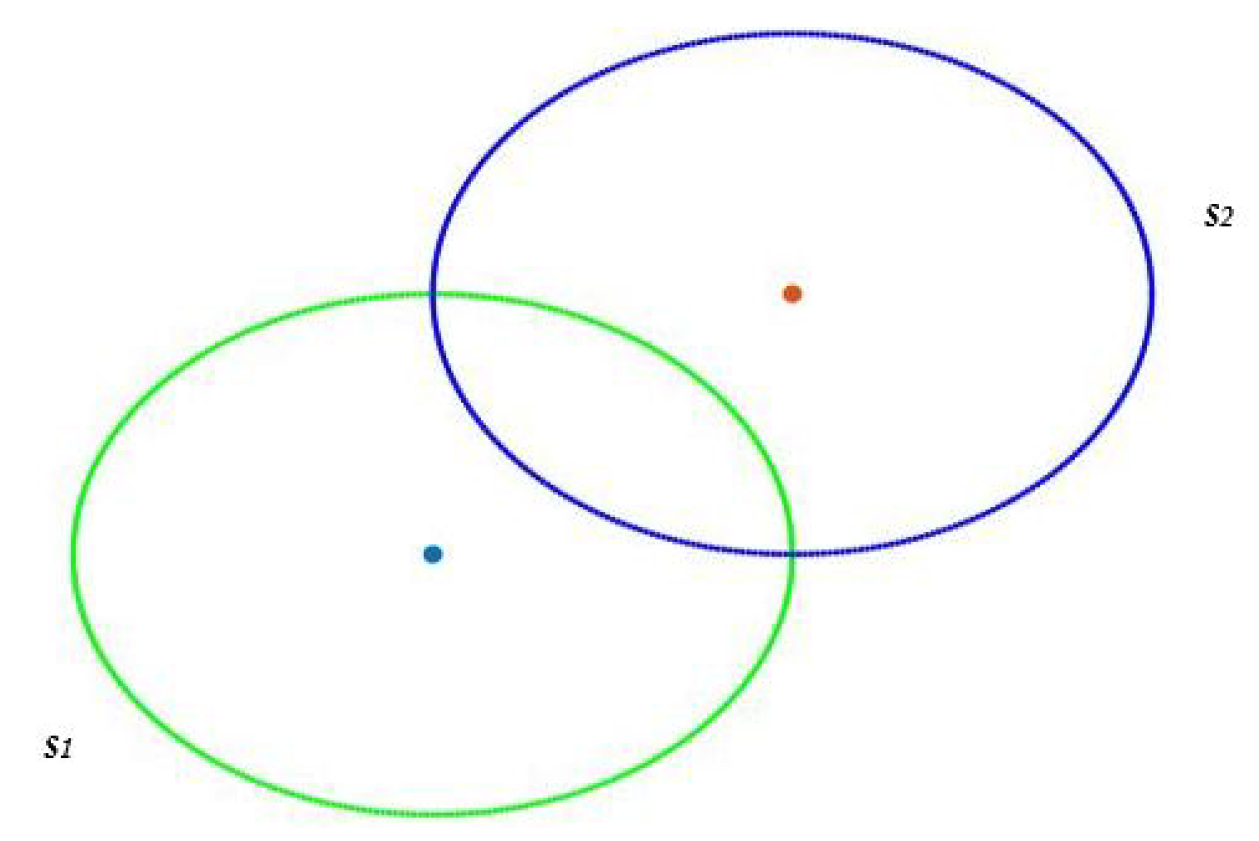
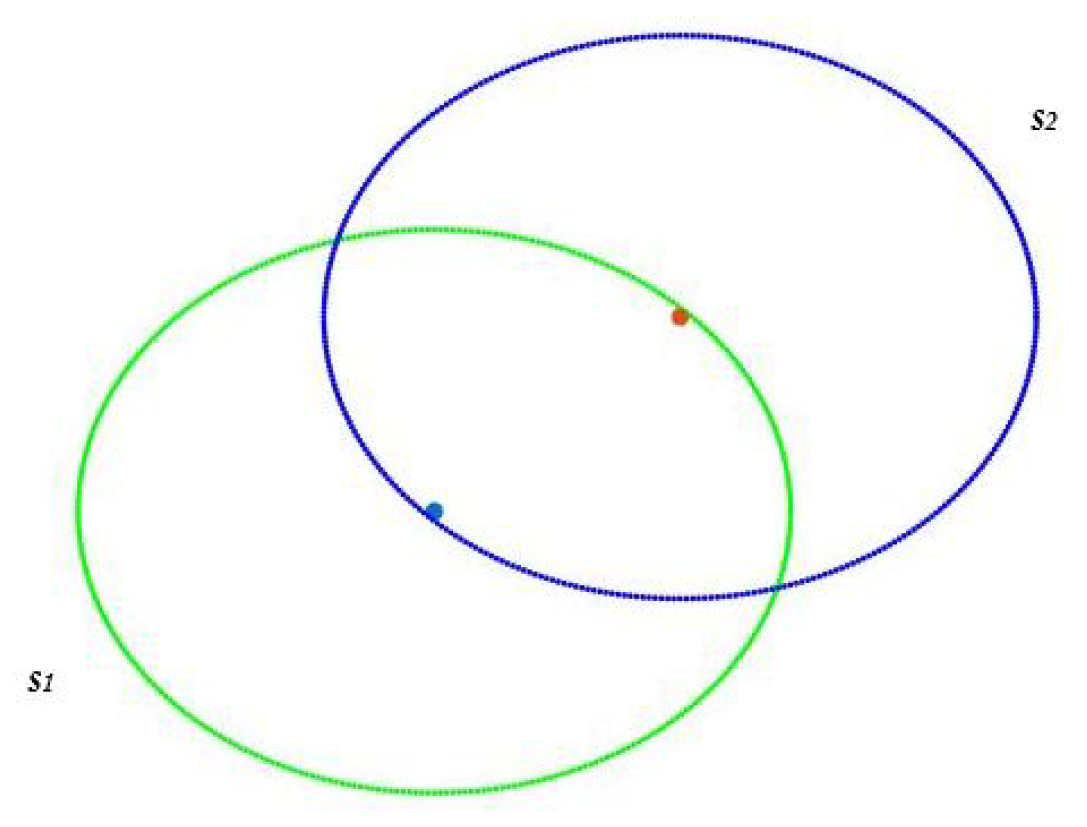
The ith sensor has coordinates ( x i , y i ) such that most pixels of the map are located inside the circle with center ( x i , y i ) and radius r s . This means that pixels of the map would be covered by at least one sensor. In addition, we expect pixels outside the region of interest to be uncovered, or as little covered as possible. Finally, full connectivity must be guaranteed. This means that whatever pair of sensors is chosen, there is at least one path that connects them. Sensor nodes communicate within communication range ( r c ) to exchange data until reaching the sink. The network said to be connected if there is at least one path (k = 1) between each sensor node and the sink. Moreover, if there are multiple and different paths between each sensor and the sink, this is called k-connectivity where k > 1 [15]. Two sensors s 1 and s 2 are said to be unconnected if the Euclidean distance between s 1 and s 2 is greater than r c (Figure 2) and connected if this distance is less or equal to r c (Figure 3).
Figure 2. Two unconnected sensors.
Figure 3. Two connected sensors.

3.3. Formulation of Linear Programming (LP)

We formulate the above problem as the following mathematical optimization problem:
  • The map to be covered is represented in Figure 1 by the “0 values” zone, and we call it A.
  • M denotes the set of pixels which are in the map.
    M = j / j A j = 0
  • M denotes the set of pixels which are outside of the map.
    M = j / j A j = 1
The coverage and connectivity problem can be stated as follows. Given A, we need to place the sensor nodes to cover most of A while ensuring that the network is fully connected.
Let Z i j , Z i j and C i j be the Boolean variables defined as follows:
Z i j denotes the set of pixels in the map which are covered by a sensor s i
Z i j = 1 i f j th p i x e l o f m a p i s c o v e r e d b y i th s e n s o r , j M 0 o t h e r w i s e .
Z i j denotes the set of pixels outside of the map which are covered by a sensor s i
Z i j = 1 i f j th p i x e l o u t s i d e o f m a p i s c o v e r e d b y i th s e n s o r , j M 0 o t h e r w i s e .
C i j denotes the connectivity between sensor s i and s j
C i j = 1 i f d ( s i , s j ) r s 0 o t h e r w i s e .
where d ( s i , s j ) is the Euclidean distance and its give by Equation (2).
Then, the formulated linear programming problem is given by Equation (8):
O b j e c t = M a x i m i z e Z 1 = i = 1 N j M Z i j M i n i m i z e Z 2 = i = 1 N j M Z i j

4. Genetic Algorithm

Various metaheuristic algorithms exist in the literature with many general foundations. They implement a form of stochastic optimization so that the solution found depends on the set of random variables generated by the search over a large set of feasible solutions. Metaheuristics can often find reasonable solutions with less computational effort than iterative methods or simple heuristics. Therefore, they are practical approaches for optimization problems. In the field of combinatorial optimization, Padula and Kincaid [29] described several combinatorial optimization methods such as Tabu Search (TS), Simulated Annealing (SA), and Genetic Algorithm (GA) for actuator/sensor placement. Among these methods, we have conducted our study using the genetic algorithm.
In 1859, the naturalist Charles Darwin published his famous book The Origin of Species, which presented a theory to explain the phenomenon of evolution. About 100 years later, John Holland and his colleagues and students at the University of Michigan were inspired by it and tried to implement evolutionary systems based on natural selection artificially. This work then led to Genetic Algorithms, belonging to the family of evolutionary algorithms, which are used to obtain approximate solutions for certain complex optimization problems when there is no exact method (or the solution is unknown) to solve them in a reasonable time [20,21,22,23]. The novelty introduced by this group of researchers was the consideration of the crossover operator and the mutation [30].
The genetic algorithm begins with a randomly generated population of possible solutions [20]. A solution is represented by a set of genes called a chromosome or individual. A fitness function evaluates each individual to determine its quality. At the end of the generation of the initial population, three operations are performed. These are selection, crossover, and mutation [20,21]. In the selection phase, a set of probable solutions is acquired from the initial population. Then, two chromosomes (parents), chosen at random, are used to create two other chromosomes ( offspring) by the operation of crossover in which the parent exchange their genetic information. The offspring then undergo the process of mutation in order to produce a better solution. However, the mutation process does not always produce a better solution. It may even alter the mutated solutions. Once the mutation is complete, the offspring are evaluated by the fitness function, and their values are compared to those of all the chromosomes of the previous generation. If the current offspring have higher fitness values, they replace the parents in the new population. The crossover and mutation operation is iterated until the final criteria, which can be a fixed number of generations or a chromosome of the desired quality, is achieved.

4.1. Chromosome and Initial Population

A chromosome represents a complete solution to the problem to solve. In our case, we represent the chromosome as a string of coordinates ( x i , x j ) . An individual is encoded as an array of sensor node coordinates; each array member represents the corresponding sensor’s location in the surveillance region. The length of each chromosome is twice the number of deployed sensors. Thus, if we deploy 20 sensors, each chromosome will be constituted with a string of 20 possible positions (coordinates), that is, 40 elements. Consider a WSN with 20 sensors S = s 1 , s 2 , s 3 , . , s 20 . The length of a chromosome is thus 2 × 20 , which corresponds to the number of potential positions as shown in Figure 4.
Figure 4. Chromosome structure.
As said above, the initial population is a randomly generated set of chromosomes in which each chromosome is a collection of coordinates. We use a function to return a row vector containing N unique integers selected randomly from 1 to k. The initial population generation algorithm is shown in Algorithm 1.
Algorithm 1: Generation of the initial population
Require:
  Number of sensors, N
  Size of the initial population, pop size
  Grid_Number, k
Ensure: Initial Population, initPop
   1: initPop = [ ];
   2: for i = 1 to popsize do
   3:      initPop = Grid(randperm(k,N),:);
   4: end for
The Grid function first allows us to have a grid background as shown in the representation made in Figure 1. The grid obtained will depend on the loaded map. The center of any sensor can only be placed at the intersection of two grid lines, thus giving the x and y coordinates of each sensor. There are therefore as many possibilities of choice of positions as of line intersections on the grid. This intersection number is provided in the variable G r i d _ n u m b e r = k . Therefore, in line 3, the program seeks to position the N sensors randomly on the k possible intersections, by traversing the grid from the first random position chosen until the end of the grid.

4.2. The Operators

4.2.1. Selection

The selection phase defines the ability of an individual to participate in reproduction in a given generation. In most cases, individuals with a higher fitness value are chosen more than the rest. Different selection processes are available in the literature, such as Roulette wheel, Rank selection, Tournament selection, or Boltzmann selection [20,31]. In our case, the selection of individuals to be subjected to crossover and mutation is performed by rank. Ranks are assigned to individuals according to their fitness value so that each individual has a chance to be selected according to its rank. The rank-based selection method reduces the risk of premature convergence of the solution to a local minimum [31].

4.2.2. Crossover

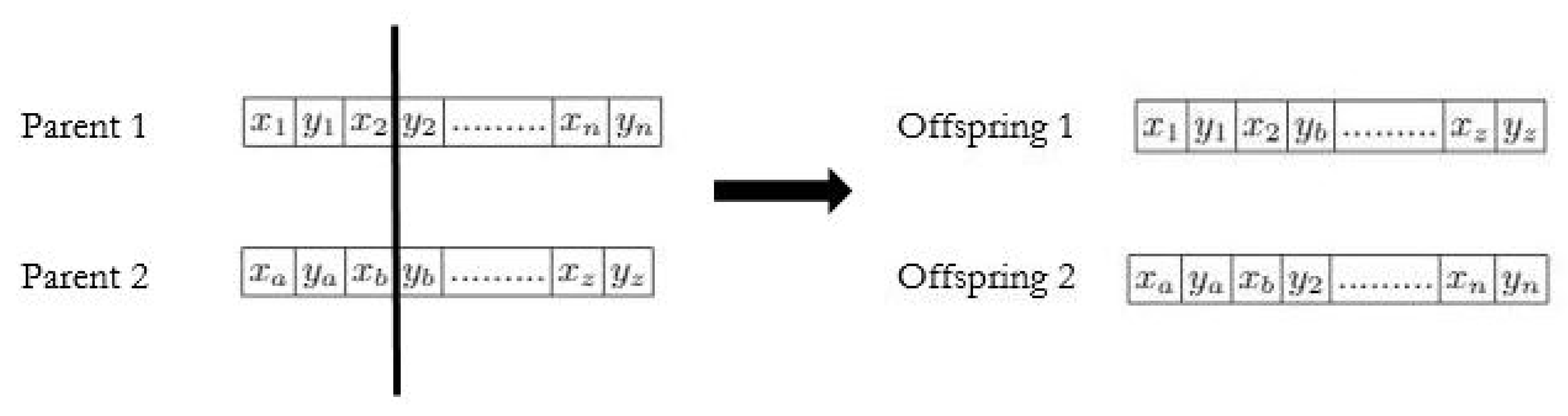
After the selection operation, the crossover is applied on the randomly chosen two parent chromosomes from the current population to produce new child chromosomes. There are various types of crossover such as single-point, two-point, k-point, uniform, partially matched, order, precedence preserving crossover, shuffle, reduced surrogate, and cycle [21,31]. In our case, we use a single-point crossover. A random crossing point is selected, and the genetic information of two parents beyond that point will be swapped with each other. Figure 5 shows the genetic information after swapping.
Figure 5. Single point crossover.

4.2.3. Mutation

The mutation is an operator that maintains the genetic diversity from one population to the next population. The well-known mutation operators are displacement, simple inversion, and scramble mutation [31].

4.2.4. Evaluation Function

The fitness value of a chromosome represents its level of quality based on the objectives. In the proposed work, the objective is to place the sensors within the area of interest to guarantee the maximum coverage inside the area of interest, the minimum outside the area, and maintain full connectivity between the sensors. The fitness function, to be maximized, was defined as the exact percentage of area covered within the area of interest.
We build the fitness function depending on the following parameters described as follows.
  • Guarantee the maximum coverage inside the area of interest. Therefore, first objective will be as follows:
    Objective 1:
    M a x i m i z e Z 1 = i = 1 N j M Z i j M i n i m i z e Z 1 = i = 1 N j M ( 1 Z i j )
  • Have the least coverage outside.
    Objective 2:
    M i n i m i z e Z 2 = i = 1 N j M Z i j
  • Under the connectivity constraint as shown in Equations (7) and (8).
To implement Equations (9) and (10), we estimate the area covered by treating each sensor node as an image and provide a way first to delineate the area of interest and then calculate the exact coverage. We simulate a two-dimensional area as a background with a number of 0. This area is the smallest possible area encompassing our area of interest where the sensors should be deployed. The 0 number is determined by the resolution initially chosen. For instance, an area of 10 × 20 with a resolution of 0.5 will provide a 20 × 40 array of 0 s in the matrix. The size of the circle materialized by the sensor is related to the radius defined in the chromosome. Each chromosome gives the x and y axes of the location of the circles in the defined rectangular area. The coordinates x and y are for the first generation created randomly. They then vary with each generation to obtain the best possible locations. Each time a sensor is placed, the circle formed by this sensor is automatically filled with 1. If the sensors overlap, the 1 is written and counted only once. This ensures that accurate coverage is found. If sensors or parts of sensors are deployed outside the area of interest, the 1 s that are outside are not counted. Finally, the program counts the number of 1 s inside the area of interest. The coverage rate is the ratio of 1 s to the initial number of 0 s. The Algorithm 2 summarizes how the final result is reached.
Algorithm 2: Coverage function
1:
Simulation of a two-dimensional background S with a number of 0;
2:
Counts the number of 0 inside S;
3:
s n u m b e r o f 0 ;
4:
Circular stamp is the square of 0 which is entirely filled by the circle formed by 1;
5:
The coordinates x and y of the position of the circles inside A are given by each chromosome;
6:
Put the center of a stamp on the position of defined circles in the chromosome;
7:
Count the number of 1 inside A;
8:
if Overlap between circle then
9:
    Count once 1 in the overlapped area;
10:
else
11:
    Count number of 1;
12:
end if
13:
if Circle goes outside of A then
14:
    Count only the one that are inside;
15:
else
16:
    Count number of 1;
17:
     b n u m b e r o f 1 ;
18:
end if
19:
C o v e r a g e = b / s × 100 ;
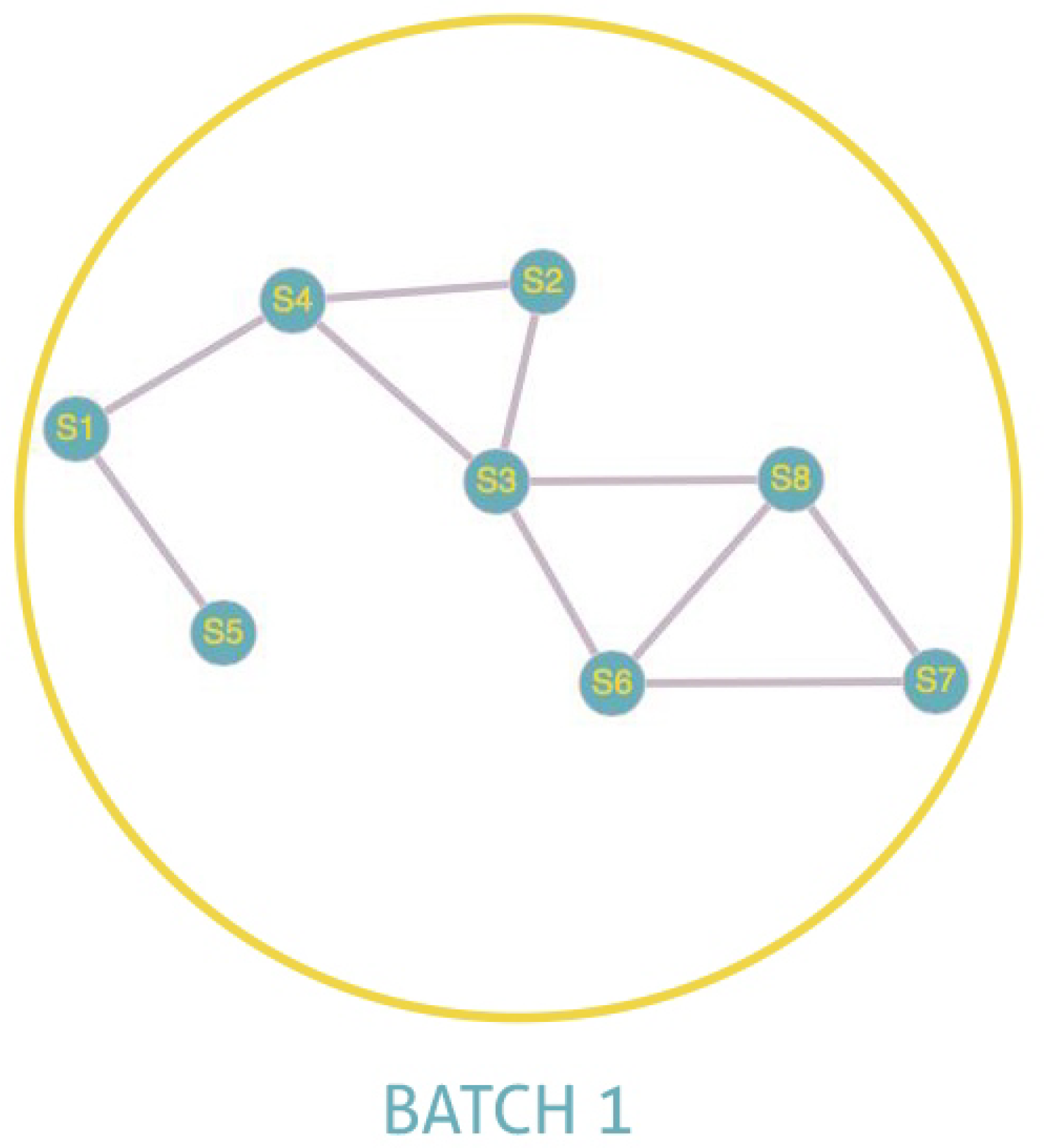
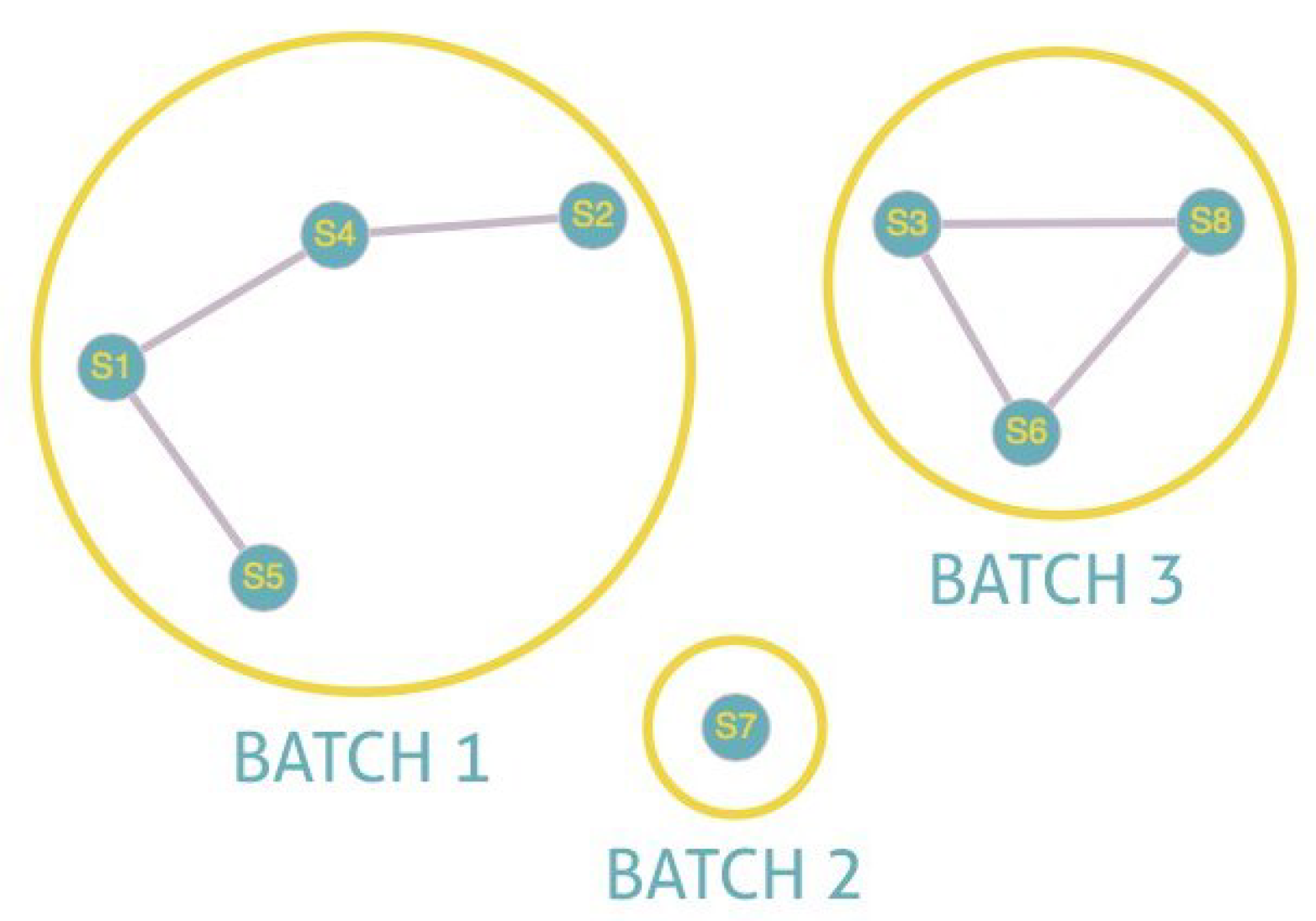
To establish and respect the connectivity constraint, as present in Equation (7), we proceed as follows: with respect to each solution, there are pairs of [ x i , y i ] f o r i = 1 , . . . , N and a unique radius r. [ x i , y i ] is the location of the ith sensor deployed. We consider the points x i as the set of vertices of a graph named G. Then we generate a square matrix of size N × N called C. The matrix C is considered as the adjacency matrix of the graph G. c i j is equal to 1 if the distance between the position [ x i , y i ] and the position [ x j , y j ] is less than or equal to the value r, and 0, otherwise. We now look for the connected components of the graph G. A connected component is a group of sensors that are connected to each other. Each connected component is put into a variable as a batch, and each batch is assigned a number. This number indicates to which component each node of the graph belongs. If the batches have only one number for all nodes, it means that G has only one connected component and that all sensors are connected to each other so that G is fully connected.
Figure 6 and Figure 7 illustrate the explanation given above. In these illustrations, we will consider that two sensors are connected if there is a link between them and not connected otherwise. In Figure 6, we note that S 5 , S 1 , S 4 , and S 2 are connected between them. The same is true for S 6 , S 3 , and S 8 . S 7 , being alone, is by default connected to itself. The program, therefore, creates three batches with a number for each batch. All the nodes belonging to batch one will have the number 1 and so on. The existence of more than one batch, and therefore of several numbers, means that the graph is not fully connected. Indeed we have three connected components for Figure 6. On the other hand, in the case of total connectivity, as illustrated in Figure 7, the program will put all the sensors in the same batch. As there is only one batch number and therefore only one connected component, we can deduce that the graph is fully connected.
Figure 6. Unfully connected.
Figure 7. Fully connected.

5. Experimental Results and Discussions

5.1. Experimental Results

We performed experiments on the proposed algorithm using MATLAB x64 on a system with Core (TM) i7, 3.6 GHz, 8 GRAM, Windows 10 as a platform. A code was developed to implement the algorithm, and selected simulation cases have been executed to demonstrate the efficiency of the proposal. The algorithm automatically runs several times, changing the radius of the sensors or not and calculating the corresponding coverage inside the area of interest with the connectivity constraint. In the end, the algorithm chooses the best result. We have performed several simulations in several cases that show the algorithm’s effectiveness in both deploying and maintaining connectivity. All cases are based on actual maps of cities or parts of cities taken from Google Maps. For the cases illustrated and detailed below, we use the parameters shown in Table 1.
Table 1. Simulation parameters.
  • Case 1:
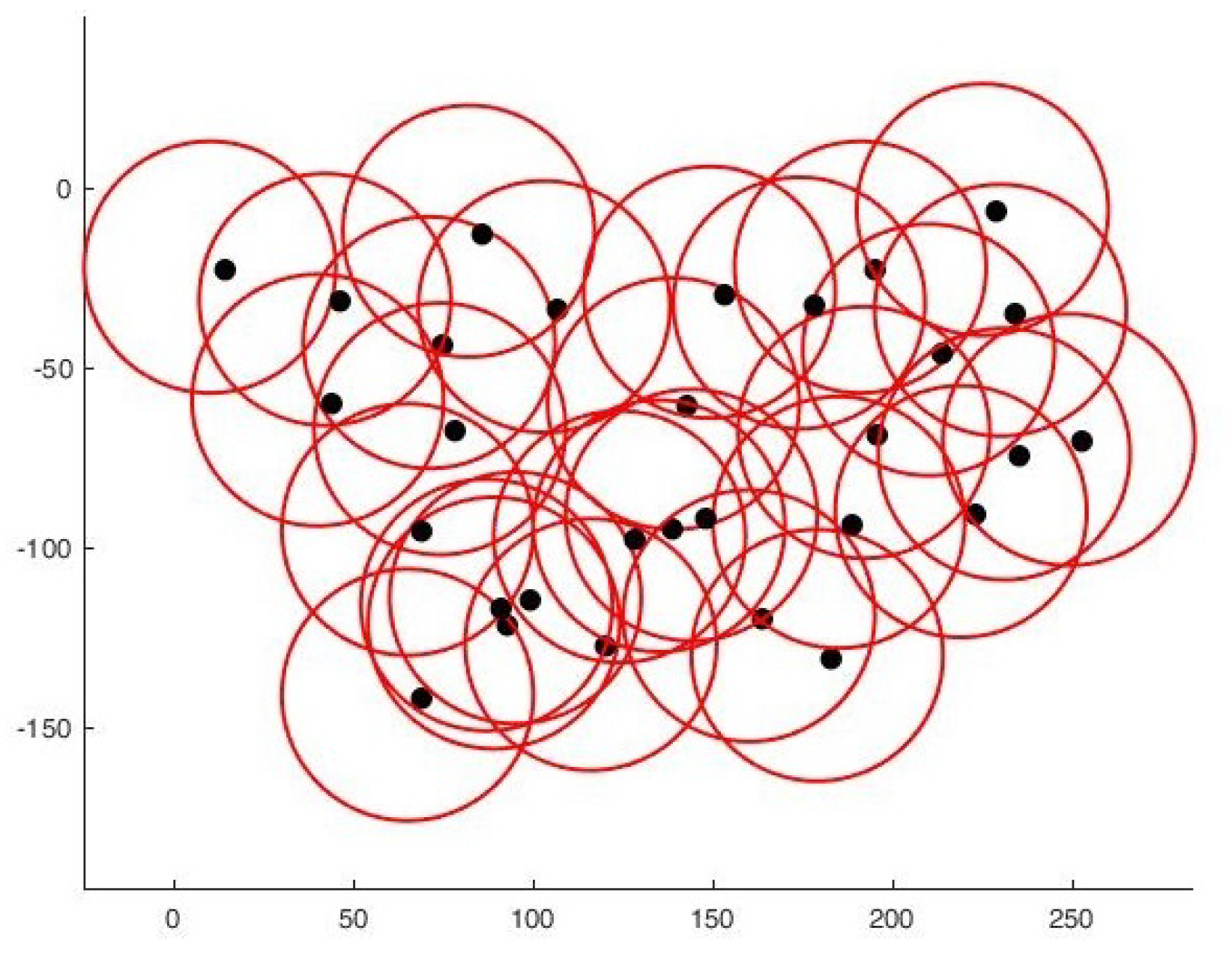
    For the first tests, we deploy sensors on a regularly shaped area of dimensions L × l . The objectives remain unchanged. At the beginning of the test, we have an initial and random deployment of the sensors. At every iteration, the location of the sensors is displayed, and at the end, the best population and the final position of sensors (Figure 8) are given, based on the fitness value and the connectivity constraint. Figure 9 shows the sensor connectivity scheme.
    Figure 8. Final deployment.
    Figure 9. Sensors connectivity scheme.
  • Case 2:
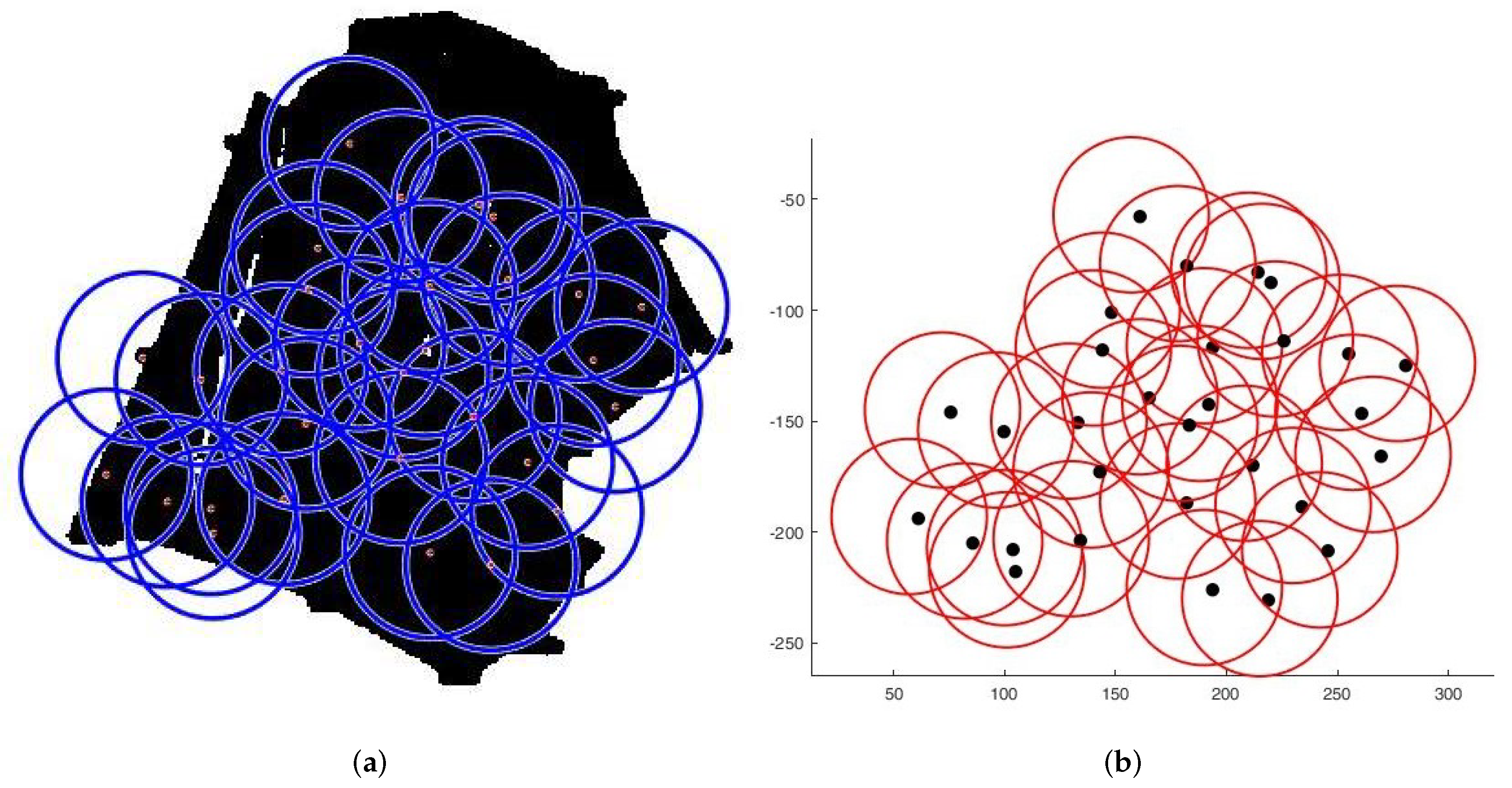
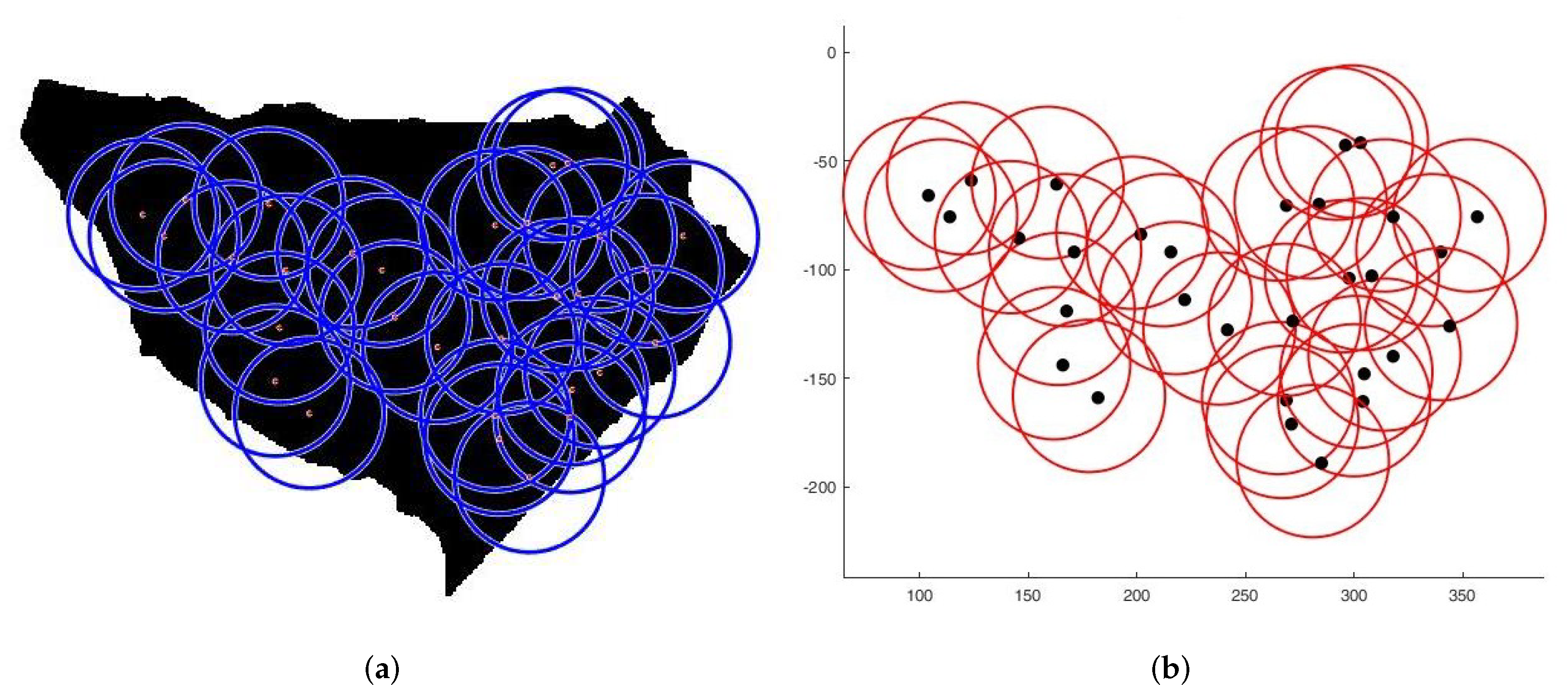
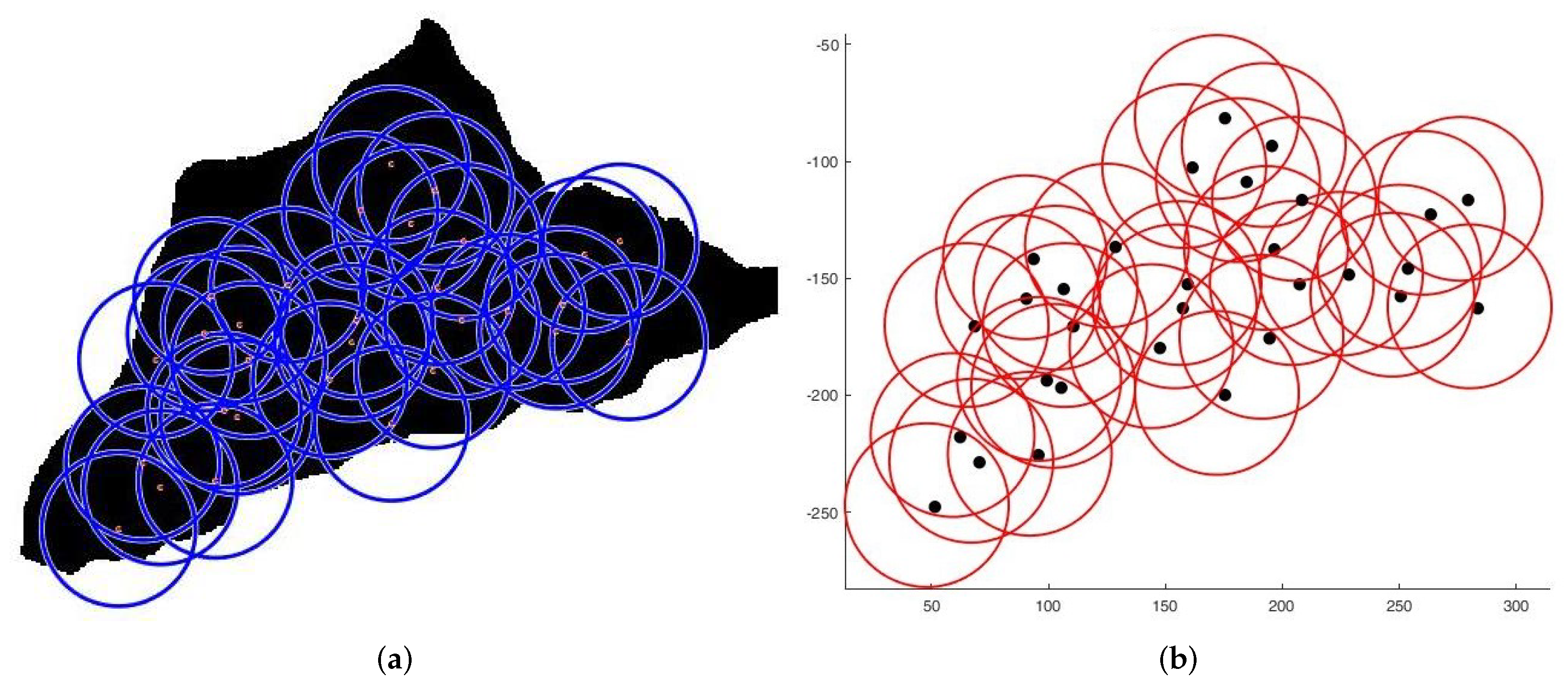
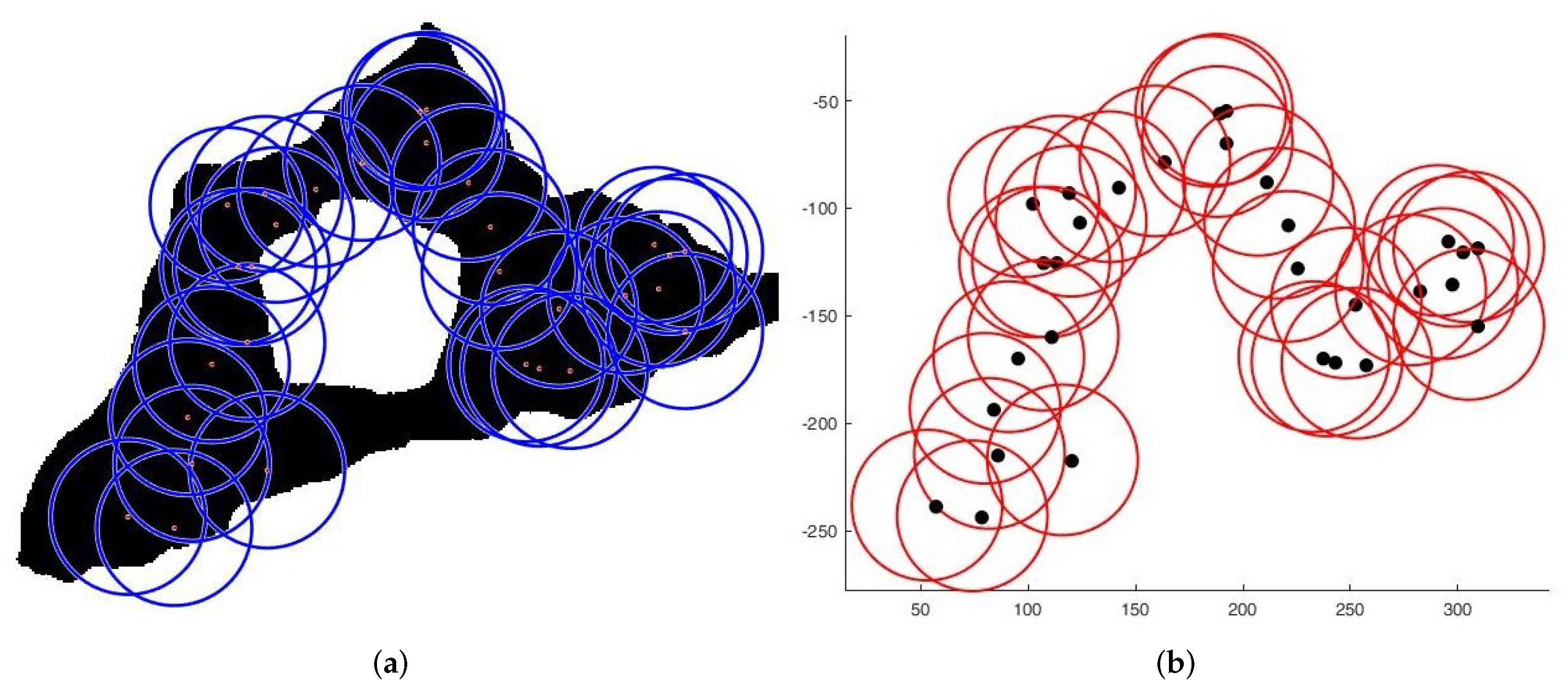
    For the second test, we deploy sensors on three irregularly shaped areas, keeping the same objectives. Figure 10, Figure 11 and Figure 12 show the final position of the sensors and the sensor connectivity scheme corresponding in each case.
    Figure 10. Deployment on first area. (a) Final positioning. (b) Connectivity scheme.
    Figure 11. Deployment on second area. (a) Final positioning. (b) Connectivity scheme.
    Figure 12. Deployment on third area. (a) Final positioning. (b) Connectivity scheme.
  • Case 3:
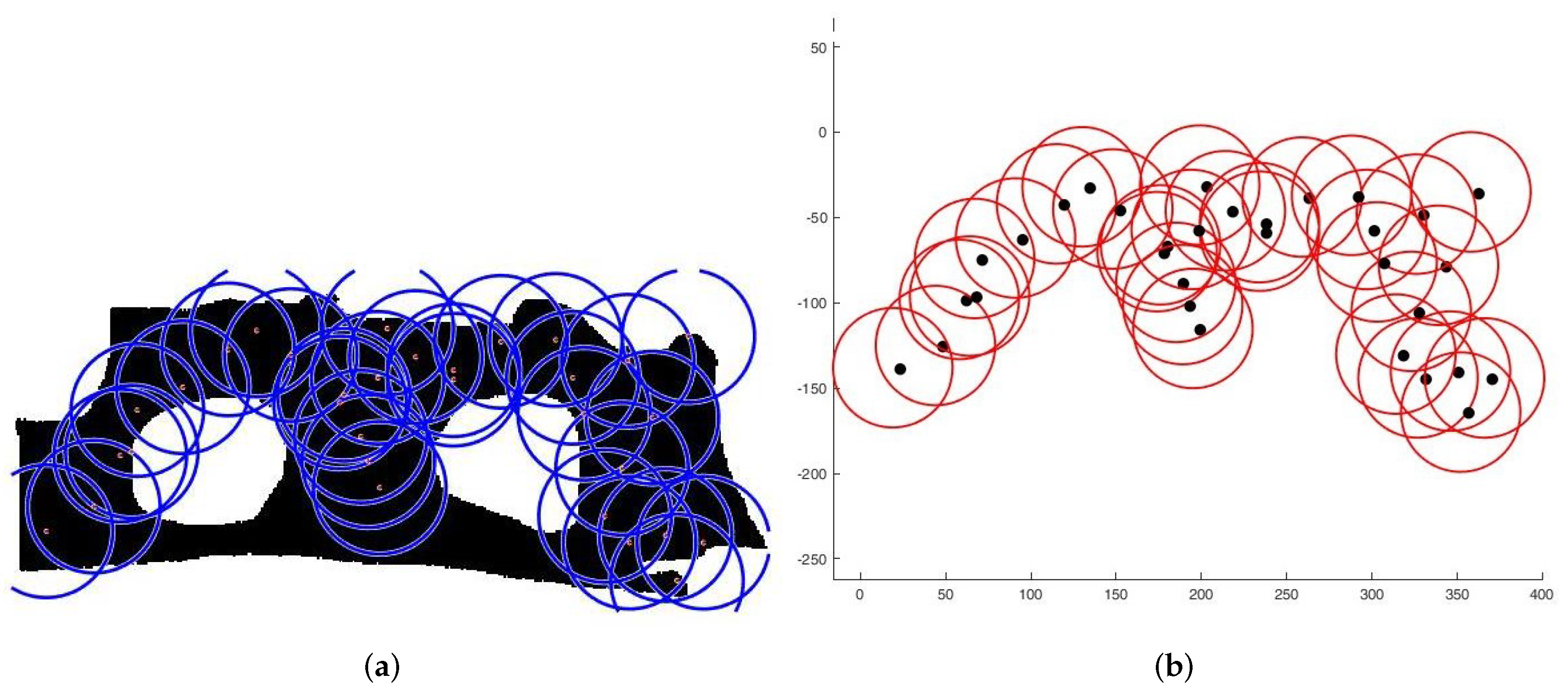
    For the third set of tests, we create an area of "no interest" on the map using the last deployment area. The goal here is to deploy sensors while maintaining the previously stated objectives. To illustrate, in the case of deployment in a city, it would be useless to deploy sensors in a lake or an area empty of houses. Figure 13 and Figure 14 show the final position of the sensors in each case and the sensor connectivity scheme corresponding to each final positioning.
    Figure 13. Deployment with one “no interest” area. (a) Final positioning. (b) Connectivity scheme.
    Figure 14. Deployment with two “no interest” area. (a) Final positioning. (b) Connectivity scheme.

5.2. Discussion

In order to evaluate the performance of the proposal, an extensive simulation is performed considering many different network scenarios as described in the previous section. All scenarios considered represent actual maps and are simulated with a grid-based detection field of at least 300 × 300 . In all network scenarios, sensor nodes are randomly placed in the area during the first deployment. In our simulation, we took an initial population of 150 chromosomes. However, there are no universal rules for defining the population size. The end criterion is taken as the maximum number of iterations which in our case is 400. However, we observe that the algorithm converges before reaching the maximum number of iterations. The detection and communication range of the sensor nodes is identical, as specified above, and is equal to 35 m. The simulations are performed 30 times for each scenario, and the average result is considered.
First, we show the relationship between the coverage rate and the number of sensors in Table 2 below. As connectivity is always acquired, it remains constant with radius. Therefore, in this table, two variables come into play for the same radius, namely the coverage rate and the rate coverage out of the area of interest.
Table 2. Coverage percentage.
By varying the number of sensors, we observe the percentage of coverage inside the area of interest and the percentage of coverage outside. As connectivity is always acquired, it remains constant with radius. By combining these values, we notice that the variation of the percentage of coverage when we go from 40 sensors to 60 or from 60 to 80 is not significant (1.7%). The right compromise in terms of nodes and coverage is between [40–60–80].
Then, we ran several test instances varying the population size and the number of iterations and then considered the average of the results. By varying the population size in the tests, we can see that we achieve almost 99% coverage with a population size of 50. We then varied the number of iterations and noted that we achieved convergence with a coverage rate above 98% for 200 iterations.
We also provide a time performance of the algorithm using the parameters in Table 1. We vary the number of generations and we observe the time taken by the algorithm to propose a first good solution, which for us comes down to a first connected deployment. We note this duration DFGS (duration for first good solution). Then, we observe the total time taken to go through all the generations. The unit of time is the second and the results are presented in Table 3.
Table 3. Simulation time.
We observe that at 20 generations, it takes only 8 s for the algorithm to propose a first good solution to the third generation and 48 s to go through the 20 generations by improving the proposals. At 40 generations, it takes 31 s for the first good solution to the 13th generation and 105 s in all. At 80 generations, it takes 100 s for the first good solution to the 37th generation and 213 s in all. At 160 generations, it takes 105 s for a first good solution at the 41st generation and 420 in all. At 320 generations, it takes 89 s for a first good solution to the 34th generation and 840 s in all. Finally, at 640 generations, it takes 34 s for the first good solution to the 14th generation and 1800 s in all.
Finally, we compare our proposal with [22] one of the recent papers working on area coverage and connectivity. As these authors deal with the area coverage problem, excluding or minimizing overlaps, a strict comparison is difficult. Secondly, to the best of our knowledge, none of the authors encountered in the literature treat the problem from any other angle than regular forms. However, by comparing with [22], and based on the results provided by the authors; we can see that our proposal provides a better solution in terms of coverage/area covered ratio. Indeed, for an area of 100 × 100 , they reach 97.25% of coverage with a number of sensors between 30 and 50, while for a larger area, we go beyond this percentage with as many sensors. Table 4 summarizes a brief comparison made between the two works and Figure 15 shows the results we obtained in terms of deployment and connectivity scheme by using their parameters.
Table 4. Comparison parameters.
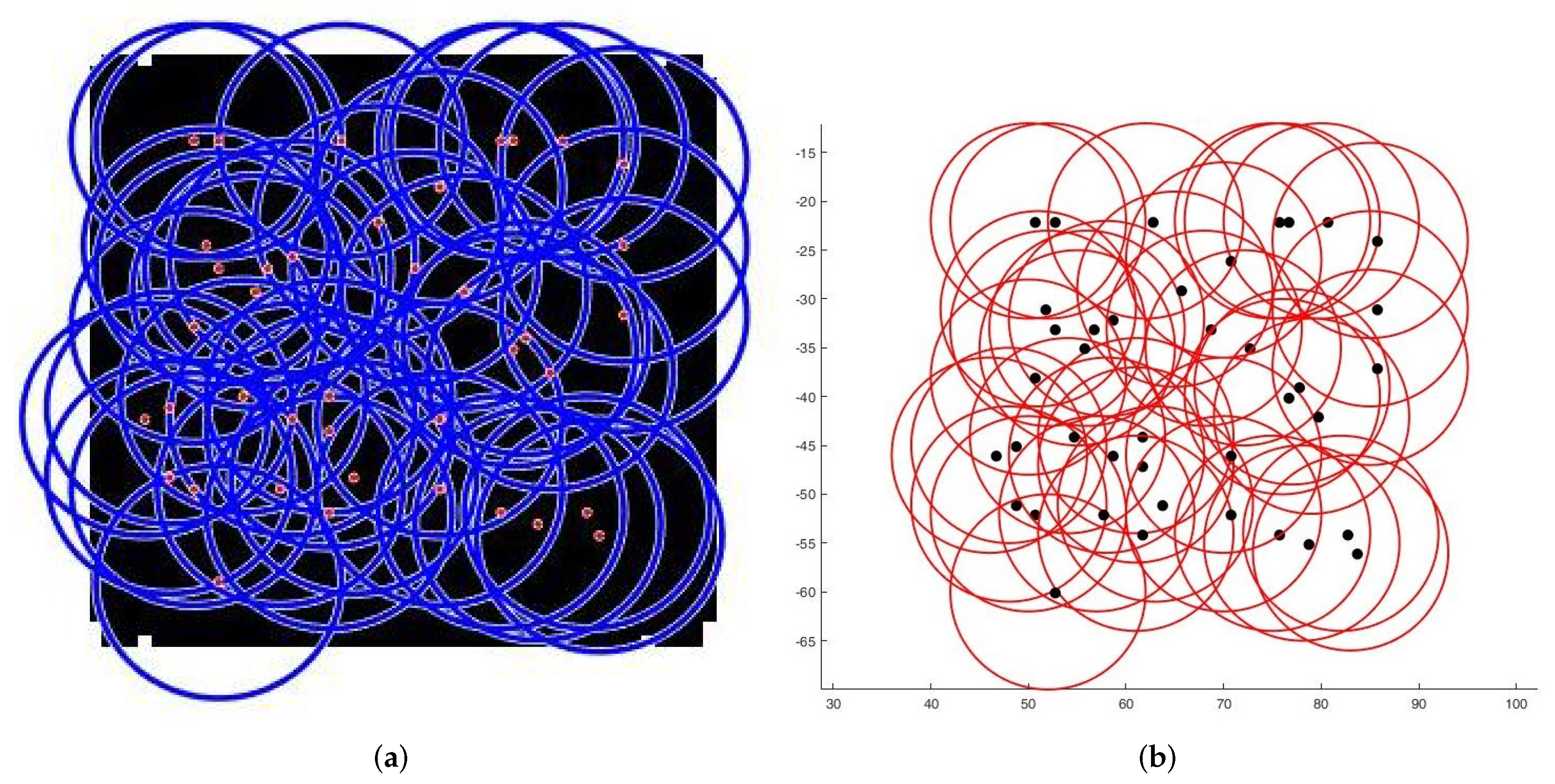
Figure 15. Deployment on a 100 × 100 square. (a) Final positioning. (b) Connectivity scheme.

6. Conclusions

This paper proposed a GA-based scheme to find the best positions for sensor node placement in wireless sensor networks, respecting the coverage and connectivity between the sensor nodes. The need for such a method has been demonstrated when an entire area is of interest in a study. We first presented the linear programming formulation of the problem. We then explained the representation of our chromosomes, selection, crossover, mutation, and finally, the derivation of the fitness function through the algorithm based on the calculation of the percentage of coverage and the one based on the connectivity between sensors. Our proposal has been extensively simulated by varying the number of test cases and using several scenarios. Unlike the other methods presented in the literature review, ours is placed in an actual deployment situation and considers the overlap between one or more sensors to compute and give the exact maximum coverage rate, focusing on the areas of interest while maintaining full connectivity. Several tests have been performed on areas of different shapes, ranging from regular to irregular. These tests show that we can achieve a coverage rate of up to 95%. The results show that the algorithm is efficient and that the proposed approach satisfies the desired objectives.
The proposal has a wide range of applications in smart cities, for example. However, in this paper we have not addressed the issue of the connectivity disruption or energy efficiency in our deployment. In our future work, we will develop an even more efficient scheme that will consider the connectivity disruption, energy, redundancy, and finally, the routing of the detected data.

Author Contributions

F.T., W.A., K.A., E.C.E. and P.G. conceived and worked together to achieve this work; F.T., W.A., K.A. and P.G. discussed the method and the derivation process of the theory analysis; F.T., W.A. and K.A. compiled the simulation program by Matlab and analyzed the results; F.T. wrote the original draft. All authors have read and agreed to the published version of the manuscript.

Funding

This research received no external funding.

Institutional Review Board Statement

Not applicable.

Data Availability Statement

Not applicable.

Conflicts of Interest

The authors declare no conflict of interest.

References

  1. Ali, A.; Ming, Y.; Chakraborty, S.; Iram, S. A Comprehensive Survey on Real-Time Applications of WSN. Future Internet 2017, 9, 77. [Google Scholar] [CrossRef] [Green Version]
  2. Di Mento, J.M. Beyond the Water’s Edge: United States National Security and the Ocean Environment; Fletcher School of Law and Diplomacy (Tufts University): Medford, MA, USA, 2007; p. 3262885. [Google Scholar]
  3. Hanh, N.T.; Binh, H.T.T.; Hoai, N.X.; Palaniswami, M.S. An efficient genetic algorithm for maximizing area coverage in wireless sensor networks. Inf. Sci. 2019, 488, 58–75. [Google Scholar] [CrossRef]
  4. Haseeb, K.; Ud Din, I.; Al-Mogren, A.; Islam, N. An Energy Efficient and Secure IoT-based WSN Framework: An application to Smart Agriculture. Sensors 2020, 20, 2081. [Google Scholar] [CrossRef]
  5. Silva, B.N.; Khan, M.; Han, K. Towards sustainable smart cities: A review of trends, architectures, components, and open challenges in smart cities. Sustain. Cities Soc. 2018, 38, 697–713. [Google Scholar] [CrossRef]
  6. Khoufi, I.; Minet, P.; Laouiti, A.; Mahfoudh, S. Survey of Deployment Algorithms in Wireless Sensor Networks: Coverage and Connectivity Issues and Challenges. Int. J. Auton. Adapt. Commun. Syst. 2017, 10, 341–390. [Google Scholar] [CrossRef]
  7. Rashid, B.; Rehmani, M.H. Applications of wireless sensor networks for urban areas: A survey. J. Netw. Comput. Appl. 2016, 60, 192–219. [Google Scholar] [CrossRef]
  8. Wang, B. Coverage Problems in Sensor Networks: A Survey. ACM Comput. Surv. 2011, 43, 1–53. [Google Scholar] [CrossRef]
  9. Lloret, J.; Sendra, S.; Garcia, L.; Jimenez, J.M. A Wireless Sensor Network Deployment for Soil Moisture Monitoring in Precision Agriculture. Sensors 2021, 21, 7243. [Google Scholar] [CrossRef]
  10. Catelani, M.; Ciani, L.; Bartolini, A.; Del Rio, C.; Guidi, G.; Patrizi, G. Reliability Analysis of Wireless Sensor Network for Smart Farming Applications. Sensors 2021, 21, 7683. [Google Scholar] [CrossRef]
  11. Fariba, A.; Jafari, N.N. Deployment Strategies in the Wireless Sensor Networks: Systematic Literature Review, Classification, and Current Trends. Wirel. Pers. Commun. 2017, 95, 819–846. [Google Scholar] [CrossRef]
  12. Anju, S.; Pal, S.R. Survey on Coverage Problems in Wireless Sensor Networks. Wirel. Pers. Commun. 2015, 80, 1475–1500. [Google Scholar] [CrossRef]
  13. Devi, G.; Bal, R.S. Node Deployment Coverage in Large Wireless Sensor Networks. J. Netw. Commun. Emerg. Technol. (JNCET) 2016, 6, 77–84. [Google Scholar]
  14. Amin, B.M.; M’hammed, S.; David, B.; Louis, A.; El-Hami, A.; Belahcene, M. Multi-Objective WSN Deployment Using Genetic Algorithms Under Cost, Coverage, and Connectivity Constraints. Wirel. Pers. Commun. 2017, 94, 2739–2768. [Google Scholar] [CrossRef]
  15. Farsi, M.; Elhosseini, M.A.; Badawy, M.; Arafat Ali, H.; Zain Eldin, H. Deployment Techniques in Wireless Sensor Networks, Coverage and Connectivity: A Survey. IEEE Access 2019, 7, 28940–28954. [Google Scholar] [CrossRef]
  16. Orick, G.L.; Stephenson, K.; Collins, C. A linearized circle packing algorithm. Comput. Geom. 2017, 64, 13–29. [Google Scholar] [CrossRef] [Green Version]
  17. Litvinchev, I.; Infante, L.; Ozuna, L. Packing circular-like objects in a rectangular container. J. Comput. Syst. Sci. Int. 2015, 54, 259–267. [Google Scholar] [CrossRef]
  18. Yoon, Y.; Kim, Y. An Efficient Genetic Algorithm for Maximum Coverage Deployment in Wireless Sensor Networks. IEEE Trans. Cybern. 2013, 43, 1473–1483. [Google Scholar] [CrossRef]
  19. Ha, L.D.T.; Binh, N.T.; Nghia, H.T.T.; Duc, N. An Improved Genetic Algorithm for Maximizing Area Coverage in Wireless Sensor Networks. In Proceedings of the Sixth International Symposium on Information and Communication Technology, SoICT 2015, Hue, Vietnam, 3–4 December 2015; Association for Computing Machinery: New York, NY, USA, 2015; pp. 61–66. [Google Scholar] [CrossRef]
  20. Gupta, S.K.; Kuila, P.; Jana, P.K. Genetic algorithm approach for k-coverage and m-connected node placement in target based wireless sensor networks. Comput. Electr. Eng. 2016, 56, 544–556. [Google Scholar] [CrossRef]
  21. Subash, H.; Pratyay, K. Coverage and connectivity aware energy efficient scheduling in target based wireless sensor networks: An improved genetic algorithm based approach. Wirel. Netw. 2019, 15, 1995–2011. [Google Scholar] [CrossRef]
  22. Hanaa, Z.; Mahmoud, B.; Mostafa, E.; Hesham, A.; Ajith, A. An improved dynamic deployment technique based-on genetic algorithm (IDDT-GA) for maximizing coverage in wireless sensor networks. J. Ambient. Intell. Humaniz. Comput. 2020, 11, 4177–4194. [Google Scholar]
  23. Njoya, A.N.; Ari, A.A.A.; Awa, M.N.; Titouna, C.; Labraoui, N.; Effa, J.Y.; Abdou, W.; Gueroui, A. Hybrid Wireless Sensors Deployment Scheme with Connectivity and Coverage Maintaining in Wireless Sensor Networks. Wirel. Pers. Commun. 2020, 56, 544–556. [Google Scholar] [CrossRef]
  24. Akusta Dagdeviren, Z.; Akram, V. Connectivity Estimation Approaches for Internet of Things-EnabledWireless Sensor Networks. In Emerging Trends in IoT and Integration with Data Science, Cloud Computing, and Big Data Analytics; Taser, P.Y., Ed.; IGI Global: Hershey, PA, USA, 2022; Chapter 6; pp. 104–122. [Google Scholar] [CrossRef]
  25. Khalilpour Akram, V.; Akusta Dagdeviren, Z.; Dagdeviren, O.; Challenger, M. PINC: Pickup Non-Critical Node Based k-Connectivity Restoration in Wireless Sensor Networks. Sensors 2021, 21, 6418. [Google Scholar] [CrossRef] [PubMed]
  26. Zorlu, O.; Sahingoz, O.K. Increasing the coverage of homogeneous wireless sensor network by genetic algorithm based deployment. In Proceedings of the 2016 Sixth International Conference on Digital Information and Communication Technology and its Applications (DICTAP), Konya, Turkey, 21–23 July 2016; pp. 109–114. [Google Scholar] [CrossRef]
  27. Njoya, A.N.; Abdou, W.; Dipanda, A.; Tonye, E. Evolutionary-Based Wireless Sensor Deployment for Target Coverage. In Proceedings of the 2015 11th International Conference on Signal-Image Technology Internet-Based Systems (SITIS), Bangkok, Thailand, 23–27 November 2015; pp. 739–745. [Google Scholar] [CrossRef]
  28. Tossa, F.; Abdou, W.; Ezin, E.C.; Gouton, P. Improving Coverage Area in Sensor Deployment Using Genetic Algorithm. In Proceedings of the Computational Science—ICCS 2020, Amsterdam, The Netherlands, 3–5 June 2020; Krzhizhanovskaya, V.V., Závodszky, G., Lees, M.H., Dongarra, J.J., Sloot, P.M.A., Brissos, S., Teixeira, J., Eds.; Springer International Publishing: Cham, Switzerland, 2020; pp. 398–408. [Google Scholar]
  29. Padula, S.L.; Kinkaid, R.K. Optimization Strategies for Sensor and Actuator Placement; Nasa Langley Research Center: Hampton, VA, USA, 1999. [Google Scholar]
  30. Holland, J.H. Adaptation in Natural and Artificial Systems; University of Michigan Press: Ann Arbor, MI, USA, 1975. [Google Scholar]
  31. Katoch, S.; Chauhan, S.S.; Kumar, V. A review on genetic algorithm: Past, present, and future. Multimed. Tools Appl. 2021, 80, 8091–8126. [Google Scholar] [CrossRef] [PubMed]
Publisher’s Note: MDPI stays neutral with regard to jurisdictional claims in published maps and institutional affiliations.

Article Metrics

Citations

Article Access Statistics

Multiple requests from the same IP address are counted as one view.