Abstract
Software-defined network (SDN) and vehicular ad-hoc network (VANET) combined provided a software-defined vehicular network (SDVN). To increase the quality of service (QoS) of vehicle communication and to make the overall process efficient, researchers are working on VANET communication systems. Current research work has made many strides, but due to the following limitations, it needs further investigation and research: Cloud computing is used for messages/tasks execution instead of fog computing, which increases response time. Furthermore, a fault tolerance mechanism is used to reduce the tasks/messages failure ratio. We proposed QoS aware and fault tolerance-based software-defined V vehicular networks using Cloud-fog computing (QAFT-SDVN) to address the above issues. We provided heuristic algorithms to solve the above limitations. The proposed model gets vehicle messages through SDN nodes which are placed on fog nodes. SDN controllers receive messages from nearby SDN units and prioritize the messages in two different ways. One is the message nature way, while the other one is deadline and size way of messages prioritization. SDN controller categorized in safety and non-safety messages and forward to the destination. After sending messages to their destination, we check their acknowledgment; if the destination receives the messages, then no action is taken; otherwise, we use a fault tolerance mechanism. We send the messages again. The proposed model is implemented in CloudSIm and iFogSim, and compared with the latest models. The results show that our proposed model decreased response time by 50% of the safety and non-safety messages by using fog nodes for the SDN controller. Furthermore, we reduced the execution time of the safety and non-safety messages by up to 4%. Similarly, compared with the latest model, we reduced the task failure ratio by 20%, 15%, 23.3%, and 22.5%.
1. Introduction
The recent development of information communication technology (ICT), vehicular networks (VN), and their communication systems has attracted researchers’ attentions. The advanced communication system of vehicles is especially used for efficient road traffic and safety. The vehicular ad-hoc network (VANET) mainly consists of three communication types as vehicle to vehicle (V2V), vehicle to road (V2R), and vehicle to infrastructure (V2I) [1]. The communication techniques that are used by VANET are the dedicated short-range communication (DSRC) method and wireless access in vehicular environments (WAVE). Current research work is in progress on designing or developing more efficient communication techniques. However, VANET communication faces several difficulties: scalability, flexibility, security, and less programmability [2]. To overcome the above challenges, researchers developed a new paradigm known as software-defined networking (SDN). The said technology is used to separate control plan from data plan and provide programmability to the communication system of VANET. Due to SDN, the dynamic communication of messages is activated, and the overall system becomes more attractive as required by the public [3]. The above technology provides a decent Application programming interface (APIs) and provides new facilities and business interpretations. SDN is unique, flexible, programmable, and centralized dynamic control of communication. Due to the several pros of SDN, researchers combined SDN and VANET for better communication among vehicles, which is known as a software defined vehicular network (SDVN) [4,5]. To make the communications systems of vehicles on the road, SDVN plays a vital role. Most of the time, when there is less traffic and movement on roads, then there is also the problem of unwanted acts like theft, security, etc.; so, in this case, the message of the vehicle must reach the monitoring cells (i.e., the police) [6]. If, in such cases, vehicle messages fail, then the tourists/passengers may be in danger.
The data generated by SDVN are stored on the cloud for further processing and storage. Cloud computing is defined as “a model for enabling ubiquitous, convenient, on-demand network access to a shared pool of configurable computing resources (e.g., networks, servers, storage, applications, and services) that can be rapidly provisioned and released with minimal management effort or service provider interaction. This cloud model comprises five essential characteristics, three service models, and four deployment models” [7]. We need to use fog computing to reduce response time to store and execute SDVN vehicles’ data. Fog computing minimizes delay, and the servers are placed to nearby edges for the users. Fog computing is defined as “a geographically distributed computing architecture with a resource pool consists of one or more ubiquitously connected heterogeneous devices (including edge devices) at the edge of the network and not exclusively seamlessly backed by cloud services, to collaboratively provide elastic computation, storage and communication (and many other new services and tasks) in isolated environments to a large scale of clients in proximity” [8]. Current models of SDVN performed well, but they are using the cloud for execution and storage, which will increase the response time of critical/priority-based tasks. Furthermore, the main challenge is fault tolerance, as if priority/critical-based tasks fail but the sender is not aware of it, it will create problems for other vehicles in the attached area.
Contributions
- A new architecture is proposed based on SDVN; fog nodes are used instead of cloud computing to reduce response time.
- Response time is considered in the proposed model, which is an important QoS parameter of the vehicles messages/tasks/data.
- Fault-tolerance-based architecture is provided to reduce tasks/messages failure ratio.
- Message priority is calculated based on the nature of messages instead of deadline and size, as several highest/critical messages have more size, but its nature remains critical/urgent.
2. Literature Review
In this section, detailed literature is provided about the proposed model. The literature is divided into VANET models, SDN-based models, SDVN-based models, and scheduling SDVN models, as shown in Table 1.
Table 1.
Literature review models with comparison.
Table 1 models are further explained in detail in the following subpart of the paper:
2.1. VANET Models
An intelligent transportation system (ITS) is an advanced communication system amongst vehicles on the roadside to exchange information. Its advanced type is VANET, which can connect thousands of wireless nodes (Vehicles). VANET is an advanced type of ad-hoc network, which is used by ITS currently. In [3], the author proposed the VANET architecture-based mobile ad-hoc network (MANET). The proposed model is used for vehicles by using wireless technology to decrease energy consumption while using dynamic topology. Similarly, in [9], the author proposed safety and non-safety-based VANET architecture. In the proposed model, the author sent safety messages first and then non-safety messages to increase QoS. In VANET, vehicles are directly connected to share necessary information.
2.2. SDN-Based Models
According to [2], SDN is more efficient than traditional networks, as the SDN data plane is separate from the control plane. In SDN, the centralized controller can view the complete network and manage network traffic efficiently compared to traditional networks. Similarly, in [10], the author proposed the Roadside Unit (RSU)-based SDN model, in which they used CR technology to transmit the vehicle information by using the 5G networking model. In [11], the author proposed the Software-Defined Network Edge (SDNE) model. The proposed model provided network services to the edge of networking devices to reduce communication delay and respond quickly. They provided a three-tier architecture that performs very well in terms of response time and energy consumption.
2.3. SDVN-Based Models
SDVN is based on SDN and VANET architectures. SDVN is not fully centralized, as it is partially centralized and has hierarchical architecture. In [5], the author proposed a topology-based routing protocol for SDVN. The proposed model is used for vehicle dynamic path selection for communication among other vehicles in real time. They used predicated topologies to maintain routing tables and paths. They used two communications models such as uni-cast for communication and geo-cast for data dissemination. The proposed SDVN model performed well in terms of communication and dissemination of information. Similarly, in [12], the authors proposed and placed dynamic controllers in the edges of SDVN architecture. The proposed model performed well in road traffic. The proposed model reduced network changes as compared with the available network models. In [13], the authors proposed multi-access edge computing (MEC) for vehicles. They used two communication models: information/messages receiving, while the other is for messages forwarding to the connected vehicles. Model one is used for information forwarding to V2V and V2I. The second model is used for updating information and forwarding information using the Open-Flow protocol. The proposed model consists of four layers and reduces the latency of communication messages, and improves the routing path. In [14], the author proposed a prototype-based SDVN architecture in which the author examined backbone real hardware that consists of Open-Flow switches. In [15], the proposed RTISAR model reduces delay and packet loss, and makes overall communication from source to destination. In [16], the author proposed an application layer for VANET vehicles to reduce communication delay and manage massive traffic in ruler and urban areas.
2.4. Scheduling SDVN Models
Scheduling is the process of allocating tasks/messages for communication to take place in order. As the local SDN control receives multiple messages, such scheduling mechanisms must manage and send messages based on priority. In some cases, we need to send essential data earlier than the already received messages for transmission, so in this situation, we need such scheduling that gives proper priority to messages and then transmits it based on the attached priorities. In [17], the author proposed the Unmanned Aerial Vehicle (UAV) model. The proposed model is infrastructure-less and based on SDN technology. The author provided a theoretical offloading mechanism in which they offload data based on different levels of zones. Emergency zone data are sent first, then the other zone data, and so on. The main aspect of the proposed model is to keep a balance between energy consumption and communication delay. Similarly, in [18], the author proposed a priority-based scheduling algorithm called the RSA algorithm tapping vigorous cloud. The proposed model divides the data into emergency data, and least used data, urgent data, and the average user data. They further send the data according to the scheduling algorithms such as FCFS, NDS, and SJF. The proposed model performed well in terms of energy consumption and bandwidth, as shown in the results. In [19], the authors proposed scheduling algorithm-based deadlines and size. If any task/message deadline and size is less than the model, send that data first, and so on. They provided D*S Algorithm by sending vehicle messages to RSU. The proposed model calculates message priority based on deadline and size. In [20], they proposed a collective scheduling algorithm in which they categorized messages into three categories: the size of messages, static factor, and dynamic factor. Static messages are divided into safety and no safety messages, while dynamic messages are calculated from VANET clustering. From the results of the provided mechanism, energy consumption is decreased and performed well. Zhu et al. [21] proposed the Hybrid Emergency Message Transmission (HEMT) model by using SDN technology. Similarly, ref. [22] proposed a cloud-based scheduling model. The proposed model is based on the nature of data such as video, audio, and text. In [23,24], the authors proposed a mobility-aware scheduling algorithm by sending and receiving vehicle messages in the concerned cluster circle. The authors of [25] proposed a Markov-based model while giving high priority to high mobility vehicles. Similarly, in [26], the author proposed a packet-based scheduling algorithm by using a multi-level queuing system. Another scheduling algorithm is provided in which the authors proposed a scheduling model and gave high priority to the packets whose deadline is near to expire. In [27,28], the authors recently proposed efficient architecture for SDVN by using a priority basis scheduling algorithm for time-critical and non-critical messages. Its main limitation is that they did not use fog instead of cloud to decrease response time, and they also did not use a fault tolerance mechanism to make the overall process of SDVN communication efficient.
Furthermore, in [29], the author proposed vehicle to vehicle, vehicle to infrastructure communication for congestion avoidance. They used linear adaptive congestion control designed for leveraging the performance of VANET communication. They did not use a fault tolerance mechanism for data offloading and fog for data processing to reduce delay as compared with the proposed model. Similarly, in [30] the author proposed QoS aware vehicle communication model using the clustering technique. They reduced packet drop ratio and messages delay. They did not use nearby edge devices for processing to reduce the further delay of the messages.
Based on current literature, we investigated and found the following limitations of SDVN communications:
- Response time of messages/data need to reduce
- Fault tolerance mechanism should be used to reduce tasks/messages failure ratio
- Mobility aware protocols need to develop for SDVN communications
- Cache-based scheduling algorithms needed to reduce energy consumption
3. Problem Formulation
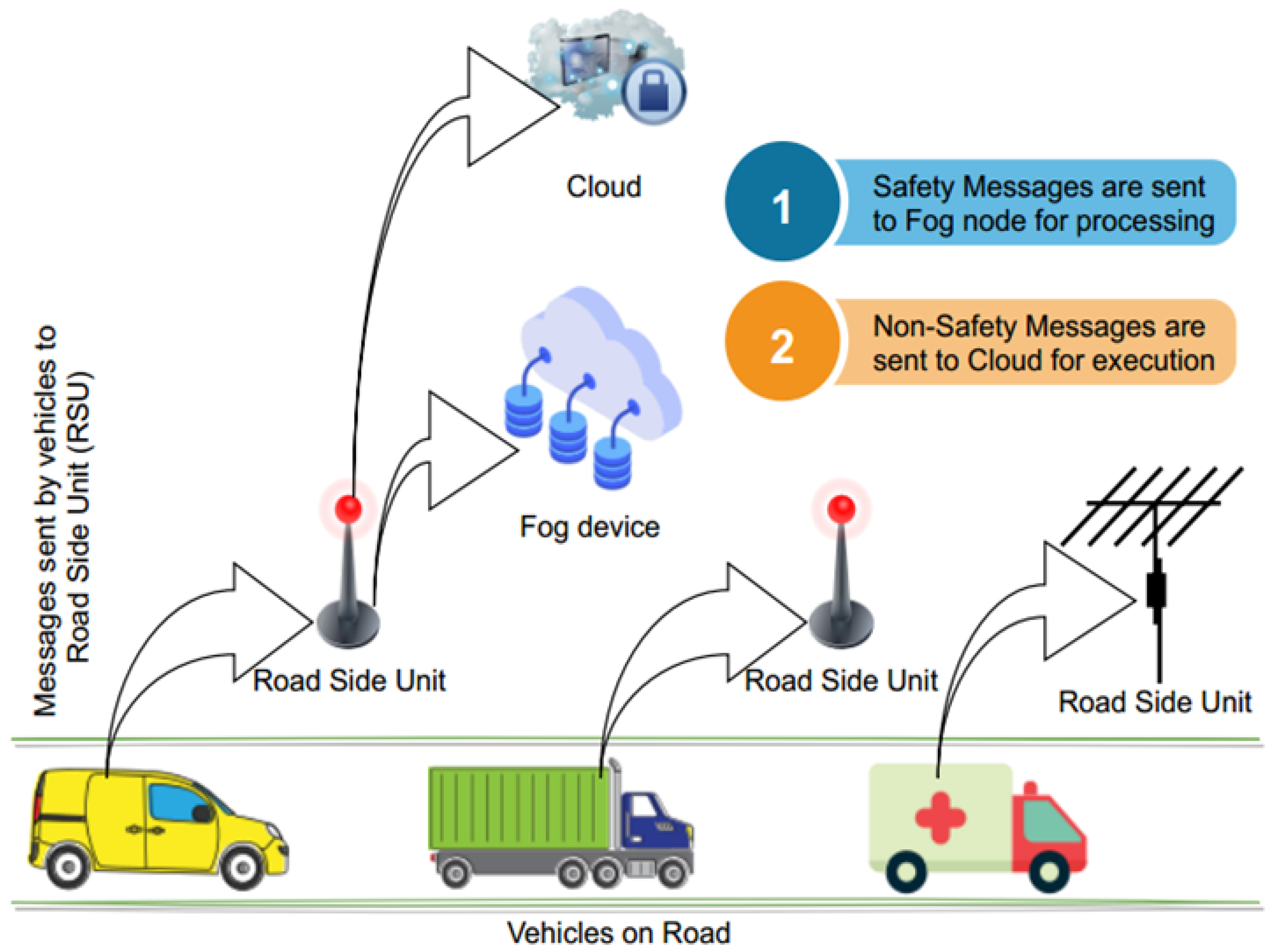
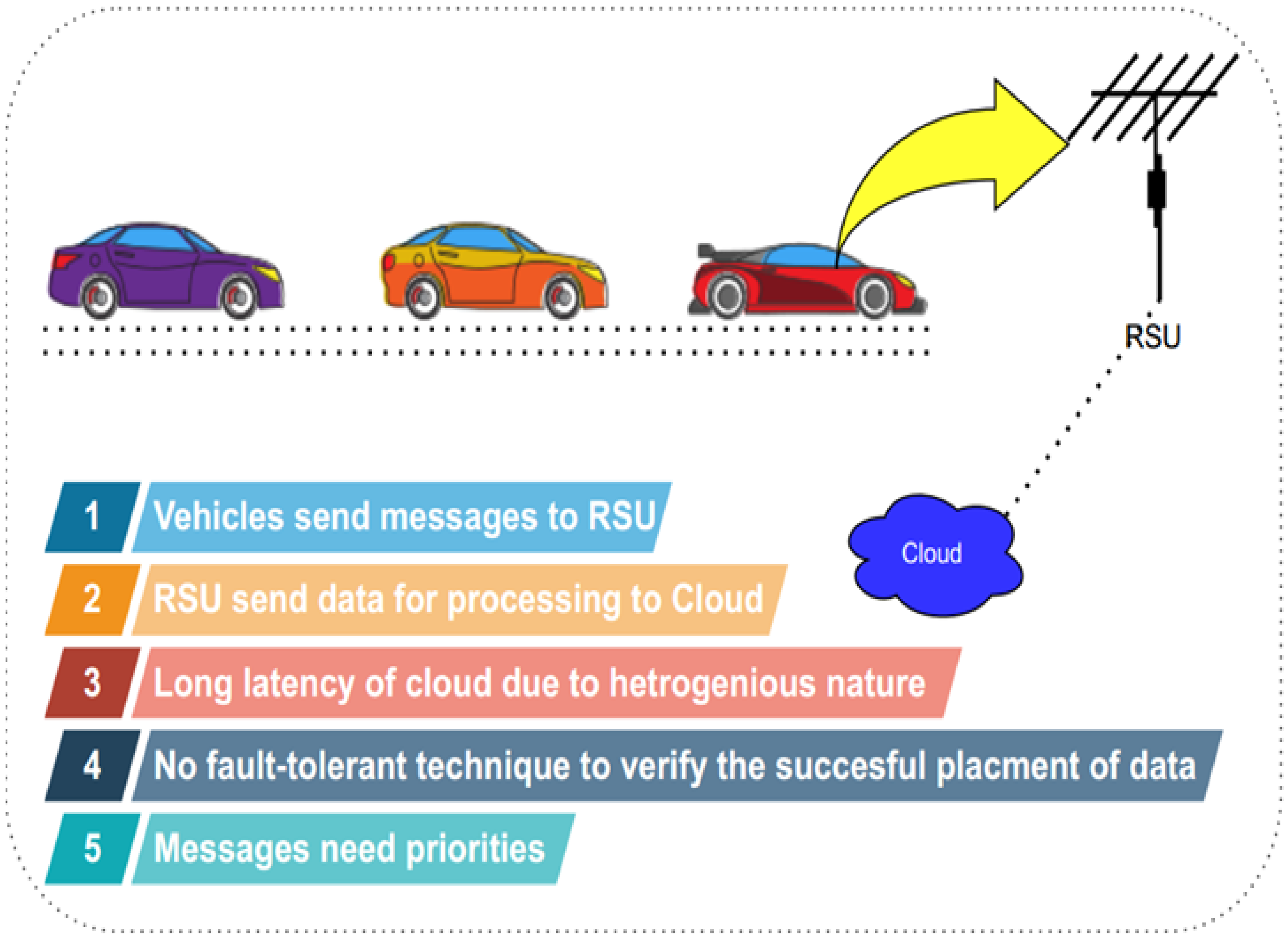
As reflected from the Literature Review [5,9,10,11,12,13,14,15,16,17,18,19,20,21,22,23,24,25,26,27,28,31], they used the Cloud for data execution and storage, which has the following limitations, as shown in Figure 1:
Figure 1.
Problem Formulation-1.
- Response time is not provided for the safety and non-safety messages of vehicles
- Cloud is used for task execution, which leads to higher response time
- Safety messages are given priority based on deadline and size, but not given priority based on message nature, as some messages are large in size, but have the highest priority.
Furthermore, it is observed that no fault-tolerance method is used in [27,28]; when any highest priority message does not deliver to the destination, then it may create an efficiency problem of the proposed model.
4. Proposed Solution
In this section, the proposed model is provided as follows:
4.1. System Architecture
The system architecture of the proposed model is provided here in detail as follows, and as shown in Figure 2:
Figure 2.
System Architecture of the proposed model.
4.2. SDN Based Smart Gateway
Software-defined network smart gateway is a gateway that receives vehicles’ messages/data and processes it according to rules embedded in it, and forwards it to other vehicles when required, and sends to the cloud or fog for storage and processing. Smart gateways are placed in fog nodes near the roadside to reduce response time.
4.3. VANET Vehicles
VANET vehicles are part of SDVN and communicate with each other during critical times, or share any important information.
4.3.1. SDN Controller
The SDN controller is used for information/messages prioritization and forwarding to destination. The controller is connected to the nearby SDN nodes and, from time to time, updates routing tables of the received information. The controller is placed in edge fog nodes to get the processing power and short storage. For heavy computation and permanent storage, the controller sends information to the cloud.
4.3.2. Fog Nodes
Fog nodes are used to provide nearby processing and storage to VANET Vehicles messages/information. SDN nodes and the main SDN controller are placed on fog nodes to reduce response time.
4.3.3. Cloud Datacenter
The Cloud is used for heavy computation and permanent storage when required by VANET information/messages.
4.4. QAFT-SDVN Proposed Model
The proposed model consists of vehicles that will communicate with each other during the journey, SDN nodes that are placed on fog nodes, main SDN control that is also placed on fog nodes, the cloud, which is for huge computation and storage, as shown in Figure 3. We have vehicles from , , , ⋯, ; furthermore, we have SDN nodes from , , , ⋯, . We have Fog nodes from Fog, Fog, Fog, ⋯, Fog, and cloud nodes from , , , ⋯, . Vehicles send and receive messages such as , , , . The following Table 2 is used for the abbreviations used in the proposed model:
Figure 3.
QAFT-SDVN Proposed Model.
Table 2.
List of abbreviation used in the proposed model.
Our proposed model first gets messages from vehicles through nearby gateways, which are placed into fog nodes. Messages are categorized into safety and non-safety according to the nature of messages and deadline, and size. The concerned SDN controller performs necessary action and returns the result to vehicles otherwise sent to the cloud for storage and necessary action. The following Algorithm 1 is used for messages receiving and giving priority to them.
| Algorithm 1: Vehicles Messages receiving and priority allocation based on message nature |
| Input: (Vehicles Messages) Output: & (Messages Priorities)
|
The following Algorithm 2 is used to calculate messages priority based on deadline and size:
| Algorithm 2: Vehicles Messages receiving and priority allocation based on deadline and size |
| Input: (Vehicles Messages) Output: & (Messages Priorities)
|
Algorithm 1 input consists of vehicle messages, and the output consists of & (weighted priority). Algorithm 1 consists of nine steps in which we used two linear for loops. The first for loop is used for messages/data receiving at SDN Controller, then the second for loop is used for priority calculation of the received messages according to the messages nature, as provided in Table 1. The algorithm at the end returns two lists of messages and further forward the messages to vehicles and to the cloud for storage, which is provided in Algorithm 3. Algorithm two is used for messages received at SDN nodes placed on fog nodes; the input consists of vehicle messages, the output consists of two lists. One is of priority basis messages. The other list consists of normal messages. Messages priority is calculated according to deadline and size; priority is calculated of the generated messages, if the priority is less or equal to the priority of deadline and size of the messages that are given in the table, then we assign it to list 1 otherwise to list 2.
The following Algorithm 3 is used for messages forwarding according to priority assign to them:
| Algorithm 3: Messages forwarding to vehicles for information and cloud |
| Input: & (Two list one of safety messages while the other one of non-safety messages) Output: Sending messages receipt and database storage
|
Algorithm three works based on received messages; the input consists of two lists from Algorithms 1 and 2. The first safety messages that are provided in Table 1 are sent. Then, the second list of normal messages is sent according to a first-come and first-serve basis.
| Algorithm 4: Fault-Tolerance Mechanism for SDVN |
| Input: & (Two list one of safety messages while the other one of non-safety messages) Output: £ (Successful messages)
|
In step 3, we call Algorithm 4 for fault tolerance; if any message failed and did not reach the proper destination, then we provided a mechanism in algorithm four that will solve it accordingly.
Algorithm 4 is provided to tackle fault tolerance of the sent messages of vehicles. Algorithm 4 is used for failed and successful tasks; if the source receives the acknowledgment, then we assign it the list of successful messages; otherwise, we assign it to failed tasks/messages list and further resend according to Algorithm 3.
5. Simulation Setup and Results
This section consists of resource modeling, application modeling, performance parameters, and results. Results are provided based on different scenarios.
5.1. Resource Modeling
For the implementation and simulation of the proposed model, we need a real VANET environment, but a real environment is costly and cannot be created easily. So, for a simulation of the proposed model, we used CloudSim [32] & iFogSim [33]. Further pricing mechanism and resources allocation mechanism was obtained from [34,35,36]. We used vehicles for sending messages, SDN nodes, SDN controller, fog nodes in which we placed SDN nodes, and Cloud for heavy processing and storage. Further detail of the simulation environment is provided in Table 3.
Table 3.
Message types with deadline and size.
5.2. Application Modeling
Multiple vehicles are considered to send messages to nearby fog nodes in which SDN nodes and controllers are fixed. The following Table 4 consists of the application model for the proposed model:
Table 4.
Application modeling.
The following Table 5 consist of each datacenter power that will be used for tasks execution:
Table 5.
Datacenter detail.
5.3. Simulation Process
In the simulation of the proposed model first, we created datacenters of clouds and their sub datacenters of fog. We created different vehicles which send data to nearby RSU/Gateways. Random tasks. Tasks are also created randomly as provided in the above table. Randomly the messages/data are sent to RSU/Gateways by the vehicles. The RSU/Gateway prioritizes the data in safety and non-safety messages by using a priority algorithm. The RSU/Gateway further forwards safety messages to the fog node while non-safety messages to the cloud. Fog node used the least priority first policy for the execution of the data while Cloud used FCFS scheduling model for execution of the offloaded data. From the different simulation/implementation runs, we obtain data and evaluate the data for further analysis, as provided in Section 5.5.
5.4. Performance Parameters
The following performance parameters are used to evaluate the proposed model:
5.4.1. Response Time
Response time is the actual time of the resource’s response to the vehicles sent messages. Response time is calculated according to the following (1):
5.4.2. Execution Time
Execution time of the vehicles messages is the total time taken by the execution node to prioritize it and forward it to the destination.
5.4.3. Tasks/Messages Failure Ratio
Messages failure ratio is the actual messages that failed to send and did not receive via the destination party. The following (3) is used to calculate the tasks/messages failure ratio.
5.5. Results Comparison
The following scenarios are created to evaluate the proposed model:
5.5.1. Response Time Comparison with Random and Previous Work of Safety and Non-Safety Messages
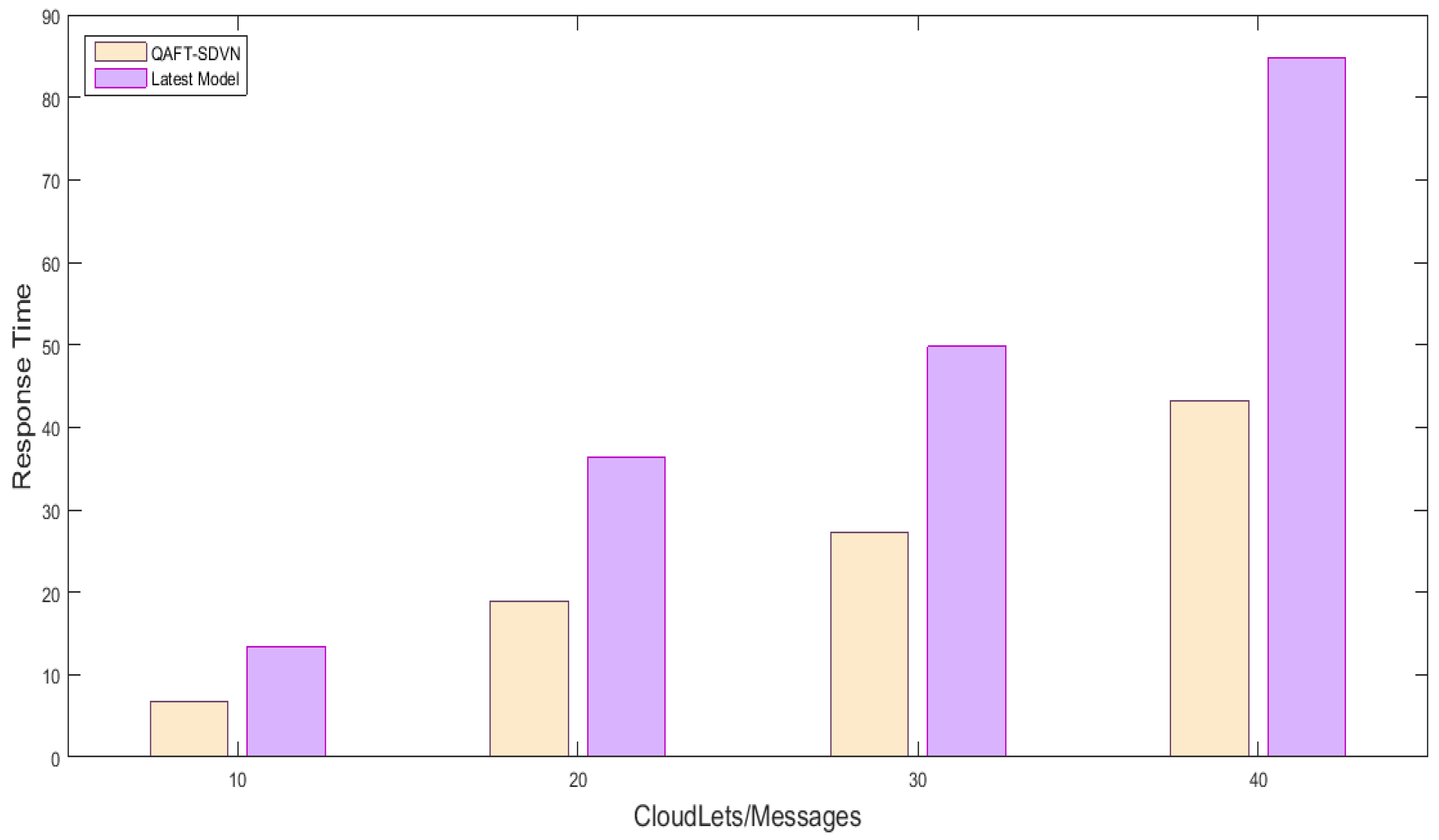
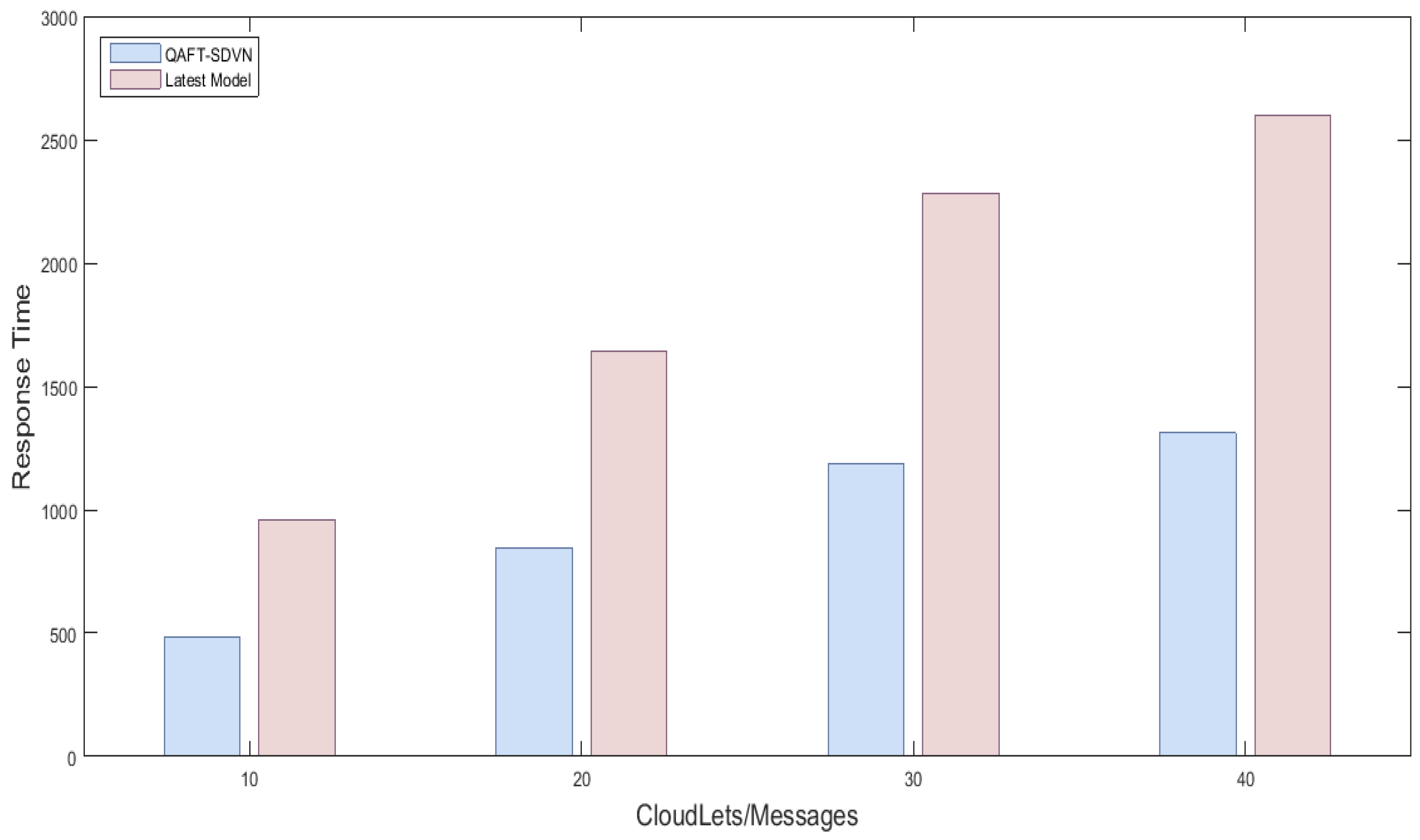
We created one cloud node with a data center; the details are provided in Table 3 and Table 4. Three fog nodes are created with equal specification and placed three SDN nodes in which one was considered as SDN main controller. 15 vehicles randomly sent messages, and we observed their response time using fog nodes and fog nodes. Figure 4 shows the response time comparison of the proposed model with the latest work using fog and without fog nodes. Figure 4 x-axis shows No messages/Cloudlets/Tasks executed, and the y-axis shows response time milliseconds. We sent the first 10 messages to fog and then to cloud, then we sent 20 messages, 30 messages, and 40 messages. Due to fog usage, we reduced the response time of safety messages by up , which is sufficient for vehicles in an emergency. So, the proposed QAFT-SDVN model perfumed very well in terms of response time while forwarding safety messages. The other non-safety messages were sent by FCPS methods whose response time was also reduced by fog nodes. Similarly, as shown in Figure 5, response time comparison non-safety messages are provided, and the results show that our proposed model performed well, as we used fog nodes for SDN technology instead of the cloud.
Figure 4.
Response time comparison of proposed model with the latest models of safety messages.
Figure 5.
Response time comparison of proposed model with the latest models of non-safety messages.
5.5.2. Effect of the Execution Time of Latest Model with the Proposed QAFT-SDVN Model
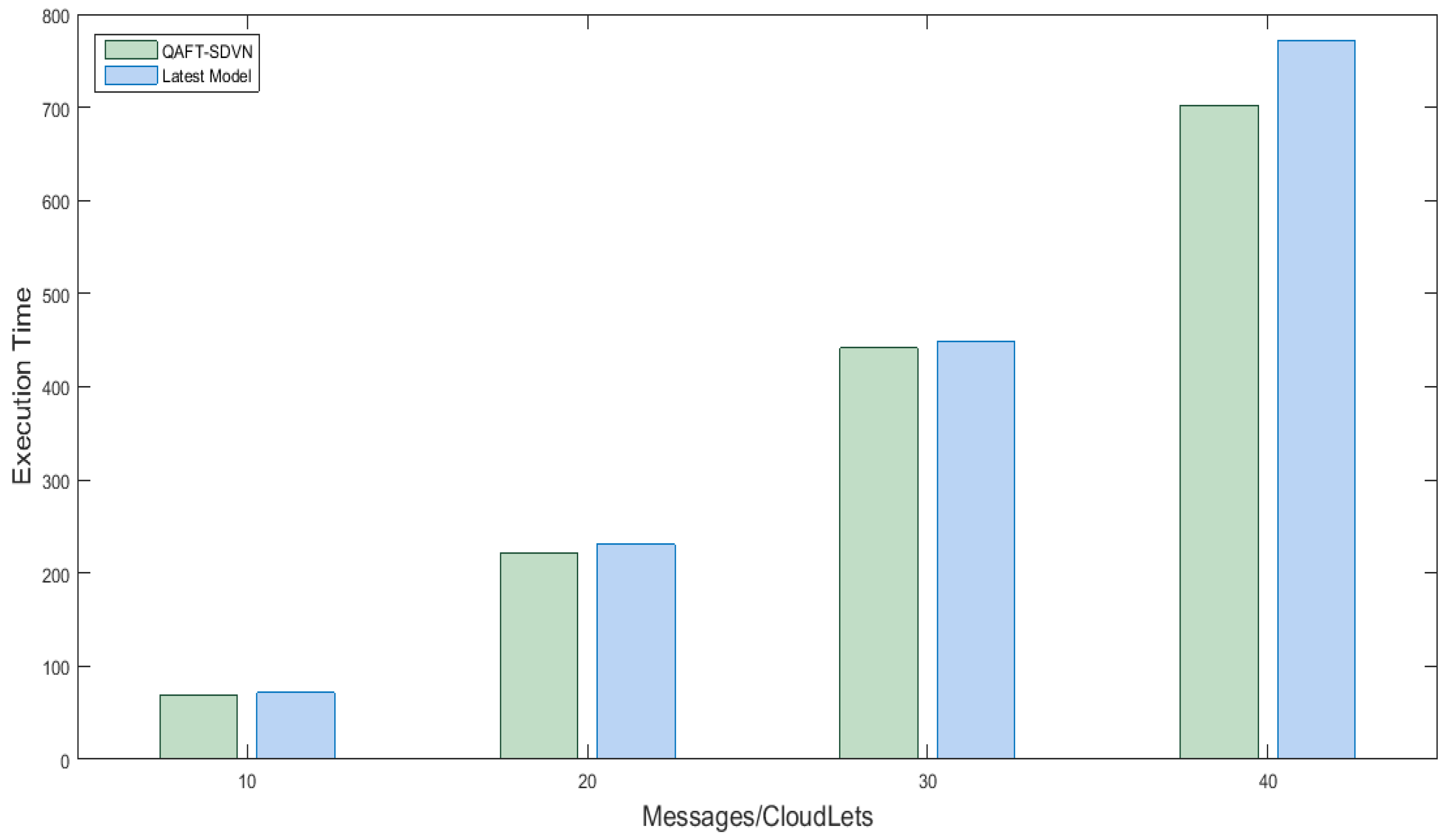
In this scenario, fifteen vehicles were created, one cloud datacenter, three fog nodes placed with SDN nodes. Different messages are created and sent to fog nodes and then to the cloud, and their execution time is analyzed and compared with work already done in [27,28]. Figure 6 x-axis shows no messages from vehicles while the y-axis shows execution time taken by the messages. The execution time of the proposed model and the available work is the same, but our proposed model reduced execution time up to 4% by using efficient priority algorithms to categorize safety and non-safety messages.
Figure 6.
Execution time of safety messages in milli seconds.
5.5.3. Tasks/Messages Failure Ration Comparison with Previous Work
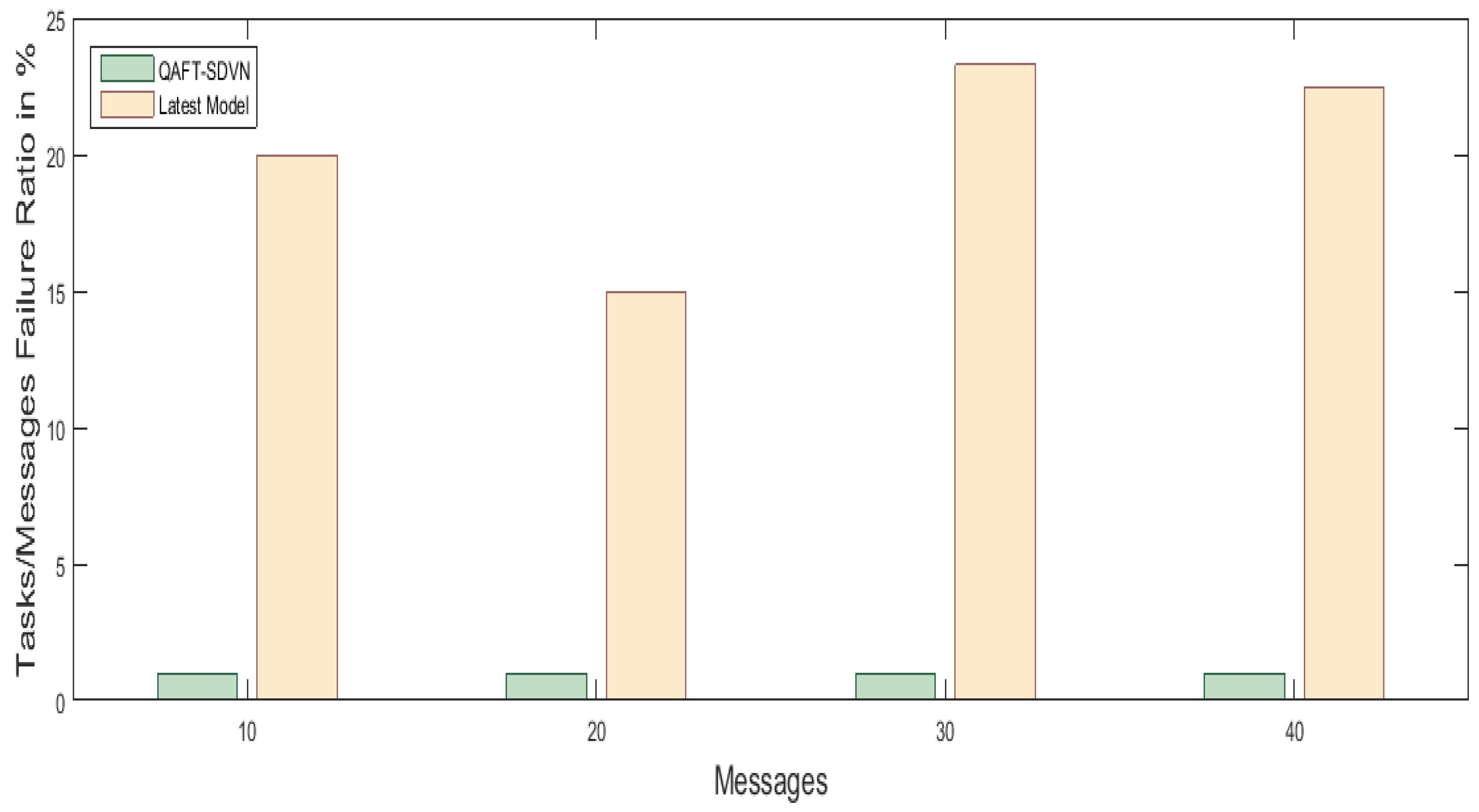
In this scenario, we consider the same resources like the above scenarios. Here, we analyzed our Algorithms 3 and 4 for tasks/messages failure ration calculation. Our proposed model did not drop any message using a fault tolerance mechanism, while the previous work [27,28] randomly dropped 20%, 15%, 23.3%, and 22.5% messages, as shown in Figure 7.
Figure 7.
Tasks/Messages failure ratio comparison with available work.
5.6. Simulation Experiment/ Illustrative Example
In the experiment, we considered five vehicles with ten different messages, as shown in the following tables, as safety messages and non-safety messages are stored:
In the above two tables, safety and non-safety messages are stored and received from vehicles. In the simulation, we defined safety and non-safety messages with ID No to process further in Table 6 and Table 7. After receiving messages from vehicles, our Algorithm 1 checks the nature of the message and stores them in Table 6 and Table 7 accordingly. Algorithm 2 is used to prioritize the Algorithm 1 out tables and assign priorities as shown in Table 6 and Table 7 columns as “Priority”. Algorithm 3 sends Table 6 data to fog in ascending order as if any Vehicle message priority value is less than the message will be sent first. And Table 7 data were sent to the cloud for execution. After the assignment of the messages to their assigned execution machines the Algorithm 4 checks for fault tolerance. If any message fails to offload, then Algorithm 4 resends the failed message until successful offloading to the execution server. By priority basis scheduling and fault tolerance, the proposed model reduced energy consumption and messages failure ratio as compared with the latest work.
Table 6.
Safety messages.
Table 7.
Non-Safety Messages.
6. Discussion
In this section, we discussed the provided result in a detailed and comprehensive manner. The proposed model reduced response time by using fog in the middle of the RSUs and Cloud. As when data was sent to the cloud then it was taking so long due to the heterogeneous nature of the cloud. In the cloud basically, the services/servers are placed for way from the users/clients. So, as compared with QAFT-SDVN’s latest model, our proposed model reduced the response time of the safety messages, while up to of the non-safety messages due to load division on fog and cloud nodes. The result analysis shows that task failure was a drawback of the traditional models, and we reduced the tasks failure ratio up to as compared with non-fault tolerant models. We have used the task retry mechanism and node retry mechanism when tasks are failed. Energy consumption is also reduced due to reducing the communication cost of the priority messages up to .
7. Conclusions
In this paper, we provided QoS aware and fault tolerance-based software-defined vehicular networks using Cloud-fog computing (QAFT-SDVN). The proposed model communicates vehicle messages through SDN nodes which are placed on fog nodes. SDN controllers receive messages from nearby SDN units and prioritize the messages in two different ways. One is message nature-based, while the other one is based on the deadline and size of the messages. SDN controller categorized in safety and non-safety messages and forward to the destination. After sending messages to their destination, we check their acknowledgment; if the destination receives the messages, no action is taken. Otherwise, we use a fault tolerance mechanism, in which we re-transmit the messages. The proposed model is implemented, evaluated, and compared with the latest models. The results show that our proposed model decreased response time by of the safety and non-safety messages by using Fog nodes for the SDN controller. Furthermore, we reduced the execution time of the safety and non-safety messages by up to . Similarly, compared with the latest model such as the QAFT-SDVN model, we reduced the task failure ratio by , , , and by using the fault tolerant technique, Fog technologies, and messages nature-based priority. In the future, we will work on the vehicle’s mobility and connection with the different RSUs of vehicles. In the future, we will also need a security model for the proposed system.
Author Contributions
Conceptualization, S.A.S.; Formal analysis, M.R., A.U. and A.W.; Investigation, M.R.; Methodology, S.A.S., S.H., F.A. and A.U.; Project administration, S.A.S.; Resources, A.W., M.Z. and C.V.-R.; Software, H.Z.; Validation, M.R.; Writing—original draft, A.U.; Writing—review and editing, A.W. All authors have read and agreed to the published version of the manuscript.
Funding
This work was supported by the School of Engineering and Sciences at Tecnologico de Monterrey.
Conflicts of Interest
The authors declare no conflict of interest.
References
- Shin, M.K.; Nam, K.H.; Kim, H.J. Software-defined networking (SDN): A reference architecture and open APIs. In Proceedings of the IEEE 2012 International Conference on ICT Convergence (ICTC), Jeju Island, Korea, 15–17 October 2012; pp. 360–361. [Google Scholar]
- Kreutz, D.; Ramos, F.M.V.; Verissimo, P.E.; Rothenberg, C.E.; Azodolmolky, S.; Uhlig, S. Software-defined networking: A comprehensive survey. Proc. IEEE 2015, 103, 14–76. [Google Scholar] [CrossRef] [Green Version]
- Singh, S.; Sunil, A. VANET routing protocols: Issues and challenges. In Proceedings of the 2014 Recent Advances in Engineering and Computational Sciences (RAECS), Chandigarh, India, 6–8 March 2014; pp. 1–5. [Google Scholar]
- Borcoci, E. From vehicular Ad-hoc networks to internet of vehicles. In Proceedings of the NexComm 2017 Conference, Venice, Italy, 23–27 April 2017; pp. 23–27. [Google Scholar]
- Kalinin, M.O.; Krundyshev, V.M.; Semianov, P.V. Architectures for building secure vehicular networks based on SDN technology. Autom. Control Comput. Sci. 2017, 51, 907–914. [Google Scholar] [CrossRef]
- Rafique, W.; Qi, L.; Yaqoob, I.; Imran, M.; Rasool, R.U.; Dou, W. Complementing IoT services through software defined networking and edge computing: A comprehensive survey. IEEE Commun. Surv. Tutor. 2020, 22, 1761–1804. [Google Scholar] [CrossRef]
- Peter, M.; Grance, T. The NIST Definition of Cloud Computing; National Institute of Standards and Technology: Gaithersburg, MD, USA, 2011. [Google Scholar]
- Yi, S.; Hao, Z.; Qin, Z.; Li, Q. Fog Computing: Platform and Applications. In Proceedings of the 2015 Third IEEE Workshop on Hot Topics in Web Systems and Technologies (HotWeb), Washington, DC, USA, 12–13 November 2015. [Google Scholar]
- Pankaj, K.; Chakshu, G.; Inderjeet, S. Performance Evaluation of Network Aggregation Techniques in VANET. IJIREEICE 2017, 5, 36–39. [Google Scholar]
- Mousa, S.H.; Ismail, M.; Nordin, R.; Abdullah, N.F. Effective wide spectrum sharing techniques relying on CR technology toward 5G: A survey. J. Commun. 2020, 15, 122–147. [Google Scholar] [CrossRef]
- Goudarzi, S.; Anisi, M.H.; Ahmadi, H.; Musavian, L. Dynamic Resource Allocation Model for Distribution Operations using SDN. IEEE Internet Things J. 2020, 8, 976–988. [Google Scholar] [CrossRef]
- Toufga, S.; Abdellatif, S.; Assouane, H.T.; Owezarski, P.; Villemur, T. Towards Dynamic Controller Placement in Software Defined Vehicular Networks. Sensors 2020, 20, 1701. [Google Scholar] [CrossRef] [PubMed] [Green Version]
- Soleymani, S.A.; Goudarzi, S.; Anisi, M.H.; Kama, N.; Adli Ismail, S.; Azmi, A.; Hanan Abdullah, A. A trust model using edge nodes and a cuckoo filter for securing VANET under the NLoS condition. Symmetry 2020, 12, 609. [Google Scholar] [CrossRef]
- Sadio, O.; Ibrahima, N.; Claude, L. Design and Prototyping of a Software Defined Vehicular Networking. IEEE Trans. Veh. Technol. 2019, 69, 842–850. [Google Scholar] [CrossRef]
- Al-Mayouf, Y.R.B.; Abdullah, N.F.; Mahdi, O.A.; Khan, S.; Ismail, M.; Guizani, M.; Ahmed, S.H. Real-time intersection-based segment aware routing algorithm for urban vehicular networks. IEEE Trans. Intell. Transp. Syst. 2018, 7, 2125–2141. [Google Scholar] [CrossRef]
- Thota, J.; Abdullah, N.F.; Doufexi, A.; Armour, S. V2V for vehicular safety applications. IEEE Trans. Intell. Transp. Syst. 2019, 21, 2571–2585. [Google Scholar] [CrossRef]
- Alioua, A.; Senouci, S.-M.; Moussaoui, S.; Sedjelmaci, H.; Messous, M.-A. Efficient data processing in software-defined UAV-assisted vehicular networks: A sequential game approach. Wirel. Pers. Commun. 2018, 101, 2255–2286. [Google Scholar] [CrossRef]
- Singh, S.; Negi, S.; Verma, S.K. VANET based p-RSA scheduling algorithm using dynamic cloud storage. Wirel. Pers. Commun. 2018, 98, 3527–3547. [Google Scholar] [CrossRef]
- Zhang, Y.; Zhao, J.; Cao, G. On scheduling vehicle-roadside data access. In Proceedings of the Fourth ACM International Workshop on Vehicular ad hoc Networks, Montreal, QC, Canada, 10 September 2007; pp. 9–18. [Google Scholar]
- Kumar, R.; Pal, R.; Prakash, A.; Tripathi, R. A Collective Scheduling Algorithm for Vehicular Ad Hoc Network. In Recent Trends in Communication, Computing, and Electronics; Khare, A., Tiwary, U., Sethi, I., Singh, N., Eds.; Springer: Singapore, 2019; pp. 165–180. [Google Scholar]
- Zhu, W.; Gao, D.; Zhao, W.; Zhang, H.; Chiang, H.-P. SDN-enabled hybrid emergency message transmission architecture in internet-of-vehicles. Int. J. Enterp. Inf. Syst. 2018, 12, 471–491. [Google Scholar] [CrossRef]
- Singh, S.; Negi, S.; Verma, S.K.; Panwar, N. Comparative study of existing data scheduling approaches and role of cloud in VANET environment. Procedia Comput. Sci. 2018, 125, 925–934. [Google Scholar] [CrossRef]
- Shahverdya, M.; Asgarib, M.; Fathyc, M. A QoS-based scheduling algorithm in vanets. J. Theor. Appl. Inf. Technol. 2015, 77, 429–437. [Google Scholar]
- Lim, J.M.-Y.; Chang, Y.C.; Alias, M.Y.; Loo, J. Performance modeling of adaptive VANET with enhanced priority scheme. KSIITrans. Internet Inf. Syst. 2015, 9, 1337–1358. [Google Scholar]
- Javad, S.M.; Mahmood, F. A new approach in packet scheduling in the VANET. arXiv 2010, arXiv:1010.0430. [Google Scholar]
- Dubey, B.B.; Chauhan, N.; Chand, N.; Awasthi, L.K. Priority based efficient data scheduling technique for VANETs. Wirel. Netw. 2016, 22, 1641–1657. [Google Scholar] [CrossRef]
- Adnan, M.; Iqbal, J.; Waheed, A.; Amin, N.U.; Zareei, M.; Goudarzi, S.; Umer, A. On the design of efficient hierarchic architecture for software defined vehicular networks. Sensors 2021, 21, 1400. [Google Scholar] [CrossRef]
- Adnan, M.; Iqbal, J.; Waheed, A.; Amin, N.U.; Zareei, M.; Umer, A.; Mohamed, E.M. Towards the Design of Efficient and Secure Architecture for Software-Defined Vehicular Networks. Sensors 2021, 21, 3902. [Google Scholar] [CrossRef]
- Sangaiah, A.K.; Ramamoorthi, J.S.; Rodrigues, J.J.P.C.; Rahman, M.A.; Muhammad, G.; Alrashoud, M. LACCVoV: Linear adaptive congestion control with optimization of data dissemination model in vehicle-to-vehicle communication. IEEE Trans. Intell. Transp. Syst. 2020, 22, 5319–5328. [Google Scholar] [CrossRef]
- Javadpour, A.; Rezaei, S.; Sangaiah, A.K.; Slowik, A.; Khaniabadi, S.M. Enhancement in Quality of Routing Service Using Metaheuristic PSO Algorithm in VANET Networks. Soft Comput. 2021, 1–12. [Google Scholar] [CrossRef]
- Wadhonkar, A.; Deepti, T. An Analysis of Priority Length and Deadline Based Task Scheduling Algorithms in Cloud Computing. IJCSN 2016, 5, 360–364. [Google Scholar]
- Calheiros, R.N.; Ranjan, R.; Beloglazov, A.; De Rose, C.; Buyya, R. CloudSim: A toolkit for modeling and simulation of cloud computing environments and evaluation of resource provisioning algorithms. Softw. Pract. Exp. 2011, 41, 23–50. [Google Scholar] [CrossRef]
- Gupta, H.; Dastjerdi, A.V.; Ghosh, S.K.; Buyya, R. iFogSim: A toolkit for modeling and simulation of resource management techniques in the Internet of Things, Edge and Fog computing environments. Softw. Pract. Exp. 2017, 47, 1275–1296. [Google Scholar] [CrossRef] [Green Version]
- Umer, A.; Nazir, B.; Ahmad, Z. Adaptive market-oriented combinatorial double auction resource allocation model in cloud computing. J. Supercomput. 2021, 1–43. [Google Scholar] [CrossRef]
- Ullah, Z.; Umer, A.; Zaree, M.; Ahmad, J.; Alanazi, F.; Amin, N.U.; Umar, A.I.; Jehangiri, A.I.; Adnan, M. Negotiation Based Combinatorial Double Auction Mechanism in Cloud Computing. CMC-Comput. Mater. Contin. 2021, 69, 2123–2140. [Google Scholar] [CrossRef]
- Ahmad, Z.; Nazir, B.; Umer, A. A fault-tolerant workflow management system with Quality-of-Service-aware scheduling for scientific workflows in cloud computing. Int. J. Commun. Syst. 2021, 34, e4649. [Google Scholar]
Publisher’s Note: MDPI stays neutral with regard to jurisdictional claims in published maps and institutional affiliations. |
© 2022 by the authors. Licensee MDPI, Basel, Switzerland. This article is an open access article distributed under the terms and conditions of the Creative Commons Attribution (CC BY) license (https://creativecommons.org/licenses/by/4.0/).