


Validity and Reliability of the Inertial Measurement Unit for Barbell Velocity Assessments: A Systematic Review




Abstract
1. Introduction
2. Materials and Methods
2.1. Eligibility Criteria
2.2. Information Sources and Search
2.3. Data Extraction
2.4. Data Items
2.5. Methodological Assessment
3. Results
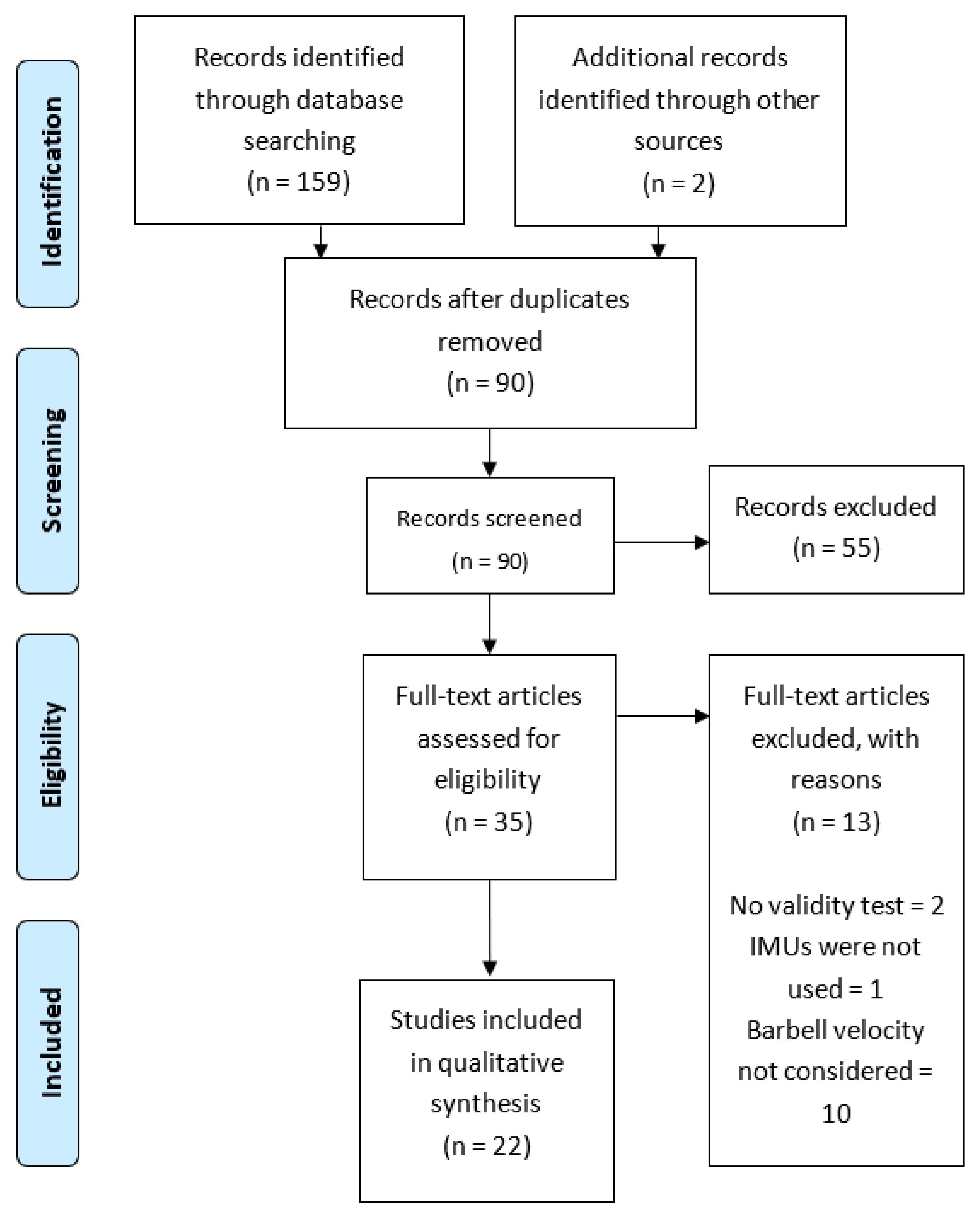
3.1. Study Identification and Selection
3.2. Methodological Quality
3.3. Characteristics of Individual Studies
3.4. Results of Individual Studies: Validity of IMU for Estimation of Barbell Velocity
3.5. Results of Individual Studies: Reliability of IMU for Estimation of Barbell Velocity
4. Discussion
4.1. Validity of IMU for Estimation of Barbell Velocity
4.2. Reliability of IMU for Estimation of Barbell Velocity
4.3. Study Limitations, Future Research, and Practical Implications
5. Conclusions
Author Contributions
Funding
Institutional Review Board Statement
Informed Consent Statement
Conflicts of Interest
References
- Mann, J.B.; Ivey, P.A.; Sayers, S.P. Velocity-based training in football. Strength Cond. J. 2015, 37, 52–57. [Google Scholar] [CrossRef]
- Banyard, H.G.; Tufano, J.J.; Delgado, J.; Thompson, S.W.; Nosaka, K. Comparison of the effects of velocity-based training methods and traditional 1RM-percent-based training prescription on acute kinetic and kinematic variables. Int. J. Sports Physiol. Perform. 2019, 14, 246–255. [Google Scholar] [CrossRef]
- Guerriero, A.; Varalda, C.; Piacentini, M. The role of velocity based training in the strength periodization for modern athletes. J. Funct. Morphol. Kinesiol. 2018, 3, 55. [Google Scholar] [CrossRef]
- Orange, S.T.; Metcalfe, J.W.; Robinson, A.; Applegarth, M.J.; Liefeith, A. Effects of in-season velocity versus percentage-based training in Academy Rugby League players. Int. J. Sports Physiol. Perform. 2020, 15, 554–561. [Google Scholar] [CrossRef]
- González-Badillo, J.J.; Pareja-Blanco, F.; Rodríguez-Rosell, D.; Abad-Herencia, J.L.; del Ojo-López, J.J.; Sánchez-Medina, L. Effects of velocity-based resistance training on young soccer players of different ages. J. Strength Cond. Res. 2015, 29, 1329–1338. [Google Scholar] [CrossRef]
- Nevin, J. Autoregulated resistance training. Strength Cond. J. 2019, 41, 34–39. [Google Scholar] [CrossRef]
- Sindiani, M.; Lazarus, A.; Iacono, A.D.; Halperin, I. Perception of changes in bar velocity in resistance training: Accuracy levels within and between exercises. Physiol. Behav. 2020, 224, 113025. [Google Scholar] [CrossRef]
- Weakley, J.; McLaren, S.; Ramirez-Lopez, C.; García-Ramos, A.; Dalton-Barron, N.; Banyard, H.; Mann, B.; Weaving, D.; Jones, B. Application of velocity loss thresholds during free-weight resistance training: Responses and reproducibility of perceptual, metabolic, and neuromuscular outcomes. J. Sports Sci. 2020, 38, 477–485. [Google Scholar] [CrossRef]
- Nagata, A.; Doma, K.; Yamashita, D.; Hasegawa, H.; Mori, S. The effect of augmented feedback type and frequency on velocity-based training-induced adaptation and retention. J. Strength Cond. Res. 2020, 34, 3110–3117. [Google Scholar] [CrossRef]
- Randell, A.D.; Cronin, J.B.; Keogh, J.W.L.; Gill, N.D.; Pedersen, M.C. Effect of instantaneous performance feedback during 6 weeks of velocity-based resistance training on sport-specific performance tests. J. Strength Cond. Res. 2011, 25, 87–93. [Google Scholar] [CrossRef]
- Weakley, J.; Mann, B.; Banyard, H.; McLaren, S.; Scott, T.; Garcia-Ramos, A. Velocity-based training. Strength Cond. J. 2020, 1–19. [Google Scholar] [CrossRef]
- Ramírez, J.M.; Núñez, V.M.; Lancho, C.; Poblador, M.S.; Lancho, J.L. Velocity-based training of lower limb to improve absolute and relative power outputs in concentric phase of half-squat in soccer players. J. Strength Cond. Res. 2015, 29, 3084–3088. [Google Scholar] [CrossRef] [PubMed]
- Rauch, J.; Loturco, I.; Cheesman, N.; Thiel, J.; Alvarez, M.; Miller, N.; Carpenter, N.; Barakat, C.; Velasquez, G.; Stanjones, A.; et al. Similar strength and power adaptations between two different velocity-based training regimens in collegiate female volleyball players. Sports 2018, 6, 163. [Google Scholar] [CrossRef] [PubMed]
- Petridis, L.; Pálinkás, G.; Tróznai, Z.; Béres, B.; Utczás, K. Determining strength training needs using the force-velocity profile of elite female handball and volleyball players. Int. J. Sports Sci. Coach 2021, 16, 123–130. [Google Scholar] [CrossRef]
- Ruf, L.; Chéry, C.; Taylor, K.-L. Validity and reliability of the load-velocity relationship to predict the one-repetition maximum in deadlift. J. Strength Cond. Res. 2018, 32, 681–689. [Google Scholar] [CrossRef]
- Loturco, I.; Suchomel, T.; Kobal, R.; Arruda, A.F.S.; Guerriero, A.; Pereira, L.A.; Pai, C.N. Force-velocity relationship in three different variations of prone row exercises. J. Strength Cond. Res. 2021, 35, 300–309. [Google Scholar] [CrossRef]
- Banyard, H.G.; Nosaka, K.; Haff, G.G. Reliability and validity of the load–velocity relationship to predict the 1RM back squat. J. Strength Cond. Res. 2017, 31, 1897–1904. [Google Scholar] [CrossRef]
- Watanabe, K.; Sakai, T.; Kato, S.; Hashizume, N.; Horii, N.; Yoshikawa, M.; Hasegawa, N.; Iemitsu, K.; Tsuji, K.; Uchida, M.; et al. Conduction velocity of muscle action potential of knee extensor muscle during evoked and voluntary contractions after exhaustive leg pedaling exercise. Front. Physiol. 2020, 11, 546. [Google Scholar] [CrossRef]
- Twomey, R.; Aboodarda, S.J.; Kruger, R.; Culos-Reed, S.N.; Temesi, J.; Millet, G.Y. Neuromuscular fatigue during exercise: Methodological considerations, etiology and potential role in chronic fatigue. Clin. Neurophysiol. 2017, 47, 95–110. [Google Scholar] [CrossRef]
- Mora-Custodio, R.; Rodríguez-Rosell, D.; Yáñez-García, J.M.; Sánchez-Moreno, M.; Pareja-Blanco, F.; González-Badillo, J.J. Effect of different inter-repetition rest intervals across four load intensities on velocity loss and blood lactate concentration during full squat exercise. J. Sports Sci. 2018, 36, 2856–2864. [Google Scholar] [CrossRef]
- Banyard, H.G.; Nosaka, K.; Vernon, A.D.; Haff, G.G. The reliability of individualized load–velocity profiles. Int. J. Sports Physiol. Perform. 2018, 13, 763–769. [Google Scholar] [CrossRef] [PubMed]
- Appleby, B.B.; Banyard, H.; Cormack, S.J.; Newton, R.U. Validity and reliability of methods to determine barbell displacement in heavy back squats: Implications for velocity-based training. J. Strength Cond. Res. 2020, 34, 3118–3123. [Google Scholar] [CrossRef] [PubMed]
- Courel-Ibáñez, J.; Martínez-Cava, A.; Morán-Navarro, R.; Escribano-Peñas, P.; Chavarren-Cabrero, J.; González-Badillo, J.J.; Pallarés, J.G. Reproducibility and repeatability of five different technologies for bar velocity measurement in resistance training. Ann. Biomed. Eng. 2019, 47, 1523–1538. [Google Scholar] [CrossRef] [PubMed]
- Pérez-Castilla, A.; Piepoli, A.; Delgado-García, G.; Garrido-Blanca, G.; García-Ramos, A. Reliability and concurrent validity of seven commercially available devices for the assessment of movement velocity at different intensities during the bench press. J. Strength Cond. Res. 2019, 33, 1258–1265. [Google Scholar] [CrossRef] [PubMed]
- Orange, S.T.; Metcalfe, J.W.; Marshall, P.; Vince, R.V.; Madden, L.A.; Liefeith, A. Test-retest reliability of a commercial linear position transducer (GymAware PowerTool) to measure velocity and power in the back squat and bench press. J. Strength Cond. Res. 2020, 34, 728–737. [Google Scholar] [CrossRef] [PubMed]
- Grgic, J.; Scapec, B.; Pedisic, Z.; Mikulic, P. Test-retest reliability of velocity and power in the deadlift and squat exercises assessed by the GymAware PowerTool system. Front. Physiol. 2020, 11, 1146. [Google Scholar] [CrossRef]
- Beckham, G.K.; Layne, D.K.; Kim, S.B.; Martin, E.A.; Perez, B.G.; Adams, K.J. Reliability and criterion validity of the Assess2Perform bar sensei. Sports 2019, 7, 230. [Google Scholar] [CrossRef]
- García-Ramos, A.; Pérez-Castilla, A.; Martín, F. Reliability and concurrent validity of the Velowin optoelectronic system to measure movement velocity during the free-weight back squat. Int. J. Sports Sci. Coach. 2018, 13, 737–742. [Google Scholar] [CrossRef]
- Pueo, B.; Lopez, J.J.; Mossi, J.M.; Colomer, A.; Jimenez-Olmedo, J.M. Video-based system for automatic measurement of barbell velocity in back squat. Sensors 2021, 21, 925. [Google Scholar] [CrossRef]
- Sánchez-Pay, A.; Courel-Ibáñez, J.; Martínez-Cava, A.; Conesa-Ros, E.; Morán-Navarro, R.; Pallarés, J.G. Is the high-speed camera-based method a plausible option for bar velocity assessment during resistance training? Measurement 2019, 137, 355–361. [Google Scholar] [CrossRef]
- van der Kruk, E.; Reijne, M.M. Accuracy of human motion capture systems for sport applications; state-of-the-art review. Eur. J. Sport Sci. 2018, 18, 806–819. [Google Scholar] [CrossRef] [PubMed]
- Balsalobre-Fernández, C.; Marchante, D.; Baz-Valle, E.; Alonso-Molero, I.; Jiménez, S.L.; Muñóz-López, M. Analysis of wearable and smartphone-based technologies for the measurement of barbell velocity in different resistance training exercises. Front. Physiol. 2017, 8, 649. [Google Scholar] [CrossRef] [PubMed]
- Peart, D.J.; Balsalobre-Fernández, C.; Shaw, M.P. Use of mobile applications to collect data in sport, health, and exercise science. J. Strength Cond. Res. 2019, 33, 1167–1177. [Google Scholar] [CrossRef] [PubMed]
- Balsalobre-Fernández, C.; Kuzdub, M.; Poveda-Ortiz, P.; Campo-Vecino, J. Validity and reliability of the push wearable device to measure movement velocity during the back squat exercise. J. Strength Cond. Res. 2016, 30, 1968–1974. [Google Scholar] [CrossRef] [PubMed]
- Ahmad, N.; Ghazilla, R.A.R.; Khairi, N.M.; Kasi, V. Reviews on various Inertial Measurement Unit (IMU) sensor applications. Int. J. Signal Process. Syst. 2013, 1, 256–262. [Google Scholar] [CrossRef]
- Aroganam, G.; Manivannan, N.; Harrison, D. Review on wearable technology sensors used in consumer sport applications. Sensors 2019, 19, 1983. [Google Scholar] [CrossRef] [PubMed]
- Apte, S.; Meyer, F.; Gremeaux, V.; Dadashi, F.; Aminian, K. A sensor fusion approach to the estimation of instantaneous velocity using single wearable sensor during sprint. Front. Bioeng. Biotechnol. 2020, 8, 838. [Google Scholar] [CrossRef]
- Ueberschär, O.; Fleckenstein, D.; Warschun, F.; Kränzler, S.; Walter, N.; Hoppe, M.W. Measuring biomechanical loads and asymmetries in junior elite long-distance runners through triaxial inertial sensors. Sport. Orthop. Traumatol. 2019, 35, 296–308. [Google Scholar] [CrossRef]
- Zhou, L.; Fischer, E.; Tunca, C.; Brahms, C.M.; Ersoy, C.; Granacher, U.; Arnrich, B. How we found our IMU: Guidelines to IMU selection and a comparison of seven IMUs for pervasive healthcare applications. Sensors 2020, 20, 4090. [Google Scholar] [CrossRef]
- Adesida, Y.; Papi, E.; McGregor, A.H. Exploring the role of wearable technology in sport kinematics and kinetics: A systematic review. Sensors 2019, 19, 1597. [Google Scholar] [CrossRef]
- Crang, Z.L.; Duthie, G.; Cole, M.H.; Weakley, J.; Hewitt, A.; Johnston, R.D. The validity and reliability of wearable microtechnology for intermittent team sports: A systematic review. Sport. Med. 2021, 51, 549–565. [Google Scholar] [CrossRef]
- Noamani, A.; Nazarahari, M.; Lewicke, J.; Vette, A.H.; Rouhani, H. Validity of using wearable inertial sensors for assessing the dynamics of standing balance. Med. Eng. Phys. 2020, 77, 53–59. [Google Scholar] [CrossRef] [PubMed]
- de Magalhaes, F.A.; Vannozzi, G.; Gatta, G.; Fantozzi, S. Wearable inertial sensors in swimming motion analysis: A systematic review. J. Sports Sci. 2015, 33, 732–745. [Google Scholar] [CrossRef] [PubMed]
- Armitage, M.; Beato, M.; McErlain-Naylor, S.A. Inter-unit reliability of IMU step metrics using IMeasureU blue trident inertial measurement units for running-based team sport tasks. J. Sports Sci. 2021. ahead-of-print. [Google Scholar] [CrossRef]
- Santos-Gago, J.M.; Ramos-Merino, M.; Vallarades-Rodriguez, S.; Álvarez-Sabucedo, L.M.; Fernández-Iglesias, M.J.; García-Soidán, J.L. Innovative use of wrist-worn wearable devices in the sports domain: A systematic review. Electronics 2019, 8, 1257. [Google Scholar] [CrossRef]
- Abbott, J.C.; Wagle, J.P.; Sato, K.; Painter, K.; Light, T.J.; Stone, M.H. Validation of inertial sensor to measure barbell kinematics across a spectrum of loading conditions. Sports 2020, 8, 93. [Google Scholar] [CrossRef]
- Thompson, S.W.; Rogerson, D.; Dorrell, H.F.; Ruddock, A.; Barnes, A. The reliability and validity of current technologies for measuring barbell velocity in the free-weight back squat and power clean. Sports 2020, 8, 94. [Google Scholar] [CrossRef] [PubMed]
- Jovanovic, M.; Jukic, I. Within-unit reliability and between-units agreement of the commercially available linear position transducer and Barbell-mounted inertial sensor to measure movement velocity. J. Strength Cond. Res. 2020. ahead-of-print. [Google Scholar] [CrossRef]
- Arede, J.; Figueira, B.; Gonzalo-Skok, O.; Leite, N. Validity and reliability of Gyko sport for the measurement of barbell velocity on the bench-press exercise. J. Sports Med. Phys. Fitness 2019, 59, 1651–1658. [Google Scholar] [CrossRef]
- Camomilla, V.; Bergamini, E.; Fantozzi, S.; Vannozzi, G. Trends supporting the in-field use of wearable inertial sensors for sport performance evaluation: A systematic review. Sensors 2018, 18, 873. [Google Scholar] [CrossRef]
- O’Reilly, M.; Caulfield, B.; Ward, T.; Johnston, W.; Doherty, C. Wearable inertial sensor systems for lower limb exercise detection and evaluation: A systematic review. Sport. Med. 2018, 48, 1221–1246. [Google Scholar] [CrossRef] [PubMed]
- Worsey, M.; Espinosa, H.; Shepherd, J.; Thiel, D. Inertial sensors for performance analysis in combat sports: A systematic review. Sports 2019, 7, 28. [Google Scholar] [CrossRef]
- McGrath, J.; Neville, J.; Stewart, T.; Cronin, J. Upper body activity classification using an inertial measurement unit in court and field-based sports: A systematic review. Proc. Inst. Mech. Eng. Part P J. Sport. Eng. Technol. 2021. ahead-of-print. [Google Scholar]
- Moher, D.; Liberati, A.; Tetzlaff, J.; Altman, D.G. Preferred reporting items for systematic reviews and meta-analyses: The PRISMA statement. PLoS Med. 2009, 6, e1000097. [Google Scholar] [CrossRef]
- Collaboration, C. Data Extraction Template for Included Studies. Available online: https://cccrg.cochrane.org/sites/cccrg.cochrane.org/files/public/uploads/det_2015_revised_final_june_20_2016_nov_29_revised.doc (accessed on 2 January 2021).
- Bampouras, T.M.; Relph, N.S.; Orme, D.; Esformes, J.I. Validity and reliability of the Myotest Pro wireless accelerometer in squat jumps. Isokinet. Exerc. Sci. 2013, 21, 101–105. [Google Scholar] [CrossRef]
- Caruso, J.F.; Olson, N.M.; Taylor, S.T.; McLagan, J.R.; Shepherd, C.M.; Borgsmiller, J.A.; Mason, M.L.; Riner, R.R.; Gilliland, L.; Grisewold, S. Front squat data reproducibility collected with a triple-axis accelerometer. J. Strength Cond. Res. 2012, 26, 40–46. [Google Scholar] [CrossRef] [PubMed]
- Comstock, B.A.; Solomon-Hill, G.; Flanagan, S.D.; Earp, J.E.; Luk, H.-Y.; Dobbins, K.A.; Dunn-Lewis, C.; Fragala, M.S.; Ho, J.-Y.; Hatfield, D.L.; et al. Validity of the Myotest® in measuring force and power production in the squat and bench press. J. Strength Cond. Res. 2011, 25, 2293–2297. [Google Scholar] [CrossRef]
- Crewther, B.T.; Kilduff, L.P.; Cunningham, D.J.; Cook, C.; Owen, N.; Yang, G.-Z. Validating two systems for estimating force and power. Int. J. Sports Med. 2011, 32, 254–258. [Google Scholar] [CrossRef]
- Ferro, A.; Floría, P.; Villacieros, J.; Muñoz-López, A. Maximum velocity during loaded countermovement jumps obtained with an accelerometer, linear encoder and force platform: A comparison of technologies. J. Biomech. 2019, 95, 109281. [Google Scholar] [CrossRef]
- Flores, F.J.; Sedano, S.; de Benito, A.M.; Redondo, J.C. Validity and reliability of a 3-axis accelerometer for measuring weightlifting movements. Int. J. Sports Sci. Coach. 2016, 11, 872–879. [Google Scholar] [CrossRef]
- García-Pinillos, F.; Latorre-Román, P.A.; Valdivieso-Ruano, F.; Balsalobre-Fernández, C.; Párraga-Montilla, J.A. Validity and reliability of the WIMU ® system to measure barbell velocity during the half-squat exercise. Proc. Inst. Mech. Eng. Part P J. Sport. Eng. Technol. 2019, 233, 408–415. [Google Scholar] [CrossRef]
- Mateo, P.G. Measurement of a squat movement velocity: Comparison between a RehaGait accelerometer and the high-speed video recording method called MyLift. J. Phys. Educ. Sport 2020, 20, 1343–1353. [Google Scholar]
- Lake, J.; Augustus, S.; Austin, K.; Comfort, P.; McMahon, J.; Mundy, P.; Haff, G.G. The reliability and validity of the bar-mounted PUSH Band TM 2.0 during bench press with moderate and heavy loads. J. Sports Sci. 2019, 37, 2685–2690. [Google Scholar] [CrossRef] [PubMed]
- Lorenzetti, S.; Lamparter, T.; Lüthy, F. Validity and reliability of simple measurement device to assess the velocity of the barbell during squats. BMC Res. Notes 2017, 10, 707. [Google Scholar] [CrossRef]
- McGrath, G.A.; Flanagan, E.P.; O’Donovan, P.; Collins, D.J.; Kenny, I.C. Velocity based training: Validity of monitoring devices to assess mean concentric velocity in the bench press exercise. J. Aus Strength Cond 2018, 26, 23–30. [Google Scholar]
- McMaster, D.T.W.; Gill, N.D.; Cronin, J.B.; McGuigan, M.R. Is wireless accelerometry a viable measurement system for assessing vertical jump performance? Sports Technol. 2013, 6, 86–96. [Google Scholar] [CrossRef]
- Muyor, J. Validity and reliability of a new device (WIMU®) for measuring hamstring muscle extensibility. Int. J. Sports Med. 2017, 38, 691–695. [Google Scholar] [CrossRef]
- Rahmani, A.; Samozino, P.; Morin, J.-B.; Morel, B. A simple method for assessing upper-limb force–velocity profile in bench press. Int. J. Sports Physiol. Perform. 2018, 13, 200–207. [Google Scholar] [CrossRef]
- Sato, K.; Smith, S.L.; Sands, W.A. Validation of an accelerometer for measuring sport performance. J. Strength Cond. Res. 2009, 23, 341–347. [Google Scholar] [CrossRef] [PubMed]

| Inclusion Criteria | Exclusion Criteria |
|---|---|
| Test of a wearable wireless IMU. | Instruments other than wearable wireless IMU. |
| Tests were conducted in barbell movements. | The tests were not conducted in barbell movements (e.g., human movements, other instruments). |
| Estimation of barbell velocity (m/s). | Estimation of other outcomes than velocity (e.g., displacement). |
| In the case of validity, the IMU was compared with (i) an isoinertial dynamometer consisting in cable-extension linear position transducer, or (ii) optoelectronic system. | For validity, the IMU was compared with other instrument than isoinertial dynamometer or optoelectronic system (e.g., smartphone application; other IMU). |
| In the case of validity, one of the following measures were included: (i) typical error, (ii) mean absolute error, (iii) correlation coefficient, and (iv) standard error of the estimate. | For validity, outcomes presented are not typical error, mean absolute error, correlation coefficient, or standard error of estimate. |
| In the case of reliability, one of the following measures were included: (i) intraclass correlation test, (ii) coefficient of variation, (iii) standardized typical error and (iv) standard error of measurement. | For reliability, outcomes presented are not (i) intraclass correlation test, (ii) coefficient of variation, (iii) standardized typical error, and (iv) standard error of measurement. |
| Only original and full-text studies written in English. | Written in languages other than English. Article types other than original (e.g., reviews, letters to editors, trial registrations, proposals for protocols, editorials, book chapters, and conference abstracts). |
| Reference | 1 | 2 | 3 | 4 | 5 | 6 | 7 | 8 | 9 | 10 | Quality |
|---|---|---|---|---|---|---|---|---|---|---|---|
| Abbott et al. [46] | 1 | 1 | 0 | 1 | 1 | 1 | 1 | 1 | 1 | 1 | High |
| Arede et al. [49] | 1 | 1 | 1 | 1 | 1 | 1 | 1 | 1 | 1 | 1 | High |
| Balsalobre-Fernández et al. [32] | 1 | 0 | 1 | 1 | 1 | 1 | 1 | 0 | 0 | 0 | Low |
| Bampouras et al. [56] | 1 | 0 | 1 | 1 | 1 | 1 | 1 | 0 | 1 | 0 | Low |
| Beckham et al. [27] | 1 | 0 | 1 | 1 | 1 | 1 | 1 | 1 | 1 | 1 | High |
| Caruso et al. [57] | 1 | 1 | 1 | 1 | 1 | 1 | 1 | 0 | 0 | 0 | Low |
| Comstock et al. [58] | 1 | 1 | 1 | 1 | 1 | 1 | 1 | 1 | 1 | 1 | High |
| Courel-Ibañez et al. [23] | 1 | 0 | 1 | 1 | 1 | 1 | 1 | 1 | 1 | 0 | High |
| Crewther et al. [59] | 1 | 1 | 1 | 1 | 1 | 1 | 1 | 1 | 1 | 1 | High |
| Ferro et al. [60] | 1 | 1 | 1 | 1 | 1 | 1 | 0 | 1 | 1 | 0 | High |
| Flores et al. [61] | 1 | 1 | 0 | 1 | 1 | 1 | 1 | 0 | 1 | 1 | High |
| García-Pinillos et al. [62] | 1 | 0 | 1 | 1 | 1 | 1 | 1 | 1 | 1 | 1 | High |
| García Mateo [63] | 1 | 1 | 1 | 1 | 1 | 1 | 1 | 1 | 1 | 1 | High |
| Jovanovic and Jukic [48] | 1 | 1 | 1 | 1 | 1 | 1 | 1 | 0 | 0 | 1 | High |
| Lake et al. [64] | 1 | 1 | 1 | 1 | 1 | 1 | 1 | 1 | 1 | 0 | High |
| Lorenzetti et al. [65] | 1 | 0 | 0 | 1 | 1 | 1 | 1 | 1 | 0 | 1 | Low |
| McGrath et al. [66] | 1 | 0 | 0 | 1 | 1 | 1 | 1 | 0 | 1 | 0 | Low |
| McMaster et al. [67] | 1 | 0 | 1 | 1 | 1 | 1 | 1 | 1 | 1 | 0 | High |
| Muyor et al. [68] | 1 | 0 | 1 | 1 | 1 | 1 | 1 | 1 | 0 | 1 | High |
| Pérez-Castilla et al. [24] | 1 | 1 | 1 | 1 | 1 | 1 | 1 | 1 | 1 | 1 | High |
| Rahmani et al. [69] | 1 | 0 | 1 | 1 | 1 | 1 | 1 | 1 | 1 | 0 | High |
| Sato et al. [70] | 1 | 1 | 1 | 1 | 1 | 1 | 1 | 1 | 1 | 0 | High |
| Study | IMU Brand and Model | IMU Characteristics | Comparator Characteristics | N/Sex/Population | Age (y) | Experimental Protocol | Movement | Validity Outcomes | Reliability Outcomes |
|---|---|---|---|---|---|---|---|---|---|
| Abbott et al. [46] | Barsensei, (Assess2Perform, Montrose, USA) | Triaxial IMU (100 Hz) | 3DMOCAP, 4 cameras, Vicon System, United Kingdom (100Hz) | N = 16, men, resistance-trained males | 25.9 ± 5.2 | 1RM squat test protocol, beginning at 20% of self-reported 1RM and progressing in 5–10% until failure | Squat | SEE | CV |
| Arede et al. [49] | Gyko Sport (Microgate, Bolzano, Italy) | Triaxial IMU (500 Hz) | SmartCoach Power Encoder linear transducer (100Hz) | N = 10, ND, basketball players | 15.1 ± 1.0 | Incremental test with repetitions at 40, 50, 60, 70, 80, and 90% of 1RM (six sets of two repetitions) | Bench press | SEE, Pearson’s r | ICC, Cronbach’s alpha |
| Balsalobre-Fernández et al. [32] | Beast sensor | Triaxial IMU (50 Hz) | SmartCoach Power Encoder linear transducer (1 kHz) | N = 10, men and women, competitive powerlifters | 26.1 ± 3.9 | 1RM incremental test (five sets of repetitions with loads ranging ≈50–90% 1RM and one set of one repetition with 1RM) | Full squat, bench press, hip-thrust | SEE, Pearson’s r | ICC |
| Bampouras et al. [56] | Myotest (Sion, Switzerland) | Triaxial IMU (500 Hz) | Force platform | N = 30, men, physically active participants | 28.3 ± 8.5 | Two squat jumps were performed for each session in two different occasions interspaced by seven days | Squat jump with barbell | SEM, Pearson’s r | ICC, CV |
| Beckham et al. [27] | Barsensei, (Assess2Perform, Montrose, USA) | Triaxial IMU | GymAware Power Tool | N = 16, men and women, experienced participants | 22.5 ± 2.6 | Two sets of three repetitions at 45%, 60%, and 75% 1RM | Back squat | Mean difference | ICC |
| Caruso et al. [57] | Myotest (Sion, Switzerland) | Triaxial IMU (500 Hz) | - | N = 18, ND, American football players | ND | Three to six repetitions at 55, 65, 75, and 80% 1RM and additional 83% at 1RM | Front squat | - | ICC, CV, SEM |
| Comstock et al. [58] | Myotest (Myotest Inc, Switzerland) | Triaxial IMU (200 Hz) | Force platform | N = 97, men and women | 24.2 ± 4.2 | Three sets of repetitions at 30% and 1RM | Bench press, bench throw, squat | R2 | ICC |
| Courel-Ibañez et al. [23] | PUSH Band (PUSH Inc., Toronto, Canada) | Triaxial IMU (200 Hz) | T-Force Dynamic Measurement System (1000 Hz) | N = 17, men | 26.2 ± 3.6 | Two sets of five repetitions, seven increasing loads (20-30-40-50-60-70- 80 kg) | Bench press, full squat, and prone bench pull | SEM, SEE, SDC, BIAS | ICC, CV, CCC, MSD |
| Crewther et al. [59] | Myotest (Myotest Inc, Switzerland) | Triaxial IMU (200 Hz) | Kistler portable force plate (Type 92866AA) | N = 12, men | 28.8 ± 6.8 | 2 × single repetition were performed with 20, 40, 60, and 80 kg loads | Squats | Pearson’s r, systematic bias, random error | - |
| Ferro et al. [60] | Wimu RealTrack Systems (Almeria, Spain) | Triaxial IMU (1000 Hz) | Kistler Holding AG, Switzerland (1000 Hz), SmartCoach Power Encoder linear transducer | N = 9, men | 20.78 ± 2.11 | Five jumps were made in each of 6 series with a 20 kg barbell +0, +5, +10, +15, +20, and +25 kg | CMJ loaded | LoA, BIAS, CI, R2 | ICC, TE, CV, SWC |
| Flores et al. [61] | PASCO (Roseville, California) | Triaxial IMU (100 Hz) | 3DMOCAP, 4 cameras, Vicon System, United Kingdom (100Hz) | N = 11, men | 27.47 ± 3.61 | Subjects randomly performed three sets of one repetition with different loads, ranging from 30 to 90% of 1RM, using loads between 50 and 140 kg | Order of the exercises was power snatch, power clean, and jerk from the rack | Pearson’s r, ME, CV | ICC, SEM, ES |
| García-Pinillos et al. [62] | Wimu RealTrack Systems (Almeria, Spain) | Triaxial IMU (1000 Hz) | T-Force Dynamic Measurement System (1000 Hz) | N = 19, men | 23.7 ± 2.8 | The maximal test was applied by gradually adding 20 kg to the bar | Half-squat | Pearson’s r, LoA, systematic bias, random error, R2 | CV, SEM |
| García Mateo [63] | RehaGait | Triaxial IMU | High-speed smartphone camera (MyLift) | N = 6, ND | 25.6 ± 3.26 | Fifteen repetitions of were performed with a bar less than 1 kg | Squats | Paired samples t-test | - |
| Jovanovic and Jukic [48] | PUSH Band (PUSH Inc., Toronto, Canada) | Triaxial IMU (200 Hz) | GymAware Power Tool (Kinetic Performance Technologies, Canberra, Australia) | N = 12, men | 26.1 ± 4.3 | 1RM incremental test and sets to failure were performed with 90 and 80% of previously established 1RM | Hexagonal barbell deadlift | OLP regression, RSE, BIAS, Pearson’s r | SESOI, SDC |
| Lake et al. [64] | PUSH Band (PUSH Inc., Toronto, Canada) | Triaxial IMU (200 Hz) | 3DMOCAP, 4 cameras, Vicon System, United Kingdom (100 Hz) | N = 14, men | 22.1 ± 2.6 | They performed three sets of three repetitions with 60% 1RM before progressing to perform three sets of one repetition with 90% 1RM | Bench press | BIAS, ordinary least products regression | Confidence limits, least products regression, ICC, CV |
| Lorenzetti et al. [65] | Myotest (Sion, Switzerland) | Triaxial IMU (200 Hz) | 3DMOCAP, 16 cameras, Vicon System, United Kingdom (100 Hz) | N = 9, men | 30.9 ± 5.9 | Participants performed 2 × 5 traditional squats with a weight of 70% of their 1RM and 2 × 5 ballistic squats with a weight of 25 kg | Squat, ballistic squat | Pearson’s r | Root mean square error |
| McGrath et al. [66] | PUSH Band (PUSH Inc., Toronto, Canada) | Triaxial IMU (200 Hz) | Eagle motion capture system (Santa Rosa, California) | N = 10, ND | 23.4 ± 6.8 | One set of six repetitions at 40% 1RM, and one set of six repetitions at 80% 1RM | Bench press | Systematic bias and random error, R2 | ICC |
| McMaster et al. [67] | Myotest (Sion, Switzerland) | Triaxial IMU (200 Hz) | Tri-axial force plate (Advanced Mechanical Technology, Inc., Acupower, Watertown, MA, USA) | N = 18, ND | 21.6 ± 2.9 | Weightless CMJ twice in a row | CMJ | Pearson’s r | ICC, SEM, ES |
| Muyor et al. [68] | Wimu RealTrack Systems (Almeria, Spain) | Triaxial IMU (1000 Hz) | T-Force Dynamic Measurement System | N = 23, men | 22.3 ± 3.2 | One set of 15 repetitions 10% RM, 10 repetitions 40% RM, 80% RM | Back squat | Systematic bias, effect size d, SEM, R2, SEE, ICC | Systematic bias, effect size d, SEM, ICC, CV |
| Pérez-Castilla et al. [24] | PUSH Band (PUSH Inc., Toronto, Canada), Beast Sensor (Beast Technologies Srl.) | Triaxial IMU | Trio-OptiTrack. Trio-OptiTrack (V120:Trio; OptiTrack, Natu- ralPoint, Inc.) | N = 14, men | 22.9 ± 1.6 | Three repetitions were executed, each with five relative loads of 45, 55, 65, 75, and 85% of 1RM | Bench press | Systematic bias, Pearson’s r | CV, ICC |
| Rahmani et al. [69] | Myotest (Sion, Switzerland) | Triaxial IMU (500 Hz) | Field computation method | N = 12, men | 28.2 ± 9.8 | 10 reps at 17 kg, 8 at 27 kg, 6 at 37 kg, 4 at 47 kg, 3 at 57 kg, 2 at 67 kg | Bench press | SEE, R2 | CV, ICC |
| Sato et al. [70] | PASCO (Roseville, California) | Triaxial IMU (100 Hz) | A high-speed video camera (HSV-400, NAC Image Technology, Japan) | N = 7, men | 24.29 ± 2.98 | Each participant made two trials with a weight of 40 kg | Barbell high-pull | Pearson’s r | - |
| Study | IMU Brand and Model | SEE | Correlation Coefficient | Evidence |
|---|---|---|---|---|
| Abbott et al. [46] | Barsensei, (Assess2Perform, Montrose, USA) | 0.03 to 0.06 m•s−1 | - | Not valid |
| Beckham et al. [27] | Barsensei, (Assess2Perform, Montrose, USA) | - | - | Not valid |
| Arede et al. [49] | Gyko Sport (Microgate, Bolzano, Italy) | 0.18 m•s−1 | r = 0.79 | Valid |
| Balsalobre-Fernández et al. [34] | Beast Sensor | BW 0.04–0.07 m•s−1 | BB 0.04–0.05 m•s−1 | BW r = 0.94–0.98 BB r = 0.97–0.98 | Valid |
| Pérez-Castilla et al. [24] | Beast Sensor | - | r = 0.76 | Valid |
| Bampouras et al. [56] | Myotest (Sion, Switzerland) | - | r = 0.815 | Valid |
| Comstock et al. [58] | Myotest (Sion, Switzerland) | - | Bench press R2 = 0.92, bench throw R2 = 0.92, squat R2 = 0.97 | Valid |
| Crewther et al. [59] | Myotest (Sion, Switzerland) | - | r = 0.92 | Valid |
| Lorenzetti et al. [65] | Myotest (Sion, Switzerland) | - | r = 0.61 | Valid |
| McMaster et al. [67] | Myotest (Sion, Switzerland) | - | Ahip: 0.38 Abar: 0.40 | Not valid |
| Rahmani et al. [69] | Myotest (Sion, Switzerland) | F (N): 30.2 (m•s−1): 0.07 F0 (N): −18.7 v0 (m•s−1):−0.01 F-vslope (N/m•s−1): 6.1 Pmax (W): −26.6 | F (N): R2 = 0.95 (m•s−1): R2 = 0.89 F0 (N): R2 = 0.93 v0 (m•s−1): R2 = 0.59 F-vslope (N/m•s−1): R2 = 0.99 Pmax (W): R2 = 0.87 | Valid |
| Courel-Ibañez et al. [23] | PUSH Band (PUSH Inc., Toronto, Canada) | Bench press: 0.135 m•s−1 Full squat: 0.091 m•s−1 | Bench press: r = 0.92 Squat: r = 0.90 | Valid |
| Jovanovic and Jukic [48] | PUSH Band (PUSH Inc., Toronto, Canada) | - | r = 0.915–0.948 | Valid |
| Lake et al. [64] | PUSH Band (PUSH Inc., Toronto, Canada) | - | - | Valid |
| McGrath et al. [66] | PUSH Band (PUSH Inc., Toronto, Canada) | - | R2: 0.85 | Valid |
| Pérez-Castilla et al. [24] | PUSH Band (PUSH Inc., Toronto, Canada) | - | r = 0.97 | Valid |
| Ferro et al. [60] | Wimu RealTrack Systems (Almeria, Spain) | - | r = 0.009 | Not valid * |
| García-Pinillos et al. [28] | Wimu RealTrack Systems (Almeria, Spain) | - | r = 0.60 R2 = 0.77 | Valid |
| Muyor et al. [68] | Wimu RealTrack Systems (Almeria, Spain) | 0.030 | R2 = 0.95 | Valid |
| Flores et al. [61] | PASCO (Roseville, California) | - | Power snatch r = 0.84 Power clean r = 0.882 Jerk r = 0.933 | Valid |
| Sato et al. [70] | PASCO (Roseville, California) | - | r = 0.87 | Valid |
| García Mateo [63] | RehaGait | - | - | Valid |
| Study | IMU Brand and Model | Intraclass Correlation Coefficient (ICC) | Coefficient of Variation (CV) (%) | Standard Error of Measurement (SEM) | Evidence |
|---|---|---|---|---|---|
| Abbott et al. [46] | Barsensei (Assess2Perform, Montrose, USA) | - | Between 10% and 30% in all intensities. | - | Not reliable |
| Beckham et al. [27] | Barsensei (Assess2Perform, Montrose, USA) | 0.273–0.451 | - | - | Not reliable |
| Arede et al. [49] | Gyko Sport (Microgate, Bolzano, Italy) | 0.774 | - | - | Reliable |
| Balsalobre-Fernández et al. [32] | Beast Sensor | BW 0.910–0.988 BB 0.922–0.990 | - | - | Reliable |
| Pérez-Castilla et al. [24] | Beast Sensor | 0.36 | 35.0% | - | Not reliable |
| Bampouras et al. [56] | Myotest (Sion, Switzerland) | FACC 0.90; PACC 0.80; VACC 0.84 | FACC 2.1%, PACC 3.3% and VACC 3.2% | - | Reliable |
| Caruso et al. [57] | Myotest (Sion, Switzerland) | P55: 0.10 | P65: 0.86 | P75: 0.79 | P80–83: 0.97 | F55: 0.75 | F65: 0.85 | F75: 0.73 | F80–83: 0.81 |V55: 0.14 | V65: 0.89 | V75: 0.86 | V80–83:0.96 | P55: 36.5 | P65: 20.4 | P75: 31.3 | P80-83: 17.8 | F55: 6.6 | F65: 4.7 | F75: 7.4 | F80–83: 7.8 | V55: 34.0 | V65: 20.5 | V75: 29.4 | V80–83: 21.0 | P55: 990 | P65: 168.7 | P75: 379.9 | P80–83: 54.0 | F55: 50.0 | F65: 33.7 | F75: 75.6 | F80: 78.4 | V55: 106.0 | V65: 18.6 | V75: 26.4 | V80-83: 61 | Reliable |
| Comstock et al. [58] | Myotest (Sion, Switzerland) | 0.96 | - | - | Reliable |
| Lorenzetti et al. [65] | Myotest (Sion, Switzerland) | - | - | - | Reliable |
| McMaster et al. [67] | Myotest (Sion, Switzerland) | PF Ahip: 0.80 | Abar: 0.83 PV and PP Ahip: 0.35 | Abar: 0.77 | - | PF Ahip: 3 | Abar: 13 PV and PP Ahip: 11 |Abar: 23 | Not reliable |
| Rahmani et al. [69] | Myotest (Sion, Switzerland) | 0.90 | <10% | - | Reliable |
| Courel-Ibañez et al. [23] | PUSH Band (PUSH Inc., Toronto, Canada) | MV full squat: 0.97 | PV full squat: 0.94 | MV bench press: 0.97 | PV bench press: 0.96 | MV full squat: 5.6 | MV bench press: 12.2 | PV bench press: 13.7 | MV bench press: 0.08 m•s−1| PV bench press: 0.18 m•s−1| MV full squat: 0.06 m•s−1 | PV full squat: 0.09 m•s−1 | Reliable |
| Jovanovic and Jukic [48] | PUSH Band (PUSH Inc., Toronto, Canada) | - | - | - | Reliable |
| Lake et al. [64] | PUSH Band (PUSH Inc., Toronto, Canada) | PV 60% 1RM: 0.94 | MV 60% 1RM: 0.93 | PV 90% 1RM: 0.95 | MV 90% 1RM: 0.97 | PV 60% 1RM: 4.2 | MV 60% 1RM: 5.8 | PV 90% 1RM: 4.7 | MV 90% 1RM: 7.2 | - | Reliable |
| McGrath et al. [66] | PUSH Band (PUSH Inc., Toronto, Canada) | 0.97 | - | - | Reliable |
| Pérez-Castilla et al. [24] | PUSH Band (PUSH Inc., Toronto, Canada) | 0.58 | - | 9.34 | Not reliable |
| Ferro et al. [60] | Wimu RealTrack Systems (Almeria, Spain) | 0.81 | 4.88 | - | Reliable |
| García-Pinillos et al. [62] | Wimu RealTrack Systems (Almeria, Spain) | - | 6–17 | 0.02–0.11 m•s−1 | Reliable |
| Muyor et al. [68] | Wimu RealTrack Systems (Almeria, Spain) | 40% concentric phase: 0.97 | 40% eccentric phase: 0.95 | 80% concentric phase: 0.90 | 80% eccentric phase: 0.92 | 40% concentric phase: 2.60 | 40% eccentric phase: 3.79 | 80% concentric phase: 3.53 | 80% eccentric phase: 4.51 | 40% concentric phase: 0.007 m•s−1| 40% eccentric phase: 0.013 m•s−1| 80% concentric phase: 0.011 m•s−1| 80% eccentric phase: 0.010 m•s−1 | Reliable |
| Flores et al. [61] | PASCO (Roseville, California) | POWER SNATCH (up to pull phase): 0.95 | POWER CLEAN (up to pull phase): 0.96 | JERK (up to catch position): 0.99 | - | POWER SNATCH (up to pull phase): 1.77 | POWER CLEAN (up to pull phase): 1 | JERK (up to catch position): 0.55 | Reliable |
| Barsensei (Assess2Perform, USA) | Gyko Sport (Microgate, Italy) | Beast Sensor | Myotest (Sion, Switzerland) | PUSH Band (PUSH Inc., Toronto, Canada) | Wimu RealTrack Systems, (Almeria, Spain) | PASCO (Rosevile, California) | RehaGait | |
|---|---|---|---|---|---|---|---|---|
| Validity | Abbott et al. [46] Not valid Beckham et al. [27] Not Valid | Arede et al. [49] Valid | Balsalobre-Fernández et al. [34] Valid Pérez-Castilla et al. [28] Valid | Bampouras et al. [56] Valid Comstock et al. [58] Valid Crewther et al. [59] Valid Lorenzetti et al. [65] Valid McMaster et al. [67] Not Valid Rahmani et al. [69] Valid | Courel-Ibañez et al. [23] Valid Jovanovic and Jukic [48] Valid Lake et al. [64] Valid McGrath et al. [66] Valid Pérez-Castilla et al. [24] Valid | Ferro et al. [60] Not Valid García-Pinillos et al. [62] Valid Muyor et al. [68] Valid | Flores et al. [61] Valid Sato et al. [70] Valid | García Mateo [63] Valid |
| Reliability | Abbott et al. [46] Not Reliable Beckham et al. [27] Not Reliable | Arede et al. [49] Reliable (0.774) | Balsalobre-Fernández et al. [34] Reliable (0.910–988) Pérez-Castilla et al. [24] Not Reliable | Bampouras et al. [56] Reliable (0.80–0.90) Carusa et al. [57] Reliable (0.97–0.10) Comstock et al. [58] Reliable (0.96) Lorenzetti et al. [65] Reliable McMaster et al. [67] Not Reliable Rahmani et al. [69] Reliable (0.90) | Courel-Ibañez et al. [23] Reliable (0.94–0.97) Jovanovic and Jukic [48] Reliable Lake et al. [64] Reliable (0.93–0.97) McGrath et al. [66] Reliable (0.97) Pérez-Castilla et al. [24] Not Reliable | Ferro et al. [60] Reliable (0.81) García-Pinillos et al. [62] Reliable Muyor et al. [68] Reliable (0.92–0.95) | Flores et al. [61] Reliable |
Publisher’s Note: MDPI stays neutral with regard to jurisdictional claims in published maps and institutional affiliations. |
© 2021 by the authors. Licensee MDPI, Basel, Switzerland. This article is an open access article distributed under the terms and conditions of the Creative Commons Attribution (CC BY) license (https://creativecommons.org/licenses/by/4.0/).
Share and Cite
Clemente, F.M.; Akyildiz, Z.; Pino-Ortega, J.; Rico-González, M. Validity and Reliability of the Inertial Measurement Unit for Barbell Velocity Assessments: A Systematic Review. Sensors 2021, 21, 2511. https://doi.org/10.3390/s21072511
Clemente FM, Akyildiz Z, Pino-Ortega J, Rico-González M. Validity and Reliability of the Inertial Measurement Unit for Barbell Velocity Assessments: A Systematic Review. Sensors. 2021; 21(7):2511. https://doi.org/10.3390/s21072511
Chicago/Turabian StyleClemente, Filipe Manuel, Zeki Akyildiz, José Pino-Ortega, and Markel Rico-González. 2021. "Validity and Reliability of the Inertial Measurement Unit for Barbell Velocity Assessments: A Systematic Review" Sensors 21, no. 7: 2511. https://doi.org/10.3390/s21072511
APA StyleClemente, F. M., Akyildiz, Z., Pino-Ortega, J., & Rico-González, M. (2021). Validity and Reliability of the Inertial Measurement Unit for Barbell Velocity Assessments: A Systematic Review. Sensors, 21(7), 2511. https://doi.org/10.3390/s21072511

