You are currently viewing a new version of our website. To view the old version click .
Sensors
  • Article
  • Open Access

8 December 2021

Face Manipulation Detection Based on Supervised Multi-Feature Fusion Attention Network

,
,
,
,
and
1
The Key Laboratory of the Ministry of Education for Optoelectronic Measurement Technology and Instrument, Beijing Information Science and Technology University, Beijing 100101, China
2
School of Computer Science and Engineering, Northeastern University, Shenyang 110169, China
*
Author to whom correspondence should be addressed.
This article belongs to the Section Sensor Networks

Abstract

Nowadays, faces in videos can be easily replaced with the development of deep learning, and these manipulated videos are realistic and cannot be distinguished by human eyes. Some people maliciously use the technology to attack others, especially celebrities and politicians, causing destructive social impacts. Therefore, it is imperative to design an accurate method for detecting face manipulation. However, most of the existing methods adopt single convolutional neural network as the feature extraction module, causing the extracted features to be inconsistent with the human visual mechanism. Moreover, the rich details and semantic information cannot be reflected with single feature, limiting the detection performance. Therefore, this paper tackles the above problems by proposing a novel face manipulation detection method based on a supervised multi-feature fusion attention network (SMFAN). Specifically, the capsule network is used for face manipulation detection, and the SMFAN is added to the original capsule network to extract details of the fake face image. Further, the focal loss is used to realize hard example mining. Finally, the experimental results on the public dataset FaceForensics++ show that the proposed method has better performance.

1. Introduction

Face manipulation technology is a novel way to replace human faces in videos. Now, the realization of face manipulation is getting easier, benefiting from the development of convolutional neural networks (CNN) [1] and generative adversarial nets (GANs) [2]. Due to the entertainment and simplicity, it becomes increasingly popular. Nowadays, face manipulation methods can be divided into two categories: face synthesis and face swap.
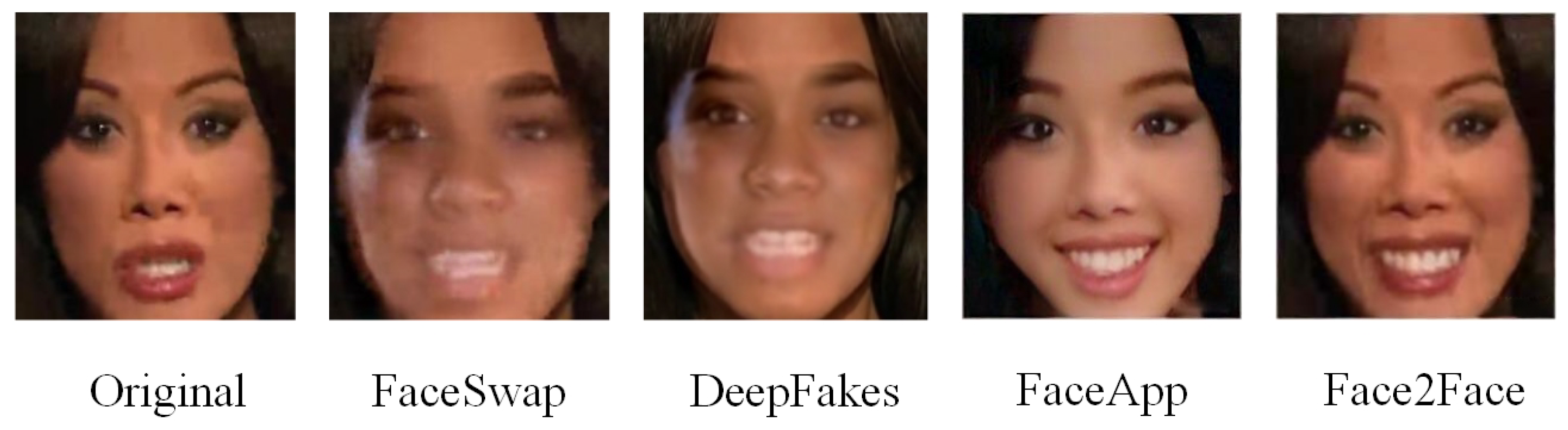
Face synthesis mainly generates non-existent but incredibly realistic human faces through GAN (such as Cycle-Consistent Adversarial Networks (CycleGAN)  [3] and Star Generative Adversarial Nets (StarGAN) [4]). In contrast, face swap replaces one person’s face with another person’s face, usually through two methods: FaceSwap method based on computer graphics and Deepfake method based on deep learning. Moreover, face expression swap, whose popular ways are Face2Face and FaceApp, modifies facial expressions, such as changing the crying expression into the laugh. As shown in Figure 1, among all four face images, only the first one is a natural optical image, and the remaining images are manipulated by various methods. Nevertheless, most manipulated faces are not detected due to the poor privacy of faces and the advanced manipulation technology. Using face manipulation technology to make fake videos will undoubtedly ruin the image of celebrities and politicians, for instance, the manipulated video of U.S. democratic leader Nancy Pelosi getting drunk that Trump shared on Facebook aroused great attention on the Internet. In addition, Obama’s video was also used to make manipulated videos. The manipulated targets are not only worldwide officials but also actors, singers, and even ordinary people. Therefore, it is necessary to design a method to detect all the manipulation types.
Figure 1. Face manipulated images.
When advanced face manipulation methods appear, various face manipulation detection methods are also emerging. Methods based on CNN [1] and some of its variants [5] have made significant progress. These methods can easily handle high-dimensional information and reduce the complexity of the network model. Recurrent Neural Network (RNN) [6,7], especially the Long Short-Term Memory (LSTM), also achieves good performance within the field. Besides, some technologies in other fields, such as natural language processing (NLP) [8], can also be used in the face manipulation detection task. Furthermore, the development of capsule network [9] has brought new way for face manipulation detection task. However, the above-mentioned methods only use single CNN as the feature extraction module, especially the CNN used in the capsule network method [9] only has three layers, which results in poor consistency between the features and the human visual mechanism. Therefore, the proposed method tackles above problems by proposing face manipulation detection method based on the supervised multi-feature fusion attention network named SMFAN.
The proposed model has apparent strengths. In particular, based on the original capsule network, the proposed model predicts the attention map by SMFAN. Then, in order to improve the problem of insufficient detail feature extracted by the original capsule network, the attention map is sent to the feature extraction module of the original capsule network. In addition, the introduction of focal loss [10] is utilized to prevent the vast number of easy negatives from overwhelming the detector during training. Finally, the experiments evaluate the proposed model on the FaceForensics++ [11] dataset, and the experimental results show that the proposed model is better than the original capsule network.
In summary, the main contributions of this paper are twofold:
  • Based on the work of the capsule network [9], the SMFAN is introduced to optimize the feature extraction module.
  • Use focal loss to down-weight the loss assigned to the well-classified examples.
The remainder of this paper is organized as follows. Section 2  introduces related work. Section 3  describes the proposed method, including the overall network structure, the SMFAN structure, and the loss function. Section 4  shows the experimental results, and Section 5  summarizes this paper.

3. Face Manipulation Detection Based on Supervised Multi-Feature Fusion Attention Network

3.1. The Overall Framework

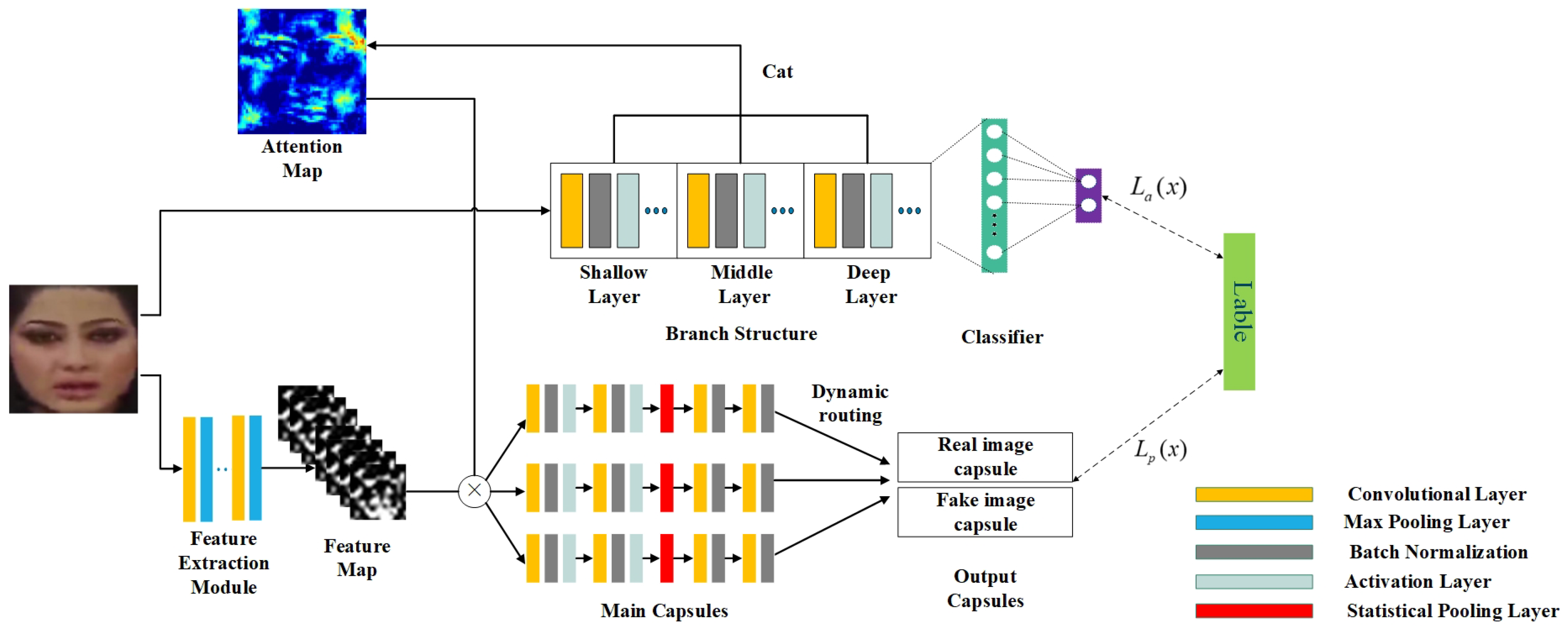
Traditional CNN employs scalars to represent neurons and weights, then estimates the probability of various features. In this paper, the capsule network is employed to predict the probability of feature with vector norm, which effectively reduces the error caused by the change of face posture information, such as the change of direction and angle during the prediction process. As shown in the lower part in Figure 2, the input images pass through the feature extraction module to obtain the feature maps. Then, they are input into the capsule network, which is divided into three main capsules and two output capsules. After the main capsules process the input features, the corresponding outputs are sent to two output capsules through the dynamic routing algorithm [9].
Figure 2. Network structure.
However, the original capsule network has obvious defects. It only uses the first three layers of VGG19 [29] as the feature extraction module, which weakens the detection accuracy. In order to optimize the feature extraction module in the original capsule network, the upper part of Figure 2, namely, SMFAN, is introduced. Specifically, the face is first input into the SMFAN to extract features. Then, the features are input into the classifier, which are divided into two categories: natural or manipulated face. Moreover, the result of the classifier is compared with the correct label of the face. At the same time, the process will output an attention map which is used for optimizing the feature extraction module of the capsule network. With the continuous optimization of parameters during training process, the output attention map is more and more in line with the human visual mechanism, and the optimization result of the feature extraction module is getting better and better. In addition, focal loss, which is proposed to address examples imbalance by reshaping the standard cross entropy loss, is adopted to supervise the training of model to improve detection accuracy.

3.2. Supervised Multi-Feature Fusion Attention Network

The original capsule network makes up for the shortcomings of traditional CNN to a certain extent. However, its feature extraction module is too shallow. As a result, the insufficient details of extracted features are input into the main capsules, which limits detection accuracy.
In recent years, the attention mechanism has become an essential concept in deep learning, especially computer vision. The attention mechanism that conforms to the human visual mechanism can perform intuitive visual interpretation for images or videos. The attention structure can be straightforward, just like directly introducing a convolutional layer and activation function into the original network and multiplying the obtained attention map with the original feature map. At present, the attention mechanism in many works is a variant of the above mode, that is, operating on the convolutional layer and changing the way to obtain the attention maps. For example, Sitaula et al. [30] concatenated the image after maximum pooling and average pooling, and then multiplied it with the feature map of the original VGG-16 after convolution. Dang et al. [17] introduced the attention mechanism based on salient features of face, where a regression-based method was used to estimate the attention map and then multiplied it with the input feature maps to optimize. However, the attention maps obtained by the above methods are all unsupervised, so the perception of image details is poor. Therefore, this paper proposes the SMFAN, which is a separate network to estimate the attention map. Compared with the traditional attention network, the proposed attention network has supervision information, and the purpose is to estimate the attention map that is in line with the human visual mechanism. The attention map contains low-level, middle-level, and high-level features, which has detailed information owned by the shallow layer and semantic information owned by the deep layer. Furthermore, it will be continuously optimized during training process. Finally, the obtained attention map is introduced into the feature extraction module of the capsule network to optimize detailed features while retaining the structure of the capsule network.
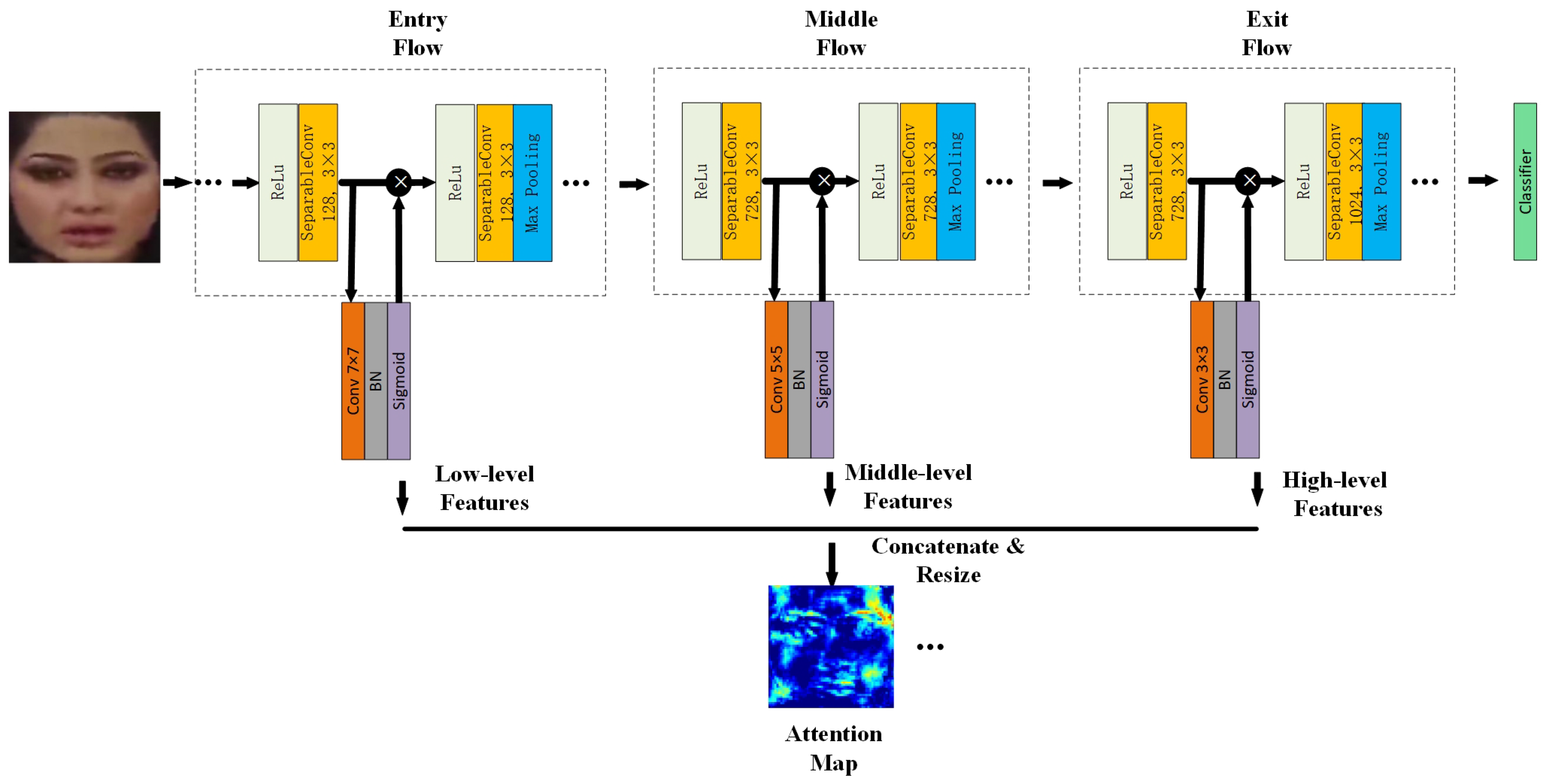
The process of obtaining the attention map is shown in Figure 3. XceptionNet, pre-trained by Imagenet  [31], is adopted as the attention network. The reason why XceptionNet is used is that it serves as the baseline network in face manipulation detection, which is also one of the best performing CNNs within this field. In addition, we conducted comparative experiments in Section 4.2.4 to prove that XceptionNet is a better choice.
Figure 3. Supervised attention network structure.
Estimating the attention map is realized by a convolutional layer, batch normalization (BN), and sigmoid activation function. Specifically, the attention map is estimated after the first separable convolution of the entry stream, the middle stream, and the exit stream, respectively, and the size of the convolution kernel is 7 × 7 , 5 × 5 , and 3 × 3 , respectively. Then, we resize the three attention maps to 64 × 64 and concatenate them. Finally, after changing the dimension of the cascading attention maps, the multi-feature fusion attention map is obtained. The obtained attention map is multiplied with the feature maps extracted from the feature extraction module to enhance the representability ability. The optimized feature map is defined by Equation (1):
A ( x ) = ( 1 + C o n ( M L ( x ) , M M ( x ) , M H ( x ) ) ) · A ( x ) ,
where M L ( x ) is the low-level features, M M ( x ) is the middle-level features, M H ( x ) is the high-level features, C o n represents the concatenation operation, and A ( x ) is the feature maps of the feature extraction module.
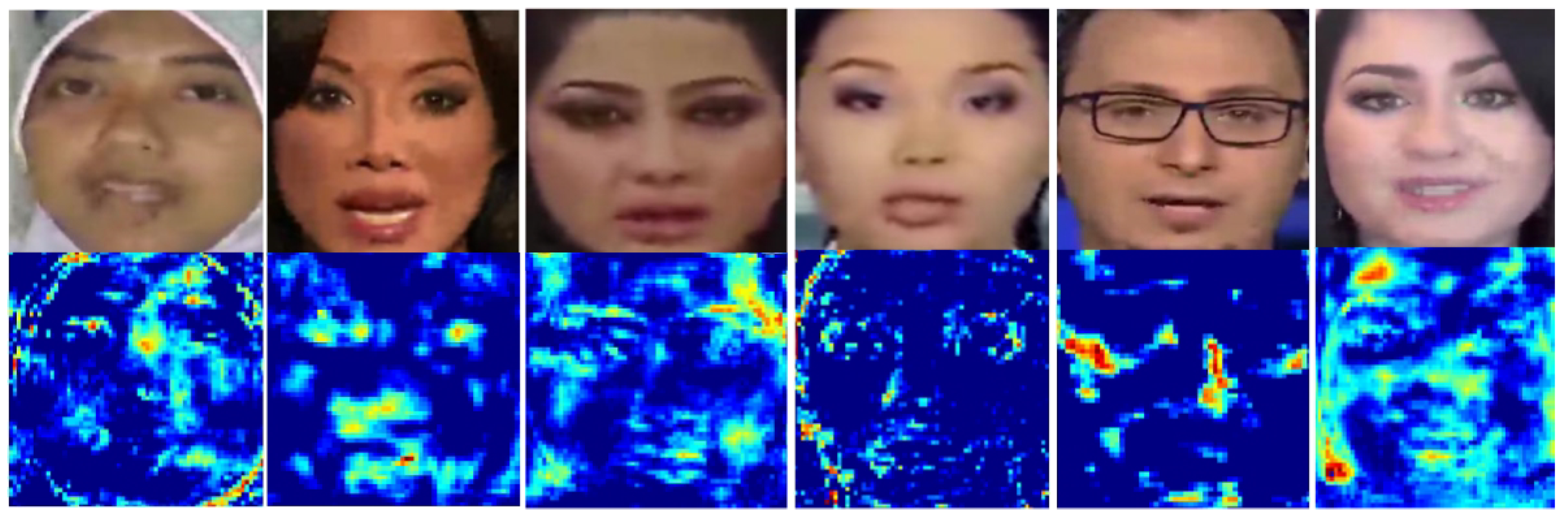
It can be seen from Equation (1) that each pixel of the estimated attention map is added with a constant 1. The purpose is that the constant can highlight the feature maps at the peak of the attention map and prevent the low pixel values from falling to 0. Experiments in Section 4.2.4 will evaluate the effect of adding the constant 1. As shown in Figure 4, some attention maps are visualized. The first row is the cropped face images, and the second row is the attention maps corresponding to the face images of the first row. It can be seen that the attention mechanism can effectively pay attention to the critical parts of the face, such as the eyes, nose, mouth, and the face profile.
Figure 4. Visualization of attention map.

3.3. Loss Function

Traditional cross-entropy loss treats all examples equally and is utilized by most of the current methods, which causes that these methods to treat hard examples like easy examples. Using models trained by the cross-entropy loss, unpredictable errors may occur, especially in detecting hard examples.
Focal loss [10] based on cross-entropy loss, by introducing a weighting factor α and a modulating factor γ , addresses the scenario where there is an extreme imbalance between positive and negative classes during training. The loss reduces the weights of easy examples in training, so it can also be understood as a kind of hard example mining. Therefore, focal loss is adopted to improve the detection performance of hard examples in this paper, and the loss function L is defined by Equation (2):
L = { ( 1 α ) ( y ) γ lg ( 1 y ) , y = 0 α ( 1 y ) γ lg y , y = 1 ,
where y is the output, α is used to balance the imbalance in the number of positive and negative examples, γ is used to reduce the loss contribution from easy examples and extends the range in which an example receives low loss, and y is the label, where y = 1 represents positive examples and y = 0 represents negative examples.
The loss is used in the capsule network and the SMFAN, and the total loss L ( x ) in the training process is shown in Equation (3):
L ( x ) = L a ( x ) + L p ( x ) ,
where L a ( x ) is the focal loss of the SMFAN branch, and L p ( x ) is the focal loss of the capsule network. The definitions of the above two losses are defined by Equations (4) and (5):
L a ( x ) = { ( 1 α a ) ( y a ) γ a ( 1 y a ) , y = 0 α a ( 1 y a ) γ a lg y a , y = 1 ,
L p ( x ) = { ( 1 α p ) ( y p ) γ p lg ( 1 y p ) , y = 0 α p ( 1 y p ) γ p lg y p , y = 1 ,
where y a and y p are the output of the SMFAN branch and capsule network, respectively. α a and α p are used to balance the importance of positive and negative examples in the SMFAN branch and capsule network, respectively. γ a and γ p are used to reduce the loss contribution from well-classified examples in the SMFAN branch and capsule network, respectively. y is the label.
In summary, the process of the SMFAN algorithm is shown in Algorithm 1.
Algorithm 1 SMFAN
Input: The image I;
Output: The label: 0 (manipulated) or 1 (real);
for all training images do
  1. Input the image I to the Xception network for classification (real or manipulated);
  2. Estimate the attention maps M L ( x ) , M M ( x ) , M H ( x ) after the first separable convolution of the entry stream, the middle stream, and the exit stream;
  3. Resize the three attention maps to 64 × 64 and concatenate them to obtain the multi-feature fusion attention map C o n ( M L ( x ) , M M ( x ) , M H ( x ) ) ;
  4. Obtain the feature maps A ( x ) via the feature extraction module of the capsule network;
  5. The multi-feature fusion attention map is multiplied with A ( x ) , namely A ( x ) = ( 1 + C o n ( M L ( x ) , M M ( x ) , M H ( x ) ) ) · A ( x ) is obtained;
  6. Through the dynamic routing algorithm of the capsule network, the results are output to two output capsules, 0 or 1 respectively;
  7. Calculate the total focal loss L and back propagate to update network parameters.
end for

4. Experimental Results and Analysis

4.1. Experimental Settings

4.1.1. Datasets

FaceForensics [32] dataset is used in this paper, which includes more than 1000 videos (contains 500,000 frames of images) manipulated by Face2Face. Subsequently, an extended version of the FaceForensics dataset named FaceForensics++ is released, which is further expanded by DeepFakes and FaceSwap technology. It includes 3000 fake videos (contains 1.5 million frames of images). Nowadays, it has become the benchmark dataset for most researchers in the field. Besides, Deepfake Detection Challenge (DFDC) has been released as part of the DFDC Kaggle competition, and Diverse Fake Face Dataset (DFFD) [17], including 2.6 million images, comprises various categories of face manipulations.
In this paper, three manipulation types are picked from the FaceForensics++ [11] dataset for experiments: DeepFakes, FaceSwap, and Face2Face. Among the 1000 videos of each type, 720 videos are randomly selected as the training set, and 270 frames are extracted from each video; 140 videos are randomly selected as the validation set, and the remaining 140 videos are selected as the test set. One-hundred frames are extracted from both the validation set and the test set. Afterwards, the MTCNN [33] algorithm is used to locate and recognize the faces in videos and crop the faces, which are used as the data in the experiment.

4.1.2. Experimental Settings

During the training process, the input image size is 256 × 256 . Epoch is set to 20 for training, and the batch size is set to 32. The learning rate of capsule network is 0.001 , while the learning rate of the SMFAN branch is 0.0001 . The Stochastic Gradient Descent (SGD) method is used for optimization. The focal losses in capsule network and the SMFAN branch are consistent, where the weighting factor α a and α p are 0.25 , and the modulating factor γ a and γ p are 2. The Pytorch is used as the basic framework, and the GPU is NVIDIA RTX 2080Ti.

4.2. Experimental Results and Analysis

Based on capsule network, this paper proposes to use SMFAN to optimize the feature extraction module of capsule network, and use focal loss to replace the cross-entropy loss in the original network. In order to verify the superiority of the proposed method, the following experiments are done. Typically, all performances are reported on the same dataset and parameters, and all results are obtained based on the compressed version (compression rate is 23 % ) of FaceForensics++ dataset. Accuracy is used to measure the performance, which is defined by Equation (6):
a c c u r a c y = T P + T N t o t a l ,
where T P represents the number of samples that the positive class is judged to be positive, T N represents the number of samples that the negative class is judged to be negative, and t o t a l represents the total number of samples.

4.2.1. Comparative Experiment

In order to verify the effectiveness of the proposed method, the proposed method is compared with the original capsule network [9]. The reason why we only compare with capsule network is that SMFAN is proposed based on the capsule network [9], which aims to improve the feature extraction ability of the original capsule network.
Table 1 shows the experimental results on DeepFakes, FaceSwap, and Face2Face. The results show that for all manipulation types, the uncertainty has a certain degree of decline, which shows that our method is more stable. In addition, the results also show that for DeepFakes and Face2Face, the accuracy of the proposed method has been improved significantly, which has increased by more than 1 % . On the other hand, for the FaceSwap, the accuracy improvement is less, ~ 0.6 % . The reasons why the increase is small include the following aspects: (1) the FaceSwap is more mature in dealing with facial jitter and (2) the pose information of the face is more realistic in the process of replacing the entire face, which weakens the advantages of the capsule network.
Table 1. Comparison of the accuracy and the uncertainty of the proposed method and the original capsule network on different manipulation types.
In addition, to verify the generalization of the proposed method, all videos of the three manipulation types are integrated together as the new training set and test set. The results are shown in Table 2. The results show that compared with the original capsule network, the proposed method’s accuracy is increased by more than 4 % and the generalization ability is better. Furthermore, the performance advantage of uncertainty is obvious, which also proves its generalization and stability. The fundamental reason for the improvement lies in the important role of the attention branch, which can focus on key parts of the human face.
Table 2. Comparison of the accuracy and the uncertainty of the proposed method and the original capsule network on the FaceForensics++ dataset.

4.2.2. Model Performance Comparison Experiment

Nowadays, state-of-the-art methods with excellent detection results have been proposed. In order to verify the superiority of the proposed model, the comparative experiment is conducted on the Face2Face manipulation type. Table 3 shows the comparison of accuracy between the proposed method and other state-of-the-art methods on the Face2Face manipulation type.
Table 3. Comparison of accuracy between the proposed method and state-of-the-art methods on the Face2Face manipulation type.
It can be seen from Table 3 that compared with state-of-the-art methods, the detection performance of the proposed method has significant improvement. Among them, the advantages obtained by the proposed method are much greater than the one proposed by Cozzolino [34] and Bayar et al. [35], there is a significant performance improvement, which is approximately 19% and 12% respectively. Compared with the methods proposed by Afchar et al. [36] and Raghavendra et al. [37], it increases by approximately 5%. Compared with the baseline method proposed by Rossler et al. [11], the accuracy has an increase of ~0.9%. Compared with the methods proposed by Li et al. [38] and Zhu et al. [39] in 2020, the proposed method is also better. In summary, because the proposed method integrates the advantages of XceptionNet in feature extraction, the rich details and semantic information brought by multi-features fusion and the robustness of the capsule network, the proposed method is better than the state-of-the-art detection methods.

4.2.3. Ablation Experiment

In order to prove the respective effects of SMFAN and focal loss, the following ablation experiments are carried out: (1) introduce SMFAN and calculate its accuracy on the DeepFakes, FaceSwap, Face2Face manipulation types after training the model (replace the loss in Figure 2 with the cross-entropy loss), and (2) do not use SMFAN, only focal loss is used instead of cross-entropy loss (only use the lower part of Figure 2). The experimental results are shown in Table 4. It can be seen from Table 4 that for the manipulated types, the introduction of SMFAN greatly improves the performance, especially the DeepFakes type, which increases by approximately 0.9%. The focal loss makes the model focus on training a sparse set of hard examples, which also plays a role that cannot be ignored. In addition, for the FaceSwap type, the improvement of introducing SMFAN and focal loss is smaller than that of the DeepFakes and Face2Face types, which verifies the small improvement in the detection performance of the FaceSwap type in Section 4.2.1.
Table 4. Comparison of accuracy of introducing the SMFAN branch and focal loss on different manipulation types.
Then, the above experiments are performed again using the integrated dataset with all three types, and the experimental results are shown in Table 5. It can be seen from Table 5 that the improvement is approximately 2.7% when introduces SMFAN and 1.2% when introduces focal loss. The results also prove the above conclusion.
Table 5. Comparison of accuracy of introducing the SMFAN branch and focal loss on the FaceForensics++ dataset.

4.2.4. Branch Structure Model Experiment

Compared with the traditional attention mechanism, the attention branch in this paper has obvious characteristics—it has supervised information and contains rich features. Through directly obtaining the attention map based on the feature extraction module of the original capsule network and multiplying it with the feature map, this paper proves that SMFAN is more reasonable. The experimental results are shown in Table 6. Compared with directly introducing attention structure, our proposed SMFAN branch is more in line with the human visual mechanism because of the supervised multi-feature fusion attention map. It can be seen from Table 6 that the detection performance of the supervised SMFAN branch is improved by ~2.4%, which is significantly better than the traditional attention structure.
Table 6. Comparison of accuracy of directly introducing attention and using of SMFAN branch on the FaceForensics++ dataset.
In addition, the attention branches with a single feature and two-layer features (low-level and high-level) fusion are compared with the proposed three-layer features fusion (low-level, middle-level, and high-level). The experimental results are shown in Table 7. Due to equipment limitations, this paper only carries out three-layer feature fusion. It can be concluded that the more fused features, the better the performance.
Table 7. Comparison of accuracy of features fusion of different layers on the FaceForensics++ dataset.
Further, in order to verify the influence of the constant 1 mentioned in Section 3.2, we compare the results of whether to introduce the constant 1 in SMFAN. From the results of Table 8, the constant 1 improves the model’s accuracy, increasing by 0.28%. It can be seen that the constant 1 does have the significance in highlighting the feature maps and preventing low-value pixels.
Table 8. Comparison of accuracy of whether to introduce the constant 1 in the SMFAN branch.
Furthermore, we conducted comparative experiments in Table 9 to prove XceptionNet performs better than VGG-16 as the branch network. More specifically, VGG-16 has three fully connected layers, which means that VGG-16 has more parameters, and the real-time performance is poor. Moreover, the accuracy of XceptionNet is higher, so XceptionNet is used in our work.
Table 9. Comparison of the accuracy of XceptionNet and VGG-16 on the FaceForensics++ dataset.

4.2.5. Time Performance Comparison Experiment

We compare the number of network parameters and processing time of different methods. The results are shown in Table 10. It can be concluded that compared with the method based on capsule network, the parameters of our method are increased by approximately 3 times, but the processing time for a single image only increased by approximately 0.5 times. When compared with the method proposed by Rossler et al., the number of parameters has increased by 7000K, but the processing time for a single image is similar. In summary, although the number of parameters of the proposed method has increased, the processing time is only slightly increased with high accuracy. In a word, the proposed method has a better balance between performance and time.
Table 10. Comparison of the number of network parameters and processing time between different methods.
Therefore, in the scenarios of the strict real-time requirements, the proposed method may not meet the requirements because it uses time in exchange for performance. The best solution to this problem is of course to use a network with fewer parameters and higher performance, which will be one of the focuses of the future work.

5. Conclusions

This paper proposes a capsule network structure based on SMFAN to detect whether videos or images have been manipulated. For the input image, this paper uses SMFAN to estimate the attention map, which is used to optimize the feature extraction module of capsule network. Then capsule network is used to detect whether the input is real or fake, and the focal loss is used to improve the detection accuracy. The experimental results show that the proposed method has a significant performance improvement compared with the state-of-the-art methods, and has better discriminant ability when various manipulation types are mixed. The focus of future work will be on the real-time performance improvement. In addition, the use of improved capsule network is also a major focus of future work.

Author Contributions

Conceptualization, L.C., W.S. and F.Z.; methodology, W.S.; software, F.Z.; validation, L.C., K.D. and P.S.; formal analysis, F.Z.; investigation, C.F.; resources, K.D.; data curation, F.Z. and P.S.; writing—original draft preparation, L.C.; writing—review and editing, W.S. and F.Z.; visualization, W.S.; supervision, C.F.; project administration, K.D.; funding acquisition, P.S. All authors have read and agreed to the published version of the manuscript.

Funding

This work was supported in part by the National Science Foundation of China under Grant U20A20163 and Grant 61671069, in part by the Scientific Research Project of Beijing Municipal Education Commission under Grant KZ202111232049 and Grant KM202011232021, and in part by the Qin Xin Talents Cultivation Program under Grant QXTCP A201902.

Institutional Review Board Statement

Not applicable.

Data Availability Statement

The original datasets are publicly available from Github (https://github.com/ondyari/FaceForensics).

Conflicts of Interest

The authors declare no conflict of interest.

References

  1. Gu, J.; Wang, Z.; Kuen, J.; Ma, L.; Shahroudy, A. Recent advances in convolutional neural networks. arXiv 2015, arXiv:1512.07108. [Google Scholar] [CrossRef] [Green Version]
  2. Goodfello, I. Generative adversarial nets. In Proceedings of the Advances in Neural Information Processing Systems, Montreal, QC, Canada, 8–13 December 2014; pp. 2672–2680. [Google Scholar]
  3. Zhu, J.Y. Unpaired image-to-image translation using cycle-consistent adversarial networks. In Proceedings of the IEEE International Conference on Computer Vision (ICCV2017), Venice, Italy, 22–29 October 2017; pp. 2223–2232. [Google Scholar]
  4. Choi, Y.; Choi, M.; Kim, M. StarGAN: Unified Generative Adversarial Networks for Multi-Domain Image-to-Image Translation. In Proceedings of the IEEE Conference on Computer Vision and Pattern Recognition (CVPR2018), Salt Lake City, UT, USA, 19–21 June 2018; pp. 8789–8797. [Google Scholar]
  5. Bayar, B.; Stamm, M.C. Constrained convolutional neural networks: A new approach towards general purpose image ma-nipulation detection. In Proceedings of the IEEE Transactions on Information Forensics and Security (TIFS2018), Kaohsiung, Taiwan, China, 10–12 April 2018; pp. 2691–2706. [Google Scholar]
  6. Guera, D.; Delp, E. Deepfake Video Detection Using Recurrent Neural Networks. In Proceedings of the International Conference on Advanced Video and Signal Based Surveillance (AVSS2018), Auckland, New Zealand, 27–30 November 2018; pp. 1–6. [Google Scholar]
  7. Sabir, E.; Cheng, J.; Jaiswal, A.; AbdAlmageed, W.; Masi, I.; Natarajan, P. Recurrent Convolutional Strategies for Face Manipulation Detection in Videos. In Proceedings of the IEEE Conference on Computer Vision and Pattern Recognition Workshops (CVPRW2019), Long Beach, CA, USA, 16–20 June 2019; pp. 80–87. [Google Scholar]
  8. Wodajo, D.; Atnafu, S. Deepfake Video Detection Using Convolutional Vision Transformer. arXiv 2021, arXiv:2102.11126. [Google Scholar]
  9. Nguyen, H.H.; Yamagishi, J.; Echizen, I. Use of a Capsule Network to Detect Fake Images and Videos. arXiv 2019, arXiv:1910.12467. [Google Scholar]
  10. Lin, Y.; Goyal, P.; Girshick, R.; He, K.; Dollár, P. Focal Loss for Dense Object Detection. IEEE Trans. Pattern Anal. Mach. Intell. 2020, 42, 318–327. [Google Scholar] [CrossRef] [PubMed] [Green Version]
  11. Rossler, A.; Cozzolino, D.; Verdoliva, L.; Verdoliva, L.; Riess, C.; Thies, J.; Nießner, M. FaceForensics++: Learning to Detect Manipulated Facial Images. arXiv 2019, arXiv:1901.08971. [Google Scholar]
  12. Karras, T.; Laine, S.; Aila, T. A Style-Based Generator Architecture for Generative Adversarial Networks. arXiv 2018, arXiv:1812.04948. [Google Scholar]
  13. Nirkin, Y.; Keller, Y.; Hassner, T. FSGAN: Subject Agnostic Face Swapping and Reenactment. In Proceedings of the IEEE International Conference on Computer Cision (ICCV2019), Seoul, Korea, 27 October–2 November 2019; pp. 7183–7192. [Google Scholar]
  14. Natsume, R.; Yatagawa, T.; Morishima, S. RSGAN: Face Swapping and Editing Using Face and Hair Representation in Latent Spaces. In Proceedings of the SIGGRAPH’ 18 ACM SIGGRAPH 2018 Posters, New York, NY, USA, 12–16 August 2018; pp. 1–2. [Google Scholar]
  15. Thies, J.; Zollhofer, M.; Stamminger, M.; Theobalt, C.; NieBner, M. Face2face: Real-Time Face Capture and Reenactment Of RGB Videos. In Proceedings of the IEEE Conference on Computer Vision and Pattern Recognition (CVPR2016), Las Vegas, NV, USA, 27–30 June 2016; pp. 2387–2395. [Google Scholar]
  16. Chollet, F. Xception: Deep Learning with Depthwise Separable Convolutions. In Proceedings of the IEEE Conference on Computer Vision and Pattern Recognition (CVPR2017), Honolulu, HI, USA, 22–25 July 2017; pp. 1800–1807. [Google Scholar]
  17. Dang, H.; Liu, F.; Stehouwer, J.; Liu, X.; Jain, A. On the Detection of Digital Face Manipulation. In Proceedings of the IEEE Conference on Computer Vision and Pattern Recognition (CVPR2020), Online, 14–19 June 2020; pp. 5780–5789. [Google Scholar]
  18. Durall, R.; Keuper, M.; Keuper, J. Watch your Up-Convolution: CNN Based Generative Deep Neural Networks are Failing to Reproduce Spectral Distributions. In Proceedings of the IEEE Conference on Computer Vision and Pattern Recognition (CVPR2020), Online, 14–19 June 2020; pp. 7887–7896. [Google Scholar]
  19. Guo, Z.Q.; Yang, G.; Chen, J.Y.; Sun, X.M. Fake Face Detection via Adaptive Residuals Extraction Network. arXiv 2020, arXiv:2005.04945. [Google Scholar]
  20. Zhou, P.; Han, X.; Morariu, V.; Davis, L. Two-Stream Neural Networks for Tampered Face Detection. In Proceedings of the IEEE Conference on Computer Vision and Pattern Recognition Workshops (CVPRW2017), Honolulu, HI, USA, 22–25 July 2017; pp. 1831–1839. [Google Scholar]
  21. Szegedy, C.; Vanhoucke, V.; Ioffe, S.; Shlens, J.; Wojna, Z. Rethinking the inception architecture for computer vision. In Proceedings of the IEEE Conference on Computer Vision and Pattern Recognition (CVPR2016), Las Vegas, NV, USA, 27–30 June 2016; pp. 2818–2826. [Google Scholar]
  22. Fridrich, J.; Kodovsky, J. Rich models for steganalysis of digital images. IEEE Trans. Inf. Forensics Secur. 2012, 7, 868–882. [Google Scholar] [CrossRef] [Green Version]
  23. Nataraj, L.; Mohammed, Y.; Manjunath, B.; Chandrasekaran, S.; Flenner, A.; Bappy, J.; Roy-Chowdhury, A. Detecting GAN Generated Fake Images Using Co-Occurrence Matrices. Electron. Imaging 2019, 5, 1–7. [Google Scholar] [CrossRef] [Green Version]
  24. Wang, C.; Li, Z.; Sarpong, B. Multimodal adaptive identity-recognition algorithm fused with gait perception. Big Data Min. Anal. 2019, 4, 223–232. [Google Scholar] [CrossRef]
  25. Zhao, X.; Wang, Z.; Gao, L.; Li, Y.; Wang, S. Incremental face clustering with optimal summary learning via graph convolutional network. Tsinghua Science and Technology. Tsinghua Sci. Technol. 2021, 26, 536–547. [Google Scholar] [CrossRef]
  26. Liu, Y.; Song, Z.; Xu, X.; Rafique, W.; Zhang, X.; Shen, J.; Khosravi, M.R.; Qi, L. Bidirectional GRU networks-based next POI category prediction for healthcare. Int. J. Intell. Syst. 2021. [Google Scholar] [CrossRef]
  27. Yang, Z.; Chen, H.; Zhang, J.; Ma, J.; Chang, Y. Attention-based Multi-level Feature Fusion for Named Entity Recognition. In Proceedings of the Twenty-Ninth International Joint Conference on Artificial Intelligence (IJCAI2020), Yokohama, Japan, 7–15 January 2021; pp. 3594–3600. [Google Scholar]
  28. Qin, X.; Wang, Z.; Bai, Y. FFA-Net: Feature fusion attention network for single image dehazing. In Proceedings of the AAAI Conference on Artificial Intelligence(AAAI2020), New York, NY, USA, 7–12 February 2020; pp. 11908–11915. [Google Scholar]
  29. Simonyan, K.; Zisserman, A. Very deep convolutional networks for large-scale image recognition. arXiv 2014, arXiv:1409.1556. [Google Scholar]
  30. Sitaula, C.; Hossain, M.B. Attention-based VGG-16 model for COVID-19 chest X-ray image classification. Appl. Intell. 2021, 51, 2850–2863. [Google Scholar] [CrossRef] [PubMed]
  31. Deng, J.; Dong, W. Imagenet: A Large-Scale Hierarchical Image Database. In Proceedings of the IEEE Conference on Computer Vision and Pattern Recognition (CVPR2009), Miami, FL, USA, 20–25 June 2016; pp. 248–255. [Google Scholar]
  32. Rossler, A.; Cozzolino, D.; Verdoliva, L.; Verdoliva, L.; Riess, C.; Thies, J.; Nießner, M. Faceforensics: A Large-Scale Video Dataset for Forgery Detection in Human Faces. arXiv 2018, arXiv:1803.09179. [Google Scholar]
  33. Zhang, K.P.; Zhang, Z.P.; Li, Z.F.; Qiao, Y. Joint Face Detection and Alignment Using Multitask Cascaded Convolutional Networks. IEEE Signal Process. Lett. 2016, 23, 10:1499–10:1503. [Google Scholar] [CrossRef] [Green Version]
  34. Cozzolino, D.; Poggi, G.; Verdoliva, L. Recasting Residual-Based Local Descriptors as Convolutional Neural Networks: An Application to Image Forgery Detection. In Proceedings of the 5th ACM Workshop on Information Hiding and Multimedia Security, Philadelphia, PA, USA, 20–22 June 2017; pp. 159–164. [Google Scholar]
  35. Bayar, B.; Stamm, M.C. A Deep Learning Approach To Universal Image Manipulation Detection Using A New Convolutional Layer. In Proceedings of the 4th ACM Workshop on Information Hiding and Multimedia Security, Vigo, Spain, 20–22 June 2016; pp. 5–10. [Google Scholar]
  36. Afchar, D.; Nozick, V.; Yamagishi, J.; Echizen, I. Mesonet: A Compact Facial Video Forgery Detection Network. In Proceedings of the IEEE International Workshop on Information Forensics and Security (WIFS2018), Hong Kong, China, 11–13 December 2018; pp. 1–7. [Google Scholar]
  37. Raghavendra, R.; Venkatesh, S.; Christoph Busch, R.B. Transferable Deep-CNN Features for Detecting Digital and Print-Scanned Morphed Face Images. In Proceedings of the IEEE Conference on Computer Vision and Pattern Recognition Workshops (CVPRW2017), Honolulu, HI, USA, 22–25 July 2017; pp. 1822–1830. [Google Scholar]
  38. Li, L.Z.; Bao, J.M.; Zhang, T.; Yang, H.; Chen, D.; Wen, F.; Guo, B.N. Face X-Ray for More General Face Forgery Detection. In Proceedings of the IEEE Conference on Computer Vision and Pattern Recognition (CVPR2020), Seattle, WA, USA, 13–19 June 2020; pp. 5000–5009. [Google Scholar]
  39. Zhu, X.; Wang, H.; Fei, H.Y.; Lei, Z.; Li, S.Z. Face Forgery Detection by 3D Decomposition. arXiv 2020, arXiv:2011.09737. [Google Scholar]
Publisher’s Note: MDPI stays neutral with regard to jurisdictional claims in published maps and institutional affiliations.

Article Metrics

Citations

Article Access Statistics

Multiple requests from the same IP address are counted as one view.