


Enhanced Single Image Super Resolution Method Using Lightweight Multi-Scale Channel Dense Network



Abstract
1. Introduction
- We propose multi-scale channel dense block (MCDB) to design the CNN based lightweight SR network structure.
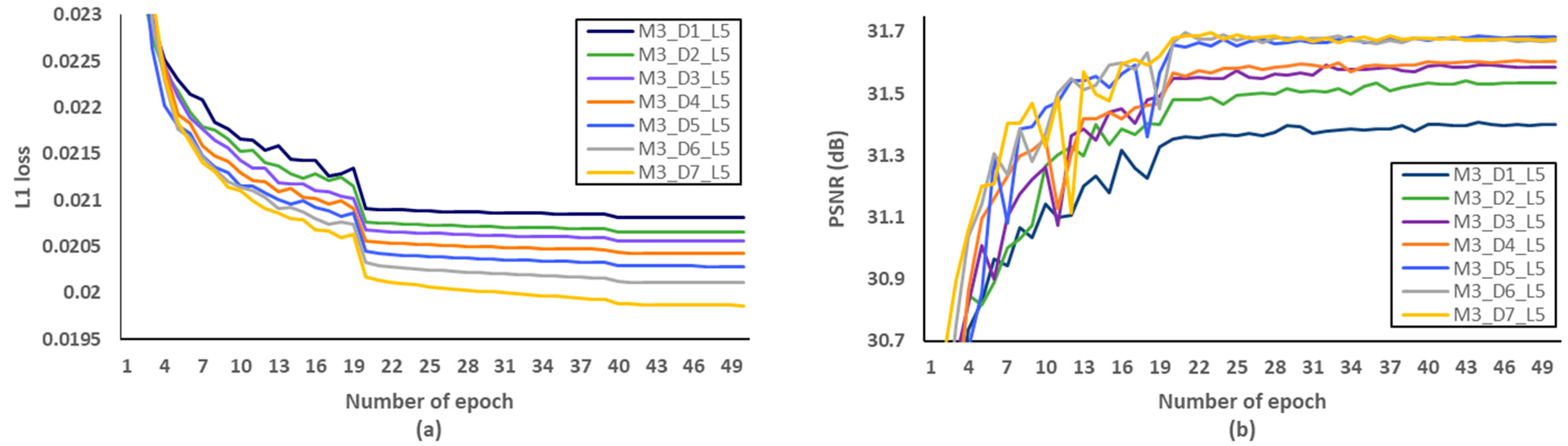
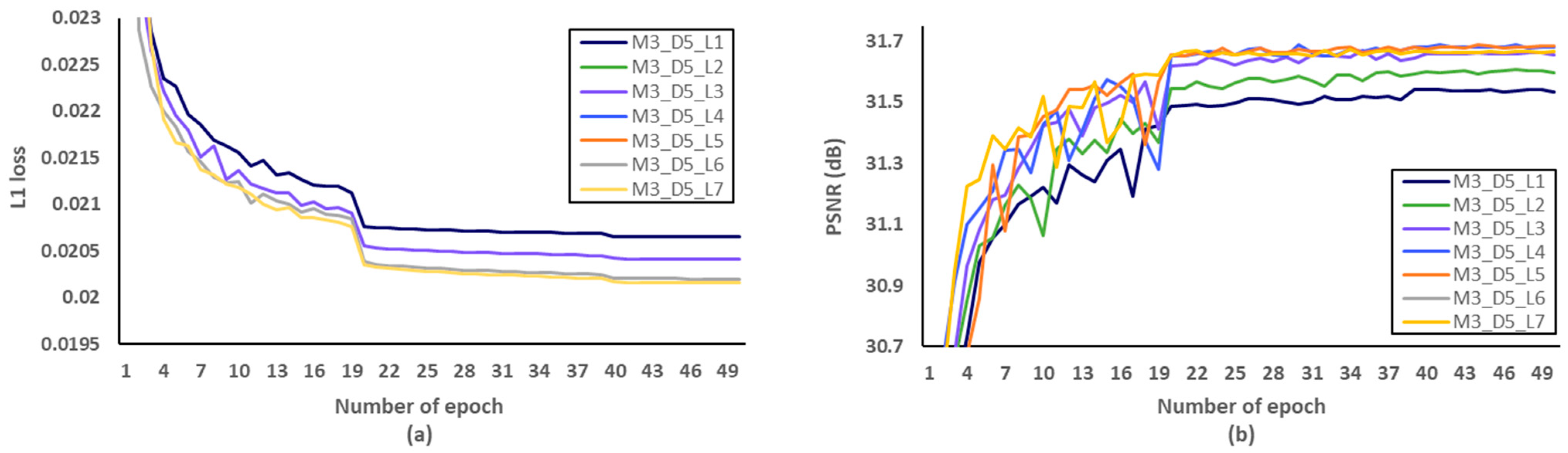
- Through a variety of ablation works, the proposed network architectures are optimized in terms of the optimal number of the dense blocks and the dense layers.
- Finally, we investigate the trade-off between the network complexity and the SR performance on publicly available test datasets compared to the previous method.
2. Related Works
3. Proposed Method
3.1. Overall Architecture of MCDN
3.2. MCDN Training
4. Experimental Results
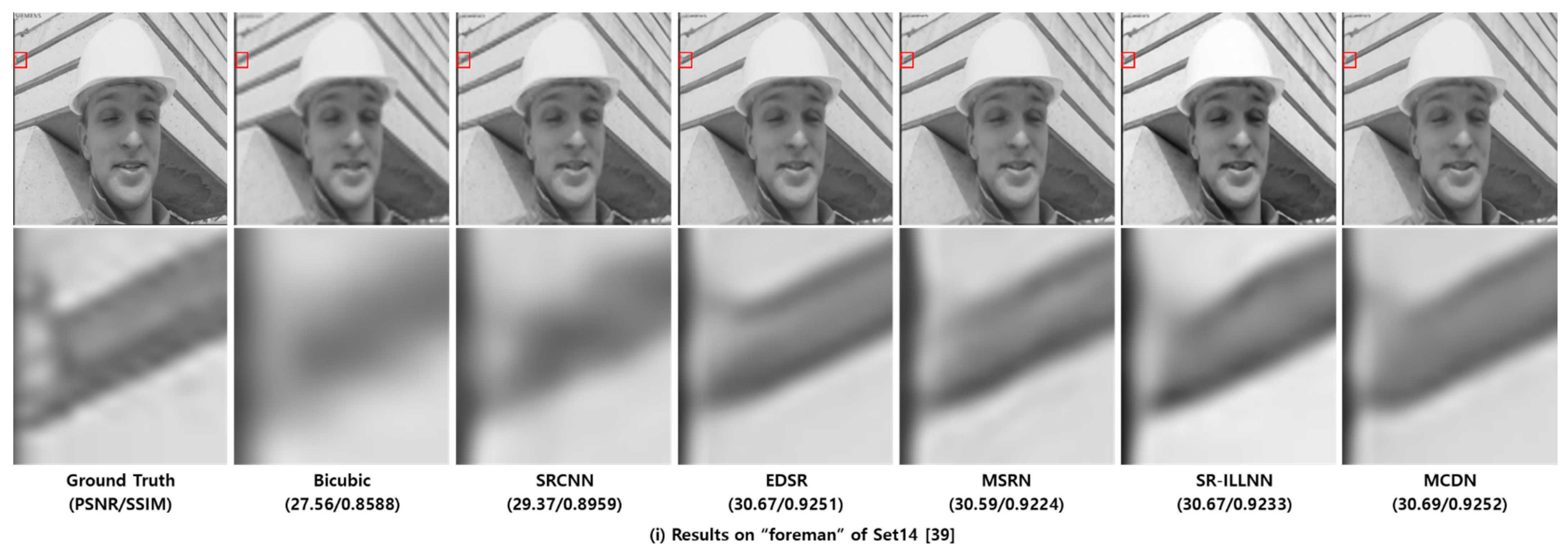
4.1. Performance Measurements
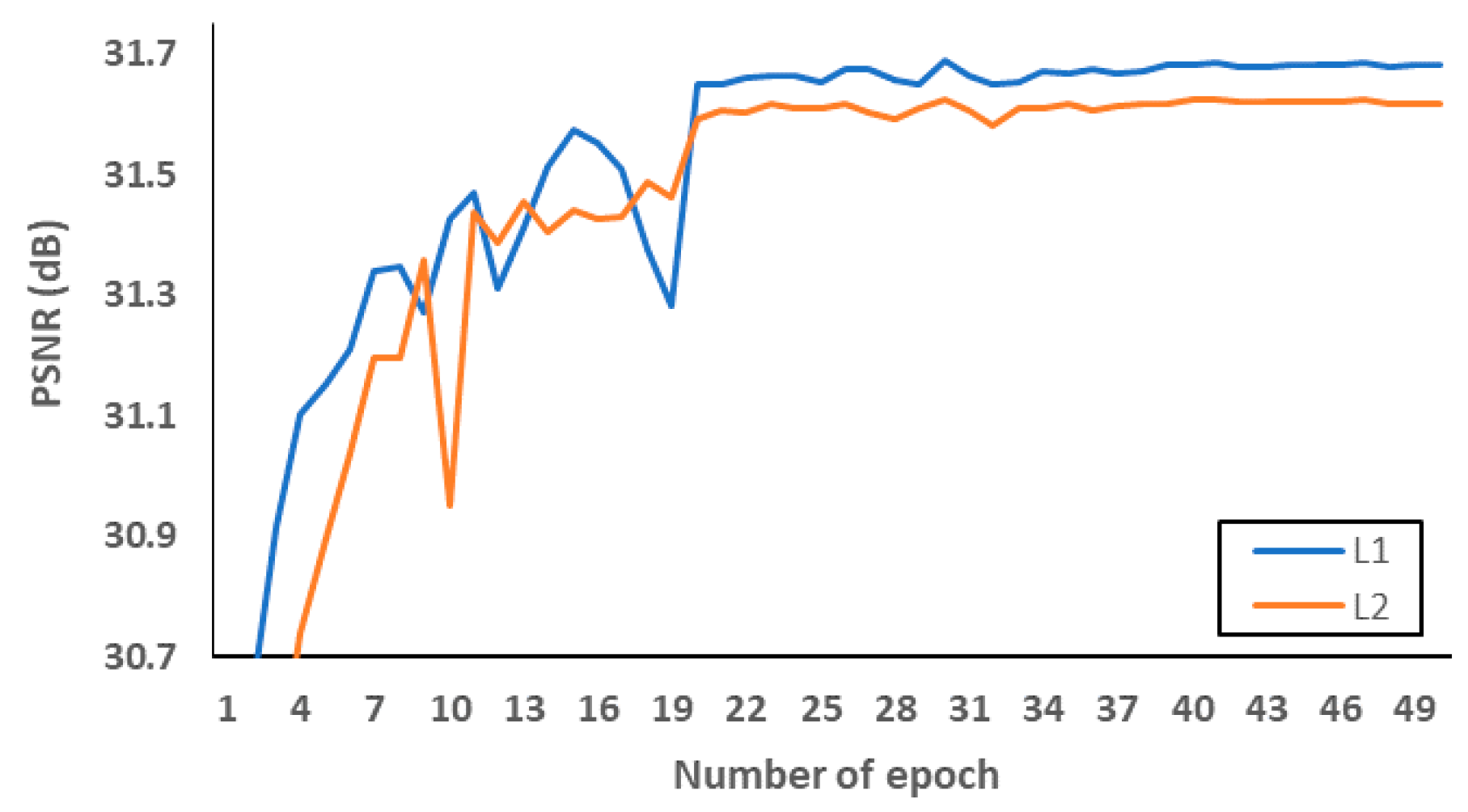
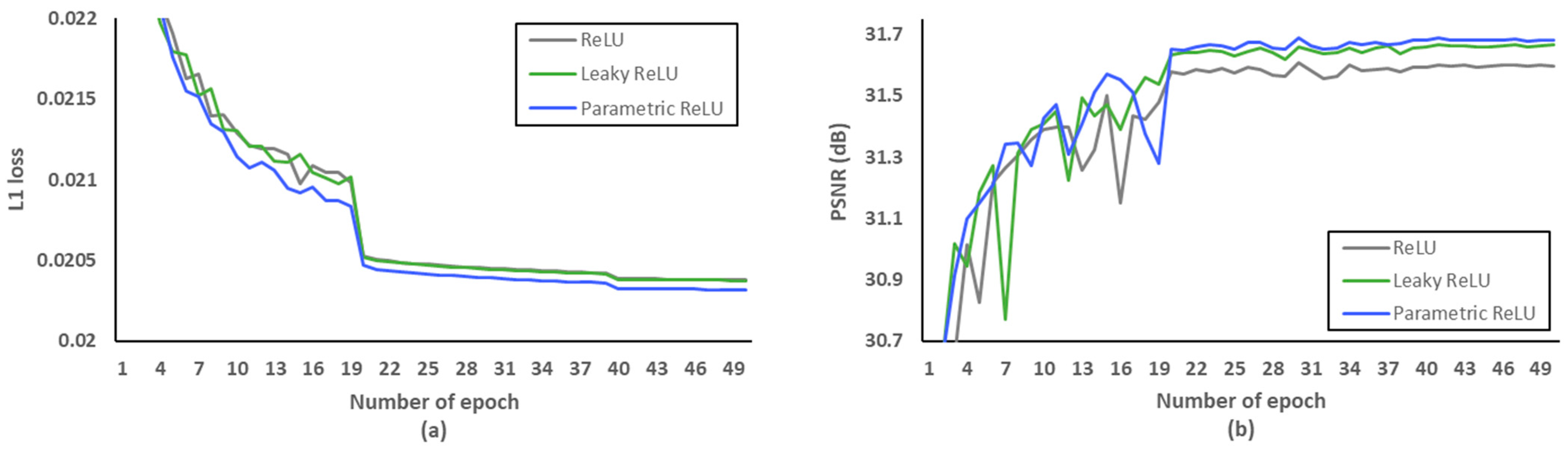
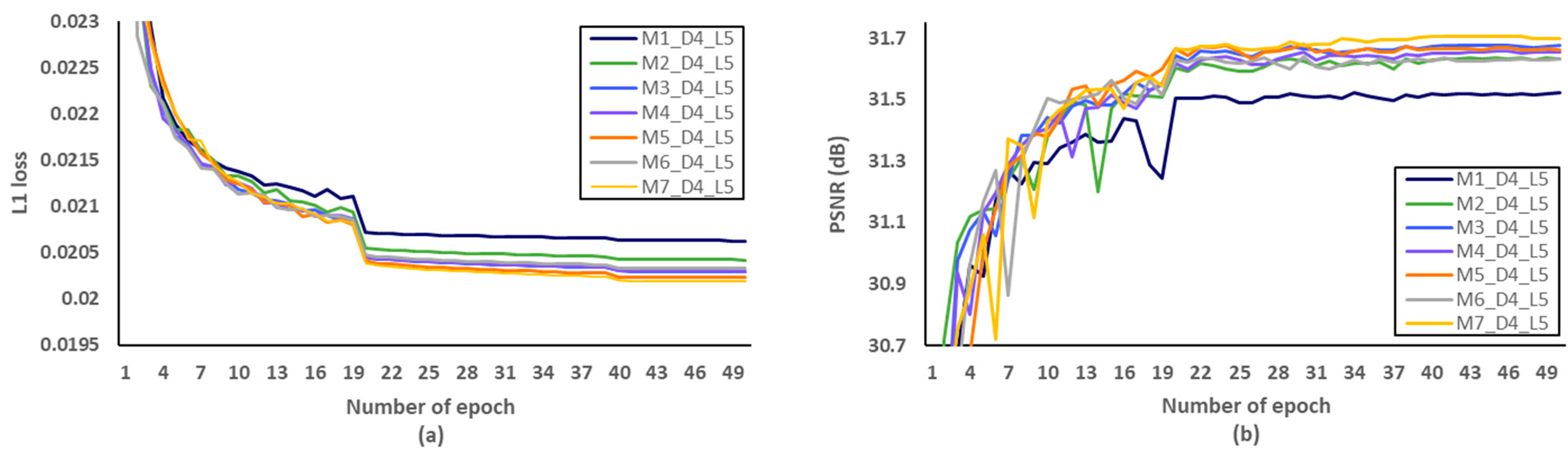
4.2. Ablation Studies
5. Conclusions
Author Contributions
Funding
Institutional Review Board Statement
Informed Consent Statement
Data Availability Statement
Acknowledgments
Conflicts of Interest
References
- Chen, L.; Ding, Q.; Zou, Q.; Chen, Z.; Li, L. DenseLightNet: A Light-Weight Vehicle Detection Network for Autonomous Driving. IEEE Trans. Ind. Electron. 2020, 12, 10600–10609. [Google Scholar] [CrossRef] [Scilit]
- Wells, J.; Chatterjee, A. Content-Aware Low-Complexity Object Detection for Tracking Using Adaptive Compressed Sensing. IEEE J. Emerg. Sel. Top. Power Electron. 2018, 8, 578–590. [Google Scholar] [CrossRef] [Scilit]
- Gong, M.; Shu, Y. Real-Time Detection and Motion Recognition of Human Moving Objects Based on Deep Learning and Multi-Scale Feature Fusion in Video. IEEE Access 2020, 8, 25811–25822. [Google Scholar] [CrossRef] [Scilit]
- Oliveira, B.; Ferreira, F.; Martins, C. Fast and Lightweight Object Detection Network: Detection and Recognition on Resource Constrained Devices. IEEE Access 2017, 6, 8714–8724. [Google Scholar] [CrossRef] [Scilit]
- Zhang, J.; Zhu, H.; Wang, P.; Ling, A.X. ATT Squeeze U-Net: A Lightweight Network for Forest Fire Detection and Recognition. IEEE Access 2020, 9, 10858–10870. [Google Scholar] [CrossRef] [Scilit]
- Chen, G.; Wang, H.; Chen, K.; Li, Z.; Song, Z.; Liu, Y.; Chen, W.; Knoll, A. A Survey of the Four Pillars for Small Object Detection: Multiscale Representation, Contextual Information, Super-Resolution, and Region Proposal. IEEE Trans. Syst. Man Cybern. Syst. 2020. [Google Scholar] [CrossRef] [Scilit]
- Peled, S.; Yeshurun, Y. Superresolution in MRI: Application to Human White Matter Fiber Visualization by Diffusion Tensor Imaging. Magn. Reason. Med. 2001, 45, 29–35. [Google Scholar] [CrossRef] [Scilit]
- Shi, W.; Caballero, J.; Ledig, C.; Zhang, X.; Bai, W.; Bhatia, K.; Marvao, A.; Dawes, T.; Regan, D.; Rueckert, D. Cardiac Image Super-Resolution with Global Correspondence Using Multi-Atlas PatchMatch. Med. Image Comput. Comput. Assist. Interv. 2013, 8151, 9–16. [Google Scholar]
- Thornton, M.; Atkinson, P.; Holland, D. Sub-pixel mapping of rural land cover objects from fine spatial resolution satellite sensor imagery using super-resolution pixel-swapping. Int. J. Remote Sens. 2006, 27, 473–491. [Google Scholar] [CrossRef] [Scilit]
- Zhang, L.; Zhang, H.; Shen, H.; Li, P. A super-resolution reconstruction algorithm for surveillance images. Signal Process. 2010, 90, 848–859. [Google Scholar] [CrossRef] [Scilit]
- Yang, C.; Ma, C.; Yang, M. Single-image super-resolution: A benchmark. In Proceedings of the European Conference on Computer Vision, Zurich, Switzerland, 6–12 September 2014; pp. 372–386. [Google Scholar]
- Lecun, Y.; Boser, B.; Denker, J.; Henderson, D.; Howard, R.E.; Hubbard, W.; Jackel, L.D. Backpropagation Applied to Handwritten Zip Code Recognition. Neural Comput. 1989, 1, 541–551. [Google Scholar] [CrossRef] [Scilit]
- Hore, A.; Ziou, D. Image quality metrics: PSNR vs. SSIM. International Conference on Pattern Recognition. In Proceedings of the 20th International Conference on Pattern Recognition, Istanbul, Turkey, 23–26 August 2010; pp. 2366–2369. [Google Scholar]
- Wang, Z.; Bovik, A.C.; Sheikh, H.; Simoncelli, E.P. Image quality assessment: From error visibility to structural similarity. IEEE Trans. Image Process. 2004, 13, 600–612. [Google Scholar] [CrossRef] [Scilit]
- Szegedy, C.; Liu, W.; Jia, Y.; Sermanet, P.; Reed, S.; Anguelov, D.; Erhan, D.; Vanhoucke, V.; Rabinovich, A. Going deeper with convolutions. In Proceedings of the IEEE Conference on Computer Vision and Pattern Recognition, Boston, MA, USA, 7–12 June 2015; pp. 1–9. [Google Scholar]
- He, K.; Zhang, X.; Ren, S.; Sun, J. Deep residual learning for image recognition. In Proceedings of the Conference on Computer Vision and Pattern Recognition, Las Vegas, NY, USA, 27–30 June 2016; pp. 770–778. [Google Scholar]
- Huang, G.; Liu, Z.; Van Der Maaten, L.; Weinberger, K. Densely connected convolutional networks. In Proceedings of the Conference on Computer Vision and Pattern Recognition, Honolulu, HI, USA, 21–26 July 2017; pp. 4700–4708. [Google Scholar]
- Dong, C.; Loy, C.; He, K.; Tang, X. Image super-resolution using deep convolutional networks. IEEE Trans. Pattern. Anal. Mach. Intell. 2015, 38, 295–307. [Google Scholar] [CrossRef] [Scilit] [PubMed]
- Dong, C.; Loy, C.; Tang, X. Accelerating the Super-Resolution Convolutional Neural Network. In Proceedings of the European Conference on Computer Vision, Amsterdam, The Netherlands, 8–16 October 2016; pp. 391–407. [Google Scholar]
- Shi, W.; Caballero, J.; Huszar, F.; Totz, J.; Aitken, A.; Bishop, R.; Rueckert, D.; Wang, Z. Real-Time Single Image and Video Super-Resolution Using an Efficient Sub-Pixel Convolutional Neural Network. In Proceedings of the IEEE Conference on Computer Vision and Pattern Recognition, Las Vegas, NV, USA, 27–30 June 2016; pp. 1874–1883. [Google Scholar]
- Kim, J.; Lee, J.; Lee, K. Accurate image super-resolution using very deep convolutional networks. In Proceedings of the Conference on Computer Vision and Pattern Recognition, Las Vegas, NY, USA, 27–30 June 2016; pp. 1646–1654. [Google Scholar]
- Ledig, C.; Theis, L.; Huszár, F.; Caballero, J.; Cunningham, A.; Acosta, A.; Aitken, A.; Tejani, A.; Totz, J.; Wang, Z.; et al. Photo-realistic single image super-resolution using a generative adversarial network. In Proceedings of the Conference on Computer Vision and Pattern Recognition, Honolulu, HI, USA, 21–26 July 2017; pp. 4681–4690. [Google Scholar]
- Goodfellow, I.; Abadie, J.; Mirza, M.; Xu, B.; Farley, D.; Ozair, S.; Courville, A.; Bengio, Y. Generative Adversarial Nets. Adv. Neural Inf. Process. Syst 2014, 2, 2672–2680. [Google Scholar]
- Tong, T.; Li, G.; Liu, X.; Gao, Q. Image super-resolution using dense skip connections. In Proceedings of the Conference on Computer Vision and Pattern Recognition, Honolulu, HI, USA, 21–26 July 2017; pp. 4799–4807. [Google Scholar]
- Zhang, Y.; Tian, Y.; Kong, Y.; Zhong, B.; Fu, Y. Residual Dense Network for Image Super-Resolution. In Proceedings of the Conference on Computer Vision and Pattern Recognition, Salt Lake City, UT, USA, 18–22 June 2018; pp. 2472–2481. [Google Scholar]
- Ahn, N.; Kang, B.; Sohn, K. Fast, Accurate, and Lightweight Super-Resolution with Cascading Residual Network. In Proceedings of the European Conference on Computer Vision, Munich, Germany, 8–14 September 2018; pp. 252–268. [Google Scholar]
- Lim, B.; Son, S.; Kim, H.; Nah, S.; Lee, K. Enhanced deep residual networks for single image super-resolution. In Proceedings of the Conference on Computer Vision and Pattern Recognition Workshops, Honolulu, HI, USA, 21–26 July 2017; pp. 136–144. [Google Scholar]
- Lai, W.; Huang, J.; Ahuja, J.; Yang, M. Deep Laplacian Pyramid Networks for Fast and Accurate Super-Resolution. In Proceedings of the Conference on Computer Vision and Pattern Recognition, Honolulu, HI, USA, 21–26 July 2017; pp. 624–632. [Google Scholar]
- Liu, Y.; Zhang, X.; Wang, S.; Ma, S.; Gao, W. Progressive Multi-Scale Residual Network for Single Image Super-Resolution. arXiv 2020, arXiv:2007.09552. [Google Scholar]
- Li, J.; Fang, F.; Mei, K.; Zhang, G. Multi-scale Residual Network for Image Super-Resolution. In Proceedings of the European Conference on Computer Vision, Munich, Germany, 8–14 September 2018; pp. 517–532. [Google Scholar]
- Kim, S.; Jun, D.; Kim, B.; Lee, H.; Rhee, E. Single Image Super-Resolution Method Using CNN-Based Lightweight Neural Networks. Appl. Sci. 2021, 11, 1092. [Google Scholar] [CrossRef] [Scilit]
- Zhao, H.; Gallo, O.; Frosio, I.; Kautz, J. Loss Functions for Image Restoration with Neural Networks. IEEE Trans. Comput. Imaging 2017, 3, 47–57. [Google Scholar] [CrossRef] [Scilit]
- Kingma, D.; Ba, J. Adam: A method for stochastic optimization. arXiv 2014, arXiv:1412.6980. [Google Scholar]
- Glorot, X.; Bordes, A.; Bengio, Y. Deep Sparse Rectifier Neural Networks. In Proceedings of the Fourteenth International Conference on Artificial Intelligence and Statistics, Fort Lauderdale, FL, USA, 11–13 April 2011; pp. 315–323. [Google Scholar]
- Redford, A.; Metz, L.; Chintala, S. Unsupervised representation learning with deep convolutional generative adversarial networks. arXiv 2015, arXiv:1511.06434. [Google Scholar]
- He, K.; Zhang, X.; Ren, S.; Sun, J. Delving deep into rectifiers: Surpassing human-level performance on imagenet classification. In Proceedings of the IEEE International Conference on Computer Vision, Santiago, Chile, 13–16 December 2015; pp. 1026–1034. [Google Scholar]
- Agustsson, E.; Timofte, R. NTIRE 2017 Challenge on Single Image Super-Resolution: Dataset and Study. In Proceedings of the Conference on Computer Vision and Pattern Recognition Workshops, Honolulu, HI, USA, 21–26 July 2017. [Google Scholar]
- Bavilacqua, M.; Roumy, A.; Guillemot, C.; Morel, M.L. Low-complexity single-image super-resolution based on nonnegative neighbor embedding. In Proceedings of the 23rd British Machine Vision Conference (BMVC), Surrey, UK, 3–7 September 2012; pp. 1–10. [Google Scholar]
- Zeyde, R.; Elad, M.; Protter, M. On single image scale-up using sparse-representations. In Proceedings of the International Conference on Curves and Sufaces, Avignon, France, 24–30 June 2010; pp. 711–730. [Google Scholar]
- Martin, D.; Fowlkes, C.; Tal, D.; Malik, J. A database of human segmented natural images and its application to evaluating segmentation algorithms and measuring ecological statistics. In Proceedings of the Eighth IEEE International Conference on Computer Vision, Vancouver, BC, Canada, 7–14 July 2001; pp. 416–423. [Google Scholar]
- Huang, J.; Singh, A.; Ahuja, N. Single Image Super-resolution from Transformed Self-Exemplars. In Proceedings of the IEEE Conference on Computer Vision and Pattern Recognition, Boston, MA, USA, 7–12 June 2015; pp. 5197–5206. [Google Scholar]
- Wang, Z.; Chen, J.; Hoi, S. Deep Learning for Image Super-resolution: A Survey. IEEE Trans. Pattern Anal. Mach. Intell. 2020. [Google Scholar] [CrossRef] [Scilit] [PubMed]
- Yang, W.; Zhang, X.; Tian, Y.; Wang, W.; Xue, J.H.; Liao, Q. Deep Learning for Single Image Super-Resolution: A Brief Review. IEEE Trans. Multimed. 2019, 21, 3106–3121. [Google Scholar] [CrossRef] [Scilit]
- Li, K.; Yang, S.; Dong, R.; Wang, X.; Huang, J. Survey of single image super-resolution reconstruction. IET Image Process. 2020, 14, 2273–2290. [Google Scholar] [CrossRef] [Scilit]
- Zhao, H.; Gallo, O.; Frosio, I.; Kautz, J. Loss functions for neural networks for image processing. arXiv 2015, arXiv:1511.08861. [Google Scholar]
- Mass, A.; Hannun, A.; Ng, A. Rectifier Nonlinearities Improve Neural Network Acoustic Models. In Proceedings of the 30th International Conference on Machine Learning, Atlanta, GA, USA, 16–21 June 2013; Volume 30, pp. 1–6. [Google Scholar]

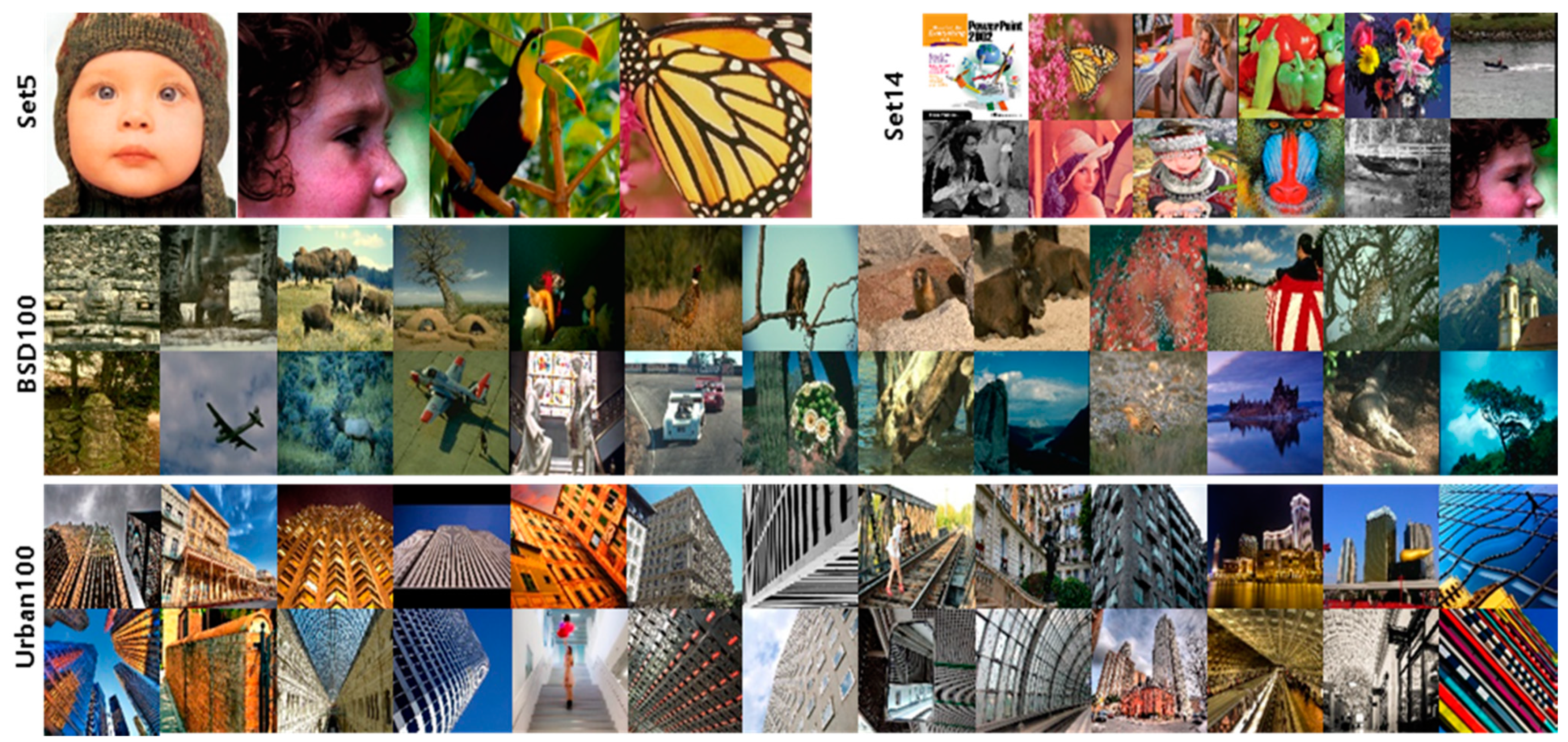
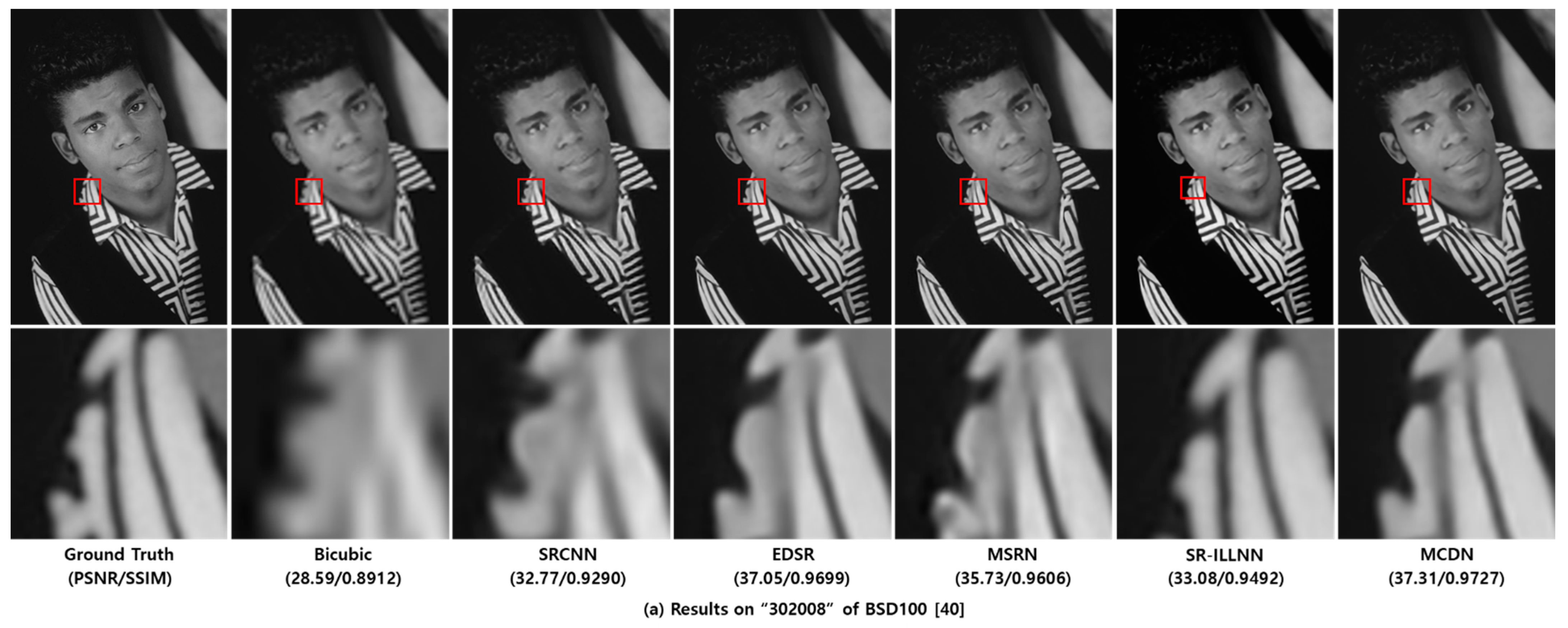
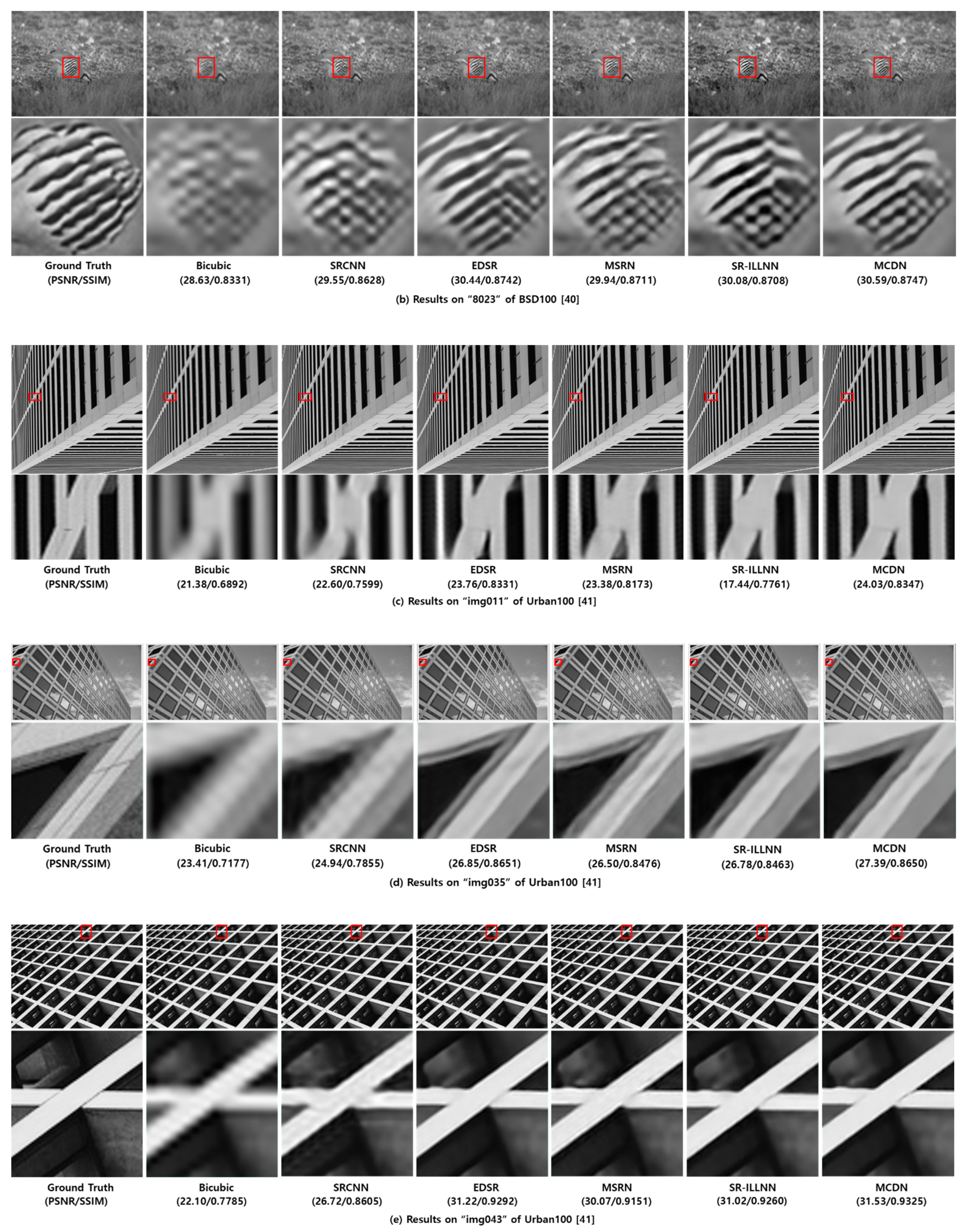
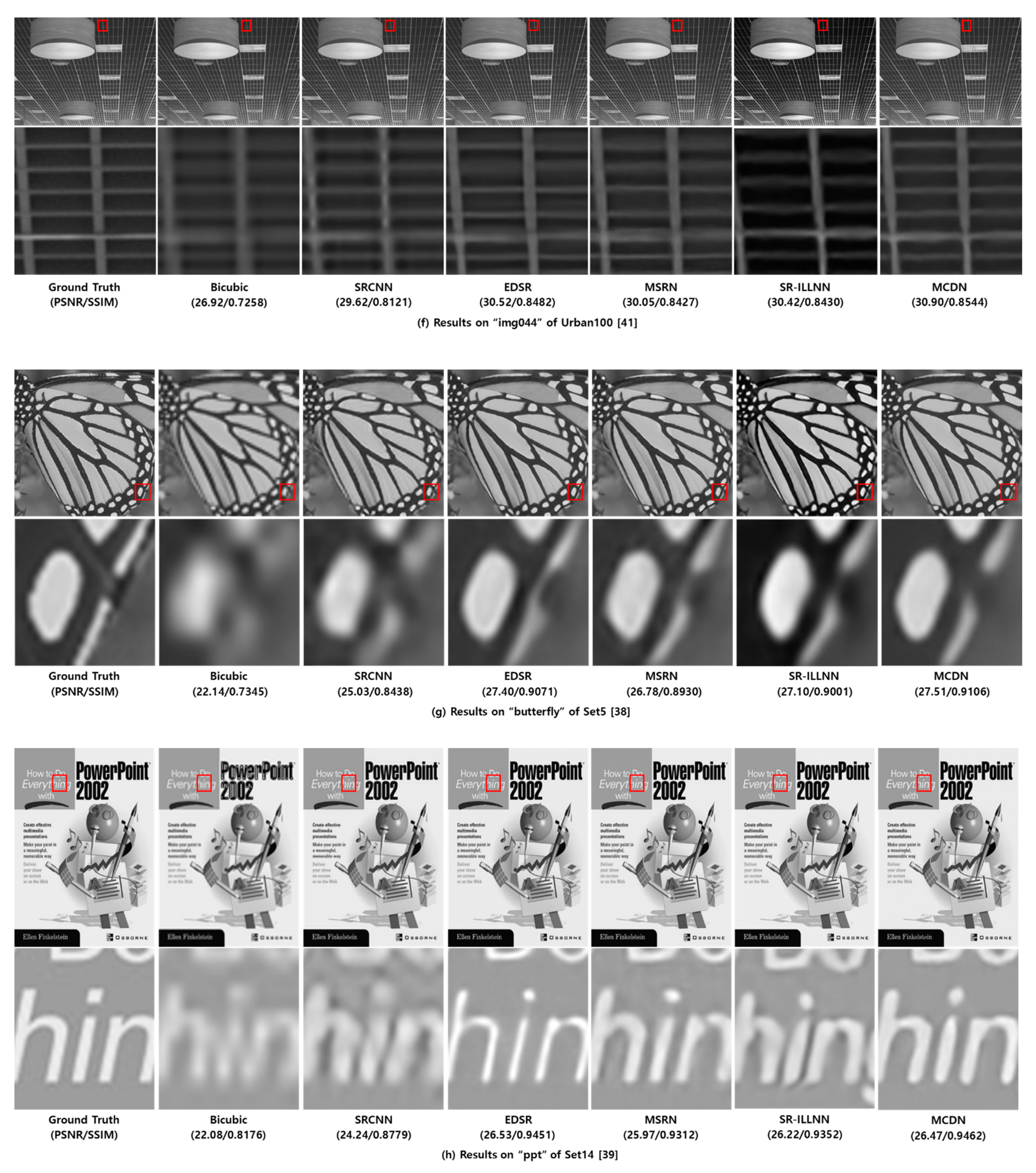

| Hyper Parameters | Options |
|---|---|
| Loss function | L1 loss |
| Optimizer | Adam |
| Batch size | 128 |
| Num. of epochs | 50 |
| Learning rate | 10−3 to 10−5 |
| Initial weight | Xavier |
| Activation function | Parametric ReLU |
| Padding mode | Zero padding |
| Experimental Environments | Options |
|---|---|
| Linux version | Ubuntu 16.04 |
| Deep learning frameworks | Pytorch 1.4.0 |
| CUDA version | 10.1 |
| Input size () | 25 × 25 × 1 |
| Label size () | 100 × 100 × 1 |
| Num. of Parameters | Total Memory Size (MB) | |
|---|---|---|
| SRCNN [18] | 57K | 14.98 |
| EDSR [27] | 43,061K | 371.87 |
| MSRN [30] | 6,075K | 70.56 |
| SR-ILLNN [31] | 439K | 80.83 |
| MCDN | 531K | 65.07 |
| Dataset | Bicubic | SRCNN [18] | EDSR [27] | MSRN [30] | SR-ILLNN [31] | MCDN |
|---|---|---|---|---|---|---|
| Set5 | 28.44 | 30.30 | 31.68 | 31.36 | 31.41 | 31.68 |
| Set14 | 25.80 | 27.09 | 27.96 | 27.76 | 27.83 | 27.96 |
| BSD100 | 25.99 | 26.86 | 27.42 | 27.36 | 27.33 | 27.43 |
| Urban100 | 23.14 | 24.33 | 25.54 | 25.25 | 25.32 | 25.56 |
| Average | 24.73 | 25.80 | 26.70 | 26.49 | 26.54 | 26.70 |
| Dataset | Bicubic | SRCNN [18] | EDSR [27] | MSRN [30] | SR-ILLNN [31] | MCDN |
|---|---|---|---|---|---|---|
| Set5 | 0.8112 | 0.8599 | 0.8893 | 0.8845 | 0.8848 | 0.8897 |
| Set14 | 0.7033 | 0.7495 | 0.7748 | 0.7703 | 0.7709 | 0.7745 |
| BSD100 | 0.6699 | 0.7112 | 0.7309 | 0.7281 | 0.7275 | 0.7305 |
| Urban100 | 0.6589 | 0.7158 | 0.7698 | 0.7600 | 0.7583 | 0.7686 |
| Average | 0.6702 | 0.7192 | 0.7551 | 0.7489 | 0.7479 | 0.7543 |
| Set5 | Set14 | BSD100 | Urban100 | Average | ||||||
|---|---|---|---|---|---|---|---|---|---|---|
| PSNR | SSIM | PSNR | SSIM | PSNR | SSIM | PSNR | SSIM | PSNR | SSIM | |
| L1 | 31.68 | 0.8897 | 27.96 | 0.7745 | 27.43 | 0.7305 | 25.56 | 0.7686 | 26.70 | 0.7543 |
| L2 | 31.61 | 0.8883 | 27.90 | 0.7733 | 27.40 | 0.7297 | 25.47 | 0.7653 | 26.65 | 0.7524 |
| Num. of Parameters | Total Memory Size (MB) | |
|---|---|---|
| M3_D1_L5 | 125K | 25.57 |
| M3_D2_L5 | 185K | 34.62 |
| M3_D3_L5 | 267K | 44.93 |
| M3_D4_L5 | 395K | 57.85 |
| M3_D5_L5 | 639K | 76.21 |
| M3_D6_L5 | 1146K | 106.39 |
| M3_D7_L5 | 2713K | 164.02 |
| Num. of Parameters | Total Memory Size (MB) | |
|---|---|---|
| M3_D5_L1 | 280K | 37.82 |
| M3_D5_L2 | 351K | 45.87 |
| M3_D5_L3 | 435K | 54.96 |
| M3_D5_L4 | 531K | 65.07 |
| M3_D5_L5 | 639K | 76.21 |
| M3_D5_L6 | 760K | 88.37 |
| M3_D5_L7 | 893K | 101.57 |
| Set5 | Set14 | BSD100 | Urban100 | Average | ||||||
|---|---|---|---|---|---|---|---|---|---|---|
| Model | PSNR | SSIM | PSNR | SSIM | PSNR | SSIM | PSNR | SSIM | PSNR | SSIM |
| M1_D5_L5 | 31.50 | 0.8866 | 27.83 | 0.7714 | 27.34 | 0.7279 | 25.34 | 0.760. | 26.55 | 0.7491 |
| M2_D5_L5 | 31.58 | 0.8882 | 27.92 | 0.7739 | 27.40 | 0.7298 | 25.50 | 0.7665 | 26.66 | 0.7530 |
| M3_D5_L5 | 31.68 | 0.8895 | 27.98 | 0.7747 | 27.43 | 0.7304 | 25.56 | 0.7692 | 26.71 | 0.7546 |
| M4_D5_L5 | 31.66 | 0.8896 | 28.01 | 0.7751 | 27.43 | 0.7308 | 25.59 | 0.7708 | 26.73 | 0.7555 |
| M5_D5_L5 | 31.73 | 0.8903 | 28.03 | 0.7755 | 27.44 | 0.7310 | 25.65 | 0.7725 | 26.76 | 0.7564 |
| M6_D5_L5 | 31.70 | 0.8901 | 28.05 | 0.7758 | 27.45 | 0.7313 | 25.66 | 0.7729 | 26.77 | 0.7568 |
| M7_D5_L5 | 31.70 | 0.8899 | 28.05 | 0.7761 | 27.44 | 0.7313 | 25.65 | 0.7730 | 26.76 | 0.7568 |
| M3_D1_L5 | 31.40 | 0.8853 | 27.80 | 0.7707 | 27.31 | 0.7270 | 25.25 | 0.7576 | 26.50 | 0.7474 |
| M3_D2_L5 | 31.53 | 0.8874 | 27.88 | 0.7724 | 27.36 | 0.7285 | 25.36 | 0.7616 | 26.58 | 0.7500 |
| M3_D3_L5 | 31.58 | 0.8878 | 27.90 | 0.7731 | 27.39 | 0.7292 | 25.41 | 0.7638 | 26.61 | 0.7514 |
| M3_D4_L5 | 31.60 | 0.8883 | 27.96 | 0.7742 | 27.40 | 0.7299 | 25.50 | 0.7665 | 26.66 | 0.7531 |
| M3_D5_L5 | 31.68 | 0.8895 | 27.98 | 0.7747 | 27.43 | 0.7304 | 25.56 | 0.7692 | 26.71 | 0.7546 |
| M3_D6_L5 | 31.67 | 0.8894 | 27.99 | 0.7749 | 27.43 | 0.7308 | 25.59 | 0.7708 | 26.72 | 0.7555 |
| M3_D7_L5 | 31.67 | 0.8897 | 27.95 | 0.7748 | 27.41 | 0.7307 | 25.58 | 0.7711 | 26.71 | 0.7556 |
| M3_D5_L1 | 31.53 | 0.8871 | 27.86 | 0.7722 | 27.35 | 0.7283 | 25.37 | 0.7615 | 26.58 | 0.7499 |
| M3_D5_L2 | 31.59 | 0.8880 | 27.90 | 0.7732 | 27.38 | 0.7292 | 25.43 | 0.7642 | 26.62 | 0.7516 |
| M3_D5_L3 | 31.65 | 0.8891 | 27.93 | 0.7739 | 27.41 | 0.7299 | 25.50 | 0.7667 | 26.67 | 0.7531 |
| M3_D5_L4 | 31.68 | 0.8897 | 27.96 | 0.7745 | 27.43 | 0.7305 | 25.56 | 0.7686 | 26.70 | 0.7543 |
| M3_D5_L5 | 31.68 | 0.8895 | 27.98 | 0.7747 | 27.43 | 0.7304 | 25.56 | 0.7692 | 26.71 | 0.7546 |
| M3_D5_L6 | 31.68 | 0.8897 | 27.99 | 0.7750 | 27.43 | 0.7309 | 25.60 | 0.7706 | 26.73 | 0.7555 |
| M3_D5_L7 | 31.66 | 0.8894 | 27.99 | 0.7753 | 27.43 | 0.7309 | 25.61 | 0.7711 | 26.73 | 0.7557 |
| Skip Connection | Dense Connection | Set5 | Set14 | BSD100 | Urban100 | Average | |||||
|---|---|---|---|---|---|---|---|---|---|---|---|
| PSNR | SSIM | PSNR | SSIM | PSNR | SSIM | PSNR | SSIM | PSNR | SSIM | ||
| Disable | Disable | 26.42 | 0.7362 | 24.34 | 0.6297 | 24.78 | 0.5985 | 21.95 | 0.5823 | 23.50 | 0.5963 |
| Disable | Enable | 31.37 | 0.8845 | 27.78 | 0.7698 | 27.29 | 0.7264 | 25.22 | 0.7557 | 26.47 | 0.7462 |
| Enable | Disable | 31.59 | 0.8879 | 27.90 | 0.7731 | 27.39 | 0.7291 | 25.42 | 0.7643 | 26.62 | 0.7516 |
| Enable | Enable | 31.68 | 0.8897 | 27.96 | 0.7745 | 27.43 | 0.7305 | 25.56 | 0.7686 | 26.70 | 0.7543 |
| Skip Connection | Dense Connection | Num. of Parameters | Total Memory Size (MB) | Inference Speed (s) |
|---|---|---|---|---|
| Disable | Disable | 167K | 40.02 | 24.09 |
| Disable | Enable | 531K | 65.07 | 46.59 |
| Enable | Disable | 434K | 40.02 | 26.37 |
| Enable | Enable | 531K | 65.07 | 47.20 |
Publisher’s Note: MDPI stays neutral with regard to jurisdictional claims in published maps and institutional affiliations. |
© 2021 by the authors. Licensee MDPI, Basel, Switzerland. This article is an open access article distributed under the terms and conditions of the Creative Commons Attribution (CC BY) license (https://creativecommons.org/licenses/by/4.0/).
Share and Cite
Lee, Y.; Jun, D.; Kim, B.-G.; Lee, H. Enhanced Single Image Super Resolution Method Using Lightweight Multi-Scale Channel Dense Network. Sensors 2021, 21, 3351. https://doi.org/10.3390/s21103351
Lee Y, Jun D, Kim B-G, Lee H. Enhanced Single Image Super Resolution Method Using Lightweight Multi-Scale Channel Dense Network. Sensors. 2021; 21(10):3351. https://doi.org/10.3390/s21103351
Chicago/Turabian StyleLee, Yooho, Dongsan Jun, Byung-Gyu Kim, and Hunjoo Lee. 2021. "Enhanced Single Image Super Resolution Method Using Lightweight Multi-Scale Channel Dense Network" Sensors 21, no. 10: 3351. https://doi.org/10.3390/s21103351
APA StyleLee, Y., Jun, D., Kim, B.-G., & Lee, H. (2021). Enhanced Single Image Super Resolution Method Using Lightweight Multi-Scale Channel Dense Network. Sensors, 21(10), 3351. https://doi.org/10.3390/s21103351

