You are currently viewing a new version of our website. To view the old version click .
Sensors
  • Article
  • Open Access

21 August 2018

What Is the Fastest Way to Connect Stations to a Wi-Fi HaLow Network?

,
,
,
,
and
1
Institute for Information Transmission Problems, Russian Academy of Sciences, 127051 Moscow, Russia
2
Telecommunication Systems Lab, National Research University Higher School of Economics, 101000 Moscow, Russia
3
IDLab, Department of Mathematics and Computer Science, University of Antwerp-Imec, 2020 Antwerp, Belgium
*
Author to whom correspondence should be addressed.
This article belongs to the Special Issue QoS in Wireless Sensor Networks

Abstract

Wi-Fi HaLow is an adaptation of the widespread Wi-Fi technology for the Internet of Things scenarios. Such scenarios often involve numerous wireless stations connected to a shared channel, and contention for the channel significantly affects the performance in such networks. Wi-Fi HaLow contains numerous solutions aimed at handling the contention between stations, two of which, namely, the Centralized Authentication Control (CAC) and the Distributed Authentication Control (DAC), address the contention reduction during the link set-up process. The link set-up process is special because the access point knows nothing of the connecting stations and its means of control of these stations are very limited. While DAC is self-adaptive, CAC does require an algorithm to dynamically control its parameters. Being just a framework, the Wi-Fi HaLow standard neither specifies such an algorithm nor recommends which protocol, CAC or DAC, is more suitable in a given situation. In this paper, we solve both issues by developing a novel robust close-to-optimal algorithm for CAC and compare CAC and DAC in a vast set of experiments.

1. Introduction

The Internet of Things (IoT) is an important part of the future network infrastructure, providing connectivity to numerous autonomous devices, such as sensors and actuators. The multiplicity of such devices, the necessity to place them in remote places, and convenience considerations promote wireless connectivity for IoT scenarios. In turn, building a wireless network of sensors and actuators raises its own problems, such as energy efficiency, reliability, and timeliness of communications in case of a large number of devices connected to a common wireless (hence broadcast) channel. Thus, any wireless technology for IoT should have an appropriate design of low-layer protocols to consider these problems.
A good illustration of such considerations is the Wi-Fi HaLow technology [1], based on the IEEE 802.11ah standard, which has evolved as an attempt to meet the IoT requirements while keeping the ideology of Wi-Fi. It has introduced to Wi-Fi many new mechanisms that address the IoT peculiarities. For example, the Restricted Access Window (RAW) [2] can be used to group stations (STAs) and to assign them dedicated time intervals for transmission, thus decreasing contention for the channel and improving transmission reliability. Another good example is the Traffic Indication Map Segmentation [3] mechanism which can be used to improve the energy efficiency of Wi-Fi by grouping STAs and enabling them to receive only those network advertisements and packets which are related to their specific group while spending the rest of the time in the doze state.
These and many other novelties of Wi-Fi HaLow make it suitable for massive machine-type communications. However, before a Wi-Fi access point (AP) can use these novel features to control an STA, the STA needs to set up the link with it. During the link set-up, the AP learns of the STA’s existence, of its capabilities and its admissibility to the network, informs the STA of the network parameters and assigns it an identifier, namely Association ID (AID), used throughout the entire process of data exchange with this STA. Thus, the AP’s means to control an STA before the end of the link set-up are quite limited. Therefore, to transmit management frames needed for link set-up, the STAs have to use the basic channel access method, namely Carrier Sense Multiple Access with Collision Avoidance (CSMA/CA) with binary exponential backoff.
In traditional Wi-Fi networks, where the typical number of connecting STAs is small, such an approach is sufficient to provide fast link set-up. At the same time, in IoT networks, it is a feasible scenario when a big number of devices is trying to simultaneously set up the link with an AP, e.g., when an AP serving a group of STAs reboots after a malfunction or a blackout and all the STAs served by it have to reconnect. Another example requiring connection of multiple STAs at once is the scenario with mobile devices. For a high number of contending STAs, CSMA/CA suffers from collisions and provides poor performance. As the result, link set-up lasts for a long time and causes degradation of network performance for the already connected devices.
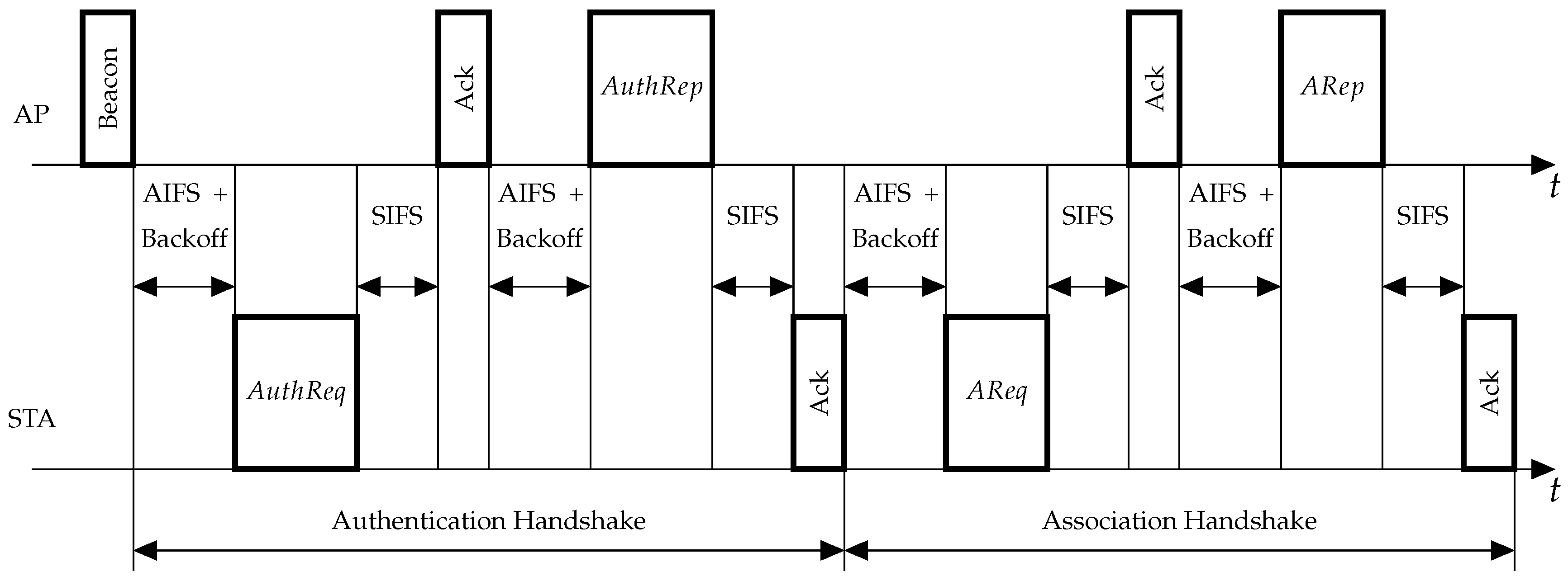
Fortunately, the IEEE 802.11ah standard describes two protocols aimed at reducing the contention during the link set-up process and making it faster. The first one is the Centralized Authentication Control (CAC) protocol, which allows the AP to periodically set the portion of STAs that may send requests for link set-up. The second one is the Distributed Authentication Control (DAC) protocol, which allows the STAs to spread their link set-up requests over random time intervals in a way similar to binary-exponential backoff. Both protocols have a list of parameters. Moreover, CAC needs to change them online. However, being a framework, the standard only describes the protocols as a set of primitives to provide fast link set-up, but it does not specify how to configure them in various scenarios.
Although several papers have already studied the problem of fast link set-up in IEEE 802.11ah networks, they have many drawbacks and limitations. This paper generalizes and significantly extends our previous work in this area [4,5,6]. An important contribution of the paper is a new algorithm to adaptively control parameters of CAC. In contrast to our previous work, the designed algorithm continues learning during the whole link set-up process, which makes it more robust in scenarios with changing contention conditions, e.g., when several groups of STAs start link set-up one-by-one. For DAC, we show that its performance slightly depends on most of its parameters. We also compare the performance of CAC and DAC in different scenarios.
The rest of the paper is organized as follows. Section 2 provides a brief description of channel access in Wi-Fi networks and main peculiarities of CAC and DAC. Section 3 analyses prior arts on link set-up in IEEE 802.11ah networks. In Section 4, we introduce our algorithm to control CAC parameters focusing on the differences with the previous version. In Section 5, we compare the performance of CAC and DAC in a vast set of scenarios. Specifically, we show that the performance of DAC is insensitive to many of its parameters. In addition, we demonstrate that the designed algorithm is much more efficient than DAC in different scenarios. Conclusions are given in Section 6.

4. Proposed Algorithm for CAC

Let us describe the proposed algorithm. Similarly to [8], we use information about the queue size and change the authentication threshold by Δ . However, the value of Δ is not constant. In contrast, it is estimated based on some learning approach.
Note that Δ determines the portion of STAs allowed authentication. For example, let N be the number of connecting STAs. Since the STAs equiprobably draw their integer values, when the threshold is increased by Δ , on average approximately Δ 1023 N new STAs can start the authentication process.
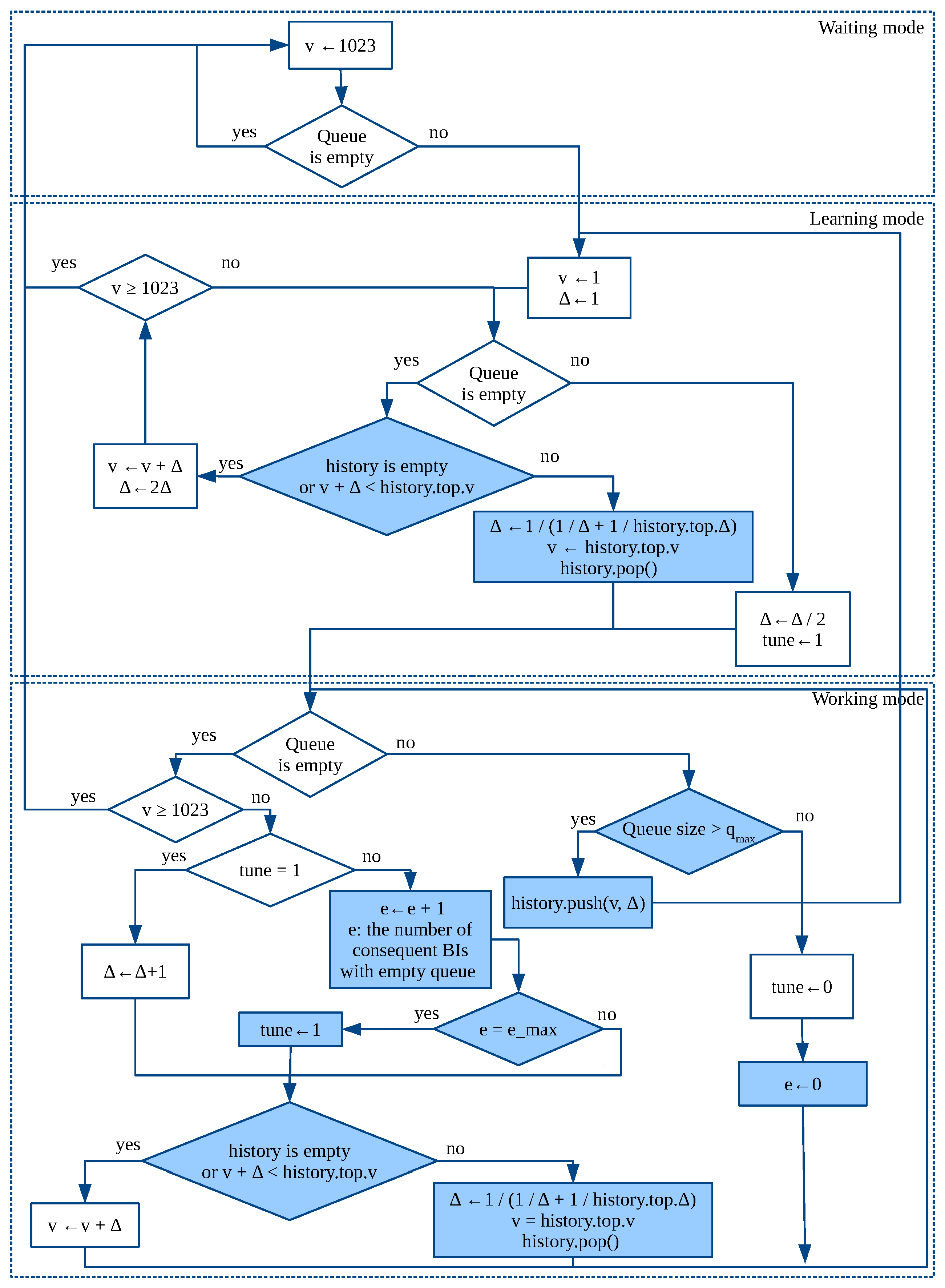
The algorithm works in three modes. It starts in the waiting mode, in which the AP keeps the maximal threshold and monitors the queue at the end of each B I .
When the queue contains at least one A u t h R e p , by the end of the B I , the AP switches to the learning mode and sets the threshold and Δ to 1.
In the l e a r n i n g mode, every B I , the AP increases the threshold by Δ . To find the optimal value of Δ , we follow the classic idea to control congestion used in TCP Slow Start. Specifically, the AP doubles Δ each B I until the A u t h R e p queue becomes non-empty by the end of some B I , which means that we achieved congestion. At this point, the AP understands that Δ is too high and its previous value is less than or equal to the optimal one. Thus, it halves Δ and switches to the working mode.
In the working mode, each B I , the AP increases threshold by Δ if the queue is empty; otherwise, it keeps the threshold unchanged. To improve the estimation of the optimal Δ , the AP also increases Δ by 1 each B I . Such tuning is only made when the t u n e flag is set. This flag is reset if the queue is non-empty by the end of the B I , which indicates that the found estimation of Δ is too high. The t u n e flag is set when the algorithm switches from the learning mode to the working mode. Apart from that, it is also set if the queue has been empty for at least e _ m a x consequent B I s , where e _ m a x is the algorithm parameter.
When the threshold reaches its maximal value, the AP switches back to the waiting mode.
It is possible that, when the AP is in the w o r k i n g mode, the number of connecting STAs suddenly changes, e.g., if a new group of STAs has appeared in the network. In such a case, the estimation of the optimal Δ is not valid anymore, and the AP has to adapt to the new network conditions in order to provide fast link set-up for the STAs. The adaptation is made in the following way. In the working mode, the AP monitors the A u t h R e p queue length and if it becomes greater than q m a x , it considers that new STAs have appeared. In such a case, the AP saves the used Δ and the current threshold value in a stack h i s t o r y (The stack is used since there can be several groups of STAs appearing in the network at different time.), sets Δ and the threshold to 1 and switches back to the l e a r n i n g mode to estimate a new optimal value of Δ , which corresponds to the number of appeared STAs. Later in the l e a r n i n g or in the w o r k i n g mode, the AP reaches the previously saved threshold value and recalculates Δ taking into account that above the old threshold the STAs from the old and the new groups have not associated yet:
Δ n e w = Δ × Δ s a v e d Δ + Δ s a v e d .
To explain this formula, we consider two groups of STAs of size N 1 and N 2 , respectively. Let n be the optimal number of STAs that should be allowed to request authentication in a B I . The optimal Δ that corresponds to that number equals Δ 1 = n N 1 × 10²³ and Δ 2 = n N 2 × 10²³ , respectively. If these two groups are united, then the optimal Δ is calculated as Δ u n i t e d = n N 1 + N 2 × 1023 = 1 1 / Δ 1 + 1 / Δ 2 .
The block diagram of the algorithm is shown in Figure 3, where v is the current threshold value and ← is the assignment operator. The block diagram uses method p u s h that puts the provided threshold value and Δ to the top of the stack, and method p o p that removes the top element from the stack.
Figure 3. Algorithm for CAC, changes to algorithm ‘Up’ from [6] are shown with painted blocks.
The diagram highlights the difference with our previous algorithm, published in the paper [6].

5. Results and Discussion

5.1. Considered Scenario and Simulation Setup

To evaluate the performance of CAC and DAC, we consider a Wi-Fi HaLow network with an AP and M STAs (hereinafter referred to as saturated STAs) transmitting data in the saturated mode, i.e., they always have data frames in their queues. The saturated STAs are connected to the AP at the beginning of the experiment. In a given time instant, N STAs (hereinafter referred to as new STAs) appear and start link set-up to the AP. By default, M = 20 while N is variable from 100 to 8000.
The AP uses one of the described authentication control protocols to limit the contention of the new STAs.
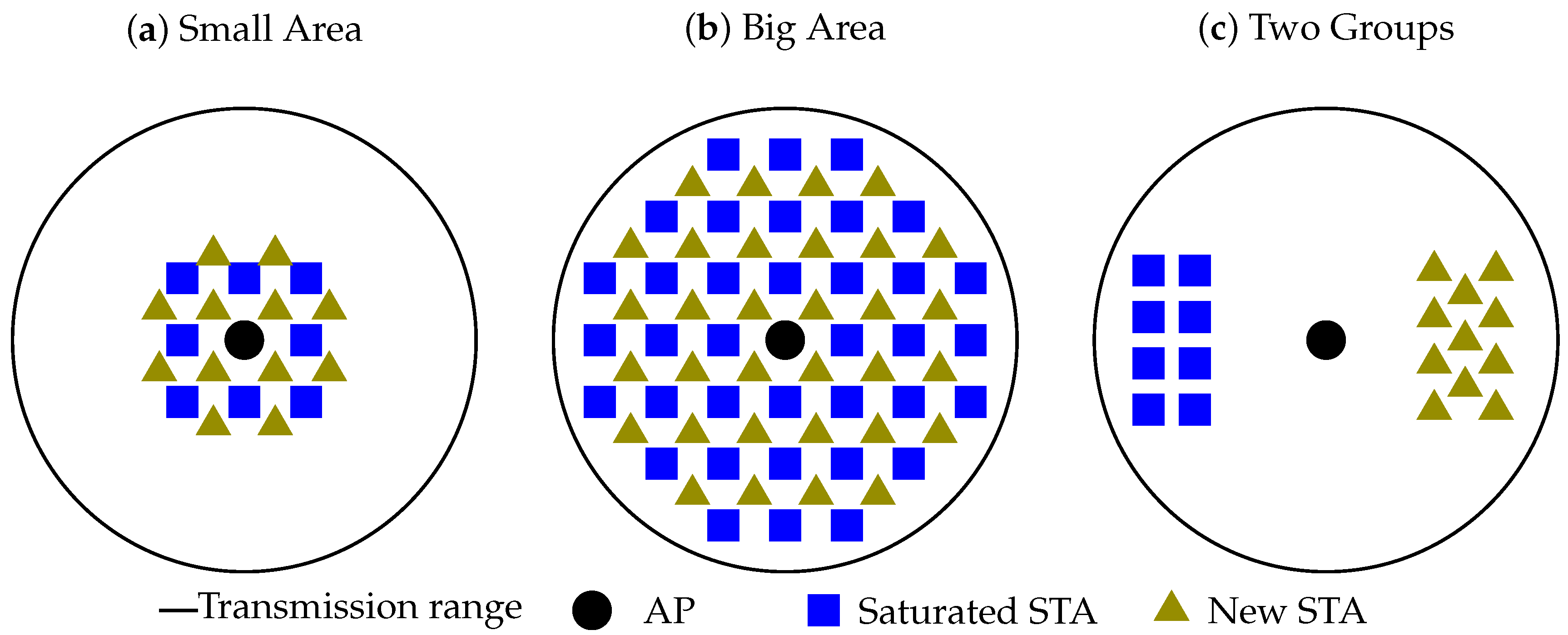
We consider three cases (see Figure 4):
Figure 4. Studied cases.
  • Small Area: the saturated STAs and the new STAs are located close to the AP and to each other, i.e., they can clearly sense each other;
  • Large Area: the saturated STAs and the new STAs are located in a wide range around the AP; thus, the central STAs sense each other, while the edge STAs cannot sense the STAs on the opposite edge;
  • Two Groups: the AP can sense saturated STAs and new STAs, but saturated STAs are hidden from the new STAs.
We measure the link set-up time from the appearance of the group of new STAs until the end of association for the last STA. For that, we implement the described scenario in the ns-3 simulator [14]. The network operates in a 1 MHz channel at a fixed rate of 600 kbps. In the Small Area case, all STAs are spread uniformly within a circle with 30 m radius around the AP. In the Large Area case, all STAs are spread uniformly within a circle with 200 m radius around the AP. In the Two Groups case, saturated STAs are spread uniformly within a 20   m × 20   m box at a distance of 200 m from the AP, and new STAs are spread uniformly within a 20   m × 20   m box at a distance of 200 m from the AP on the diametrically opposite side. Thus, we guarantee that all the STAs can receive frames from the AP, the AP can receive frames from all the STAs, but STAs of different types do not sense each other.
At the start of the simulation, saturated STAs associate to the AP, and after successful association starts transmitting saturated data flows using EDCA. A random delay from 1 s to 5 s after all saturated STAs are associated with the AP, new STAs appear and start associating to the AP.
The AP broadcasts beacons with a period of 512 ms, and the A u t h e n t i c a t e F a i l u r e T i m e o u t at STAs is set to 512 ms. It should be noted that regardless of A u t h e n t i c a t e F a i l u r e T i m e o u t , once the STA starts transmission of a frame, it does not drop the frame until the frame is either transmitted or the retry limit is reached. It means that the frame generated at the beginning of a beacon-interval can still be transmitted during the next B I s , which is an important issue touched upon in Section 5.2.

5.2. Evaluation of Distributed Authentication Control

To evaluate the performance of DAC in the described scenario, we consider different values of its parameters, looking for the set of parameters that minimizes the link set-up time for the new STAs.
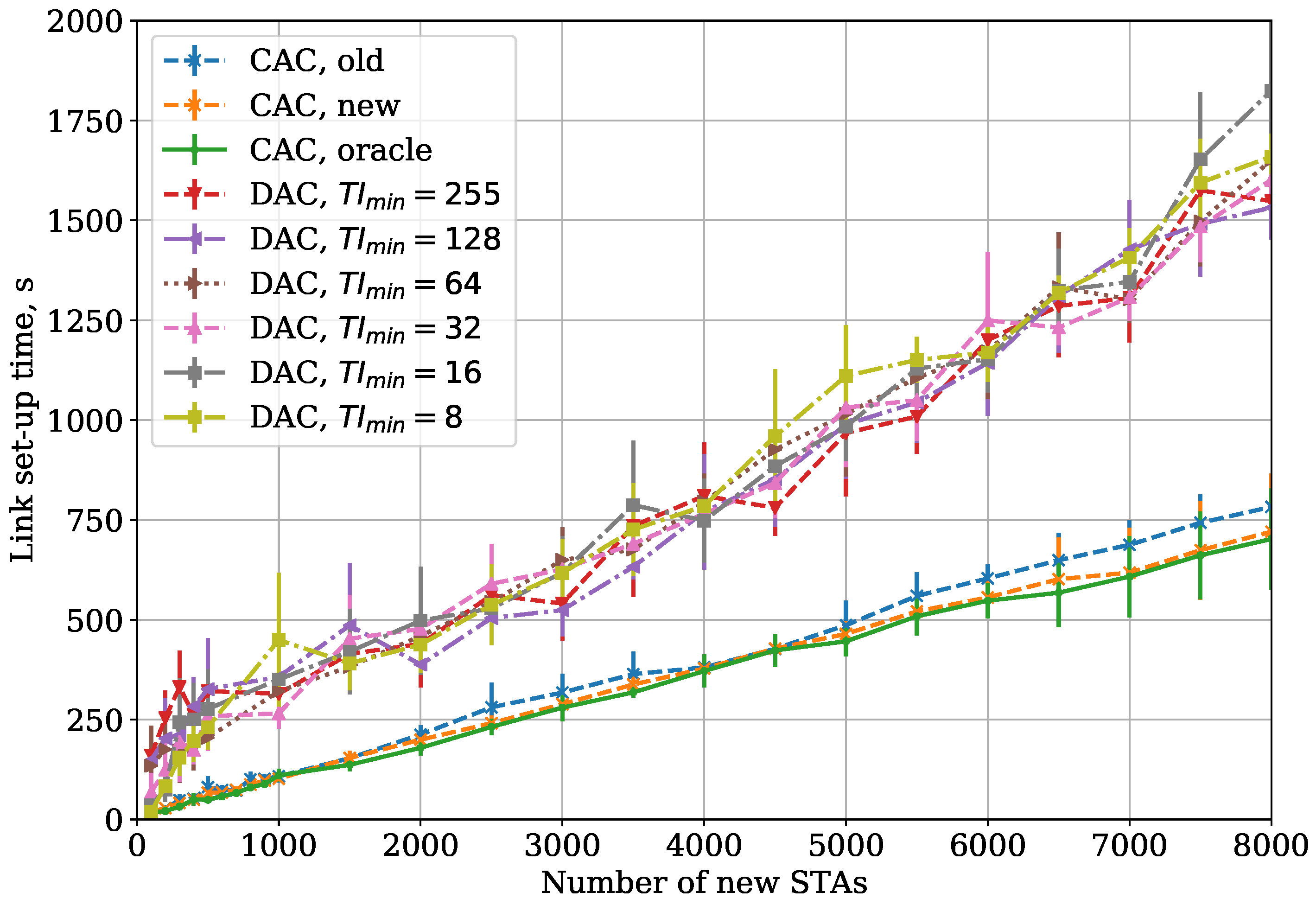
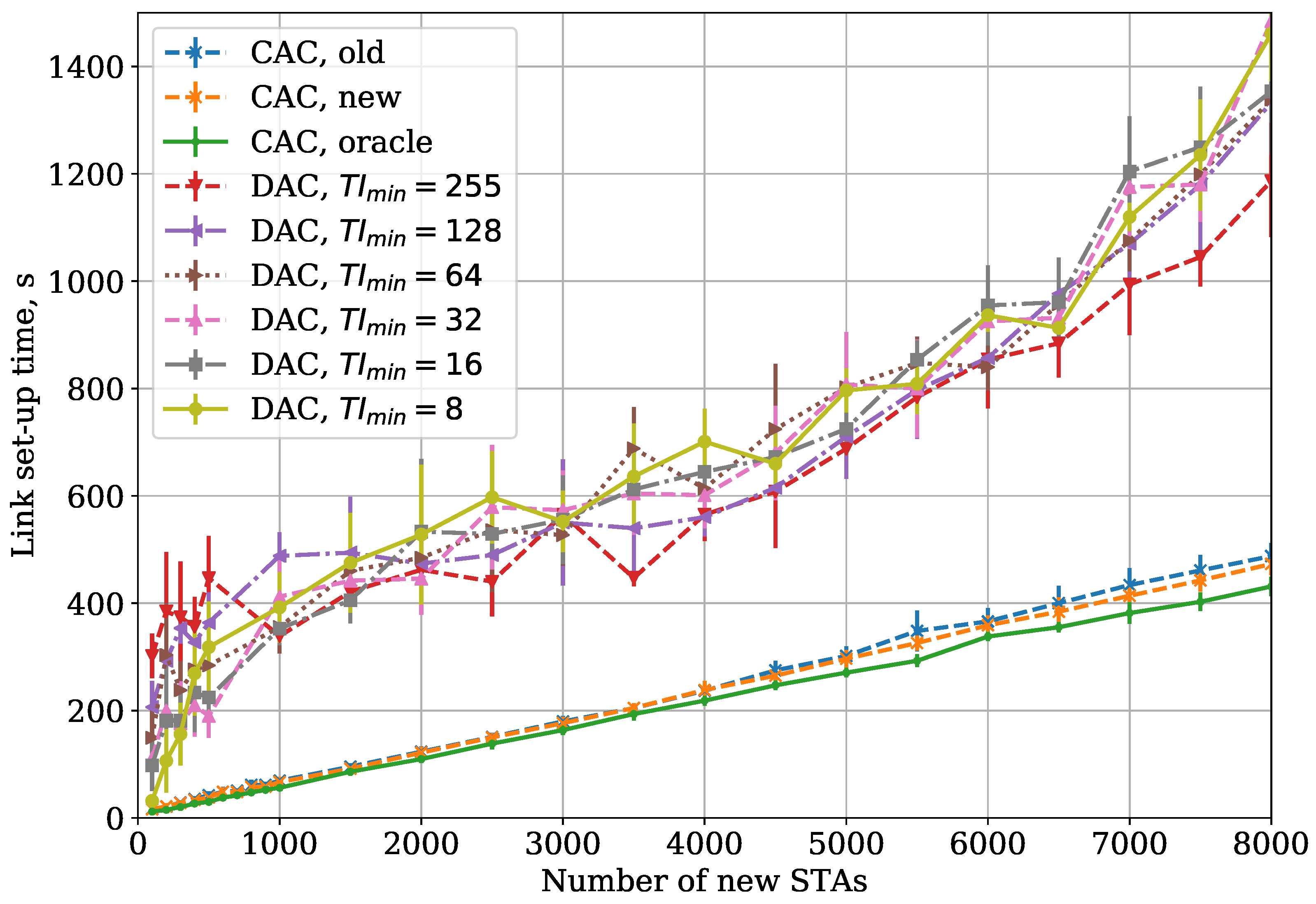
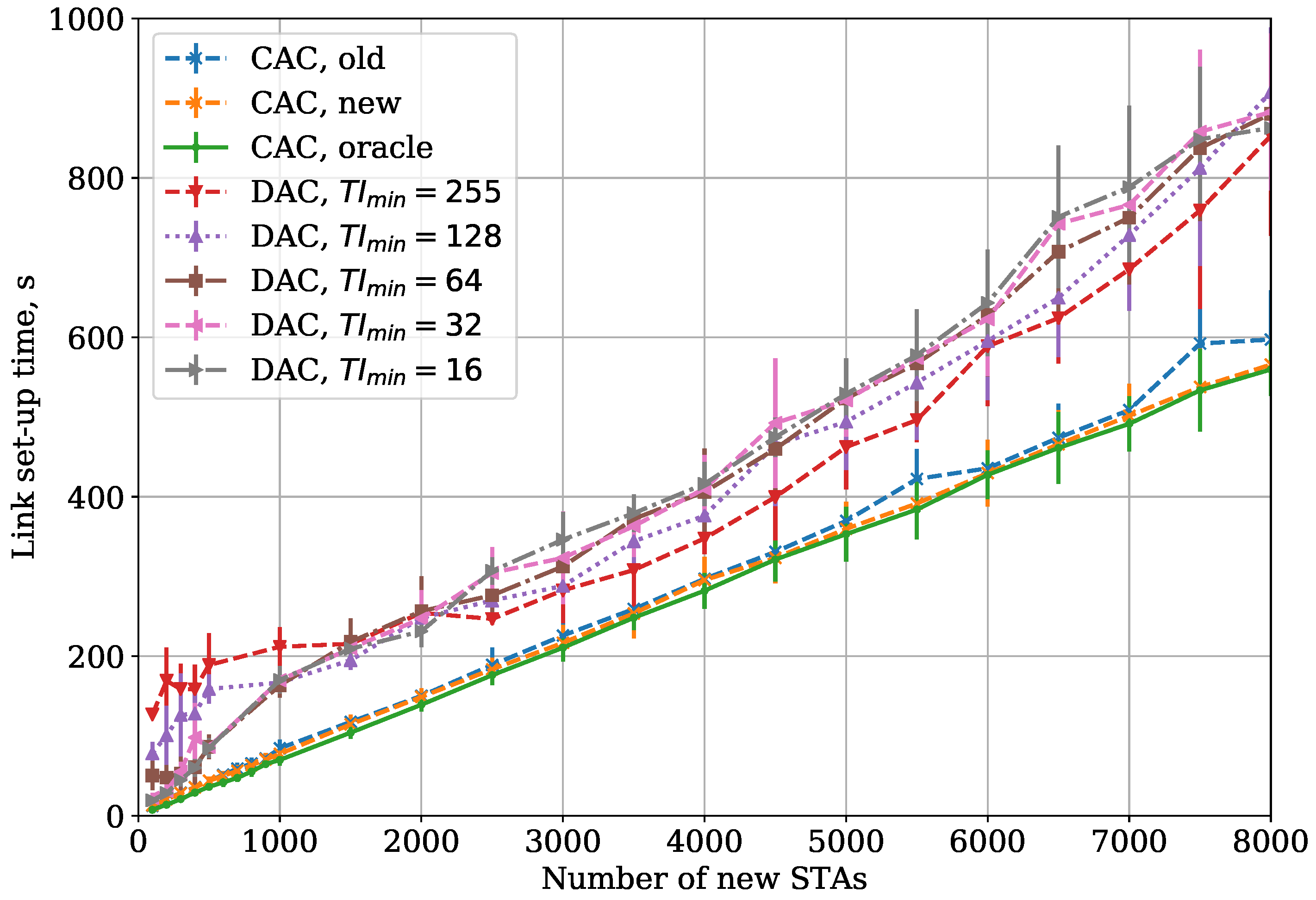
Firstly, we vary the T I m i n parameter with fixed T I m a x = 255 and T A C = 60 in the Small Area case. Figure 5 shows the dependency of link set-up time on the number of new STAs. According to the obtained results, the optimal value of T I m i n depends on the number of new STAs. When the number of new STAs is small, they can associate at the first attempt and the association lasts for T I m i n B I s on average. Thus, the use of large T I m i n is redundant and just increases the association time. At the same time, in the case of numerous new STAs, the first authentication attempts are mostly unsuccessful if T I m i n is low, which results in new authentication attempts and increases the link set-up time. Selection of high T I m i n increases the success probability of the first authentication attempt.
Figure 5. CAC and DAC protocols: dependency of the link set-up time on the number of new STAs for the Small Area case.
Curves ‘CAC’ in Figure 5 are explained in Section 5.3.
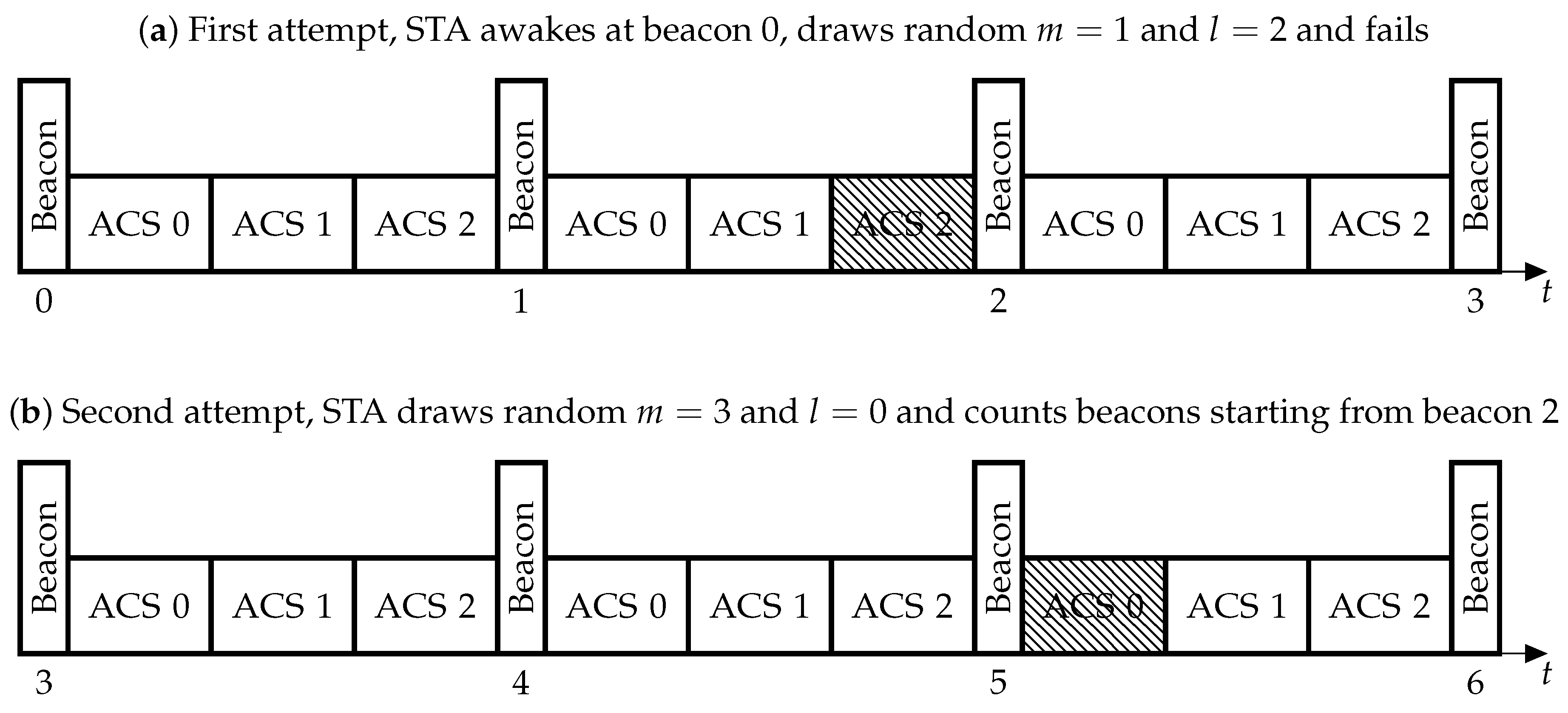
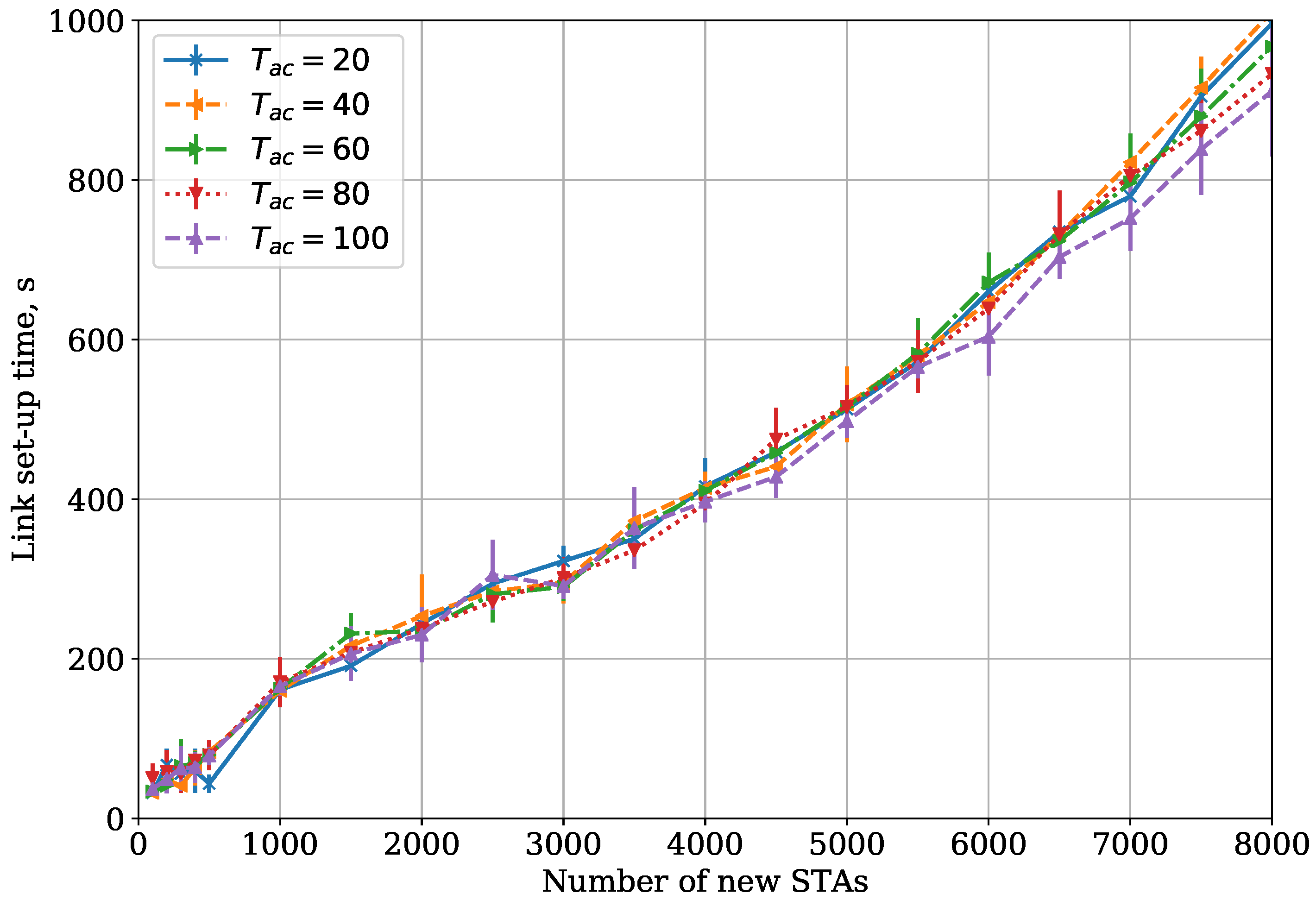
Secondly, we vary the T A C parameter with fixed T I m i n = 64 and T I m a x = 255 (see Figure 6). As one can see, the variance of T A C has almost no effect on the link set-up time. This is caused by the fact that the STA does not necessarily transmit its A u t h R e q during the chosen ACS. At the beginning of its ACS, the STA just generates its A u t h R e q and starts the procedure of random channel access. However, if the channel is busy or in case of collisions, the STA can defer the actual transmission of A u t h R e q past the end of its ACS or even beyond its B I . As the result, transmission attempts are not localized within their corresponding ACSs but are spread in time regardless of the T A C value.
Figure 6. DAC protocol: dependency of link set-up time on the number of new STAs, T I m i n = 64 for the Small Area case.
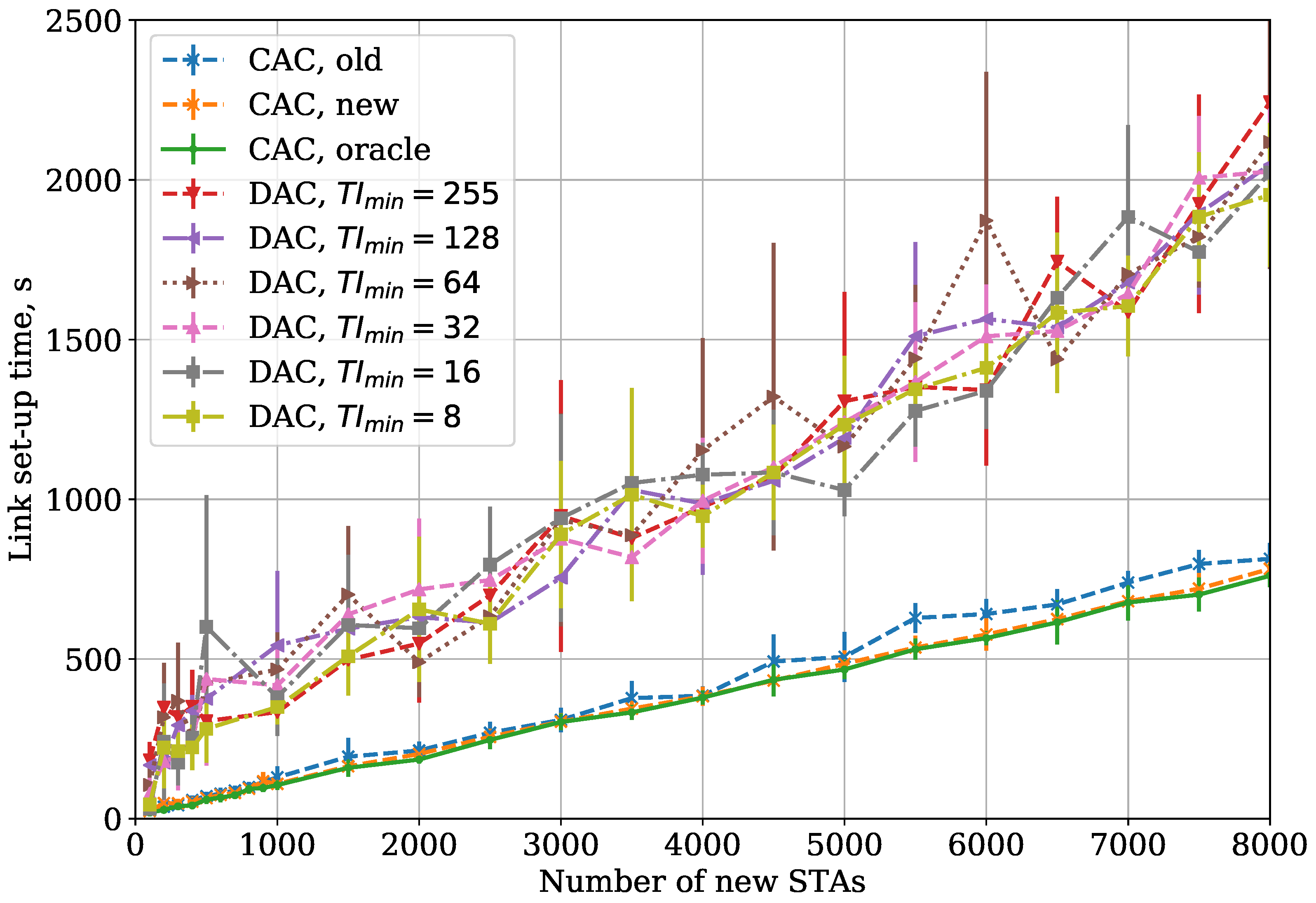
In the Large Area case, the STAs in different parts of the network do not hear each other. It increases the frame collision rate, and, consequently, link set-up time (see Figure 7). Another effect is that the discrepancy between the curves with different parameters becomes less significant because the collisions with new STAs and with saturated STAs have a similar impact on the link set-up time.
Figure 7. CAC and DAC protocols: dependency of link set-up time on the number of new STAs for the Large Area case.
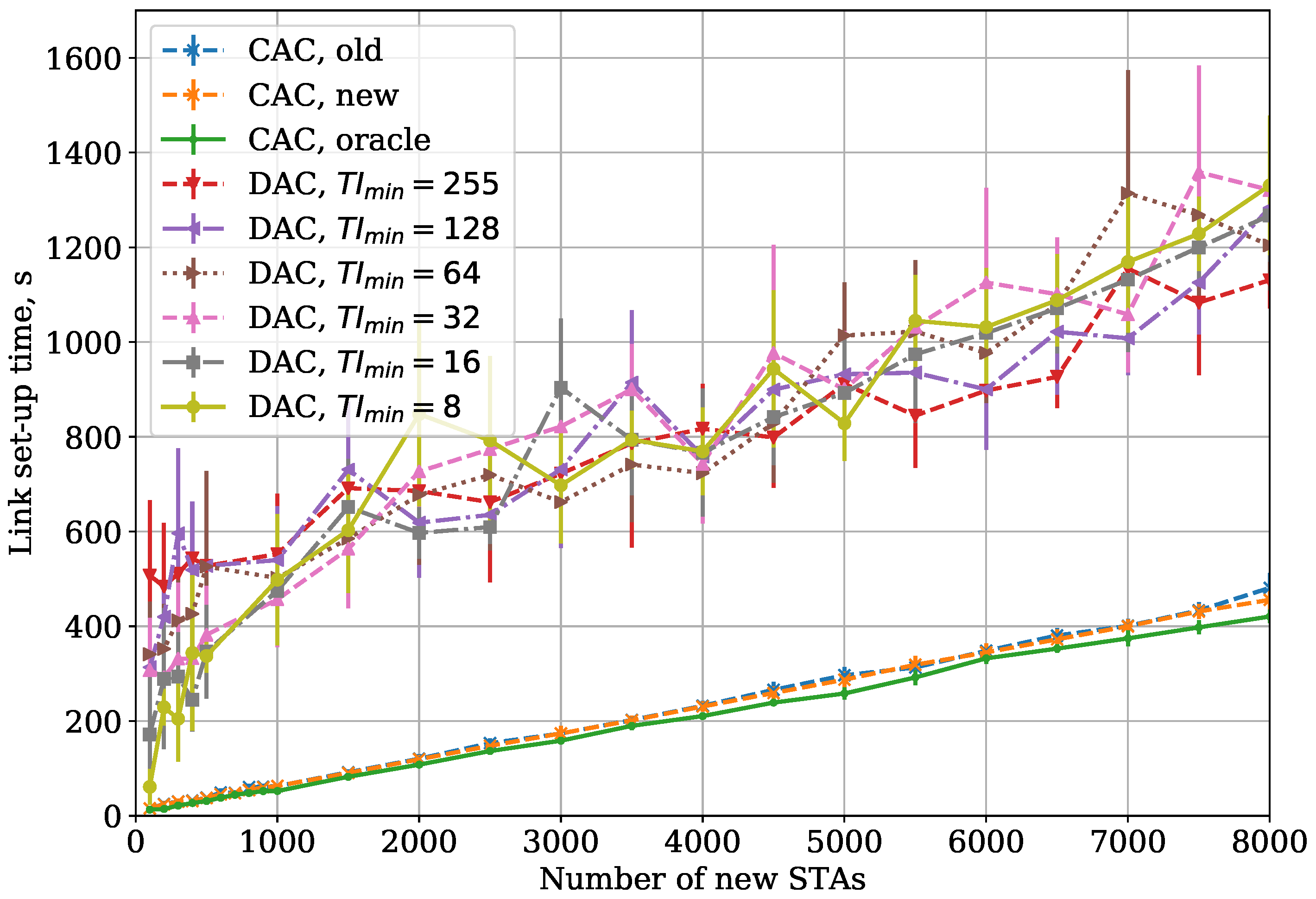
If the saturated STAs are hidden from the new STAs, the link set-up time becomes higher than in the Small Area case but lower than in the Large Area case (see Figure 8). The collision rate of A u t h R e q s and A R e q s is higher than in the Small Area case, which explains increased link set-up time. At the same time, since new STAs do not sense saturated STAs, they spend less time waiting for the channel to become idle, which results in link set-up time lower than in the Large Area case. In addition, a relative increase of link set-up time is higher for small numbers of new STAs because collisions make the STAs double their T I more often.
Figure 8. CAC and DAC protocols: dependency of link set-up time on the number of new STAs for the Two Groups case.
In summary, the optimal value for T I m i n depends on the number of contending STAs, which is typically unknown at the beginning of the link set-up process. Moreover, since the impact of T I m i n on link set-up time is stronger for the small number of contending STAs, T I m i n should be rather small, e.g., 8 or 16. At the same time, the performance of the protocol almost does not depend on T A C .

5.3. Comparison of Authentication Control Protocols

In this section, we compare the performance of CAC and DAC.
Figure 5 presents the dependency of the average link set-up time for a group on new STAs on the number of STAs in the Small Area case. Here, we show the link set-up time for CAC when our algorithm—described in Section 2.4—is used (curve “CAC, new”), and compare it with an old version of our algorithm, presented in [6] (curve “CAC, old”) and with Oracle, which is an idealistic solution corresponding to the case when the AP a priori knows the number of STAs that are connecting to it and sets up the authentication threshold accordingly. In other words, the results of the Oracle algorithm can be considered as a lower bound for the link set-up time. As one can see, CAC with the threshold control algorithm described in Section 2.4 is almost twice as efficient as DAC in terms of link set-up time and is very close to the Oracle solution.
In the Large Area case, we obtain a similar dependency, but the link set-up time becomes higher for all the considered protocols (see Figure 8). Moreover, the gap between the CAC and DAC link set-up time becomes more significant.
In the Two Groups case (see Figure 8), the link set-up time is higher than in the Small Area case but lower than in the Large Area case. The reason for such a difference is explained in Section 5.2.
Let us explain why CAC is much more efficient than DAC when the number of STAs is high. In case of collisions, the DAC doubles T I , therefore the time interval over which the STAs’ transmission attempts are spread is also doubled. Unlike EDCA, such deferral time is not shortened if the channel is idle. Thus, having occasionally several collisions in a row, the STA may significantly increase its link set-up time. Apart from that, the link set-up time for DAC significantly fluctuates from run to run.
Another important issue of DAC is the collision accumulation effect, which happens as follows. If T I m i n is too low, the first authentication attempts of most STAs are unsuccessful. These STAs make new attempts in a twice wider T I , but this interval intersects with the interval where the other STAs make their first transmission attempt. As a result, the collision probability for retries does not immediately decrease and T I is finally increased too much.
At the same time, when CAC is used with our authentication threshold control algorithm, the time interval and the protocol parameters are set up adaptively, in accordance with the estimated number of connecting STAs. This is why CAC allows obtaining a link set-up time close to the optimal.
We also show the results for the Large Area and Two Groups cases, when the frame body capture effect is enabled. Capture effect is a phenomenon observed in some receivers [18], when an STA receiving two partially overlapping frames switches to a stronger one even if it is already receiving the weaker one. In our simulation, we considered that the switch happens if the power difference at the receiver is at least 10 dB. As shown in Figure 9 and Figure 10, with capture effect enabled, the difference between CAC and DAC increases even more. The reason for such a behavior is that, with capture effect present, the success rate for the saturated STAs rises, which in its turn makes their traffic more intensive and increases interference and collision rate for the edge new STAs. The DAC reacts to higher collision rate by increasing the average T I , which yields longer link set-up. At the same time, the CAC adapts to the collision rate and the channel occupancy and thus provides faster link set-up.
Figure 9. CAC and DAC protocols: dependency of the link set-up time on the number of new STAs for the Large Area case with Capture Effect.
Figure 10. CAC and DAC protocols: dependency of the link set-up time on the number of new STAs for the Two Groups case with Capture Effect.
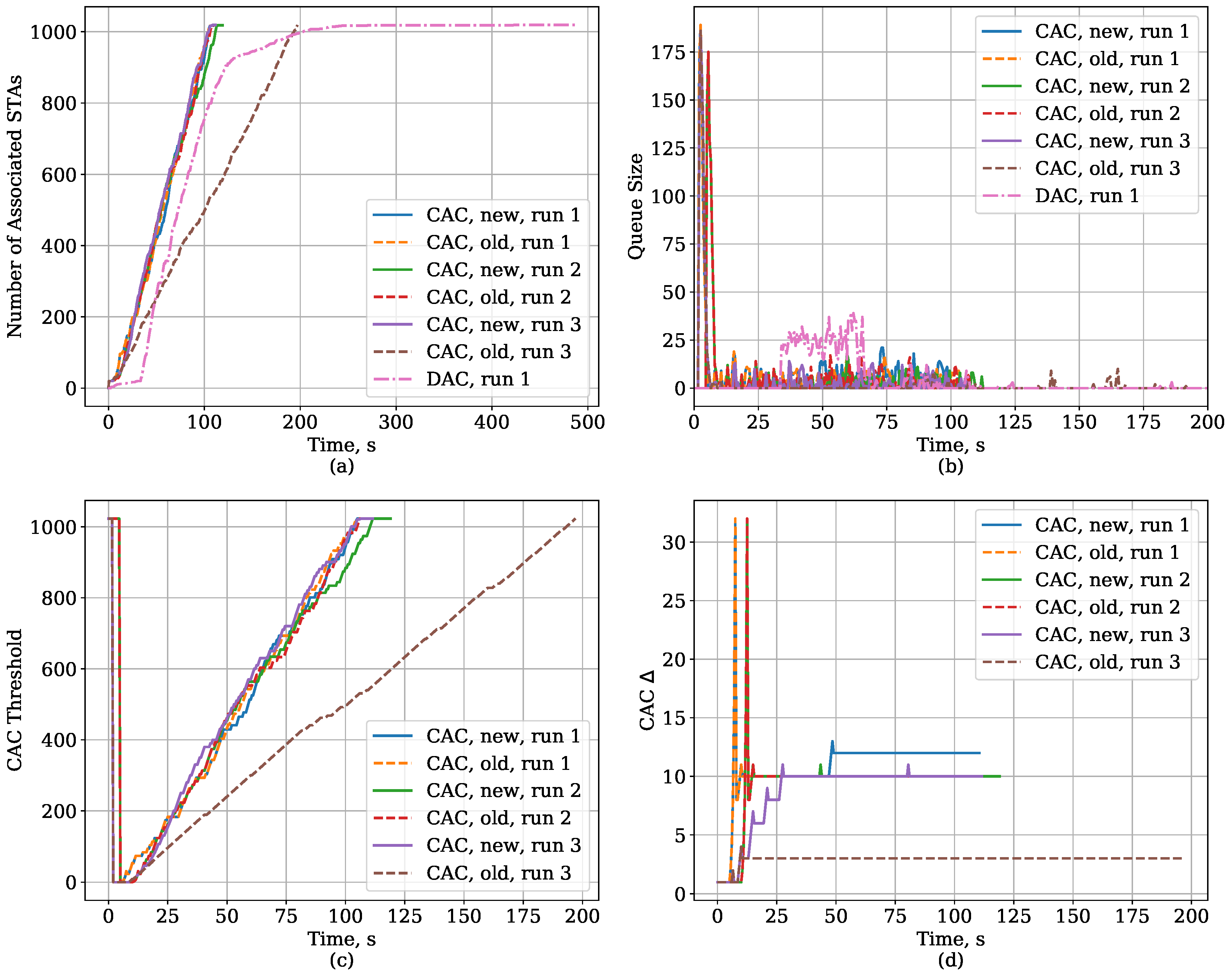
The new version of the threshold control algorithm outperforms the old one. It provides lower link set-up time, which becomes very close to the Oracle solution, and is also more stable, i.e., it has a lower variance of the link set-up time. To explain this difference, we need to highlight again the changes we have introduced to the algorithm and consider the plots in Figure 11. They show the time dependencies of the number of STAs associated with the AP and the size of the AP queue, CAC threshold, and CAC Δ value for the old and new threshold control algorithms and for the DAC protocol. The CAC results are provided for several runs to highlight the difference between the algorithms. For the CAC protocol, the number of associated STAs grows almost linearly with time, and, for most runs, the results for the new and old algorithm are the same. When the new STAs appear, the AP queue suddenly grows, but later it is kept at a relatively low length. The CAC up algorithm quickly finds a suitable value for Δ and for the most time keeps it constant. Thus, the threshold grows linearly. However, in some runs (e.g., run 3), the old algorithm underestimates the optimal Δ , and, although lower Δ yields lower average queue size, it also yields slower growth of threshold and, as a consequence, slower link set-up time. On the contrary, the new algorithm tunes Δ if the queue has been empty for several B I s in a row. In the considered run, the algorithm firstly underestimates the optimal Δ during the learning mode, but later in the working mode increases Δ in several steps and reaches a value close to optimal.
Figure 11. Time dependency of the CAC and DAC protocol parameters for the Large Area case with Capture Effect: (a) the number of associated STAs, (b) AP queue size, (c) CAC threshold, (d) the value of Δ in CAC.
The plots also show that the DAC protocol quickly associates most STAs, but for a small portion of STAs the link set-up time is high because they make unsuccessful authentication attempts, increase their T I and make new authentication attempts after waiting for the deferral which is the higher the more unsuccessful attempts the STA has made.
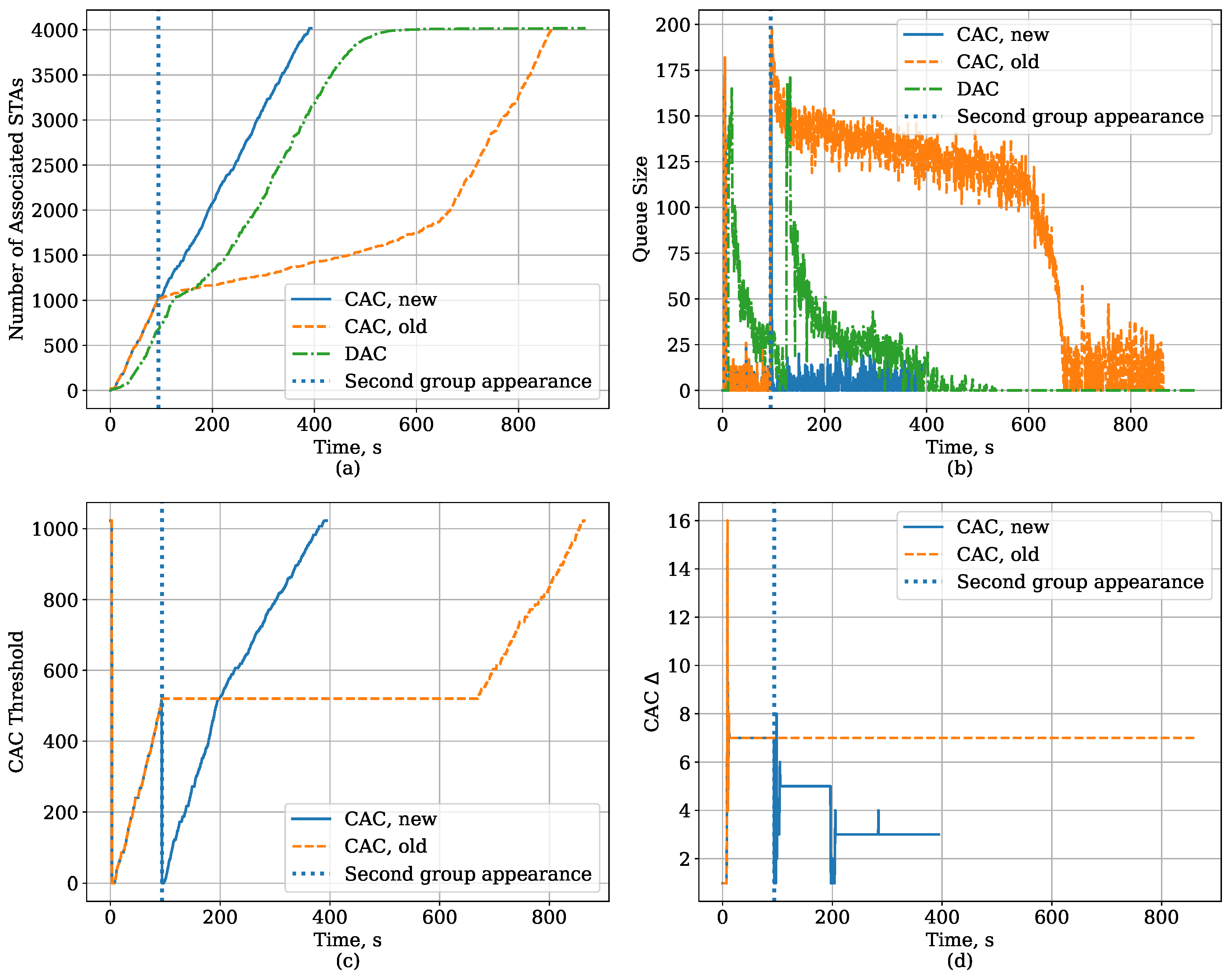
To explain another feature of the new algorithm for the CAC protocol, we consider a situation when the new STAs arrive in two groups. Specifically, after the saturated STAs connect to the AP, a group of 2000 new STAs appears and starts associating with the AP. Later, when half of them are associated, 2000 more STAs appear and start associating too. In such a scenario, the second group of new STAs arrives while the CAC authentication threshold control algorithm is in the working mode. As shown in Figure 12, in such a case, the old version of our algorithm shows poor performance because, as soon as the second group appears, the AP experiences sudden significant increase of the queue size, freezes its threshold and waits until the queue becomes empty, which means that it waits until the STAs resolve their collisions according to bare EDCA. On the contrary, the new algorithm detects that the queue has become too long and switches back to the learning mode, drops the threshold and estimates a new Δ , thus helping the STAs to authenticate and associate without unnecessary collisions. Later, when the threshold reaches the value it had before the drop, the algorithm recalculated the Δ because the new Δ should correspond to a higher number of STAs. The effect of such a recalculation can be seen at the queue size plot, so the queue size for “CAC, new” after 200 s (when it reaches the old threshold value) is lower than the queue size for “CAC, old” after 700 s (when it unfreezes the threshold).
Figure 12. Time dependency of the CAC and DAC protocol parameters for the Large Area case with Capture Effect when new STAs arrive in two groups: (a) the number of associated STAs, (b) AP queue size, (c) CAC threshold, (d) the value of Δ in CAC.
The changes made to the algorithm improve its ability to adapt to the number of devices in the network and decrease the link set-up time almost twofold. The new algorithm can work well even if the devices arrive in more than two groups because the algorithm maintains a history of old threshold and Δ values used in the working mode and recalculates the Δ every time it reaches them. The algorithm forgets the history only if it reaches the maximal threshold value and the queue is free, which indicates that all the STAs have set up the link with the AP.
It should be noted that, in this scenario, for most STAs, the DAC provides a lower link set-up time than the old CAC authentication threshold algorithm because the new STAs randomize the B I s when they start their authentication attempts. However, the DAC still suffers from the fact that a small number of STAs have very high link set-up time. In addition, it is less efficient than our new algorithm.
To sum up, since DAC does not require any additional algorithms, it is much easier in implementation. However, its ability to adapt to the current situation in the network is rather limited. With the standard default parameters ( T I m i n = 8 , T I m a x = 255 , T a c = 10 ), it provides the link set-up time up to four times higher than the theoretically lower bound.
At the same time, with our authentication threshold control algorithm, the link set-up time for CAC grows almost linearly and is rather close to the theoretical lower bound. The designed algorithm is robust to the changing number of associating STAs.


6. Conclusions

We have studied the link set-up process in Wi-Fi HaLow networks, which consists of two main handshakes: Authentication and Association. Both handshakes are performed using Wi-Fi random channel access, the performance of which significantly degrades in case of a high number of contending STAs. Such a situation is typical for Wi-Fi HaLow networks because this technology has been designed as a version of Wi-Fi for the Internet of Things scenarios, so the Wi-Fi HaLow has two possible solutions to limit the contention for channel access, namely, CAC and DAC.
With CAC, the AP periodically broadcasts the Authentication Threshold, the increment of which effectively determines the percentage of devices that are allowed to start authentication at the moment. In this paper, we have proposed a new algorithm for CAC, which is both efficient and robust. We tested this algorithm for the case when, besides connecting STAs, there are STAs which transmit saturated data flows. When they are hidden from the connecting ones, the algorithm preserves its efficiency even in such an unfriendly scenario. This is the first major contribution of this paper.
The second contribution is related to DAC. With DAC, the STAs randomly select intervals, during which they start authentication and, in case of failure, make new attempts after waiting a number of intervals, chosen according to the binary-exponential approach, while the AP broadcasts parameters of these intervals. We have run the excessive simulation to determine the best configuration of DAC and have shown that there is no set of parameters that can minimize the link set-up time for all possible numbers of connecting STAs, and that, in some scenarios, the DAC is essentially insensitive to some of its parameters, which is valuable for optimal configuration.
The third contribution of this paper is the comparison of the performance of CAC with DAC in different complex scenarios. We have shown that CAC outperforms DAC. However, such an advantage of CAC comes at the cost of complexity of the protocol and the need for the AP to constantly track the link set-up process, which can be done with the designed algorithm.
As a direction of future work, we consider the performance evaluation of CAC and DAC in a case with multiple APs, where the inter-network interference might affect the link set-up time of the devices, and such problems as load balancing among the APs, minimization of service traffic and handover optimization should be solved to provide the fast association of devices and to improve the overall network performance.

Author Contributions

E.K. and A.L. stated the problem and designed the simulation scenarios. J.F. and L.T. implemented the IEEE 802.11ah protocol in the ns-3 environment, as well as the capture effect feature. D.B. designed the algorithm. D.B. and E.S. ran the simulation and analyzed the results. All of the authors contributed to writing the paper.

Funding

Dmitry Bankov, Evgeny Khorov, Andrey Lyakhov and Ekaterina Stepanova were supported by the Russian Government (Agreement No 14.W03.31.0019). Jeroen Famaey and Le Tian were supported by the Flemish FWO SBO S004017N IDEAL-IoT (Intelligent DEnse And Long-range IoT networks) project.

Acknowledgments

A part of the numerical results has been obtained using computing resources of the federal collective usage center Complex for Simulation and Data Processing for Mega-science Facilities at NRC “Kurchatov Institute” [19].

Conflicts of Interest

The authors declare no conflict of interest. The founding sponsors had no role in the design of the study; in the collection, analyses, or interpretation of data; in the writing of the manuscript, and in the decision to publish the results.

Abbreviations

The following abbreviations are used in this manuscript:
ACKAcknowledgement Frame
ACSAuthentication Control Slot
AIFSArbitration Inter-Frame Space
APAccess Point
AIDAssociation ID
BIBeacon Interval
CACCentralized Authentication Control
DACDistributed Authentication Control
EDCAEnhanced Distributed Channel Access
IoTInternet of Things
MACMedium Access Control layer
PHYPhysical layer
RAWRestricted Access Window
SIFSShort Inter-Frame Space
STAStation

References

  1. Khorov, E.; Lyakhov, A.; Krotov, A.; Guschin, A. A survey on IEEE 802.11 ah: An enabling networking technology for smart cities. Comput. Commun. 2015, 58, 53–69. [Google Scholar] [CrossRef]
  2. Khorov, E.; Krotov, A.; Lyakhov, A. Modelling Machine Type Communication in IEEE 802.11ah Networks. In Proceedings of the 2015 IEEE International Conference on Communication Workshop (ICCW), London, UK, 8–12 June 2015; pp. 1149–1154. [Google Scholar]
  3. Kureev, A.; Bankov, D.; Khorov, E.; Lyakhov, A. Improving Efficiency of Heterogeneous Wi-Fi Networks with Joint Usage of TIM Segmentation and Restricted Access Window. In Proceedings of the 2017 IEEE 28th Annual International Symposium on Personal, Indoor, and Mobile Radio Communications (PIMRC), Montreal, QC, Canada, 8–13 October 2017; pp. 1–5. [Google Scholar] [CrossRef]
  4. Bankov, D.; Khorov, E.; Lyakhov, A. The Study of the Centralized Control Method to Hasten Link Set-up in IEEE 802.11 ah Networks. In Proceedings of the European Wireless 2015, 21th European Wireless Conference, Budapest, Hungary, 20–22 May 2015; pp. 1–6. [Google Scholar]
  5. Bankov, D.; Khorov, E.; Lyakhov, A. The Study of the Distributed Control Method to Hasten Link Set-Up in IEEE 802.11ah Networks. In Proceedings of the 2016 XV International Symposium Problems of Redundancy in Information and Control Systems (REDUNDANCY), St. Petersburg, Russia, 26–29 September 2016; pp. 13–17. [Google Scholar]
  6. Bankov, D.; Khorov, E.; Lyakhov, A.; Stepanova, E. Fast Centralized Authentication in Wi-Fi HaLow Networks. In Proceedings of the 2017 IEEE International Conference on Communications (ICC), Paris, France, 21–25 May 2017. [Google Scholar]
  7. IEEE. IEEE P802.11ahTM Standard for Information Technology—Telecommunications and Information Exchange between Systems Local and Metropolitan Area Networks—Specific Requirements—Part 11: Wireless LAN Medium Access Control (MAC) and Physical Layer (PHY) Specifications—Amendment 2: Sub 1 GHz License Exempt Operation; IEEE: Piscataway, NJ, USA, 2017. [Google Scholar]
  8. Wang, H. Supporting Authentication/Association for Large Number of Stations. Available online: http://mentor.ieee.org/802.11/dcn/12/11-12-0112-04-00ah-supporting-of-the-authentication-association-for-large-number-of-stations.pptx (accessed on 20 August 2018).
  9. Sthapit, P.; Subedi, S.; Kwon, G.R.; Pyun, J.Y. Performance Analysis of Association Procedure in IEEE 802.11ah. In Proceedings of the ICSNC 2015: The Tenth International Conference on Systems and Networks Communications, Barcelona, Spain, 15–20 November 2015; p. 4. [Google Scholar]
  10. Shahin, N.; Tann, L.; Kim, Y.T. Enhanced registration procedure with NAV for mitigated contentions in M2M communications. In Proceedings of the 2016 18th Asia-Pacific Network Operations and Management Symposium (APNOMS), Kanazawa, Japan, 5–7 October 2016; pp. 1–6. [Google Scholar]
  11. Sthapit, P.; Pyun, J.Y. Station Grouping Strategy for Minimizing Association Delay in IEEE 802.11ah. IEICE Trans. Commun. 2017, 100, 1419–1427. [Google Scholar] [CrossRef]
  12. Shahin, N.; Ali, R.; Kim, Y.T. Hybrid Slotted-CSMA/CA-TDMA for Efficient Massive Registration of IoT Devices. IEEE Access 2018, 6, 18366–18382. [Google Scholar] [CrossRef]
  13. Tay, Y.; Jamieson, K.; Balakrishnan, H. Collision-minimizing CSMA and its applications to wireless sensor networks. IEEE J. Sel. Areas Commun. 2004, 22, 1048–1057. [Google Scholar] [CrossRef]
  14. NS-3 Consortium. Available online: http://www.nsnam.org/ (accessed on 20 August 2018).
  15. Tian, L.; Deronne, S.; Latré, S.; Famaey, J. Implementation and Validation of an IEEE 802.11 ah Module for ns-3. In Proceedings of the Workshop on ns-3, Seattle, WA, USA, 15–16 June 2016; ACM: New York, NY, USA; pp. 49–56. [Google Scholar]
  16. Tian, L.; Famaey, J.; Latré, S. Evaluation of the IEEE 802.11 ah Restricted Access Window Mechanism for dense IoT networks. In Proceedings of the 2016 IEEE 17th International Symposium on A World of Wireless, Mobile and Multimedia Networks (WoWMoM), Coimbra, Portugal, 21–24 June 2016; pp. 1–9. [Google Scholar]
  17. Tian, L.; Khorov, E.; Latré, S.; Famaey, J. Real-Time Station Grouping under Dynamic Traffic for IEEE 802.11ah. Sensors 2017, 17, 1559. [Google Scholar] [CrossRef] [PubMed]
  18. Khorov, E.; Kureev, A.; Levitsky, I.; Lyakhov, A. Testbed to Study the Capture Effect: Can We Rely on This Effect in Modern Wi-Fi Networks. In Proceedings of the 2018 IEEE International Black Sea Conference on Communications and Networking (BlackSeaCom), Batumi, Georgia, 4–7 June 2018. [Google Scholar]
  19. SRC “Kurchatov Institute”. Available online: http://ckp.nrcki.ru/ (accessed on 20 August 2018).

Article Metrics

Citations

Article Access Statistics

Multiple requests from the same IP address are counted as one view.