You are currently viewing a new version of our website. To view the old version click .
Sensors
  • Article
  • Open Access

12 July 2016

Exploiting Outage and Error Probability of Cooperative Incremental Relaying in Underwater Wireless Sensor Networks
,
,
,
,
,
and
1
Department of Computer Science, International Islamic University, Islamabad 44000, Pakistan
2
COMSATS Institute of Information Technology, Islamabad 44000, Pakistan
3
Cameron Library, University of Alberta, Edmonton, AB T6G 2J8, Canada
4
Internetworking Program, Faculty of Engineering, Dalhousie University, Halifax, NS B3J 4R2, Canada
This article belongs to the Special Issue Enabling the Move from Wireless Sensor Networks to Internet of Things and Cyber-Physical Systems

Abstract

This paper embeds a bi-fold contribution for Underwater Wireless Sensor Networks (UWSNs); performance analysis of incremental relaying in terms of outage and error probability, and based on the analysis proposition of two new cooperative routing protocols. Subject to the first contribution, a three step procedure is carried out; a system model is presented, the number of available relays are determined, and based on cooperative incremental retransmission methodology, closed-form expressions for outage and error probability are derived. Subject to the second contribution, Adaptive Cooperation in Energy (ACE) efficient depth based routing and Enhanced-ACE (E-ACE) are presented. In the proposed model, feedback mechanism indicates success or failure of data transmission. If direct transmission is successful, there is no need for relaying by cooperative relay nodes. In case of failure, all the available relays retransmit the data one by one till the desired signal quality is achieved at destination. Simulation results show that the ACE and E-ACE significantly improves network performance, i.e., throughput, when compared with other incremental relaying protocols like Cooperative Automatic Repeat reQuest (CARQ). E-ACE and ACE achieve 69% and 63% more throughput respectively as compared to CARQ in hard underwater environment.

1. Introduction

In addition to a wide range of applications, Underwater Wireless Sensor Networks (UWSNs) have gained attention due to significance in emerging paradigms. These networks consist of sensors and vehicles that are deployed in aqueous environment to perform collaborative monitoring tasks. These networks offer variety of applications like assisted navigation, environmental monitoring, resource investigation, tactical surveillance, disaster prevention, etc. [1]. Instead of radio and light waves, UWSNs use acoustic waves due to favourable propagation characteristics in water. Unlike terrestrial WSNs, which use radio and light waves, UWSNs pose some design challenges; long propagation delay, energy constrained sensor nodes, dynamic network topology, huge monitoring area and low bandwidth [1,2,3]. Channel impairments like path loss, multi-path fading, reflection, refraction and aquatic noises introduce high Bit Error Rate (BER) in acoustic transmission and thus lead to lower quality of the received signal [4].
Data critical applications require reliable communication and higher throughput efficiency. Authors in [4,5] suggest that Automatic Repeat reQuest (ARQ) and cooperative diversity schemes efficiently improve the BER. The basic idea of ARQ is to retransmit data in case of failure [4]. On the other hand, Cooperation means sharing each others’s resources to achieve a common goal. Consider a system with a source-destination pair and a relay. Source node broadcasts its data to destination and relay node. As a second replica of the original signal, the relay node forwards the received signal to the destination where both independently received copies are combined to improve quality of the received signal [6].
Cooperative diversity relaying techniques are divided into two categories; fixed relaying and incremental relaying [5]. In fixed relaying, two commonly used techniques are Amplify and Forward (AF) and Decode and Forward (DF). In AF, relay node only amplifies the received signal and forwards it to destination, whereas, in DF, data at relay is decoded, corrected, recoded and forwarded to destination [7]. In incremental relaying, source broadcasts data to destination and relay in a way that feedback is generated from destination about success or failure of the data. In case of negative acknowledgement, relay retransmits data to destination using AF or DF relaying technique, otherwise, source continues with the next packet. Incremental relaying is an on-demand cooperative ARQ scheme and is also termed as Hybrid-ARQ (H-ARQ) scheme [5].
In [8], Ikki et al. present end-to-end performance analysis of incremental relaying cooperative diversity over Rayleigh fading channels, in which the best relay among multiple available relays retransmits the source signal. Similarly, Duy et al. [9] exploit multiple relays and select one of the relays to retransmit signal. However, the aforementioned works only focus on single retransmission (incase of direct transmission failure). In aqueous environment, poor link quality due to severe fading, path-loss and noise may lead to loss of transmitted data. If, somehow, the data reaches its destination, quality is so poor that makes it useless. Therefore, we exploit more number of retransmissions to achieve the desired signal quality at the receiver and require more number of retransmissions. In this regard, we presented closed-form expressions for outage and error probability of incremental relaying with cooperative retransmissions.
Our main contributions in this work are as follows:
  • We proposed incremental relaying cooperative diversity scheme based on multiple number of relays. In our proposed scheme, source broadcasts data to destination and relays. If destination receives an erroneous signal, then relay is responsible to retransmit the signal. Both direct and relayed signals are combined at destination using a diversity combining technique. If signal quality is still not sufficient, second relay is held responsible to retransmit the data. This process continues till either of the two termination criteria are reached; the destination receives a signal with an acceptable quality or all available relays are expired.
  • We proposed two routing protocols for UWSN; ACE [10] and E-ACE. In ACE protocol, retransmission mechanism is incorporated in a cooperative manner to enhance reliability of an existing routing protocol; Energy Efficient Depth Based Routing (EEDBR) [3]. ACE allows only two retransmissions in case of erroneous data reception at destination. However, in noisy underwater environment, two retransmissions may not be sufficient. Therefore, enhanced version of ACE, E-ACE is proposed. In E-ACE, all nodes present in common region of source and destination’s transmission range perform retransmission. Increased number of retransmissions improves reliability and throughput.
  • In our work, the relays perform retransmissions in a cooperative manner. The idea of cooperative retransmissions is taken from CARQ scheme [11]. CARQ scheme is proposed for underwater channel. In this scheme, for a given source-destination pair, neighbor nodes make a cooperative nodes set. The cooperative nodes are selected to retransmit the erroneous packet in a closest one first manner. However, we introduced channel affects and different relay nodes selection criteria in our proposed scheme. For channel affects, BER is calculated at each destination to evaluate the signal quality. Additionally, we presented the cooperative nodes selection method, i.e., minimum depth and highest residual energy among the cooperative nodes. Furthermore, signal combining technique is incorporated in the proposed protocols to reduce Bit Error Rate.
Rest of the paper is organized as follows. Section 2 describes related work, Section 3 presents the proposed schemes and performance analysis in terms of outage and error probability, simulation results and discussions are given in Section 4, and Section 5 concludes the paper.

3. System Performance Analysis and Our Proposed Cooperative Routing Protocols

This section presents outage and error probability performance analysis of incremental relaying cooperative diversity with retransmissions. Based on the analysis, we then propose two cooperative routing protocols; ACE and E-ACE.

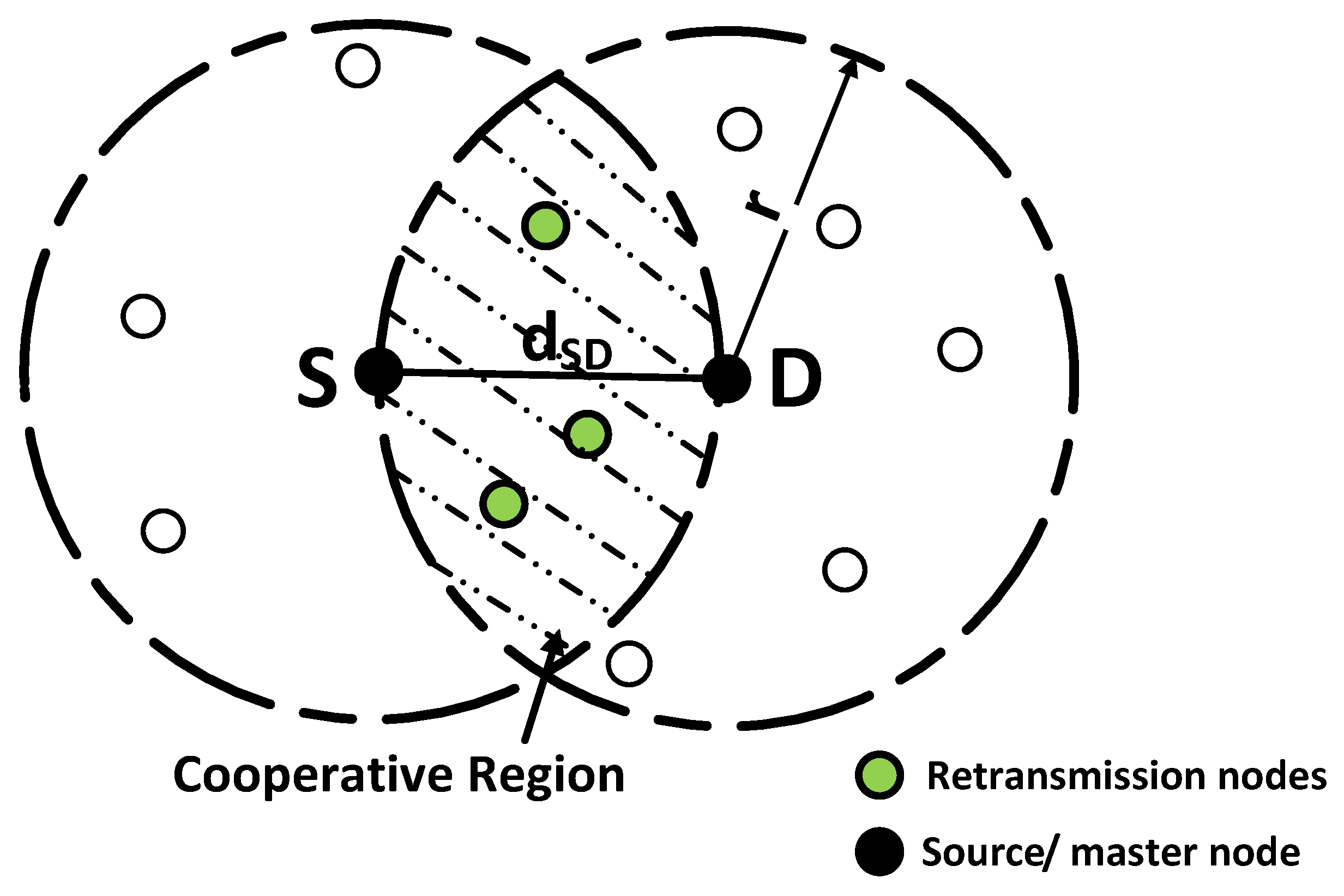
3.1. System Model and Performance Analysis

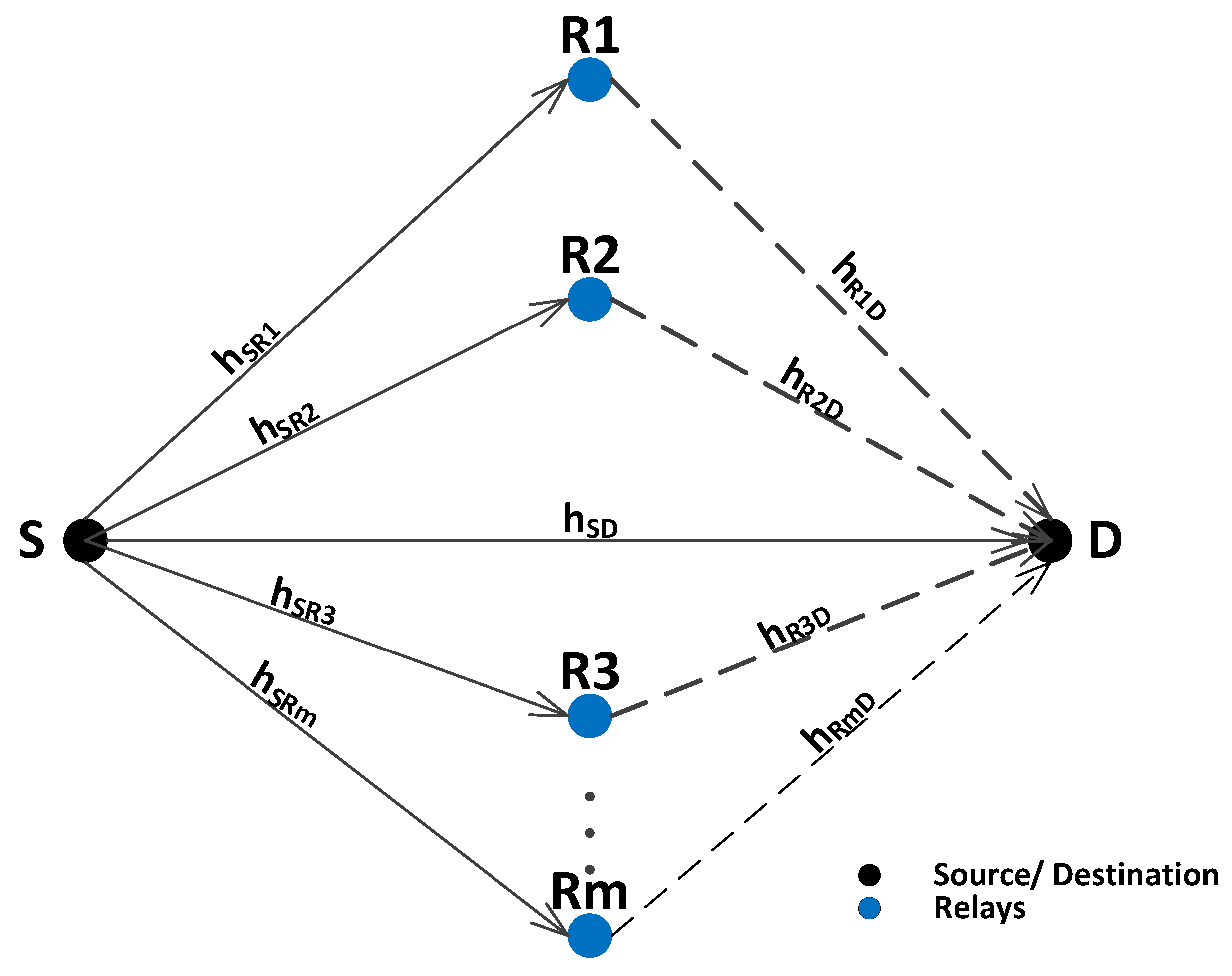
Figure 1 shows the proposed system model that consists of a Source (S), Destination (D) and Relays (R), where R = { R 1 , R 2 , . . . R m } . m is maximum number of relays present in the common region of S and D’s transmission range which is also called cooperative region. Each node is equipped with a single omni directional antenna. This work assumes only the special case of non-Line Of Sight (LOS) communication between the nodes due to presence of fish, sea weeds, garbage, salts, etc. For non-LOS communication Rayleigh fading distribution is used. Therefore, we have assumed that each link follows Rayleigh fading as in [27,28]. Additive White Gaussian Noise (AWGN) is also considered to add aquatic noise effect. In the proposed model, Binary Phase Shift Keying (BPSK) is used as a modulation technique, AF as a relaying technique and Maximal Ratio Combining (MRC) as a receive diversity technique.
Figure 1. System model.
The proposed system is supposed to follow incremental relaying cooperative diversity. Communication process takes place in two phases. In the first phase, S broadcasts its signal to D and R. If signal received at destination is of sufficient quality, relays are not supposed to retransmit data to destination. On the other hand, if destination receives low quality signal, then relays retransmit the signal one by one till the desired signal quality is achieved at D or all the relays are expired. A relay performs retransmission only once. It is assumed that the channel will experience same fading affects if it performs retransmission multiple times. Therefore, to save energy, relay’s transmission is restricted to single attempt. This assumption also helps to balance the load among other relay nodes. If the retransmission from 1st relay is not successful, it will not retransmit again. Instead, it signals the other available relay to perform retransmission. This process continues till the transmission is successful or the number of available relays are finished.
Quality of a signal is measured in terms of SNR threshold, γ 0 . The value of γ 0 depends on the sensing environment. Small value of γ 0 means exclusion of relays and large value of γ 0 means inclusion of relays. The received signals at relays and destination are mathematically expressed as:
y S D ( t ) = h S D x ( t ) + n 0 ( t )
y S R i ( t ) = h S R i x ( t ) + n j ( t )
y R i D ( t ) = h R i D x s ( t ) + n i ( t )
x s ( t ) = G y S R i ( t )
where i, j = 1→ m. h S D , h S R i and h R i D are Rayleigh fading coefficients and n 0 , n i and n j represent channel noises. x(t) is transmitted signal at time t and x s ( t ) is the transmitted signal by the relay at time t. y S D represents the signal received at D from S. y S R i is the signal received at R i from S and y R i D is the received signal at D from R i .
Since AF relaying technique is used, so, we define G as an amplification factor as:
G = 1 E b h S R i + N 0
where, N 0 is the power spectral density of AWGN noise and E b is the energy of transmitted signal. Using MRC, the signal at D is given as:
y D ( t ) = y S D ( t ) + y R i D ( t )
y D ( t ) represents the combined signal of direct and relayed transmission at D. The relays retransmit if and only if the reception at D is erroneous.

3.2. Determination of the Number of Available Relays

Relays, present in the cooperative region, retransmit the data whenever direct transmission has SNR less than γ 0 . Cooperative region is a common region of S and D’s transmission range. Maximum number of retransmissions depends on the number of relays present in the cooperative region. Thus, for m relays, the maximum allowable retransmissions are also m.
In this paper, we assume that nodes, n, are distributed randomly over an area, X, with density, ρ. In Figure 2, highlighted region is the overlapping region in which nodes can directly communicate with S and D. In order to find the number of nodes n in cooperative region, it is required to find area of cooperative region, defined as A. Let the distance between S and D is d S D . The node density is given as:
ρ = n A
From Appendix A, area of cooperative region with same transmission range, r, is calculated as:
A = 2 r 2 cos - 1 ( d S D 2 r ) - d S D 2 4 r 2 - d S D 2
Figure 2. Cooperative region and retransmission nodes.
Total number of nodes present in cooperative region is ρ × A . Since S and D nodes are also included in that area, therefore, total number of retransmission nodes are given as:
m = ρ × A - 2
m = ρ × r 2 cos - 1 ( d S D 2 r ) - d S D 2 4 r 2 - d S D 2 - 2

3.3. Outage Probability

Outage is defined as non-availability of signal at D. In the proposed model, outage occurs when direct transmission along with all the retransmissions fail to achieve the desired SNR threshold at D.
The expression for outage probability ( P o u t ) can be written as:
P o u t = P r ( γ S D γ 0 ) P r ( γ S R 1 D + γ S D γ 0 | γ S D γ 0 ) P r ( γ S R 1 D + γ S R 2 D + γ S D γ 0 | γ S R 1 D + γ S D γ 0 ) P r ( i = 1 m γ S R i D + γ S D γ 0 | i = 1 m - 1 γ S R i D + γ S D γ 0 )
In Equation (11), the first term “ P r ( γ S D γ 0 ) ” represents the failure probability of direct link which requires the first relay to retransmit the signal. Therefore, first relay is needed to retransmit the signal. The second term “ P r ( γ S R 1 D + γ S D γ 0 | γ S D γ 0 ) ” represents the probability that combined signal at the destination is below γ 0 when direct transmission has already suffered outage. Similarly, the third term “ P r ( γ S R 1 D + γ S R 2 D + γ S D γ 0 | γ S R 1 D + γ S D γ 0 ) ” shows that second retransmission is also failed to achieve SNR above γ 0 , provided that the first retransmission is also in outage. In third term, second retransmission is combined with the first retransmission along with directly transmitted signal by using MRC. These retransmissions continue till SNR above γ 0 is achieved at destination or all available relays are utilized. When mth retransmission fails to achieve SNR greater than γ 0 , outage is considered to be occurred. Here γ S R i D is the equivalent SNR of S R i D . It is defined in Equation (12) below.
γ S R i D = m i n ( γ S R i , γ R i D )
= γ S R i γ R i D γ S R i + γ R i D + 1
By using law of conditional probability, Equation (11) can be reduced to:
P o u t = P r ( i = 1 m γ S R i D + γ S D γ 0 )
In order to calculate a closed-form expression, m is limited to 3 for the sake of simplicity. Hence, P o u t can be expressed as:
P o u t = P r ( γ S R 1 D + γ S R 2 D + γ S R 3 D + γ S D γ 0 )
See Appendix C for derivation of Equation (15).
To calculate P o u t , it is required to know the output SNR at the destination. Since MRC is used at destination, the SNR at D, γ D , is the sum of direct signal, γ S D , and relayed signals, i = 1 3 γ S R i D . Where γ S R i D is the equivalent SNR of S R i D [15,29]. A tight upper bound for γ S R i D is given in [30]. Since fading is Rayleigh distributed, therefore, γ follows exponential distribution with mean γ ¯ [15]. The Probability Distribution Function (PDF) of m i n ( γ S R i , γ R i D ) is also exponential with a mean γ ¯ R i = m i n ( γ ¯ S R i , γ ¯ R i D ) = γ ¯ S R i γ ¯ R i D γ ¯ S R i + γ ¯ R i D + 1 .
For sum of exponentially distributed independent random variables, their PDF is the convolution of these variables.
The mean of output SNR at D, γ ¯ d is given as γ ¯ D = γ ¯ S D + γ ¯ R 1 + γ ¯ R 2 + γ ¯ R 3 . PDF of g a m m a d , f γ d , is given as:
f γ d ( z ) = γ ¯ S D 2 exp ( - z / γ ¯ S D ) - exp ( - z / γ ¯ R 3 ) ( γ ¯ S D - γ ¯ R 1 ) ( γ ¯ S D - γ ¯ R 2 ) ( γ ¯ S D - γ ¯ R 3 ) - γ ¯ S D γ ¯ R 2 exp ( - z / γ ¯ R 2 ) - exp ( - z / γ ¯ R 3 ) ( γ ¯ S D - γ ¯ R 1 ) ( γ ¯ S D - γ ¯ R 2 ) ( γ ¯ R 2 - γ ¯ R 3 ) + γ ¯ R 1 υ + τ ( γ ¯ S D - γ ¯ R 1 ) ( γ ¯ R 1 - γ ¯ R 2 )
where,
υ = γ ¯ R 2 exp ( - z / γ ¯ R 2 ) - exp ( - z / γ ¯ R 3 ) γ ¯ R 2 - γ ¯ R 3
and
τ = γ ¯ R 1 exp ( - z / γ ¯ R 1 ) - exp ( - z / γ ¯ R 3 ) γ ¯ R 1 - γ ¯ R 3
The detailed derivation of f γ d is given in Appendix B.
By integrating Equation (B6) and doing some necessary simplification, we get closed-form expression for P o u t as:
P o u t = 1 + γ ¯ S D 2 γ ¯ R 3 e x p ( - γ 0 / γ ¯ R 3 ) - γ ¯ S D e x p ( - γ 0 / γ ¯ S D ) ( γ ¯ S D - γ ¯ R 2 ) ( γ ¯ S D - γ ¯ R 3 ) ( γ ¯ S D - γ ¯ R 1 ) + γ ¯ R 2 γ ¯ R 2 e x p ( - γ 0 / γ ¯ R 2 ) - γ ¯ R 3 e x p ( - γ 0 / γ ¯ R 3 ) ( γ ¯ S D - γ ¯ R 2 ) ( γ ¯ R 2 - γ ¯ R 3 ) ( γ ¯ S D - γ ¯ R 1 ) + γ ¯ R 1 γ ¯ R 2 γ ¯ R 3 e x p ( - γ 0 / γ R 3 ¯ ) - γ ¯ R 2 e x p ( - γ 0 / γ R 2 ¯ ) ( γ ¯ R 2 - γ ¯ R 3 ) ( γ ¯ R 1 - γ ¯ R 2 ) ( γ ¯ S D - γ ¯ R 1 ) + γ ¯ R 1 2 γ ¯ R 1 e x p ( - γ 0 / γ R 1 ¯ ) - γ ¯ R 3 e x p ( - γ 0 / γ R 3 ¯ ) ( γ R 1 ¯ - γ R 3 ¯ ) ( γ R 1 ¯ - γ R 2 ¯ ) ( γ S D ¯ - γ R 1 ¯ )
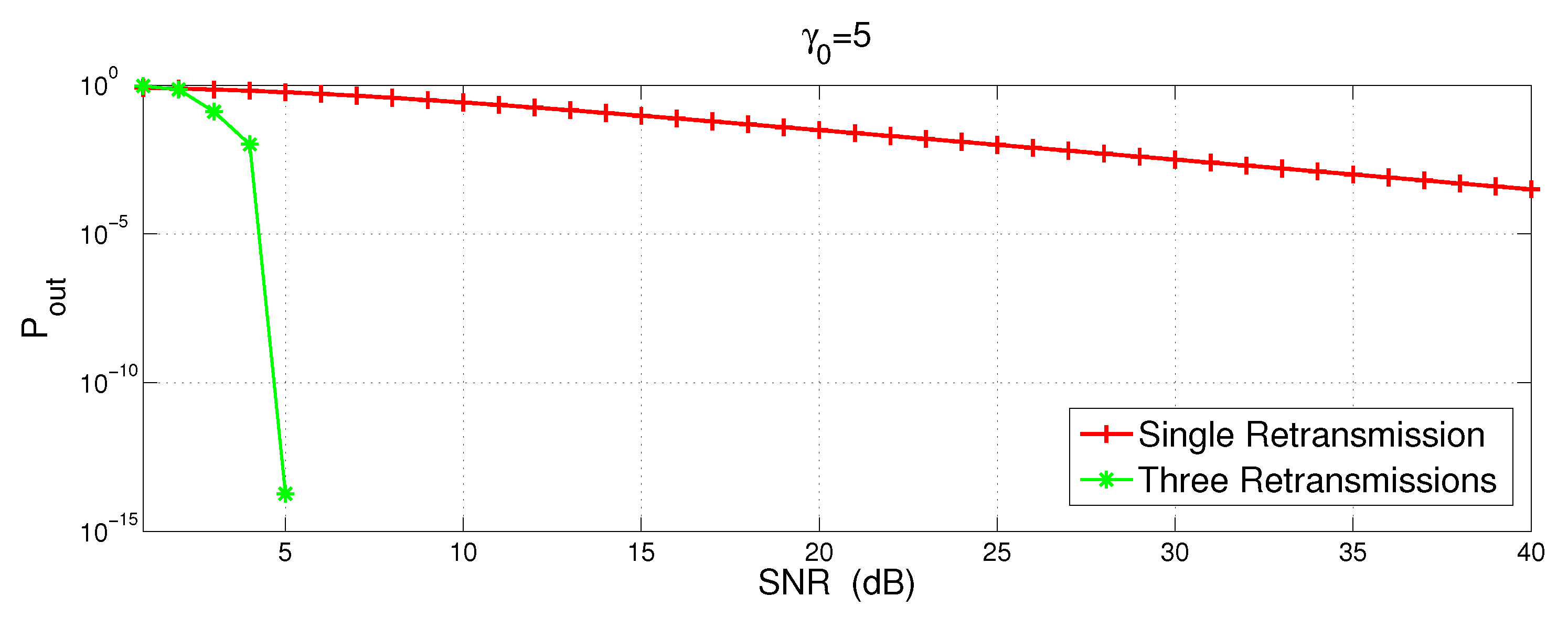
Figure 3 shows the outage probability with one and three retransmissions vs. SNR of the transmitted signal. The SNR is varied from 1 to 40 dB. This simulation is conducted for the case when γ S D γ R 1 γ R 2 γ R 3 and γ 0 is set to 5 dB. Figure 3 clearly shows that more number of retransmissions reduces the outage probability. With three retransmission, the transmitted signal with low SNR, i.e., 5dB, outage probability is 10 - 15 . This is because, in case of error after first retransmission, second retransmission may help the system to get out of outage and same is the case with third retransmission.
Figure 3. P o u t of incremental relaying with cooperative retransmissions.

3.4. Error Probability

In this section, closed-form expressions for error probability of incremental relaying with cooperative retransmissions has been derived for AF relaying. The average un-conditional error probability, P ( e ) is given as [15]:
P ( e ) = P r ( γ S D γ 0 ) × P d i v ( e ) + ( 1 - P r ( γ S D γ 0 ) ) × P d i r e c t ( e )
The first term, P r ( γ S D γ 0 ) × P d i v ( e ) , in the above equation represents that the error occurs in the direct transmission and assistance from relays is needed. The fading is Rayleigh distributed, therefore, γ S D follows exponential distribution. Hence P r ( γ S D ) is written as:
P r ( γ S D γ 0 ) = 1 - e x p ( - γ 0 γ ¯ S D )
Here γ S D is the SNR between S and D. P d i v ( e ) in Equation (20) represents the average probability that an error occurs in the combined diversity transmission from S and R to the D. P d i r e c t ( e ) represents the probability of error at D given that direct transmission is successful and relay’s assistance is not required. The conditional error probability takes the form of a × e r f c ( b γ S D ) , with e r f c ( x ) is the error function defines as e r f c ( x ) = ( 2 / π ) 0 e x p ( - x 2 ) d x ) and (a,b) are constants. For BPSK: a = 0.5 and b = 1. Hence, P d i r e c t ( e ) can be written as
P d i r e c t ( e ) = 0 a × e r f c ( b γ ) f γ S D ( γ | γ S D > γ 0 ) d γ
where, f γ S D ( γ | γ S D > γ 0 ) is the conditional PDF of γ S D given that γ S D is greater than the threshold γ 0 .
The conditional PDF, f γ S D ( γ | γ S D > γ 0 ) , for γ > γ 0 is found as:
f γ S D ( γ | γ S D > γ 0 ) = e x p ( γ 0 / γ ¯ S D ) γ ¯ S D e x p ( - γ ¯ γ ¯ S D )
The closed-form expression for P d i r e c t ( e ) , after substituting Equation (23) into Equation (22), solving the integration and doing some required manipulations, is written as:
P d i r e c t ( e ) = a e r f c ( b γ 0 ) - a e x p ( γ 0 γ ¯ S D ) × b γ ¯ S D 1 + b γ ¯ S D e r f c ( γ 0 ( b + 1 / γ ¯ S D ) )
If the destination needs assistance from relays, the signals are combined at D using MRC. To calculate P d i v ( e ) , we need to know the output SNR at D. The output SNR at D will be sum of direct signal, γ S D and relayed signals. For incremental relaying cooperative retransmissions, P d i v ( e ) will have three cases.
Case 1:
( γ S D γ 0 )
In this case, the relay, R 1 , performs re-transmission given that direct transmission is not successful. In this case, γ d = γ S D + γ R 1 , where γ d represents output SNR at D and γ R i is defined in Equation (B2). P d i v ( e ) can be written as
P d i v ( e ) = 0 a × e r f c ( b z ) f γ d ( z | γ S D γ 0 ) d z
γ d is a random variable whose PDF is the convolution of the PDFs of γ S D and γ R 1 = f γ 1 . f γ 1 is derived in Appendix B in Equation (B3). The conditional PDF of output SNR at D, f γ d ( z | γ S D γ 0 ) is derived as:
f γ d ( z | γ S D γ 0 ) = f γ S D ( z ) * f γ R 1 ( z ) P r [ γ S D γ 0 ] = e x p ( - z / γ ¯ R 1 ) - e x p ( - z / γ ¯ S D ) ( γ ¯ R 1 - γ ¯ S D ) ( 1 - e x p ( - γ 0 / γ ¯ S D ) ) , i f z γ 0
where, P r [ γ S D γ 0 ] is defined in Equation (21). Now, the closed-form expression for P d i v ( e ) is obtained by putting Equation (26) in Equation (25) and performing integration. We need to integrate from 0 to γ 0 for case γ d γ 0 .
P d i v ( e ) = a ( γ ¯ R 1 - γ ¯ S D ) ( 1 - e - γ 0 γ ¯ S D ) × γ ¯ R 1 - γ ¯ R 1 b γ ¯ R 1 ( 1 + b γ ¯ R 1 ) e r f ( γ 0 ( b + 1 / γ ¯ R 1 ) ) - γ ¯ R 1 e - γ 0 γ ¯ R 1 e r f c ( γ 0 b ) - a ( - γ ¯ R 1 + γ ¯ S D ) ( - 1 + e - γ 0 γ ¯ S D ) × γ ¯ S D - e - γ 0 γ ¯ S D + b γ ¯ S D ( 1 + b γ ¯ S D ) e - γ 0 γ ¯ S D e r f ( γ 0 ( b + 1 / γ ¯ S D ) ) + e r f c ( γ 0 b )
Case 2:
( γ S D + γ R 1 ) γ 0
In this case, relays, R 1 and R 2 , perform retransmission given that first retransmission was not successful. Here, γ d = γ S D + γ R 1 + γ R 2 , where γ d represents output SNR at D and γ R i is given in Equation (B2). P d i v ( e ) can be written as:
P d i v ( e ) = 0 a × e r f c ( b z ) f γ d ( z | ( γ S D + γ R 1 ) γ 0 ) d z
The PDF of random variable, γ d , will be the convolution of the PDFs of γ S D , γ R 1 and γ R 2 . Hence, f γ d ( z | ( γ S D + γ R 1 ) γ 0 ) for case z γ 0 is derived as:
f γ d ( z | ( γ S D + γ R 1 ) γ 0 ) = f γ S D ( z ) * f γ R 1 ( z ) * f γ R 2 ( z ) P r [ γ S D + γ R 1 γ 0 ] = 1 ( γ ¯ S D ( - e - γ 0 γ ¯ S D + 1 ) - γ ¯ R 1 ( - e - γ 0 γ ¯ R 1 + 1 ) ) × γ ¯ S D γ ¯ S D - γ ¯ R 2 e x p ( - z / γ ¯ S D ) - e x p ( - z / γ ¯ R 2 ) - γ ¯ R 1 γ ¯ R 1 - γ ¯ R 2 e x p ( - z / γ ¯ R 1 ) - e x p ( - z / γ ¯ R 2 )
where f γ S D ( z ) * f γ R 1 ( z ) * f γ R 2 ( z ) = f γ 2 . f γ 2 is defined in Appendix B in Equation (B4). P r [ γ S D + γ R 1 γ 0 ] is obtained by integrating Equation (B3) from 0 to γ 0 .
Substituting Equation (29) in Equation (28), integrating and doing necessary manipulations, the closed-form expression for P d i v ( e ) is given as:
P d i v ( e ) = a γ ¯ S D ( 1 - exp ( - γ 0 / γ ¯ S D ) ) + γ ¯ R 1 ( - 1 + exp ( - γ 0 / γ ¯ R 1 ) ) × γ ¯ S D 2 1 - e - γ 0 γ ¯ S D + e - γ 0 γ ¯ S D e r f ( b γ 0 ) - u e r f ( γ 0 ( b + 1 / γ ¯ S D ) ) γ ¯ S D - γ ¯ R 2 - γ ¯ R 1 2 1 - e - γ 0 γ ¯ R 1 + e - γ 0 γ ¯ R 1 e r f ( b γ 0 ) - v e r f ( γ 0 ( b + 1 / γ ¯ R 1 ) ) γ ¯ R 1 - γ ¯ R 2 - γ S D γ R 2 1 - e - γ 0 γ ¯ R 2 + e - γ 0 γ ¯ R 2 e r f ( b γ 0 ) - w e r f ( γ 0 ( b + 1 / γ ¯ R 2 ) ) γ ¯ S D - γ ¯ R 2 + γ ¯ R 1 γ ¯ R 2 1 - e - γ 0 γ ¯ R 2 + e - γ 0 γ ¯ R 2 e r f ( b γ 0 ) - w e r f ( γ 0 ( b + 1 / γ ¯ R 2 ) ) γ ¯ R 1 - γ ¯ R 2
where,
u = γ ¯ S D b 1 + γ ¯ S D b
v = γ ¯ R 1 b 1 + γ ¯ R 1 b
w = γ ¯ R 2 b 1 + γ ¯ R 2 b
Case 3:
( γ S D + γ R 1 + γ R 2 ) γ 0
For this case, relays, R 1 , R 2 and R 3 , perform retransmission given that second retransmission was not successful and third retransmission is required from R 3 . Here, γ d = γ S D + γ R 1 + γ R 2 + γ R 2 , where γ d represents output SNR at D and γ R i is from Equation (B2). P d i v ( e ) can be written as
P d i v ( e ) = 0 a × e r f c ( b z ) f γ d ( z | ( γ S D + γ R 1 + γ R 2 ) γ 0 ) d z
The PDF of random variable, γ d , in this case will be the convolution of the PDFs of γ S D , γ R 1 , γ R 2 and γ R 3 . So, f γ d ( z | ( γ S D + γ R 1 + γ R 2 ) γ 0 ) for case z γ 0 is given by:
f γ d ( z | ( γ S D + γ R 1 + γ R 2 ) γ 0 ) = f γ S D ( z ) * f γ R 1 ( z ) * f γ R 2 ( z ) * f γ R 3 P r [ γ S D + γ R 1 + γ R 2 γ 0 ] = γ ¯ S D 2 exp ( - z / γ ¯ S D ) - exp ( - z / γ ¯ R 3 ) ( γ ¯ S D - γ ¯ R 2 ) ( γ ¯ S D - γ ¯ R 3 ) - γ ¯ S D × υ ( γ ¯ R 2 - γ ¯ R 3 ) + γ ¯ R 1 υ + τ ( γ ¯ R 1 - γ ¯ R 2 ) ÷ γ ¯ S D 2 ( 1 - exp ( - γ 0 / γ ¯ S D ) ) γ ¯ S D - γ ¯ R 2 - γ ¯ S D γ ¯ R 2 ( 1 - exp ( - γ 0 / γ ¯ R 2 ) ) γ ¯ S D - γ ¯ R 2 - γ ¯ R 1 ( γ ¯ R 1 - γ ¯ R 1 e - γ 0 γ ¯ R 1 + γ ¯ R 2 ( - 1 + e - γ 0 γ ¯ R 2 ) ) γ ¯ R 1 - γ ¯ R 2
where:
υ = γ ¯ R 2 exp ( - z / γ ¯ R 2 ) - exp ( - z / γ ¯ R 3 ) γ ¯ R 2 - γ ¯ R 3
and
τ = γ ¯ R 1 exp ( - z / γ ¯ R 1 ) - exp ( - z / γ ¯ R 3 ) γ ¯ R 1 - γ ¯ R 3
f γ S D ( z ) * f γ R 1 ( z ) * f γ R 2 ( z ) * f γ R 3 = f γ 3 . f γ 3 is derived in Equation (B5) in Appendix B and P r [ γ S D + γ R 1 + γ R 2 γ 0 ] is obtained by integration Equation (B4) from 0 to γ 0 . By substituting the above equation in Equation (34) and integrating, we get closed-form expression for P d i v ( e ) as:
P d i v ( e ) = a γ ¯ S D 2 ( 1 - e - γ 0 γ ¯ S D ) γ ¯ S D - γ ¯ R 2 - γ ¯ S D γ ¯ R 2 ( 1 - e - γ 0 γ ¯ R 2 ) γ ¯ S D - γ ¯ R 2 - γ ¯ R 1 ( γ ¯ R 1 - γ ¯ R 1 e - γ 0 γ ¯ R 1 + γ ¯ R 2 ( - 1 + e - γ 0 γ ¯ R 2 ) ) γ ¯ R 1 - γ ¯ R 2 γ ¯ S D 3 1 - e - γ 0 γ ¯ S D + e - γ 0 γ ¯ S D e r f ( b γ 0 ) - γ ¯ S D b 1 + γ ¯ S D b e r f ( γ 0 ( b + 1 / γ ¯ S D ) ) ( γ ¯ S D - γ ¯ R 2 ) ( γ ¯ S D - γ ¯ R 3 ) - γ ¯ R 1 3 1 - e - γ 0 γ ¯ R 1 + e - γ 0 γ ¯ R 1 e r f ( b γ 0 ) - γ ¯ R 1 b 1 + γ ¯ R 1 b e r f ( γ 0 ( b + 1 / γ ¯ R 1 ) ) ( γ ¯ R 1 - γ ¯ R 2 ) ( γ ¯ R 1 - γ ¯ R 2 ) - γ ¯ S D γ ¯ R 2 2 1 - e - γ 0 γ ¯ R 2 + e - γ 0 γ ¯ R 2 e r f ( b γ 0 ) - γ ¯ R 2 b 1 + γ ¯ R 2 b e r f ( γ 0 ( b + 1 / γ ¯ R 2 ) ) ( γ ¯ S D - γ ¯ R 2 ) ( γ ¯ R 2 - γ ¯ R 3 ) + γ ¯ R 1 γ ¯ R 2 2 1 - e - γ 0 γ ¯ R 2 + e - γ 0 γ ¯ R 2 e r f ( b γ 0 ) - γ ¯ R 2 b 1 + γ ¯ R 2 b e r f ( γ 0 ( b + 1 / γ ¯ R 2 ) ) ( γ ¯ R 1 - γ ¯ R 2 ) ( γ ¯ R 2 - γ ¯ R 3 ) - γ ¯ S D 2 γ ¯ R 3 1 - e - γ 0 γ ¯ R 3 + e - γ 0 γ ¯ R 3 e r f ( b γ 0 ) - γ ¯ R 3 b 1 + γ ¯ R 3 b e r f ( γ 0 ( b + 1 / γ ¯ R 3 ) ) ( γ ¯ S D - γ ¯ R 2 ) ( γ ¯ S D - γ ¯ R 3 ) + γ ¯ R 1 2 γ ¯ R 3 1 - e - γ 0 γ ¯ R 3 + e - γ 0 γ ¯ R 3 e r f ( b γ 0 ) - γ ¯ R 3 b 1 + γ ¯ R 3 b e r f ( γ 0 ( b + 1 / γ ¯ R 3 ) ) ( γ ¯ R 1 - γ ¯ R 2 ) ( γ ¯ R 1 - γ ¯ R 3 ) + γ ¯ S D γ ¯ R 2 γ ¯ R 3 1 - e - γ 0 γ ¯ R 3 + e - γ 0 γ ¯ R 3 e r f ( b γ 0 ) - γ ¯ R 3 b 1 + γ ¯ R 3 b e r f ( γ 0 ( b + 1 / γ ¯ R 3 ) ) ( γ ¯ S D - γ ¯ R 2 ) ( γ ¯ R 2 - γ ¯ R 3 ) - γ ¯ R 1 γ ¯ R 2 γ ¯ R 3 1 - e - γ 0 γ ¯ R 3 + e - γ 0 γ ¯ R 3 e r f ( b γ 0 ) - γ ¯ R 3 b 1 + γ ¯ R 3 b e r f ( γ 0 ( b + 1 / γ ¯ R 3 ) ) ( γ ¯ R 1 - γ ¯ R 2 ) ( γ ¯ R 2 - γ ¯ R 3 )
By substituting Equations (21), (24) and (27) or (30) or (38) in Equation (20), we get closed-form expression for error probability of incremental relaying with cooperative retransmissions. Note that z is an auxiliary variable which is representing γ d , who is the sum of γ S D and γ R i .
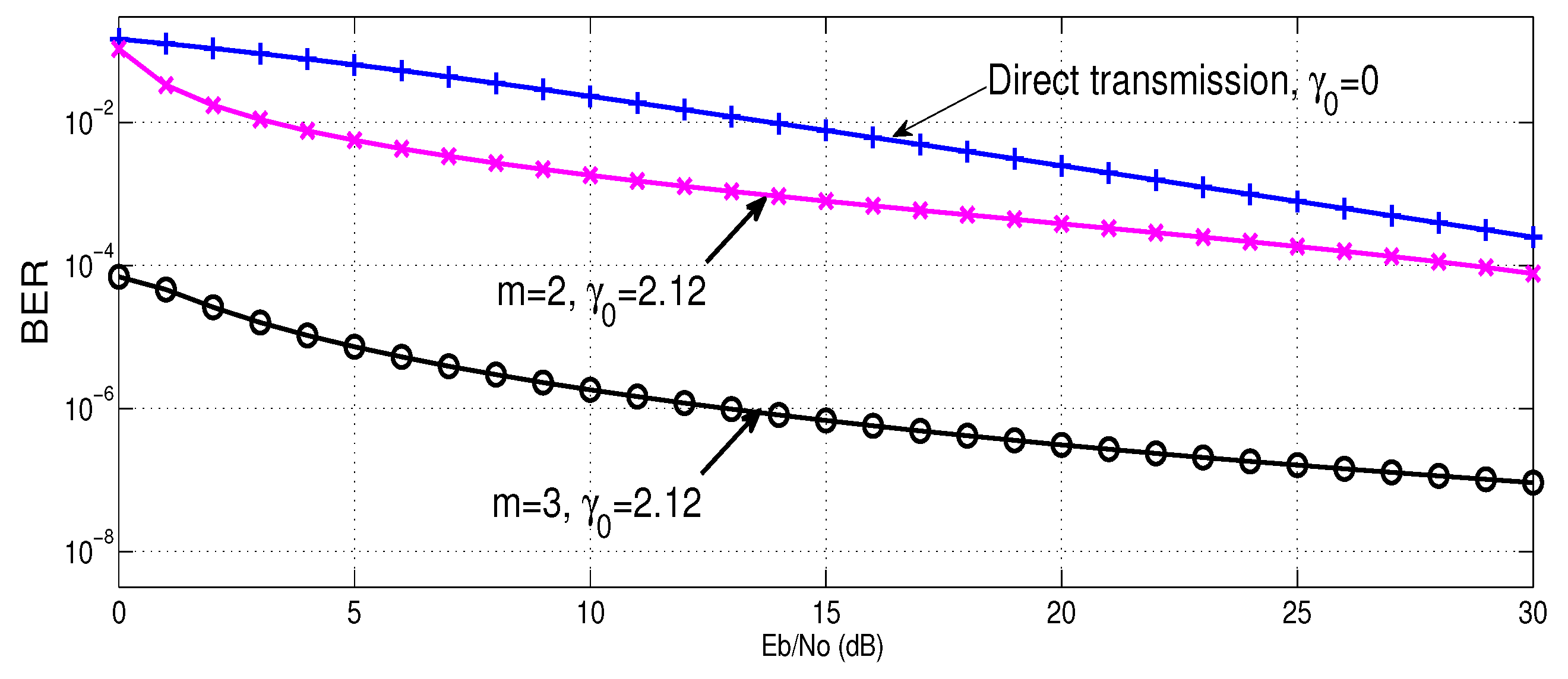
Figure 4 shows the BER performance using incremental relaying cooperative diversity with cooperative retransmissions. The performance is meant for AF scheme using γ 0 = 2 . 12 . In this plot, error probability for direct transmission, γ 0 , and re-transmissions involving 2 and 3 relays are plotted against the SNR of the transmitted signal ( E b / N o ) . Results demonstrate that because of diversity gain, the cooperation improves the BER performance in comparison with the direct transmission.
Figure 4. BER comparison of incremental relaying with cooperative retransmissions, using m = 2 and m = 3, with direct transmission.
The results also show that in low SNR, system benefits from the diversity gain, however, at high SNR, both m = 2 and m = 3 tend to get parallel with the direct transmission. This is because, at high SNR destination rarely need assistance from relay to perform retransmission.

3.5. Proposed Scheme 1: ACE

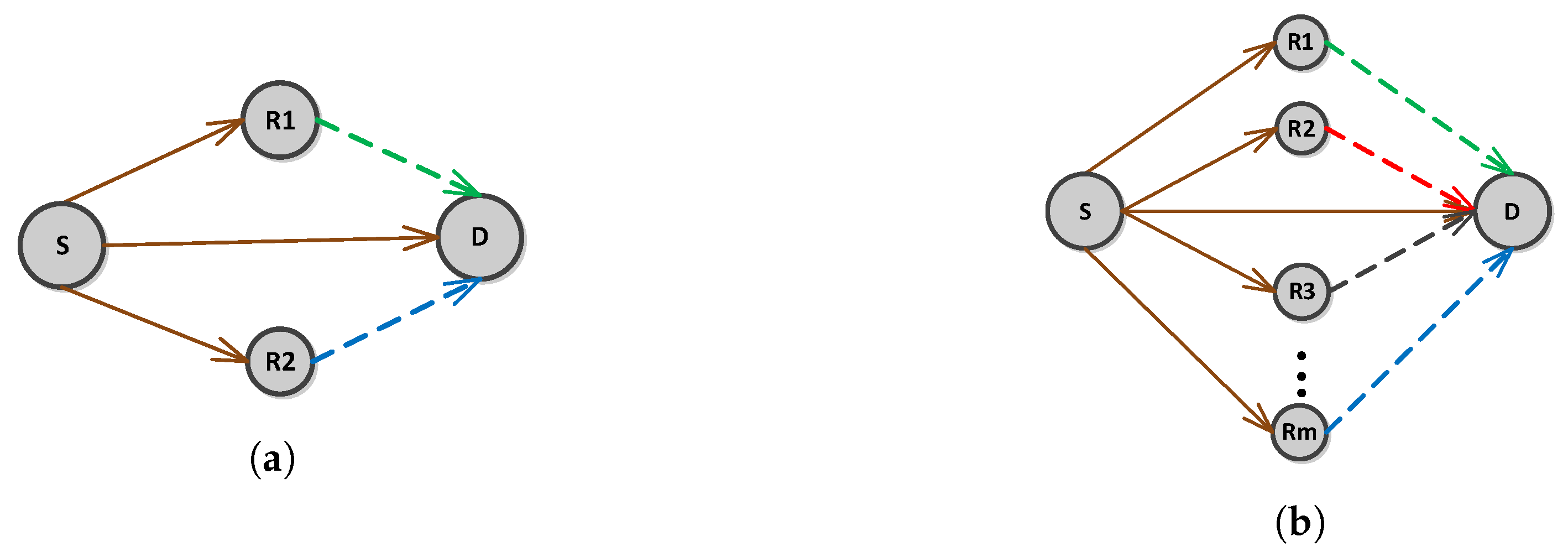
ACE is an adaptive cooperative retransmission routing protocol based on incremental relaying cooperative diversity. Figure 5a shows proposed system model of ACE for single S-D pair. It consists of S, D and two relays R1 and R2. S broadcasts data to D, R1 and R2 in the first phase. Retransmission from R1 and R2 is performed one by one in the second phase if and only if the destination receives erroneous signal at D. The proposed scheme works in time slots. A Time slot is a duration in which all alive nodes transmit their data to the Sink. It is assumed for the proposed protocol that alive nodes always have data to send. BS/Sink keeps the record of all the alive and dead nodes. It is the responsibility of BS to broadcast the Time Division Multiple Access (TDMA) schedule telling the nodes when it can transmit. Nodes send data packet during their allocated transmission time. When all the node finish data transmission, next time slot is initiated by the BS. Each slot consists of three phases given as:
  • Information exchange phase
  • Path establishment phase
  • Data transmission phase
Figure 5. System model. (a) ACE; (b) E-ACE.

3.5.1. Information Exchange Phase

ACE is localization free routing protocol. Nodes are equipped with inexpensive depth sensors. Each node broadcasts its depth and residual energy information to all nodes in its transmission range via HELLO packet. Neighbour nodes are identified on the basis of depth information. A neighbor of node “x” is one whose depth difference from x lies within the transmission range of x. This process is repeated for all the nodes and information regarding local neighbours is stored in each node’s database.
Information exchange phase is repeated in the beginning of each time slot and neighbors and residual energy information is updated. This is because, once nodes start to die, neighbors and residual energy information may change and needs to be updated for the path establishment phase.

3.5.2. Path Establishment Phase

Once a node knows its neighbours, a multi-hop path is established from source to sink. Path establishment phase has two main objectives; (i) identification of the next destination and (ii) identification of relays that act as cooperative nodes for data retransmission. Source node identifies its neighbours with the help of depth information of other nodes. Nodes that have depth lower than that of source node are included in the Forwarding Neighbour (FN) list and are called FNs which are potential candidates for next hop destination. Neighbours with depth greater than source node are neglected. EEDBR algorithm is followed to select the master node from FN list for the next hop destination. In this process, the node of lesser depth and highest residual energy is selected as master node.
Relay nodes are identified after the selection of master node and are identified among the nodes that lie in the cooperative region as shown in Figure 2. Nodes that are deployed in cooperative region are known as cooperative nodes. In ACE, only two nodes among all cooperative nodes act as relays. Selection criteria for R1 and R2 is based on highest residual energy and minimum depth. Once a node identifies the master node and cooperative nodes, it broadcasts this information to its neighbors. Neighbors on receiving this information know, who the master node is and who the cooperative nodes are. It is assumed that control messages are not lost during transmission. The process of choosing master node and retransmission nodes continues till sink is approached.

3.5.3. Data Transmission Phase

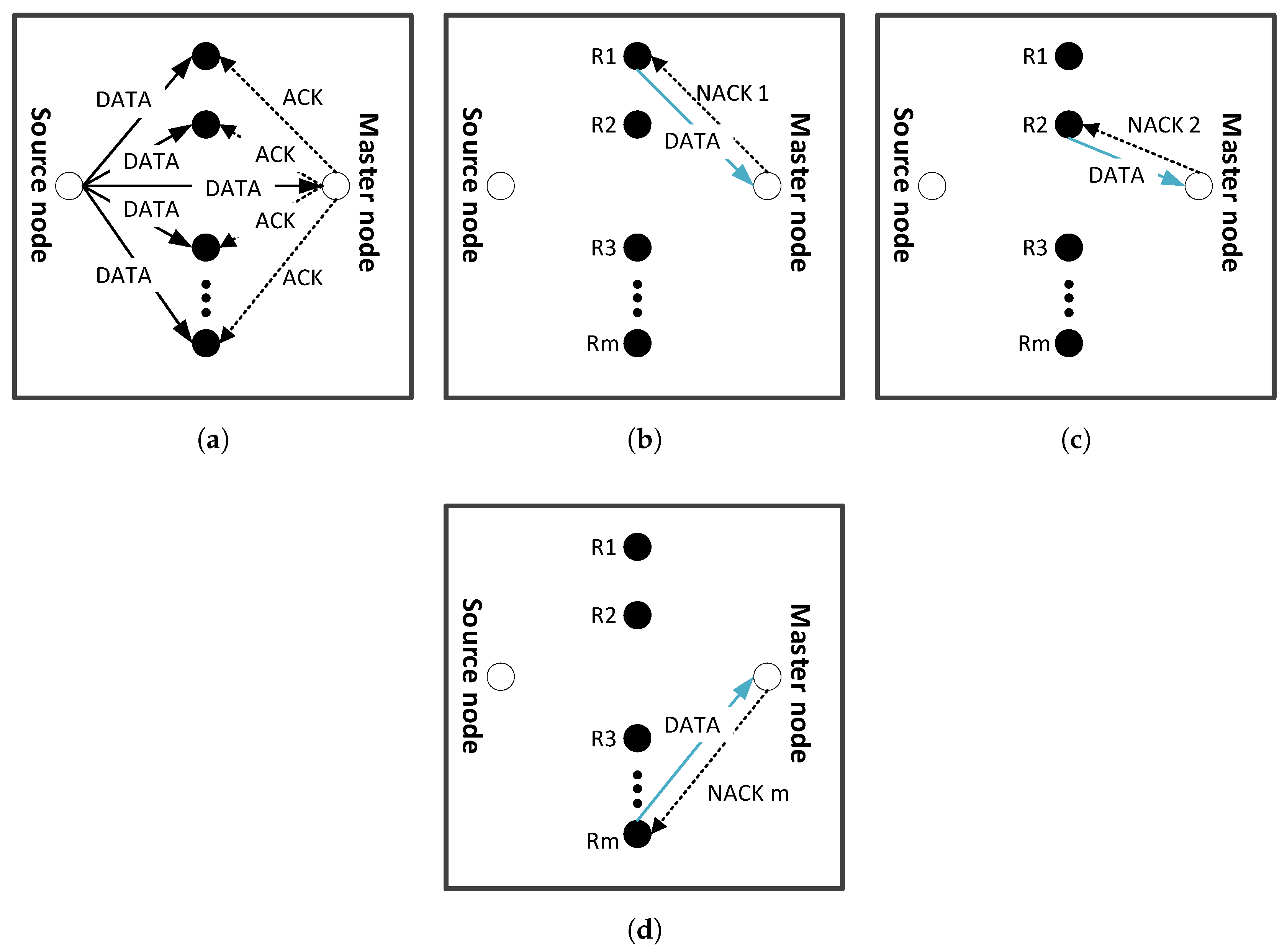
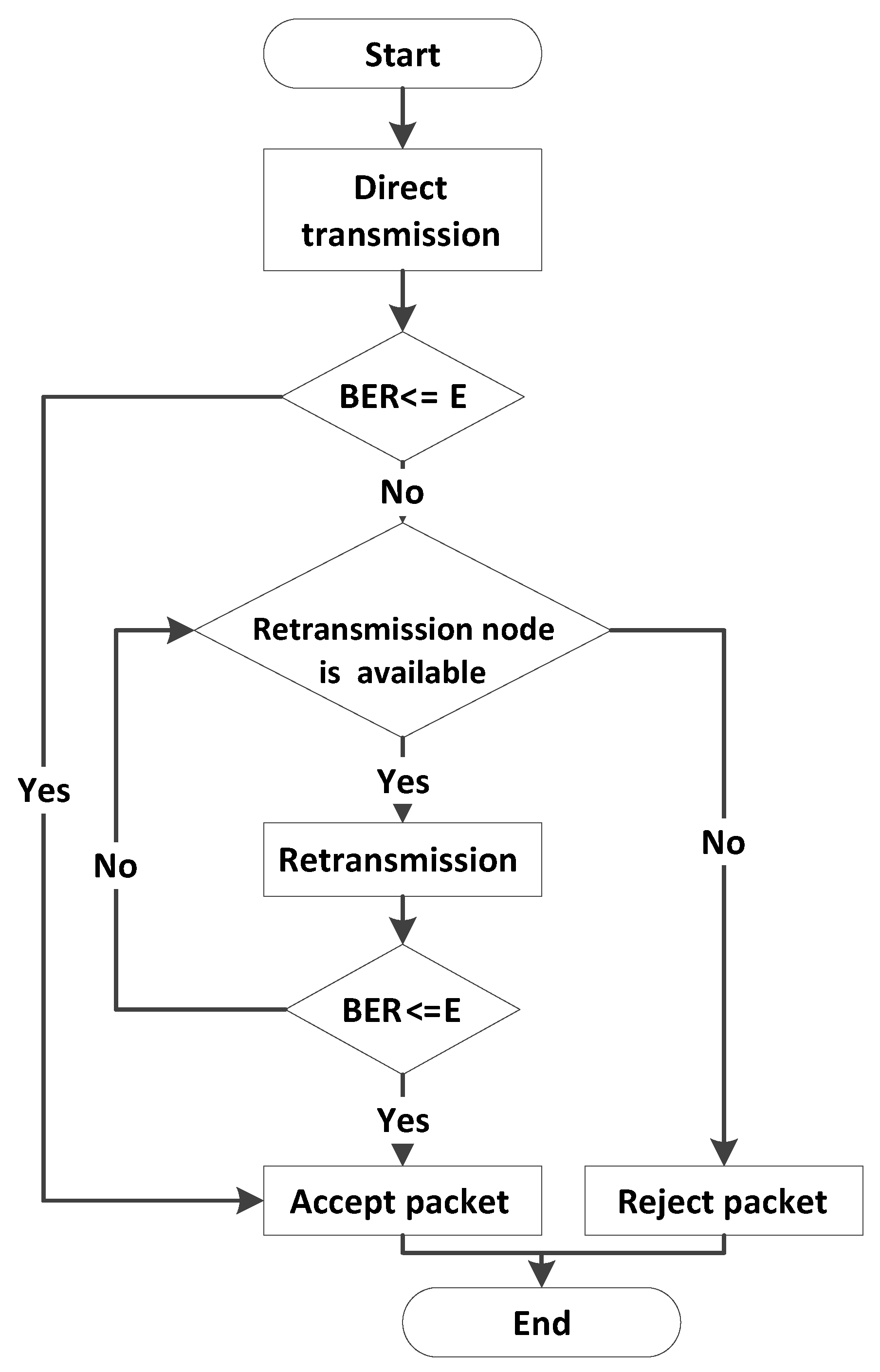
In this phase, data is transmitted from source to sink through the path which is established in path establishment phase. Source node broadcasts its data to master and cooperative nodes. Data on its way from source to destination suffers fading due to multi-path propagation and noise in the water. These factors introduce high BER in the signal. In ACE, data received at the master node in direct transmission is compared with the original data sent by the source node and BER is calculated. If BER is less than or equal to maximum allowable BER, E, then data packet is accepted. Upon acceptance, the master node sends acknowledgement (ACK) to retransmission nodes as shown in Figure 6a. Soon after, retransmission nodes discard the data.
Figure 6. Data transmission from source to master node: (a) packet is accepted by master node and acknowledgement (ACK) is sent to retransmission nodes indicating that no retransmission is required; (b) packet is rejected by master node and asking for first retransmission from R1; (c) packet is again rejected and asking for second retransmission from R2; and (d) mth relay node performing data retransmission.
If BER is greater than E, Negative ACK (NACK), is sent by master node to retransmission nodes. Figure 6b shows that, for the first retransmission, NACK1 is selectively sent to first retransmission node, R1. In response to NACK1, data is amplified and forwarded to master node by R1. This amplified data may also suffer fading and noise. Therefore, to achieve acceptable BER at master node, direct signal from source to master node and relayed signal from source to relay to master node are combined using MRC. At the master node, BER is calculated and compared with the predefined threshold, E. If it is less than or equal to E, data packet is accepted and ACK signal is sent to retransmission nodes. Retransmission nodes discard the data on reception of ACK signal. However, if BER is greater than E, NACK2 is sent to another retransmission node which amplifies and forwards the data to master node as shown in Figure 6c. Selection of different retransmission nodes leads to balanced energy consumption. A given node quickly depletes its energy if it is engaged in multiple retransmissions. At the master node, the direct, and two relayed signals are combined using MRC. If the calculated BER is less than or equal to E, data packet is accepted else dropped. Incase of ACK from the master node, the retransmission nodes discard their data. It is assumed that signaling information; ACK/NACK is not lost during transmission.

3.6. Proposed Scheme 2: E-ACE

In poor underwater environment (noise, water bubbles, fading, etc), high BER is introduced that make two retransmissions insufficient. Therefore, to increase reliability and throughput efficiency of the network, E-ACE is proposed. Unlike ACE, E-ACE allows m relays to perform cooperative retransmissions as shown in Figure 5b. Instead of using two cooperative nodes, as in ACE, for retransmissions, rest of the nodes, present in the cooperative region, are used. In this way energy balancing is achieved and node does not deplete its energy in performing multiple retransmissions. ACE is actually a special case of E-ACE with cooperative nodes limited to 2.
Rest of the E-ACE protocol operation is similar to that of ACE, i.e., information exchange phase, path establishment phase, and data transmission phase. It is worth mentioning in E-ACE that all the nodes present in cooperative region are candidates for retransmitting the data. The nodes in cooperative region may vary for each S-D pair. More m results in increased retransmissions, thereby, reducing outage probability and vice versa.

3.6.1. Information Exchange Phase

This phase is replica of ACE information exchange phase.

3.6.2. Path Establishment Phase

This phase is similar to ACE’s path establishment phase.

3.6.3. Data Transmission Phase

Till 2nd retransmission, this phase is similar to ACE’s data transmission phase. However, if BER is not acceptable after retransmission from R2, R3 does data retransmission and the process continues till all the retransmission nodes are expired or acceptable BER is achieved as shown in Figure 6d. Figure 7 presents data transmission flow chart of a single packet for E-ACE.
Figure 7. Data transmission flow chart for Enhanced-Adaptive Cooperation in Energy (E-ACE).

3.7. Energy Consumption Analysis

In this section, we evaluate the energy consumption of ACE and E-ACE.
The transmission energy E T , for a message of size L bits through a channel with bandwidth, B kbps is given as [31]:
E T = P t × L B
Similarly, the receiving energy, E R , is defined as:
E R = P r × L B
where P t and P r are transmit and receive power respectively. Let N be the total number of nodes in the network and all nodes always have data to transmit. The total transmission energy E T T X with m relays involved in data transmission becomes,
E T T X = ( m + 1 ) × E T
Here the term ( m + 1 ) , m indicates the number of relays involved in retransmission and 1 indicate the transmission from source node. In case of ACE, m = 1 , 2 . If no retransmission is performed, m = 0 . Similarly the total reception energy, E R R X is derived as:
E R R X = ( m + 1 ) × E R
In reception energy, 1 indicates the reception at master node.
The transmission from source to sink takes place in a multi-hop manner. The number of hops can be different for different nodes depending on node’s location. Let h i be the number of hops for data packet of node N i . The energy required for data from node N i travelling through h i hops is given as:
E T T X i = N i × h i × ( m + 1 ) × E T
where, i = 1 : N . The total transmission energy of the network becomes:
E T T X = i = 1 N N i × h i × ( m + 1 ) × E T
Similarly the total reception energy, E R R X is given as:
E T R X = i = 1 N N i × h i × ( m + 1 ) × E R
In ACE and E-ACE, besides data transmission, we have energy spent by control messages. Let E C T R L be the total energy used in control messages. The total energy consumption for ACE and E-ACE is,
E = E T T X + E R R X + E C T R L
where, E C T R L , with length of control message L C , is defined as:
E C T R L = ( i = 1 N N i × h i ) P t × L C B + ( i = 1 N ( N i + m ) × h i ) P r × L C B

4. Simulation Results and Discussions

In this section, the performance of the proposed protocols ACE and E-ACE are compared with other proposed protocols referred as EEDBR [3] and Cooperative ARQ (CARQ) [11]. CARQ is is an ARQ based scheme in which cooperative nodes are used to provide alternative paths for a specific source destination link. Relay nodes are selected based on the smallest distance from the destination. When the destination node receives an erroneous packet, it asks for retransmission from a cooperative node, which is selected in a closest-one-first manner from the nodes in the cooperative region. EEDBR is another routing protocol that takes depth and residual energy information in selection of next hop. It is a non cooperative routing protocol and relies on single link for data transmission.z
In simulations, 250 nodes are randomly deployed in an area of 500 m × 500 m. The network is homogenous and each node has initial energy of 30 J and a fixed transmission range of 100 m. The values of energy consumption are 2 W for transmission, 0.1 W for reception and 10 mW for idle sensing. Maximum allowable BER is set to 0.49 and m = 3. Channel bandwidth is 30 kbps. The size of data packet is 1000 bits and that of control packet is 48 bits. We assume that the nodes are anchored with wires in seawater such that the nodes can slightly move horizontally and the horizontal movement is small enough to be neglected. Four unconstrained sinks (in terms of energy) are deployed on the surface of water at an equal distance of 100 m. Underwater nodes are equipped with acoustic modems and sinks are equipped with both acoustic and radio modems. It is worth mentioning here that only for the sake of fair comparison, the simulation parameters are chosen according the existing works used for comparison.

4.1. Network Performance Parameters—Definitions

Subject to validation of the proposed work, we conduct simulations in terms of the following metrics.
  • Network lifetime: It is the time duration from the start of the network till the death of the last node.
  • Total energy consumption: It is the total energy consumed by all the nodes during transmission, reception, and idle time. It is measured in Joules.
  • Throughput: It is defined as the total number of successfully received packets at the sink and is measured in packets/time slot.
  • Packet drop: It is the number of packets that are not successfully received at the sink.
  • Packet acceptance ratio: It is the ratio of packets received at sink to the total number of packets sent towards sink.

4.2. Network Performance Parameters—Discussion

4.2.1. Network Lifetime

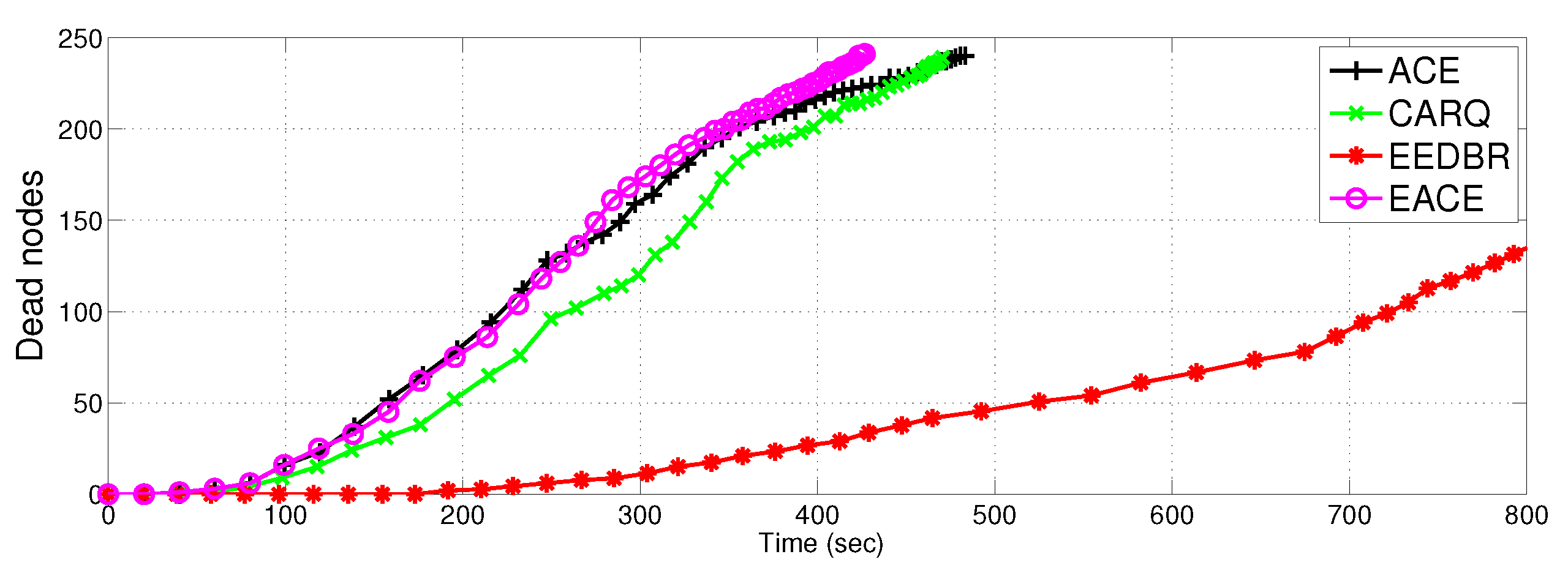
Figure 8 shows network lifetime comparison of the proposed protocols with EEDBR and CARQ. Network lifetime of ACE, E-ACE and CARQ is less than EEDBR because they consume more energy in retransmissions in case of erroneous data reception. Difference in lifetime of EEDBR and ACE is greater, whereas, the difference in lifetime of ACE, E-ACE an CARQ is small. This is due to the fact that ACE and CARQ allows only two relays and hence, maximum two retransmissions can be done, whereas, E-ACE allows m relays to retransmit data packet. However, most of the time two retransmissions are enough to achieve acceptable BER at destination and in some cases (low SNR region, obstacle, etc.), there is requirement for three or more retransmissions. This also validates our assumption of limiting m to 3.
Figure 8. Network lifetime.
Although, both CARQ and ACE are using two retransmission nodes, however, lifetime of ACE is less than CARQ because, ACE has more throughput.The reason behind is that ACE use MRC technique to combine data from direct transmission and relayed transmissions. MRC significantly reduces the BER introduced during individual transmissions. Signal combining technique is not incorporated in CARQ, therefore, data does not achieve acceptable BER. Hence packet is forcefully dropped at the same hop even after 2 retransmissions and protocol continues with the next node packet.

4.2.2. Total Energy Consumption

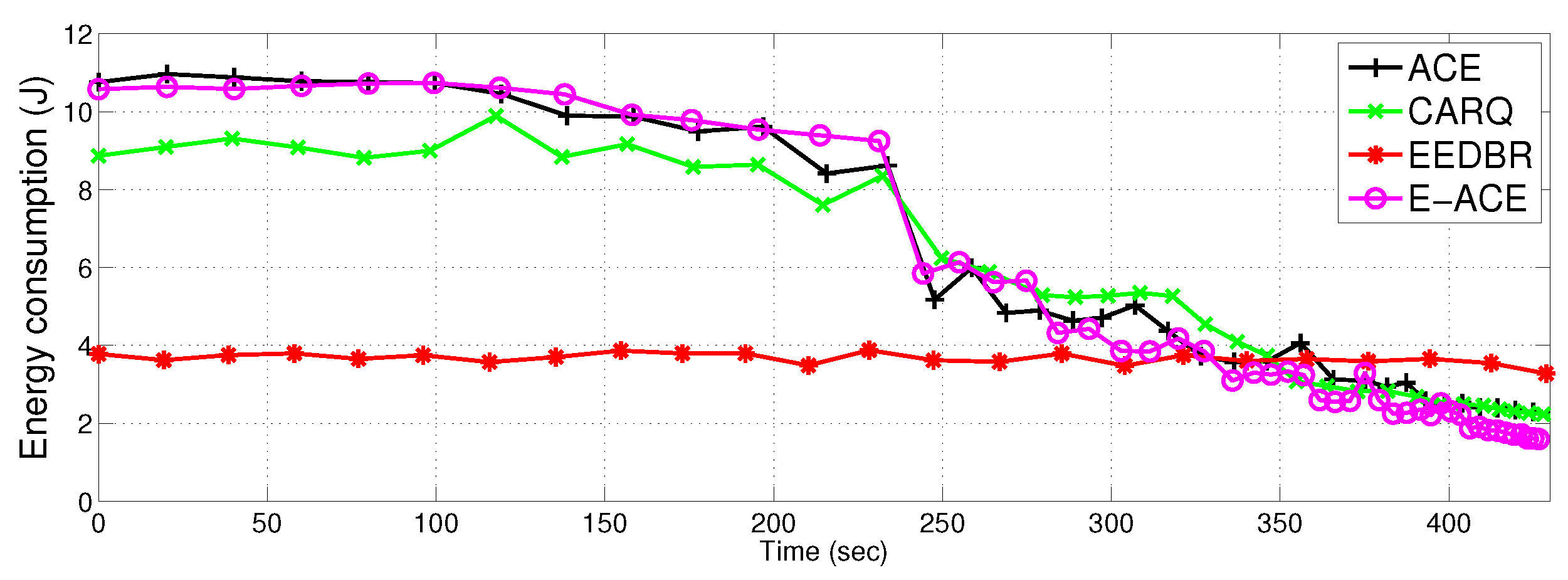
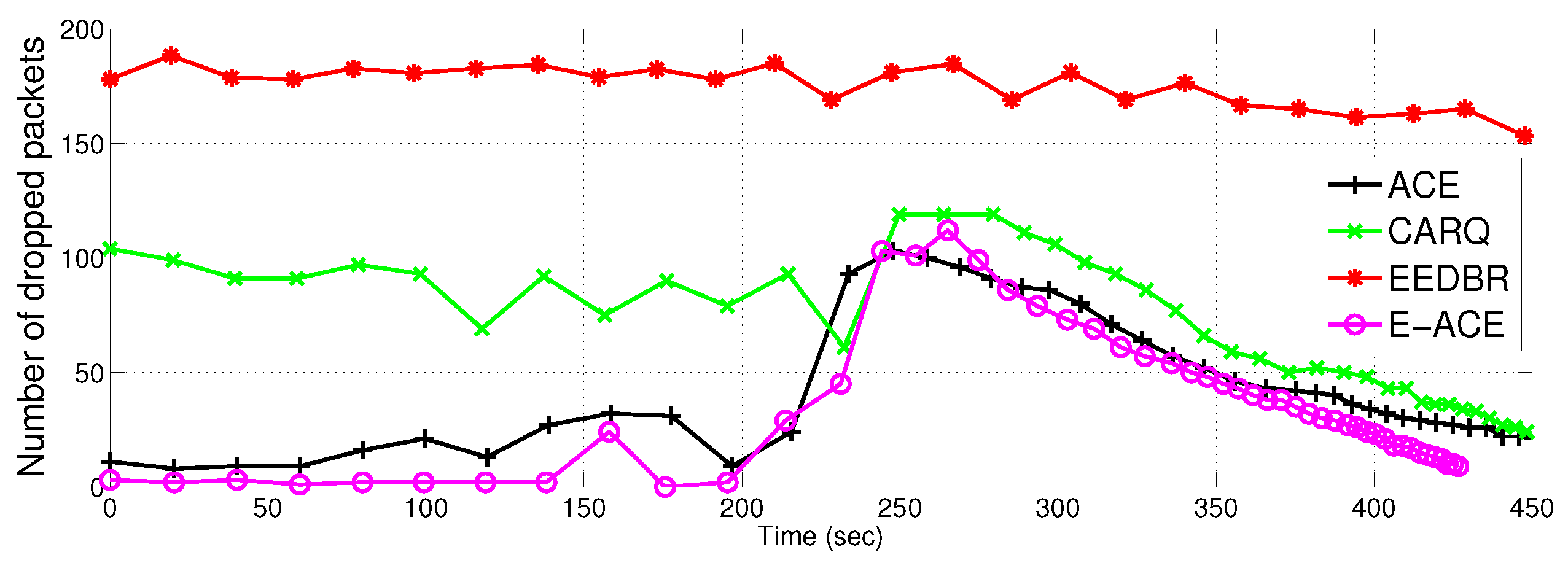
Figure 9 shows total energy consumption of the proposed protocols in comparison to EEDBR and CARQ. Energy consumption of E-ACE, ACE and CARQ is greater than EEDBR due to more allowed retransmissions. ACE and E-ACE show same energy consumption with almost same throughput (refer Figure 10). CARQ and EEDBR show less energy consumption because they have low throughput and high packet drop (refer Figure 11). Less throughput contributes to low energy consumption because less packets are transmitted.
Figure 9. Total energy consumption of the network.
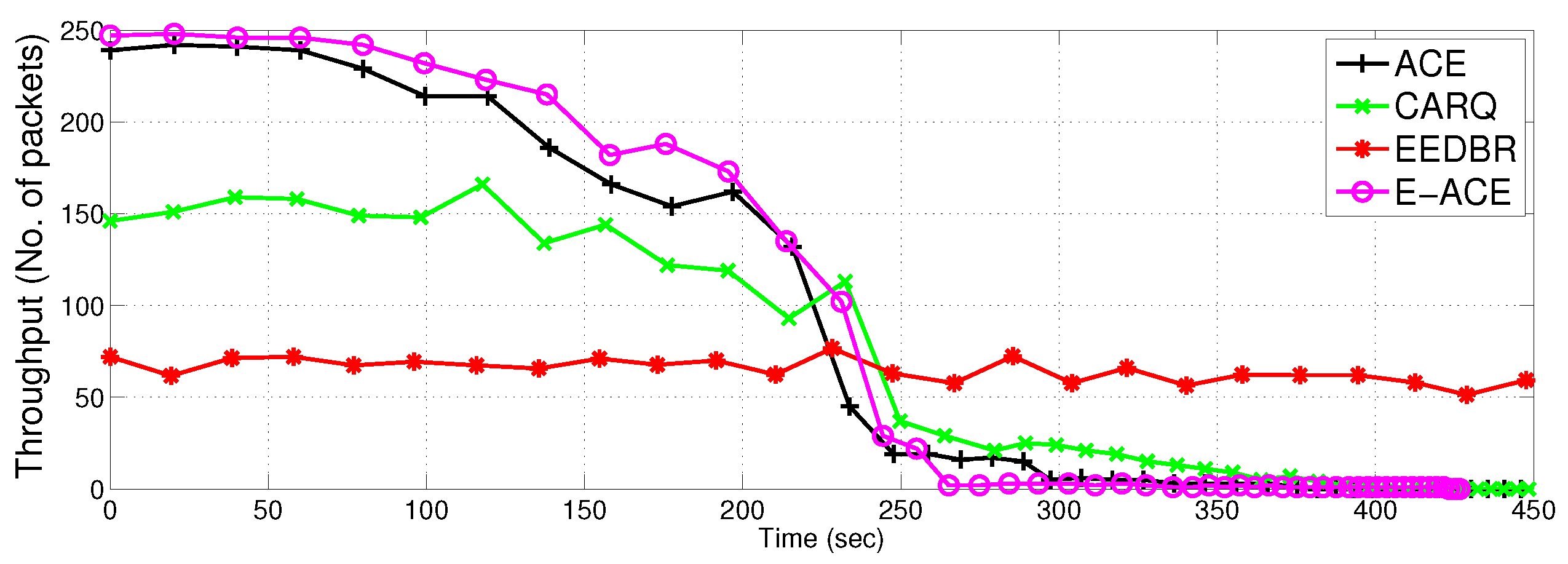
Figure 10. Throughput.
Figure 11. Packets dropped.
In later time slots, energy consumption of the four protocols is almost same because ACE and E-ACE have very few alive nodes to send data to sink. EEDBR has 238 nodes alive at 300 s, whereas, ACE and E-ACE have not more than 100 alive nodes.
Figure 8 and Figure 9 show the drawback of E-ACE. These figures also show the tradeoff between energy consumption and reliability. More number of retransmission causes surplus energy consumption, thereby, reducing the network lifetime.

4.2.3. Throughput

Figure 10 shows the performance of ACE and E-ACE in terms of throughput. E-ACE has 69% more throughput as compared to CARQ and ACE has 63% more throughput as compared to CARQ. Difference in throughput of E-ACE and ACE is less because third retransmission is rarely invoked. Most of the time, two retransmissions are enough to achieve acceptable BER. CARQ and EEDBR shows less throughput as compared to ACE and E-ACE, because network conditions (noise, fading, etc.) may not be suitable to achieve acceptable BER even after retransmissions in CARQ. CARQ does not combine the source signal with the relayed signal to reduce BER. When direct transmission is not successful, it discards the erroneous data and rely only on the retransmitted data packet from relay.
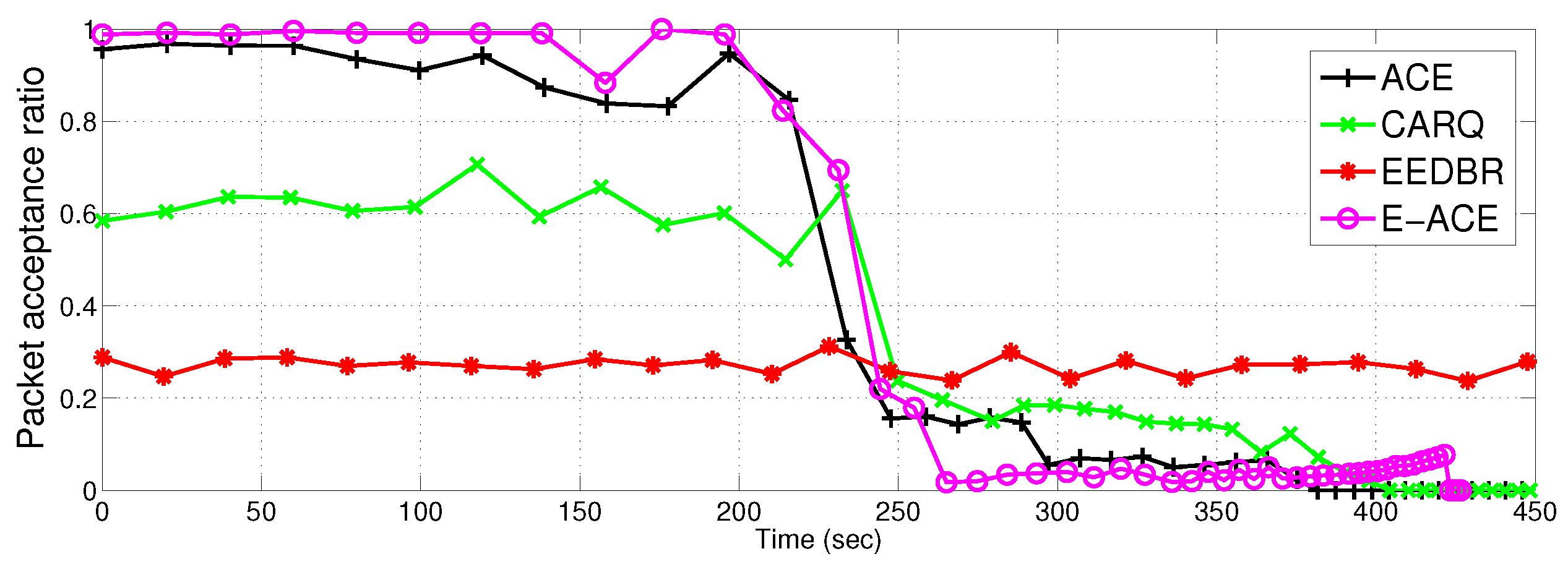
Table 2 shows throughput vs. dead nodes comparison of the four protocols. It shows that initially E-ACE has more throughput than ACE, however, this difference is very small. The performance of ACE and E-ACE is better than EEDBR till the death of 130 nodes. It is observed that throughput can be increased by using more cooperative nodes. However, with more retransmissions, more energy is consumed. After 230 s, ACE, E-ACE and CARQ have less throughput as compared to EEDBR because they have less number of alive nodes available to send data to sink, whereas, EEDBR has more alive nodes. More alive nodes can send more data to sink and increase throughput. Since the load on nodes is equally distributed, therefore, in sparse network, nodes may not find relays or next destination to send data to sink and die due to idle sensing. This is the main reason of low throughput and low packet acceptance ratio as shown in later time slots of Figure 12.
Table 2. Throughput vs. dead nodes.
Figure 12. Packet acceptance ratio.

4.2.4. Packet Drop

Figure 11 compares E-ACE, ACE with CARQ and EEDBR in terms of packet drop. It is actually the difference between total number of packets sent to sink and the total number of packets successfully received at sink. In simulations, packet is considered dropped when BER at destination is greater than the threshold after double or triple retransmissions. Packet is also considered as dropped when there is no neighbour to cooperate. As each node sends single packet per time slot and there is no data aggregation at relay nodes, therefore, maximum number of sent packets to sink are equal to total number of nodes.
In ACE, packet drop rate is negligible and close to E-ACE. Whereas, EEDBR has packet drop rate close to 70%. Figure 11 shows performance improvement of E-ACE as compared to EEDBR and CARQ. EEDBR relies on single link for data transmission and no cooperative mechanism is involved. Therefore, it has maximum packet drop count. EEDBR shows increase in packet drop rate in the later course of simulations due to availability of fewer alive nodes for data transportation to sink. CARQ shows more packet drop despite of using retransmission mechanism using two nodes because of non incorporation of data combining technique at the destination. Also, the relay selection mechanism in CARQ is dependant on distance only, therefore, energy balancing is not achieved and cooperative node may nodes die out who was responsible for retransmission.

4.2.5. Packet Acceptance Ratio

Figure 12 demonstrates another parameter, i.e., packet acceptance ratio. E-ACE outperforms EEDBR with packet acceptance ratio close to 98%. Whereas, EEDBR has the lowest packet acceptance ratio (approximately 28%). This means that less than half of the packets are successfully delivered to sink and rest of the packets are dropped. ACE shows acceptance ratio of 95% and CARQ shows acceptance ratio of 58%. After 230 s, there is a drop off in acceptance ratio of ACE, E-ACE and CARQ. This drop is due to two reasons; (1) less relays are available to provide cooperative retransmissions and (2) due to fading consideration, the channel conditions are not suitable to achieve BER more than the threshold even after two retransmissions.
More acceptance ratio means more reliable network. In later time slots, EEDBR has more packet acceptance ratio because it has more alive nodes to forward data to sink. Thus, the retransmission mechanism clearly enhances network performance in terms of reliability.

4.3. Performance Trade-offs

In this section, trade-offs (the cost at which the performance metrics are achieved) of the proposed protocols are discussed (refer to Table 3).
Table 3. Performance trade-offs for ACE and E-ACE.
ACE achieves more throughput by compromising on the network lifetime. Figure 8 and Figure 9 demonstrate the decrease in lifetime and increase in energy consumption of the network respectively. In case of direct transmission failure, retransmission from the relay nodes causes increased energy consumption thereby reducing network lifetime. It can be clearly seen that when throughput is maximum in the initial seconds (see Figure 10), the energy consumption is more than double of EEDBR protocol. This is because transmission energy is used once or twice more for retransmission of data. After 230 s, when more than 100 nodes are dead in ACE (Figure 8), throughput is decreased, hence energy consumption is also decreased. Later on, energy consumption of ACE is almost similar to EEDBR and CARQ with throughput less than EEDBR. Decrease in throughput is due to less number of alive nodes to carry data to sink.
E-ACE achieves throughput and reliability at the cost of reduced network lifetime. The reduction in network lifetime is due to increased energy consumption; retransmissions in case of direct transmission failure. Before 230 s (Figure 9), Relay transmissions are activated whenever direct transmission fails to achieve an acceptable BER, that is why, energy consumption of E-ACE is almost twice as compared to EEDBR (refer Figure 10). Later on, EEDBR and CARQ outperforms E-ACE (refer Figure 12) because they have more alive nodes to carry data to sink. Thus, we can say that E-ACE has less throughput and packet acceptance ratio than EEDBR, however, at the cost of more energy consumption. Reason behind this observation is that nodes decay rate of EEDBR is very slow as compared to E-ACE. Therefore, energy required by all the nodes for single transmission in EEDBR is almost equal to energy required for cooperative retransmissions in E-ACE.
In both protocols, throughput is increased at the price of increased time delay. Cooperative diversity is implemented in time division channel. Source node broadcasts to destination and relay nodes in first phase. In case of direct transmission failure, first retransmission is performed by the retransmission node in the second phase, thus adding more delay. If it is again not acceptable, next retransmission is performed in the third phase, adding another delay, and so on. Therefore, more number of retransmissions enhance reliable reception, however, at the cost of surplus delay.

5. Conclusions and Future Work

In this paper, incremental relaying with cooperative retransmission protocols; ACE and E-ACE, have been proposed for UWSNs along with outage and error probability performance analysis. Closed-form expressions for outage and error probability are determined and expression for the number of available relays is also derived. Results show that incremental relaying with triple retransmissions shows very less outage probability and so is BER as compared to regular incremental relaying cooperative diversity network having single retransmission mechanism. The proposed model and protocols are validated via simulations. We evaluated the proposed schemes by comparing them with another cooperative protocol called CARQ and non cooperative routing protocol referred as EEDBR. ACE and E-ACE substantially show better relative performance in terms of reliability and throughput efficiency. This improvement is likely due to the cooperative diversity benefits and the retransmission mechanism. However, this reliability is achieved at the cost of increased energy consumption which leads to decreased network lifetime. Future works include derivation of expression capacity of incremental relaying with m retransmissions. In addition, expressions for outage, BER and capacity using DF incremental relaying cooperative retransmissions will also be derived.
This research work assumed non-LOS communication between static nodes, so, in future, we will extend our work for LOS communication between mobile nodes.

Acknowledgments

The authors would like to extend their sincere appreciation to the Deanship of Scientific Research at King Saud University for funding this Research group No. RG-037-1435.

Author Contributions

Hina Nasir and Nadeem Javaid proposed the protocols. Hina Nasir performed and wrote simulations. Umar Qasim, Zahoor Ali Khan and Nabil Alrajeh did modelling work. Iftikhar Azim Niaz and Muhammad Sher wrote and refined the manuscript.

Conflicts of Interest

The authors declare no conflict of interest.

Appendix A. Area of Overlapping Region
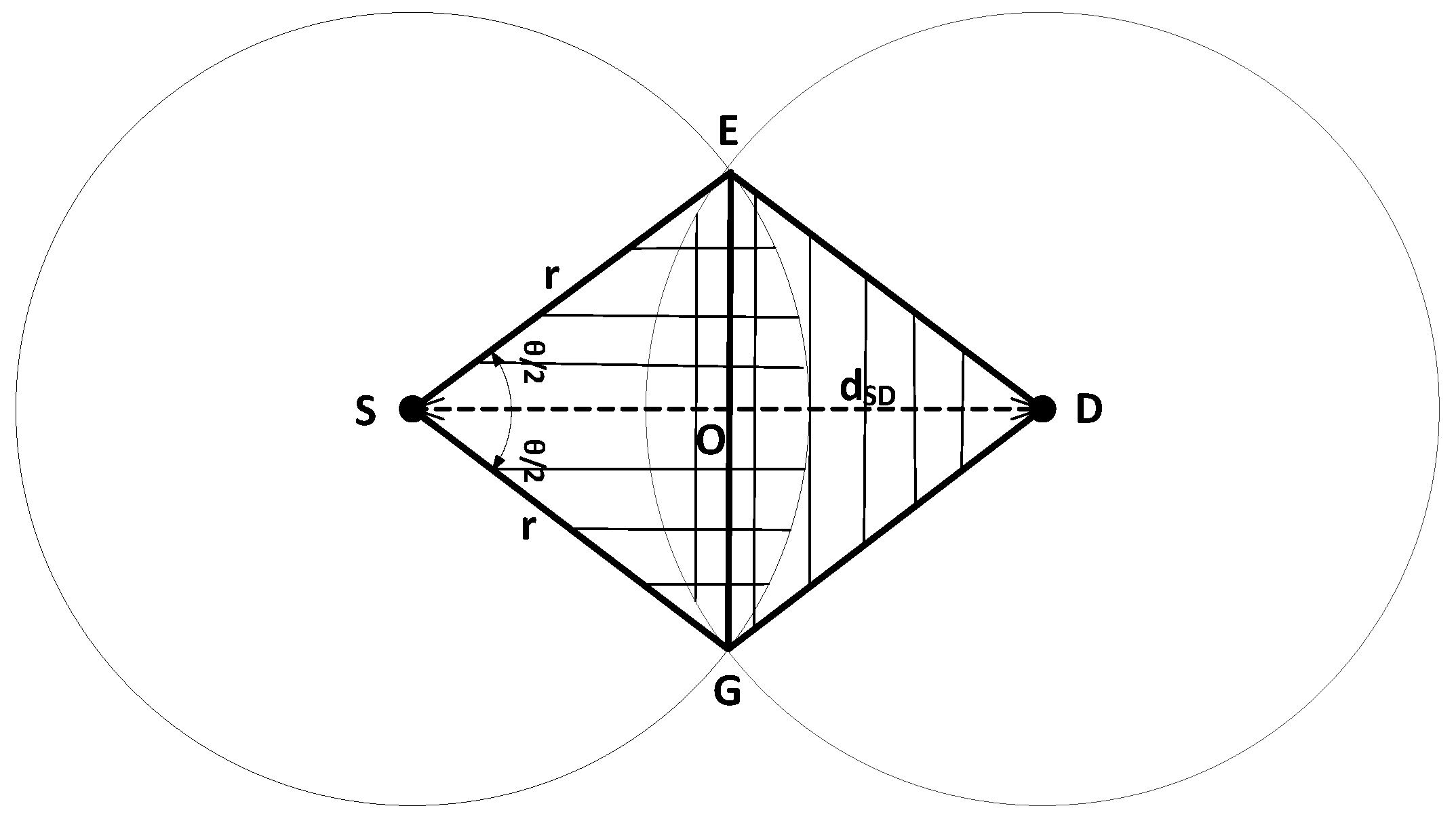
Figure A1 shows the overlapping area of same transmission ranges of two sensors. Transmission range is denoted by r. Therefore, the area of overlapping region is found by subtracting area of triangle SEG from area of sector [32].
Figure A1. Area of overlapping region.
Area of sector is given by:
A S = θ 2 r 2
where θ is the angle of sector in radians. In order to find θ, we know that triangle SEG is an isosceles triangle with height d S D / 2 . Using half angle identity:
cos ( θ 2 ) = d S D / 2 r = d S D 2 r
solving for θ, we get:
θ = 2 arccos ( d S D 2 r )
Putting Equation (A3) in Equation (A1), we get:
A S = 2 arccos ( d S D 2 r ) 2 r 2 = r 2 arccos ( d S D 2 r )
Now area of triangle SEG is given as:
A T = 1 2 b a s e × h e i g h t .
Using Pythagorean theorem to find O E ¯ of the right angle triangle SOE.
O E ¯ = r 2 - d S D 2 4
Therefore, base of the triangle SEG is 2 × O E ¯ .
b a s e = 4 r 2 - d S D 2
Area of the triangle SEG is given as:
A T = 1 2 4 r 2 - d S D 2 × d S D 2 = d S D 4 4 r 2 - d S D 2
Area of the overlapping region is 2 × ( A S - A T ) .
A = 2 × r 2 arccos ( d S D 2 r ) - d S D 4 4 r 2 - d S D 2 A = 2 r 2 arccos ( d S D 2 r ) - d S D 2 4 r 2 - d S D 2

Appendix B. Derivation of fγd

γ follows exponential distribution with mean γ ¯ . By definition of PDF:
f γ S D = 1 γ ¯ S D e x p ( - γ S D / γ ¯ S D )
f γ R i = 1 γ ¯ R i e x p ( - γ R i / γ ¯ R i ) , i ϵ 1 , 2 , 3
f γ d is calculated by the convolution of above equations. By parts convolution, f γ 1 ( x ) is derived as [15]:
f γ 1 ( x ) = 1 γ ¯ S D e x p ( - x / γ ¯ S D ) * 1 γ ¯ R 1 e x p ( - x / γ ¯ R 1 ) = 1 γ ¯ S D γ ¯ R 1 0 z e x p ( - γ ¯ R 1 x - γ ¯ S D z + γ ¯ S D x γ ¯ S D γ ¯ R 1 ) d x = 1 γ ¯ S D - γ ¯ R 1 e x p ( - z / γ ¯ S D ) - e x p ( - z / γ ¯ R 1 )
Similarly, convolution of f γ 1 and f γ R 2 is calculated as:
f γ 2 ( x ) = 1 γ ¯ S D - γ ¯ R 1 e x p ( - x / γ ¯ S D ) - e x p ( - x / γ ¯ R 1 ) * 1 γ ¯ R 2 e x p ( - x / γ ¯ R 2 ) = 1 γ ¯ R 2 ( γ ¯ S D - γ ¯ R 1 ) 0 z e x p ( - γ ¯ R 2 x - γ ¯ S D z + γ ¯ S D x γ ¯ R 2 γ ¯ S D ) - e x p ( - γ ¯ R 2 x - γ ¯ R 1 z + γ ¯ R 1 x γ ¯ R 1 γ ¯ R 2 ) d x = γ ¯ S D γ ¯ S D - γ ¯ R 2 e x p ( - z / γ ¯ S D ) - e x p ( - z / γ ¯ R 2 ) - γ ¯ R 1 γ ¯ R 1 - γ ¯ R 2 e x p ( - z / γ ¯ R 1 ) - e x p ( - z / γ ¯ R 2 ) ( γ ¯ S D - γ ¯ R 1 )
Third convolution of f γ 2 with f γ R 3 is calculated as:
f γ 3 ( x ) = γ ¯ S D γ ¯ S D - γ ¯ R 2 e x p ( - x / γ ¯ S D ) - e x p ( - x / γ ¯ R 2 ) - γ ¯ R 1 γ ¯ R 1 - γ ¯ R 2 e x p ( - x / γ ¯ R 1 ) - e x p ( - x / γ ¯ R 2 ) ( γ ¯ S D - γ ¯ R 1 ) * 1 γ ¯ R 3 e x p ( - x / γ ¯ R 3 ) = γ ¯ S D γ ¯ R 3 ( γ ¯ S D - γ ¯ R 2 ) 0 z e x p ( - γ ¯ R 3 x - γ ¯ S D z + γ ¯ S D x γ ¯ S D γ ¯ R 3 ) - e x p ( - γ ¯ R 3 x - γ ¯ R 2 z + γ ¯ R 2 x γ ¯ R 2 γ ¯ R 3 ) d x γ ¯ S D - γ ¯ R 1 - γ ¯ R 1 γ ¯ R 3 ( γ ¯ R 1 - γ ¯ R 2 ) 0 z e x p ( - γ ¯ R 3 x - γ ¯ R 1 z + γ ¯ R 1 x γ ¯ R 1 γ ¯ R 3 ) - e x p ( - γ ¯ R 3 x - γ ¯ R 2 z + γ ¯ R 2 x γ ¯ R 2 γ ¯ R 3 ) d x γ ¯ S D - γ ¯ R 1
Integrating and doing some necessary manipulations, PDF of f γ d is given by:
f γ d = γ ¯ S D 2 exp ( - z / γ ¯ S D ) - exp ( - z / γ ¯ R 3 ) ( γ ¯ S D - γ ¯ R 1 ) ( γ ¯ S D - γ ¯ R 2 ) ( γ ¯ S D - γ ¯ R 3 ) - γ ¯ S D γ ¯ R 2 exp ( - z / γ ¯ R 2 ) - exp ( - z / γ ¯ R 3 ) ( γ ¯ S D - γ ¯ R 1 ) ( γ ¯ S D - γ ¯ R 2 ) ( γ ¯ R 2 - γ ¯ R 3 ) + γ ¯ R 1 υ + τ ( γ ¯ S D - γ ¯ R 1 ) ( γ ¯ R 1 - γ ¯ R 2 )
where:
υ = γ ¯ R 2 exp ( - z / γ ¯ R 2 ) - exp ( - z / γ ¯ R 3 ) γ ¯ R 2 - γ ¯ R 3
and
τ = γ ¯ R 1 exp ( - z / γ ¯ R 1 ) - exp ( - z / γ ¯ R 3 ) γ ¯ R 1 - γ ¯ R 3

Appendix C. Derivation of Pout

The general expression for outage probability derived in Section 3.3 Equation (11) is given as:
P o u t = P r ( γ S D γ 0 ) P r ( γ S R 1 D + γ S D γ 0 | γ S D γ 0 ) P r ( γ S R 1 D + γ S R 2 D + γ S D γ 0 | γ S R 1 D + γ S D γ 0 ) P r ( i = 1 m γ S R i D + γ S D γ 0 | i = 1 m - 1 γ S R i D + γ S D γ 0 )
By limiting m to 3, we get:
P o u t = P r ( γ S D γ 0 ) P r ( γ S R 1 D + γ S D γ 0 | γ S D γ 0 ) P r ( γ S R 1 D + γ S R 2 D + γ S D γ 0 | γ S R 1 D + γ S D γ 0 ) P r ( γ S R 1 D + γ S R 2 D + γ S R 3 D + γ S D γ 0 | γ S R 1 D + γ S R 2 D + γ S D γ 0 )
Using the law of conditional probability, i.e., P ( A | B ) = P ( A B ) P ( B ) , we get:
P o u t = P r ( γ S D γ 0 ) × P r ( γ S R 1 D + γ S D ) P r ( γ S D γ 0 ) × P r ( γ S R 1 D + γ S R 2 D + γ S D ) P r ( γ S R 1 D + γ S D )
× P r ( γ S R 1 D + γ S R 2 D + γ S R 3 D + γ S D ) P r ( γ S R 1 D + γ S R 2 D + γ S D )
= P r ( γ S R 1 D + γ S R 2 D + γ S R 3 D + γ S D γ 0 )

References

  1. Akyildiz, I.F.; Dario, P.; Tommaso, M. Underwater acoustic sensor networks: Research challenges. Ad Hoc Netw. 2005, 10, 257–279. [Google Scholar] [CrossRef]
  2. Yan, H.; Shi, Z.J.; Cui, J.H. DBR: Depth-Based Routing for Underwater Sensor Networks. In Networking: Ad Hoc and Sensor Networks, Wireless Networks, Next Generation Internet; Springer: Berlin, Germany, 2008; pp. 72–86. [Google Scholar]
  3. Wahid, A.; Kim, D. An energy efficient localization-free routing protocol for underwater wireless sensor networks. Int. J. Distrib. Sens. Netw. 2012. [Google Scholar] [CrossRef]
  4. Babiker, A.; Nordin, Z. Energy Efficient Communication for Underwater Wireless Sensors Networks. In Energy Efficiency in Communications and Networks; InTech: Rijeka, Croatia, 2012. [Google Scholar]
  5. Fareed, M.M.; Mohamed-Slim, A. Efficient Incremental Relaying. In Proceedings of the IEEE International Symposium on Information Theory Proceedings (ISIT); Istanbul, Turkey, 7–12 July 2013; pp. 1964–1668.
  6. Al-Dharrab, S.; Uysal, M.; Duman, T.M. Cooperative underwater acoustic communications. IEEE Commun. Mag. 2013, 51, 146–153. [Google Scholar] [CrossRef]
  7. Jannati, M.J.; Abdollah, D.A.; Vahid, T.V. Implementation of cooperative virtual MISO communication in underwater acoustic wireless sensor networks. Int. J. Comput. Sci. Issues 2011, 8, 124–130. [Google Scholar]
  8. Ikki, S.S.; Ahmed, M.H. Performance analysis of cooperative diversity with incremental-best-relay technique over Rayleigh fading channels. IEEE Trans. Commun. 2011, 59, 2152–2161. [Google Scholar] [CrossRef]
  9. Duy, T.T.; Kong, H.Y. Performance analysis of hybrid decode-amplify-forward incremental relaying cooperative diversity protocol using SNR-based relay selection. J. Commun. Netw. 2012, 14, 703–709. [Google Scholar] [CrossRef]
  10. Nasir, H.; Javaid, N.; Murtaza, M.; Manzoor, S.; Khan, Z.A.; Qasim, U.; Sher, M. ACE: Adaptive Cooperation in EEDBR for Underwater Wireless Sensor Networks. In Proceedings of the Ninth International Conference on Broadband and Wireless Computing, Communication and Applications, Guangdong, China, 8–10 November 2014; pp. 8–10.
  11. Lee, J.W.; Cheon, J.Y.; Cho, H.S. A cooperative ARQ scheme in underwater acoustic sensor networks. In Proceedings of the IEEE OCEANS, Sydney, Australia, 24–27 May 2010; pp. 1–5.
  12. Mansourkiaie, F.; Ahmed, M. Optimal and Near-Optimal Cooperative Routing and Power Allocation for Collision Minimization in Wireless Sensor Networks. IEEE Sens. J. 2016, 16, 1398–1411. [Google Scholar] [CrossRef]
  13. Michalopoulos, D.S.; Suraweera, HA.; Schober, R. Relay selection for simultaneous information transmission and wireless energy transfer: A tradeoff perspective. IEEE J. Sel. Areas Commun. 2015, 33, 1578–1594. [Google Scholar] [CrossRef]
  14. Coutinho, R.; Boukerche, A.; Menezes Vieira, L.; Loureiro, A. Geographic and Opportunistic Routing for Underwater Sensor Networks. IEEE Sens. J. 2016, 65, 548–561. [Google Scholar] [CrossRef]
  15. Ikki, S.S.; Ahmed, M.H. Performance analysis of incremental-relaying cooperative-diversity networks over Rayleigh fading channels. Commun. IET 2011, 5, 337–349. [Google Scholar] [CrossRef]
  16. Madan, R.; Mehta, N.B.; Molisch, A.F.; Zhang, J. Energy-efficient cooperative relaying over fading channels with simple relay selection. IEEE Trans. Wirel. Commun. 2008, 7, 3013–3025. [Google Scholar] [CrossRef]
  17. Zhou, Z.; Zhou, S.; Cui, J.H.; Cui, S. Energy-efficient cooperative communication based on power control and selective single-relay in wireless sensor networks. IEEE Trans. Wirel. Commun. 2008, 7, 3066–3078. [Google Scholar] [CrossRef]
  18. Razeghi, B.; Okati, N.; Abed Hodtani, G. A novel multi-criteria relay selection scheme in cooperation communication networks. In Proceedings of the IEEE 49th Annual Conference on Information Sciences and Systems (CISS), Baltimore, MD, USA, 18–20 March 2015; pp. 1–4.
  19. Wang, X.; Zhang, H.; Gulliver, T.A.; Shi, W.; Zhang, H. Performance analysis of two-way AF cooperative relay networks over Weibull fading channels. J. Commun. 2013, 8, 372–377. [Google Scholar] [CrossRef]
  20. Hikmat, Q.A.; Dai, B.; Khaji, R.; Huang, B. Performance Analysis of Best Relay Selection in Cooperative Wireless Networks. Int. J. Future Gener. Commun. Netw. 2015, 8, 43–56. [Google Scholar] [CrossRef]
  21. Sharma, S.; Shi, Y.; Hou, Y.T.; Sherali, H.D.; Kompella, S. Cooperative communications in multi-hop wireless networks: Joint flow routing and relay node assignment. In Proceedings of the IEEE INFOCOM, San Diego, CA, USA, 14–19 March 2010; pp. 1–9.
  22. Hsu, C.C.; Liu, H.H.; Gomez, J.L.; Chou, C.F. Delay-Sensitive Opportunistic Routing for Underwater Sensor Networks. IEEE Sens. J. 2015, 15, 6584–6591. [Google Scholar] [CrossRef]
  23. Mansourkiaie, F.; Ahmed, M.H. Joint Cooperative Routing and Power Allocation for Collision Minimization in Wireless Sensor Networks With Multiple Flows. IEEE Wirel. Commun. Lett. 2015, 4, 6–9. [Google Scholar] [CrossRef]
  24. Habibi, J.; Ghrayeb, A.; Aghdam, A.G. Energy-efficient cooperative routing in wireless sensor networks: A mixed-integer optimization framework and explicit solution. IEEE Trans. Commun. 2013, 61, 3424–3437. [Google Scholar] [CrossRef]
  25. Zhou, Z.; Zhou, S.; Cui, S.; Cui, J.H. Energy-efficient cooperative communication in a clustered wireless sensor network. IEEE Trans. Veh. Technol. 2008, 57, 3618–3628. [Google Scholar] [CrossRef]
  26. Fang, W.; Liu, F.; Yang, F.; Shu, L.; Nishio, S. Energy-efficient cooperative communication for data transmission in wireless sensor networks. IEEE Trans. Consum. Electron. 2010, 56, 2185–2192. [Google Scholar] [CrossRef]
  27. Zhou, Z.; Cui, J.H. Energy efficient multi-path communication for time-critical applications in underwater sensor networks. In Proceedings of the 9th ACM International Symposium on Mobile Ad Hoc Networking and Computing, Hong Kong, China, 26–30 May 2008; pp. 221–230.
  28. Carbonelli, C.; Mitra, U. Cooperative multihop communication for underwater acoustic networks. In Proceedings of the 1st ACM International Workshop on Underwater Networks, Los Angeles, CA, USA, 25 September 2006; Volume 1, pp. 97–100.
  29. Hasna, M.O.; Alouini, M.S. End-to-end performance of transmission systems with relays over Rayleigh-fading channels. IEEE Trans. Wirel. Commun. 2003, 2, 1126–1131. [Google Scholar] [CrossRef]
  30. Ikki, S.; Ahmed, M.H. Performance analysis of cooperative diversity wireless networks over Nakagami-m fading channel. IEEE Commun. Lett. 2007, 11, 334–336. [Google Scholar] [CrossRef]
  31. Stojanovic, M. On the relationship between capacity and distance in an underwater acoustic communication channel. In Proceedings of the ACM SIGMOBILE Mobile Computing and Communications Review, New York, NY, USA, 1 October 2007; Volume 11, pp. 34–43.
  32. Huang, X.; Zhai, H.; Fang, Y. Robust cooperative routing protocol in mobile wireless sensor networks. IEEE Trans. Wirel. Commun. 2008, 7, 5278–5285. [Google Scholar] [CrossRef]
Article Metrics

Citations

Article Access Statistics

Multiple requests from the same IP address are counted as one view.