
Diversity and Traditional Uses of Fabaceae Species in Maha Sarakham Province, Thailand

 ,
,  ,
, 
Abstract
1. Introduction
2. Materials and Methods
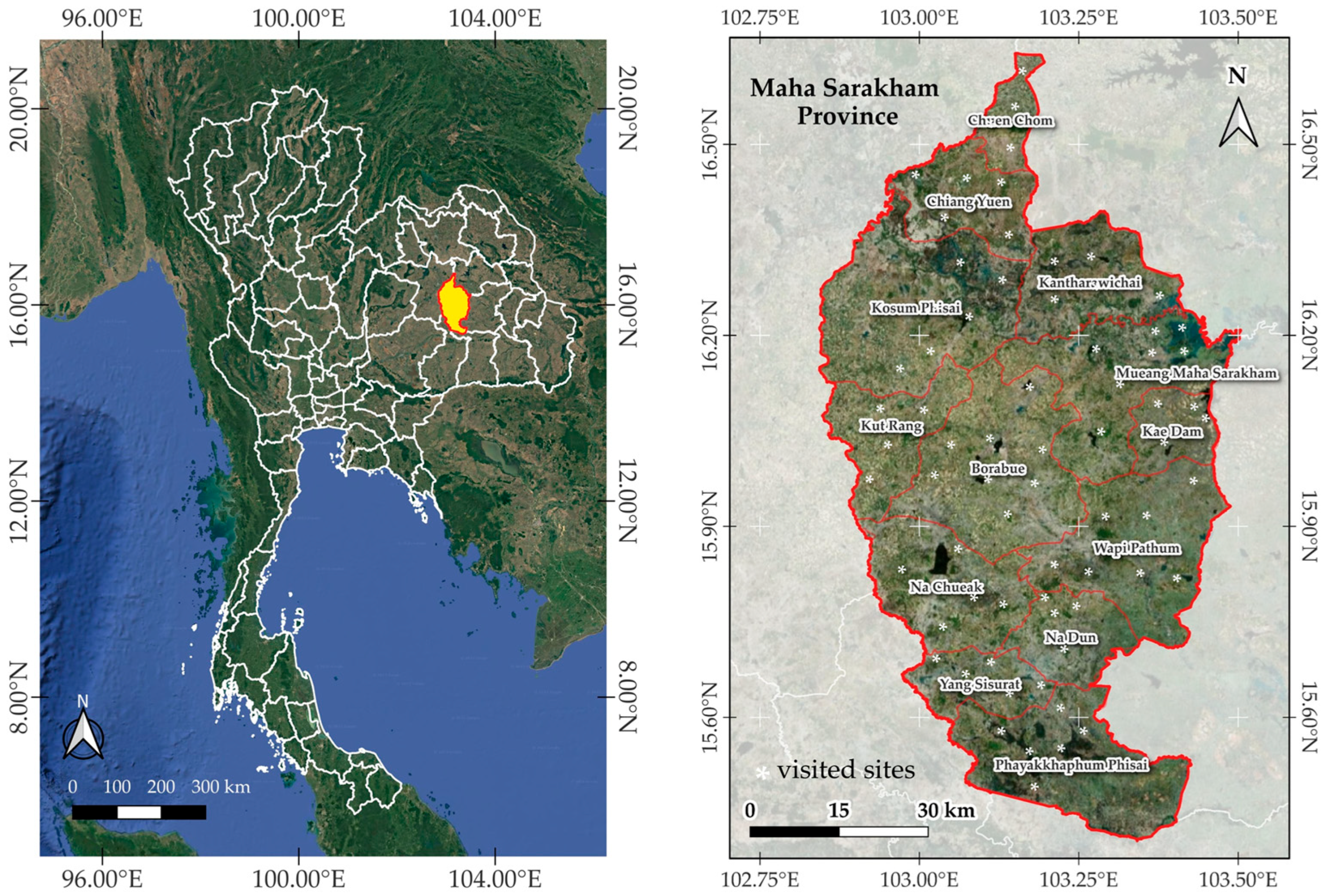
2.1. Study Area
2.2. Data Collection
2.3. Utilization Study
2.4. Data Analysis
2.4.1. The Species Use Value (SUV)
2.4.2. Relative Frequency of Citation (RFC)
2.4.3. Plant Part Value (PPV)
2.4.4. Informant Consensus Factor (Fic)
2.4.5. Fidelity Level (%FL)
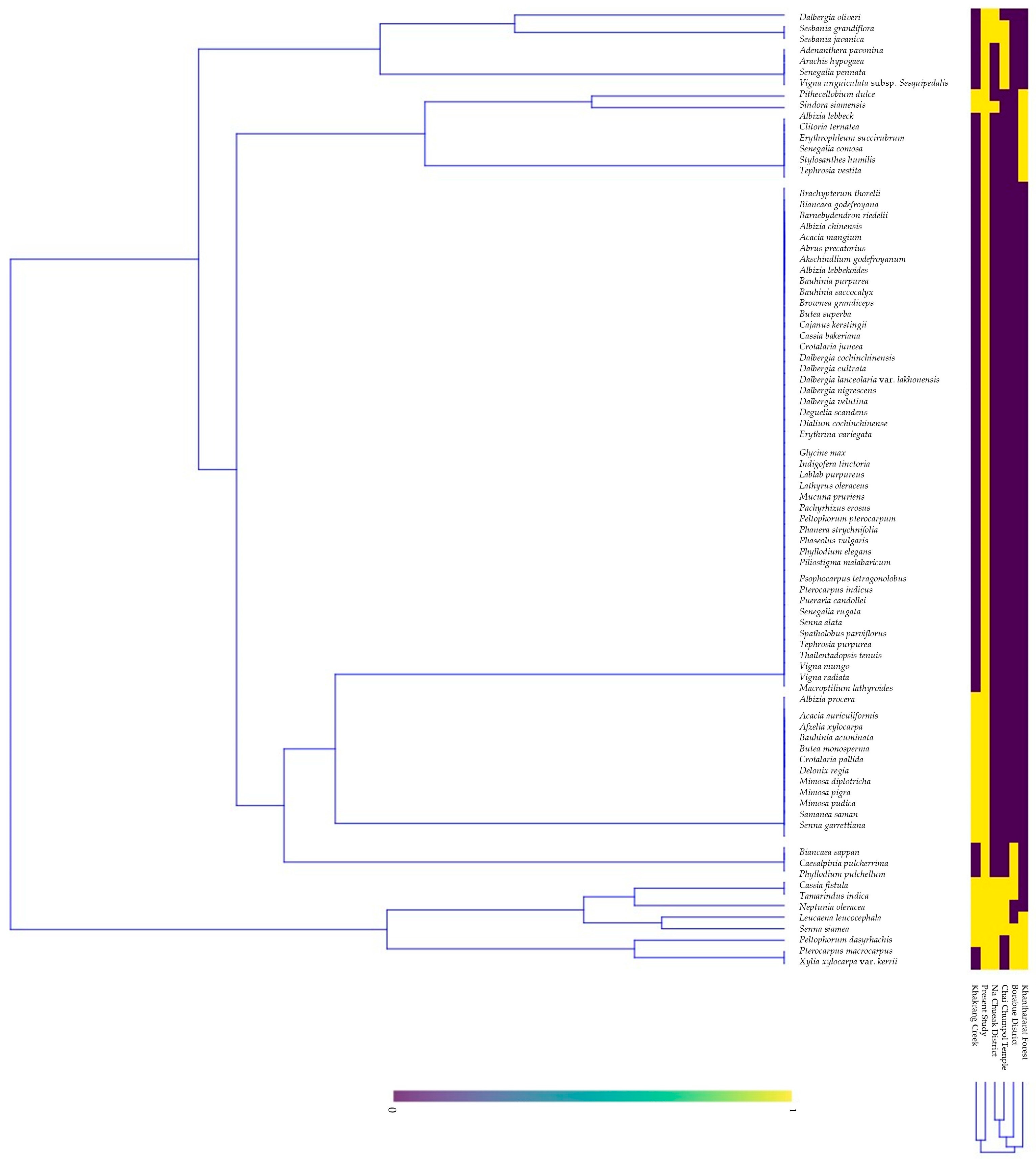
2.4.6. Comparative Analysis with Previous Studies in the Maha Sarakham Province
3. Results
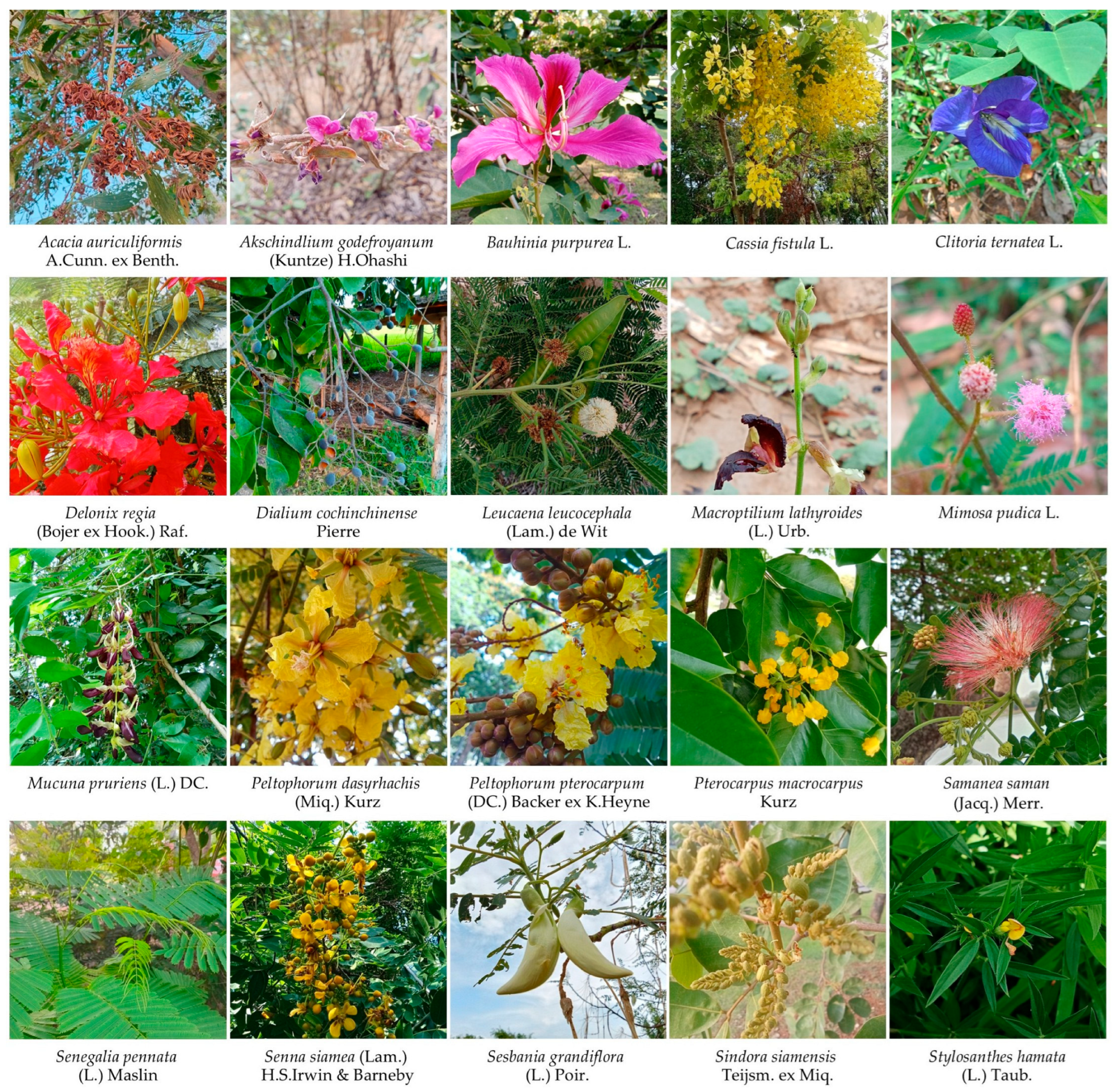
3.1. Diversity of Fabaceae in Maha Sarakham Province
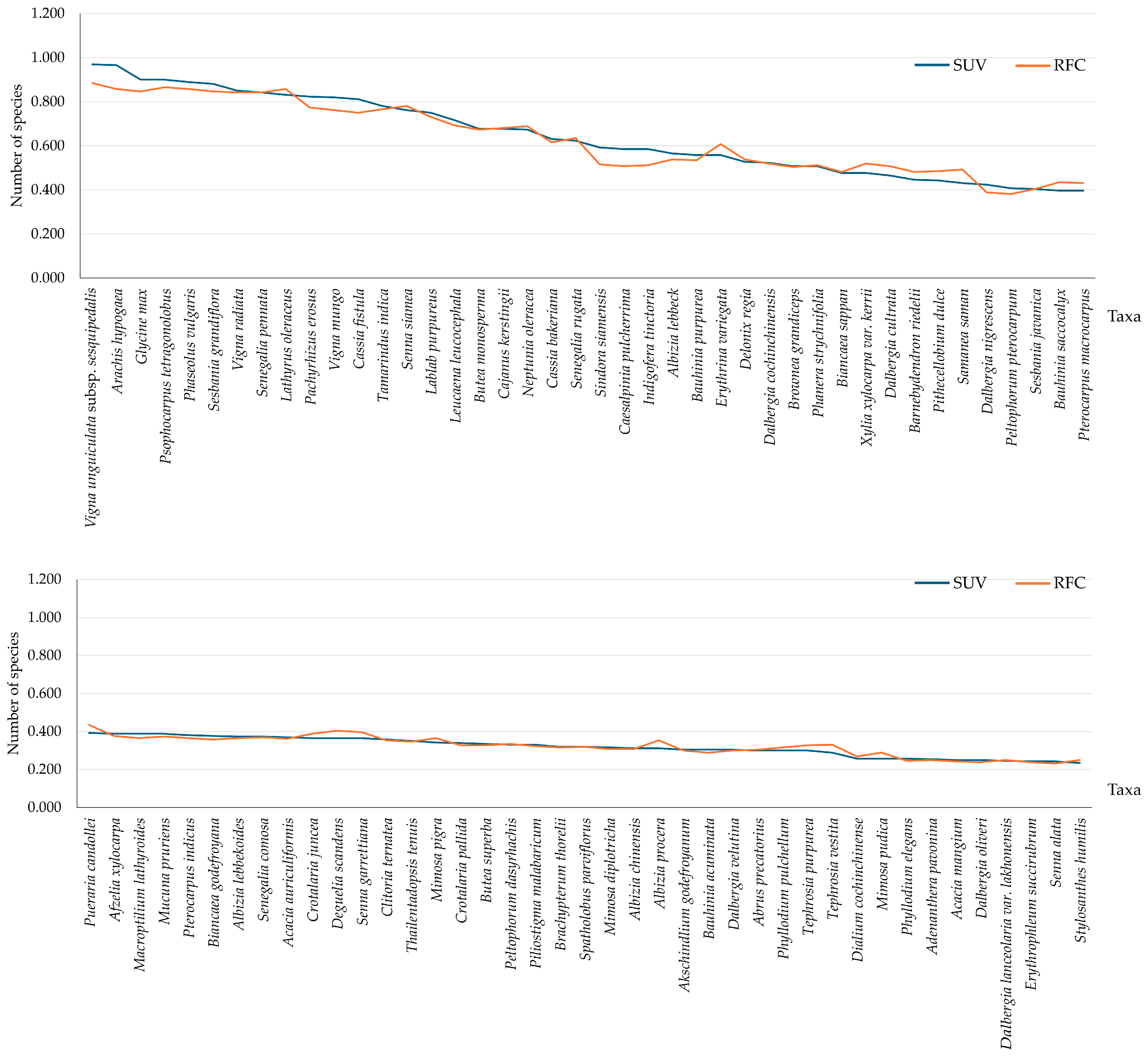
3.2. Species Use Value (SUV) of Fabaceae in Maha Sarakham Province
3.3. Relative Frequency of Citation (RFC) of Fabaceae in Maha Sarakham Province
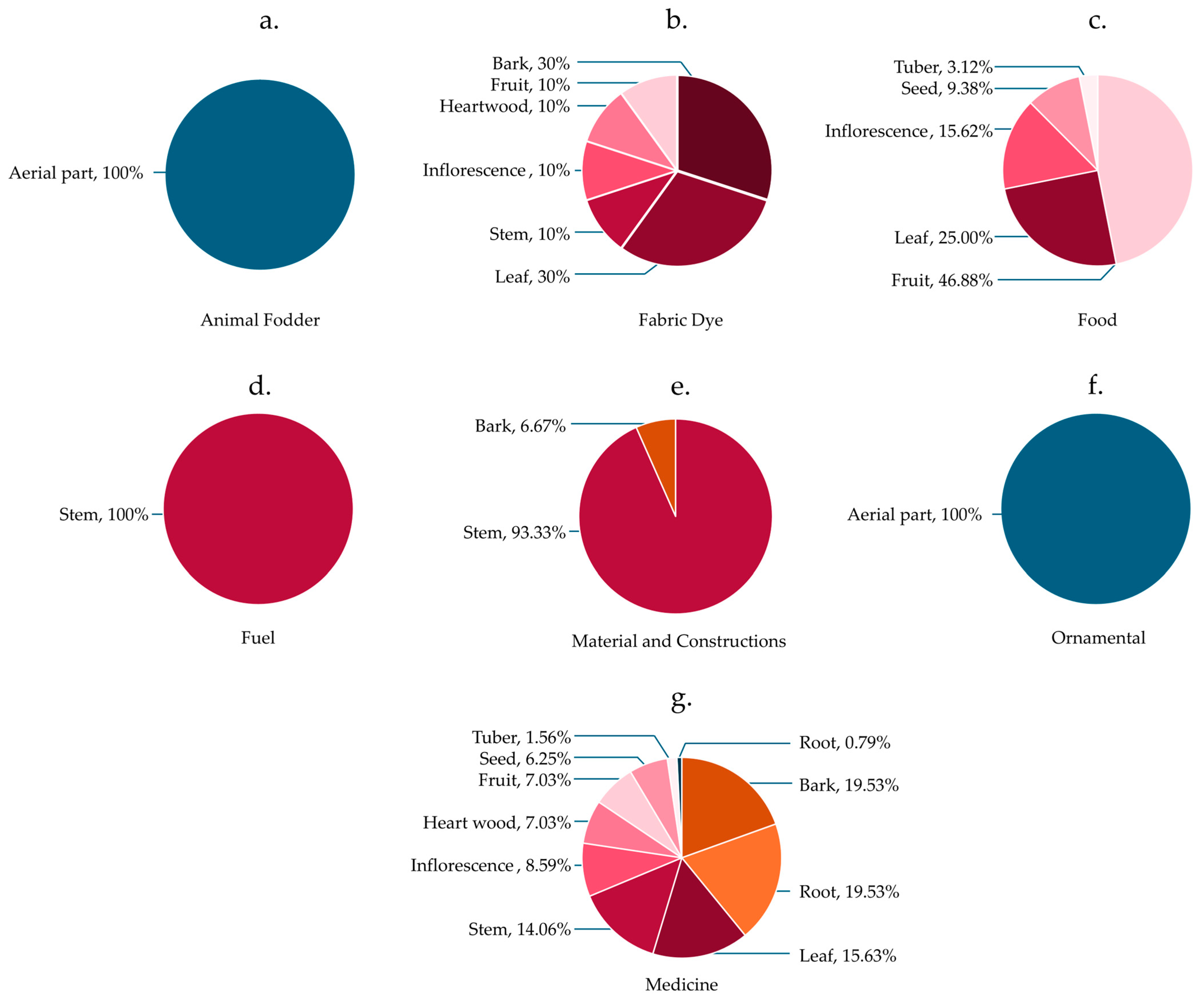
3.4. Utilization of Fabaceae in Maha Sarakham Province
3.4.1. Fabaceae Species Used as Animal Fodder
3.4.2. Fabaceae Species Used as Fabric Dye
3.4.3. Fabaceae Species Used as Food
3.4.4. Fabaceae Species Used as Fuel
3.4.5. Fabaceae Species Used as Material and Constructions
3.4.6. Fabaceae Species Used for Ornamental
3.4.7. Fabaceae Species Used as Medicine
3.5. Fidelity Level (%FL) of Fabaceae Used as Medicine in Maha Sarakham Province
3.6. Informant Consensus Factor (Fic) of Fabaceae Used as Medicine in Maha Sarakham Province
3.7. Comparison of the Present Findings with Previous Studies
4. Discussion
4.1. Species Diversity and Genera Composition of Fabaceae
4.2. Life Forms, Resource Origin, and Native Status of Fabaceae
4.3. Species Use Value (SUV) and Relative Frequency of Citation (RFC) of Fabaceae
4.4. Ethnobotanical Applications of Fabaceae in Maha Sarakham Province
4.5. Fidelity Level (FL) of Fabaceae Species Used as Medicine
4.6. Informant Consensus Factor (Fic) of Fabaceae Species Used as Medicine
4.7. Comparison with Previous Ethnobotanical Surveys in Maha Sarakham Province
4.8. Suggestions for Future Research
- Phytochemical and pharmacological validation: Many species with high FL and Fic values, such as Abrus precatorius, Albizia lebbeck, and Bauhinia saccocalyx, show strong cultural consensus for treating specific ailments. Future studies should investigate their bioactive compounds and pharmacological activities to validate traditional uses and potentially identify novel therapeutic agents.
- Nutritional and agronomic assessment: Species commonly used as food and fodder, including Vigna unguiculata subsp. sesquipedalis, Arachis hypogaea, and Sesbania grandiflora, could be evaluated for nutrient content, yield optimization, and resilience under local agroecological conditions to support food security and sustainable agriculture.
- Conservation and sustainable management: Several Fabaceae species, particularly those used for timber, construction, and fuel, face pressure from overharvesting. Research on population status, reproductive biology, and community-based conservation strategies is essential to ensure long-term availability.
- Ethnobotanical knowledge transmission: Investigation into intergenerational knowledge transfer could help us understand how traditional practices are maintained or lost over time, particularly for less frequently used species with low FL values.
- Broader geographic and comparative studies: Expanding surveys to neighboring provinces or cross-cultural studies would allow for comparative analyses, helping to identify shared ethnobotanical practices, unique local uses, and potential species of regional or national importance.
5. Conclusions
Supplementary Materials
Author Contributions
Funding
Institutional Review Board Statement
Data Availability Statement
Acknowledgments
Conflicts of Interest
References
- Zhao, Y.; Zhang, R.; Jiang, K.-W.; Qi, J.; Hu, Y.; Guo, J.; Zhu, R.; Zhang, T.; Egan, A.N.; Yi, T.-S.; et al. Nuclear phylotranscriptomics and phylogenomics support numerous polyploidization events and hypotheses for the evolution of rhizobial nitrogen-fixing symbiosis in Fabaceae. Mol. Plant 2021, 14, 748–773. [Google Scholar] [CrossRef] [PubMed]
- Taylor, B.N.; Simms, E.L.; Komatsu, K.J. More Than a Functional Group: Diversity within the Legume–Rhizobia Mutualism and Its Relationship with Ecosystem Function. Diversity 2020, 12, 50. [Google Scholar] [CrossRef]
- Ogbole, O.O.; Akin-Ajani, O.D.; Ajala, T.O.; Ogunniyi, Q.A.; Fettke, J.; Odeku, O.A. Nutritional and pharmacological potentials of orphan legumes: Subfamily Faboideae. Heliyon 2023, 9, e15493. [Google Scholar] [CrossRef] [PubMed]
- Singh, A.K.; Elango, D.; Raigne, J.; Van der Laan, L.; Rairdin, A.; Soregaon, C.; Singh, A. Plant-based protein crops and their improvement: Current status and future perspectives. Crop Sci. 2025, 65, e21389. [Google Scholar] [CrossRef]
- Grygier, A.; Chakradhari, S.; Ratusz, K.; Rudzińska, M.; Patel, K.S.; Lazdiņa, D.; Segliņa, D.; Górnaś, P. Evaluation of Selected Medicinal, Timber and Ornamental Legume Species’ Seed Oils as Sources of Bioactive Lipophilic Compounds. Molecules 2023, 28, 3994. [Google Scholar] [CrossRef]
- Saensouk, P.; Saensouk, S.; Boonma, T.; Hanchana, K.; Rakarcha, S.; Maknoi, C.; Chanthavongsa, K.; Jitpromma, T. Ecological Analysis and Ethnobotanical Evaluation of Plants in Khanthararat Public Benefit Forest, Kantarawichai District, Thailand. Forests 2025, 16, 1012. [Google Scholar] [CrossRef]
- Lisciani, S.; Marconi, S.; Le Donne, C.; Camilli, E.; Aguzzi, A.; Gabrielli, P.; Gambelli, L.; Kunert, K.; Marais, D.; Vorster, B.J.; et al. Legumes and common beans in sustainable diets: Nutritional quality, environmental benefits, spread and use in food preparations. Front. Nutr. 2024, 11, 1385232. [Google Scholar] [CrossRef]
- Turner, N.J.; Cuerrier, A.; Joseph, L. Well Grounded: Indigenous Peoples’ Knowledge, Ethnobiology and Sustainability. People Nat. 2022, 4, 627–651. [Google Scholar] [CrossRef]
- Saensouk, S.; Saensouk, P.; Boonma, T.; Rakarcha, S.; Chanthavongsa, K.; Piwpuan, N.; Jitpromma, T. From Ornamental Beauty to Economic and Horticultural Significance: Species Diversity and Ethnobotany of Bignoniaceae in Maha Sarakham Province, Thailand. Horticulturae 2025, 11, 841. [Google Scholar] [CrossRef]
- Saensouk, P.; Saensouk, S.; Boonma, T.; Junsongduang, A.; Appamaraka, S.; Koompoot, K.; Chanthavongsa, K.; Jitpromma, T. Ethnobotany of Lao Isan Ethnic Group from Na Chueak District, Maha Sarakham Province, Northeastern Thailand. Horticulturae 2025, 11, 497. [Google Scholar] [CrossRef]
- Ouma, A. Intergenerational Learning Processes of Traditional Medicinal Knowledge and Socio-Spatial Transformation Dynamics. Front. Sociol. 2022, 7, 661992. [Google Scholar] [CrossRef] [PubMed]
- Asigbaase, M.; Adusu, D.; Anaba, L.; Abugre, S.; Kang-Milung, S.; Acheamfour, S.A.; Adamu, I.; Ackah, D.K. Conservation and Economic Benefits of Medicinal Plants: Insights from Forest-Fringe Communities of Southwestern Ghana. Trees For. People 2023, 14, 100462. [Google Scholar] [CrossRef]
- Saensouk, P.; Saensouk, S.; Boonma, T.; Junsongduang, A.; Rakarcha, S.; Chanthavongsa, K.; Jitpromma, T. Zingiberaceae in Roi Et Province, Thailand: Diversity, Ethnobotany, Horticultural Value, and Conservation Status. Horticulturae 2025, 11, 527. [Google Scholar] [CrossRef]
- Viroj, J.; Claude, J.; Lajaunie, C.; Cappelle, J.; Kritiyakan, A.; Thuainan, P.; Chewnarupai, W.; Morand, S. Agro-Environmental Determinants of Leptospirosis: A Retrospective Spatiotemporal Analysis (2004–2014) in Mahasarakham Province (Thailand). Trop. Med. Infect. Dis. 2021, 6, 115. [Google Scholar] [CrossRef]
- QGIS Development Team. QGIS Geographic Information System. Open Source Geospatial Foundation Project. 2024. Available online: http://qgis.osgeo.org (accessed on 22 April 2025).
- Department of Provincial Administration (DOPA), Thailand. Statistical Yearbook 2023. Available online: https://stat.bora.dopa.go.th/stat/statnew/statMenu/newStat/home.php (accessed on 10 October 2025).
- Alexander, S.T.; McCargo, D. Diglossia and Identity in Northeast Thailand: Linguistic, Social, and Political Hierarchy. J. Socioling. 2014, 18, 60–86. [Google Scholar] [CrossRef]
- Duangsin, T.; Chantachon, S.; Paengsoi, K. Buddhist Philosophy: A Study of Buddha Images for Perpetuating Buddhism in Isan Society. J. Soc. Sci. 2011, 7, 149–151. [Google Scholar] [CrossRef]
- Plant of the World Online, Facilitated by the Royal Botanic Gardens, Kew. Available online: https://powo.science.kew.org (accessed on 15 April 2025).
- Tajik, O.; Golzar, J.; Noor, S. Purposive Sampling. Int. J. Educ. Lang. Stud. 2025, 1–9. [Google Scholar] [CrossRef]
- Goodman, L.A. Snowball Sampling. Ann. Math. Stat. 1961, 32, 148–170. [Google Scholar] [CrossRef]
- International Society of Ethnobiology (ISE). International Society of Ethnobiology Code of Ethics (with 2008 Additions). 2006. Available online: http://ethnobiology.net/code-of-ethics/ (accessed on 30 August 2024).
- Secretariat of the Convention on Biological Diversity. Nagoya Protocol on Access to Genetic Resources and the Fair and Equitable Sharing of Benefits Arising from Their Utilization to the Convention on Biological Diversity. United Nations, Montreal. 2011. Available online: https://www.cbd.int/abs/ (accessed on 30 August 2024).
- Hoffman, B.; Gallaher, T. Importance indices in ethnobotany. Ethnobot. Res. Appl. 2007, 5, 201–218. [Google Scholar] [CrossRef]
- Tardío, J.; Pardo-de-Santayana, M. Cultural importance indices: A comparative analysis based on the useful wild plants of Southern Cantabria (Northern Spain). Econ. Bot. 2008, 62, 24–39. [Google Scholar] [CrossRef]
- Gomez-Beloz, A. Plant use knowledge of the Winikina Warao: The case for questionnaires in ethnobotany. Econ. Bot. 2002, 56, 231–241. [Google Scholar] [CrossRef]
- Heinrich, M.; Ankli, A.; Frei, B.; Weimann, C.; Sticher, O. Medicinal plants in Mexico: Healers’ consensus and cultural importance. Soc. Sci. Med. 1998, 47, 1859–1871. [Google Scholar] [CrossRef] [PubMed]
- World Health Organization. International Classification of Diseases 11th Revision (ICD-11); World Health Organization: Geneva, Switzerland, 2019; Available online: https://icd.who.int/en (accessed on 25 June 2025).
- Friedman, J.; Yaniv, Z.; Dafni, A.; Palewitch, D. A preliminary classification of the healing potential of medicinal plants, based on a rational analysis of an ethnopharmacological field survey among Bedouins in the Negev Desert, Israel. J. Ethnopharmacol. 1986, 16, 275–286. [Google Scholar] [CrossRef] [PubMed]
- Sneath, P.H.A.; Sokal, R.R. Numerical Taxonomy; W.H. Freeman: San Francisco, CA, USA, 1973. [Google Scholar]
- Thipthamrongsap, W.; Saensouk, S.; Saensouk, P. Diversity and utilization of medicinal plants in Borabue District, Maha Sarakham Province, Northeastern Thailand. Biodiversitas 2025, 26, 3040–3046. [Google Scholar] [CrossRef]
- Saensouk, P.; Saensouk, S.; Hein, K.Z.; Appamaraka, S.; Maknoi, C.; Souladeth, P.; Koompoot, K.; Sonthongphithak, P.; Boonma, T.; Jitpromma, T. Diversity, Ethnobotany, and Horticultural Potential of Local Vegetables in Chai Chumphol Temple Community Market, Maha Sarakham Province, Thailand. Horticulturae 2025, 11, 243. [Google Scholar] [CrossRef]
- Saensouk, P.; Saensouk, S.; Boonma, T.; Koompoot, K.; Rakarcha, S.; Chanthavongsa, K.; Jitpromma, T. Ethnobotanical knowledge of the Lao Isan ethnic group in communities surrounding Khakrang Creek, Mueang District, Maha Sarakham Province, Northeastern Thailand. Trop. J. Nat. Prod. Res. 2025, 9, 3607–3624. [Google Scholar] [CrossRef]
- Arunkumar, A.N.; Warrier, R.R.; Kher, M.M.; Teixeira da Silva, J.A. Indian rosewood (Dalbergia latifolia Roxb.): Biology, utilisation, and conservation practices. Trees 2022, 36, 883–898. [Google Scholar] [CrossRef]
- Thantsin, K.; San, K.A.A.; Aye, Y.Y. Essential improvement of non-timber forest products in Myanmar. IOP Conf. Ser. Earth Environ. Sci. 2020, 591, 012031. [Google Scholar] [CrossRef]
- Nhung, N.P.; Chi, N.M.; Thu, P.Q.; Thuong, B.H.; Ban, D.V.; Dell, B. Market and policy setting for the trade in Dalbergia tonkinensis, a rare and valuable rosewood, in Vietnam. Trees For. People 2020, 1, 100002. [Google Scholar] [CrossRef]
- Puspitawati, I.R.; Susanto, A. Potential of Albizzia forest in food crops based agroforestry. Int. J. Integr. Sci. 2023, 2, 1903–1910. [Google Scholar] [CrossRef]
- Sprent, J.I.; Odee, D.W.; Dakora, F.D. African legumes: A vital but under-utilized resource. J. Exp. Bot. 2010, 61, 1257–1265. [Google Scholar] [CrossRef] [PubMed]
- de Souza, C.R.; Coelho de Souza, F.; Françoso, R.D.; Maia, V.A.; Pinto, J.R.R.; Higuchi, P.; Silva, A.C.; do Prado Júnior, J.A.; Farrapo, C.L.; Lenza, E.; et al. Functional and structural attributes of Brazilian tropical and subtropical forests and savannas. For. Ecol. Manag. 2024, 558, 121811. [Google Scholar] [CrossRef]
- Haq, S.M.; Pieroni, A.; Bussmann, R.W.; Abd-ElGawad, A.M.; El-Ansary, H.O. Integrating traditional ecological knowledge into habitat restoration: Implications for meeting forest restoration challenges. J. Ethnobiol. Ethnomed. 2023, 19, 33. [Google Scholar] [CrossRef] [PubMed]
- Yang, S.-E.; Vo, T.-L.T.; Chen, C.-L.; Yang, N.-C.; Chen, C.-I.; Song, T.-Y. Nutritional composition, bioactive compounds and functional evaluation of various parts of Cajanus cajan (L.) Millsp. Agriculture 2020, 10, 558. [Google Scholar] [CrossRef]
- Awoke, A.; Siyum, Y.; Gudesho, G.; Akmel, F.; Abate, K.S. Ethnobotanical study of wild and semi-wild edible plants in Yeki district, Sheka Zone, Southwest Ethiopia. J. Ethnobiol. Ethnomed. 2025, 21, 54. [Google Scholar] [CrossRef]
- Guterres, L.; Duarte, M.C.; Catarino, S.; Roxo, G.; Barnabé, J.; Sebastiana, M.; Monteiro, F.; Romeiras, M.M. Diversity of legumes in the cashew agroforestry system in East Timor (Southeast Asia). Foods 2022, 11, 3503. [Google Scholar] [CrossRef]
- Quamruzzaman, A.; Islam, F.; Akter, L.; Khatun, A.; Mallick, S.R.; Gaber, A.; Laing, A.; Brestic, M.; Hossain, A. Evaluation of the quality of yard-long bean (Vigna unguiculata subsp. sesquipedalis L.) cultivars to meet the nutritional security of increasing population. Agronomy 2022, 12, 2195. [Google Scholar] [CrossRef]
- Acheampong, R.; Osei Tutu, C.; Owusu-Bempah, J.; Kumador, D.K.; Mahama, S.; Kortei, N.K.; Wiafe-Kwagyan, M.; Akonor, P.T.; Ayim-Akonor, M. Underutilised legumes in regenerative agriculture: Implications for food and nutritional security—A review. Appl. Food Res. 2025, 5, 101313. [Google Scholar] [CrossRef]
- Dery, G.; Dzitse, S.; Tom-Dery, D. Ethnobotanical survey of medicinal plants in Sissala East municipality of the upper West region, Ghana. Phytomed. Plus 2023, 3, 100461. [Google Scholar] [CrossRef]
- Angami, T.; Bhagawati, R.; Touthang, L.; Makdoh, B.; Khatri, N.; Lungmuana, L.; Bharati, K.A.; Silambarasan, R.; Ayyanar, M. Traditional uses, phytochemistry and biological activities of Parkia timoriana (DC.) Merr., an underutilized multipurpose tree bean: A review. Genet. Resour. Crop Evol. 2018, 65, 679–692. [Google Scholar] [CrossRef]
- Meragiaw, M.; Fekadu, M.; Senbeta, F.; Demissew, S. Ethnobotanical survey of multipurpose, medicinal and wild edible plants in the upper Gibe watershed landscapes, West Shewa Zone, Ethiopia. Plant Biosyst. 2024, 158, 1149–1159. [Google Scholar] [CrossRef]
- Ralte, L.; Sailo, H.; Singh, Y.T. Ethnobotanical study of medicinal plants used by the indigenous community of the western region of Mizoram, India. J. Ethnobiol. Ethnomed. 2024, 20, 2. [Google Scholar] [CrossRef] [PubMed]
- Asif, J.M.; Govender, T.N.; Ang, H.L.; Ratnam, W. Growth performance and lignin content of Acacia mangium Willd. and Acacia auriculiformis A. Cunn. ex Benth. under normal and stressed conditions. J. For. Sci. 2017, 63, 381–392. [Google Scholar] [CrossRef]
- Ouyang, S.; Tie, L.; Rao, X.; Cai, X.; Liu, S.; Vitali, V.; Wei, L.; Yu, Q.; Sun, D.; Lin, Y.; et al. Mixed-Species Acacia Plantation Decreases Soil Organic Carbon and Total Nitrogen Concentrations but Favors Species Regeneration and Tree Growth over Monoculture: A Thirty-Three-Year Field Experiment in Southern China. Forests 2023, 14, 968. [Google Scholar] [CrossRef]
- Auemporn, J.; Kanokkorn, S.; Angkhana, I.; Ratchaneeporn, N.; Benjamas, O.; Wattana, T.; Henrik, B. Diversity and Traditional Knowledge of Textile Dyeing Plants in Northeastern Thailand. Econ. Bot. 2017, 71, 241–255. [Google Scholar] [CrossRef]
- Dekar, K. Traditional Indigo Cultivation and Textile Dyeing in Bhutan. AICCM Bull. 2025, 1–11. [Google Scholar] [CrossRef]
- Hu, R.; Li, T.; Qin, Y.; Liu, Y.; Huang, Y. Ethnobotanical study on plants used to dye traditional costumes by the Baiku Yao nationality of China. J. Ethnobiol. Ethnomed. 2022, 18, 2. [Google Scholar] [CrossRef]
- Bhandari, N.L.; Pokhrel, B.; Bhandari, U.; Bhattarai, S.; Devkota, A.; Bhandari, G. An overview of research on plant based natural dyes in Nepal: Scope and challenges. J. Agric. Nat. Resour. 2020, 3, 45–66. [Google Scholar] [CrossRef]
- Aguilar, C.H.; Pires, D.; Cortaga, C.; Peja, R., Jr.; Cruz, M.A.; Langres, J.; Redillas, M.C.F.; Galvez, L.; Balendres, M.A. Harnessing Legume Productivity in Tropical Farming Systems by Addressing Challenges Posed by Legume Diseases. Nitrogen 2025, 6, 65. [Google Scholar] [CrossRef]
- Ebert, A.W. Potential of Underutilized Traditional Vegetables and Legume Crops to Contribute to Food and Nutritional Security, Income and More Sustainable Production Systems. Sustainability 2014, 6, 319–335. [Google Scholar] [CrossRef]
- Munalula, F.; Meincken, M. An Evaluation of South African Fuelwood with Regards to Calorific Value and Environmental Impact. Biomass Bioenergy 2009, 33, 415–420. [Google Scholar] [CrossRef]
- Miah, M.D.; Islam, G. Reckoning Physical Properties of Firewood with Its Preference by the Rural Households in a Selected Village of Narsingdi District of Bangladesh. Environ. Earth Ecol. 2020, 4, 15–30. [Google Scholar] [CrossRef]
- Vyamana, V.G.; Andrew, S.M.; Chamshama, S.A.O. Integration of Indigenous Agroforestry Tree Species in Agricultural Fields Enhances Fuelwood Production in Tanzania. Environ. Sustain. Indic. 2023, 18, 100246. [Google Scholar] [CrossRef]
- Delgado-Salinas, A.; Torres-Colín, L.; Luna-Cavazos, M.; Bye, R. Diversity of Useful Mexican Legumes: Analyses of Herbarium Specimen Records. Diversity 2021, 13, 267. [Google Scholar] [CrossRef]
- Saensouk, P.; Saensouk, S.; Boonma, T.; Ragsasilp, A.; Junsongduang, A.; Chanthavongsa, K.; Jitpromma, T. Plant Species Diversity and the Interconnection of Ritual Beliefs and Local Horticulture in Heet Sip Song Ceremonies, Roi Et Province, Northeastern Thailand. Horticulturae 2025, 11, 677. [Google Scholar] [CrossRef]
- Rai, A.; Pandey, V.C.; Singh, A.K.; Ghoshal, N.; Singh, N. Butea monosperma: A Leguminous Species for Sustainable Forestry Programmes. Environ. Dev. Sustain. 2021, 23, 8492–8505. [Google Scholar] [CrossRef]
- Wonglangka, W.; Suwannarat, S.; Auttarat, S. Living Cultural Infrastructure as a Model for Biocultural Conservation: A Case Study of the Maekha Canal, Chiang Mai, Thailand. Conservation 2025, 5, 45. [Google Scholar] [CrossRef]
- Sutjaritjai, N.; Panyadee, P.; Phumthum, M.; Inta, A.; Balslev, H. High Diversity of Medicinal Uses of Thai Legumes (Fabaceae) and Their Potential in Public Herbal Medicine. Diversity 2022, 14, 588. [Google Scholar] [CrossRef]
- Felix, Y.; Bio, L.; Oyedeji, A. Evaluation of the Bioactive Compounds in Leaves and Stem-Bark of Piptadeniastrum africanum (Hook.f.) Brenan (Family Fabaceae). Int. J. Med. Plants Nat. Prod. 2019, 5, 1–7. [Google Scholar] [CrossRef]
- Ahmed, A.S.; Moodley, N.; Eloff, J.N. Bioactive compounds from the leaf extract of Bauhinia galpinii (Fabaceae) used as antidiarrhoeal therapy in southern Africa. S. Afr. J. Bot. 2019, 126, 345–353. [Google Scholar] [CrossRef]
- Hajare, S.W.; Chandra, S.; Sharma, J.; Tandan, S.K.; Lal, J.; Telang, A.G. Anti-inflammatory activity of Dalbergia sissoo leaves. Fitoterapia 2001, 72, 131–139. [Google Scholar] [CrossRef]
- Alshehri, M.M.; Quispe, C.; Herrera-Bravo, J.; Sharifi-Rad, J.; Tutuncu, S.; Aydar, E.F.; Topkaya, C.; Mertdinc, Z.; Ozcelik, B.; Aital, M.; et al. A Review of Recent Studies on the Antioxidant and Anti-Infectious Properties of Senna Plants. Oxid. Med. Cell. Longev. 2022, 2022, 6025900. [Google Scholar] [CrossRef] [PubMed]
- Chhetri, R.; Bhutia, L.T.; Bose, B. An ethnobotanical insight into the healing traditions as strategies for forest conservation of indigenous ethnic communities in the West Sikkim district of the Sikkim Himalayas, India. Trees For. People 2025, 22, 101058. [Google Scholar] [CrossRef]
- Bouafia, M.; Amamou, F.; Gherib, M.; Benaissa, M.; Azzi, R.; Nemmiche, S. Ethnobotanical and ethnomedicinal analysis of wild medicinal plants traditionally used in Naâma, southwest Algeria. Vegetos 2021, 34, 654–662. [Google Scholar] [CrossRef] [PubMed]
- Kacholi, D.S.; Amir, H.M. Indigenous knowledge and quantitative analysis of medicinal plants used to remedy respiratory tract disorders in mid-western Tanzania. BioMed Res. Int. 2024, 2024, 8534815. [Google Scholar] [CrossRef]
- Chashike, A.; Shibru, S.; Gebre, T.; Uncha, A. Ethnobotanical study of traditional medicinal plants and associated indigenous knowledge in Melokoza District, South Ethiopia. Trees For. People 2025, 20, 100849. [Google Scholar] [CrossRef]
- Copete, J.C.; Kik, A.; Novotny, V.; Cámara-Leret, R. The importance of Indigenous and local people for cataloging biodiversity. Trends Ecol. Evol. 2023, 38, 1112–1114. [Google Scholar] [CrossRef]
- van der Gulik, P.T.S.; Hoff, W.D.; Speijer, D. Renewing Linnaean taxonomy: A proposal to restructure the highest levels of the Natural System. Biol. Rev. 2023, 98, 584–602. [Google Scholar] [CrossRef]
- Cuni-Sanchez, A.; Ngute, A.S.K.; Sonké, B.; Sainge, M.N.; Burgess, N.D.; Klein, J.A.; Marchant, R. The importance of livelihood strategy and ethnicity in forest ecosystem services’ perceptions by local communities in north-western Cameroon. Ecosyst. Serv. 2019, 40, 101000. [Google Scholar] [CrossRef]



| Location | GPS Coordinates | SV | Gender | Ethnicity | Language | Religion | ||
|---|---|---|---|---|---|---|---|---|
| Latitude (N, S) | Longitude (E, W) | M | F | |||||
| Borabue District | 16°2′18″ N | 103°7′9″ E | 8 | 10 | 10 | Lao Isan | Isan | Theravāda Buddhism, Christianity |
| Chiang Yuen District | 16°24′29″ N | 103°6′19″ E | 5 | 10 | 10 | Lao Isan | Isan | Theravāda Buddhism |
| Chuen Chom District | 16°31′53″ N | 103°10′18″ E | 4 | 10 | 10 | Lao Isan | Isan | Theravāda Buddhism |
| Kae Dam District | 16°1′30″ N | 103°23′6″ E | 4 | 10 | 10 | Lao Isan | Isan | Theravāda Buddhism |
| Kantharawichai District | 16°19′22″ N | 103°17′48″ E | 5 | 10 | 10 | Lao Isan | Isan | Theravāda Buddhism, Christianity |
| Kosum Phisai District | 16°14′55″ N | 103°4′1″ E | 6 | 10 | 10 | Lao Isan | Isan | Theravāda Buddhism |
| Kut Rang District | 16°3′6″ N | 102°59′36″ E | 4 | 10 | 10 | Lao Isan | Isan | Theravāda Buddhism |
| Mueang Maha Sarakham District | 16°11′3″ N | 103°18′4″ E | 7 | 10 | 10 | Lao Isan | Isan | Theravāda Buddhism, Christianity |
| Na Chueak District | 15°48′0″ N | 103°1′54″ E | 5 | 10 | 10 | Lao Isan | Isan | Theravāda Buddhism |
| Na Dun District | 15°42′50″ N | 103°13′37″ E | 4 | 10 | 10 | Lao Isan | Isan | Theravāda Buddhism |
| Phayakkhaphum Phisai District | 15°30′59″ N | 103°11′37″ E | 6 | 10 | 10 | Lao Isan | Isan | Theravāda Buddhism, Christianity |
| Wapi Pathum District | 15°50′48″ N | 103°22′48″ E | 7 | 10 | 10 | Lao Isan | Isan | Theravāda Buddhism, Christianity |
| Yang Sisurat District | 15°41′24″ N | 103°6′12″ E | 5 | 10 | 10 | Lao Isan | Isan | Theravāda Buddhism |
| No. | Scientific Name | Vernacular Name (Isan Dialect) | Distribution in Thailand | Life Form | Resource | Used Parts | Utilization | SUV | RFC | Voucher No. |
|---|---|---|---|---|---|---|---|---|---|---|
| 1. | * Abrus precatorius L. | มะกล่ำตาหนู (Maklam Ta Nu) | Native | H | wild | RT | MD | 0.300 | 0.304 | TJ201 |
| 2. | Acacia auriculiformis A.Cunn. ex Benth. | กระถินณรงค์ (Krathin Narong) | Introduced | T | cultivated | BK, SM | FU, MC, MD | 0.369 | 0.362 | TJ202 |
| 3. | * Acacia mangium Willd. | กระถินเทพา (Krathin Thepha) | Introduced | T | cultivated | SM | FU, MC | 0.250 | 0.242 | TJ598 |
| 4. | Adenanthera pavonina L. | มะกล่ำต้น (Maklam Ton) | Native | T | wild | LV, FT, SD, SM | FD, MD | 0.254 | 0.250 | TJ605 |
| 5. | Afzelia xylocarpa (Kurz) Craib | มะค่าโมง (Ma Kha Mong) | Native | T | cultivated | BK, SD | MD | 0.388 | 0.377 | TJ203 |
| 6. | * Akschindlium godefroyanum (Kuntze) H.Ohashi | ตองหมอง (Tong Mong) | Native | S | wild | LV, RT | MD | 0.304 | 0.300 | TJ608 |
| 7. | * Albizia chinensis (Osbeck) Merr. | คันฮุง (Khan Hung) | Native | T | wild | AP | OR | 0.312 | 0.308 | TJ620 |
| 8. | * Albizia lebbeck (L.) Benth. | พฤกษ์ (Phruek) | Introduced | T | cultivated | SD | MD | 0.565 | 0.538 | TJ204 |
| 9. | Albizia lebbekoides (DC.) Benth. | คาง (Khang) | Native | T | cultivated | BK, RT | MD | 0.373 | 0.365 | TJ205 |
| 10. | Albizia procera (Roxb.) Benth. | ถ่อน (Thon) | Native | T | cultivated | LV | FD | 0.312 | 0.354 | TJ433 |
| 11. | Arachis hypogaea L. | ถั่วลิสง (Tour Li Song) | Introduced | H | cultivated | SD | FD | 0.965 | 0.858 | TJ614 |
| 12. | * Barnebydendron riedelii (Tul.) J.H.Kirkbr. | ประดู่แดง (Pradu Daeng) | Introduced | T | cultivated | BK, HW, RT | MD | 0.446 | 0.481 | TJ206 |
| 13. | Bauhinia acuminata L. | เสี้ยวดอกเล็ก (Siao Dok Lek) | Introduced | S | cultivated | AP, IR, SM | FD, FU, OR | 0.304 | 0.288 | TJ434 |
| 14. | * Bauhinia purpurea L. | ชงโค (Chong Kho) | Introduced | T | cultivated | AP, IR, LV, RT | MD, OR | 0.558 | 0.535 | TJ207 |
| 15. | * Bauhinia saccocalyx Pierre | เสี้ยวป่า (Siao Pa) | Native | T | wild | LV | FD, MD | 0.396 | 0.435 | TJ603 |
| 16. | * Biancaea godefroyana (Kuntze) Molinari & Mayta | หนามหัน (Nam Han) | Native | C | wild | SM | MD | 0.377 | 0.358 | TJ599 |
| 17. | Biancaea sappan (L.) Tod. | ฝาง (Phang) | Native | T | wild | HW, SM | FD, MD | 0.477 | 0.481 | TJ626 |
| 18. | * Brachypterum thorelii (Gagnep.) Adema & Sirich. | เถาตับปลา(Thao Tap Pla) | Native | C | wild | IR | MD | 0.319 | 0.315 | TJ627 |
| 19. | * Brownea grandiceps Jacq. | โสกสะปัน (Sok Sa Pan) | Introduced | T | cultivated | IR | MD | 0.508 | 0.504 | TJ208 |
| 20. | Butea monosperma (Lam.) Kuntze | ทองกวาว (Thong Kwao) | Native | T | cultivated | AP, BK, SM | MC, MD, OR, RB | 0.677 | 0.673 | TJ209 |
| 21. | * Butea superba Roxb. ex Willd. | จานเครือ (Chan Khruea) | Native | C | cultivated | SM | MD | 0.335 | 0.327 | TJ617 |
| 22. | Caesalpinia pulcherrima (L.) Sw. | หางนกยูงไทย (Hang Nokyung Thai) | Introduced | T | cultivated | WP | OR | 0.585 | 0.508 | TJ618 |
| 23. | * Cajanus kerstingii Harms | ถั่วแฮ (Thua Hae) | Introduced | S | cultivated | FT | FD | 0.677 | 0.681 | TJ632 |
| 24. | * Cassia bakeriana Craib | กัลปพฤกษ์ (Kanlapaphruek) | Native | T | cultivated | AP, BK, SD | MD, OR | 0.631 | 0.615 | TJ210 |
| 25. | Cassia fistula L. | คูน (Khun) | Doubtful | T | cultivated | AP, FT, IR, LV, RT, SM | FY, MC, MD, OR, RB | 0.812 | 0.750 | TJ211 |
| 26. | Clitoria ternatea L. | อัญชัญ (An Chan) | Introduced | H | cultivated | AP, IR, RT | AF, FY, FD, MD, OR | 0.358 | 0.354 | TJ212 |
| 27. | * Crotalaria juncea L. | ปอเทือง (Po Thueang) | Native | S | wild | SM | MC | 0.365 | 0.388 | TJ633 |
| 28. | Crotalaria pallida Aiton | หิ่ง (Hing) | Native | S | wild | AP | AF | 0.338 | 0.327 | TJ437 |
| 29. | * Dalbergia cochinchinensis Pierre | พะยูง (Phayung) | Native | T | cultivated | BK, RT, SM | FU, MC, MD | 0.523 | 0.519 | TJ213 |
| 30. | * Dalbergia cultrata T.S.Ralph | กระพี้เขาควาย (Kraphi Khao Khwai) | Native | T | wild | BK | MD | 0.465 | 0.508 | TJ214 |
| 31. | * Dalbergia lanceolaria var. lakhonensis (Gagnep.) Niyomdham & P.H.Hô | ขี้มอด (Khi Mod) | Native | T | wild | BK, RT | MD | 0.246 | 0.250 | TJ593 |
| 32. | * Dalbergia nigrescens Kurz | ฉนวน (Chanuan) | Native | T | cultivated | BK | MD | 0.423 | 0.388 | TJ215 |
| 33. | Dalbergia oliveri Gamble ex Prain | อีเม็ง (I Meng) | Native | T | cultivated | AP | OR | 0.250 | 0.238 | TJ625 |
| 34. | * Dalbergia velutina Benth. | เครือคางควาย (Khruea Khang Khwai) | Native | C | wild | RT | MD | 0.304 | 0.300 | TJ634 |
| 35. | * Deguelia scandens Aubl. | เถาวัลย์เปรียง (Taw wan priang) | Introduced | C | wild | SM | MC, MD | 0.365 | 0.404 | TJ635 |
| 36. | Delonix regia (Bojer ex Hook.) Raf. | หางนกยูงฝรั่ง (Hang Nokyung Farang) | Introduced | T | cultivated | AP, BK, HW, RT | MD | 0.527 | 0.538 | TJ216 |
| 37. | * Dialium cochinchinense Pierre | เค็ง (Kheng) | Native | T | wild | FT, RT | FD, MD | 0.258 | 0.269 | TJ629 |
| 38. | * Erythrina variegata L. | ทองหลางลาย (Thonglang Lai) | Native | T | cultivated | AP, LV | MD, OR | 0.558 | 0.608 | TJ217 |
| 39. | Erythrophleum succirubrum Gagnep. | ซาก (Sak) | Native | T | wild | SM | MD | 0.242 | 0.238 | TJ597 |
| 40. | * Glycine max (L.) Merr. | ถั่วเหลือง (Thualueang) | Native | H | cultivated | FT | FD, RB | 0.900 | 0.846 | TJ616 |
| 41. | * Indigofera tinctoria L. | คราม (Khram) | Native | S | wild | LV, SM | FY | 0.585 | 0.512 | TJ622 |
| 42. | * Lablab purpureus (L.) Sweet | ถั่วแปบ (Thuapaep) | Introduced | C | cultivated | FT | FD | 0.750 | 0.731 | TJ630 |
| 43. | * Lathyrus oleraceus Lam. | ถั่วลันเตา (Thua Lantao) | Introduced | C | cultivated | FT | FD | 0.831 | 0.858 | TJ621 |
| 44. | Leucaena leucocephala (Lam.) de Wit | กะเส็ด (Ka Sed) | Native | T | wild | AP, FT, LV, SM | AF, FY, FD, FU, MD, | 0.715 | 0.692 | TJ631 |
| 45. | Macroptilium lathyroides (L.) Urb. | ถั่วผี (Thua Phi) | Introduced | H | wild | AP | AF | 0.388 | 0.365 | TJ636 |
| 46. | Mimosa diplotricha C.Wright | ไมยราพยักษ์ (Maiyarap Yak) | Introduced | S | wild | SM | FU | 0.315 | 0.308 | TJ442 |
| 47. | Mimosa pigra L. | ไมยราพเลื้อย (Maiyarap Lueai) | Introduced | T | wild | LV, SM | FU, MC, MD | 0.342 | 0.365 | TJ218 |
| 48. | Mimosa pudica L. | ไมยราพ (Maiyarap) | Introduced | S | wild | RT, SM | MD | 0.258 | 0.288 | TJ628 |
| 49. | * Mucuna pruriens (L.) DC. | หมามุ่ย (Ma Mui) | Native | C | wild | RT, SM | MD | 0.388 | 0.373 | TJ219 |
| 50. | Neptunia oleracea Lour. | ผักกระเฉดน้ำ (Phak Krachet Nam) | Native | C | wild | LV | FD | 0.673 | 0.688 | TJ624 |
| 51. | * Pachyrhizus erosus (L.) Urb. | มันแกว (Man Kaeo) | Introduced | C | cultivated | TB | FD | 0.823 | 0.773 | TJ623 |
| 52. | Peltophorum dasyrhachis (Miq.) Kurz | อะราง (A Rang) | Native | T | cultivated | AP, BK, SM | FY, MC, MD, OR | 0.331 | 0.335 | TJ220 |
| 53. | * Peltophorum pterocarpum (DC.) Backer ex K.Heyne | นนทรี (Nonsi) | Native | T | cultivated | AP, BK, SM | MD | 0.408 | 0.381 | TJ221 |
| 54. | * Phanera strychnifolia (Craib) K.W.Jiang, S.R.Gu & T.Y.Tu | ย่านางแดง (Yanang Daeng) | Native | C | cultivated | RT, SM | MD | 0.508 | 0.512 | TJ619 |
| 55. | * Phaseolus vulgaris L. | ถั่วดำ (Thua Dam) | Introduced | C | cultivated | FT | FD | 0.888 | 0.858 | TJ595 |
| 56. | * Phyllodium elegans (Lour.) Desv. | เกล็ดปลาหมอ (Klet Pla Mo) | Native | S | wild | RT | MD, RB | 0.258 | 0.246 | TJ615 |
| 57. | Phyllodium pulchellum (L.) Desv. | เก็ดลิ่น (Ket Lin) | Native | S | wild | AP | OR | 0.300 | 0.315 | TJ604 |
| 58. | * Piliostigma malabaricum (Roxb.) Benth. | ส้มเสี้ยว (Som Siao) | Native | T | wild | LV | MD | 0.331 | 0.323 | TJ606 |
| 59. | Pithecellobium dulce (Roxb.) Benth. | บักขามแป (Bak Kham Pae) | Introduced | T | wild | BK, FT, RT, SD, SM | FD, MD | 0.442 | 0.485 | TJ222 |
| 60. | * Psophocarpus tetragonolobus (L.) DC. | ถั่วพู (Thua Phu) | Introduced | C | cultivated | FT | FD | 0.900 | 0.865 | TJ610 |
| 61. | * Pterocarpus indicus Willd. | ประดู่บ้าน (Pradu Ban) | Native | T | cultivated | BK, HW, LV, RT, SM | FY, MC, MD | 0.381 | 0.365 | TJ223 |
| 62. | Pterocarpus macrocarpus Kurz | ประดู่ป่า (Pradu Pa) | Native | T | cultivated | BK, HW, LV, SM | FY, FU, MC, MD | 0.396 | 0.431 | TJ224 |
| 63. | * Pueraria candollei Wall. ex Benth. | กวาวเครือขาว (Kwao Khruea Khao) | Native | C | cultivated | TB | MD | 0.392 | 0.435 | TJ613 |
| 64. | Samanea saman (Jacq.) Merr. | จามจุรี (Cham Chu Ri) | Introduced | T | cultivated | AP, BK, HW, LV, SM | MC, MD, OR | 0.431 | 0.492 | TJ225 |
| 65. | Senegalia comosa (Gagnep.) Maslin, Seigler & Ebinger | หนามหัน (Nam Han) | Native | C | wild | RT | MD | 0.373 | 0.369 | TJ226 |
| 66. | Senegalia pennata (L.) Maslin | ผักขา (Phak Kha) | Introduced | S | cultivated | LV | FD | 0.842 | 0.842 | TJ592 |
| 67. | * Senegalia rugata (Lam.) Britton & Rose | ส้มป่อย (Sompoi) | Native | S | wild | BK, LV | MD | 0.623 | 0.635 | TJ594 |
| 68. | * Senna alata (L.) Roxb. | ชุมเห็ดเทศ (Chumhet Thet) | Introduced | S | cultivated | IR, LV | MD | 0.242 | 0.231 | TJ602 |
| 69. | Senna garrettiana (Craib) H.S.Irwin & Barneby | แสมสาร (Samae San) | Native | T | cultivated | AP, HW | MD | 0.365 | 0.396 | TJ227 |
| 70. | Senna siamea (Lam.) H.S.Irwin & Barneby | ขี้เหล็ก (Khilek) | Native | T | cultivated | AP, IR, FT, LV, SM | FY, FD, FU, MC, MD, OR, RB | 0.762 | 0.781 | TJ228 |
| 71. | Sesbania grandiflora (L.) Poir. | แค (Khae) | Introduced | T | cultivated | FT, IR, LV | FY, FD, MD | 0.881 | 0.846 | TJ609 |
| 72. | Sesbania javanica Miq. | โสน (Sano) | Native | S | wild | IR | FD | 0.404 | 0.404 | TJ591 |
| 73. | Sindora siamensis Teijsm. ex Miq. | มะค่าแต้ (Ma KhaTae) | Native | T | cultivated | AP, BK, FT, SD, SM | FD, FU, MC, MD | 0.592 | 0.515 | TJ229 |
| 74. | * Spatholobus parviflorus (Roxb. ex G.Don) Kuntze | จานเครือ (Chan Khruea) | Native | C | wild | AP | OR | 0.319 | 0.319 | TJ589 |
| 75. | Stylosanthes humilis Kunth | หญ้าสไตโล (Ya Satai Lo) | Introduced | H | wild | AP | AF | 0.235 | 0.250 | TJ601 |
| 76. | Tamarindus indica L. | บักขาม (Bak Kham) | Introduced | T | cultivated | AP, BK, HW, FT, IR, LV, RT, SD, SM | FD, MD, OR | 0.781 | 0.765 | TJ230 |
| 77. | * Tephrosia purpurea (L.) Pers. | ครามป่า (Khram Pa) | Native | S | wild | AP | AF | 0.300 | 0.327 | TJ590 |
| 78. | Tephrosia vestita Vogel | ด่านราชสีห์ (Dan Ratchasi) | Native | S | wild | LV | MD | 0.288 | 0.331 | TJ612 |
| 79. | * Thailentadopsis tenuis (Craib) Kosterm. | กำลังช้างสาร (Kamlang Chang San) | Native | T | cultivated | SM | MD | 0.350 | 0.346 | TJ596 |
| 80. | * Vigna mungo (L.) Hepper | ถั่วดำ (Thua Dam) | Native | H | cultivated | FT | FD | 0.819 | 0.762 | TJ611 |
| 81. | * Vigna radiata (L.) R.Wilczek | ถั่วเขียว (Thuakhiao) | Native | C | cultivated | FT | FD | 0.850 | 0.842 | TJ607 |
| 82. | Vigna unguiculata subsp. sesquipedalis (L.) Verdc. | ถั่วฝักยาว (Thuafakyao) | Introduced | C | cultivated | FT | FD, RB | 0.969 | 0.885 | TJ600 |
| 83. | Xylia xylocarpa (Roxb.) W.Theob. var. kerrii (Craib & Hutch.) I.C.Nielsen | แดง (Daeng) | Native | T | cultivated | BK, HW, IR, FT, SM | FD, FU, MC, MD | 0.477 | 0.519 | TJ231 |
| No. | Scientific Name | Used Parts | Preparation | Resulting Color |
|---|---|---|---|---|
| 1. | Biancaea sappan (L.) Tod. | heartwood | Approximately 4–5 kg of heartwood is boiled in 20 L of water until reduced to about 10 L. The extract is filtered once a sufficient color intensity is reached. For dyeing, silk or cotton threads are soaked in the dye solution for 30 min, then treated in lime water for 5 min, rinsed, and dried in the shade. The process may be repeated to deepen the color. The dye can be stored for up to three months. | Dye silk to get red-pink tones; dye cotton to get red-pink tones. |
| 2. | Cassia fistula L. | fruit | Approximately 4–5 kg of mature pods is boiled in 20 L of water until the volume is reduced to about 10 L or one-third. The extract is then filtered once sufficient color intensity is reached. For dyeing, silk or cotton threads are immersed in the dye solution for approximately 30 min, then rinsed and dried in the shade. The process can be repeated to achieve a deeper color. The dye solution can be stored for up to three months. | Dye silk to get brown tones; dye cotton to get brown tones. |
| 3. | Clitoria ternatea L. | inflorescence | Approximately 0.5 kg of dried flowers is boiled in 30 L of water for about 3 h. The extract is allowed to cool slightly and then filtered to obtain the dye solution. For dyeing, 1 kg of silk threads is first immersed in the cooled dye bath for 20–30 min, followed by immersion in the hot dye bath for 1 h. During this stage, 2–3 tablespoons of alum are added as a mordant, and the silk threads are kneaded by hand to ensure even dye absorption. Afterward, the threads are dried in the shade until cool, then rinsed with water until clear, and left to dry for one week. | Dyeing silk with alum gives a grey-black tone. |
| 4. | Indigofera tinctoria L. | leaf and stem | Approximately 40 kg of fresh leaves and stems is fermented in 40 L of water 24 h in a sealed container, yielding approximately 1 kg of indigo paste per jar. For dye preparation, 2 kg of indigo paste is mixed with 2 L of rice-washing water and 2 L of star fruit juice, then fermented for 7 days or until the solution turns yellow, indicating readiness for use. For dyeing, silk threads are immersed in the dye bath for approximately 15 min, then rinsed with water and dried in the shade. The process can be repeated to achieve a deeper color. | Dye silk to get a blue-blue tone; dye cotton to get a blue-blue tone. |
| 5. | Leucaena leucocephala (Lam.) de Wit | leaf | Approximately 4 kg of leaves is boiled in 30 L of water until the pigment is released. The solution is then filtered to obtain the dye extract. For dyeing, cotton or silk threads are immersed in the hot dye bath, followed by mordanting with 4 tablespoons of alum per 30 L of water. The mixture is boiled for approximately 2 h. After dyeing, the threads are allowed to cool, rinsed until the water runs clear, then dried first in the shade and subsequently under sunlight. | Dye silk with alum to get a yellow tone; Dye cotton with alum to get a yellow tone. |
| 6. | Peltophorum dasyrhachis (Miq.) Kurz | bark | Approximately 5 kg of bark is boiled in 20 L of water for about 1 h, after which the solution is filtered to obtain the dye extract. For dyeing, 1 tablespoon of alum is added to the dye bath, and cotton threads are immersed in the hot solution for approximately 2 h. The threads are then removed, rinsed thoroughly with clean water, and dried in the shade. | Dye cotton with alum to get red-pink tones. |
| 7. | Pterocarpus indicus Willd. | bark | The inner bark is separated, chopped into small pieces, and dried. Approximately 3 kg of dried bark is sufficient to dye 1 kg of silk threads. The bark is boiled in water at a ratio of 1:10 (bark to water) for 1 h to extract the dye, after which the solution is filtered to obtain the dye bath. Silk threads are then dyed using a hot immersion process for 1 h. Following dyeing, the threads are soaked in a red dye-fixing solution to enhance color fastness. | Dye silk to get dark brown color. |
| 8. | Pterocarpus macrocarpus Kurz | bark | Approximately 4–5 kg of bark is boiled in 20 L of water until the volume is reduced to about 10 L (one-third of the original). The extract is assessed for color intensity and then filtered to obtain the dye solution. Silk or cotton threads are fully immersed in the dye bath and soaked for approximately 30 min, followed by a 5 min soak in lime water. After rinsing with water, the threads are dried in the shade. To achieve a deeper color, the dyeing process may be repeated as needed. The dye solution can be stored for up to three months. | Dye silk to get brown tones; dye cotton to get brown tones. |
| 9. | Senna siamea (Lam.) H.S.Irwin & Barneby | leaf | Approximately 10 kg of fresh leaves is boiled in 30 L of water for about 3 h. The solution is allowed to cool slightly before being filtered to obtain the dye extract. For dyeing, 1 kg of silk threads is first immersed in the cooled dye bath for 20–30 min, followed by immersion in the hot dye bath for 1 h with the addition of 2–3 tablespoons of alum as a mordant. The silk threads are manually kneaded to ensure thorough contact with the dye. After dyeing, the threads are dried in the shade until cool, rinsed with water until the rinse water runs clear, and then left to dry completely for one week. | Dye silk by adding alum to get a green tone. |
| No. | Scientific Name | Used Parts | Method of Uses |
|---|---|---|---|
| 1. | Adenanthera pavonina L. | seed | Seeds are roasted and eaten as a snack |
| 2. | Albizia procera (Roxb.) Benth. | leaf | Young leaves are boiled and eaten as a side vegetable with chili paste |
| 3. | Arachis hypogaea L. | fruit | Fruits are roasted and eaten as a snack or used as a food ingredient |
| 4. | Bauhinia acuminata L. | inflorescence | Flowers are used as a sour-flavoring ingredient in local dishes |
| 5. | Bauhinia saccocalyx Pierre | leaf | Leaves are used as a sour-flavoring ingredient in cooking |
| 6. | Cajanus kerstingii Harms | fruit | Fruits are boiled and eaten as a side vegetable with chili paste or as a snack |
| 7. | Clitoria ternatea L. | inflorescence | Flowers are eaten fresh or used to make beverages. |
| 8. | Dialium cochinchinense Pierre | fruit | Fruits are eaten fresh as fruit |
| 9. | Glycine max (L.) Merr. | fruit | Fruits are used to make desserts |
| 10. | Lablab purpureus (L.) Sweet | fruit | Fruits are boiled and eaten as a side vegetable with chili paste or as a snack |
| 11. | Lathyrus oleraceus Lam. | fruit | Fruits are boiled and eaten as a side vegetable with chili paste or used in cooking |
| 12. | Leucaena leucocephala (Lam.) de Wit | fruit, leaf | Young pods and leaves are eaten fresh as vegetables |
| 13. | Neptunia oleracea Lour. | leaf | Leaves are boiled or cooked as vegetables |
| 14. | Pachyrhizus erosus (L.) Urb. | tuber | Tubers are steamed, boiled, or roasted and eaten as an energy-rich food or used in desserts |
| 15. | Phaseolus vulgaris L. | fruit | Fruits are used to make desserts |
| 16. | Pithecellobium dulce (Roxb.) Benth. | fruit | Fruits are eaten fresh as fruit |
| 17. | Psophocarpus tetragonolobus (L.) DC. | fruit | Fruits are eaten fresh or cooked as vegetables |
| 18. | Senegalia pennata (L.) Maslin | leaf | Leaves are eaten fresh or cooked as vegetables |
| 19. | Senna siamea (Lam.) H.S.Irwin & Barneby | leaf | Leaves are boiled to remove bitterness before being cooked in various dishes |
| 20. | Sesbania grandiflora (L.) Poir. | inflorescence, leaf | Flowers are cooked as vegetables; leaves are boiled and eaten with chili paste |
| 21. | Sesbania javanica Miq. | inflorescence | Flowers are cooked as vegetables |
| 22. | Sindora siamensis Teijsm. ex Miq. | fruit | Fruits are roasted, and the inner seeds are eaten as a snack |
| 23. | Tamarindus indica L. | fruit, inflorescence, leaf, seed | Fruits are eaten fresh or used as a sour spice; flowers and leaves are used as sour-flavoring ingredients; seeds are roasted and eaten as snacks |
| 24. | Vigna mungo (L.) Hepper | fruit | Fruits are used to make desserts |
| 25. | Vigna radiata (L.) R.Wilczek | fruit | Fruits are used to make desserts |
| 26. | Vigna unguiculata subsp. sesquipedalis (L.) Verdc. | fruit | Fruits are eaten fresh or cooked as vegetables |
| 27. | Xylia xylocarpa (Roxb.) W.Theob. var. kerrii (Craib & Hutch.) I.C.Nielsen | fruit | Fruits are roasted, and the inner seeds are eaten as a snack |
| No. | Scientific Name | Used Part | Method of Uses |
|---|---|---|---|
| 1. | Acacia auriculiformis A.Cunn. ex Benth. | stem | Used for furniture and as raw material in the pulp and paper industry |
| 2. | Acacia mangium Willd. | stem | Used for furniture and light construction not in direct contact with soil |
| 3. | Butea monosperma (Lam.) Kuntze | bark | Bark used for making ropes and paper |
| 4. | Cassia fistula L. | stem | Processed into household items, tools, agricultural implements, and used in house and bridge construction |
| 5. | Crotalaria juncea L. | stem | Used as raw material for paper production |
| 6. | Dalbergia cochinchinensis Pierre | stem | Used for furniture, house construction, and various woodworking purposes |
| 7. | Deguelia scandens Aubl. | stem | Used to make agricultural tools |
| 8. | Mimosa pigra L. | stem | Used for fences and vegetable crop supports |
| 9. | Peltophorum dasyrhachis (Miq.) Kurz | stem | Processed into household items, tools, agricultural implements, and used in house and bridge construction |
| 10. | Pterocarpus indicus Willd. | stem | Processed into household items, tools, agricultural implements, and used in house and bridge construction |
| 11. | Pterocarpus macrocarpus Kurz | stem | Processed into household items, tools, agricultural implements, and used in house and bridge construction |
| 12. | Samanea saman (Jacq.) Merr. | stem | Used for furniture |
| 13. | Senna siamea (Lam.) H.S.Irwin & Barneby | stem | Used for furniture and fences |
| 14. | Sindora siamensis Teijsm. ex Miq. | stem | Processed into household items, tools, agricultural implements, and used in house and bridge construction |
| 15. | Xylia xylocarpa (Roxb.) W.Theob. var. kerrii (Craib & Hutch.) I.C.Nielsen | stem | Processed into household items, tools, agricultural implements, and used in house and bridge construction |
| Group of Ailments | Number of Use Reports (Nur) | Number of Taxa (Nt) | Fic |
|---|---|---|---|
| Cardiovascular Disorders | 19 | 1 | 1.00 |
| Cancer Disorders | 72 | 2 | 0.99 |
| Respiratory Disorders | 61 | 2 | 0.98 |
| Poisoning or Toxicological Disorders | 214 | 7 | 0.97 |
| Skin Disorders | 515 | 16 | 0.97 |
| Febrile Disorders | 497 | 16 | 0.97 |
| Musculoskeletal Disorders | 133 | 5 | 0.97 |
| Infectious, Parasitic, and Immune Disorders | 373 | 13 | 0.97 |
| Eye Disorders | 62 | 3 | 0.97 |
| Gastrointestinal Disorders | 815 | 28 | 0.97 |
| Nutritional and Blood Disorders | 312 | 12 | 0.96 |
| Obstetric, Gynecological, and Urinary Disorders | 273 | 12 | 0.96 |
Disclaimer/Publisher’s Note: The statements, opinions and data contained in all publications are solely those of the individual author(s) and contributor(s) and not of MDPI and/or the editor(s). MDPI and/or the editor(s) disclaim responsibility for any injury to people or property resulting from any ideas, methods, instructions or products referred to in the content. |
© 2025 by the authors. Licensee MDPI, Basel, Switzerland. This article is an open access article distributed under the terms and conditions of the Creative Commons Attribution (CC BY) license (https://creativecommons.org/licenses/by/4.0/).
Share and Cite
Saensouk, P.; Saensouk, S.; Mattapha, S.; Chanthavongsa, K.; Jitpromma, T. Diversity and Traditional Uses of Fabaceae Species in Maha Sarakham Province, Thailand. Diversity 2025, 17, 838. https://doi.org/10.3390/d17120838
Saensouk P, Saensouk S, Mattapha S, Chanthavongsa K, Jitpromma T. Diversity and Traditional Uses of Fabaceae Species in Maha Sarakham Province, Thailand. Diversity. 2025; 17(12):838. https://doi.org/10.3390/d17120838
Chicago/Turabian StyleSaensouk, Piyaporn, Surapon Saensouk, Sawai Mattapha, Khamfa Chanthavongsa, and Tammanoon Jitpromma. 2025. "Diversity and Traditional Uses of Fabaceae Species in Maha Sarakham Province, Thailand" Diversity 17, no. 12: 838. https://doi.org/10.3390/d17120838
APA StyleSaensouk, P., Saensouk, S., Mattapha, S., Chanthavongsa, K., & Jitpromma, T. (2025). Diversity and Traditional Uses of Fabaceae Species in Maha Sarakham Province, Thailand. Diversity, 17(12), 838. https://doi.org/10.3390/d17120838