


Abstract
In the present study, we updated the taxonomy and distributional data for 14 carnivore species based on previous records and the recent results of camera trapping (4787 camera nights from 58 locations) and depicted species richness. We then identified threats and the conservation measures that are practiced to ensure the protection of the carnivores of Saudi Arabia. A total of 10 species of carnivores (Canis aureus, Canis lupus, Caracal caracal, Felis lybica, Genetta genetta, Hyaena hyaena, Ichneumia albicauda, Mellivora capensis, Vulpes cana, and Vulpes vulpes) were recorded based on camera trapping efforts. The striped hyena was the most recorded species in 13 locations, with the highest number of observations made at Raydah Protected Area, followed by the red fox and the Arabian wolf. Both Genetta genetta and Mellivora capensis were the least recorded species. Vulpes vulpes was the most distributed species and it was recorded from 15 sites. The southwestern corner of Saudi Arabia covering the Asir, Jazan, and Najran Plateaus extending further into the Al Sarawat Mountains hosts the highest number of carnivore species. Major threats affecting carnivores include killing and animal trade. The status of the critically endangered species, Panthera pardus nimr, was discussed. Threats and the conservation status based on regional assessment according to the IUCN Red List of the carnivores of Saudi Arabia were documented and highlighted.
1. Introduction
The vast area of Saudi Arabia with varied habitats has always offered shelters for several species of carnivores. Over the past four decades, several studies have addressed the systematics, distribution, and ecology of the carnivores of Saudi Arabia. In this period, field studies have focused on the distribution and taxonomic status of many carnivores, such as the Arabian wolf, Canis lupus arabs Pocock, 1934 [1,2,3]; Blanford’s fox, Vulpes cana Blanford, 1877 [4,5,6]; red fox, Vulpes vulpes (Linnaeus, 1758) [7,8]; Rüppell’s fox, Vulpes rueppellii (Schinz, 1825) [8,9]; caracal, Caracal caracal (Schreber, 1776) [10,11]; sand cat, Felis margarita Loche, 1858 [12,13,14,15]; Arabian leopard, Panthera pardus nimr (Hemprich and Ehrenberg, 1833) [16,17]; honey badger, Mellivora capensis (Schreber, 1776) [18,19]; white-tailed mongoose, Ichneumia albicauda (Cuvier, 1829) [20]; and striped hyena, Hyaena hyaena (Linnaeus, 1758) [21]. An update on the distribution of the Asiatic jackal, Canis aureus Linnaeus, 1758 was investigated [22]. Other general studies also discussed the status of the carnivores [23,24,25,26,27,28,29], with a major revision of the carnivores of the Arabian Peninsula published in 1985 [24].
Threats affecting the carnivores of Saudi Arabia were studied and highlighted, including persecution, illegal trade, killing and poisoning, and habitat destruction [30,31,32,33,34].
The carnivores of Saudi Arabia belong to 6 families (Canidae, Felidae, Hyaenidae, Herpestidae, Mustelidae, and Viverridae), with a total of 14 extant species. The current status of the Arabian leopard remains uncertain [16,17]. Recently, we evaluated the conservation status of the carnivores in the kingdom where conservation measures should be enforced due to the deterioration of the well-being of some species [3,24]. Regionally within the Arabian Peninsula, 16 carnivores have been recorded from Yemen [35], 11 from Oman [36], 12 from the United Arab Emirates [37], and 5 from Kuwait [38].
In the present study, we updated the taxonomy and distributional data for 14 carnivore species based on previous records and recent fieldwork results. We also identified threats and the conservation measures that are currently practiced to ensure the protection of the carnivores in Saudi Arabia.
2. Materials and Methods
2.1. Camera Trapping
A total of 4787 camera trapping nights were conducted from February 2020 to January 2024. Camera traps were placed at 58 locations covering 3 protected areas (Ibex Reserve, Raydah Protected Area, and Farasan), and the southwestern mountains of the Red Sea (Figure 1). They were placed randomly and opportunistically.
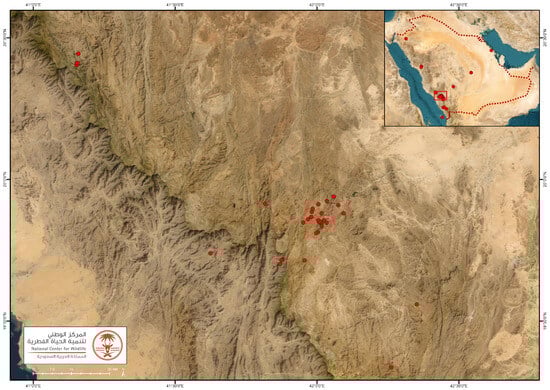
Figure 1.
Locations of camera traps used in the study (National Center for Wildlife).
2.2. Distributional Data
Previous records for the carnivores of Saudi Arabia were extracted from published papers, reports, and the mammal collection of the late Prof. Iyad Nader deposited at the NCW. Additionally, personal observations and fieldwork using camera trapping were conducted at different sites in Saudi Arabia by the National Center for Wildlife (NCW) field biologists. Data on carnivore distribution include 229 localities (Figure 2, Appendix A). Records for each species reported previously are indicated with the reference number in parentheses. Scientific and common names were checked according to the IUCN.
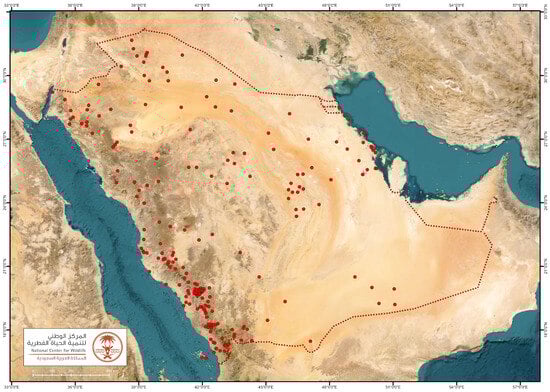
Figure 2.
Map of Saudi Arabia showing localities of reported carnivores (NCW).
3. Results
3.1. Camera Trapping
A total of 10 species of carnivores were recorded based on camera trapping efforts (Table 1, Figure 3). The striped hyena was the most recorded species in 13 locations, with the highest number of observations made at the Raydah Protected Area, followed by the red fox and the Arabian wolf (Table 1). Both Genetta genetta and Mellivora capensis were the least recorded species. Vulpes vulpes was the most distributed species and it was recorded from 15 sites.

Table 1.
Carnivores recorded by camera traps from Saudi Arabia.
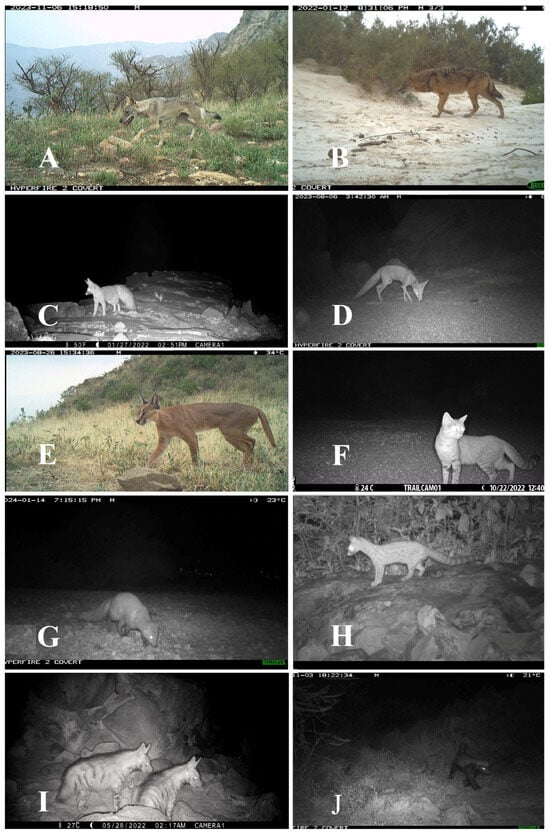
Figure 3.
(A) Canis lupus. (B) Canis aureus. (C) Vulpes cana. (D) Vulpes vulpes. (E) Caracal caracal. (F) Felis lybica. (G) Ichneumia albicauda. (H) Genetta genetta. (I) Hyaena hyaena. (J) Mellivora capensis. (All photos by NCW).
3.2. Diversity of the Carnivore Fauna of Saudi Arabia
The carnivores of Saudi Arabia consist of 14 species in 6 families (Canidae, Felidae, Herpestidae, Hyaenidae, Mustelidae, and Viverridae) and 10 genera. The family Canidae includes five species, while the families Hyaenidae and Viverridae include one species each (Table 2).
Table 2.
Carnivores reported from Saudi Arabia.
Family Canidae
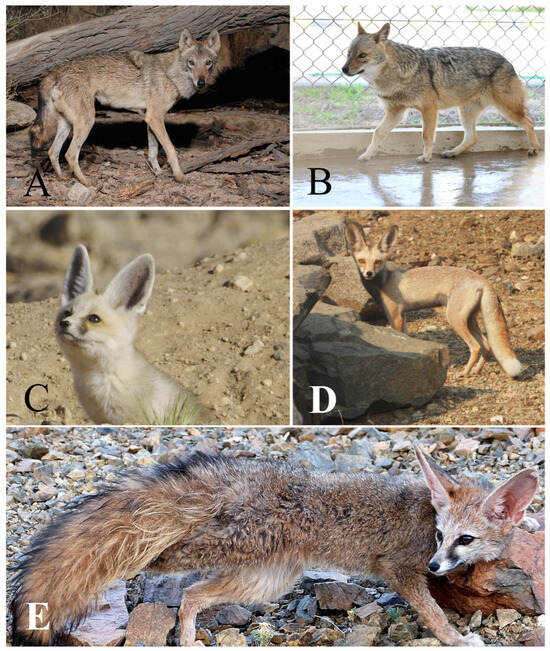
Figure 4.
(A) Canis lupus (NCW). (B) Canis aureus (NCW). (C) Vulpes rueppellii (NCW). (D) Vulpes vulpes (NCW). (E) Vulpes cana (Photo by A. Aloufi).
Common name: Arabian wolf.
Previous Records: Hijla, Taif-Abha, Wadi Khumra [1], Al Khunfa, Al Jandaliyah, At Taysiyah, At Tubaiq, Ballasmar, Haram of Makkah, Harrat Al Harrah, Harrat Khaybar/Wadi Hadiyah, Harrat Uwayrid, Himma Al-Azahirah, Himma Al-Fawqa’, Himma Al Humayd, Ibex Reserve, Farasan Islands, Jabal Aja, Jabal Batharah/Wadi Turabah, Jabal Uthrub/Al-Balas, Jibal Qaraqir, Jabal Shada, Mahazat As Sayd, Majama’ Al Hadb, Nafud Al Urayq, Raydah, Saja/Umm Ar Rimth, Wadi Iya, Wadi Lajb/Jabal Al Qahar, Wadi Tarj/Jabal Jandaf [3], Asir [5], Al Dalham, Al Majmah, Artawiyah, Ayn Dar, Bani Sa’ad, between Al Muzahmiya and Dharma, between Al Khobar and Dammam, Fuleji-Jiddah, Haql, Harrat Khaybar, Khawr Khafji, Jabal Sawdah, Jabal Warjan, Makkah bypass, Shigri, Taif-Abha, Wadi Hanaq, Wadi Hanifah, Wadi Khumra, Wadi Qust, Wadi Sanakhah, Wadi Shuqub, Wadi Turbah, Zaymah [24], Al Namas [25], Ain Al Akhdher, Al Bedeaa, Al Desah, Al Kheretah, Al Khonfah, Al Sero, Al Zetah, At-Tubayq, Bajdah, Demaj, E of Geal, Gumailah, Haqel, Harat Al Rahah, Jabal Al Lawz, Jabal Shar, Magna, Sharma road, Taima Al Hamra farms, Taima Al Ktaeb, Wadi Dham [28], Bisha [29], Al Namas, Jebal Al Fiqrah [34], Asir, Hejaz, Hofuf, Nafud, Riyadh [36], Harrat [39], Jeddah [40], Wadi as Sirhan [41], Buraida [42], Ibex Reserve [43].
Recent records: Al Bashayer, Al Far’ah, Aqbat Al Khashaba, Bellahmar, Al Foaha, Jabal Gaimran, Jabal Radwa, Jebal Al Saro, Luga, Rijal Alma’a, Shwas, Tabuk, Tanomah, Tbalah, Wadi Al Khitan, Wadi Qanonah, Wadi Shara, Wadi Tarj, Yadamah.
Remarks: The Arabian wolf occurs in the mountainous areas of the southwest and the rocky landscape of northern Saudi Arabia. Cunningham and Wronski [3] presented a distribution map for the Arabian wolf based on previously unpublished reports. The distribution of this species covers vast areas, including rocky areas, wadi beds, open deserts, and around human settlements.
Wolves feed on a variety of food items, including small mammals, wild ungulates, large lizards, and domestic animals [1]. At Al Namas, it was found to predate a calf. Camera trapping revealed two individuals together. Pups are usually born in the spring or early summer in very cold places, such as the tundra. Females give birth to six to eight puppies, with a gestation period of 2–2.5 months.
Two subspecies were reported from Saudi Arabia; Canis lupus arabs Pocock, 1934 and Canis lupus pallipes Sykes, 1831. Bray et al. [44] provided genetic evidence that wolves of Saudi Arabia are variable in terms of their genetics and are more closely related to the Eurasian wolf Canis lupus group than to the Indian wolf Canis lupus pallipes. The Saudi Arabian wolf population should be considered as Canis lupus arabs. In any case, the taxonomic and phylogenetic position of the Arabian wolf requires further genetic and molecular research.
Common name: Golden jackal.
Previous records: Abo Ali Island, Al Jubail, Al Asfar Lake, Domat Al Jandal, Qa’ Sharorah, Tabarjal [22], Hofuf, Laija, Jabal Qarah, Safwa [24], Abo Ali Island, Dauhat Ad-Dafi, Ras Al-Abkhara [45].
Recent records: No found.
Remarks: The Golden Jackal is a nocturnal species and often feeds on carrions and food wastes. It prefers areas with open waterbodies, surrounded by reeds and other aquatic vegetation such as Phragmites australis [22]. Its distribution in Saudi Arabia is confined to areas with open pools such as Al Asfar Lake and Domat Al Jandal. One pair was observed during the afternoon at Abo Ali Island [22].
Very little is known about its biology in Saudi Arabia. Mating starts in October and continues till December and pups are born in late winter and early spring. It feeds basically on birds, small mammals, reptiles, amphibians, and large insects [24].
Common name: Blandford’s fox.
Previous Records: Ibex Reserve [5,43], Al Namas [25], Bajdah [28], Bisha [29], Biljurshi, Jabal Shada [36], Al Namas, At-Tubaiq Reserve, Jebal Al Fiqrah [46].
Recent records: Aqabat Shareegah, Haid Al Naqa’, Jebal Al Saro, Jabel Bathrah, Majama’ Al Hadb, Wadi Tarj.
Remarks: This species occurs along the arid mountainous habitats of Saudi Arabia. It has also been recorded in sandstone deserts around the Tabuk area, steep, rocky slopes, and canyons and cliffs along the Red Sea mountains [28,36]. In Bajdah, it occurs along with other mammals, including the rock hyrax, the Nubian ibex, the striped hyena, the red fox and the Arabian wolf [6]. Al-Khalili [4] gave a general account of its habitat selection and behavior.
Gestation lasts for about two months, with a litter size of one to three [47]. This species feeds on invertebrates and fruits, and lizards and rodents seem to be other potential diets. This species is active at night and mostly solitary. The home range was estimated between 0.5 and 2.0 km2 [47]. In Saudi Arabia, camera traps showed that peak activity started after 19:00 h with the highest peak at around 05:00 h [6]. In the United Arab Emirates, the diet for this species consists of small invertebrates and fruits [48].
Vulpes rueppellii (Schinz, 1825). Figure 4C
Common name: Rüppell’s sand fox.
Previous records: Mahazat as-Sayd [9], Irq Abu Fakr, Rub Al Khali, Sakaka, Zilfi-Buraydah [24], Bisha [29], Riyadh [31], Khafs, Riyadh [40], Ain Sala, Hibaka qa amyat, Najran [36], Nafud Al Sirr, Riyadh, Rub Al Khali, Wadi Dawasir [42], Ibex Reserve [43], Badanah, Rafha [49], Khurais [50].
Recent records: Al Salhaniyah.
Remarks: The Rüppell’s sand fox inhabits extreme desertic conditions with soft sand and stony deserts as well. It seems to be common in Mahazat as-Sayd where sand and moderate rocky hills are dominant, with relatively rich vegetation cover of desert plants [8].
Details on the reproduction, diet, and home range for this species in Mahazat as-Sayd Protected Area are reported [8]. The diet consists of desert rodents (Meriones crassus, Gerbillus cheesmani, and G. nanus), birds, reptiles, beetles, other invertebrates, seeds, and plant materials. The number of cubs per litter ranges from 2 to 6, with a mean of 3.3 [8]. Rüppell’s sand fox is strictly a crepuscular/nocturnal animal.
Common name: Red fox.
Previous records: Thummamah, Riyadh [7], Mahazat as-Sayd Protected Area [8], Al Jubah, Sakaka, At Tawil [23], Al Aqiq, Amq, Al Baha, Al Uqayr, An Nimas, Ayn Dar, Azaiba, Biljurshi, Bisha, Hakimah, Harrat Kishb, Fayfa, Jafura, Jabal Buwayb, Jabal As Sinfa, Jabal Tuwaiq, Khasab, Makkah, Mikhwah, Qurum, Riyadh, Rumah, Sabya, Samran, Shoiba, Taif-Abha, Wadi Ad Dilla, Wadi Dhi Khul, Wadi Khumrah, Wadi Maraba, Wadi Mardum, Wadi Shakub, Wadi Tabalah, Wadi Turabah [24], An Nimas [25,43], Al Qelebah, Al Sero, Al Zetah, At-Tubayq Reserve Bajdah, Demaj, El Zawiah, Haqel, Shegry, S Tabuk, Tadco farms, Wadi Al Akhdher [28], Bisha [29], Asir, Abha, Dhahran, Harrat Al Harrah, S Hejaz, Jiddah, Kharj, Najran, Nejd, Riyadh, Taif [36], Hofuf, NE Saudi Arabia [42], Ibex Reserve [43], Urq Bin Ma’rd [51], Sakaka [52].
Recent records: Al Jubail, Al Qawba, Bellahmar, Jabal Gaimran, Jebal Al Fiqrah, Jebal Al Saro, Jabel Bathrah, Jabal Radwa, Nofoud Al Uraiq, Riyadh, Tanomah, Wadi Nama’an, Wadi Tarj, Wadi Tibalah.
Remarks: The red fox has a wide range of habitats, including extreme deserts, mountains, sand and gravel deserts, and coastal regions [24]. It also invades urban areas looking for food in the garbage. In the current study, it is considered by far the most common carnivore in Saudi Arabia.
It mates during early winter, giving birth in early spring. It is mainly nocturnal but can be observed during the daytime as well. It feeds on small rodents and birds, lizards, snakes, scorpions, insects, vegetables, and fruits [8]. A home range of 27.3 km2 was estimated for one female in Mahazat as-Sayd Protected Area [8].
This species is also persecuted and hunted in many parts of the country. The species population of Saudi Arabia is considered as Vulpes vulpes arabica Thomas, 1902.
Family Hyaenidae
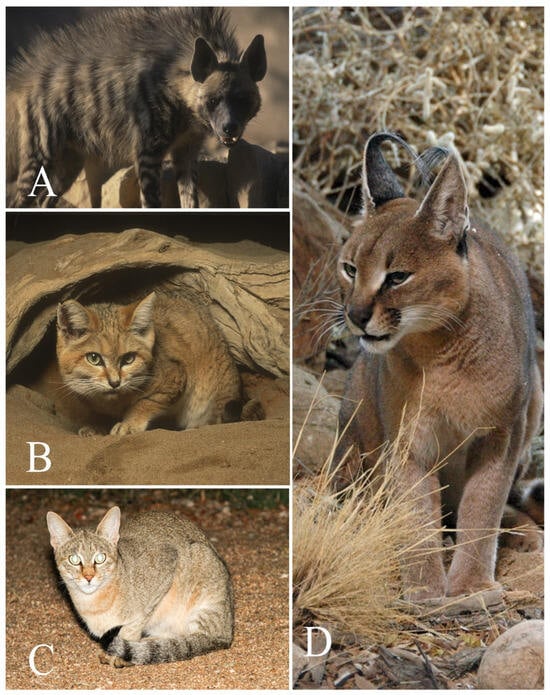
Figure 5.
(A) Hyaena hyaena (NCW archives). (B) Felis margarita (NCW archives) . (C) Felis lybica (NCW archives). (D) Caracal caracal (NCW archives).
Common name: Striped hyena
Previous records: Al Harrah, Aljubeh, Alwidyan, An Nafud, Khaw’s village, Laija [23], Bani Sar, Biljurshi, Jabal Ayn Dar, Jabal Burrayman, Jabal Lidam, Jabal Qidam, Makkah, Masane, Namrah, Taif Shafa, Talhah, Wadi Qust, Wadi Turabah [24], Al Namas [25,43], Abu Rakah, Alagan, Al Desah, Bajdah, El Bedeaa, E Geal, Gumailah, Haqel, Harat Alrahah, Wadi Al Gshabreah [28], Bisha [29], Asir [34], Al Hasa, Al Medinah, Asir, Hejaz, Tubyeq [36], Hesam (W Tabuk), Jebel Al Lawz, Jebel Hijaz, Jebel Mayen, S Taif across the southwest and in northwest along the Tabuk [53], Turaif [54].
Recent records: Abha, Al Hada, Al Salhaniyah, Al Mosabba’ah, Al Ruddf, Bellasmar, Jebal Al Diqnah, Jabal Gaimran, Jebal Al Saro, Raydah PA, Rijal Alma’a, Shbalah, Tanomah, Wadi Al Hafya, Wadi Khaytan, Wadi Tibalh, Yadamah.
Remarks: The distribution of the striped hyena in Saudi Arabia is the most common in the western mountains, with scattered localities in the heart of the Arabian Peninsula. Rocky terrain rich in caves is quite common in the Hijaz Mountains extending southward to Asir. The striped hyena seeks refuge in remote areas away from human settlements. It is known in the northeast near Hail and Arar where underground caves are abundant. It avoids open sand deserts.
They breed at any time of the year. Gestation lasts for 3 months. A lactating female was observed in March. The activity period extends after 6 p.m. in winter to 3 a.m. in summer. It was found along with the caracal and the Arabian wolf. At Al Baha, the striped hyena feeds on carrion of camels, donkeys, sheep, and cattle. In a cave in Umm Jirsan, northwest Saudi Arabia, Stewart et al. [21] found tens of thousands of dried old bones from more than 40 animal species (among which were horses, donkeys, wolves, foxes, sheep, camels, goats, gazelles, and hyenas).
The striped hyena is widely distributed in the Middle East where two subspecies occur: Hyaena hyaena syriaca Matschie, 1900, known in Jordan, Palestine, and Syria, and Hyaena hyaena sultana Pocock, 1934, in the Arabian Peninsula [36].
Family Felidae
Common name: Caracal.
Previous records: Abha, Abha-Jizan road, Khamis Mushayt [10], Harrat Al Harrah [11], Wadi Khaytan, between Malik and Abyam [24], Makman Shamma [26], Bisha [29], Qaim [40].
Recent records: Al Awamer, Al Fowaha, Al Namas, Bellahmar, Bellasmar, Jabal Gaimran, Jebal Al Daqnah, Jebal Al Saro, Janab Shokor, Mahayel Aseer, Raydah, Rijal Alma’a, Shwas, Tanomah, Tharban, Wadi Turbah, Yadamah.
Remarks: In Saudi Arabia, the caracal is common in the southwestern mountains where pairs were documented by camera traps. It was found along with the striped hyena and the African wildcat. In Harrat Al Harrah, a radio-tracked male home range was from 270 to 1116 km2 [11]. The species was observed in several locations in Al Namas with camera traps, whereas two individuals, a female and a juvenile, were seen in one frame in a rocky area. The species is active during the day and nighttime.
Both sexes become sexually mature by the time they are one year old. Breeding takes place throughout the year. The gestation lasts about two to three months, following which a litter consisting of one to six kittens is born. The caracal feeds primarily on birds, small mammals, gazelles, lizards, and snakes [36]. Van Heezik and Seddon [11] found that the caracal in the Harrat al Harrah Protected Area fed mainly on the Libyan jird, Meriones libycus, and was also observed to scavenge on dead Arabian sand gazelle, Gazella marica, and feed on the killed steppe eagle, Aquila niplaensis.
Felis margarita (Loche, 1858). Figure 5B
Common name: Sand cat.
Previous records: Mahazat as Sayd [8,55,56], Saja/Umm Ar-Rimth, Mahazat as Sayd Reserve [12], Uruq Bani Ma’arid [15], Ashayrah [24], Harrat al-Harrah [26,57], Al Zetah, Haqel, Rowafah [28], Sharri [58], Bisha [29]. Saja/Umm Ar-Rimth protected area [32], between Sarrar and Al Uwaynah, Rumah [36], Riyadh [59], Turif [54].
Recent records: Ibex Reserve, Meegowa, Nofoud Al Uraiq.
Remarks: The sand cat inhabits escarpment plateaus, sand dunes, and interdunal gravel valleys in Uruq Bani Ma’arid [15]. It was found along with Rueppell’s fox in the sand dune habitats. Similarly, it was found in sandy areas in the deserts of Tabuk [28].
Young individuals were observed in May, June, and August. This species is strictly nocturnal and more active during the hot season [15]. The gestation period lasts between 59 and 67 days [60]. Rodents and the young of Lepus capensis were reported as the main prey of this cat [61]. The cat was active for a total of 7.3 and 6.4 hours per day during summer and winter, respectively [15]. Its activity pattern overlapped with that of V. rueppellii and V. vulpes [15]. Fagbo et al. [58] found that a sand cat collected from Sharri village near Qaseem was affected by rabies.
Common name: African wildcat.
Previous records: Thumamah [7], Bisha [29], Asir, At Taysiyah, Bani Malik, Bani Sar, Biljurshi, Buradah, Harrat Al Harrah, Hejaz, Luga, Makkah, Makkah-Taif Road, Umm Al Quron, Wadi Dhib, Wadi Nissah, Wadi Hizwah, Wadi Samara, N Jeddah [36], Rub al Khali [62].
Recent records: Al Baha, Al Fowaha, Al Namas, Jebal Al Daqnah, Jabal Al Fiqrah, Jebal Al Saro, Majama’ Al Hadb, Sabat Al Jarah, Nofoud Al Uraiq, Shwas, Wadi Khytan.
Remarks: The African wildcat occurs in rocky areas, scrub deserts, dunes, and plains from the sea level to 2300 m a.s.l. There are no detailed studies on the wildcat in Arabia except for a radio-tracking study of two animals in the UAE [63,64]. A wildcat was found resting in the hollow of a Ghaf tree Prosopis cinerea [65].
It is presumed to be a generalist feeder, preying on rodents, small birds, reptiles, eggs, etc. The stomach of one wildcat examined on the Batinah coast, Oman, contained coleoptera, orthoptera, lizards, mammal fur, and a date stone, with the insect remains perhaps a response to the scarcity of rodents during a period of drought [36]. Females give birth to up to 5 kittens and the gestation period lasts 56–60 days.
Panthera pardus nimr (Hemprich and Ehrenberg, 1833) Figure 6A
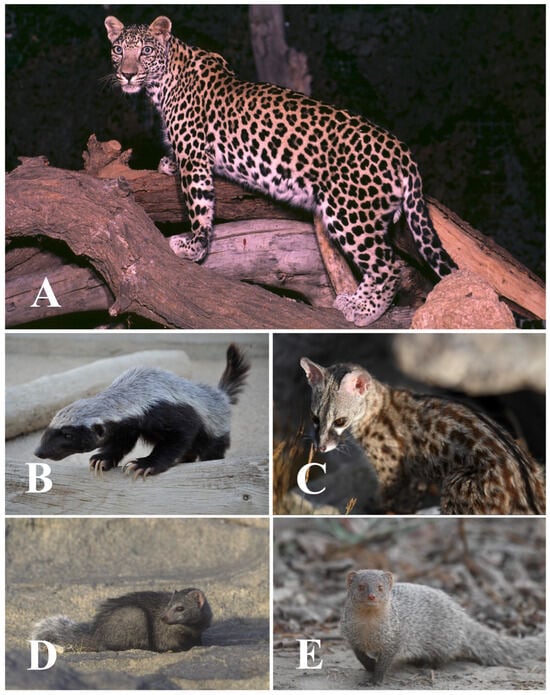
Figure 6.
(A) Panthera pardus nimr (NCW). (B) Mellivora capensis (NCW). (C) Genetta genetta (NCW). (D) Ichneumia albicauda (NCW). (E) Herpestes edwardsii (Photo by M. Al Zayer).
Common name: Arabian leopard.
Previous records: Hijaz in the north and the Asir in the south, Sarawat Mountains, Wadi Hiswa [16], El-Taiyabah [17], Tabuk [28], Al Namas, Bani Saad, Al Fiqrah mountain, Wadi Nauman [33], Hail [66].
Remarks: Leopards were found along remote and rugged mountainous areas in Saudi Arabia. Higher elevations of its distribution range are vegetated with juniper, with the slopes being broken by dry wadis where leopards have been reported [16]. In the Asir Mountains, leopards live along the steep escarpment, parallel to the Red Sea coast, which drops from 2400 m to around 600 m a.s.l. [16]. Arabian leopard scat analyses have revealed the presence of the Arabian gazelle, Gazella arabica, Nubian ibex, Capra nubiana, cape hare, Lepus capensis, rock hyrax, Procavia capensis, some bird species, Indian crested porcupine, Hystrix indica, Ethiopian hedgehog, Paraechinus aethiopicus, small rodents, and insects [67].
In 2017, the National Action Plan for the Arabian Leopard estimated the population of the Arabian leopard around 50 individuals at various sites in the Asir and Hijaz Mountains [68], including Jabal Shada, Raydah, Jazan, and a site on the border with Yemen [69]. However, extensive camera trapping carried out by the National Center for Wildlife since 2010 did not record any leopard presence within Saudi Arabia. These efforts included a follow-up survey conducted after the discovery of the poisoned leopard carcass in Wadi Nauman in 2014, which failed to detect any leopards in that area [69]. During late 2020 and 2021, intensive surveys of 13 sites with 82,075 camera trapping nights, which were considered most likely to support extant leopard populations, were undertaken by the NGO Panthera, in partnership with the Royal Commission for AlUla and with support from the National Center for Wildlife. No leopards were found, and the existing 2021 National Action Plan was updated for the Arabian leopard. It seems unlikely that any functional leopard populations remain in Saudi Arabia, although it is likely that individual leopards may occasionally disperse northward into the kingdom from Yemen [70]. Also, a strategy for the conservation of the leopard in the Arabian Peninsula was drafted [71].
Uphyrkina et al. [72] recognized at least nine discrete populations of Panthera pardus across its distribution in Asia and Africa. They stated that the Arabian subspecies, Panthera pardus nimr is distinct from other populations. More historical records on the distribution of this subspecies were given by Spalton and Al Hikmani [73]. Based on an analysis of historic and current distribution, P. p. nimr has lost as much as 98% of its historic range in the Arabian Peninsula [74].
Family Mustelidae
Common name Honey badger.
Previous records: Mahazat As-Sayd Protected Area [19], Ar Rass, Ayn Dar, Hakimah, Qatif, Makkah By-Pass, Wadi Baysh [24], Makman Shamma [26], Taima [28], Bisha [29], Northern and Central Saudi Arabia; Summan [75], Jafura Desert [76], Badanah [77], Turaif [54].
Recent records: Al Namas, Al Fowha, Al Jawf. Al Majardah, Al Hareeq, Al Huda, Al Fowha, Biljarashi, Hwalt Al Khabeerah, Jabal Gaimran. Its presence was confirmed near the Al-Hair Lakes in 2022 (observation by F.M.A.), about 45 km south of Riyadh.
Remarks: The Honey badger occurs in most habitats (wadis, mountains, sandy-gravel desert, and plateau) in the Arabian Peninsula except for extensive sand dunes. It has been recorded at 2000 m a.s.l. in Abha, southwestern Saudi Arabia. The honey badger was killing captive Asian houbara bustards, Chlamydotis macqueenii, in Saudi Arabia [19]. Three individuals were recorded by camera traps in a wadi bed in Al Namas. They were mostly active during the nighttime, with few sightings in the early morning hours. Females give birth to 1–2 newborns with a gestation period that lasts for 8–9 weeks.
Family Viverridae
Common name: Common genet.
Previous records: Biljurshi, Wadi Alayb, Wadi Khaytan [12], Bisha [29], S Asir [36], Al Jowa, N Jizan, Wadi Samara [78], An Namas [79].
Recent records: Al Baha, Al Bashayer, Al Thahara, Al Sawda, Aqabat Shareegah, Bellahmar, Jebal Al Fiqrah, Jabal Shada, Raydah, Tanomah.
Remarks: The common genet inhabits groves, riparian areas, forests, rocky areas, and scrublands [80]. In Saudi Arabia, it occurs in mountainous areas in the southwest, with dense forests, such as in Bisha [29], and permanent water bodies. Also, it is found around the coastal areas near Jazan. It also invades human habitations and sometimes attacks chickens and other small birds.
The biology of this species is summarized from the species account given by Larivière and Calzada [80]. The common genet is an opportunistic carnivore: it feeds on small mammals, birds and their eggs, reptiles, amphibians, fish, insects, and fruits. Mating occurs from January to September, peaking in February and March. The gestation lasts for 10–11 weeks with a litter size between 1 and 4. This species is nocturnal, with the highest activity from sunset to sunrise.
Family Herpestidae
Common name: White-tailed mongoose.
Previous records: Abu Arish, Al Aradh, Ad adrb, Al Lith, Bani Malik, Hakimah, Wadi Turabah, Sukh Abyan, between Sabya and Sukh Abyan [24], Bisha [29], Jabal Shada [36], Tawlah [78], Al Aradh, Hakimah [81], Farasan al Kebir [82,83].
Recent records: Al Namas, Al Awamer, Al Baha, Ashouq, Sabt Al Alalaya, Sarat Abeedah, Wadi Al Osher.
Remarks: The white-tailed mongoose can be found in wooded wadis, coastal plains, plantations, gardens, and even urban areas. This species seems to be common in Bisha where 12 individuals were trapped in the mountains and valleys around Bisha [29]. In Farasan Island, the white-tailed mongoose has an adverse effect on the breeding of the osprey, Pandion haliaetus [82], and Kentish plover, Charadrius alexandrines [83].
Details on the biology of this species in Yemen were investigated [84]. It feeds on insects, rodents, reptiles (lizards and snakes), toads, worms, and fruit. Females give birth to two young, and reproduction occurs during February–May.
Herpestes edwardsii (E. Geoffroy, 1818) Figure 6E
Common name: Indian grey mongoose.
Previous records: Al Qatif [12], Uqair [40], Al Qatif [78], Sayhat [85].
Recent records: No found.
Remarks: The Indian grey mongoose was probably introduced to Kuwait and eastern Saudi Arabia. It occurs mainly near the Saudi coasts on the Arabian Gulf. It was found in oases and agricultural areas in Al Qatif [12,85]. Very little is known about its habitat use and distribution in eastern Saudi Arabia.
No data are available on this species in Saudi Arabia. Elsewhere, it was found to feed on rodents, birds, reptiles, a variety of arthropods, and plant materials [86]. Females give birth to 2–3 young, with a gestation period of up to two months.
No information is available on the threats that may affect the Indian grey mongoose in Saudi Arabia.
3.3. Zoogeographical Affinities of the Carnivores of Saudi Arabia
The zoogeography of the mammals of the Arabian Peninsula was presented by Delany [87]. His discussion was based on the distributional data before 1989 (Table 3). Recent studies have expanded the known range for several species that now allow us to discuss in detail the zoogeographic affinities of the carnivores in Saudi Arabia.
Table 3.
Zoogeographic affinities of the carnivores of Saudi Arabia.
Eight species, C. caracal, F. lybica, F. margarita, H. hyaena, M. capensis, P. pardus, V. rueppellii, and V. vulpes, representing 57% of the carnivores of Saudi Arabia, have a wide range of distribution throughout the Afrotropical–Palaearctic–Oriental range. One species, i.e., G. genetta has the Afrotropical–Palaearctic range (7%), and one species, i.e., I. albicauda, is strictly Afrotropical (7%), while three species (21%), C. aureus, H. edwardsii, and V. cana, have Oriental–Palearctic affinities. Canis lupus is the only Palaearctic species (7%).
3.4. Species Richness of Carnivores in Saudi Arabia
Figure 7 shows the species richness of the carnivores across Saudi Arabia. The southwestern corner of Saudi Arabia, covering Asir, Jazan, and Najran Plateaus extending further into the Al Sarawat Mountains, hosts the highest number of carnivore species. This includes one Afrotropical species, I. albicauda., and species of other affinities, such as C. lupus, C. caracal, F. lybica, H. hyaena, M. capensis V. cana, V. vulpes, and the critically endangered Panthera pardus. This area represents the Afromontane element characterized by rich vegetation cover, suitable habitats for carnivores, and abundance of prey of large- to medium- to small-sized animals, such as the Arabian gazelle, Gazella arabica, Nubian ibex, Capra nubiana, rock hyrax, Procavia capensis, Arabian hare, Lepus capensis, and rodents.
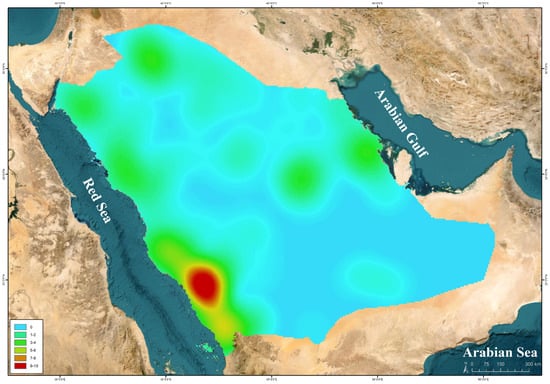
Figure 7.
Heat map showing carnivore species richness in Saudi Arabia (NCW).
The Red Sea Mountains also host a number of carnivores. Both C. lupus and H. hyaena are common species, in addition to the widespread V. vulpes. The Blandford’s fox, V. cana, is associated with both sandstone mountains in the northwest and along the Red Sea Mountains.
At least two species inhabit sand deserts across the country, i.e., the sand cat, F. margarita, and Rüppell’s sand fox, V. rueppellii. Both species are highly adaptable to living in sand dunes.
In eastern Saudi Arabia where salt marches are common, two species of special interest, the Indian grey mongoose, H. edwardsii, with very few records, and the golden jackal, C. aureus, are commonly reported.
3.5. Conservation of Carnivores in Saudi Arabia
Most carnivores in Saudi Arabia are protected under the Executive Regulations for Hunting of Wildlife, Article N. M/165 for the year 2020 issued by the Ministry of Environment, Water and Agriculture. Penalties are very severe, varying from as low as SAR 50,000 (USD 13,300) for the killing of the common genet to as high as SAR 400,000 (USD 106,670) for the Arabian leopard. Only the two species of mongooses are not listed.
Confiscated animals by the Environmental Security Special Force are sent to sheltering facilities around the kingdom. Ten species of local carnivores were confiscated and are kept in five sheltering facilities (Table 4). The striped hyena is the most confiscated animal, followed by the Arabian wolf and caracal. At present, all these species are held awaiting rewilding and, subsequently, if deemed suitable, they will be released into fit habitats.
Table 4.
Number of confiscated carnivores held at five sheltering facilities in Saudi Arabia.
Table 5 summarizes the conservation status of the carnivores of Saudi Arabia according to global, regional, and national IUCN assessments [88]. Recently, we assessed the conservation status of the mammals of Saudi Arabia at the local scales according to the IUCN criteria. The Arabian leopard, P. pardus nimr, was listed under the critically endangered category. The effective population size is clearly below 250 mature individuals; in fact, the population is declining, and the distribution is severely fragmented, with no subpopulation larger than 50 mature individuals. The species has not been recorded in Saudi Arabia since 2014.
Table 5.
Conservation status of carnivores of Saudi Arabia according to the global, regional, and national levels.
Camera traps placed in 13 sites from its historical range and scat DNA analysis failed to document the presence of the leopard [89]. This study concluded that there are no surviving, sustainable populations of Arabian leopards in Saudi Arabia, but, perhaps, individual animals may be present. Both Canis lupus and Hyaena hyaena are listed as endangered. Although both species have a wide distribution range across Saudi Arabia, they are under severe threats (hunted, poisoned, and killed) causing continued decline in their populations, while the Asiatic jackal, C. aureus, and Blanford’s fox, V. cana, are listed as vulnerable. The Blanford’s fox prefers rugged terrain, especially in the southwestern Asir range [90]. The Asiatic jackal has a confined and fragmented distribution in Saudi Arabia. The honey badger, M. capensis, and the caracal, C. caracal are listed as near threatened. This is mainly due to extensive hunting, killing, and habitat degradation.
3.6. Threats Affecting Wild Carnivores in Saudi Arabia
Unfortunately, large carnivores, especially the Arabian wolf and the striped hyena, are persecuted in many different forms. They are shot when encountered and their carcasses are hung on trees or road signs near villages (Figure 8 and Figure 9). Shepherds claim that wolves predate their sheep and immediately kill them. The use of ‘tree hanging’ to display killed carnivores, especially wolves and hyenas, is a common practice in Saudi Arabia [3].
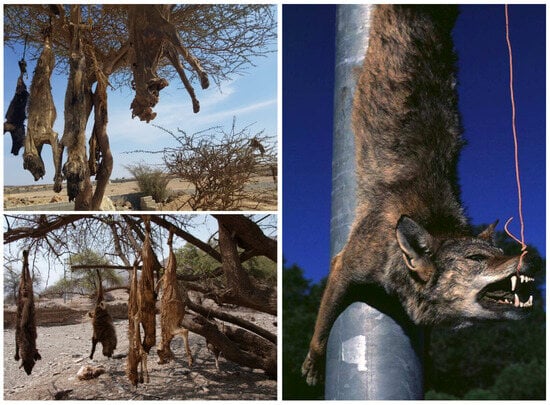
Figure 8.
Tree-hung wolves (NCW).
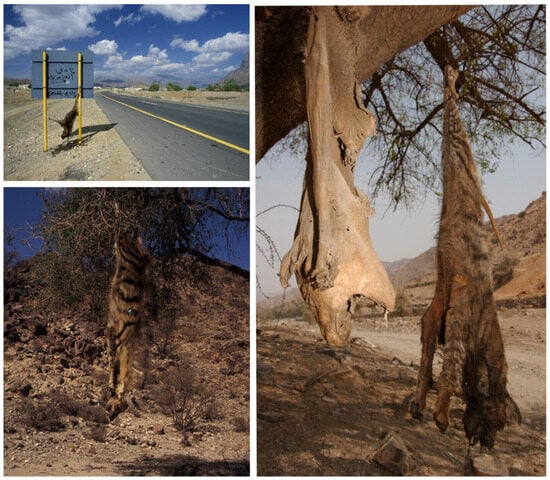
Figure 9.
Tree-hung striped hyenas (NCW).
Wolves are one of the most persecuted animals in Saudi Arabia. They are hunted, shot, and hung at village intersections. Aloufi and Amr [28] documented that 30 individuals were killed and hung by locals in the Tabuk Province.
Habitat loss and degradation of natural habitats in addition to indiscriminate killing and poaching are major threats affecting the well-being of the Asiatic jackal. Locals do not differentiate between wolves and jackals. A roadkill animal was found dead on the highway near Tarabjal. The Rüppell’s sand fox [24] is also persecuted and was observed hung near Riyadh [31], as is the red fox.
Aloufi and Amr [28] documented that nine hyenas were killed and hung by locals in the Tabuk Province. They are killed by rifle poaching, traps, or poisoning. In addition, habitat alteration, desertification, and urban expansion have their toll on the species’ survivorship. Also, the meat of the striped hyena is consumed by some locals. This species is under severe threat and should be protected.
The caracal is presumed to have a wide distribution range in Saudi Arabia. However, its population size is not known without estimates and may be declining, with various forms of threats emerging. This carnivore is trapped and illegally kept on private farms or collections. Fourteen animals have been confiscated in the last two years.
The Arabian leopard has been subjected to extensive poaching over the past 50 years causing a severe decline in its population [91]. Two young leopards were poisoned in Aqabat Tella’, 15 km north of Al Namas in 2007. One leopard was killed and hung in Al Kur, 5 km below Jabal Al Hada, Taif, in 2014 (Figure 10). A values-based management plan was developed to re-establish the return of this magnificent species [91].
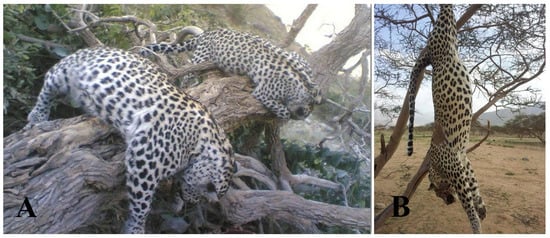
Figure 10.
(A) Two poisoned leopards in Aqabat Tella’, Al Namas, in 2007. (B) A killed leopard in Al Kur, 5 km below Jabal Al Hada, Taif, in 2014.
Local markets offer several carnivores for sale. The Arabian wolf and the sand cat were offered for sale at the Tabuk pet market [30]. The common genet and the white-tailed mongoose were for sale at the Riyadh pet market in 2023 (observation by F.M.A.)
Forty-nine wolves and fifty hyaenas were confiscated from private farms or collections. Some locals keep wolves in enclosures that lack proper space and living conditions. We came across some private farms holding different species of carnivores as “pets or show animals”. In addition, the NCW is currently engaged in captive breeding programs for the caracal and other canids.
4. Discussion
The carnivore fauna of Saudi Arabia is considered relatively rich compared with neighboring countries with 14 known species. It constitutes about 20% of the terrestrial mammals of Saudi Arabia. Twenty-one extant species of carnivores have been recorded from Iraq [92], sixteen from Jordan [93], two from Bahrain [94], five from Kuwait [38], seven from Qatar [95], twelve from the United Arab Emirates [37], twelve from Oman [36] and sixteen from Yemen [35,96].
The carnivores of Saudi Arabia are under severe threats and require more protection through law enforcement all over the country. Habitat loss and degradation are among the major threats causing decline of carnivores in Saudi Arabia and the Arabian Peninsula [53]. Agricultural and pastoralism expansion in desert and mountain habitats have caused retraction of the home range of large carnivores, thus leading to conflict between humans and wildlife [53]. Some selected species have been proposed for captive breeding programs in facilities within operated protected areas. This will ensure breeding animals that will be subsequently released within the protected areas network that will cover 30% of the total area of Saudi Arabia by the year 2030.
Hunting and persecution of wild carnivores were the main reason for the extinction of the cheetah, Acinonyx jubatus, in Saudi Arabia [97]. This species was distributed in the northern parts of Saudi Arabia. Four cheetahs were killed in the early 1950s by the ARAMCO workers near the Saudi–Iraqi–Jordanian borders [98]. It was last seen in Hail in 1973 where two animals were killed [97]. By now, the cheetah is considered an extinct species in Saudi Arabia: in 2022, 5 mummified, over 50 skulls, and skeletal remains of cheetahs were found in underground caves in Luga, Ara’r Governorate. The caves varied in size, from small to very large, with extensive alleys and tunnels. Studies to determine the ages and genetic profiles of the collected materials were undertaken by the NCW. By now, the whole genome of two Arabian leopards has been sequenced and compared with other populations [99].
Furthermore, the magnitude of animal trade in local carnivores requires more attention in order to accommodate confiscated animals in sheltering units, along with rewilding and rehabilitation programs. Threats affecting carnivores should be quantified to secure more conservation efforts. Public awareness is very important for educating the public on the importance of these animals in preserving the natural ecosystems of the country.
The present study revealed the urgent need to conduct further studies on the biology of all carnivores in the country to understand their breeding biology, food preference, diseases, habitat preferences, and genetic profiles. This last approach is absolutely fundamental to better define the phylogenetic and taxonomic realities of some Saudi taxa.
Author Contributions
Conceptualization, A.A.B., F.M.A. and Z.S.A.; methodology and data collection, A.A.A., A.R.A.G., F.S., F.N., S.A., S.A.J., K.A.M. and M.A. and result analysis, F.M.A., F.N., S.A.J. and Z.S.A.; writing, A.A.A., A.A.B., F.M.A., S.A.J. and Z.S.A. All authors have read and agreed to the published version of the manuscript.
Funding
This study was supported by the National Center for Wildlife (NCW), Kingdom of Saudi Arabia.
Data Availability Statement
Data are presented in the study.
Acknowledgments
Our thanks are extended to Mohammed Al Dughaim, Wildlife Shelter Unit at Al Thumamah (NCW), for providing data on confiscated carnivores; Mohammad Al Nashiri from the GIS unit (NCW) for map preparation; Mengjing Wei (NCW) for her editorial help; and Mohammed Al Zayer for providing images. Authors wish to express their gratitude to Mohammed Qurban, CEO of NCW, for his continuous support and guidance.
Conflicts of Interest
The authors declare no conflicts of interest.
Appendix A
| Locality | N | E | Locality | N | E |
| 90 km North Jizan | 16°56′00″ | 42°33′00″ | Jabal Qidam | 26°32′00″ | 48°50′00″ |
| Abha | 18°14′00″ | 42°31′00″ | Jabal Radwa | 24°56′29″ | 37°56′42″ |
| Abu Arish | 17°7′00″ | 42°40′00″ | Jabal Shada | 19°50′52″ | 41°18′57″ |
| Abu Rakah | 27°16′16″ | 36°47′80″ | Jabal Tahfa | 24°54′04″ | 43°09′54″ |
| Ad Darb | 17°25′00″ | 42°31′00″ | Jabal Tuwaiq | 24°30′00″ | 46°30′00″ |
| Ain Sala | 19°56′00″ | 51°3′00″ | Jabal Uthrub | 19°46′31″ | 41°42′57″ |
| Al Ahsa | 25°33′16″ | 49°46′36″ | Jabal Wergan | 23°59′00″ | 39°15′00″ |
| Al Aqiq | 20°11′00″ | 41°39′00″ | Jabal Aja | 27°26′59″ | 41°25′20″ |
| Al Ardhi | 18°58′07″ | 42°4′50″ | Jafura | 25°37′00″ | 50°10′00″ |
| Al Awamer | 19°42′26″ | 41°42′23″ | Janab Shukur | 19°54′00″ | 41°49′00″ |
| Al Baha | 19°35′54″ | 41°45′40″ | Jebal Al Amud | 31°00′00″ | 39°21′00″ |
| Al Bashayer | 19°42′54″ | 41°53′24″ | Jeddah | 21°51′00″ | 39°07′00″ |
| Al Bashir | 19°42′57″ | 41°52′36″ | Jibal Zallaqah | 31°16′00″ | 38°45′00″ |
| Al Dalham | 18°01′00″ | 43°24′00″ | Khafji | 28°27′00″ | 48°28′00″ |
| Al Disah | 27°37′57″ | 36°32′30″ | Khafs | 25°20′00″ | 46°30′00″ |
| Al Figarh | 24°58′15″ | 38°48′03″ | Khamis Mushayt | 18°18′00″ | 42°44′00″ |
| Al Fouha | 19°46′45″ | 41°58′10″ | Kharj | 23°55′00″ | 47°30′00″ |
| Al Huda | 21°23′05” | 39°55′18” | Khawa | 29°45′00″ | 40°23′00″ |
| Al Hariq | 23°40′35″ | 46°25′08″ | Khurais | 25°05′00″ | 48°04′00″ |
| Al Jandaliyah | 27°17′00″ | 45°7′00″ | Laija | 29°45′00″ | 39°30′00″ |
| Al Jawf | 13°00′13.47” | 39°15′29.34″ | Luga | 29°46′75″ | 42°38′52″ |
| Al Jowa | 17°00′00″ | 43°3′00″ | Mahazat as Sayd | 22°14′41″ | 41°50′24″ |
| Al Jubail | 26°50′29″ | 49°35′30″ | Majami Alhadb | 21°38′53″ | 43°47′03″ |
| Al Khunfah | 28°38′00″ | 39°19′00″ | Makkah | 25°40′08″ | 41°21′17″ |
| Al Lith | 20°09′00″ | 40°17′00″ | Makkah-Taif Road | 21°21′30″ | 40°14′00″ |
| Al Madinah | 24°49′7″ | 39°23′44″ | Malik and Abyam | 17°16′00″ | 43°03′00″ |
| Al Majardah | 19°05′3.2″ | 41°53′41″ | Masane | 18°10′00″ | 43°58′00″ |
| Al Majmaah | 22°04′00″ | 40°1′00″ | Meda’ in Salih | 26°51′00″ | 37°58′00″ |
| Al Makwah | 19°42′30″ | 41°22′02″ | Mikhwah | 19°18′00″ | 41°14′0″ |
| Al Mosabbah | 19°48′33″ | 42°00′29″ | Muhayil Asir | 18°09′00″ | 42°09′00″ |
| Al Muzaylif | 19°33′59″ | 41°13′48″ | N Jeddah | 21°43′00″ | 39°12′00″ |
| Al Namas | 19°09′07″ | 42°9′26″ | Naam | 23°42′06″ | 46°46′30″ |
| Al Qassim | 25°40′08″ | 41°43′28″ | Nafud | 28°30′00″ | 41°00′00″ |
| Al Qatif | 26°36′00″ | 49°59′00″ | Nafud Al Sirr | 25°15′00″ | 44°15′00″ |
| Al Qawba | 19°33′33″ | 42°21′05″ | Nafud Al Urayq | 25°15′10″ | 42°25′59″ |
| Al Qelebah | 28°24′17″ | 37°40′41″ | Najran | 17°30′00″ | 44°20′00″ |
| Al Qunfida | 19°09′00″ | 41°7′00″ | Namrah | 19°45′00″ | 41°40′00″ |
| Al Ruddf | 21°13′11” | 40°24′49” | NE of Jeddah | 21°38′00″ | 39°23′00″ |
| Al Sadrah | 19°42′37″ | 41°42′44″ | Qaim | 21°20′00″ | 40°45′00″ |
| Al Salhaniyah | 22°52′36” | 40°29′18” | Rafha | 29°36′00″ | 43°32′00″ |
| Al Sarhan | 18°16′00″ | 42°22′00″ | Raydah | 18°12′18″ | 42°24′34″ |
| Al Soudah | 18°15′29″ | 42°17′28″ | Rijal Alma’ | 18°07′14″ | 42°16′15″ |
| Al Uqayr | 25°37′00″ | 50°14′00″ | Riyadh | 24°39′00″ | 46°46′00″ |
| Al Zaharh | 19°01′15″ | 42°2′52″ | Rowafah | 27°44′27″ | 36°18′14″ |
| Al Zetah | 28°52′23″ | 35°30′50″ | Rub’ Al Khali | 20°00′00″ | 50°00′00″ |
| Alagan | 28°23′00″ | 36°33′58″ | Rumah | 25°39′00″ | 47°10′00″ |
| Alhafya | 19°42′54″ | 41°52′31″ | Sabt Al Alayah | 19°05′34″ | 41°56′51″ |
| Aqabat Khashaba | 19°43′59″ | 41°48′07″ | Sabt Al Jarah | 19°13′33″ | 41°23′39″ |
| Aqabat Shareegah | 19°42′06″ | 41°52′10″ | Sabya | 17°07′00″ | 42°39′00″ |
| Ar Rass | 25°51′00″ | 43°31′00″ | Safwa | 26°39′00″ | 49°58′00″ |
| Arasha | 19°44′00″ | 41°37′00″ | Saihat | 26°29′00″ | 50°03′00″ |
| Artawiyah | 26°31′00″ | 45°22′00″ | SajaUmm Ar Rimth | 22°30′23″ | 42°28′20″ |
| Ash Shuwayhitiyah | 30°23′00″ | 40°08′00″ | Sakaka | 30°10′00″ | 40°20′00″ |
| Ashayrah | 21°39′00″ | 40°38′00″ | Samran | 23°05′00″ | 39°58′00″ |
| Asir | 19°30′00″ | 42°00′00″ | Sarrar AL Uwaynah | 26°52′00″ | 48°20′00″ |
| At Taysiyah | 28°20′00″ | 43°22′00″ | Shabalh | 19°58′13″ | 41°55′6″ |
| At Tubayg | 29°35′00″ | 37°06′00″ | Shafa/Taif | 21°07′00″ | 40°22′00″ |
| Ayn Dar | 25°59′00″ | 49°23′00″ | Shamran | 19°48′32″ | 41°55′23″ |
| Badanah | 30°58′00″ | 41°03′00″ | Sharawrah | 17°28′00″ | 47°06′00″ |
| Bajdah | 28°20′51″ | 35°47′16″ | Shawas | 19°52′08″ | 41°58′29″ |
| Ballahmar | 18°36′07″ | 42°12′03″ | Shigry | 28°02′00″ | 35°54′00″ |
| Ballasmar | 18°46′58″ | 42°10′08″ | Shoiba | 20°45′00″ | 39°30′00″ |
| Bani Malik | 17°19′00″ | 43°14′00″ | Southern Asir | 19°30′00″ | 42°00′00″ |
| Bani Mazen | 18°05′14″ | 42°25′10″ | Southern Hejaz | 25°30′00″ | 38°00′00″ |
| Bani Saad | 20°52′58″ | 40°43′58″ | Sukh Abyan | 17°19′00″ | 43°5′00″ |
| Bani Sar | 20°08′00″ | 41°45′00″ | Summan | 27°00′00″ | 47°00′00″ |
| Bedea’a | 27°48′11″ | 36°33′15″ | Tabarjal | 30°26′17″ | 38°10′20″ |
| Biljurashi | 19°49′28″ | 41°37′25″ | Tabuk | 27°39′06″ | 38°36′00″ |
| Bisha | 19°59′00″ | 42°20′00″ | Taif | 21°31′12″ | 40°35′19″ |
| Buraydah | 26°20′00″ | 43°59′00″ | Taif -Abha | 21°12′00″ | 40°37′00″ |
| Dammam | 26°22′00″ | 50°10′00″ | Talhah | 17°47′00″ | 43°31′00′ |
| Dhahran | 17°40′00″ | 43°30′00″ | Tanomah | 18°51′51″ | 42°8′18.7″ |
| Dharma | 24°30′00″ | 46°15′00″ | Tawlah | 20°15′00″ | 41°21′00″ |
| Djezirat Abu Ali | 27°18′00″ | 49°38′00″ | Tayma | 27°20′11″ | 38°39′47″ |
| El Taiyabah | 24°35′00″ | 39°01′00″ | Tharban | 18°59′27″ | 41°45′52″ |
| El zawiah | 28°23′00″ | 36°33′58″ | The Ibex reserve | 23°21′41″ | 46°26′30″ |
| Farasan Al Kebir | 16°42′20″ | 41°58′59″ | Turabah | 28°31′00″ | 42°37′00″ |
| Farasan Islands | 16°40′00″ | 42°09′00″ | Turaif | 31°39′57″ | 38°39′48″ |
| Fayfa | 17°15′00″ | 43°06′00″ | Umm Al Quron | 19°12′00″ | 51°5′00″ |
| Geal | 28°23′00″ | 36°33′58″ | Uruq Bani M’ arid | 19°20′13″ | 45°54′14″ |
| Gumailah | 28°23′00″ | 36°33′58″ | Wadi Ad Dawasir | 20°30′00″ | 44°41′00″ |
| Hafar al batin | 28°12′00″ | 46°07′00″ | Wadi Ad Dilla | 17°55′00″ | 42°23′00″ |
| Haid Alnagah | 19°50′8″ | 42°01′00″ | Wadi Al Akhdher | 28°05′50″ | 37°07′42″ |
| Hail | 29°00′00″ | 42°12′00″ | Wadi Al Ashr | 19°42′17″ | 41°40′47″ |
| Hakimah | 17°01′00″ | 42°50′00″ | Wadi Al ayb | 20°07′00″ | 40°55′00″ |
| Haqel | 29°13′07″ | 34°56′02″ | Wadi Al Dilfah | 19°56′00″ | 41°40′00″ |
| Harrat Al Harrah | 31°05′00″ | 39°24′00″ | Wadi Al gshabreah | 27°42′36″ | 35°44′2″ |
| Harrat Khaybar | 26°05′00″ | 39°50′00″ | Wadi Baysh | 17°23′00″ | 42°35′00″ |
| Harrat Kishb | 22°43′00″ | 41°10′00″ | Wadi Dhi Khul | 17°31′00″ | 43°50′00″ |
| Harrat Uwayrid | 26°37′50″ | 37°47′01″ | Wadi Dhib | 24°37′00″ | 46°04′00″ |
| Haswa | 28°35′38″ | 36°38′02″ | Wadi Hadiyah | 24°59′59″ | 39°55′03″ |
| Hawalat Al Khabira | 19°42′58″ | 41°42′21″ | Wadi Hanaq | 22°44′00′ | 39°15′00″ |
| Hawalh | 19°44′28″ | 41°43′24″ | wadi Hanifah | 24°45′00″ | 46°35′00″ |
| Hejaz | 25°30′00″ | 38°00′00″ | Wadi Hiswa | 18°15′00″ | 42°28′00″ |
| Hibaka qa amyat | 19°15′00″ | 50°20′00″ | wadi hizwah | 18°05′00″ | 43°56′00′ |
| Hijla | 18°15′00″ | 42°38′00″ | Wadi Iya | 18°52′37″ | 42°28′00″ |
| Himma Al Azahirah | 19°49′45″ | 41°44′44″ | Wadi Khaytan | 19°43′59″ | 41°37′32″ |
| Himma Al Fawqa | 19°50′29″ | 41°51′27″ | Wadi Khumra | 24°55′00″ | 46°11′00″ |
| Himma Al Humayd | 19°52′14″ | 41°43′31″ | WadiMakmanShamma | 30°38′00″ | 39°14′00″ |
| Hofuf | 25°20′00″ | 49°34′00″ | Wadi Mardum | 22°16′00″ | 39°14′00″ |
| Jabal Al Amad | 30°55′00″ | 39°20′00″ | Wadi Nauman | 21°18′46″ | 40°09′39″ |
| Jabal Al Dagna | 19°44′22″ | 41°37′26″ | Wadi Nissah | 24°12′00″ | 46°04′00″ |
| Jabal Al Fiqrah | 24°17′38″ | 38°54′31″ | Wadi Qanuna | 19°39′43″ | 41°50′32″ |
| Jabal Al Qahar/Wadi Lajb | 17°36′17″ | 42°55′51″ | Wadi Qust | 20°57′00″ | 41°6′00″ |
| Jabal Al Saro | 19°51′33″ | 41°58′5″ | Wadi Samra | 17°33′00″ | 42°24′00″ |
| Jabal Al Soudah | 18°16′00″ | 42°22′00″ | Wadi Sanakhah | 18°02′00″ | 44°7′00″ |
| Jabal Amer | 20°58′00″ | 40°29′00″ | Wadi Shuqub | 20°40′00″ | 41°15′00″ |
| Jabal As Sinfa | 27°57′00″ | 35°47′00″ | Wadi Shuraa | 19°47′23″ | 41°47′40″ |
| Jabal Ayn Dar | 25°59′00″ | 49°23′00″ | Wadi Sirhan | 30°55′14″ | 38°54′56″ |
| Jabal Batharah | 20°26′40″ | 41°09′29″ | Wadi Tabalah | 19°54′35″ | 42°4′30.46″ |
| Jabal Burrayman | 21°39′00″ | 39°14′00″ | Wadi Tarj | 19°20′10″ | 42°15′45″ |
| Jabal Buwayb | 25°21′00″ | 46°45′00″ | Wadi Thah | 19°56′22″ | 42°3′29″ |
| Jabal Jandaf | 19°06′20″ | 42°18′04″ | Wadi Turabah | 20°29′49″ | 49°12′00″ |
| Jabal Lidam | 26°22′00″ | 43°27′00″ | Yadamah | 18°27′00″ | 45°4′30″ |
| Jabal Qaraqir | 26°44′31″ | 37°53′27″ | Zaymah | 21°37′00″ | 40°06′00″ |
| Zilfi | 26°00′00″ | 43°12′00″ |
References
- Nader, I.A.; Büttiker, W. Mammals of Saudi Arabia. Mammalia: Fam. Canidae. Records of the Arabian wolf, Canis lupus arabs Pocock, 1934, from Saudi Arabia. Fauna Saudi Arab. 1980, 2, 405–411. [Google Scholar]
- Wronski, T.; Macasero, W. Evidence for the persistence of Arabian wolf (Canis lupus pallipes) in the Ibex Reserve, Saudi Arabia and its preferred prey species. Zool. Middle East 2008, 45, 11–18. [Google Scholar] [CrossRef]
- Cunningham, P.L.; Wronski, T. Arabian wolf distribution update from Saudi Arabia. Canid News 2010, 13, 1–6. [Google Scholar]
- Al-khalili, A.D. Ecological review and the distribution of Blanford’s fox Vulpes cana Blanford, 1877 (Mammalia: Carnivora: Canidae). Fauna Saudi Arab. 1993, 13, 390–396. [Google Scholar]
- Cunningham, P.L.; Wronski, T. Blandford’s fox confirmed at At Tubaiq Protected Area (northern Saudi Arabia) and the Ibex Reserve (central Saudi Arabia). Canid News 2009, 12, 1–7. [Google Scholar]
- Aloufi, A.; Eid, E. Distribution and morphometric measurements of Blanford’s Fox Vulpes cana (Mammalia: Carnivora: Canidae) of the Kingdom of Saudi Arabia. J. Threat. Taxa JoTT 2019, 11, 13557–13562. [Google Scholar] [CrossRef]
- Macdonald, D.W.; Courtenay, O.; Forbes, S.; Mathews, F. The red fox (Vulpes vulpes) in Saudi Arabia: Loose-knit groupings in the absence of territoriality. J. Zool. 1999, 249, 383–391. [Google Scholar] [CrossRef]
- Lenain, D.M.; Olfermann, E.; Warrington, S. Ecology, diet and behaviour of two fox species in a large, fenced protected area in central Saudi Arabia. J. Arid Environ. 2004, 57, 45–60. [Google Scholar] [CrossRef]
- Williams, J.B.; Lenain, D.; Ostrowski, S.; Tieleman, B.I.; Seddon, P.J. Energy expenditure and water flux of Rüppell’s foxes in Saudi Arabia. Physiol. Biochem. Zool. 2002, 75, 479–488. [Google Scholar] [CrossRef] [PubMed][Green Version]
- Nader, I.A. A second record of the caracal lynx Caracal caracal schmitzi (Matschie, 1912) for Saudi Arabia (Mammalia: Carnivora). Mammalia 1984, 48, 148–150. [Google Scholar] [CrossRef]
- van Heezik, Y.M.; Seddon, P.J. Range size and habitat use of an adult male caracal in northern Saudi Arabia. J. Arid Environ. 1998, 40, 109–112. [Google Scholar] [CrossRef]
- Strauss, M.; Shobrak, M.; Sher Shah, M. First trapping results from a new sand cat study in Saudi Arabia. Cat News 2007, 47, 20–21. [Google Scholar]
- Banfield, L.M.; al Qahtani, H.; Mallon, D. Arabian Sand Cat Felis margarita harrisoni Status Review and Conservation Strategy; Al Ain Zoo: Abu Dhabi, United Arab Emirates, 2014. [Google Scholar]
- Zafar ul-Islam, M.; Al Qhatani, H.; Aldosari, M. Arabian sand cats in the ‘Uruq Bani Ma’arid reserve, empty quarter of Saudi Arabia. Cat News 2018, 67. [Google Scholar]
- Amin, R.; Wacher, T.; Bruce, T.; Barichievy, C. The status and ecology of the sand cat in the Uruq Bani Ma’arid Protected Area, Empty Quarter of Saudi Arabia. Mammalia 2021, 85, 220–226. [Google Scholar] [CrossRef]
- Judas, J.; Paillat, P.; Khoja, A.; Boug, A. Status of the Arabian leopard in Saudi Arabia. Cat News 2006, 1, 11–19. [Google Scholar]
- Al-Johany, A.M.H. Distribution and conservation of the Arabian leopard Panthera pardus nimr in Saudi Arabia. J. Arid Environ. 2007, 68, 20–30. [Google Scholar] [CrossRef]
- Nader, I.A. First record of the marbled polecat Vormela peregusna (Güldenstaedt, 1770) for Saudi Arabia (Mammalia: Carnivora: Mustelidae). Fauna Saudi Arab. 1991, 12, 416–419. [Google Scholar]
- Zafar-ul Islam, M.; Basheer, M.; Rahman, W.; Boug, A. The honey badger, Mellivora capensis, killing captive Asian houbara bustards, Chlamydotis macqueenii, in Saudi Arabia. Zool. Middle East 2010, 50, 127–129. [Google Scholar] [CrossRef]
- Simmons, D.J. A new location for the White-tailed mongoose, Ichneumia albicauda (Cuvier, 1829), Farasan Kabir Island, Red Sea, Saudi Arabia. Small Carniv. Conserv. 1995, 13, 3–5. [Google Scholar]
- Stewart, M.; Andrieux, E.; Clark-Wilson, R.; Vanwezer, N.; Blinkhorn, J.; Armitage, S.J.; al Omari, A.; Zahrani, B.; Alqahtani, M.; Al-Shanti, M.; et al. Taphonomy of an excavated striped hyena (Hyaena hyaena) den in Arabia: Implications for paleoecology and prehistory. Archaeol. Anthropol. Sci. 2021, 13, 139. [Google Scholar] [CrossRef]
- Al Atawi, T.T.; Al Ghamdi, A.-R.; Shuraim, F.; Al Boug, A.; Amr, Z. Updates on the distribution of the Golden Jackal, Canis aureus Linnaeus, 1758, in Saudi Arabia. Lynx New Series 2023, 54, 5–10. [Google Scholar] [CrossRef]
- Green, A.A. Status of large mammals of northern Saudi Arabia. Mammalia 1986, 50, 483–494. [Google Scholar] [CrossRef]
- Gasparetti, J.; Harrison, D.L.; Büttiker, W. The carnivores of Arabia. Fauna Saudi Arab. 1985, 7, 397–461. [Google Scholar]
- Nader, I.A. Distribution and status of five predators in Saudi Arabia. J. Wild. Res. 1996, 1, 210–214. [Google Scholar]
- Seddon, P.J.; van Heezik, Y.; Nader, I.N. Mammals of the Harrat al-Harrah Protected Area, Saudi Arabia. Zool. Middle East 1997, 14, 137–146. [Google Scholar] [CrossRef]
- Harrison, D.L. The large mammals in Arabia. Oryx 2009, 9, 357–363. [Google Scholar] [CrossRef]
- Aloufi, A.A.; Amr, Z.S. Carnivores of Tabuk Province, Saudi Arabia. Lynx 2018, 49, 77–90. [Google Scholar] [CrossRef]
- Alqahtani, A.R.M. A survey of carnivora diversity in Bisha district, southwestern Saudi Arabia. Egypt. Acad. J. Biol. Sci. 2022, 14, 295–307. [Google Scholar] [CrossRef]
- Aloufi, A.; Eid, E. Conservation perspectives of illegal animal trade at markets in Tabuk, Saudi Arabia. TRAFIC Bull. 2014, 26, 77–80. [Google Scholar]
- Cunningham, P.L. Persecution of Rüppell’s fox in central Saudi Arabia. Canid News 2009, 12, 1–5. [Google Scholar]
- Sher Shah, M.; Cunningham, P. Fences as a threat to Sand Cats, Felis margarita Loche, 1858, in Saudi Arabia. Zool. Middle East 2008, 44, 104–106. [Google Scholar] [CrossRef]
- Zafar-ul Islam, M.; Boug, A.; As-Shehri, A.; Al Jaid, M. Poisoning of endangered Arabian leopard in Saudi Arabia and its conservation efforts. Cat News 2014, 60, 16–17. [Google Scholar]
- Cunningham, P.L.; Wronski, T.; Al Aqeel, K. Predators persecuted in the Asir Region, western Saudi Arabia. Wildl. Middle East News 2009, 4, 6. [Google Scholar]
- Al-Jumaily, M.M. Review of the mammals of the Republic of Yemen. Fauna Arab. 1998, 17, 477–499. [Google Scholar]
- Harrison, D.L.; Bates, P.J.J. The Mammals of Arabia, 2nd ed.; Harrison Zoological Museum Publication: Kent, UK, 1991; 354p. [Google Scholar]
- Cunningham, P.L. Checklist and status of the terrestrial mammals from the United Arab Emirates. Zool. Middle East 2004, 33, 7–20. [Google Scholar] [CrossRef]
- Abu Baker, M.A.; Buhadi, Y.A.; Alenezi, A.; Amr, Z.S. Mammals of the State of Kuwait; IUCN: Gland, Switzerland; Environment Public Authority: Kuwait, Kuwait, 2022.
- Doughty, C.M. Travels in Arabia Deserta; University Press: Cambridge, UK, 1888; 674p. [Google Scholar]
- Morrison-Scott, T.C.S. Some Arabian mammals collected by Mr. H. St. J.B.; Philby, C.I.E. Novit. Zool. 1939, 41, 181–211. [Google Scholar]
- Bromage, T.N. Wolves in the Middle East; Field: London, UK, 1954; 703p. [Google Scholar]
- Harrison, D.L. The Mammals of Arabia, Vol. II. Carnivora, Hyracoidea, Artiodactyla; Ernest Benn Limited: London, UK, 1968; pp. 195–381. [Google Scholar]
- Bruce, T.; Al-Hazzah, Q.S.; Al-Othman, O.S.; Al-Khairi, M.H.; Wronski, T.; Wacher, T.; Davey, K.; Amin, R. Mammal Diversity Survey in the Ibex Reserve, Saudi Arabia; Final Report 2016; Zoological Society of London: London, UK, 2016. [Google Scholar]
- Bray, T.C.; Mohammed, O.S.; Butynski, T.M.; Wronski, T.; Sandouka, M.A.; Alagaili, A.N. Genetic variation and subspecific status of the grey wolf (Canis lupus) in Saudi Arabia. Mamm. Biol. 2014, 79, 409–413. [Google Scholar] [CrossRef]
- Kock, D.; Nader, I. Terrestrial mammals of the Jubail Marine Wildlife Sanctuary. In Marine Wildlife Sanctuary for the Arabian Gulf: Environmental Research and Conservation Following the 1991 Gulf War Oil Spill; Krupp, F., Abuzinada, A.H., Nader, I.A.A., Eds.; Senckenbergische Naturforschende Gesellschaft: Frankfurt, Germany, 1996; pp. 421–437. [Google Scholar]
- Jackson, R.; Boug, A.; Islam, M.Z.; Shehri, A. Camera-Trapping Manual for the Arabian Leopard. NWRC and SWC Report. 2010. Available online: https://www.zlibrary.to/dl/camera-trap-manual-for-arabian-leopard-pdf-nwrcgovsa (accessed on 16 December 2024).
- Geffen, E. Vulpes cana. Mamm. Species 1994, 462, 1–4. [Google Scholar] [CrossRef]
- Cunningham, P.L.; Howarth, B. Notes on the distribution and diet of Blanford’s Fox, Vulpes cana Blanford, 1877 from the United Arab Emirates. Zool. Middle East 2002, 27, 21–28. [Google Scholar] [CrossRef]
- Lewis, R.E.; Lewis, J.H.; Harrison, D.L. On a collection of mammals from northern Saudi Arabia. Proc. Zool. Soc. 1965, 144, 61–74. [Google Scholar] [CrossRef]
- Lipscombe-Vincett, B.A. Animal Life in Saudi Arabia; Privately Printed: Mishawaka, IN, USA, 1982; 252p. [Google Scholar]
- Wacher, T.; Attum, O. Preliminary investigations into presence and distribution of small carnivores in the Empty Quarter of Saudi Arabia through the use of a camera trap. Mammalia 2006, 69, 81–84. [Google Scholar] [CrossRef]
- Mohamed, W.F. On the Occurrence of Arabian Red Fox Vulpes vulpes arabica (Thomas, 1902) in Sakaka, Northern Saudi Arabia. Pak. J. Zool. 2016, 48, 1979–1982. [Google Scholar]
- Mallon, D.; Budd, K. Regional Red List Status of Carnivores in the Arabian Peninsula; IUCN, Gland & Environment and Protected Areas Authority: Sharjah, United Arab Emirates, 2011; 49p. [Google Scholar]
- Paray, B.A.; Al-Sadoon, M.K. A survey of mammal diversity in the Turaif province, Kingdom of Saudi Arabia. Saudi J. Biol. Sci. 2018, 25, 604–608. [Google Scholar] [CrossRef] [PubMed]
- Lenain, D.M.; Warrington, S. Is translocation an effective tool to remove predatory foxes from a desert protected area? J. Arid Environ. 2001, 48, 205–209. [Google Scholar] [CrossRef][Green Version]
- Ostrowski, S.; van Vuuren, M.; Lenain, D.M.; Durand, A. A serological survey of wild felids from central west Saudi Arabia. J. Wildl. Dis. 2003, 39, 696–701. [Google Scholar] [CrossRef]
- Goriup, P.D.; Norton, J.A.; Al-Salamah, M. Houbara Bustard Field Research Project; Report on activities April–June 1989; NCWCD Technical Report No.15; National Commission for Wildlife Conservation: Riyadh, Saudi Arabia, 1989; 42p.
- Fagbo, S.F.; Al-Saigul, A.M.; Ali, A.A.; Elshamary, E.; Selim, A.A.; Tatwany, H.; Alfadel, Y.; Stegeman, A.; Assiri, A.; Rupprecht, C.E. Rabies in a Sand Cat (Felis margarita) in Saudi Arabia: One health implications. J. Wildl. Dis. 2021, 57, 977–979. [Google Scholar] [CrossRef] [PubMed]
- Morsy, T.A.; Al-Dakhil, M.A.; El-Bahrawy, A.F. Natural Lieshmania infection in sand cats captured in Riyadh district, Saudi Arabia. J. Egypt. Soc. Parasitol. 1999, 29, 69–74. [Google Scholar] [PubMed]
- Mellen, J. Reproductive Behavior of Small Captive cats (Felis sp.). Ph.D. Thesis, University of California, Davis, CA, USA, 1989. [Google Scholar]
- Sliwa, A. Felis margarita Sand cat. In Mammals of Africa, Volume V: Carnivores, Pangolins, Equids and Rhinoceroses; Kingdon, J., Hoffman, M., Eds.; Bloomsbury Publishing: London, UK, 2013. [Google Scholar]
- Philby, H.S.J.B. The Empty Quarter; Constable & Co., Pub.: London, UK, 1933; 576p. [Google Scholar]
- Phelan, P.; Sliwa, A. Range size and den use of Gordon’s wildcats in the Emirate of Sharjah, United Arab Emirates. Cat News 2006, 44, 16–17. [Google Scholar]
- Phelan, P.; Sliwa, A. Range size and den use of Gordon’s wildcats Felis silvestris gordoni in the Emirate of Sharjah, United Arab Emirates. J. Arid Environ. 2005, 60, 15–25. [Google Scholar] [CrossRef]
- Tourenq, C.; Coleman, L. The cat and the tree: A desert tale. Cat News 2011, 56, 20–21. [Google Scholar]
- Carruthers, D. Big game of Syria, Palestine and Sinai. Field Lond. 1909, 114, 1135–1136. [Google Scholar]
- Palomares, F.; Islam, M.Z.; Boug, A. Non-Invasive Sampling of the Arabian Leopard in Saudi Arabia Using Molecular Analysis of Faeces; Saudi Wildlife Authority/National Wildlife Research Center: Taif, Saudi Arabia; Ilia State University: Tbilisi, Georgia, 2014; 120p.
- Islam, M.Z.; Boug, A. National strategy and action plan for Arabian Leopard in the Kingdom of Saudi Arabia. Cat News 2017, 66, 14–17. [Google Scholar]
- Zafar-ul Islam, M.; Boug, A.; Judas, J.; As-Shehri, A. Conservation challenges for the Arabian Leopard (Panthera pardus nimr) in the Western Highlands of Arabia. Biodiversity 2018, 19, 1–10. [Google Scholar] [CrossRef]
- Zafar-ul Islam, M.; Gavashelishvili, A.; Kokiashvili, L.; al Boug, A.; as Shehri, A. Modeling the distribution and movement intensity of the Arabian Leopard Panthera pardus nimr (Mammalia: Felidae). Zool. Middle East 2021, 67, 106–118. [Google Scholar] [CrossRef]
- Breitenmoser, U.; Breitenmoser-Würsten, C.; Mallon, D.; Edmonds, J.A. Strategy for the Conservation of the Leopard in the Arabian Peninsula; IUCN/SSC Cat Specialist Group, Environment & Protected Areas Authority: Sharjah, United Arab Emirates, 2010. [Google Scholar]
- Uphyrkina, O.; Johnson, W.E.; Quigley, H.; Miquelle, D.; Marker, L.; Bush, M.; O’Brien, S.J. Phylogenetics, genome diversity and origin of modern leopard, Panthera pardus. Mol. Ecol. 2001, 10, 2617–2633. [Google Scholar] [CrossRef]
- Spalton, J.A.; Al Hikmani, H.M. The leopard in the Arabian Peninsula—Distribution and subspecies status. Cat News 2006, 1, 4–8. [Google Scholar]
- Jacobson, A.P.; Gerngross, P.; Lemeris, J.R., Jr.; Schoonover, R.F.; Anco, C.; Breitenmoser-Würsten, C.; Durant, S.M.; Farhadinia, M.S.; Henschel, P.; Kamler, J.F.; et al. Leopard (Panthera pardus) status, distribution, and the research efforts across its range. PeerJ 2016, 4, e1974. [Google Scholar] [CrossRef] [PubMed]
- Dickson, H.R.P. The Arab of the Desert; George Allen & Unwin: London, UK, 1949; 664p. [Google Scholar]
- Cheesman, R.E.; Hinton, M.A. LXII.—On the mammals collected in the desert of Central Arabia by Major RE Cheesman. Ann. Mag. Nat. Hist. 1924, 14, 548–558. [Google Scholar] [CrossRef]
- Lewis, R.E.; Atallah, S.I. A note on the occurrence of Mellivora capensis ssp. in northern Saudi Arabia (Mellivorinae: Mustellidae). Z. Säugetierkd. 1966, 31, 390–392. [Google Scholar]
- Nader, I. The present status of the viverrids of the Arabian Peninsula (Mammalia: Carnivora: Viverridae). Senck. Biol. 1979, 59, 311–316. [Google Scholar]
- Barnes, D. Reportage of the genet, Genetta genetta. J. Saudi Arab. Nat. Hist. Soc. 1983, 2, 38–42. [Google Scholar]
- Larivière, S.; Calzada, J. Genetta genetta. Mamm. Species 2001, 680, 1–6. [Google Scholar] [CrossRef]
- Nader, I.A.; Al Shaer, A.R.; Faden, Y.M.O. First record of white-tailed mongoose Ichneumia albicauda (G. Cuvier, 1829) from Saudi Arabia. Bull. Fac. Sci. Riyadh Univ. 1975, 7, 231–233. [Google Scholar]
- Fisher, P.R. Ecology and behaviour of Osprey Pandion haliaetus of Farasan Islands, Red Sea, Saudi Arabia. Ph.D. Thesis, Manchester Metropolitan University, Manchester, UK, 2001. [Google Scholar]
- Alrashidi, M.; Kosztolanyi, A.; Shobrak, M.; Székely, T. Breeding ecology of the Kentish Plover, Charadrius alexandrinus, in the Farasan Islands, Saudi Arabia. Zool. Middle East 2011, 53, 15–24. [Google Scholar] [CrossRef]
- Al-Safadi, M.M. On the biology and ecology of the White-tailed and Bushy-tailed Mongoose (Ichneumia albicauda and Bdeogale crassicauda) in Yemen. Zool. Middle East 1995, 11, 5–13. [Google Scholar] [CrossRef]
- Harrison, D.L. The Mammals of Arabia. Vol. III. Lagomorpha-Rodentia; Ernest Benn Ltd.: London, UK, 1972; pp. 385–670. [Google Scholar]
- Akrim, F.; Mahmood, T.; Nadeem, M.S.; Qasim, S.; Andleeb, S.; Fatima, H. Distribution, dietary breadth and niche overlap between two sympatric mongoose species inhabiting Pir Lasura National Park, Azad Jammu and Kashmir, Pakistan. Pak. J. Zool. 2019, 51, 1497–1507. [Google Scholar] [CrossRef]
- Delany, M.J. The zoogeography of the mammal fauna of southern Arabia. Mamm. Rev. 1989, 19, 133–152. [Google Scholar] [CrossRef]
- Mallon, D.P.; Hilton-Taylor, C.; Amori, G.; Baldwin, R.; Bradshaw, P.L.; Budd, K. The Conservation Status and Distribution of the Mammals of the Arabian Peninsula; IUCN: Gland, Switzerland; Environment and Protected Areas Authority: Sharjah, United Arab Emirates, 2023; 152p.
- Dunford, C.E.; Faure, J.P.B.; Ross, M.D.; Spalton, J.A.; Drouilly, M.; Pryce-Fitchen, K.J.P.; De Bruin, R.; Botha, A.; Alshehri, A.; Le Roex, N.; et al. Searching for spots: A comprehensive survey for the Arabian Leopard Panthera pardus nimr in Saudi Arabia. Oryx 2024, 58, 351–362. [Google Scholar] [CrossRef]
- Faure, J.P.B.; Drouilly, M.; Botha, A.E.; Ross, M.D.; Spalton, J.A.; AlHlafi, M.; Dunford, C.E.; Mills, D.R.; De Bruin, R.; Gallacher, E.; et al. Blanford’s fox (Vulpes cana) habitat suitability in Saudi Arabia: Insights from camera trapping and ensemble species distribution modelling. J. Arid Environ. 2024, 221, 105136. [Google Scholar] [CrossRef]
- Zafarul Islam, M.; Smith, M.; al Boug, A. The decline of the Arabian Leopard Panthera pardus nimr in Saudi Arabia: A values-based plan for future management. Biodivers. Conserv. 2024, 33, 1393–1411. [Google Scholar] [CrossRef]
- Al-Sheikhly, O.F.; Haba, M.K.; Barbanera, F.; Csorba, G.; Harrison, D.L. Checklist of the mammals of Iraq (Chordata: Mammalia). Bonn Zool. Bull. 2015, 64, 33–58. [Google Scholar]
- Amr, Z.S. The Mammals of Jordan, 2nd ed.; Al Rai Press: Amman, Jordan, 2012. [Google Scholar]
- AI-Khalili, A.D. New records and a review of the mammalian fauna of the State of Bahrain, Arabian Gulf. J. Arid Environ. 1990, 19, 95–103. [Google Scholar] [CrossRef]
- Gillespei, F. Mammals of Qatar; Bloomsbury Qatar Foundation Publishing: Ar Rayyan, Qatar, 2014. [Google Scholar]
- Mensoor, M. The mammals of Yemen (Chordata: Mammalia). Preprints 2023, 2023010181. [Google Scholar] [CrossRef]
- Nader, I. Rare and endangered mammals in Saudi Arabia. In Proceedings of the First Symposium Wildlife Conservation and Development in Saudi Arabia, Riyadh, Saudi Arabia, February 1987; Abu-Zinada, A.H., Goriup, P.D., Nader, I.A., Eds.; National Commission for Wildlife Conservation & Development: Riyadh, Saudi Arabia, 1989; pp. 220–233. [Google Scholar]
- Hatt, R.T. The Mammals of Iraq; Miscellaneous Publications Museum of Zoology University of Michigan: Ann Arbor, MI, USA, 1959; Volume 106, pp. 1–113. [Google Scholar]
- Mochales-Riaño, G.; Fontsere, C.; de Manuel, M.; Talavera, A.; Burriel-Carranza, B.; Tejero-Cicuéndez, H.; AlGethami, R.H.M.; Shobrak, M.; Tomas Marques-Bonet, T.; Carranza, S. Genomics reveals introgression and purging of deleterious mutations in the Arabian leopard (Panthera pardus nimr). iScience 2023, 26, 107481. [Google Scholar] [CrossRef]
Disclaimer/Publisher’s Note: The statements, opinions and data contained in all publications are solely those of the individual author(s) and contributor(s) and not of MDPI and/or the editor(s). MDPI and/or the editor(s) disclaim responsibility for any injury to people or property resulting from any ideas, methods, instructions or products referred to in the content. |
© 2024 by the authors. Licensee MDPI, Basel, Switzerland. This article is an open access article distributed under the terms and conditions of the Creative Commons Attribution (CC BY) license (https://creativecommons.org/licenses/by/4.0/).