


In the published publication [1], there was an error of misidentified sample and locality regarding GenBank sequences. The corresponding author was made aware of the mistake by Benjamin Victor (Guy Harvey Research Institute, Nova Southeastern University, USA). The corrected GenBank sequences appear below:
- KF678526, KF678623, KF678715, KF678812, MZ026020, MW980010, and MG779071.
JFBM 46839 was listed as Hypleurochilus geminatus. It has been updated to Hypleurochilus sp. The original field identification by the collector was without knowledge of a cryptic species cooccurring. Without being able to identify this sample to species, we decided to change specimen identification to Hypleurochilus sp.
- 2.
- MZ026019, MW980009, MG779165, MG779132, MG779097, MG779073, and MG778931.
Hypleurochilus fissicornis was actually collected in Uruguay, not Chile. The sampling locality error was unknown at the time of publication and subsequently discovered in other fish samples by several researchers. This species does not occur in Chile and was actually sampled in Punta Ballena, Uruguay.
Table 1 and Figure 1 now correctly identify Hypleurochilus geminatus as Hypleurochilus sp. and Hypleurochilus fissicornis as being collected in Punta Ballena, Uruguay. See the corrected Table 1 and Figure 1 as follows:

Table 1.
List of species sampled, catalog number, locality, and GenBank accession number for molecular loci sampled. Novel GenBank accession numbers are reported in bold. * Salariopsis gen. nov. Roman numbers in brackets refer to analysed specimens shown in Figure 1.
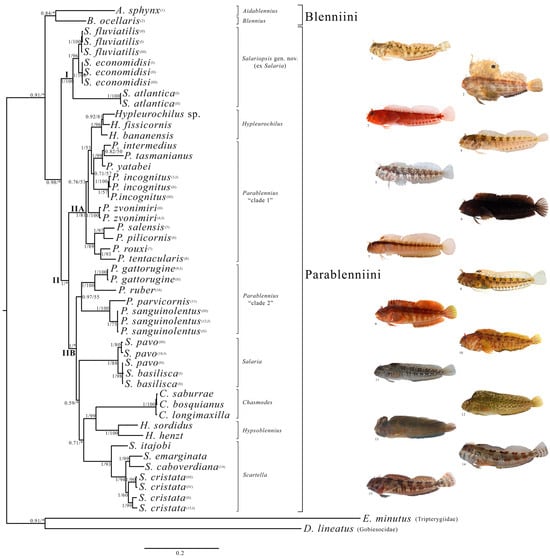
Figure 1.
Bayesian phylogram of the studied Blenniidae samples based on the concatenated mtDNA and nuDNA dataset. Node statistical support is reported as nodal posterior probabilities (Bayesian Inference of phylogeny, BI)/bootstrap values (maximum likelihood, ML). Asterisks indicate a bootstrap support value lower than 50. Square brackets group the samples according to the current taxonomy. Arabic numbers in brackets refer to the blennies’ images attached next to the phylogram. Roman numbers in brackets refer to specimens listed in Table 1. (I), freshwater Salariopsis gen. nov. (ex Salaria) clade; (II), marine Parablenniini clade; (IIA), Hypleurochilus and Parablennius “clade 1” subclades; (IIB), Parablennius “clade 2”, Salaria, Chasmodes, Hypsoblennius and Scartella subclades.
The authors state that the scientific conclusions are unaffected. This correction was approved by the Academic Editor. The original publication has also been updated.
Reference
- Vecchioni, L.; Ching, A.C.; Marrone, F.; Arculeo, M.; Hundt, P.J.; Simons, A.M. Multi-Locus Phylogenetic Analyses of the Almadablennius Clade Reveals Inconsistencies with the Present Taxonomy of Blenniid Fishes. Diversity 2022, 14, 53. [Google Scholar] [CrossRef]
Disclaimer/Publisher’s Note: The statements, opinions and data contained in all publications are solely those of the individual author(s) and contributor(s) and not of MDPI and/or the editor(s). MDPI and/or the editor(s) disclaim responsibility for any injury to people or property resulting from any ideas, methods, instructions or products referred to in the content. |
© 2024 by the authors. Licensee MDPI, Basel, Switzerland. This article is an open access article distributed under the terms and conditions of the Creative Commons Attribution (CC BY) license (https://creativecommons.org/licenses/by/4.0/).