


Abstract
In this work, the species diversity of epilithon diatoms of Donuzlav Gulf (Crimean coastal waters of the Black Sea) is presented for the first time. A total of 60 taxa of Bacillariophyta belonging to 3 classes, 18 families and 34 genera were found. The largest number of species (45) of diatoms was observed in summer, and the smallest number of species (12) in winter. A total of 25 saprobity indicator species of diatoms was found on the epilithon, 12 taxa of which belong to a group of betamesosaprobionts—indicators of moderate organic pollution of water. Marine species comprise 55% and brackish-marine ones make up 37% of them, but no freshwater species were identified. The diatom community was dominated by cosmopolites (32%) and arctic–boreal–tropical species (27%). The maximal abundance (186.2 × 10³ cells cm−2) and biomass (0.083 mg cm−2) of diatoms was noted in June 2018 at salinity 16.58‰ and T = 24.4 °C with the dominant cosmopolites species of Licmophora abbreviata and Cocconeis scutellum. The minimum values, 14.8 × 10³ cells cm−2 and 0.005 mg cm−2, were observed in January 2019 at salinity 16.86‰ and T = 9.0 °C with the dominant Berkeleya rutilans and Nitzschia hybrida f. hyalina. The high values of BOD5, oxidizability, silicon, Norg and Porg were noted, indicating a certain degree of water pollution by domestic sewage. It has been shown that the pollution in the southwestern part of the Donuzlav Gulf is greatest since this part of the coast was populated most densely in comparison with the northern coast of the Gulf where there are no coastal settlements except for two mariculture farms.
1. Introduction
Donuzlav Gulf of the Black Sea is a unique semi-enclosed marine with a surface area of 47.5 km2, located off the West coast of the Crimea 150 km from Sevastopol. The length of the sand embankment separating it from the sea is 9 km and its width is about 200–600 m. Most of the depth is less than 4–5 m; in the area of the central basin along the lake, the depth reaches 12–20 m. The first complex studies of biota, including phytoplankton, and monitoring data of hydrochemical and chemical–toxicological characteristics of Donuzlav marine ecosystems were conducted in different years [1,2,3]. The authors showed that in the ecosystem of Donuzlav marked high trophic waters, productivity of meio- and macrobenthos, as well as the presence of natural populations of mollusks (mussels) and fish make the reservoir very promising for the development of mariculture. The period 2015–2017 showed that the average content of dissolved oxygen in the water changed in the range of 8.77–9.40 mg L−1 [3]. These values are satisfactory for the life of hydrobionts and the degree of pollution the water environment with heavy metals and a petroleum hydrocarbon contaminated site is quite low. The ecosystem of Donuzlav Gulf is of particular interest. On the one hand, it has twice undergone its formation. At first, it was a sea, then it was separated from the sea by a mound, then again, it became a Gulf. Currently, the ecosystem of Donuzlav is affected by such anthropogenic environmental factors as industrial sand mining and the location of the mussel–oyster farms. Therefore, the primary producers of the microphytobenthos as an important food source for all species of aquatic organisms have never been studied. Diatom indices used in biomonitoring of water quality of the mostly of the rivers [4,5,6,7,8,9,10] but very poorly marked on the marine benthic ecosystems [11,12,13,14,15,16,17,18].
Despite the fact that diversity species of the microphytobenthos of the Black Sea is well studied in different ecotopes [18,19,20,21,22]. However, diatoms of microphytobenthos in different seasons of the year have never been studied in the Donuzlav Gulf. In this regard, it became necessary to conduct a study of benthic diatoms as indicators of water quality using the known environmental saprobity indicators. These data are poorly understood in the seas of the World Ocean in general and in the Black Sea in particular.
The aim of this work was the study of species diversity of benthic diatoms and their indicator role in the Donuzlav Gulf of Crimean coastal waters of the Black Sea.
2. Materials and Methods
Sampling of stones was carried out from April 2018 to April 2019 at 9 stations at a depth of 0.5 to 1.5 m in the Donuzlav Gulf (45°20’00” N, 33°00’00” E) of the Crimean coastal waters of the Black Sea (Figure 1 and Figure 2). Among them, Stations 1, 2, 3, 5, 7 are located near areas for the cultivation of mussels and oysters. In this work, different methods of studying diatoms were used [16,18,19]. Samples of stones were taken manually, by three stones from each sampling station. In the laboratory, each stone was scraped for suspension for qualitative and quantitative processing. The collected stones were carefully cleaned by a scraper to collect suspensions. Samples of the suspension from live diatoms were used for the taxonomic study and the samples were fixed by 2% formaldehyde for the quantitative assessment. The sizes of the stones were of the following range: length (x):4–12 cm; width (y):2–7 cm; height (z):1.5–3.5 cm. Determination of the surface area (S, cm2) of the stones was carried out by the method of Graham et al. [23]:S = π/3 (xy + yz + xz), where x, y, z are the linear of the substrate sizes. The error in determining the surface area of the stone was ± 5%. Goryaev’s camera with a volume of 0.9 mm3 was used for counting of diatom cells.
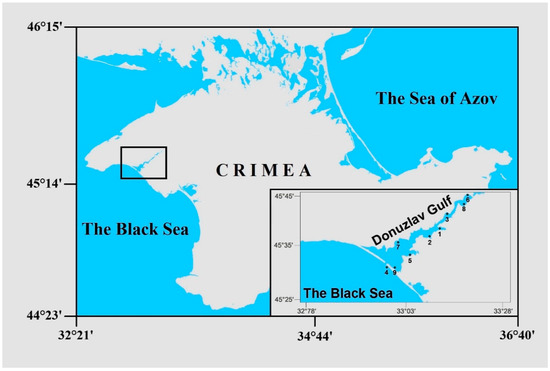
Figure 1.
Crimean area of the studied diatoms—Donuzlav Gulf of the Black Sea.
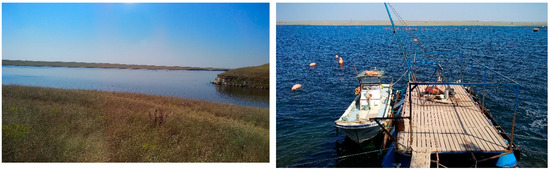
Figure 2.
Northern (A) and southern (B) coasts of the Donuzlav Gulf of the Black Sea.
The study of diatoms was carried out on a light microscope of C. Zeiss “Axioskop 40” with software AxioVision Rel. 4.6 at magnifications of 10 × 40, 10 × 100 under oil immersion in living material and in permanent slides prepared according [23] and mounted in the El’yashev media (n = 1.67). A total of 64 samples was collected and processed. Analysis of number of species (n), species richness (R), abundance (N, cells cm−2) and biomass (B, mg cm−2) of community diatoms in each sample was carried out according to the methods described earlier [16,18,20]. The abundance and biomass of diatoms were calculated according to the formulae: N = n V/S V, where n is the number of diatom cells in the Goryaev counting chamber with volume equal to 0.9 mm3; V is the sample volume, ml; B = h V b/SVchamber, where b is total Vchamber, mm3, h, the unit weight of benthic diatoms, is equal to 1.2 × 10⁻⁹ mg µm−3, and others are 1 × 10⁻⁹ mg µm−3 [24].
The hydrological characteristic of Donuzlav Gulf waters had the following range: the temperature varied from 7.0 °C (March) to 27.0 °C (July) and salinity from 16.58‰ (June) to 18.62‰ (May). The hydrochemical parameters of Donuzlav Gulf waters (pH, O2, alkaline permanganate oxidizability, Norg, NO2, NO3, NH4, Porg, PO4, Si) at the stations are determined according to conventional methods [25,26].
In our work we used the method of monitoring the quality water of the environment on saprobity indicators developed for diatoms and adopted species names to modern system [4,5,6,7,8,9,10,11,12,13,14,15,18,27,28,29]. The species composition of diatoms was determined using the following sources [18,29,30,31,32]. The maps of distribution of environmental variables values and indicator taxa number were generated in the Statistica 12.0 program [33].
3. Results
Species diversity of microphytobenthos of the stone substrates in the Donuzlav Gulf are 60 taxa of Bacillariophyta (Table 1), belonging to 3 classes, 18 families and 34 genera. In the diatom flora, marine and cosmopolites dominated, which is typical for the phytobenthos of the Crimean coastal waters of the Black Sea [18,21].

Table 1.
Checklist of the epilithon diatoms in the Donuzlav Gulf of the Black Sea, 2018–2019 and their ecological and phytogeographical characteristics.
From the total species of diatoms on stone substrates in the Donuzlav Gulf the Bacillariophyceae class dominated. Mass species of pennate diatoms presented of genera Licmophora, Grammatophora, Cylindrotheca, Trachyneis, Cocconeis, and Striatella, etc.
The geographical characteristic of the diatoms of Gulf was carried out. It is shown that in the flora diatom, predominant were cosmopolites (32%) and arctic–boreal–tropical species (27%), which is common species for the microphytobenthos of the Crimean coastal waters of the Black Sea (Table 1). The number of species (40; 12; 29; 30; 21; 37; 38) was distributed by stations according to the values of water salinity (16.58; 16.86; 17.06; 17.81; 18.52; 18.54; 18.62‰). From all 24 species found throughout, the range of investigated water salinity values was from 16.58 to 18.62‰ (June). Only two species of Amphora arcus and Berkeleya rutilans were found at all stations in the Donuzlav Gulf.
The 18 species found once or twice in the range of the whole water salinity spectrum were as follows: Berkeleya micans, Carinasigma rectum, Gyrosigma prolongatum, Halamphora coffeiformis, Haslea ostrearia, Licmophora dalmatica, L. flabellata, L. gracilis, Lyrella clavata, Melosira moniliformis, Navicula perrhombus, N. salinarum, Nitzschia sigma, N. tenuirostris, Parlibellus delognei, Pleurosigma elongatum, Tabularia tabulata, Tryblionella coarctata (Table 1).
The largest number of species (45) was observed in July at salinity of 16.58‰ and temperature 24.4 °C. The smallest number of species (12) was in January at salinity of 16.86‰ and T = 9.0 °C. Despite the low salinity of the Gulf waters, marine species dominated (55% of all species) and brackish-marine species were at 37% (Table 1), which are generally characteristic of the microphytobenthos of the Black Sea [16,18,19]. No freshwater species have been found, although in the past the Gulf was separated from the sea and was called a lake or liman. However, according to our data, the studied area can be considered a marine Gulf.
Other data on the species diversity is the dynamic of their quantitative values (species richness, abundance and biomass of the community), which together with the species composition, and environmental and phytogeographical characteristics can be used to estimate the productivity and water quality of the studied reservoir. Therefore, the following values were obtained. The richness of species varied from 11 to 24 (Figure 3).
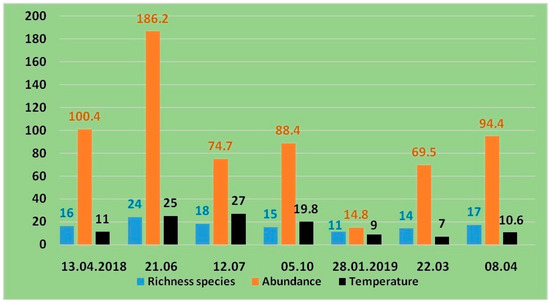
Figure 3.
Species richness, abundance of diatoms and water temperature in Donuzlav Gulf of the Black Sea (2018–2019).
From these, 10 species dominated in abundance and biomass: Berkeleya rutilans, L. abbreviata in April, maximum values of species cosmopolites L. abbreviata and C. scutellum in June at T = 24.4 °C, A. hyalina, Th. eccentrica in July, N. perrhombus and A. longipes in October, and minimum values of B. rutilans, N. hybrida var. hyalina in January, G. marina and C. closterium in March.
The values of abundance (N) diatoms changed (14.8–186.2) × 103 cells cm−2 with average N = 100.5 × 10³ cells cm−2 (Figure 3). The minimum abundance was N = 14.8 × 10³ cells cm−2 with B = 0.005 mg·cm−2 were in January at salinity 16.86‰ and T = 9.0 °C with dominant of B. rutilans and N. hybrida f. hyalina. The maximum abundance 186.2 × 10³ cells cm−2 with a biomass of 0.083 mg·cm−2 were found in June 2018 with dominant L. abbreviata and C. scutellum. The biomass (B) varied from 0.006 to 0.083 mg·cm−2 with an average B = 0.044 mg·cm−2 (Figure 4).
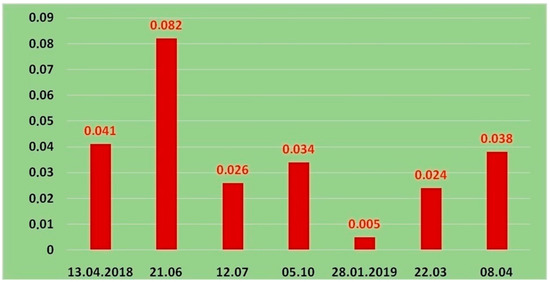
Figure 4.
Species biomass diatoms in the Donuzlav Gulf of the Black Sea (2018–2019).
Another environmental characteristic is the ratio of species to organic water pollution. Diatoms are indicators of water quality; this is known in particular for freshwater bodies. The study of marine waters on this issue is still lagging behind.
Bioindication of organic pollution in the coastal waters of the Black Sea microphytobenthos communities was gathered for the first time; therefore, the materials for comparison are not yet available. With the help of ecological characteristics of these species, the proportion of saprobiont species was studied. A total of 25 species-indicators of saprobity were found in the epilithon of the Donuzlav Gulf from which 12 taxa belong to a group of betamesosaprobiontes species of moderate organic pollution of water (Table 1). Analysis of the distribution of species-indicators of organic pollution in the epilithon showed that class 2, 4, and 5 indicators of water quality have been also presented. We choose indicators of class 2 (low organic pollution) and class 5 (high organic pollution) of water quality to demonstrate the contrast of its distribution in Donuzlav stations (Figure 5A,B).
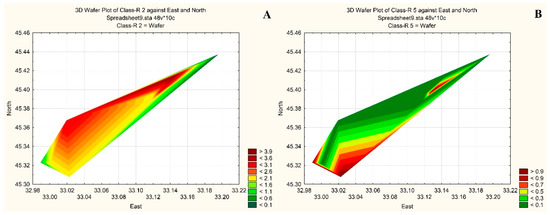
Figure 5.
Maps of saprobity indicators of class 2 (A) and 5 (B) of water quality in the Donuzlav Gulf of the Black Sea (2018–2019).
For the development of bottom-diatoms important are not only hydrological values, but also the hydrochemical parameters of the environment (Table 2).
Table 2.
The hydrochemical parameters of Donuzlav Gulf waters of the Black Sea.
The analysis showed that the dissolved oxygen content in the range from 10.14 to 10.42 mg L−1 with an average value of 10.29 mg L−1 in 2018–2019 (Table 2, Figure 6A). The minimum of these values was observed in the winter at station 8, the maximum was in June in the middle part of the Donuzlav Gulf (station 2).
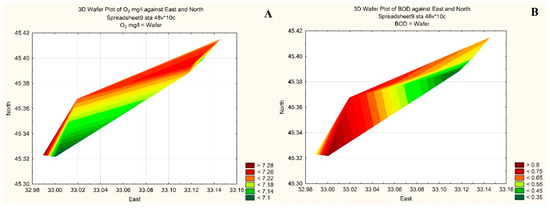
Figure 6.
The average annual concentrations of dissolved oxygen (A) and BOD5 (B) in the water column at the sampling stations in the Donuzlav Gulf of the Black Sea.
The values of BOD5 were low, ranging from 0.34 to 0.82 mg O2 L−1 (Figure 6B). They were 2.5–6 times lower than the minimum permissible concentration (2.0 mg O2 L−1), which indicates the relative cleanness of the waters. The magnitude of the oxidizability changed in the range of 2.68 to 3.67 mg O2 L−1 and were below the minimum permissible level (4.0 mg O2 L−1) confirming no water pollution in this area.
The values of organic nitrogen varied from 875 to 1104 µg L−1 and was highest at station 7 (Figure 7A); inorganic forms of nitrogen varied within the following limits: nitrites (NO2) ranged from 0.3 to 0.9 µg L−1, nitrates (NO3) from 9.2 to 17.8 µg L−1 and ammonium nitrogen (NH4) from 0.6 to 14.2 µg L−1 (Table 2, Figure 7B and Figure 8A,B). The maximum concentration of nitrite nitrogen was below the maximum permissible concentration (20 µg L−1).
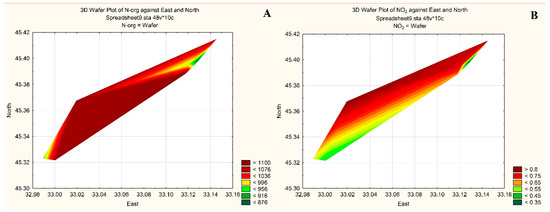
Figure 7.
Average annual concentrations of organic nitrogen (A) and dissolved nitrites (B) in the water column at the sampling stations in the Donuzlav Gulf of the Black Sea.
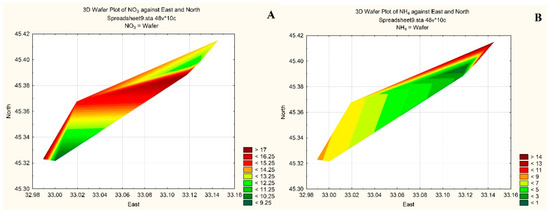
Figure 8.
Concentrations of dissolved nitrates (A) and ammonium (B) in the water column at the sampling stations in the Donuzlav Gulf of the Black Sea.
The values of organic phosphorus (Porg) varied from 6.1 to 9.5 µg L−1 and the concentrations of mineral phosphorus (PO4) varied in a narrow range (from 0.9 to 1.7 µg L−1) (Figure 9). In general, the content of nutrients in the Donuzlav Gulf increased from April to June and decreased from October to January.
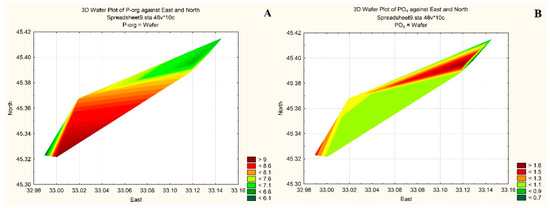
Figure 9.
Dissolved organic phosphorus (A) and orthophosphate (B) concentrations in the water column at the sampling stations in the Donuzlav Gulf of the Black Sea.
The concentrations of dissolved silicon varied from 49.7 to 137.4 µg L−1 in the waters of the Donuzlav Gulf in January 2019 (Figure 10). The maximum was marked at station 8 in autumn and winter. The minimum was near the farm at station 3, most likely due to the development of diatoms.
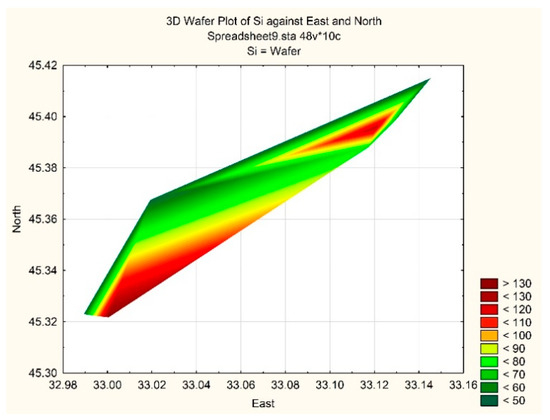
Figure 10.
Concentrations of dissolved silicon in the water column at the sampling stations in the Donuzlav Gulf of the Black Sea.
4. Discussion
A comparison of the quantitative data obtained for benthic diatoms from other areas of the Black Sea are recorded for diatom communities as follows. In the epilithon of stones from Karantinnaya Bay (Sevastopol) the species richness (R = 16) and abundance diatoms (average N= 338.6 ± 160.0 × 10³ cells cm−2) at maximum N = 641.4 × 10³ cells cm−2 with dominant of diatom Nitzschia tenuirostris (N = 477.2 × 10³ cells cm−2) was in April 1988 at T = 13.0 °C [18], which was also marked in the Donuzlav Gulf. In the epiphyton of the brown alga Cystoseira crinita Duby 1830 in the Donuzlav Gulf 35 species of diatoms were found with an average abundance of 104 × 103 cells cm−2 in June 2018 at T = 25 °C [22]. The maximum values of the species richness (26) and abundance (74.78 × 10³ cells cm−2) of algae were observed in epizoon of Karantinnaya Bay in February 2016 at T = 9.7 °C and in April 2015 (62.0 × 10³ cells cm−2, T = 10.3 °C), as well as in January 2016 (65.1 × 10³ cells cm−2, T = 9.5 °C) [21]. The largest biomass was registered in August of 2016 (0.272 mg cm−2, T = 25.5 °C). Near the area for the cultivation of mussels, 24 species-indicators have been detected, among which 16 are beta-mesosaprobionts [21]. It should be noted that in the microphytobenthos of the Azov, Black and Japanese seas this group of saprobity also dominated [11,13,16,18,19].
For comparison, we present data on the structure and functioning of the plankton and benthic communities of Donuzlav in the conditions of anthropogenic pollution of 2000 [2]. From a total number of 82 taxa in phytoplankton of Donuzlav, including 45 species of diatoms, 12 species of benthic diatoms were found that we observed in the microphytobenthos of this area. The largest abundance of 5823 million cells m−3 with biomass of 1932.4 mg m−3 of phytoplankton was found in May [2]. However, the authors noted that these values were lower in the Black Sea as a whole. Currently phytoplankton is developing worse than before. The abundance and biomass of diatoms in Donuzlav benthos were also lower than in the Sevastopol region.
Over the study period, microphytobenthos in the value of pH = 8.41 in the environment was constant and was close to that found in Kazach’ya Bay (Sevastopol) = 8.14 [18]. The range of oxygen saturation variability (103–105%) was small. The maximum value of saturation corresponds to the maximum value of the absolute oxygen content, and the minimum value of oxygen saturation was marked at Station 1 in Donuzlav. In general, there was a slight super saturating of oxygen from 3–5%. Here the average content of dissolved oxygen in the water changed in the range of 8.77–9.40 mg L−1 in the period 2015–2017 [3]. There was a greater range of variation and seasonal variation than in the open waterbody [1].
In Karantinnaya Bay, as a comparison, the corresponding range was 93–125% [21]. The seasonal variability of concentrations of organic nitrogen and phosphorus was not observed. The maximum values of BOD5, oxidizability, silicon and a high content of Norg were noted, which indicates a certain degree of contamination by domestic sewage.
5. Conclusions
The species diversity of benthic diatoms on stony substrates in the Donuzlav Gulf was presented for the first time. A total of 60 taxa of Bacillariophyta, belonging to 3 classes, 18 families, and 34 genera were found. The largest number of diatom species (45) was observed in summer and the smallest (12) was detected in winter. Marine species comprise 55% and brackish-marine ones make up 37% of them, but no freshwater species was identified. The diatom community is dominated by cosmopolites (32%) and arctic–boreal–tropical species (27%).
The maximal abundance (186.2 103 cells cm−2) and biomass (0.083 mgcm−2) of diatoms were noted in June 2018 at salinity 16.58‰ and T = 24.4 °C with the dominant species of L. abbreviata and C. scutellum. The minimum values, 14.8·103 cells cm−2 and 0.005 mg cm−2, were observed in January 2019 at salinity 16.86‰ and T = 9.0 °C with the dominant species of B. rutilans and N. hybrida f. hyalina.
A total number of 25 saprobity indicator species of diatoms were found on the epilithon, 12 taxa of which belong to a group of betamesosaprobionts—indicators of moderate organic pollution of water. The high values of BOD5, oxidizability, silicon, Norg and Porg were noted, indicating a certain degree of water pollution by domestic sewage. It has been shown that the pollution in the southwestern part of the Donuzlav Gulf was greatest since this part of the coast is populated most densely in comparison with the northern coast of Donuzlav where there are no coastal settlements except for two mariculture farms.
Thus, the species diversity, environmental and quantitative characteristics of diatomic benthos and hydrochemical parameters of the Donuzlav Gulf indicate a high supply of oxygen-enriched waters and a sufficient supply of nutrients for the development of biota. The nutrient levels in the water of the gulf are typical for semi-enclosed waters of the Crimean coastal shelf.
Author Contributions
Methodology, R.L.I.; resources, K.N.P., L.D.N.; writing—original draft preparation, R.L.I.; writing—review and editing, R.L.I., L.D.N.
Funding
This research received no external funding.
Acknowledgments
This work was carried out within the state assignment AAAA-A18-118021350003-6 from A.O. Kovalevsky Institute of Biology of the Southern Seas of Russian Academy of Sciences. We would like to thank S.S. Barinova from University of Haifa (Israel) for their help and advice on the preparation of drawings on bioindication maps of the Donuzlav Gulf.
Conflicts of Interest
The authors declare that they have no conflict of interest.
References
- Kovrigina, N.P.; Nemirovsky, M.S. Hydrochemical characteristics of waters near Lake Donuzlav according to 1990–1997. Ecol. Morya 1999, 48, 10–15. (In Russian) [Google Scholar]
- Samyshev, E.Z.; Senichkina, L.G.; Sergeeva, N.G.; Mikhailova, T.V.; Pankratova, T.M. Structure and functioning of the plankton and benthic communities of oz. Donuzlav in the conditions of anthropogenic pollution and assessment of prospects of its fishery use. In Systems Control Environment: Proceeding Sci./NAS of Ukraine; IGI Publisher: Sevastopol, Russia, 2001; pp. 301–325. [Google Scholar]
- Zhugaylo, S.S.; Avdeeva, T.M.; Pugach, M.N.; Adzhiumerov, E.N. Current state of water quality and bottom sediments in Lake Donuzlav in modern times. Aquat. Bioresour. Environ. 2018, 1, 32–38. [Google Scholar]
- Barinova, S.S.; Bilous, O.P.; Tsarenko, P.M. Algal Indication of Water Bodies in Ukraine: Methods and Prospects; Publishing House of Haifa University: Haifa, Israel; Kyiv, Ukraine, 2019; 367p. (In Russian) [Google Scholar]
- Barinova, S.S.; Medvedeva, L.A.; Anisimova, O.V. Diversity of Algal Indicators in the Environmental Assessment; Pilies Studio Publisher: Tel’Aviv, Israel, 2006; 498p. (In Russian) [Google Scholar]
- Harding, W.R.; Taylor, J.C. The South African Diatom Index (SADI)—A Preliminary Index for Indicating Water Quality in Rivers and Streams in Southern Africa; WRC Report; Water Research Commission: Pretoria, South Africa, 2011; pp. 1–11. [Google Scholar]
- Harding, W.R.; Taylor, J.C. Diatoms as Indicators of Historical Water Quality: A Comparison of Samples Taken in the Wemmershoek Catchment (Western Province, South Africa) in 1960 and 2008; Water Research Commission: Pretoria, South Africa, 2014; pp. 601–606. [Google Scholar]
- Potapova, M.; Charles, D.F. Diatom metrics for monitoring eutrophication in river of the United States. Ecol. Indic. 2007, 7, 48–70. [Google Scholar] [CrossRef]
- Prygiel, J. Management of the diatom monitoring network in France. J. App. Phycol. 2002, 14, 19–26. [Google Scholar] [CrossRef]
- Szczepocka, E.; Żelazna-Wieczorek, J. Diatom biomonitoring—Scientific foundations, commonly discussed issues and frequently made errors. Oceanol. Hydrobiol. Stud. 2018, 47, 314–325. [Google Scholar] [CrossRef]
- Barinova, S.S.; Bondarenko, A.V.; Ryabushko, L.I.; Kapranov, S.V. Microphytobenthos as indicator of water quality and organic pollution in the Western coastal zone of the Sea of Azov. Oceanol. Hydrobiol. Stud. 2019, 48, 21–35. [Google Scholar] [CrossRef]
- Begun, A.A. Of the state of the marine environment on diatoms of epiphytonmacrophytes (Peter the Great Bay, Japan Sea). Izv. Tinro 2012, 169, 1–17. [Google Scholar]
- Ryabushko, L.I.; Begun, A.A. Diatoms of Microphytobenthos of the Sea of Japan; Book 1; N. Orianda Publishers: Sevastopol-Simferopol, Russia, 2015; 288p. (In Russian) [Google Scholar]
- Zalat, A.A. Distribution and origin of diatoms in the bottom sediments of the Suez canal lakes and adjacent areas, Egypt. Diat. Res. 2002, 17, 243–266. [Google Scholar] [CrossRef]
- Desrosiers, C.; Leflaivea, J.; Eulinb, A.; Ten-Hagea, L. Bioindicators in marine waters: Benthic diatoms as a tool to assess water quality from eutrophic to oligotrophic coastal ecosystems. Ecol. Indic. 2013, 32, 25–34. [Google Scholar] [CrossRef]
- Ryabushko, L.I.; Bondarenko, A.V. The Qualitative and Quantitative Characteristics of the Benthic Diatoms near Kazantip Cape of the Sea of Azov. J. Black Sea Mediterr. Environ. 2016, 22, 237–249. (In Russian) [Google Scholar]
- Bondarenko, A.V.; Ryabushko, L.I.; Sadogurskaya, S.A. Microalgae of Benthos and Plankton in the Coastal Waters of the Nature Reserve “Kazantipskiy” (the Sea of Azov, Crimea). In Biodiversity and Environment of Protected Areas 2018, 4, 25–48. (In Russian) [Google Scholar]
- Ryabushko, L.I. Microphytobenthos of the Black Sea; Gaevskay, A.V., Ed.; ECOSI-Gidrofizica: Sevastopol, Russia, 2013; 416p. (In Russian) [Google Scholar]
- Ryabushko, L.I.; Balycheva, D.S.; Ryabushko, V.I. Microphytobenthos Diatoms of the Black Sea: Biodiversity and Ecology. Ecol. Montenegrina 2017, 10, 1–15. [Google Scholar]
- Ryabushko, L.I.; Balycheva, D.S.; Strizhak, A.V. Diatoms of epiphyton some species of green algae-macrophytes and periphyton of anthropogenic substrates of the Crimean coastal waters of the Black Sea. Algologia 2013, 23, 419–437. (In Russian) [Google Scholar] [CrossRef]
- Ryabushko, L.I.; Pospelova, N.V.; Balycheva, D.S.; Kovrigina, N.P.; Troshchenko, O.A.; Kapranov, S.V. Epizoon microalgae of the cultivated mollusk Mytilus galloprovincialis Lam. 1819, phytoplankton, hydrological and hydrochemical characteristics in the mussel-and-oyster farm area (Sevastopol, the Black Sea). Mar. Biol. J. 2017, 2, 67–83. (In Russian) [Google Scholar] [CrossRef]
- Ryabushko, L.I.; Lishaev, D.N.; Shiroyan, A.G. The species, ecological and geographical diversity of microphytobenthos microalgae in the Crimean coast of the Black Sea. In Proceedings of the 2nd International UNIDOCAP the Blacк Sea Symposium on Biodiversity, Samsun, Turkey, 28–30 November 2018; Progr. & Abstract. Book: Samsun, Turkey, 2018; p. 33. (In Russian). [Google Scholar]
- Graham, A.A.; McCaughan, D.J.; McKee, F.S. Measurement of surface area of stones. Hydrobiologia 1988, 157, 85–87. [Google Scholar] [CrossRef]
- Oksiyuk, O.P.; Yurchenko, V.V. About the weight diatoms. Hydrobiol. J. 1971, 7, 116. (In Russian) [Google Scholar]
- Grasshoff, K. (Ed.) Methods of Seawater Analysis; Verlag Chemie: Weinheim, Germany; New York, NY, USA, 1976; 317p. [Google Scholar]
- Methods of Hydrochemical Studies of Basic Hydrochemical Elements; VNIRO: Moscow, Russia, 1988; 120p. (In Russian)
- Sladeček, V. Diatoms as indicators of organic pollution. Acta Hydrochem. Hydrobiol. 1986, 14, 555–566. [Google Scholar] [CrossRef]
- Guiry, M.D.; Guiry, G.M. AlgaeBase. World-Wide Electronic Publication, National University of Ireland, Galway. Available online: http://www.algaebase.org (accessed on 20 December 2018).
- Guslyakov, N.E.; Zakordonets, O.A.; Gerasimyuk, V.P. Atlas of Diatoms of the Benthos in the North-Western Part of the Black Sea and Adjacent Reservoirs; Nauk. Dumka: Kyiv, Ukraine, 1992; 112p. (In Russian) [Google Scholar]
- Proshkina-Lavrenko, A.I. Diatoms of the Black Sea Benthos; Nauka Publishers: Leningrad, Moscow, 1963; 244p. (In Russian) [Google Scholar]
- Ryabushko, L.I.; Begun, A.A. Diatoms of the Microphytobenthos of the Sea of Japan (Synopsis and Atlas); Book 2; PK «KIA» Publishers: Sevastopol, Russia, 2016; 324p. (In Russian) [Google Scholar]
- Smith, W.F. A Synopsis of the British Diatomaceae; John Van Voorst: London, UK, 1853; Volume 1, 89p. [Google Scholar]
- Barinova, S. Ecological Mapping in Application to Aquatic Ecosystems BioIndication: Problems and Methods. Int. J. Environ. Sci. Nat. Resour. 2017, 3, 1–7. [Google Scholar] [CrossRef]
© 2019 by the authors. Licensee MDPI, Basel, Switzerland. This article is an open access article distributed under the terms and conditions of the Creative Commons Attribution (CC BY) license (http://creativecommons.org/licenses/by/4.0/).