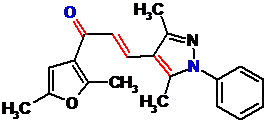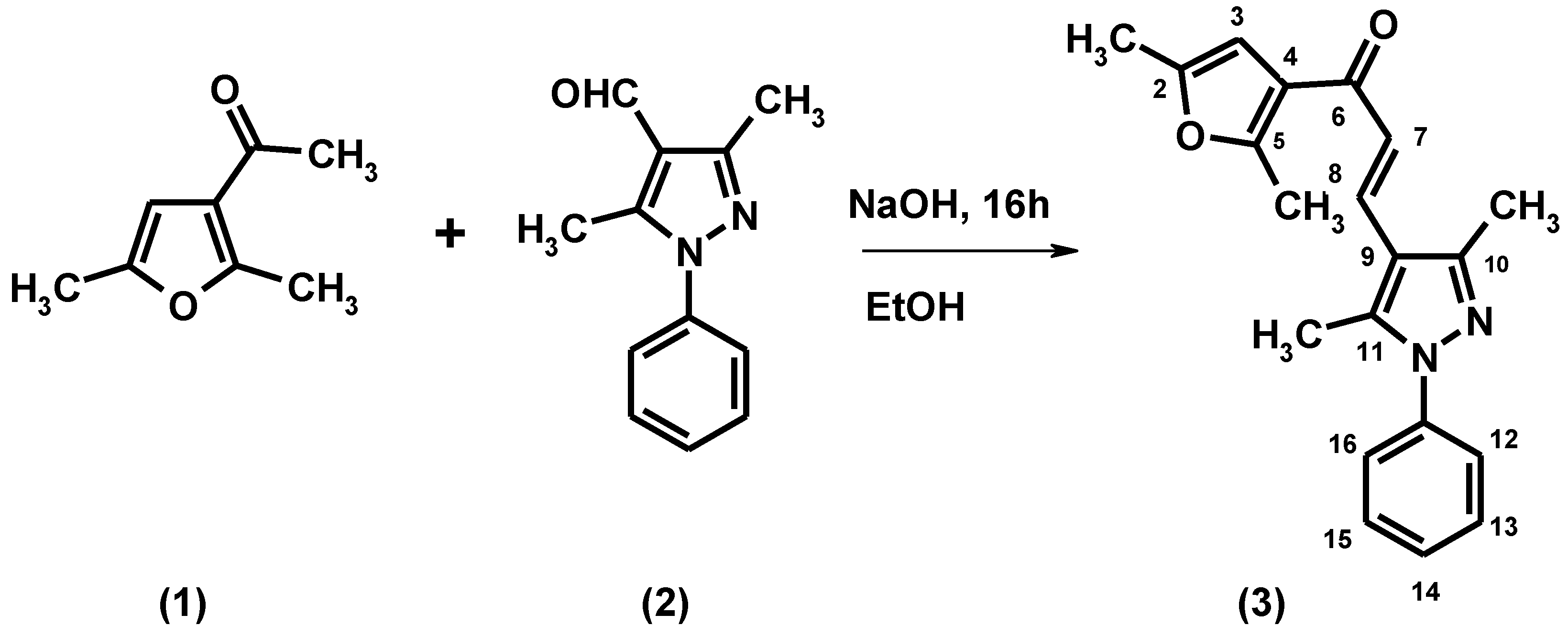
(2E)-3-(3,5-Dimethyl-1-phenyl-1H-pyrazol-4-yl)-1-(2,5-dimethyl-3-furanyl)prop-2-en-1-one

Abstract
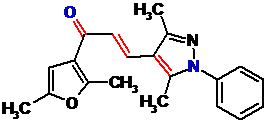
:

Supplementary materials
Supplementary File 1Supplementary File 2Supplementary File 3Acknowledgements
References
- Nowakowska, Z. A review of anti-infective and anti-inflammatory chalcones. Eur. J. Med Chem. 2007, 42, 125–137. [Google Scholar] [CrossRef] [PubMed]
- Avila, H.P.; Smania, E.F.A.; Monache, F.D.; Smania, A., Jr. Structure–activity relationship of antibacterial chalcones. Bioorg. Med. Chem. 2008, 16, 9790–9794. [Google Scholar] [CrossRef] [PubMed]
- Batovska, D.; Parushev, S.; Stamboliyska, B.; Tsvetkova, I.; Ninova, M.; Najdenski, H. Examination of growth inhibitory properties of synthetic chalcones for which antibacterial activity was predicted. Eur. J. Med. Chem. 2009, 44, 2211–2218. [Google Scholar] [CrossRef] [PubMed]
- Ducki, S.; Forrest, R.; Hadfield, J.A.; Kendall, A.; Lawrence, N.J.; McGown, A.T.; Rennison, D. Potent antimitotic and cell growth inhibitory properties of substituted chalcones. Bioorg. Med. Chem. Lett. 1998, 8, 1051–1056. [Google Scholar] [CrossRef]
- Lahtchev, K.L.; Batovska, D.I.; Parushev, S.P.; Ubiyvovk, V.M.; Sibirny, A.A. Antifungal activity of chalcones: A mechanistic study using various yeast strains. Eur. J. Med. Chem. 2008, 43, 2220–2228. [Google Scholar] [CrossRef] [PubMed]
- Detsi, A.; Majdalani, M.; Kontogiorgis, C.A.; Hadjipavlou-Litina, D.; Kefalas, P. Natural and synthetic 2′-hydroxy-chalcones and aurones: Synthesis, characterization and evaluation of the antioxidant and soybean lipoxygenase inhibitory activity. Bioorg. Med. Chem. 2009, 17, 8073–8085. [Google Scholar] [CrossRef] [PubMed]
- Bandgar, B.P.; Gawande, S.S.; Bodade, R.G.; Totre, J.V.; Khobragade, C.N. Synthesis and biological evaluation of simple methoxylated chalcones as anticancer, anti-inflammatory and antioxidant agents. Bioorg. Med. Chem. 2010, 18, 1364–1370. [Google Scholar] [CrossRef] [PubMed]
- Holla, B.S.; Akberali, P.M.; Shivananda, M.K. Studies on arylfuran derivatives: Part X. Synthesis and antibacterial properties of arylfuryl-Δ2-pyrazolines. Il Farmaco 2000, 55, 256–263. [Google Scholar] [CrossRef]
- Dawane, B.S.; Konda, S.G.; Mandawad, G.G.; Shaikh, B.M. Poly(ethylene glycol) (PEG-400) as an alternative reaction solvent for the synthesis of some new 1-(4-(4′-chlorophenyl)-2-thiazolyl)-3-aryl-5-(2-butyl-4-chloro-1H-imidazol-5yl)-2-pyrazolines and their in vitro antimicrobial evaluation. Eur. J. Med. Chem. 2010, 45, 387–392. [Google Scholar] [CrossRef] [PubMed]
- Budakoti, A.; Bhat, A.R.; Athar, F.; Azam, A. Syntheses and evaluation of 3-(3-bromo phenyl)-5-phenyl-1-(thiazolo [4,5-b] quinoxaline-2-yl)-2-pyrazoline derivatives. Eur. J. Med. Chem. 2008, 43, 1749–1757. [Google Scholar] [CrossRef] [PubMed]
- Khode, S.; Maddi, V.; Aragade, P.; Palkar, M.; Ronad, P.K.; Mamledesai, S.; Thippeswamy, A.H.M.; Satyanarayana, D. Synthesis and pharmacological evaluation of a novel series of 5-(substituted)aryl-3-(3-coumarinyl)-1-phenyl-2-pyrazolines as novel anti-inflammatory and analgesic agents. Eur. J. Med. Chem. 2009, 44, 1682–1688. [Google Scholar] [CrossRef] [PubMed]
© 2010 by the authors; licensee MDPI, Basel, Switzerland. This article is an Open Access article distributed under the terms and conditions of the Creative Commons Attribution license (http://creativecommons.org/licenses/by/3.0/).
Share and Cite
Asiri, A.M.; Khan, S.A. (2E)-3-(3,5-Dimethyl-1-phenyl-1H-pyrazol-4-yl)-1-(2,5-dimethyl-3-furanyl)prop-2-en-1-one. Molbank 2010, 2010, M687. https://doi.org/10.3390/M687
Asiri AM, Khan SA. (2E)-3-(3,5-Dimethyl-1-phenyl-1H-pyrazol-4-yl)-1-(2,5-dimethyl-3-furanyl)prop-2-en-1-one. Molbank. 2010; 2010(2):M687. https://doi.org/10.3390/M687
Chicago/Turabian StyleAsiri, Abdullah Mohamed, and Salman A. Khan. 2010. "(2E)-3-(3,5-Dimethyl-1-phenyl-1H-pyrazol-4-yl)-1-(2,5-dimethyl-3-furanyl)prop-2-en-1-one" Molbank 2010, no. 2: M687. https://doi.org/10.3390/M687
APA StyleAsiri, A. M., & Khan, S. A. (2010). (2E)-3-(3,5-Dimethyl-1-phenyl-1H-pyrazol-4-yl)-1-(2,5-dimethyl-3-furanyl)prop-2-en-1-one. Molbank, 2010(2), M687. https://doi.org/10.3390/M687
 Display in JSmol Viewer