


Keywords:
4-amino-3; 5-di-(4-pyridyl)-4H-1; 2; 4-triazole; 3; 5-di-(4-pyridyl)-1H-1; 2; 4-triazole; synthesis Introduction
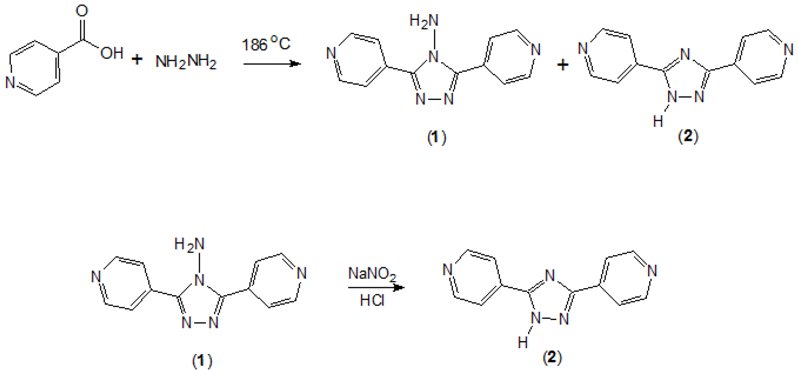
4-Amino-3,5-di-(4-pyridyl)-4H-1,2,4-triazole (1) and 3,5-di-(4-pyridyl)-1H-1,2,4-triazole (2) are potential multi-topic bridging ligands in preparation of coordination compounds of 1 – 3D structures.[1] In an early literature, a method to prepare compound 1 has been reported [2], which involves the reaction of isonicotinonitrile with excess amount of hydrazine in ethylene glycol at 130°C. Polymeric copper complexes of 2 have been prepared by Chen et al.; 2 was generated by an in situ cycloaddition of 4-pyridylnitrile and ammonia in presence of Cu2+ under hydrothermal condition.[3] However, no synthetic procedures about the compound 2 – the deaminated product of 1 has appeared in the literature to the best of our knowledge. In this paper, we describe a facile method to prepare compound 2 starting from isonicotinic acid and hydrazine.
Synthesis
Isonicotinic acid (2.46g,0.02mol) and 2ml of 80% hydrazine were mixed in a 15 ml Teflon-lined reactor and heated for 48 h at 186°C [4]. The resulting liquid was diluted by water, and then the pH was adjusted from 9 to 6 by addition of HCl solution. White precipitate was obtained, and recrystallised from ethanol. The product is actually a mixture of 4-amino-3,5-di-(4-pyridyl)-4H-1,2,4-triazole (1) and 3,5-di-(4-pyridyl)-1H-1,2,4-triazole (2) in ca 1:7 molar ratio, estimated from the HNMR spectrum.
Pure sample of 2 was prepared by a successive deamination process [5]. The mixture of 1 and 2 (2.38 g, ca 10 mmol) was dissolved in aqueous HCl (6M, 3 mL). To it was added slowly an aqueous solution of NaNO2 (0.76 g, 11 mmol); a lot of bubbles were generated quickly. The mixture was stirred for 5~6 h, then the pH was adjusted from 4 to 6.5 by 10% NaOH solution. White precipitate appeared and it was filtered and dried in air.
Recrystallisation of the crude product from ethanol afforded colorless needles of 2. The overall yield of this method is 9%.
Melting point: sublimated at 242°C
IR (KBr pellet, cm-1): 1607 s, 1448 m, 1144 w, 983 m, 838 w, 724 m, 513 w.
1H-NMR (400 MHz, DMSO-d6): δ = 8.78 (4H, d, py-H), 8.02 (4H, d, py-H).
Elemental Analysis: Calculated for C12H9N5·0.5H2O: C 57.59, H 4.83, N 27.98%; Found: C 57.28, H 4.70, N 27.90%.
MS (m/z): 225.2 (15%), 224.2 (100%, M+H), 218.3 (5%).
Supplementary materials
Supplementary File 1Supplementary File 2Supplementary File 3References
- Dong, Y.-B.; Wang, H.-Y.; Ma, J.-P.; Huang, R.-Q.; Smith, M. D. Cryst. Growth Des. 2005, 5, 789–800.
- Bentiss, F.; Lagrenée, M.; Traisnel, M.; Mernari, B.; Elattari, H. J. Heterocyclic Chem. 1999, 36, 149–152.
- Zhang, J.-P.; Lin, Y.-Y.; Huang, X.-C.; Chen, X.-M. J. Am. Chem. Soc. 2005, 127, 5495–5506. [PubMed]
- Herbst, R. M.; Garrison, J. A. J. Org. Chem. 1953, 18, 872–877.
- Mosch-Zanetti, N. C.; Ferbinteanu, M.; Magull, J. Eur. J. Inorg. Chem. 2002, 950–956.
© 2008 by MDPI (http://www.mdpi.org/). Reproduction is permitted for noncommercial purposes.