


The quinoline ring systems are important structural units in naturally occurring alkaloids and synthetic analogues with interesting biological activities. Therefore, the development of new and efficient synthetic route for the preparation of their analogues is of importance in both synthetic organic chemistry and medicinal chemistry.1,2,3,4
We reported here the synthesis of a new quinoline derivative.
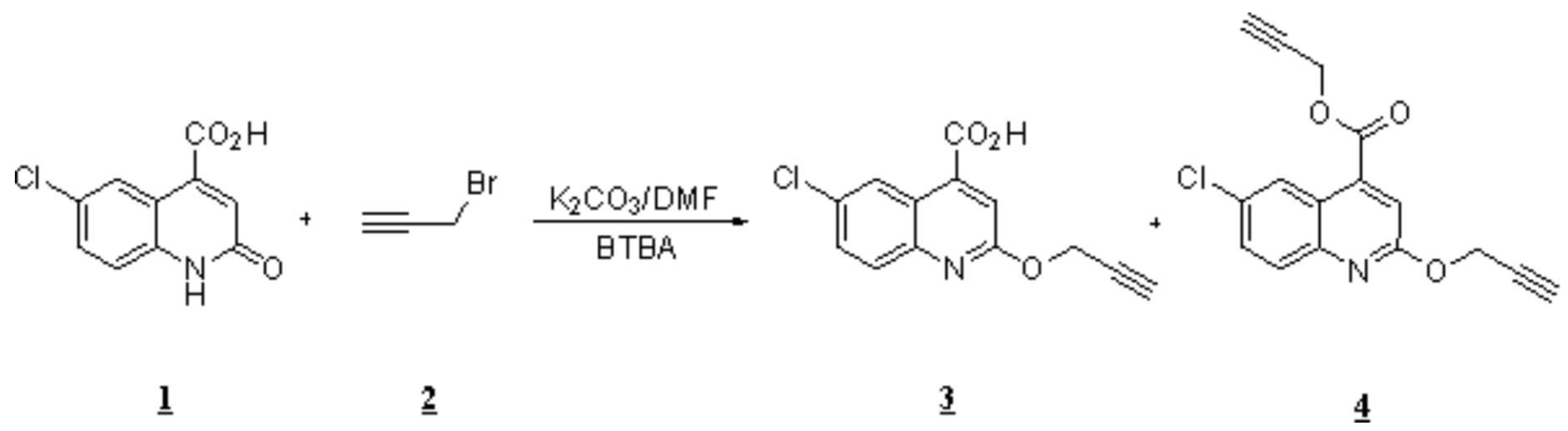
To a solution of quinoline 1 (1 g, 4.4 mmol) and K2CO3 (1.21 g, 8.8 mmol) in 60 mL of DMF, was added propargyl bromide (0.75 mL, 8.8 mmol) and tetra n-butylammonium bromide (TBAB) (catalytic amount). The mixture was stirred at room temperature for 24 h and the reaction was quenched by the addition of saturated aqueous NaHCO3. The mixture was extracted with Et2O and the combined organic layers were washed with brine and dried over Na2SO4. After removal of the solvent, the residue was purified by column chromatography on silica gel (n-hexane/AcOEt 8:2) to give 0.44 g (43 %) of 3 and 0.46 g (35 %) of 4.
6-chloro-2-(propargyloxy)quinoline-4-carboxylic acid, 3
Melting point: 170 °C
1H-NMR (300 MHz, CDCl3): δ= 2.62 (t, 1H, ≡CH, 3J= 2.4 Hz); 5.09 (d, 2H, OCH2, 3J= 2.4 Hz); 7.61 (s, 1H, =CH); 7.64-8.53 (m, 3H, HAr).
13C-NMR (300 MHz, CDCl3): δ= 54.7 (OCH2); 76.1 (≡CH); 118.1 (=CH); 127.1, 129.6, 133.7 (CHAr); 120.1, 137.3, 143.8 (Cq); 164.0 (C=N); 164.2 (CO2H).
MS (EI, m/z): 237.
Elemental analysis: Calculated for C13H8ClNO3: C, 59.67 %; H, 3.08 %; N, 5.35 %; Found: C, 59.70 %; H, 3.04 %; N, 5.41 %;
Propargyl-6-chloro-2-(propargyloxy)quinoline-4-carboxylate, 4
Melting point: 156 °C
1H-NMR (300 MHz, CDCl3): δ= 2.67 (t, 1H, ≡CH, 3J= 2.4 Hz); 2.70 (t, 1H, ≡CH, 3J= 2.4 Hz); 5.05 (d, 2H, OCH2, 3J= 2.4 Hz); 5.12 (d, 2H, OCH2, 3J= 2.4 Hz); 7.08 (s, 1H, =CH); 7.58-8.20 (m, 3H, HAr).
13C-NMR (300 MHz, CDCl3): δ= 52.4 (OCH2); 54.4 (OCH2); 78.1 (≡CH); 78.7 (≡CH); 78.9, 75.5 (≡C); 118.2 (=CH); 125.5, 126.4, 131.9 (CHAr); 118.5, 138.1, 138.2 (Cq); 159.7 (C=N); 164.3 (CO2H).
MS (EI, m/z): 299.
Elemental analysis: Calculated for C16H10ClNO3: C, 64.12 %; H, 3.36 %; N, 4.67 %; Found: C, 64.17 %; H, 3.29 %; N, 4.72 %;
Supplementary materials
Supplementary File 1Supplementary File 2Supplementary File 3Supplementary File 4Supplementary File 5Supplementary File 6References
- Balasubramanian, M.; Keay, J. G. Pyridines and their Benzo Derivatives: Application. In Comprehensive Heterocyclic Chemistry II; Katrizky, A. P., Rees, V. W., Scriven, E. F., Eds.; Pergamon: Oxford, 1996; Vol. 5, pp. 245–300. [Google Scholar]
- Ranu, B. C.; Hajra, A.; Dey, S. S.; Jana, U. Tetrahedron 2003, 59, 813–819.
- Wada, Y.; Mori, T.; Ichikawa, J. Chem. Lett. 2003, 32, 1000–1001.
- Kobayashi, K.; Yoneda, K.; Mizumoto, T.; Umakoshi, H.; Morikawa, O.; Konishi, H. Tetrahedron Lett. 2003, 44, 4733–4736.
© 2006 MDPI. All rights reserved.