


A large number of isoindoline skeletons such as staurosporine, indoprofen, and pazinaclone have been reported to possess biological activities [1,2,3,4,5]. Synthesis and study of the biological activity of isoindoline derivatives are under investigation.
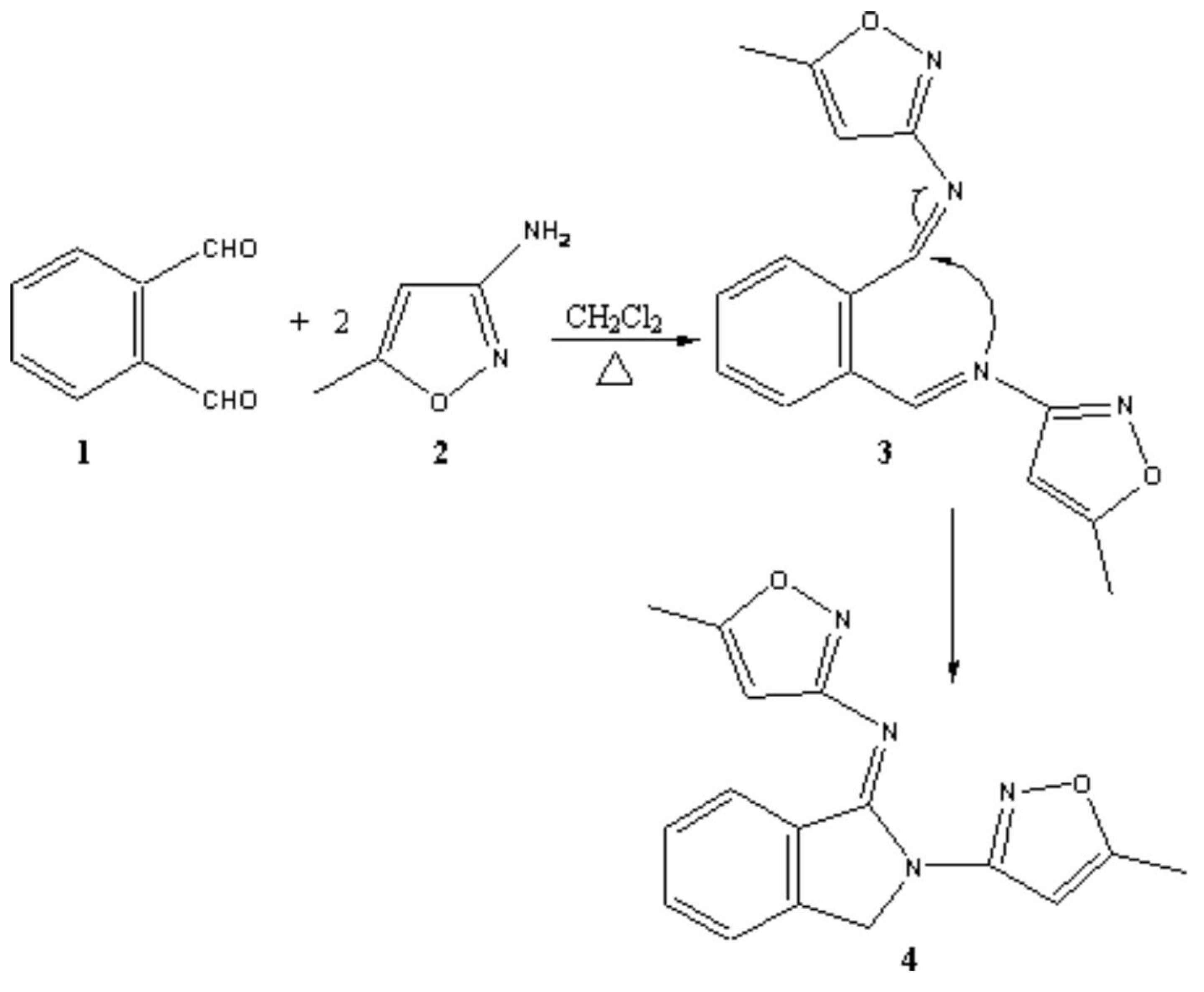
To a stirred solution of o-phthalicaldehyde (1) (0.5 g, 3.73 mmol) in dichloromethane (20 ml) a solution of amine 2 (0.73 g, 7.44 mmol) in dichloromethane (20 ml) was added. The reaction mixture was heated under reflux for the 3h, the progress of the reaction was monitored by TLC. The solvent was reduced and left, pale yellow cubic crystals start to form which were filtered off to give the isoindole derivative 4 as colorless cubic crystals (0.75 g, 68 %).
Biological Activity: Compound 4 showed antifungal activity against four species: Chrysoporium tropicum, Fusarium oxysporum, Geotrichum candidum and Trichoplyton rubrum.
Melting Point: 191°C.
UV (EtOH; λmax nm; ε (dm3.mol−1.cm−1): 205 (10057); 242 (4583); 277 (4032).
IR (KBr, cm−1): 3099 (CH); 1651 (C=N); 1430 (C-CH3); 1376 (C-N).
1H-NMR (CDCl3, 400 MHz): d= 7.49 (2H, d, J=7.5 Hz); 7.26-7.24 (2H, m); 7.11 (1H, s); 5.81 (1H, s); 4.96 (2H, s); 2.44 (3H, s); 2.39 (3H, s).
13C-NMR (CDCl3, 100 MHz): d= 170.3; 196.8; 166.8; 159.3; 155.6; 140.9; 132.0; 129.7; 127.9; 126.3; 123.3; 98.2; 96.2; 51.4; 13.0; 12.8.
MS (m/z, %): 294 (M+, 91.91); 279 (M+-CH3, 99.9); 117 (17.25); 116 (C8H4N, 100).
Elemental Analysis: Calculated for C16H14N4O2 (294.31): C, 65.30%; H, 4.79%; N, 19.04%. Found: C, 65.50%; H, 4.94%; N, 18.75%.
Supplementary materials
Supplementary File 1Supplementary File 2Supplementary File 3Acknowledgment
The author thanks Professor A. H. Moubasher and Professor A. Y. Abdel-Malek, Department of Botany, Assiut University, Assiut, Egypt, for the Biological Activity studies.
References
- Takahashi, I.; Hatanaka, M. Heterocycles 1997, 45, 2475.
- Kundu, N. G.; Khan, M. W.; Mukhopadhyay, R. Indian Chem. Soc. 2001, 78, 671.
- Olmo, E.; Armas, M.; Ybarra, M.; López, J.; Oporto, P.; Giménez, A.; Deharo, E.; Feliciano, A. Bioorganic & Medicinal Chemistry Letters 2003, 13, 2769.
- Takahashi, I.; Miyamoto, R.; Nishiuchi, K.; Hatanaka, M.; Yamano, A.; Sakushima, A.; Sakushima, A.; Hosoi, S. Heterocycles 2004, 63, 1267.
- Cul, A.; Daïch, A.; Decroix, B.; Sanz, G.; Hijfte, L. Tetrahedron 2004, 60, 11029.
- Sample Availability: Available from MDPI.
© 2005 MDPI. All rights reserved.