Metabolic Plasticity in Schizophrenia: Clinical Rehabilitation Meets LC–MS Metabolomics and Neurofeedback
 , ,
, ,
Abstract
1. Introduction
2. Results
3. Discussion
4. Materials and Methods
4.1. Study Design
4.2. Ethical Issues
4.3. PANSS
4.4. Rehabilitation Therapy
4.5. Neurofeedback Therapy (GSR Biofeedback, Galvanic Skin Response Biofeedback)
4.6. Sample Preparation
4.7. Mass Spectrometry Analysis
4.8. Data Processing and Statistical Analysis
5. Conclusions
Supplementary Materials
Author Contributions
Funding
Institutional Review Board Statement
Informed Consent Statement
Data Availability Statement
Conflicts of Interest
References
- Tayeb, H.O.; Murad, H.A.; Rafeeq, M.M.; Tarazi, F.I. Pharmacotherapy of schizophrenia: Toward a metabolomic-based approach. CNS Spectr. 2019, 24, 281–286. [Google Scholar] [CrossRef] [PubMed]
- Yao, G.; Zang, J.; Huang, Y.; Lu, H.; Ping, J.; Wan, J. Discovery of biological markers for schizophrenia based on metabolomics: Systematic review. Front. Psychiatry 2025, 16, 1540260. [Google Scholar] [CrossRef] [PubMed]
- Zhang, Y.; Wang, Y.; Xing, H.; Bai, Y.; Li, M.; Zhao, H.; Ding, L.; Wang, W.; Bao, T. Association between endogenous lactate accumulation and dysregulated activation of the NLRP3 inflammasome pathway in schizophrenia. Sci. Rep. 2025, 15, 19609. [Google Scholar] [CrossRef] [PubMed]
- Hatzimanolis, A.; Foteli, S.; Xenaki, L.; Selakovic, M. Elevated serum kynurenic acid in first-episode psychosis and insufficient response to antipsychotics. Schizophrenia 2024, 10, 61. [Google Scholar] [CrossRef]
- Zinellu, A.; Tommasi, S.; Carrn, C.; Sotgia, S. A systematic review and meta-analysis of nitric oxide–related arginine metabolomics in schizophrenia. Transl. Psychiatry 2024, 14, 439. [Google Scholar] [CrossRef]
- Messinis, A.; Panteli, E.; Paraskevopoulou, A.; Zymarikopoulou, A.; Filion, M. Altered lipidomics biosignatures in schizophrenia: A systematic review. Schizophr. Res. 2024, 271, 380–390. [Google Scholar] [CrossRef]
- Murray, A.; Humpston, C.; Wilson, M.; Rogers, J.; Katshu, M.; Liddle, P. Measurement of brain glutathione with MR spectroscopy in schizophrenia-spectrum disorders: A systematic review and meta-analysis. Brain Behav. Immun. 2024, 115, 3–12. [Google Scholar] [CrossRef]
- Burghardt, K.; Kajy, M.; Ward, K.; Burghardt, P. Metabolomics, lipidomics, and antipsychotics: A systematic review. Biomedicines 2023, 11, 3295. [Google Scholar] [CrossRef]
- Huang, Y.; Wang, H.; Zhang, J.; Zhou, N. Relationship of metabolites and metabolic ratios with schizophrenia: A Mendelian randomization study. Ann. Gen. Psychiatry 2024, 23, 34. [Google Scholar] [CrossRef]
- Zhang, Y.; Tong, L.; Ma, L.; Ye, H.; Zeng, S.; Zhang, S.; Ding, Y.; Wang, W.; Bao, T. Progress in the research of lactate metabolism in schizophrenia. Adv. Biol. 2024, 8, 2300409. [Google Scholar] [CrossRef]
- Senko, D.; Efimova, O.; Osetrova, M.; Anikanov, N.; Boyko, M. White matter lipidome alterations in the schizophrenia brain. Schizophrenia 2024, 10, 123. [Google Scholar] [CrossRef]
- Antenucci, N.; D’Errico, G.; Fazio, F.; Nicoletti, F.; Bruno, V.; Battaglia, G. Changes in kynurenine metabolites in gray and white matter in schizophrenia. Schizophrenia 2024, 10, 27. [Google Scholar] [CrossRef] [PubMed]
- Krzyściak, W.; Bystrowska, B.; Karcz, P.; Chrzan, R.; Bryll, A.; Turek, A.; Mazur, P.; Śmierciak, N.; Szwajca, M.; Donicz, P.; et al. Association of blood metabolomics biomarkers with brain metabolites and Patient-Reported Outcomes as a New Approach in Individualized Diagnosis of schizophrenia. Int. J. Mol. Sci. 2024, 25, 2294. [Google Scholar] [CrossRef] [PubMed]
- Carletti, B.; Banaj, N.; Piras, F.; Bossu, P. Schizophrenia and glutathione: A challenging story. J. Pers. Med. 2023, 13, 1526. [Google Scholar] [CrossRef] [PubMed]
- Schulz, K.F.; Altman, D.G.; Moher, D.; CONSORT Group. CONSORT 2010 statement: Updated guidelines for reporting parallel group randomized trials. BMJ 2010, 340, c332. [Google Scholar] [CrossRef]
- World Health Organization. The ICD-10 Classification of Mental and Behavioral Disorders: Diagnostic Criteria for Research (ICD-10-DCR); World Health Organization: Geneva, Switzerland, 1993; ISBN 92-4-154455-4. [Google Scholar]
- Walsh-Messinger, J.; Antonius, D.; Opler, M.; Aujero, N.; Goetz, D.; Goetz, R.; Malaspina, D. Factor structure of the positive and negative syndrome scale (PANSS) differs by sex. Clin. Schizophr. Relat. Psychoses 2018, 11, 207–213. [Google Scholar] [CrossRef]
- Markiewicz-Gospodarek, A.; Markiewicz, R.; Dobrowolska, B.; Maciejewski, R.; Łoza, B. Relationship of neuropeptide S with clinical and metabolic parameters of patients during rehabilitation therapy for schizophrenia. Brain Sci. 2022, 12, 768. [Google Scholar] [CrossRef]
- Kay, S.R.; Fiszbein, A.; Opler, L.A. The positive and negative syndrome scale (PANSS) for schizophrenia. Schizophr. Bull. 1987, 13, 261–276. [Google Scholar] [CrossRef]
- Jaglinska, K.; Polak, B.; Klimek-Turek, A.; Fornal, E.; Stachniuk, A.; Trzpil, A.; Błaszczyk, R.; Wysokinski, A. Comparison of the Determination of Some Antihypertensive Drugs in Clinical Human Plasma Samples by Solvent Front Position Extraction and Precipitation Modes. Molecules 2023, 28, 2213. [Google Scholar] [CrossRef]
- Wykes, T.; Reeder, C.; Williams, C.; Corner, J.; Rice, C.; Everitt, B. Are the effects of cognitive remediation therapy (CRT) durable? Results from an exploratory trial in schizophrenia. Schizophr. Res. 2003, 61, 163–174. [Google Scholar] [CrossRef]
- Ghaziri, J.; Tucholka, A.; Larue, V.; Blanchette-Sylvestre, M.; Reyburn, G.; Gilbert, G.; Lévesque, J.; Beauregard, M. Neurofeedback training induces changes in white and gray matter. Clin. EEG Neurosci. 2013, 44, 265–272. [Google Scholar] [CrossRef] [PubMed]
- Thompson, M.; Thompson, L. Neurofeedback. In Wprowadzenie do Podstawowych Koncepcji Psychofizjologii Stosowanej; Biomed Neurotechnologie: Wrocław, Poland, 2013. (In Polish) [Google Scholar]
- Sarchiapone, M.; Gramaglia, C.; Iosue, M.; Carli, V.; Mandelli, L.; Serretti, A.; Marangon, D.; Zeppegno, P. The association between ele trodermal activity (EDA), depression and suicidal behavior: A systematic review and narrative synthesis. BMC Psychiatry 2018, 18, 22. [Google Scholar] [CrossRef] [PubMed]
- Thorell, L.H.; Wolfersdorf, M.; Straub, R.; Steyer, J.; Hodgkinson, S.; Kaschka, W.P.; Jandl, M. Electrodermal hyporeactivity as a trait marker for suicidal propensity in uni- and bipolar depression. J. Psychiatr. Res. 2013, 47, 1925–1931. [Google Scholar] [CrossRef] [PubMed]
- Gandara, V.; Pineda, J.; Shu, I.; Singh, F. A systematic review of the potential use of neurofeedback in patients with schizophrenia. Schizophr. Bull. Open 2020, 1, sgaa005. [Google Scholar] [CrossRef]
- Lin, C.; Hung, Y.; Lin, C.; Tsai, M.; Huang, T. Does biofeedback improve symptoms of schizophrenia (emotion, psychotic symptoms, and cognitive function)? Taiwan J. Psych. 2016, 30, 120–127. [Google Scholar]
- Wincewicz, K.; Nasierkowski, T. Electrodermal activity and suicide risk assessment in patients with affective disorders. Psychiatr. Pol. 2020, 54, 1137–1147. [Google Scholar] [CrossRef]
- Markiewicz, R.; Dobrowolska, B. Cognitive and Social Rehabilitation in Schizophrenia—From Neurophysiology to Neuromodulation. Pilot Study. Int. J. Environ. Res. Public Health 2020, 17, 4034. [Google Scholar] [CrossRef]
- Markiewicz, R.; Dobrowolska, B. Reinforcement of Self-Regulated Brain Activity in Schizophrenia Patients Undergoing Rehabilitation. BioMed Res. Int. 2021, 2021, 8030485. [Google Scholar] [CrossRef]
- Kinalski, R. Clinical Neurophysiology for Neurorehabilitation; MedPharm Publishing: Wrocław, Poland, 2008. [Google Scholar]
- Konjevod, M.; Saiz, J.; Borday, L.; Strac, D. Validated metabolomic biomarkers in psychiatric disorders: A narrative review. Mol. Med. 2025, 31, 254. [Google Scholar] [CrossRef]
- He, Y.; Yu, Z.; Giegling, I.; Xie, L.; Hartmann, A.M.; Prehn, C.; Adamski, J.; Kahn, R.; Li, Y.; Illig, T.; et al. Schizophrenia shows a unique metabolomics signature in plasma. Transl. Psychiatry 2012, 2, e149. [Google Scholar] [CrossRef]
- Liu, Y.; Song, X.; Liu, X.; Pu, J.; Gui, S.; Xu, S.; Tian, L.; Zhong, X.; Zhao, L.; Wang, H.; et al. Alteration of lipids and amino acids in plasma distinguish schizophrenia patients from controls: A targeted metabolomics study. Psychiatry Clin. Neurosci. 2021, 75, 138–144. [Google Scholar] [CrossRef] [PubMed]
- Orešič, M.; Tang, J.; Seppänen-Laakso, T.; Mattila, I.; Saarni, S.E.; Saarni, S.I.; Lönnqvist, J.; Sysi-Aho, M.; Hyötyläinen, T.; Perälä, J.; et al. Metabolome in schizophrenia and other psychotic disorders: A general population-based study. Genome Med. 2011, 3, 19. [Google Scholar] [CrossRef]
- Petrovchich, I.; Sosinsky, A.; Konde, A.; Archibald, A.; Henderson, D.; Maletic-Savatic, M.; Milanovic, S. Metabolomics in schizophrenia and major depressive disorder. Front. Biol. 2016, 11, 222–231. [Google Scholar] [CrossRef]
- Kaddurah-Daouk, R.; McEvoy, J.; Baillie, R.A.; Lee, D.; Yao, J.K.; Doraiswamy, P.M.; Krishnan, K.R.R. Metabolomic mapping of atypical antipsychotic effects in schizophrenia. Mol. Psychiatry 2007, 12, 934–945. [Google Scholar] [CrossRef] [PubMed]
- Koike, S.; Bundo, M.; Iwamoto, K.; Suga, M.; Kuwabara, H.; Ohashi, Y.; Shinoda, K.; Takano, Y.; Iwashiro, N.; Satomura, Y.; et al. A snapshot of plasma metabolites in first-episode schizophrenia: A capillary electrophoresis time-of-flight mass spectrometry study. Transl. Psychiatry 2014, 4, 379. [Google Scholar] [CrossRef] [PubMed]
- Onozato, M.; Umino, M.; Shoji, A.; Ichiba, H.; Tsujino, N.; Funatogawa, T.; Tagata, H.; Nemoto, T.; Mizuno, M.; Fukushima, T. Serum d- and l-Lactate, Pyruvate and Glucose Levels in Individuals with at-Risk Mental State and Correlations with Clinical Symptoms. Early Interv. Psychiatry 2020, 14, 410–417. [Google Scholar] [CrossRef]
- Merritt, K.; McGuire, P.K.; Egerton, A.; Aleman, A.; Block, W.; Bloemen, O.J.N.; Borgan, F.; Bustillo, J.R.; Capizzano, A.A.; 1H-MRS in Schizophrenia Investigators; et al. Association of Age, Antipsychotic Medication, and Symptom Severity in Schizophrenia with Proton Magnetic Resonance Spectroscopy Brain Glutamate Level: A Mega-Analysis of Individual Participant-Level Data. JAMA Psychiatry 2021, 78, 667–681. [Google Scholar] [CrossRef]
- Crider, A. Personality and electrodermal response lability: An interpretation. Appl. Psychophysiol. Biofeedback 2008, 33, 141. [Google Scholar] [CrossRef]
- Jandl, M.; Steyer, J.; Kaschka, W.P. Suicide risk markers in major depressive disorder: A study of electrodermal activity and event-related potentials. J. Affect. Disord. 2010, 123, 138–149. [Google Scholar] [CrossRef]
- Schneider, D.; Regenbogen, C.; Kellermann, T.; Finkelmeyer, A.; Kohn, N.; Derntl, B.; Schneider, F.; Habel, U. Empathic behavioral and physiological responses to dynamic stimuli in depression. Psychiatry Res. 2012, 200, 294–305. [Google Scholar] [CrossRef]
- Naszariahi, M.N.; Khaleeda, K.A.; Mortar, A.M. The development of galvanic skin response for depressed people. AIP Conf. Proc. 2020, 2291, 020096. [Google Scholar] [CrossRef]
- Schell, A.M.; Dawson, M.E.; Rissling, A.; Ventura, J.; Subotnik, K.L.; Gitlin, M.J.; Nuechterlein, K.H. Electrodermal predictors of functional outcome and negative symptoms in schizophrenia. Psychophysiology 2005, 42, 483–492. [Google Scholar] [CrossRef]
- Markiewicz, R.; Dobrowolska, B. Initial results of tests using GSR biofeedback as a new neurorehabilitation technology complementing pharmacological treatment of patients with schizophrenia. BioMed Res. Int. 2021, 2021, 5552937. [Google Scholar] [CrossRef] [PubMed]
- Sethi, S.; Brietzke, E. Omics—Based Biomarkers: Application of Metabolomics in Neuropsychiatric Disorders. Int. J. Neuropsychopharmacol. 2015, 19, pyv096. [Google Scholar] [CrossRef] [PubMed]
- Makrecka, M.; Kuka, J.; Vokska, K.; Antone, U.; Sevostjanovs, E.; Cirule, H.; Grinberga, S.; Pugovics, O.; Dambrova, M.; Liepinsh, E. Long-chain acylcarnitine content determines the pattern of energy metabolism in cardiac mitochondria. Mol. Cell. Biochem. 2014, 395, 1–10. [Google Scholar] [CrossRef]
- Mednova, I.A.; Chernonosov, A.A.; Kasakin, M.F.; Kornetova, E.G.; Semke, A.V.; Bokhan, N.A.; Koval, V.V.; Ivanova, S.A. Amino acid and acylcarnitine levels in chronic patients with schizophrenia: A preliminary study. Metabolites 2021, 11, 34. [Google Scholar] [CrossRef]
- Pruett, B.S.; Meador-Woodruff, J.H. Evidence for altered energy metabolism, increased lactate, and decreased pH in schizophrenia brain: A focused review and meta-analysis of human postmortem and magnetic resonance spectroscopy studies. Schizophr. Res. 2020, 223, 29–42. [Google Scholar] [CrossRef]
- Lozupone, M.; Seripa, D.; Stella, E.; La Montagna, M.; Solfrizzi, V.; Quaranta, N.; Veneziani, F.; Cester, A.; Sardone, R.; Bonfiglio, C.; et al. Innovative biomarkers in psychiatric disorders: A major clinical challenge in psychiatry. Expert Rev. Proteom. 2017, 14, 809–824. [Google Scholar] [CrossRef]
- Erjavec, G.N.; Konjevod, M.; Perkovic, M.N.; Strac, D.S.; Tudor, L.; Barbas, C.; Grune, T.; Zarkovic, N.; Pivac, N. Short overview on metabolic approach and redox changes in psychiatric disorders. Redox Biol. 2017, 14, 178–186. [Google Scholar] [CrossRef]
- Wetie, A.; Sokolowska, I.; Wormwood, K.; Beglinger, K.; Michel, T.; Thome, J.; Darie, C.; Woods, A. Mass spectrometry for the detection of potential psychiatric biomarkers. J. Mol. Psychiatry 2013, 1, 8. [Google Scholar] [CrossRef][Green Version]



| Variable | NF | REH | CON | ANOVA | ||||
|---|---|---|---|---|---|---|---|---|
| M | SD | M | SD | M | SD | F | p | |
| Age (years) | 39.07 | 7.41 | 37.00 | 7.03 | 36.33 | 7.28 | 0.58 | 0.564 |
| Education (years) | 11.93 | 3.06 | 12.67 | 2.06 | 12.80 | 2.08 | 0.85 | 0.433 |
| BMI (kg/m2) | 28.09 | 3.18 | 28.59 | 3.17 | 30.68 | 3.43 | 0.13 | 0.880 |
| PANSS Positive | 17.27 | 3.61 | 15.13 | 1.55 | 15.67 | 2.77 | 2.40 | 0.103 |
| PANSS Negative | 24.67 | 5.21 | 23.00 | 3.38 | 23.20 | 4.23 | 0.66 | 0.522 |
| PANSS General | 37.20 | 5.72 | 41.47 | 8.89 | 38.20 | 7.99 | 1.28 | 0.290 |
| PANSS Total | 79.13 | 9.42 | 79.60 | 11.84 | 78.60 | 10.79 | 0.03 | 0.968 |
| Diagnosis (years) | 10.47 | 5.17 | 9.80 | 4.23 | 11.13 | 5.57 | 0.27 | 0.769 |
| Antipsychotics (olanzapine equivalents in milligrams) | 18.77 | 5.35 | 18.83 | 4.78 | 20.00 | 6.55 | 0.23 | 0.796 |
| Group | Subtest | T1 | T2 | F | p | ||
|---|---|---|---|---|---|---|---|
| M | SD | M | SD | ||||
| NF | Positive | 17.27 | 3.61 | 13.33 | 1.59 | 14.89 | 0.001 |
| Negative | 24.67 | 5.21 | 19.20 | 2.48 | 13.48 | 0.001 | |
| General | 37.20 | 5.72 | 31.33 | 11.72 | 3.04 | 0.093 | |
| Total | 79.13 | 9.42 | 63.87 | 13.44 | 12.99 | 0.001 | |
| REH | Positive | 15.13 | 1.55 | 8.60 | 1.96 | 102.64 | 0.000 |
| Negative | 23.00 | 3.38 | 11.60 | 2.56 | 108.47 | 0.000 | |
| General | 41.47 | 8.89 | 27.33 | 3.92 | 31.75 | 0.000 | |
| Total | 79.60 | 11.84 | 47.53 | 6.00 | 87.52 | 0.000 | |
| CON | Positive | 15.67 | 2.77 | 15.13 | 2.53 | 0.30 | 0.586 |
| Negative | 23.20 | 4.23 | 22.07 | 4.35 | 0.52 | 0.475 | |
| General | 38.20 | 7.99 | 37.73 | 6.16 | 0.683 | 0.416 | |
| Total | 78.60 | 10.79 | 74.93 | 8.58 | 1.061 | 0.312 | |
| Pathway/Class | Metabolite (s) | Direction (↑/↓) | Notes | Main References |
|---|---|---|---|---|
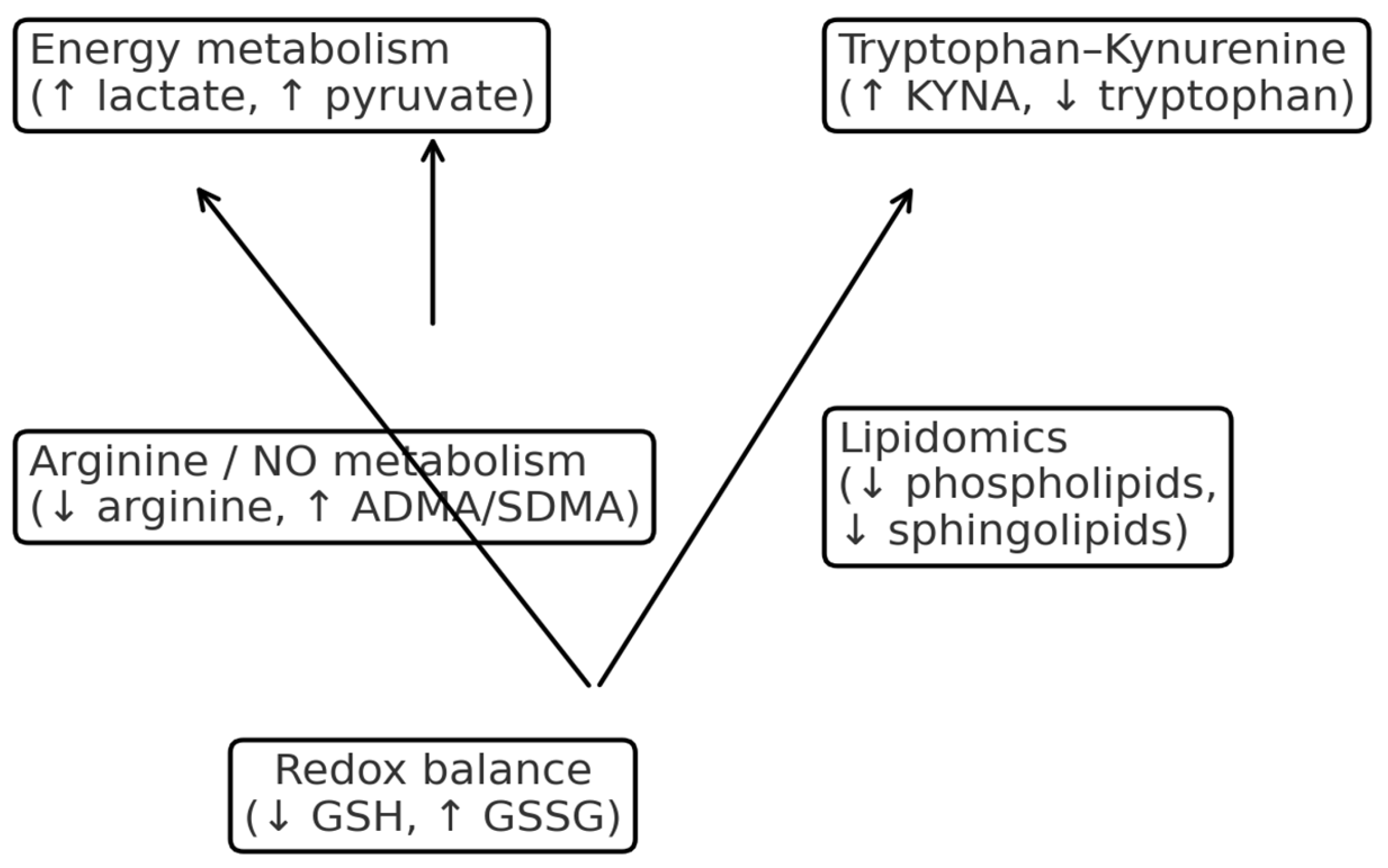
| Energy metabolism | Lactate | ↑ | Cognitive impairment, mitochondrial dysfunction | [3] |
| Energy metabolism | Pyruvate | ↑ | Altered glycolysis | [2,10] |
| Energy metabolism | Glucose-6-phosphate | ↑ | Biomarker panels | |
| Tryptophan–Kynurenine | Kynurenine | ↑ | Immune activation link | [12] |
| Tryptophan–Kynurenine | Kynurenic acid | ↑ | Elevated in FEP, NMDA receptor antagonist | [4] |
| Arginine/nitric oxide (NO) metabolism | Arginine | ↓ | Meta-analytically robust | [5] |
| Redox | Glutathione (GSH) | ↓ | Strong replication | [7] |
| Redox | Oxidized glutathione (GSSG) | ↑ | Predictive of treatment response | [14] |
| Lipidomics | Phospholipids/Sphingolipids | ↓ | Membrane and myelin disruption | [6,11] |
| Other | Cortisol | ↑ | Correlated with symptoms | [13] |
Disclaimer/Publisher’s Note: The statements, opinions and data contained in all publications are solely those of the individual author(s) and contributor(s) and not of MDPI and/or the editor(s). MDPI and/or the editor(s) disclaim responsibility for any injury to people or property resulting from any ideas, methods, instructions or products referred to in the content. |
© 2025 by the authors. Licensee MDPI, Basel, Switzerland. This article is an open access article distributed under the terms and conditions of the Creative Commons Attribution (CC BY) license.
Share and Cite
Trubalski, M.; Markiewicz, R.; Markiewicz-Gospodarek, A.; Kalisz, G.; Łoza, B.; Szymańczyk, S. Metabolic Plasticity in Schizophrenia: Clinical Rehabilitation Meets LC–MS Metabolomics and Neurofeedback. Int. J. Mol. Sci. 2026, 27, 380. https://doi.org/10.3390/ijms27010380
Trubalski M, Markiewicz R, Markiewicz-Gospodarek A, Kalisz G, Łoza B, Szymańczyk S. Metabolic Plasticity in Schizophrenia: Clinical Rehabilitation Meets LC–MS Metabolomics and Neurofeedback. International Journal of Molecular Sciences. 2026; 27(1):380. https://doi.org/10.3390/ijms27010380
Chicago/Turabian StyleTrubalski, Mateusz, Renata Markiewicz, Agnieszka Markiewicz-Gospodarek, Grzegorz Kalisz, Bartosz Łoza, and Sylwia Szymańczyk. 2026. "Metabolic Plasticity in Schizophrenia: Clinical Rehabilitation Meets LC–MS Metabolomics and Neurofeedback" International Journal of Molecular Sciences 27, no. 1: 380. https://doi.org/10.3390/ijms27010380
APA StyleTrubalski, M., Markiewicz, R., Markiewicz-Gospodarek, A., Kalisz, G., Łoza, B., & Szymańczyk, S. (2026). Metabolic Plasticity in Schizophrenia: Clinical Rehabilitation Meets LC–MS Metabolomics and Neurofeedback. International Journal of Molecular Sciences, 27(1), 380. https://doi.org/10.3390/ijms27010380