Rodent Models for Atherosclerosis

 ,
,
Abstract
1. Background
2. Optimizing Rodent Models for Atherosclerosis Research
2.1. Conserved Lipid Metabolism Pathways Between Rodents and Humans
2.2. Key Differences in Lipid Metabolisms Between Rodents and Humans
2.3. Diet-Induced Atherosclerosis in Apoe−/− and Ldlr−/− Mouse Models
2.4. Mouse Models for Atherosclerosis Using Genetic and Viral Approaches
2.4.1. The AAV-Pcsk9 Mouse Model Offers a Novel, Non-Genetically Modified Alternative for Experimental Research on Atherosclerosis
2.4.2. APOE*3-Leiden Mice Might Be a Suitable Model for Studies on the Progression and Regression of Atherosclerosis
3. Rat Models for Atherosclerosis
4. Hamster Models for Atherosclerosis and Lipid Disorders
5. Sex Differences in Rodent Atherosclerotic Models and Potential Mechanisms
6. Conclusions
Supplementary Materials
Author Contributions
Funding
Institutional Review Board Statement
Informed Consent Statement
Data Availability Statement
Conflicts of Interest
References
- Björkegren, J.L.M.; Lusis, A.J. Atherosclerosis: Recent developments. Cell 2022, 185, 1630–1645. [Google Scholar] [CrossRef]
- Xiang, Q.; Tian, F.; Xu, J.; Du, X.; Zhang, S.; Liu, L. New insight into dyslipidemia-induced cellular senescence in atherosclerosis. Biol. Rev. Camb. Philos. Soc. 2022, 97, 1844–1867. [Google Scholar] [CrossRef] [PubMed]
- Stone, N.J.; Robinson, J.G.; Lichtenstein, A.H.; Bairey Merz, C.N.; Blum, C.B.; Eckel, R.H.; Goldberg, A.C.; Gordon, D.; Levy, D.; Lloyd-Jones, D.M.; et al. 2013 ACC/AHA guideline on the treatment of blood cholesterol to reduce atherosclerotic cardiovascular risk in adults: A report of the American College of Cardiology/American Heart Association Task Force on Practice Guidelines. J. Am. Coll. Cardiol. 2014, 63, 2889–2934, Erratum in Circulation, 2015, 25, e396. https://doi.org/10.1161/CIR.0000000000000346. [Google Scholar] [CrossRef] [PubMed]
- Diao, Y. Clematichinenoside AR Alleviates Foam Cell Formation and the Inflammatory Response in Ox-LDL-Induced RAW264.7 Cells by Activating Autophagy. Inflammation 2021, 44, 758–768. [Google Scholar] [CrossRef] [PubMed]
- Vergallo, R.; Crea, F. Atherosclerotic Plaque Healing. N. Engl. J. Med. 2020, 383, 846–857. [Google Scholar] [CrossRef]
- Vesselinovitch, D.; Wissler, R.W. Experimental production of atherosclerosis in mice: Part 2. Effects of atherogenic and high-fat diets on vascular changes in chronically and acutely irradiated mice. J. Atheroscler. Res. 1968, 8, 497–523. [Google Scholar] [CrossRef]
- Smith, J.D.; Breslow, J.L. The emergence of mouse models of atherosclerosis and their relevance to clinical research. J. Intern. Med. 1997, 242, 99–109. [Google Scholar] [CrossRef]
- Krul, E.S.; Dolphin, P.J. Secretion of nascent lipoproteins by isolated hepatocytes from hypothyroid and hypothyroid, hypercholesterolemic rats. Biochim. Biophys. Acta 1982, 713, 609–621. [Google Scholar] [CrossRef]
- Scholz, K.E.; Beynen, A.C.; West, C.E. Comparison between the hypercholesterolaemia in rabbits induced by semipurified diets containing either cholesterol or casein. Atherosclerosis 1982, 44, 85–97. [Google Scholar] [CrossRef]
- Pfeuffer, M. Differences in the underlying mechanisms of cholesterol- and casein-induced hypercholesterolemia in rabbit and rat. Atherosclerosis 1989, 76, 89–91. [Google Scholar] [CrossRef]
- Damasceno, N.R.; Gidlund, M.A.; Goto, H.; Dias, C.T.; Okawabata, F.S.; Abdalla, D.S. Casein and soy protein isolate in experimental atherosclerosis: Influence on hyperlipidemia and lipoprotein oxidation. Ann. Nutr. Metab. 2001, 45, 38–46. [Google Scholar] [CrossRef]
- Rudel, L.L.; Parks, J.S.; Hedrick, C.C.; Thomas, M.; Williford, K. Lipoprotein and cholesterol metabolism in diet-induced coronary artery atherosclerosis in primates. Role of cholesterol and fatty acids. Prog. Lipid Res. 1998, 37, 353–370. [Google Scholar] [CrossRef] [PubMed]
- Hu, F.B.; Manson, J.E.; Willett, W.C. Types of dietary fat and risk of coronary heart disease: A critical review. J. Am. Coll. Nutr. 2001, 20, 5–19. [Google Scholar] [CrossRef] [PubMed]
- Vergnes, L.; Phan, J.; Strauss, M.; Tafuri, S.; Reue, K. Cholesterol and cholate components of an atherogenic diet induce distinct stages of hepatic inflammatory gene expression. J. Biol. Chem. 2003, 278, 42774–42784. [Google Scholar] [CrossRef] [PubMed]
- Getz, G.S.; Reardon, C.A. Diet and murine atherosclerosis. Arterioscler. Thromb. Vasc. Biol. 2006, 26, 242–249. [Google Scholar] [CrossRef]
- Wang, Z.; Klipfell, E.; Bennett, B.J.; Koeth, R.; Levison, B.S.; Dugar, B.; Feldstein, A.E.; Britt, E.B.; Fu, X.; Chung, Y.M.; et al. Gut flora metabolism of phosphatidylcholine promotes cardiovascular disease. Nature 2011, 472, 57–63. [Google Scholar] [CrossRef]
- Fillios, L.C.; Naito, C.; Andrus, S.B.; Roach, A.M. The hypercholesteremic and atherogenic properties of varous purines and pyrimidines. Am. J. Clin. Nutr. 1959, 7, 70–75. [Google Scholar] [CrossRef]
- Fillios, L.C.; Naito, C.; Andrus, S.B.; Roach, A.M. Further studies on experimental atherosclerosis and dietary pyrimidines: Orotic acid, thiouracil, and uracil in male and female rats. Circ. Res. 1960, 8, 71–77. [Google Scholar] [CrossRef]
- Suzuki, M.; O’Neal, R.M. Effects of therapeutic and toxic doses of propylthiouracil in rats. J. Pharmacol. Exp. Ther. 1967, 155, 345–351. [Google Scholar] [CrossRef]
- Atkinson, J. Vascular calcium overload. Physiological and pharmacological consequences. Drugs 1992, 44, 111–118. [Google Scholar] [CrossRef]
- Getz, G.S.; Reardon, C.A. Animal models of atherosclerosis. Arterioscler. Thromb. Vasc. Biol. 2012, 32, 1104–1115. [Google Scholar] [CrossRef]
- Teupser, D.; Tan, M.; Persky, A.D.; Breslow, J.L. Atherosclerosis quantitative trait loci are sex- and lineage-dependent in an intercross of C57BL/6 and FVB/N low-density lipoprotein receptor−/− mice. Proc. Natl. Acad. Sci. USA 2006, 103, 123–128. [Google Scholar] [CrossRef] [PubMed]
- Smith, J.D.; James, D.; Dansky, H.M.; Wittkowski, K.M.; Moore, K.J.; Breslow, J.L. In silico quantitative trait locus map for atherosclerosis susceptibility in apolipoprotein E-deficient mice. Arterioscler. Thromb. Vasc. Biol. 2003, 23, 117–122. [Google Scholar] [CrossRef] [PubMed]
- Zhao, Y.; Yang, Y.; Xing, R.; Cui, X.; Xiao, Y.; Xie, L.; You, P.; Wang, T.; Zeng, L.; Peng, W.; et al. Hyperlipidemia induces typical atherosclerosis development in Ldlr and Apoe deficient rats. Atherosclerosis 2018, 271, 26–35. [Google Scholar] [CrossRef] [PubMed]
- Rosenfeld, M.E.; Polinsky, P.; Virmani, R.; Kauser, K.; Rubanyi, G.; Schwartz, S.M. Advanced atherosclerotic lesions in the innominate artery of the ApoE knockout mouse. Arterioscler. Thromb. Vasc. Biol. 2000, 20, 2587–2592. [Google Scholar] [CrossRef]
- Gordon, S.M.; Li, H.; Zhu, X.; Shah, A.S.; Lu, L.J.; Davidson, W.S. A comparison of the mouse and human lipoproteome: Suitability of the mouse model for studies of human lipoproteins. J. Proteome Res. 2015, 14, 2686–2695. [Google Scholar] [CrossRef]
- Gisterå, A.; Ketelhuth, D.F.J.; Malin, S.G.; Hansson, G.K. Animal Models of Atherosclerosis-Supportive Notes and Tricks of the Trade. Circ. Res. 2022, 130, 1869–1887. [Google Scholar] [CrossRef]
- Kido, T.; Kurata, H.; Kondo, K.; Itakura, H.; Okazaki, M.; Urata, T.; Yokoyama, S. Bioinformatic Analysis of Plasma Apolipoproteins A-I and A-II Revealed Unique Features of A-I/A-II HDL Particles in Human Plasma. Sci. Rep. 2016, 6, 31532. [Google Scholar] [CrossRef]
- Hedrick, C.C.; Castellani, L.W.; Wong, H.; Lusis, A.J. In vivo interactions of apoA-II, apoA-I, and hepatic lipase contributing to HDL structure and antiatherogenic functions. J. Lipid Res. 2001, 42, 563–570. [Google Scholar] [CrossRef]
- Nguyen, D.; Nickel, M.; Mizuguchi, C.; Saito, H.; Lund-Katz, S.; Phillips, M.C. Interactions of apolipoprotein A-I with high-density lipoprotein particles. Biochemistry 2013, 52, 1963–1972. [Google Scholar] [CrossRef]
- Dallinga-Thie, G.M.; Schneijderberg, V.L.; van Tol, A. Identification and characterization of rat serum lipoprotein subclasses. Isolation by chromatography on agarose columns and sequential immunoprecipitation. J. Lipid Res. 1986, 27, 1035–1043. [Google Scholar] [CrossRef]
- Bornfeldt, K.E. Apolipoprotein C3: Form begets function. J. Lipid Res. 2024, 65, 100475. [Google Scholar] [CrossRef] [PubMed]
- Kohan, A.B. Apolipoprotein C-III: A potent modulator of hypertriglyceridemia and cardiovascular disease. Curr. Opin. Endocrinol. Diabetes Obes. 2015, 22, 119–125. [Google Scholar] [CrossRef] [PubMed]
- Ouimet, M.; Barrett, T.J.; Fisher, E.A. HDL and Reverse Cholesterol Transport. Circ. Res. 2019, 124, 1505–1518. [Google Scholar] [CrossRef] [PubMed]
- Kaabia, Z.; Poirier, J.; Moughaizel, M.; Aguesse, A.; Billon-Crossouard, S.; Fall, F.; Durand, M.; Dagher, E.; Krempf, M.; Croyal, M. Plasma lipidomic analysis reveals strong similarities between lipid fingerprints in human, hamster and mouse compared to other animal species. Sci. Rep. 2018, 8, 15893. [Google Scholar] [CrossRef]
- Liang, Y.Q.; Isono, M.; Okamura, T.; Takeuchi, F.; Kato, N. Alterations of lipid metabolism, blood pressure and fatty liver in spontaneously hypertensive rats transgenic for human cholesteryl ester transfer protein. Hypertens. Res. 2020, 43, 655–666. [Google Scholar] [CrossRef]
- Wang, D.Q.; Paigen, B.; Carey, M.C. Phenotypic characterization of Lith genes that determine susceptibility to cholesterol cholelithiasis in inbred mice: Physical-chemistry of gallbladder bile. J. Lipid Res. 1997, 38, 1395–1411. [Google Scholar] [CrossRef]
- Wittenburg, H.; Carey, M.C. Biliary cholesterol secretion by the twinned sterol half-transporters ABCG5 and ABCG8. J. Clin. Investig. 2002, 110, 605–609. [Google Scholar] [CrossRef][Green Version]
- McMaster, P.D. DO Species Lacking a Gall Bladder Possess Its Functional Equivalent? J. Exp. Med. 1922, 35, 127–140. [Google Scholar] [CrossRef][Green Version]
- Nishina, P.M.; Wang, J.; Toyofuku, W.; Kuypers, F.A.; Ishida, B.Y.; Paigen, B. Atherosclerosis and plasma and liver lipids in nine inbred strains of mice. Lipids 1993, 28, 599–605. [Google Scholar] [CrossRef]
- Paigen, B.; Holmes, P.A.; Mitchell, D.; Albee, D. Comparison of atherosclerotic lesions and HDL-lipid levels in male, female, and testosterone-treated female mice from strains C57BL/6, BALB/c, and C3H. Atherosclerosis 1987, 64, 215–221. [Google Scholar] [CrossRef]
- Zhao, Y.; Kuge, Y.; Zhao, S.; Strauss, H.W.; Blankenberg, F.G.; Tamaki, N. Prolonged high-fat feeding enhances aortic 18F-FDG and 99mTc-annexin A5 uptake in apolipoprotein E-deficient and wild-type C57BL/6J mice. J. Nucl. Med. 2008, 49, 1707–1714. [Google Scholar] [CrossRef] [PubMed]
- Santos-Sánchez, G.; Cruz-Chamorro, I.; Álvarez-Ríos, A.I.; Álvarez-Sánchez, N.; Rodríguez-Ortiz, B.; Álvarez-López, A.I.; Fernández-Pachón, M.S.; Pedroche, J.; Millán, F.; Millán-Linares, M.D.C.; et al. Bioactive Peptides from Lupin (Lupinus angustifolius) Prevent the Early Stages of Atherosclerosis in Western Diet-Fed ApoE(−/−) Mice. J. Agric. Food Chem. 2022, 70, 8243–8253. [Google Scholar] [CrossRef] [PubMed]
- Boord, J.B.; Maeda, K.; Makowski, L.; Babaev, V.R.; Fazio, S.; Linton, M.F.; Hotamisligil, G.S. Adipocyte fatty acid-binding protein, aP2, alters late atherosclerotic lesion formation in severe hypercholesterolemia. Arterioscler. Thromb. Vasc. Biol. 2002, 22, 1686–1691. [Google Scholar] [CrossRef]
- Miyoshi, T.; Li, Y.; Shih, D.M.; Wang, X.; Laubach, V.E.; Matsumoto, A.H.; Helm, G.A.; Lusis, A.J.; Shi, W. Deficiency of inducible NO synthase reduces advanced but not early atherosclerosis in apolipoprotein E-deficient mice. Life Sci. 2006, 79, 525–531. [Google Scholar] [CrossRef] [PubMed]
- Wilck, N.; Fechner, M.; Dreger, H.; Hewing, B.; Arias, A.; Meiners, S.; Baumann, G.; Stangl, V.; Stangl, K.; Ludwig, A. Attenuation of early atherogenesis in low-density lipoprotein receptor-deficient mice by proteasome inhibition. Arterioscler. Thromb. Vasc. Biol. 2012, 32, 1418–1426. [Google Scholar] [CrossRef]
- Hartvigsen, K.; Binder, C.J.; Hansen, L.F.; Rafia, A.; Juliano, J.; Hörkkö, S.; Steinberg, D.; Palinski, W.; Witztum, J.L.; Li, A.C. A diet-induced hypercholesterolemic murine model to study atherogenesis without obesity and metabolic syndrome. Arterioscler. Thromb. Vasc. Biol. 2007, 27, 878–885. [Google Scholar] [CrossRef]
- Zheng, G.; Zhao, Y.; Li, Z.; Hua, Y.; Zhang, J.; Miao, Y.; Guo, Y.; Li, L.; Shi, J.; Dong, Z.; et al. GLSP and GLSP-derived triterpenes attenuate atherosclerosis and aortic calcification by stimulating ABCA1/G1-mediated macrophage cholesterol efflux and inactivating RUNX2-mediated VSMC osteogenesis. Theranostics 2023, 13, 1325–1341. [Google Scholar] [CrossRef]
- Keeter, W.C.; Carter, N.M.; Nadler, J.L.; Galkina, E.V. The AAV-PCSK9 murine model of atherosclerosis and metabolic dysfunction. Eur. Heart J. Open 2022, 2, oeac028. [Google Scholar] [CrossRef]
- Mahley, R.W. Apolipoprotein E: Remarkable Protein Sheds Light on Cardiovascular and Neurological Diseases. Clin. Chem. 2017, 63, 14–20. [Google Scholar] [CrossRef]
- Mahley, R.W.; Huang, Y. Atherogenic remnant lipoproteins: Role for proteoglycans in trapping, transferring, and internalizing. J. Clin. Investig. 2007, 117, 94–98. [Google Scholar] [CrossRef] [PubMed]
- Ishibashi, S.; Herz, J.; Maeda, N.; Goldstein, J.L.; Brown, M.S. The two-receptor model of lipoprotein clearance: Tests of the hypothesis in “knockout” mice lacking the low density lipoprotein receptor, apolipoprotein E, or both proteins. Proc. Natl. Acad. Sci. USA 1994, 91, 4431–4435. [Google Scholar] [CrossRef] [PubMed]
- Mineo, C. Lipoprotein receptor signalling in atherosclerosis. Cardiovasc. Res. 2020, 116, 1254–1274. [Google Scholar] [CrossRef]
- Véniant, M.M.; Withycombe, S.; Young, S.G. Lipoprotein size and atherosclerosis susceptibility in Apoe(−/−) and Ldlr(−/−) mice. Arterioscler. Thromb. Vasc. Biol. 2001, 21, 1567–1570. [Google Scholar] [CrossRef] [PubMed]
- Zhang, S.H.; Reddick, R.L.; Piedrahita, J.A.; Maeda, N. Spontaneous hypercholesterolemia and arterial lesions in mice lacking apolipoprotein E. Science 1992, 258, 468–471. [Google Scholar] [CrossRef]
- Nakashima, Y.; Plump, A.S.; Raines, E.W.; Breslow, J.L.; Ross, R. ApoE-deficient mice develop lesions of all phases of atherosclerosis throughout the arterial tree. Arterioscler. Thromb. 1994, 14, 133–140. [Google Scholar] [CrossRef]
- Yang, S.; Zhao, Y.; Cao, S.; Liu, X.; Feng, M.; Chen, Y.; Ma, C.; Zhan, T.; Zhang, Q.; Jia, H.; et al. Kanglexin counters vascular smooth muscle cell dedifferentiation and associated arteriosclerosis through inhibiting PDGFR. Phytomedicine 2024, 130, 155704. [Google Scholar] [CrossRef]
- Burke, A.C.; Sutherland, B.G.; Telford, D.E.; Morrow, M.R.; Sawyez, C.G.; Edwards, J.Y.; Drangova, M.; Huff, M.W. Intervention with citrus flavonoids reverses obesity and improves metabolic syndrome and atherosclerosis in obese Ldlr(−/−) mice. J. Lipid Res. 2018, 59, 1714–1728. [Google Scholar] [CrossRef]
- Wan, H.; Lu, Y.; Yang, J.; Wan, H.; Yu, L.; Fang, N.; He, Y.; Li, C. Naoxintong capsule remodels gut microbiota and ameliorates early-stage atherosclerosis in apolipoprotein E-deficient mice. Phytomedicine 2024, 129, 155662. [Google Scholar] [CrossRef]
- Hogarth, C.A.; Roy, A.; Ebert, D.L. Genomic evidence for the absence of a functional cholesteryl ester transfer protein gene in mice and rats. Comp. Biochem. Physiol. B Biochem. Mol. Biol. 2003, 135, 219–229. [Google Scholar] [CrossRef]
- Greeve, J.; Altkemper, I.; Dieterich, J.H.; Greten, H.; Windler, E. Apolipoprotein B mRNA editing in 12 different mammalian species: Hepatic expression is reflected in low concentrations of apoB-containing plasma lipoproteins. J. Lipid Res. 1993, 34, 1367–1383. [Google Scholar] [CrossRef] [PubMed]
- Centa, M.; Ketelhuth, D.F.J.; Malin, S.; Gisterå, A. Quantification of Atherosclerosis in Mice. J. Vis. Exp. 2019, 148, e59828. [Google Scholar] [CrossRef] [PubMed]
- Schwartz, S.M.; Galis, Z.S.; Rosenfeld, M.E.; Falk, E. Plaque Rupture in Humans and Mice. Arterioscler. Thromb. Vasc. Biol. 2007, 27, 705–713. [Google Scholar] [CrossRef] [PubMed]
- Bjørklund, M.M.; Hollensen, A.K.; Hagensen, M.K.; Dagnaes-Hansen, F.; Christoffersen, C.; Mikkelsen, J.G.; Bentzon, J.F. Induction of atherosclerosis in mice and hamsters without germline genetic engineering. Circ. Res. 2014, 114, 1684–1689. [Google Scholar] [CrossRef]
- Cariou, B.; Le May, C.; Costet, P. Clinical aspects of PCSK9. Atherosclerosis 2011, 216, 258–265. [Google Scholar] [CrossRef]
- Roche-Molina, M.; Sanz-Rosa, D.; Cruz, F.M.; García-Prieto, J.; López, S.; Abia, R.; Muriana, F.J.; Fuster, V.; Ibáñez, B.; Bernal, J.A. Induction of sustained hypercholesterolemia by single adeno-associated virus-mediated gene transfer of mutant hPCSK9. Arterioscler. Thromb. Vasc. Biol. 2015, 35, 50–59. [Google Scholar] [CrossRef]
- Peled, M.; Nishi, H.; Weinstock, A.; Barrett, T.J.; Zhou, F.; Quezada, A.; Fisher, E.A. A wild-type mouse-based model for the regression of inflammation in atherosclerosis. PLoS ONE 2017, 12, e0173975. [Google Scholar] [CrossRef]
- Lutgens, E.; Daemen, M.; Kockx, M.; Doevendans, P.; Hofker, M.; Havekes, L.; Wellens, H.; de Muinck, E.D. Atherosclerosis in APOE*3-Leiden transgenic mice: From proliferative to atheromatous stage. Circulation 1999, 99, 276–283. [Google Scholar] [CrossRef]
- Groot, P.H.; van Vlijmen, B.J.; Benson, G.M.; Hofker, M.H.; Schiffelers, R.; Vidgeon-Hart, M.; Havekes, L.M. Quantitative assessment of aortic atherosclerosis in APOE*3 Leiden transgenic mice and its relationship to serum cholesterol exposure. Arterioscler. Thromb. Vasc. Biol. 1996, 16, 926–933. [Google Scholar] [CrossRef]
- Pouwer, M.G.; Heinonen, S.E.; Behrendt, M.; Andréasson, A.C.; van Koppen, A.; Menke, A.L.; Pieterman, E.J.; van den Hoek, A.M.; Jukema, J.W.; Leighton, B.; et al. The APOE(∗)3-Leiden Heterozygous Glucokinase Knockout Mouse as Novel Translational Disease Model for Type 2 Diabetes, Dyslipidemia, and Diabetic Atherosclerosis. J. Diabetes Res. 2019, 2019, 9727952. [Google Scholar] [CrossRef]
- Sari, G.; Meester, E.J.; van der Zee, L.C.; Wouters, K.; van Lennep, J.R.; Peppelenbosch, M.; Boonstra, A.; Van der Heiden, K.; Mulder, M.M.T.; Vanwolleghem, T. A mouse model of humanized liver shows a human-like lipid profile, but does not form atherosclerotic plaque after western type diet. Biochem. Biophys. Res. Commun. 2020, 524, 510–515. [Google Scholar] [CrossRef]
- Gijbels, M.J.; van der Cammen, M.; van der Laan, L.J.; Emeis, J.J.; Havekes, L.M.; Hofker, M.H.; Kraal, G. Progression and regression of atherosclerosis in APOE3-Leiden transgenic mice: An immunohistochemical study. Atherosclerosis 1999, 143, 15–25. [Google Scholar] [CrossRef] [PubMed]
- van Vlijmen, B.J.; van ‘t Hof, H.B.; Mol, M.J.; van der Boom, H.; van der Zee, A.; Frants, R.R.; Hofker, M.H.; Havekes, L.M. Modulation of very low density lipoprotein production and clearance contributes to age- and gender- dependent hyperlipoproteinemia in apolipoprotein E3-Leiden transgenic mice. J. Clin. Investig. 1996, 97, 1184–1192. [Google Scholar] [CrossRef] [PubMed]
- Lee, J.G.; Ha, C.H.; Yoon, B.; Cheong, S.A.; Kim, G.; Lee, D.J.; Woo, D.C.; Kim, Y.H.; Nam, S.Y.; Lee, S.W.; et al. Knockout rat models mimicking human atherosclerosis created by Cpf1-mediated gene targeting. Sci. Rep. 2019, 9, 2628. [Google Scholar] [CrossRef] [PubMed]
- Livero, F.; Gasparotto Junior, A. Non-genetic rats models for atherosclerosis research: From past to present. Front. Biosci. Sch. 2019, 11, 203–213. [Google Scholar] [CrossRef]
- Andrus, S.B.; Fillios, L.C.; Mann, G.V.; Stare, F.J. Experimental production of gross atherosclerosis in the rat. J. Exp. Med. 1956, 104, 539–554. [Google Scholar] [CrossRef]
- Marques, C.; Meireles, M.; Norberto, S.; Leite, J.; Freitas, J.; Pestana, D.; Faria, A.; Calhau, C. High-fat diet-induced obesity Rat model: A comparison between Wistar and Sprague-Dawley Rat. Adipocyte 2016, 5, 11–21. [Google Scholar] [CrossRef]
- Sasaki, S.; Yoneda, Y.; Fujita, H.; Uchida, A.; Takenaka, K.; Takesako, T.; Itoh, H.; Nakata, T.; Takeda, K.; Nakagawa, M. Association of blood pressure variability with induction of atherosclerosis in cholesterol-fed rats. Am. J. Hypertens. 1994, 7, 453–459. [Google Scholar] [CrossRef]
- Li, W.; Yang, C.; Mei, X.; Huang, R.; Zhang, S.; Tang, Y.; Dong, Q.; Zhou, C. Effect of the polyphenol-rich extract from Allium cepa on hyperlipidemic sprague-dawley rats. J. Food Biochem. 2021, 45, e13565. [Google Scholar] [CrossRef]
- Kumar, R.; Salwe, K.J.; Kumarappan, M. Evaluation of Antioxidant, Hypolipidemic, and Antiatherogenic Property of Lycopene and Astaxanthin in Atherosclerosis-induced Rats. Pharmacogn. Res. 2017, 9, 161–167. [Google Scholar]
- Fu, W.J.; Lei, T.; Yin, Z.; Pan, J.H.; Chai, Y.S.; Xu, X.Y.; Yan, Y.X.; Wang, Z.H.; Ke, J.; Wu, G.; et al. Anti-atherosclerosis and cardio-protective effects of the Angong Niuhuang Pill on a high fat and vitamin D3 induced rodent model of atherosclerosis. J. Ethnopharmacol. 2017, 195, 118–126. [Google Scholar] [CrossRef] [PubMed]
- Su, Z.L.; Hang, P.Z.; Hu, J.; Zheng, Y.Y.; Sun, H.Q.; Guo, J.; Liu, K.Y.; Du, Z.M. Aloe-emodin exerts cholesterol-lowering effects by inhibiting proprotein convertase subtilisin/kexin type 9 in hyperlipidemic rats. Acta Pharmacol. Sin. 2020, 41, 1085–1092. [Google Scholar] [CrossRef] [PubMed]
- Dianita, R.; Jantan, I.; Jalil, J.; Amran, A.Z. Effects of Labisia pumila var alata extracts on the lipid profile, serum antioxidant status and abdominal aorta of high-cholesterol diet rats. Phytomedicine 2016, 23, 810–817. [Google Scholar] [CrossRef] [PubMed]
- Sheng, Y.; Meng, G.; Zhang, M.; Chen, X.; Chai, X.; Yu, H.; Han, L.; Wang, Q.; Wang, Y.; Jiang, M. Dan-shen Yin promotes bile acid metabolism and excretion to prevent atherosclerosis via activating FXR/BSEP signaling pathway. J. Ethnopharmacol. 2024, 330, 118209. [Google Scholar] [CrossRef]
- Xu, F.; Zhang, J.; Zhou, X.; Hao, H. Lipoxin A(4) and its analog attenuate high fat diet-induced atherosclerosis via Keap1/Nrf2 pathway. Exp. Cell Res. 2022, 412, 113025. [Google Scholar] [CrossRef]
- Nistor, A.; Bulla, A.; Filip, D.A.; Radu, A. The hyperlipidemic hamster as a model of experimental atherosclerosis. Atherosclerosis 1987, 68, 159–173. [Google Scholar] [CrossRef]
- Liu, G.; Lai, P.; Guo, J.; Wang, Y.; Xian, X. Genetically-engineered hamster models: Applications and perspective in dyslipidemia and atherosclerosis-related cardiovascular disease. Med. Rev. 2021, 1, 92–110. [Google Scholar] [CrossRef]
- Liu, G.L.; Fan, L.M.; Redinger, R.N. The association of hepatic apoprotein and lipid metabolism in hamsters and rats. Comp. Biochem. Physiol. A Comp. Physiol. 1991, 99, 223–228. [Google Scholar] [CrossRef]
- Taghibiglou, C.; Rudy, D.; Van Iderstine, S.C.; Aiton, A.; Cavallo, D.; Cheung, R.; Adeli, K. Intracellular mechanisms regulating apoB-containing lipoprotein assembly and secretion in primary hamster hepatocytes. J. Lipid Res. 2000, 41, 499–513. [Google Scholar] [CrossRef]
- Dillard, A.; Matthan, N.R.; Lichtenstein, A.H. Use of hamster as a model to study diet-induced atherosclerosis. Nutr. Metab. 2010, 7, 89. [Google Scholar] [CrossRef]
- Dong, Z.; Shi, H.; Zhao, M.; Zhang, X.; Huang, W.; Wang, Y.; Zheng, L.; Xian, X.; Liu, G. Loss of LCAT activity in the golden Syrian hamster elicits pro-atherogenic dyslipidemia and enhanced atherosclerosis. Metabolism 2018, 83, 245–255. [Google Scholar] [CrossRef]
- Wang, W.Z.; Liu, C.; Luo, J.Q.; Lei, L.J.; Chen, M.H.; Zhang, Y.Y.; Sheng, R.; Li, Y.N.; Wang, L.; Jiang, X.H.; et al. A novel small-molecule PCSK9 inhibitor E28362 ameliorates hyperlipidemia and atherosclerosis. Acta Pharmacol. Sin. 2024, 45, 2119–2133. [Google Scholar] [CrossRef] [PubMed]
- Mangiapane, E.H.; McAteer, M.A.; Benson, G.M.; White, D.A.; Salter, A.M. Modulation of the regression of atherosclerosis in the hamster by dietary lipids: Comparison of coconut oil and olive oil. Br. J. Nutr. 1999, 82, 401–409. [Google Scholar] [CrossRef] [PubMed]
- Jonas, A. Lecithin cholesterol acyltransferase. Biochim. Biophys. Acta 2000, 1529, 245–256. [Google Scholar] [CrossRef] [PubMed]
- Lin, X.; Zhang, W.; Yang, C.; Ma, P.; He, K.; Chen, G.; Tao, Y.; Yan, H.; Yang, Z.; Zhang, L.; et al. Depleting LCAT Aggravates Atherosclerosis in LDLR-deficient Hamster with Reduced LDL-Cholesterol Level. J. Adv. Res. 2024, 63, 187–194. [Google Scholar] [CrossRef]
- Hobbs, H.H.; Brown, M.S.; Goldstein, J.L. Molecular genetics of the LDL receptor gene in familial hypercholesterolemia. Hum. Mutat. 1992, 1, 445–466. [Google Scholar] [CrossRef]
- He, K.; Wang, J.; Shi, H.; Yu, Q.; Zhang, X.; Guo, M.; Sun, H.; Lin, X.; Wu, Y.; Wang, L.; et al. An interspecies study of lipid profiles and atherosclerosis in familial hypercholesterolemia animal models with low-density lipoprotein receptor deficiency. Am. J. Transl. Res. 2019, 11, 3116–3127. [Google Scholar]
- Wang, J.; He, K.; Yang, C.; Lin, X.; Zhang, X.; Wang, Y.; Liu, G.; Xian, X. Dietary Cholesterol Is Highly Associated with Severity of Hyperlipidemia and Atherosclerotic Lesions in Heterozygous LDLR-Deficient Hamsters. Int. J. Mol. Sci. 2019, 20, 3515. [Google Scholar] [CrossRef]
- Wu, Y.; Xu, M.J.; Cao, Z.; Yang, C.; Wang, J.; Wang, B.; Liu, J.; Wang, Y.; Xian, X.; Zhang, F.; et al. Heterozygous Ldlr-Deficient Hamster as a Model to Evaluate the Efficacy of PCSK9 Antibody in Hyperlipidemia and Atherosclerosis. Int. J. Mol. Sci. 2019, 20, 5936. [Google Scholar] [CrossRef]
- Vinson, J.A.; Teufel, K.; Wu, N. Green and black teas inhibit atherosclerosis by lipid, antioxidant, and fibrinolytic mechanisms. J. Agric. Food Chem. 2004, 52, 3661–3665. [Google Scholar] [CrossRef]
- Romain, C.; Gaillet, S.; Carillon, J.; Vidé, J.; Ramos, J.; Izard, J.C.; Cristol, J.P.; Rouanet, J.M. Vineatrol and cardiovascular disease: Beneficial effects of a vine-shoot phenolic extract in a hamster atherosclerosis model. J. Agric. Food Chem. 2012, 60, 11029–11036. [Google Scholar] [CrossRef]
- Uehara, Y.; Urata, H.; Ideishi, M.; Arakawa, K.; Saku, K. Chymase inhibition suppresses high-cholesterol diet-induced lipid accumulation in the hamster aorta. Cardiovasc. Res. 2002, 55, 870–876. [Google Scholar] [CrossRef] [PubMed][Green Version]
- Auger, C.; Rouanet, J.M.; Vanderlinde, R.; Bornet, A.; Décordé, K.; Lequeux, N.; Cristol, J.P.; Teissedre, P.L. Polyphenols-enriched Chardonnay white wine and sparkling Pinot Noir red wine identically prevent early atherosclerosis in hamsters. J. Agric. Food Chem. 2005, 53, 9823–9829. [Google Scholar] [CrossRef] [PubMed]
- Ismail, B.S.; Mahmoud, B.; Abdel-Reheim, E.S.; Soliman, H.A.; Ali, T.M.; Elesawy, B.H.; Zaky, M.Y. Cinnamaldehyde Mitigates Atherosclerosis Induced by High-Fat Diet via Modulation of Hyperlipidemia, Oxidative Stress, and Inflammation. Oxid. Med. Cell Longev. 2022, 2022, 4464180. [Google Scholar] [CrossRef]
- Zhu, H.X.; Ren, J.L.; Cao, W.J.; Wang, R.; Chen, L.L.; Gao, Q.; Zhou, Y.B. Intermedin(1-53) Improves Atherosclerosis by Reducing Local Endothelial Damage via AMPK Signaling Pathway in Obese apoE-Deficient Mice. J. Inflamm. Res. 2025, 18, 6583–6596. [Google Scholar] [CrossRef] [PubMed]
- García-Prieto, C.F.; Hernández-Nuño, F.; Rio, D.D.; Ruiz-Hurtado, G.; Aránguez, I.; Ruiz-Gayo, M.; Somoza, B.; Fernández-Alfonso, M.S. High-fat diet induces endothelial dysfunction through a down-regulation of the endothelial AMPK-PI3K-Akt-eNOS pathway. Mol. Nutr. Food Res. 2015, 59, 520–532. [Google Scholar] [CrossRef]
- Clark, M.; Centner, A.M.; Ukhanov, V.; Nagpal, R.; Salazar, G. Gallic acid ameliorates atherosclerosis and vascular senescence and remodels the microbiome in a sex-dependent manner in ApoE(−/−) mice. J. Nutr. Biochem. 2022, 110, 109132. [Google Scholar] [CrossRef]
- Robichaud, S.; Rochon, V.; Emerton, C.; Laval, T.; Ouimet, M. Trehalose promotes atherosclerosis regression in female mice. Front. Cardiovasc. Med. 2024, 11, 1298014. [Google Scholar] [CrossRef]
- AlSiraj, Y.; Chen, X.; Thatcher, S.E.; Temel, R.E.; Cai, L.; Blalock, E.; Katz, W.; Ali, H.M.; Petriello, M.; Deng, P.; et al. XX sex chromosome complement promotes atherosclerosis in mice. Nat. Commun. 2019, 10, 2631. [Google Scholar] [CrossRef]
- Chen, S.; Markman, J.L.; Shimada, K.; Crother, T.R.; Lane, M.; Abolhesn, A.; Shah, P.K.; Arditi, M. Sex-Specific Effects of the Nlrp3 Inflammasome on Atherogenesis in LDL Receptor-Deficient Mice. JACC Basic. Transl. Sci. 2020, 5, 582–598. [Google Scholar] [CrossRef]
- Venegas-Pino, D.E.; Wang, P.W.; Stoute, H.K.; Singh-Pickersgill, N.A.; Hong, B.Y.; Khan, M.I.; Shi, Y.; Werstuck, G.H. Sex-Specific Differences in an ApoE−/−:Ins2+/Akita Mouse Model of Accelerated Atherosclerosis. Am. J. Pathol. 2016, 186, 67–77. [Google Scholar] [CrossRef] [PubMed]
- Yuan, X.; Nagamine, R.; Tanaka, Y.; Tsai, W.T.; Jiang, Z.; Takeyama, A.; Imaizumi, K.; Sato, M. The effects of dietary linoleic acid on reducing serum cholesterol and atherosclerosis development are nullified by a high-cholesterol diet in male and female apoE-deficient mice. Br. J. Nutr. 2023, 129, 737–744. [Google Scholar] [CrossRef] [PubMed]
- Jarrett, K.E.; Lee, C.; De Giorgi, M.; Hurley, A.; Gillard, B.K.; Doerfler, A.M.; Li, A.; Pownall, H.J.; Bao, G.; Lagor, W.R. Somatic Editing of Ldlr With Adeno-Associated Viral-CRISPR Is an Efficient Tool for Atherosclerosis Research. Arterioscler. Thromb. Vasc. Biol. 2018, 38, 1997–2006. [Google Scholar] [CrossRef] [PubMed]
- Dutta, S.; Sengupta, P. Men and mice: Relating their ages. Life Sci. 2016, 152, 244–248. [Google Scholar] [CrossRef]
- Sengupta, P. The Laboratory Rat: Relating Its Age With Human’s. Int. J. Prev. Med. 2013, 4, 624–630. [Google Scholar]
- Dutta, S.; Sengupta, P. Age of Laboratory Hamster and Human: Drawing the Connexion. Biomed. Pharmacol. J. 2019, 12, 49–56. [Google Scholar] [CrossRef]
- Caligiuri, G.; Nicoletti, A.; Zhou, X.; Törnberg, I.; Hansson, G.K. Effects of sex and age on atherosclerosis and autoimmunity in apoE-deficient mice. Atherosclerosis 1999, 145, 301–308. [Google Scholar] [CrossRef]
- Makhanova, N.; Morgan, A.P.; Kayashima, Y.; Makhanov, A.; Hiller, S.; Zhilicheva, S.; Xu, L.; Pardo-Manuel de Villena, F.; Maeda, N. Genetic architecture of atherosclerosis dissected by QTL analyses in three F2 intercrosses of apolipoprotein E-null mice on C57BL6/J, DBA/2J and 129S6/SvEvTac backgrounds. PLoS ONE 2017, 12, e0182882. [Google Scholar] [CrossRef]
- Surra, J.C.; Barranquero, C.; Torcal, M.P.; Orman, I.; Segovia, J.C.; Guillén, N.; Navarro, M.A.; Arnal, C.; Osada, J. In comparison with palm oil, dietary nut supplementation delays the progression of atherosclerotic lesions in female apoE-deficient mice. Br. J. Nutr. 2013, 109, 202–209. [Google Scholar] [CrossRef]
- Marsh, M.M.; Walker, V.R.; Curtiss, L.K.; Banka, C.L. Protection against atherosclerosis by estrogen is independent of plasma cholesterol levels in LDL receptor-deficient mice. J. Lipid Res. 1999, 40, 893–900. [Google Scholar] [CrossRef]
- Chira, E.C.; McMillen, T.S.; Wang, S.; Haw, A., 3rd; O’Brien, K.D.; Wight, T.N.; Chait, A. Tesaglitazar, a dual peroxisome proliferator-activated receptor alpha/gamma agonist, reduces atherosclerosis in female low density lipoprotein receptor deficient mice. Atherosclerosis 2007, 195, 100–109. [Google Scholar] [CrossRef][Green Version]
- Hartman, H.B.; Gardell, S.J.; Petucci, C.J.; Wang, S.; Krueger, J.A.; Evans, M.J. Activation of farnesoid X receptor prevents atherosclerotic lesion formation in LDLR−/− and apoE−/− mice. J. Lipid Res. 2009, 50, 1090–1100. [Google Scholar] [CrossRef] [PubMed]
- Ataie, Z.; Fatehi-Hassanabad, Z.; Nakhaee, S.; Foadoddini, M.; Farrokhfall, K. Sex-specific endothelial dysfunction induced by high-cholesterol diet in rats: The role of protein tyrosine kinase and nitric oxide. Nutr. Metab. Cardiovasc. Dis. 2022, 32, 745–754. [Google Scholar] [CrossRef] [PubMed]
- Wilson, T.A.; Nicolosi, R.J.; Lawton, C.W.; Babiak, J. Gender differences in response to a hypercholesterolemic diet in hamsters: Effects on plasma lipoprotein cholesterol concentrations and early aortic atherosclerosis. Atherosclerosis 1999, 146, 83–91. [Google Scholar] [CrossRef] [PubMed]
- Xiangdong, L.; Yuanwu, L.; Hua, Z.; Liming, R.; Qiuyan, L.; Ning, L. Animal models for the atherosclerosis research: A review. Protein Cell 2011, 2, 189–201. [Google Scholar] [CrossRef]
- Nour, J.; Bonacina, F.; Norata, G.D. Gonadal sex vs. genetic sex in experimental atherosclerosis. Atherosclerosis 2023, 384, 117277. [Google Scholar] [CrossRef]
- Flurkey, K.M.; Currer, J.; Harrison, D.E. Chapter 20—Mouse Models in Aging Research. In The Mouse in Biomedical Research, 2nd ed.; Fox, J.G., Davisson, M.T., Quimby, F.W., Barthold, S.W., Newcomer, C.E., Smith, A.L., Eds.; Academic Press: Burlington, MA, USA, 2007; pp. 637–672. [Google Scholar]
- Smit, V.; de Mol, J.; Schaftenaar, F.H.; Depuydt, M.A.C.; Postel, R.J.; Smeets, D.; Verheijen, F.W.M.; Bogers, L.; van Duijn, J.; Verwilligen, R.A.F.; et al. Single-cell profiling reveals age-associated immunity in atherosclerosis. Cardiovasc. Res. 2023, 119, 2508–2521. [Google Scholar] [CrossRef]


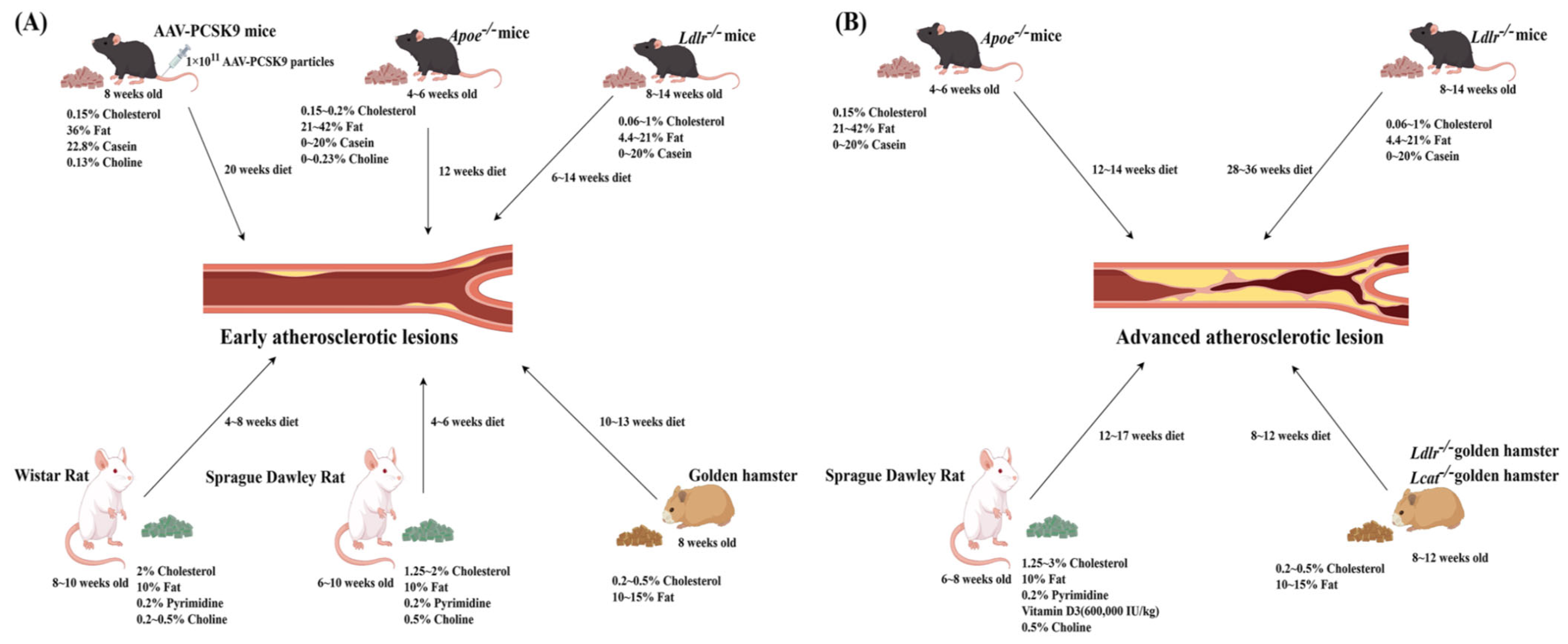
| Mouse Models | Age (Weeks) | Key Components of HFD | HFD: Weeks | Fasting Plasma Cholesterol Levels | Fasting Plasma Triglyceride Levels | Stages of Atherosclerosis | References |
|---|---|---|---|---|---|---|---|
| Apoe−/− mice | 6 | Western diet (WD) with standard cholesterol 0.2%, 46.1% fat, casein-vitamin tested 23.3%, and 0.23% choline tartrate | 12 | TC, 420 ± 14 mg/Dl HDL-C, 48 ± 2 mg/dL LDL-C, 328 ± 14 mg/dL. | 133 ± 6 mg/dL | early-stage atherosclerosis, accompanied by a marked upregulation of inflammatory mediators and the development of hyperlipidemia. | [43] |
| Apoe−/− mice | 4 | 21% fat, 0.15% cholesterol, 19.5% casein, no cholate | 14 | TC, 865 ± 175 mg/dL | 218 ± 99 mg/dL | An advanced atherosclerosis model was established with the lesion area of the ascending aorta (1.69 ± 0.23%). | [44] |
| Apoe−/− mice | 6 | 42% fat, 0.15% cholesterol and 19.5% casein (without sodium cholate) | 12 | TC, 1032.0 ± 50.2 mg/dL | 71.6 ± 7.0 mg/dL | Advanced atherosclerotic lesions were observed, characterized by extensive and severe plaques within the aorta. | [45] |
| Ldlr−/− mice | 10 | 21% milk fat, 17% casein, 0.21% cholesterol | 6 | TC, 998 ± 72 mg/dL HDL-C, 83.7 ± 8.5 mg/dL. | 902 ± 93 mg/dL | Atherosclerotic lesions observed in the aorta, including plaque areas of 1.29 ± 0.20% in the aortic arch and 19.36 ± 2.46% in the aortic root. | [46] |
| Ldlr−/− mice | 14 | 1% cholesterol, 4.4% fat casein-free | 14 | TC, 800 mg/dL | 175 mg/dL | There is no obvious atherosclerotic lesion in the aorta. | [47] |
| 28 | Severe atherosclerotic lesions were observed in the aorta, with the aortic cross-sectional lesion area measuring 337 ± 48 × 103 μm2. | ||||||
| Ldlr−/− mice | 14 | 21% milk fat, 0.06% cholesterol | 14 | TC, 1600 mg/dL | 600 mg/dL | There is no obvious atherosclerotic lesion in the aorta. | [47] |
| 28 | Severe atherosclerotic lesions characterized by fibrous caps and necrotic cores were identified in the aorta, with the aortic cross-sectional lesion area (547 ± 39 × 103 μm2). | ||||||
| Ldlr−/− mice | 8 | 21% fat, 0.5% cholesterol, 20% protein, 50% carbohydrates, no cholate | 12 | TC, 1547 mg/dL HDL, 19–39 mg/dL LDL, 387–580 mg/dL. | 708.56 mg/dL | The formation of atherosclerotic plaques and lipid deposits in the aorta. | [48] |
| 36 | TC, 1160 mg/dL HDL, 77 mg/dL LDL, 387 and 580 mg/dL | decreased | An increased area of atherosclerotic plaques and expansion of the necrotic core. | ||||
| C57BL/6J mice | 8 | 0.15% added cholesterol (HFD-C, fat: 60% kcal; carbohydrate: 26% kcal, Bio-Serv, F3282) | 20 | TC, 361 ± 20 mg/dL | 125 ± 9 mg/dL | A few atherosclerotic plaques were observed in the aorta. | [49] |
| The AAV-PCSK9 mice | 8 | 0.15% added cholesterol (HFD-C; fat: 60% kcal; carbohydrate: 26% kcal, Bio-Serv, F3282) | 20 | TC, 500 ± 56 mg/dL | 122 ± 19 mg/dL | Many atherosclerotic plaques were observed in the aorta. | [49] |
| Rat Models | Age (Weeks) | Key Components of HFD | HFD: X Weeks | Fasting Plasma Cholesterol Levels | Fasting Plasma Triglyceride Levels | Stages of Atherosclerosis | References |
| Wistar Rat | 8 | 2% cholesterol, 0.5% cholic acid, 10% lard, 5% sucrose, 0.2% 6-methyl2-thiouracil and 82.3% conventional rat food | 6 | TC levels, 358 ± 26 mg/dL HDL-C levels, 27 ± 7 mg/dL | 32 ± 5 mg/dL. | No apparent atherosclerotic lesions were observed. | [78] |
| Wistar Rat | 8 | 77.6% carbohydrate, 10% fat, 10% protein, 2% cholesterol, 0.2% bile salt and 0.2% methylthiouracil | 4 | TC levels, 154.66~231.99 mg/dL LDL levels, 77.33~115.99 mg/dL HDL levels, 23.2~15.5 mg/dL | 86.11~129.16 mg/dL. | The hyperlipidemia model was established. | [82] |
| Wistar Rat | 8~10 | 2% cholesterol HCD diet | 8 | TC levels, 135.33~154.66 mg/dL LDL levels, 135.33~154.66 mg/dL HDL levels, approximately 19.33 mg/dL | Approximately 43.05 mg/dL | Lipid streaks and intimal thickening were observed in the abdominal aorta, indicating the onset of early-stage atherosclerosis. | [83] |
| SD Rat | 8 | Vitamin D3, HFD with 3% cholesterol, 0.5% sodium cholate, 0.2% propylthiouracil, 5% sugar, 10% lard and 81.3% base feed (600,000 IU/kg) | 17 | TC levels, 102.85 ± 11.21 mg/dL LDL-C, 57.99 ± 4.25 mg/dL HDL-C, 51.04 ± 3.09 mg/dL | 55.97 ± 7.75 mg/dL | Aortic lipid deposition, medial thickening, vascular calcification, and intimal rupture. | [81] |
| SD Rat | 8~10 | 100 g cholesterol, 30 g propylthiouracil, and 100 g cholic acid in 1 L of peanut oil prepared fresh | 6 | TC levels, 202.50 ± 14.23 mg/dL LDL, 119.5 ± 11.16 mg/dL HDL-C, 31.83 ± 2.78 mg/dL | 234.66 ± 10.70 mg/dL | 2 rats developed lipid streaks in the aorta, while all 6 rats exhibited early atherosclerotic lesions characterized by intimal thickening and lipid droplet accumulation. | [80] |
| SPF adult male SD rat | Adult | 2% cholesterol, 0.5% sodium cholate, 3% lard soil, 0.2% Propylthiouracil 5% refined sugar, and 89.3% base feed | 4 | TC, 334.66 ± 52.19 mg/dL LDL levels, 89.22 ± 39.44 mg/dL HDL-C, 32.09 ± 9.28 mg/dL | 61.14 ± 39.61 mg/dL | Established an early atherosclerotic disease model, characterized by the appearance of numerous foam cells in the aorta. | [79] |
| SD Rat | Not specifically mentioned | 81.3% basal diet, 3.5% cholesterol, 10% lard, 5.0% sucrose and 0.2% propylthiouracil. | 12 | TC, 231.99~579.98 mg/dL LDL-C, 115.995~579.975 mg/dL | Intimal thickening of the blood vessels was observed. | [84] | |
| SD Rat | 6 | 1.25% cholesterol, 0.5% sodium cholate | 17 | TC, 38.67.67~96.66 mg/dL LDL, 7.73~23.199 mg/dL HDL, 7.73~15.47 mg/dL. | 86.11~172.22 mg/dL | Prominent atherosclerotic plaques were observed in the aorta. | [85] |
| Hamster Models | Age (Weeks) | Key Components of HFD | HFD: X Weeks | Fasting Plasma Cholesterol Level | Fasting Plasma Triglyceride Levels | Stages of Atherosclerosis | References |
| Golden hamster | 8 weeks | Food with 0.2% cholesterol and 10% coconut oil | 10 | TC, 492 ± 67 mg/dL LDL-C, 433 ± 67 mg/dL HDL, 51 ± 6 mg/dL | 333 ± 35 mg/dL. | In an early atherosclerosis model, the appearance of foam cells in the aorta. | [100] |
| Golden hamster | Newly weaned | 200 g/kg casein, 3 g/kg methionine, 393 g/kg corn starch, 33 g/kg maltodextrin 10, 154 g/kg sucrose, 50 g/kg cellulose, 100 g/kg hydrogenated coconut oil, 2 g/kg cholesterol, 35 g/kg mineral mix and 10 g/kg vitamin mix | 13 | TC, 409.859 ± 15.47 mg/dL LDL-C, 305 ± 18.56 mg/dL HDL-C, 104.395 ± 6.57 mg/dL. | 198.05 ± 35.30 mg/dL | Lipid streaks appeared in the aorta, occupying approximately 6% of the aortic area. | [101] |
| Golden hamster | 8 | Standard rodent meal supplemented with 0.5% cholesterol and 10% coconut oil | 12 | TC, 467.85 ± 42.92 mg/dL LDL-C, 196.07 ± 21.27 mg/dL HDL-C, 146.93 ± 21.65 mg/dL | 938.59 ± 139.49 mg/dL | Lipid deposits were observed in the aorta. | [102] |
| Golden hamster | Newly weaned | 0.5% cholesterol, 15% lard | 12 | TC, 401.18 ± 25.13 mg/dL HDL-C, 144.44 ± 14.31 mg/dL | 118.27 ± 14.64 mg/dL | Lipid streaks, indicative of early atherosclerotic lesions, were observed in the aorta. | [103] |
| Ldlr−/− golden hamster | 10~12 | 0.5% cholesterol and 15% fat | 12 | TC, 608 ± 18 mg/dL | Approximately 400 mg/dL. | 33% atherosclerotic lesions in the aortic arch, thoracic aorta, and abdominal aorta with the aortic root lesion measuring 2.9 × 105 μm2. | [97] |
| Lcat−/− golden hamster | 8~12 | 0.5% cholesterol, 10% fat | 12 | TC, > 3000 mg/dL Additionally, Lcat−/− hamsters developed hypertriglyceridemia. | 15,000 mg/dL hypertriglyceridemia was observed in Lcat−/− hamsters. | 5% to 20% atherosclerotic lesions appeared in the aorta, and the aortic root plaque area ranged from 5 to 15 × 104 μm2. | [91] |
| Rodent Models | Sex | Age (Weeks) | Key Components of HFD | HFD: X Weeks | Fasting Plasma Total Cholesterol Level (TC) | Fasting Plasma Triglyceride Levels | Lesions of Atherosclerosis | References |
| Apoe−/− mice | Male | 7 | 50 g palm oil and 50 g/kg lard and low cholesterol content 0.4 g/kg | 9 | TC, 391.14 mg/dL | 85.5 mg/dL | Atherosclerotic lesions in the aortic root, approximately 150 × 103 μm2. | [112] |
| Female | 7 | 9 | TC, 8.04 mg/dL. | 17.4 mg/dL | Atherosclerotic lesions in the aortic root, approximately ~100 × 103 μm2. | |||
| Apoe−/− mice | Male | 12 | Normal diet supplemented with 3% (w/w) edible whole nuts (nut group), composed of a mixture containing 50% walnuts, 25% almonds, and 25% hazelnuts | 12 | TC, 541.31 mg/dL. | 258.33 mg/dL. | Atherosclerotic lesions in the aortic root, approximately 64.6 × 103 μm2. | [119] |
| Female | 12 | 12 | TC, 352.02 mg/dL. | 172.22 mg/dL | Atherosclerotic lesions in the aortic root, approximately 63.6 × 103 μm2. | |||
| Apoe−/− mice | Male | 12 | Normal diet supplemented with 2% (w/w) palm oil for 12 weeks | 12 | TC, 661.13 mg/dL. | 275.55 mg/dL | Atherosclerotic lesions in the aortic root, approximately 90.2 × 103 μm2. | [119] |
| Female | 12 | 12 | TC, 417.58 mg/dL | 163.61 mg/dL | Atherosclerotic lesions in the aortic root, approximately 84.2 × 103 μm2. | |||
| Ldlr−/− mice | Male | 5~8 | 1.25% cholesterol, 6% fat, minimum essential dietary requirements of vitamin E, without cholate | 12 | TC, 242.7 ± 7.2 mg/dL | Unavailable | 5~10% atherosclerotic lesion area in the aorta. | [120] |
| Female | 12 | TC, 209.3 ± 3.3 mg/dL | Unavailable | ~5% atherosclerotic lesion area in the aorta. | ||||
| Ldlr−/− mice | Male | 6~8 | 21% butterfat and 0.15% cholesterol | 12 | TC, 1791.5 ± 103.07 mg/dL. | 490.82 ± 52.53 mg/dL | 11.7% lesion area in the aorta, 12% the necrotic area. | [121] |
| Female | 12 | TC, 1353.82 ± 93.15 mg/dL | 490.82 ± 32.72 mg/dL | 11.5% atherosclerotic lesion area in the aorta. | ||||
| Ldlr−/− mice | Male | 8~12 | 42% fat and 0.2% cholesterol | 12 | non-HDL-C, 1600 ~1800 mg/dL | 800 ~900 mg/dL | 20% atherosclerotic lesion area in the aorta. | [122] |
| Female | 12 | non-HDL-C, 1200 ~1400 mg/dL | 200 ~300 mg/dL | 25% atherosclerotic lesion area in the aorta. | ||||
| SD Rat | Male | 12 | Regular diet supplemented with 2% cholesterol | 12 | TC, 74 ± 5 mg/dL LDL-C, 35 ± 4 mg/dL HDL, 18 ± 1 mg/dL | 130 ± 12 mg/dL | Dysfunction of the endothelium in the aorta. | [123] |
| Female | 12 | TC, 71 ± 4 mg/dL LDL-C, 17 ± 1 mg/dL HDL-C, 21 ± 1 mg/dL | 168 ± 4 mg/dL | Dysfunction of the endothelium in the aorta. | ||||
| Golden hamster | Male | 10 | 10% coconut oil and 0.05% cholesterol | 12 | TC, 289.60 ± 12.37 mg/dL | 456.37 ± 42.2 mg/dL | The aortic fatty streak appeared in the aorta. | [124] |
| Female | 12 | TC, 246.04 ± 8.89 mg/dL | 490.5 ± 18.08 mg/dL | Lipid streaks appeared in the aorta. |
Disclaimer/Publisher’s Note: The statements, opinions and data contained in all publications are solely those of the individual author(s) and contributor(s) and not of MDPI and/or the editor(s). MDPI and/or the editor(s) disclaim responsibility for any injury to people or property resulting from any ideas, methods, instructions or products referred to in the content. |
© 2025 by the authors. Licensee MDPI, Basel, Switzerland. This article is an open access article distributed under the terms and conditions of the Creative Commons Attribution (CC BY) license.
Share and Cite
Zeng, L.; Chi, J.; Zhu, M.; Hao, H.; Long, S.; Liu, Z.; Zhang, C. Rodent Models for Atherosclerosis. Int. J. Mol. Sci. 2026, 27, 378. https://doi.org/10.3390/ijms27010378
Zeng L, Chi J, Zhu M, Hao H, Long S, Liu Z, Zhang C. Rodent Models for Atherosclerosis. International Journal of Molecular Sciences. 2026; 27(1):378. https://doi.org/10.3390/ijms27010378
Chicago/Turabian StyleZeng, Linghong, Jingshu Chi, Meiqi Zhu, Hong Hao, Shiyin Long, Zhenguo Liu, and Caiping Zhang. 2026. "Rodent Models for Atherosclerosis" International Journal of Molecular Sciences 27, no. 1: 378. https://doi.org/10.3390/ijms27010378
APA StyleZeng, L., Chi, J., Zhu, M., Hao, H., Long, S., Liu, Z., & Zhang, C. (2026). Rodent Models for Atherosclerosis. International Journal of Molecular Sciences, 27(1), 378. https://doi.org/10.3390/ijms27010378