Interplay Between 3D Chromatin Architecture and Gene Regulation at the APOE Locus Contributes to Alzheimer’s Disease Risk


Abstract
1. Introduction
2. Results
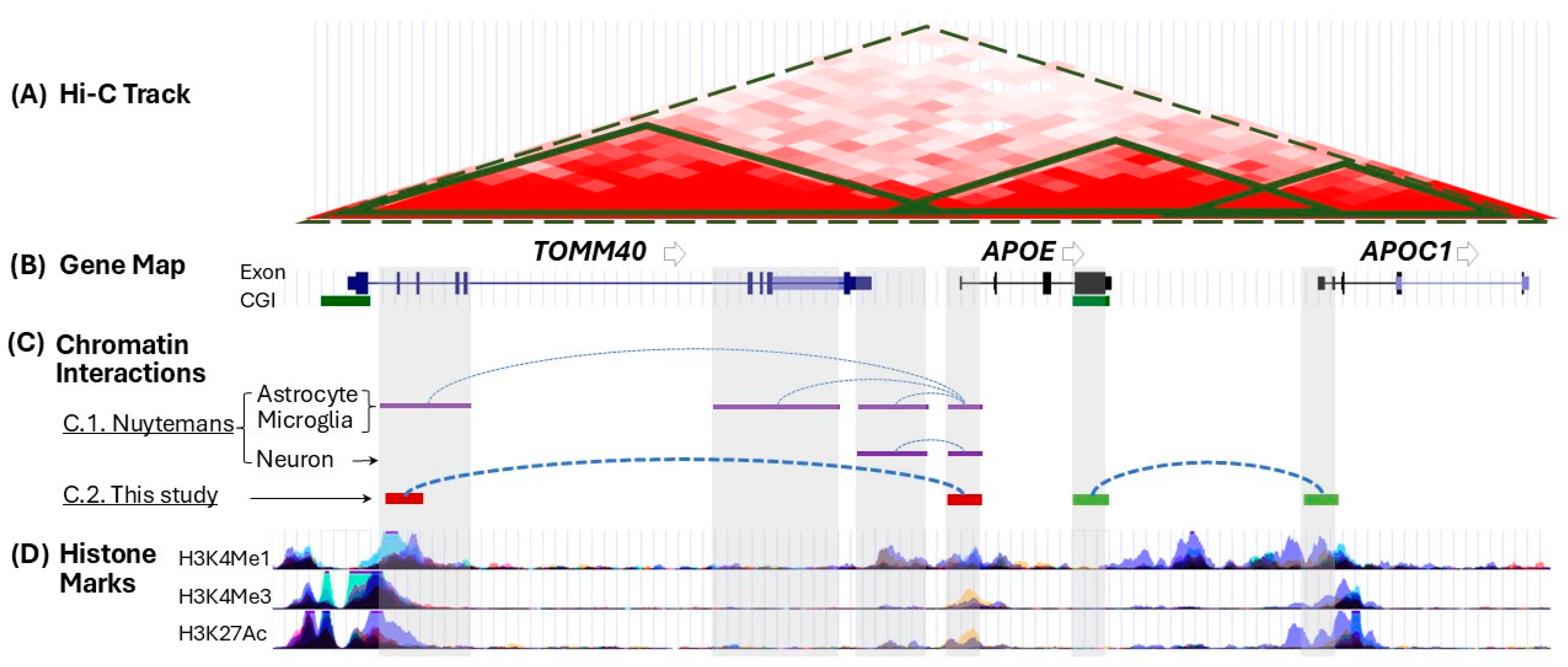
2.1. Design a Chromosome Conformation Capture Assay Targeting the APOE Locus
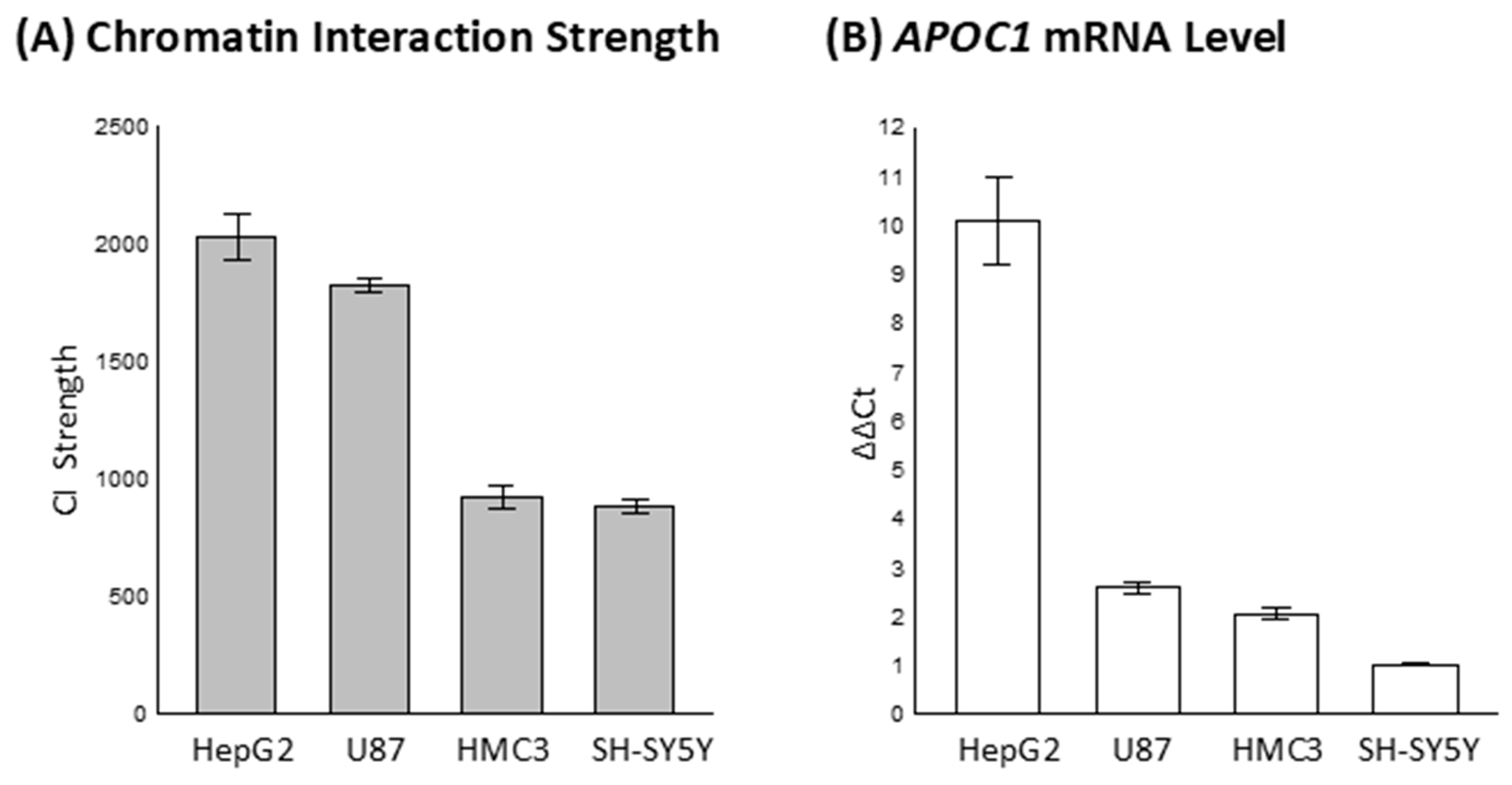
2.2. Identification and Quantification of Cell Type-Specific Chromatin Interactions at the APOE Locus in Human Cell Lines
2.3. Chromatin Interaction Strength and Gene Expression Profiles in Human Postmortem Brain Tissues
2.4. Impact of Regional DNA Methylation on Chromatin Interactions and Gene Expression
3. Discussion
4. Materials and Methods
4.1. Human Postmortem Brain (PMB) and Cell Lines
4.2. DNA/RNA Extraction and Genotyping
4.3. Chromosome Conformation Capture (3C)
4.4. CI Strength-Digital PCR (CIS-dPCR)
4.5. Reverse Transcriptase Reaction and Quantitative PCR (RT-qPCR)
4.6. Bisulfite Pyrosequencing
4.7. Statistical Analysis and Visualization
5. Conclusions
Supplementary Materials
Author Contributions
Funding
Institutional Review Board Statement
Informed Consent Statement
Data Availability Statement
Conflicts of Interest
References
- Davies, G.; Harris, S.E.; Reynolds, C.A.; Payton, A.; Knight, H.M.; Liewald, D.C.; Lopez, L.M.; Luciano, M.; Gow, A.J.; Corley, J.; et al. A genome-wide association study implicates the APOE locus in nonpathological cognitive ageing. Mol. Psychiatry 2014, 19, 76–87. [Google Scholar] [CrossRef]
- Deelen, J.; Evans, D.S.; Arking, D.E.; Tesi, N.; Nygaard, M.; Liu, X.; Wojczynski, M.K.; Biggs, M.L.; van der Spek, A.; Atzmon, G.; et al. A meta-analysis of genome-wide association studies identifies multiple longevity genes. Nat. Commun. 2019, 10, 3669, Erratum in Nat. Commun. 2021, 12, 2463. https://doi.org/10.1038/s41467-021-22613-2. [Google Scholar] [CrossRef] [PubMed]
- Lambert, J.C.; Ibrahim-Verbaas, C.A.; Harold, D.; Naj, A.C.; Sims, R.; Bellenguez, C.; DeStafano, A.L.; Bis, J.C.; Beecham, G.W.; Grenier-Boley, B.; et al. Meta-analysis of 74,046 individuals identifies 11 new susceptibility loci for Alzheimer’s disease. Nat. Genet. 2013, 45, 1452–1458. [Google Scholar] [CrossRef]
- Xu, M.; Zhao, J.; Zhang, Y.; Ma, X.; Dai, Q.; Zhi, H.; Wang, B.; Wang, L. Apolipoprotein E Gene Variants and Risk of Coronary Heart Disease: A Meta-Analysis. Biomed. Res. Int. 2016, 2016, 3912175. [Google Scholar] [CrossRef]
- Chen, W.; Li, B.; Wang, H.; Wei, G.; Chen, K.; Wang, W.; Wang, S.; Liu, Y. Apolipoprotein E E3/E4 genotype is associated with an increased risk of type 2 diabetes mellitus complicated with coronary artery disease. BMC Cardiovasc. Disord. 2024, 24, 160. [Google Scholar] [CrossRef]
- Silva, F.; Rodriguez-Revenga, L.; Madrigal, I.; Alvarez-Mora, M.I.; Oliva, R.; Mila, M. High apolipoprotein E4 allele frequency in FXTAS patients. Genet. Med. Off. J. Am. Coll. Med. Genet. 2013, 15, 639–642. [Google Scholar] [CrossRef]
- Coto, E.; Gomez, J.; Tavira, B.; Tranche, S.; Ortega, F.; Rodriguez, M.I.; Sanchez, E.; Marin, R.; Corao, A.I.; Arenas, J.; et al. A Common Polymorphism Is an Independent Risk Factor for Reduced Glomerular Filtration Rate in the Spanish RENASTUR Cohort. Cardiorenal Med. 2013, 3, 113–119. [Google Scholar] [CrossRef] [PubMed]
- Bras, J.; Guerreiro, R.; Darwent, L.; Parkkinen, L.; Ansorge, O.; Escott-Price, V.; Hernandez, D.G.; Nalls, M.A.; Clark, L.N.; Honig, L.S.; et al. Genetic analysis implicates APOE, SNCA and suggests lysosomal dysfunction in the etiology of dementia with Lewy bodies. Hum. Mol. Genet. 2014, 23, 6139–6146. [Google Scholar] [CrossRef]
- Carty, C.L.; Bhattacharjee, S.; Haessler, J.; Cheng, I.; Hindorff, L.A.; Aroda, V.; Carlson, C.S.; Hsu, C.N.; Wilkens, L.; Liu, S.; et al. Analysis of metabolic syndrome components in >15 000 african americans identifies pleiotropic variants: Results from the population architecture using genomics and epidemiology study. Circulation. Cardiovasc. Genet. 2014, 7, 505–513. [Google Scholar] [CrossRef]
- Abyadeh, M.; Gupta, V.; Paulo, J.A.; Sheriff, S.; Shadfar, S.; Fitzhenry, M.; Amirkhani, A.; Gupta, V.; Salekdeh, G.H.; Haynes, P.A.; et al. Apolipoprotein epsilon in Brain and Retinal Neurodegenerative Diseases. Aging Dis. 2023, 14, 1311–1330. [Google Scholar] [CrossRef] [PubMed]
- Mata, I.F.; Leverenz, J.B.; Weintraub, D.; Trojanowski, J.Q.; Hurtig, H.I.; Van Deerlin, V.M.; Ritz, B.; Rausch, R.; Rhodes, S.L.; Factor, S.A.; et al. APOE, MAPT, and SNCA Genes and Cognitive Performance in Parkinson Disease. JAMA Neurol. 2014, 71, 1405–1412. [Google Scholar] [CrossRef]
- Romero, J.R.; Preis, S.R.; Beiser, A.; DeCarli, C.; Viswanathan, A.; Martinez-Ramirez, S.; Kase, C.S.; Wolf, P.A.; Seshadri, S. Risk factors, stroke prevention treatments, and prevalence of cerebral microbleeds in the Framingham Heart Study. Stroke 2014, 45, 1492–1494. [Google Scholar] [CrossRef]
- Kim, T.Y.; Chung, H.G.; Shin, H.S.; Kim, S.J.; Choi, J.H.; Chung, M.Y.; An, S.K.; Choi, T.K.; So, H.S.; Cho, H.S. Apolipoprotein E gene polymorphism, alcohol use, and their interactions in combat-related posttraumatic stress disorder. Depress. Anxiety 2013, 30, 1194–1201. [Google Scholar] [CrossRef]
- Montagne, A.; Nation, D.A.; Sagare, A.P.; Barisano, G.; Sweeney, M.D.; Chakhoyan, A.; Pachicano, M.; Joe, E.; Nelson, A.R.; D’Orazio, L.M.; et al. APOE4 leads to blood-brain barrier dysfunction predicting cognitive decline. Nature 2020, 581, 71–76. [Google Scholar] [CrossRef] [PubMed]
- Kunkle, B.W.; Grenier-Boley, B.; Sims, R.; Bis, J.C.; Damotte, V.; Naj, A.C.; Boland, A.; Vronskaya, M.; van der Lee, S.J.; Amlie-Wolf, A.; et al. Genetic meta-analysis of diagnosed Alzheimer’s disease identifies new risk loci and implicates Abeta, tau, immunity and lipid processing. Nat. Genet. 2019, 51, 414–430, Erratum in Nat. Genet. 2019, 51, 1423–1424. https://doi.org/10.1038/s41588-019-0495-7. [Google Scholar] [CrossRef]
- Bellenguez, C.; Kucukali, F.; Jansen, I.E.; Kleineidam, L.; Moreno-Grau, S.; Amin, N.; Naj, A.C.; Campos-Martin, R.; Grenier-Boley, B.; Andrade, V.; et al. New insights into the genetic etiology of Alzheimer’s disease and related dementias. Nat. Genet. 2022, 54, 412–436. [Google Scholar] [CrossRef] [PubMed]
- Farrer, L.A.; Cupples, L.A.; Haines, J.L.; Hyman, B.; Kukull, W.A.; Mayeux, R.; Myers, R.H.; Pericak-Vance, M.A.; Risch, N.; van Duijn, C.M. Effects of age, sex, and ethnicity on the association between apolipoprotein E genotype and Alzheimer disease. A meta-analysis. APOE and Alzheimer Disease Meta Analysis Consortium. JAMA 1997, 278, 1349–1356. [Google Scholar] [CrossRef]
- Belloy, M.E.; Andrews, S.J.; Le Guen, Y.; Cuccaro, M.; Farrer, L.A.; Napolioni, V.; Greicius, M.D. APOE Genotype and Alzheimer Disease Risk Across Age, Sex, and Population Ancestry. JAMA Neurol. 2023, 80, 1284–1294. [Google Scholar] [CrossRef] [PubMed]
- Meyer, M.R.; Tschanz, J.T.; Norton, M.C.; Welsh-Bohmer, K.A.; Steffens, D.C.; Wyse, B.W.; Breitner, J.C. APOE genotype predicts when--not whether--one is predisposed to develop Alzheimer disease. Nat. Genet. 1998, 19, 321–322. [Google Scholar] [CrossRef]
- Shinohara, M.; Kanekiyo, T.; Yang, L.; Linthicum, D.; Shinohara, M.; Fu, Y.; Price, L.; Frisch-Daiello, J.L.; Han, X.; Fryer, J.D.; et al. APOE2 eases cognitive decline during Aging: Clinical and preclinical evaluations. Ann. Neurol. 2016, 79, 758–774. [Google Scholar] [CrossRef]
- Andrade-Guerrero, J.; Santiago-Balmaseda, A.; Jeronimo-Aguilar, P.; Vargas-Rodriguez, I.; Cadena-Suarez, A.R.; Sanchez-Garibay, C.; Pozo-Molina, G.; Mendez-Catala, C.F.; Cardenas-Aguayo, M.D.; Diaz-Cintra, S.; et al. Alzheimer’s Disease: An Updated Overview of Its Genetics. Int. J. Mol. Sci. 2023, 24, 3754. [Google Scholar] [CrossRef]
- Andrews, S.J.; Renton, A.E.; Fulton-Howard, B.; Podlesny-Drabiniok, A.; Marcora, E.; Goate, A.M. The complex genetic architecture of Alzheimer’s disease: Novel insights and future directions. EBioMedicine 2023, 90, 104511. [Google Scholar] [CrossRef] [PubMed]
- ADSP (Alzheimer’s Disease Sequencing Project). List of AD Loci and Genes. 2025. Available online: https://adsp.niagads.org/gvc-top-hits-list/ (accessed on 25 April 2025).
- ALZForum, AlzGene. Available online: www.alzforum.org/alzgene (accessed on 27 May 2025).
- Chen, Y.; Strickland, M.R.; Soranno, A.; Holtzman, D.M. Apolipoprotein E: Structural Insights and Links to Alzheimer Disease Pathogenesis. Neuron 2021, 109, 205–221. [Google Scholar] [CrossRef]
- Xu, H.; Fu, J.; Mohammed Nazar, R.B.; Yang, J.; Chen, S.; Huang, Y.; Bao, T.; Chen, X. Investigation of the Relationship between Apolipoprotein E Alleles and Serum Lipids in Alzheimer’s Disease: A Meta-Analysis. Brain Sci. 2023, 13, 1554. [Google Scholar] [CrossRef] [PubMed]
- Bu, G. Apolipoprotein E and its receptors in Alzheimer’s disease: Pathways, pathogenesis and therapy. Nat. Rev. Neurosci. 2009, 10, 333–344. [Google Scholar] [CrossRef]
- Harris, F.M.; Brecht, W.J.; Xu, Q.; Mahley, R.W.; Huang, Y. Increased tau phosphorylation in apolipoprotein E4 transgenic mice is associated with activation of extracellular signal-regulated kinase: Modulation by zinc. J. Biol. Chem. 2004, 279, 44795–44801. [Google Scholar] [CrossRef]
- Mahley, R.W.; Weisgraber, K.H.; Huang, Y. Apolipoprotein E: Structure determines function, from atherosclerosis to Alzheimer’s disease to AIDS. J. Lipid Res. 2009, 50, S183–S188. [Google Scholar] [CrossRef] [PubMed]
- Guo, L.; LaDu, M.J.; Van Eldik, L.J. A dual role for apolipoprotein e in neuroinflammation: Anti- and pro-inflammatory activity. J. Mol. Neurosci. 2004, 23, 205–212. [Google Scholar] [CrossRef]
- Raber, J.; Wong, D.; Yu, G.-Q.; Buttini, M.; Mahley, R.W.; Pitas, R.E.; Mucke, L. Alzheimer’s disease: Apolipoprotein E and cognitive performance. Nature 2000, 404, 352–354. [Google Scholar] [CrossRef]
- Wahrle, S.E.; Jiang, H.; Parsadanian, M.; Legleiter, J.; Han, X.; Fryer, J.D.; Kowalewski, T.; Holtzman, D.M. ABCA1 is required for normal central nervous system ApoE levels and for lipidation of astrocyte-secreted apoE. J. Biol. Chem. 2004, 279, 40987–40993. [Google Scholar] [CrossRef]
- Belaidi, A.A.; Bush, A.I.; Ayton, S. Apolipoprotein E in Alzheimer’s disease: Molecular insights and therapeutic opportunities. Mol. Neurodegener. 2025, 20, 47. [Google Scholar] [CrossRef]
- Chen, Y.; Holtzman, D.M. New insights into innate immunity in Alzheimer’s disease: From APOE protective variants to therapies. Trends Immunol. 2024, 45, 768–782. [Google Scholar] [CrossRef]
- Myers, R.H.; Schaefer, E.J.; Wilson, P.W.; D’Agostino, R.; Ordovas, J.M.; Espino, A.; Au, R.; White, R.F.; Knoefel, J.E.; Cobb, J.L.; et al. Apolipoprotein E epsilon4 association with dementia in a population- based study: The Framingham study. Neurology 1996, 46, 673–677. [Google Scholar] [CrossRef]
- Khachaturian, A.S.; Corcoran, C.D.; Mayer, L.S.; Zandi, P.P.; Breitner, J.C.; Cache County Study, I. Apolipoprotein E epsilon4 count affects age at onset of Alzheimer disease, but not lifetime susceptibility: The Cache County Study. Arch. Gen. Psychiatry 2004, 61, 518–524. [Google Scholar] [CrossRef]
- Liddell, M.B.; Lovestone, S.; Owen, M.J. Genetic risk of Alzheimer’s disease: Advising relatives. Br.J. Psychiatry 2001, 178, 7–11. [Google Scholar] [CrossRef] [PubMed]
- Valerio, D.; Raventos, H.; Schmeidler, J.; Beeri, M.S.; Villalobos, L.M.; Bolanos-Palmieri, P.; Carrion-Baralt, J.R.; Fornaguera, J.; Silverman, J.M. Association of apolipoprotein E-e4 and dementia declines with age. Am. J. Geriatr. Psychiatry 2014, 22, 957–960. [Google Scholar] [CrossRef]
- Corrada, M.M.; Paganini-Hill, A.; Berlau, D.J.; Kawas, C.H. Apolipoprotein E genotype, dementia, and mortality in the oldest old: The 90+ Study. Alzheimers Dement. 2013, 9, 12–18. [Google Scholar] [CrossRef] [PubMed]
- Mondadori, C.R.; de Quervain, D.J.; Buchmann, A.; Mustovic, H.; Wollmer, M.A.; Schmidt, C.F.; Boesiger, P.; Hock, C.; Nitsch, R.M.; Papassotiropoulos, A.; et al. Better memory and neural efficiency in young apolipoprotein E epsilon4 carriers. Cereb. Cortex 2007, 17, 1934–1947. [Google Scholar] [CrossRef] [PubMed]
- Taylor, W.D.; Boyd, B.; Turner, R.; McQuoid, D.R.; Ashley-Koch, A.; MacFall, J.R.; Saleh, A.; Potter, G.G. APOE epsilon4 associated with preserved executive function performance and maintenance of temporal and cingulate brain volumes in younger adults. Brain Imaging Behav. 2017, 11, 194–204. [Google Scholar] [CrossRef]
- Jochemsen, H.M.; Muller, M.; van der Graaf, Y.; Geerlings, M.I. APOE epsilon4 differentially influences change in memory performance depending on age. The SMART-MR study. Neurobiol. Aging 2012, 33, 832.e15–832.e22. [Google Scholar] [CrossRef]
- Rusted, J.M.; Evans, S.L.; King, S.L.; Dowell, N.; Tabet, N.; Tofts, P.S. APOE e4 polymorphism in young adults is associated with improved attention and indexed by distinct neural signatures. Neuroimage 2013, 65, 364–373. [Google Scholar] [CrossRef]
- Kulminski, A.M.; Philipp, I.; Shu, L.; Culminskaya, I. Definitive roles of TOMM40-APOE-APOC1 variants in the Alzheimer’s risk. Neurobiol. Aging 2022, 110, 122–131. [Google Scholar] [CrossRef]
- Takei, N.; Miyashita, A.; Tsukie, T.; Arai, H.; Asada, T.; Imagawa, M.; Shoji, M.; Higuchi, S.; Urakami, K.; Kimura, H.; et al. Genetic association study on in and around the APOE in late-onset Alzheimer disease in Japanese. Genomics 2009, 93, 441–448. [Google Scholar] [CrossRef]
- Christiansen, M.K.; Nyegaard, M.; Larsen, S.B.; Grove, E.L.; Wurtz, M.; Neergaard-Petersen, S.; Hvas, A.M.; Jensen, H.K.; Kristensen, S.D. A genetic risk score predicts cardiovascular events in patients with stable coronary artery disease. Int. J. Cardiol. 2017, 241, 411–416. [Google Scholar] [CrossRef] [PubMed]
- Lin, R.; Zhang, Y.; Yan, D.; Liao, X.; Gong, G.; Hu, J.; Fu, Y.; Cai, W. Association of common variants in TOMM40/APOE/APOC1 region with human longevity in a Chinese population. J. Hum. Genet. 2016, 61, 323–328. [Google Scholar] [CrossRef]
- Blue, E.E.; Cheng, A.; Chen, S.; Yu, C.E.; Alzheimer’s Disease Genetics, C. Association of Uncommon, Noncoding Variants in the APOE Region With Risk of Alzheimer Disease in Adults of European Ancestry. JAMA Netw. Open 2020, 3, e2017666. [Google Scholar] [CrossRef] [PubMed]
- Dogan, E.S.; Liu, C. Three-dimensional chromatin packing and positioning of plant genomes. Nat. Plants 2018, 4, 521–529. [Google Scholar] [CrossRef]
- Sexton, T.; Cavalli, G. The role of chromosome domains in shaping the functional genome. Cell 2015, 160, 1049–1059. [Google Scholar] [CrossRef] [PubMed]
- Zagirova, D.; Kononkova, A.; Vaulin, N.; Khrameeva, E. From compartments to loops: Understanding the unique chromatin organization in neuronal cells. Epigenetics Chromatin 2024, 17, 18. [Google Scholar] [CrossRef]
- Papantonis, A.; Oudelaar, A.M. Mechanisms of Enhancer-Mediated Gene Activation in the Context of the 3D Genome. Annu. Rev. Genom. Hum. Genet. 2025, 26, 163–188. [Google Scholar] [CrossRef]
- Liu, S.; Wang, C.Y.; Zheng, P.; Jia, B.B.; Zemke, N.R.; Ren, P.; Park, H.L.; Ren, B.; Zhuang, X. Cell type-specific 3D-genome organization and transcription regulation in the brain. Sci. Adv. 2025, 11, eadv2067. [Google Scholar] [CrossRef]
- Matharu, N.; Ahituv, N. Minor Loops in Major Folds: Enhancer-Promoter Looping, Chromatin Restructuring, and Their Association with Transcriptional Regulation and Disease. PLoS Genet. 2015, 11, e1005640. [Google Scholar] [CrossRef]
- Breeze, C.E.; Haugen, E.; Gutierrez-Arcelus, M.; Yao, X.; Teschendorff, A.; Beck, S.; Dunham, I.; Stamatoyannopoulos, J.; Franceschini, N.; Machiela, M.J.; et al. FORGEdb: A tool for identifying candidate functional variants and uncovering target genes and mechanisms for complex diseases. Genome Biol. 2024, 25, 3. [Google Scholar] [CrossRef]
- Liu, T.; Porter, J.; Zhao, C.; Zhu, H.; Wang, N.; Sun, Z.; Mo, Y.Y.; Wang, Z. TADKB: Family classification and a knowledge base of topologically associating domains. BMC Genom. 2019, 20, 217. [Google Scholar] [CrossRef]
- Yu, C.E.; Cudaback, E.; Foraker, J.; Thomson, Z.; Leong, L.; Lutz, F.; Gill, J.A.; Saxton, A.; Kraemer, B.; Navas, P.; et al. Epigenetic signature and enhancer activity of the human APOE gene. Hum. Mol. Genet. 2013, 22, 5036–5047. [Google Scholar] [CrossRef]
- Nuytemans, K.; Lipkin Vasquez, M.; Wang, L.; Van Booven, D.; Griswold, A.J.; Rajabli, F.; Celis, K.; Oron, O.; Hofmann, N.; Rolati, S.; et al. Identifying differential regulatory control of APOE varepsilon4 on African versus European haplotypes as potential therapeutic targets. Alzheimers Dement. 2022, 18, 1930–1942. [Google Scholar] [CrossRef]
- He, Y.; Li, C.; Yang, Y.; Li, Y.; Wang, Y.; Yang, H.; Jin, T.; Chen, S. Meta-analysis of the rs2075650 polymorphism and risk of Alzheimer disease. Aging Clin. Exp. Res. 2016, 28, 805–811. [Google Scholar] [CrossRef] [PubMed]
- Foraker, J.; Millard, S.P.; Leong, L.; Thomson, Z.; Chen, S.; Keene, C.D.; Bekris, L.M.; Yu, C.E. The APOE Gene is Differentially Methylated in Alzheimer’s Disease. J. Alzheimers Dis. 2015, 48, 745–755. [Google Scholar] [CrossRef] [PubMed]
- Griswold, A.J.; Celis, K.; Bussies, P.L.; Rajabli, F.; Whitehead, P.L.; Hamilton-Nelson, K.L.; Beecham, G.W.; Dykxhoorn, D.M.; Nuytemans, K.; Wang, L.; et al. Increased APOE epsilon4 expression is associated with the difference in Alzheimer’s disease risk from diverse ancestral backgrounds. Alzheimers Dement. 2021, 17, 1179–1188. [Google Scholar] [CrossRef] [PubMed]
- Rajabli, F.; Feliciano, B.E.; Celis, K.; Hamilton-Nelson, K.L.; Whitehead, P.L.; Adams, L.D.; Bussies, P.L.; Manrique, C.P.; Rodriguez, A.; Rodriguez, V.; et al. Ancestral origin of ApoE epsilon4 Alzheimer disease risk in Puerto Rican and African American populations. PLoS Genet. 2018, 14, e1007791. [Google Scholar] [CrossRef]
- Yu, C.-E.; Tulloch, J.; Lee, E.-G. APOE Genetics and Epigenetics and Physiological Mechanisms. In Apolipoprotein E: From Biochemistry and Biology to Translational Medicine; Oria, R., Ashford, J.W., Smith, C.J., Eds.; Springer Nature: Cham, Switzerland, 2025; pp. 1–29. [Google Scholar]
- Millan-Zambrano, G.; Burton, A.; Bannister, A.J.; Schneider, R. Histone post-translational modifications-cause and consequence of genome function. Nat. Rev. Genet. 2022, 23, 563–580. [Google Scholar] [CrossRef]
- Li, K.Y.; Cao, Q.; Chow, S.H.; Nicoletti, C.; Puri, P.L.; Wang, H.; Leung, D.; Yip, K.Y. Regulatory roles of three-dimensional structures of chromatin domains. Genome Biol. 2025, 26, 184. [Google Scholar] [CrossRef] [PubMed]
- Zhang, L.; Xia, Y.; Gui, Y. Neuronal ApoE4 in Alzheimer’s disease and potential therapeutic targets. Front. Aging Neurosci. 2023, 15, 1199434. [Google Scholar] [CrossRef]
- Reed, K.S.M.; Davis, E.S.; Bond, M.L.; Cabrera, A.; Thulson, E.; Quiroga, I.Y.; Cassel, S.; Woolery, K.T.; Hilton, I.; Won, H.; et al. Temporal analysis suggests a reciprocal relationship between 3D chromatin structure and transcription. Cell Rep. 2022, 41, 111567. [Google Scholar] [CrossRef]
- Deng, S.; Feng, Y.; Pauklin, S. 3D chromatin architecture and transcription regulation in cancer. J. Hematol. Oncol. 2022, 15, 49. [Google Scholar] [CrossRef]
- Braunger, J.M.; Cammarata, L.V.; Sornapudi, T.R.; Uhler, C.; Shivashankar, G.V. Transcriptional changes are tightly coupled to chromatin reorganization during cellular aging. Aging Cell 2024, 23, e14056. [Google Scholar] [CrossRef]
- Kreibich, E.; Kleinendorst, R.; Barzaghi, G.; Kaspar, S.; Krebs, A.R. Single-molecule footprinting identifies context-dependent regulation of enhancers by DNA methylation. Mol. Cell 2023, 83, 787–802.e9. [Google Scholar] [CrossRef] [PubMed]
- King, A.D.; Huang, K.; Rubbi, L.; Liu, S.; Wang, C.Y.; Wang, Y.; Pellegrini, M.; Fan, G. Reversible Regulation of Promoter and Enhancer Histone Landscape by DNA Methylation in Mouse Embryonic Stem Cells. Cell Rep. 2016, 17, 289–302. [Google Scholar] [CrossRef] [PubMed]
- Bell, J.S.K.; Vertino, P.M. Orphan CpG islands define a novel class of highly active enhancers. Epigenetics 2017, 12, 449–464. [Google Scholar] [CrossRef]
- Wei, Y.; Du, X.; Guo, H.; Han, J.; Liu, M. Mitochondrial dysfunction and Alzheimer’s disease: Pathogenesis of mitochondrial transfer. Front. Aging Neurosci. 2024, 16, 1517965. [Google Scholar] [CrossRef]
- Sherman, E.L.; Taylor, R.D.; Go, N.E.; Nargang, F.E. Effect of mutations in Tom40 on stability of the translocase of the outer mitochondrial membrane (TOM) complex, assembly of Tom40, and import of mitochondrial preproteins. J. Biol. Chem. 2006, 281, 22554–22565. [Google Scholar] [CrossRef] [PubMed]
- Zhu, X.; Perry, G.; Moreira, P.I.; Aliev, G.; Cash, A.D.; Hirai, K.; Smith, M.A. Mitochondrial abnormalities and oxidative imbalance in Alzheimer disease. J. Alzheimers Dis. 2006, 9, 147–153. [Google Scholar] [CrossRef] [PubMed]
- Fuior, E.V.; Gafencu, A.V. Apolipoprotein C1: Its Pleiotropic Effects in Lipid Metabolism and Beyond. Int. J. Mol. Sci. 2019, 20, 5939. [Google Scholar] [CrossRef]
- Rouland, A.; Masson, D.; Lagrost, L.; Verges, B.; Gautier, T.; Bouillet, B. Role of apolipoprotein C1 in lipoprotein metabolism, atherosclerosis and diabetes: A systematic review. Cardiovasc. Diabetol. 2022, 21, 272. [Google Scholar] [CrossRef] [PubMed]
- Gratchev, A.; Kzhyshkowska, J.; Kannookadan, S.; Ochsenreiter, M.; Popova, A.; Yu, X.; Mamidi, S.; Stonehouse-Usselmann, E.; Muller-Molinet, I.; Gooi, L.; et al. Activation of a TGF-beta-specific multistep gene expression program in mature macrophages requires glucocorticoid-mediated surface expression of TGF-beta receptor II. J. Immunol. 2008, 180, 6553–6565. [Google Scholar] [CrossRef]
- Zhou, Q.; Zhao, F.; Lv, Z.P.; Zheng, C.G.; Zheng, W.D.; Sun, L.; Wang, N.N.; Pang, S.; de Andrade, F.M.; Fu, M.; et al. Association between APOC1 polymorphism and Alzheimer’s disease: A case-control study and meta-analysis. PLoS ONE 2014, 9, e87017. [Google Scholar] [CrossRef]
- Lee, E.G.; Leong, L.; Chen, S.; Tulloch, J.; Yu, C.E. APOE Locus-Associated Mitochondrial Function and Its Implication in Alzheimer’s Disease and Aging. Int. J. Mol. Sci. 2023, 24, 10440. [Google Scholar] [CrossRef]
- Sussman, C.; Liberatore, R.A.; Drozdz, M.M. Delivery of DNA-Based Therapeutics for Treatment of Chronic Diseases. Pharmaceutics 2024, 16, 535. [Google Scholar] [CrossRef]
- Degerman, S.; Domellof, M.; Landfors, M.; Linder, J.; Lundin, M.; Haraldsson, S.; Elgh, E.; Roos, G.; Forsgren, L. Long leukocyte telomere length at diagnosis is a risk factor for dementia progression in idiopathic parkinsonism. PLoS ONE 2014, 9, e113387. [Google Scholar] [CrossRef]
- O’Connell, G.C.; Chantler, P.D.; Barr, T.L. High Interspecimen Variability in Nucleic Acid Extraction Efficiency Necessitates the Use of Spike-In Control for Accurate qPCR-based Measurement of Plasma Cell-Free DNA Levels. Lab. Med. 2017, 48, 332–338. [Google Scholar] [CrossRef]



| Ctrl | AD | |
|---|---|---|
| Sample, n | 10 | 15 |
| Sex, Female, n (%) | 6 (60.0) | 8 (53.3) |
| Age at death_mean (SD) | 83.8 (6.8) | 84.7 (5.1) |
| Age at onset_mean (SD) | N/A | 76.3 (6.4) |
| Disease duration_mean years (SD) | N/A | 8.3 (4.3) |
| Postmortem interval_mean hours (SD) | 4.8 (2.5) | 4.8 (2.0) |
| CERAD score | ||
| Absent | 5 | 0 |
| Sparse | 3 | 0 |
| Moderate | 2 | 2 |
| Frequent | 0 | 13 |
| BRAAK stage | ||
| I | 1 | 0 |
| II | 4 | 0 |
| III | 5 | 0 |
| IV | 0 | 0 |
| V | 0 | 8 |
| VI | 0 | 7 |
| APOE genotype | ||
| ε3/ε3 | 5 | 5 |
| ε3/ε4 | 5 | 5 |
| ε4/ε4 | 0 | 5 |
| Outcome a: | Chromatin Interaction Strength | APOC1 mRNA Level |
|---|---|---|
| Disease status | 0.247 | 0.055 |
| APOE ε3/ε4 | 0.408 | 0.285 |
| APOE ε4/ε4 | 0.024 | 0.570 |
| Disease and APOE ε3/ε4 | 0.427 | 0.651 |
| Disease and APOE ε4/ε4 | NA | NA |
| Outcome a: | Chromatin Interaction Strength | APOC1 mRNA Level | ||
|---|---|---|---|---|
| Estimate [95% CI] | p-Value | Estimate [95% CI] | p-Value | |
| ACME | −7.10 [−123.82, 114.01] | 0.934 | −0.021 [−0.220, 0.219] | 0.874 |
| ADE | 345.77 [−16.00, 678.07] | 0.066 | 0.383 [−0.328, 1.165] | 0.278 |
| Total Effect | 338.67 [18.82, 674.22] | 0.042 | 0.362 [−0.322, 1.166] | 0.298 |
| Proportion Mediated | −0.02 [−0.71, 0.50] | 0.916 | −0.057 [−2.179, 1.497] | 0.916 |
Disclaimer/Publisher’s Note: The statements, opinions and data contained in all publications are solely those of the individual author(s) and contributor(s) and not of MDPI and/or the editor(s). MDPI and/or the editor(s) disclaim responsibility for any injury to people or property resulting from any ideas, methods, instructions or products referred to in the content. |
© 2025 by the authors. Licensee MDPI, Basel, Switzerland. This article is an open access article distributed under the terms and conditions of the Creative Commons Attribution (CC BY) license.
Share and Cite
Lee, E.-G.; Leong, L.; Chen, S.; Tulloch, J.; Yu, C.-E. Interplay Between 3D Chromatin Architecture and Gene Regulation at the APOE Locus Contributes to Alzheimer’s Disease Risk. Int. J. Mol. Sci. 2026, 27, 302. https://doi.org/10.3390/ijms27010302
Lee E-G, Leong L, Chen S, Tulloch J, Yu C-E. Interplay Between 3D Chromatin Architecture and Gene Regulation at the APOE Locus Contributes to Alzheimer’s Disease Risk. International Journal of Molecular Sciences. 2026; 27(1):302. https://doi.org/10.3390/ijms27010302
Chicago/Turabian StyleLee, Eun-Gyung, Lesley Leong, Sunny Chen, Jessica Tulloch, and Chang-En Yu. 2026. "Interplay Between 3D Chromatin Architecture and Gene Regulation at the APOE Locus Contributes to Alzheimer’s Disease Risk" International Journal of Molecular Sciences 27, no. 1: 302. https://doi.org/10.3390/ijms27010302
APA StyleLee, E.-G., Leong, L., Chen, S., Tulloch, J., & Yu, C.-E. (2026). Interplay Between 3D Chromatin Architecture and Gene Regulation at the APOE Locus Contributes to Alzheimer’s Disease Risk. International Journal of Molecular Sciences, 27(1), 302. https://doi.org/10.3390/ijms27010302