Review: Detection of Cancer Biomarkers from a Clinical Perspective
 , , , and
Abstract
1. Introduction
2. Clinical Detection Using Different Methods
2.1. Detection with Mass Spectrometry
2.2. Detection with Immunoassays Including ELISA
2.3. Nucleic Acid-Based Detection of Cancer Biomarkers
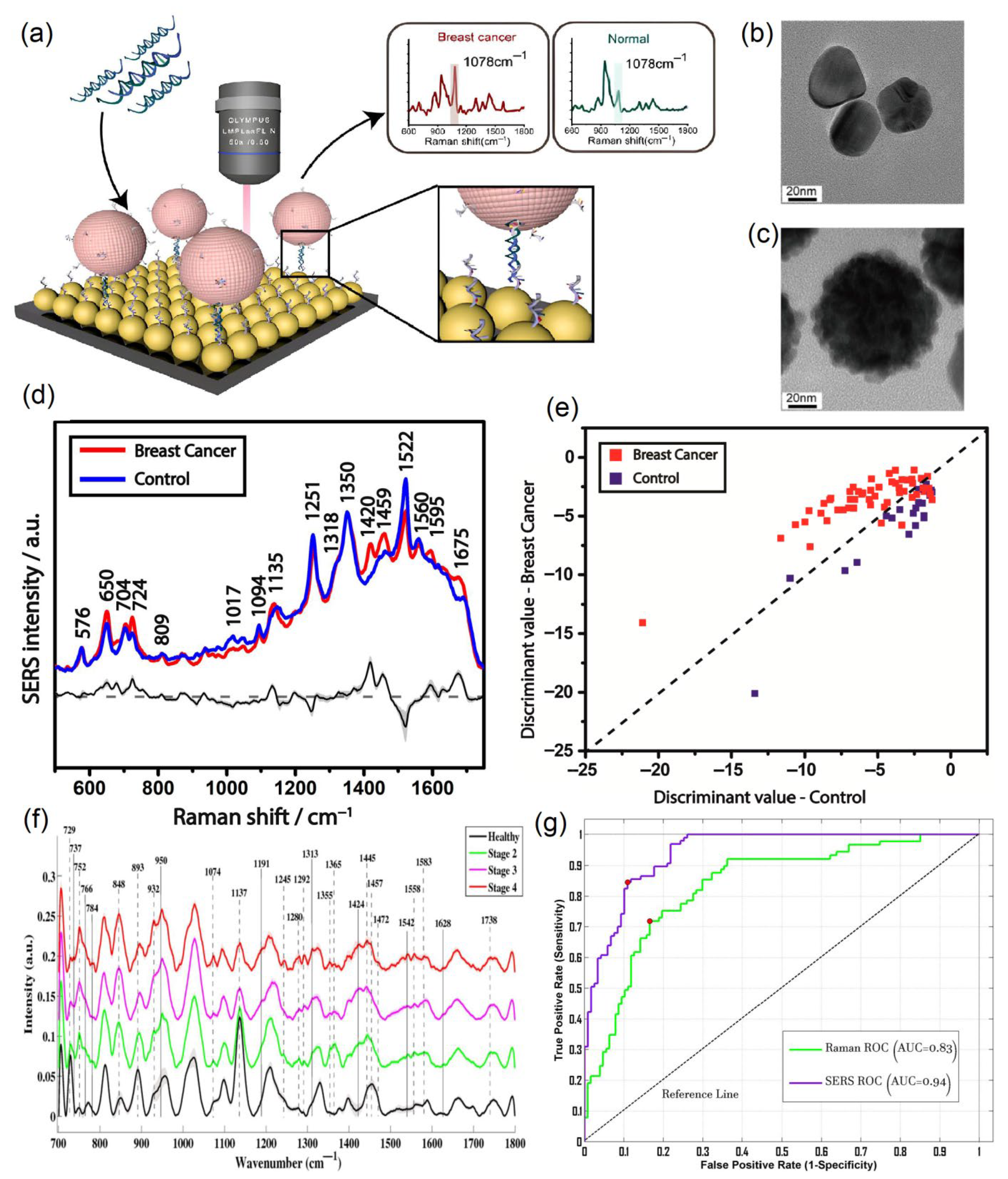
2.4. Detection with SERS

| First Author, Year | Assay/Data Processing Method | Biomarker (Cancer Type) | Cancer Patients/Control Patients | Sensitivity/Specificity/Accuracy |
|---|---|---|---|---|
| Direct SERS: | ||||
| Feng, 2017 [140] | Direct SERS, PLS-DA | Urinary modified nucleosides (nasopharyngeal) | 62/52 | 95.2%/97.2%/- |
| Urinary modified nucleosides (esophageal) | 55/52 | 90.9%/98.2%/- | ||
| Hernandez-Arteaga, 2017 [141] | Direct SERS | Sialic acid in the saliva (breast) | 100/106 | 94%/98%/- |
| Koo, 2018 [142] | Direct SERS | ERG and PCA3 (prostate) | 90/30 | 87%/90%/- |
| Paraskevaidi, 2018 [143] | Direct SERS | CA125 (ovarian) | 27/28 | 80%/94%/- |
| Qian, 2018 [144] | Direct SERS | Proteins and nucleic acids (lung) | 61/66 | 95.1%/100%/- |
| Hernadez-Arteaga, 2019 [145] | Direct SERS | Sialic acid (breast) | 35/129 | 80%/93%/- |
| Lin, 2019 [146] | Direct SERS | Modified nucleoside (gastric) | 50/48 | 84%/95.8%/- |
| Modified nucleoside (breast) | 43/48 | 87.5%/87.5%/- | ||
| Moisoiu, 2019 [147] | Direct SERS | Anionic purine metabolites: uric acid, xanthine, and hypoxanthine (breast) | 53/22 | 81%/95%/- |
| Perumal, 2019 [148] | Direct SERS | Hp (epithelial ovarian cancer) | 54/57 | 94%/91%/- |
| Lin, 2020 [149] | Direct SERS | Tumor markers such as DNA, RNA, proteins, etc. (gastric) | 50/48 | 90%/93.8%/- |
| Tumor markers such as DNA, RNA, proteins, etc. (breast) | 43/48 | 96%/93.8%/- | ||
| Lin, 2020 [150] | Direct SERS | DNA, RNA, proteins (colorectal) | 63/53 | 95.8%/94.3%/- |
| Ma, 2021 [151] | Direct SERS | Urinary metabolite (prostate) | 12/63 | 86%/87.1%/- |
| Hu, 2021 [138] | Direct SERS | Metabolites, exfoliated tumor cells (bladder) | 161/87 | 100%/98.9%/- |
| Nargis, 2021 [152] | Direct SERS | SERS features related to DNA, proteins, and lipids (breast) | 17/12 | 90%/98.4%/94% |
| Xiong, 2023 [153] | Direct SERS | L-tyrosine; acetoacetate, riboflavin; phospholipids, amide-I, alpha-helix (bladder; adrenal; acute myeloid leukemia) | 80/30 | -/-/98.27% |
| Arithmetic mean | 90%/95%/96% | |||
| Median | 90%/95%/96 | |||
| Indirect SERS: | ||||
| Banaei, 2021 [154] | SERS immunoassay | EVs (pancreatic) | 5/5 | 95%/96%/- |
| Han, 2022 [155] | Microfluidic SERS | CD63, VIM, EpCAM (osteosarcoma) | 20/20 | 100%/90%/95% |
| Weng, 2022 [139] | SERS with CHA amplification | miRNA-21 (breast) | 30/30 | 93.3%/100%/100% |
| miRNA-155 (breast) | 100%/100%/100% | |||
| Murali, 2023 [156] | Indirect SERS (using nanotags) | ER, PR, HER2 (breast, singleplex) | N/A | 95%/92%/- |
| (duplex) | 88%/85%/- | |||
| (triplex) | 75%/67%/- | |||
| Arithmetic mean | 92%/90%/98% | |||
| Median | 95%/92%/100% | |||
| Direct and Indirect SERS Combined: | ||||
| Arithmetic mean (overall): | 91%/93%/97% | |||
| Median (overall): | 92%/94%/98% | |||
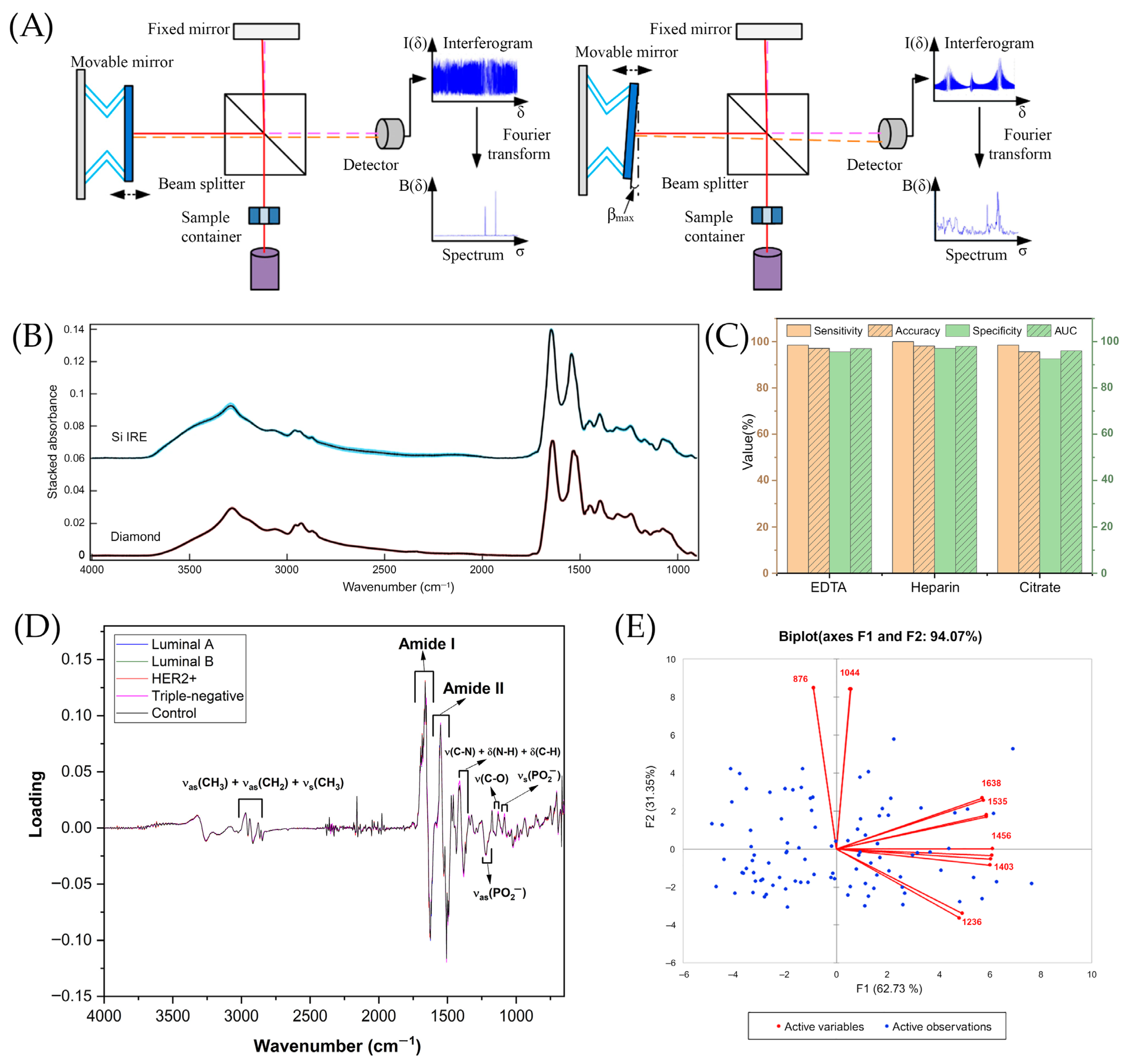
2.5. Detection with FTIR
3. Clinical Applications for Cancer Biomarker Detection
4. Challenges and Perspectives
5. Conclusions
Author Contributions
Funding
Data Availability Statement
Conflicts of Interest
References
- Brown, J.S.; Amend, S.R.; Austin, R.H.; Gatenby, R.A.; Hammarlund, E.U.; Pienta, K.J. Updating the Definition of Cancer. Mol. Cancer Res. 2023, 21, 1142–1147. [Google Scholar] [CrossRef]
- Hajdu, S.I. A note from history: Landmarks in history of cancer, part 1. Cancer 2010, 117, 1097–1102. [Google Scholar] [CrossRef]
- Carbone, A. Cancer Classification at the Crossroads. Cancers 2020, 12, 980. [Google Scholar] [CrossRef] [PubMed]
- Siegel, R.L.; Miller, K.D.; Wagle, N.S.; Jemal, A. Cancer statistics, 2023. CA Cancer J. Clin. 2023, 73, 17–48. [Google Scholar] [CrossRef]
- Zhu, J.; Li, S.; Li, X.; Wang, L.; Du, L.; Qiu, Y. Impact of population ageing on cancer-related disability-adjusted life years: A global decomposition analysis. J. Glob. Health 2024, 14, 04144. [Google Scholar] [CrossRef] [PubMed]
- Wu, L.; Qu, X. Cancer biomarker detection: Recent achievements and challenges. Chem. Soc. Rev. 2015, 44, 2963–2997. [Google Scholar] [CrossRef] [PubMed]
- Saadatmand, S.; Bretveld, R.; Siesling, S.; Tilanus-Linthorst, M.M. Influence of tumour stage at breast cancer detection on survival in modern times: Population based study in 173 797 patients. BMJ 2015, 351, h4901. [Google Scholar] [CrossRef]
- Zheng, G.; Patolsky, F.; Cui, Y.; Wang, W.U.; Lieber, C.M. Multiplexed electrical detection of cancer markers with nanowire sensor arrays. Nat. Biotechnol. 2005, 23, 1294–1301. [Google Scholar] [CrossRef]
- Chen, J.; Hou, H.; Chen, H.; Luo, Y.; Zhang, L.; Zhang, Y.; Liu, H.; Zhang, F.; Liu, Y.; Wang, A.; et al. Urinary metabolomics for discovering metabolic biomarkers of laryngeal cancer using UPLC-QTOF/MS. J. Pharm. Biomed. Anal. 2019, 167, 83–89. [Google Scholar] [CrossRef]
- Jarockyte, G.; Karabanovas, V.; Rotomskis, R.; Mobasheri, A. Multiplexed Nanobiosensors: Current Trends in Early Diagnostics. Sensors 2020, 20, 6890. [Google Scholar] [CrossRef]
- Amethiya, Y.; Pipariya, P.; Patel, S.; Shah, M. Comparative analysis of breast cancer detection using machine learning and biosensors. Intell. Med. 2022, 2, 69–81. [Google Scholar] [CrossRef]
- Saba, T. Recent advancement in cancer detection using machine learning: Systematic survey of decades, comparisons and challenges. J. Infect. Public Health 2020, 13, 1274–1289. [Google Scholar] [CrossRef]
- Diamandis, E.P. Mass Spectrometry as a Diagnostic and a Cancer Biomarker Discovery Tool: Opportunities and Potential Limitations. Mol. Cell. Proteom. 2004, 3, 367–378. [Google Scholar] [CrossRef]
- Bernard, P.S.; Wittwer, C.T. Real-time PCR technology for cancer diagnostics. Clin. Chem. 2002, 48, 1178–1185. [Google Scholar] [CrossRef]
- Arya, S.K.; Estrela, P. Recent advances in enhancement strategies for electrochemical ELISA-based immunoassays for cancer biomarker detection. Sensors 2018, 18, 2010. [Google Scholar] [CrossRef]
- Terzapulo, X.; Kassenova, A.; Bukasov, R. Immunoassays: Analytical and Clinical Performance, Challenges, and Perspectives of SERS Detection in Comparison with Fluorescent Spectroscopic Detection. Int. J. Mol. Sci. 2024, 25, 2080. [Google Scholar] [CrossRef]
- Sultangaziyev, A.; Ilyas, A.; Dyussupova, A.; Bukasov, R. Trends in application of SERS substrates beyond Ag and Au, and their role in bioanalysis. Biosensors 2022, 12, 967. [Google Scholar] [CrossRef]
- Sala, A.; Anderson, D.J.; Brennan, P.M.; Butler, H.J.; Cameron, J.M.; Jenkinson, M.D.; Rinaldi, C.; Theakstone, A.G.; Baker, M.J. Biofluid diagnostics by FTIR spectroscopy: A platform technology for cancer detection. Cancer Lett. 2020, 477, 122–130. [Google Scholar] [CrossRef] [PubMed]
- Farooq, M.; Leevan, E.; Ahmed, J.; Ko, B.; Shin, S.; De Souza, A.; Takebe, N. Blood-based multi-cancer detection: A state-of-the-art update. Curr. Probl. Cancer 2024, 48, 101059. [Google Scholar] [CrossRef]
- Aitekenov, S.; Gaipov, A.; Bukasov, R. Review: Detection and quantification of proteins in human urine. Talanta 2021, 223, 121718. [Google Scholar] [CrossRef] [PubMed]
- Wang, X.; Kaczor-Urbanowicz, K.E.; Wong, D.T.W. Salivary biomarkers in cancer detection. Med. Oncol. 2017, 34, 7. [Google Scholar] [CrossRef]
- Marcuello, C.; Lim, K.; Nisini, G.; Pokrovsky, V.S.; Conde, J.; Ruggeri, F.S. Nanoscale Analysis beyond Imaging by Atomic Force Microscopy: Molecular Perspectives on Oncology and Neurodegeneration. Small Sci. 2025, 5, e202500351. [Google Scholar] [CrossRef]
- Isaic, A.; Motofelea, N.; Hoinoiu, T.; Motofelea, A.C.; Leancu, I.C.; Stan, E.; Gheorghe, S.R.; Dutu, A.G.; Crintea, A. Next-Generation Sequencing: A Review of Its Transformative Impact on Cancer Diagnosis, Treatment, and Resistance Management. Diagnostics 2025, 15, 2425. [Google Scholar] [CrossRef]
- Terzapulo, X.; Dyussupova, A.; Ilyas, A.; Boranova, A.; Shevchenko, Y.; Mergenbayeva, S.; Filchakova, O.; Gaipov, A.; Bukasov, R. Detection of Cancer Biomarkers: Review of Methods and Applications Reported from Analytical Perspective. Crit. Rev. Anal. Chem. 2025, 172, 1–46. [Google Scholar] [CrossRef] [PubMed]
- Griffiths, J. A Brief History of Mass Spectrometry. Anal. Chem. 2008, 80, 5678–5683. [Google Scholar] [CrossRef] [PubMed]
- Wang, P.; Whiteaker, J.R.; Paulovich, A.G. The evolving role of mass spectrometry in cancer biomarker discovery. Cancer Biol. Ther. 2009, 8, 1083–1094. [Google Scholar] [CrossRef][Green Version]
- Marshall, A.G.; Hendrickson, C.L.; Jackson, G.S. Fourier transform ion cyclotron resonance mass spectrometry: A primer. Mass Spectrom. Rev. 1998, 17, 1–35. [Google Scholar] [CrossRef]
- Dettmer, K.; Aronov, P.A.; Hammock, B.D. Mass spectrometry-based metabolomics. Mass Spectrom. Rev. 2007, 26, 51–78. [Google Scholar] [CrossRef]
- Taguchi, F.; Solomon, B.; Gregorc, V.; Roder, H.; Gray, R.; Kasahara, K.; Nishio, M.; Brahmer, J.; Spreafico, A.; Ludovini, V.; et al. Mass Spectrometry to Classify Non–Small-Cell Lung Cancer Patients for Clinical Outcome After Treatment With Epidermal Growth Factor Receptor Tyrosine Kinase Inhibitors: A Multicohort Cross-Institutional Study. J. Natl. Cancer Inst. 2007, 99, 838–846. [Google Scholar] [CrossRef]
- Bian, X.; Qian, Y.; Tan, B.; Li, K.; Hong, X.; Wong, C.C.; Fu, L.; Zhang, J.; Li, N.; Wu, J.-L. In-depth mapping carboxylic acid metabolome reveals the potential biomarkers in colorectal cancer through characteristic fragment ions and metabolic flux. Anal. Chim. Acta 2020, 1128, 62–71. [Google Scholar] [CrossRef]
- Markin, P.A.; Brito, A.; Moskaleva, N.; Fodor, M.; Lartsova, E.V.; Shpot, Y.V.; Lerner, Y.V.; Mikhajlov, V.Y.; Potoldykova, N.V.; Enikeev, D.V.; et al. Plasma Sarcosine Measured by Gas Chromatography-Mass Spectrometry Distinguishes Prostatic Intraepithelial Neoplasia and Prostate Cancer from Benign Prostate Hyperplasia. Lab. Med. 2020, 51, 566–573. [Google Scholar] [CrossRef]
- Takayama, T.; Tsutsui, H.; Shimizu, I.; Toyama, T.; Yoshimoto, N.; Endo, Y.; Inoue, K.; Todoroki, K.; Min, J.Z.; Mizuno, H.; et al. Diagnostic approach to breast cancer patients based on target metabolomics in saliva by liquid chromatography with tandem mass spectrometry. Clin. Chim. Acta 2016, 452, 18–26. [Google Scholar] [CrossRef]
- Mu, A.K.-W.; Lim, B.-K.; Aminudin, N.; Hashim, O.H.; Shuib, A.S. Application of SELDI-TOF in N-glycopeptides Profiling of the Urine from Patients with Endometrial, Ovarian and Cervical Cancer. Arch. Physiol. Biochem. 2016, 122, 111–116. [Google Scholar] [CrossRef]
- Xiao, H.; Zhang, Y.; Kim, Y.; Kim, S.; Kim, J.J.; Kim, K.M.; Yoshizawa, J.; Fan, L.-Y.; Cao, C.-X.; Wong, D.T.W. Differential Proteomic Analysis of Human Saliva using Tandem Mass Tags Quantification for Gastric Cancer Detection. Sci. Rep. 2016, 6, 22165. [Google Scholar] [CrossRef]
- Zhong, L.; Cheng, F.; Lu, X.; Duan, Y.; Wang, X. Untargeted saliva metabonomics study of breast cancer based on ultra performance liquid chromatography coupled to mass spectrometry with HILIC and RPLC separations. Talanta 2016, 158, 351–360. [Google Scholar] [CrossRef]
- Chen, Y.-T.; Chen, H.-W.; Wu, C.-F.; Chu, L.J.; Chiang, W.-F.; Wu, C.-C.; Yu, J.-S.; Tsai, C.-H.; Liang, K.-H.; Chang, Y.-S.; et al. Development of a Multiplexed Liquid Chromatography Multiple-Reaction-Monitoring Mass Spectrometry (LC-MRM/MS) Method for Evaluation of Salivary Proteins as Oral Cancer Biomarkers. Mol. Cell. Proteom. 2017, 16, 799–811. [Google Scholar] [CrossRef]
- Fujita, K.; Kume, H.; Matsuzaki, K.; Kawashima, A.; Ujike, T.; Nagahara, A.; Uemura, M.; Miyagawa, Y.; Tomonaga, T.; Nonomura, N. Proteomic analysis of urinary extracellular vesicles from high Gleason score prostate cancer. Sci. Rep. 2017, 7, 42961. [Google Scholar] [CrossRef] [PubMed]
- Hirata, Y.; Kobayashi, T.; Nishiumi, S.; Yamanaka, K.; Nakagawa, T.; Fujigaki, S.; Iemoto, T.; Kobayashi, M.; Okusaka, T.; Nakamori, S.; et al. Identification of highly sensitive biomarkers that can aid the early detection of pancreatic cancer using GC/MS/MS-based targeted metabolomics. Clin. Chim. Acta 2017, 468, 98–104. [Google Scholar] [CrossRef] [PubMed]
- Zhou, B.; Zhou, Z.; Chen, Y.; Deng, H.; Cai, Y.; Rao, X.; Yin, Y.; Rong, L. Plasma proteomics-based identification of novel biomarkers in early gastric cancer. Clin. Biochem. 2020, 76, 5–10. [Google Scholar] [CrossRef] [PubMed]
- Arendowski, A.; Ossoliński, K.; Nizioł, J.; Ruman, T. Gold nanostructures—Assisted laser desorption/ionization mass spectrometry for kidney cancer blood serum biomarker screening. Int. J. Mass Spectrom. 2020, 456, 116396. [Google Scholar] [CrossRef]
- Assad, D.X.; Acevedo, A.C.; Mascarenhas, E.C.P.; Normando, A.G.C.; Pichon, V.; Chardin, H.; Guerra, E.N.S.; Combes, A. Using an Untargeted Metabolomics Approach to Identify Salivary Metabolites in Women with Breast Cancer. Metabolites 2020, 10, 506. [Google Scholar] [CrossRef]
- Cheng, F.; Wen, Z.; Feng, X.; Wang, X.; Chen, Y. A serum lipidomic strategy revealed potential lipid biomarkers for early-stage cervical cancer. Life Sci. 2020, 260, 118489. [Google Scholar] [CrossRef] [PubMed]
- Deutsch, O.; Haviv, Y.; Krief, G.; Keshet, N.; Westreich, R.; Stemmer, S.M.; Zaks, B.; Navat, S.P.; Yanko, R.; Lahav, O.; et al. Possible proteomic biomarkers for the detection of pancreatic cancer in oral fluids. Sci. Rep. 2020, 10, 21995. [Google Scholar] [CrossRef] [PubMed]
- Xiong, Y.; Shi, C.; Zhong, F.; Liu, X.; Yang, P. LC-MS/MS and SWATH based serum metabolomics enables biomarker discovery in pancreatic cancer. Clin. Chim. Acta 2020, 506, 214–221. [Google Scholar] [CrossRef] [PubMed]
- Yang, T.; Fu, Z.; Zhang, Y.; Wang, M.; Mao, C.; Ge, W. Serum proteomics analysis of candidate predictive biomarker panel for the diagnosis of trastuzumab-based therapy resistant breast cancer. Biomed. Pharmacother. 2020, 129, 110465. [Google Scholar] [CrossRef]
- McKitterick, N.; Bicak, T.C.; Switnicka-Plak, M.A.; Cormack, P.A.; Reubsaet, L.; Halvorsen, T.G. On-line duplex molecularly imprinted solid-phase extraction for analysis of low-abundant biomarkers in human serum by liquid chromatography-tandem mass spectrometry. J. Chromatogr. A 2021, 1655, 462490. [Google Scholar] [CrossRef]
- Chen, F.; Dai, X.; Zhou, C.-C.; Li, K.-X.; Zhang, Y.-J.; Lou, X.-Y.; Zhu, Y.-M.; Sun, Y.-L.; Peng, B.-X.; Cui, W. Integrated analysis of the faecal metagenome and serum metabolome reveals the role of gut microbiome-associated metabolites in the detection of colorectal cancer and adenoma. Gut 2021, 71, 1315–1325. [Google Scholar] [CrossRef]
- Gong, Q.; Zhang, X.; Liang, A.; Huang, S.; Tian, G.; Yuan, M.; Ke, Q.; Cai, Y.; Yan, B.; Wang, J.; et al. Proteomic screening of potential N-glycoprotein biomarkers for colorectal cancer by TMT labeling combined with LC-MS/MS. Clin. Chim. Acta 2021, 521, 122–130. [Google Scholar] [CrossRef]
- Jain, A.; Kotimoole, C.N.; Ghoshal, S.; Bakshi, J.; Chatterjee, A.; Prasad, T.S.K.; Pal, A. Identification of potential salivary biomarker panels for oral squamous cell carcinoma. Sci. Rep. 2021, 11, 3365. [Google Scholar] [CrossRef]
- Kozar, N.; Kruusmaa, K.; Dovnik, A.; Bitenc, M.; Argamasilla, R.; Adsuar, A.; Goswami, N.; Takač, I.; Arko, D. Identification of novel diagnostic biomarkers in endometrial cancer using targeted metabolomic profiling. Adv. Med. Sci. 2021, 66, 46–51. [Google Scholar] [CrossRef]
- Wang, W.; He, Z.; Kong, Y.; Liu, Z.; Gong, L. GC-MS-based metabolomics reveals new biomarkers to assist the differentiation of prostate cancer and benign prostatic hyperplasia. Clin. Chim. Acta 2021, 519, 10–17. [Google Scholar] [CrossRef]
- Zhang, J.; Wen, X.; Li, Y.; Li, X.; Qian, C.; Tian, Y.; Ling, R.; Duan, Y. Diagnostic approach to thyroid cancer based on amino acid metabolomics in saliva by ultra-performance liquid chromatography with high resolution mass spectrometry. Talanta 2021, 235, 122729. [Google Scholar] [CrossRef]
- Frantzi, M.; Heidegger, I.; Roesch, M.C.; Gomez-Gomez, E.; Steiner, E.; Vlahou, A.; Mullen, W.; Guler, I.; Merseburger, A.S.; Mischak, H.; et al. Validation of diagnostic nomograms based on CE-MS urinary biomarkers to detect clinically significant prostate cancer. Prostate Cancer Prostatic Dis. 2022, 25, 543–551. [Google Scholar] [CrossRef]
- Lin, R.-R.; Li, X.-Y.; Weng, Q.-H.; Zhou, X.-X.; Zheng, F.-Y.; Cai, J.-P. A study on UHPLC-MS/MS analyses of DNA and RNA oxidative damage metabolites in patients with cervical carcinoma: 8-oxoG in urine as a potential biomarker of cervical carcinoma. Heliyon 2022, 8, e09321. [Google Scholar] [CrossRef]
- Zou, L.; Wang, L.; Guo, L.; Zhou, W.; Lai, Z.; Zhu, C.; Wu, X.; Li, Z.; Yang, A. Small molecules as potential biomarkers of early gastric cancer: A mass spectrometry imaging approach. Clin. Chim. Acta 2022, 534, 35–42. [Google Scholar] [CrossRef]
- Alustiza, M.; Ripoll, L.; Canals, A.; Murcia, O.; Martínez-Roca, A.; García-Heredia, A.; Giner-Calabuig, M.; Jover, R.; Vidal, L. A novel non-invasive colorectal cancer diagnostic method: Volatile organic compounds as biomarkers. Clin. Chim. Acta 2023, 542, 117273. [Google Scholar] [CrossRef]
- Chang, Q.; Chen, P.; Yin, J.; Liang, G.; Dai, Y.; Guan, Y.; Chen, Y.; Zhao, Y.; Lu, Y.-J.; Zhang, L.; et al. Discovery and validation of bladder cancer related excreted nucleosides biomarkers by dilution approach in cell culture supernatant and urine using UHPLC-MS/MS. J. Proteom. 2022, 270, 104737. [Google Scholar] [CrossRef] [PubMed]
- Han, J.; Gong, S.; Bian, X.; Qian, Y.; Wang, G.; Li, N.; Wu, J.-L. Polarity-regulated derivatization-assisted LC-MS method for amino-containing metabolites profiling in gastric cancer. J. Pharm. Anal. 2023, 13, 1353–1364. [Google Scholar] [CrossRef] [PubMed]
- Li, X.; Wen, X.; Luo, Z.; Tian, Y.; Qian, C.; Zhang, J.; Ling, R.; Duan, Y. Development of a headspace-solid phase microextraction gas chromatography-high resolution mass spectrometry method for analyzing volatile organic compounds in urine: Application in breast cancer biomarker discovery. Clin. Chim. Acta 2023, 540, 117236. [Google Scholar] [CrossRef]
- Ossoliński, K.; Ruman, T.; Ossoliński, T.; Ossolińska, A.; Arendowski, A.; Kołodziej, A.; Płaza-Altamer, A.; Nizioł, J. Monoisotopic silver nanoparticles-based mass spectrometry imaging of human bladder cancer tissue: Biomarker discovery. Adv. Med. Sci. 2022, 68, 38–45. [Google Scholar] [CrossRef]
- Sani, S.N.; Zhou, W.; Ismail, B.B.; Zhang, Y.; Chen, Z.; Zhang, B.; Bao, C.; Zhang, H.; Wang, X. LC-MS/MS Based Volatile Organic Compound Biomarkers Analysis for Early Detection of Lung Cancer. Cancers 2023, 15, 1186. [Google Scholar] [CrossRef]
- Burton, C.; Shi, H.; Ma, Y. Simultaneous Detection of Six Urinary Pteridines and Creatinine by High-Performance Liquid Chromatography-Tandem Mass Spectrometry for Clinical Breast Cancer Detection. Anal. Chem. 2013, 85, 11137–11145. [Google Scholar] [CrossRef]
- Yie, S.-M.; Luo, B.; Ye, N.-Y.; Xie, K.; Ye, S.-R. Detection of Survivin-expressing circulating cancer cells in the peripheral blood of breast cancer patients by a RT-PCR ELISA. Clin. Exp. Metastasis 2006, 23, 279–289. [Google Scholar] [CrossRef]
- Wu, A.H. A selected history and future of immunoassay development and applications in clinical chemistry. Clin. Chim. Acta 2006, 369, 119–124. [Google Scholar] [CrossRef]
- Darwish, I.A. Immunoassay Methods and their Applications in Pharmaceutical Analysis: Basic Methodology and Recent Advances. Int. J. Biomed. Sci. 2006, 2, 217–235. [Google Scholar] [CrossRef]
- Rusling, J.F.; Kumar, C.V.; Gutkind, J.S.; Patel, V. Measurement of biomarker proteins for point-of-care early detection and monitoring of cancer. Analyst 2010, 135, 2496–2511. [Google Scholar] [CrossRef]
- Aydin, S. A short history, principles, and types of ELISA, and our laboratory experience with peptide/protein analyses using ELISA. Peptides 2015, 72, 4–15. [Google Scholar] [CrossRef]
- Ranjan, R.; Esimbekova, E.N.; Kratasyuk, V.A. Rapid biosensing tools for cancer biomarkers. Biosens. Bioelectron. 2017, 87, 918–930. [Google Scholar] [CrossRef]
- Feng, Y.; Li, Q.; Chen, J.; Yi, P.; Xu, X.; Fan, Y.; Cui, B.; Yu, Y.; Li, X.; Du, Y.; et al. Salivary protease spectrum biomarkers of oral cancer. Int. J. Oral Sci. 2019, 11, 7. [Google Scholar] [CrossRef] [PubMed]
- Liu, W.; Li, J.; Zhang, P.; Hou, Q.; Feng, S.; Liu, L.; Cui, D.; Shi, H.; Fu, Y.; Luo, Y. A novel pan-cancer biomarker plasma heat shock protein 90alpha and its diagnosis determinants in clinic. Cancer Sci. 2019, 110, 2941–2959. [Google Scholar] [CrossRef] [PubMed]
- He, X.; Jiang, X.-H.; Yie, K.Y.-X.; Chen, J.; Zhang, J.-B.; Yie, S.-M. An autoantibody against a 48-Kd fragment of human DNA-topoiomerase I in breast cancer: Implication for diagnosis and prognosis, and antibody-dependent cellular cytotoxicity in vitro. Cell. Immunol. 2020, 347, 104007. [Google Scholar] [CrossRef] [PubMed]
- Selickaja, S.; Galindo-Feria, A.S.; Dani, L.; Mimori, T.; Rönnelid, J.; Holmqvist, M.; Lundberg, I.E.; Venalis, P. ELISA, protein immunoprecipitation and line blot assays for anti-TIF1-gamma autoantibody detection in cancer-associated dermatomyositis. Rheumatology 2022, 61, 4991–4996. [Google Scholar] [CrossRef] [PubMed]
- Li, N.; Chinthalapally, M.; Holden, V.K.; Deepak, J.; Dhilipkannah, P.; Fan, J.M.; Todd, N.W.; Jiang, F. Profiling Plasma Cytokines by A CRISPR-ELISA Assay for Early Detection of Lung Cancer. J. Clin. Med. 2022, 11, 6923. [Google Scholar] [CrossRef]
- Ye, G.; Zhang, X.; Li, M.; Lin, Z.; Xu, Y.; Dong, H.; Zhou, J.; Zhang, J.; Wang, S.; Zhu, Y.; et al. Integrated analysis of circulating and tissue proteomes reveals that fibronectin 1 is a potential biomarker in papillary thyroid cancer. BMC Cancer 2023, 23, 412. [Google Scholar] [CrossRef]
- Vanarsa, K.; Castillo, J.; Wang, L.; Lee, K.H.; Pedroza, C.; Lotan, Y.; Mohan, C. Comprehensive proteomics and platform validation of urinary biomarkers for bladder cancer diagnosis and staging. BMC Med. 2023, 21, 133. [Google Scholar] [CrossRef]
- Gerber, E.; Asare-Werehene, M.; Reunov, A.; Burger, D.; Le, T.; Carmona, E.; Mes-Masson, A.-M.; Tsang, B.K. Predicting chemoresponsiveness in epithelial ovarian cancer patients using circulating small extracellular vesicle-derived plasma gelsolin. J. Ovarian Res. 2023, 16, 14. [Google Scholar] [CrossRef]
- Makoui, M.H.; Mobini, M.; Khoshnoodi, J.; Bahadori, T.; Golsaz-Shirazi, F.; Tabriz, H.M.; Madjd, Z.; Jeddi-Tehrani, M.; Zarnani, A.-H.; Amiri, M.M.; et al. Novel Monoclonal Antibodies Specific for Human Ki67 and P53 Tumor Markers in Breast Cancer Tissue Samples. Iran. J. Immunol. 2023, 20, 177–189. [Google Scholar] [CrossRef]
- Liu, K.; Ding, Y.; Wang, Y.; Zhao, Q.; Yan, L.; Xie, J.; Liu, Y.; Xie, Q.; Cai, W.; Bao, S.; et al. Combination of IL-34 and AFP improves the diagnostic value during the development of HBV related hepatocellular carcinoma. Clin. Exp. Med. 2022, 23, 397–409. [Google Scholar] [CrossRef]
- Molga-Magusiak, M.; Rzepakowska, A.; Żurek, M.; Kotuła, I.; Demkow, U.; Niemczyk, K. Prognostic and predictive role of soluble programmed death ligand-1 in head and neck cancer. Braz. J. Otorhinolaryngol. 2023, 89, 417–424. [Google Scholar] [CrossRef]
- Wei, C.; Chen, X.; Ji, J.; Xu, Y.; He, X.; Zhang, H.; Mo, Z.; Wang, F. Urinary exosomal prostate-specific antigen is a noninvasive biomarker to detect prostate cancer: Not only old wine in new bottles. Int. J. Cancer 2022, 152, 1719–1727. [Google Scholar] [CrossRef]
- Rezuchova, I.; Bartosova, M.; Belvoncikova, P.; Takacova, M.; Zatovicova, M.; Jelenska, L.; Csaderova, L.; Meciarova, I.; Pohlodek, K. Carbonic Anhydrase IX in Tumor Tissue and Plasma of Breast Cancer Patients: Reliable Biomarker of Hypoxia and Prognosis. Int. J. Mol. Sci. 2023, 24, 4325. [Google Scholar] [CrossRef]
- Debernardi, S.; Blyuss, O.; Rycyk, D.; Srivastava, K.; Jeon, C.Y.; Cai, H.; Cai, Q.; Shu, X.; Crnogorac-Jurcevic, T. Urine biomarkers enable pancreatic cancer detection up to 2 years before diagnosis. Int. J. Cancer 2022, 152, 769–780. [Google Scholar] [CrossRef]
- Tan, L.-M.; Ke, S.-P.; Li, X.; Ouyang, T.-L.; Yu, L.-Q.; Yu, J.-L.; Wang, Y.-K.; Yang, Q.-J.; Li, X.-H.; Yu, X.; et al. The value of serum TRAP1 in diagnosing small cell lung cancer and tumor immunity. Exp. Biol. Med. 2023, 248, 201–208. [Google Scholar] [CrossRef]
- Xu, Y.; Zhang, W.; Xia, T.; Liu, Y.; Bi, Z.; Guo, L.; Xie, W.; Xiang, Y.; Xu, Z.; Yu, Z.; et al. Diagnostic value of tumor-associated autoantibodies panel in combination with traditional tumor markers for lung cancer. Front. Oncol. 2023, 13, 1022331. [Google Scholar] [CrossRef]
- Furuya, H.; Pagano, I.; Chee, K.; Kobayashi, T.; Wong, R.S.; Lee, R.; Rosser, C.J. Comparison of Commercial ELISA Kits, a Prototype Multiplex Electrochemoluminescent Assay, and a Multiplex Bead-Based Immunoassay for Detecting a Urine-Based Bladder-Cancer-Associated Diagnostic Signature. Diagnostics 2019, 9, 166. [Google Scholar] [CrossRef]
- Tan, H.-L.; Nyarko, A.; Duan, S.-L.; Zhao, Y.-X.; Chen, P.; He, Q.; Zhang, Z.-J.; Chang, S.; Huang, P. Comprehensive analysis of the effect of Hashimoto’s thyroiditis on the diagnostic efficacy of preoperative ultrasonography on cervical lymph node lesions in papillary thyroid cancer. Front. Endocrinol. 2023, 13, 987906. [Google Scholar] [CrossRef] [PubMed]
- Jagodzińska, A.; Chudecka-Głaz, A.; Michalczyk, K.; Pius-Sadowska, E.; Wieder-Huszla, S.; Jurczak, A.; Machaliński, B. The Diagnostic Role of FGF 21 in Endometrial Cancer and Other Pathologies of the Uterine Corpus. Diagnostics 2023, 13, 399. [Google Scholar] [CrossRef] [PubMed]
- Mitobe, Y.; Matsuda, K.-I.; Sonoda, Y. Usefulness of Serum Soluble Interleukin-2 Receptor Levels for Differentiating between PCNSL and SCNSL. Neurol. Medico-Chir. 2023, 63, 111–115. [Google Scholar] [CrossRef] [PubMed]
- Sparano, C.; Adornato, V.; Puccioni, M.; Zago, E.; Perigli, G.; Badii, B.; Santoro, R.; Maggi, M.; Petrone, L. Early calcitonin levels in medullary thyroid carcinoma: Prognostic role in patients without distant metastases at diagnosis. Front. Oncol. 2023, 13, 1120799. [Google Scholar] [CrossRef]
- Sekacheva, M.; Boroda, A.; Fatyanova, A.; Rozhkov, A.; Bagmet, N. Clinical validation of the novel CLIA-CA-62 assay efficacy for early-stage breast cancer detection. Front. Oncol. 2023, 13, 1009863. [Google Scholar] [CrossRef]
- Kim, H.H.; Moon, O.J.; Seol, Y.H.; Lee, J. A simple urine test by 3D-plus-3D immunoassay guides precise in vitro cancer diagnosis. Bioeng. Transl. Med. 2023, 8, e10489. [Google Scholar] [CrossRef]
- Zhu, H.; Zhang, H.; Xu, Y.; Laššáková, S.; Korabečná, M.; Neužil, P. PCR Past, Present and Future. BioTechniques 2020, 69, 317–325. [Google Scholar] [CrossRef] [PubMed]
- Du, Y.; Dong, S. Nucleic Acid Biosensors: Recent Advances and Perspectives. Anal. Chem. 2016, 89, 189–215. [Google Scholar] [CrossRef]
- Yu, C.Y.; Chan, K.G.; Yean, C.Y.; Ang, G.Y. Nucleic Acid-Based Diagnostic Tests for the Detection SARS-CoV-2: An Update. Diagnostics 2021, 11, 53. [Google Scholar] [CrossRef] [PubMed]
- Notomi, T.; Okayama, H.; Masubuchi, H.; Yonekawa, T.; Watanabe, K.; Amino, N.; Hase, T. Loop-mediated isothermal amplification of DNA. Nucleic Acids Res. 2000, 28, E63. [Google Scholar] [CrossRef]
- Zhao, Y.; Chen, F.; Li, Q.; Wang, L.; Fan, C. Isothermal Amplification of Nucleic Acids. Chem. Rev. 2015, 115, 12491–12545. [Google Scholar] [CrossRef]
- Assumpção, A.L.F.V.; da Silva, R.C. Immuno-PCR in cancer and non-cancer related diseases: A review. Vet. Q. 2016, 36, 63–70. [Google Scholar] [CrossRef]
- D’Agata, R.; Giuffrida, M.C.; Spoto, G. Peptide Nucleic Acid-Based Biosensors for Cancer Diagnosis. Molecules 2017, 22, 1951. [Google Scholar] [CrossRef] [PubMed]
- Alhasan, A.H.; Scott, A.W.; Wu, J.J.; Feng, G.; Meeks, J.J.; Thaxton, C.S.; Mirkin, C.A. Circulating microRNA signature for the diagnosis of very high-risk prostate cancer. Proc. Natl. Acad. Sci. USA 2016, 113, 10655–10660. [Google Scholar] [CrossRef]
- Zhu, W.; Zhou, K.; Zha, Y.; Chen, D.; He, J.; Ma, H.; Liu, X.; Le, H.; Zhang, Y. Diagnostic Value of Serum miR-182, miR-183, miR-210, and miR-126 Levels in Patients with Early-Stage Non-Small Cell Lung Cancer. PLoS ONE 2016, 11, e0153046. [Google Scholar] [CrossRef]
- Liang, Q.; Chiu, J.; Chen, Y.; Huang, Y.; Higashimori, A.; Fang, J.; Brim, H.; Ashktorab, H.; Ng, S.C.; Ng, S.S.M.; et al. Fecal Bacteria Act as Novel Biomarkers for Noninvasive Diagnosis of Colorectal Cancer. Clin. Cancer Res. 2017, 23, 2061–2070. [Google Scholar] [CrossRef]
- Ooki, A.; Maleki, Z.; Tsay, J.-C.J.; Goparaju, C.; Brait, M.; Turaga, N.; Nam, H.-S.; Rom, W.N.; Pass, H.I.; Sidransky, D.; et al. A Panel of Novel Detection and Prognostic Methylated DNA Markers in Primary Non–Small Cell Lung Cancer and Serum DNA. Clin. Cancer Res. 2017, 23, 7141–7152. [Google Scholar] [CrossRef]
- Wang, N.; Wang, L.; Yang, Y.; Gong, L.; Xiao, B.; Liu, X. A serum exosomal microRNA panel as a potential biomarker test for gastric cancer. Biochem. Biophys. Res. Commun. 2017, 493, 1322–1328. [Google Scholar] [CrossRef]
- Lithwick-Yanai, G.; Dromi, N.; Shtabsky, A.; Morgenstern, S.; Strenov, Y.; Feinmesser, M.; Kravtsov, V.; Leon, M.E.; Hajdúch, M.; Ali, S.Z.; et al. Multicentre validation of a microRNA-based assay for diagnosing indeterminate thyroid nodules utilising fine needle aspirate smears. J. Clin. Pathol. 2016, 70, 500–507. [Google Scholar] [CrossRef] [PubMed]
- Barták, B.K.; Kalmár, A.; Péterfia, B.; Patai, Á.V.; Galamb, O.; Valcz, G.; Spisák, S.; Wichmann, B.; Nagy, Z.B.; Tóth, K.; et al. Colorectal adenoma and cancer detection based on altered methylation pattern of SFRP1, SFRP2, SDC2, and PRIMA1 in plasma samples. Epigenetics 2017, 12, 751–763. [Google Scholar] [CrossRef]
- van Agthoven, T.; Looijenga, L.H.J. Accurate primary germ cell cancer diagnosis using serum based microRNA detection (ampTSmiR test). Oncotarget 2016, 8, 58037–58049. [Google Scholar] [CrossRef]
- Kahraman, M.; Röske, A.; Laufer, T.; Fehlmann, T.; Backes, C.; Kern, F.; Kohlhaas, J.; Schrörs, H.; Saiz, A.; Zabler, C.; et al. MicroRNA in diagnosis and therapy monitoring of early-stage triple-negative breast cancer. Sci. Rep. 2018, 8, 11584. [Google Scholar] [CrossRef]
- Xie, Y.; Zhang, Y.; Du, L.; Jiang, X.; Yan, S.; Duan, W.; Li, J.; Zhan, Y.; Wang, L.; Zhang, S.; et al. Circulating long noncoding RNA act as potential novel biomarkers for diagnosis and prognosis of non-small cell lung cancer. Mol. Oncol. 2018, 12, 648–658. [Google Scholar] [CrossRef] [PubMed]
- Pan, B.; Qin, J.; Liu, X.; He, B.; Wang, X.; Pan, Y.; Sun, H.; Xu, T.; Xu, M.; Chen, X.; et al. Identification of Serum Exosomal hsa-circ-0004771 as a Novel Diagnostic Biomarker of Colorectal Cancer. Front. Genet. 2019, 10, 1096. [Google Scholar] [CrossRef] [PubMed]
- Zhang, S.; Du, L.; Wang, L.; Jiang, X.; Zhan, Y.; Li, J.; Yan, K.; Duan, W.; Zhao, Y.; Wang, L.; et al. Evaluation of serum exosomal LncRNA-based biomarker panel for diagnosis and recurrence prediction of bladder cancer. J. Cell. Mol. Med. 2018, 23, 1396–1405. [Google Scholar] [CrossRef]
- Liu, X.; Wen, J.; Li, C.; Wang, H.; Wang, J.; Zou, H. High-Yield Methylation Markers for Stool-Based Detection of Colorectal Cancer. Dig. Dis. Sci. 2019, 65, 1710–1719. [Google Scholar] [CrossRef]
- Liao, J.; Shen, J.; Leng, Q.; Qin, M.; Zhan, M.; Jiang, F. MicroRNA-based biomarkers for diagnosis of non-small cell lung cancer (NSCLC). Thorac. Cancer 2020, 11, 762–768. [Google Scholar] [CrossRef]
- Wang, Z.; Yang, H.; Ma, D.; Mu, Y.; Tan, X.; Hao, Q.; Feng, L.; Liang, J.; Xin, W.; Chen, Y.; et al. Serum PIWI-Interacting RNAs piR-020619 and piR-020450 Are Promising Novel Biomarkers for Early Detection of Colorectal Cancer. Cancer Epidemiol. Biomark. Prev. 2020, 29, 990–998. [Google Scholar] [CrossRef] [PubMed]
- Xie, H.; Mahoney, D.W.; Foote, P.H.; Burger, K.N.; Doering, K.A.; Taylor, W.R.; Then, S.S.; Cao, X.; McGlinch, M.; Berger, C.K.; et al. Novel Methylated DNA Markers in the Surveillance of Colorectal Cancer Recurrence. Clin. Cancer Res. 2020, 27, 141–149. [Google Scholar] [CrossRef] [PubMed]
- Huang, G.; Wei, B.; Chen, Z.; Wang, J.; Zhao, L.; Peng, X.; Liu, K.; Lai, Y.; Ni, L. Identification of a four-microRNA panel in serum as promising biomarker for colorectal carcinoma detection. Biomark. Med. 2020, 14, 749–760. [Google Scholar] [CrossRef] [PubMed]
- Yao, Y.; Ni, H.; Wang, X.; Xu, Q.; Zhang, J.; Jiang, L.; Wang, B.; Song, S.; Zhu, X. A New Biomarker of Fecal Bacteria for Non-Invasive Diagnosis of Colorectal Cancer. Front. Cell. Infect. Microbiol. 2021, 11, 744049. [Google Scholar] [CrossRef]
- Peng, C.; Zhao, G.; Pei, B.; Wang, K.; Li, H.; Fei, S.; Song, L.; Wang, C.; Xiong, S.; Xue, Y.; et al. A Novel Plasma-Based Methylation Panel for Upper Gastrointestinal Cancer Early Detection. Cancers 2022, 14, 5282. [Google Scholar] [CrossRef]
- Miyoshi, J.; Zhu, Z.; Luo, A.; Toden, S.; Zhou, X.; Izumi, D.; Kanda, M.; Takayama, T.; Parker, I.M.; Wang, M.; et al. A microRNA-based liquid biopsy signature for the early detection of esophageal squamous cell carcinoma: A retrospective, prospective and multicenter study. Mol. Cancer 2022, 21, 44. [Google Scholar] [CrossRef]
- Ruiz-Bañobre, J.; Rodriguez-Casanova, A.; Costa-Fraga, N.; Bao-Caamano, A.; Alvarez-Castro, A.; Carreras-Presas, M.; Brozos-Vazquez, E.; Vidal-Insua, Y.; Vazquez-Rivera, F.; Candamio-Folgar, S.; et al. Noninvasive early detection of colorectal cancer by hypermethylation of the LINC00473 promoter in plasma cell-free DNA. Clin. Epigenetics 2022, 14, 86. [Google Scholar] [CrossRef]
- Iadsee, N.; Chuaypen, N.; Techawiwattanaboon, T.; Jinato, T.; Patcharatrakul, T.; Malakorn, S.; Petchlorlian, A.; Praditpornsilpa, K.; Patarakul, K. Identification of a novel gut microbiota signature associated with colorectal cancer in Thai population. Sci. Rep. 2023, 13, 6702. [Google Scholar] [CrossRef]
- Uehiro, N.; Sato, F.; Pu, F.; Tanaka, S.; Kawashima, M.; Kawaguchi, K.; Sugimoto, M.; Saji, S.; Toi, M. Circulating cell-free DNA-based epigenetic assay can detect early breast cancer. Breast Cancer Res. 2016, 18, 129. [Google Scholar] [CrossRef]
- Sefrioui, D.; Blanchard, F.; Toure, E.; Basile, P.; Beaussire, L.; Dolfus, C.; Perdrix, A.; Paresy, M.; Antonietti, M.; Iwanicki-Caron, I.; et al. Diagnostic value of CA19.9, circulating tumour DNA and circulating tumour cells in patients with solid pancreatic tumours. Br. J. Cancer 2017, 117, 1017–1025. [Google Scholar] [CrossRef]
- Kalinich, M.; Bhan, I.; Kwan, T.T.; Miyamoto, D.T.; Javaid, S.; LiCausi, J.A.; Milner, J.D.; Hong, X.; Goyal, L.; Sil, S.; et al. An RNA-based signature enables high specificity detection of circulating tumor cells in hepatocellular carcinoma. Proc. Natl. Acad. Sci. USA 2017, 114, 1123–1128. [Google Scholar] [CrossRef]
- Sun, N.; Lee, Y.-T.; Zhang, R.Y.; Kao, R.; Teng, P.-C.; Yang, Y.; Yang, P.; Wang, J.J.; Smalley, M.; Chen, P.-J.; et al. Purification of HCC-specific extracellular vesicles on nanosubstrates for early HCC detection by digital scoring. Nat. Commun. 2020, 11, 4489. [Google Scholar] [CrossRef]
- Shinjo, K.; Hara, K.; Nagae, G.; Umeda, T.; Katsushima, K.; Suzuki, M.; Murofushi, Y.; Umezu, Y.; Takeuchi, I.; Takahashi, S.; et al. A novel sensitive detection method for DNA methylation in circulating free DNA of pancreatic cancer. PLoS ONE 2020, 15, e0233782. [Google Scholar] [CrossRef] [PubMed]
- Saito, Y.; Takahashi, N.; Matsui, A.; Michiyuki, S.; Yamauchi, Y.; Shimizu, Y.; Hoshi, E.; Sakao, Y.; Kawamura, M. Comparative study of the loop-mediated isothermal amplification method and the QIAGEN therascreen PCR kit for the detection of EGFR mutations in non-small cell lung cancer. J. Thorac. Dis. 2021, 13, 743–753. [Google Scholar] [CrossRef] [PubMed]
- Sebuyoya, R.; Moranova, L.; Izadi, N.; Moran, L.; Hrstka, R.; Anton, M.; Bartosik, M. Electrochemical DNA biosensor coupled to LAMP reaction for early diagnostics of cervical precancerous lesions. Biosens. Bioelectron. X 2022, 12, 100224. [Google Scholar] [CrossRef]
- Lin, X.; Bo, Z.-H.; Lv, W.; Zhou, Z.; Huang, Q.; Du, W.; Shan, X.; Fu, R.; Jin, X.; Yang, H.; et al. Miniaturized microfluidic-based nucleic acid analyzer to identify new biomarkers of biopsy lung cancer samples for subtyping. Front. Chem. 2022, 10, 946157. [Google Scholar] [CrossRef]
- Moranova, L.; Stanik, M.; Hrstka, R.; Campuzano, S.; Bartosik, M. Electrochemical LAMP-based assay for detection of RNA biomarkers in prostate cancer. Talanta 2022, 238, 123064. [Google Scholar] [CrossRef]
- Pilot, R.; Signorini, R.; Durante, C.; Orian, L.; Bhamidipati, M.; Fabris, L. A Review on Surface-Enhanced Raman Scattering. Biosensors 2019, 9, 57. [Google Scholar] [CrossRef]
- Shi, L.; Li, Y.; Li, Z. Early cancer detection by SERS spectroscopy and machine learning. Light Sci. Appl. 2023, 12, 234. [Google Scholar] [CrossRef] [PubMed]
- Langer, J.; Jimenez de Aberasturi, D.; Aizpurua, J.; Alvarez-Puebla, R.A.; Auguié, B.; Baumberg, J.J.; Bazan, G.C.; Bell, S.E.J.; Boisen, A.; Brolo, A.G.; et al. Present and Future of Surface-Enhanced Raman Scattering. ACS Nano 2020, 14, 28–117. [Google Scholar] [CrossRef]
- Mergenbayeva, S.; Terzapulo, X.; Bukasov, R. Detection of Biomarker Clusterin in SERS Immunoassays on Al Foil After Substrate Selection and Assay Optimization with Fluorescently Labeled Antibodies. Molecules 2025, 30, 3974. [Google Scholar] [CrossRef] [PubMed]
- Bukasov, R.; Sultangaziyev, A.; Kunushpayeva, Z.; Rapikov, A.; Dossym, D. Aluminum Foil vs. Gold Film: Cost-Effective Substrate in Sandwich SERS Immunoassays of Biomarkers Reveals Potential for Selectivity Improvement. Int. J. Mol. Sci. 2023, 24, 5578. [Google Scholar] [CrossRef] [PubMed]
- Ilyas, A.; Dyussupova, A.; Sultangaziyev, A.; Shevchenko, Y.; Filchakova, O.; Bukasov, R. SERS immuno- and apta-assays in biosensing/bio-detection: Performance comparison, clinical applications, challenges. Talanta 2023, 265, 124818. [Google Scholar] [CrossRef]
- Porter, M.D.; Lipert, R.J.; Siperko, L.M.; Wang, G.; Narayanan, R. SERS as a bioassay platform: Fundamentals, design, and applications. Chem. Soc. Rev. 2008, 37, 1001–1011. [Google Scholar] [CrossRef]
- Grubisha, D.S.; Lipert, R.J.; Park, H.-Y.; Driskell, J.; Porter, M.D. Femtomolar Detection of Prostate-Specific Antigen: An Immunoassay Based on Surface-Enhanced Raman Scattering and Immunogold Labels. Anal. Chem. 2003, 75, 5936–5943. [Google Scholar] [CrossRef]
- Hu, D.; Xu, X.; Zhao, Z.; Li, C.; Tian, Y.; Liu, Q.; Shao, B.; Chen, S.; Zhao, Y.; Li, L.; et al. Detecting urine metabolites of bladder cancer by surface-enhanced Raman spectroscopy. Spectrochim. Acta Part A Mol. Biomol. Spectrosc. 2021, 247, 119108. [Google Scholar] [CrossRef]
- Weng, S.; Lin, D.; Lai, S.; Tao, H.; Chen, T.; Peng, M.; Qiu, S.; Feng, S. Highly sensitive and reliable detection of microRNA for clinically disease surveillance using SERS biosensor integrated with catalytic hairpin assembly amplification technology. Biosens. Bioelectron. 2022, 208, 114236. [Google Scholar] [CrossRef]
- Feng, S.; Zheng, Z.; Xu, Y.; Lin, J.; Chen, G.; Weng, C.; Lin, D.; Qiu, S.; Cheng, M.; Huang, Z.; et al. A noninvasive cancer detection strategy based on gold nanoparticle surface-enhanced raman spectroscopy of urinary modified nucleosides isolated by affinity chromatography. Biosens. Bioelectron. 2017, 91, 616–622. [Google Scholar] [CrossRef]
- Hernández-Arteaga, A.; Nava, J.d.J.Z.; Kolosovas-Machuca, E.S.; Velázquez-Salazar, J.J.; Vinogradova, E.; José-Yacamán, M.; Navarro-Contreras, H.R. Diagnosis of breast cancer by analysis of sialic acid concentrations in human saliva by surface-enhanced Raman spectroscopy of silver nanoparticles. Nano Res. 2017, 10, 3662–3670. [Google Scholar] [CrossRef]
- Koo, K.M.; Wang, J.; Richards, R.S.; Farrell, A.; Yaxley, J.W.; Samaratunga, H.; Teloken, P.E.; Roberts, M.J.; Coughlin, G.D.; Lavin, M.F.; et al. Design and Clinical Verification of Surface-Enhanced Raman Spectroscopy Diagnostic Technology for Individual Cancer Risk Prediction. ACS Nano 2018, 12, 8362–8371. [Google Scholar] [CrossRef] [PubMed]
- Paraskevaidi, M.; Ashton, K.M.; Stringfellow, H.F.; Wood, N.J.; Keating, P.J.; Rowbottom, A.W.; Martin-Hirsch, P.L.; Martin, F.L. Raman spectroscopic techniques to detect ovarian cancer biomarkers in blood plasma. Talanta 2018, 189, 281–288. [Google Scholar] [CrossRef] [PubMed]
- Qian, K.; Wang, Y.; Hua, L.; Chen, A.; Zhang, Y. New method of lung cancer detection by saliva test using surface-enhanced Raman spectroscopy. Thorac. Cancer 2018, 9, 1556–1561. [Google Scholar] [CrossRef]
- Hernández-Arteaga, A.C.; Zermeño-Nava, J.d.J.; Martínez-Martínez, M.U.; Hernández-Cedillo, A.; Ojeda-Galván, H.J.; José-Yacamán, M.; Navarro-Contreras, H.R. Determination of Salivary Sialic Acid Through Nanotechnology: A Useful Biomarker for the Screening of Breast Cancer. Arch. Med. Res. 2019, 50, 105–110. [Google Scholar] [CrossRef]
- Lin, X.; Wang, L.; Lin, H.; Lin, D.; Lin, J.; Liu, X.; Qiu, S.; Xu, Y.; Chen, G.; Feng, S. A novel urine analysis technique combining affinity chromatography with Au nanoparticle based surface enhanced Raman spectroscopy for potential applications in non-invasive cancer screening. J. Biophotonics 2019, 12, e201800327. [Google Scholar] [CrossRef]
- Moisoiu, V.; Socaciu, A.; Stefancu, A.; Iancu, S.D.; Boros, I.; Alecsa, C.D.; Rachieriu, C.; Chiorean, A.R.; Eniu, D.; Leopold, N.; et al. Breast Cancer Diagnosis by Surface-Enhanced Raman Scattering (SERS) of Urine. Appl. Sci. 2019, 9, 806. [Google Scholar] [CrossRef]
- Perumal, J.; Mahyuddin, A.P.; Balasundaram, G.; Goh, D.; Fu, C.Y.; Kazakeviciute, A.; Dinish, U.; Choolani, M.; Olivo, M. SERS-based detection of haptoglobin in ovarian cyst fluid as a point-of-care diagnostic assay for epithelial ovarian cancer. Cancer Manag. Res. 2019, 11, 1115–1124. [Google Scholar] [CrossRef]
- Lin, X.; Wu, Q.; Lin, J.; Liu, X.; Jia, X.; Peng, M.; Lin, D.; Qiu, S.; Feng, S. Label-free liquid biopsy based on urine analysis using surface-enhanced Raman spectroscopy for noninvasive gastric and breast cancer detection. J. Raman Spectrosc. 2020, 51, 2245–2254. [Google Scholar] [CrossRef]
- Lin, J.; Huang, Z.; Lin, X.; Wu, Q.; Quan, K.; Cheng, Y.; Zheng, M.; Xu, J.; Dai, Y.; Qiu, H.; et al. Rapid and label-free urine test based on surface-enhanced Raman spectroscopy for the non-invasive detection of colorectal cancer at different stages. Biomed. Opt. Express 2020, 11, 7109–7119. [Google Scholar] [CrossRef] [PubMed]
- Ma, Y.; Chi, J.; Zheng, Z.; Attygalle, A.; Kim, I.Y.; Du, H. Therapeutic prognosis of prostate cancer using surface-enhanced Raman scattering of patient urine and multivariate statistical analysis. J. Biophotonics 2020, 14, e202000275. [Google Scholar] [CrossRef] [PubMed]
- Nargis, H.; Nawaz, H.; Bhatti, H.; Jilani, K.; Saleem, M. Comparison of surface enhanced Raman spectroscopy and Raman spectroscopy for the detection of breast cancer based on serum samples. Spectrochim. Acta Part A Mol. Biomol. Spectrosc. 2021, 246, 119034. [Google Scholar] [CrossRef]
- Xiong, C.-C.; Zhu, S.-S.; Yan, D.-H.; Yao, Y.-D.; Zhang, Z.; Zhang, G.-J.; Chen, S. Rapid and precise detection of cancers via label-free SERS and deep learning. Anal. Bioanal. Chem. 2023, 415, 3449–3462. [Google Scholar] [CrossRef]
- Banaei, N.; Moshfegh, J.; Kim, B. Surface enhanced Raman spectroscopy-based immunoassay detection of tumor-derived extracellular vesicles to differentiate pancreatic cancers from chronic pancreatitis. J. Raman Spectrosc. 2021, 52, 1810–1819. [Google Scholar] [CrossRef]
- Han, Z.; Peng, X.; Yang, Y.; Yi, J.; Zhao, D.; Bao, Q.; Long, S.; Yu, S.-X.; Xu, X.-X.; Liu, B.; et al. Integrated microfluidic-SERS for exosome biomarker profiling and osteosarcoma diagnosis. Biosens. Bioelectron. 2022, 217, 114709. [Google Scholar] [CrossRef]
- Murali, V.P.; Karunakaran, V.; Murali, M.; Lekshmi, A.; Kottarathil, S.; Deepika, S.; Saritha, V.N.; Ramya, A.N.; Raghu, K.G.; Sujathan, K.; et al. A clinically feasible diagnostic spectro-histology built on SERS-nanotags for multiplex detection and grading of breast cancer biomarkers. Biosens. Bioelectron. 2023, 227, 115177. [Google Scholar] [CrossRef]
- Hu, Y.; Xu, L.; Miao, X.; Xie, Y.; Zhang, Z.; Wang, Y.; Ren, W.; Jiang, W.; Wang, X.; Wu, A.; et al. SERS/Fluorescence Dual-Modal Imaging Bioprobe for Accurate Diagnosis of Breast Cancer. Anal. Chem. 2025, 97, 5527–5537. [Google Scholar] [CrossRef]
- Zhang, S.; Wu, S.Q.Y.; Hum, M.; Perumal, J.; Tan, E.Y.; Lee, A.S.G.; Teng, J.; Dinish, U.S.; Olivo, M. Complete characterization of RNA biomarker fingerprints using a multi-modal ATR-FTIR and SERS approach for label-free early breast cancer diagnosis. RSC Adv. 2024, 14, 3599–3610. [Google Scholar] [CrossRef]
- Pang, N.; Yang, W.; Yang, G.; Yang, C.; Tong, K.; Yu, R.; Jiang, F. The utilization of blood serum ATR-FTIR spectroscopy for the identification of gastric cancer. Discov. Oncol. 2024, 15, 350. [Google Scholar] [CrossRef] [PubMed]
- Waesche, W.; Bindig, U.; Mueller, G.J.; Frege, P.; Gross, U.M. FTIR microspectroscopy of tissues for in-vivo and in-vitro cancer diagnostics. In Optical Biopsies and Microscopic Techniques II; SPIE: Bellingham, WA, USA, 1997; Volume 3197, pp. 86–93. [Google Scholar]
- Song, C.L.; Kazarian, S.G. Three-dimensional depth profiling of prostate tissue by micro ATR-FTIR spectroscopic imaging with variable angles of incidence. Analyst 2019, 144, 2954–2964. [Google Scholar] [CrossRef] [PubMed]
- Fadlelmoula, A.; Pinho, D.; Carvalho, V.H.; Catarino, S.O.; Minas, G. Fourier transform infrared (ftir) spectroscopy to analyse human blood over the last 20 years: A review towards lab-on-a-chip devices. Micromachines 2022, 13, 187. [Google Scholar] [CrossRef]
- Chai, J.; Zhang, K.; Xue, Y.; Liu, W.; Chen, T.; Lu, Y.; Zhao, G. Review of MEMS Based Fourier Transform Spectrometers. Micromachines 2020, 11, 214. [Google Scholar] [CrossRef]
- Johnston, S.F. The Evolution of FTIR Technology. Chem. Br. 1990, 26, 573–579. [Google Scholar] [CrossRef]
- Su, K.-Y.; Lee, W.-L. Fourier transform infrared spectroscopy as a cancer screening and diagnostic tool: A review and prospects. Cancers 2020, 12, 115. [Google Scholar] [CrossRef]
- Smith, B.R.; Ashton, K.M.; Brodbelt, A.; Dawson, T.; Jenkinson, M.D.; Hunt, N.T.; Palmer, D.S.; Baker, M.J. Combining random forest and 2D correlation analysis to identify serum spectral signatures for neuro-oncology. Analyst 2016, 141, 3668–3678. [Google Scholar] [CrossRef]
- Elmi, F.; Movaghar, A.F.; Elmi, M.M.; Alinezhad, H.; Nikbakhsh, N. Application of FT-IR spectroscopy on breast cancer serum analysis. Spectrochim. Acta Part A Mol. Biomol. Spectrosc. 2017, 187, 87–91. [Google Scholar] [CrossRef]
- Liu, H.; Su, Q.; Sheng, D.; Zheng, W.; Wang, X. Comparison of red blood cells from gastric cancer patients and healthy persons using FTIR spectroscopy. J. Mol. Struct. 2017, 1130, 33–37. [Google Scholar] [CrossRef]
- Paraskevaidi, M.; Morais, C.L.M.; Lima, K.M.G.; Ashton, K.M.; Stringfellow, H.F.; Martin-Hirsch, P.L.; Martin, F.L. Potential of mid-infrared spectroscopy as a non-invasive diagnostic test in urine for endometrial or ovarian cancer. Analyst 2018, 143, 3156–3163. [Google Scholar] [CrossRef] [PubMed]
- Adeeba; Siddiqui, A.J.; Sherazi, S.T.H.; Ahmed, S.; Choudhary, M.I.; Rahman, A.U.; Musharraf, S.G. A comparative profiling of oral cancer patients and high risk niswar users using FT-IR and chemometric analysis. Spectrochim. Acta Part A Mol. Biomol. Spectrosc. 2018, 203, 177–184. [Google Scholar] [CrossRef]
- Butler, H.J.; Brennan, P.M.; Cameron, J.M.; Finlayson, D.; Hegarty, M.G.; Jenkinson, M.D.; Palmer, D.S.; Smith, B.R.; Baker, M.J. Development of high-throughput ATR-FTIR technology for rapid triage of brain cancer. Nat. Commun. 2019, 10, 4501. [Google Scholar] [CrossRef] [PubMed]
- Bangaoil, R.; Santillan, A.; Angeles, L.M.; Abanilla, L.; Lim, A., Jr.; Ramos, M.C.; Fellizar, A.; Guevarra, L., Jr.; Albano, P.M. ATR-FTIR spectroscopy as adjunct method to the microscopic examination of hematoxylin and eosin-stained tissues in diagnosing lung cancer. PLoS ONE 2020, 15, e0233626. [Google Scholar] [CrossRef] [PubMed]
- Sitnikova, V.E.; Kotkova, M.A.; Nosenko, T.N.; Kotkova, T.N.; Martynova, D.M.; Uspenskaya, M.V. Breast cancer detection by ATR-FTIR spectroscopy of blood serum and multivariate data-analysis. Talanta 2020, 214, 120857. [Google Scholar] [CrossRef]
- Tomas, R.C.; Sayat, A.J.; Atienza, A.N.; Danganan, J.L.; Ramos, M.R.; Fellizar, A.; Notarte, K.I.; Angeles, L.M.; Bangaoil, R.; Santillan, A.; et al. Detection of breast cancer by ATR-FTIR spectroscopy using artificial neural networks. PLoS ONE 2022, 17, e0262489. [Google Scholar] [CrossRef]
- Sala, A.; Cameron, J.M.; Jenkins, C.A.; Barr, H.; Christie, L.; Conn, J.J.A.; Evans, T.R.J.; Harris, D.A.; Palmer, D.S.; Rinaldi, C.; et al. Liquid Biopsy for Pancreatic Cancer Detection Using Infrared Spectroscopy. Cancers 2022, 14, 3048. [Google Scholar] [CrossRef]
- Du, Y.; Xie, F.; Yin, L.; Yang, Y.; Yang, H.; Wu, G.; Wang, S. Breast cancer early detection by using Fourier-transform infrared spectroscopy combined with different classification algorithms. Spectrochim. Acta Part A Mol. Biomol. Spectrosc. 2022, 283, 121715. [Google Scholar] [CrossRef]
- Chen, H.; Li, X.; Zhang, S.; Yang, H.; Gao, Q.; Zhou, F. Rapid and sensitive detection of esophageal cancer by FTIR spectroscopy of serum and plasma. Photodiagn. Photodyn. Ther. 2022, 40, 103177. [Google Scholar] [CrossRef]
- Guo, S.; Wei, G.; Chen, W.; Lei, C.; Xu, C.; Guan, Y.; Ji, T.; Wang, F.; Liu, H. Fast and Deep Diagnosis Using Blood-Based ATR-FTIR Spectroscopy for Digestive Tract Cancers. Biomolecules 2022, 12, 1815. [Google Scholar] [CrossRef]
- de Souza, N.M.P.; Machado, B.H.; Padoin, L.V.; Prá, D.; Fay, A.P.; Corbellini, V.A.; Rieger, A. Rapid and low-cost liquid biopsy with ATR-FTIR spectroscopy to discriminate the molecular subtypes of breast cancer. Talanta 2022, 254, 123858. [Google Scholar] [CrossRef] [PubMed]
- Dong, L.; Duan, X.; Bin, L.; Wang, J.; Gao, Q.; Sun, X.; Xu, Y. Evaluation of Fourier transform infrared (FTIR) spectroscopy with multivariate analysis as a novel diagnostic tool for lymph node metastasis in gastric cancer. Spectrochim. Acta Part A Mol. Biomol. Spectrosc. 2022, 289, 122209. [Google Scholar] [CrossRef]
- Wolf, A.M.D.; Fontham, E.T.H.; Church, T.R.; Flowers, C.R.; Guerra, C.E.; LaMonte, S.J.; Etzioni, R.; McKenna, M.T.; Oeffinger, K.C.; Shih, Y.-C.T.; et al. Colorectal cancer screening for average-risk adults: 2018 guideline update from the American Cancer Society. CA Cancer J. Clin. 2018, 68, 250–281. [Google Scholar] [CrossRef] [PubMed]
- Filchakova, O.; Dossym, D.; Ilyas, A.; Kuanysheva, T.; Abdizhamil, A.; Bukasov, R. Review of COVID-19 testing and diagnostic methods. Talanta 2022, 244, 123409. [Google Scholar] [CrossRef]
- Mandrekar, J.N. Receiver Operating Characteristic Curve in Diagnostic Test Assessment. J. Thorac. Oncol. 2010, 5, 1315–1316. [Google Scholar] [CrossRef]
- Kunushpayeva, Z.; Rapikov, A.; Akhmetova, A.; Sultangaziyev, A.; Dossym, D.; Bukasov, R. Sandwich SERS immunoassay of human immunoglobulin on silicon wafer compared to traditional SERS substrate, gold film. Sens. Bio-Sens. Res. 2020, 29, 100355. [Google Scholar] [CrossRef]
- Silva, G.B.; Alvarez, L.A.; Campos, F.V.; Guimarães, M.C.; Oliveira, J.P. A sensitive gold nanoparticle-based lateral flow immunoassay for quantitative on-site detection of Salmonella in foods. Microchem. J. 2024, 199, 109952. [Google Scholar] [CrossRef]
- Rabia, L.A.; Desai, A.A.; Jhajj, H.S.; Tessier, P.M. Understanding and overcoming trade-offs between antibody affinity, specificity, stability and solubility. Biochem. Eng. J. 2018, 137, 365–374. [Google Scholar] [CrossRef]
- Luo, Y.; Pehrsson, M.; Langholm, L.; Karsdal, M.; Bay-Jensen, A.-C.; Sun, S. Lot-to-Lot Variance in Immunoassays—Causes, Consequences, and Solutions. Diagnostics 2023, 13, 1835. [Google Scholar] [CrossRef]
- Xie, Y.; Meng, W.-Y.; Li, R.-Z.; Wang, Y.-W.; Qian, X.; Chan, C.; Yu, Z.-F.; Fan, X.-X.; Pan, H.-D.; Xie, C.; et al. Early lung cancer diagnostic biomarker discovery by machine learning methods. Transl. Oncol. 2020, 14, 100907. [Google Scholar] [CrossRef]
- Gamble, P.; Jaroensri, R.; Wang, H.; Tan, F.; Moran, M.; Brown, T.; Flament-Auvigne, I.; Rakha, E.A.; Toss, M.; Dabbs, D.J.; et al. Determining breast cancer biomarker status and associated morphological features using deep learning. Commun. Med. 2021, 1, 14. [Google Scholar] [CrossRef] [PubMed]
- Banaei, N.; Moshfegh, J.; Mohseni-Kabir, A.; Houghton, J.M.; Sun, Y.; Kim, B. Machine learning algorithms enhance the specificity of cancer biomarker detection using SERS-based immunoassays in microfluidic chips. RSC Adv. 2019, 9, 1859–1868. [Google Scholar] [CrossRef]
- Ahamad, M.; Aktar, S.; Uddin, J.; Rahman, T.; Alyami, S.A.; Al-Ashhab, S.; Akhdar, H.F.; Azad, A.; Moni, M.A. Early-Stage Detection of Ovarian Cancer Based on Clinical Data Using Machine Learning Approaches. J. Pers. Med. 2022, 12, 1211. [Google Scholar] [CrossRef] [PubMed]
- Kim, M.; Chen, C.; Wang, P.; Mulvey, J.J.; Yang, Y.; Wun, C.; Antman-Passig, M.; Luo, H.-B.; Cho, S.; Long-Roche, K.; et al. Detection of ovarian cancer via the spectral fingerprinting of quantum-defect-modified carbon nanotubes in serum by machine learning. Nat. Biomed. Eng. 2022, 6, 267–275. [Google Scholar] [CrossRef] [PubMed]
- Kiritani, S.; Yoshimura, K.; Arita, J.; Kokudo, T.; Hakoda, H.; Tanimoto, M.; Ishizawa, T.; Akamatsu, N.; Kaneko, J.; Takeda, S.; et al. A new rapid diagnostic system with ambient mass spectrometry and machine learning for colorectal liver metastasis. BMC Cancer 2021, 21, 262. [Google Scholar] [CrossRef] [PubMed]
- Dong, S.; He, D.; Zhang, Q.; Huang, C.; Hu, Z.; Zhang, C.; Nie, L.; Wang, K.; Luo, W.; Yu, J.; et al. Early cancer detection by serum biomolecular fingerprinting spectroscopy with machine learning. eLight 2023, 3, 17. [Google Scholar] [CrossRef]
- Rahman, M.; Ghasemi, Y.; Suley, E.; Zhou, Y.; Wang, S.; Rogers, J. Machine Learning Based Computer Aided Diagnosis of Breast Cancer Utilizing Anthropometric and Clinical Features. IRBM 2021, 42, 215–226. [Google Scholar] [CrossRef]
- Aitekenov, S.; Sultangaziyev, A.; Abdirova, P.; Yussupova, L.; Gaipov, A.; Utegulov, Z.; Bukasov, R. Raman, Infrared and Brillouin Spectroscopies of Biofluids for Medical Diagnostics and for Detection of Biomarkers. Crit. Rev. Anal. Chem. 2022, 53, 1561–1590. [Google Scholar] [CrossRef]


| Author, Year | Technique | Analyte | Detection | Sensitivity | Specificity | Number of Samples | Other FOM |
|---|---|---|---|---|---|---|---|
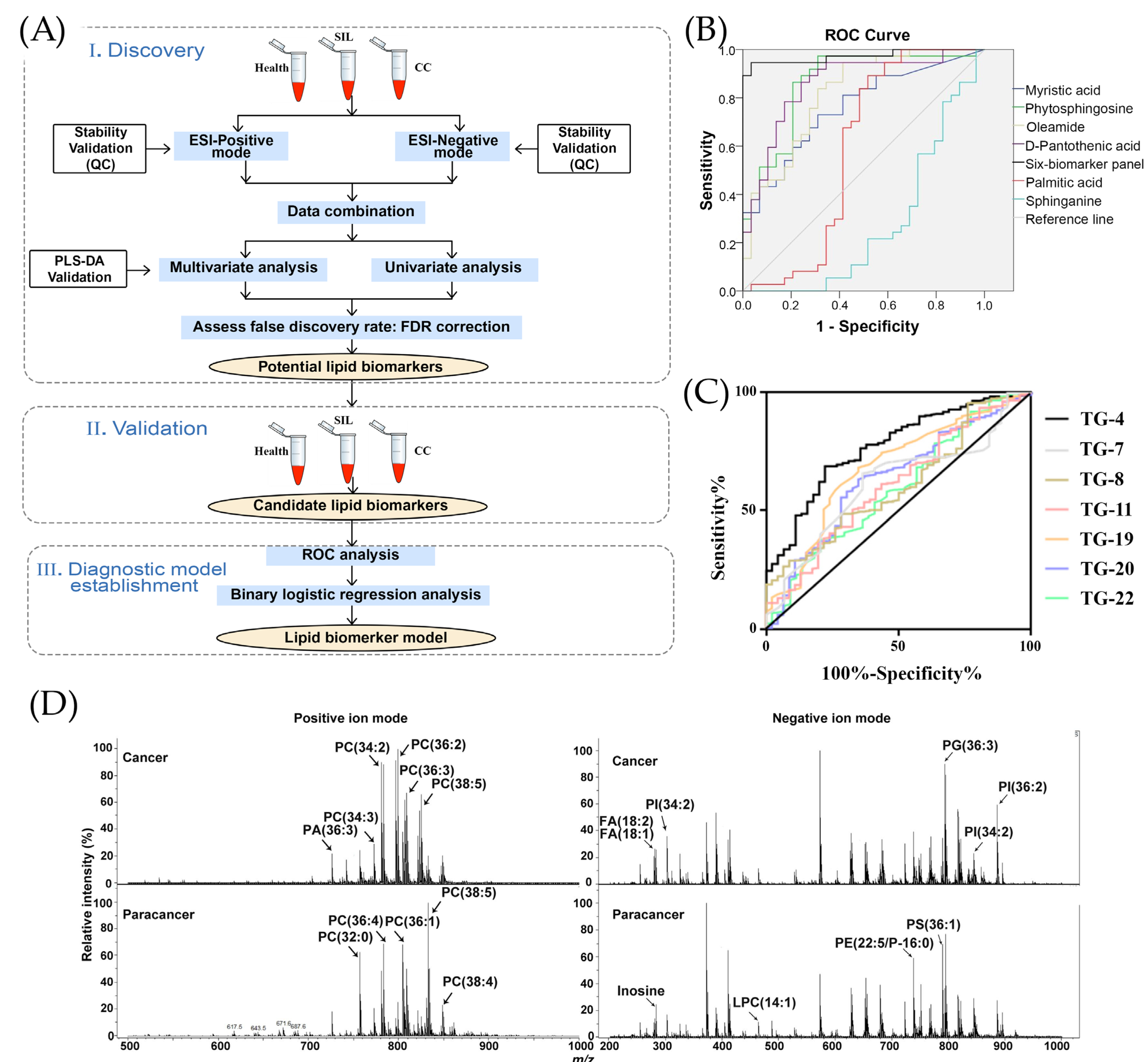
| Takayama, 2016 [32] | UPLC-MS/MS | Polyamines | Breast cancer | 80% | 80% | 172 (111+, 61−) | |
| Mu, 2016 [33] | SELDI-TOF-MS | Urinary glycopeptides | Endometrial, ovarian, and cervical cancer | 100% | 91.70% | 12 (4 endometrial cancer, 4 ovarian cancer, 4 cervical cancer) | |
| Xiao, 2016 [34] | TMT, LC-MS/MS, ELISA | Proteins (cystatin B (CSTB), triosephosphate isomerase (TPI1), and deleted in malignant brain tumors 1 protein (DMBT1). | Gastric cancer | 85% | 80% | 80 (40−, 40+) | Accuracy: 0.93; AUC: 0.93; ROC: 0.81–0.92, p < 0.05 |
| Zhong, 2016 [35] | UPLC-MS | Metabolome (LysoPC 18:1) | Breast cancer | 77.80% | 100% | 55 (30+, 25−) | AUC: 0.93; 95% CI: 0.836–1.000 |
| Chen, 2017 [36] | LC-MRM/MS | 56 salivary proteins | Oral cancer | 54.1–86.9% | 74.1–91.4% | 119 (58−, 61+) | AUC: 0.59–0.91; Cut-off value: 2.21–6798.48 ng/mL |
| Fujita, 2017 [37] | LC-MS/MS, Western blot | FABP5 | Prostate | 60% | 100% | 18 (6 negative biopsy, 6 Gleason score 6 prostate cancer, 6 Gleason score 8–9 prostate cancer) | AUC: 0.856 |
| Hirata, 2017 [38] | GC-MS/MS | 16 targeted metabolites | Pancreatic cancer | 90.70% | 89.50% | 1st set: 113 (58+, 55−), 2nd set: 32 (16+, 16−) | AUC: 0.931 |
| Chen, 2019 [9] | UPLC-QTOF/MS | 6 metabolites | Laryngeal cancer | 95% | 97% | 66 (29−, 37+) | AUC: 0.97 |
| Zhou, 2020 [39] | LC-MS/MS | 11 proteins | Early gastric cancer | 66.70% | 86.70% | 30 (15−, 15+) | AUC: 0.796 |
| Arendowski, 2020 [40] | LDI-MS | Compounds, lipids | Kidney cancer | 74% | 78% | 100 (50−, 50+) but sensitivity 37 sample, specificity 39 sample, accuracy 32 sample | Accuracy: 76%; AUC: 0.669 |
| Assad, 2020 [41] | LC-QTOF MS | Metabolome (glycerophospholipids and oligopeptides) | Breast cancer | 65.20% | 77.10% | 58 (23+, 35−) | AUC: 0.732 |
| Bian, 2020 [30] | DIAAA derivatization-UHPLC-QTOF/MS | 605 carboxylic acids | Colorectal cancer | 96.90% | 94.40% | Training cohort (43 CRC and 32 healthy human serum), and validation cohort (15 CRC and 15 healthy human serum) | AUC: 0.85; Cut-off 0.71 |
| Cheng, 2020 [42] | Q-TOF-MS | Phosphatidylcholine and phosphatidylethanolamine | Cervical cancer | 95.20% | 86% | 71 CC patients (n = 21), squamous intraepithelial lesions (SIL) (n = 30), and HC, n = 20, 72 = 25 CC patients, 27 SIL patients, 20 HC | AUC: 0.966 |
| Deutsch, 2020 [43] | qMS | Proteome | Pancreatic cancer | 90% | 90% | 31 (16−, 15+) | AUC: 0.91 |
| Xiong, 2020 [44] | LC-MS/MS and SWATH | Bile acids (8 metabolites) | Pancreatic cancer | 100% | 100% | 34 | AUC: 1; 95% CI: 1.0 |
| Yang, 2020 [45] | LC–MS/MS | 18 proteins | Breast cancer | 83.90% | 89.70% | 114 (51−, 63−) | AUC: 0.901; 95% CI: 0.840–0.962; cut off value 0.736. |
| Markin, 2020 [31] | GC-MS | Prostate-specific antigen, sarcosine | Prostate cancer | 92.60% | 91.70% | 79 (36, 16, 27) | Accuracy: 87.3% |
| McKitterick, 2021 [46] | LC-MS/MS | NLLGLIEAK and ELPLYR peptide | Lung cancer | Accuracy: 87.3 ± 41.4% | |||
| Chen, 2021 [47] | LC-MS | fecal metagenome and serum metabolome | Colorectal cancer | 83.50% | 84.90% | 44 (11−, 33+) | AUC: 0.92 |
| Gong, 2021 [48] | LC-MS/MS | ICAM1, APMAP | Colorectal cancer | 84% | 76% | 40 (20−, 20+) | AUC: 0.896, 0.854 |
| Jain, 2021 [49] | LC-MS | Proteomics | OSCC | 100% | 77.60% | 99 (49−, 50+) | AUC: 0.94 |
| Kozar, 2021 [50] | HPLC-TQ/MS | 4 endogenous metabolites | Endometrial cancer | 94% | 75% | 36 (21−, 15+) | AUC: 92.5%; CI: 90.5–94.5% |
| Wang, 2021 [51] | GC-MS | L-serine, myo-inositol, and decanoic acid + tPSA | Prostate cancer | 82.90% | 72.70% | 79 (38−,41+) | AUC: 0.781 (p < 0.05) |
| Zhang, 2021 [52] | HILIC-UPLC-HRMS | 10 amino acids | Thyroid cancer | 91.20% | 85.20% | 122 (61−, 61+) | AUC: 0.936; R2 > 0.99; recover: 92.2–110.3% |
| Frantzi, 2022 [53] | CE-MS | 19-biomarker model | Prostate cancer | 87% | 65% | 147 | AUC: 0.81 |
| Lin, 2022 [54] | UHPLC-MS/MS | 8-oxodG and 8-oxoG | cervical carcinoma | 77.10% | 90% | 194 (100−, 70+, 24 one-year follow-up) | AUC: 0.871; cut-off value 1.239 |
| Zou, 2022 [55] | LE-ESSI FTICR-MSI | Phosphatidylcholine (32:0) and phosphatidylcholine (34:3) | Gastric cancer | 100% | 100% | 60 (30−, 30+) | AUC: 1.00 |
| Alustiza, 2023 [56] | Mag-HSAE-TD-GC–MS | p-Cresol, 3(4H)-dibenzofuranone,4a,9b-dihydro-8,9b-dimethyl- (3(4H)-DBZ) | Colorectal cancer | 87% | 79% | 80 (32−, 24+, 24 polyps) | AUC: 0.86; 95% CI: 0.75–0.96 |
| Chang, 2023 [57] | UHPLC-MS/MS | 17 nucleosides and CRE | Bladder cancer | 219 | Accuracy: 91–114%; AUC: 0.819: RSDs < 10% | ||
| Han, 2023 [58] | UHPLC-MS/MS | 19 amino acids and 7 amino-containing neurotransmitters | Gastric cancer | 91.40% | 87.50% | 25 (15+, 10−) | Accuracy: 95% |
| Li, 2023 [59] | GC-HRMS | 8 volatile organic compounds (VOCs) | Breast cancer | 76% | 92.30% | 168 (88−, 80+) | AUC: 0.91; Accuracy: 84.3% |
| Ossolinski, 2023 [60] | LDI-MSI/MS | 10 metabolites | Bladder cancer | 83% | 100% | 6 | AUC: 0.944 |
| Sani, 2023 [61] | LC-MS/MS | 21 VOCs | Lung cancer | 96% | 86% | 386 (95−, 291+) | AUC TG-7, TG-21: 0.611 |
| Average/Median Total:33 references | 86.23% 87.00% | 86.92% 87.50% |
| Author, Year | Analytical Technique | Analyte | Cancer Type | # Sample | Sensitivity, % | Specificity, % | Other FoM (e.g., AUC, Cut-Off Value, etc.) |
|---|---|---|---|---|---|---|---|
| ELISA | |||||||
| Xiao, 2016 [34] | ELISA | Proteins (cystatin B(CSTB), triosephosphate isomerase (TPI1) | Gastric cancer | 40 (20+, 20−) | 85 | 80 | ROC: 0.81–0.92; p < 0.05 |
| Feng, 2019 [69] | ELISA | Cytokines | Oral squamous cell carcinoma (OSCC) | 80 (60+, 20−) | 70 | 86.7 | AUC: 0.843; 95% CI: 0.743–0.942 |
| Liu, 2019 [70] | ELISA | Heat shock protein 90 α(Hsp90α) | Pancreatic cancer | 81.33 | 81.65 | Cut-off: 69.19 ng/mL; AUC: 0.895 | |
| He, 2020 [71] | ELISA | TOPO48 (48 kDa-fragment derived from human DNA-topoisomerase I) | Breast cancer | 214 (78+, 136−) | 76 | 100 | AUC: 0.801; 95% CI: 0.716–0.887 |
| Selickaja, 2022 [72] | In-house ELISA | Anti-TIF1-γ autoantibodies | Dermatomyositis | 213 (131+, 82−) | 58 | 86 | The anti-TIF1-γ results from the in-house ELISA were confirmed with IP in 93 of 101 (92%) cases, κ = 0.76, with a commercial ELISA in 110 of 131 (84%) cases, κ = 0.63 |
| Commercial ELISA | 63 | 72 | |||||
| Li, 2022 [73] | CRISPR-ELISA | Cytokines (IL-6, IL-8, and IL-10) | Lung cancer | 252 (127+, 125−) | 80.60 | 82 | AUC: 0.79 |
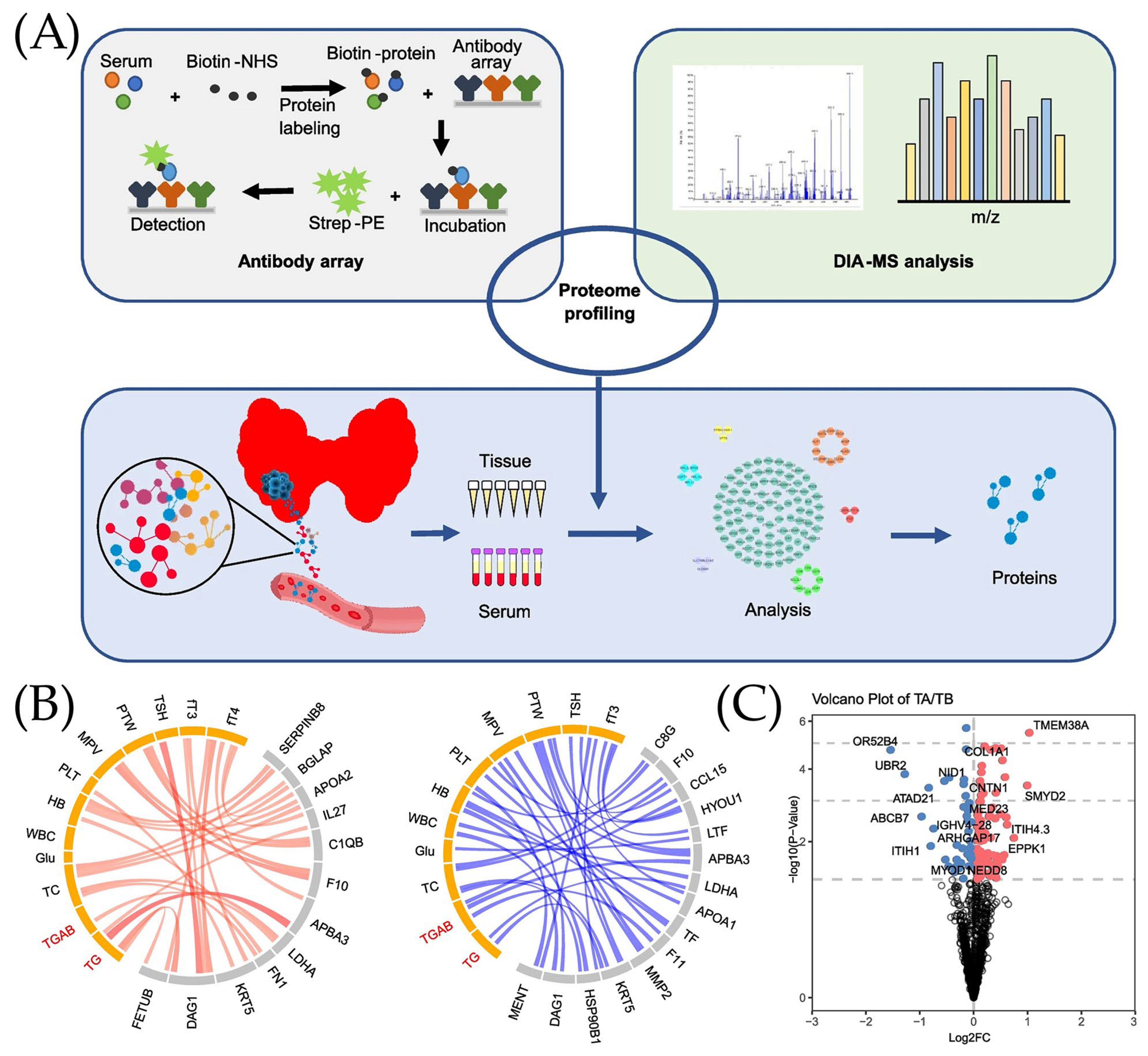
| Ye, 2023 [74] | ELISA | Fibronectin 1 (FN1) | Papillary thyroid cancer | 49 (26+, 23−) | 96.89 | 91.67 | AUC: 0.924; 95% CI: 0.867–0.98 |
| Vanarsa, 2023 [75] | ELISA | Urine proteins (e.g., IL-8, IgA, fibronectin) | Bladder cancer | 68 (37, 31−) | 97 | 90 | AUC: 0.96; 95% CI: 0.92–1.00 |
| Gerber, 2023 [76] | Sandwich ELISA | Plasma gelsolin | Epithelial ovarian cancer | 96 (70+, 26−) | 73.91 | 72.46 | AUC: 0.7656, p = 0.0001, cut-off 1.586 |
| Makoui, 2023 [77] | ELISA | Anti-Ki67 mAbs (2H1) | Breast cancer | 200 (+/− not given) | 94.20 | 99 | Accuracy: 96.6%, p = 0.001, r = 0.298 |
| anti-P53 mAbs(2A6) | 97.30 | 98.10 | Accuracy: 97.5% | ||||
| Liu, 2023 [78] | ELISA | AFP+IL-34 | Hepatocellular carcinoma | 108 (88+, 20−) | 63.2 | 93.10 | AUC: 0.837, cut-off value 1.88 |
| Molga-Magusiak, 2023 [79] | ELISA | sPD-L1 | Head and neck cancer | 60 (40 malignant, 20 benign) | 35.50 | 95 | AUC: 0.664; 95% CI: 0.529–0.8; p-value = 0.039; cutoff: 0.765 ng/mL |
| Wei, 2023 [80] | ELISA | Urinary exosomal prostate-specific antigen (UE-PSA) | Prostate cancer | 272 (87+, 185−) | 95 | - | UE-PSA could avoid 57.6% (155 cases) of unnecessary biopsies while only missing 2.6% (7 cases) of clinically significant prostate cancer (csPC) |
| Rezuchova, 2023 [81] | ELISA | Carbonic anhydrase IX (CA IX) | Breast cancer | 100 (24+, 76−) | 70 | 90 | AUC: 0.822; 95% CI: 0.4601–0.6700; p < 0.001 |
| Debernardi, 2023 [82] | ELISA | Urinary biomarkers-LYVE1, REG1B, TFF1; plasma biomarkers-CA19-9 PancRISK+CA19-9 | Pancreatic ductal adenocarcinoma (PDAC) | 198 (99+, 198−) | 72 | 90 | AUC: 0.827; 95% CI: 0.726–0.927 |
| Tan, 2023 [83] | ELISA | Tumor necrosis factor receptor-associated protein 1 (TRAP1) | Limited-stage disease SCLC (small cell lung cancer) | 367 (292+, 75−) | 96.40 | 56 | AUC: 0.819; cutoff 349.03 pg/mL |
| Xu, 2023 [84] | ELISA | 7 tumor-associated autoantibodies (AABs) | lung cancer | 987 (533+, 454−) | 64 | 51.5 | The positive predictive value (PPV) of 7-AABs was 63.97% and the negative predictive value (NPV) was 51.54%. The false positive rate (FPR) for 7-AABs was 36.02% and the false negative rate (FNR) was 48.49% |
| Average, median | 77%, 76% | 84%, 88% | |||||
| Average AUC (# of studies) | 0.83 (12) | ||||||
| Immunoassays | |||||||
| Furuya, 2019 [85] | Multiplex bead-based IA(MBA) | Proteins | Bladder cancer | 80 (40+, 40−) | 93 | 95 | Accuracy: 94%; AUC: 0.97 |
| Multiplex electro-chemiluminescent assay (MEA) | 85 | 80 | Accuracy 83%; AUC: 0.86 | ||||
| Tan, 2022 [86] | Electro-chemiluminescence IA | Antithyroglobulin (TGAb) and antithyroid peroxidase (TPOAb) | Hashimoto’s thyroiditis (HT) | 1874 (806+, 1068−) | 53.80 | 72.1 | PPV 86.8%, NPV 31.4%, FPR 27.9%, FNR 46.2% |
| Jagodzińska, 2023 [87] | Fluorescent IA | FGF 21 (metabolism regulator) | Endometrial cancer | 233 (186+, 47−) | 41 | 90 | AUC: 0.677 |
| Tan, 2023 [83] | Chemiluminescence IA | Neuron-specific enolase (NSE) | LS SCLC | 367 (292+, 75−) | 60.70 | 92.40 | AUC: 0.800; cutoff 5.93 ng/mL |
| Carcinoembryonic antigen (CEA) | 92.30 | 18.90 | AUC: 0.513; cutoff 10.33 ng/mL | ||||
| Carbohydrate antigen 19-9 (CA19-9) | 100 | 18.5 | AUC: 0.535; Cutoff: 7.46 U/ml | ||||
| TRAP1+NSE | 90.8 | 92.9 | - | ||||
| Combination of 4 biomarkers | 96.40 | 81.50 | - | ||||
| Mitobe, 2023 [88] | Chemiluminescence IA | sIL-2R | Central nervous system lymphoma | 130 (48 PCNSL 8 SCNSL, 16 metastatic brain tumors 58 glioblastoma (GBM) | 87.5 | 66.7 | AUC: 0.826; cutoff 521 U/mL |
| Sparano, 2023 [89] | Chemiluminescence IA | Calcitonin | Thyroid carcinoma | 55 (28 complete response, 27 persistent disease) | 89 | 82 | Early calcitonin level ≥ 16 pg/mL AUC = 0.911, CI95%: 0.819–1000, p < 0.001 |
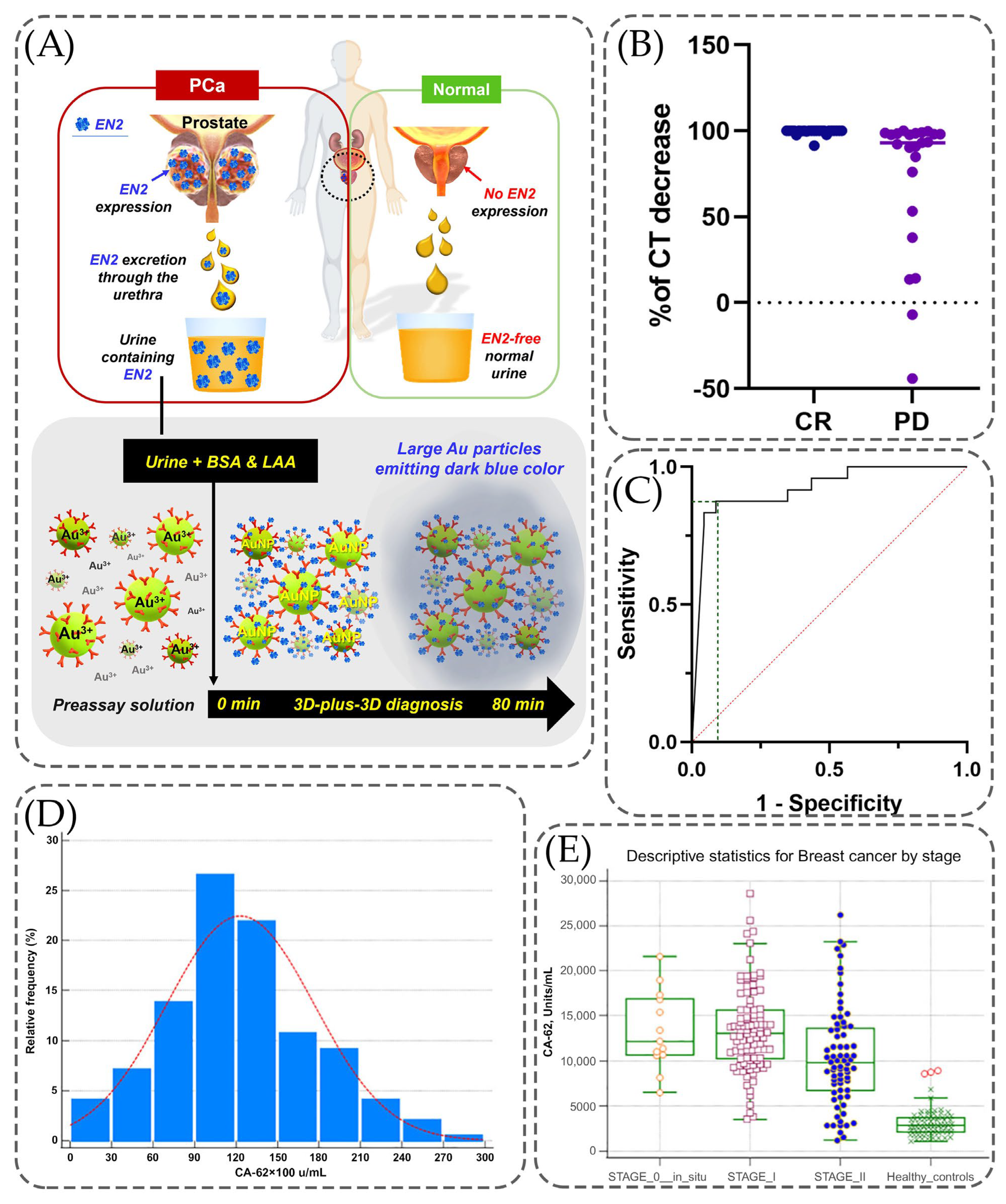
| Sekacheva, 2023 [90] | Chemiluminescent IA | CA-62 | Breast cancer | 269 (196+, 73−) | 92 | 93 | For comparison: Sensitivity for mammography was 63–80% at 60% specificity |
| Kim, 2023 [91] | 3D-plus-3D IA | Engrailed-2 protein | Prostate cancer | 90 (60+, 30−) | 100 | 100 | Incubation time 12–16 h |
| Xu, 2023 [84] | electro-chemiluminescence IA | 7 tumor-associated autoantibodies (AABs) + 7 tumor antigens (7-TAs) | Lung cancer | 987 (533+, 454−) | 92.09 | 52.06 | Specificity 95% CI 45.58–58.48% |
| Average, median | 84%, 91% | 74%, 82% | |||||
| Average AUC (# of studies) | 0.76 (5) | ||||||
| Author, Year | Technique | Analyte | Detection | Sensitivity | Specificity | Accuracy | Number of Samples |
|---|---|---|---|---|---|---|---|
| Quantitative PCR | |||||||
| Alhasan, 2016 [99] | Real-time qPCR | Circular miRNas (miR-200c, miR-605, miR-135a, miR-433, and miR-106a) | High-risk prostate cancer from low-risk | 89% | 16 (8+; 8−) | ||
| Zhu, 2016 [100] | TaqMan probe qRT-PCR | Four miRNAs (miR-182, miR-183, miR-210, or miR-126) with carcinoembryonic antigen (CEA) | Non-small cell lung cancer | 81.3% | 100% | 90.8% | 216 (112+; 104−) |
| Liang, 2017 [101] | qPCR | Fusobacterium nucleatum | Colorectal Cancer | 82.0% | 80.7% | 81.3% | 230 (111+; 119−) |
| qPCR | Fusobacterium nucleatum, Bacteroides clarus, Roseburia intestinalis, Clostridium hathewayi | 83.8% | 83.2% | 83.5% | |||
| Quantitative PCR and HemoSure immunogold labeling FIT dipsticks | Fusobacterium nucleatum, Bacteroides clarus, Roseburia intestinalis, Clostridium hathewayi | 92.8% | 81.5% | 87.0% | |||
| Ooki, 2017 [102] | Quantitative methylation-specific PCR | 6 genes: CDO1, HOXA9, AJAP1, PTGDR, UNCX, and MARCH11 | non–small cell lung cancer (stage IA lung adenocarcinoma) | 72.1% | 71.4% | 71.8% | 85 (43+; 42−) |
| Wang, 2017 [103] | qRT-PCR | 2 miRNAs (miR-19b-3p and miR-106a-5p) | Gastric cancer | 95% | 90% | 92.5% | 40 (20+; 20−) |
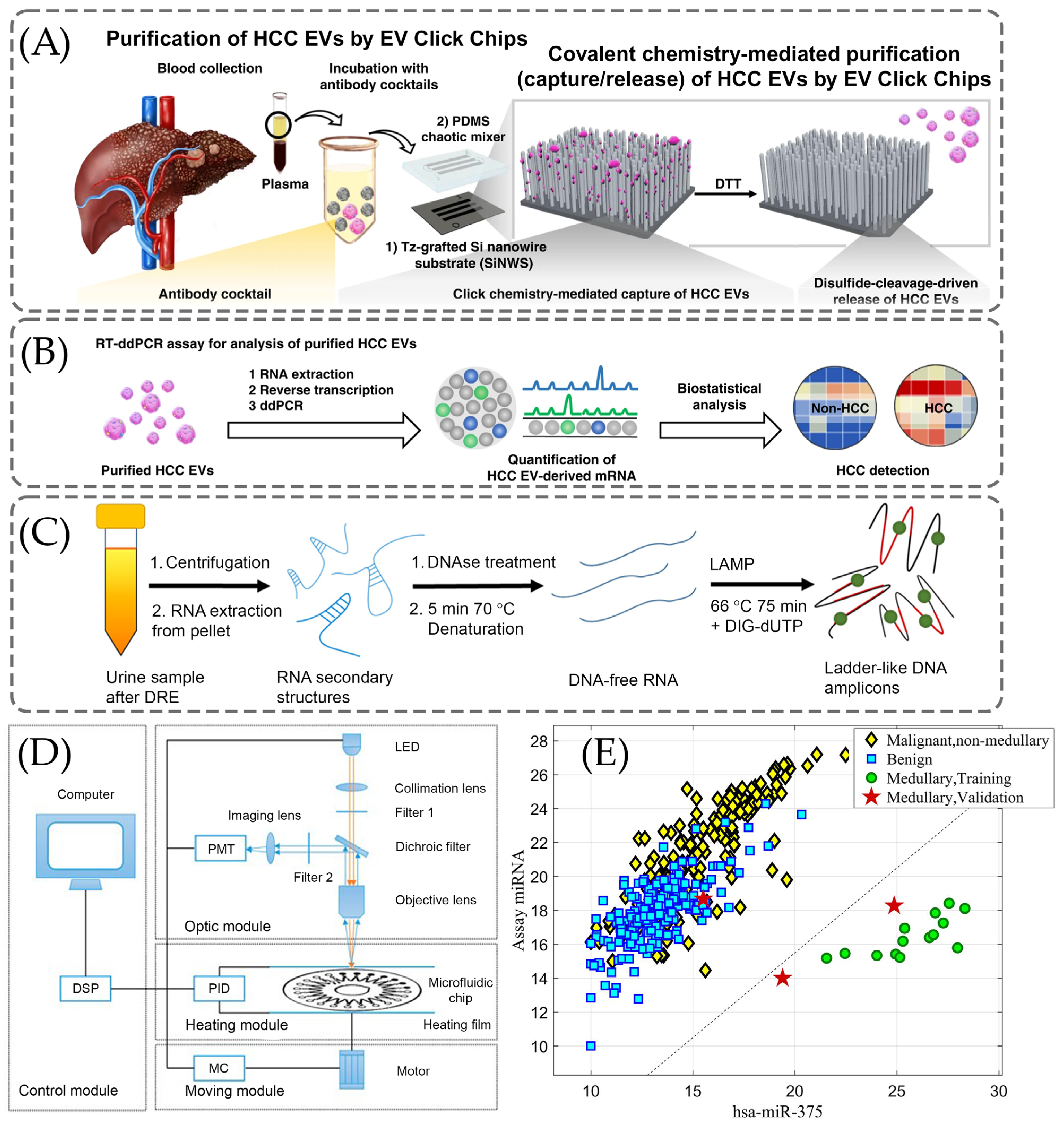
| Lithwick Yanai, 2017 [104] | RT-qPCR RosettaGX Reveal | miRNA hsa-miR-375 | Thyroid cancer | 97.5% | 78.2% | 83.3% | 150 (39+; 111−) |
| Bartak, 2017 [105] | MethyLight PCR | SFRP1, SFRP2, SDC2, and PRIMA1 | Colorectal Cancer | 91.5% | 97.3% | 94.1% | 84 (47+; 37−) |
| Agthoven, 2017 [106] | Real-time qPCR | Micro RNAs (miR-371a-3p, miR-373-3p, miR-367-3p) | Testicular germ cell cancer | 90% | 91% | 90.3% | 414 (250+; 164−) |
| Kahraman, 2018 [107] | RT-qPCR | 77 miRNAs | Triple negative breast cancer | 83.8% | 74.2% | 79% | |
| Xie, 2018 [108] | Quantitative real-time PCR | Two long non-coding RNA and three tumor markers (CEA, CYFRA21-1, and SCCA) | Non-small cell lung cancer | 91% | 70% | 80.5% | 200 (100+; 100−) |
| Pan, 2019 [109] | qRT-PCR | Exosomal circular RNA (hsa-circ-0004771) | Colorectal cancer | 80.91% | 82.86% | 81.4% | 145 (115+; 35−) |
| Zhang, 2019 [110] | Real-time qPCR | three long non-coding RNA panel (PCAT-1, UBC1 and SNHG16) | Bladder cancer | 80% | 75% | 77.5% | 320 (16+; 160−) |
| Liu, 2020 [111] | Methylation-specific PCR | Methylated COL4A2, TLX2 | Colorectal cancer | 91.7% | 97.6% | 94.5% | 163 (80+; 83−) |
| Liao, 2020 [112] | RT-PCR | miRNAs (Integrated 2 sputum miRs-31-5p and 210-3p and one plasma miR-21-5p) | Non-small cell lung cancer | 85.5% | 91.7% | 0.913 | 111 (56+; 55−) |
| Wang, 2020 [113] | qRT-PCR | PIWI-Interacting RNAs piR-020619 and piR-020450 in serum | Small colorectal tumors | 81.7% | 90.9% | 0.869 | 71+ |
| Early-stage (I and II) colorectal cancer | 76.8% | 90.9% | 0.839 | 173+ | |||
| Xie, 2020 [114] | Methylation-specific qPCR | 13 Methyl DNA markers | Colorectal cancer | 90% | 90% | 90% 0.96 | 100 (40+; 60−) |
| Huang, 2020 [115] | RT-qPCR | 4 miRNAs (miR-203a-3p, miR-145-5p, miR-375-3p and miR-200c-3p) in serum | Colorectal cancer | 81.3% | 73.3% | 77.5%; 0.893 | 160 (80+; 80−) |
| Yao, 2021 [116] | Probe-based duplex PCR | Five bacteria (Prevotella copri, Gemella morbillorum, Parvimonas micra, Cetobacterium somerae, and Pasteurella stomatis) and fecal immunochemical test | Colorectal cancer | 68.0% | 89.3% | 75.5% | 318 (206+; 112−) |
| Peng, 2022 [117] | PCR | Methylated biomarkers (ELMO1, ZNF582 and TFPI2) | Upper gastrointestinal cancer | 71.0% | 90% | 80.6% | 376 (186+; 190−) |
| Miyoshi, 2022 [118] | qRT-PCR | 8 miRNAs in serum (miR-103, miR-106b, miR-151, miR-17, miR-181a, miR-21, miR-25, and miR-93) | Esophageal squamous cell carcinoma (ESCC) | 89.3% | 84.3% | 86.6% | 186 (84+; 102−) |
| Ruiz-Banobre, 2022 [119] | Methylation-specific RT-PCR | Methylation of RNA LINC00473 (tissue) | Colorectal cancer | 91% | 100% | 0.941 | |
| Iadsee, 2023 [120] | Real-time qPCR | Fecal Erysipelatoclostridium ramosum | Colorectal cancer | 72.7% | 64.7% | ||
| Tissue Erysipelatoclostridium ramosum | Colorectal cancer | 86.7% | 65.5% | ||||
| qPCR average | Average/Median | 83.8% 83.8% (25) | 83.9% 83.2% (25) | 83.7% 83.4% (20) | |||
| Droplet digital PCR | |||||||
| Uehiro, 2016 [121] | Digital PCR | Circulating free DNA (12 methylated cancer markers, 4 control markers) | Breast cancer | 86.2% | 82.7% | 84.7% | 111 (58+; 53−) |
| Sefrioui, 2017 [122] | Digital PCR | Circulating tumor DNA | Pancreatic adenocarcinoma | 65.1% | 75.0% | 67.2% | 55 (43+; 12−) |
| Kalinich, 2017 [123] | Digital PCR | Circulating tumor cells | Hepatocellular carcinoma | 56% | 95% | 86.3% | 73 (16+; 57−) |
| Sun, 2020 [124] | Droplet digital rt-PCR | Hepatocellular carcinoma (HCC)-specific extracellular vesicle (EV) mRNA markers | Hepatocellular carcinoma | 94.4% | 88.5% | 91.9% | 62 (36+; 26−) |
| Shinjo, 2020 [125] | Methyl-CpG binding protein with droplet digital PCR | 5 DNA methylation markers in tissues | Pancreatic cancer | 96.4% | 90% | 95.9% | 147 (137+; 10-) |
| 5 DNA methylation markers in serum | 68% | 86% | 78.7% | 61 (47+; 14−) | |||
| Ruiz-Banobre, 2022 [119] | Droplet digital RT-PCR | Methylation of RNA LINC00473 (plasma) | Colorectal cancer | 90% | 63% | 0.833 (AUC) | |
| ddPCR average | Average/Median | 79.4% 86.2% (7) | 82.9% 86.0% (7) | 84.2% 85.5% (6) | |||
| All PCR | Average/Median | 82.9% 83.8% (32) | 83.7% 83.8% (32) | 83.9% 83.4% (26) | |||
| LAMP | |||||||
| Saito, 2021 [126] | LAMP | Epidermal growth factor receptor mutations exon 19 deletion or L858R point mutation | Non-small cell lung cancer | 95.9% | 97.1% | 96.6% | 117 (49+; 68−) |
| Sebuyoya, 2022 [127] | Capture of LAMP products on the surface of gold screen printed electrodes and electrochemical (amperometry) biosensor | DNA of human papillomavirus HPV16 and HPV18 | Cervical cancer | 91.7% | 94.4% | 15 | |
| Lin, 2022 [128] | RT-LAMP with machine learning | 11 mRNA biomarkers | Lung cancer | 88.0% | 86.6% | AUC 0.934 | 86 |
| Moranova, 2022 [129] | LAMP with chronoamperometry | Long non-coding RNA prostate cancer antigen 3 | Prostate cancer | 100% | 100% | 100% | 19 (12+; 7−) |
| LAMP average | Average Median | 93.9% 93.8% (4) | 94.5% 95.8% (4) | 98.3% 98.3% (2) | |||
| All clinical | Average Median | 84.1% 85.9% (36) | 84.8% 86.3% (36) | 84.9% 84.1% (28) | |||
| First Author, Year | Assay/Data Processing Method | Analyte (Cancer Type) | Cancer Patients/Control Patients | Sensitivity/Specificity/Accuracy |
|---|---|---|---|---|
| Smith, 2016 [166] | ATR-FTIR (diamond) | Protein, lipid, phosphate, carbohydrate, amide (Brain cancer) | 433 (134 primary brain cancer, 177 metastatic brain cancer, 64 high-grade glioma, 23 low-grade glioma) | 92.8%/91.5%/92.4% |
| Elmi, 2017 [167] | ATR-FTIR | Proteins, lipids, collagen, esters etc. (Breast cancer) | 86 (43+, 43−) | 76%/72%/80% |
| Liu, 2017 [168] | Transmission FTIR (barium fluoride) | Lipids, proteins, sugars, etc. (Gastric cancer) | 70 (40+, 30−) | 95%/70%/84.2% |
| Paraskevaidi, 2018 [169] | ATR-FTIR | Proteins and nucleic acids (Endometrial cancer, ovarian cancer) | 30 (10 endometrial cancer, 10 ovarian cancer, 10 healthy) | 95%/100%/95%-endometrial cancer, 100%/96.3%/100%-ovarian cancer |
| Adeeba, 2018 [170] | ATR-FTIR | DNA and RNA (Oral cancer) | 147 (67 oral cancer, 60 “niswar” (dipping smokeless tobacco product) users, 20 control) | 100%100%/95% |
| Butler, 2019 [171] | ATR-FTIR | Protein (Brain cancer) | 724 (104+, 620−) | 93.2%/92.8%/96% |
| Bangaoil, 2020 [172] | ATR-FTIR | Hematoxylin and eosin (H&E)-stained tissues (Lung cancer) | 120 (54+, 66−) | 97.73%/92.45%/94.85% |
| Sitnikova, 2020 [173] | ATR-FTIR | Several functional groups of DNA and RNA (Breast cancer) | 146 (66+, 80−) | 92.3%/87.1%/89.3% |
| Tomas, 2022 [174] | ATR-FTIR via NN | Lipid, nucleic acid, phospholipid, and carbohydrates (Breast cancer) | 166 (88 malignant, 78 benign) | -/89%/96% |
| Sala, 2022 [175] | ATR-FTIR | Proteins, lipids (Pancreatic cancer) | 235 (100 pancreatic cancer and 100 healthy) | 92%/88%/90% |
| Du, 2022 [176] | FTIR | Lipids, proteins, sugar, and nucleic acids (Breast cancer) | 526 (308 invasive breast cancer, 101 ductal carcinoma in situ, and 117 healthy controls) | 100%/100%/94.2% |
| Chen, 2022 [177] | FTIR | Proteins, lipids, nucleic acids (Esophageal cancer) | 68 (48-stage II, 20-stage III) | 98.53%/100% /99.26%- late-stage cancer 91.43%/100%/97.08%-early-stage cancer |
| Guo, 2022 [178] | ATR-FTIR | Protein (Liver cancer—LC, gastric cancer—GC, colorectal cancer—CC) | 252 (25 LC, 68 GC, 73 CC, 44 control) | 100%/95%/95% |
| NMP de Souza, 2023 [179] | ATR-FTIR | Nucleic acid (Breast cancer) | 74 (56+, 18−) | -/-/100% |
| Dong, 2023 [180] | FTIR | Protein, lipids, nucleic acids (Gastric cancer) | 160 fresh non-metastatic and 80 metastatic lymph nodes, (each) from 60 patients with gastric cancer | 96.6%/93.8%/- |
| FTIR (15 reports) | Arithmetic mean (overall): | 94.71%/91.75%/93.64% | ||
| Median (overall): | 95.00%/93.30%/95.00% |
| Technique | Total Studies | Average Sensitivity (Median), % | Average Specificity (Median), % | Average Accuracy (Median), % | Average sens. + spec., % | Ave. AUC (# Publications) | All Refs (Refs. with Reported AUC) |
|---|---|---|---|---|---|---|---|
| Mass spectrometry | 33 (7 with acc) | 86 (87.0) | 87 (87.5) | 87 (87.3) | 86.6 | 0.87 (28) | [9,30,31,32,33,34,35,36,37,38,39,40,41,42,43,44,45,46,47,48,49,50,51,52,53,54,55,56,57,58,59,60,61] |
| PCR | 31 (25 with acc) | 83 (83.8) | 84 (83.8) | 84 (83.4) | 83.5 | 0.89 (21) | [99,100,101,102,103,104,105,106,107,108,109,110,111,112,113,114,115,116,117,118,119,120,121,122,123,124,125,126,127,128,129] |
| ELISA | 17 (2 with acc) | 77 (76.0) | 84 (88.4) | 97 (-) | 80.5 | 0.83 (12) | [34,69,70,71,72,73,74,75,76,77,78,79,80,81,82,83,84] |
| IAs | 9 (3 with acc) | 84 (91.4) | 74 (81.8) | 77 (79.0) | 79.0 | 0.76 (5) | [83,84,85,86,87,88,89,90,91] |
| SERS | 19 (4 with acc) | 91 (92.0) | 93 (94.0) | 97 (98.0) | 91.5 | 0.97 (3) | [138,139,140,141,142,143,144,145,146,147,148,149,150,151,152,153,154,155,156] |
| FTIR | 15 (14 with acc) | 95 (95) | 92 (93.3) | 94 (95) | 93.2 | 0.95 (3) | [166,167,168,169,170,171,172,173,174,175,176,177,178,179,180] |
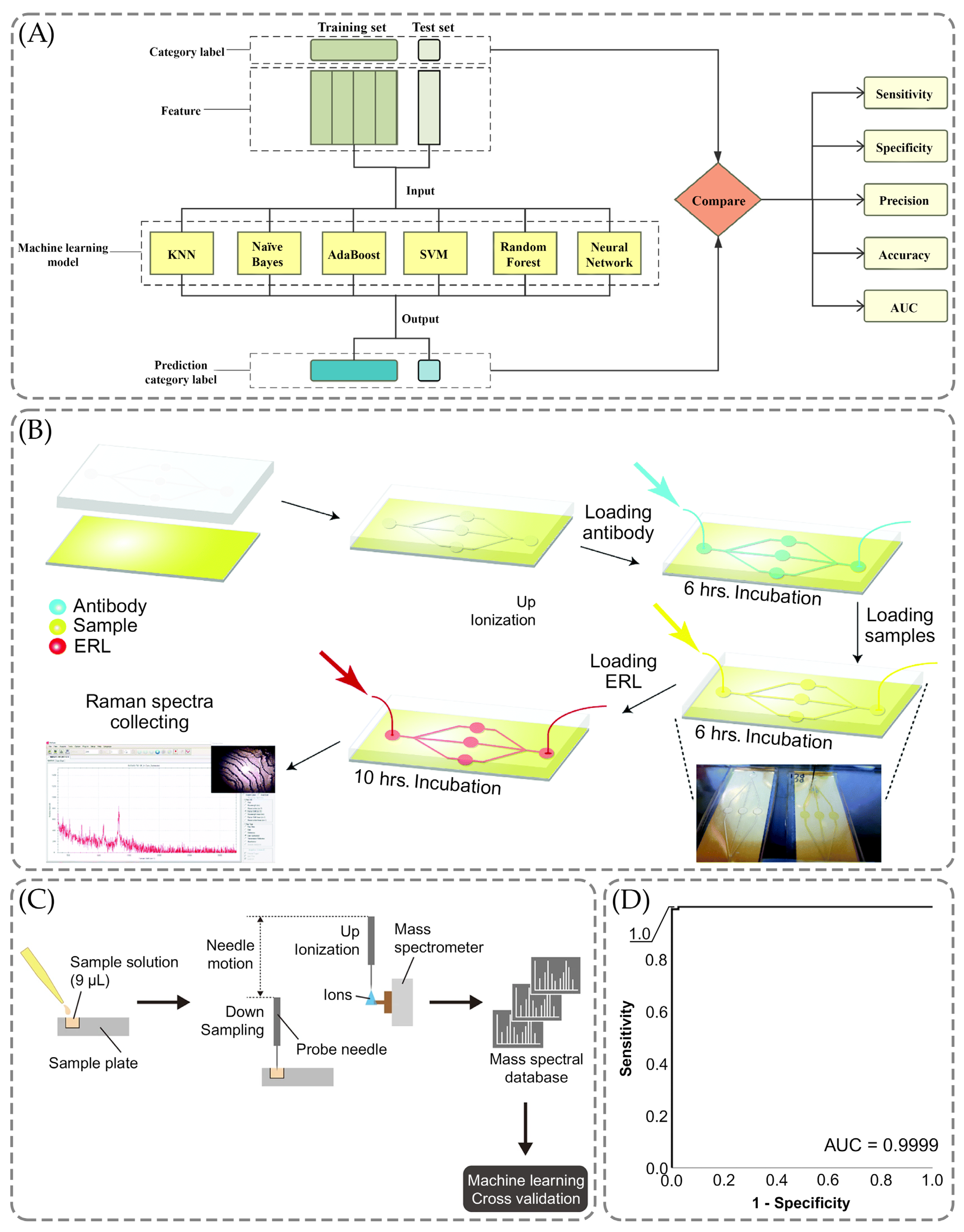
| Authors-Year | Analytical Technique | Analyte | Sensitivity | Specificity | Accuracy | Number of Samples | AUC |
|---|---|---|---|---|---|---|---|
| Banaei, 2019 [190] | SERS, K-nearest neighbor, and classification tree ML algorithms | 5 protein biomarkers (CA19-9, HE4, MUC4, MMP7, and mesothelin) | 86 | 93 | 91 | 20 sera samples | |
| Xie, 2021 [188] | LC-MS/MS, Naïve Bayes ML algorithm | Specific combination of six metabolic biomarkers | 98.1 | 100 | 97 | 0.989 | |
| Ahamad, 2022 [191] | Random Forest (RF) | Carbohydrate antigen 125, carbohydrate antigen 19-9, carcinoembryonic antigen, and human epididymis protein 4 | 86 | 91 | 106 patients with OC marker features | 0.93 | |
| Ahamad, 2022 [191] | Random Forest (RF), Gradient Boosting Machine (GBM), and Light Gradient Boosting Machine (LGBM) | Carbohydrate antigen 125, carbohydrate antigen 19-9, carcinoembryonic antigen, and human epididymis protein 4 | 97 | 88 | 349 patients with 49 features | 0.87 | |
| Kim, 2022 [192] | Artificial neural networks (ANN), Random Forest (RF), and support vector machine (SVM) | CA125 | 87 | 98 | 269 serum samples | ||
| Kiritani, 2021 [193] | PESI-MS, logistic regression | Specific monounsaturated fatty acid-bonded phospholipids | 99 | 100 | 99.5 | NP 80/103 | 0.9999 |
| Dong, 2023 [194] | SERS and artificial intelligence for cancer screening (SERS-AICS) | 95.87 | 95.4 | 95.81 | Early Lung C NP 45/36; Early Colorectum C NP 42/32 Gastric C NP 39/36 Liver C NP 33/32 | 0.81 0.94 0.89 0.93 Av of 4: 0.893 | |
| Rahman, 2021 [195] | Support vector machine (SVM) model with radial basis function (RBF) kernel | BMI, Age, Glucose, MCP-1, Resistin, and Insulin. | 95.1 | 94 | 93.9 | 0.989 | |
| Average | 93.0 | 96.7 | 93.2 | 0.945 | |||
| Median | 95.5 | 96.7 | 92.5 | 0.960 |
Disclaimer/Publisher’s Note: The statements, opinions and data contained in all publications are solely those of the individual author(s) and contributor(s) and not of MDPI and/or the editor(s). MDPI and/or the editor(s) disclaim responsibility for any injury to people or property resulting from any ideas, methods, instructions or products referred to in the content. |
© 2025 by the authors. Licensee MDPI, Basel, Switzerland. This article is an open access article distributed under the terms and conditions of the Creative Commons Attribution (CC BY) license (https://creativecommons.org/licenses/by/4.0/).
Share and Cite
Terzapulo, X.; Dyussupova, A.; Ilyas, A.; Boranova, A.; Shevchenko, Y.; Mergenbayeva, S.; Kassenova, A.; Filchakova, O.; Gaipov, A.; Bukasov, R. Review: Detection of Cancer Biomarkers from a Clinical Perspective. Int. J. Mol. Sci. 2025, 26, 11745. https://doi.org/10.3390/ijms262311745
Terzapulo X, Dyussupova A, Ilyas A, Boranova A, Shevchenko Y, Mergenbayeva S, Kassenova A, Filchakova O, Gaipov A, Bukasov R. Review: Detection of Cancer Biomarkers from a Clinical Perspective. International Journal of Molecular Sciences. 2025; 26(23):11745. https://doi.org/10.3390/ijms262311745
Chicago/Turabian StyleTerzapulo, Xeniya, Aigerim Dyussupova, Aisha Ilyas, Aigerim Boranova, Yegor Shevchenko, Saule Mergenbayeva, Aiym Kassenova, Olena Filchakova, Abduzhappar Gaipov, and Rostislav Bukasov. 2025. "Review: Detection of Cancer Biomarkers from a Clinical Perspective" International Journal of Molecular Sciences 26, no. 23: 11745. https://doi.org/10.3390/ijms262311745
APA StyleTerzapulo, X., Dyussupova, A., Ilyas, A., Boranova, A., Shevchenko, Y., Mergenbayeva, S., Kassenova, A., Filchakova, O., Gaipov, A., & Bukasov, R. (2025). Review: Detection of Cancer Biomarkers from a Clinical Perspective. International Journal of Molecular Sciences, 26(23), 11745. https://doi.org/10.3390/ijms262311745