Review

Plant Metabolomics: An Indispensable System Biology Tool for Plant Science
1
Joint International Research Laboratory of Metabolic & Developmental Sciences, Shanghai Jiao Tong University–University of Adelaide Joint Centre for Agriculture and Health, School of Life Sciences and Biotechnology, Shanghai Jiao Tong University, Shanghai 200240, China
2
Plant Genomics Center, School of Agriculture, Food and Wine, University of Adelaide, Waite Campus, Urrbrae, South Australia 5064, Australia
*
Author to whom correspondence should be addressed.
Int. J. Mol. Sci. 2016, 17(6), 767; https://doi.org/10.3390/ijms17060767
Submission received: 23 March 2016 / Revised: 4 May 2016 / Accepted: 6 May 2016 / Published: 1 June 2016
(This article belongs to the Section Molecular Plant Sciences)

Abstract

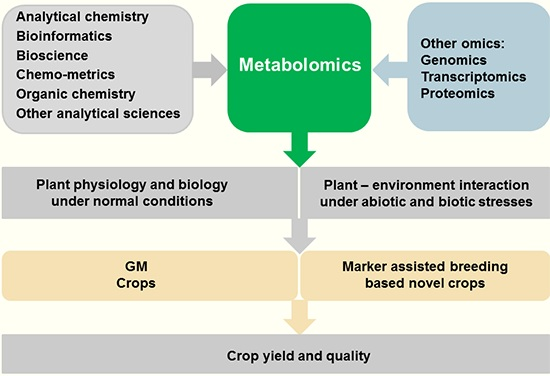
As genomes of many plant species have been sequenced, demand for functional genomics has dramatically accelerated the improvement of other omics including metabolomics. Despite a large amount of metabolites still remaining to be identified, metabolomics has contributed significantly not only to the understanding of plant physiology and biology from the view of small chemical molecules that reflect the end point of biological activities, but also in past decades to the attempts to improve plant behavior under both normal and stressed conditions. Hereby, we summarize the current knowledge on the genetic and biochemical mechanisms underlying plant growth, development, and stress responses, focusing further on the contributions of metabolomics to practical applications in crop quality improvement and food safety assessment, as well as plant metabolic engineering. We also highlight the current challenges and future perspectives in this inspiring area, with the aim to stimulate further studies leading to better crop improvement of yield and quality.
Keywords: primary and secondary metabolism; mQTL; mGWAS; metabolic engineering; crop improvement primary and secondary metabolism; mQTL; mGWAS; metabolic engineering; crop improvement
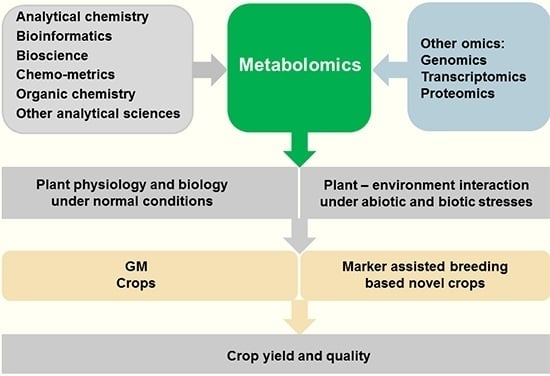
Graphical Abstract