3. Materials and Methods
General: Melting points were determined with a Yanagimoto MPS3 micromelting apparatus. UV/Vis spectra were measured with JASCO V-670 spectrophotometer. The fluorescence spectra and fluorescence quantum yield were measured with JASCO FP-8350 and Hamamatsu C11347 absolute photoluminescence quantum yield spectrometer, respectively. The UV/Vis spectra, fluorescence spectra, and fluorescence quantum yields were measured at room temperature. 1H and 13C NMR spectra were recorded with a JEOL ECA500 at 500 MHz (1H NMR) and 125 MHz (13C NMR) or a JEOL ECZ400 at 400 MHz (1H NMR) and 100 MHz (13C NMR), respectively. The HRMS data were obtained with a Waters Xevo G2-XS QTof (ESI-TOF) or a Bruker Daltonics autoflex maX (MALDI-TOF).
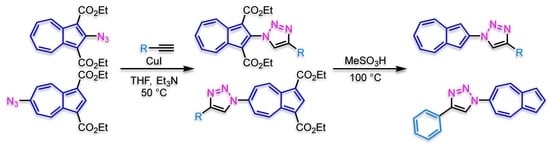
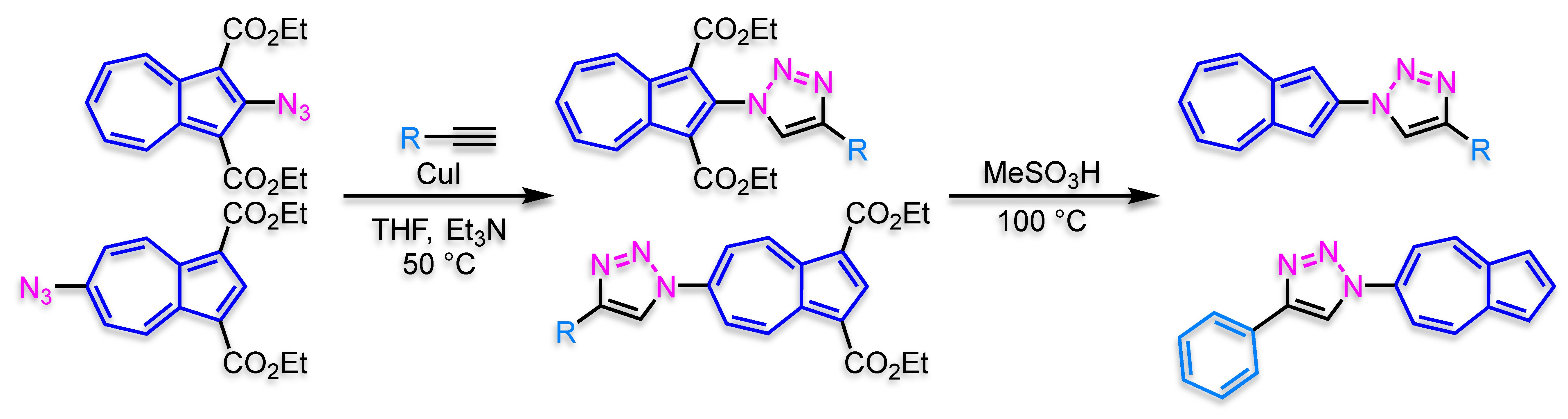
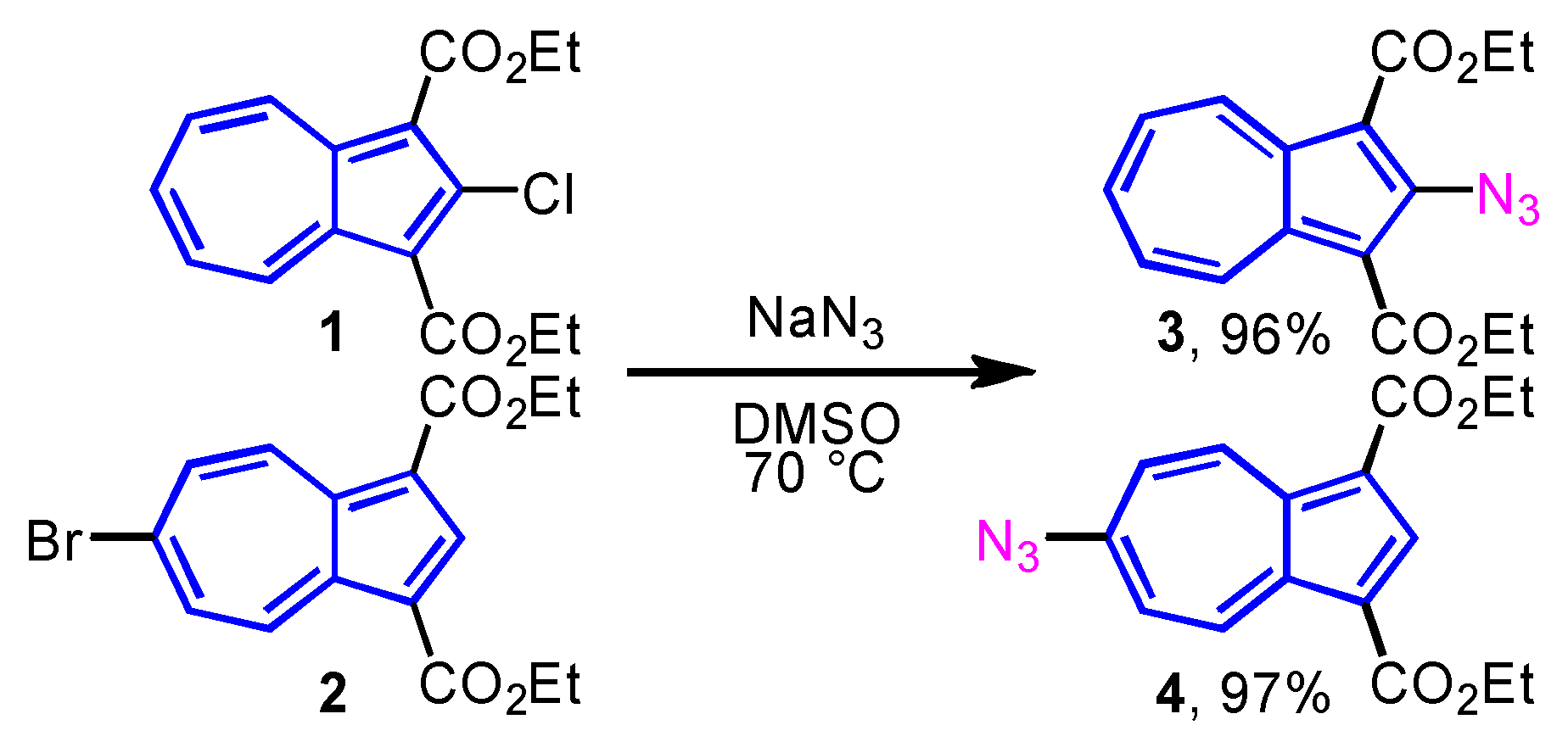
Diethyl 2-azidoazulene-1,3-dicarboxylate (3): A mixture of 3-chloro-1,3-diethoxycarbonylazulene (1) (1.54 g, 5.02 mmol) and sodium azide (503 mg, 7.72 mmol) in DMSO (30 mL) was heated at 70 °C in an oil bath for 4 h under an Ar atmosphere. The reaction mixture was poured into water and extracted with AcOEt. The organic layer was washed with water and brine, dried over Na2SO4, and concentrated under reduced pressure to afford the product 3 (1.53 g, 97%) as a red oil. IR (ATR): νmax = 2998 (w), 2979 (w), 2110 (m), 1694 (s), 1676 (m), 1592 (w), 1533 (w), 1498 (w), 1434 (s), 1411 (m), 1382 (w), 1296 (m), 1211 (s), 1180 (s), 1113 (w), 1093 (w), 1069 (m), 1056 (m), 1031 (m), 966 (w), 883 (w), 848 (w), 824 (w), 789 (m), 768 (w), 737 (w), 674 (w) cm−1; 1H NMR (500 MHz, CDCl3): δH = 9.45 (dd, J = 9.7, 1.1 Hz, 2H), 7.84–7.80 (m, 1H), 7.68 (t, J = 9.9 Hz, 2H), 4.49 (q, J = 7.1 Hz, 4H), 1.47 (t, J = 7.2 Hz, 6H) ppm; 13C NMR (125 MHz, CDCl3): δC = 164.32, 149.20, 142.52, 138.97, 137.12, 131.41, 109.42, 60.70, 14.57 ppm; HRMS (ESI-TOF, Positive): calcd for [C16H15N3O4 + H]+ 314.1135, found: 314.1147.
Diethyl 6-azidoazulene-1,3-dicarboxylate (4): A solution of 2 (358 mg, 1.02 mmol) and sodium azide (170 mg, 2.61 mmol) in DMSO (30 mL) was heated at 70 °C in an oil bath for 2 h under an Ar atmosphere. The reaction mixture was poured into water and extracted with ethyl acetate. The combined organic layers were washed with water, dried over Na2SO4, and concentrated under reduced pressure. The residue was purified by column chromatography on silica gel using ethyl acetate as eluent to afford 4 (304 mg, 95%) as a yellow solid. M.p. 150–152 °C (lit. 150.5–152 °C); 1H NMR (500 MHz, CDCl3): δH = 9.65 (dd, J = 9.9, 1.3 Hz, 2H), 8.68 (s, 1H), 7.32 (dt, J = 11.1, 1.1 Hz, 2H), 4.42 (q, J = 7.1 Hz, 4H), 1.44 (t, J = 7.2 Hz, 6H) ppm; 13C NMR (125 MHz, CDCl3): δC = 165.02, 152.43, 141.75, 140.99, 138.41, 120.99, 117.69, 60.25, 14.63 ppm; HRMS (ESI-TOF, Positive): calcd for [C16H15N3O4 + H]+ 314.1135; found: 314.1147.
Diethyl 2-(4-phenyl-1H-1,2,3-triazol-1-yl)azulene-1,3-dicarboxylate (5a): To a degassed solution of 3 (158 mg, 0.50 mmol) and ethynylbenzene (115 mg, 1.13 mmol) in THF (2.5 mL) and triethylamine (2.5 mL) was added CuI (11 mg, 0.06 mmol). The mixture was heated at 50 °C in an oil bath for 17 h under an Ar atmosphere. The reaction mixture was poured into a 10% NH4Cl solution and extracted with toluene. The combined organic layers were washed with brine, dried over Na2SO4, and concentrated under reduced pressure. The residue was purified by column chromatography on silica gel using toluene as eluent to afford 5a (160 mg, 77%) as a purple solid. M.p. 140–143 °C; IR (ATR): νmax = 3143 (w), 2978 (w), 1678 (s), 1510 (w), 1479 (w), 1459 (w), 1431 (s), 1414 (m), 1385 (m), 1354 (w), 1322 (w), 1299 (w), 1256 (m), 1214 (m), 1180 (s), 1154 (m), 1112 (w), 1084 (w), 1060 (m), 1042 (m), 1025 (m), 881 (w), 826 (w), 792 (m), 761 (m), 741 (w), 718 (w), 690 (m), 656 (w) cm−1; UV/Vis (CH2Cl2): λmax (log ε) = 236 (4.62), 272 (4.47), 291 sh (4.61), 302 (4.73), 361 (4.01), 495 sh (2.99), 513 (3.00), 570 sh (2.60) nm; 1H NMR (500 MHz, CDCl3): δH = 9.96–9.94 (m, 2H), 8.17–8.12 (m, 2H), 7.95–7.89 (m, 4H), 7.49–7.46 (m, 2H), 7.39–7.36 (m, 1H), 4.18–4.14 (m, 4H), 1.01 (t, J = 7.2 Hz, 6H) ppm; 13C NMR (125 MHz, CDCl3): δC = 163.63, 146.61, 143.65, 142.87, 141.84, 141.65, 131.94, 130.82, 129.04, 128.16, 125.88, 123.38, 113.15, 60.67, 13.93 ppm; HRMS (ESI-TOF, Positive): calcd for [C24H21N3O4 + H]+ 416.1605; found: 416.1608.
Diethyl 2-[4-(4-aminophenyl)-1H-1,2,3-triazol-1-yl]azulene-1,3-dicarboxylate (5b): To a degassed solution of 3 (158 mg, 0.50 mmol) and 4-ethynylaniline (103 mg, 0.88 mmol) in THF (2.5 mL) and triethylamine (2.5 mL) was added CuI (12 mg, 0.06 mmol). The mixture was heated at 50 °C in an oil bath for 17 h under an Ar atmosphere. The reaction mixture was poured into a 10% NH4Cl solution and extracted with toluene. The combined organic layers were washed with brine, dried over Na2SO4, and concentrated under reduced pressure. The residue was purified by column chromatography on silica gel using toluene/AcOEt as eluent to afford 5b (162 mg, 75%) as a red solid. M.p. 199–202 °C; IR (ATR): νmax = 3415 (w), 3347 (w), 2977 (w), 1692 (m), 1674 (m), 1643 (w), 1613 (m), 1563 (w), 1513 (m), 1489 (m), 1474 (m), 1460 (m), 1432 (s), 1386 (m), 1352 (w), 1332 (w), 1293 (w), 1252 (s), 1223 (m), 1212 (m), 1189 (s), 1141 (m), 1117 (w), 1080 (m), 1057 (m), 1038 (s), 888 (w), 865 (w), 847 (w), 829 (m), 816 (m), 792 (m), 764 (w), 730 (m), 712 (w), 700 (w), 683 (m), 655 (w), cm−1; UV/Vis (CH2Cl2): λmax (log ε) = 236 (4.48), 272 (4.57), 294 (4.69), 333 sh (4.00), 362 (3.97), 499 (3.00), 524 sh (2.98), 574 (2.57) nm; 1H NMR (500 MHz, CDCl3): δH = 9.92 (d, J = 9.7 Hz, 2H), 8.13 (t, J = 9.9 Hz, 1H), 7.97 (s, 1H), 7.90 (t, J = 10.2 Hz, 2H), 7.73 (d, J = 8.6 Hz, 2H), 6.78 (d, J = 8.6 Hz, 2H), 4.15 (q, J = 7.1 Hz, 4H), 3.79 (s, 2H), 1.02 (t, J = 7.2 Hz, 6H) ppm; 13C NMR (125 MHz, CDCl3): δC = 163.72, 146.94, 146.52, 143.90, 142.72, 141.70, 141.66, 131.86, 127.12, 122.16, 121.32, 115.45, 113.17, 60.67, 13.94 ppm; HRMS (ESI-TOF, Positive): calcd for [C24H22N4O4 + H]+ 431.1714; found: 431.1733.
Diethyl 2-[4-(4-nitrophenyl)-1H-1,2,3-triazol-1-yl]azulene-1,3-dicarboxylate (5c): To a degassed solution of 3 (158 mg, 0.50 mmol) and 4-ethynylnitrobenzene (147 mg, 1.00 mmol) in THF (2.5 mL) and triethylamine (2.5 mL) was added CuI (11 mg, 0.06 mmol). The mixture was heated at 50 °C in an oil bath for 17 h under an Ar atmosphere. The reaction mixture was poured into a 10% NH4Cl solution and extracted with toluene. The combined organic layers were washed with brine, dried over Na2SO4, and concentrated under reduced pressure. The residue was purified by column chromatography on silica gel using toluene/AcOEt as eluent to afford 5c (178 mg, 77%) as a red solid. M.p. 222–225 °C; IR (ATR): νmax = 3139 (w), 3111 (w), 2988 (w), 1703 (m), 1684 (m), 1604 (w), 1591 (w), 1512 (s), 1473 (w), 1436 (s), 1385 (w), 1341 (s), 1313 (w), 1286 (w), 1254 (m), 1215 (m), 1183 (m), 1144 (w), 1110 (w), 1077 (w), 1054 (w), 1040 (m), 967 (w), 887 (w), 853 (m), 795 (m), 768 (w), 757 (w), 745 (w), 728 (w), 711 (w), 688 (w), 680 (w), 661 (w) cm−1; UV/Vis (CH2Cl2): λmax (log ε) = 232 (4.46), 273 (4.31), 303 (4.57), 335 sh (4.40), 365 sh (4.13), 493 sh (2.98), 512 (3.00) nm; 1H NMR (500 MHz, CDCl3): δH = 9.96 (d, J = 10.0 Hz, 2H), 8.35 (d, J = 8.6 Hz, 2H), 8.28 (s, 1H), 8.24–8.16 (m, 2H), 8.12 (d, J = 8.9 Hz, 2H), 7.95 (t, J = 10.0 Hz, 2H), 7.69 (d, J = 8.9 Hz, 1H), 4.17 (q, J = 7.1 Hz, 4H), 1.01 (t, J = 7.0 Hz, 6H) ppm; 13C NMR (125 MHz, CDCl3): δC = 163.42, 147.45, 144.44, 143.23, 142.16, 141.57, 133.50, 132.16, 126.18, 124.90, 124.61, 123.86, 113.06, 60.73, 13.96 ppm; HRMS (ESI-TOF, Positive): calcd for [C24H20N4O6 + H]+ 461.1456; found: 461.1480.
Diethyl 2-[4-(naphthalen-1-yl)-1H-1,2,3-triazol-1-yl]azulene-1,3-dicarboxylate (5d): To a degassed solution of 3 (158 mg, 0.50 mmol) and 1-ethynylnaphthalene (158 mg, 1.04 mmol) in THF (2.5 mL) and triethylamine (2.5 mL) was added CuI (11 mg, 0.06 mmol). The mixture was heated at 50 °C in an oil bath for 17 h under an Ar atmosphere. The reaction mixture was poured into a 10% NH4Cl solution and extracted with toluene. The combined organic layers were washed with brine, dried over Na2SO4, and concentrated under reduced pressure. The residue was purified by column chromatography on silica gel using toluene/AcOEt as eluent to afford 5d (171 mg, 74%) as an orange solid. M.p. 174–176 °C; IR (ATR): νmax = 3135 (w), 3063 (w), 2998 (w), 2978 (w), 1693 (m), 1679 (s), 1591 (w), 1506 (m), 1434 (s), 1414 (m), 1397 (m), 1384 (m), 1354 (w), 1317 (w), 1298 (w), 1265 (m), 1254 (m), 1215 (s), 1180 (s), 1152 (m), 1116 (w), 1062 (m), 1049 (m), 1033 (w), 998 (w), 943 (w), 885 (w), 839 (w), 800 (s), 793 (s), 776 (s), 744 (m), 715 (w), 687 (w), 669 (w), 660 (w) cm−1; UV/Vis (CH2Cl2): λmax (log ε) = 273 (4.40), 294 sh (4.61), 304 (4.74), 362 (3.94), 493 sh (2.99), 508 (3.00) nm; 1H NMR (500 MHz, CDCl3): δH = 9.99 (d, J = 9.7 Hz, 2H), 8.59 (dd, J = 6.6, 2.9 Hz, 1H), 8.21 (s, 1H), 8.17 (t, J = 9.9 Hz, 1H), 7.96–7.90 (m, 5H), 7.61–7.53 (m, 3H), 4.21 (q, J = 7.2 Hz, 4H), 1.07 (t, J = 7.2 Hz, 6H) ppm; 13C NMR (125 MHz, CDCl3): δC = 163.71, 145.49, 142.93, 141.92, 141.76, 134.12, 132.01, 131.21, 128.94, 128.70, 128.15, 127.22, 126.71, 126.18, 126.12, 125.65, 125.42, 113.23, 60.75, 14.10 ppm; HRMS (ESI-TOF, Positive): calcd for [C28H23N3O4 + H]+ 466.1761; found: 466.1747.
Diethyl 2-[4-(5-isopropyl-3-methoxycarbonylazulen-1-yl)-1H-1,2,3-triazol-1-yl]azulene-1,3-dicarboxylate (5e): To a degassed solution of 3 (122 mg, 0.39 mmol) and 1-ethynyl-5-isopropyl-3-methoxycarbonylazulene (192 mg, 0.76 mmol) in THF (2 mL) and triethylamine (2 mL) was added CuI (11 mg, 0.06 mmol). The mixture was heated at 50 °C in an oil bath for 17 h under an Ar atmosphere. The reaction mixture was poured into a 10% NH4Cl solution and extracted with toluene. The combined organic layers were washed with brine, dried over Na2SO4, and concentrated under reduced pressure. The residue was purified by column chromatography on silica gel using toluene as eluent to afford 5e (193 mg, 88%) as a brown solid. M.p. 208–211 °C; IR (ATR): νmax = 2974 (w), 1685 (s), 1592 (w), 1518 (m), 1434 (s), 1386 (m), 1362 (w), 1321 (w), 1275 (w), 1191 (s), 1170 (m), 1136 (m), 1099 (w), 1053 (m), 1027 (m), 937 (w), 902 (m), 879 (w), 792 (m), 776 (m), 740 (w), 719 (w), 710 (w), 687 (w), 659 (w) cm−1; UV/Vis (CH2Cl2): λmax (log ε) = 237 (4.71), 273 (4.65), 305 (4.97), 318 sh (4.71), 365 (4.20), 388 (4.10), 403 sh (4.03), 522 (3.18), 570 (3.03) nm; 1H NMR (500 MHz, CDCl3): δH = 9.98–9.95 (m, 2H), 9.82 (d, J = 2.0 Hz, 1H), 9.62 (d, J = 9.5 Hz, 1H), 8.63 (s, 1H), 8.20 (s, 1H), 8.15 (t, J = 9.7 Hz, 1H), 7.92 (t, J = 10.2 Hz, 2H), 7.83 (d, J = 10.6 Hz, 1H), 7.56 (t, J = 10.0 Hz, 1H), 4.17 (q, J = 7.2 Hz, 4H), 3.98 (s, 3H), 3.26 (t, J = 6.9 Hz, 1H), 1.45 (d, J = 6.9 Hz, 6H), 1.01–0.99 (m, 6H) ppm; 13C NMR (125 MHz, CDCl3): δC = 165.90, 163.70, 149.64, 143.86, 143.59, 142.83, 142.26, 141.81, 141.71, 139.95, 139.28, 138.79, 138.23, 137.32, 131.93, 127.85, 124.17, 117.09, 114.97, 113.23, 60.67, 51.20, 39.19, 24.74, 13.98 ppm; HRMS (ESI-TOF, Positive): calcd for [C33H31N3O6 + H]+ 566.2286, found: 566.2260.
Diethyl 2-[4-ferrocenyl-1H-1,2,3-triazol-1-yl]azulene-1,3-dicarboxylate (5f): To a degassed solution of 3 (161 mg, 0.51 mmol) and ethynylferrocene (221 mg, 1.05 mmol) in THF (2.5 mL) and triethylamine (2.5 mL) was added CuI (12 mg, 0.06 mmol). The mixture was heated at 50 °C in an oil bath for 17 h under an Ar atmosphere. The reaction mixture was poured into a 10% NH4Cl solution and extracted with toluene. The combined organic layers were washed with brine, dried over Na2SO4, and concentrated under reduced pressure. The residue was purified by column chromatography on silica gel using toluene/AcOEt as eluent to afford 5f (226 mg, 85%) as a red solid. M.p. 191–194 °C; IR (ATR): νmax = 2987 (w), 1686 (s), 1592 (w), 1525 (w), 1507 (w), 1457 (w), 1434 (s), 1385 (m), 1335 (w), 1319 (w), 1299 (w), 1252 (m), 1239 (w), 1214 (s), 1186 (s), 1154 (w), 1099 (m), 1061 (m), 1036 (s), 974 (w), 877 (m), 825 (m), 781 (w), 762 (w), 742 (w), 725 (w), 714 (w), 703 (w), 683 (w), 669 (w), 654 (w) cm−1; UV/Vis (CH2Cl2): λmax (log ε) = 273 (4.47), 291 sh (4.59), 302 (4.71), 362 (4.00), 490 (3.30), 517 sh (3.26) nm; 1H NMR (500 MHz, CDCl3): δH = 9.89 (d, J = 9.7 Hz, 2H), 8.13 (t, J = 9.9 Hz, 1H), 7.89 (t, J = 10.2 Hz, 2H), 7.83 (s, 1H), 4.78 (t, J = 1.7 Hz, 2H), 4.34 (t, J = 1.9 Hz, 2H), 4.21 (q, J = 7.2 Hz, 4H), 4.17 (s, 5H), 1.14 (t, J = 7.2 Hz, 6H) ppm; 13C NMR (125 MHz, CDCl3): δC = 163.68, 145.31, 143.67, 142.66, 141.62, 141.53, 131.79, 123.01, 113.15, 75.86, 69.66, 68.71, 67.04, 60.69, 14.20 ppm; HRMS (ESI-TOF, Positive): calcd for [C28H25FeN3O4 + H]+ 524.1267, found: 524.1282; calcd: [C28H25FeN3O4]+ 523.1189, found: 523.1216.
Diethyl 2-(4-butyl-1H-1,2,3-triazol-1-yl)azulene-1,3-dicarboxylate (5g): To a degassed solution of 3 (157 mg, 0.50 mmol) and 1-hexyne (84 mg, 1.02 mmol) in THF (2.5 mL) and triethylamine (2.5 mL) was added CuI (10 mg, 0.05 mmol). The mixture was heated at 50 °C in an oil bath for 17 h under an Ar atmosphere. The reaction mixture was poured into a 10% NH4Cl solution and extracted with toluene. The combined organic layers were washed with brine, dried over Na2SO4, and concentrated under reduced pressure. The residue was purified by column chromatography on silica gel using toluene/AcOEt as eluent to afford 5g (142 mg, 72%) as a red solid. M.p. 99–101 °C; IR (ATR): νmax = 3144 (w), 2983 (w), 2954 (w), 2931 (w), 2855 (w), 1678 (s), 1591 (w), 1508 (m), 1459 (w), 1433 (s), 1415 (m), 1383 (m), 1355 (w), 1317 (w), 1298 (w), 1254 (m), 1221 (s), 1182 (s), 1132 (w), 1111 (w), 1059 (m), 1044 (s), 1027 (w), 880 (w), 820 (w), 793 (m), 743 (w), 716 (w), 687 (w), 669 (w), 660 (w) cm−1; UV/Vis (CH2Cl2): λmax (log ε) = 273 (4.47), 292 sh (4.61), 303 (4.73), 363 (3.94), 495 sh (2.99), 514 (3.00) nm; 1H NMR (500 MHz, CDCl3): δH = 9.89 (dd, J = 10.7, 1.0 Hz, 2H), 8.11 (t, J = 9.7 Hz, 1H), 7.88 (dd, J = 10.7, 9.9 Hz, 2H), 7.62 (s, 1H), 4.16 (q, J = 7.2 Hz, 4H), 2.86 (t, J = 7.7 Hz, 2H), 1.80–1.74 (m, 2H), 1.49 (q, J = 7.4 Hz, 2H), 1.07 (t, J = 7.2 Hz, 6H), 0.98 (t, J = 7.3 Hz, 3H) ppm; 13C NMR (125 MHz, CDCl3): δC = 163.73, 146.86, 144.16, 142.58, 141.56, 131.76, 124.29, 113.18, 60.56, 31.91, 25.38, 22.52, 13.96, 13.92 ppm; HRMS (ESI-TOF, Positive): calcd for [C22H25N3O4 + H]+ 396.1918; found: 396.1927.
Diethyl 6-(4-phenyl-1H-1,2,3-triazol-1-yl)azulene-1,3-dicarboxylate (6a): To a degassed solution of 4 (269 mg, 0.86 mmol) and ethynylbenzene (182 mg, 1.78 mmol) in THF (4 mL) and triethylamine (4 mL) was added CuI (17 mg, 0.09 mmol). The mixture was heated at 50 °C in an oil bath for 18 h under an Ar atmosphere. The reaction mixture was poured into a 10% NH4Cl solution and extracted with toluene. The combined organic layers were washed with brine, dried over Na2SO4, and concentrated under reduced pressure. The residue was purified by column chromatography on silica gel using CH2Cl2/ethyl acetate as eluent to afford 6a (299 mg, 84%) as a purple solid. M.p. 177–180 °C; IR (ATR): νmax = 3116 (w), 3092 (w), 2976 (w), 2930 (w), 1692 (s), 1592 (w), 1550 (w), 1522 (w), 1480 (w), 1467 (w), 1437 (s), 1406 (w), 1393 (w), 1382 (w), 1362 (w), 1302 (w), 1237 (w), 1199 (s), 1173 (m), 1092 (w), 1080 (w), 1047 (w), 1036 (s), 988 (m), 909 (w), 867 (w), 842 (m), 820 (w), 766 (s), 708 (w), 691 (m), 671 (w), 656 (w) cm−1; UV/Vis (CH2Cl2): λmax (log ε) = 239 (4.80), 265 sh (4.51), 309 (4.77), 336 (4.67), 374 sh (4.42), 522 (3.00), 565 sh (2.87), 623 (2.32) nm; 1H NMR (500 MHz, CDCl3): δH = 9.76 (d, J = 11.2 Hz, 2H), 8.90 (s, 1H), 7.93 (s, 1H), 7.77 (dd, J = 10.0, 1.1 Hz, 2H), 7.41–7.33 (m, 3H), 7.22–7.21 (m, 2H), 4.44 (q, J = 7.1 Hz, 4H), 1.45 (t, J = 7.2 Hz, 6H) ppm; 13C NMR (125 MHz, CDCl3): δC = 164.71, 145.14, 144.92, 142.96, 138.62, 137.91, 134.02, 129.92, 129.40, 128.78, 127.40, 126.15, 118.26, 60.52, 14.61 ppm; HRMS (ESI-TOF, Positive): calcd for [C24H21N3O4 + H]+ 416.1605, found: 416.1608.
Diethyl 6-[4-(4-aminophenyl)-1H-1,2,3-triazol-1-yl]azulene-1,3-dicarboxylate (6b): To a degassed solution of 4 (162 mg, 0.52 mmol) and 4-ethynylaniline (120 mg, 1.02 mmol) in THF (3 mL) and triethylamine (3 mL) was added CuI (11 mg, 0.06 mmol). The mixture was stirred at 50 °C for 17 h under an Ar atmosphere. The reaction mixture was poured into a 10% NH4Cl solution and extracted with toluene. The combined organic layers were washed with brine, dried over Na2SO4, and concentrated under reduced pressure. The residue was purified by column chromatography on silica gel using CH2Cl2/AcOEt as eluent to afford 6b (192 mg, 86%) as a purple solid. M.p. 223–227 °C; IR (ATR): νmax = 3432 (w), 3348 (w), 3095 (w), 2979 (w), 1701 (m), 1673 (m), 1633 (w), 1612 (w), 1589 (w), 1549 (w), 1498 (w), 1436 (s), 1406 (w), 1387 (m), 1298 (w), 1239 (w), 1200 (s), 1179 (m), 1091 (m), 1035 (s), 990 (m), 907 (w), 871 (w), 850 (w), 828 (m), 765 (m), 720 (w), 670 (w), 655 (w) cm−1; UV/Vis (CH2Cl2): λmax (log ε) = 239 (4.32), 270 (4.30), 315 (4.50), 347 (3.89), 378 (3.90), 523 sh (2.78), 565 sh (2.62), 624 sh (2.13) nm; 1H NMR (500 MHz, DMSO-d6): δH = 9.74 (d, J = 11.2 Hz, 2H), 9.04 (s, 1H), 8.65 (s, 1H), 8.50 (d, J = 11.2 Hz, 2H), 7.63 (d, J = 8.3 Hz, 2H), 6.71 (d, J = 8.0 Hz, 2H), 4.98 (s, 2H), 4.41 (q, J = 7.2 Hz, 4H), 1.40 (t, J = 7.0 Hz, 6H) ppm; Low solubility of compound humped the measurement of 13C NMR; HRMS (ESI-TOF, Positive): calcd for [C24H22N4O4 + H]+ 431.1714, found: 431.1733.
Diethyl 6-[4-(4-nitrophenyl)-1H-1,2,3-triazol-1-yl]azulene-1,3-dicarboxylate (6c): To a degassed solution of 4 (159 mg, 0.51 mmol) and 4-ethynylnitrobenzene (81 mg, 0.55 mmol) in THF (3 mL) and triethylamine (3 mL) was added CuI (10 mg, 0.05 mmol). The mixture was heated at 50 °C in an oil bath for 17 h under an Ar atmosphere. The reaction mixture was poured into a 10% NH4Cl solution and extracted with toluene. The combined organic layers were washed with brine, dried over Na2SO4, and concentrated under reduced pressure. The residue was purified by column chromatography on silica gel using CH2Cl2/AcOEt as eluent to afford 6c (162 mg, 69%) as a purple solid. M.p. 258–262 °C; IR (ATR): νmax = 3162 (w), 2979 (w), 1688 (m), 1606 (w), 1588 (w), 1550 (w), 1518 (m), 1429 (s), 1406 (w), 1389 (w), 1344 (m), 1246 (w), 1201 (s), 1110 (w), 1095 (w), 1080 (w), 1043 (m), 1019 (m), 996 (w), 963 (w), 912 (w), 868 (w), 855 (w), 810 (w), 768 (w), 755 (w), 708 (w), 690 (w), 657 (w) cm−1; UV/Vis (CH2Cl2): λmax (log ε) = 237 (4.52), 268 (4.26), 333 (4.69), 374 sh (4.26), 523 (2.83), 570 sh (2.68), 630 sh (2.17) nm; 1H NMR (500 MHz, DMSO-d6): δH = 9.77 (dd, J = 10.0, 1.1 Hz, 2H), 9.57 (d, J = 2.0 Hz, 1H), 8.69 (s, 1H), 8.50 (dd, J = 11.3, 0.7 Hz, 2H), 8.33 (d, J = 8.9 Hz, 2H), 8.21 (dd, J = 6.9, 2.0 Hz, 2H), 4.41 (q, J = 7.1 Hz, 4H), 1.40 (t, J = 7.2 Hz, 6H) ppm; 13C NMR (125 MHz, DMSO-d6): δC = 164.27, 148.14, 146.76, 145.51, 143.52, 142.05, 138.79, 136.79, 127.11, 124.78, 123.68, 123.61, 118.35, 60.58, 14.75 ppm; HRMS (ESI-TOF, Positive): calcd for [C24H20N4O6 + H]+ 461.1456, found: 461.1436.
Diethyl 6-[4-(naphthalen-1-yl)-1H-1,2,3-triazol-1-yl]azulene-1,3-dicarboxylate (6d): To a degassed solution of 4 (143 mg, 0.46 mmol) and 1-ethynylnaphthalene (140 mg, 0.92 mmol) in THF (2.5 mL) and triethylamine (2.5 mL) was added CuI (10 mg, 0.05 mmol). The mixture was heated at 50 °C in an oil bath for 17 h under an Ar atmosphere. The reaction mixture was poured into a 10% NH4Cl solution and extracted with toluene. The combined organic layers were washed with brine, dried over Na2SO4, and concentrated under reduced pressure. The residue was purified by column chromatography on silica gel using CH2Cl2 as eluent to afford 6d (175 mg, 82%) as a purple solid. M.p. 179–182 °C; IR (ATR): νmax = 3132 (w), 3060 (w), 2979 (w), 1685 (s), 1587 (w), 1551 (w), 1518 (w), 1435 (s), 1378 (w), 1350 (w), 1201 (s), 1128 (w), 1109 (w), 1086 (w), 1046 (m), 1021 (w), 993 (m), 912 (w), 874 (w), 859 (w), 797 (m), 769 (m), 742 (w), 714 (w), 674 (w), 662 (w), cm−1; UV/Vis (CH2Cl2): λmax (log ε) = 270 (4.27), 316 (4.74), 358 sh (4.30), 375 sh (4.23), 522 (3.00), 565 (2.87), 625 sh (2.29) nm; 1H NMR (500 MHz, CDCl3): δH = 9.93 (dd, J = 10.0, 1.4 Hz, 2H), 8.89 (s, 1H), 8.46–8.43 (m, 2H), 8.30 (dd, J = 9.9, 1.3 Hz, 2H), 7.96–7.93 (m, 2H), 7.83 (dd, J = 6.9, 1.1 Hz, 1H), 7.60–7.54 (m, 3H), 4.47 (q, J = 7.2 Hz, 4H), 1.48 (t, J = 7.2 Hz, 6H) ppm; 13C NMR (125 MHz, CDCl3): δC = 164.76, 148.77, 145.05, 144.43, 142.43, 138.61, 134.04, 131.16, 129.74, 128.72, 127.69, 127.11, 127.04, 126.34, 125.46, 125.28, 122.62, 121.68, 118.43, 60.54, 14.63 ppm; HRMS (ESI-TOF, Positive): calcd for [C28H23N3O4 + H]+ 466.1761, found: 466.1747.
Diethyl 6-{4-[5-isopropyl-3-(methoxycarbonyl)azulen-1-yl]-1H-1,2,3-triazol-1-yl}azulene-1,3-dicarboxylate (6e): To a degassed solution of 4 (53 mg, 0.17 mmol) and 1-ethynyl-5-isopropyl-3-methoxycarbonylazulene (86 mg, 0.34 mmol) in THF (1 mL) and triethylamine (1 mL) was added CuI (3 mg, 0.016 mmol). The mixture was heated at 50 °C in an oil bath for 17 h under an Ar atmosphere. The reaction mixture was poured into a 10% NH4Cl solution and extracted with toluene. The combined organic layers were washed with brine, dried over Na2SO4, and concentrated under reduced pressure. The residue was purified by column chromatography on silica gel using toluene as eluent to afford 6e (73 mg, 76%) as a purple solid. M.p. 170–174 °C; IR (ATR): νmax = 2978 (w), 1686 (s), 1587 (w), 1571 (w), 1547 (w), 1522 (w), 1434 (s), 1421 (m), 1404 (m), 1239 (m), 1207 (s), 1171 (m), 1119 (m), 1082 (w), 1063 (w), 1041 (m), 1028 (m), 983 (m), 940 (w), 908 (w), 876 (m), 857 (m), 817 (w), 777 (m), 768 (w), 739 (w), 705 (w), 676 (w), 662 (w) cm−1; UV/Vis (CH2Cl2): λmax (log ε) = 237 (4.79), 270 (4.51), 324 (4.98), 364 sh (4.41), 381 (4.12), 560 sh (2.85), 613 sh (2.52) nm; 1H NMR (500 MHz, CDCl3): δH = 9.92 (d, J = 11.2 Hz, 2H), 9.83 (d, J = 1.7 Hz, 1H), 9.55 (d, J = 9.7 Hz, 1H), 8.88 (s, 1H), 8.64 (s, 1H), 8.46 (s, 1H), 8.29 (dd, J = 10.0, 1.4 Hz, 2H), 7.85 (d, J = 10.3 Hz, 1H), 7.60 (t, J = 10.0 Hz, 1H), 4.47 (q, J = 7.2 Hz, 4H), 3.99 (s, 3H), 3.27 (t, J = 6.9 Hz, 1H), 1.48 (t, J = 7.2 Hz, 6H), 1.45 (d, J = 6.9 Hz, 6H) ppm; 13C NMR (125 MHz, CDCl3): δC = 165.74, 164.79, 150.27, 146.83, 145.09, 144.28, 142.50, 142.38, 140.16, 139.61, 139.12, 138.60, 138.54, 137.32, 128.34, 122.46, 119.03, 118.35, 115.58, 115.23, 60.52, 51.28, 39.21, 24.73, 14.65 ppm; HRMS (ESI-TOF, Positive): calcd for [C33H31N3O6 + H]+ 566.2286, found: 566.2260.
Diethyl 6-(4-ferrocenyl-1H-1,2,3-triazol-1-yl)azulene-1,3-dicarboxylate (6f): To a degassed solution of 4 (158 mg, 0.50 mmol) and ethynylferrocene (210 mg, 1.00 mmol) in THF (2.5 mL) and triethylamine (2.5 mL) was added CuI (10 mg, 0.05 mmol). The mixture was heated at 50 °C in an oil bath for 17 h under an Ar atmosphere. The reaction mixture was poured into a 10% NH4Cl solution and extracted with toluene. The combined organic layers were washed with brine, dried over Na2SO4, and concentrated under reduced pressure. The residue was purified by column chromatography on silica gel using CH2Cl2 as eluent to afford 6f (194 mg, 74%) as a red solid. M.p. 247–250 °C; IR (ATR): νmax = 3119 (w), 2975 (w), 1691 (s), 1598 (w), 1550 (w), 1436 (s), 1409 (w), 1390 (m), 1352 (w), 1306 (w), 1237 (m), 1194 (s), 1118 (w), 1078 (w), 1043 (m), 1036 (s), 1020 (m), 988 (m), 870 (m), 840 (m), 820 (m), 764 (m), 716 (w), 670 (w), 658 (w) cm−1; UV/Vis (CH2Cl2): λmax (log ε) = 240 (4.41), 266 sh (4.11), 309 (4.38), 336 (4.27), 374 sh (4.03), 501 (2.99), 565 sh (2.73) nm; 1H NMR (500 MHz, CDCl3): δH = 9.90 (d, J = 11.5 Hz, 2H), 8.87 (s, 1H), 8.23 (d, J = 11.5 Hz, 2H), 8.08 (s, 1H), 4.83 (t, J = 1.7 Hz, 2H), 4.46 (q, J = 7.2 Hz, 4H), 4.39 (t, J = 1.9 Hz, 2H), 4.15 (s, 4H), 1.47 (t, J = 7.2 Hz, 6H) ppm; 13C NMR (125 MHz, CDCl3): δC = 164.79, 149.20, 145.03, 144.19, 142.30, 138.60, 122.27, 118.30, 117.32, 74.15, 69.80, 69.30, 67.04, 60.49, 14.63 ppm; HRMS (ESI-TOF, Positive): calcd for [C28H25FeN3O4 + H]+ 524.1267, found: 524.1282; [C28H25FeN3O4]+ 523.1189, found: 523.1216.
Diethyl 6-(4-butyl-1H-1,2,3-triazol-1-yl)azulene-1,3-dicarboxylate (6g): To a degassed solution of 4 (158 mg, 0.50 mmol) and 1-hexyne (84 mg, 1.02 mmol) in THF (5 mL) and triethylamine (5 mL) was added CuI (15 mg, 0.08 mmol). The mixture was heated at 50 °C in an oil bath for 17 h under an Ar atmosphere. The reaction mixture was poured into a 10% NH4Cl solution and extracted with toluene. The combined organic layers were washed with brine, dried over Na2SO4, and concentrated under reduced pressure. The residue was purified by column chromatography on silica gel using toluene as eluent to afford 6g (129 mg, 65%) as a purple solid. M.p. 172–173 °C; IR (ATR): νmax = 3125 (w), 2960 (w), 2931 (w), 2872 (w), 1693 (s), 1590 (w), 1549 (w), 1519 (w), 1479 (w), 1436 (s), 1409 (w), 1394 (w), 1381 (w), 1352 (w), 1325 (w), 1308 (w), 1236 (w), 1198 (s), 1164 (m), 1077 (m), 1039 (s), 1020 (w), 994 (m), 932 (w), 910 (w), 869 (w), 845 (w), 804 (w), 763 (m), 701 (w), 659 (w) cm−1; UV/Vis (CH2Cl2): λmax (log ε) = 237 (4.24), 270 (3.96), 324 (4.43), 362 sh (3.88), 381 sh (3.57), 519 (2.73), 561 sh (2.53), 616 sh (1.93) nm; 1H NMR (500 MHz, CDCl3): δH = 9.87 (dd, J = 10.0, 1.4 Hz, 2H), 8.85 (s, 1H), 8.17 (dd, J = 10.0, 1.4 Hz, 2H), 7.92 (s, 1H), 4.45 (q, J = 7.2 Hz, 4H), 2.85 (t, J = 7.7 Hz, 2H), 1.79–1.73 (m, 2H), 1.48–1.44 (m, 8H), 0.98 (t, J = 7.4 Hz, 3H) ppm; 13C NMR (125 MHz, CDCl3): δC = 164.78, 150.46, 145.32, 144.14, 142.31, 138.58, 122.50, 119.97, 118.20, 60.47, 31.45, 25.46, 22.43, 14.62, 13.91 ppm; HRMS (ESI-TOF, Positive): calcd for [C22H25N3O4 + H]+ 396.1918, found: 396.1927.
1-(Azulen-2-yl)-4-phenyl-1H-1,2,3-triazole (7a): A solution of 5a (104 mg, 0.25 mmol) in methanesulfonic acid (3 mL) was heated at 90 °C in an oil bath for 2 h. The reaction mixture was poured into water. The precipitate was collected by filtration to afford 7a (63 mg, 93%) as a purple solid. M.p. 228–231 °C; IR (ATR): νmax = 3142 (m), 3115 (w), 3084 (w), 3055 (w), 3023 (w), 1575 (m), 1536 (m), 1522 (s), 1477 (m), 1452 (m), 1421 (m), 1399 (m), 1299 (w), 1230 (m), 1223 (m), 1213 (m), 1172 (w), 1155 (w), 1071 (w), 1040 (m), 1016 (m), 959 (w), 915 (w), 899 (m), 810 (m), 760 (m), 736 (m), 706 (w), 692 (m), 660 (w), 632 (w) cm−1; UV/Vis (CH2Cl2): λmax (log ε) = 239 (4.33), 285 (4.75), 301 (4.64), 344 (3.85), 373 (4.17), 549 (2.65), 569 (2.63), 582 (2.64), 640 sh (2.24) nm; 1H NMR (400 MHz, CDCl3): δH = 8.40 (d, J = 9.2 Hz, 2H), 8.38 (s, 1H), 7.96 (dd, J = 8.3, 1.3 Hz, 2H), 7.70–7.64 (m, 3H), 7.50–7.46 (m, 2H), 7.41–7.36 (m, 1H), 7.33 (t, J = 9.9 Hz, 2H) ppm; 13C NMR (100 MHz, CDCl3): δC = 148.44, 142.64, 140.04, 137.76, 137.62, 130.24, 129.03, 128.57, 126.01, 125.33, 117.96, 106.28 ppm; HRMS (ESI-TOF, Positive): calcd for [C18H13N3 + H]+ 272.1182; found: 272.1210.
4-[1-(Azulen-2-yl)-1H-1,2,3-triazol-4-yl]aniline (7b): A solution of 5b (108 mg, 0.25 mmol) in methanesulfonic acid (3 mL) was heated at 90 °C in an oil bath for 2 h. The reaction mixture was poured into water. The precipitate was collected by filtration to afford 7b (63 mg, 88%) as a purple solid. M.p. 237–239 °C; IR (ATR): νmax = 3464 (w), 3333 (s), 3210 (w), 1625 (s), 1612 (m), 1579 (w), 1535 (w), 1519 (m), 1489 (s), 1441 (w), 1417 (m), 1397 (w), 1296 (m), 1230 (m), 1218 (w), 1202 (w), 1184 (w), 1169 (w), 1128 (w), 1041 (m), 1020 (w), 958 (w), 946 (w), 901 (w), 833 (m), 801 (s), 789 (s), 769 (w), 729 (m), 700 (w), 657 (w), 630 (w) cm−1; UV/Vis (CH2Cl2): λmax (log ε) = 237 (4.30), 292 (4.93), 380 (4.16), 510 sh (2.55), 547 (2.69), 582 (2.66), 638 sh (2.30) nm; 1H NMR (400 MHz, CDCl3): δH = 8.40–8.38 (m, 2H), 8.24 (s, 1H), 7.76–7.74 (m, 2H), 7.68–7.63 (m, 3H), 7.32 (t, J = 9.8 Hz, 2H), 6.79–6.77 (m, 2H), 3.81 (s, 2H) ppm; 13C NMR (100 MHz, CDCl3): δC = 148.77, 146.85, 142.85, 140.05, 137.54, 137.42, 127.26, 125.25, 120.67, 116.58, 115.37, 106.24 ppm; HRMS (ESI-TOF, Positive): [C18H14N4 + H]+ 287.1291; found: 287.1290.
1-(Azulen-2-yl)-4-(4-nitrophenyl)-1H-1,2,3-triazole (7c): A solution of 5c (115 mg, 0.25 mmol) in methanesulfonic acid (3 mL) was heated at 90 °C in an oil bath for 2 h. The reaction mixture was poured into water. The precipitate was collected by filtration to afford 7c (75 mg, 95%) as a purple solid. M.p. 321–323 °C; IR (ATR): νmax = 3134 (w), 3102 (w), 3053 (w), 1604 (s), 1579 (w), 1536 (m), 1508 (s), 1477 (s), 1453 (m), 1415 (m), 1398 (m), 1376 (w), 1337 (s), 1315 (s), 1296 (s), 1272 (m), 1236 (s), 1222 (s), 1208 (s), 1199 (s), 1164 (w), 1109 (s), 1032 (m), 1016 (s), 1006 (s), 962 (m), 899 (w), 860 (s), 852 (m), 836 (m), 793 (s), 769 (m), 752 (s), 742 (s), 703 (m), 688 (m), 652 (w), 627 (m) cm−1; UV/Vis (CH2Cl2): λmax (log ε) = 299 (4.65), 357 (4.35), 373 (4.45), 549 (2.70), 582 (2.68), 637 sh (2.31) nm; 1H NMR (400 MHz, CDCl3): δH = 8.53 (s, 1H), 8.44 (d, J = 9.2 Hz, 2H), 8.36 (dd, J = 7.0, 2.0 Hz, 2H), 8.14 (dd, J = 6.9, 2.0 Hz, 2H), 7.74–7.69 (m, 3H), 7.36 (t, J = 9.9 Hz, 2H) ppm; Low solubility of compound hampered the measurement of 13C NMR; HRMS (ESI-TOF, Positive): [C18H12N4O2 + H]+ 317.1033; found: 317.1062.
1-(Azulen-2-yl)-4-(naphthalen-1-yl)-1H-1,2,3-triazole (7d): A solution of 5d (116 mg, 0.25 mmol) in methanesulfonic acid (3 mL) was heated at 90 °C in an oil bath for 2 h. The reaction mixture was poured into water, and the resulting solid was collected by filtration to afford 7d (73 mg, 91%) as a purple solid. M.p. 159–161 °C; IR (ATR): νmax = 3115 (m), 3045 (m), 3016 (w), 1581 (m), 1536 (m), 1503 (s), 1454 (m), 1392 (m), 1338 (w), 1298 (w), 1277 (w), 1258 (w), 1237 (m), 1218 (m), 1201 (m), 1163 (w), 1105 (w), 1034 (m), 1010 (m), 955 (w), 900 (w), 861 (w), 836 (m), 813 (m), 792 (s), 769 (s), 731 (s), 716 (m), 658 (w), 637 (w), 625 (m) cm−1; UV/Vis (CH2Cl2): λmax (log ε) = 289 (4.80), 340 (3.90), 358 (4.02), 372 (4.18), 549 (2.66), 582 (2.65), 639 sh (2.27) nm; 1H NMR (400 MHz, CDCl3): δH = 8.49–8.46 (m, 1H), 8.45–8.42 (m, 3H), 7.95–7.93 (m, 2H), 7.85 (dd, J = 7.1, 1.2 Hz, 1H), 7.74 (s, 2H), 7.69 (t, J = 9.9 Hz, 1H), 7.60–7.55 (m, 3H), 7.35 (t, J = 9.9 Hz, 2H) ppm; 13C NMR (100 MHz, CDCl3): δC = 147.62, 142.63, 140.10, 137.82, 137.70, 134.00, 131.26, 129.30, 128.62, 127.69, 127.52, 126.89, 126.20, 125.50, 125.36, 121.05, 106.34 ppm, one signal is overlapped with other signals; HRMS (ESI-TOF, Positive): [C22H15N3 + H]+ 322.1339; found: 322.1357.
1-(Azulen-2-yl)-4-(azulen-1-yl)-1H-1,2,3-triazole (7e): A solution of 5e (113 mg, 0.20 mmol) in methanesulfonic acid (5 mL) was heated at 90 °C in an oil bath for 2 h. The reaction mixture was poured into water, and the resulting solid was collected by filtration to afford 7e (65 mg, 89%) as a purple solid. M.p. 252–254 °C; IR (ATR): νmax = 3136 (m), 3112 (m), 3084 (m), 3045 (m), 3023 (m), 3004 (m), 2958 (s), 2922 (m), 2884 (m), 2865 (m), 1580 (m), 1562 (m), 1536 (m), 1522 (s), 1502 (m), 1484 (m), 1453 (m), 1428 (m), 1394 (s), 1363 (m), 1325 (w), 1295 (m), 1261 (m), 1247 (w), 1220 (m), 1176 (m), 1161 (w), 1106 (m), 1070 (w), 1054 (w), 1040 (m), 1004 (m), 978 (w), 955 (w), 943 (w), 919 (w), 908 (w), 900 (m), 886 (w), 870 (w), 859 (w), 820 (m), 802 (s), 770 (s), 730 (m), 700 (m), 632 (m) cm−1; UV/Vis (CH2Cl2): λmax (log ε) = 299 (4.89), 341 (4.12), 386 (4.22), 550 (3.15), 585 (3.15), 655 sh (2.93) nm; 1H NMR (400 MHz, CDCl3): δH = 9.28 (d, J = 9.9 Hz, 1H), 8.40 (d, J = 10.2 Hz, 3H), 8.33 (d, J = 1.7 Hz, 1H), 8.21 (d, J = 4.0 Hz, 1H), 7.72 (s, 2H), 7.67–7.59 (m, 2H), 7.37–7.28 (m, 4H), 3.12 (t, J = 6.9 Hz, 1H), 1.40 (d, J = 6.9 Hz, 6H) ppm; 13C NMR (100 MHz, CDCl3): δC = 146.43, 144.27, 143.21, 142.83, 140.33, 137.39, 137.32, 136.06, 135.62, 135.23, 125.24, 124.15, 117.97, 117.45, 117.28, 106.52, 38.55, 24.53 ppm; HRMS (ESI-TOF, Positive): [C25H21N3 + H]+ 364.1808; found: 364.1826.
1-(Azulen-2-yl)-4-butyl-1H-1,2,3-triazole (7g): A solution of 5g (79 mg, 0.20 mmol) in methanesulfonic acid (5 mL) was heated at 90 °C in an oil bath for 3 h. The reaction mixture was poured into water, and the resulting solid was collected by filtration to afford 7g (45 mg, 90%) as a purple solid. M.p. 97–100 °C; IR (ATR): νmax = 3142 (m), 3115 (m), 3084 (w), 3055 (w), 3023 (w), 1575 (m), 1536 (s), 1522 (s), 1477 (m), 1452 (m), 1421 (m), 1399 (s), 1299 (w), 1230 (m), 1223 (m), 1213 (m), 1172 (m), 1155 (w), 1071 (w), 1040 (m), 1016 (s), 959 (w), 915 (w), 899 (m), 810 (s), 760 (m), 736 (m), 706 (w), 692 (s), 660 (w), 632 (m) cm−1; UV/Vis (CH2Cl2): λmax (log ε) = 239 (4.21), 290 (4.78), 298 (4.77), 340 (3.82), 354 (3.94), 370 (4.10), 548 sh (2.65), 581 (2.63), 635 sh (2.28) nm; 1H NMR (400 MHz, CDCl3): δH = 8.36 (d, J = 9.1 Hz, 2H), 7.89 (s, 1H), 7.66–7.60 (m, 3H), 7.29 (t, J = 10.1 Hz, 2H), 2.83 (t, J = 7.5 Hz, 2H), 1.74 (quint, J = 7.5 Hz, 2H), 1.44 (sextet, J = 7.5 Hz, 2H), 0.96 (t, J = 7.5 Hz, 3H) ppm; 13C NMR (100 MHz, CDCl3): δC = 149.30, 143.06, 140.07, 137.43, 137.32, 125.19, 119.34, 106.21, 31.55, 25.45, 22.42, 13.95 ppm; HRMS (ESI-TOF, Positive): [C16H17N3 + H]+ 252.1495; found: 252.1497.
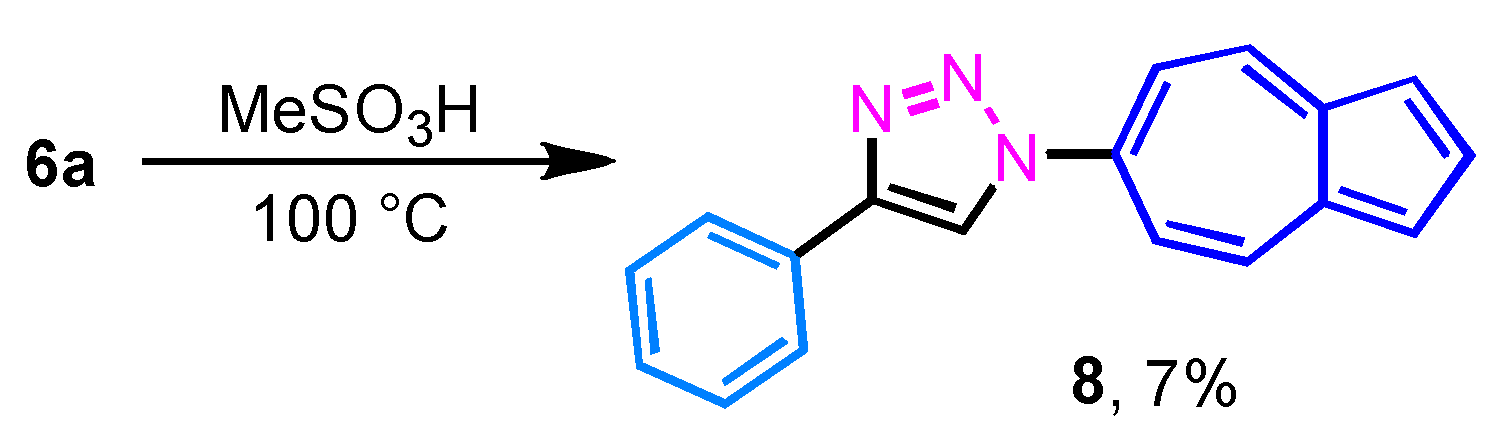
1-(Azulen-2-yl)-4-(azulen-1-yl)-1H-1,2,3-triazole (8): A solution of 5e (208 mg, 0.50 mmol) in methanesulfonic acid (5 mL) was heated at 90 °C in an oil bath for 1 h. The reaction mixture was poured into water, and the resulting solid was collected by filtration. The crude solid was dissolved in CH2Cl2 and purified by column chromatography on silica gel using CH2Cl2 as eluent to afford 8 (9 mg, 7%) as a purple solid. M.p. 228–231 °C; IR (ATR): νmax = 3125 (m), 3093 (w), 3080 (w), 3058 (w), 1574 (m), 1551 (m), 1477 (m), 1454 (m), 1422 (m), 1398 (m), 1379 (m), 1346 (m), 1308 (m), 1286 (m), 1239 (m), 1211 (m), 1197 (m), 1161 (m), 1085 (m), 1073 (m), 1050 (m), 1032 (m), 1019 (m), 977 (m), 965 (m), 916 (m), 905 (m), 837 (m), 821 (m), 792 (m), 764 (s), 740 (s), 706 (m), 689 (s), 662 (m), 644 (m) cm−1; 1H NMR (400 MHz, CDCl3): δH = 8.46 (d, J = 10.3 Hz, 2H), 8.30 (d, J = 0.6 Hz, 1H), 8.00 (t, J = 3.8 Hz, 1H), 7.95–7.93 (m, 2H), 7.65 (d, J = 10.6 Hz, 2H), 7.54 (d, J = 3.7 Hz, 2H), 7.48 (t, J = 7.7 Hz, 2H), 7.41–7.37 (m, 1H) ppm; 13C NMR (100 MHz, CDCl3): δC = 148.81, 142.82, 139.18, 138.78, 135.46, 130.11, 129.09, 128.71, 125.99, 120.74, 119.10, 116.23 ppm; HRMS (MALDI-TOF, Positive): calcd for [C18H13N3 + H]+ 272.1182, found: 272.1175.
Diethyl 6-[(triphenyl-λ5-phosphaneylidene)amino]azulene-1,3-dicarboxylate (9): To a degassed solution of 4 (605 mg, 1.93 mmol) in THF (10 mL) was added triphenylphosphane (1.02 g, 3.89 mmol). The mixture was heated at 50 °C in an oil bath for 17 h under an Ar atmosphere. The generated solid was filtered and washed with EtOH and hexane to afford 9 (908 mg, 86%) as a yellow solid. M.p. 175–178 °C; IR (ATR): νmax = 2980 (w), 1686 (w), 1666 (m), 1579 (w), 1562 (w), 1535 (w), 1479 (w), 1459 (w), 1425 (s), 1368 (w), 1323 (s), 1241 (w), 1196 (s), 1142 (w), 1106 (m), 1094 (m), 1047 (m), 999 (w), 952 (s), 889 (s), 868 (w), 846 (w), 828 (w), 806 (w), 761 (w), 721 (m), 693 (m), 669 (w), 655 (w) cm−1; 1H NMR (500 MHz, CDCl3): δH = 9.11 (d, J = 10.9 Hz, 2H), 8.22 (s, 1H), 7.77–7.73 (m, 6H), 7.62–7.59 (m, 3H), 7.53–7.50 (m, 6H), 7.14 (d, J = 11.7 Hz, 2H), 4.33 (q, J = 7.1 Hz, 4H), 1.38 (t, J = 7.2 Hz, 6H) ppm; 13C NMR (125 MHz, CDCl3): δC = 168.86, 168.84, 166.07, 137.43, 137.12, 134.80, 132.90, 132.88, 132.68, 132.60, 129.33, 129.23, 128.45, 127.84, 127.68, 127.65, 114.58, 59.34, 14.71 ppm; HRMS (ESI-TOF, Positive): calcd for [C34H30NO4P + H]+ 548.1985; found: 548.1978.
Diethyl 6-aminoazulene-1,3-dicarboxylate (10): To a solution of 9 (551 mg, 1.01 mmol) in THF (20 mL) was added hydrochloric acid (2 mL). The mixture was heated at reflux temperature in an oil bath for 17 h. The reaction mixture was poured into water and neutralized with K2CO3. The resulting solid was collected by filtration and washed with EtOH and hexane to afford 10 (235 mg, 81%) as a yellow solid. M.p. 252–254 °C (lit. 236–237 °C); 1H NMR (500 MHz, CDCl3): δH = 9.41 (d, J = 11.2 Hz, 2H), 8.34 (s, 1H), 6.87 (d, J = 11.5 Hz, 2H), 5.05 (s, 2H), 4.38 (q, J = 7.1 Hz, 4H), 1.42 (t, J = 7.2 Hz, 6H) ppm; 13C NMR (125 MHz, CDCl3): δC = 165.78, 159.38, 139.96, 137.49, 136.51, 132.26, 128.62, 116.50, 77.10, 59.70, 14.70 ppm; HRMS (ESI-TOF, Positive): calcd for [C16H17NO4 + H]+ 288.1230; found: 288.1253.




 ,
,