Chemoselectively Functionalized Ketoesters by Halogenative C–C Bond Cleavage of Cyclic Diketones
 and
and 
Abstract
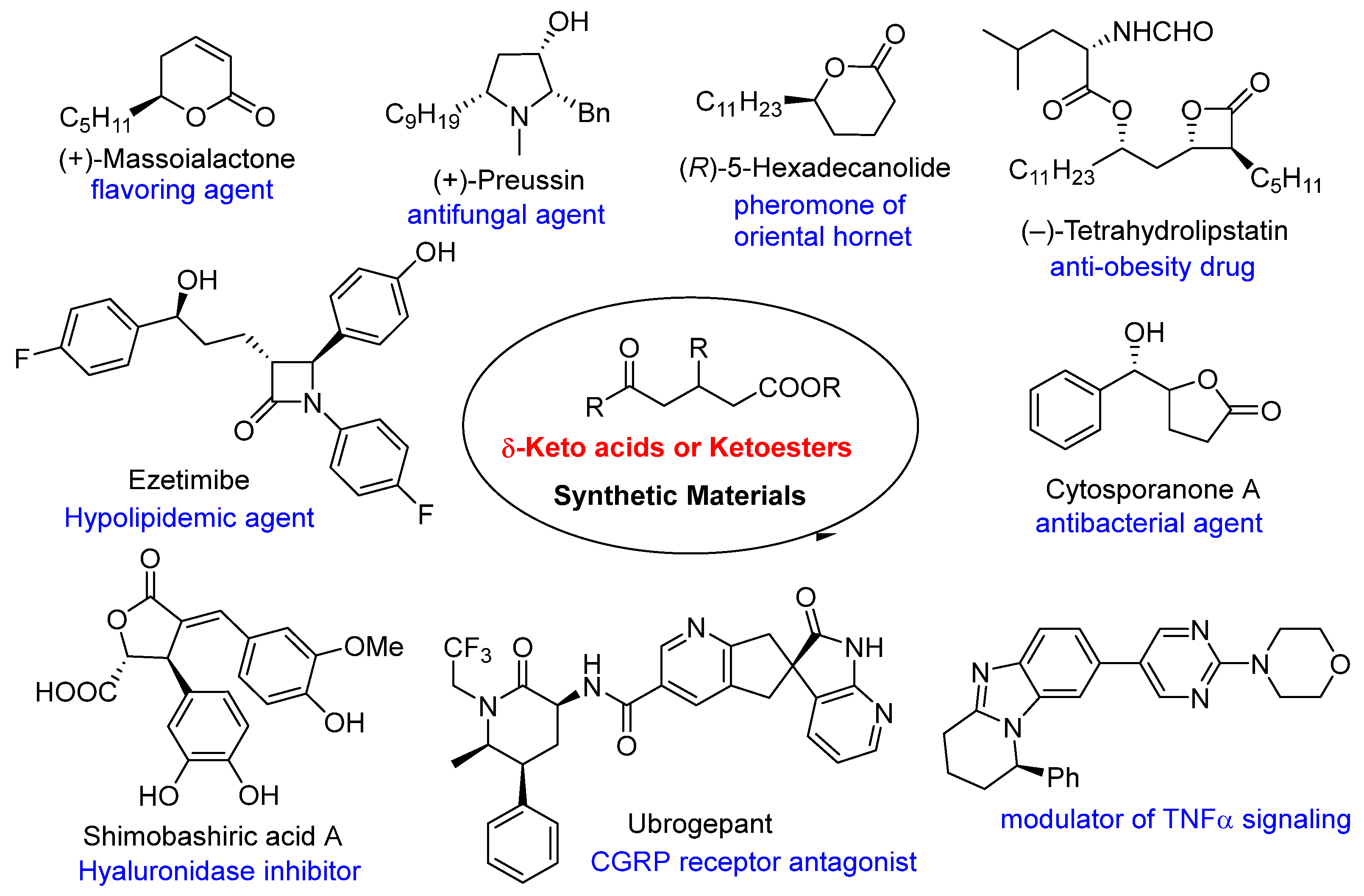
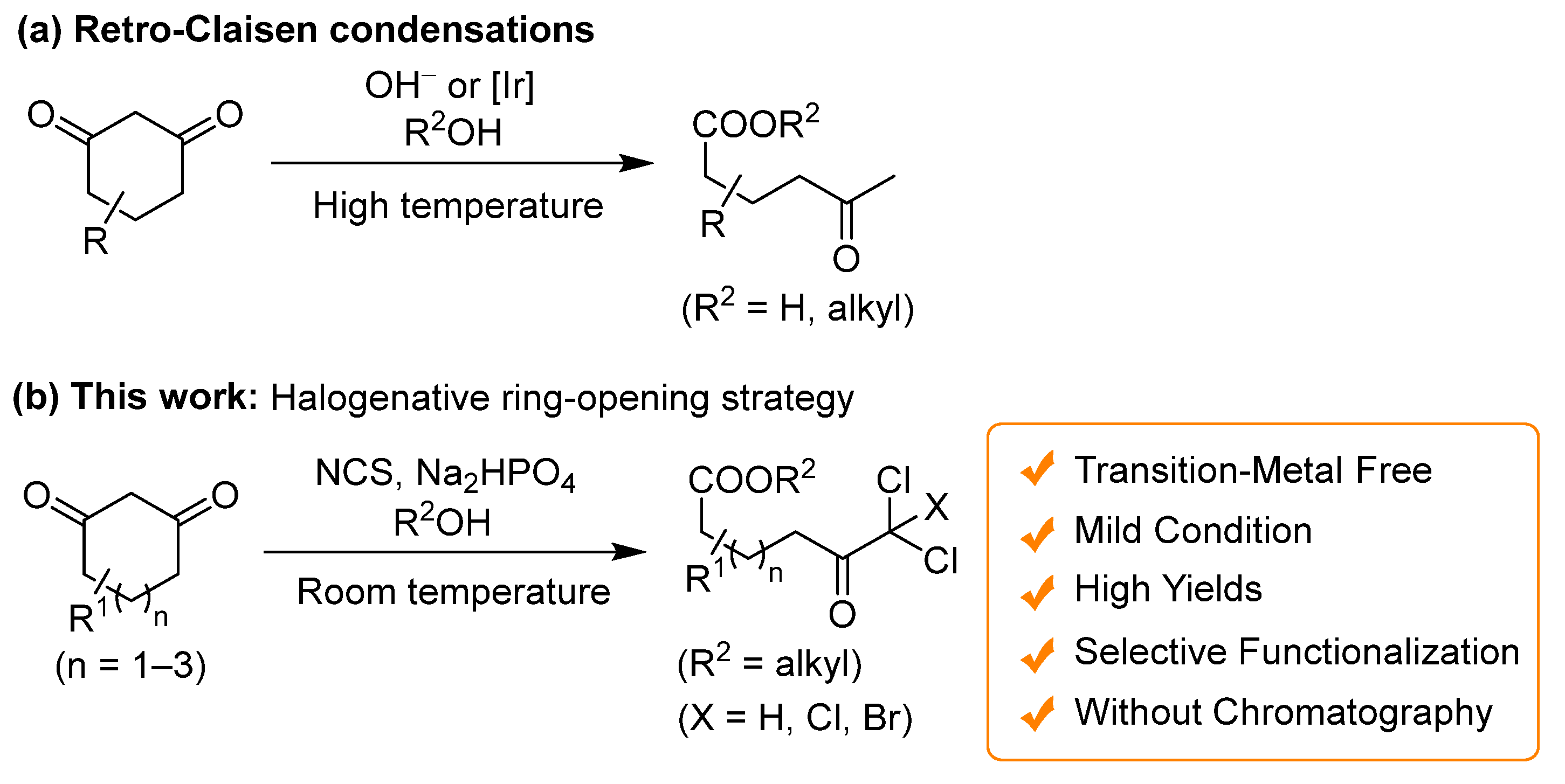
1. Introduction
2. Results and Discussion
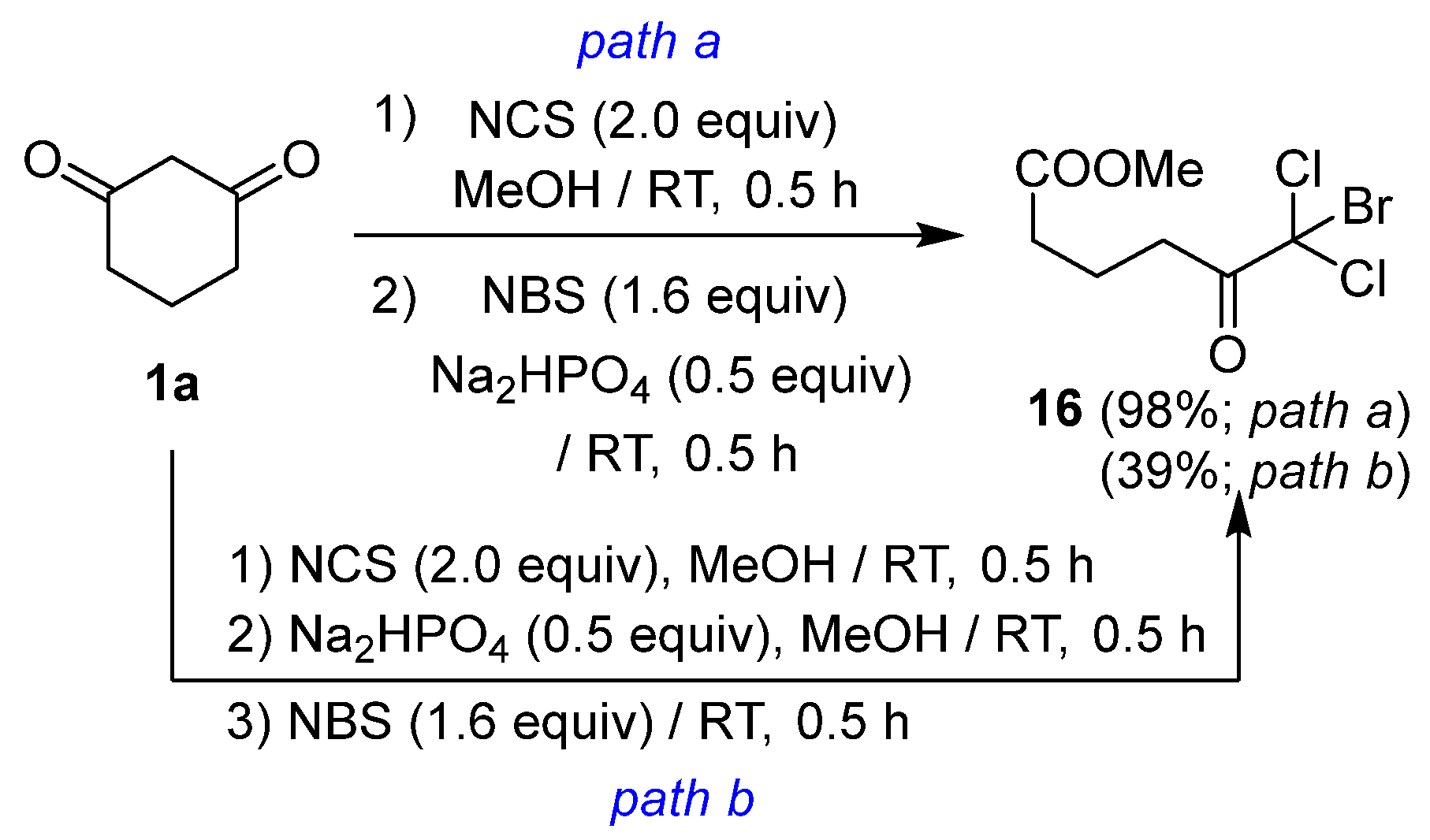
2.1. Optimization of Buffer Salt for Halogenative Ring-Opening Reaction
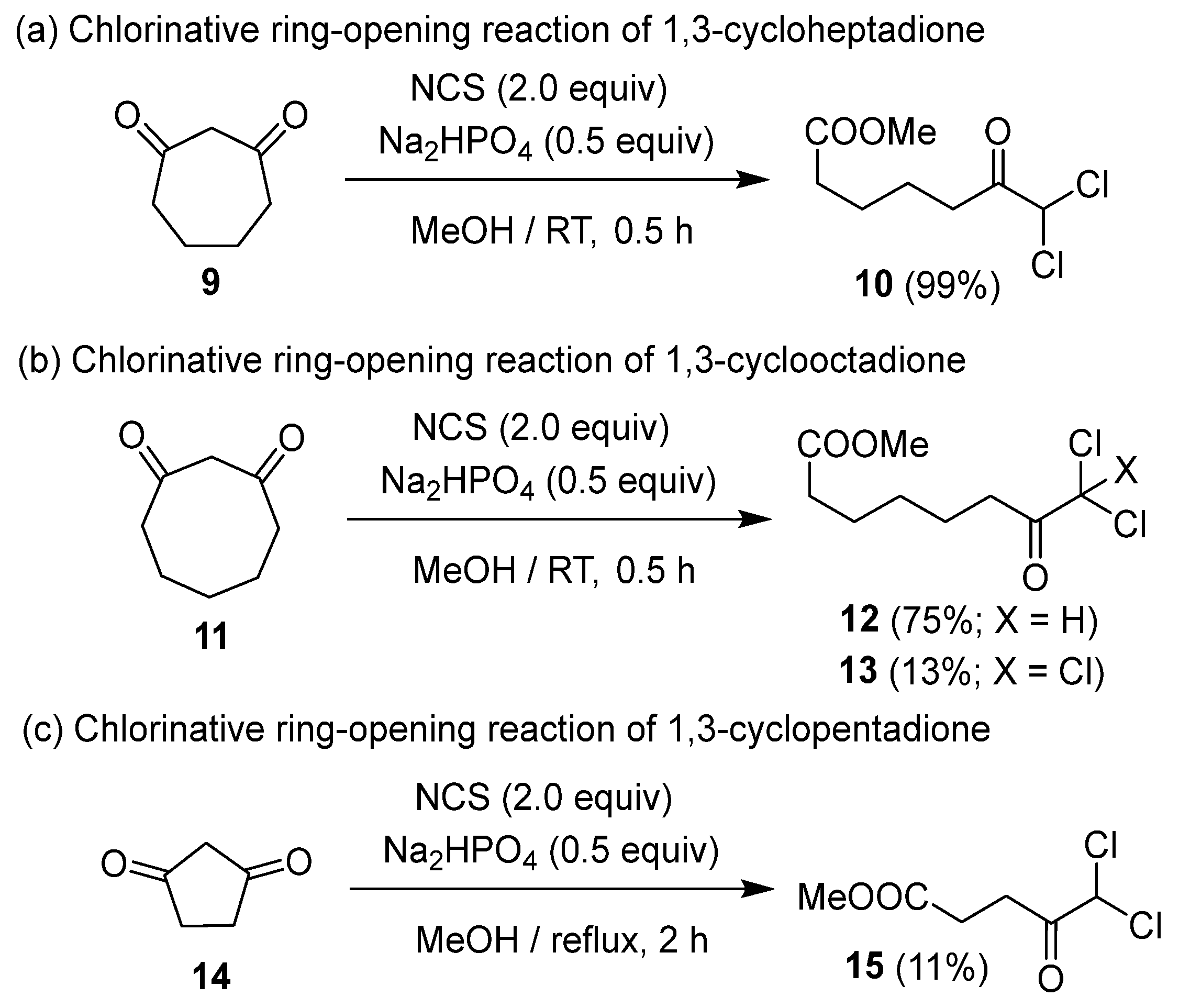
2.2. Substrate Scope
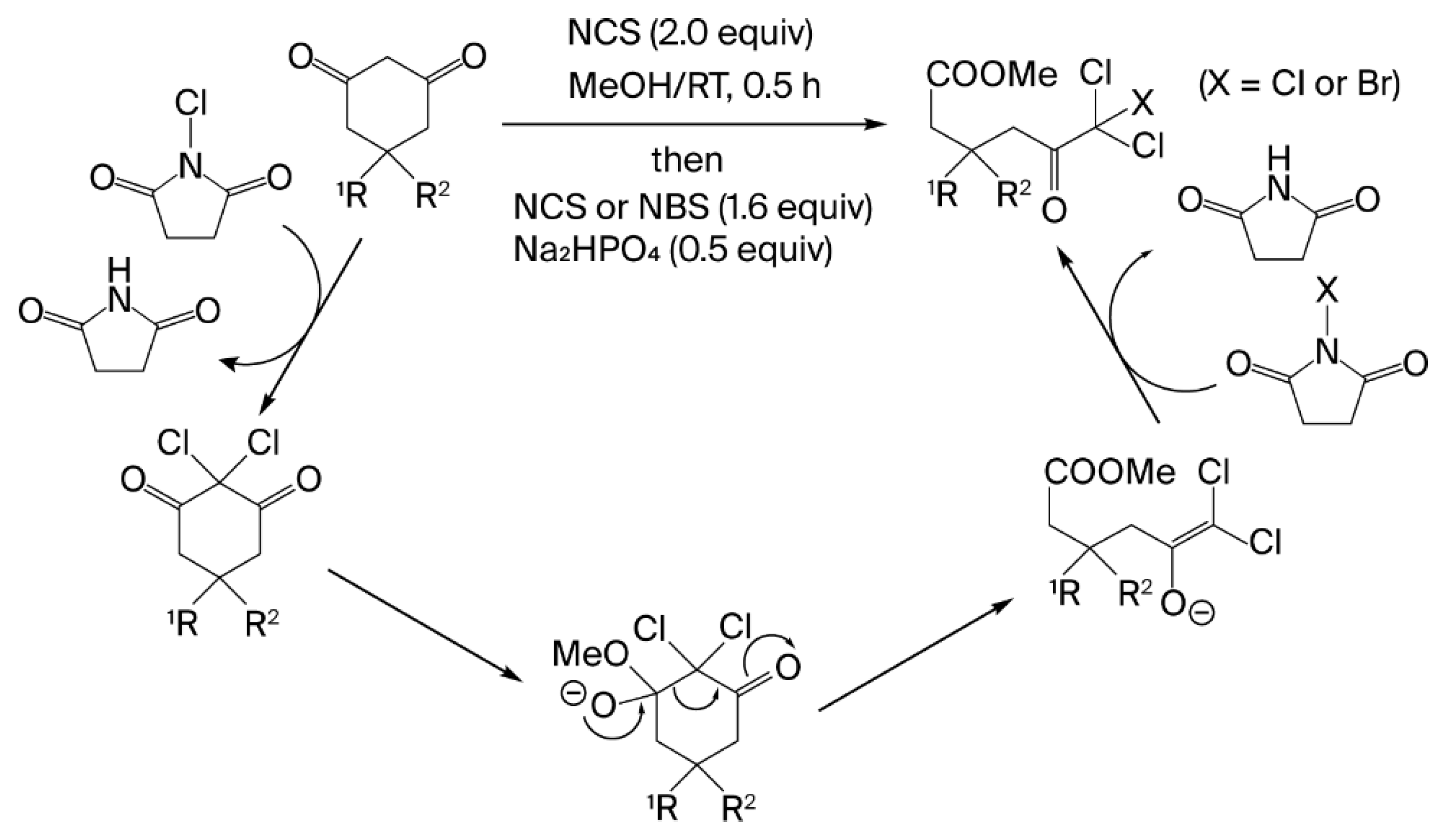
2.3. Mechanism
3. Materials and Methods
3.1. General Information
3.2. Synthesis of Haloketo Acid Alkyl Esters
3.2.1. General Procedure for Synthesizing Dichloroketo Acid Methyl Esters
3.2.2. 6,6-Dichloro-5-oxo-hexanoic Acid Methyl Ester (2a)
3.2.3. 6,6-Dichloro-3-methyl-5-oxo-hexanoic Acid Methyl Ester (2b)
3.2.4. 6,6-Dichloro-5-oxo-3-phenyl-hexanoic Acid Methyl Ester (2c)
3.2.5. 6,6-Dichloro-3-(4-methoxy-phenyl)-5-oxo-hexanoic Acid Methyl Ester (2d)
3.2.6. 6,6-Dichloro-3,3-dimethyl-5-oxo-hexanoic Acid Methyl Ester (2e)
3.2.7. 6,6-Dichloro-3-methyl-5-oxo-3-phenyl-hexanoic Acid Methyl Ester (2f)
3.2.8. 6,6-Dichloro-3-methyl-5-oxo-3-p-tolyl-hexanoic Acid Methyl Ester (2g)
3.2.9. General Procedure for Synthesis of Trichloroketo Acid Methyl Esters
3.2.10. 6,6,6-Trichloro-5-oxo-hexanoic Acid Methyl Ester (3a)
3.2.11. 6,6,6-Trichloro-3-methyl-5-oxo-hexanoic Acid Methyl Ester (3b)
3.2.12. 6,6,6-Trichloro-5-oxo-3-phenyl-hexanoic Acid Methyl Ester (3c)
3.2.13. 6,6,6-Trichloro-3-(4-methoxy-phenyl)-5-oxo-hexanoic Acid Methyl Ester (3d)
3.2.14. 6,6,6-Trichloro-3,3-dimethyl-oxo-hexanoic Acid Methyl Ester (3e)
3.2.15. 6,6,6-Trichloro-3-methyl-5-oxo-3-phenyl-hexanoic Acid Methyl Ester (3f)
3.2.16. 6,6,6-Trichloro-3-methyl-5-oxo-3-p-tolyl-hexanoic Acid Methyl Ester (3g)
3.2.17. General Procedure for Synthesis of Dichloroketo Acid Alkyl Esters
3.2.18. 6,6-Dichloro-5-oxo-hexanoic Acid Ethyl Ester (4)
3.2.19. 6,6-Dichloro-5-oxo-hexanoic Acid Propyl Ester (5)
3.2.20. 6,6-Dichloro-5-oxo-hexanoic Acid 2-Methoxy-Ethyl Ester (6)
3.2.21. 6,6-Dichloro-5-oxo-hexanoic Acid Butyl Ester (7)
3.2.22. 6,6-Dichloro-5-oxo-hexanoic Acid Isobutyl Ester (8)
3.2.23. 7,7-Dichloro-5-oxo-heptanoic Acid Methyl Ester (10)
3.2.24. 8,8-Dichloro-5-oxo-octanoic Acid Methyl Ester (12)
3.2.25. 8,8,8-Trichloro-5-oxo-octanoic Acid Methyl Ester (13)
3.2.26. 5,5-Dichloro-5-oxo-pentanoic Acid Methyl Ester (15)
3.2.27. 6-Bromo-6,6-dichloro-5-oxo-hexanoic Acid Methyl Ester (16)
4. Conclusions
Supplementary Materials
Author Contributions
Funding
Data Availability Statement
Conflicts of Interest
References
- Shi, Y.; Tan, X.; Gao, S.; Zhang, Y.; Wang, J.; Zhang, X.; Yin, Q. Direct synthesis of chiral NH lactams via Ru-catalyzed asymmetric reductive amination/cyclization cascade of keto acids/esters. Org. Lett. 2020, 22, 2707–2713. [Google Scholar] [CrossRef]
- Wei, D.; Netkaew, C.; Darcel, C. Iron-catalysed switchable synthesis of pyrrolidines vs pyrrolidinones by reductive amination of levulinic acid derivatives via hydrosilylation. Adv. Synth. Catal. 2019, 361, 1781–1786. [Google Scholar]
- Liu, X.; Zhou, P.; Zhu, Z.; Guo, Y.; Lv, H.; Zhang, Z.; Zhu, L. Multisite CuNi/Al2O3 catalyst enabling high-efficiency reductive amination of biomass-derived levulinic acid (esters) to pyrrolidones under mild conditions. ACS Catal. 2025, 15, 91–104. [Google Scholar] [CrossRef]
- Mourelle-Insua, Á.; Zampieri, L.A.; Lavandera, I.; Gotor-Fernández, V. Conversion of γ- and δ-keto esters into optically active lactams. Transaminases in cascade processes. Adv. Synth. Catal. 2018, 360, 686–695. [Google Scholar] [CrossRef]
- Yang, W.; Sun, X.; Yu, W.; Rai, R.; Deschamps, J.R.; Mitchell, L.A.; Jiang, C.; MacKerell, A.D.; Xue, F. Facile synthesis of spirocyclic lactams from β-keto carboxylic acids. Org. Lett. 2015, 17, 3070–3073. [Google Scholar] [CrossRef] [PubMed]
- Panda, S.; Nanda, A.; Saha, R.; Ghosh, R.; Bagh, B. Cobalt-catalyzed chemodivergent synthesis of cyclic amines and lactams from ketoacids and anilines using hydrosilylation. J. Org. Chem. 2023, 88, 16997–17009. [Google Scholar] [CrossRef] [PubMed]
- Wu, J.; Tongdee, S.; Ammaiyappan, Y.; Darcel, C. A concise route to cyclic amides from nitroarenes and ketoacids under iron-catalyzed hydrosilylation conditions. Adv. Synth. Catal. 2021, 363, 3859–3865. [Google Scholar] [CrossRef]
- Chen, M.; Zhang, X.-Y.; Xing, C.-G.; Zhang, C.; Zheng, Y.-C.; Pan, J.; Xu, J.-H.; Bai, Y.-P. Efficient stereoselective synthesis of structurally diverse γ- and δ-lactones using an engineered carbonyl reductase. ChemCatChem 2019, 11, 2600–2606. [Google Scholar] [CrossRef]
- Arai, N.; Namba, T.; Kawaguchi, K.; Matsumoto, Y.; Ohkuma, T. Chemoselectivity control in the asymmetric hydrogenation of γ- and δ-keto esters into hydroxy esters or diols. Angew. Chem. Int. Ed. 2018, 57, 1386–1389. [Google Scholar]
- Díaz-Rodríguez, A.; Borzęcka, W.; Lavandera, I.; Gotor, V. Stereodivergent preparation of valuable γ- or δ-hydroxy esters and lactones through one-pot cascade or tandem chemoenzymatic protocols. ACS Catal. 2014, 4, 386–393. [Google Scholar] [CrossRef]
- Guijarro, D.; Pablo, Ó.; Yus, M. Synthesis of γ-, δ-, and ε-lactams by asymmetric transfer hydrogenation of N-(tert-butylsulfinyl)iminoesters. J. Org. Chem. 2013, 78, 3647–3654. [Google Scholar] [CrossRef][Green Version]
- Machrouhi, F.; Pârles, E.; Namy, J.-L. Barbier-type reactions of cyclic acid anhydrides and keto acids mediated by an SmI2-(Nil2-catalytic) system preparation of disubstituted lactones. Eur. J. Org. Chem. 1998, 1998, 2431–2436. [Google Scholar]
- Wada, M.; Honna, M.; Kuramoto, Y.; Miyoshi, N. A Grignard-type addition of allyl unit to carbonyl compounds containing a carboxyl group by using BiCl3 Zn(0) allyl bromide. Bull. Chem. Soc. Jpn. 1997, 70, 2265–2267. [Google Scholar]
- Mandal, A.K.; Jawalkar, D.G. Studies toward the syntheses of functionally substituted γ-butyrolactones and spiro-γ-butyrolactones and their reaction with strong acids: A novel route to α-pyrones. J. Org. Chem. 1989, 54, 2364–2369. [Google Scholar] [CrossRef]
- Zhhang, S.; Lian, F.; Xue, M.; Qin, T.; Li, L.; Zhang, X.; Xu, K. Electrocatalytic dehydrogenative esterification of aliphatic carboxylic acids: Access to bioactive lactones. Org. Lett. 2017, 19, 6622–6625. [Google Scholar] [CrossRef]
- Uyanik, M.; Suzuki, D.; Yasui, T.; Ishihara, K. In situ generated (hypo)iodite catalysts for the direct α-oxyacylation of carbonyl compounds with carboxylic acids. Angew. Chem., Int. Ed. 2011, 50, 5331–5334. [Google Scholar]
- Chen, J.-Y.; Huang, Y.-B.; Hu, B.; Li, K.-M.; Zhang, J.-L.; Zhang, X.; Yan, X.-Y.; Lu, Q. A bio-based click reaction leading to the dihydropyridazinone platform for nitrogen-containing scaffolds. Green Chem. 2023, 25, 2672–2680. [Google Scholar]
- Jha, A.; Naidu, A.B.; Abdelkhalik, A.M. Transition metal-free one-pot cascade synthesis of 7-oxa-2-azatricyclo[7.4.0.02,6]trideca-1(9), 10, 12-trien-3-ones from biomass-derived levulinic acid under mild conditions. Org. Biomol. Chem. 2013, 11, 7559–7565. [Google Scholar] [PubMed]
- Miyazaki, T.; Maekawa, H.; Yonemura, K.; Yamamoto, Y.; Yamanaka, Y.; Nishiguchi, I. Mg-promoted facile and selective intramolecular cyclization of aromatic δ-ketoesters. Tetrahedron 2011, 67, 1598–1602. [Google Scholar] [CrossRef]
- Kawata, A.; Takata, K.; Kuninobu, Y.; Takai, K. Indium-catalyzed retro-Claisen condensation. Angew. Chem. Int. Ed. 2007, 46, 7793–7795. [Google Scholar]
- Rao, C.B.; Rao, D.C.; Babu, D.C.; Venkateswarlu, Y. Retro-Claisen condensation with FeIII as catalyst under solvent-free condensation. Eur. J. Org. Chem. 2010, 2010, 2855–2859. [Google Scholar] [CrossRef]
- Hussein, M.A.; Huynh, V.T.; Hommelsheim, R.; Koenigs, R.M.; Nguyen, T.V. An efficient method for retro-Claisen-type C–C bond cleavage of diketones with tropylium catalyst. Chem. Commun. 2018, 54, 12970–12973. [Google Scholar]
- Chevella, D.; Thota, C.; Majumder, S. Amverlyst-15 catalysed retro-Claisen condensation of β-diketones with alcohols: A practical approach to synthesize estres and ketoesters. Mol. Catal. 2023, 548, 113408. [Google Scholar]
- Cai, G.-X.; Wen, J.; Lai, T.-T.; Xie, D.; Zhou, C.-H. Sequential Michael addition/Claisen condensation of aromatic β-diketones with α,β-unsaturated esters: An approach to obtain 1,5-ketoesters. Org. Biomol. Chem. 2016, 14, 2390–2394. [Google Scholar] [CrossRef]
- Agostinho, M.; Kobayashi, S. Strontium-catalyzed highly enantioselective Michael additions of malonates to enones. J. Am. Chem. Soc. 2008, 130, 2430–2431. [Google Scholar] [CrossRef] [PubMed]
- Yasuda, M.; Chiba, K.; Ohigashi, N.; Katoh, Y.; Baba, A. Michael addition of stannyl ketone enolate to α,β-unsaturated esters catalyzed by tetrabutylammonium bromide and an ab initio theoretical study of the reaction course. J. Am. Chem. Soc. 2003, 125, 7291–7300. [Google Scholar] [CrossRef]
- Chen, M.S.; White, M.C. Combined effects on selectivity in Fe-catalyzed methylene oxidation. Science 2010, 327, 566–571. [Google Scholar] [CrossRef]
- He, T.; Chen, D.; Qian, S.; Zheng, Y.; Huang, S. Selective C–C bond cleavage of cycloalkanones by NaNO2/HCl. Org. Lett. 2021, 23, 6525–6529. [Google Scholar] [CrossRef]
- Xin, H.; Duan, X.-H.; Yang, M.; Zhang, Y.; Guo, L.-N. Visble light-driven, copper-catalyzed aerobic oxidative cleavage of cycloalkanones. J. Org. Chem. 2021, 86, 8263–8273. [Google Scholar] [CrossRef]
- Nakatsuji, Y.; Kobayashi, Y.; Masuda, S.; Takemoto, Y. Azolium/hydroquinone organo-radical Co-catalysis: Aerobic C–C bond cleavage in ketones. Chem. Eur. J. 2021, 27, 2633–2637. [Google Scholar]
- Xin, H.; Duan, X.-H.; Liu, L.; Guo, L.-N. Metal-free, visible-light-induced selective C–C bond cleavage of cycloalkanones with molecular oxygen. Chem. Eur. J. 2020, 26, 11690–11694. [Google Scholar]
- Ye, Z.; Cai, X.; Li, J.; Dai, M. Catalytic cyclopropanol ring opening for divergent syntheses of γ-butyrolactones and δ-ketoesters containing all-carbon quaternary centers. ACS Catal. 2018, 8, 5907–5914. [Google Scholar] [CrossRef]
- Zhang, H.; Wu, G.; Yi, H.; Sun, T.; Wang, B.; Zhang, Y.; Dong, G.; Wang, J. Copper(I)-catalyzed chemoselective coupling of cyclopropanols with diazoesters: Ring-opening C–C bond formations. Angew. Chem. Int. Ed. 2017, 56, 3945–3950. [Google Scholar]
- Jiang, Y.; Xi, S.; Wang, Q.; Fu, L.; He, L.; Wang, Z.; Zhang, M. Facile synthesis of δ-ketoesters via formal two-carbon insertion into β-ketoesters. Tetrahedron Lett. 2022, 92, 153656. [Google Scholar]
- Gao, R.-D.; Hin, N.; Prchalová, E.; Pal, A.; Lam, J.; Rais, R.; Slusher, B.S.; Tsukamoto, T. Medel studies towards prodrugs of the glutamine antagonist 6-diazo-5-oxo-L-norleucine (DON) containing a diazo precursor. Bioorg. Med. Chem. Lett. 2021, 50, 128321. [Google Scholar] [CrossRef]
- Tang, H.; Zhang, M.; Zhang, Y.; Luo, P.; Ravelli, D.; Wu, J. Direct synthesis of thioesters from feedstock chemicals and elemental sulfur. J. Am. Chem. Soc. 2023, 145, 5846–5854. [Google Scholar] [CrossRef]
- Liu, X.; Wen, J.; Yao, L.; Nie, H.; Jiang, R.; Chen, W.; Zhang, X. Highly chemo- and enantioselective hydrogenation of 2-substituted-4-oxo-2-alkenoic acids. Org. Lett. 2020, 22, 4812–4816. [Google Scholar] [CrossRef] [PubMed]
- Davis, F.A.; Zhang, H.; Lee, S.H. Masked oxo sulfinimines (N-sulfinyl imines) in the asymmetric synthesis of proline and pipecolic acid derivatives. Org. Lett. 2001, 3, 759–762. [Google Scholar] [CrossRef] [PubMed]
- Kluender, H.C.E.; Benz, G.H.H.H.; Brittelli, D.R.; Bullock, W.H.; Combs, K.J.; Dixon, B.R.; Schneider, S.; Wood, J.E.; Vanzandt, M.C.; Wolanin, D.J.; et al. Derivatives of Substituted 4-Biarybutyric Acid as Matrix Metalloprotease Inhibitors. U.S. Patent 5,789,434A, 4 August 1998. [Google Scholar]
- Pashikanti, G.; Chavan, L.N.; Liebeskind, L.S.; Goodman, M.M. Synthetic efforts toward the synthesis of a fluorinated analog of 5-aminolevulinic acid: Practical synthesis of racemic and enantiomerically defined 3-fluoro-5-aminolevulinic acid. J. Org. Chem. 2024, 89, 12176–12186. [Google Scholar] [CrossRef] [PubMed]
- Chowdhury, R.; Ghosh, S.K. Enantioselective route to b-silyl-d-keto esters by organocatalyzed regioselective Michael addition of methyl ketones to a (silylmethylene)malonate and their use in natural product synthesis. Synthesis 2011, 2011, 1936–1945. [Google Scholar]
- Han, Y.-Y.; Bin, H.-Y.; Wei, T.; Cheng, H.-A.; Lin, Z.-P.; Fu, X.-F.; Li, Y.-Q.; Xie, J.-H.; Yan, P.-C.; Zhou, Q.-L. Iridium-catalyzed asymmetric hydrogenation of g- and d-ketoacids for enantioselective synthesis of g- and d-lactones. Org. Lett. 2020, 22, 818–822. [Google Scholar]
- Krabbe, S.W.; Johnson, J.S. Asymmetric total syntheses of megacerotonic acid and Shimobashiric acid A. Org. Lett. 2015, 17, 1188–1191. [Google Scholar] [CrossRef]
- Yasuda, N.; Cleator, E.; Kosjek, B.; Yin, J.; Xiang, B.; Chen, F.; Kuo, S.C.; Belyk, K.; Mullens, P.R.; Goodyear, A.; et al. Practical asymmetric synthesis of calcitonin gene-related peptide (CGRP) receptor antagonist subrogepant. Org. Process Res. Dev. 2017, 21, 1851–1858. [Google Scholar] [CrossRef]
- Yang, X.-H.; Xie, J.-H.; Liu, W.-P.; Zhou, Q.-L. Catalytic asymmetric hydrogenation of δ-ketoesters: Highly efficient approach to chiral 1,5-diols. Angew. Chem. Int. Ed. 2013, 52, 7833–7836. [Google Scholar] [CrossRef]
- Giannopoulos, V.; Smonou, I. Asymmetric reaction of α,α-dichloro-β-keto esters by NADPH-dependent ketoreductases. Eur. J. Org. Chem. 2022, 2022, e202200410. [Google Scholar] [CrossRef]
- Fager, D.C.; Lee, K.; Hoveyda, A.H. Catalytic enantioselective addition of an allyl group to ketones containing a tri-, a di-, or a monohalomethyl moiety. Stereochemical control based on distinctive electronic and steric attributes of C–Cl, C–Br, and C–F bonds. J. Am. Chem. Soc. 2019, 141, 16125–16138. [Google Scholar] [CrossRef] [PubMed]
- Zheng, L.-S.; Phansavath, P.; Ratovelomanana-Vidal, V. Synthesis of enantioenriched α,α-dichloro- and α,α-difluoro-β-hydroxy esters and amides by ruthenium-catalyzed asymmetric transfer hydrogenation. Org. Lett. 2018, 20, 5107–5111. [Google Scholar] [CrossRef] [PubMed]
- Guo, M.; Zheng, Y.; Terell, J.L.; Ad, M.; Opoku-Temeng, C.; Bentley, W.E.; Sintim, H.O. Geminal dihalogen isosteric replacement in hydrated Al-2 affords potent quorum sensing modulators. Chem. Commun. 2015, 51, 2617–2620. [Google Scholar] [CrossRef]
- Concellón, J.M.; Rodríguez-Solla, H.; Concellón, C.; Díaz, P. Synthesis of E-α,β-unsaturated ketones with complete stereoselectivity via sequential aldol-type/elimination reactions promoted by samarium-diiodide or chromium dichloride. Synlett 2006, 2006, 837–840. [Google Scholar] [CrossRef]
- Peppe, C.; das Chagas, R.P. Indium(I) bromide-promoted stereoselective preparation of (E)-α,β-unsaturated ketones via sequential intermolecular aldol-type coupling/elimination reactions of α,α-dichloroketones with aldehydes. J. Organometal. Chem. 2006, 691, 5856–5860. [Google Scholar] [CrossRef]
- Sasai, H.; Arai, S.; Shibasaki, M. Catalytic aldol reaction with Sm(HMDS)3 and its application for the introduction of a carbon–carbon triple bond at C-13 in prostaglandin synthesis. J. Org. Chem. 1994, 59, 2661–2664. [Google Scholar] [CrossRef]
- Anthore-Dalion, L.; Zard, S.Z. Chemoselective reduction: Xanthates as traceless precursors of polyfunctionalized α,α-dichloroketones. Org. Lett. 2017, 19, 5545–5548. [Google Scholar] [CrossRef]
- Anthore, L.; Li, S.; White, L.V.; Zard, S.Z. Radical solution to the alkylation of the highly base-sensitive 1,1-dichloroacetone. Application to the synthesis of Z-alkenoates and E,E-dienoates. Org. Lett. 2015, 17, 5320–5323. [Google Scholar] [CrossRef]
- Grainger, R.S.; Owoare, R.B.; Tisselli, P.; Steed, J.W. A synthetic alternative to the type-II intramolecular 4 + 3 cycloaddition reation. J. Org. Chem. 2003, 68, 7899–7902. [Google Scholar] [CrossRef]
- Ganiek, M.A.; Ivanova, M.V.; Martin, B.; Knochel, P. Mild homologation of esters through continuous flow chloroacetate Claisen reactions. Angew. Chem. Int. Ed. 2018, 57, 17249–17253. [Google Scholar] [CrossRef]
- Holzschneider, K.; Häring, A.P.; Haack, A.; Corey, D.J.; Benter, T.; Kirsch, S.F. Pathways in degradation of geminal diazides. J. Org. Chem. 2017, 82, 8242–8250. [Google Scholar] [CrossRef]
- Jiang, J.; Zou, H.; Dong, Q.; Wang, R.; Lu, L.; Zhu, Y.; He, W. Synthesis of 2-keto(hetero)aryl benzox(thio)azoles through base promoted cyclization of 2-amino(thio)phenols with α,α-dihaloketones. J. Org. Chem. 2016, 81, 51–56. [Google Scholar] [CrossRef] [PubMed]
- Limanto, J.; Desmond, R.A.; Gauthier, D.R., Jr.; Devine, P.N.; Reamer, R.A.; Volante, R.P. A regioselective approach to 5-substituted 3-amino-1,2,4-triazines. Org. Lett. 2003, 5, 2271–2274. [Google Scholar] [CrossRef] [PubMed]
- Morimoto, H.; Yoshino, T.; Yukawa, T.; Lu, G.; Matsunaga, S.; Shibasaki, M. Lewis base assisted Brønsted base catalysis: Bidentate phosphine oxides as activators and modulators of Brønsted basic lanthanum–aryloxides. Angew. Chem. Int. Ed. 2008, 47, 9125–9129. [Google Scholar] [CrossRef] [PubMed]
- Morimoto, H.; Lu, G.; Aoyama, N.; Matsunaga, S.; Shibasaki, M. Lanthanum aryloxide/pybox-catalyzed direct asymmetric Mannich-type reactions using a trichloromethyl ketone as a propionate equivalent donor. J. Am. Chem. Soc. 2007, 129, 9588–9589. [Google Scholar] [CrossRef]
- Morimoto, H.; Wiedemann, S.H.; Yamaguchi, A.; Harada, S.; Chen, Z.; Matsunaga, S.; Shibasaki, M. Trichloromethyl ketones as synthetically versatile donors: Application in direct catalytic mannich-type reactions and the stereoselective synthesis of azetidines. Angew. Chem. Int. Ed. 2006, 45, 3146–3150. [Google Scholar] [CrossRef]
- Perryman, M.S.; Harris, M.E.; Foster, J.L.; Joshi, A.; Clarson, G.J.; Fox, D.J. Trichloromethyl ketones: Asymmetric transfer hydrogenation and subsequent Jocic-type reactions with amines. Chem. Commun. 2013, 49, 10022–10024. [Google Scholar] [CrossRef] [PubMed]
- Rexit, A.A.; Hu, X. Intermolecular atom transfer radical addition of α,α,α-trichloromethyl ketones and alkenes mediated by a CuCl/bpy system. Tetrahedron 2015, 71, 2313–2316. [Google Scholar] [CrossRef]
- Essa, A.H.; Lerrick, R.I.; Çiftci, E.; Harrington, R.W.; Waddell, P.G.; Clegg, W.; Hall, M.J. Grignard-mediated reduction of 2,2,2-trichloro-1-arylethanones. Org. Biomol. Chem. 2015, 13, 5793–5803. [Google Scholar] [CrossRef]
- Morrill, L.C.; Stark, D.G.; Taylor, J.E.; Smith, S.R.; Squires, J.A.; D’Hollander, A.C.A.; Simal, C.; Shapland, P.; O’Riordan, T.J.C.; Smith, A.D. Organocatalytic Michael addition lactonisation of carboxylic acids using α,β-unsaturated trichloromethyl ketones as α,β-unsaturated ester equivalents. Org. Biomol. Chem. 2014, 12, 9016–9027. [Google Scholar] [CrossRef] [PubMed]
- Attaba, N.; Taylor, J.E.; Slawin, A.M.Z.; Smith, A.D. Enantioselective NHC-catalyzed redox [4 + 2]-hetero-Diels–Alder reaction using α,β-unsaturated trichloromethyl ketones as amide equivalents. J. Org. Chem. 2015, 80, 9728–9739. [Google Scholar] [CrossRef]
- China, H.; Yoto, Y.; Sasa, H.; Kikushima, K.; Dohi, T. Reconstructive synthesis of fluorinated dihydropyrido[1,2-a]indolones by a cyclohexadiones cut-to-fuse strategy. Adv. Synth. Catal. 2025, 367, e202401037. [Google Scholar] [CrossRef]
- China, H.; Okada, Y.; Dohi, T. The multiple reactions in the monochlorodimedone assay: Discovery of unique dehalolactonizations under mild conditions. Asian J. Org. Chem. 2015, 4, 1065–1074. [Google Scholar] [CrossRef]
- China, H.; Yatabe, H.; Kageyama, N.; Fujitake, M.; Kikushima, K.; Dohi, T. New syntheses of haloketo acid methyl esters and their transformation to halolactones by reductive cyclization. Russ. Chem. Bull. 2020, 69, 1804–1810. [Google Scholar] [CrossRef]
- Liu, G.-B.; Zhao, H.-Y.; Zhang, J.; Thiemann, T. Raney Ni-Al alloy mediated hydrodehalogenation and aromatic ring hydrogenation of halogenated phenols in aqueous medium. J. Chem. Res. 2009, 2009, 342–344. [Google Scholar] [CrossRef]
- Suzuki, M.; Watanabe, A.; Noyori, R. Palladium(0)-catalyzed reaction of α,β-epoxy ketones leading to β-diketones. J. Am. Chem. Soc. 1980, 102, 2095–2096. [Google Scholar] [CrossRef]
- Ishikawa, T.; Kadoya, R.; Arai, M.; Takahashi, H.; Kaisi, Y.; Mizuta, T.; Yoshikai, K.; Saito, S. Revisiting [3+3] route to 1,3-cyclohexanedione frameworks: Hidden aspect of thermodynamically controlled enolates. J. Org. Chem. 2001, 66, 8000–8009. [Google Scholar] [CrossRef]
- Sharma, D.; Bandna; Shil, A.K.; Singh, B.; Das, P. Consecutive Michael–Claisen process for cyclohexane-1,3-dione derivative (CDD) synthesis from unsubstituted and substituted acetone. Synlett 2012, 23, 1199–1204. [Google Scholar] [CrossRef]
- Zhang, W.; Benmohamed, R.; Arvanites, A.C.; Morimoto, R.I.; Ferrante, R.J.; Kirsch, D.R.; Silverman, R.B. Cyclohexane 1,3-diones and their inhibition of mutant SOD1-dependent protein aggregation and toxicity in PC12 cells. Bioorg. Med. Chem. 2012, 20, 1029–1045. [Google Scholar] [CrossRef] [PubMed]
- Kirihara, M.; Kakuda, H.; Ichinose, M.; Ochiai, Y.; Takizawa, S.; Mokuya, A.; Okubo, K.; Hatano, A.; Shiro, M. Fragmentation of tertiary cyclopropanol compounds catalyzed by vanadyl acetylacetonate. Tetrahedron 2005, 61, 4831–4839. [Google Scholar] [CrossRef]
- Sims, E.A.; DeForest, C.A.; Anseth, K.S. A mild, large-scale synthesis of 1,3-cyclooctanedione: Expanding access to difluorinated cyclooctyne for copper-free click chemistry. Tetrahedron Lett. 2011, 52, 1871–1873. [Google Scholar] [CrossRef] [PubMed][Green Version]
- Gupta, S.K. An exceptionally facile reaction of α,α-dichloro-β-keto esters with bases. J. Org. Chem. 1973, 38, 4081–4982. [Google Scholar] [CrossRef]
- Lin, Y.-M.; Yi, W.-B.; Shen, W.-Z.; Lu, G.-P. A route to α-fluoroalkyl sulfides from α-fluorodiaroylmethanes. Org. Lett. 2016, 18, 592–595. [Google Scholar] [CrossRef] [PubMed]
- Leng, D.J.; Black, C.M.; Pattison, G. One-pot synthesis of difluoromethyl ketones by a difluorination/fragmentation process. Org. Biomol. Chem. 2016, 14, 1531–1535. [Google Scholar] [CrossRef]
- Ke, Z.; Lam, Y.-P.; Chan, K.-S.; Yeung, Y.-Y. Zwitterion-catalyzed deacylative dehalogenation of β-oxo amides. Org. Lett. 2020, 22, 7353–7357. [Google Scholar] [CrossRef]
- Pu, X.; Li, Q.; Lu, Z.; Yang, X. N-Chloro-N-methoxybenzenesulfonamide: A chlorinating reagent. Eur. J. Org. Chem. 2016, 2016, 5937–5940. [Google Scholar] [CrossRef]
- Wang, J.; Li, H.; Zhang, D.; Huang, P.; Wang, Z.; Zhang, R.; Liang, Y.; Dong, D. Divergent synthesis of α,α-dihaloamides through α,α-dihalogenation of β-oxo amides by using N-halosuccinimides. Eur. J. Org. Chem. 2013, 2013, 5376–5380. [Google Scholar] [CrossRef]
- Zhang, Q.; Liu, W.; Chen, C.; Tan, L. Approach for the direct synthesis of β-dichlorosubstituted acetanilides using iodine trichloride (ICl3) as the oxidant and catalyst. Chin. J. Chem. 2013, 31, 453–455. [Google Scholar] [CrossRef]
- Liu, W.-B.; Chen, C.; Zhang, Q.; Zhu, Z.-B. Organic synthesis using (diacetoxyiodo)benzene (DIB): Unexpected and novel oxidation of 3-oxo-butanamides to 2,2-dihalo-N-phenylacetamides. Beilstein J. Org. Chem. 2012, 8, 344–348. [Google Scholar] [CrossRef] [PubMed]
- Liu, M.; Ohashi, M.; Hung, Y.-S.; Scherlach, K.; Watanabe, K.; Hertweck, C.; Tang, Y. AoiQ catalyzes geminal dichlorination of 1,3-diketone natural products. J. Am. Chem. Soc. 2021, 143, 7267–7271. [Google Scholar] [CrossRef]
- Podzelinska, K.; Latimer, R.; Bhattacharya, A.; Vining, L.C.; Zechel, D.L.; Jia, Z. Chloramphenicol biosynthesis: The structure of CmlS, a flavin-dependent halogenase showing a covalent flavin-aspartate bond. J. Mol. Biol. 2010, 397, 316–331. [Google Scholar] [CrossRef]
- De Buyck, L.; De Prooter, H.; Schamp, N. Hexachlorodimedone: Ring opening and intermolecular substitution of halogen. Preparation of γ, δ-diketoacids and esters. Bull. Soc. Chim. Belg. 1988, 97, 371–382. [Google Scholar] [CrossRef]
- Lee-Ruff, E.; Hopkinson, A.C.; Kazarians-Moghaddam, H. Photochemistry of α,α-disubstituted bicyclic cyclobutanones—A potential thermal-photochemical metathesis reaction. Tetrahedron Lett. 1983, 24, 2067–2070. [Google Scholar] [CrossRef]
- Bigg, M.G.; Roberts, S.M.; Suschitzky, H. Stereocontrolled addition of some sulfenyl halides to bicyclo[3.2.0]hept-2-en-6-ones and modification of the adducts. J. Chem. Soc. Perkin Trans. 1 1981, 926–929. [Google Scholar] [CrossRef]
- Donskaya, N.A.; Bessmertnykh, A.G.; Drobush, V.A.; Shabarov, Y.S. Sterically shielded halocyclobutanones. I. Reactions of cyclopropyl-substituted 2,2-dichlorocyclobutanes with potassium hydroxide. Zhu. Org. Khim. 1987, 23, 745–751. [Google Scholar]
- Gaidamaka, S.N.; Benzmenova, T.E.; Shantalii, O.A.; Usenko, Y.N.; Varshavets, T.N.; Rozko, A.N. Synthesis and reaction of 2,2-dichloro-3-oxothiolane 1,1-dioxide with some nucleophiles. Zhu. Org. Khim. 1988, 24, 1726–1731. [Google Scholar]
- Chernova, L.N.; Simonov, V.D. Reaction of perchloro-2-cyclopenten-1-one and perchloro-4-cyclopentene-1,3-dione with ammonia and aliphatic amines. Zhu. Org. Khim. 1980, 16, 1653–1659. [Google Scholar] [CrossRef]
- Brook, P.R.; Duke, A.J. Ring-opening reactions of 7,7-dichlorobicyclo[3.2.0]hept-2-en-6-one and its conversion into methyl benzoate with methoxide ion. J. Chem. Soc. C 1971, 1764–1769. [Google Scholar] [CrossRef]
- Heard, D.M.; Lennox, A.J.J. Dichloromeldrum’s acid (DiCMA): A practical and green amides dichloroacetylation reagent. Org. Lett. 2021, 23, 3368–3372. [Google Scholar] [CrossRef]
- China, H.; Okada, Y.; Dohi, T. Suppression mechanism for enol-enol isomerization of 2-substituted dimedones. Asian J. Org. Chem. 2015, 4, 952–962. [Google Scholar] [CrossRef]
- El-Deeb, I.Y.; Funakoshi, T.; Shimomoto, Y.; Matsubara, R.; Hayashi, M. Dehydrogenative formation of resorcinol derivatives using Pd/C–ethylene catalytic system. J. Org. Chem. 2017, 82, 2630–2640. [Google Scholar] [CrossRef]
- Halili, M.A.; Bachu, P.; Lindahl, F.; Bechara, C.; Mohanty, B.; Reid, R.C.; Scanlon, M.J.; Robinson, C.V.; Fairlie, D.P.; Martin, J.L. Small molecule inhibitors of disulfide bond formation by the bacterial DsbA–DsbB dual enzyme system. ACS Chem. Biol. 2015, 10, 957–964. [Google Scholar] [CrossRef] [PubMed]




 | ||
|---|---|---|
| Entry | Buffer Salt | Yield (%) |
| 1 | Na2HPO4 | 100 |
| 2 | K2HPO4 | 80 |
| 3 | NaH2PO4 | 60 (10) 1 |
| 4 | KH2PO4 | 14 (21) 1 |
| 5 | NaHCO3 | 91 |
| 6 | KHCO3 | 82 |
| 7 | Na2CO3 | 71 |
| 8 | K2CO3 | 57 |
| 9 | AcONa | 95 |
| 10 | AcOK | 92 |
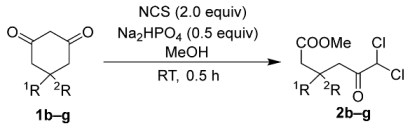 | ||
|---|---|---|
| Entry | Product | Yield (%) |
| 1 | 2b (1R = H, 2R = Me) | 98 |
| 2 | 2c (1R = H, 2R = Ph) | 99 |
| 3 | 2d (1R = H, 2R = p-MeOC6H4) | 87 |
| 4 | 2e (1R, 2R = Me) | 97 |
| 5 | 2f (1R = Ph, 2R = Me) | 93 |
| 6 | 2g (1R = p-Me C6H4, 2R = Me) | 95 |
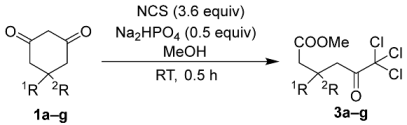 | ||
|---|---|---|
| Entry | Product | Yield (%) |
| 1 | 3a (1R, 2R = H) | 91 |
| 2 | 3b (1R = H, 2R = Me) | 99 |
| 3 | 3c (1R = H, 2R = Ph) | 90 |
| 4 | 3d (1R = H, 2R = p-MeOC6H4) | 85 |
| 5 | 3e (1R, 2R = Me) | 98 |
| 6 | 3f (1R = Ph, 2R = Me) | 100 |
| 7 | 3g (1R = p-Me C6H4, 2R = Me) | 98 |
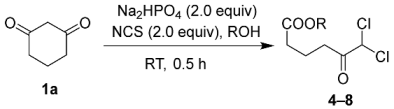 | ||
|---|---|---|
| Entry (Alcohol) | Product | Yield (%) |
| 1 (EtOH) | 4 (R = Et) | 86 |
| 2 (nPrOH) | 5 (R = nPr) | 77 |
| 3 (2-methoxyethanol) | 6 (R = CH2CH2OCH3) | 78 |
| 4 (nBuOH) | 7 (R = nBu) | 40 |
| 5 (tBuOH) | 8 (R = tBu) | 27 |
Disclaimer/Publisher’s Note: The statements, opinions and data contained in all publications are solely those of the individual author(s) and contributor(s) and not of MDPI and/or the editor(s). MDPI and/or the editor(s) disclaim responsibility for any injury to people or property resulting from any ideas, methods, instructions or products referred to in the content. |
© 2026 by the authors. Licensee MDPI, Basel, Switzerland. This article is an open access article distributed under the terms and conditions of the Creative Commons Attribution (CC BY) license.
Share and Cite
China, H.; Kageyama, N.; Yatabe, H.; Fujitake, M.; Matsumoto, Y.; Jing, Z.; Dohi, T. Chemoselectively Functionalized Ketoesters by Halogenative C–C Bond Cleavage of Cyclic Diketones. Molecules 2026, 31, 199. https://doi.org/10.3390/molecules31010199
China H, Kageyama N, Yatabe H, Fujitake M, Matsumoto Y, Jing Z, Dohi T. Chemoselectively Functionalized Ketoesters by Halogenative C–C Bond Cleavage of Cyclic Diketones. Molecules. 2026; 31(1):199. https://doi.org/10.3390/molecules31010199
Chicago/Turabian StyleChina, Hideyasu, Nami Kageyama, Hodaka Yatabe, Mihoyo Fujitake, Yusei Matsumoto, Zhihan Jing, and Toshifumi Dohi. 2026. "Chemoselectively Functionalized Ketoesters by Halogenative C–C Bond Cleavage of Cyclic Diketones" Molecules 31, no. 1: 199. https://doi.org/10.3390/molecules31010199
APA StyleChina, H., Kageyama, N., Yatabe, H., Fujitake, M., Matsumoto, Y., Jing, Z., & Dohi, T. (2026). Chemoselectively Functionalized Ketoesters by Halogenative C–C Bond Cleavage of Cyclic Diketones. Molecules, 31(1), 199. https://doi.org/10.3390/molecules31010199