A CRISPR Powered Immobilization-Free, Amplification-Free Carbon-Nanotube Field-Effect Transistor (FET) Sensor for Influenza A Virus (IAV)


Abstract
1. Introduction
2. Results and Discussion
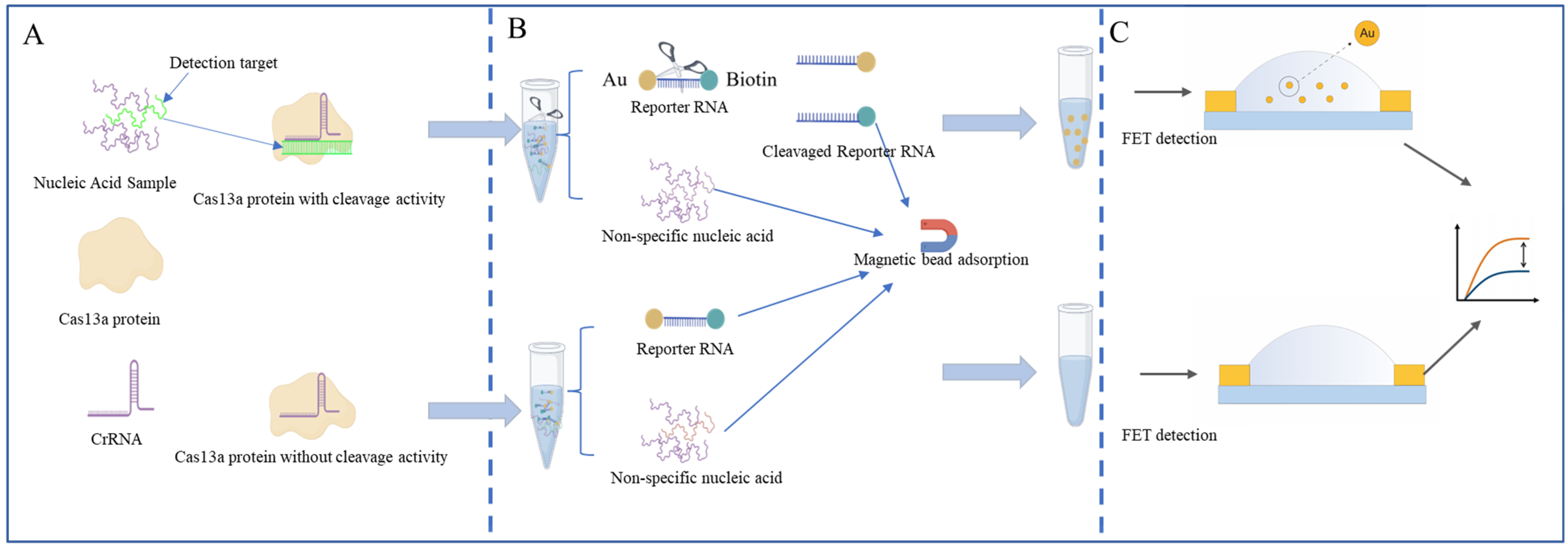
2.1. Design of FET Biosensor
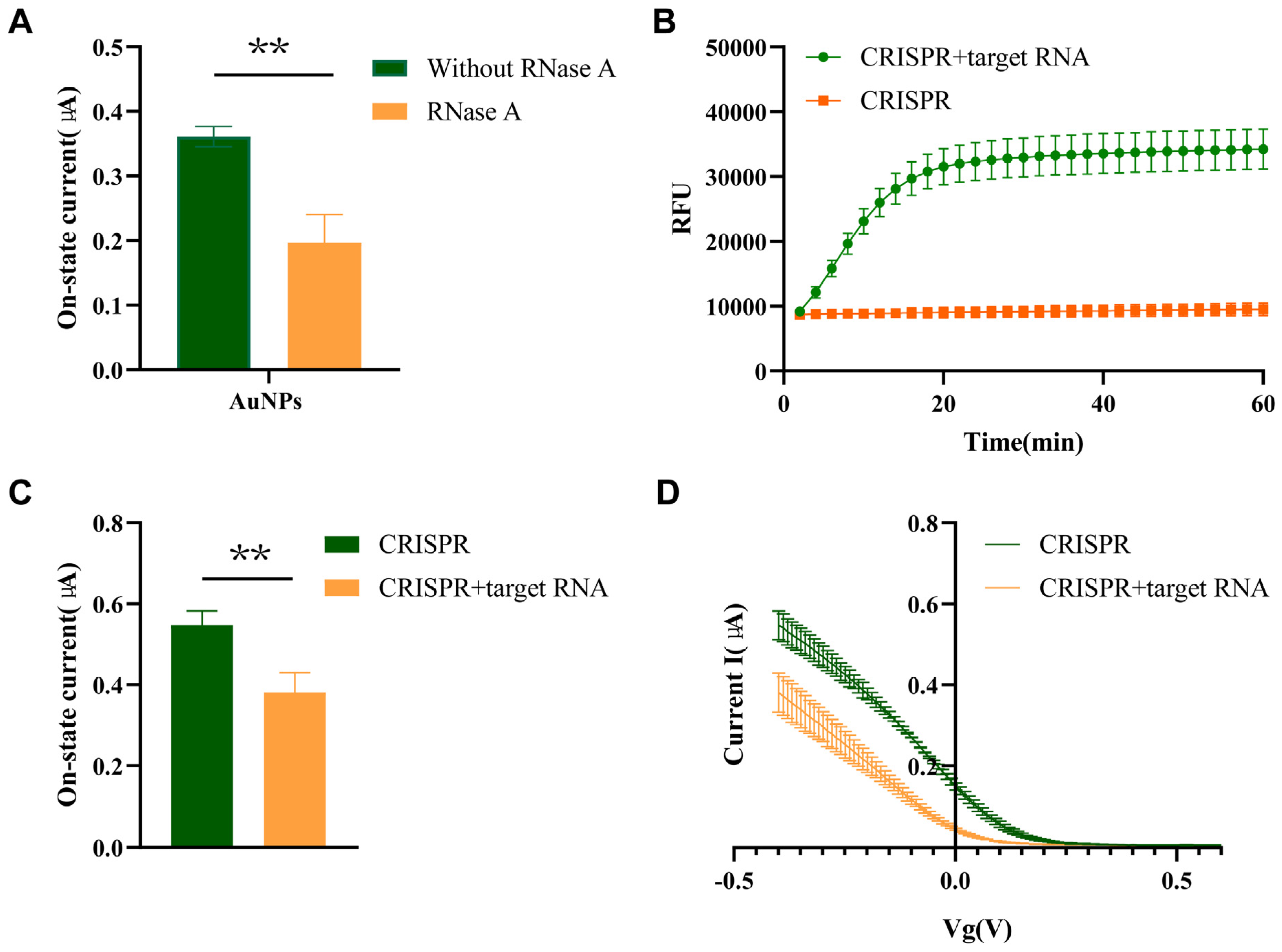
2.2. Validation of CRISPR-FET Biosensors
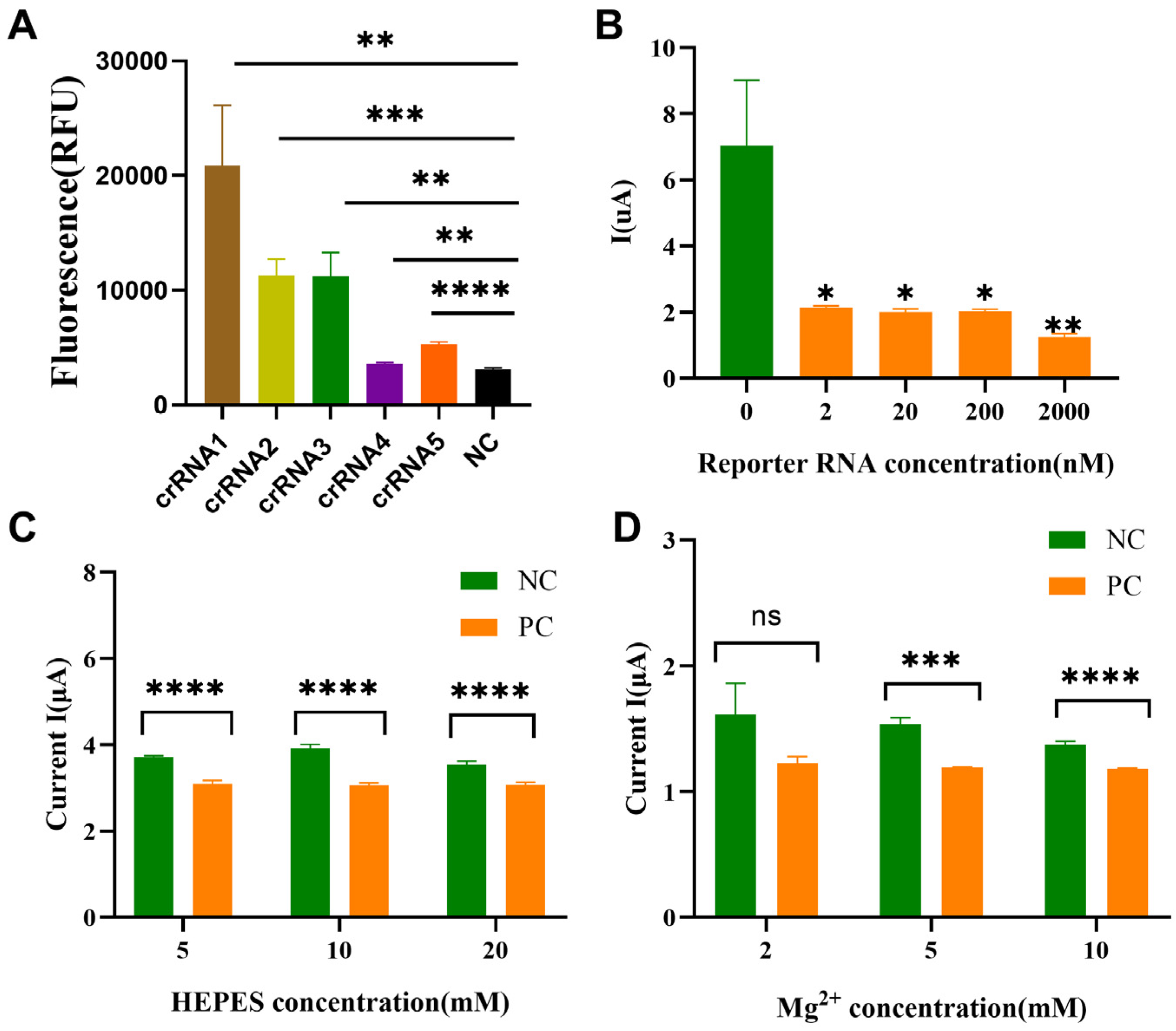
2.3. Screening of High-Efficiency crRNA
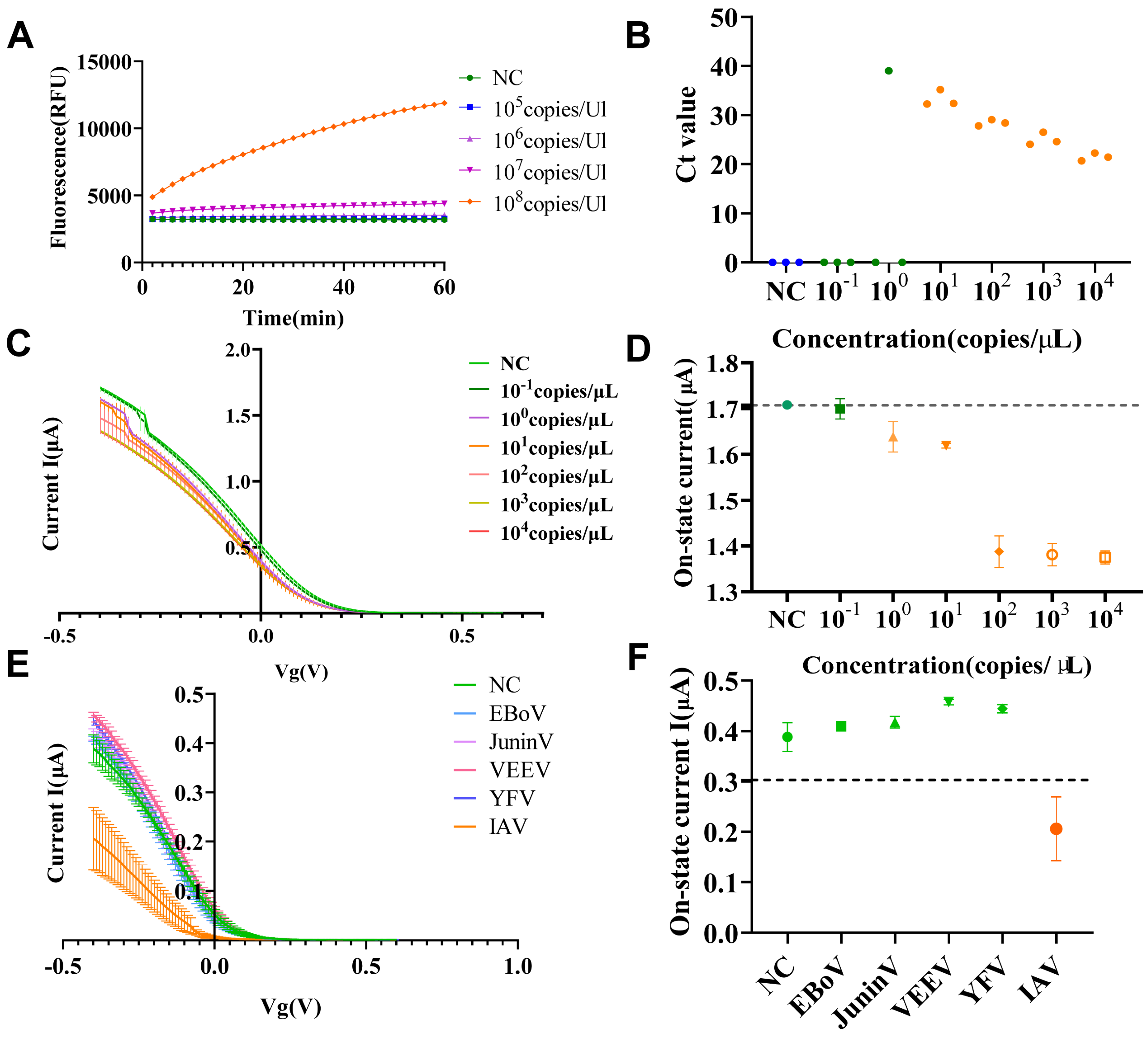
2.4. Sensitivity Detection and Specificity Detection Results
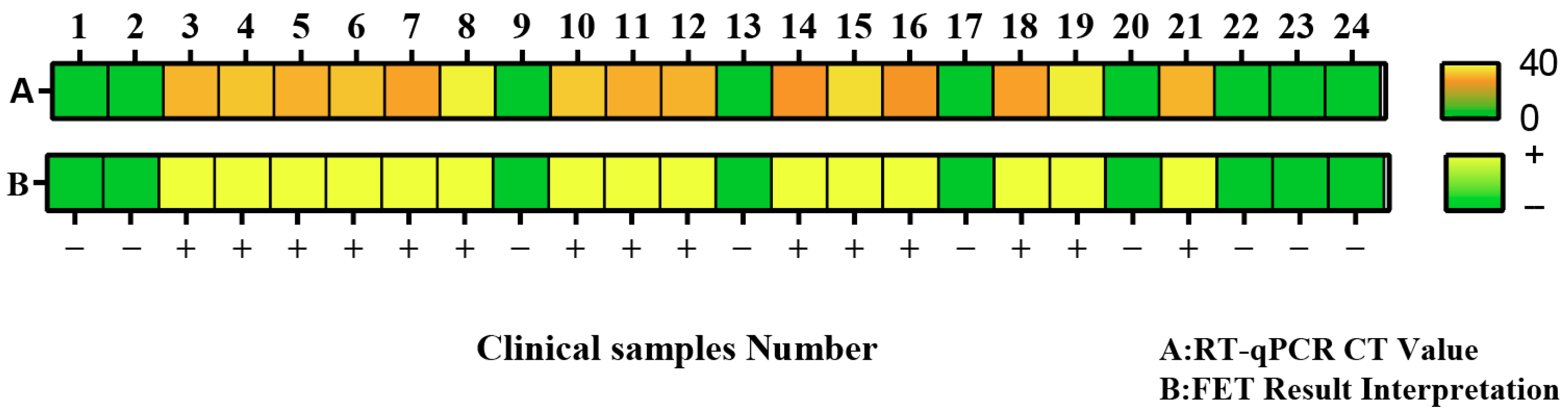
2.5. Clinical Sample Detection Results
3. Materials and Methods
3.1. Materials
3.2. CRISPR/Cas13a Fluorescence Assay
3.3. Immunomagnetic Bead Separation
3.4. CRISPR-FET Experiment
3.5. RT-qPCR Experiment
3.6. Sensor Characterization
3.7. Statistical Analysis
4. Discussion
Supplementary Materials
Author Contributions
Funding
Data Availability Statement
Conflicts of Interest
References
- Uyeki, T.M.; Hui, D.S.; Zambon, M.; Wentworth, D.E.; Monto, A.S. Influenza. Lancet 2022, 400, 693–706. [Google Scholar] [CrossRef]
- Dunning, J.; Thwaites, R.S.; Openshaw, P.J.M. Seasonal and pandemic influenza: 100 years of progress, still much to learn. Mucosal Immunol. 2020, 13, 566–573. [Google Scholar] [CrossRef]
- Laybourn, H.A.; Hellemann Polhaus, C.; Kristensen, C.; Lyngfeldt Henriksen, B.; Zhang, Y.; Brogaard, L.; Larsen, C.A.; Trebbien, R.; Larsen, L.E.; Kalogeropoulos, K.; et al. Multi-omics analysis reveals the impact of influenza a virus host adaptation on immune signatures in pig tracheal tissue. Front. Immunol. 2024, 15, 1432743. [Google Scholar] [CrossRef] [PubMed]
- Nagy, A.; Horvath, A.; Farkas, A.; Furi, P.; Erdelyi, T.; Madas, B.G.; Czitrovszky, A.; Merkely, B.; Szabo, A.; Ungvari, Z.; et al. Modeling of nursing care-associated airborne transmission of SARS-CoV-2 in a real-world hospital setting. GeroScience 2022, 44, 585–595. [Google Scholar] [CrossRef] [PubMed]
- Laconi, A.; Fortin, A.; Bedendo, G.; Shibata, A.; Sakoda, Y.; Awuni, J.A.; Go-Maro, E.; Arafa, A.; Maken Ali, A.S.; Terregino, C.; et al. Detection of avian influenza virus: A comparative study of the in silico and in vitro performances of current RT-qPCR assays. Sci. Rep. 2020, 10, 8441. [Google Scholar] [CrossRef]
- Cassedy, A.; Parle-McDermott, A.; O’Kennedy, R. Virus Detection: A Review of the Current and Emerging Molecular and Immunological Methods. Front. Mol. Biosci. 2021, 8, 637559. [Google Scholar] [CrossRef]
- Niu, Q.; Jiang, Z.; Wang, L.; Ji, X.; Baele, G.; Qin, Y.; Lin, L.; Lai, A.; Chen, Y.; Veit, M.; et al. Prevention and control of avian influenza virus: Recent advances in diagnostic technologies and surveillance strategies. Nat. Commun. 2025, 16, 3558. [Google Scholar] [CrossRef]
- Gao, R.; Liu, X.; Xiong, Z.; Wang, G.; Ai, L. Research progress on detection of foodborne pathogens: The more rapid and accurate answer to food safety. Food Res. Int. 2024, 193, 114767. [Google Scholar] [CrossRef] [PubMed]
- Atmar, R.L. Immunological Detection and Characterization. In Viral Infections of Humans; Springer Nature: Cham, Switzerland, 2014; pp. 47–62. [Google Scholar] [CrossRef]
- Song, H.O.; Kim, J.H.; Ryu, H.S.; Lee, D.H.; Kim, S.J.; Kim, D.J.; Suh, I.B.; Choi, D.Y.; In, K.H.; Kim, S.W.; et al. Polymeric LabChip real-time PCR as a point-of-care-potential diagnostic tool for rapid detection of influenza A/H1N1 virus in human clinical specimens. PLoS ONE 2012, 7, e53325. [Google Scholar] [CrossRef]
- Mackay, I.M.; Arden, K.E.; Nitsche, A. Real-time PCR in virology. Nucleic Acids Res. 2002, 30, 1292–1305. [Google Scholar] [CrossRef]
- Ngoc, L.T.N.; Lee, Y.C. Current Trends in RNA Virus Detection via Nucleic Acid Isothermal Amplification-Based Platforms. Biosensors 2024, 14, 97. [Google Scholar] [CrossRef]
- Hindson, B.J.; Ness, K.D.; Masquelier, D.A.; Belgrader, P.; Heredia, N.J.; Makarewicz, A.J.; Bright, I.J.; Lucero, M.Y.; Hiddessen, A.L.; Legler, T.C.; et al. High-Throughput Droplet Digital PCR System for Absolute Quantitation of DNA Copy Number. Anal. Chem. 2011, 83, 8604–8610. [Google Scholar] [CrossRef]
- Huggett, J.F. The Digital MIQE Guidelines Update: Minimum Information for Publication of Quantitative Digital PCR Experiments for 2020. Clin. Chem. 2020, 66, 1012–1029. [Google Scholar] [CrossRef] [PubMed]
- Srivastava, P.; Prasad, D. Isothermal nucleic acid amplification and its uses in modern diagnostic technologies. 3 Biotech 2023, 13, 200. [Google Scholar] [CrossRef] [PubMed]
- Liu, M.; Hou, Y.; Cheng, Y.; Li, Z.; Zeng, J.; Li, L.; Luo, J.; Shen, B.J.I.M. Recent advances in isothermal amplification techniques coupled with clustered regularly interspaced short palindromic repeat/Cas systems. Interdiscip. Med. 2025, 3, e20250052. [Google Scholar] [CrossRef]
- Feng, Y.; Zhao, X.; Ye, Q.; Zou, J.; Wan, Q.; Jiang, F.; Cai, Z.; Zhang, J.; Qu, X.; Huang, J.; et al. Isothermal nucleic acid amplification-based biosensors: The next generation analytical toolkit for point-of-care assay of foodborne pathogens. Trends Food Sci. Technol. 2025, 157, 104882. [Google Scholar] [CrossRef]
- Ahmed, M.Z.; Badani, P.; Reddy, R.; Mishra, G. Clustered Regularly Interspaced Short Palindromic Repeats (CRISPR)/Cas Advancement in Molecular Diagnostics and Signal Readout Approaches. J. Mol. Diagn. 2021, 23, 1433–1442. [Google Scholar] [CrossRef]
- Xu, D.; Wu, Q.; Yang, F.; Zhang, Q.; Jiang, Q.; Zeng, X.; Zhang, Y.; Lv, T.; Wang, J.; Li, F. Fast-Flu: RT-RPA-CRISPR/Cas12a assisted one-step platform for rapid influenza B virus detection. Microbiol. Spectr. 2025, 13, e0036525. [Google Scholar] [CrossRef]
- Broughton, J.P.; Deng, X.; Yu, G.; Fasching, C.L.; Servellita, V.; Singh, J.; Miao, X.; Streithorst, J.A.; Granados, A.; Sotomayor-Gonzalez, A.; et al. CRISPR–Cas12-based detection of SARS-CoV-2. Nat. Biotechnol. 2020, 38, 870–874. [Google Scholar] [CrossRef]
- Liu, L.; Li, X.; Ma, J.; Li, Z.; You, L.; Wang, J.; Wang, M.; Zhang, X.; Wang, Y. The Molecular Architecture for RNA-Guided RNA Cleavage by Cas13a. Cell 2017, 170, 714–726.e710. [Google Scholar] [CrossRef]
- Tambe, A.; East-Seletsky, A.; Knott, G.J.; Doudna, J.A.; O’Connell, M.R. RNA Binding and HEPN-Nuclease Activation Are Decoupled in CRISPR-Cas13a. Cell Rep. 2018, 24, 1025–1036. [Google Scholar] [CrossRef]
- Ahmad, W.; Gong, Y.; Abbas, G.; Khan, K.; Khan, M.; Ali, G.; Shuja, A.; Tareen, A.K.; Khan, Q.; Li, D. Evolution of low-dimensional material-based field-effect transistors. Nanoscale 2021, 13, 5162–5186. [Google Scholar] [CrossRef] [PubMed]
- Sengupta, J.; Hussain, C.M. Graphene transistor-based biosensors for rapid detection of SARS-CoV-2. Bioelectrochemistry 2024, 156, 108623. [Google Scholar] [CrossRef]
- Li, H.; Yang, J.; Wu, G.; Weng, Z.; Song, Y.; Zhang, Y.; Vanegas, J.A.; Avery, L.; Gao, Z.; Sun, H.; et al. Amplification-Free Detection of SARS-CoV-2 and Respiratory Syncytial Virus Using CRISPR Cas13a and Graphene Field-Effect Transistors. Angew. Chem. 2022, 61, e202203826, (International ed. in English). [Google Scholar] [CrossRef]
- Sun, Y.; Yang, C.; Jiang, X.; Zhang, P.; Chen, S.; Su, F.; Wang, H.; Liu, W.; He, X.; Chen, L.; et al. High-intensity vector signals for detecting SARS-CoV-2 RNA using CRISPR/Cas13a couple with stabilized graphene field-effect transistor. Biosens. Bioelectron. 2023, 222, 114979. [Google Scholar] [CrossRef]
- Zhang, Z.; Hu, J.-J.; Lin, S.; Wu, J.; Xia, F.; Lou, X. Field effect transistor biosensors for healthcare monitoring. Interdiscip. Med. 2024, 2, e20240032. [Google Scholar] [CrossRef]
- Forsyth, R.; Devadoss, A.; Guy, O.J. Graphene Field Effect Transistors for Biomedical Applications: Current Status and Future Prospects. Diagnostics 2017, 7, 45. [Google Scholar] [CrossRef]
- Chen, Z.; Wu, C.; Yuan, Y.; Xie, Z.; Li, T.; Huang, H.; Li, S.; Deng, J.; Lin, H.; Shi, Z.; et al. CRISPR-Cas13a-powered electrochemical biosensor for the detection of the L452R mutation in clinical samples of SARS-CoV-2 variants. J. Nanobiotechnol. 2023, 21, 141. [Google Scholar] [CrossRef] [PubMed]
- Li, J.; Tang, L.; Li, T.; Li, K.; Zhang, Y.; Ni, W.; Xiao, M.-M.; Zhao, Y.; Zhang, Z.-Y.; Zhang, G.-J. Tandem Cas13a/crRNA-Mediated CRISPR-FET Biosensor: A One-for-All Check Station for Virus without Amplification. ACS Sens. 2022, 7, 2680–2690. [Google Scholar] [CrossRef]
- Hu, F.; Liu, Y.; Zhao, S.; Zhang, Z.; Li, X.; Peng, N.; Jiang, Z. A one-pot CRISPR/Cas13a-based contamination-free biosensor for low-cost and rapid nucleic acid diagnostics. Biosens. Bioelectron. 2022, 202, 113994. [Google Scholar] [CrossRef]
- Xu, X.; Yu, Y.; Hu, Q.; Chen, S.; Nyholm, L.; Zhang, Z. Redox Buffering Effects in Potentiometric Detection of DNA Using Thiol-Modified Gold Electrodes. ACS Sens. 2021, 6, 2546–2552. [Google Scholar] [CrossRef] [PubMed]
- Han, Y.; Li, F.; Yang, L.; Guo, X.; Dong, X.; Niu, M.; Jiang, Y.; Li, L.; Li, H.; Sun, Y. Imunocapture Magnetic Beads Enhanced and Ultrasensitive CRISPR-Cas13a-Assisted Electrochemical Biosensor for Rapid Detection of SARS-CoV-2. Biosensors 2023, 13, 597. [Google Scholar] [CrossRef]
- Sadighbayan, D.; Hasanzadeh, M.; Ghafar-Zadeh, E. Biosensing based on field-effect transistors (FET): Recent progress and challenges. TrAC Trends Anal. Chem. 2020, 133, 116067. [Google Scholar] [CrossRef]
- Sakata, T. Signal transduction interfaces for field-effect transistor-based biosensors. Commun. Chem. 2024, 7, 35. [Google Scholar] [CrossRef]
- Sun, M.; Yu, Z.; Wang, S.; Qiu, J.; Huang, Y.; Chen, X.; Zhang, Y.; Wang, C.; Zhang, X.; Liang, Y.; et al. Universal Amplification-Free RNA Detection by Integrating CRISPR-Cas10 with Aptameric Graphene Field-Effect Transistor. Nano Micro Lett. 2025, 17, 242. [Google Scholar] [CrossRef]
- Wright, A.J.; Nasralla, H.H.; Deshmukh, R.; Jamalzadeh, M.; Hannigan, M.; Patera, A.; Li, Y.; Manzo-Perez, M.; Parashar, N.; Huang, Z.; et al. Nanoscale-localized multiplexed biological activation of field effect transistors for biosensing applications. Nanoscale 2024, 16, 19620–19632. [Google Scholar] [CrossRef]
- Zheng, Y.; Zhang, C.; Zhang, Y.; Zhou, K.; Tan, P.; Liu, Y.; Duan, G.; Li, H.; Chen, C.; Guo, C.; et al. A Nanomaterial-Independent Biosensor Based on Gallium Arsenide High-Electron-Mobility Transistors for Rapid and Ultra-Sensitive Pathogen Detection. ACS Sens. 2025, 10, 3898–3908. [Google Scholar] [CrossRef] [PubMed]
- Feng, X.; Li, P.; Xiao, M.; Li, T.; Chen, B.; Wang, X.; Wang, L. Recent advances in the detection of pathogenic microorganisms and toxins based on field-effect transistor biosensors. Crit. Rev. Food Sci. Nutr. 2024, 64, 9161–9190. [Google Scholar] [CrossRef] [PubMed]
- Meng, Q.; Li, H.; Zhao, W.; Song, M.; Zhang, W.; Li, X.; Chen, J.; Wang, L. Overcoming Debye screening effect in field-effect transistors for enhanced biomarker detection sensitivity. Nanoscale 2024, 16, 20864–20884. [Google Scholar] [CrossRef]
- Ding, Y.; Li, C.; Tian, M.; Wang, J.; Wang, Z.; Lin, X.; Liu, G.; Cui, W.; Qi, X.; Li, S.; et al. Overcoming Debye length limitations: Three-dimensional wrinkled graphene field-effect transistor for ultra-sensitive adenosine triphosphate detection. Front. Phys. 2023, 18, 53301. [Google Scholar] [CrossRef]



| Sample ID | Sample Type | RT-qPCR Ct Value | Interpretation Result | Presence of Other Pathogens |
|---|---|---|---|---|
| 1 | Throat Swab | - | (−) | |
| 2 | Throat Swab | - | (−) | |
| 3 | Throat Swab | 30.93 | Flu A (+) | |
| 4 | Throat Swab | 32.78 | Flu A (+) | |
| 5 | Throat Swab | 30.4 | Flu A (+) | |
| 6 | Throat Swab | 32.62 | Flu A (+) | |
| 7 | Throat Swab | 28.7 | Flu A (+) | SARS-CoV-2 (+) |
| 8 | Throat Swab | 38.31 | Flu A (+) | |
| 9 | Throat Swab | - | (−) | SARS-CoV-2 (+) |
| 10 | Throat Swab | 33.34 | Flu A (+) | |
| 11 | Throat Swab | 30.18 | Flu A (+) | |
| 12 | Throat Swab | 30.54 | Flu A (+) | |
| 13 | Throat Swab | - | (−) | |
| 14 | Throat Swab | 27.25 | Flu A (+) | |
| 15 | Throat Swab | 35.71 | Flu A (+) | |
| 16 | Throat Swab | 26.67 | Flu A (+) | |
| 17 | Throat Swab | - | (−) | SARS-CoV-2 (+) |
| 18 | Throat Swab | 28.47 | Flu A (+) | |
| 19 | Throat Swab | 37.78 | Flu A (+) | |
| 20 | Throat Swab | - | (−) | |
| 21 | Throat Swab | 30.77 | Flu A (+) | |
| 22 | Throat Swab | - | (−) | |
| 23 | Throat Swab | - | (−) | Adenovirus (+) |
| 24 | Throat Swab | - | (−) | Adenovirus (+) |
Disclaimer/Publisher’s Note: The statements, opinions and data contained in all publications are solely those of the individual author(s) and contributor(s) and not of MDPI and/or the editor(s). MDPI and/or the editor(s) disclaim responsibility for any injury to people or property resulting from any ideas, methods, instructions or products referred to in the content. |
© 2025 by the authors. Licensee MDPI, Basel, Switzerland. This article is an open access article distributed under the terms and conditions of the Creative Commons Attribution (CC BY) license (https://creativecommons.org/licenses/by/4.0/).
Share and Cite
Li, W.; Shi, Y.; Li, D.; Wang, Y.; Sun, Y.; Li, H.; Han, Y. A CRISPR Powered Immobilization-Free, Amplification-Free Carbon-Nanotube Field-Effect Transistor (FET) Sensor for Influenza A Virus (IAV). Molecules 2025, 30, 4608. https://doi.org/10.3390/molecules30234608
Li W, Shi Y, Li D, Wang Y, Sun Y, Li H, Han Y. A CRISPR Powered Immobilization-Free, Amplification-Free Carbon-Nanotube Field-Effect Transistor (FET) Sensor for Influenza A Virus (IAV). Molecules. 2025; 30(23):4608. https://doi.org/10.3390/molecules30234608
Chicago/Turabian StyleLi, Wenjun, Yue Shi, Dong Li, Yihan Wang, Yansong Sun, Hao Li, and Yao Han. 2025. "A CRISPR Powered Immobilization-Free, Amplification-Free Carbon-Nanotube Field-Effect Transistor (FET) Sensor for Influenza A Virus (IAV)" Molecules 30, no. 23: 4608. https://doi.org/10.3390/molecules30234608
APA StyleLi, W., Shi, Y., Li, D., Wang, Y., Sun, Y., Li, H., & Han, Y. (2025). A CRISPR Powered Immobilization-Free, Amplification-Free Carbon-Nanotube Field-Effect Transistor (FET) Sensor for Influenza A Virus (IAV). Molecules, 30(23), 4608. https://doi.org/10.3390/molecules30234608