

NMR-Based Metabolomic and QMB-Based E-Nose Approaches to Evaluate the Quality and Sensory Features of Pasta Fortified with Alternative Protein Sources

 , ,
, ,  , and
, and
Abstract
1. Introduction
2. Results and Discussion
2.1. Evaluation of Pasta Quality
2.1.1. Standard Cooking Parameters
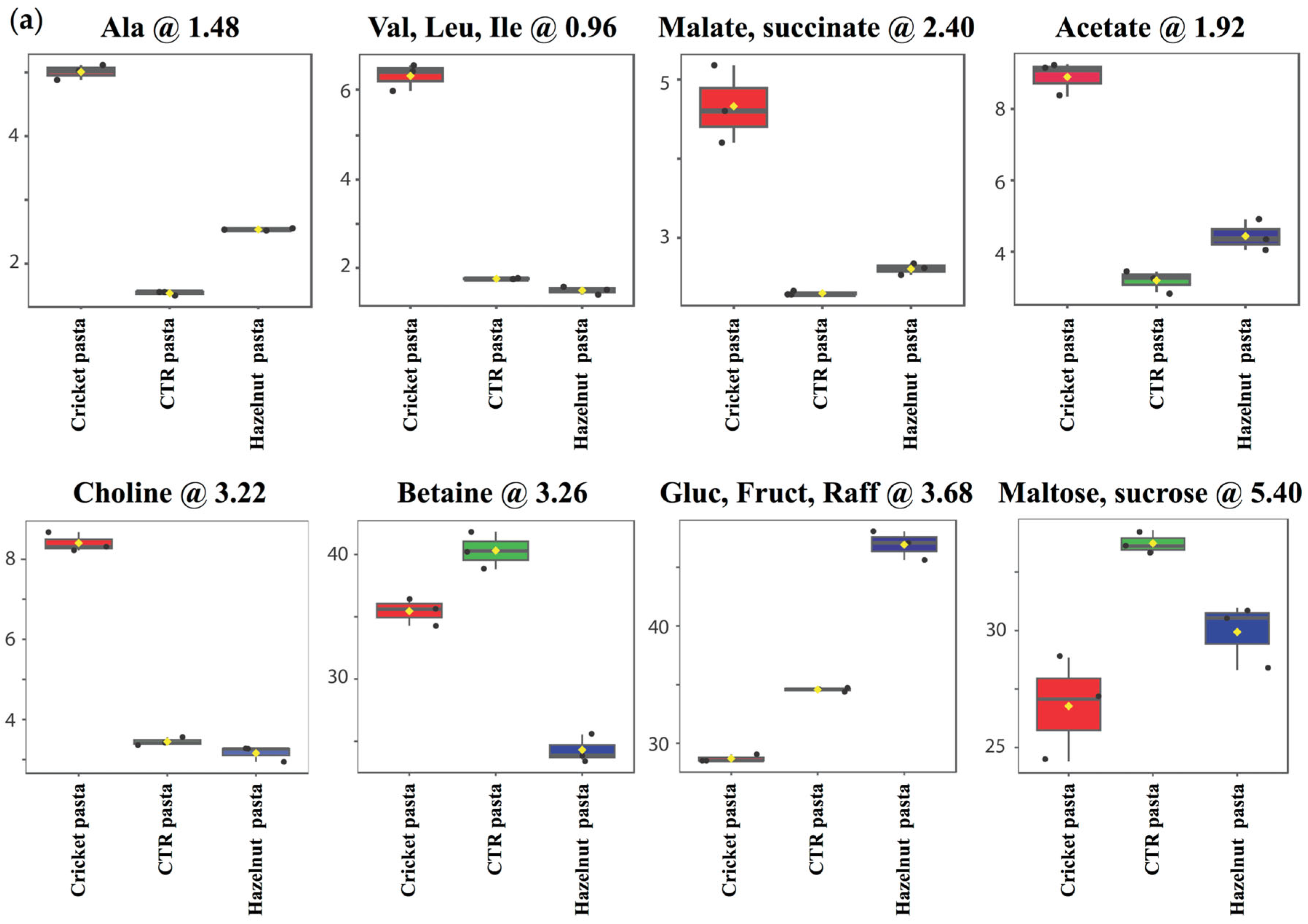
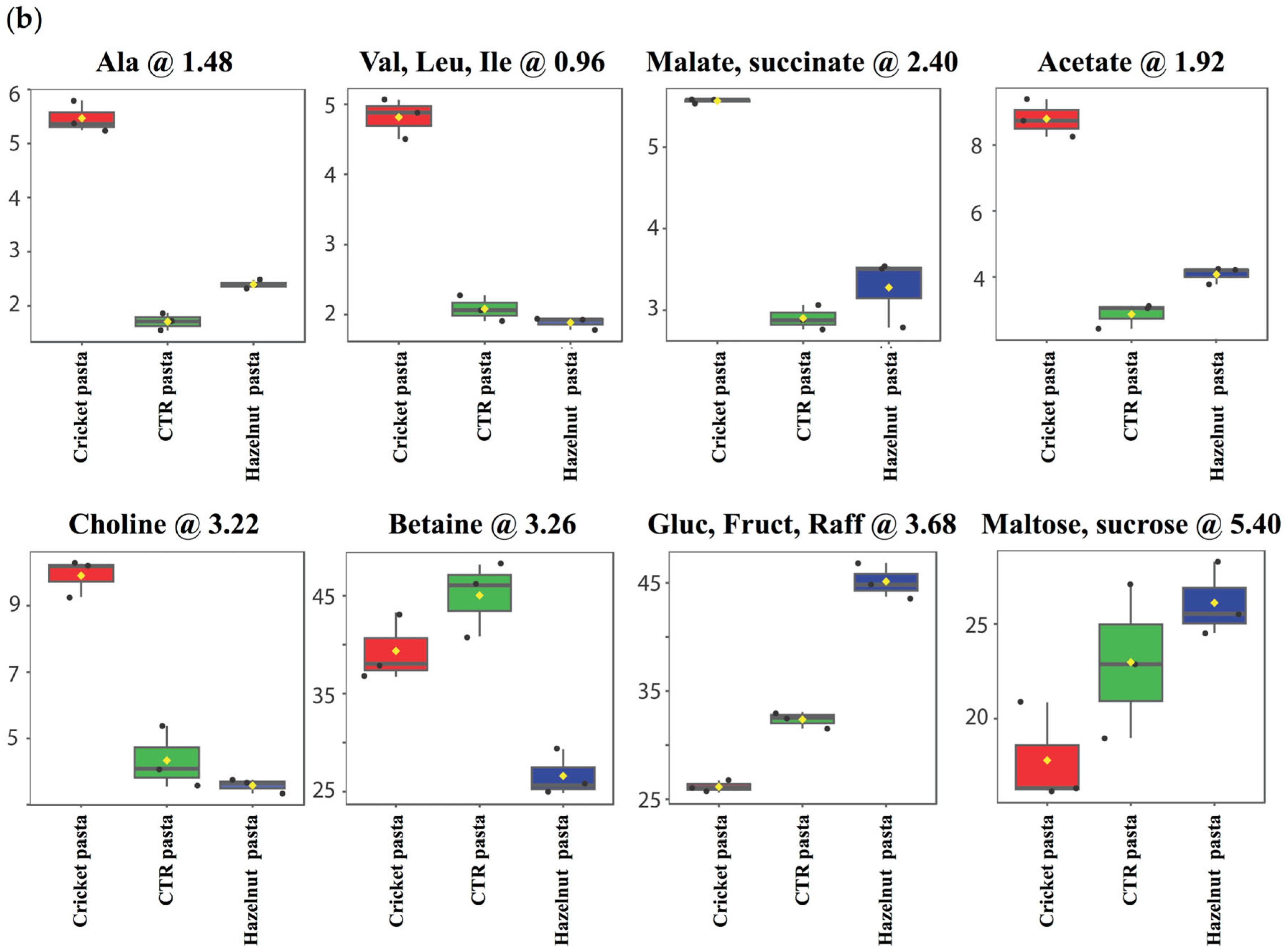
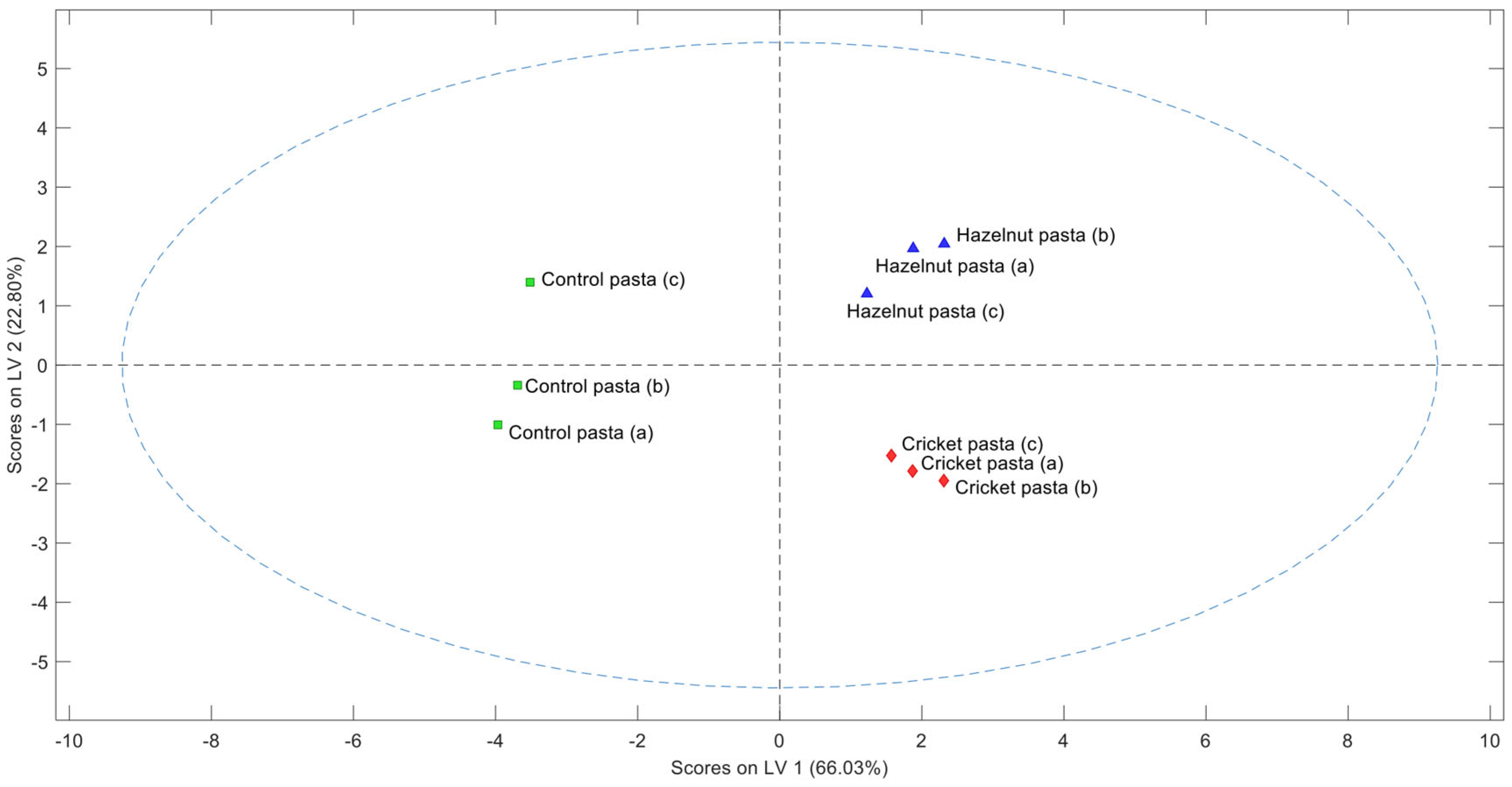
2.1.2. 1H NMR Analysis of Cooking Water
2.1.3. Determination of Pasta Colour
2.2. Sensory Evaluation of Cooked Pasta
2.2.1. Sensory Profiling by Descriptive Analysis
2.2.2. Sensory Analysis with Electronic Nose
3. Materials and Methods
3.1. Raw Materials
- -
- soft wheat flour “00” (Molino Profili, Viterbo, Italy): 73 g of total carbohydrates, 11.5 g of proteins, 2.0 g of total fat and 2.5 g of total dietary fibre;
- -
- durum wheat semolina (Molino Profili, Viterbo, Italy): 72 g of total carbohydrates, 11.5 g of proteins, 1.0 g of total fat and 2.5 g of total dietary fibre;
- -
- hazelnut flour of the Tonda Gentile Romana (Agricola Pini, Viterbo, Italy): 8.9 g of total carbohydrates, 17.9 g of proteins, 64.8 g of total fat and 4.0 g of total dietary fibre;
- -
- partially defatted cricket (Acheta domesticus) powder (Small Giants, Milan, Italy): 3.2 g of total carbohydrates, 77.2 g of proteins, 11.6 g of total fat and 8.0 g of total dietary fibre;
- -
- eggs were purchased by Azienda Agricola Bacocco (Viterbo, Italy).
3.2. Pasta Manufacturing
3.3. Standard Parameters of Pasta Quality
3.4. 1NMR Spectroscopy of Cooking Water
3.5. Sensory Profile
3.6. Statistical Analysis
4. Conclusions
Supplementary Materials
Author Contributions
Funding
Institutional Review Board Statement
Informed Consent Statement
Data Availability Statement
Acknowledgments
Conflicts of Interest
References
- FAO; IFAD; UNICEF; WFP; WHO. The State of Food Security and Nutrition in the World 2024–Financing to End Hunger, Food Insecurity and Malnutrition in All Its Forms; FAO, IFAD, UNICEF, WFP, WHO: Rome, Italy, 2024. [CrossRef] [Scilit]
- UN. World Population Projected to Reach 9.8 Billion in 2050, and 11.2 Billion in 2100. 2022. Available online: https://www.un.org/development/desa/en/news/population/world-population-prospects-2017.html (accessed on 13 June 2022).
- Van Huis, A.; van Itterbeeck, J.; Klunder, H.; Mertens, E.; Muir, G.; Vantomme, P. Edible Insects—Future Prospects for Food and Feed Security; FAO: Rome, Italy, 2013. [Google Scholar]
- Ismail, B.P.; Senaratne-Lenagala, L.; Stube, A.; Brackenridge, A. Protein Demand: Review of Plant and Animal Proteins Used in Alternative Protein Product Development and Production. Anim. Front. 2020, 10, 53–63. [Google Scholar] [CrossRef] [Scilit]
- Crippa, M.; Solazzo, E.; Guizzardi, D.; Monforti-Ferrario, F.; Tubiello, F.N.; Leip, A. Food systems are responsible for a third of global anthropogenic GHG emissions. Nat. Food 2021, 2, 198–209. [Google Scholar] [CrossRef] [Scilit] [PubMed]
- Katie, E.W.; Kelleghan, D.B.; Blanes-Vidal, V.; Schauberger, G.; Curran, T.P. Ammonia emissions from agriculture and their contribution to fine particulate matter: A review of implications for human health. J. Environ. Manag. 2022, 323, 116285. [Google Scholar] [CrossRef] [Scilit] [PubMed]
- Gil, M.; Rudy, M.; Duma-Kocan, P.; Stanisławczyk, R.; Krajewska, A.; Dziki, D.; Hassoon, W.H. Sustainability of Alternatives to Animal Protein Sources, a Comprehensive Review. Sustainability 2024, 16, 7701. [Google Scholar] [CrossRef] [Scilit]
- Mariotti, F. Animal and Plant Protein Sources and Cardiometabolic Health. Adv. Nutr. 2019, 10, S351–S366. [Google Scholar] [CrossRef] [Scilit]
- Ma, H.; Qi, X. Red Meat Consumption and Cancer Risk: A Systematic Analysis of Global Data. Foods 2023, 12, 4164. [Google Scholar] [CrossRef] [Scilit]
- Thornton, P.; Gurney-Smith, H.; Wollenberg, E. Alternative sources of protein for food and feed. Curr. Opin. Environ. Sustain. 2023, 62, 101277. [Google Scholar] [CrossRef] [Scilit]
- Quintieri, L.; Nitride, C.; De Angelis, E.; Lamonaca, A.; Pilolli, R.; Russo, F.; Monaci, L. Alternative Protein Sources and Novel Foods: Benefits, Food Applications and Safety Issues. Nutrients 2023, 15, 1509. [Google Scholar] [CrossRef] [Scilit]
- Jafarzadeh, S.; Qazanfarzadeh, Z.; Majzoobi, M.; Sheiband, S.; Oladzadabbasabad, N.; Esmaeili, Y.; Barrow, C.J.; Timms, W. Alternative proteins; A path to sustainable diets and environment. Curr. Res. Food Sci. 2024, 9, 100882. [Google Scholar] [CrossRef] [Scilit]
- Bustos, M.C.; Perez, G.T.; Leon, A.E. Structure and quality of pasta enriched with functional ingredients. Rsc Adv. 2015, 5, 30780–30792. [Google Scholar] [CrossRef] [Scilit]
- Cecchini, C.; Bresciani, A.; Menesatti, P.; Pagani, M.A.; Marti, A. Assessing the Rheological Properties of Durum Wheat Semolina: A Review. Foods 2021, 10, 2947. [Google Scholar] [CrossRef] [Scilit]
- Bresciani, A.; Cardone, G.; Jucker, C.; Savoldelli, S.; Marti, A. Technological Performance of Cricket Powder (Acheta domesticus L.) in Wheat-Based Formulations. Insects 2022, 13, 546. [Google Scholar] [CrossRef] [Scilit] [PubMed]
- Zarzycki, P.; Wirkijowska, A.; Teterycz, D.; Łysakowska, P. Innovations in Wheat Bread: Using Food Industry By-Products for Better Quality and Nutrition. Appl. Sci. 2024, 14, 3976. [Google Scholar] [CrossRef] [Scilit]
- Di Stefano, V.; Pagliaro, A.; Del Nobile, M.A.; Conte, A.; Melilli, M.G. Lentil Fortified Spaghetti: Technological Properties and Nutritional Characterization. Foods 2020, 10, 4. [Google Scholar] [CrossRef] [Scilit] [PubMed]
- Biernacka, B.; Dziki, D.; Różyło, R.; Gawlik-Dziki, U. Banana Powder as an Additive to Common Wheat Pasta. Foods 2020, 9, 53. [Google Scholar] [CrossRef] [Scilit]
- Biernacka, B.; Dziki, D.; Gawlik-Dziki, U. Pasta Enriched with Dried and Powdered Leek: Physicochemical Properties and Changes during Cooking. Molecules 2022, 27, 4495. [Google Scholar] [CrossRef] [Scilit]
- Çabuk, B.; Yılmaz, B. Fortification of traditional egg pasta (erişte) with edible insects: Nutritional quality, cooking properties and sensory characteristics evaluation. J. Food Sci. Technol. 2020, 57, 2750–2757. [Google Scholar] [CrossRef] [Scilit]
- Pasini, G.; Cullere, M.; Vegro, M.; Simonato, B.; Dalle Zotte, A. Potentiality of protein fractions from the house cricket (Acheta domesticus) and yellow mealworm (Tenebrio molitor) for pasta formulation. LWT-Food Sci. Technol. 2022, 164, 113638. [Google Scholar] [CrossRef] [Scilit]
- Bianchi, F.; Tolve, R.; Rainero, G.; Bordiga, M.; Brennan, C.S.; Simonato, B. Technological, nutritional and sensory properties of pasta fortified with agro- industrial by-products: A review. Int. J. Food Sci. Technol. 2021, 56, 4356–4366. [Google Scholar] [CrossRef] [Scilit]
- la Gatta, B.; Rutigliano, M.; Dilucia, F.; Liberatore, M.T.; Viscecchia, R.; Bimbo, F.; Di Luccia, A. Protein network assessment and sensory characteristics of durum wheat fresh pasta fortified with artichoke bracts and tomato powders. Food Biosci. 2023, 54, 102858. [Google Scholar] [CrossRef] [Scilit]
- Duda, A.; Adamczak, J.; Chełmińska, P.; Juszkiewicz, J.; Kowalczewski, P. Quality and Nutritional/Textural Properties of Durum Wheat Pasta Enriched with Cricket Powder. Foods 2019, 8, 46. [Google Scholar] [CrossRef] [Scilit]
- Ho, I.; Peterson, A.; Madden, J.; Huang, E.; Amin, S.; Lammert, A. Will It Cricket? Product Development and Evaluation of Cricket (Acheta domesticus) Powder Replacement in Sausage, Pasta, and Brownies. Foods 2022, 11, 3128. [Google Scholar] [CrossRef] [Scilit]
- FAO. Looking at Edible Insects from a Food Safety Prospective; Challenges and Opportunities for the Sector; Food and Agriculture Organization of the United Nations: Rome, Italy, 2021. [Google Scholar]
- EU. Commission Implementing Regulation 2022/188 authorising the placing on the market of frozen, dried and powder forms of Acheta domesticus as a novel food under Regulation (EU) 2015/2283 of the European Parliament and of the Council, and amending Commission Implementing Regulation (EU) 2017/2470 (Text with EEA relevance). Off. J. Eur. Union 2017, L30, 108–114. Available online: https://eur-lex.europa.eu/legal-content/EN/TXT/PDF/?uri=CELEX:32022R0188&from=EN (accessed on 15 May 2025).
- Delgado Calvo-Flores, L.; Garino, C.; Moreno, F.J.; Broll, H. Insects in food and their relevance regarding allergenicity assessment. EFSA J. 2022, 20, e200909. [Google Scholar] [CrossRef] [Scilit] [PubMed]
- Zeppa, G.; Belviso, S.; Bertolino, M.; Cavallero, M.C.; Dal Bello, B.; Ghirardello, D.; Giordano, M.; Giorgis, M.; Grosso, A.; Rolle, L.; et al. The effect of hazelnut roasted skin from different cultivars on the quality attributes, polyphenol content and texture of fresh egg pasta. J. Sci. Food Agric. 2015, 95, 1678–1688. [Google Scholar] [CrossRef] [Scilit] [PubMed]
- Costantini, L.; Di Matteo, G.; Felli, M.; Savatin, D.V.; Mannina, L.; Merendino, N. Evaluation of the Phenolic Components, Fiber Content, Antioxidant Activity, and Prebiotic Capacity of a Shortbread Cookie Fortified with Hazelnut Skin Waste. Foods 2024, 13, 3814. [Google Scholar] [CrossRef] [Scilit]
- Rosa-Sibakov, N.; Heinio, R.L.; Cassan, D.; Holopainen-Mantila, U.; Micard, V.; Lantto, R.; Sozer, N. Effect of bioprocessing and fractionation on the structural, textural and sensory properties of gluten-free faba bean pasta. LWT-Food Sci. Technol. 2016, 67, 27–36. [Google Scholar] [CrossRef] [Scilit]
- Piazza, L.; Ratti, S.; Girotto, F.; Cappellozza, S. Silkworm pupae derivatives as source of high value protein intended for pasta fortification. J. Food Sci. 2023, 88, 341–355. [Google Scholar] [CrossRef] [Scilit]
- Nino, M.C.; Reddivari, L.; Osorio, C.; Kaplan, I.; Liceaga, A.M. Insects as a Source of Phenolic Compounds and Potential Health Benefits. J. Insects Food Feed. 2021, 7, 1077–1088. [Google Scholar] [CrossRef] [Scilit]
- Kitts, D.D. Antioxidant and Functional Activities of MRPs Derived from Different Sugar–Amino Acid Combinations and Reaction Conditions. Antioxidants 2021, 10, 1840. [Google Scholar] [CrossRef] [Scilit]
- Özdemir, K.S.; Yilmaz, C.; Durmaz, G.; Gokmen, V. Hazelnut skin powder: A new brown colored functional ingredient. Food Res. Int. 2014, 65, 291–297. [Google Scholar] [CrossRef] [Scilit]
- Grossmann, K.K.; Merz, M.; Appel, D.; De Araujo, M.M.; Fischer, L. New insights into the flavoring potential of cricket (Acheta domesticus) and mealworm (Tenebrio molitor) protein hydrolysates and their Maillard products. Food Chem. 2021, 364, 130336. [Google Scholar] [CrossRef] [Scilit] [PubMed]
- Umebara, I.; Akutsu, K.; Kubo, M.; Iijima, A.; Sakurai, R.; Masutomi, H.; Ishihara, K. Analysis of Fatty Acid Composition and Volatile Profile of Powder from Edible Crickets (Acheta domesticus) Reared on Apple By-Products. Foods 2024, 13, 1668. [Google Scholar] [CrossRef] [Scilit] [PubMed]
- Alasalvar, C.; Bolling, B.W. Review of nut phytochemicals, fat-soluble bioactives, antioxidant components and health effects. Br. J. Nutr. 2015, 113, S68–S78. [Google Scholar] [CrossRef] [Scilit]
- Biró, B.; Sipos, M.A.; Kovács, A.; Badak-Kerti, K.; Pásztor-Huszár, K.; Gere, A. Cricket-Enriched Oat Biscuit: Technological Analysis and Sensory Evaluation. Foods 2020, 9, 1561. [Google Scholar] [CrossRef] [Scilit]
- Bawa, M.; Songsermpong, S.; Kaewtapee, C.; Chanput, W. Nutritional, sensory, and texture quality of bread and cookie enriched with house cricket (Acheta domesticus) powder. J. Food Process Preserv. 2020, 44, e14601. [Google Scholar] [CrossRef] [Scilit]
- Capuano, R.; Paba, E.; Mansi, A.; Marcelloni, A.M.; Chiominto, A.; Proietto, A.R.; Zampetti, E.; Macagnano, A.; Lvova, L.; Catini, A.; et al. Aspergillus Species Discrimination Using a Gas Sensor Array. Sensors 2020, 20, 4004. [Google Scholar] [CrossRef] [Scilit]
- AACC. Approved Methods of the AACC, 10th ed.; Cereals & Grains Association: Saint Paul, MN, USA, 2000. [Google Scholar]
- CIE. Official Recommendations on Uniform Colour Space, Colour Difference Equations and Metric Colour Terms; CIE publication No. 15. E-1.3.1; Commission Internationale de l’Éclairage, Bureau Central de la CIE: Paris, France, 1976. [Google Scholar]
- Imperlini, E.; Massaro, F.; Grifoni, A.; Maiurano, F.; Taddei, A.R.; Borocci, S.; Buonocore, F.; Porcelli, F. Membrane alteration, anti-virulence properties and metabolomic perturbation of a chionodracine-derived antimicrobial peptide, KHS-Cnd, on two bacteria models. Peptides 2024, 182, 171311. [Google Scholar] [CrossRef] [Scilit]
- De Santis, D.; Ferri, S.; Rossi, A.; Frisoni, R.; Modesti, M. Shortbread cookies reformulation by raspberry powder enrichment: Functional and sensory aspects. Int. J. Food Sci. Technol. 2024, 59, 7560–7569. [Google Scholar] [CrossRef] [Scilit]



| Sample | Cooking Loss (CL) (%) | Water Absorption (WA) % | ||||
|---|---|---|---|---|---|---|
| mean ± SD | CI | d | mean ± SD | CI | d | |
| Cooking time: OCT | ||||||
| Control pasta | 7.03 ± 0.36 | 6.14, 7.91 | 3.18 | 233.91 ± 1.77 | 229.50, 238.32 | 0.03 |
| Hazelnut pasta | 8.89 ± 0.62 * | 7.35, 10.43 | 3.68 | 220.87 ± 12.5 | 189.75, 251.98 | 1.46 |
| Cricket pasta | 7.10 ± 0.50 # | 5.88, 8.34 | 0.19 | 221.12 ± 3.85 * | 211.56, 230.68 | 4.27 |
| Cooking time: 20 min | ||||||
| Control pasta | 3.84 ± 0.78 | 2.60, 5.08 | 1.80 | 323.09 ± 4.63 | 311.58, 334.61 | 3.20 |
| Hazelnut pasta | 5.95 ± 0.71 * | 4.82, 7.08 | 2.84 | 317.65 ± 9.53 | 293.98, 341.32 | 0.73 |
| Cricket pasta | 4.64 ± 0.75 # | 3.45, 5.83 | 1.05 | 286.02 ± 10.25 **,# | 260.55, 311.48 | 4.66 |
| Sample | Uncooked/Cooked | L * (Lightness) | a * (Redness) | b * (Yellowness) |
|---|---|---|---|---|
| Control pasta | Uncooked | 70.46 ± 0.66 | 5.23 ± 0.29 | 41.79 ± 2.08 |
| Cooked | 65.49 ± 1.36 | −1.80 ± 0.05 | 22.54 ± 0.66 | |
| Hazelnut pasta | Uncooked | 60.61 ± 1.77 ** | 6.91 ± 0.31 ** | 34.98 ± 0.39 * |
| Cooked | 62.54 ± 0.44 | 0.92 ± 0.28 * | 21.07 ± 1.90 | |
| Cricket pasta | Uncooked | 54.68 ± 0.68 ***,# | 4.34 ± 0.14 *,### | 21.53 ± 0.35 ***,### |
| Cooked | 48.60 ± 0.84 **,## | 2.15 ± 0.16 **,# | 14.41 ± 1.18 * |
| Control Pasta | Hazelnut Pasta | Cricket Pasta | ||||
|---|---|---|---|---|---|---|
| Descriptors | Coefficient | p-Value | Coefficient | p-Value | Coefficient | p-Value |
| Colour (CO) | −1.389 | <0.0001 | −0.222 | 0.018 | 1.611 | <0.0001 |
| Pitting (PI) | −2.167 | <0.0001 | 0.833 | 0.002 | 1.333 | <0.0001 |
| Surface Roughness (SR) | −1.222 | 0.000 | 0.444 | 0.049 | 0.778 | 0.003 |
| Egg (EG) | 0.500 | 0.046 | 0.500 | 0.046 | −1.000 | 0.001 |
| Nut (NU) | −0.889 | 0.000 | 1.778 | <0.0001 | −0.889 | 0.000 |
| Cooked Odour (CKO) | 0.556 | 0.005 | −0.111 | 0.496 | −0.444 | 0.018 |
| Bread Crust (BC) | −1.000 | <0.0001 | 1.667 | <0.0001 | −0.667 | 0.000 |
| Vegetal Dried (VD) | −0.944 | 0.001 | −0.278 | 0.173 | 1.222 | <0.0001 |
| Salty (SA) | −1.000 | 0.002 | 0.667 | 0.021 | 0.333 | 0.201 |
| Bitter (BI) | −0.778 | 0.001 | 1.222 | <0.0001 | −0.444 | 0.033 |
| Aftertaste (AT) | −0.833 | 0.000 | 0.333 | 0.065 | 0.500 | 0.011 |
| Taste Intensity (TI) | −0.444 | 0.041 | 0.389 | 0.067 | 0.056 | 0.775 |
| Astringent (AS) | −1.111 | <0.0001 | 0.889 | 0.000 | 0.222 | 0.188 |
| Homogeneous Texture (HT) | −1.500 | <0.0001 | −0.500 | 0.033 | −1.000 | 0.001 |
| Shrimp Flavour (SF) | −0.889 | <0.0001 | −0.889 | <0.0001 | 1.778 | <0.0001 |
| Sample | AT | PI | SR | SA | AS | TI | CO | VD | SF | BI | BC | NU | EG | CKO | HT |
|---|---|---|---|---|---|---|---|---|---|---|---|---|---|---|---|
| Control pasta | 2.500 | 4.167 | 3.667 | 2.000 | 1.500 | 2.333 | 5.000 | 2.500 | 2.667 | 0.833 | 0.500 | 0.000 | 2.667 | 2.333 | 1.833 |
| Hazelnut pasta | 2.333 | 3.667 | 3.333 | 2.333 | 2.167 | 2.667 | 3.167 | 1.000 | 0.000 | 2.500 | 2.833 | 2.667 | 4.167 | 2.667 | 2.333 |
| Cricket pasta | 1.167 | 0.667 | 1.667 | 0.667 | 0.167 | 1.833 | 2.000 | 0.333 | 0.000 | 0.500 | 0.167 | 0.000 | 4.167 | 3.333 | 4.333 |
Disclaimer/Publisher’s Note: The statements, opinions and data contained in all publications are solely those of the individual author(s) and contributor(s) and not of MDPI and/or the editor(s). MDPI and/or the editor(s) disclaim responsibility for any injury to people or property resulting from any ideas, methods, instructions or products referred to in the content. |
© 2025 by the authors. Licensee MDPI, Basel, Switzerland. This article is an open access article distributed under the terms and conditions of the Creative Commons Attribution (CC BY) license (https://creativecommons.org/licenses/by/4.0/).
Share and Cite
Chiossi, M.; De Santis, D.; Modesti, M.; Ferri, S.; Fidaleo, M.; Buonocore, F.; Porcelli, F.; Imperlini, E. NMR-Based Metabolomic and QMB-Based E-Nose Approaches to Evaluate the Quality and Sensory Features of Pasta Fortified with Alternative Protein Sources. Molecules 2025, 30, 3438. https://doi.org/10.3390/molecules30163438
Chiossi M, De Santis D, Modesti M, Ferri S, Fidaleo M, Buonocore F, Porcelli F, Imperlini E. NMR-Based Metabolomic and QMB-Based E-Nose Approaches to Evaluate the Quality and Sensory Features of Pasta Fortified with Alternative Protein Sources. Molecules. 2025; 30(16):3438. https://doi.org/10.3390/molecules30163438
Chicago/Turabian StyleChiossi, Marika, Diana De Santis, Margherita Modesti, Serena Ferri, Marcello Fidaleo, Francesco Buonocore, Fernando Porcelli, and Esther Imperlini. 2025. "NMR-Based Metabolomic and QMB-Based E-Nose Approaches to Evaluate the Quality and Sensory Features of Pasta Fortified with Alternative Protein Sources" Molecules 30, no. 16: 3438. https://doi.org/10.3390/molecules30163438
APA StyleChiossi, M., De Santis, D., Modesti, M., Ferri, S., Fidaleo, M., Buonocore, F., Porcelli, F., & Imperlini, E. (2025). NMR-Based Metabolomic and QMB-Based E-Nose Approaches to Evaluate the Quality and Sensory Features of Pasta Fortified with Alternative Protein Sources. Molecules, 30(16), 3438. https://doi.org/10.3390/molecules30163438