Abstract
Making use of a Diels–Alder approach based on various α,β-unsaturated 2-carbomethoxy-4,4-dimethyl-1-tetralones as novel dienophiles, the corresponding polycyclic adducts could be efficiently synthesized in good to high yields (74~99%) in the presence of Lewis acid (e.g., SnCl4). Accordingly, a synthetically useful platform is established to provide a focused aromatic polyketide-like library for screening of potential natural and non-natural antimicrobial agents.
1. Introduction
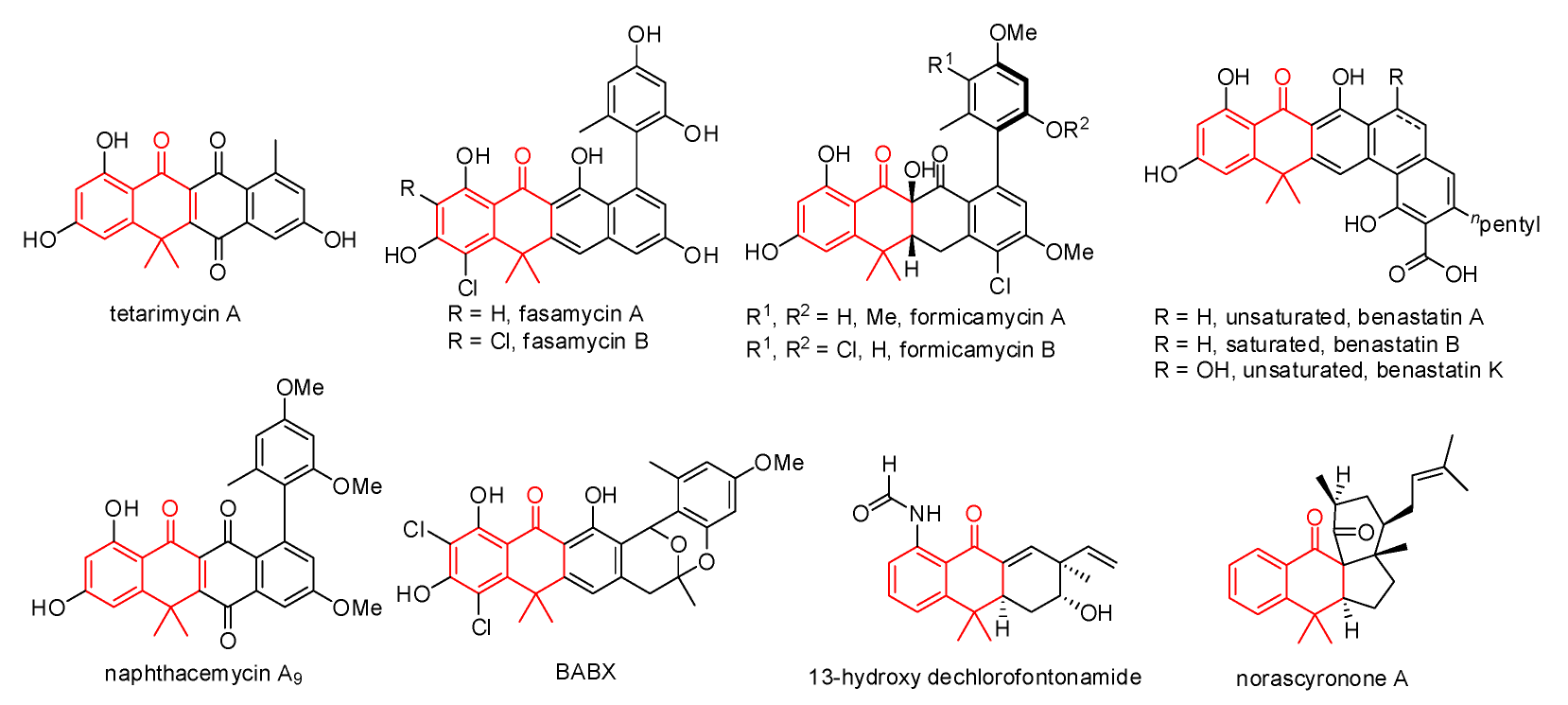
Naturally occurring polyketides isolated from Streptomyces species have an abundance of structural diversities and possess a variety of interesting bioactivities [1,2,3]. Among them, a family, featured with a 4,4-dimethyl-1-tetralone unit as highlighted in red in Figure 1, has been shown to have antimicrobial activities against Gram-positive pathogens, such as methicillin-resistant Staphylococcus aureus (S. aureus) (MRSA) and vancomycin-resistant S. aureus (VRSA) strains [4,5,6,7,8,9,10].
Figure 1.
Aromatic polyketides containing a γ-gem-dimethyl-1-tetralone unit.
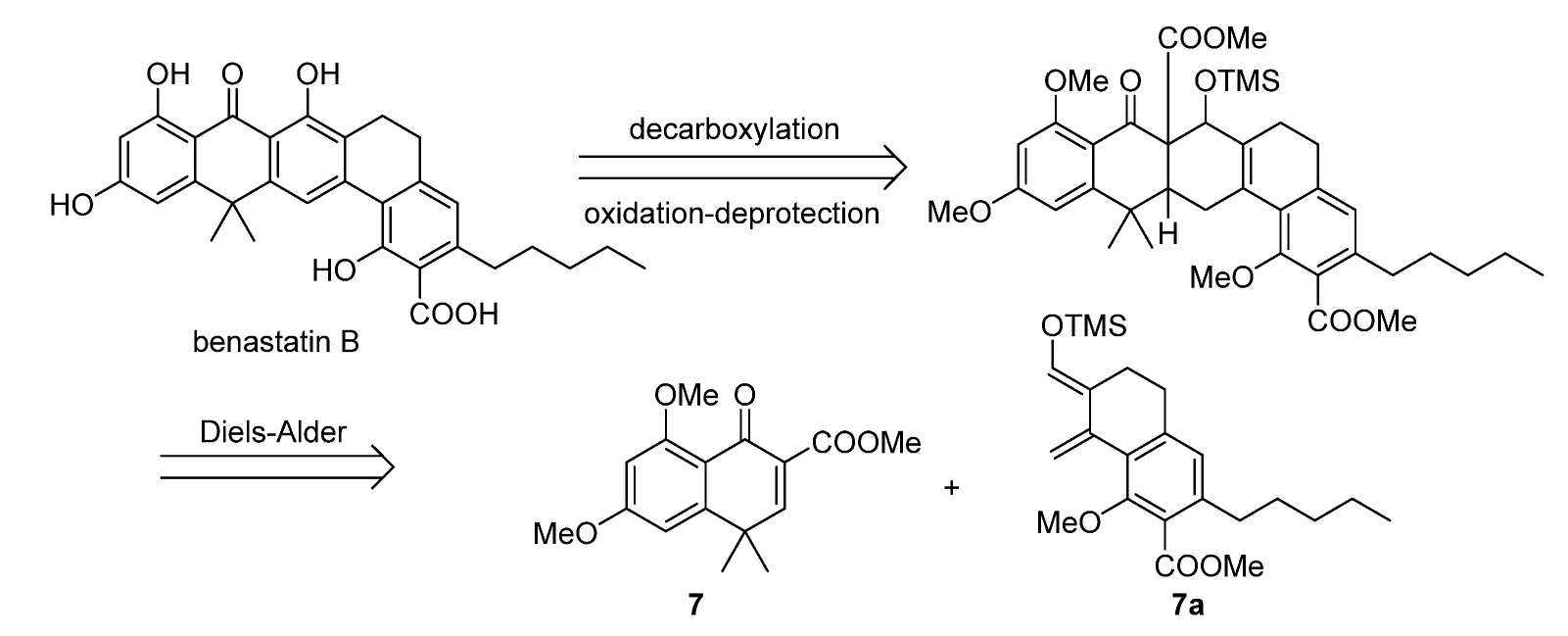
Clinically, only a few antibiotics are able to cope with these resistant strains today. For example, daptomycin and linezolid are commonly used for the treatment of VRSA infection and vancomycin, teicolplanin, ceftaroline, and tigecycline are available for MRSA infection. It is highly conceivable that the prevalence of MRSA and VRSA strains may further evolve and develop resistance to current limited antibiotics, leading to the complete failure of clinical treatment in the future. Thus, developing more effective antibiotics to bolster an antimicrobial arsenal appears to be an urgent medical need for modern society. Along this axis, a plausible Diels–Alder approach to rapidly construct polycyclic core structures towards polyketide-like antibiotics was conceived. Using benastatin B as a typical example, retrosynthetic analysis (Figure 2) discloses that it can be disconnected into two major fragments, a dienophile 7 and created diene 7a, by which the desired polycyclic skeleton can be simply established in one Diels–Alder operation to afford the corresponding adduct, of which decarboxylation and deprotection can be effected under acidic conditions, followed by Dess–Martin and/or DDQ oxidation to achieve the target molecule.
Figure 2.
The retrosynthetic analysis of benastatin B through a plausible Diels–Alder approach.
2. Results and Discussion
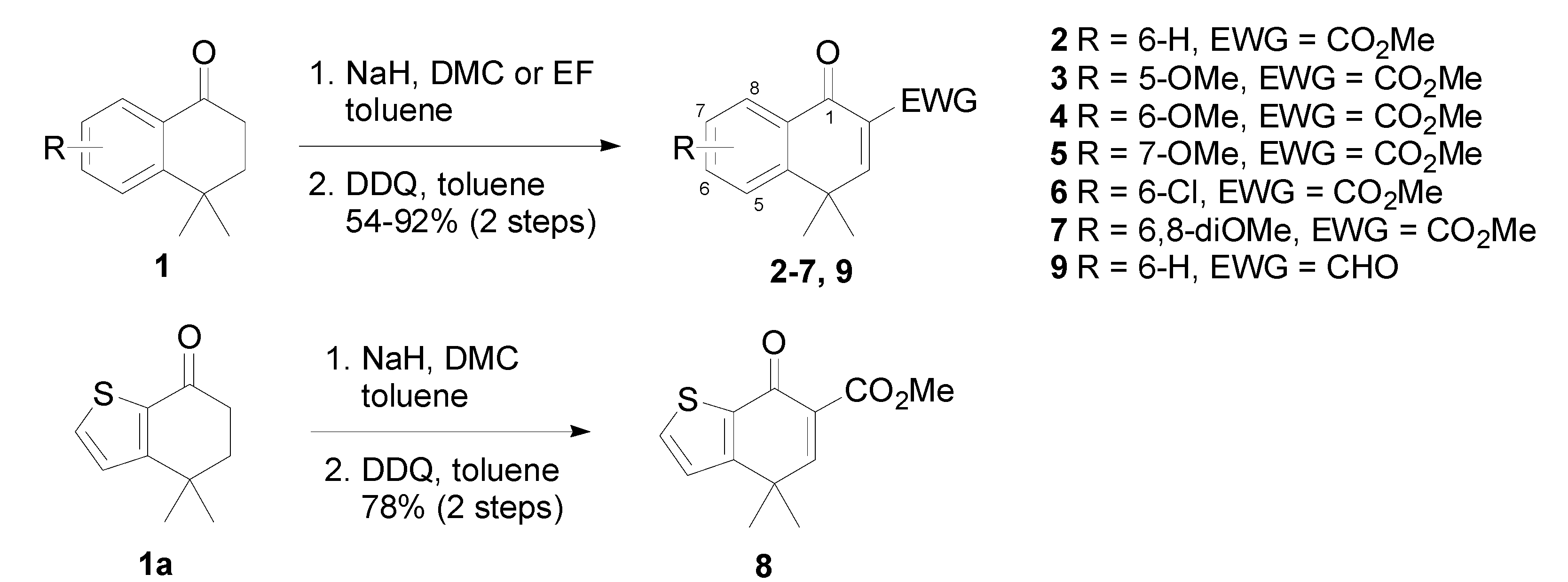
Results of these studies are presented as follows. The project was initiated by the use of various 4,4-dimethyl-tetralones 1 or 1a as starting material to provide dienophiles, which are either commercially available or readily prepared through several well-documented methodologies [4,5,6,11]. As typified by Scheme 1, using compounds 1 and 1a as starting material, α-activated dienophiles 2–9 could be rapidly constructed based on a two-step synthetic sequence with good to high yields (54–92%), involving substitution with dimethyl carbonate (DMC) or ethyl formate (EF) in the presence of NaH, followed by 2,3-dichloro-5,6-dicyano-1,4-benzoquinone (DDQ) oxidation.
Scheme 1.
Preparation of α-activated dienophiles 2–9.
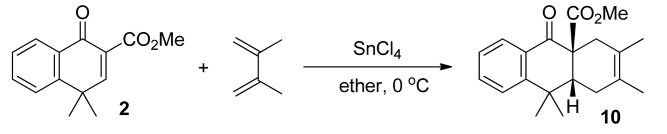
Inspired by our previous studies on Diels–Alder cycloaddition which can be easily promoted by the use of α-activated cross conjugated cycloalkenones as dienophiles [12,13,14,15,16,17,18,19,20] in the presence of various Lewis acids, a D–A model study based on dienophile 2 and 2,3-dimethyl-1,3-butadiene was then explored under catalysis with an array of Lewis acids, including SnCl4, BF3(OEt2), ZnCl2, TiCl4, ZnI2, and BCl3 (see Table S1 in SI). Among them, SnCl4 was found to be superior to others to facilitate the desired Diels–Alder reactions in terms of yields and milder reaction conditions. Further screening suggested that minor modifications with a raising reaction temperature from 0 °C to room temperature resulted in higher yields (Table 1, Entry 2, 91% vs. Entry 3, 98%). Thus, the reaction system (SnCl4, ether, 0 °C to rt) indicated in Entry 3 was considered the method of choice and was adopted as a standard method for the current studies. Results and the scope of Diels–Alder reactions are compiled in Table 2 and discussed thereof as follows.
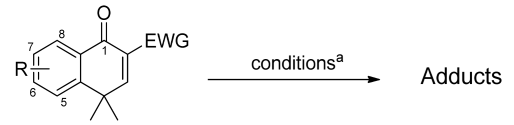
Table 1.
Screening of Diels–Alder cycloaddition conditions a.
Table 2.
Scope of dienophiles and dienes applied for Diels–Alder cycloaddition a.
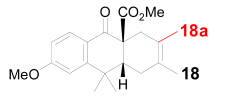
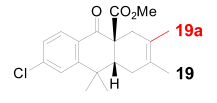
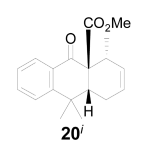
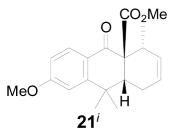
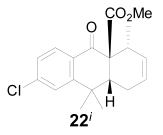
In general, we discovered that 4,4-dimethyl-tetral-1-ones 2~8 with an α-ester activating group could serve as dienophiles as efficient as their corresponding α-activated cross conjugated cycloalkenones with little influence by either an electron-donating or electron-withdrawing substituent(s) in the benzene ring in terms of yields, as seen in Entries 1 (98%), 3 (86%), and 5 (87%). However, the reaction rate for the presence of an electron-donating group(s) appeared to significantly retard the progress of reactions as compared with an electron-withdrawing group (Entry 3, 6-methoxy, 18 h vs. Entry 5, 6-Cl, 2 h). Apparently, these results might be attributed to the enhancement of the dienophilicity of dienophiles, thus lowering the energy of LUMO and accelerating reactions. However, it is hard to explain why the reaction rate of neutral dienophiles 2 and 8 (Entries 1, 7, 11, 14, and 17) was individually as efficient as the electron-deficient dienophile 6 (Entries 5, 10, 13, and 16), particularly when the endo-to-ketone transition state was considered a typically preferred mechanistic pathway due to a secondary orbital effect. Normally, addition of the 2-substituted dienes should result in more para than anti-para adducts as a result of the preferred electronic effects over the steric barrier in accordance with the para rule. Similar results were also observed in our cases, as seen in Entries 8 (17:17a = 74:26, 78%), 9 (18:18a = 69:31, 81%), and 10 (19:19a = 75:25, 79%), the ratio of which was tentatively determined based on the regiochemistry of para adduct 17, whose structure was unambiguously identified by an X-ray crystallographic picture [21]. Since it was difficult to separate a pair of para and anti-para isomers, only the spectral data of major para adducts 17, 18, and 19 could be absolutely provided. trans-Piperylene was expected not to suffer any steric barrier and thus, the endo-to-ketone addition adducts 20 (Entry 11), 21 (Entry 12), and 22 (Entry 13), following the ortho rule, were exclusively obtained, the stereochemistry of which was respectively identified with a single-crystal X-ray analysis [22,23,24].
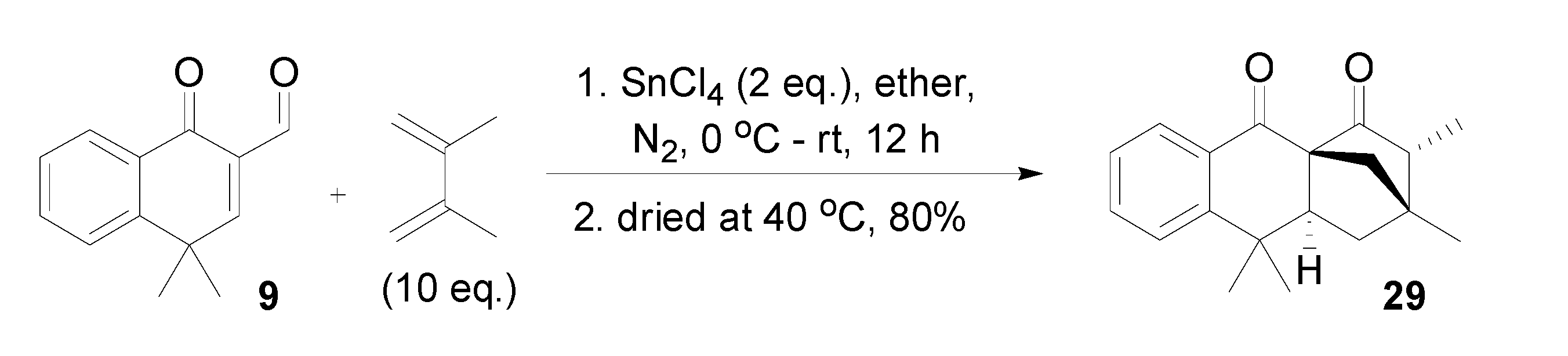
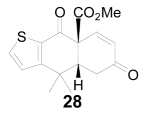
When a relatively more reactive Danishefsky’s diene was employed, ZnI2, a weaker Lewis acid, was elected instead to avoid polymerization, again furnishing the desired enones 27 and 28, respectively, in good yields (63~72%) after acidic work-up conditions. The above results clearly demonstrate that this newly developed Diels–Alder approach in combination with an appropriate Lewis acid has great potential in synthesizing natural and non-natural polyketides containing a 4,4-dimethyl-1-tetralone unit. Meeting significant success in serving compound 2~8 as dienophiles, we further extended the methodology to dienophile 9 activated with an aldehyde group instead of an ester group [25]. Not unexpectedly, Diels–Alder reactions of 9 with various dienes tested in Table 2 under similar reaction conditions also gave rise to corresponding Diels–Alder adducts in moderate to good yields (63~90%, unpublished results). However, it was serendipitously found that when the reaction was complete (Scheme 2) and its reaction mixture was concentrated/dried directly in water bath at 40 °C instead of an usual work-up procedure, an unexpected product 29 was obtained exclusively in 80% yield, whose structure was unambiguously identified with an X-ray crystallographic analysis [26].
Scheme 2.
Diels–Alder reaction accompanied with unexpected rearrangements.
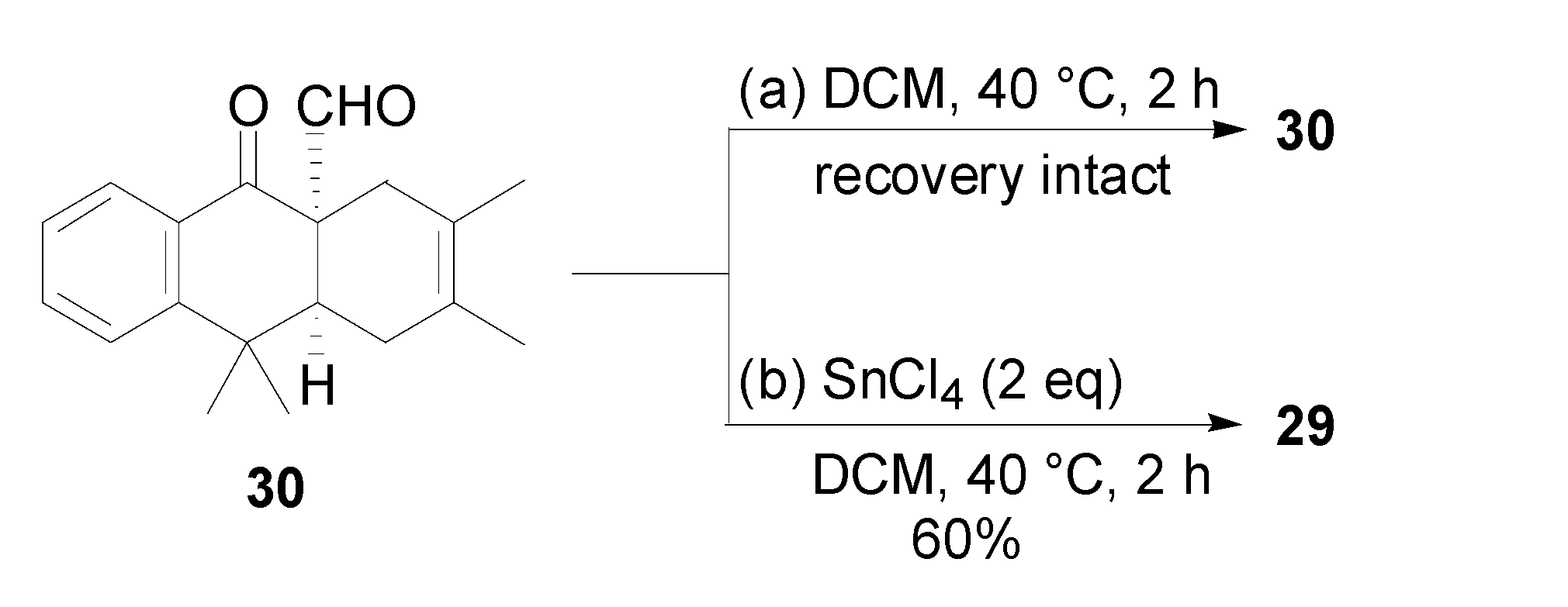
We speculated that 29 should be derived from the normal Diels–Alder adduct 30 during elevating temperature. Thus, compound 30, obtained by a usual work-up as seen in Experimental 3.3., was subjected to two different reaction conditions (a) and (b), as seen in Scheme 3, to clarify which factor(s) really forced the reaction forward. Results clearly verified that compound 30 was smoothly converted to 29 in 60% under condition (b). Meanwhile, it was recovered intact under condition (a) in the absence of SnCl4.
Scheme 3.
Diels–Alder adduct 30 was verified as an intermediate of 29.
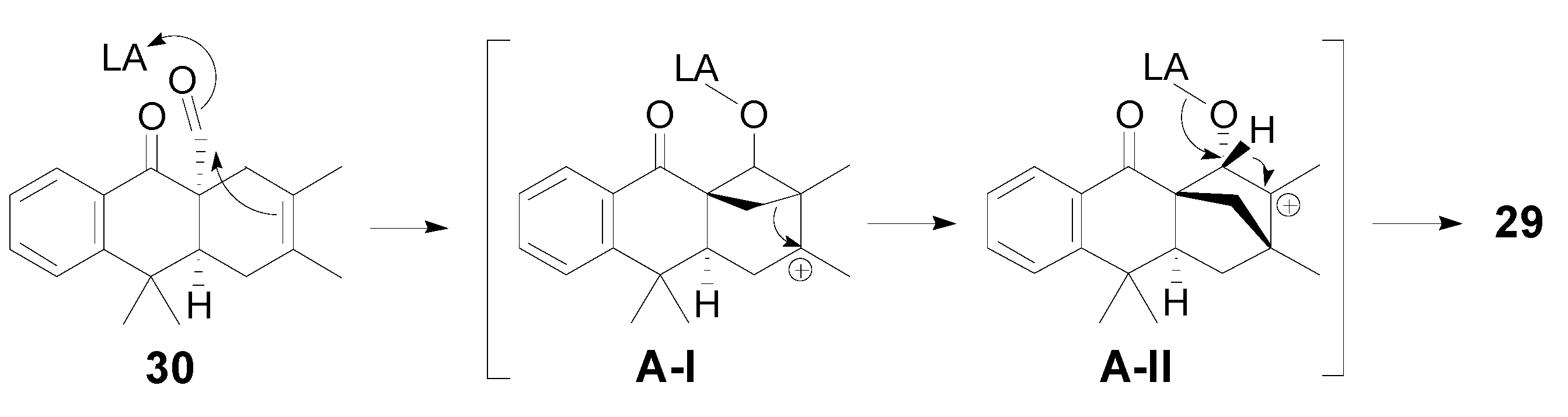
Accordingly, the plausible mechanism is thus proposed as depicted in Scheme 4. The reaction sequence is believed to proceed with a consecutive Diels–Alder reaction and two 1,2-shift rearrangements. Upon the formation of Diels–Alder product 30, its angular aldehyde moiety was complexed/catalyzed with LA (i.e., SnCl4) to form the oxonium ion, which in turn underwent an electrophilic addition with the alkene to give carbocation species A-I (like Prins reaction), by which a cascade of 1,2-hydride and 1,2-alkyl carbanion shifts sequentially occurred via species A-II to achieve diketone 29, as similar to the previous report by Wang and coworkers [27].
Scheme 4.
A proposed mechanism consisting of a domino D–A reaction and two 1,2-shifts.
3. Experimental Section
3.1. Materials and Reagents
All reactions were performed under N2 atmosphere unless otherwise stated. All reagents were employed as received without further purification. All solvents were dried and distilled by standard techniques. Diethyl ether was distilled from potassium and toluene was distilled from calcium hydride under N2. Analytical thin layer chromatography was performed on SiO2 60 F-254 plates and flash column chromatography was carried out using SiO2 60 (particle size 0.040–0.055 mm, 230–400 mesh). Visualization was performed under UV irradiation at 254 nm followed by staining with aqueous potassium permanganate and charring by heat gun. 1H and 13C-NMR spectra were recorded by Bruker Ascend 400 (400 MHz) or Bruker Ascend 600 (600 MHz). Chemical shifts were expressed in ppm using TMS in CDCl3 (δ = 0.00) with residual chlroform-d1 (δ = 7.26) as the internal standard in 1H-NMR spectra. 13C-NMR spectra were recorded in CDCl3, using the central resonances of CDCl3 (δ = 77.00) as the internal references. Multiplicities are recorded as s (singlet), d (doublet), t (triplet), q (quartet), quint (quintet), dd (doublet of doublets), dt (doublet of triplets), tt (triplet of triplets), ddd (doublet of doublet of doublets), m (multiplet), and br (broad). Coupling constants (J) were expressed in Hz. HRMS was obtained on a triple quadrupole mass analysis using electron ionization (EI) and electrospray ionization (ESI) source, and spectral data were recorded as m/z values. Copies of 1H and 13C-NMR spectra of the synthetic products and X-ray crystallographic data copies of the products (17, 20, 21, 22 and 29) can be found in Supplementary Materials.
3.2. General Procedure for Preparation of Dienophiles 2–9 Using 6 as a Typical Example
A stirred solution of 6-chloro-4,4-dimethyl-1-tetralone (0.86 g, 4.12 mmol), NaH (0.51 g, 21.25 mmol), and dimehtyl carbonate (0.60 g, 6.67 mmol) in dry toluene (10 mL) was heated up to reflux. After the reaction was complete, sat. NH4Cl(aq) was added to quench the reaction. The organic layer was separated and the aqueous layer was extracted with EA (2 × 20 mL). The organic portions were combined and dried over MgSO4, filtered and concentrated to give the residue, which was purified by chromatography on silical gel (n-hexane:ethyl acetate = 4:1) to afford 6-chloro-2-carbomethoxy-4,4-dimethyl-1-tertralone (0.88 g) in 80% yield, which was subsequently stirred in dry toluene (10 mL), followed by adding DDQ (0.75 g, 3.30 mmol) in one portion and kept at 80 °C under N2 for 16 h. After the reaction was complete, the reaction mixture was filtrated with celite and quenched with saturated NaHCO3(aq) (5 mL) and extracted with EtOAc (3 × 10 mL). Organic layers were combined and washed with brine, dried over MgSO4, and then filtered and concentrated to give the crude residue, which was purified by chromatography on silical gel (n-hexane:ethyl acetate = 4:1) to afford dienophile 6 (0.54 g) in 62% yield.
3.2.1. Methyl 6-Chloro-4,4-dimethyl-1-oxo-1,4-dihydronaphthalene-2-carboxylate (6)
1H NMR (CDCl3, 600 MHz): δ 8.14 (d, J = 8.4 Hz, 1H), 7.59 (s, 1H), 7.48 (d, J = 1.8 Hz, 1H), 7.36 (dd, J = 8.4, 1.8 Hz, 1H), 3.88 (s, 3H), 1.53 (s, 6H); 13C NMR (CDCl3, 150 MHz): δ 179.8, 165.3, 161.8, 149.8, 139.7, 129.3, 129.3, 129.1, 127.8, 126.2, 52.5, 37.6, 29.3; HRMS [ESI]+ calculated for C14H13ClNaO3: 287.0451 [M+Na]+; found: 287.0451.
3.2.2. Methyl 5-Methoxy-4,4-dimethyl-1-oxo-1,4-dihydronaphthalene-2-carboxylate (3)
57% Yield; 1H NMR (CDCl3, 400 MHz): δ 7.89 (d, J = 8.0 Hz, 1H), 7.58 (s, 1H), 7.40 (t, J = 8.0 Hz, 1H), 7.12 (d, J = 8.0 Hz, 1H), 3.92 (s, 3H), 3.89 (s, 3H), 1.61 (s, 6H); 13C NMR (CDCl3, 150 MHz): δ 180.9, 165.7, 165.1, 157.4, 135.7, 132.4, 128.0, 127.4, 119.7, 115.3, 55.5, 52.4, 37.7, 24.9; HRMS [ESI]+ calculated for C15H16NaO4: 283.0946 [M+Na]+; found: 283.0950.
3.2.3. Methyl 7-Methoxy-4,4-dimethyl-1-oxo-1,4-dihydronaphthalene-2-carboxylate (5)
74% Yield; 1H NMR (CDCl3, 600 MHz): δ 7.60 (d, J = 3.0 Hz, 1H), 7.57 (s, 1H), 7.38 (d, J = 8.4 Hz, 1H), 7.11 (dd, J = 8.4, 3.0 Hz, 1H), 3.83 (s, 3H), 3.80 (s, 3H), 1.45 (s, 6H); 13C NMR (CDCl3, 150 MHz): δ 180.7, 165.6, 162.4, 158.4, 141.0, 131.6, 129.2, 127.4, 121.7, 108.8, 55.5, 52.4, 37.2, 29.2; HRMS [ESI]+ calculated for C15H16NaO4: 283.0946 [M+Na]+; found: 283.0952.
3.2.4. Methyl 4,4-Dimethyl-7-oxo-4,7-dihydrobenzo[b]thiophene-6-carboxylate (8)
77% Yield; 1H NMR (CDCl3, 600 MHz): δ 7.63 (d, J = 4.8 Hz, 1H), 7.50 (s, 1H), 7.09 (d, J = 4.8 Hz, 1H), 3.79 (s, 3H), 1.41 (s, 6H); 13C NMR (CDCl3, 150 MHz): δ 175.7, 165.3, 162.0, 156.5, 135.8, 134.4, 129.5, 125.8, 52.4, 38.8, 27.8; HRMS [ESI]+ calculated for C12H12NaO3S: 259.0405 [M+Na]+; found: 259.0402.
3.3. General Procedure for Preparation of Diels-Alder Adducts 10–28 Using 10 as a Typical Example
To a stirred solution of dienophile 2 (145 mg, 0.63 mmol) in dry ether (6 mL), 2,3-Dimethyl-1,3-butadiene (520 mg, 6.33 mmol) was added, followed by tin (IV) chloride (240 mg, 1.27 mmol) dropwise under N2 at 0 °C. The resulting mixture was warmed up to room temperature and stirred for another 2.5 h. After the reaction was complete, sat. NaHCO3(aq) (1.0 mL) was added to quench the reaction. The organic layer was separated and the aqueous layer was extracted with EtOAc (3 × 10 mL). The organic portions were combined, washed with brine, dried over MgSO4, and then filtered and concentrated to give the crude residue, which was purified by chromatography on silical gel (n-hexane:ethyl acetate = 3:1) to afford adduct 10 (193 mg) in 98% yield.
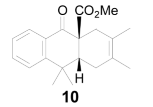
3.3.1. (4aS,9aR)-Methyl 2,3,9,9-Tetramethyl-10-oxo-1,4,4a,9,9a,10-hexahydroanthracene-4a-carboxylate (10)
98% yield; 1H NMR (CDCl3, 400 MHz): δ 8.06 (d, J = 8.0 Hz, 1H), 7.54 (m, 1H), 7.39 (d, J = 9.2 Hz, 1H), 7.30 (m, 1H), 3.64 (s, 3H), 2.76 (m, 1H), 2.69 (d, J = 16.8 Hz, 1H), 2.49 (d, J = 16.8 Hz, 1H), 2.17 (dd, J = 18.0, 6.8 Hz, 1H), 1.79 (dd, J = 18.0, 8.4 Hz, 1H), 1.64 (s, 3H), 1.52 (s, 3H), 1.36 (s, 3H), 1.34 (s, 3H); 13C NMR (CDCl3, 100 MHz): δ 195.2, 174.7, 149.8, 134.2, 130.0, 127.7, 126.8, 126.4, 123.4, 123.1, 57.4, 52.5, 44.8, 37.6, 36.8, 32.5, 32.3, 28.3, 18.7, 18.5; HRMS [ESI]+ calculated for C20H24O3: 312.1720; found: 312.1724.
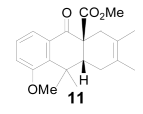
3.3.2. (4aS,9aR)-Methyl 8-Methoxy-2,3,9,9-tetramethyl-10-oxo-1,4,4a,9,9a,10-hexahydroanthracene-4a-carboxylate (11)
74% yield; 1H NMR (CDCl3, 600 MHz): δ 7.73 (d, J = 7.8 Hz, 1H), 7.27 (t, J = 7.8 Hz, 1H), 7.09 (d, J = 7.8 Hz, 1H), 3.84 (s, 3H), 3.62 (s, 3H), 2.67 (d, J = 16.8 Hz, 1H), 2.61 (dd, J = 9.0, 6.6 Hz, 1H), 2.47 (d, J = 16.8 Hz, 1H), 2.20 (m, 1H), 1.83 (m, 1H), 1.64 (s, 3H), 1.52 (s, 3H), 1.48 (s, 3H), 1.44 (s, 3H); 13C NMR (CDCl3, 150 MHz): δ 195.4, 174.7, 158.7, 136.6, 132.3, 127.2, 123.4, 123.0, 120.3, 117.1, 57.0, 55.5, 52.4, 46.8, 37.8, 36.8, 32.2, 27.9, 26.6, 18.7, 18.4; HRMS [ESI]+ calculated for C21H26NaO4: 365.1729 [M+Na]+; found: 365.1726.
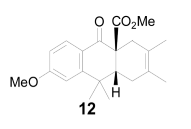
3.3.3. (4aS,9aR)-Methyl 7-Methoxy-2,3,9,9-Tetramethyl-10-Oxo-1,4,4a,9,9a,10-Hexahydroanthracene-4a-Carboxylate (12)
86% yield; 1H NMR (CDCl3, 400 MHz): δ 8.07 (d, J = 7.6 Hz, 1H), 6.85–6.82 (m, 2H), 3.86 (s, 3H), 3.65 (s, 3H), 2.76 (m, 1H), 2.71 (d, J = 16.8 Hz, 1H), 2.47 (d, J = 16.8 Hz, 1H), 2.15 (dd, J = 18.0, 6.8 Hz, 1H), 1.79 (dd, J = 18.0, 8.0 Hz, 1H), 1.63 (s, 3H), 1.51 (s, 3H), 1.34 (s, 3H), 1.33 (s, 3H); 13C NMR (CDCl3, 100 MHz): δ 193.9, 174.9, 164.3, 152.4, 130.6, 123.7, 123.4, 123.2, 112.0, 111.8, 57.1, 55.4, 52.5, 44.8, 37.9, 37.0, 32.5, 32.4, 28.2, 18.7, 18.5; HRMS [ESI]+ calculated for C21H26O4: 342.1826; found: 342.1826.
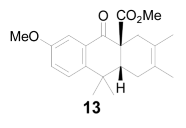
3.3.4. (4aS,9aR)-Methyl 6-Methoxy-2,3,9,9-tetramethyl-10-oxo-1,4,4a,9,9a,10-hexahydroanthracene-4a-carboxylate (13)
75% yield; 1H NMR (CDCl3, 600 MHz): δ 7.54 (d, J = 3.0 Hz, 1H), 7.29 (d, J = 9.0 Hz, 1H), 7.12 (dd, J = 9.0, 3.0 Hz, 1H), 3.84 (s, 3H), 3.65 (s, 3H), 2.75 (dd, J = 7.8, 6.6 Hz, 1H), 2.68 (d, J = 16.8 Hz, 1H), 2.48 (d, J = 16.8 Hz, 1H), 2.16 (dd, J = 18.0, 6.6 Hz, 1H), 1.78 (dd, J = 18.0, 7.8 Hz, 1.64 (s, 3H), 1.52 (s, 3H), 1.32 (s, 6H); 13C NMR (CDCl3, 150 MHz): δ 195.3, 174.7, 157.9, 142.3, 130.9, 128.2, 123.5, 123.0, 122.7, 109.3, 57.5, 55.4, 52.6, 44.9, 37.1, 36.9, 32.5, 32.3, 28.3, 18.7, 18.5; HRMS [ESI]+ calculated for C21H26NaO4: 365.1729 [M+Na]+; found: 365.1732.
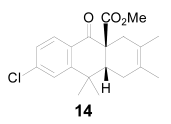
3.3.5. (4aS,9aR)-Methyl 7-Chloro-2,3,9,9-tetramethyl-10-oxo-1,4,4a,9,9a,10-hexahydroanthracene-4a-carboxylate (14)
87% yield; 1H NMR (CDCl3, 400 MHz): δ 8.00 (d, J = 8.4 Hz, 1H), 7.34 (d, J = 1.2 Hz, 1H), 7.27 (dd, J = 8.4, 1.2 Hz, 1H), 3.64 (s, 3H), 2.75 (m, 1H), 2.70 (d, J = 16.0 Hz, 1H), 2.47 (d, J = 16.0 Hz, 1H), 2.18 (dd, J = 18.0, 6.8 Hz, 1H), 1.72 (dd, J = 18.0, 8.4 Hz, 1H), 1.63 (s, 3H), 1.51 (s, 3H), 1.36 (s, 3H), 1.33 (s, 3H); 13C NMR (CDCl3, 100 MHz): δ 194.0, 174.5, 151.5, 140.5, 129.5, 128.6, 127.0, 126.9, 123.3, 123.1, 57.2, 52.6, 44.9, 37.8, 36.9, 32.4, 32.3, 28.2, 18.6, 18.4; HRMS [ESI]+ calculated for C20H23ClO3: 346.1330; found: 346.1327.
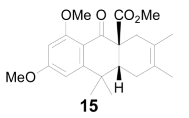
3.3.6. (4aS,9aR)-Methyl 5,7-Dimethoxy-2,3,9,9-tetramethyl-10-oxo-1,4,4a,9,9a,10-hexahydroanthracene-4a-carboxylate (15)
91% yield; 1H NMR (CDCl3, 400 MHz): δ 6.43 (d, J = 2.4 Hz, 1H), 6.34 (d, J = 2.4 Hz, 1H), 3.87 (s, 3H), 3.85 (s, 3H), 3.63 (s, 3H), 2.68 (dd, J = 8.4, 6.8 Hz, 1H), 2.66 (d, J = 16.4 Hz, 1H), 2.43 (d, J = 16.4 Hz, 1H), 2.12 (dd, J = 16.8, 6.8 Hz, 1H), 1.77 (m, 1H), 1.61 (s, 3H), 1.50 (s, 3H), 1.32 (s, 3H), 1.30 (s, 3H); 13C NMR (CDCl3, 100 MHz): δ 192.7, 175.1, 164.2, 162.7, 154.5, 123.6, 123.0, 144.1, 103.7, 96.3, 58.7, 56.0, 55.3, 52.4, 44.7, 38.4, 37.0, 33.1, 32.6, 28.8, 18.6, 18.4; HRMS [ESI]+ calculated for C22H28NaO5: 395.1834 [M+Na]+; found: 395.1835.
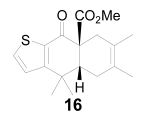
3.3.7. (4aR,8aS)-Methyl 4,4,6,7-Tetramethyl-9-oxo-4,4a,5,8,8a,9-hexahydronaphtho[2,3-b]thiophene-8a-carboxylate (16)
83% yield; 1H NMR (CDCl3, 400 MHz): δ 7.65 (d, J = 5.2 Hz, 1H), 7.03 (d, J = 5.2 Hz, 1H), 3.69 (s, 3H), 2.85 (dd, J = 6.8, 4.8 Hz, 1H), 2.59 (d, J = 17.2 Hz, 1H), 2.43 (d, J = 17.2 Hz, 1H), 2.11 (m, 1H), 1.93 (m, 1H), 1.62 (s, 3H), 1.58 (s, 3H), 1.36 (s, 3H), 1.21 (s, 3H); 13C NMR (CDCl3, 100 MHz): δ 189.8, 173.6, 158.7, 135.3, 133.3, 126.8, 123.6, 123.2, 58.8, 52.6, 44.9, 37.7, 35.6, 31.2, 31.0, 26.4, 18.8, 18.5; HRMS [ESI]+ calculated for C18H22O3S: 318.1284; found: 318.1285.
3.3.8. (4aS,9aR)-Methyl 2,9,9-Trimethyl-10-oxo-1,4,4a,9,9a,10-hexahydroanthracene-4a-carboxylate (17)
58% yield; 1H NMR (CDCl3, 400 MHz): δ 8.07 (d, J = 9.2 Hz, 1H), 7.55 (m, 1H), 7.40 (d, J = 8.0 Hz, 1H), 7.31 (m, 1H), 5.41 (m, 1H), 3.66 (s, 3H), 2.83 (m, 1H), 2.79 (m, 1H), 2.54 (d, J = 17.2 Hz, 1H), 2.17 (dd, J = 18.4, 6.8 Hz, 1H), 1.79 (dd, J = 18.4, 8.0 Hz, 1H), 1.58 (s, 3H), 1.38 (s, 3H), 1.37 (s, 3H); 13C NMR (CDCl3, 100 MHz): δ 195.3, 174.6, 149.8, 134.2, 132.0, 129.8, 127.8, 126.8, 126.5, 118.2, 56.6, 52.6, 44.4, 37.6, 32.5, 30.9, 30.6, 28.2, 23.3; HRMS [ESI]+ calculated for C19H22O3: 298.1563; found: 298.1564.
3.3.9. (4aS,9aR)-Methyl 7-Methoxy-2,9,9-trimethyl-10-oxo-1,4,4a,9,9a,10-hexahydroanthracene-4a-carboxylate (18)
56% yield; 1H NMR (CDCl3, 600 MHz): δ 8.06 (d, J = 9.6 Hz, 1H), 6.83–6.80 (m, 2H), 5.39 (m, 1H), 3.84 (s, 3H), 3.64 (s, 3H), 2.83–2.73 (m, 2H), 2.51 (d, J = 17.4 Hz, 1H), 2.14 (dd, J = 18.6, 6.0 Hz, 1H), 1.77 (dd, J = 18.6, 8.4 Hz, 1H), 1.56 (s, 3H), 1.34 (s, 6H); 13C NMR (CDCl3, 150 MHz): δ 194.0, 174.8, 164.4, 152.4, 130.6, 123.5, 119.2, 118.4, 112.1, 111.8, 56.3, 55.4, 52.5, 44.3, 37.9, 32.3, 31.0, 30.7, 28.1, 23.3; HRMS [ESI]+ calculated for C20H24NaO4: 351.1572 [M+Na]+; found: 351.1571.
3.3.10. (4aS,9aR)-Methyl 7-Chloro-2,9,9-trimethyl-10-oxo-1,4,4a,9,9a,10-hexahydroanthracene-4a-carboxylate (19)
59% yield; 1H NMR (CDCl3, 400 MHz): δ 7.92 (d, J = 8.0 Hz, 1H), 7.26 (d, J = 2.0 Hz, 1H), 7.19 (dd, J = 8.0, 2.0 Hz, 1H), 5.31 (m, 1H), 3.56 (s, 3H), 2.75–2.67 (m, 2H), 2.43 (d, J = 17.2 Hz, 1H), 2.08 (dd, J = 18.4, 6.8 Hz, 1H), 1.64 (dd, J = 18.4, 7.2 Hz, 1H), 1.48 (s, 3H), 1.29 (s, 3H), 1.26 (s, 3H); 13C NMR (CDCl3, 100 MHz): δ 194.1, 174.5, 151.5, 140.6, 131.9, 129.6, 128.4, 127.1, 127.0, 118.2, 56.4, 52.7, 44.6, 37.9, 32.3, 31.0, 30.7, 28.2, 23.2; HRMS [ESI]+ calculated for C19H21ClNaO3: 355.1077 [M+Na]+; found: 355.1077.
3.3.11. (4R,4aS,9aR)-Methyl 4,9,9-Trimethyl-10-oxo-1,4,4a,9,9a,10-hexahydroanthracene-4a-carboxylate (20)
85% yield; 1H NMR (CDCl3, 400 MHz): δ 7.99 (d, J = 8.4 Hz, 1H), 7.49 (m, 1H), 7.31–7.28 (m, 2H), 5.63 (m, 1H), 5.47 (m, 1H), 3.62 (s, 3H), 2.85 (m, 1H), 2.70 (dd, J = 10.8, 6.8 Hz, 1H), 2.40 (m, 1H), 1.77 (m, 1H), 1.40 (s, 3H), 1.36 (d, J = 7.6 Hz, 3H), 1.33 (s, 3H); 13C NMR (CDCl3, 100 MHz): δ 195.1, 174.6, 147.8, 133.6, 132.0, 130.8, 127.4, 126.5, 126.4, 123.7, 59.9, 52.1, 49.3, 39.5, 38.6, 32.6, 29.0, 27.9, 17.2; HRMS [ESI]+ calculated for C19H22O3: 298.1563; found: 298.1569.
3.3.12. (4R,4aS,9aR)-Methyl 7-Methoxy-4,9,9-trimethyl-10-oxo-1,4,4a,9,9a,10-hexahydroanthracene-4a-carboxylate (21)
87% yield; 1H NMR (CDCl3, 400 MHz): δ 8.01 (d, J = 8.4 Hz, 1H), 6.82 (dd, J = 8.4, 2.4 Hz, 1H), 6.74 (d, J = 2.4 Hz, 1H), 5.62 (m, 1H), 5.47 (m, 1H), 3.85 (s, 3H), 3.64 (s, 3H), 2.83 (m, 1H), 2.69 (dd, J = 10.8, 6.8 Hz, 1H), 2.39 (m, 1H), 1.78 (m, 1H), 1.39 (s, 3H), 1.37 (d, J = 7.6 Hz, 3H), 1.31 (s, 3H); 13C NMR (CDCl3, 100 MHz): δ 194.1, 174.8, 163.9, 150.5, 130.9, 130.1, 125.7, 123.9, 111.8, 111.6, 59.6, 55.3, 52.2, 49.3, 39.7, 38.9, 32.4, 28.9, 28.1, 17.4; HRMS [ESI]+ calculated for C20H24O4: 328.1669; found: 328.1672.
3.3.13. (4R,4aS,9aR)-Methyl 7-Chloro-4,9,9-trimethyl-10-oxo-1,4,4a,9,9a,10-hexahydroanthracene-4a-carboxylate (22)
99% yield; 1H NMR (CDCl3, 400 MHz): δ 7.94 (d, J = 6.8 Hz, 1H), 7.28–7.25 (m, 2H), 5.62 (m, 1H), 5.47 (m, 1H), 3.64 (s, 3H), 2.85 (m, 1H), 2.70 (dd, J = 10.8, 6.8 Hz, 1H), 2.41 (m, 1H), 1.73 (m, 1H), 1.40 (s, 3H), 1.35 (d, J = 7.6 Hz, 3H), 1.32 (s, 3H); 13C NMR (CDCl3, 100 MHz): δ 194.1, 174.4, 149.7, 139.9, 130.8, 130.5, 129.1, 127.1, 126.6, 123.5, 59.8, 52.3, 49.1, 39.5, 38.8, 32.4, 28.9, 27.9, 17.1; HRMS [ESI]+ calculated for C19H21ClO3: 332.1174; found: 332.1176.
3.3.14. (5aS,11aR)-Methyl 11,11-Dimethyl-6-oxo-1,4,5,5a,6,11,11a,12-octahydrotetracene-5a-carboxylate (23)
94% yield; 1H NMR (CDCl3, 400 MHz): δ 8.07 (d, J = 8.0 Hz, 1H), 7.55 (m, 1H), 7.39 (d, J = 6.8 Hz, 1H), 7.30 (m, 1H), 5.69–5.61 (m, 2H), 3.65 (s, 3H), 2.85 (m, 1H), 2.68–2.59 (m, 3H), 2.49–2.42 (m, 3H), 2.13 (dd, J = 18.0, 6.8 Hz, 1H), 1.75 (dd, J = 18.0, 8.4 Hz, 1H), 1.38 (s, 3H), 1.36 (s, 3H); 13C NMR (CDCl3, 100 MHz): δ 194.9, 174.5, 149.7, 134.2, 129.9, 127.7, 126.8, 126.5, 124.2, 124.0, 123.4, 123.2, 57.2, 52.5, 44.6, 37.6, 35.0, 32.5, 30.9, 30.6, 30.4, 28.3; HRMS [ESI]+ calculated for C22H24O3: 336.1720; found: 336.1720.
3.3.15. (5aS,11aR)-Methyl 9-Methoxy-11,11-dimethyl-6-oxo-1,4,5,5a,6,11,11a,12-octahydrotetracene-5a-carboxylate (24)
71% yield; 1H NMR (CDCl3, 400 MHz): δ 8.07 (d, J = 6.4 Hz, 1H), 6.84–6.81 (m, 2H), 5.68–5.60 (m, 2H), 3.86 (s, 3H), 3.65 (s, 3H), 2.84 (m, 1H), 2.65 (d, J = 15.6 Hz, 1H), 2.56 (m, 2H), 2.46–2.42 (m, 3H), 2.12 (dd, J = 18.0, 6.8 Hz, 1H), 1.74 (dd, J = 18.0, 8.0 Hz, 1H), 1.36 (s, 3H), 1.35 (s, 3H); 13C NMR (CDCl3, 100 MHz): δ 193.6, 174.7, 164.4, 152.4, 130.6, 124.3, 124.0, 123.7, 123.4, 123.3, 112.0, 111.8, 57.0, 55.4, 52.5, 44.6, 37.9, 35.2, 32.4, 30.9, 30.6, 30.6, 28.2; HRMS [ESI]+ calculated for C23H26O4: 366.1826; found: 366.1822.
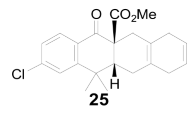
3.3.16. (5aS,11aR)-Methyl 9-Chloro-11,11-dimethyl-6-oxo-1,4,5,5a,6,11,11a,12-octahydrotetracene-5a-carboxylate (25)
76% yield; 1H NMR (CDCl3, 400 MHz): δ 8.01 (d, J = 8.4 Hz, 1H), 7.35 (d, J = 2.0 Hz, 1H), 7.28 (dd, J = 8.4, 2.0 Hz, 1H), 5.69–5.60 (m, 2H), 3.65 (s, 3H), 2.83 (dd, J = 8.8, 6.8 Hz, 1H), 2.68 (d, J = 16.0 Hz, 1H), 2.58–2.52 (m, 2H), 2.47–2.39 (m, 3H), 2.13 (dd, J = 18.0, 6.8 Hz, 1H), 1.69 (dd, J = 18.0, 8.8 Hz, 1H), 1.38 (s, 3H), 1.35 (s, 3H); 13C NMR (CDCl3, 100 MHz): δ 193.8, 174.4, 151.4, 140.6, 129.6, 128.6, 127.1, 127.0, 124.2, 124.0, 123.2, 123.2, 57.1, 52.6, 44.8, 37.9, 35.1, 32.3, 30.8, 30.6, 30.5, 28.3; HRMS [ESI]+ calculated for C22H23ClO3: 370.1330; found: 370.1335.
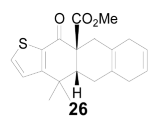
3.3.17. (4aR,10aS)-Methyl 4,4-Dimethyl-11-oxo-4,4a,5,6,9,10,10a,11-octahydroanthra[2,3-b]thiophene-10a-carboxylate (26)
99% yield; 1H NMR (CDCl3, 400 MHz): δ 7.66 (d, J = 5.2 Hz, 1H), 7.05 (d, J = 5.2 Hz, 1H), 5.69–5.63 (m, 2H), 3.71 (s, 3H), 2.93 (dd, J = 6.8, 4.8 Hz, 1H), 2.58–2.39 (m, 6H), 2.10 (m, 1H), 1.87 (m, 1H), 1.38 (s, 3H), 1.24 (s, 3H); 13C NMR (CDCl3, 100 MHz): δ 189.6, 173.5, 158.7, 135.4, 133.3, 126.9, 124.3, 124.0, 123.6, 123.3, 58.7, 52.7, 44.8, 37.8, 33.9, 31.0, 31.0, 30.7, 29.4, 26.5; HRMS [ESI]+ calculated for C20H22O3S: 342.1284; found: 342.1285.
3.3.18. (4aS,9aR)-Methyl 9,9-Dimethyl-2,10-dioxo-1,2,4a,9,9a,10-hexahydroanthracene-4a-carboxylate (27)
63% yield; 1H NMR (CDCl3, 400 MHz): δ 8.06 (d, J = 10.4 Hz, 1H), 7.64 (m, 1H), 7.44–7.40 (m, 2H), 7.14 (d, J = 13.6 Hz, 1H), 6.23 (d, J = 13.6 Hz, 1H), 3.76 (s, 3H), 3.23 (dd, J = 12.4, 6.8 Hz, 1H), 2.71 (dd, J = 22.8, 6.8 Hz, 1H), 2.44 (dd, J = 22.8, 12.4 Hz, 1H), 1.43 (s, 3H), 1.30 (s, 3H); 13C NMR (CDCl3, 100 MHz): δ 197.0, 192.6, 171.5, 150.0, 148.0, 135.2, 130.2, 129.8, 128.5, 127.1, 125.6, 59.1, 53.7, 47.4, 37.3, 37.3, 29.8, 28.9; HRMS [ESI]+ calculated for C18H18NaO4: 321.1103 [M+Na]+; found: 321.1103.
3.3.19. (4aR,8aS)-Methyl 4,4-Dimethyl-6,9-dioxo-4,4a,5,6,8a,9-hexahydronaphtho[2,3-b]thiophene-8a-carboxylate (28)
72% yield; 1H NMR (CDCl3, 400 MHz): δ 7.77 (d, J = 5.2 Hz, 1H), 7.07 (d, J = 5.2 Hz, 1H), 7.02 (d, J = 10.0 Hz, 1H), 6.25 (d, J = 10.0 Hz, 1H), 3.79 (s, 3H), 3.27 (m, 1H), 2.67–2.53 (m, 2H), 1.43 (s, 3H), 1.26 (s, 3H); 13C NMR (CDCl3, 100 MHz): δ 196.8, 185.6, 171.5, 159.9, 146.9, 137.3, 133.7, 130.6, 126.6, 60.1, 53.7, 48.6, 37.8, 37.2, 29.3, 27.7; HRMS [ESI]+ calculated for C16H16NaO4S: 327.0667 [M+Na]+; found: 327.0665.
3.3.20. (2R,4aS,9aS)-2,3,9,9-Tetramethyl -2,3,9,9a-tetrahydro-1H-2,4a-methanoanthracene-4,10-dione (29)
80% yield; 1H NMR (CDCl3, 400 MHz): δ 7.95 (d, J = 7.6 Hz, 1H), 7.51 (m, 1H), 7.37–7.30 (m, 2H), 2.18–2.05 (m, 4H), 1.93 (m, 1H), 1.59 (m, 1H), 1.35 (s, 3H), 1.27 (s, 3H), 1.11 (s, 3H), 1.06 (d, J = 7.6 Hz, 3H); 13C NMR (CDCl3, 100 MHz): δ 213.6, 198.2, 151.9, 133.8, 133.7, 127.6, 126.8, 123.7, 68.9, 53.1, 46.2, 46.1, 44.6, 37.4, 32.6, 28.2, 24.9, 19.4, 9.9; HRMS [ESI]+ calculated for C19H22NaO2: 305.1517 [M+Na]+; found: 305.1521.
4. Conclusions
In this work, we have demonstrated that a newly synthetic method through Diels–Alder addition to afford highly stereoselective and functionalized adducts has been developed, by which a library of potential natural and/or non-natural antibiotics, containing a 4,4-dimethyl-1-tetralone unit, can be rapidly built up for screening initial hit compounds for further peripherally structural modifications in the hope that advanced compounds with potent antimicrobial activities, particularly against Gram-positive pathogens, can be discovered.
Supplementary Materials
The following supporting information can be downloaded at: https://www.mdpi.com/article/10.3390/molecules28062739/s1, Copies of 1H and 13C NMR spectra of the synthetic products 3, 5, 6, 8 and 10–29 as well as copies of the X-ray crystallographic structure of synthetic products 17, 20–22, and 29 are available online. Table S1: Screening of Diels-Alder cycloaddition conditions.
Author Contributions
C.-J.L., M.R., H.-H.K. and C.-C.L. synthesized all dienophiles and the corresponding Diels–Alder adducts. C.-H.W. double-checked and corrected all spectral data. K.-S.S. provided scientific input and wrote the manuscript. J.-C.L. and K.-S.S. are the responsible researchers, who provided the final version of the manuscript. All authors have read and agreed to the published version of the manuscript.
Funding
This research was supported by the Ministry of Science and Technology, Taiwan (MOST 108-2113-M-400-005; MOST 109-2113-M-400-006; MOST 109-2622-B-400-001; MOST 110-2113-M-400-001) and National Hearth Research Institutes, Taiwan.
Institutional Review Board Statement
Not applicable.
Informed Consent Statement
Not applicable.
Data Availability Statement
The data present in this study are available on request from the corresponding authors.
Conflicts of Interest
The authors declare no conflict of interest.
References and Notes
- Ueki, M.; Koshiro, N.; Aono, H.; Kawatani, M.; Uramoto, M.; Kawasaki, H.; Osada, H. Isolation of New Polyketide Metabolites, Linearolides A and B from Streptomyces sp. RK95-74. J. Antibiot. 2013, 66, 333–337. [Google Scholar] [CrossRef] [PubMed]
- Wang, Z.; Yang, G.-X.; Liu, C.; Wang, L.; Qi, Y.; Cao, M.; Guo, X.; Li, J.; Huang, X.; Zang, J.; et al. Isolation and Biosynthesis of Phenazine-Polyketide Hybrids from Streptomyces sp. KIB-H483. J. Nat. Prod. 2022, 85, 1324–1331. [Google Scholar] [CrossRef] [PubMed]
- Almalki, M.A. Isolation and Characterization of Polyketide Drug Molecule from Streptomyces Species with Antimicrobial Activity Against Clinical Pathogens. J. Infect. Public Health 2020, 13, 125–130. [Google Scholar] [CrossRef] [PubMed]
- Huang, J.-K.; Lauderdale, T.-L.Y.; Shia, K.-S. Studies on Antibiotics Active Against Resistant Bacteria. Total Synthesis of MRSA-Active Tetarimycin A and its Analogues. Org. Lett. 2015, 17, 4248–4251. [Google Scholar] [CrossRef]
- Huang, J.-K.; Lauderdale, T.-L.Y.; Shia, K.-S. Total Synthesis of Tetarimycin A, (±)-Napthacemycin A9, and (±)-Fasamyc.in A: Structure-Activity Relationship Studies Against Drug-Resistant Bacteria. J. Org. Chem. 2018, 83, 6508–6523. [Google Scholar] [CrossRef]
- Huang, J.-K.; Shia, K.-S. Development of a Cross-Conjugated Vinylogous [4 + 2] Anionic Annulation and Application to the Total Synthesis of Natural Antibiotics (±)-ABX. Angew. Chem. Int. Ed. 2020, 59, 6540–6545. [Google Scholar] [CrossRef]
- Qin, Z.; Munnoch, J.T.; Devine, R.; Holmes, N.A.; Seipke, R.F.; Wilkinson, K.A.; Wilkinson, B.; Hutchings, M.I. Formicamycins, Antibacterial Polyketides Produced by Streptomyces Formicae Isolated from African Tetraponera Plant-Ants. Chem. Sci. 2017, 8, 3218. [Google Scholar] [CrossRef]
- Fukumoto, A.; Kim, Y.-P.; Iwatsuki, M.; Hirose, T.; Sunazuka, T.; Hanaki, H.; Ōmura, S.; Shiomi, K. Naphthacemycins, Novel Circumventors of β-Lactam Resistance in MRSA, Produced by Streptomyces sp. KB-3346-5. II. Structure Elucidation. J. Antibiot. 2017, 70, 568–573. [Google Scholar] [CrossRef]
- Kallitidas, D.; Kang, H.-S.; Brady, S.F. Tetarimycin A, an MRSA-Active Antibiotic Identified Through Induced Expression of Environmental DNA Gene Clusters. J. Am. Chem. Soc. 2012, 134, 19552–19555. [Google Scholar] [CrossRef]
- Kim, H.; Lantvit, D.; Hwang, C.H.; Kroll, D.J.; Swanson, S.M.; Franzblau, S.G.; Orjala, J. Indole Alkaloids from Two Cultured Cyanobacteria, Westiellopsis sp. and Fischerella Muscicola. Bioorg. Med. Chem. 2012, 20, 5290–5295. [Google Scholar] [CrossRef]
- Zhang, Y.; Yin, Z.; Wu, X.-F. Iron-Catalyzed Synthesis of Dihydronaphthalenones from Aromatic Oxime Esters. Adv. Synth. Catal. 2019, 361, 3223–3227. [Google Scholar] [CrossRef]
- Wu, Y.-K.; Ly, T.W.; Shia, K.-S. α-Activated Cross Conjugated Cycloalkenone Systems in Organic Synthesis. In Advances in Organic Synthesis; Atta-ur-Rahman, Ed.; Bentham Science Publishers: Hilversum, The Netherlands, 2012; Volume 5, pp. 216–259. [Google Scholar]
- Fringuelli, F.; Taticchi, A.; Wenkert, E. Diels-Alder Reactions of Cycloalkenones in Organic Synthesis. Org. Prep. Proc. Int. 1990, 22, 133–165. [Google Scholar] [CrossRef]
- Liu, H.J.; Browne, E.N.C. 2-Carbomethoxy-4,4-dimethyl-2,5-cyclohexadien-1-one as a Dienophile. A Convenient Approach to the 4,4-Dimethyl-1-decalone System. Tetrahedron Lett. 1977, 18, 2919–2922. [Google Scholar] [CrossRef]
- Liu, H.J.; Browne, E.N.C. Diels–Alder Reactions of 4,4-Dimethyl-2-cyclohexenones. A Direct Route to the 4,4-Dimethyl-1-decalones. Can. J. Chem. 1987, 65, 1262–1278. [Google Scholar] [CrossRef]
- Fringuelli, F.; Pizzo, F.; Taticchi, A.; Halls, T.D.J.; Wenkert, E. Diels-Alder Reactions of Cycloalkenones. 1. Preparation and Structure of the Adducts. J. Org. Chem. 1982, 47, 5056–5065. [Google Scholar] [CrossRef]
- Fringuelli, F.; Minuti, L.; Pizzo, F.; Taticchi, A.; Halls, T.D.J.; Wenkert, E. Diels-Alder Reactions of Cycloalkenones. 2. Preparation and Structure of Cyclohexadienone Adducts. J. Org. Chem. 1983, 48, 1810–1813. [Google Scholar] [CrossRef]
- Liu, H.J.; Ngooi, T.K.; Browne, E.N.C. Diels–Alder Reactions of 2-Carbomethoxy-2-cyclohexen-1-one. Can. J. Chem. 1988, 66, 3143–3152. [Google Scholar] [CrossRef]
- Liotta, D.; Saindane, M.; Barnum, C. Diels-Alder Reactions Involving Cross-Conjugated Dienones. Effects of Substitution on Reactivity. J. Am. Chem. Soc. 1981, 103, 3224–3226. [Google Scholar] [CrossRef]
- Liu, H.J.; Han, Y. Facial Selectivity in Diels-Alder Reaction of 4,4-Disubstituted 2,5-Cyclohexadienones. Tetrahedron Lett. 1993, 34, 423–426. [Google Scholar]
- Crystallographic Data for CCDC 1838083 (d19262) also lend support to the structural elucidation of the Diels-Alder product (17): C19H22O3, Mw = 298.37, cell, a = 8.6866(11) Å, b = 9.0657(12) Å, c = 10.9733(14) Å, α = 77.551(4) Å, β = 75.651(4) Å, γ = 68.105(4) Å, V = 769.48(17) Å, space group P -1, Z = 2, Nref 2742 were independent; for the observed data, wR2 = 0.1070(2721), R = 0.0417(2113).
- Crystallographic Data for CCDC 1838080 (d18814) (20): C19H22O3, Mw = 298.37, cell, a = 8.2078(3) Å, b = 9.5084(4) Å, c = 11.3548(5) Å, α = 68.335(1) Å, β = 77.530(1) Å, γ = 69.151(1) Å, V = 765.98(5) Å, space group P -1, Z = 2, Nref 2710 were independent; for the observed data, wR2 = 0.1055(2683), R = 0.0379(2365).
- Crystallographic Data for CCDC 1838081 (d18985) (21): C20H24O4, Mw = 328.39, cell, a = 8.5236(4) Å, b = 9.9115(5) Å, c = 10.9382(5) Å, α = 65.938(1) Å, β = 81.411(1) Å, γ = 83.286(1) Å, V = 832.71(7) Å, space group P -1, Z = 2, Nref 2971 were independent; for the observed data, wR2 = 0.0867(2896), R = 0.0349(2582).
- Crystallographic Data for CCDC 1838082 (d18986) (22): C19H21ClO3, Mw = 332.81, cell, a = 8.2565(4) Å, b = 9.8020(6) Å, c = 11.5948(7) Å, α = 65.106(2) Å, β = 78.505(2) Å, γ = 75.694(2) Å, V = 819.93(8) Å, space group P -1, Z = 2, Nref 2971 were independent; for the observed data, wR2 = 0.0795(2873), R = 0.0308(2577).
- Huang, J.-K.; Shia, K.-S. Anionic Diels−Alder Chemistry of Cyclic Sodium Dien-1-olates Delivering Highly Stereoselective and Functionalized Polycyclic Adducts. Org. Lett. 2021, 23, 5709–5713. [Google Scholar] [CrossRef]
- Crystallographic Data for CCDC 2204212 (d22314) (29): C19H22O2, Mw = 282.37, cell, a = 11.8648(5) Å, b = 10.5302(5) Å, c = 12.4692(6) Å, α = 90 Å, β = 94.065(1) Å, γ = 90 Å, V = 832.71(7) Å, space group P 21/n, Z = 4, Nref 2752 were independent; for the observed data, wR2 = 0.1184(2739), R = 0.0427(2222).
- Liang, D.; Zou, Y.; Wang, Q.; Goeke, A. Sequential Diels-Alder Reaction/Rearrangement Sequence: Synthesis of Functionalized Bicyclo[2.2.1]heptane Derivatives and Revision of Their Relative Configuration. J. Org. Chem. 2014, 79, 6726–6731. [Google Scholar] [CrossRef] [PubMed]
Disclaimer/Publisher’s Note: The statements, opinions and data contained in all publications are solely those of the individual author(s) and contributor(s) and not of MDPI and/or the editor(s). MDPI and/or the editor(s) disclaim responsibility for any injury to people or property resulting from any ideas, methods, instructions or products referred to in the content. |
© 2023 by the authors. Licensee MDPI, Basel, Switzerland. This article is an open access article distributed under the terms and conditions of the Creative Commons Attribution (CC BY) license (https://creativecommons.org/licenses/by/4.0/).