

Development of Volatile Compounds during Hydrolysis of Porcine Hemoglobin with Papain

 , ,
, , 
Abstract
1. Introduction
2. Results and Discussion
3. Materials and Methods
3.1. Enzymatic Hydrolysis
3.2. Volatile Compound Analysis
3.2.1. Dynamic Headspace Sampling
3.2.2. Gas Chromatography-Mass Spectrometry
3.3. Data Analysis
3.3.1. GC-MS
3.3.2. Yield
4. Conclusions
Acknowledgments
Author Contributions
Conflicts of Interest
References
- Wismer-Pedersen, J. Use of haemoglobin in foods—A review. Meat Sci. 1988, 24, 31–45. [Google Scholar] [CrossRef] [Scilit]
- Ur Rahman, U.; Sahar, A.; Khan, M.A. Recovery and utilization of effluents from meat processing industries. Food Res Int. 2014, 65(Part C), 322–328. [Google Scholar] [CrossRef] [Scilit]
- Roy, M.; Karmakar, S.; Debsarcar, A.; Sen, P.K.; Mukherjee, J. Application of rural slaughterhouse waste as an organic fertilizer for pot cultivation of solanaceous vegetables in India. Int. J. Recycl. Org. Waste Agric. 2013, 2, 6. [Google Scholar] [CrossRef] [Scilit]
- Alao, B.; Falowo, A.; Chulayo, A.; Muchenje, V. The Potential of Animal By-Products in Food Systems: Production, Prospects and Challenges. Sustainability 2017, 9, 1089. [Google Scholar] [CrossRef] [Scilit]
- Bah, C.S.F.; Bekhit, A.E.-D.A.; Carne, A.; McConnell, M.A. Slaughterhouse Blood: An Emerging Source of Bioactive Compounds. Compr. Rev. Food Sci. Food Saf. 2013, 12, 314–331. [Google Scholar] [CrossRef] [Scilit]
- Ofori, J.A.; Hsieh, Y.-H.P. The use of blood and derived products as food additives. In Food Additive; El-Samragy, Y., Ed.; InTech: Rijeka, Croatia, 2012; pp. 229–256. [Google Scholar]
- Piot, J.M.; Guillochon, D.; Thomas, D. Preparation of decolorized peptides from slaughter-house blood. MIRCEN J. Appl. Microbiol. Biotechnol. 1986, 2, 359–364. [Google Scholar] [CrossRef] [Scilit]
- Duarte, R.T.; Carvalho Simões, M.C.; Sgarbieri, V.C. Bovine Blood Components: Fractionation, Composition, and Nutritive Value. J. Agric. Food Chem. 1999, 47, 231–236. [Google Scholar] [CrossRef] [Scilit] [PubMed]
- Igene, J.O.; King, J.A.; Pearson, A.M.; Gray, J.I. Influence of heme pigments, nitrite, and non-heme iron on development of warmed-over flavor (WOF) in cooked meat. J. Agric. Food Chem. 1979, 27, 838–842. [Google Scholar] [CrossRef] [Scilit]
- Landmann, W.A.; Dill, C.W.; Young, C.R. Nutritive Value of Globin-Amino Acid and Complementary Globin-Cereal Mixtures. J. Nutr. 1980, 110, 2254–2262. [Google Scholar] [CrossRef] [Scilit] [PubMed]
- Lafarga, T.; Hayes, M. Bioactive peptides from meat muscle and by-products: Generation, functionality and application as functional ingredients. Meat Sci. 2014, 98, 227–239. [Google Scholar] [CrossRef] [Scilit] [PubMed]
- Mora, L.; Reig, M.; Toldrá, F. Bioactive peptides generated from meat industry by-products. Food Res. Int. 2014, 65(Part C), 344–349. [Google Scholar] [CrossRef] [Scilit]
- Li-Chan, E.C.Y. Bioactive peptides and protein hydrolysates: Research trends and challenges for application as nutraceuticals and functional food ingredients. Curr. Opin. Food Sci. 2015, 1, 28–37. [Google Scholar] [CrossRef] [Scilit]
- Clemente, A. Enzymatic protein hydrolysates in human nutrition. Trends Food Sci. Technol. 2000, 11, 254–262. [Google Scholar] [CrossRef] [Scilit]
- Sun, Q.; Shen, H.; Luo, Y. Antioxidant activity of hydrolysates and peptide fractions derived from porcine hemoglobin. J. Food Sci. Technol. 2011, 48, 53–60. [Google Scholar] [CrossRef] [Scilit] [PubMed]
- Ofori, J.A.; Hsieh, Y.-H.P. Issues Related to the Use of Blood in Food and Animal Feed. Crit. Rev. Food Sci. Nutr. 2014, 54, 687–697. [Google Scholar] [CrossRef] [Scilit] [PubMed]
- Leksrisompong, P.P.; Miracle, R.E.; Drake, M. Characterization of Flavor of Whey Protein Hydrolysates. J Agric. Food Chem. 2010, 58, 6318–6327. [Google Scholar] [CrossRef] [Scilit] [PubMed]
- Guo, X.; Tian, S.; Small, D.M. Generation of meat-like flavourings from enzymatic hydrolysates of proteins from Brassica sp. Food Chem. 2010, 119, 167–172. [Google Scholar] [CrossRef] [Scilit]
- Jarunrattanasri, A.; Theerakulkait, C.; Cadwallader, K.R. Aroma Components of Acid-Hydrolyzed Vegetable Protein Made by Partial Hydrolysis of Rice Bran Protein. J. Agric. Food. Chem. 2007, 55, 3044–3050. [Google Scholar] [CrossRef] [Scilit] [PubMed]
- Guichard, E. Interactions between flavor compounds and food ingredients and their influence on flavor perception. Food Rev. Int. 2002, 18, 49–70. [Google Scholar] [CrossRef] [Scilit]
- The Good Scents Company Information System. Available online: http://www.thegoodscentscompany.com/ (accessed on 8 January 2017).
- Cui, H.; Jia, C.; Hayat, K.; Yu, J.; Deng, S.; Karangwa, E.; Duhoranimana, E.; Xia, S.; Zhang, X. Controlled formation of flavor compounds by preparation and application of Maillard reaction intermediate (MRI) derived from xylose and phenylalanine. RSC Adv. 2017, 7, 45442–45451. [Google Scholar] [CrossRef] [Scilit]
- Varlet, V.; Prost, C.; Serot, T. Volatile aldehydes in smoked fish: Analysis methods, occurence and mechanisms of formation. Food Chem. 2007, 105, 1536–1556. [Google Scholar] [CrossRef] [Scilit]
- Hidalgo, F.J.; Zamora, R. Strecker-type Degradation Produced by the Lipid Oxidation Products 4,5-Epoxy-2-Alkenals. J. Agric. Food Chem. 2004, 52, 7126–7131. [Google Scholar] [CrossRef] [Scilit] [PubMed]
- Estévez, M.; Ventanas, S.; Heinonen, M. Formation of Strecker aldehydes between protein carbonyls—α-Aminoadipic and γ-glutamic semialdehydes—and leucine and isoleucine. Food Chem. 2011, 128, 1051–1057. [Google Scholar] [CrossRef] [Scilit]
- Ott, A.; Germond, J.-E.; Baumgartner, M.; Chaintreau, A. Aroma Comparisons of Traditional and Mild Yogurts: Headspace Gas Chromatography Quantification of Volatiles and Origin of α-Diketones. J. Agric. Food Chem. 1999, 47, 2379–2385. [Google Scholar] [CrossRef] [Scilit] [PubMed]
- Meinert, L.; Broge, E.H.; Bejerholm, C.; Jensen, K. Application of hydrolyzed proteins of animal origin in processed meat. Food Sci. Nutr. 2016, 4, 290–297. [Google Scholar] [CrossRef] [Scilit] [PubMed]
- Johnsen, L.G.; Skou, P.B.; Khakimov, B.; Bro, R. Gas chromatography–mass spectrometry data processing made easy. J. Chromatogr. A 2017, 1503, 57. [Google Scholar] [CrossRef] [Scilit] [PubMed]
Sample Availability: Samples of the compounds are not available from the authors. |

| Time (h) | Yield (%) | SD (%) |
|---|---|---|
| 0 | 59.8 | ±0.2 |
| 1 | 65.1 | ±0.2 |
| 3 | 64.9 | ±6.1 |
| 5 | 73.7 | ±1.2 |
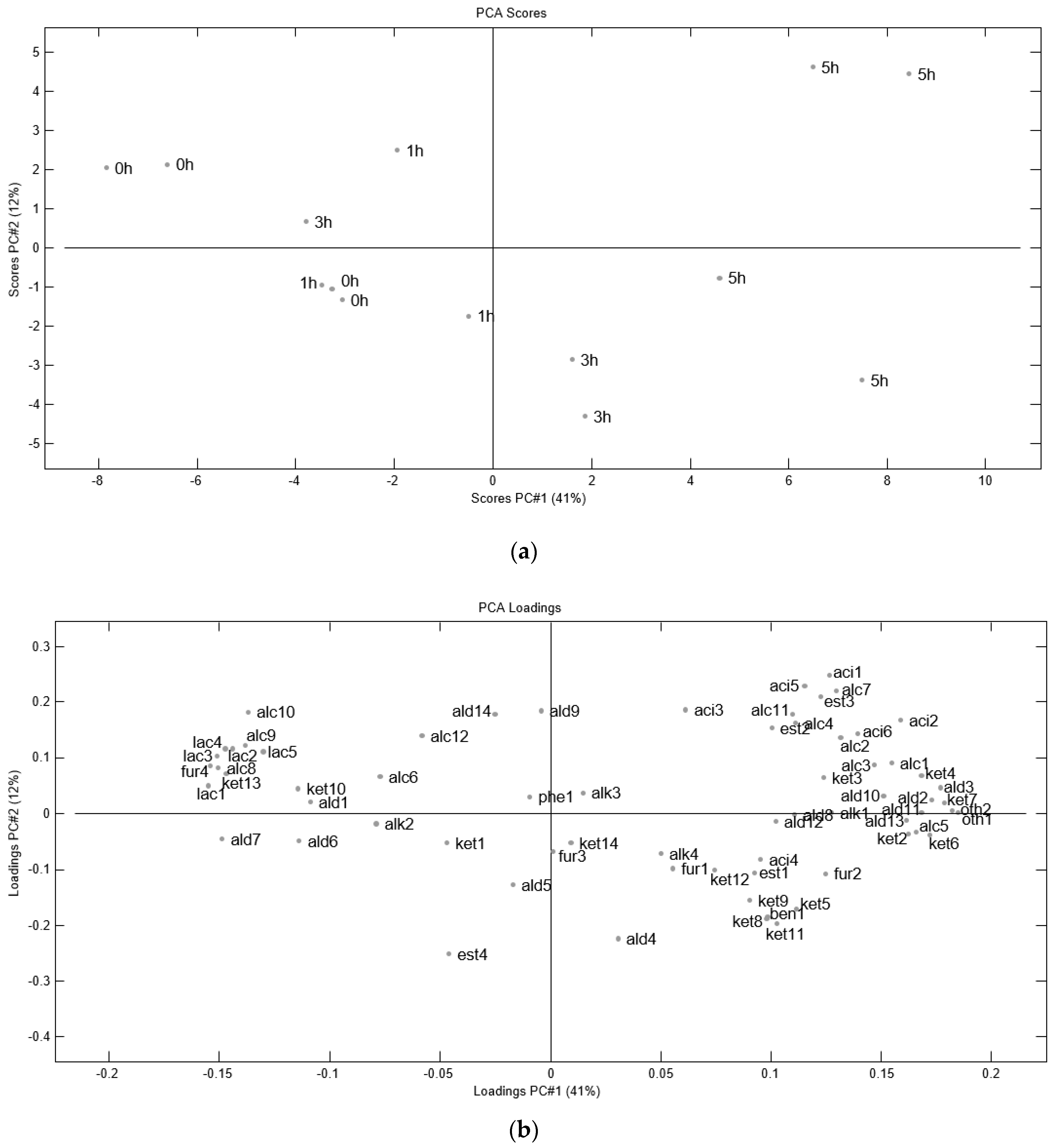
| Code 1 | Compound | 0 h 2 | 1 h | 3 h | 5 h | Retention Index | ||
|---|---|---|---|---|---|---|---|---|
| Exp. | Auth. Std. | Literature | ||||||
| alc1 | 2-Methyl-1-propanol | 33 | 34 | 41 | 53 | 1100 | 1100 | |
| alc2 | Butanol | 12 | 13 | 15 | 28 | 1165 | 1165 | |
| alc3 | 2-Methylbutanol | 34 | 53 | 68 | 147 | 1231 | 1158–1244 | |
| alc4 | 3-Methylbutanol | 138 | 128 | 116 | 463 | 1232 | 1230 | |
| alc5 | 3-Methyl-3-buten-1-ol | 39 c | 47 b | 44 b, c | 52 a | 1268 | 1221–1277 | |
| alc6 | 1-Pentanol | 37 | 40 | 40 | 33 | 1274 | 1274 | |
| alc7 | 1-Hexanol | 28 b | 9 b | 30 b | 295 a | 1372 | 1372 | |
| alc8 | 1-Heptanol | 55 | 43 | 39 | 17 | 1471 | 1471 | |
| alc9 | 1-Octanol | 63 | 54 | 46 | 32 | 1573 | 1573 | |
| alc10 | Z-10-Pentadecen-1-ol | 33 | 31 | 11 | 15 | 1676 | ||
| alc11 | Phenylethyl alcohol | 1 | 1 | 6 | 190 | 1936 | 1936 | |
| alc12 | Dodecanol | 25 | 36 | 1 | 15 | 1992 | 1919–1984 | |
| ald1 | 2-Methylpropanal | 296 a | 226 b | 324 a | 206 b | 749 | 770–834 | |
| ald2 | 2-Methylbutanal | 192 c | 242 b | 260 b | 353 a | 907 | 913 | |
| ald3 | 3-Methylbutanal | 914 d | 1406 c | 2029 b | 4109 a | 917 | 917 | |
| ald4 | Pentanal | 133 b | 197 a | 184 a | 153 ab | 983 | 983 | |
| ald5 | Hexanal | 791 b | 1427 a | 1508 a | 844 b | 1083 | 1088 | |
| ald6 | Heptanal | 125 | 139 | 138 | 87 | 1192 | 1192 | |
| ald7 | Octanal | 209 a | 234a | 191 a | 107 b | 1303 | 1311 | |
| ald8 | Nonanal | 265 b | 337ab | 453 a | 440 a | 1406 | 1403 | |
| ald9 | (E)-2-Octenal | 11 | 15 | 18 | 14 | 1441 | 1393–1467 | |
| ald10 | Decanal | 59 b | 55 b | 83 b | 160 a | 1510 | 1511 | |
| ald11 | Benzaldehyde | 21,821 d | 38,502 c | 46,420 b | 53,809 a | 1530 | 1539 | |
| ald12 | (E)-2-Nonenal | 15c | 21 b, c | 32 a | 27 ab | 1549 | 1551 | |
| ald13 | Benzeneacetaldehyde | 27c | 51 c | 112 b | 222 a | 1650 | 1592–1684 | |
| ald14 | (E)-2-Decenal | 22 | 26 | 22 | 22 | 1660 | 1592–1682 | |
| est1 | Ethyl acetate | 74 | 49 | 86 | 102 | 864 | 850–914 | |
| est2 | Hexyl acetate | 0 | 1 | 2 | 223 | 1288 | 1293 | |
| est3 | Ethyl octanoate | 1 | 1 | 1 | 52 | 1446 | 1445 | |
| est4 | Ethyl decanoate | 3 | 3 | 3 | 2 | 1651 | 1651 | |
| fur1 | 2-Pentylfuran | 51 d | 111 b | 137 a | 89c | 1243 | 1193–1258 | |
| fur2 | 1-(2,4-Dimethyl-furan-3-yl)-ethanone | 17 | 25 | 109 | 137 | 1586 | ||
| fur3 | 2-Furanmethanol | 2 | 17 | 2 | 3 | 1671 | 1613–1698 | |
| fur4 | 5-Ethyldihydro-2(3H)-furanone | 83 | 65 | 59 | 2 | 1719 | ||
| ket1 | 2-Butanone | 979 | 981 | 1051 | 923 | 887 | 906 | |
| ket2 | 3-Methyl-2-butanone | 985c | 1746 b | 1803 b | 2122 a | 929 | 918–989 | |
| ket3 | 3,3-dimethyl-2-butanone | 88 | 95 | 94 | 105 | 948 | 969–986 | |
| ket4 | 2,3-Butanedione | 1665 c | 2079 b, c | 2404 b | 3166 a | 985 | 985 | |
| ket5 | 4-Methyl-2-pentanone | 25 | 37 | 60 | 73 | 1006 | 993–1040 | |
| ket6 | 3-Methyl-2-pentanone | 512 c | 731 b | 751 b | 889 a | 1014 | 1001 | |
| ket7 | 2,3-Pentanedione | 85 c | 120 b | 122 b | 168 a | 1073 | 1073 | |
| ket8 | 4-Methyl-3-penten-2-one | 29 | 53 | 155 | 196 | 1133 | 1110–1159 | |
| ket9 | 2,4-Pentanedione | 7 | 18 | 20 | 54 | 1162 | 1167–1230 | |
| ket10 | 2-Heptanone | 45 | 43 | 46 | 32 | 1198 | 1190 | |
| ket11 | 4-Methyl-2-heptanone | 21 | 32 | 38 | 40 | 1219 | 1206–1224 | |
| ket12 | 6-Methyl-5-hepten-2-one | 9 | 12 | 44 | 26 | 1350 | 1296–1368 | |
| ket13 | 2-Nonanone | 45 | 34 | 29 | 8 | 1402 | 1382 | |
| ket14 | Acetophenone | 142 | 138 | 109 | 133 | 1663 | 1600–1695 | |
| lac1 | Butyrolactone | 50 | 52 | 43 | 0 | 1641 | 1593–1673 | |
| lac2 | delta-Hexalactone | 14 | 11 | 9 | 4 | 1816 | 1751–1830 | |
| lac3 | gamma-Heptalactone | 118 | 83 | 80 | 5 | 1825 | 1755–1817 | |
| lac4 | gamma-Nonalactone | 140 | 102 | 71 | 2 | 2063 | 1981–2068 | |
| lac5 | gamma-Decalactone | 36 | 23 | 13 | 1 | 2176 | 2090–2185 | |
| aci1 | Acetic acid | 19 | 67 | 17 | 272 | 1459 | 1401–1485 | |
| aci2 | 3-Methylbutanoic acid | 13 b | 23 b | 2 b | 197 a | 1679 | 1631–1707 | |
| aci3 | Pentanoic acid | 1 | 9 | 0 | 8 | 1747 | 1755 | |
| aci4 | Hexanoic acid | 5 | 25 | 3 | 210 | 1859 | 1797–1889 | |
| aci5 | Octanoic acid | 1 | 9 | 1 | 20 | 2078 | 2011–2100 | |
| aci6 | Benzoic acid | 26 b | 46 ab | 49 ab | 85 a | 2415 | 2380–2457 | |
| alk1 | Tetradecane | 21 b | 28 b | 41 a | 41 a | 1405 | 1400 | |
| alk2 | Hexadecane | 19 | 16 | 20 | 17 | 1602 | 1600 | |
| alk3 | Heptadecane | 8 | 5 | 8 | 9 | 1700 | 1700 | |
| alk4 | Octadecane | 16 | 14 | 24 | 20 | 1800 | 1800 | |
| ben1 | 1,2,4-Trimethylbenzene | 15 | 15 | 17 | 17 | 1285 | 1247–1333 | |
| phe1 | Phenol | 57 | 73 | 50 | 59 | 2024 | 1949–2037 | |
| oth1 | 3-Methylbutanenitrile | 63c | 74 b | 75 b | 90 a | 1121 | 1090–1144 | |
| oth2 | Thiazole | 20 c | 36 b | 40 b | 63 a | 1259 | 1210–1270 | |
© 2018 by the authors. Licensee MDPI, Basel, Switzerland. This article is an open access article distributed under the terms and conditions of the Creative Commons Attribution (CC BY) license (http://creativecommons.org/licenses/by/4.0/).
Share and Cite
Bak, K.H.; Petersen, M.A.; Lametsch, R.; Hansen, E.T.; Ruiz-Carrascal, J. Development of Volatile Compounds during Hydrolysis of Porcine Hemoglobin with Papain. Molecules 2018, 23, 357. https://doi.org/10.3390/molecules23020357
Bak KH, Petersen MA, Lametsch R, Hansen ET, Ruiz-Carrascal J. Development of Volatile Compounds during Hydrolysis of Porcine Hemoglobin with Papain. Molecules. 2018; 23(2):357. https://doi.org/10.3390/molecules23020357
Chicago/Turabian StyleBak, Kathrine Holmgaard, Mikael Agerlin Petersen, René Lametsch, Erik T. Hansen, and Jorge Ruiz-Carrascal. 2018. "Development of Volatile Compounds during Hydrolysis of Porcine Hemoglobin with Papain" Molecules 23, no. 2: 357. https://doi.org/10.3390/molecules23020357
APA StyleBak, K. H., Petersen, M. A., Lametsch, R., Hansen, E. T., & Ruiz-Carrascal, J. (2018). Development of Volatile Compounds during Hydrolysis of Porcine Hemoglobin with Papain. Molecules, 23(2), 357. https://doi.org/10.3390/molecules23020357

