


Abstract
We propose a model that interpolates between quantum walks and persistent (correlated) random walks using one parameter on the one-dimensional lattice. We show that the limit distribution is described by the normal variance mixture with the arcsine law.
1. Introduction
Discrete-time quantum walk on the one-dimensional lattice with the uniform quantum coin is one of the first triggers that led to the development of studies on discrete-time quantum walks, e.g., [1,2,3,4,5]. The time evolution is determined by the 2-dimensional unitary matrix
Note that the unitarity of C implies , and and so on. The diagonal elements of C represent the complex-valued weights associated with the transmission in the same direction (left or right) as that of the previous step, while the off-diagonal elements represent the complex-valued weights associated with the reflection to the different direction from that of the previous step at each vertex. Let us denote the time evolution of this quantum walk by . On the other hand, we choose the corresponding random walk model as persistent random walk (or equivalently correlated random walk) [6,7], where the probabilities of moving left and right are determined by the choice of the directions at the previous time. In this paper, we set that the moving probability at each time step and each position of the correlate random walk is locally represented by
The total time evolution operator of such a persistent random walk mode is denoted by . Since both dynamics evolve on the arcs of the one-dimensional lattice, we find that it is possible to represent and so that both domains are the same and both operators preserve the trace. (See Section 3 for more detail.)
So we propose the following natural model which interpolates between the persistent random walk and the quantum walk. At each time step independently, a walker flips a Bernoulli coin for the choice of or ; that is, a walker chooses with probability p, while it chooses with probability . Let be the average of the distributions of the walker’s position at time t with respect to all the possible coin tosses and of a position of an interpolate walker at time t, that is, . Here, if a random variable X follows a distribution F, we write in short. The distribution can be realized by taking the trace of the t-th iteration of the convex combination of and :
We emphasize that this model can be regarded as a discrete-time model analogous to the Lindblad master equation for the quantum stochastic walk [8,9] on a one-dimensional lattice. See [8] for more detail, which is discussed in the general connected graphs. Under the difference equation of the quantum stochastic walk given by [8], Equation (32), a discrete-time quantum stochastic walk driven by a convex combination of quantum walks and correlated random walks can be constructed on general graphs. Note that in this case, the graph in [8] should not be converted to itself but to , where is the directed line graph of ; that is, , and iff the terminal of a coincides with the origin of b in . Thus, following the framework presented in [8], one can also extend our model on to higher dimensions . We study such a discrete-time stochastic quantum walk model focusing on a simple graph to see its fundamental property.
In this paper, we characterize the limit behavior of the quantum stochastic walk model on the one-dimensional lattice by the normal variance mixture with the arcsine law as follows.
Theorem 1
(Main theorem). Let ν be the scaled arcsine distribution, such that
where , and is the indicator function of the set . Let be a random variable following ν. A position of an interpolating walker with the parameter at time t is denoted by with the initial state . Then, converges in distribution to the average of in ν, that is,
where is the average in ν.
The following corollaries are equivalent expressions to Theorem 1.
Corollary 1.
Let be a random variable following the limit distribution of . The limit density function of is expressed by
Corollary 2.
Let Z be a random variable following the normal distribution . Assume that the random variables and Z are independent. Then the (cumulative) distribution of is described by
for any , which is nothing but the mixing variance of the normal distribution [10].
The variance of the limit distribution is given by a random variable following the arcsine distribution, where the highest probability is taken around both end points, that is, and . When q approaches 0, can be regarded as a delta function concentrated at , which is consistent with the limiting distribution of the (purely) persistent random walk [7]. On the other hand, as q approaches 1, the domain of the density function that gives the variance spans all positive real numbers, reflecting the linear spreading of the quantum walk at .
Such a crossover between the quantum walk and the persistent (or correlated) random walk models is discussed in [11] by a geometric control, and it is shown that a glimpse of the ballistic spreading of the quantum walk is already seen even in the geometry where the walk is close to the random walk. On the other hand, there are other types of quantum walk models that exhibit essentially diffusive spreading, for example, [12,13]. In [12], the quantum walk with decoherence is proposed as well as the diffusive spreading of the Hadamard-based walk. It seems that this model can be reproduced by setting in our walk model. Note that when , the persistent random walk is simply reduced to the isotropic random walk. We connect the persistent random walk, which is a double Markov process, and the quantum walk by considering and characterize the interpolating walk model by the weak convergence. In [13], the random choice of unitary operators at each time step induces decoherence and, as a result, the diffusive spreading exhibits a drift. Recently, another discrete-time quantum stochastic walk model on a 1-dimensional lattice was proposed, and the recurrence properties were discussed in [14].
This paper is organized as follows. In Section 2, we give a numerical demonstration of the consistency of our main results of Theorem 1. In Section 3, we give a detailed definition of our interpolating walk model. In Section 3, we show the proofs of the main results. Section 4 presents the summary and discussion. The main theorem gives the discontinuity of the limit theorem with respect to the parameter p at . Then we discuss the limit theorem for p close to 0.
2. Numerical Demonstrations
Let us see the demonstrations of the interpolating walks with the parameters p given by the numerical simulations and the consistency of Theorem 1.
First, we show the distributions of the interpolating walks given by the numerical simulations with and the parameters , , and in Figure 1a–d, respectively, at the final time . We can observe a transition from distributions of the quantum walk to the random walk as p increases. The shape of the distribution rapidly gets closer to a normal distribution along with the growth of the value of p; the peak around the origin is already higher than those around the edges in shown in Figure 1b. This observation supports our statement of the main theorem that once the rate of decoherence p deviates from 0 slightly, the shape of the limit distribution of has the structure of a normal distribution.
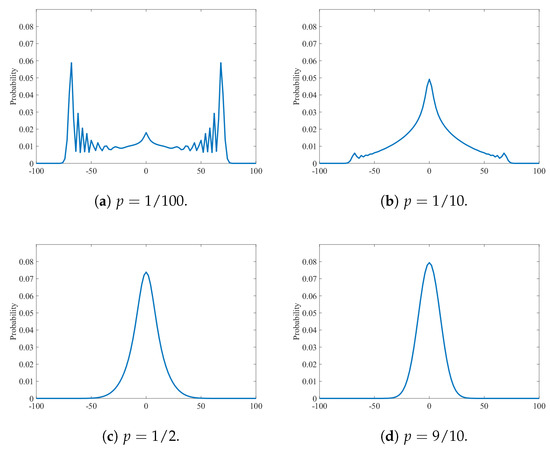
Figure 1.
Probability distribution of the interpolating walks with at the final time . The parameters p of the four panels are set to (a) , (b) , (c) , and (d) , respectively. Note that the values only on the positions labeled with even numbers are plotted; the ones on the odd-numbered positions are zero.
Secondly, let us discuss the consistency of our analytical results with Theorem 1 in more detail. Note that if is odd, then for any and . The following step function , which satisfies and reflects such a parity with the position and time, should approximate the limit density function of in Theorem 1 in that
for any :
Figure 2 shows the simultaneous plot of and for and . Here we use the second equality in Equation (1) to approximately draw the limit density function of , , by the Gauss–Kronrod quadrature approximation [15]. We see that the step function appears to be close to for sufficiently large t, as expected with Equation (2).
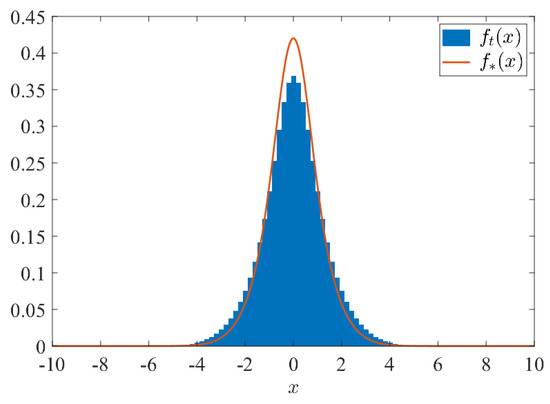
Figure 2.
Comparison between and : We set , and . The blue step function shows with , while the orange curve shows the limit density function .
Finally, let us discuss the case that the parameter p is very close to 0. It is well-known that if the parameter , converges to the Konno function [16]. On the other hand, if the parameter p is even slightly greater than 0, the shape of the limit distribution of has the structure of a normal distribution by our main theorem. In this sense, Theorem 1 indicates that the limit distribution in is clearly distinguished from that in . However, in the above setting, it is assumed that the parameter p is independent of the final time s even if p is small, which implies that the decoherence occurs infinitely many times when . Then we set the parameter p by with some positive constant value to avoid the infinitely many uses of the evolution operator . Note that such a setting gives the Poisson occurrence of because the probability that “the number of choices of the evolution operator during the time span s is k” can be expressed by
Then the number of occurrence during the infinite time span is finite (its average is ), and the time interval at which the evolution is used follows the exponential distribution with parameter . We discuss the behavior of the interpolating walk in such a natural setting of in Section 5 and obtain an expression of the characteristic function of in the long-time limit, which shows the ballistic spreading in Proposition 3. Figure 3 shows a distribution at the final time s with the parameter . A “protrusion” is seen in the middle of a typical quantum walk distribution. Its characterization is left as an open problem in this paper.
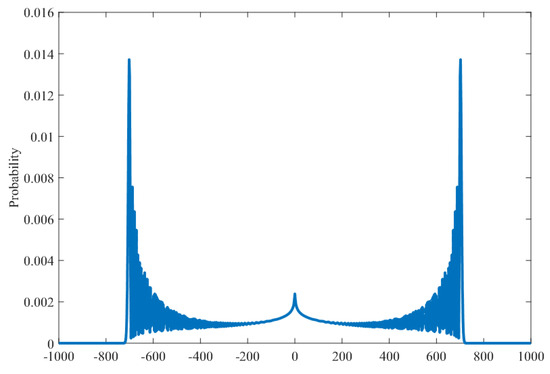
Figure 3.
The numerical simulation of the distribution with the parameter at the final time . We set , and .
3. Setting of Interpolating Walk
3.1. Random Walk
Let be the set of symmetric arcs of . Each element of is denoted by . Here the origin and terminus of are x and , respectively. Note that the inverse of is . The total state space is set by . For each time step with the initial state , is obtained by the following iterations: . Here the local time evolution at is denoted by
for every and . It moves as shown in Figure 4 and Figure 5. This random walk model is called a persistent random/correlated random walk. At each time, the random walker chooses the same direction as the one chosen exactly 1 step before (right or left) with probability r, and a different direction with probability . The probability of being found at vertex x at time t is defined as
Let and be the sets of the 2-dimensional complex-valued matrices and the unitary matrices. Let us consider an equivalent expression to this random walk on the space as follows. Set matrices P and Q as
where with , . Define by
for any and . For each time step with the initial state , is obtained by . Thus this walk with the time evolution can be regarded as an open quantum random walk [17]. Let us see that this open quantum random walk is isomorphic to the persistent random walk as follows. The time iteration can be reexpressed by
The second equality derives from , where we set as
Therefore, the following equation is derived:
which is the same as the local time evolution at on the space (3) and (4). Indeed we obtain the following proposition.
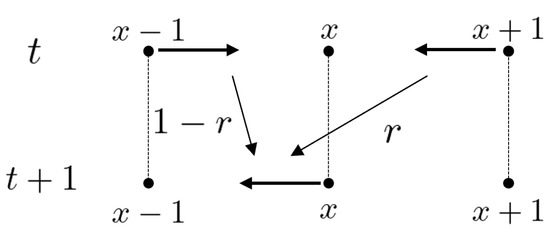
Figure 4.
The recursion (3).
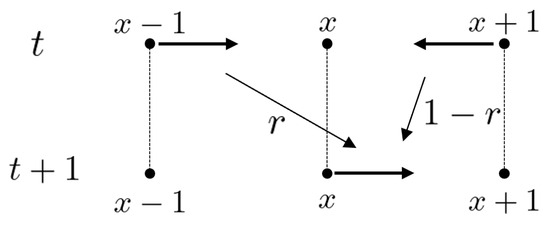
Figure 5.
The recursion (4).
Proposition 1.
For a persistent random walk with the initial state , if satisfies and , then for all ,
Here,
Proof.
By calculating the trace of in this case, we obtain
so if we set such that it satisfies
when is given as the initial state, the finding probability defined in (5) for each time step is given by
□
3.2. Quantum Walk
As with the random walk discussed in the previous section, first, the total state space is set by . For each time step with the initial state , is obtained by the following iterations: . Here the local time evolution at is denoted by
for every and . It moves as shown in Figure 6 and Figure 7. Here and is unitary. The left-moving quantum walker chooses to move left with probability amplitude a and right with probability amplitude c, while the right-moving quantum walker chooses to move left with probability amplitude b and right with probability amplitude d. The probability of being found at vertex x at time t is defined as
Let us consider an equivalent expression to this quantum walk on the space as follows. Define by
for any . For each time step with the initial state , is given by the recursion . In particular, if we set , it satisfies because
This corresponds to the local time evolution at on the space (7) and (8).
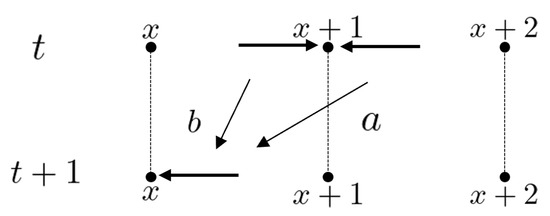
Figure 6.
The recursion (7).
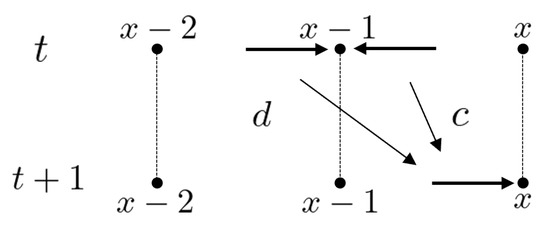
Figure 7.
The recursion (8).
Proposition 2.
For a quantum walk with the initial state , if satisfies , then for all ,
Proof.
By the induction with respect to t, we have for any . Then taking the trace of , we obtain
which implies the desired conclusion. □
3.3. Interpolating Walk
We define the interpolation model between the random walk and the quantum walk as follows. For a parameter , let be defined as
Set
with the initial state . Since is a convex combination of in (10) and in (6) which are trace-preserving, then at each time , the finding probability at each position x can be defined as
The operator is expressed by
Then the first and second terms are interpreted as the decoherence and interference terms, respectively, and the strength of the interference is tunable by the parameter .
The following observation is well-known, but let us confirm that this equation represents a process in which a random walk is performed with probability p, while a quantum walk is executed with probability . Here, we set i.i.d. Bernoulli sequence such that and
with . By taking the average over , we have
Since this equation satisfies the same recurrence relation as (11), the interpolation model can be interpreted as a walk that represents the average behavior of a system that randomly chooses the evolution of the random walk with probability p or that of the quantum walk with probability at each time step independently.
4. Proof of Theorem 1
4.1. Fourier Transform
The following isomorphism is useful for our analysis: for any matrices and of size N,
where is the matrix transpose of B. Therefore when the matrix is reinterpreted as a vector as , we have
From now on, denote the vector representation of by .
Let be a random variable following the distribution . To obtain the limit distribution of , we concentrate on obtaining the asymptotics of the characteristic function of ,
The following lemma plays an important role in computing the characteristic function.
Lemma 1.
Set for any and
Then, we have
Proof.
The finding probability defined in (12), so the characteristic function takes the following form:
Set the Fourier transform (). Then the following equation is obtained:
This implies that the characteristic function of can be expressed by
By the recurrence relation representing the local time evolution,
satisfies the following recursion with respect to the time step t:
which implies
Inserting (14) into (13), we obtain the desired conclusion. □
4.2. Asymptotics of the Eigenvalues of
To obtain the limit of the characteristic function of , we consider the expansion of the time evolution operator in the Fourier space in Lemma 1 as follows so that the Kato perturbation theorem [18] can be applied.
where
Here, D is defined as .
Then let us put . We are interested in the expansion of the perturbed eigenvalues in which split from the non-perturbed eigenvalue by the small perturbation . To this end, we check the spectral formation of the non-perturbed matrix T.
Lemma 2.
Let T be the non-perturbed matrix of . Then and
The vector is an eigenvector of T, which is independent of the parameter p. Moreover, for any ,
Proof.
The non-perturbed matrix T is reexpressed by
where is the projection onto and
Note that for any and the equality holds if and only if or . By the properties of the unitarity of C, for example, and , only the eigenvector of T which belongs to is . This implies that if , then . On the other hand, if , then T becomes . Since is a unitary, all the eigenvalues of T are unitary, in particular, . This finishes the proof. □
Let us concentrate on the case, since the case reproduces the usual quantum walk driven by the unitary operator. By Lemma 2, in a large time iteration of , the eigenspace of the eigenvalue , which splits from the non-perturbed eigenvalue 1 of T by the small perturbation , contributes almost all the behavior. The following lemma gives the expansion of with respect to .
Lemma 3.
Assume . Let be the eigenvalue of which splits from the non-perturbed eigenvalue 1 of T. Then we have
Proof.
The eigenvalues of that are close to 1 can be expanded as follows because 1 is a simple eigenvalue of T:
Here, since is simple, according to [18], and coincide with the coefficients of the second and third orders of the weighted mean of the eigenvalues that form the -group, ;
respectively, where is the eigenprojection associated with the eigenvalue 1 of T, and S is the reduced resolvent associated with the eigenvalue 1 of T. By using (15) and (16), then we have , and
Let S be defined as , where are the eigenvalues of T that are not equal to 1, and are the corresponding eigenprojections. is expressed as follows by using (15)–(17):
Since (), the first and second terms of (20) are reduced to
Let us continue the computation of the second term as follows. Due to the commutativity of the trace operation, it is shown that
Note that by setting , we have
Then let us compute as follows. In this case, with , T is expressed as , and thus we have
by utilizing the unitarity of the matrix C. Here, , and l are defined as and By performing calculations using cofactor expansion, the following result is obtained:
Therefore, simplifying slightly, we obtain the following formula:
Put . The above formula simplifies the expression of the second term by
Inserting the first term (21) and the second term (23) into (20), we obtain
The eigenvalues of that are close to 1 can be analyzed as follows by inserting (19) and (24) into (18):
□
Now by using Lemmas 1–3, let us finish the proof of Theorem 1.
4.3. Proof of Theorem 1
Proof.
Since the initial state is defined by , note that the initial state in the Fourier space, , is given by
for any . Then using Lemmas 1, the characteristic function can be expressed as follows:
Here in the last equation, we used Lemmas 2, 3 and the fact that eigenvalues other than those in the neighborhood of 1 approach zero in the limit of due to the Riemann–Lebesgue lemma. By Lemma 3, for the eigenvalues splitting from 1 by the perturbation , the second term proportional to vanishes, while the third term proportional to retains a value. To obtain a non-trivial convergence in the limit, we set by . Next, by setting and performing substitution integral,
The term represents the form of the Fourier transform of a normal distribution, so the final form of the characteristic function in the limit is as follows:
In other words, the limit of the characteristic function represents the Fourier transform of the product of a normal distribution and an inverse scale factor. Here, s denotes the variance of the normal distribution, and the distribution of s follows the arcsine distribution. The resulting limit distribution corresponds to the mean of this arcsine distribution. This completes the proof. □
5. Summary and Discussion
In this study, we constructed a model that interpolates between the quantum walk and the random walk on a one-dimensional lattice using a single parameter . We found that the walk spreads diffusively with respect to the time step, and the limiting distribution converges to a normal variance mixture with the arcsine law depending on the parameter p.
Our limit theorem shows discontinuity with respect to the parameter p at . Then future challenges include cases where the parameter p is very close to zero. For example, the problem under the setting of the parameter with some positive real value and the final time of the walk s may be interesting. Because such a setting produces a Poisson occurrence until the final time s of the decoherence for , the probability that “the number of occurrence of during the time step s is k” can be described by for . Indeed we obtain the following expression for the characteristic function of with .
Proposition 3.
Let s be the final time step and set with some positive real number . Put , and for by
Then we have
Proof.
The proof is given in Appendix A. □
Remark 1.
If we put in the integral of the LHS in (25), which means (quantum walk), then
This is consistent with the limit theorem for the pure quantum walk [16]. On the other hand, if , which may correspond to , then
which means that the limit density function of is . This is consistent with the “diffusive” spreading for the interpolating walk with a constant p in Theorem 1.
Although the expression of Proposition 3 looks suggestive, we could not find a great interpretation of the expression. Thus it remains an open problem. The limit behavior of the interpolating walk with the parameter , is also a future problem.
The introduction of stochasticity may influence not only the limit distribution but also the recurrence behavior of the walk in a non-trivial way. Our limit theorem implies that the scaling order of our walk is discontinuous with respect to the parameter p at . On the other hand, according to the results of [14], the recurrence probability of their model with a parameter is continuous over . Note that the model in [14] intersects with our model at . We expect a monotone increase in the recurrence probabilities with p. In contrast with our intuition, a local minimum value exists at in the recurrence probability with an appropriate parameter . The continuous quantum stochastic walk on the line [19] shows that the scaling order of the moment is also discontinuous with respect to , but interestingly, the discontinuity appears not at but at , which contrasts with our discontinuous place in the scaling of the limit theorem. More detailed analytical investigations of these intriguing behaviors are left for future work.
Additionally, while we constructed an interpolation model between persistent random walks and quantum walks on a one-dimensional lattice in this study, considering interpolation models on more general graphs under the construction method proposed by [8] and analyzing their limiting distributions also remain tasks for future research. We hope that in the near future, our observation can contribute the construction and analysis of a discrete-time version of the quantum maze problem which is explored in the continuous-time stochastic quantum walk model in [20].
Author Contributions
Conceptualization, E.S.; formal analysis, S.Y.; investigation, H.S.; validation, T.Y. and R.H.; writing, E.S. and S.Y.; supervision, E.S. All authors have read and agreed to the published version of the manuscript.
Funding
This research was funded by the Japan Society for the Promotion of Science (JSPS), grant numbers 24K06863, 24KJ0864, 23KJ0384, and 22H05197. The APC was covered by the Institutional Open Access Program (IOAP) discount and voucher, and the authors incurred no APC.
Institutional Review Board Statement
Not applicable.
Data Availability Statement
The simulation results presented in this study are contained within the article. No additional data are available.
Acknowledgments
H.S. acknowledges financial support from the Grant-in-Aid of JSPS Fellows JSPS KAKENHI (Grant No. JP24KJ0864). T.Y. acknowledges financial support from the Grant-in-Aid of JSPS Fellows JSPS KAKENHI (Grant No. JP23KJ0384). R.H. acknowledges financial support from the Grant-in-Aid of Transformative Research Areas JSPS KAKENHI (Grant No. JP22H05197). E.S. acknowledges financial support from the Grant-in-Aid of Scientific Research (C) JSPS KAKENHI (Grant No. 24K06863).
Conflicts of Interest
The authors declare no conflicts of interest.
Appendix A. Proof of Proposition 3
Proof.
Put , . We divide the proof into the following 3 steps.
- Step 1: First let us rewrite the time evolution operator in the Fourier space in Lemma 1 as follows so that the Kato perturbation theory [18] can be applied.whereandThe eigenvalues of the non-perturbed unitary matrix T are described byLet be the eigenvalue of which split from the non-perturbed eigenvalue 1 of T. The eigenvalues of that are close to 1 can be expanded as follows because 1 is a semi-simple eigenvalue of T:Here, according to [18], , where and is the eigenprojection associated with the eigenvalue 1 of T. The eigenprojection can be expressed by using and , which are the eigenvectors corresponding to the eigenvalue of of T, that is,Note that and are the eigenvectors of the unitary matrices and whose concrete expressions arewhere .
- Step 2: Secondly, let us obtain the closed form of . To this end, let us see that can be essentially reduced to the following 2-dimensional matrix bywherein the following. By using (A1)–(A3), and (A5), we haveHere we used the following computational results in the fourth equality:Therefore, since the 2-dimensional matrix is isomorphic to , the eigenvalues of coincide with . Then we havewith the eigenprojections
- Step 3: Finally, let us complete the proof by using (A6) and (A7). Let be the eigenprojection of the eigenvalues defined in (A4), respectively. Recall the integral expression of Lemma 1 for the characteristic function of . Since the contribution to the characteristic function of the eigenvalues in the expression of the integral form Lemma 1 other than can be estimated by in the limit of t by the Riemann–Lebesgue lemma, it is sufficient to consider restricted to the eigenspaces of with as follows:Since we set satisfyingthe characteristic function can be expressed as follows:Inserting the expressions of in (A7) and using the following factswe obtain the desired conclusion:
□
References
- Ambainis, A.; Bach, E.; Nayak, A.; Vishwanath, A.; Watrous, J. One-dimensional quantum walks. In Proceedings of the Thirty-Third Annual ACM Symposium on Theory of Computing, Crete, Greece, 6–8 July 2001; pp. 37–49. [Google Scholar]
- Kendon, V. Decoherence in quantum walks—A review. Math. Struct. in Comp. Sci. 2006, 17, 1169–1220. [Google Scholar] [CrossRef]
- Konno, N. Quantum Walks. In Lecture Notes in Mathematics; Springer: Berlin/Heidelberg, Germany, 2008; Volume 1954, pp. 309–452. [Google Scholar]
- Meyer, D.A. From quantum cellular automata to quantum lattice gases. J. Stat. Phys. 1996, 85, 551–574. [Google Scholar] [CrossRef]
- Portugal, R. Quantum Walk and Search Algorithm, 2nd ed.; Springer Nature: Cham, Switzerland, 2018. [Google Scholar]
- Balakrishnan, V.; Chaturvedi, S. Persistent diffusion on a line. Phys. Stat. Mech. Its Appl. 1988, 148, 581–596. [Google Scholar] [CrossRef]
- Konno, N. Limit theorems and absorption problems for one-dimensional correlated random walks. Stoch. Model. 2009, 25, 28–49. [Google Scholar] [CrossRef]
- Schuhmacher, P.K.; Govia, L.C.G.; Taketani, B.G.; Wilhelm, F.K. Quantum simulation of a discrete-time quantum stochastic walk. Lett. J. Explor. Front. Phys. 2021, 133, 50003. [Google Scholar] [CrossRef]
- Whitfield, J.D.; Rodríguez-Rosario, C.A.; AspuruGuzik, A. Quantum stochastic walks: A generalization of classical random walks and quantum walks. Phys. Rev. A 2010, 81, 022323. [Google Scholar] [CrossRef]
- Hall, P.; Heybe, C.C. Martingale Limit Theory and Its Application; Probability and Mathematical Statistics; Academic Press: Cambridge, MA, USA, 1980. [Google Scholar]
- Konno, N.; Matsue, K.; Segawa, E. A crossover between open quantum random walks to quantum walks. J. Stat. Phys. 2023, 190, 202. [Google Scholar] [CrossRef]
- Brun, T.A.; Carteret, H.A.; Ambainis, A. Quantum random walks with decoherent coins. Phys. Rev. A 2003, 67, 032304. [Google Scholar] [CrossRef]
- Ahlbrecht, A.; Vogts, H.; Werner, A.H.; Werner, R.F. Asymptotic evolution of quantum walks with random coin. J. Math. Phys. 2011, 52, 042201. [Google Scholar] [CrossRef]
- Štefănák, M.; Potoĕk, V.; Yalçınkaya, I.; Gábris, A.; Jex, I. Recurrence in discrete-time quantum stochastic walks. arXiv 2015, arXiv:2501.08674. [Google Scholar]
- Kronrod, A.S. Nodes and Weights of Quadrature Formulas: Sixteen-Place Tables; Consultants Bureau: New York, NY, USA, 1965. [Google Scholar]
- Konno, N. Quantum random walks in one dimension. Quantum Inf. Process. 2002, 1, 345–354. [Google Scholar] [CrossRef]
- Attal, S.; Petruccione, F.; Sabot, C.; Sinayskiy, I. Open quantum random walks. J. Stat. Phys. 2012, 147, 832852. [Google Scholar] [CrossRef]
- Kato, T. A Short Introduction to Perturbation Theory for Linear Operator; Springer: New York, NY, USA, 1982. [Google Scholar]
- Domino, K.; Glos, A.; Ostaszewski, M.; Pawela, Ł.; Sadowski, P. Properties of quantum stochastic walks from the asymptotic scaling exponent. Quantum Inf. Comput. 2018, 18, 181–197. [Google Scholar] [CrossRef]
- Caruso, F.; Crespi, A.; Ciriolo, A.G.; Sciarrino, F.; Osellame, R. Fast escape of a quantum walker from an integrated photonic maze. Nat. Commun. 2016, 7, 11682. [Google Scholar] [CrossRef] [PubMed]
Disclaimer/Publisher’s Note: The statements, opinions and data contained in all publications are solely those of the individual author(s) and contributor(s) and not of MDPI and/or the editor(s). MDPI and/or the editor(s) disclaim responsibility for any injury to people or property resulting from any ideas, methods, instructions or products referred to in the content. |
© 2025 by the authors. Licensee MDPI, Basel, Switzerland. This article is an open access article distributed under the terms and conditions of the Creative Commons Attribution (CC BY) license (https://creativecommons.org/licenses/by/4.0/).