


Efficient Post-Shrinkage Estimation Strategies in High-Dimensional Cox’s Proportional Hazards Models



Abstract
1. Introduction
2. Methodology
2.1. Notation and Assumptions
2.2. Signal Strength Regularity Conditions
- (A1)
- There exists a positive constant , such that for ;
- (A2)
- The coefficient vector satisfies for some , where for ;
- (A3)
- , for .
2.3. Cox Proportional Hazards Model
2.4. Variable Selection and Estimation
- Elastic Net (ENet). The Elastic Net estimator implements (4) with the combined penaltywhere . When , this reduces to the LASSO, and when , it becomes Ridge. Combining and penalties leverages the benefits of Ridge while still producing sparse solutions. Unlike LASSO, which can select n variables at most, ENet has no such limitation when .
2.4.1. Variable Selection Procedure for and
- Step 1 (detection of ). Obtain a candidate subset of strong signals using a penalized likelihood estimator (PLE). Specifically, considerwhere penalizes each , shrinking weak effects toward zero and selecting the strong signals. The tuning parameter governs the size of the subset .
- Step 2 (detection of ). To identify , first solve a penalized regression problem with a ridge penalty only on the variables in . Formally,where is a tuning parameter controlling the overall strength of regularization for variables in . We then define a post-selection weighted ridge (WR) estimator bywhere is a thresholding parameter. The set is thenWe apply this post-selection procedure only if . In particular, we set
2.4.2. Post-Selection Shrinkage Estimation
3. Asymptotic Properties
- (B1)
- for some .
- (B2)
- , where for in (A2).
- (B3)
- The existence of a positive definite matrix such that , where the eigenvalues of satisfy .
- (B4)
- Sparse Riesz condition: For the random design matrix , any with , and any vector , there exists such that holds with probability tending to 1.
Asymptotic Distributional Bias and Risk Analysis
- If , then ;
- If and , then for .
4. Simulation Study
Key Observations and Insights
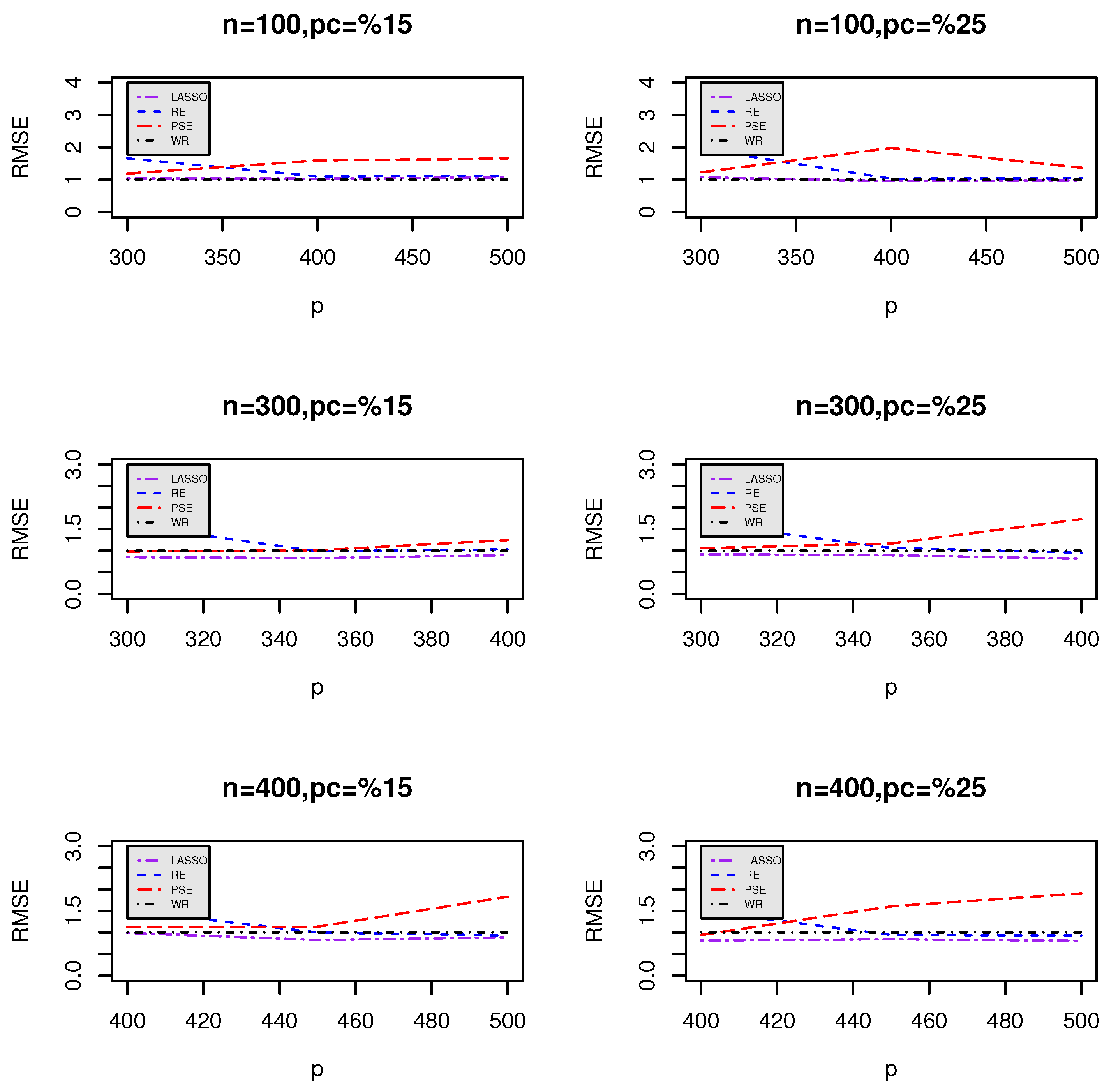
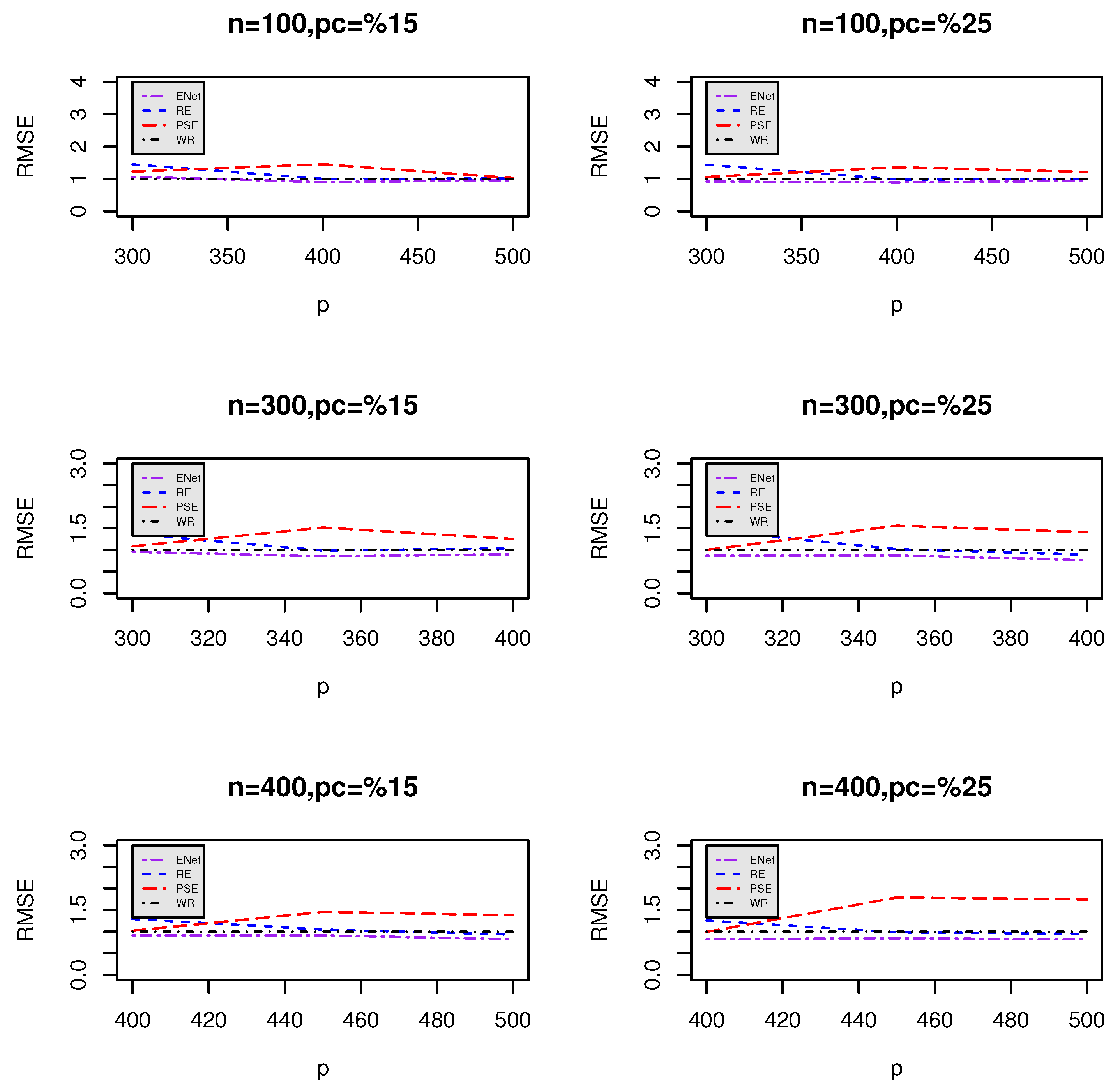
- Superior performance of post-selection estimators: Across all combinations of n and p, the post-selection estimators ( and ) consistently demonstrate lower RMSEs compared to LASSO and ENet. This suggests that these estimators provide better predictive accuracy and stability.
- Impact of censoring percentage:
- When the censoring percentage increases from 15% to 25%, the RMSE values tend to increase across all methods, indicating the expected loss of predictive power due to increased censoring.
- However, the post-selection estimators maintain a more stable RMSE trend, demonstrating their robustness in handling censored data.
- Effect of increasing predictors (p):
- As p increases, the RMSE for LASSO and ENet tends to rise, particularly under higher censoring rates.
- This trend suggests that LASSO and ENet struggle with larger feature spaces, likely due to their tendency to aggressively shrink weaker covariates.
- In contrast, the post-selection estimators show relatively stable RMSE behavior, indicating their ability to retain relevant information even in high-dimensional settings.
- Impact of sample size (n) on RMSE stability:
- Larger sample sizes (n) generally lead to lower RMSE values across all methods.
- However, the gap between LASSO/ENet and the post-selection estimators remains consistent, reinforcing the advantage of the proposed methods even with more data.
- Comparing LASSO and ENet:
- ENet generally has lower RMSE values than LASSO, particularly for small sample sizes, indicating its advantage in balancing feature selection and regularization.
- However, ENet still underperforms compared to post-selection estimators, suggesting that the additional shrinkage adjustments help mitigate underfitting issues.
5. Real Data Example
5.1. Example 1
5.2. Example 2
6. Conclusions
Author Contributions
Funding
Data Availability Statement
Acknowledgments
Conflicts of Interest
Nomenclature
| Symbol | Description |
| General Notation | |
| n | Sample size (number of observations) |
| p | Number of covariates (predictor variables) |
| Set of real numbers | |
| Probability measure | |
| Expectation operator | |
| Indicator function | |
| Regression and Estimators | |
| Regression coefficient vector | |
| Estimated regression coefficients | |
| Regularization parameter (for LASSO/ENet) | |
| Selected subset of variables | |
| -dimensional vector in the selection model | |
| Selected regression coefficient estimator | |
| Weighted Ridge (WR) estimator | |
| Survival Analysis Notation | |
| Cox proportional hazards likelihood function | |
| Dataset containing observations | |
| X | Covariate matrix |
| Y | Response variable (time-to-event outcome) |
| Hazard function at time t | |
| Estimated hazard function | |
| Cumulative hazard function | |
| Evaluation Metrics | |
| RMSE | Root Mean Squared Error |
| FPR | False Positive Rate |
| AUC | Area Under the Curve (for classification models) |
| Methods and Models | |
| LASSO | Least Absolute Shrinkage and Selection Operator |
| ENet | Elastic Net |
| Cox-PH | Cox Proportional Hazards Model |
| WR | Weighted Ridge estimator |
| PSE | Post-selection Shrinkage Estimator |
| RE | Restricted Estimator |
Appendix A. Proofs
References
- Ahmed, S.E. Big and Complex Data Analysis: Methodologies and Applications; Springer: Cham, Switzerland, 2017. [Google Scholar]
- Bradic, J.; Fan, J.; Jiang, J. Regularization for Cox’s proportional hazards model with np-dimensionality. Ann. Stat. 2011, 39, 3092–3120. [Google Scholar] [CrossRef] [Scilit] [PubMed]
- Bradic, J.; Song, R. Structured estimation for the nonparametric Cox model. Electron. J. Stat. 2015, 9, 492–534. [Google Scholar] [CrossRef] [Scilit]
- Gui, J.; Li, H. Penalized Cox regression analysis in the high-dimensional and low-sample size settings with applications to microarray gene expression data. Bioinformatics 2005, 21, 3001–3008. [Google Scholar] [CrossRef] [Scilit]
- Akaike, H. A new look at the statistical model identification. IEEE Trans. Autom. Control 1974, 19, 716–723. [Google Scholar] [CrossRef] [Scilit]
- Schwarz, G. Estimating the dimension of a model. Ann. Stat. 1978, 6, 461–464. [Google Scholar] [CrossRef] [Scilit]
- Tibshirani, R. Regression shrinkage and selection via the Lasso. J. R. Stat. Soc. Ser. B 1996, 58, 267–288. [Google Scholar] [CrossRef] [Scilit]
- Zou, H. The adaptive Lasso and its oracle properties. J. Am. Stat. Assoc. 2006, 101, 1418–1429. [Google Scholar] [CrossRef] [Scilit]
- Zou, H.; Hastie, T. Regularization and variable selection via the elastic net. J. R. Stat. Soc. Ser. B 2005, 67, 301–320. [Google Scholar] [CrossRef] [Scilit]
- Sun, T.; Zhang, C.H. Scaled sparse linear regression. Biometrika 2012, 99, 879–898. [Google Scholar] [CrossRef] [Scilit]
- Tibshirani, R. The lasso method for variable selection in the Cox model. Stat. Med. 1997, 16, 385–395. [Google Scholar] [CrossRef] [Scilit]
- Zhang, H.; Lu, W. Adaptive lasso for Cox’s proportional hazards model. Biometrika 2007, 94, 691–703. [Google Scholar] [CrossRef] [Scilit]
- Zou, H. A note on path-based variable selection in the penalized proportional hazards model. Biometrika 2008, 95, 241–247. [Google Scholar] [CrossRef] [Scilit]
- Fan, J.; Li, R. Variable selection for Cox’s proportional hazards model and frailty model. Ann. Stat. 2002, 6, 74–99. [Google Scholar] [CrossRef] [Scilit]
- Hong, H.; Li, Y. Feature selection of ultrahigh-dimensional covariates with survival outcomes: A selective review. Appl. Math. Ser. B 2017, 32, 379–396. [Google Scholar] [CrossRef] [Scilit] [PubMed]
- Hong, H.; Zheng, Q.; Li, Y. Forward regression for Cox models with high-dimensional covariates. J. Multivar. Anal. 2019, 173, 268–290. [Google Scholar] [CrossRef] [Scilit]
- Hong, H.; Chen, X.; Kang, J.; Li, Y. The Lq-norm learning for ultrahigh-dimensional survival data: An integrative framework. Stat. Sin. 2020, 30, 1213–1233. [Google Scholar] [CrossRef] [Scilit]
- Ahmed, S.E.; Ahmed, F.; Yüzbaşı, B. Post-Shrinkage Strategies in Statistical and Machine Learning for High Dimensional Data; Chapman and Hall/CRC: New York, NY, USA, 2023. [Google Scholar] [CrossRef] [Scilit]
- Gao, X.; Ahmed, S.E.; Feng, Y. Post selection shrinkage estimation for high-dimensional data analysis. Appl. Stoch. Models Bus. Ind. 2017, 33, 97–120. [Google Scholar] [CrossRef] [Scilit]
- Cox, D.R. Regression models and life-tables (with discussion). J. R. Stat. Soc. Ser. B 1972, 34, 187–220. [Google Scholar] [CrossRef] [Scilit]
- Buhlmann, P.; van de Geer, S. Statistics for High-Dimensional Data: Methods, Theory and Applications, 1st ed.; Springer: Berlin/Heidelberg, Germany, 2011. [Google Scholar]
- Kurnaz, S.F.; Hoffmann, I.; Filzmoser, P. Robust and sparse estimation methods for high-dimensional linear and logistic regression. J. Chemom. Intell. Lab. Syst. 2018, 172, 211–222. [Google Scholar] [CrossRef] [Scilit]
- Belhechmi, S.; Bin, R.D.; Rotolo, F.; Michiels, S. Accounting for grouped predictor variables or pathways in high-dimensional penalized Cox regression models. BMC Bioinform. 2020, 21, 277. [Google Scholar] [CrossRef] [Scilit] [PubMed]
- Rosenwald, A.; Wright, G.; Chan, W.C.; Connors, J.M.; Campo, E.; Fisher, R.I.; Gascoyne, R.D.; Muller-Hermelink, H.K.; Smel, E.B.; Giltnane, J.M.; et al. The use of molecular profiling to predict survival after chemotherapy for diffuse large-B-cell lymphoma. N. Engl. J. Med. 2002, 25, 1937–1947. [Google Scholar] [CrossRef] [Scilit] [PubMed]

| Censoring Percentage | ||||||||
|---|---|---|---|---|---|---|---|---|
| 15% | 25% | |||||||
| Method | ||||||||
| 100 | 300 | LASSO | 1.04 | 1.66 | 1.19 | 1.08 | 1.96 | 1.23 |
| ENet | 1.07 | 1.45 | 1.23 | 0.92 | 1.44 | 1.06 | ||
| 400 | LASSO | 1.03 | 1.10 | 1.60 | 0.96 | 1.03 | 1.98 | |
| ENet | 0.90 | 1.00 | 1.45 | 0.89 | 0.98 | 1.36 | ||
| 500 | LASSO | 1.08 | 1.13 | 1.66 | 0.98 | 1.05 | 1.37 | |
| ENet | 0.96 | 1.01 | 1.03 | 0.95 | 1.00 | 1.22 | ||
| 300 | 300 | LASSO | 0.85 | 1.60 | 0.98 | 0.92 | 1.64 | 1.06 |
| ENet | 0.96 | 1.37 | 1.08 | 0.87 | 1.46 | 1.00 | ||
| 350 | LASSO | 0.83 | 0.99 | 1.01 | 0.90 | 1.07 | 1.17 | |
| ENet | 0.85 | 0.99 | 1.52 | 0.87 | 1.02 | 1.56 | ||
| 400 | LASSO | 0.90 | 1.03 | 1.25 | 0.81 | 0.95 | 1.73 | |
| ENet | 0.90 | 1.04 | 1.25 | 0.76 | 0.89 | 1.41 | ||
| 400 | 400 | LASSO | 0.99 | 1.52 | 1.12 | 0.82 | 1.50 | 0.94 |
| ENet | 0.91 | 1.29 | 1.02 | 0.83 | 1.26 | 0.99 | ||
| 450 | LASSO | 0.83 | 1.00 | 1.13 | 0.84 | 0.94 | 1.61 | |
| ENet | 0.92 | 1.05 | 1.46 | 0.85 | 0.99 | 1.79 | ||
| 500 | LASSO | 0.89 | 0.93 | 1.83 | 0.81 | 0.93 | 1.90 | |
| ENet | 0.82 | 0.93 | 1.38 | 0.82 | 0.95 | 1.75 | ||
| Censoring Percentage | ||||||
|---|---|---|---|---|---|---|
| Method | Average | FPR | Average | FPR | ||
| 100 | 300 | LASSO | 6.1 | 0.063 | 6.4 | 0.056 |
| ENet | 6.2 | 0.063 | 6.6 | 0.052 | ||
| 400 | LASSO | 4.9 | 0.072 | 5.2 | 0.085 | |
| ENet | 5.1 | 0.072 | 4.8 | 0.075 | ||
| 500 | LASSO | 5.6 | 0.039 | 12.6 | 0.043 | |
| ENet | 4.9 | 0.039 | 4.0 | 0.033 | ||
| 300 | 300 | LASSO | 13.4 | 0.209 | 13.8 | 0.223 |
| ENet | 12.9 | 0.209 | 16.3 | 0.282 | ||
| 350 | LASSO | 15.6 | 0.202 | 15.8 | 0.208 | |
| ENet | 15.7 | 0.202 | 22.6 | 0.279 | ||
| 400 | LASSO | 14.5 | 0.137 | 13.7 | 0.155 | |
| ENet | 13.5 | 0.137 | 14.2 | 0.173 | ||
| 400 | 400 | LASSO | 14.1 | 0.163 | 15.8 | 0.171 |
| ENet | 14.2 | 0.163 | 20.4 | 0.212 | ||
| 450 | LASSO | 18.4 | 0.217 | 23.5 | 0.24 | |
| ENet | 19.1 | 0.217 | 30.1 | 0.263 | ||
| 500 | LASSO | 13.6 | 0.150 | 13.3 | 0.158 | |
| ENet | 13.3 | 0.150 | 13.6 | 0.158 | ||
| LASSO | ENet | |||||
|---|---|---|---|---|---|---|
| Gen ID | ||||||
| 18 | −0.02 | 0.26 | 0.21 | −0.03 | 0.07 | 0.20 |
| 97 | 0.01 | 0.27 | 0.00 | 0.01 | 0.26 | 0.01 |
| 101 | 0.05 | 0.19 | 0.13 | 0.05 | 0.27 | 0.12 |
| 128 | – | – | – | −0.01 | – | – |
| 232 | 0.04 | −0.42 | −0.28 | 0.04 | 0.20 | −0.25 |
| 342 | 0.15 | −0.42 | −0.13 | 0.14 | −0.39 | −0.10 |
| 369 | −0.09 | −0.05 | 0.04 | −0.08 | −0.40 | −0.12 |
| 408 | −0.01 | – | – | −0.01 | −0.09 | 0.03 |
| 410 | 0.03 | −0.26 | −0.15 | 0.03 | −0.06 | −0.14 |
| 445 | – | – | – | −0.00 | – | – |
| 468 | 0.14 | 0.08 | 0.02 | 0.13 | −0.26 | −0.01 |
| 660 | −0.00 | – | – | −0.00 | – | – |
| 731 | −0.08 | 0.09 | 0.06 | −0.08 | 0.06 | 0.06 |
| 810 | −0.04 | −0.08 | −0.09 | 0.01 | 0.09 | −0.09 |
| 907 | – | – | – | 0.01 | – | – |
| 934 | −0.00 | – | – | −0.00 | – | – |
| 952 | – | – | – | −0.01 | – | – |
| 961 | −0.05 | — | – | −0.05 | −0.08 | 0.20 |
| 1212 | – | – | – | −0.00 | – | – |
| AUC | 0.62 | 0.63 | 0.65 | 0.63 | 0.64 | 0.66 |
| LASSO | ENet | |||||
|---|---|---|---|---|---|---|
| Gen ID | ||||||
| 95 | 0.02 | – | – | −0.34 | – | – |
| 112 | 0.06 | 0.71 | 0.70 | −0.00 | −0.13 | −0.08 |
| 173 | −0.63 | – | – | 0.68 | – | – |
| 205 | – | – | – | – | – | – |
| 551 | 1.60 | 1.69 | 1.57 | −0.11 | −0.28 | −0.20 |
| 1377 | −0.22 | −0.84 | −0.80 | −0.09 | −0.16 | −0.12 |
| 1526 | 0.41 | 0.67 | 0.56 | 0.02 | – | – |
| 1543 | −0.43 | −0.79 | −0.77 | 0.40 | 0.75 | 0.69 |
| 2003 | −0.11 | – | – | 1.10 | – | – |
| 2025 | 0.18 | 0.90 | 0.78 | 1.04 | 1.22 | 1.07 |
| 2439 | – | – | – | −0.01 | −0.14 | −0.12 |
| 2705 | −0.85 | – | – | 0.36 | 0.77 | 0.61 |
| 2973 | 0.59 | 1.23 | 0.99 | −0.63 | −1.12 | −0.81 |
| 3240 | 1.13 | – | – | 0.03 | – | – |
| 3598 | −0.22 | −0.59 | −0.54 | 0.29 | 0.55 | 0.49 |
| 3882 | 0.13 | 0.40 | 0.39 | −0.06 | −0.20 | −0.15 |
| 4015 | 0.34 | 0.81 | 0.76 | −0.08 | −0.13 | −0.12 |
| 4186 | −0.50 | −0.72 | −0.53 | – | – | – |
| 4357 | 0.09 | – | – | −0.59 | −0.70 | −0.65 |
| 4662 | 0.70 | 0.90 | 0.83 | 0.21 | 0.60 | 0.38 |
| 5131 | 0.54 | 0.80 | 0.71 | 0.01 | 0.01 | 0.01 |
| 5222 | −0.15 | −0.38 | −0.26 | 1.24 | 1.67 | 1.34 |
| 5541 | – | – | – | −0.52 | −0.72 | −0.68 |
| 5577 | 0.39 | 0.86 | 0.70 | −0.73 | −0.97 | −0.80 |
| 5778 | −0.62 | – | – | −0.09 | – | – |
| 5808 | – | – | – | 0.35 | 0.55 | 0.46 |
| 5951 | – | – | – | 1.29 | 2.12 | 1.70 |
| 6103 | – | – | – | −0.63 | −0.80 | −0.76 |
| 6254 | – | – | – | 0.25 | 0.56 | 0.48 |
| 6493 | – | – | – | 0.65 | – | – |
| 6510 | – | – | – | 0.86 | 1.09 | 0.99 |
| AUC | 0.71 | 0.71 | 0.73 | 0.72 | 0.72 | 0.74 |
Disclaimer/Publisher’s Note: The statements, opinions and data contained in all publications are solely those of the individual author(s) and contributor(s) and not of MDPI and/or the editor(s). MDPI and/or the editor(s) disclaim responsibility for any injury to people or property resulting from any ideas, methods, instructions or products referred to in the content. |
© 2025 by the authors. Licensee MDPI, Basel, Switzerland. This article is an open access article distributed under the terms and conditions of the Creative Commons Attribution (CC BY) license (https://creativecommons.org/licenses/by/4.0/).
Share and Cite
Ahmed, S.E.; Arabi Belaghi, R.; Hussein, A.A. Efficient Post-Shrinkage Estimation Strategies in High-Dimensional Cox’s Proportional Hazards Models. Entropy 2025, 27, 254. https://doi.org/10.3390/e27030254
Ahmed SE, Arabi Belaghi R, Hussein AA. Efficient Post-Shrinkage Estimation Strategies in High-Dimensional Cox’s Proportional Hazards Models. Entropy. 2025; 27(3):254. https://doi.org/10.3390/e27030254
Chicago/Turabian StyleAhmed, Syed Ejaz, Reza Arabi Belaghi, and Abdulkhadir Ahmed Hussein. 2025. "Efficient Post-Shrinkage Estimation Strategies in High-Dimensional Cox’s Proportional Hazards Models" Entropy 27, no. 3: 254. https://doi.org/10.3390/e27030254
APA StyleAhmed, S. E., Arabi Belaghi, R., & Hussein, A. A. (2025). Efficient Post-Shrinkage Estimation Strategies in High-Dimensional Cox’s Proportional Hazards Models. Entropy, 27(3), 254. https://doi.org/10.3390/e27030254

