Real-Time Diagnostics on a QKD Link via QBER Time-Series Analysis

Abstract
1. Introduction
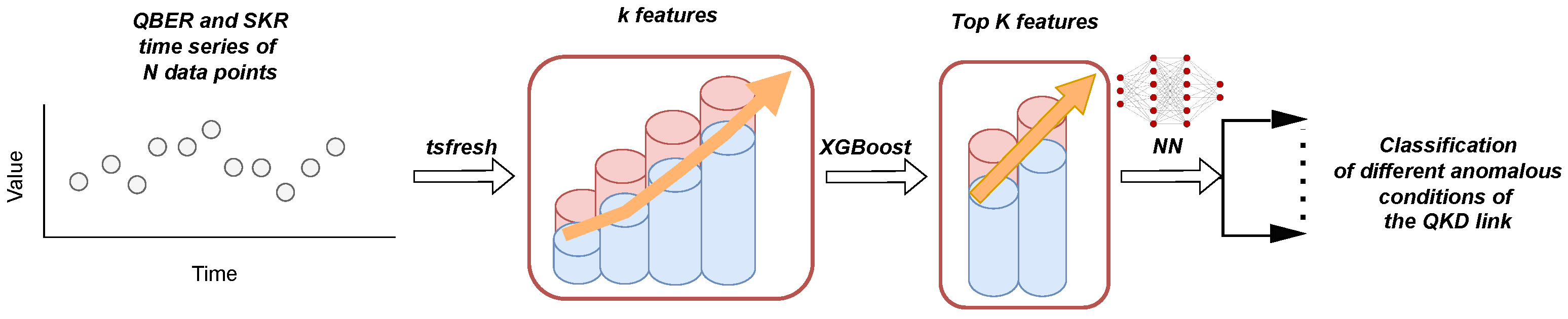
2. The ML Model for Diagnosing the Status of a QKD Link
- Training:
- Reference points and normalization: Activate the QKD system and collect the first N data points. These data points are used as reference points, with all following time-series data being normalized according to the median values of the first using a MinMax scaler.
- Creating labeled training data: Proceed by acquiring sequential N QBER and SKR data while inducing a specific impairment on the transmission line of the quantum signal. The data are then labeled according to the type of impairment. Repeat for all other types of impairments.
- Training the ML pipeline: use all collected data to train the entire ML pipeline by minimizing the loss function.
- Prediction:
- Reference points and normalization: A period of N time steps where the system runs without impairments is assumed. These N data points are used as a normalization reference for the forthcoming ones.
- Classification in real-time: at every time step, one may feed the batch created by the current point and previous ones into the ML pipeline in order to identify the impairments present in the QKD link.
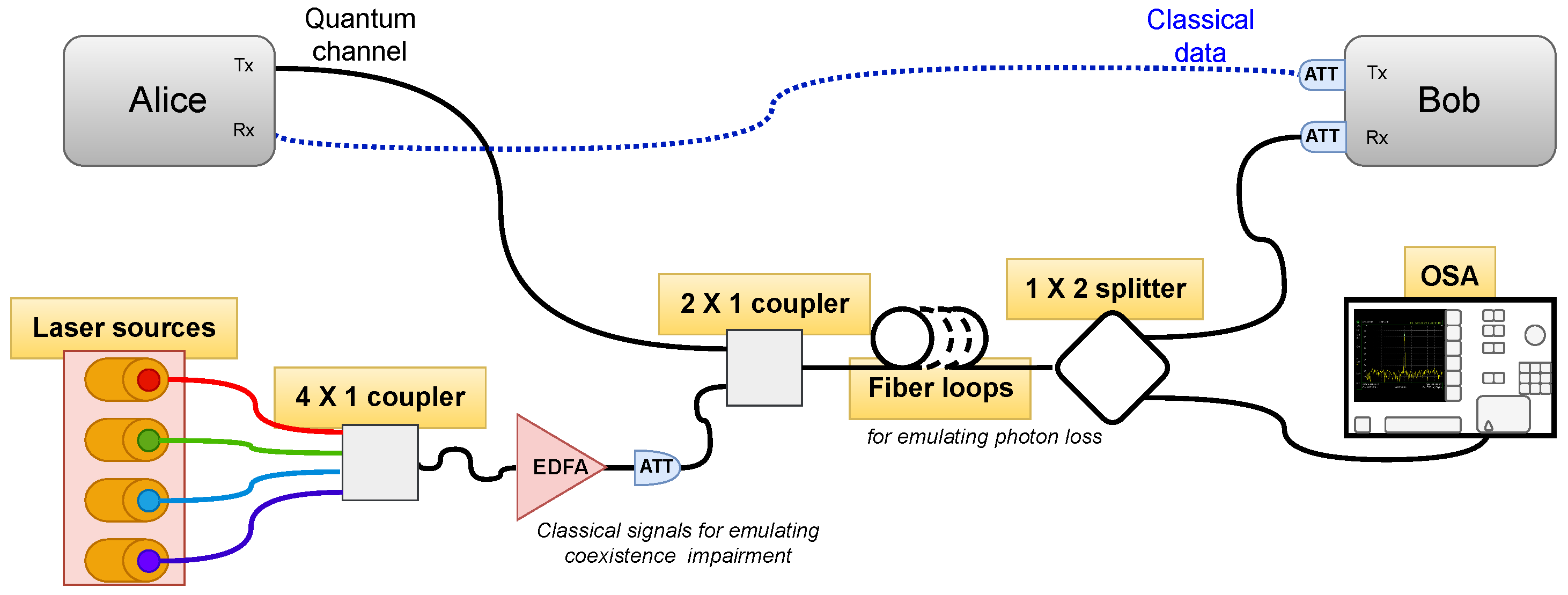
3. Demonstration of the Method with Experimental Data
- Class 1—one laser: nm, dBm.
- Class 2—two lasers: , nm,,dBm.
- Four lasers and EDFA: , , , nm:Class 3— mA: , , , dBm.Class 4— mA: , , , dBm.Class 5— mA: , , , dBm.
- Class 6—photon loss 20%: dB.
- Class 7—photon loss 46%: dB.
- Class 8—photon loss 67%: dB.
4. Conclusions
Author Contributions
Funding
Institutional Review Board Statement
Data Availability Statement
Conflicts of Interest
Abbreviations
| QKD | Quantum Key Distribution |
| NN | Neural Network |
| SDF | Single-mode Dark Fibers |
| SKR | Secure Key Rate |
| ML | Machine learning |
| EDFA | Erbium-Doped Fiber Amplifier |
| OSA | Optical Spectrum Analyzer |
Appendix A
References
- Pirandola, S.; Andersen, U.L.; Banchi, L.; Berta, M.; Bunandar, D.; Colbeck, R.; Englund, D.; Gehring, T.; Lupo, C.; Ottaviani, C.; et al. Advances in Quantum Cryptography. Adv. Opt. Photonics 2020, 12, 1012–1236. [Google Scholar] [CrossRef]
- Briegel, H.J.; Dur, W.; Cirac, J.I.; Zoller, P. Quantum Repeaters: The Role of Imperfect Local Operations in Quantum Communication. Phys. Rev. Lett. 1998, 81, 5932–5935. [Google Scholar] [CrossRef]
- Lidar, D.A.; Brun, T.A. Quantum Error Correction; Cambridge University Press: Cambridge, UK, 2013. [Google Scholar]
- Mower, J.; Zhang, Z.; Desjardins, P.; Lee, C.; Shapiro, J.H.; Englund, D. High-dimensional quantum key distribution using dispersive optics. Phys. Rev. A 2013, 87, 062322. [Google Scholar] [CrossRef]
- Lee, C.; Zhang, Z.; Steinbrecher, G.R.; Zhou, H.; Mower, J.; Zhong, T.; Wang, L.; Hu, X.; Horansky, R.D.; Verma, V.B.; et al. Entanglement-based quantum communication secured by nonlocal dispersion cancellation. Phys. Rev. A 2014, 90, 062331. [Google Scholar] [CrossRef]
- Zhong, T.; Zhou, H.; Horansky, R.D.; Lee, C.; Verma, V.B.; Lita, A.E.; Restelli, A.; Bienfang, J.C.; Mirin, R.P.; Gerrits, T.; et al. Photon-efficient quantum key distribution using time–energy entanglement with high-dimensional encoding. New J. Phys. 2015, 17, 022002. [Google Scholar] [CrossRef]
- Lee, C.; Bunandar, D.; Zhang, Z.; Steinbrecher, G.R.; Dixon, P.B.; Wong, F.N.C.; Shapiro, J.H.; Hamilton, S.A.; Englund, D. Large-alphabet encoding for higher-rate quantum key distribution. Opt. Express 2019, 27, 17539–17549. [Google Scholar] [CrossRef]
- Chang, K.C.; Sarihan, M.C.; Cheng, X.; Zhang, Z.; Wong, C.W. Large-alphabet time-bin quantum key distribution and Einstein–Podolsky–Rosen steering via dispersive optics. Quantum Sci. Technol. 2023, 9, 015018. [Google Scholar] [CrossRef]
- Zhang, Y.; Chen, Z.; Pirandola, S.; Wang, X.; Zhou, C.; Chu, B.; Zhao, Y.; Xu, B.; Yu, S.; Guo, H. Long-Distance Continuous-Variable Quantum Key Distribution over 202.81 km of Fiber. Phys. Rev. Lett. 2020, 125, 010502. [Google Scholar] [CrossRef]
- Hajomer, A.A.E.; Derkach, I.; Jain, N.; Chin, H.M.; Andersen, U.L.; Gehring, T. Long-distance continuous-variable quantum key distribution over 100-km fiber with local local oscillator. Sci. Adv. 2024, 10, eadi9474. [Google Scholar] [CrossRef]
- Cao, Y.; Li, Y.H.; Yang, K.X.; Jiang, Y.F.; Li, S.L.; Hu, X.L.; Abulizi, M.; Li, C.L.; Zhang, W.; Sun, Q.C.; et al. Long-Distance Free-Space Measurement-Device-Independent Quantum Key Distribution. Phys. Rev. Lett. 2020, 125, 260503. [Google Scholar] [CrossRef]
- Zhou, X.Y.; Ding, H.J.; Sun, M.S.; Zhang, S.H.; Liu, J.Y.; Zhang, C.H.; Li, J.; Wang, Q. Reference-Frame-Independent Measurement-Device-Independent Quantum Key Distribution Over 200 km of Optical Fiber. Phys. Rev. Appl. 2021, 15, 064016. [Google Scholar] [CrossRef]
- Yang, S.; Sarihan, M.C.; Chang, K.C.; Wong, C.W.; Dolecek, L. Efficient Information Reconciliation for Energy-Time Entanglement Quantum Key Distribution. In Proceedings of the 2019 53rd Asilomar Conference on Signals, Systems, and Computers, Pacific Grove, CA, USA, 3–6 November 2019; pp. 1364–1368. [Google Scholar] [CrossRef]
- Boutros, J.J.; Soljanin, E. Time-Entanglement QKD: Secret Key Rates and Information Reconciliation Coding. IEEE Trans. Commun. 2023, 71, 7174–7188. [Google Scholar] [CrossRef]
- Lucamarini, M.; Yuan, Z.; Dynes, J.F.; Shields, A.J. Overcoming the rate-distance barrier of quantum key distribution without using quantum repeaters. Nature 2018, 557, 400–403. [Google Scholar] [CrossRef] [PubMed]
- Chapuran, T.E.; Toliver, P.; Peters, N.A.; Jackel, J.; Goodman, M.S.; Runser, R.J.; McNown, S.R.; Dallmann, N.; Hughes, R.J.; McCabe, K.P.; et al. Optical networking for quantum key distribution and quantum communications. New J. Phys. 2009, 11, 105001. [Google Scholar] [CrossRef]
- Runser, R.J.; Chapuran, T.; Toliver, P.; Peters, N.A.; Goodman, M.S.; Kosloski, J.T.; Nweke, N.; McNown, S.R.; Hughes, R.J.; Rosenberg, D.; et al. Progress toward quantum communications networks: Opportunities and challenges. In Proceedings of the Optoelectronic Integrated Circuits IX; Eldada, L.A., Lee, E.H., Eds.; International Society for Optics and Photonics, SPIE: Bellingham, WA, USA, 2007; Volume 6476, p. 64760I. [Google Scholar] [CrossRef]
- Aleksic, S.; Hipp, F.; Winkler, D.; Poppe, A.; Schrenk, B.; Franzl, G. Perspectives and limitations of QKD integration in metropolitan area networks. Opt. Express 2015, 23, 10359–10373. [Google Scholar] [CrossRef]
- Alléaume, R.; Aymeric, R.; Ware, C.; Jaouën, Y. Technology Trends for Mixed QKD/WDM Transmission up to 80 km. In Proceedings of the 2020 Optical Fiber Communications Conference and Exhibition (OFC), San Diego, CA, USA, 8–12 March 2020; pp. 1–3. [Google Scholar]
- Kumar, R.; Qin, H.; Alléaume, R. Coexistence of continuous variable QKD with intense DWDM classical channels. New J. Phys. 2015, 17, 043027. [Google Scholar] [CrossRef]
- Qi, B.; Zhu, W.; Qian, L.; Lo, H.K. Feasibility of quantum key distribution through a dense wavelength division multiplexing network. New J. Phys. 2010, 12, 103042. [Google Scholar] [CrossRef]
- Ahmadian, M.; Ruiz, M.; Comellas, J.; Velasco, L. Cost-Effective ML-Powered Polarization-Encoded Quantum Key Distribution. J. Light. Technol. 2022, 40, 4119–4128. [Google Scholar] [CrossRef]
- Wang, D.; Song, X.; Zhou, L.; Zhao, Y. Real-Time Phase Tracking Scheme with Mismatched-Basis Data for Phase-Coding Quantum Key Distribution. IEEE Photonics J. 2020, 12, 7600307. [Google Scholar] [CrossRef]
- Liu, J.Y.; Ding, H.J.; Zhang, C.M.; Xie, S.P.; Wang, Q. Practical Phase-Modulation Stabilization in Quantum Key Distribution via Machine Learning. Phys. Rev. Appl. 2019, 12, 14059. [Google Scholar] [CrossRef]
- Lo, Y.; Woodward, R.; Roger, T.; Lovic, V.; Paraïso, T.; Marco, I.D.; Yuan, Z.; Shields, A. Self-tuning transmitter for quantum key distribution using machine intelligence. Phys. Rev. Appl. 2022, 18, 34087. [Google Scholar] [CrossRef]
- Wang, W.; Lo, H.K. Machine Learning for Optimal Parameter Prediction in Quantum Key Distribution. Phys. Rev. A 2019, 100, 062334. [Google Scholar] [CrossRef]
- Zhou, M.G.; Liu, Z.P.; Liu, W.B.; Li, C.L.; Bai, J.L.; Xue, Y.R.; Fu, Y.; Yin, H.L.; Chen, Z.B. Neural network-based prediction of the secret-key rate of quantum key distribution. Sci. Rep. 2022, 12, 8879. [Google Scholar] [CrossRef] [PubMed]
- Ou, Y.; Hugues-Salas, E.; Ntavou, F.; Wang, R.; Bi, Y.; Yan, S.; Kanellos, G.; Nejabati, R.; Simeonidou, D. Field-Trial of Machine Learning-Assisted Quantum Key Distribution (QKD) Networking with SDN. In Proceedings of the 2018 European Conference on Optical Communication (ECOC), Rome, Italy, 23–27 September 2018; pp. 1–3. [Google Scholar] [CrossRef]
- Yang, R.; Wang, R.; Seferidis, A.; Omigbodun, T.; Bahrani, S.; Oliveira, R.D.; Nejabati, R.; Simeonidou, D. A Machine Learning-Assisted Quantum and Classical Co-existence System. In Proceedings of the 2024 Optical Fiber Communications Conference and Exhibition (OFC), San Diego, WA, USA, 24–28 March 2024; pp. 1–3. [Google Scholar]
- Ren, Z.A.; Chen, Y.P.; Liu, J.Y.; Ding, H.J.; Wang, Q. Implementation of Machine Learning in Quantum Key Distributions. IEEE Commun. Lett. 2021, 25, 940–944. [Google Scholar] [CrossRef]
- Liu, J.; Jiang, Q.; Ding, H.; Ma, X.; Sun, M.; Xu, J.; Zhang, C.H.; Xie, S.; Li, J.; Zeng, G.; et al. Highly efficient twin-field quantum key distribution with neural networks. Sci. China Inf. Sci. 2023, 66, 189402. [Google Scholar] [CrossRef]
- Dong, Q.; Huang, G.; Cui, W.; Jiao, R. Optimization parameter prediction-based XGBoost of TF-QKD. Quantum Inf. Process. 2022, 21, 233. [Google Scholar] [CrossRef]
- Ho, S.; Xie, M. The use of ARIMA models for reliability forecasting and analysis. Comput. Ind. Eng. 1998, 35, 213–216. [Google Scholar] [CrossRef]
- Lindemann, B.; Müller, T.; Vietz, H.; Jazdi, N.; Weyrich, M. A survey on long short-term memory networks for time series prediction. Procedia CIRP 2021, 99, 650–655. [Google Scholar] [CrossRef]
- Lei, Y.; Wu, Z. Time series classification based on statistical features. EURASIP J. Wirel. Commun. Netw. 2020, 2020, 46. [Google Scholar] [CrossRef]
- Christ, M.; Braun, N.; Neuffer, J.; Kempa-Liehr, A.W. Time Series FeatuRe Extraction on basis of Scalable Hypothesis tests (tsfresh—A Python package). Neurocomputing 2018, 307, 72–77. [Google Scholar] [CrossRef]
- Alsahaf, A.; Petkov, N.; Shenoy, V.; Azzopardi, G. A framework for feature selection through boosting. Expert Syst. Appl. 2022, 187, 115895. [Google Scholar] [CrossRef]
- Lucamarini, M.; Patel, K.A.; Dynes, J.F.; Fröhlich, B.; Sharpe, A.W.; Dixon, A.R.; Yuan, Z.L.; Penty, R.V.; Shields, A.J. Efficient decoy-state quantum key distribution with quantified security. Opt. Express 2013, 21, 24550–24565. [Google Scholar] [CrossRef] [PubMed]
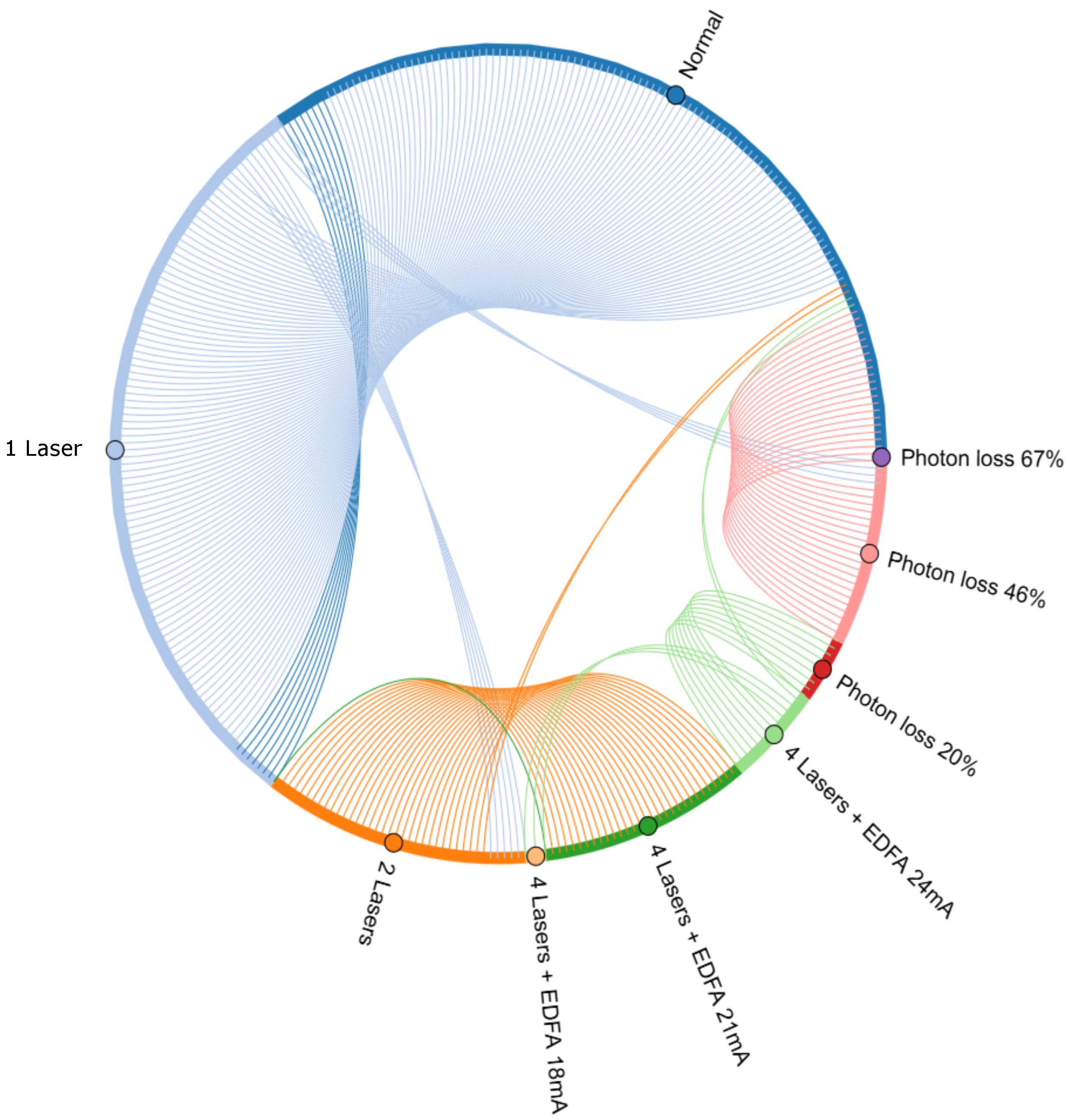
- Luque, A.; Mazzoleni, M.; Carrasco, A.; Ferramosca, A. Visualizing Classification Results: Confusion Star and Confusion Gear. IEEE Access 2022, 10, 1659–1677. [Google Scholar] [CrossRef]



| Class # | Precision | Recall | F1-Score | QBER | SKR | # Data | |
|---|---|---|---|---|---|---|---|
| 0 | Normal | 0.90 | 1.00 | 0.95 | −0.05 (0.18) | 1.08 (0.16) | 4064 |
| 1 | 1 laser | 0.88 | 0.27 | 0.41 | −0.03 (0.04) | 1.04 (0.05) | 395 |
| 2 | 2 lasers | 0.93 | 0.77 | 0.85 | 0.28 (0.07) | 0.85 (0.07) | 466 |
| 3 | 4 lasers and EDFA (18 mA) | 0.98 | 1.00 | 0.99 | 0.29 (0.03) | 0.77 (0.04) | 392 |
| 4 | 4 lasers and EDFA (21 mA) | 0.96 | 0.99 | 0.98 | 0.3 (0.02) | 0.83 (0.04) | 2070 |
| 5 | 4 lasers and EDFA (24 mA) | 1.00 | 0.87 | 0.93 | 0.17 (0.03) | 0.87 (0.04) | 353 |
| 6 | Photon loss 20% | 0.96 | 1.00 | 0.98 | 0.17 (0.03) | 0.82 (0.04) | 1067 |
| 7 | Photon loss 46% | 0.99 | 0.93 | 0.96 | 0.01 (0.03) | 0.96 (0.06) | 1529 |
| 8 | Photon loss 67% | 1.00 | 1.00 | 1.00 | 0.14 (0.03) | 0.82 (0.04) | 1629 |
| Accuracy | 0.95 | ||||||
| Macro average | 0.96 | 0.87 | 0.89 |
| Actual\Predicted | Class 0 | Class 1 | Class 2 | Class 3 | Class 4 | Class 5 | Class 6 | Class 7 | Class 8 |
|---|---|---|---|---|---|---|---|---|---|
| Class 0 | 1049 | 8 | 0 | 0 | 0 | 0 | 0 | 0 | 0 |
| Class 1 | 89 | 33 | 6 | 0 | 0 | 0 | 0 | 4 | 0 |
| Class 2 | 2 | 0 | 79 | 0 | 30 | 0 | 0 | 0 | 0 |
| Class 3 | 0 | 0 | 0 | 91 | 0 | 0 | 0 | 0 | 0 |
| Class 4 | 0 | 0 | 1 | 0 | 607 | 0 | 0 | 0 | 0 |
| Class 5 | 2 | 0 | 0 | 3 | 0 | 100 | 9 | 0 | 0 |
| Class 6 | 0 | 0 | 0 | 0 | 0 | 0 | 270 | 0 | 0 |
| Class 7 | 21 | 0 | 0 | 0 | 0 | 0 | 0 | 384 | 1 |
| Class 8 | 0 | 0 | 0 | 0 | 0 | 0 | 0 | 0 | 414 |
Disclaimer/Publisher’s Note: The statements, opinions and data contained in all publications are solely those of the individual author(s) and contributor(s) and not of MDPI and/or the editor(s). MDPI and/or the editor(s) disclaim responsibility for any injury to people or property resulting from any ideas, methods, instructions or products referred to in the content. |
© 2024 by the authors. Licensee MDPI, Basel, Switzerland. This article is an open access article distributed under the terms and conditions of the Creative Commons Attribution (CC BY) license (https://creativecommons.org/licenses/by/4.0/).
Share and Cite
Maragkopoulos, G.; Mandilara, A.; Nikas, T.; Syvridis, D. Real-Time Diagnostics on a QKD Link via QBER Time-Series Analysis. Entropy 2024, 26, 922. https://doi.org/10.3390/e26110922
Maragkopoulos G, Mandilara A, Nikas T, Syvridis D. Real-Time Diagnostics on a QKD Link via QBER Time-Series Analysis. Entropy. 2024; 26(11):922. https://doi.org/10.3390/e26110922
Chicago/Turabian StyleMaragkopoulos, Georgios, Aikaterini Mandilara, Thomas Nikas, and Dimitris Syvridis. 2024. "Real-Time Diagnostics on a QKD Link via QBER Time-Series Analysis" Entropy 26, no. 11: 922. https://doi.org/10.3390/e26110922
APA StyleMaragkopoulos, G., Mandilara, A., Nikas, T., & Syvridis, D. (2024). Real-Time Diagnostics on a QKD Link via QBER Time-Series Analysis. Entropy, 26(11), 922. https://doi.org/10.3390/e26110922