1. Introduction
Observations collected over time or space are usually correlated rather than independent. Time series are often observed with data irregularities such as missing values or detection limits. For instance, a monitoring device may have a technical detection limit and it records the limit value when the true value exceeds/precedes the detection limit. Such data is called censored (type 1) data and are common in environmental monitoring, physical sciences, business and economics. In particular, in the context of time series of counts, censored data arise in call centers. In fact, the demand measured by the number of calls is limited by the number of operators. When the number of calls is higher than the number of operators the data is right censored and the call center incurs under-staffing and poor service to the costumers.
The main consequence of neglecting censoring in the time series analysis is the loss of information that is reflected in biased and inconsistent estimators and altered serial correlation. These consequences can be summarized as problems in inference that lead to model misspecification, biased parameter estimation, and poor forecasts.
These problems have been solved in regression settings (i.i.d.) and partially solved for Gaussian time series (see for instance [
1,
2,
3,
4,
5,
6,
7]). However, the problem of modelling time series under censoring in the context of time series of counts has, as yet, received little attention in the literature even though its relevance for inference. Count time series occur in many areas such as telecommunications, actuarial science, epidemiology, hydrology and environmental studies where the modelling of censored data may be invaluable in risk assessment.
In the context of time series of counts, Ref. [
8] deal with correlated under-reported data through INAR(1)-hidden Markov chain models. A naïve method of parameter estimation was proposed, jointly with the maximum likelihood method based on a revised version of the forward algorithm. Additionally, Ref. [
9] propose a random-censoring Poisson model for under-reported data, which accounts for the uncertainty about both the count and the data reporting processes.
Here, the problem of modelling count data under censoring is considered under a Bayesian perspective. In this paper, we consider a general class of convolution closed infinitely divisible (CCID) models as proposed by [
10].
We investigate two natural approaches to analyse censored convolution closed infinitely divisible models of first order, CCID(1), using the Bayesian framework: the Approximate Bayesian Computation (ABC) methodology and the Gibbs sampler with Data Augmentation (GDA).
Since the CCID(1) under censoring presents an intractable likelihood, we resort to the Approximate Bayesian Computation methodology for estimating the model parameters. The presupposed model is simulated by using sample parameters taken from the prior distribution, then a distance between the simulated dataset and the observations is computed and when the simulated dataset is very close to the observed, the corresponding parameter samples are accepted as part of the posterior.
In addition, a widely used strategy to deal with censored data is to fill in censored data in order to create a data-augmented (complete) dataset. When the data-augmented posterior and the conditional pdf of the latent process are both available in a tractable form, the Gibbs sampler allows us to sample from the posterior distribution of the parameters of the complete dataset. This methodology is called Gibbs sampler with Data Augmentation (GDA). Here, a modified GDA, in which the data augmentation is achieved by multiple sampling of the latent variables from the truncated conditional distributions (GDA-MMS), is adopted.
The Poisson integer-valued autoregressive models of first-order, PoINAR(1), is one of the most popular classes of CCID models. It was proposed by [
11,
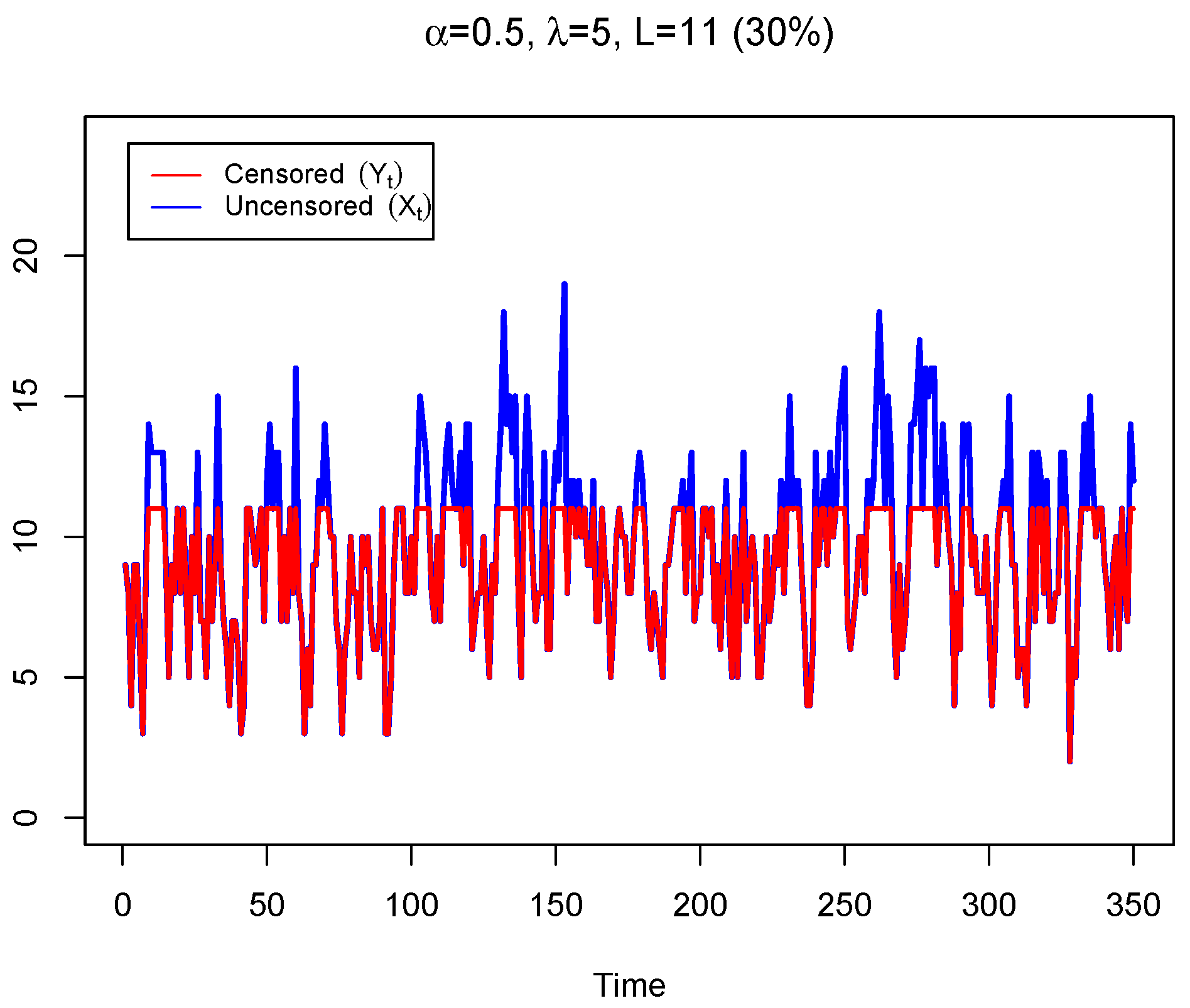
12] and extensively studied in the literature and applied to many real-world problems because of its ease of interpretation. To motivate the proposed approaches, we present in
Figure 1 a synthetic dataset with
observations generated from a PoINAR(1) process with parameters
and
(
blue line) and the respective right-censored dataset (
red line), at
corresponding to 30% of censoring. If we disregard the censoring, the estimates for the parameters (assuming an PoINAR(1) model without censoring) present a strong bias. For instance, in the frequentist framework, the conditional maximum likelihood estimates are
and
while in the Bayesian framework, the Gibbs sampler gives
and
On the other hand, if we assume a PoINAR(1) model under censoring, the parameter estimates given by the proposed approaches described in this work are, respectively,
and
and
and
Therefore, it is important to consider the censoring in data in order to avoid some inference issues that lead to a poor time series analysis.
The remainder of this work is organized as follows.
Section 2 presents a general class of convolution closed infinitely divisible (CCID) models under censoring. Two Bayesian approaches proposed to estimate the parameters of the censored CCID(1) model are described in
Section 3. The proposed methodologies are illustrated and compared with synthetic data in
Section 4. Finally,
Section 5 concludes the paper.
3. Bayesian Modelling
The Bayesian approach to the inference of an unknown parameter vector
is based on the posterior distribution
defined as
where
is the likelihood function of the observed data
and
is the prior distribution of the model parameters.
When the likelihood is computationally prohibitive or even impossible to handle, but it is feasible to simulate samples from the model (bypass the likelihood evaluation), as is the case of censored CCID(1) processes, Approximate Bayesian Computation (ABC) algorithms are an alternative. This methodology accepts the parameter draws that produce a match between the observed and the simulated sample, depending on a set of summary statistics, a chosen distance and a selected tolerance. The accepted parameters are then used to estimate (an approximation of) the posterior distribution (conditioned on the summary statistics that afforded the match).
On the other hand, the idea of imputation arises naturally in the context of censored data. The Gibbs sampler with Data Augmentation (GDA) allows us to obtain an augmented dataset from the censored data by using a modified version of the Gibbs sampler, which samples not only the parameters of the model from its complete conditional but also the censored observations. The usual inference procedures may then be applied to the augmented data set.
3.1. Approximate Bayesian Computation
Approximate Bayesian Computation (ABC) is based on an acceptance–rejection algorithm. ABC is used to compute a draw from an approximation of the posterior distributions, based on simulated data obtained from the assumed model in situations where its likelihood function is intractable or numerically difficult to handle. Summary statistics from the synthetic data are compared with the corresponding statistics from the observed data and a parameter draw is retained when there is a match (in some sense) between the simulated sample and the observed time series observation.
Recently, Ref. [
16] provided the asymptotic results pertaining to the ABC posterior, such as Bayesian consistency and asymptotic distribution of the posterior mean.
Let
be the fixed (observed) data and
the model from which the data is generated. The most basic
approximate acceptance/rejection algorithm, based on the works of [
17,
18], is as follows:
draw a value from the prior distribution,
simulate a sample from the model
accept if for some distance measure and some non-negative tolerance value where is a summary statistic and is a fixed value.
It is well known that, if we use a proper distance measure, then as
tends to zero, the distribution of the accepted values tends to the posterior distribution of the parameter given the data. When the summary statistics are sufficient for the parameter, then the distribution of the accepted values tends to the true posterior as
tends to zero, assuming a proper distance measure on the space of sufficient statistics. The latent structure of the thinning operator means that the reduction to a sufficient set of statistics of dimension smaller than the sample size is not feasible and, therefore, informative summary statistics are often used [
19].
In this work, given the characteristics of the data under study to compare the observed data () and the synthetic (simulated ) data (), we consider two distinctive characteristics of CCID(1) time series which are affected by the censoring: (i) the empirical marginal distribution and (ii) lag 1 auto-correlation.
To measure the similarity between the empirical marginal distributions the Kullback-Leibler (Note that Kullback-Leibler distance measures the dissimilarity between two probability distributions.) distance is calculated as
where
and
denote the empirical marginal distribution of the observed time series and that of the simulated time series, respectively, estimated by the corresponding sample proportions,
Whenever
is zero, the contribution of the
jth term is interpreted as zero because
.
On the other hand, lag 1 sample autocorrelations, and are compared by their squared difference.
Additionally, we estimated the censoring rates, and which are also compared by their squared difference.
Thus, for each set of parameters,
, a time series
is generated from the model CCID(1) and right censored at
L, yielding
and the above statistics,
and
are computed. Combining these statistics in a metric leading to the choice of the parameters
requires scaling. Thus, we propose the following metric
where
and
are the
statistics obtained respectively from the observed and
simulated data and
and
are the corresponding sample variances across the replications.
In summary, we propose Algorithm 1 for ABC approach based on [
20]:
| Algorithm 1 ABC for censored CCID(1) |
| For |
| Sample from the prior distribution |
| Generate a time series with n observations, from the CCID(1) model |
| Right truncate at L to obtain the simulated data |
| Compute and |
| Compute , |
| Select the values corresponding to the 0.1% quantile of |
Implementation issues regarding the prior distributions and the number of draws
N for the CensPoINAR(1) model are addressed in
Section 3.3 and
Section 4.1.
3.2. Gibbs Sampler with Data Augmentation
Gibbs sampling is a Markov chain Monte Carlo (MCMC) algorithm that can generate samples of the posterior distribution from their full conditional distributions [
21]. When the data are under censoring or there are missing values, both cases leading to an incomplete data set, Ref. [
22] proposed to combine the Gibbs sampler with data augmentation. This methodology implies imputing the censored (or missing) data, thus obtaining a complete dataset, and then dealing with the posterior of the complete data through the iterative Gibbs sampler. Therefore, the Gibbs sampler is modified in order to sample not only the parameters of the model from their complete conditionals but also the censored observations, obtaining an augmented (complete) dataset
where
where
is the truncated marginal distribution of the CCID(1) model with support in
Furthermore, we consider a modified sampling procedure for the imputation, designated as Mean of Multiple Simulation (MMS), proposed by [
23] consisting in sampling from
multiple times, say
and then imputing with the (nearest integer value) median of the
m samples. This procedure is designated by
GDA-MMS.
The augmented dataset can be considered as a CCID(1) time series and with a conditional likelihood function given by Equation (
3). The posterior distribution of
is given by
where
is the prior distribution of the parameters. In CCID(1) models the complexity of
requires resorting to Markov Chain Monte Carlo (MCMC) techniques for sampling from the full conditional distributions. The procedure is summarized in Algorithm 2 and detailed for the CensPoINAR(1) case in
Section 3.3 and
Section 4.1.
| Algorithm 2 GDA-MMS for censored CCID(1) |
| Initialize with , , , and |
| Set |
| For |
| Sample ( represents the vector with the ith element |
| removed.), |
| For |
| If |
| For |
| Sample |
| |
| Else |
| |
| Return and . |
3.3. The Particular Case of CensPoINAR(1)
This section details the ABC and GDA-MMS procedures to estimate a censored CCID(1) with the binomial thinning operation and Poisson marginal distribution, the censored Poisson INAR(1), CensPoINAR(1), model.
Consider the censored observations
from a PoINAR(1) time series
defined as
with
and
Then
and given
, the conditional likelihood function is given by
Under a Bayesian approach, we need a prior distribution for In the absence of prior information, we use weakly informative prior distributions for detailed below.
3.3.1. ABC for Censored PoINAR(1)
The ABC procedure described in Algorithm 1 is now implemented for the censored PoINAR(1). For the parameter , we choose a non-informative prior while for the positive parameter , we choose a non-informative The former allows us to explore all the support space for The choice of as a prior for allows us to explore a restricted support for the parameter that is in accordance with small counts.
3.3.2. GDA-MMS for Censored PoINAR(1)
Under the GDA-MMS approach, we first need to obtain a complete data set
by imputing the censored observations, see (
8). In this work, we draw
replicates of the right truncated at
L Poisson distribution with parameter
and set
(
represents the integer ceiling of
c),
if
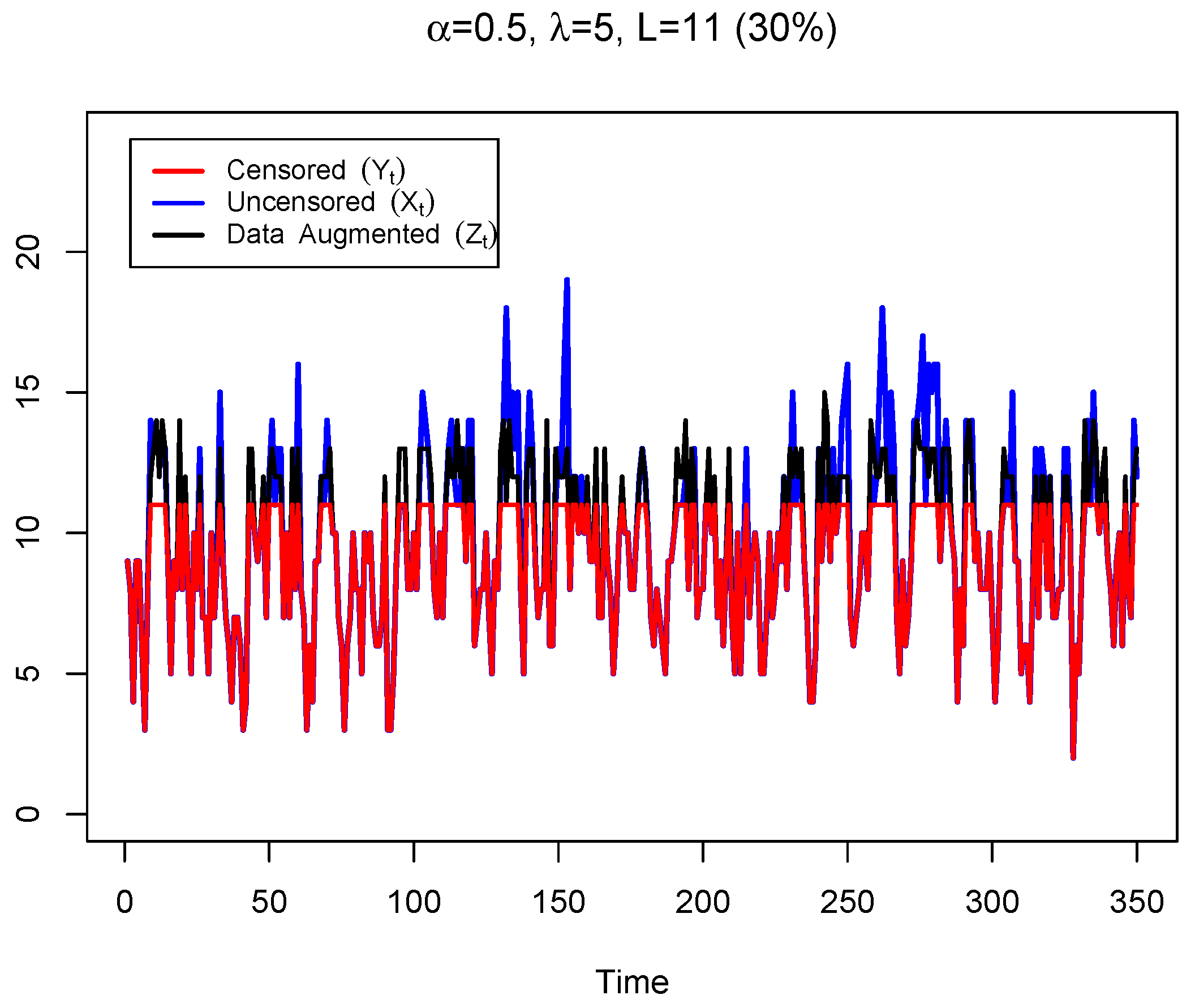
Figure 2 shows an augmented dataset (
black line) from the synthetic data presented in
Figure 1.
As remarked above, given the complexity of the posterior distribution, Markov Chain Monte Carlo techniques are required for sampling from the full conditional distributions. Thus, the Adaptive Rejection Metropolis Sampling (ARMS) is used inside the Gibbs sampler [
24]. Also in this approach, in the absence of prior information, we use weakly informative prior distributions for
. Thus, for the parameter
, we choose a non-informative beta prior, conjugate of the binomial distribution, with parameters
while for the positive parameter
, we choose a non-informative Gamma (shape, rate) prior, conjugate of the Poisson distribution, with parameters
The full conditional of
is given by
where
The full conditional distribution of
is given by
where
The parameters and are computed as the posterior mean.
The GDA-MMS procedure to estimate a censored PoINAR(1) process is detailed in Algorithm 3.
| Algorithm 3 GDA-MMS for CensPoINAR(1) |
| Initialize with , , , and |
| Set |
| For |
| Using ARMS |
| Sample |
| Sample |
| For |
| If |
| For |
| Sample |
| |
| Else |
| |
| Return and . |
4. Illustration
This section illustrates the procedures proposed above to model CCID(1) right-censored time series in the particular case of Poisson distribution and binomial thinning operation.
4.1. Illustration with CensPoINAR(1)
In this section, the performance of the Bayesian approaches previously proposed is illustrated via synthetic data. Thus, realizations with observations of CensPoINAR(1) models were simulated, with parameters and considering for each case two levels of censorship, namely 30% and 5%.
For the ABC estimates, we run
replications and choose the pairs
corresponding to the 0.1% lower quantile of
Equation (
7), in total of 1000 values from which the estimates are computed as the mean value. Software
R [
25] was used to implement the ABC algorithm.
To implement GDA-MMS algorithm we consider the initial values
given by the Conditional Least squares estimates of
and
[
24]. The hyper-parameters for the prior distributions of
and
are the following
and
In this work, the function
armspp was used from the package
armspp [
26] in
R to sample from the full conditional distributions. Several experiments were carried out to analyse the size that the chain should have in order to be stable and, thus, the number of Gibbs sampler iterations used in this work is
N = 15,000. Among these, we ignored the first 5000 simulations as burn-in time and, to reduce autocorrelation between MCMC observations, we considered only simulations from every 30 iterations. Therefore, we use a simulated sample with size 323 to obtain the Bayesian estimates. A convergence analysis with the usual diagnostic tests was performed with the package
coda [
27] in
R [
25].
Table 2 and
Table 3 summarize ABC and GDA-MMS results for the several scenarios described above: point estimates,
and
obtained as sample means, the corresponding bias, standard deviation and the coefficient of variation. The results indicate that the bias tends to decrease for large sample sizes and small censoring rates. The results also indicate that overall ABC presents estimates with smaller bias but larger variability when compared with GDA-MMS.
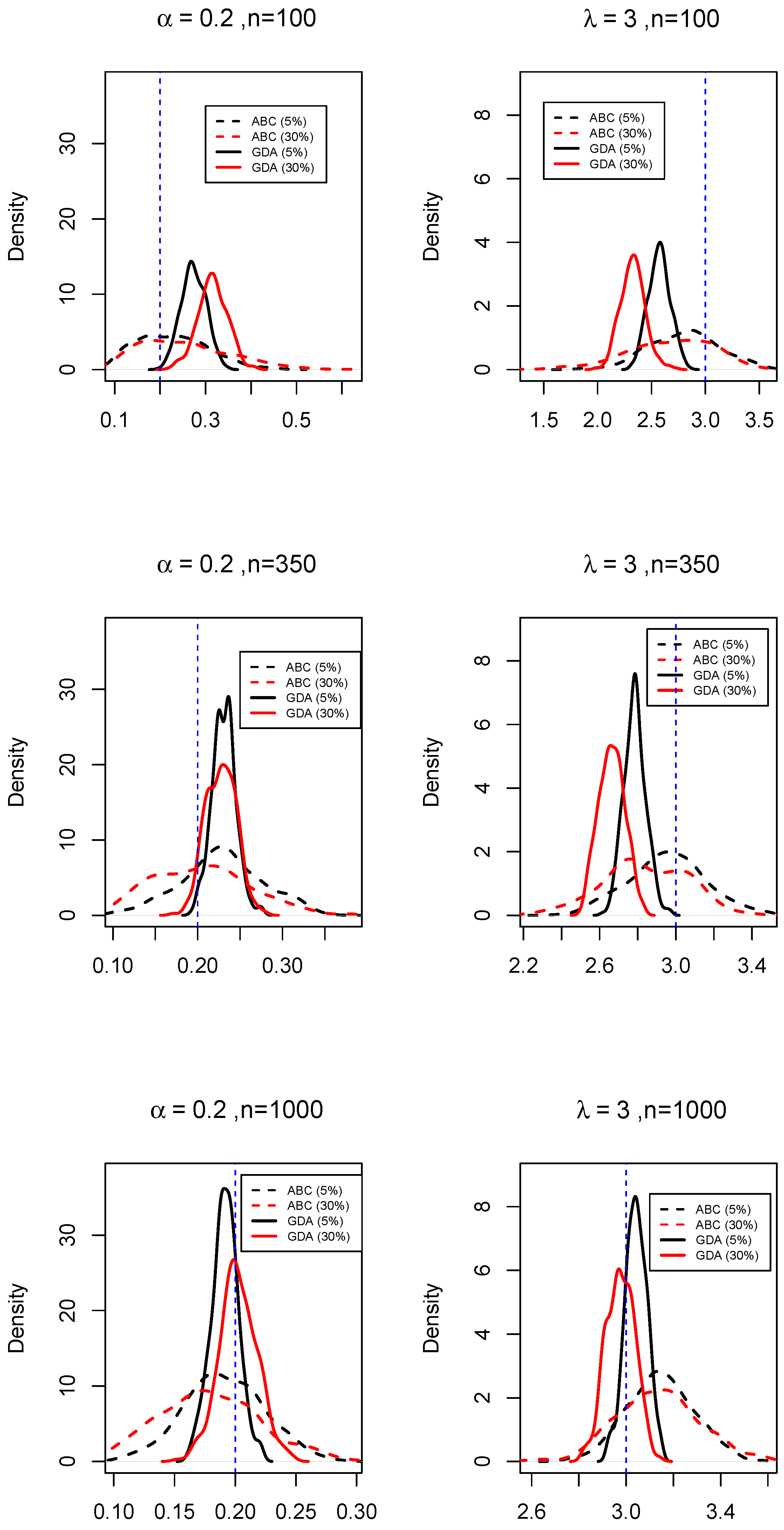
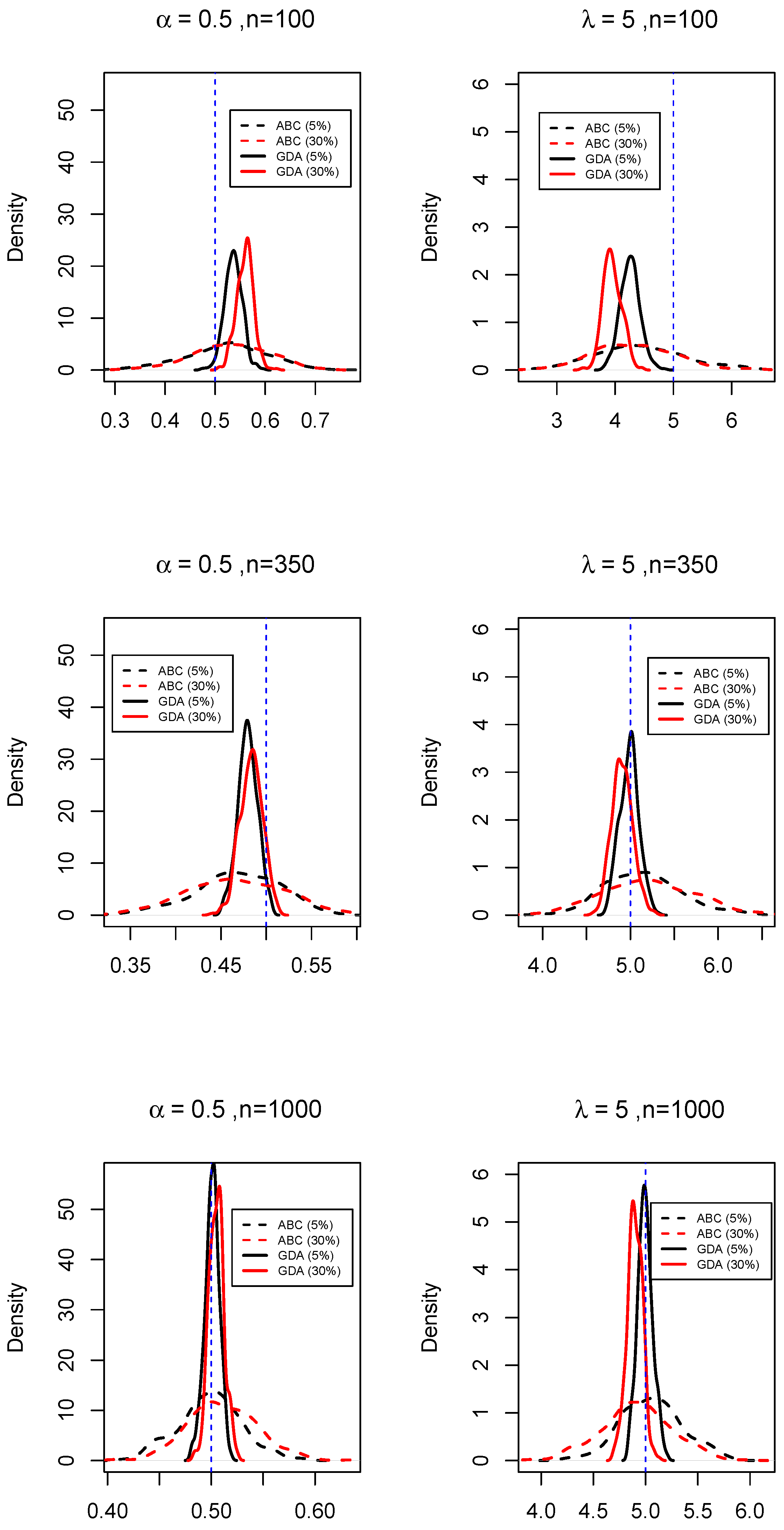
Additionally,
Figure 3 and
Figure 4 represent the corresponding posterior densities. The plots show unimodal and approximately symmetric distributions, with a dispersion that clearly decreases with increasing sample size and smaller censoring rate. The posterior densities indicate that the ABC approach produces posteriors that are flatter but with modes very close to the true value, while the corresponding GDA-MMS approach, despite producing posteriors which are more concentrated also evidence higher bias. However, the behaviour of GDA-MMS estimates varies with the parameters and even the sample sizes. These results are representative of the properties of GDA-MMS estimates across a large number of experiments, not reported here for conciseness.
4.2. Simulation Study for GDA-MMS
This section presents the results of a simulation study designed to further analyse the sample properties of GDA-MMS, in particular the bias of the resulting Bayesian estimates.
For that purpose, realizations with sample sizes and of CensPoINAR(1) models with parameters and are generated, considering two levels of censorship, namely 30% and 5%. To analyse the performance of the procedure, the sample posterior mean, standard deviation and mean squared error were calculated over 50 repetitions.
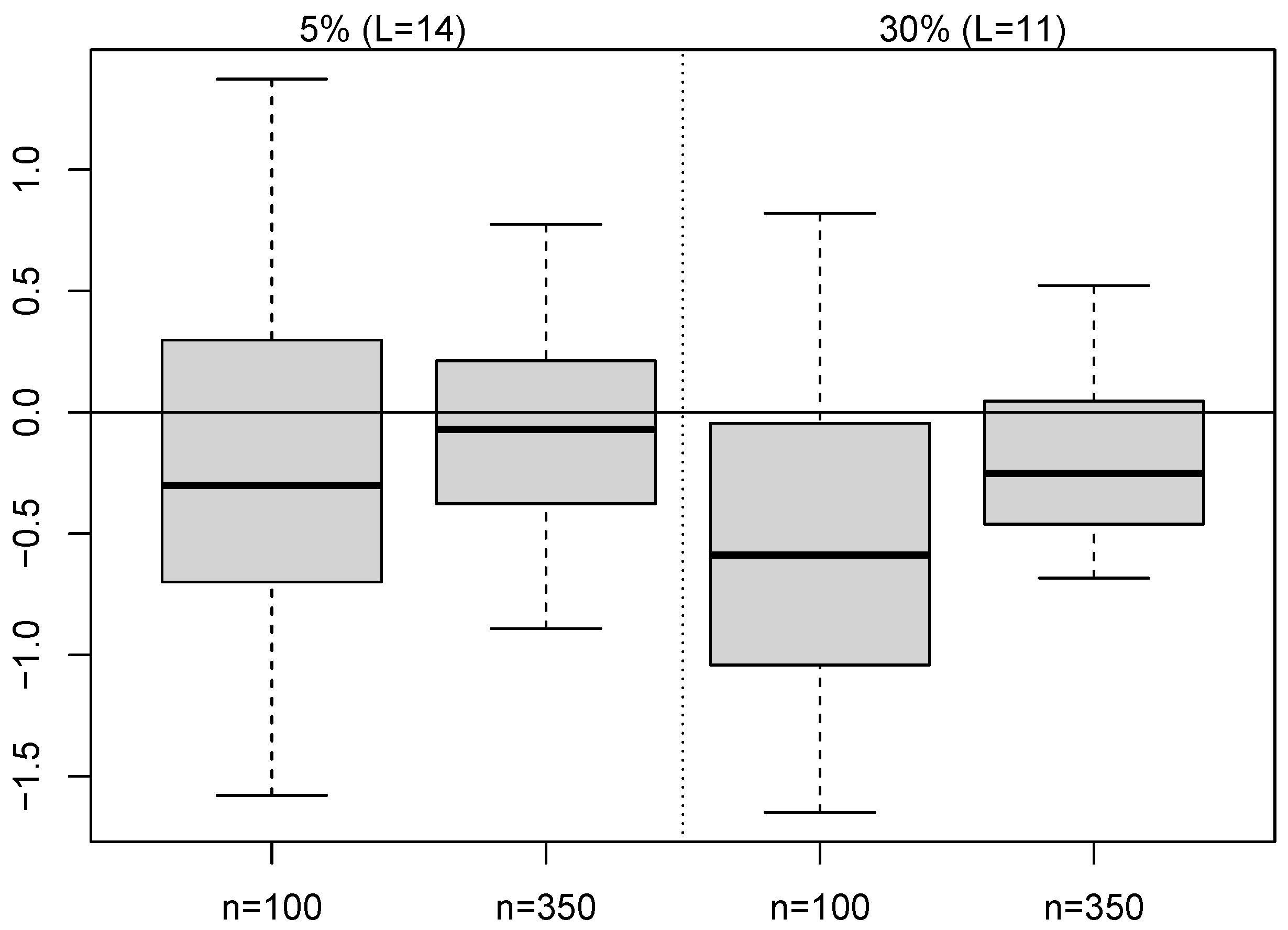
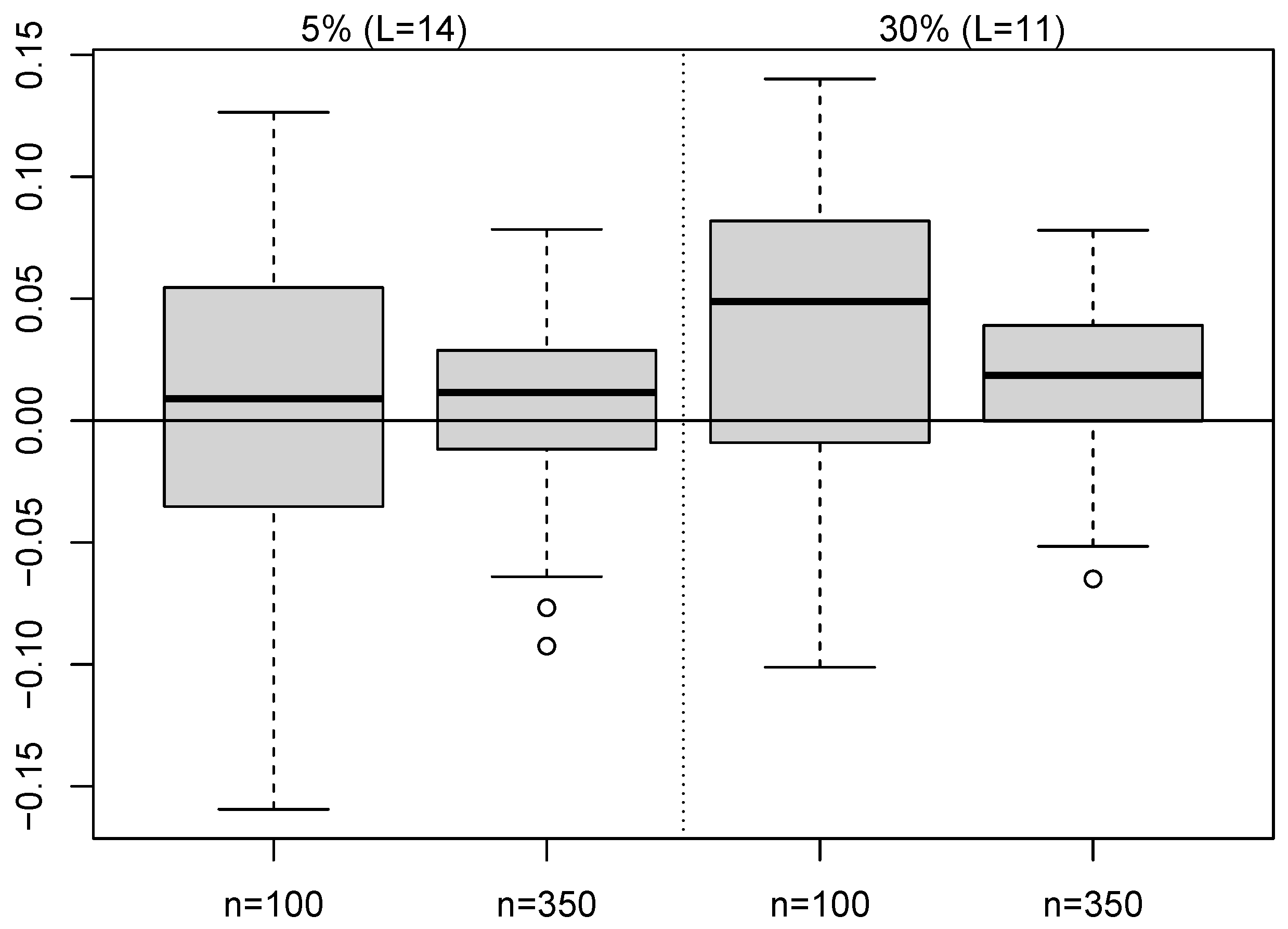
Boxplots of the sample bias for the 50 repetitions of GDA-MMS methodology are presented in
Figure 5 and
Figure 6. The bias increases with the rate of censoring and the variability decreases with the sample size. Furthermore, in general, the estimates for
presents positive sample mean biases, indicating that
is overestimated, whilst the estimates for
shows negative sample biases, indicating underestimation for
Both bias and dispersion seem larger for
Table 4 and
Table 5 present the sample posterior measures for
and
respectively. We can see improvement of the estimation methods performance when the sample size increases. Additionally, the higher the censoring percentage, the worse the behavior of the proposed methods.