


Abstract
The parameters revealing the collective behavior of hadronic matter extracted from the transverse momentum spectra of , , , , p, , , , , or , and or or produced in the most central and most peripheral gold–gold (–), copper–copper (–) and lead–lead (–) collisions at 62.4 GeV, 200 GeV and 2760 GeV, respectively, are reported. In addition to studying the nucleus–nucleus () collisions, we analyzed the particles mentioned above produced in collisions at the same center of mass energies (62.4 GeV, 200 GeV and 2760 GeV) to compare with the most peripheral collisions. We used the Tsallis–Pareto type function to extract the effective temperature from the transverse momentum spectra of the particles. The effective temperature is slightly larger in a central collision than in a peripheral collision and is mass-dependent. The mean transverse momentum and the multiplicity parameter () are extracted and have the same result as the effective temperature. All three extracted parameters in collisions are closer to the peripheral collisions at the same center of mass energy, revealing that the extracted parameters have the same thermodynamic nature. Furthermore, we report that the mean transverse momentum in the – collision is larger than that of the – and – collisions. At the same time, the latter two are nearly equal, which shows their comparatively strong dependence on energy and weak dependence on the size of the system. The multiplicity parameter, in central , depends on the interacting system’s size and is larger for the bigger system.
Keywords:
identified; strange; effective temperature; mass-dependent; transverse momentum spectra; mean transverse momentum PACS:
12.40.Ee; 13.85.Hd; 25.75.Ag; 25.75.Dw; 24.10.Pa
1. Introduction
The study of identified and strange particles in high-energy collisions is fundamental. The former allows the disquisition of the particle production mechanisms in a superhot and dense nuclear matter and explores the features of the quark–gluon plasma (QGP). On the other hand, the strange particles are a magnificent probe to identify the phase boundary of the onset of the deconfinement. The transverse momentum () spectra of identified particles are one of the pillars of significant discoveries in high-energy physics [1,2,3,4]. According to [5,6], the shape of the spectra is sensitive to the dynamic of nucleus–nucleus collisions and may be used to get the radial flow and the temperature at freeze-out. Additionally, the hadrons with strange content are argued to have smaller hadronic interaction cross-sections and may decouple earlier from the system compared to nonstrange particles [1,5,6]. In this way, the hadrons with strange content would carry direct information from the collisions at an earlier stage without dilution due to hadronic scattering at a late stage. The particles with a lower cross-section interaction are supposed to freeze out early [7,8]. However, other studies [9,10] claim that the decoupling of the particles depends on their mass such that massive particles decouple early from the system. In other works [11,12,13,14,15,16], the decoupling scenarios of different particles are different, including the single decoupling scenario in which all particles are decoupled at the same time, the double-decoupling scenario in which strange and nonstrange particles are decoupled separately, and each particle’s multiple decoupling scenarios for decoupling from the system, respectively. This is an open question up to now in the community. There are two types of freeze-out/decoupling after the fireball expansion. The system cools down as it expands, and the quarks and gluons become reconfined and hadronized. Two other transitions, chemical freeze-out and kinetic freeze-out, happen along the way. The former occurrence is very close to the phase transitions line. It is marked by the system’s temperature becoming low enough for inelastic interactions between the particles to stop. The net yield of all the particles gets fixed at this point. For some time, the particles still experience the elastic collision, and this elastic collision stops when the system expands enough, at the kinetic freeze-out. The particles’ interactions end at this stage and their transverse momentum spectra () get fixed. It should be noted that the freeze-out scenarios discussed above refer to kinetic decoupling, and we keep the focus of the present work on kinetic decoupling because we are studying the final state particles.
Indeed, the system evolution undergoes several stages, corresponding to different temperatures, as seen from the above discussion. The initial collision is the first stage of the system evolution, which corresponds to the initial temperature and describes the system’s characteristics at the initial stage. There is also another kind of temperature called the effective temperature, and it occurs just before the kinetic freeze-out temperature, which includes the flow effect. The details of these temperatures can be found in [17,18,19,20,21]. The present work is focused on the effective temperature, and we shall extract it from the transverse momentum spectra of the particles in different collisions.
The particles’ transverse momentum () spectra are essential because they give the particulars about [22] the transverse excitation degree and dynamic expansion of the collision system. This paper studied the identified and strange particles in –, – and – collisions at 62.4, 400 and 2760 GeV. We also analyzed the identical particles in collisions at the exact center of mass energy to compare the results of collisions with collisions.
2. The Method and Formalism
It is believed that a few emission sources are formed in high-energy collisions according to the multithermal source model [23,24,25,26]. For nuclear fragments and for the other produced particles (such as identified, strange and charmed particles) from the target and projectile in nucleus–nucleus collisions, the sources for the former may be nucleon or nucleon clusters. In contrast, the seeds for the latter may be the participant quarks or gluons, although the contributors can be from the gluon fusion. Different statistics such as Fermi–Dirac, Bose–Einstein, Boltzmann–Gibbs and Tsallis statistics can describe the properties of sources. The above statistics have relations with each other because they may result in similar or different distributions while describing the spectra of the produced hadrons.
The Boltzmann–Gibbs statistic describes the transverse momentum spectra of the particles in a narrow range, while the Tsallis statistic describes a wider range, although it is derived from the former [27,28,29]. In fact, the Boltzmann–Gibbs statistic is a special case of the Tsallis distribution in which entropy . For the parameterization of the final state hadrons, the Tsallis distribution is widely used in high-energy collisions from lower to higher energies (such as from a few GeV to 13 TeV). The form of the Tsallis distribution [30,31,32,33,34,35,36] is expressed as
where E denotes the energy, and p, N and y are the momentum, number of particles and rapidity, respectively. is the transverse mass and can be represented as = [37,38,39,40,41,42], and is the rest mass of the particle. T is the effective temperature, and n is the power index, particularly , where q describes the degree of equilibrium. The emission source is more equilibrated if is closer to 1 (it has a larger value).
Nonextensive thermodynamics is a new method for studying the heavy-ion collisions at relativistic energy. The Tsallis–Pareto function [42,43,44,45,46,47] can be used for fitting transverse momentum spectra in low as well as in intermediate regions, especially in the hadronization process, and demonstrates an impressive relation among hadrons. The distribution of the Tsallis–Pareto function can be expressed as
The present work is a continuation of our work published in [16,48,49,50,51,52,53,54,55,56] using different statistical fit functions to extract parameters relevant to the collective properties of the hadronic medium.
3. Results and Discussion
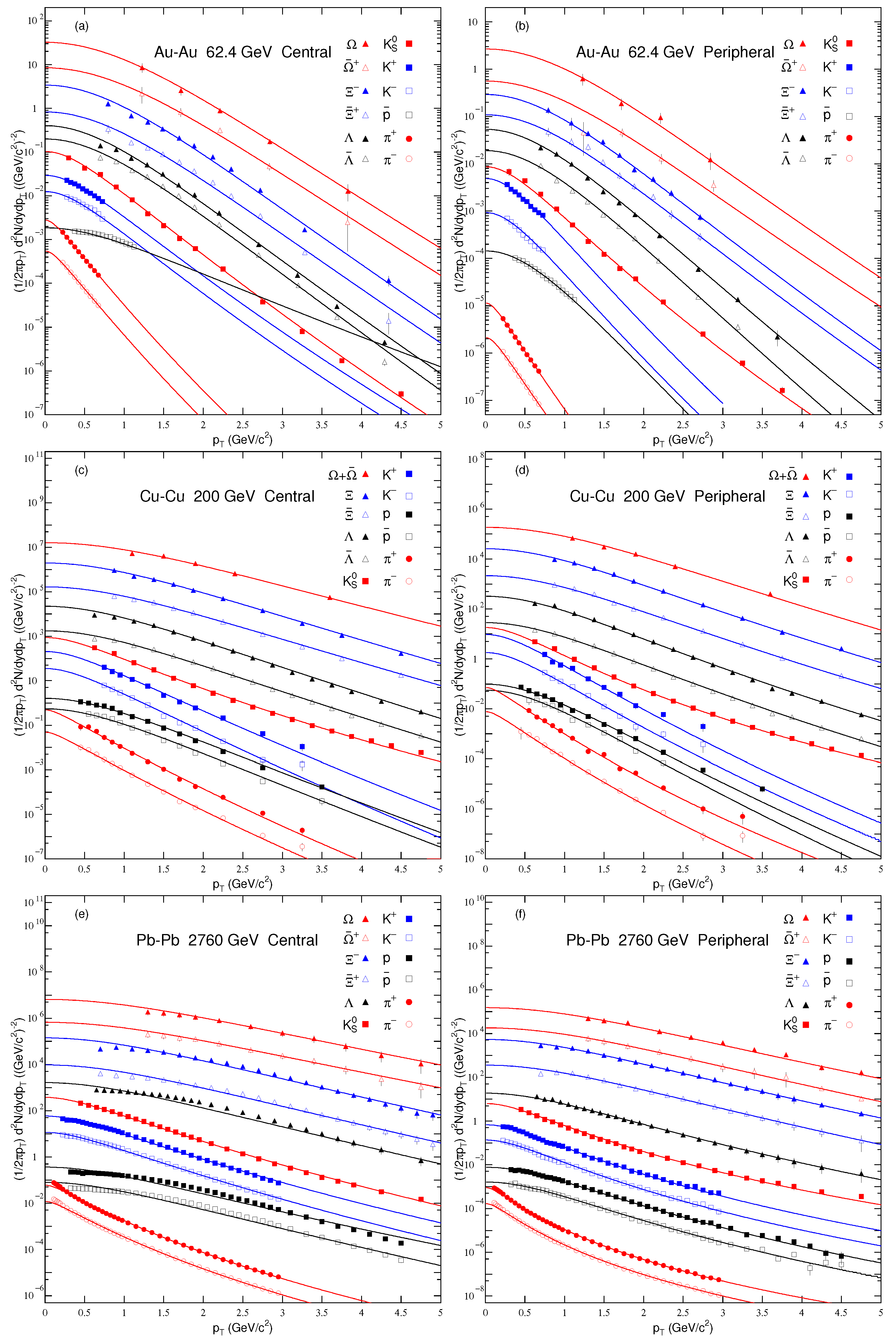
The transverse momentum spectra () of , , , , p, , , , or and or or produced in the most central and peripheral nucleus–nucleus collisions are displayed in Figure 1. Panels (a) and (b) show the spectra of the nonstrange and strange particles in collisions at GeV, while panels (c) and (d) show the spectra of these mentioned particles in – collisions at GeV. Panels (e) and (f) represent the spectra of nonstrange and strange particles in – collisions at GeV. The rapidity for , , , , p and in panels (a) and (b) is . Similarly, for , , , , , and , . Similarly, the rapidity for all the particles, as mentioned earlier in panels (c)–(f) is . The symbols are used to display the experimental data from the BRAHMS Collaboration [57], STAR Collaboration [29,58,59] and ALICE Collaboration [60,61], and the curves over the data are our fit results by using the Tsallis–Pareto type function. It can be seen that Equation (2) fits the data approximately well. Different symbols represent different particles. The filled and open symbols show the positive and negative charged particles.
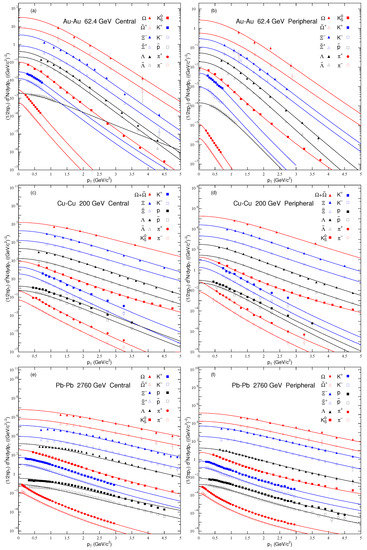
Figure 1.
Transverse momentum spectra of nonstrange and strange particles produced in –, – and – collisions at 62.4 GeV in panels (a,b), at 200 GeV in panels (c,d) and at 2760 GeV in panels (e,f), respectively. The symbols represent the experimental data measured by the BRAHMS Collaboration [57], STAR Collaboration [29,58,59] and ALICE Collaboration [60,61]. The lines are the fits from Equation (2).
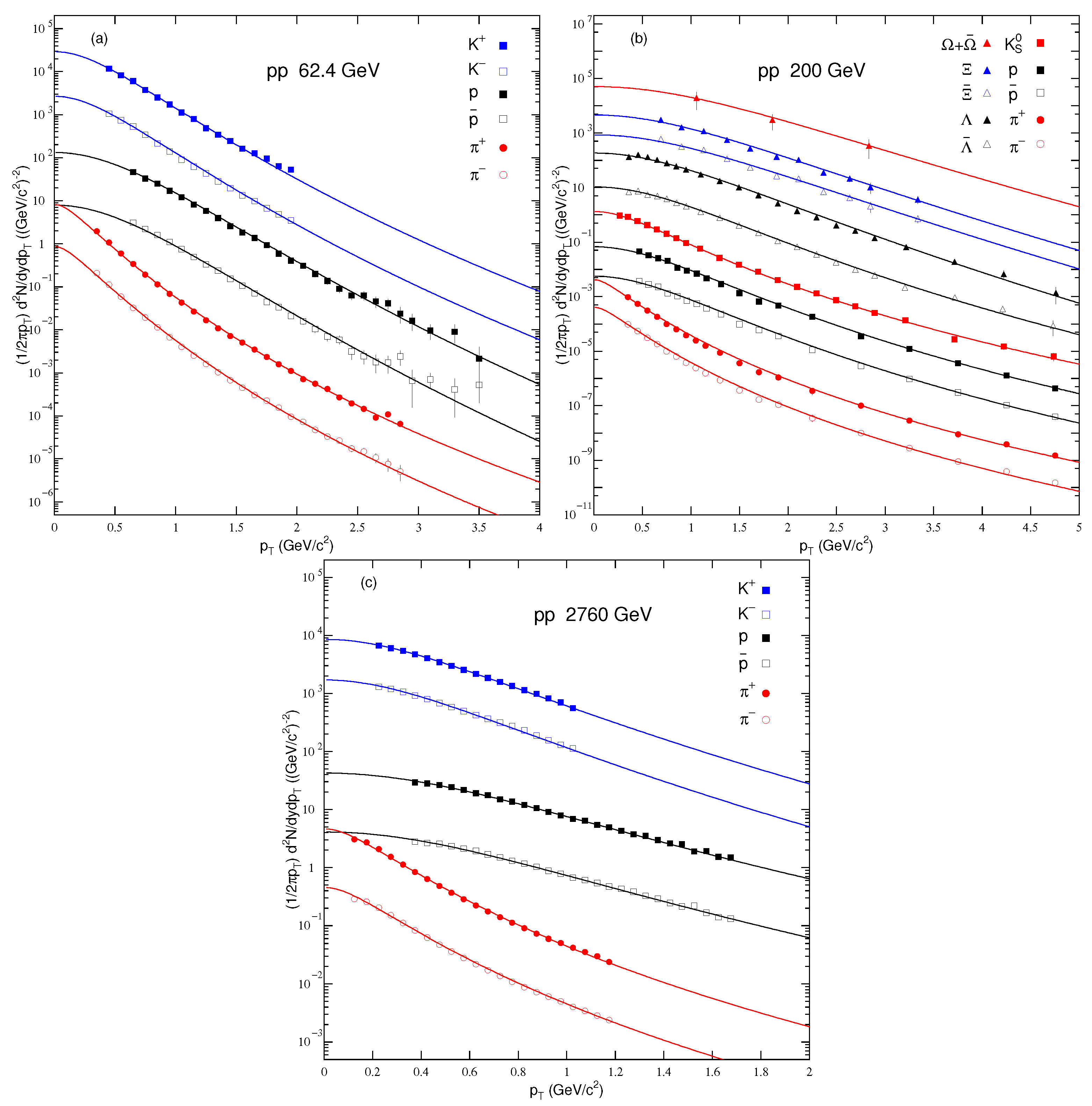
Figure 2 is similar to Figure 1, but it shows the transverse momentum spectra of the particles in p–p collisions at 62.4, 200 and 2760 GeV in panels (a)–(c), respectively. Panel (a) presents the transverse momentum spectra of , , , , p and , while panel (b) presents the transverse momentum spectra of , , , , p, , , , , , and , and panel (c) displays the transverse momentum spectra of , , , , p and . Different symbols represent different particles. The symbols are used to display the experimental data from the PHENIX Collaboration [37], STAR Collaboration [29,38,62] and CMS Collaboration [42], and the curves over the data are our fit results by Equation (2). The filled and open symbols show the positive and negative charged particles, respectively. The related extracted parameters, along with and degree of freedom (DOF) are listed in Table 1. One can see that Equation (2) fits the data well in collisions at 62.4, 200 and 2760 GeV at the RHIC and LHC.
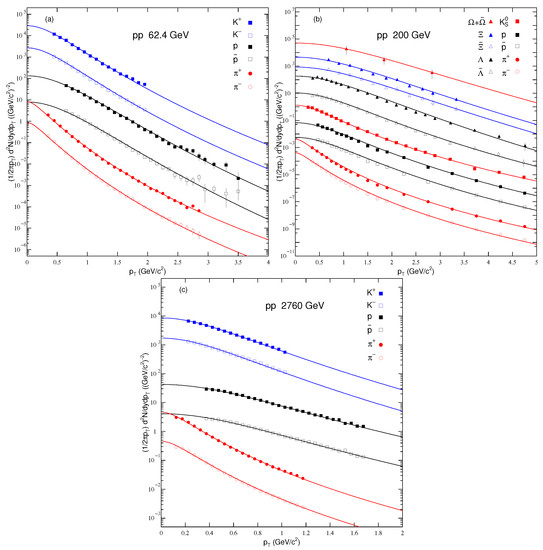
Figure 2.
Transverse momentum spectra of identified and strange particles in collisions at (a) 62.4, (b) 200 and (c) 2760 GeV.The symbols represent the experimental data measured by the PHENIX Collaboration [37], STAR Collaboration [29,38,62] and CMS Collaboration [42]. The lines are the fits from Equation (2).

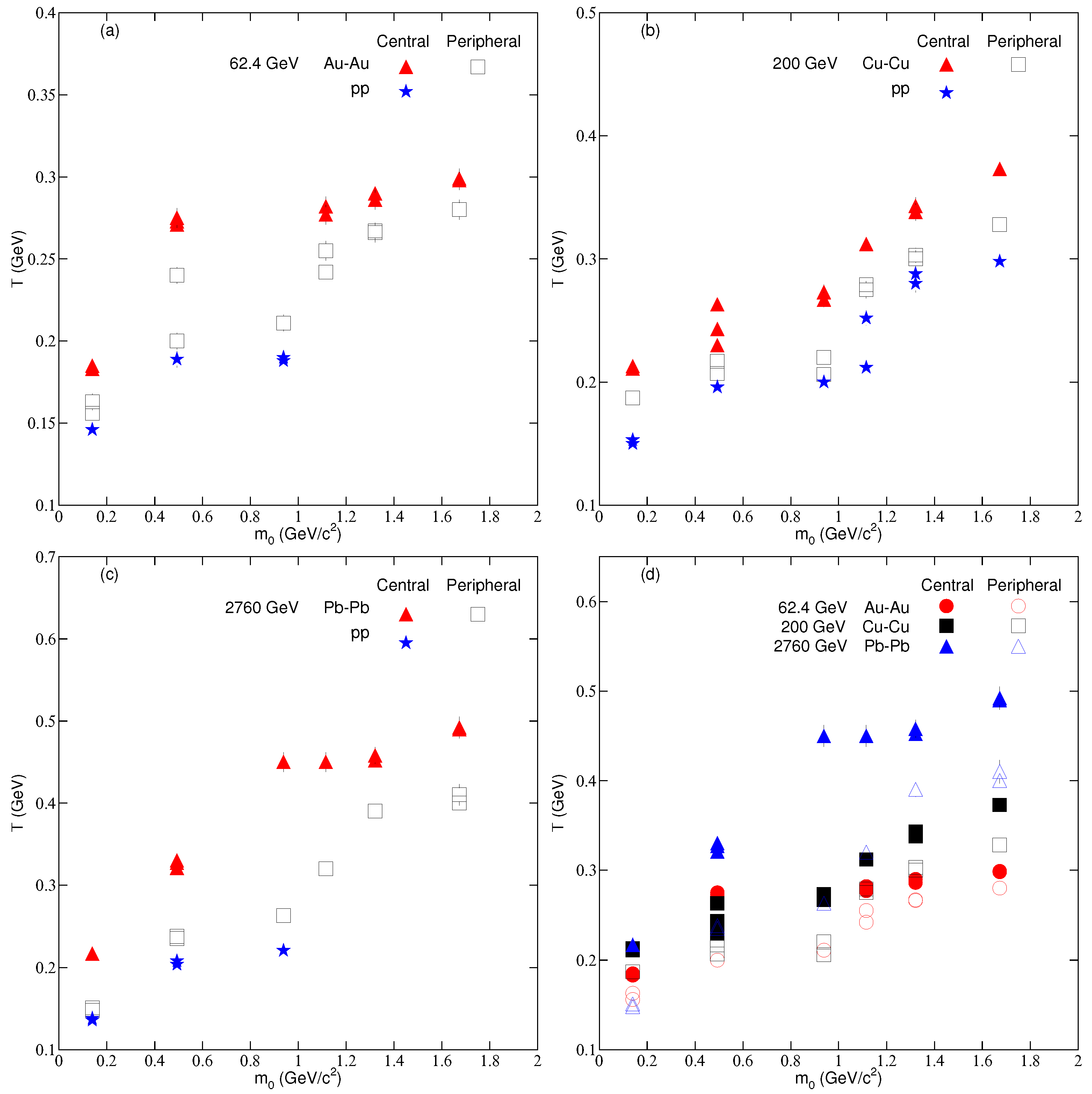
Figure 3 shows the result of the dependence of T on and centrality. Different symbols are used to represent different collisions. Filled and empty symbols show the central and peripheral collisions, respectively, and the blue-colored star symbols denote the collisions. The symbols from left to right show the mass dependence of the parameters. One can see that T is slightly larger in the central collisions compared to the peripheral collisions because there is a large number of participants in the former, which makes the reaction very intense, and thus more energy is stored in the former. These results validate our recent results [16,18,48,49]. In addition, T in collisions are also shown, which is slightly lower than or approximately equal to that in peripheral collisions at the same center of mass energy. We also note that T in and collisions increases with increasing , which shows a differential freeze-out scenario that validates our previous results [17,20,53,54,56]. T is the temperature which includes the contribution of both the kinetic freeze-out temperature and radial flow; therefore, the freeze-out refers to the kinetic freeze-out. Different Ts for different particles indicate that the scenario of the decoupling of the particles is a multiple-kinetic-decoupling scenario. In the present work, different collision systems with different center of mass energies were considered to check the system size and energy dependence of T. Still, we did not report any specific dependence of T on either.
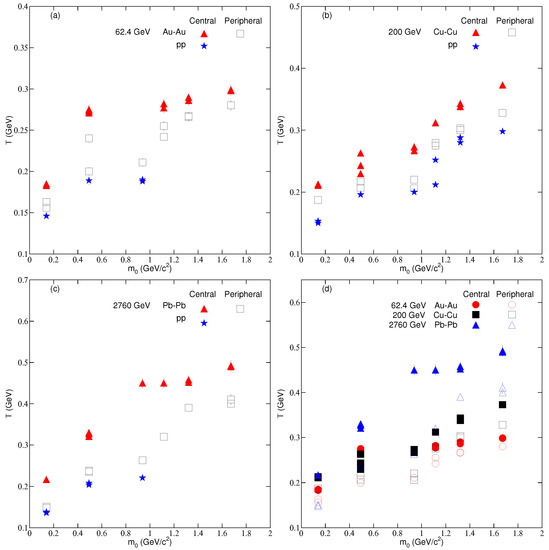
Figure 3.
Dependence of the effective temperature on centrality and mass of the particles in nucleus–nucleus and collisions at (a) 62.4 GeV (b) 200 GeV (c) 2760 GeV and (d) (62.4, 200, and 2760) GeV energies.
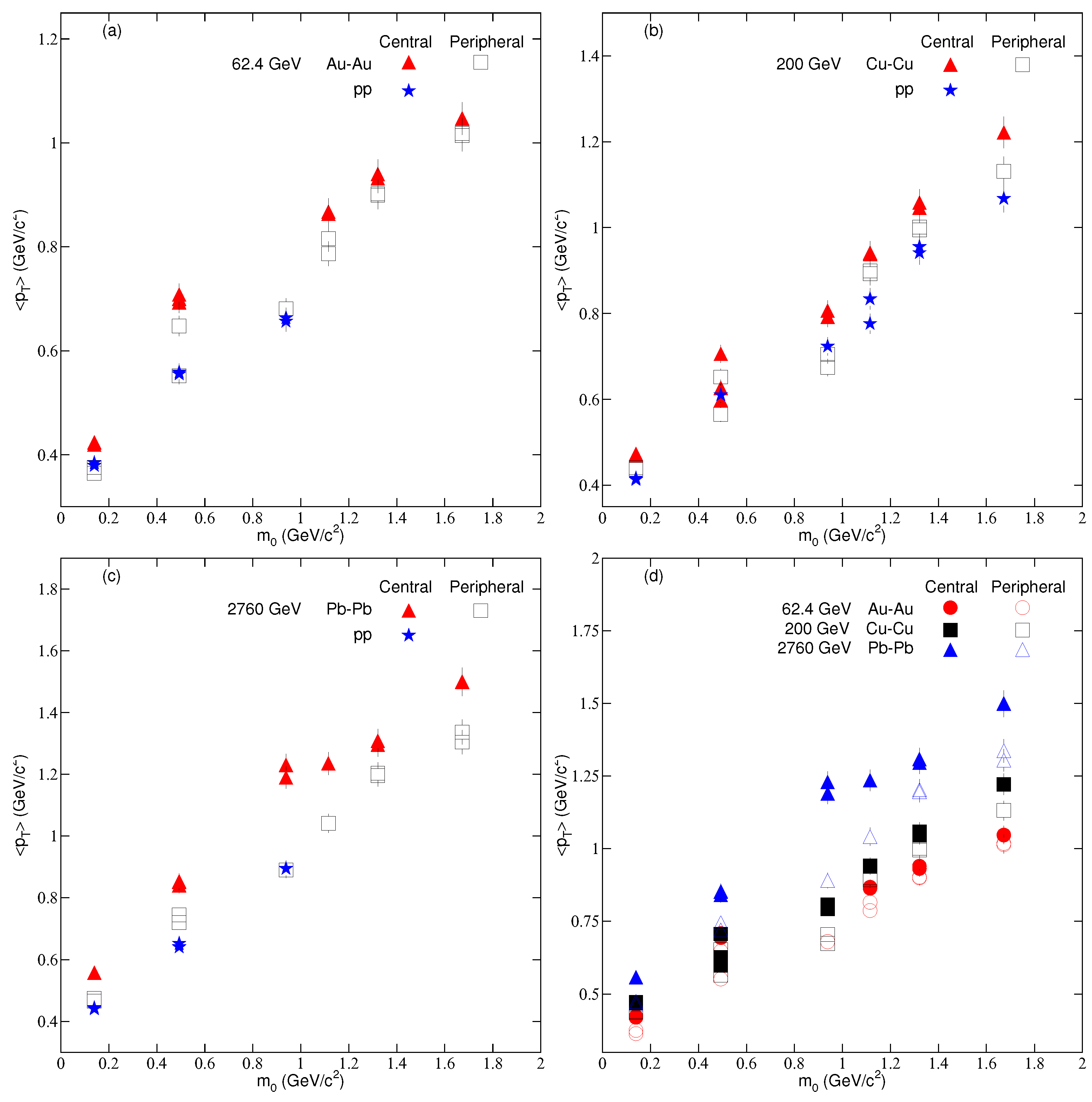
Figure 4 is similar to Figure 3, but it displays the dependence of the mean transverse momentum () on and centrality. We note that is slightly larger in a central collision than in peripheral and collisions. This is because more energy is transported in the system in central collisions than in the latter two. in collisions is close to that in peripheral collisions at the same center of mass energy. also depends on . The heavier the particle, the larger the . We can see that is larger in – collisions than in – and – collisions, which shows that depends on the size of the system, but this dependence is weak because the values of T in the – and – collisions are approximately close to each other due to the different collision energies of the two systems. The system is approximately three times larger than the – system, but its collision energy is approximately three times lower than that of – collisions, and this may increase the energy dependence of , which becomes more prominent in collisions because we can see that is larger at 2760 GeV than at 200 GeV, and at the latter is larger than at 62.4 GeV.
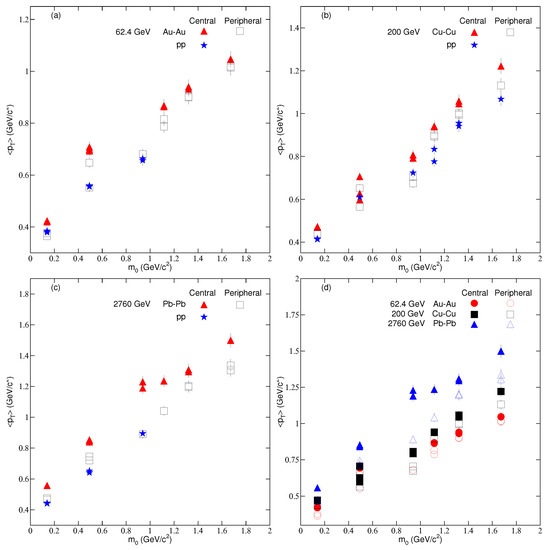
Figure 4.
Dependence of the mean transverse momentum on centrality and mass of the particles in nucleus–nucleus and collisions at (a) 62.4 GeV (b) 200 GeV (c) 2760 GeV and (d) (62.4, 200, and 2760) GeV.
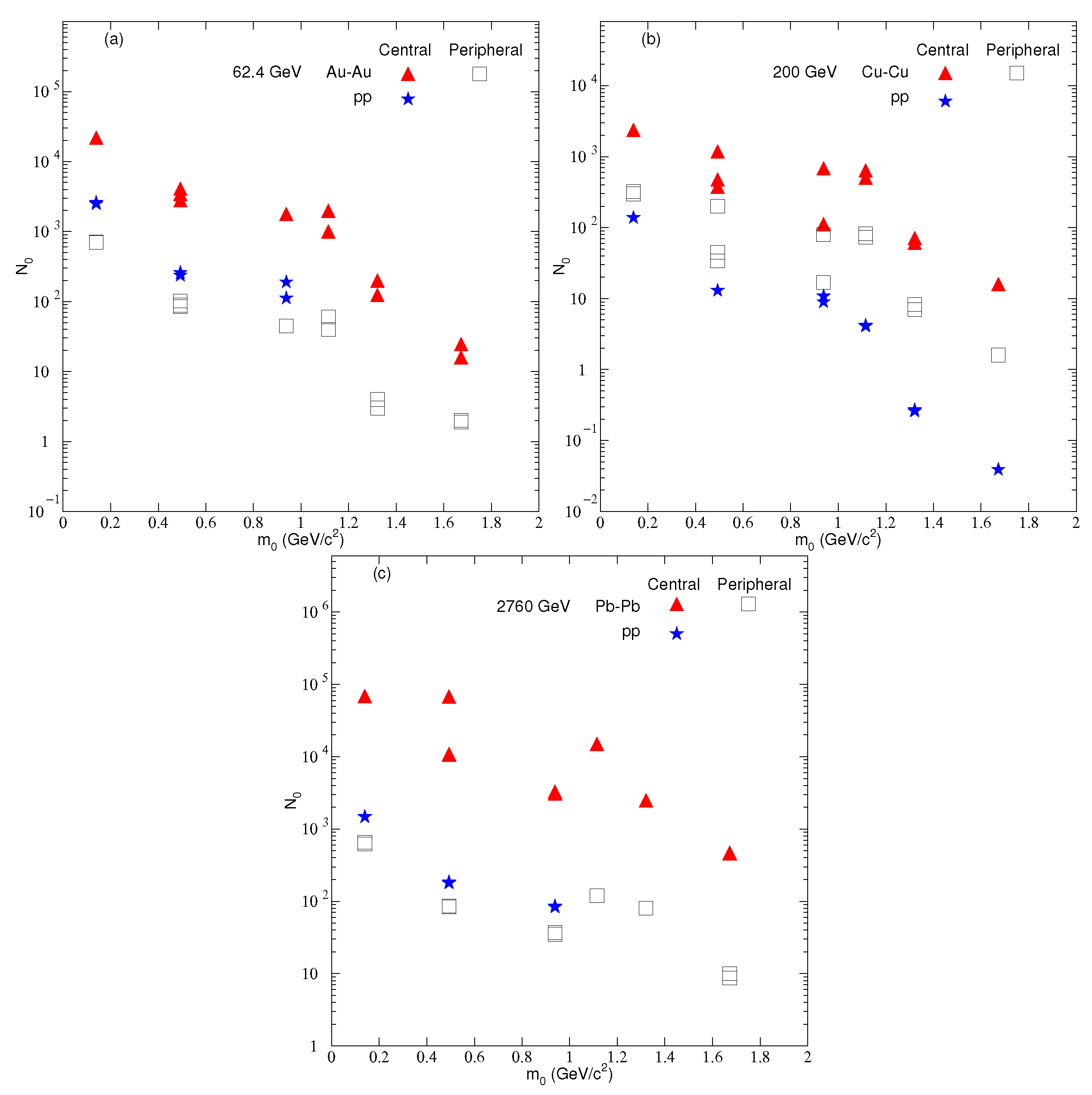
Figure 5 is similar to Figure 3, but it shows the dependence of on and centrality. is the multiplicity parameter, not only the normalization constant. It can be seen that is slightly larger in central collisions than in peripheral collisions as well as collisions, since the central collision systems are larger and more violent than the latter two collisions, which results in an enormous multiplicity. In most cases, it is also observed that in collisions is close to the peripheral collisions at the exact center of mass energy. is reported to be mass-dependent. The heavier the particles, the smaller the multiplicity. However, ’s dependence on the size of the system in central collisions can be seen. The larger the size of the system is, the larger the .
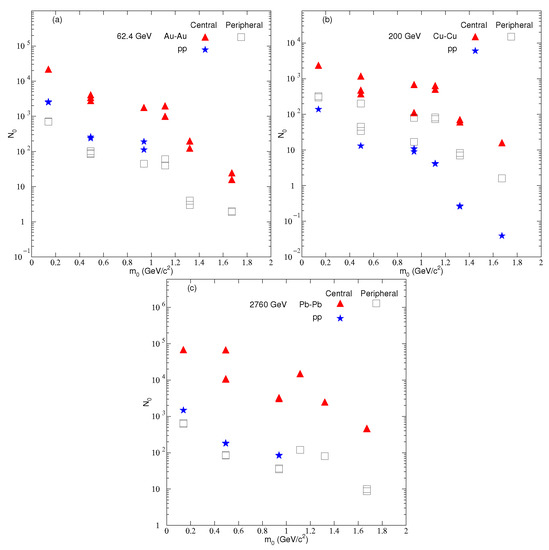
Figure 5.
Dependence of the mean on centrality and mass of the particles in nucleus–nucleus and collisions at (a) 62.4 GeV (b) 200 GeV (c) 2760 GeV.
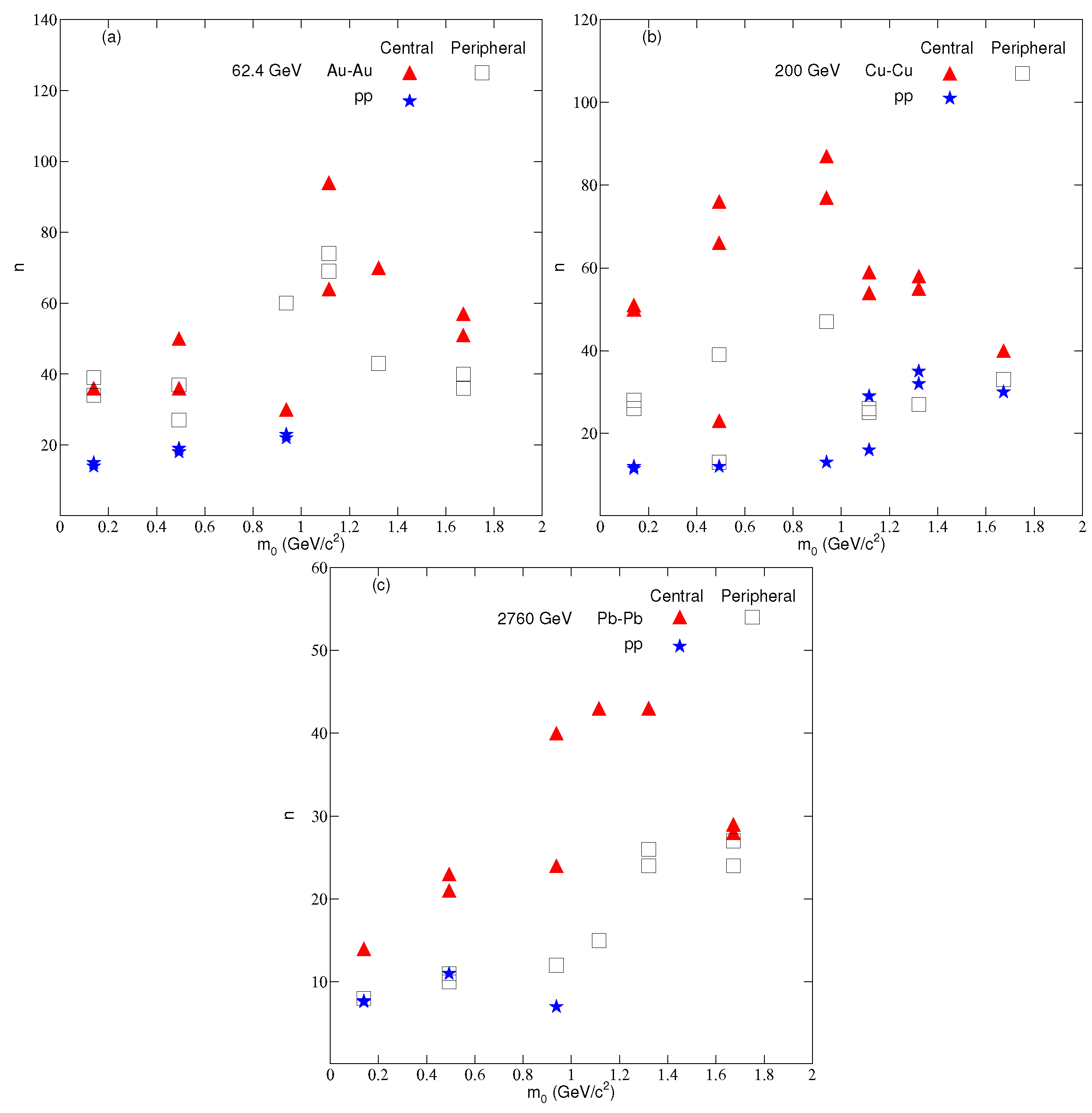
Figure 6 is similar to Figure 5, but it represents the result for the entropy parameter n. As discussed in the second section, n measures the degree of equilibrium of the system. The larger the value of n, the closer the system will be to an equilibrium state. Figure 6 highlights that n is higher in most cases in central collisions than in peripheral collisions and pp collisions, which means that the central collision system equilibrates quickly.
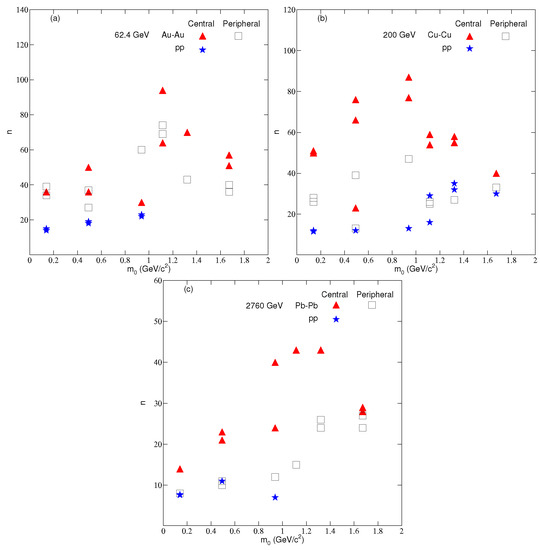
Figure 6.
Dependence of the mean n on centrality and mass of the particles in nucleus–nucleus and collisions at (a) 62.4 GeV (b) 200 GeV (c) 2760 GeV.
Before going to the conclusion section, we would like to point out that the central collision has a more significant T and n. The central collision system approaches the equilibrium state quickly compared to the peripheral and collisions. However, in peripheral collisions, the system has a lower T and n, away from the equilibrium state.
4. Conclusions
The main observations and conclusions are summarized here.
- (a)
- The transverse momentum spectra of identified and strange particles were analyzed in -, - and – collisions at 62.4 GeV, 200 GeV and 2760 GeV, respectively, by the Tsallis–Pareto type function, and the effective temperature and mean transverse momentum were extracted. We also analyzed the collisions at 62.4 GeV, 200 GeV and 2760 GeV to check the nature of the extracted parameters in the peripheral collisions and collisions at the exact center of mass energy.
- (b)
- The effective temperature (T) was more prominent in a central collision than in a peripheral collision because many hadrons were involved in the reaction, which transferred more energy in the central collision systems. T in peripheral collisions was closer to that of collisions at the exact center of mass energy, which showed that the two systems had similar thermodynamic properties.
- (c)
- The mean transverse momentum was more significant in central collisions than in peripheral collisions due to substantial momentum transfer. In peripheral collisions, it was close to that of the collisions.
- (d)
- Both the effective temperature and mean transverse momentum were mass-dependent and increased with mass. The increase of T with was consistent with the multiple kinetic freeze-out scenarios.
- (e)
- was larger in – collisions than in – and – collisions, and in the latter two cases, the values were close to each other, which showed a weak dependence on the size of the system and comparatively strong dependence on the collision’s energy because it increased with the increase of energy in collisions.
- (f)
- The multiplicity parameter was slightly larger in central collisions than in peripheral collisions. In peripheral collisions, it was close to that in collisions at the exact center of mass energy. In addition, was mass-dependent and was higher for lighter particles. in central collisions depended on the size of the interacting system; larger sizes of the interacting system yielded higher values of the .
- (g)
- The entropy parameter n was larger in a central collision, rendering the system to an equilibrium state more quickly compared to the peripheral collisions.
Author Contributions
L.-L.L., M.W., M.A., A.M.K., H.Y. and M.A.K. contributed equally to this work. All authors have read and agreed to the published version of the manuscript.
Funding
The authors would like to thank the support from the Shanxi Agricultural University Ph.D. Research Startup Project under Grant No. 2021BQ103 and Shanxi Basic Research Program No. 202103021223169.
Institutional Review Board Statement
Not applicable.
Informed Consent Statement
Not applicable.
Data Availability Statement
The data used to support the findings of this study are included within the article and are cited at relevant places within the text as references.
Conflicts of Interest
The authors declare no conflict of interest. The funding agencies had no role in the design of the study; in the collection, analysis, or interpretation of the data; in the writing of the manuscript, or in the decision to publish the results.
Compliance with Ethical Standards
The authors declare that they are in compliance with ethical standards regarding the content of this paper.
References
- Adams, J.; Aggarwal, M.M.; Ahammed, Z.; Amonett, J.; Anderson, B.D.; Arkhipkin, D.; Averichev, G.S.; Badyal, S.K.; Bai, Y.; Balewski, J.; et al. Experimental and theoretical challenges in the search for the quark gluon plasma: The STAR Collaboration’s critical assessment of the evidence from RHIC collisions. Nucl. Phys. A 2005, 757, 102–183. [Google Scholar] [CrossRef]
- Arsene, I.; Bearden, I.G.; Beavis, D.; Besliu, C.; Budick, B.; Bøggild, H.; Chasman, C.; Christensen, C.H.; Christiansen, P.; Cibor, J.; et al. Quark Gluon Plasma and Color Glass Condensate at RHIC? The perspective from the BRAHMS experiment. Nucl. Phys. A 2005, 757, C27. [Google Scholar] [CrossRef]
- Adcox, K.; Adler, S.S.; Afanasiev, S.; Aidala, C.; Ajitanand, N.N.; Akiba, Y.; Al-Jamel, A.; Alexander, J.; Amirikas, R.; Aoki, K.; et al. Formation of dense partonic matter in relativistic nucleus-nucleus collisions at RHIC: Experimental evaluation by the PHENIX collaboration. Nucl. Phys. A 2005, 757, 184–283. [Google Scholar] [CrossRef]
- Back, B.B.; Baker, M.D.; Ballintijn, M.; Barton, D.S.; Becker, B.; Betts, R.R.; Bickley, A.A.; Bindel, R.; Budzanowski, A.; Busza, W.; et al. The PHOBOS perspective on discoveries at RHIC. Nucl. Phys. A 2005, 757, 28–101. [Google Scholar] [CrossRef]
- Adams, J.; Adler, C.; Aggarwal, M.M.; Ahammed, Z.; Amonett, J.; Anderson, B.D.; Arkhipkin, D.; Averichev, G.S.; Bai, Y.; Balewski, J.; et al. Multistrange baryon production in Au-Au collisions at S(NN)**1/2 = 130 GeV. Phys. Rev. Lett. 2004, 92, 182301. [Google Scholar] [CrossRef]
- Van Hecke, H.; Sorge, H.; Xu, N. Evidence of early multistrange hadron freezeout in high-energy nuclear collisions. Phys. Rev. Lett. 1998, 81, 5764–5767. [Google Scholar] [CrossRef]
- Waqas, M.; Peng, G.X.; Liu, F.H. An evidence of triple kinetic freezeout scenario observed in all centrality intervals in Cu–Cu, Au–Au and Pb–Pb collisions at high energies. J. Phys. G 2021, 48, 075108. [Google Scholar] [CrossRef]
- Waqas, M.; Peng, G.X.; Wazir, Z. Decoupling of non-strange, strange and multi-strange particles from the system in Cu–Cu, Au–Au and Pb–Pb collisions at high energies. arXiv 2022, arXiv:2107.07840. [Google Scholar] [CrossRef]
- Waqas, M.; Liu, F.H.; Wang, R.Q.; Siddique, I. Energy scan/dependence of kinetic freeze-out scenarios of multi-strange and other identified particles in central nucleus-nucleus collisions. Eur. Phys. J. A 2020, 56, 188. [Google Scholar] [CrossRef]
- Li, L.L.; Liu, F.H.; Waqas, M.; Al-Yusufi, R.; Mujear, A. Excitation functions of related parameters from transverse momentum (mass) spectra in high energy collisions. Adv. High Energy Phys. 2020, 2020, 5356705. [Google Scholar] [CrossRef]
- Chatterjee, S.; Mohanty, B.; Singh, R. Freezeout hypersurface at energies available at the CERN Large Hadron Collider from particle spectra: Flavor and centrality dependence. Phys. Rev. C 2015, 92, 024917. [Google Scholar] [CrossRef]
- Chatterjee, S.; Das, S.; Kumar, L.; Mishra, D.; Mohanty, B.; Sahoo, R.; Sharma, N. Freeze-Out Parameters in Heavy-Ion Collisions at AGS, SPS, RHIC, and LHC Energies. Adv. High Energy Phys. 2015, 2015, 349013. [Google Scholar] [CrossRef]
- Tang, Z.; Xu, Y.; Ruan, L.; van Buren, G.; Wang, F.; Xu, Z. Spectra and radial flow at RHIC with Tsallis statistics in a Blast-Wave description. Phys. Rev. C 2009, 79, 051901. [Google Scholar] [CrossRef]
- Bashir, I.U.; Uddin, S. Kinetic Freeze-out Spectra of Identified Particles Produced in p-Pb Collisions at root(sNN) = 5.02 TeV. J. Exp. Theor. Phys. 2017, 124, 429–432. [Google Scholar] [CrossRef]
- Li, L.L.; Liu, F.H.; Waqas, M.; Ajaz, M. Analyzing Transverse Momentum Spectra by a New Method in High-Energy Collisions. Universe 2022, 8, 31. [Google Scholar] [CrossRef]
- Waqas, M.; Liu, L.M.; Peng, G.X.; Ajaz, M. Observation of different scenarios in different temperatures in small and large collision systems. arXiv 2021, arXiv:2111.07531. [Google Scholar]
- Waqas, M.; Liu, F.H. Initial, effective, and kinetic freeze-out temperatures from transverse momentum spectra in high-energy proton(deuteron)–nucleus and nucleus–nucleus collisions. Eur. Phys. J. Plus 2020, 135, 147. [Google Scholar] [CrossRef]
- Waqas, M.; Li, B.C. Kinetic freeze-out temperature and transverse flow velocity in Au–Au collisions at RHIC-BES energies. Adv. High Energy Phys. 2020, 2020, 1787183. [Google Scholar] [CrossRef]
- Waqas, M.; Liu, F.H. Centrality dependence of kinetic freeze-out temperature and transverse flow velocity in high energy nuclear collisions. Indian J. Phys. 2022, 96, 1217–1235. [Google Scholar] [CrossRef]
- Waqas, M.; Liu, F.H.; Li, L.L.; Alfanda, H.M. Effective (kinetic freeze-out) temperature, transverse flow velocity and kinetic freeze-out volume in high energy collisions. Nucl. Sci. Tech. 2020, 31, 109. [Google Scholar] [CrossRef]
- Waqas, M.; Liu, F.H.; Wazir, Z. Dependence of temperatures and kinetic freeze-out volume on centrality in Au–Au and Pb–Pb collisions at high energy. Adv. High Energy Phys. 2020, 2020, 8198126. [Google Scholar] [CrossRef]
- Bjorken, J.D. Highly Relativistic Nucleus-Nucleus Collisions: The Central Rapidity Region. Phys. Rev. D 1983, 27, 140–151. [Google Scholar] [CrossRef]
- Liu, F.H. Unified description of multiplicity distributions of final-state particles produced in collisions at high energies. Nucl. Phys. A 2008, 810, 159–172. [Google Scholar] [CrossRef]
- Liu, F.H.; Gao, Y.Q.; Tian, T.; Li, B.C. Unified description of transverse momentum spectrums contributed by soft and hard processes in high-energy nuclear collisions. Eur. Phys. J. A 2014, 50, 94. [Google Scholar] [CrossRef]
- Liu, F.H.; Li, J.S. Isotopic production cross section of fragments in Fe-56 + p and Xe-136 (Xe-124) + Pb reactions over an energy range from A-300 to A-1500 MeV. Phys. Rev. C 2008, 78, 044602. [Google Scholar] [CrossRef]
- Liu, F.H.; Lao, H.L.; Lacey, R.A. Productions of J/ψ mesons in p-Pb collisions at 5 TeV. Int. J. Mod. Phys. E 2016, 25, 1650036. [Google Scholar] [CrossRef]
- Schnedermann, E.; Sollfrank, J.; Heinz, U.W. Thermal phenomenology of hadrons from 200 to A/GeV S+S collisions. Phys. Rev. C 1993, 48, 2462–2475. [Google Scholar] [CrossRef]
- Abelev, B.I.; Aggarwal, M.M.; Ahammed, Z.; Alakhverdyants, A.V.; Anderson, B.D.; Arkhipkin, D.; Averichev, G.S.; Balewski, J.; Barannikova, O.; Barnby, L.S.; et al. Identified particle production, azimuthal anisotropy, and interferometry measurements in Au+Au collisions at s(NN)**(1/2) = 9.2- GeV. Phys. Rev. C 2010, 81, 024911. [Google Scholar] [CrossRef]
- Abelev, B.I.; Aggarwal, M.M.; Ahammed, Z.; Anderson, B.D.; Arkhipkin, D.; Averichev, G.S.; Bai, Y.; Balewski, J.; Barannikova, O.; Barnby, L.S.; et al. Systematic Measurements of Identified Particle Spectra in pp, d+ Au and Au+Au Collisions from STAR. Phys. Rev. C 2009, 79, 034909. [Google Scholar] [CrossRef]
- Alberico, W.M.; Czerski, P.; Lavagno, A.; Nardi, M.; Soma, V. Signals of non-extensive statistical mechanics in high-energy nuclear collisions. Physica A 2008, 387, 467–475. [Google Scholar] [CrossRef]
- Tsallis, C. Nonadditive entropy and nonextensive statistical mechanics-an overview after 20 years. Braz. J. Phys. 2009, 39, 337. [Google Scholar] [CrossRef]
- Wilk, G.; Wlodarczyk, Z. Multiplicity fluctuations due to the temperature fluctuations in high-energy nuclear collisions. Phys. Rev. C 2009, 79, 054903. [Google Scholar] [CrossRef]
- Alberico, W.M.; Lavagno, A. Non-extensive statistical effects in high-energy collisions. Eur. Phys. J. A 2009, 40, 313–323. [Google Scholar] [CrossRef]
- Cleymans, J.; Lykasov, G.I.; Parvan, A.S.; Sorin, A.S.; Teryaev, O.V.; Worku, D. Systematic properties of the Tsallis Distribution: Energy Dependence of Parameters in High-Energy p-p Collisions. Phys. Lett. B 2013, 723, 351–354. [Google Scholar] [CrossRef]
- Wong, C.Y.; Wilk, G. Tsallis fits to pT spectra and multiple hard scattering in pp collisions at the LHC. Phys. Rev. D 2013, 87, 114007. [Google Scholar] [CrossRef]
- Cleymans, J.; Worku, D. Relativistic Thermodynamics: Transverse Momentum Distributions in High-Energy Physics. Eur. Phys. J. A 2012, 48, 160. [Google Scholar] [CrossRef]
- Adare, A.; Afanasiev, S.; Aidala, C.; Ajitanand, N.N.; Akiba, Y.; Al-Bataineh, H.; Alexander, J.; Aoki, K.; Aphecetche, L.; Armendariz, R.; et al. Identified charged hadron production in p + p collisions at and 62.4 GeV. Phys. Rev. C 2011, 83, 064903. [Google Scholar] [CrossRef]
- Abelev, B.I.; Adams, J.; Aggarwal, M.M.; Ahammed, Z.; Amonett, J.; Anderson, B.D.; Anderson, M.; Arkhipkin, D.; Averichev, G.S.; Bai, Y.; et al. Strange particle production in p+p collisions at s**(1/2) = 200-GeV. Phys. Rev. C 2007, 75, 064901. [Google Scholar] [CrossRef]
- Abelev, B.; Abrahantes Quintana, A.; Adamova, D.; Adare, A.M.; Aggarwal, M.M.; Aglieri Rinella, G.; Agocs, A.G.; Agostinelli, A.; Aguilar Salazar, S.; Ahammed, Z.; et al. Neutral pion and η meson production in proton-proton collisions at TeV and TeV. Phys. Lett. B 2012, 717, 162–172. [Google Scholar] [CrossRef]
- Aamodt, K.; Abel, N.; Abeysekara, U.; Abrahantes Quintana, A.; Abramyan, A.; Adamova, D.; Aggarwal, M.M.; Aglieri Rinella, G.; Agocs, A.G.; Aguilar Salazar, S.; et al. Production of pions, kaons and protons in pp collisions at GeV with ALICE at the LHC. Eur. Phys. J. C 2011, 71, 1655. [Google Scholar] [CrossRef]
- Abelev, B.; Adam, J.; Adamová, D.; Adare, A.M.; Aggarwal, M.M.; Aglieri Rinella, G.; Agocs, A.G.; Agostinelli, A.; Aguilar Salazar, S.; Ahammed, Z.; et al. Multi-strange baryon production in pp collisions at TeV with ALICE. Phys. Lett. B 2012, 712, 309–318. [Google Scholar] [CrossRef]
- Chatrchyan, S.; Khachatryan, V.; Sirunyan, A.M.; Tumasyan, A.; Adam, W.; Aguilo, E.; Bergauer, T.; Dragicevic, M.; Erö, J.; Fabjan, C.; et al. Study of the Inclusive Production of Charged Pions, Kaons, and Protons in pp Collisions at , 2.76, and 7 TeV. Eur. Phys. J. C 2012, 72, 2164. [Google Scholar] [CrossRef]
- Biro, T.S.; Purcsel, G.; Urmossy, K. Non-Extensive Approach to Quark Matter. Eur. Phys. J. A 2009, 40, 325–340. [Google Scholar] [CrossRef]
- Tsallis, C. Possible Generalization of Boltzmann-Gibbs Statistics. J. Statist. Phys. 1988, 52, 479–487. [Google Scholar] [CrossRef]
- Zheng, H.; Zhu, L.; Bonasera, A. Systematic analysis of hadron spectra in p+p collisions using Tsallis distributions. Phys. Rev. D 2015, 92, 074009. [Google Scholar] [CrossRef]
- Zheng, H.; Zhu, L. Can Tsallis Distribution Fit All the Particle Spectra Produced at RHIC and LHC? Adv. High Energy Phys. 2015, 2015, 180491. [Google Scholar] [CrossRef]
- Cleymans, J.; Wellington Paradza, M. Tsallis Statistics in High Energy Physics: Chemical and Thermal Freeze-Outs. Physics 2020, 2, 38. [Google Scholar] [CrossRef]
- Waqas, M.; Peng, G.X.; Wang, R.Q.; Ajaz, M.; Ismail, A.A.K.H. Freezeout properties of different light nuclei at the RHIC beam energy scan. Eur. Phys. J. Plus 2021, 136, 1082. [Google Scholar] [CrossRef]
- Waqas, M.; Peng, G.X.; Liu, F.H.; Wazir, Z. Effects of coalescence and isospin symmetry on the freezeout of light nuclei and their anti-particles. Sci. Rep. 2021, 11, 20252. [Google Scholar] [CrossRef]
- Ajaz, M.; Haj Ismail, A.; Waqas, M.; Suleymanov, M.; AbdelKader, A.; Suleymanov, R. Pseudorapidity dependence of the bulk properties of hadronic medium in pp collisions at 7 TeV. Sci. Rep. 2022, 12, 8142. [Google Scholar] [CrossRef] [PubMed]
- Yang, P.-P.; Ajaz, M.; Waqas, M.; Liu, F.-H.; Suleymanov, M. Pseudorapidity dependence of the pt spectra of charged hadrons in pp collisions at and 2.36 tev. J. Phys. G Nucl. Part. 2022, 49, 055110. [Google Scholar] [CrossRef]
- Ajaz, M.; Khubrani, A.M.; Waqas, M.; Haj Ismail, A.; Dawi, E.A. Collective properties of hadrons in comparison of models prediction in pp collisions at 7 TeV. Results Phys. 2022, 35, 105433. [Google Scholar] [CrossRef]
- Waqas, M.; Peng, G.X. Study of Proton, Deuteron, and Triton at 54.4 GeV. Adv. High Energy Phys. 2021, 2021, 6674470. [Google Scholar] [CrossRef]
- Ajaz, M.; Al Karim Haj Ismail, A.; Ahmed, A.; Wazir, Z.; Shehzadi, R.; Younis, H.; Khan, G.; Khan, R.; Ali, S.; Waqas, M.; et al. Centrality dependence of distributions and nuclear modification factor of charged particles in Pb–Pb interactions at TeV. Results Phys. 2021, 30, 104790. [Google Scholar] [CrossRef]
- Waqas, M.; Chen, H.M.; Peng, G.X.; Ismail, A.A.K.H.; Ajaz, M.; Wazir, Z.; Shehzadi, R.; Jamal, S.; AbdelKader, A. Study of Kinetic Freeze-Out Parameters as a Function of Rapidity in pp Collisions at CERN SPS Energies. Entropy 2021, 23, 1363. [Google Scholar] [CrossRef] [PubMed]
- Ajaz, M.; Waqas, M.; Peng, G.X.; Yasin, Z.; Younis, H.; Haj Ismail, A.A.K. Study of pT spectra of light particles using modified Hagedorn function and cosmic rays Monte Carlo event generators in proton–proton collisions at GeV. Eur. Phys. J. Plus 2022, 137, 52. [Google Scholar] [CrossRef]
- Arsene, I.C.; Bearden, I.G.; Beavis, D.; Bekele, S.; Besliu, C.; Budick, B.; Bøggild, H.; Chasman, C.; Christensen, C.H.; Christiansen, P.; et al. Rapidity and centrality dependence of particle production for identified hadrons in Cu+Cu collisions at GeV. Phys. Rev. C 2016, 94, 014907. [Google Scholar] [CrossRef]
- Aggarwal, M.M.; Ahammed, Z.; Alakhverdyants, A.V.; Alekseev, I.; Alford, J.; Anderson, B.D.; Anson, C.D.; Arkhipkin, D.; Averichev, G.S.; Balewski, J.; et al. Strange and multistrange particle production in Au+Au Collisions at GeV. Phys. Rev. C 2011, 83, 024901. [Google Scholar] [CrossRef]
- Agakishiev, G.; Aggarwal, M.M.; Ahammed, Z.; Alakhverdyants, A.V.; Alekseev, I.; Alford, J.; Anderson, B.D.; Anson, C.D.; Arkhipkin, D.; Averichev, G.S.; et al. Strangeness Enhancement in Cu+Cu and Au+Au Collisions at GeV. Phys. Rev. Lett. 2012, 108, 072301. [Google Scholar] [CrossRef]
- Abelev, B.; Adam, J.; Adamova, D.; Adare, A.M.; Aggarwal, M.; Aglieri Rinella, G.; Agnello, M.; Agocs, A.G.; Agostinelli, A.; Ahammed, Z.; et al. Centrality dependence of π, K, p production in Pb-Pb collisions at TeV. Phys. Rev. C 2013, 88, 044910. [Google Scholar] [CrossRef]
- Abelev, B.B.; Aphecetche, L.; Baldisseri, A.; Baldisseri, V.; Bastid, N.; Batigne, G.; Bergognon, A.A.E.; Borel, H.; Bregant, M.; Castellanos, J.C.; et al. and production in Pb-Pb collisions at TeV. Phys. Rev. Lett. 2013, 111, 222301. [Google Scholar] [CrossRef] [PubMed] [Green Version]
- Adams, J.; Aggarwal, M.M.; Ahammed, Z.; Amonett, J.; Anderson, B.D.; Anderson, M.; Arkhipkin, D.; Averichev, G.S.; Badyal, S.K.; Bai, Y.; et al. Identified hadron spectra at large transverse momentum in p + p and d+Au collisions at GeV. Phys. Lett. B 2006, 637, 161–169. [Google Scholar] [CrossRef] [Green Version]
Publisher’s Note: MDPI stays neutral with regard to jurisdictional claims in published maps and institutional affiliations. |
© 2022 by the authors. Licensee MDPI, Basel, Switzerland. This article is an open access article distributed under the terms and conditions of the Creative Commons Attribution (CC BY) license (https://creativecommons.org/licenses/by/4.0/).