Skip to Content
  • Article
  • Open Access

29 June 2022

Law of Total Probability in Quantum Theory and Its Application in Wigner’s Friend Scenario

Qualcomm, San Diego, CA 92121, USA

Abstract

It is well-known that the law of total probability does not generally hold in quantum theory. However, recent arguments on some of the fundamental assumptions in quantum theory based on the extended Wigner’s friend scenario show a need to clarify how the law of total probability should be formulated in quantum theory and under what conditions it still holds. In this work, the definition of conditional probability in quantum theory is extended to POVM measurements. A rule to assign two-time conditional probability is proposed for incompatible POVM operators, which leads to a more general and precise formulation of the law of total probability. Sufficient conditions under which the law of total probability holds are identified. Applying the theory developed here to analyze several quantum no-go theorems related to the extended Wigner’s friend scenario reveals logical loopholes in these no-go theorems. The loopholes exist as a consequence of taking for granted the validity of the law of total probability without verifying the sufficient conditions. Consequently, the contradictions in these no-go theorems only reconfirm the invalidity of the law of total probability in quantum theory rather than invalidating the physical statements that the no-go theorems attempt to refute.

1. Introduction

In his seminal paper on the path integral formulation of quantum mechanics [1], Feynman started the introduction of his new theory by pointing out that the law of total probability in classical probability theory must be replaced by a new form of rule. Specifically, in a slightly different notation, the classical law of probability, p ( c | a ) = b p ( c | b ) p ( b | a ) where p ( y | x ) is the probability of obtaining measurement result y given measurement result x, is no longer true in quantum theory and must be replaced by φ ( c | a ) = b φ ( c | b ) φ ( b | a ) , where φ is a complex number called probability amplitude and related to classical probability by Born’s rule p ( y | x ) = | φ ( y | x ) | 2 . From this key idea, Feynman continued to expand the theory that led to the path integral formulation of quantum mechanics. He also discussed when the new rule of summation over probability amplitude can fall back to the classical law of probability. This is when one “attempts to perform” intermediate measurements that obtain results of all b. In modern terms, what Feynman means by “attempting to perform measurement” can be understood as the decoherence phenomenon [2].
The above example shows that it has been long known that the law of total probability cannot be taken for granted in quantum theory. Indeed, many other classical probability rules are only upheld in specific conditions. For instance, a joint probability can be definitely assigned only when the two measurement operators are commutative [3,4,5,6]. There are many variants of definitions of the conditional probability in quantum theory (for a review, see [7]). However, a family of no-go theorems recently published [8,9,10,11] appears to rely on the total law of probability one way or another without considering the sufficient conditions. These no-go theorems are related to the extensively discussed Wigner’s friend experiments. In quantum mechanics, the Wigner’s friend [12,13] thought experiment has been widely discussed, as it tests the validity of many quantum interpretation theories. The significance of such experiments is that Wigner and his friend give two different descriptions of the same physical process happening inside the lab. Deutsch further extended the thought experiment to be applicable to macroscopic system such as the lab system [14] itself. Based on that, a more sophisticated extended Wigner’s friend experiment is put forwarded by Brukner [8,15]. Such an experimental setup involves two remotely separated labs. Each lab contains half of an entangled pair of spins and a local observer. Outside each lab there is a super-observer who can choose to perform different types of measurements on the lab as a whole. The intention of such an experimental setup is to prove, through a no-go theorem, that measured facts are observer-dependent in quantum theory. A subsequent experiment [16] has been carried out to confirm the inequality developed in [8]. A stronger version of the no-go theorem is further proposed for reaching a similar conclusion [9]. The statement that measured facts are observer-dependent was considered important for the quantum foundation and deserved rigorous theoretical proving and experimental testing. However, proving the no-go theorems by taking the law of total probability for granted casts doubt on their theoretical rigorousness.
The fact that there is still ambiguity in using the total law of probability in quantum theory—though it has long been recognized as not being upheld in quantum mechanics—shows the need to provide a rigorous formulation of the law of total probability in quantum theory and to clarify under what conditions it holds true. This is indeed the motivation behind the present work. Formulation of the law of total probability depends on a clear definition of conditional probability in quantum theory. There is already extensive research on how conditional probability is defined [7,17,18,19,20,21,22,23,24,25]. However, these formulations are either based on projection measurements or only consider simultaneous measurements with commutative operators. In this work, I extend a two-time conditional probability formulation from projection measurement to more generic POVM measurements. Generalization for POVM measurement is needed because some of the no-go theorems choose POVM operators in their proofs. I then give several sufficient conditions for the law of total probability to become true. The theory is applied to analyze several no-go theorems related to the extended Wigner’s friend scenario. Logical loopholes are shown in these no-go theorems because their proofs rely on the law of total probability one way or another, but the conditions to validate the law are not met. Thus, these no-go theorems do not really prove the results they expect, such as “measured facts are observer-dependent”. Instead, they just indirectly confirm that the law of total probability does not not hold in quantum theory.
It is worth mentioning that other concerns regarding these no-go theorems have already been pointed out [26,27]. In particular, only when a measurement is completed should a probability distribution be assigned. Assigning probability distribution for pre-measurement without results leads to contradiction [26]. The analysis in this work will go one step further by showing that even assigning a probability distribution for completed measurements still leaves logical loopholes in the no-go theorem. This is because the law of total probability that the proofs rely on does not hold true with the specific measurement operators and initial quantum state being chosen. Lastly, it is important to emphasize that I do not take a stand on the assertions of the no-go theorems themselves. For instance, it could still be a valid statement that “measured facts are observer-dependent”. What I only show here is that there are logical loopholes in the proof of the no-go theorems.
In summary, this paper extends the formulation of conditional probability to generic POVM measurements and clarifies the conditions under which the law of total probability can be valid in quantum theory. Applying the theory developed in this work to the extended Wigner friend scenario reveals logical loopholes in several no-go theorems that take for granted the validity of the law of total probability. The contradictions in these no-go theorems only reconfirm the invalidity of the law of total probability in quantum theorem rather than invalidating the physical statements that the no-go theorems are intended to refute, such as “measured facts are independent of the observer”. I hope the results presented here inspire further research to find more convincing proof and experimental testing. This is important because the implications of the extended Wigner’s friend scenario are conceptually fundamental in quantum theory.

2. The Law of Total Probability in Quantum Theory

First, I briefly review classical probability theory. Suppose there are two random variables X and Y. Without loss of generality, I assume X and Y are discrete random variables. Measuring X (or Y) will obtain one of the values in { a i : i = 1 , 2 , 3 } (or in { b j : j = 1 , 2 , 3 } ), which is finite or countable infinite. Denote the joint probability of measuring X with result X = a i , measuring Y with result Y = b j as p ( a i , b j ) , and the conditional probability of obtaining X = a i given that Y = b j as p ( a i | b j ) . They are related by the following axioms:
p ( a i , b j ) = p ( b j | a i ) p ( a i )
p ( b j , a i ) = p ( a i | b j ) p ( b j )
p ( a i , b j ) = p ( b j , a i ) ,
where p ( a i ) is the marginal probability of measuring X with result X = a i , and similarly for p ( b j ) . Axiom (3) ensures the joint probability is defined uniquely regardless if it is defined by (1) or (2). We explicitly call out (3) since it is not always true in quantum theory.
The law of total probability can be derived (Axioms (1)–(3) give p ( b j | a i ) p ( a i ) = p ( a i | b j ) p ( b j ) , which is Bayes’ law. Summing over i on both sides and using identity i p ( a i | b j ) p ( b j ) = p ( b j ) , one obtains (4)) from axioms (1)–(3), expressed as following,
p ( b j ) = i p ( b j | a i ) p ( a i ) .
What I want to investigate here is how the equivalent version of (4) in quantum theory can be formulated.
To start with, I need to examine how conditional probability is constructed in quantum theory. The subtlety of constructing conditional probability in quantum theory has been investigated long ago. G. Bobo gives an extensive review and discussion [7]. The generally accepted formulation of conditional probability in quantum theory is provided by Lüders rule [18], where the measurements are associated with projection operators. Lüders rule is based on Gleason’s theorem, which mathematically justifies Born’s rule. Here I wish to follow a similar approach to generalize the formulation for conditional probability when the measurements are associated with POVM operators.
Mathematical proofs for generalizing Gleason’s theorem to POVM measurements are given by [28,29], which is our starting point. Suppose a quantum system S is prepared such that its state is described by density operator ρ . S could be a composite system, which I will discuss later. Let A = { A i } be a POVM for S. The probability of measurement with element A i resulting in value a i is [28,29].
p ( a i | ρ ) = T r ( ρ A i ) ,
and the post-measurement density operators ρ i are given by [4]
ρ i = A i ρ A i p ( a i | ρ ) .
Let B = { B j } be another POVM for S. Given post measurement state ρ i , the probability of measurement with element B j resulting in value b j is, by recursively applying (5), p ( b j | ρ i ) = T r ( ρ i B j ) . Substituting the expression for ρ i in (6), I obtain the conditional probability
p ( b j | a i , ρ ) = T r ( A i ρ A i B j ) T r ( ρ A i ) .
There is an underlying assumption in this definition that the probability is assigned only after the measurements are completed. In particular, the first POVM measurement A i must be completed in order to be qualified as a condition. We strictly follow this assumption as opposed to assigning a probability with only “pre-measurement”. Pre-measurement refers only to the unitary process that entangles the measured system and measuring apparatus [30] but without the projection process to single out a particular outcome.
Given the same initial state ρ , if I swap the order of measurements such that B j goes first, followed by A i , I obtain a conditional probability
p ( a i | b j , ρ ) = T r ( B j ρ B j A i ) T r ( ρ B j ) .
Note p ( a i | ρ ) = T r ( ρ A i ) and p ( b i | ρ ) = T r ( ρ B j ) ; Equations (7) and (8) can be rewritten as
p ( b j | a i , ρ ) p ( a i | ρ ) = T r ( A i ρ A i B j )
p ( a i | b j , ρ ) p ( b j | ρ ) = T r ( B j ρ B j A i ) .
Equations (9) and (10) are not necessarily equal, which indicate that the quantum version of Bayes’ theorem,
p ( a i | b j , ρ ) p ( b j | ρ ) = p ( b j | a i , ρ ) p ( a i | ρ )
does not hold in general in quantum theory. This posts a difficulty to define a joint probability as either p ( a i , b j ) = p ( a i | b j , ρ ) p ( b j | ρ ) or p ( a i , b j ) = p ( b j | a i , ρ ) p ( a i | ρ ) because it depends on the order of measurement events. Another consequence is that the laws of total probability, i.e., the quantum version of (4)
i p ( b j | a i , ρ ) p ( a i | ρ ) = p ( b j | ρ )
does not hold in general either. This is because from (9), i p ( b j | a i , ρ ) p ( a i | ρ ) = i T r ( A i ρ A i B j ) , while p ( b j | ρ ) = T r ( ρ B j ) , and these are not equal in general (Note that on the other hand, given (7) and the completeness of POVM elements, i A i = I , where I is the identity operator, it is straightforward to verify that j p ( b j | a i , ρ ) p ( a i | ρ ) = p ( a i | ρ ) ). We are interested in finding the conditions under which (12) becomes true.
It is well-known that when [ A i , B j ] = 0 , i.e., A i and B j commute, from (7) and (8), one gets p ( b j | a i , ρ ) p ( a i | ρ ) = p ( a i | b j , ρ ) p ( b j | ρ ) = T r ( ρ A i B j ) . Consequently, the law of total probability (12) becomes true and a joint probability can be well-defined. However, the situation becomes much complicated when [ A i , B j ] 0 .
Strictly speaking, due to the uncertainty principle, when A i and B j are non-commutative, the two measurements cannot be performed to obtain definite outcomes at the same time. The conditional probability defined in (7) or (8) needs to be extended to a two-time formulation of conditional probability in order to be applicable when [ A i , B j ] 0 . There is extensive research on how to construct two-time conditional probability in quantum theory [7,17,18,19,20,21,22,23,24,25]. One noticeable approach is based on the Page–Wootters timeless formulation [21,22,23,24,25]. However, this work will continue to be based on the generalized Gleason theorem for POVM [28,29] to derive the two-time conditional probability, and will leave discussion of the Page–Wootters mechanism for Section 4.
For conceptual clarity, I start the analysis by considering that there is finite nonzero duration for each measurement. After I construct the conditional probability formulation, for practical purpose of calculation, I can approximate the measurement duration to zero. Suppose the first measurement starts at t a and completes at t a + . Here t a + t a covers the time duration for both the pre-measurement unitary phase that entangles the measured system and the measuring apparatus, and the projection phase. The measurement process (Theorem 5.2 of [4] gives a detailed account on how this POVM measurement is physically realized through indirect measurement) is represented by a POVM element A i associated with outcome a i . Similarly, the second measurement starts at t b and completes at t b + . Between t a + and t b there is a free time evolution for the measured system S, described by operator U ( Δ t ) = e i H Δ t / , where Δ t = ( t b t a + ) . Since it is only meaningful to assign a probability distribution after a measurement is completed, the two-time conditional probability I want to construct is “given the measurement outcome of a i at t 1 where t a + < t 1 < t b , what is the probability of measurement outcome b at t 2 > t b + ". Mathematically, this two-time conditional probability can be written as p ( b j at t 2 | a i at t 1 , ρ 0 ) , where ρ 0 ρ ( t a ) is the initial density operator of S when the first measurement starts. After the first measurement with POVM element A i , the post-measurement state is ρ i ( t a + ) = A i ρ 0 A i / T r ( ρ 0 A i ) . The quantum system S then time evolves from t a + to t b to a new state ρ i ( t b ) = U ( Δ t ) ρ i ( t a + ) U ( Δ t ) . At t b , the second measurement occurs. This is represented by applying POVM element B j on ρ i ( t b ) and obtaining outcome b j at t b + with probability T r ( B j ρ i ( t b ) ) . Substituting ρ i ( t b ) , the two-time conditional probability is
p ( b j at t 2 | a i at t 1 , ρ 0 ) = T r ( B j ρ i ( t b ) ) = T r ( B j U ( Δ t ) A i ρ 0 A i U ( Δ t ) ) T r ( ρ 0 A i ) .
For practical purposes of calculation, I can assume the measurement duration is very small compared to the free evolution time, i.e., ( t a + t a ) Δ t and ( t b + t b ) Δ t . Then, I can denote t a t a + as t a , t b t b + as t b , and Δ t = ( t b t a ) .
Suppose the two POVM elements A i and B j are projection measurements, A i = | ϕ i ϕ i | and B j = | φ j φ j | ; one can verify that the conditional probability defined in (13) gives the correct transition probability in standard quantum mechanics:
p ( b j at t 2 | a i at t 1 , ρ 0 ) = | ϕ i | U ( Δ t ) | φ j | 2 .
However, Equation (13) is more generic as it is defined with general POVM operators. Note that the denominator in (13) T r ( ρ 0 A i ) = p ( a i at t 1 | ρ 0 ) ; Equation (13) can be rewritten as
p ( b j at t 2 | a i at t 1 , ρ 0 ) p ( a i at t 1 | ρ 0 ) = T r ( B j U ( Δ t ) A i ρ 0 A i U ( Δ t ) ) .
To analyze the two-time version of the total law of probability, which can be expressed as
p ( b j at t 2 | ρ 0 ) = i p ( b j at t 2 | a i at t 1 , ρ 0 ) p ( a i at t 1 | ρ 0 ) ,
I consider a series of two-time measurements { A i at t a , B at t b , i = 1 N } on N copies of measured system S with the same initial state ρ 0 . Each two-time measurement consists a first measurement from one possible POVM element from the complete set { A i , i = 1 N } at time t a and the same second measurement B j at time t b . For t a < t 1 < t b < t 2 , from (15) I have
i p ( b j at t 2 | a i at t 1 , ρ 0 ) p ( a i at t 1 | ρ 0 ) = i T r ( B j U ( Δ t ) A i ρ 0 A i U ( Δ t ) ) .
However, by definition, p ( b j at t 2 | ρ 0 ) = T r ( B j U ρ 0 U ) . We can see (16) is not true in general. The Theorem next attempts to address the question of under what conditions (16) is valid.
Theorem 1. 
Let ρ 0 be the density operator for a quantum system S before the measurements. Let A i and B j be two POVM elements to measure S at time t a and t b , respectively, and U ( t b , t a ) is the unitary time evolution operator from t a to t b . Select t 1 and t 2 such that t a < t 1 < t b < t 2 . The law of total probability (16) is true if one of the following conditions is met.
C1. 
[ A i , U B j U ] = 0 , ρ 0 ,
C2. 
ρ 0 = i λ i | ϕ i ϕ i | and A i = | ϕ i ϕ i | ,
C3. 
ρ 0 is a pure state, given by | Ψ Ψ | , A i is a projection operator and Ψ | [ A i , U B j U ] A i | Ψ = 0 .
The proof of Theorem 1 is in Appendix A, but a few comments are in order here. First, Condition C 1 implies U B j U A i = A i U B j U . The sequence of operations for U B j U A i means performing measurement A i at t a , time evolving the post-measurement state from t a to t b , performing measurement B j at t b , and reversing time evolution of the post-measurement state back to t a . The sequence of operations A i U B j U means time evolving the state from t a to t b , performing measurement B j at t b , then reversing time evolution of the state back to t a , and performing measurement A i at t a . Condition C 1 says that if these two sequences of operations are equivalent, then the law of total probability (16) holds true.
Second, if the post-measurement state ρ i ( t a ) after the first measurement does not change during free time evolution, such as the case of a spin state in free space, one will have ρ i ( t b ) = ρ i ( t a ) = A i ρ 0 A i / T r ( ρ 0 A i ) . Then, Equation (13) can be written as
p ( b j at t 2 | a i at t 1 , ρ ) = T r ( ρ 0 A i B j A i ) T r ( ρ 0 A i ) .
Equation (18) appears the same as (7), but the precise meaning is different in that the two measurements A i and B j in (18) are taken at two different times. With such a special post-measurement quantum state, the sufficient conditions in Theorem 1 become
C1′. 
[ A i , B j ] = 0 , ρ 0 ,
C2′. 
ρ 0 = i λ i | ϕ i ϕ i | and A i = | ϕ i ϕ i | ,
C3′. 
ρ 0 = | Ψ Ψ | , A i is a projection operator and Ψ | [ A i , B j ] A i | Ψ = 0 .
A couple of comments are in order before closing this section. First, when two measurement operations are not commutative, the conditional probability needs to be defined in the two-time formulation. Second, I can give an intuitive explanation of why (16) does not hold in general in quantum theory. As shown in (17), the right-hand side of (16) refers to the summation of traces of multiplication of operators from a series of experiments where two measurements are carried out in a sequence. In the case of a special post-measurement state where (18) holds, this is i T r ( B j A i ρ 0 A i ) . Measurement of A i changes the initial quantum state such that it affects the probability of outcome for a subsequent measurement B j . However, the term on the left-hand side of (16) refers to the probability of an experiment where only measurement B j is carried out with the same initial quantum state. There is no reason to assume both sides are equal. Equation (16) holds only in special conditions such as those specified in Theorem 1.
The conclusion here is that one should not take for granted that the law of total probability holds true in general. Instead, sufficient conditions, such as those provided in Theorem 1, need to be clearly called out. Failing to do so may leave a loophole in logical deduction when applying the law of total probability.

3. Application to Composite Systems

In this subsection, I will apply the conditional probability definition to composite quantum systems and reexamine Theorem 1 when measuring composite systems. Suppose the measured system S consists of two subsystems S 1 and S 2 that are space-like separated. Define A i = P i I 2 , where P i = | ϕ i ϕ i | is a local POVM element on subsystem S 1 , and I 2 is an identity operator on subsystem S 2 . Similarly, define B j = I 1 Q j , where Q j is a local POVM element on subsystem S 2 . By the principle of locality, a local measurement on a subsystem should not impact the other remote subsystem. Therefore, [ A i , B j ] = 0 . For measurement outcomes of two such local measurements, Equations (7) and (8) are correct formulations for conditional probability; the joint probability is well-defined. Consequently, Equations (11) and (12) hold true. There is no need to use the two-time formulation of conditional probability. This is the case for typical Bell tests and has been used to derive the Bell–CHSH inequalities (On the other hand, in the derivation of Bell–CHSH inequalities, identity (1) is further expressed as
p ( a i , b j | λ ) = p ( a i | b j , λ ) p ( b j | λ ) = p ( a i | λ ) p ( b j | λ ) ,
where λ is a hidden variable. This is known as the outcome independence assumption [31,32]).
However, suppose B j = Q j I 2 , where Q j is another local POVM element on subsystem S 1 , and [ P i , Q j ] 0 . In this case, Equation (7) is incorrect for conditional probability. The two-time conditional probability formulation is needed and can be calculated as
p ( b j at t 2 | a i at t 1 , ρ 0 ) = T r ( ( Q j I 2 ) U ( Δ t ) P i I 2 ρ 0 P i I 2 U ( Δ t ) ) T r ( ρ 0 P i I 2 ) ,
where U ( Δ t ) = U S 1 ( Δ t ) U S 2 ( Δ t ) .
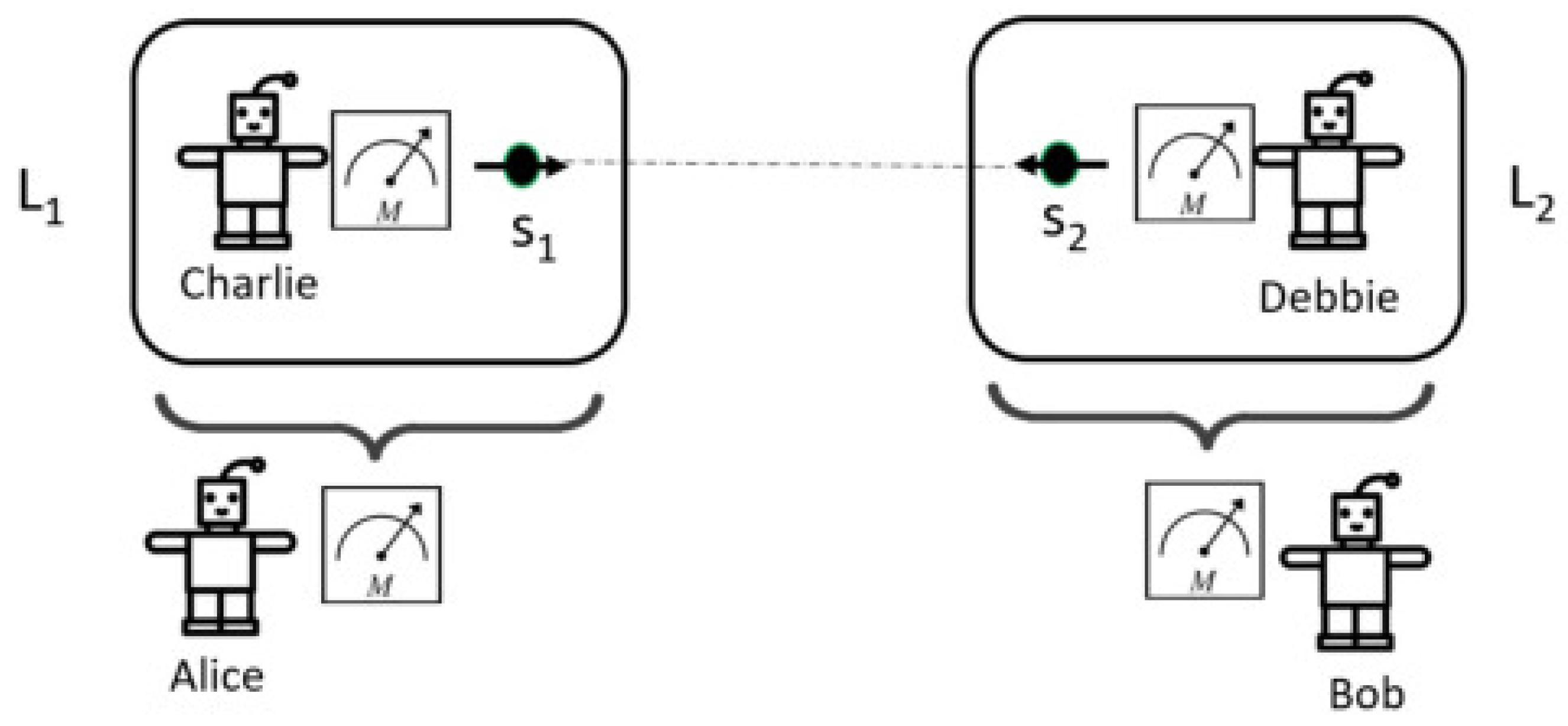
Next, I wish to apply the two-time conditional probability to the extended Wigner’s friend (EWF) scenario introduced in [8]. As shown in Figure 1, the EWF scenario consists of two space-like separated laboratories L 1 and L 2 . Each laboratory contains half of an entangled pair of systems s 1 and s 2 . L 1 also contains a friend Charlie who can perform measurements on s 1 . Outside L 1 there is a super-observer Alice who can perform different types of measurements on L 1 as a whole. Similarly, there is a friend Debbie in L 2 and a super-observer Bob outside L 2 . Here, four POVM measurements are needed and represented by POVM elements A , B , C , D , where operators A and C act on Hilbert space H L 1 , and B and D act on Hilbert space H L 2 . I drop the subscripts of the operators and ρ 0 for simplifying notations. In a typical EWF experiment, the chosen operators are not all commutative with one another. Specifically, [ A , C ] 0 and [ B , D ] 0 , while [ C I L 2 , I L 1 D ] = 0 and [ A I L 2 , I L 1 B ] = 0 . The two-time probability formulation to compute the conditional probability is needed because measurements C and D are taken before measurements A and B. Since [ C I L 2 , I L 1 D ] = 0 and [ A I L 2 , I L 1 B ] = 0 , I can assume measurements C and D are taken at the same time, t a , as C D , while measurement A and B are taken at the same, later time t b as A B . Without loss of clarity, I drop the symbol ⊗ hereafter. Then, the conditional probability for t a < t 1 < t b < t 2 is given by
p ( a b at t 2 | c d at t 1 , ρ , x y ) = T r ( ρ C D U A B U C D ) T r ( ρ C D ) ,
where U = U L 1 U L 2 is the time evolution operator from t a to t b . The law of total probability I am interested in is
p ( a b at t 2 | ρ , x y ) = c d p ( a b at t 2 | c d at t 1 , ρ , x y ) p ( c d at t 1 | ρ , x y ) .
From (21), the R.H.S. of (22) becomes
c d p ( a b at t 2 | c d at t 1 , ρ , x y ) p ( c d at t 1 | ρ , x y ) = C D T r ( ρ C D U A B U C D ) .
The summation is over POVM element sets for { C } and { D } . Since [ A I L 2 , I L 1 B ] = 0 , the L.H.S. of (22) is p ( a b at t 2 | ρ , x y ) = T r ( ρ U A B U ) . Both sides are not equal in general.
Figure 1. Sketch of the extended Wigner’s friend scenario described in [8]. Laboratory L 1 consists of spin s 1 and Charlie, while Laboratory L 2 consists of spin s 2 and Debbie. The two laboratories are remotely separated. The dotted line between s 1 and s 2 symbolizes they are entangled. Alice can measure L 1 as a whole, and Bob can measure L 2 .
In the case that the post-measurement state after the first measurement is unchanged during free time evolution (this is indeed the assumption in the no-go theorems I will analyze in the next section), Equation (21) becomes
p ( a b at t 2 | c d at t 1 , ρ , x y ) = T r ( ρ C D A B C D ) T r ( ρ C D ) .
Equation (23) is simplified to
c d p ( a b at t 2 | c d at t 1 , ρ , x y ) p ( c d at t 1 | ρ , x y ) = C D T r ( ρ C D A B C D ) ,
and p ( a b at t 2 | ρ , x y ) = T r ( ρ A B ) . In this case, one can derive the following corollary based on Theorem 1.
Corollary 1. 
In the Extended Wigner’s Friend scenario setup, suppose the post-measurement state is unchanged during free time evolution from t a to t b . Select t 1 and t 2 such that t a < t 1 < t b < t 2 . The law of total probability (22) is true if one of the following conditions is met.
C4. 
[ A , C ] = 0 and [ B , D ] = 0 , ρ 0 ,
C5. 
ρ 0 = | Ψ Ψ | , C and D are projection operators, and
Ψ | [ C D , A B ] C D | Ψ = 0 .
Condition C 4 is quite obvious. Proof of condition (26) is given in Appendix B.

5. Discussion and Conclusions

5.1. The Page–Wootters Timeless Formulation

In the timeless formulation of quantum theory developed by Page and Wootters [21], time evolution is naturally emerged from quantum correlation between a clock and a system whose dynamics are tracked by the clock. Ref. [25] proposed several two-time formulations of conditional probability based on the Page–Wootters timeless mechanism. The advantage of such formulation is that from a timeless quantum state one can derive probability of a measurement event conditional on another event regardless of the temporary order of the two events.
Although the formulation in the present work is based on the regular time evolution dynamics in the Schrodinger picture, the definition of two-time conditional probability (13) is consistent with the definitions in [25]. For instance, for the case of two projection measurements A i and B j at t a and t b , respectively, (13) gives the same transition probability (14) as that in Equation (29) of [25].
However, the timeless formulations of conditional probability in [25] are applicable only to projection measurements, while the theory developed here is more general in the sense that it is applicable to POVM measurements. A two-time conditional probability formulation for projection measurements is insufficient to analyze the no-go theorems in [9]. Moreover, my focus here is the validity of the law of total probability that is built on the definition of two-time conditional probability, which is missing in [25], as the focus there is only on the rules for two-time conditional probability.
It will be interesting to generalize the timeless Page–Wootters formulation of two-time conditional probability in [25] to be able to handle POVM measurements, although I expect such generalization should produce results similar to those presented in this work.

5.2. Limitations

One limitation of the present work is that in Theorem 1, I am only able to derive three sufficient conditions for the law of total probability to hold true. In theory, there can be many other sufficient conditions. It is desirable to find the sufficient and necessary condition for the law of total probability to hold true in quantum theory. This remains a future investigation topic. Nevertheless, for the purpose of analyzing the EWF scenario and identifying the loopholes of the relevant no-go theorems, the conditions specified in Theorem 1 and subsequent corollaries are sufficient.

5.3. Conclusions

In this paper, the standard rule to assign conditional probability in quantum theory, i.e., Lüders rule, is extended to include two-time POVM measurements. The extension is strictly based on the recursive application of the POVM measurement theory as shown in (5) and (6) and the assumption that probability distribution can be assigned only for completed quantum measurement. The resulting definition (13) is consistent with other works based on Page–Wootters formulation [25], but with advantage of being able to apply to POVM measurements instead of just projection measurements.
More importantly, with the generalized two-time conditional probability formulation, I analyze the validity of the law of total probability. It is shown that the quantum version of the law of total probability does not hold true in general. Certain conditions related to the choice of measurement operators and the initial quantum state must be met in order for the law of total probability to hold. Specifically, such sufficient conditions are derived in Theorem 1 and Corollary 1.
Application of the theory developed here to the extended Wigner’s friend scenario reveals logical loopholes in several no-go theorems. These no-go theorems take for granted the validity of the law of total probability (or the law of marginal probability) in quantum theory. However, this is not the case, as shown in Theorem 1 and Corollary 1. Thus, the no-go theorems do not lead to the desired conclusions. For instance, the violation of the inequalities developed in [8,9] in quantum theory does not necessarily lead to the desired statement that “measured facts are observer-dependent”. Instead, it just reconfirms the invalidity of the law of total probability or the law of marginal probability in quantum theory. I do not take a stand on the assertions themselves of the no-go theorems. It could be still a valid statement that “measured facts are observer-dependent”. What I show here is that there are logical loopholes to reach such a statement. It is desirable to find more convincing proof and experimental testing because the implications of the extended Wigner’s friend scenario are conceptually fundamental in quantum theory.

Funding

This research received no external funding.

Data Availability Statement

The data that support the findings of this study are available within the article.

Acknowledgments

The author sincerely thanks the anonymous reviewers of this paper for their careful reviews. The valuable comments provided help to improve the clarity of the presentations and discussions.

Conflicts of Interest

The author declares no conflict of interest.

Appendix A. Proof of Theorem 1

With Condition C 1 , [ A i , U B j U ] = 0 . Thus, [ A i , U B j U ] = 0 . The right-hand side of (15) becomes T r ( U B j U A i ρ ) . Given the completeness of POVM operators, i A i = I , I have i T r ( U B j U A i ρ ) = T r ( U B j U ρ ) = T r ( B j ρ ( t 2 ) ) = p ( b j at t 2 | ρ ) .
Given Condition C 2 , ρ = k λ k | ϕ k ϕ k | and A i = | ϕ i ϕ i | , I get A i ρ A i = λ i | ϕ i ϕ i | . Then, the right-hand side of (15) becomes T r ( U B j U λ i | ϕ i ϕ i | ) = λ i ϕ i | U B j U | ϕ i . The right-hand side of (16) becomes i λ i ϕ i | U B j U | ϕ i . On the other hand, p ( b j at t 2 | ρ ) = T r ( U B j U ρ ) = k T r ( U B j U λ k | ϕ k ϕ k | ) = i λ i ϕ i | U B j U | ϕ i , same as the right-hand side of (16).
Given ρ = | Ψ Ψ | and A i is a projection operator, in Condition C 3 , I have A i 2 = A i , and the right-hand side of (16) becomes i Ψ | A i U B j U A i | Ψ . The left-hand side p ( b j at t 2 | ρ ) = Ψ | U B j U | Ψ . Again, by the completeness of POVM operators, i A i = I , and I get p ( b j at t 2 | ρ ) = i Ψ | U B j U A i A i | Ψ . To have both sides of (16) equal, I need i Ψ | A i U B j U A i | Ψ i Ψ | U B j U A i A i | Ψ = 0 . This can be rearranged to i Ψ | [ A i , U B j U ] A i | Ψ = 0 , and Condition C 3 ensures this is the case.

Appendix B. Proof of (26)

To avoid confusion, I need to restore the subscripts of operators as C i and D j . Since C i and D j are projection operators, and ρ = | Ψ Ψ | , the R.H.S. of (23) becomes i j Ψ | C i D j A B C i D j | Ψ . Given the completeness of { C i } and { D j } , I have i j C i D j = I . Since C i 2 = C i and D j 2 = D j , I further obtain i j C i 2 D j 2 = I . Then, p ( a b at t 2 | ρ , x y ) = T r ( ρ A B ) = i j Ψ | A B C i 2 D j 2 | Ψ . To make this equal to the R.H.S. of (23), one condition is to have Ψ | C i D j A B C i D j | Ψ = Ψ | A B C i 2 D j 2 | Ψ . This is equivalent to Ψ | ( C i D j A B C i D j A B C i 2 D j 2 ) | Ψ = 0 . However, ( C i D j A B C i D j A B C i 2 D j 2 ) = [ C i D j , A B ] C i D j . Thus, I have Ψ | [ C i D j , A B ] C i D j | Ψ = 0 . Omitting the subscripts of C i and D j again gives (26).

Appendix C. Non-Commutation of Operators in [9]

The key characteristic of the EWF experiment is that the super-observer Alice (or Bob) performs measurements on the laboratory L 1 (or L 2 ) as a whole. Thus, the measurement operator acts on both the observed system and the friend in the lab. Ref. [9] carefully chooses the operators as following. When x = 1 , Alice’s measurement is represented as A ( x = 1 ) = | c c | F 1 I s 1 , where c is the outcome Charlie obtains from his measurement on s 1 , and F 1 refers to Charlie himself. For x { 2 , 3 } , Alice’s measurement operator is A ( x ) = U L 1 ( I F 1 E s 1 x ) U L 1 1 , where U L 1 1 is a unitary evolution that reverses the entanglement between F 1 and s 1 , and E s 1 x is a positive operator on s 1 associated with outcome a for measurement setting x. The operator associated with Charlie’s measurement on s 1 , according to [9], is described by a unitary operator C ( x ) = U L 1 from Alice’s perspective. U L 1 acts on the same Hilbert space H F 1 H s 1 and entangles s 1 and F 1 . For x = 1 , [ A ( x ) , C ( x ) ] = | c c | F 1 I s 1 U L 1 U L 1 | c c | F 1 I s 1 0 , and for x { 2 , 3 } , [ A ( x ) , C ( x ) ] = U L 1 ( I F 1 E s 1 x ) U L 1 2 ( I F 1 E s 1 x ) U L 1 1 0 .
As already pointed out [26], defining C ( x ) as U L 1 implies pre-measurement only with no measurement result and leads to contradictions. An alternative choice of operation is that Charles performs a projection operation after the pre-measurement. This refines the definition of C ( x ) to include both U L 1 and a projection operation on s 1 , i.e., C ( x ) = U L 1 ( I F 1 | c c | ) U L 1 . With this refined definition, one can verify that [ A ( x ) , C ( x ) ] 0 is still true. Choosing C ( x ) = U L 1 ( I F 1 | c c | ) U L 1 implies operator C ( x ) is from Charlie’s point of view. This may not be the original intention in [9]. However, the key point here is that with either choice of C ( x ) , [ A ( x ) , C ( x ) ] 0 . The same analysis goes for operators B ( y ) and D ( y ) , and the conclusion is that [ B ( y ) , D ( y ) ] 0 for y { 1 , 2 , 3 } .

Appendix D. Proof That (34) Does Not Hold

First, I consider a simpler case that only Alice performs the two types of measurements and Bob does nothing. The law of total probability in this case can take the form of p ( a 2 | ρ ) = a 1 = { 0 , 1 } p ( a 2 | a 1 , ρ ) p ( a 1 | ρ ) . This is true due to the fact that the selected operators A 1 and A 2 and wave function (28) together meet condition C 3 . To see this, substitute A 1 = | ϕ i ϕ i | L 1 into condition C 3 ; C 3 becomes
φ i | [ A 1 , A 2 ] | ϕ i = 0 , where | φ i = Ψ | ϕ i | Ψ ,
Now consider the case a 1 = 0 , where | ϕ 0 = | 00 L 1 . From (28), one can calculate
ϕ 0 | Ψ = 1 2 ( sin θ 2 | 00 L 2 + cos θ 2 | 11 L 2 )
| φ 0 = Ψ | ϕ 0 | Ψ = 1 2 | 00 L 1 .
Then, from (30) and dropping the unimportant factor of 1 / 2 for | φ 0 , I have for the case of a 1 = 0
φ 0 | [ A 1 , A 2 ] | ϕ 0 = 00 | ( 1 ) a 2 ( | 00 11 | | 11 00 | ) | 00 = 0 .
For the case of a 2 = 1 , I can verify that | φ 1 = | 11 L 1 and
φ 1 | [ A 1 , A 2 ] | ϕ 1 = 11 | ( 1 ) 1 + a 2 ( | 00 11 | | 11 11 | ) | 00 = 0 .
Therefore, condition C 3 is met with the choices of wavefunction and Alice’s measurement operation. Similarly, if only Bob performs the two types of measurements and Alice does not perform any measurement, and B 1 = | ϕ i ϕ i | L 2 , I can verify that
φ i | [ B 1 , B 2 ] | ϕ i = 0 , where | φ i = Ψ | ϕ i | Ψ .
Thus, p ( b 2 | ρ ) = b 1 = { 0 , 1 } p ( b 2 | b 1 , ρ ) p ( b 1 | ρ ) holds true per Theorem 1.
However, when I consider both Alice and Bob performing the measurements { A 1 , A 2 } and { B 1 , B 2 } , respectively, the situation is different. By replacing operators A , B , C , D in (26) with operators A 2 , B 2 , A 1 , B 1 , (26) reads
Ψ | [ A 1 B 1 , A 2 B 2 ] A 1 B 1 | Ψ = 0 .
(A1) and (A4) together are not sufficient to ensure (A5) is valid. Consequently, the law of total probability such as p ( a 2 b 2 | ρ ) = a 1 , b 1 = { 0 , 1 } p ( a 2 b 2 | a 1 b 1 , ρ ) p ( a 2 b 2 | ρ ) is not valid. Let us confirm this by direct calculation for the case a 2 = 0 and b 2 = 0 , where the corresponding projection operators are
A 1 = | ϕ i ϕ i | L 1 , B 1 = | ϕ i ϕ i | L 2 A 2 = 1 2 ( | 00 L 1 + | 11 L 1 ) ( 00 | L 1 + 11 | L 1 ) B 2 = 1 2 ( | 00 L 2 + | 11 L 2 ) ( 00 | L 2 + 11 | L 2 ) ,
where | ϕ 0 = | 00 and | ϕ 1 = | 11 . From (23), one can calculate that
a 1 , b 1 = { 0 , 1 } p ( a 2 b 2 | a 1 b 1 , ρ ) p ( a 2 b 2 | ρ )
= a 1 , b 1 = { 0 , 1 } Ψ | A 1 B 1 A 2 B 2 A 1 B 1 | Ψ
= i , j = { 0 , 1 } | Ψ | ϕ i ϕ j | 2 ϕ i | A 2 | ϕ i ϕ j | B 2 | ϕ j
= 1 4 .
Meanwhile, given [ A 2 I L 2 , I L 1 B 2 ] = 0 , the joint probability p ( a 2 b 2 | ρ ) is well-defined as
p ( a 2 = 0 , b 2 = 0 | ρ ) = T r ( A 2 B 2 ρ ) = Ψ | A 2 B 2 | Ψ = 1 16 | Ψ | ( | 00 s 1 C + | 11 s 1 C ) ( | 00 s 2 D + | 11 s 2 D ) | 2 = 1 8 sin 2 θ 2 .
Thus, p ( a 2 b 2 | ρ ) a 1 , b 1 = { 0 , 1 } p ( a 2 b 2 | a 1 b 1 , ρ ) p ( a 2 b 2 | ρ ) for the case of a 2 = 0 and b 2 = 0 . For other values of a 2 , b 2 { 0 , 1 } , similar results can be calculated. Consequently, the law of marginal probability p ( a 2 b 2 | ρ ) = a 1 , b 1 = { 0 , 1 } p ( a 1 b 1 , a 2 b 2 | ρ ) does not hold if I define the joint probability p ( a 1 b 1 , a 2 b 2 | ρ ) = p ( a 2 b 2 | a 1 b 1 , ρ ) p ( a 2 b 2 | ρ ) .
If I add another condition that the quantum state | Ψ is chosen as a product state of Hilbert space H L 1 and H L 2 , then together with (A1) and (A4), (34) becomes true. To see this, let | Ψ = | ξ L 1 | ζ L 2 ; (A8) becomes
i , j = { 0 , 1 } | ξ | ϕ i ζ | ϕ j | 2 ϕ i | A 2 | ϕ i ϕ j | B 2 | ϕ j
= i | ξ | ϕ i | 2 ϕ i | A 2 | ϕ i j | ζ | ϕ j | 2 ϕ j | B 2 | ϕ j .
However, (A1) implies i | ξ | ϕ i | 2 ϕ i | A 2 | ϕ i = ξ | A 2 | ξ , and (A4) implies j | ζ | ϕ j | 2 ϕ j | B 2 | ϕ j = ζ | B 2 | ζ . Thus, (A11) becomes ξ | A 2 | ξ ζ | B 2 | ζ = Ψ | A 2 B 2 | Ψ = p ( a 2 b 2 | ρ ) . This confirms (34) is valid.
However, | Ψ in (28) is an entangled state between Hilbert space H L 1 and H L 2 , so that (34) does not hold.

References

  1. Feynman, R.P. Space-time approach to non-relativistic quantum mechanics. Rev. Mod. Phys. 1948, 20, 367. [Google Scholar] [CrossRef] [Green Version]
  2. Zurek, W.H. Decoherence, Einselection, and the Quantum Origins of the Classical. Rev. Mod. Phys. 2003, 75, 715. [Google Scholar] [CrossRef] [Green Version]
  3. Nielsen, M.A.; Chuang, I.L. Quantum Computation and Quantum Information; Cambridge University Press: Cambridge, UK, 2000. [Google Scholar]
  4. Hayashi, M.; Ishizaka, S.; Kawachi, A.; Kimura, G.; Ogawa, T. Introduction to Quantum Information Science; Springer: Berlin/Heidelberg, Germany, 2015. [Google Scholar]
  5. Fine, A. Joint distributions, quantum correlations, and commuting observables. J. Math. Phys. 1982, 23, 1306–1310. [Google Scholar] [CrossRef]
  6. Malley, J.; Fletcher, A. Joint distributions and quantum nonlocal Models. Axioms 2004, 3, 166–176. [Google Scholar] [CrossRef] [Green Version]
  7. Bobo, G. Quantum Conditional Probability. Ph.D. Thesis, la Universidad Complutense de Madrid, Madrid, Spain, 2010. [Google Scholar]
  8. Brukner, Č. A no-go theorem for observer-independent facts. Entropy 2018, 20, 350. [Google Scholar] [CrossRef] [Green Version]
  9. Bong, K.; Utreras-Alarcon, A.; Ghafari, F.; Liang, Y.; Toschler, N.; Cavalcanti, E.G.; Pryde, G.J.; Wiseman, H.M. A strong no-go theorem on the Wigner’s friend paradox. Nat. Phys. 2020, 16, 1199–1205. [Google Scholar] [CrossRef]
  10. Biagio, A.D.; Rovelli, C. Stable facts, relative facts. Found. Phys. 2021, 51, 30. [Google Scholar] [CrossRef]
  11. Guerin, P.A.; Baumann, V.; DelSanto, F.; Brukner, Č. A no-go theorem for the persistent reality of Wigner’s freind’s perception. Nat. Comm. Phys. 2021, 4, 93. [Google Scholar]
  12. Wigner, E.H. Remarks on the mind-body question. In Symmetries and Reflections; Indiana University: Bloomington, IN, USA, 1967; pp. 171–184. [Google Scholar]
  13. Wigner, E. The Scientist Speculates; Good, I., Ed.; The PhilPapers Foundation: London, ON, Canada, 1961; pp. 284–302. [Google Scholar]
  14. Deutsch, D. Quantum theory as a universal physical theory. Int. J. Theor. Phys. 1985, 24, 1–41. [Google Scholar] [CrossRef]
  15. Brukner, Č. On the quantum measurement problem. In Quantum [Un]speakables II; Bertlmann, R., Zeilinger, A., Eds.; The Frontiers Collection; Springer: New York, NY, USA, 2016. [Google Scholar]
  16. Proietti, M.; Picksron, A.; Grattitti, F.; Barrow, P.; Kundys, D.; Branciard, C.; Ringbauer, M.; Fedrizzi, A. Experimental rejection of observer-independence in the quantum world. Sci. Adv. 2019, 9, eaaw9832. [Google Scholar] [CrossRef] [Green Version]
  17. Bobo, G. On Quantum Conditional Probability. Int. J. Theory Hist. Found. Sci. 2013, 28, 115. [Google Scholar] [CrossRef] [Green Version]
  18. Lüders, G. Über die Zustandsanderung durch den Messprozess. Annalen der Physik 1951, 8, 322–328, English translation by Kirkpatrick, K.A. (2006). Concerning the state-change due to the measurement process. Ann. Phys. (Leipzig) 2016, 15, 663–670. [Google Scholar] [CrossRef]
  19. Cassinelli, G.; Truni, P. Toward a Generalized Probability Theory: Conditional Probabilities. In Problems in the Foundations of Physics; Toraldo di Francia, G., Ed.; North Holland Publishing Company: Amsterdam, The Netherlands, 1979. [Google Scholar]
  20. Bub, J. Conditional Probabilities in Non-Boolean Possibility Structures. In The Logic-Algebraic Approach to Quantum Mechanics; Hooker, C.A., Ed.; The University of Western Ontario Series in Philosophy of Science; Reidel: Dordrecht, The Netherlands, 1979; Volume II, pp. 209–226. [Google Scholar]
  21. Page, D.N.; Wotters, W.K. Evolution without evolution: Dynamics described by stational observables. Phys. Rev. D 1983, 27, 2885. [Google Scholar] [CrossRef]
  22. Dolby, C.E. The conditional probability interpretation of hamiltonian constraint. arXiv 2004, arXiv:0406034. [Google Scholar]
  23. Giovannetti, V.; Lloyd, S.; Maccone, L. Quantum time. Phys. Rev. D 2015, 92, 045033. [Google Scholar] [CrossRef] [Green Version]
  24. Hoehn, P.A.; Smith, A.R.H.; Lock, M.P.E. Trinity of relational quantum dynamics. Phys. Rev. D 2021, 104, 066001. [Google Scholar] [CrossRef]
  25. Baumann, V.; Santo, F.D.; Smith, A.R.H.; Giacomini, F.; Castro-Ruiz, E.; Brukner, Č. Generalized probability rules from a timeless formulation of Wigner’s friend scenarios. Quantum 2021, 5, 524. [Google Scholar] [CrossRef]
  26. Zukowski, M.; Markiewicz, M. Physics and Metaphysics of Wigner’s Friends: Even Performed Pre-measurements Have No Results. Phys. Rev. Lett. 2021, 126, 130402. [Google Scholar] [CrossRef]
  27. Relaño, A. Decoherent framework for Wigner’s friend experiments. Phys. Rev. A 2020, 101, 032107. [Google Scholar] [CrossRef] [Green Version]
  28. Busch, P. Quantum States and Generalized Observables: A Simple Proof of Gleason’s Theorem. Phys. Rev. Lett. 2003, 91, 120403. [Google Scholar] [CrossRef] [Green Version]
  29. Caves, C.M.; Fuchs, C.A.; Manne, K.K.; Renes, J.M. Gleason-Type Derivations of the Quantum Probability Rule for Generalized Measurements. Found. Phys. 2004, 34, 193–209. [Google Scholar] [CrossRef] [Green Version]
  30. Von Neumann, J. Mathematical Foundations of Quantum Mechanics; Chapter VI; Princeton University Press: Princeton, NJ, USA, 1932/1955; Princeton Translated by Robert T. Beyer. [Google Scholar]
  31. Hall, M. Relaxed Bell inequality and Kochen-Specker theorems. Phys. Rev. A 2011, 84, 022102. [Google Scholar] [CrossRef] [Green Version]
  32. Hall, M. The significance of measurement independence for Bell inequalities and locality. In At the Frontier of Spacetime; Asselmeyer-Maluga, T., Ed.; Springer: Cham, Switzerland, 2016; pp. 189–204. [Google Scholar]
  33. Frauchiger, D.; Renner, R. Quantum theory cannot consistently describe the use of itself. Nat. Commun. 2018, 9, 3711. [Google Scholar] [CrossRef]
  34. Rovelli, C. Relational Quantum Mechanics. Int. J. Theor. Phys. 1996, 35, 1637–1678. [Google Scholar] [CrossRef]
  35. Smerlak, M.; Rovelli, C. Relational EPR. Found. Phys. 2007, 37, 427–445. [Google Scholar] [CrossRef] [Green Version]
  36. Transsinelli, M. Relational Quantum Mechanics and Probability. Found. Phys. 2018, 48, 1092–1111. [Google Scholar] [CrossRef] [Green Version]
  37. Rovelli, C. Space is blue and birds fly through it. Phil. Trans. R. Soc. A 2018, 376. [Google Scholar] [CrossRef] [Green Version]
  38. Yang, J.M. A Relational Formulation of Quantum Mechanics. Sci. Rep. 2018, 8, 13305. [Google Scholar] [CrossRef]
  39. Yang, J.M. Path integral implementation of relational quantum mechanics. Sci. Rep. 2021, 11, 8613. [Google Scholar] [CrossRef]
Publisher’s Note: MDPI stays neutral with regard to jurisdictional claims in published maps and institutional affiliations.

Article Metrics

Citations

Article Access Statistics

Multiple requests from the same IP address are counted as one view.