


Abstract
In this investigation, for convex functions, some new –Hermite–Hadamard-type inequalities using the notions of derivative and integral are obtained. Furthermore, for -differentiable convex functions, some new () estimates for midpoint and trapezoidal-type inequalities using the notions of integral are offered. It is also shown that the newly proved results for and can be converted into some existing results. Finally, we discuss how the special means can be used to address newly discovered inequalities.
1. Introduction
In convex functions theory, Hermite–Hadamard (HH) inequality, which was discovered by C. Hermite and J. Hadamard independently, is very important (see also [1,2] (p. 137)):
where is a convex function. In the case of concave mappings, the above inequality is satisfied in reverse order.
On the other hand, in the domain of q analysis, many works are being carried out as initiated by Euler in order to attain adeptness in mathematics that constructs quantum computing q calculus considered as a relationship between physics and mathematics. In different areas of mathematics, it has numerous applications such as combinatorics, number theory, basic hypergeometric functions, orthogonal polynomials, and other sciences, as well as mechanics, the theory of relativity, and quantum theory [3,4]. Quantum calculus also has many applications in quantum information theory, which is an interdisciplinary area that encompasses computer science, information theory, philosophy, and cryptography, among other areas [5,6]. Apparently, Euler invented this important branch of mathematics. He used the q parameter in Newton’s work on infinite series. Later, in a methodical manner, the q-calculus, calculus without limits, was firstly given by Jackson [7,8]. In 1966, Al-Salam [9] introduced a q-analogue of the q-fractional integral and q-Riemann–Liouville fractional. Since then, related research has gradually increased. In particular, in 2013, Tariboon introduced the -difference operator and -integral in [10]. In 2020, Bermudo et al. introduced the notion of derivative and -integral in [11]. Sadjang generalized to quantum calculus and introduced the notions of post-quantum calculus, or briefly -calculus in [12]. In [13], Tunç and Göv gave the post-quantum variant of -difference operator and -integral. Recently, in 2021, Chu et al. introduced the notions of derivative and -integral in [14].
Many integral inequalities have been studied using quantum and post-quantum integrals for various types of functions. For example, in [11,15,16,17,18,19,20,21,22,23,24,25], the authors used -derivatives and -integrals to prove Hermite–Hadamard integral inequalities and their left–right estimates for convex and coordinated convex functions. In [26], Noor et al. presented a generalized version of quantum integral inequalities. For generalized quasi-convex functions, Nwaeze et al. proved certain parameterized quantum integral inequalities in [27]. Khan et al. proved quantum Hermite–Hadamard inequality using the green function in [28]. Budak et al. [29], Ali et al. [30,31], and Vivas-Cortez et al. [32] developed new quantum Simpson’s and quantum Newton’s type inequalities for convex and coordinated convex functions. For quantum Ostrowski’s inequalities for convex and co-ordinated convex functions, one can consult [33,34,35]. Kunt et al. [36] generalized the results of [18] and proved Hermite–Hadamard-type inequalities and their left estimates using difference operator and integral. Recently, Latif et al. [37] found the right estimates of Hermite–Hadamard type inequalities proved by Kunt et al. [36]. To prove Ostrowski’s inequalities, Chu et al. [14] used the concepts of difference operator and integral.
Inspired by the ongoing studies, we give the generalizations of the results proved in [11,15] and we prove Hermite–Hadamard-type inequalities for convex functions using the concepts of difference operator and integral.
The organization of this paper is as follows: In Section 2, a short explanation of the concepts of q-calculus and some associated works in this direction is given. In Section 3, we review the notions of ()-derivatives and integrals. In Section 4, the Hermite–Hadamard-type inequalities for the ()-integrals are presented. The correlation between the results presented herein and similar results in the literature are also considered. In Section 5 and Section 6, we present some new () estimates of midpoint and trapezoidal type inequalities for convex functions, respectively, and show the relationship between the results given herein and comparable results in the literature. Section 7 contains some conclusions and more directions for future research.
2. Preliminaries
In this portion, we review some fundamental ideas and conclusions about convex functions and q calculus.
A convex mapping is defined as:
for all in I and t in
Definition 1
([38]). A mapping Π defined on I has a support at if there exists an affine mapping such that for all . The graph of the support mapping A is called a line of support for Π at .
Theorem 1
([38]). A mapping is convex if and only if there exists a minimum of one line of support for Π at each .
Theorem 2
([39]). If a mapping is convex, then Π is also continuous on .
Presently, we display a few known definitions and related inequalities in q calculus. We set the following notation ([4]):
The q Jackson integral of a mapping from 0 to , given by Jackson [8], is defined as:
provided that the sum converges absolutely. Moreover, over the interval , he gave the following integral of a mapping :
Definition 2
([10]). The -derivative of mapping is defined as:
For , we state if it exists and is finite.
Definition 3
([11]). The derivative of mapping is given as:
For , we state if it exists and is finite.
Definition 4
([10]). The definite integral of mapping on is defined as:
On the other hand, the following concept of q-definite integral is stated by Bermudo et al. [11]:
Definition 5
([11]). The -definite integral of mapping on is given as:
3. ()-Derivatives and Integrals
In this section, we review some fundamental notions and notations of -calculus.
The is said to be () integers and is expressed as:
with The and are called ()-factorial and ()-binomial, respectively, and expressed as:
Definition 6
([12]). The -derivative of mapping is given as:
with
Definition 7
([13]). The -derivative of mapping is given as:
with
For , we state if it exists and is finite.
Definition 8
([14]). The -derivative of mapping is given as:
For , we state if it exists and is finite.
Remark 1.
Definition 9
([13]). The definite ()-integral of mapping on is stated as:
with
Definition 10.
From [14], the definite ()-integral of mapping on is stated as:
with
Remark 2.
Remark 3.
If we take and in (10), then we have
Similarly, by taking and in (11), then we obtain that
In [36], Kunt et al. proved the following HH-type inequalities for convex functions via () integral:
Theorem 3.
For a convex mapping which is differentiable on the following inequalities hold for integral:
where
Lemma 1.
We have the following equalities
where
Proof.
From Definition 10, we have
Similarly, we can compute the second integral by using the Definition 9. □
4. New HH Type Inequalities for Post-Quantum Integrals
In this section, we give a new variant of ()-HH inequality for convex functions. It is also shown that the results presented here are a generalization of some existing results in the literature.
Theorem 4.
For a convex mapping , which is differentiable on the following inequalities hold for integral:
where
Proof.
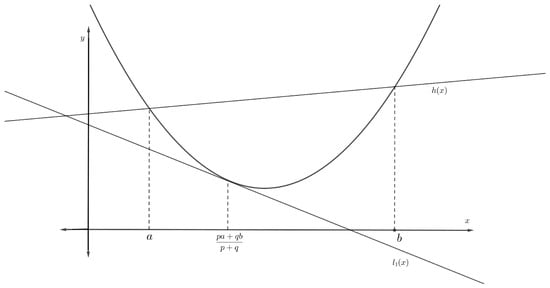
According to the given hypothesis, is differentiable on , so there exists a tangent line for the function at the point This tangent line can be indicated as a function Since is convex on , the following inequality (see Figure 1) holds for all x in
Figure 1.
Tangent line at the point of the convex function and chord line.
-integrating inequality (14) with respect to x over , we find that
where the first inequality in (13) is derived. We also have to show the second inequality in (13). According to the given hypothesis, is convex on , so , where is a secant line that connects the points () and , expressed as:
for all x in (see Figure 1). -integrating inequality (15) with respect to x over , we obtain the following
where the last inequality in (13) is obtained. Thus, the proof is completed. □
Corollary 1.
For a convex mapping the following inequality holds:
where
In the subsequent theorem, we give an alternative proof of the double inequality (13) without using the condition of differentiability on .
Theorem 5.
For a convex mapping on I and with , the double inequality (13) holds for
Proof.
According to the given hypothesis that is convex on I, by Theorem 2, is continuous on . By means of Theorem 1, there exists a minimum of one line of support for at each . Since , from the definition 1
for all and some . If the strategy that was used in the proof of Theorem 4 is applied and taking into account the inequality (18), the desired inequality (13) can be found. Thus, the proof is accomplished. □
Remark 4.
If we consider in Theorems 4 and 5, then Theorem 4 and 5 reduces to [11] (Theorem 12).
Remark 5.
If we adopt and in Theorems 4 and 5, then we retake the well-known HH inequality for convex functions.
Theorem 6.
For a convex mapping , which is differentiable on , the following inequalities hold for -integral:
where
Proof.
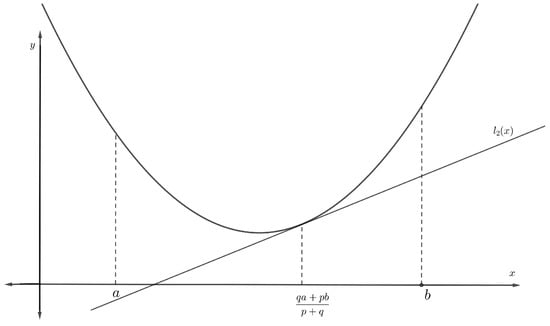
According to the given hypothesis, is differentiable on so there exists a tangent line for the function at the point This tangent line can be indicated as a function Since is convex on , then the following inequality (see Figure 2) holds for all x in
Figure 2.
Tangent line at the point of the convex function .
Theorem 7.
Let be a convex differentiable function on Then, the following inequalities hold for integral:
where
and
5. Midpoint-Type Inequalities through () Integral
In this section, we give some new midpoint-type inequalities by using the -derivative and integral.
To prove the main results of this section, we need the following crucial lemma.
Lemma 2.
Let be a differentiable function on . If is continuous and integrable on , then we have the following identity:
where
Proof.
From Definition 8, we have
From the left side of equality (23), we have
Remark 6.
If we address in Lemma 2, then Lemma 2 reduces to ([15] Lemma 2).
Remark 7.
If we use and in Lemma 2, then Lemma 2 reduces to [40] (Lemma 2.1).
Theorem 8.
Suppose that the assumptions of Lemma 2 hold. If is a convex function over , then we have the following new inequality:
where
Proof.
Taking the modulus in Lemma 2 and using the convexity of , we obtain that
Remark 8.
If we use in Theorem 8, then Theorem 8 becomes [15] (Theorem 5).
Remark 9.
If we take and in Theorem 8, then Theorem 8 reduces to [40] (Theorem 2.2)
Theorem 9.
Suppose that the assumptions of Lemma 2 hold. If , is a convex function over , then we have the following new inequality:
where are given in Theorem 8.
Proof.
Taking the modulus in Lemma 2, applying the well-known power mean inequality for ()-integrals, and by using the convexity of , , we have
which ends the proof. □
Remark 10.
If we put in Theorem 9, then Theorem 9 reduces to ([15] Theorem 6).
Remark 11.
If we set and in Theorem 9, then Theorem 9 becomes [18] (Corollary 2).
Theorem 10.
Suppose that the assumptions of Lemma 2 hold. If , is a convex function over , then we have the following new inequality:
where
Proof.
Taking the modulus in Lemma 2, by applying the well-known Hölder’s inequality for definite () integrals and using the convexity of , , we obtain that
Corollary 2.
If we pick in Theorem 10, then we have the following new inequality
Remark 12.
If we choose and in Theorem 10, then Theorem 10 reduces to [40] (Theorem 2.3).
6. Trapezoidal-Type Inequalities through ()-Integral
In this section, we give some new trapezoidal inequalities by using the derivative and integral.
To prove the main results of this section, we need the following crucial lemma.
Lemma 3.
Let be a differentiable function on . If is continuous and integrable on , then we have the following identity:
where
Proof.
Remark 13.
If we consider in Lemma 3, then Lemma 3 becomes [15] (Lemma 1).
Remark 14.
If we adopt and in Lemma 3, then Lemma 3 reduces to [41] (Lemma 2.1).
Theorem 11.
Suppose that the assumptions of Lemma 3 hold. If is a convex function over , then we have the following new inequality:
where
Proof.
Taking the modulus in Lemma 3 and using the convexity of we have
Thus, the proof is completed. □
Remark 15.
If we set in Theorem 11, then Theorem 11 becomes [15] (Theorem 3).
Remark 16.
If we consider and in Theorem 11, then Theorem 11 reduces to [41] (Theorem 2.2).
Theorem 12.
Suppose that the assumptions of Lemma 3 hold. If , is a convex function over , then we have the following new inequality:
where and are given in Theorem 11.
Proof.
Taking the modulus in Lemma 3 and applying the well-known power mean inequality for () integrals and the convexity of , , we get that.
Thus, the proof is finished. □
Remark 17.
If we consider in Theorem 12, then Theorem 12 reduces to [15] (Theorem 4).
Remark 18.
If we address and in Theorem 12, then Theorem 12 becomes [42] (Theorem 1).
Theorem 13.
Suppose that the assumptions of Lemma 3 hold. If , is a convex function over , then we have the following new inequality:
where
Proof.
Taking the modulus in Lemma 3 and applying the well-known Hölder’s inequality for ()-integrals and the convexity of , , we obtain that
Remark 19.
If we set and in Theorem 13, then Theorem 13 becomes [41] (Theorem 2.3).
7. Applications to Special Means
For arbitrary positive numbers (), we consider the means as follows:
- The arithmetic mean
- The geometric mean
- The harmonic means
Proposition 1.
For with and , the following inequality is true:
Proof.
The inequality (17) for mapping leads to this conclusion. For verification, if we choose , , , and we have
and
Thus,
which shows that the inequality (17) is valid. □
Proposition 2.
For with and , the following inequality is true:
where
and
Proof.
The inequality (17) for mapping , where leads to this conclusion. □
Proposition 3.
For with and , the following inequality is true:
where
and
Proof.
The inequality (17) for mapping leads to this conclusion. □
8. Conclusions
In the present research, we used the notions of derivative and integral, some new HH-type inequalities, and estimates for midpoint and trapezoidal type inequalities are derived. To approve their generalized behavior, we show the connection between our outcomes and the already established ones. Moreover, we provided applications to special means using the newly proved inequalities to show their significance. In future works, researchers can obtain comparable results by utilizing different kinds of convexity.
Author Contributions
All authors contributed equally to the writing of this paper. All authors read and approved the final manuscript.
Funding
This work is partially supported by National Natural Sciences Foundation of China (Grant No. 11971241).
Institutional Review Board Statement
Not applicable.
Informed Consent Statement
Not applicable.
Data Availability Statement
No data were used to support this study.
Acknowledgments
The Chinese government is acknowledged for providing full scholarship for Ph.D. studies to Muhammad Aamir Ali. We want to give thanks to the Dirección de investigación from Pontificia Universidad Católica del Ecuador for technical support to our research project entitled: “Algunas desigualdades integrales para funciones convexas generalizadas y aplicaciones".
Conflicts of Interest
The authors declare that they have no competing interests.
References
- Dragomir, S.S.; Pearce, C.E.M. Selected Topics on Hermite-Hadamard Inequalities and Applications; RGMIA Monographs; Victoria University: Melbourne, Australia, 2000. [Google Scholar]
- Pećarixcx, J.E.; Proschan, F.; Tong, Y.L. Convex Functions, Partial Orderings and Statistical Applications; Academic Press: Boston, MA, USA, 1992. [Google Scholar]
- Ernst, T. A Comprehensive Treatment of q-Calculus; Springer: Basel, Switzerland, 2012. [Google Scholar]
- Kac, V.; Cheung, P. Quantum Calculus; Springer: Berlin/Heidelberg, Germany, 2001. [Google Scholar]
- Benatti, F.; Fannes, M.; Floreanini, R.; Petritis, D. Quantum Information, Computation and Cryptography: An Introductory Survey of Theory, Technology and Experiments; Springer Science and Business Media: Berlin/Heidelberg, Germany, 2010. [Google Scholar]
- Bokulich, A.; Jaeger, G. Philosophy of Quantum Information Theory and Entaglement; Cambridge Uniersity Press: Cambridge, UK, 2010. [Google Scholar]
- Ernst, T. The History Of Q-Calculus Furthermore, New Method; Department of Mathematics, Uppsala University: Uppsala, Sweden, 2000. [Google Scholar]
- Jackson, F.H. On a q-Definite Integrals. Q. J. Pure Appl. Math. 1910, 41, 193–203. [Google Scholar]
- Al-Salam, W. Some fractional q-integrals and q-derivatives. Proc. Edinb. Math. Soc. 1966, 15, 135–140. [Google Scholar] [CrossRef] [Green Version]
- Tariboon, J.; Ntouyas, S.K. Quantum calculus on finite intervals and applications to impulsive difference equations. Adv. Differ. Equ. 2013, 282, 1–19. [Google Scholar] [CrossRef] [Green Version]
- Bermudo, S.; Kórus, P.; Valdés, J.N. On q-Hermite–Hadamard Inequalities for General Convex Functions. Acta Math. Hung. 2020, 162, 364–374. [Google Scholar] [CrossRef]
- Sadjang, P.N. On the fundamental theorem of (p,q)-calculus and some (p,q)-Taylor formulas. arXiv 2013, arXiv:1309.3934v1. [Google Scholar]
- Tunç, M.; Göv, E. Some integral inequalities via (p,q)-calculus on finite intervals. RGMIA Res. Rep. Coll. 2016, 19, 1–12. [Google Scholar]
- Chu, Y.-M.; Awan, M.U.; Talib, S.; Noor, M.A.; Noor, K.I. New post quantum analogues of Ostrowski-type inequalities using new definitions of left–right (p,q)-derivatives and definite integrals. Adv. Differ. Equ. 2020, 634. [Google Scholar] [CrossRef]
- Budak, H. Some trapezoide and midpoint type inequalities for newly defined quantum integrals. Proycciones J. Math. 2021, 40, 199–215. [Google Scholar] [CrossRef]
- Ali, M.A.; Budak, H.; Abbas, M.; Chu, Y.-M. Quantum Hermite–Hadamard-type inequalities for functions with convex absolute values of second qb-derivatives. Adv. Differ. Equ. 2021, 7. [Google Scholar] [CrossRef]
- Ali, M.A.; Alp, N.; Budak, H.; Chu, Y.-M.; Zhang, Z. On some new quantum midpoint type inequalities for twice quantum differentiable convex functions. Open Math. 2021, in press. [Google Scholar]
- Alp, N.; Sarikaya, M.Z.; Kunt, M.; Iscan, I. q-Hermite Hadamard inequalities and quantum estimates for midpoint type inequalities via convex and quasi-convex functions. J. King-Saud Univ.-Sci. 2018, 30, 193–203. [Google Scholar] [CrossRef] [Green Version]
- Alp, N.; Sarikaya, M.Z. Hermite Hadamard’s Type Inequalities for Co-Ordinated Convex Functions on Quantum Integral. Appl. Math. E-Notes 2020, 20, 341–356. [Google Scholar]
- Budak, H.; Ali, M.A.; Tarhanaci, M. Some New Quantum Hermite-Hadamard-Like Inequalities for Coordinated Convex Functions. J. Optim. Theory Appl. 2020, 186, 899–910. [Google Scholar] [CrossRef]
- Jain, S.; Mehrez, K.; Baleanu, D.; Agarwal, P. Certain Hermite–Hadamard inequalities for logarithmically convex functions with applications. Mathematics 2019, 7, 163. [Google Scholar] [CrossRef] [Green Version]
- Jhanthanam, S.; Tariboon, J.; Ntouyas, S.K.; Nonlaopon, K. On q-Hermite-Hadamard Inequalities for Differentiable Convex Functions. Mathematics 2019, 7, 632. [Google Scholar] [CrossRef] [Green Version]
- Liu, W.; Zhuang, H. Some quantum estimates of Hermite-Hadamard inequalities for convex functions. J. Appl. Anal. Comput. 2016, 7, 501–522. [Google Scholar]
- Noor, M.A.; Noor, K.I.; Awan, M.U. Some quantum estimates for Hermite-Hadamard inequalities. Appl. Math. Comput. 2015, 251, 675–679. [Google Scholar] [CrossRef]
- Tomar, M.; Agarwal, P.; Choi, J. Hermite-Hadamard type inequalities for generalized convex functions on fractal sets style. Bol. Soc. Parana. MatemáTica 2020, 38, 101–116. [Google Scholar] [CrossRef] [Green Version]
- Noor, M.A.; Noor, K.I.; Awan, M.U. Some quantum integral inequalities via preinvex functions. Appl. Math. Comput. 2015, 269, 242–251. [Google Scholar] [CrossRef]
- Nwaeze, E.R.; Tameru, A.M. New parameterized quantum integral inequalities via η-quasiconvexity. Adv. Differ. Equ. 2019, 2019, 425. [Google Scholar] [CrossRef] [Green Version]
- Khan, M.A.; Noor, M.; Nwaeze, E.R.; Chu, Y.-M. Quantum Hermite–Hadamard inequality by means of a Green function. Adv. Differ. Equ. 2020, 2020, 1–20. [Google Scholar]
- Budak, H.; Erden, S.; Ali, M.A. Simpson and Newton type inequalities for convex functions via newly defined quantum integrals. Math. Methods Appl. Sci. 2021, 44, 378–390. [Google Scholar] [CrossRef]
- Ali, M.A.; Budak, H.; Zhang, Z.; Yildrim, H. Some new Simpson’s type inequalities for co-ordinated convex functions in quantum calculus. Math. Methods Appl. Sci. 2021, 44, 4515–4540. [Google Scholar] [CrossRef]
- Ali, M.A.; Abbas, M.; Budak, H.; Agarwal, P.; Murtaza, G.; Chu, Y.M. New quantum boundaries for quantum Simpson’s and quantum Newton’s type inequalities for preinvex functions. Adv. Differ. Equ. 2021, 2021, 64. [Google Scholar] [CrossRef]
- Vivas-Cortez, M.; Ali, M.A.; Kashuri, A.; Sial, I.B.; Zhang, Z. Some New Newton’s Type Integral Inequalities for Co-Ordinated Convex Functions in Quantum Calculus. Symmetry 2020, 12, 1476. [Google Scholar] [CrossRef]
- Ali, M.A.; Chu, Y.-M.; Budak, H.; Akkurt, A.; Yildrim, H. Quantum variant of Montgomery identity and Ostrowski-type inequalities for the mappings of two variables. Adv. Differ. Equ. 2021, 2021, 1–26. [Google Scholar] [CrossRef]
- Ali, M.A.; Budak, H.; Akkurt, A.; Chu, Y.-M. Quantum Ostrowski type inequalities for twice quantum differentiable functions in quantum calculus. Open Math. 2021, in press. [Google Scholar]
- Budak, H.; Ali, M.A.; Alp, N.; Chu, Y.-M. Quantum Ostrowski type integral inequalities. J. Math. Inequalities 2021, in press. [Google Scholar]
- Kunt, M.; İşcan, İ.; Alp, N.; Sarikaya, M.Z. (p,q)-Hermite-Hadamard inequalities and (p,q)-estimates for midpoint inequalities via convex quasi-convex functions. Rev. Real Acad. Cienc. Exactas Físicas y Nat. Ser. A Matemáticas 2018, 112, 969–992. [Google Scholar]
- Latif, M.A.; Kunt, M.; Dragomir, S.S.; İşcan, İ. Post-quantum trapezoid type inequalities. AIMS Math. 2020, 5, 4011. [Google Scholar] [CrossRef]
- Roberts, A.W.; Varberg, D.E. Convex Functions; Academic Press: New York, NY, USA, 1973. [Google Scholar]
- Azpetitia, A.G. Convex functions and the Hadamard inequality. Rev. Colomb. Mat. 1994, 28, 7–12. [Google Scholar]
- Kirmaci, U.S. Inequalities for differentiable mappings and applications to special means of real numbers and to midpoint formula. Appl. Math. Comput. 2004, 147, 137–146. [Google Scholar] [CrossRef]
- Dragomir, S.S.; Agarwal, R.P. Two inequalities for diferentiable mappings and applications to special means fo real numbers and to trapezoidal formula. Appl. Math. Lett. 1998, 11, 91–95. [Google Scholar] [CrossRef] [Green Version]
- Pearce, C.E.M.; Pećarixcx, J.E. Inequalities for diferentiable mappings with application to special means and quadrature formulae. Appl. Math. Lett. 2000, 13, 51–55. [Google Scholar] [CrossRef] [Green Version]
Publisher’s Note: MDPI stays neutral with regard to jurisdictional claims in published maps and institutional affiliations. |
© 2021 by the authors. Licensee MDPI, Basel, Switzerland. This article is an open access article distributed under the terms and conditions of the Creative Commons Attribution (CC BY) license (https://creativecommons.org/licenses/by/4.0/).