
Skip Content
You are currently on the new version of our website. Access the old version .
EntropyEntropy
  • Article
  • Open Access

15 December 2020

Dichotomic Decision Optimization for the Design of HVDC Superconducting Links


,
,
and
1
Escuela Técnica Superior de Ingenieros Industriales, Universidad Politécnica de Madrid, 28006 Madrid, Spain
2
Institute for Advanced Sustainability Studies, 14467 Potsdam, Germany
3
Nexans, 62100 Calais, France
4
Nexans, 62301 Lens, France
This article belongs to the Special Issue Thermodynamic Optimization of Complex Energy Systems

Abstract

Superconducting links are an innovative solution for bulk power transmission, distinguished by their compact dimensions, high efficiency and small environmental footprint. As with any new technology field, there is a large amount of design possibilities for such links, each of them having a profound impact on the system configuration. For instance, changing the material can imply a change in the working temperature from 20 to 70 K and has consequences on the maximum link length. This article presents the dichotomic decision possibilities for the optimized design of a high-power superconducting link, focusing on some of the key components of the cable system. The complex design optimization process is exemplified using the European project Best Paths, in which the first 3-gigawatt-class superconducting cable system was designed, optimized, manufactured, and successfully tested.

1. Introduction

Superconductivity occurs in materials that can transmit electricity without losses below three characteristic thresholds: a critical value of the temperature, a critical intensity of the magnetic field, and a critical current density. Discovered more than 100 years ago, superconductivity has found successful application in both research and industrial contexts, for instance, in particle accelerators and medical imaging devices [1]. However, its first envisaged application of perfect electric power transmission has remained untapped for decades, due to the low operating temperatures of the commercially available superconductors. The discovery of high-temperature superconductors in 1987 [2] ushered in new prospects for superconducting power applications, focused in particular on fault current limiters, energy storage, and superconducting cables for power grids [3].
Due to their high efficiency, compact size, and reduced environmental footprint, superconducting power cables have generated increased interest in recent years [4]. These potential advantages are becoming quite relevant, as most countries across the globe are upgrading and expanding their electricity grids as part of their transition to renewable energy.
In the past decade, a growing number of projects related to superconducting cables of various lengths and capacities have been constructed or become operational worldwide [5]. A prominent example of a superconducting cable installed in the grid is the AmpaCity project in downtown Essen, Germany [6]. The 1 km long AC cable is based on high-temperature ceramic superconducting materials and is cooled using liquid nitrogen, operating under a voltage of 10 kV and a current of 2.4 kA. The cable system energizes a full district close to the city center and has been in operation since 2014 with 100% availability. In general, the installation of such superconducting links in inner-city areas would free up valuable space and can lead to greater efficiency and lower operating costs.
Nevertheless, widespread use of such superconducting systems for power transmission has been hindered by the high costs of the ceramic-based superconductors and their complex manufacturing process. A promising alternative explored in recent years is represented by the simple binary compound magnesium diboride (MgB2) [7], which is based on inexpensive raw materials that are abundant in nature. The manufacturing process is much simpler and has already been optimized at industrial level, resulting in commercial availability of MgB2 wires in kilometric lengths [8]. Unlike ceramic superconductors, which are cooled by low-cost readily available liquid nitrogen, the cooling medium and the cooling system required by MgB2 are more complex and more expensive. The benefits and drawbacks of these two key components of the cable system, superconducting material, and cooling system need to be carefully weighed when designing a new cable and optimizing the system performance.
The optimization process in the design of complex systems is not simply a continuous mathematical function, but goes through a dichotomic decision tree that has not yet been reported for the field of superconducting links. In other engineering fields, there is a multitude of examples of dichotomic decisions related to the design of complex systems:
  • Road vehicle traction system [9]: three options are common: front-, rear-, or all-wheel drive. Depending on the chosen use, the weather conditions (snow), the required power, etc., the optimum decision is going to change, affecting the remaining design parameters of the car.
  • Airplane engines location [10]: several options are available, for instance, front wings or rear wings. Each of them gives different possibilities in terms of manageability and puts the airplane under different mechanical stresses: compression (rear wings) and traction (front wings).
  • Thermal cycle cold sink in power plants [11]: a dry cooling system is cheaper but decreases the cycle efficiency when compared to a wet cooling system, which usually conditions the location of the power plant.
  • Windmill morphology [12]: the three-bladed windmill is not the most efficient, but is commonly used at present, due to the balance between cost, reliability, and efficiency.
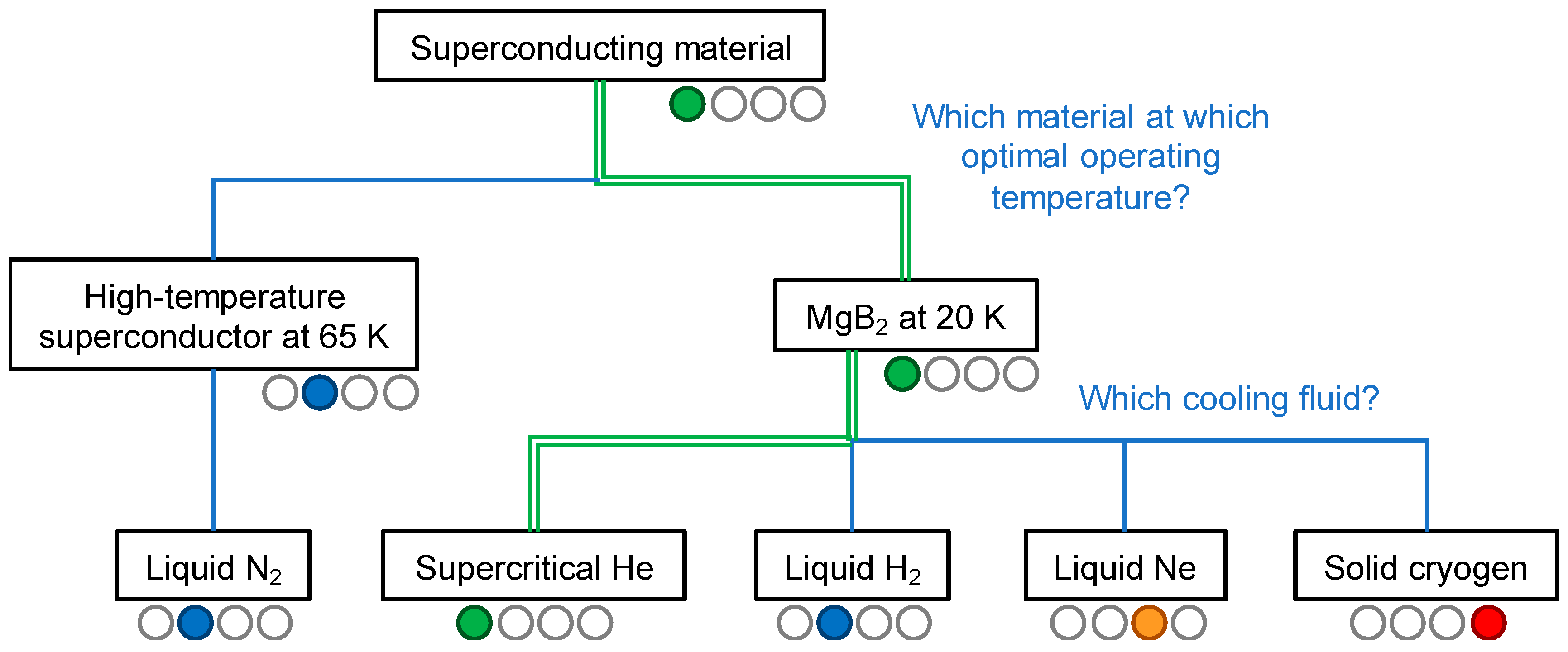
This work analyses the design possibilities that usually appear in a new technology field—in this case high-power superconducting links—and that can be limited by optimization within the traditional framework of continuous variable analysis. To avoid limitations and achieve an optimal design, dichotomic decisions are introduced, which can bring about a substantial change in the system configuration. We exemplify this approach through an in-depth description of the dichotomic decision-making process undertaken for the recently finished European project Best Paths [13], which demonstrated the first 3-gigawatt-class direct-current superconducting cable system [14,15].
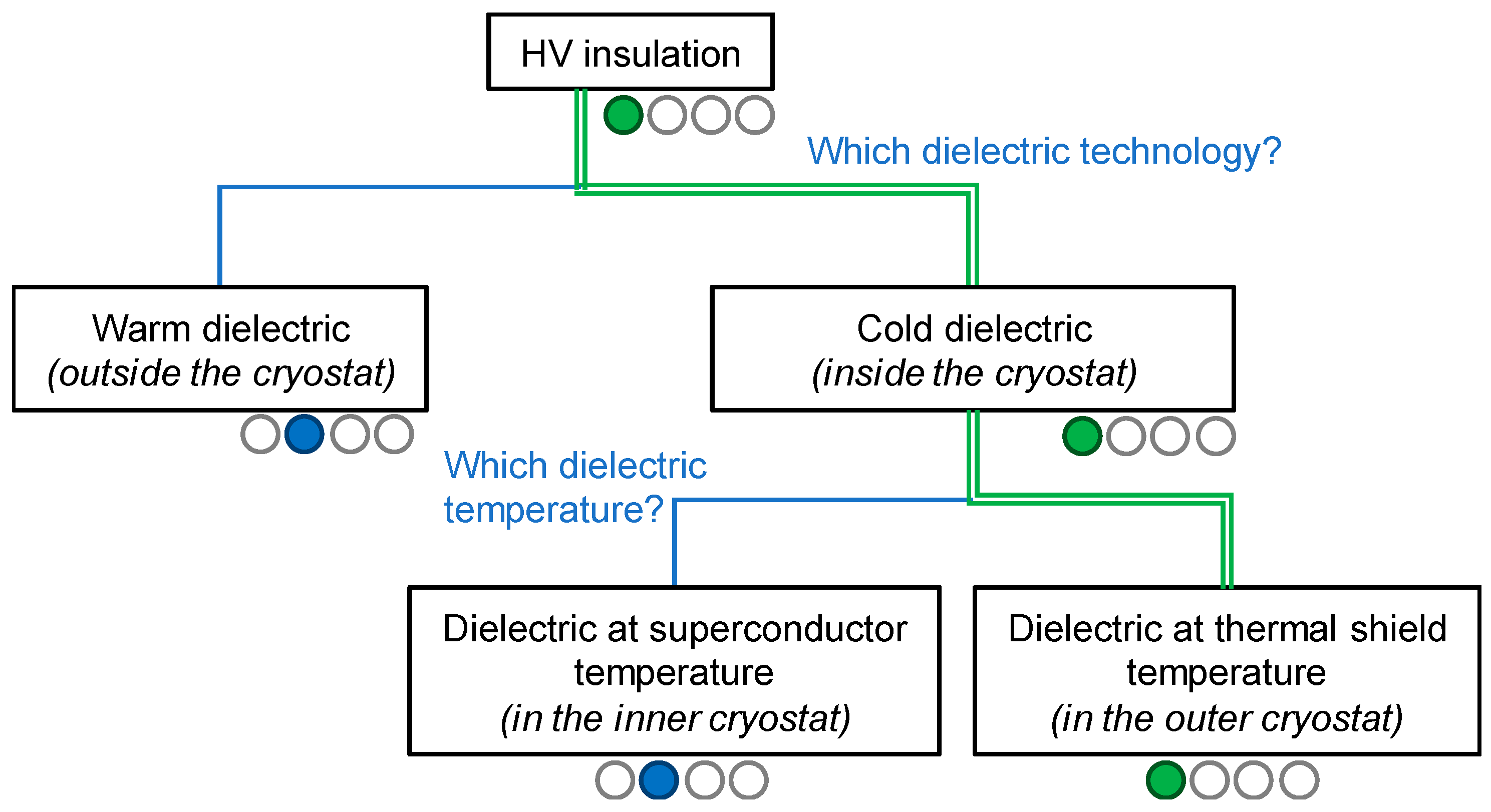
The article is divided into two main sections. Section 2 provides a comprehensive overview of the selection criteria related to available technologies for bulk power transmission, in order to understand their benefits and limitations and be able to situate superconducting links in this context. It also includes a brief introduction to the main components of a superconducting cable system. Section 3 investigates the dichotomic decision possibilities for an optimal design of high-power superconducting links, driven by the Best Paths case study. The focus is set on dichotomic decisions related to the superconductor, cooling fluid, cryogenic envelope, thermal shield, and high-voltage electrical insulation, which affect the design, dimensions, and cost of the cable system.

2. Background: Technologies for Bulk Power Transmission

2.1. Selection of Link Technology

Available technologies for high-voltage direct-current (HVDC) transmission up-to-day include overhead lines (OHL, bare conductors suspended in air between towers), insulated cables—underground (UGC), or submarine (SUB)—gas insulated lines (GIL, rigid metallic tubes filled with an insulating gas), and superconducting cables (SCC), located underground.
OHL are the backbone of transmission grids, with more than one century of service experience. Generally, except in dense urban states like Singapore, buried technologies represent less than 10% of the installed length, but most of the new infrastructures. GIL and SCC are still niche projects.
OHL are well-established at very high ratings for very long distances with several commissioned and operational ±800 kV links, particularly in China, Brazil, and India. For instance, the Zhundong-Wannan link in China transmits up to 12 GW at ±1100 kV across 3320 km [16]. The longest SUB link has been operating since 2008 over a length of 580 km and a capacity of 700 MW, with the deepest point at 410 m [17]. MurrayLink in Australia is the longest UGC, in operation since 2004, with a length of 177 km and a capacity of 220 MW [18]. The most significant GIL system was commissioned in October 2019 and is the Sudong Tunnel crossing the Yangtze River in China, with a length of 5.4 km and a capacity of 6 GW. This is an AC system, but major developments have recently been achieved in the design and testing of HVDC systems for 5000 A and ±550 kV [19].
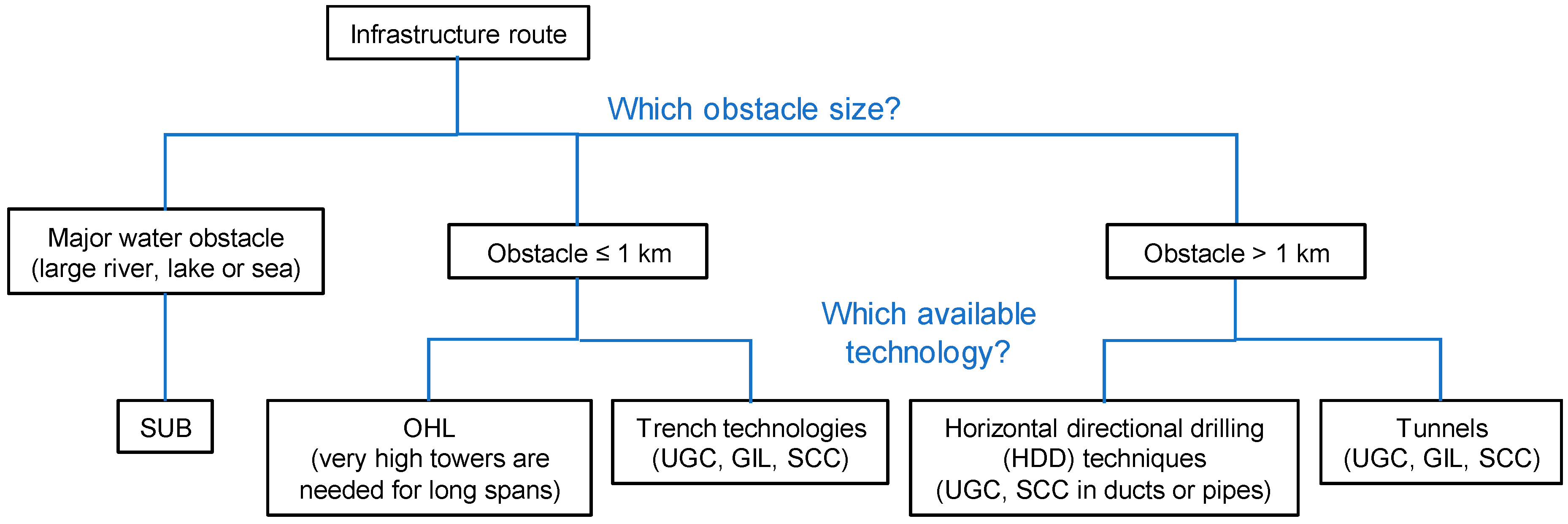
First of all, the technology selection for new infrastructure depends on the macro-environment to cross, especially according to the nature and size of the obstacles to cross. Common options are highlighted in Figure 1, with the caveat that a few very specific infrastructures push these limits.
Figure 1. Selection of link technology according to the main obstacle that needs to be crossed.

2.2. Additional Selection Criteria

In addition to the criterion related to obstacles, Table 1 summarizes a number of other important selection criteria for the HVDC transmission technology. Each criterion is rated with stars (up to ★★★★ for high interest) or discs (up to Entropy 22 01413 i001Entropy 22 01413 i001Entropy 22 01413 i001Entropy 22 01413 i001 for high difficulty), depending on whether advantages or disadvantages are described. Furthermore, these various aspects are addressed in detail below, providing a state-of-the-art overview that highlights the complexity of the decision-making process.
Table 1. Rating of available technologies for high-voltage direct-current (HVDC) transmission, according to various design criteria.

2.2.1. Visual Impact

The visual impact of transmission infrastructures may raise strong local opposition. This mainly concerns OHL, as the towers of the corridor become taller and wider with increasing transmission voltage. Buried technologies are often a condition for much better public acceptance and can significantly reduce the duration for getting the necessary administrative permits (typically 3, instead of 10 years).
Most of the existing GIL are located outdoors, but the conduits can be buried or installed in tunnels. SCC are generally installed in buried ducts, with only the terminations visible at the end of the link.

2.2.2. Infrastructure Footprint and Right-of-Way

Insulated solutions are designed to contain the electric fields and are much more compact. However, neither buildings nor trees can be added above the buried cable route.
The required strip of land includes not only the footprint of the power link itself, but also a service strip for eventual maintenance and repair. In any case, the expected footprint during the civil engineering must be extended for temporary storage of the excavated material (typical total width = 50 m, for 16 m trenches hosting 4 parallel circuits in large UGC European projects).

2.2.3. Sensitivity to Climatic Hazards

OHL may be damaged by storms, icing, sticky snow. In areas where these weather conditions are identified and recurrent, it can be preferrable to employ buried technologies. Only the equipment located above the ground in substations would then be affected. Insulation coordination is organised to avoid lightning damages in all power grid sections, as well.
SCC systems can be considered like any regular underground technology.

2.2.4. Sensitivity to Ambient Temperature

The current rating of a resistive transmission link always depends on at least one thermal criterion, because of the Joule losses, which heat the conductor and contribute to its expansion. Moreover, a maximum critical temperature at the outer surface may be required for buried systems, to avoid soil drying and thermal runaway.
The bare conductors of OHL are exposed to solar radiation and cooled by natural convection and wind. The dilatation of a span between two towers brings the lowest point closer to the ground. The regulations impose a safe distance for people.
The cables insulated with impregnated paper or polymeric materials must not overheat beyond a maximum temperature, above which ageing and breakdown may occur.
The intrinsic cryogenic cooling of superconductors makes the SCC independent from the surrounding thermal environment. The current rating is not affected by high ambient temperatures, and no heating is generated to the surrounding soil.

2.2.5. Sensitivity to Rocky Environment

The crossing of mountains is technologically easier with OHL, but results in a strong impact on the surroundings. Tracks are built to access the tower locations; helicopters can be used to carry steel angles. Trenching may be complex in soils with rocks or slopes. Tunnels may be an expensive solution.
When SUB cannot be buried, rock damping techniques ensure their protection.
For SCC, the management of elevation must also be considered due to the pumping of cryogenic fluid.

2.2.6. Ease of Making Joints

Mid-span tension joints provide electrical and mechanical continuity of the OHL conductor. Insulated cables are connected by joints that reproduce the continuity of each of the concentric components.
Factory joints are prepared ashore for SUB, while field joints are manufactured for other technologies. The use of prefabricated or pre-moulded joints has brought a significant growth to UGC systems.
The joining of SCC systems is performed by means of a manual process.

2.2.7. Repairability

The repairing of OHL is easier, with visual inspection and direct access to the bare conductors both possible. A preliminary fault location is required for buried technologies, followed by digging to prepare a repair joint. The use of ducts gives the possibility to replace the damaged section by a spare.
The repair of SUB links may require several months and several tens of millions of euros (fault location, raising of cut ends to the water surface, routing of the vessel to the zone, on-site manufacturing of the repair joint).
The repair joint of SCC systems is made more complex by the additional reconstitution of the thermal insulation and associated vacuum loss.

2.2.8. Resilience and Contingency

The possibility to transmit bulk power in the same link may be a drawback in case of a breakdown. The (n-k) rule of parallel circuits per phase is applied to avoid a total power outage. OHL towers often support several circuits and bundles of conductors.
A meshed grid can transfer the load of the failing link to other links, a 3 GW limit often being considered by the transmission system operators. This criterion must be taken into account for SCC systems, whose power rating may exceed this limit. Their intrinsic capability may be then restricted by operating considerations.

2.2.9. Monitoring and Maintenance

OHL are exposed to climatic conditions and corrosion. Frequent visual inspections and tower painting are scheduled.
Very low maintenance is required for UGC and SUB systems, while GIL and SCC have fluids under pressure and associated monitoring and maintenance operations.

2.2.10. Generated Electromagnetic Fields

Electric fields are characteristic of OHL, while magnetic fields are generated by all the technologies under consideration here. It must be noticed that the possible health effects of electromagnetic fields are very different from the static fields generated by HVDC systems [20,21]. Therefore, consistent values for recommendations or regulations are very different for DC and AC (e.g., 400 mT >> 200 µT).
A peak of the magnetic field is observed for UGC above the cable route, but in a very narrow corridor, while a measurable value remains at 100 m for OHL. By design, electromagnetic fields are negligible for GIL and SCC.

2.2.11. General Considerations

Economic considerations are crucial for the selection of the technology. The investment cost (CAPEX) includes the cost of the components, the commissioning tests, but also the delivery, installation on site, and civil engineering. The operating cost (OPEX) includes the cost of monitoring and maintenance, repair, losses. The selection of the technology needs to strike a good balance between CAPEX and OPEX. An attractive CAPEX may lead to an expensive OPEX, due to excessive maintenance operations or equipment replacements. From a technical point, only SCC systems have no electric losses, the remaining technologies exhibit Joules losses depending on the instantaneous current value, which impacts significantly the OPEX. However, the cooling system of a SCC consumes electric power to maintain the operation at cryogenic temperature. In fact, this is the main operating cost of a SCC system. It is difficult to rate the technologies generically, because each project must be assessed separately, accounting for the specific context. It can be noticed that the most expensive projects are those that end up not being realized due to excessive delays or cancelations. Some niche cases can then provide very valuable solutions; for instance, SCC systems can save investments on transformers and substations, due to their lower rated voltage level.
The environmental impact of a transmission system is increasingly considered for the selection of the technology. It can be assessed with a life cycle analysis (LCA) approach. Such studies [22] show for instance that more than 95% of the impact on climate change is caused by operating losses. Apart from the criterion of visual impact, the component manufacturing and the civil engineering (access tracks and concrete foundations of OHL towers, trenching for buried technologies) must be also considered. The compactness of SCC and their narrow trench holds promise for reducing the depletion of raw materials.
These considerations illustrate the complexity involved in the technology selection for a new HVDC power link. In the electricity grid, a combination of the various HVDC technologies is generally used for power transmission along hundreds of kilometers. The different segments using successively one of these technologies are connected in series to build up power links running from remote energy sources to consumption centers in large urban areas.
As discussed above, each HVDC solution has benefits but also limitations according to the specific application. The selection of the best technology for each link segment is strongly dependent on the local installation conditions. For example, the OHL technology is well adapted and accepted in sparsely populated areas, but often rejected in western Europe, in particular in suburban areas. By contrast, given its very small footprint and low environmental impact, the SCC technology is very well adapted to enter or cross large cities or protected areas, but of less interest for crossing large empty areas.
The OHL, UCC, SUB, and GIL technologies have already been installed and proven their added values in electricity grids. Only high-power SCC have not yet been field tested in the real grid. This was the key motivation for the study of HVDC superconducting cable systems in the Best Paths project.

2.3. Main Components of a Superconducting Cable System

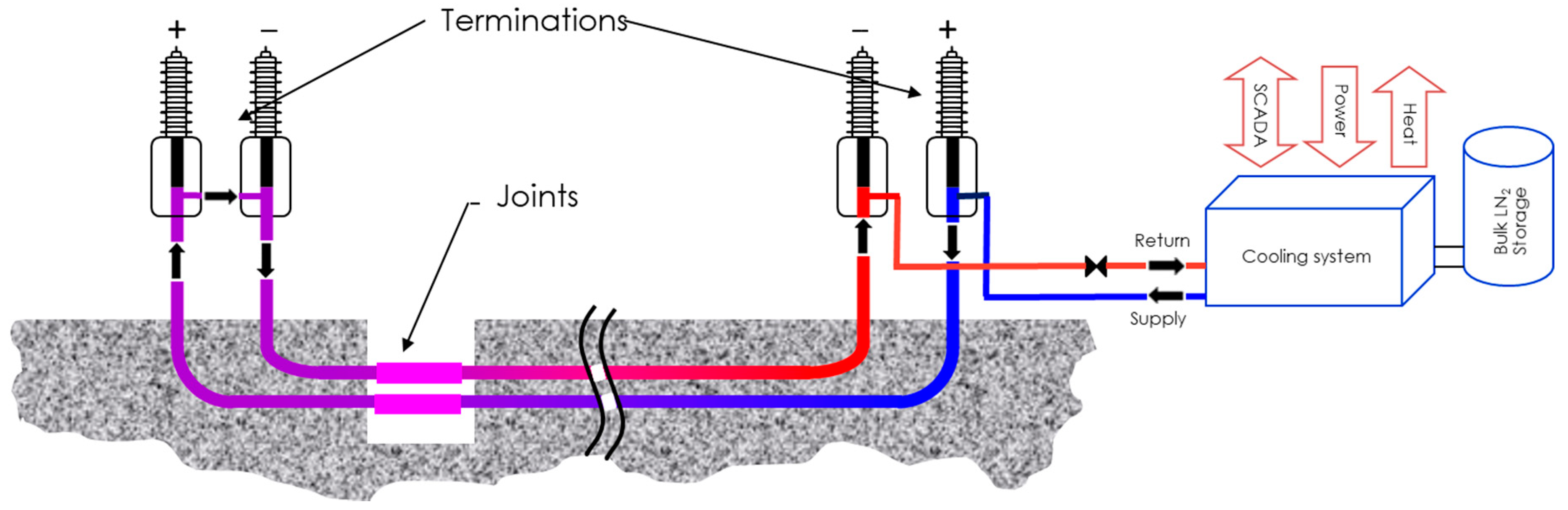
Generally, an HVDC superconducting cable system is operating at high voltage with a range of possible currents exceeding 3 kA. Below this current level, the conventional resistive cable technology is more able to meet the grid’s requirements and can be used instead. As seen in Figure 2, the HVDC cable system is bipolar, meaning that the transmission of electricity can take place in both directions.
Figure 2. Schematic of a high-voltage direct-current (HVDC) superconducting cable system with a length of approximately 10 km.
Essentially, a superconducting cable system consists of the following key components, schematically illustrated in Figure 2:
Superconductor;
Cryostat (cryogenic envelope), housing the cooling fluid needed to maintain the superconductor temperature;
High-voltage electrical insulation;
Cryogenic terminations and joints;
Adequate cooling devices connected to associated power and fluid supplies for the auxiliary equipment (chiller, pumps, etc.).
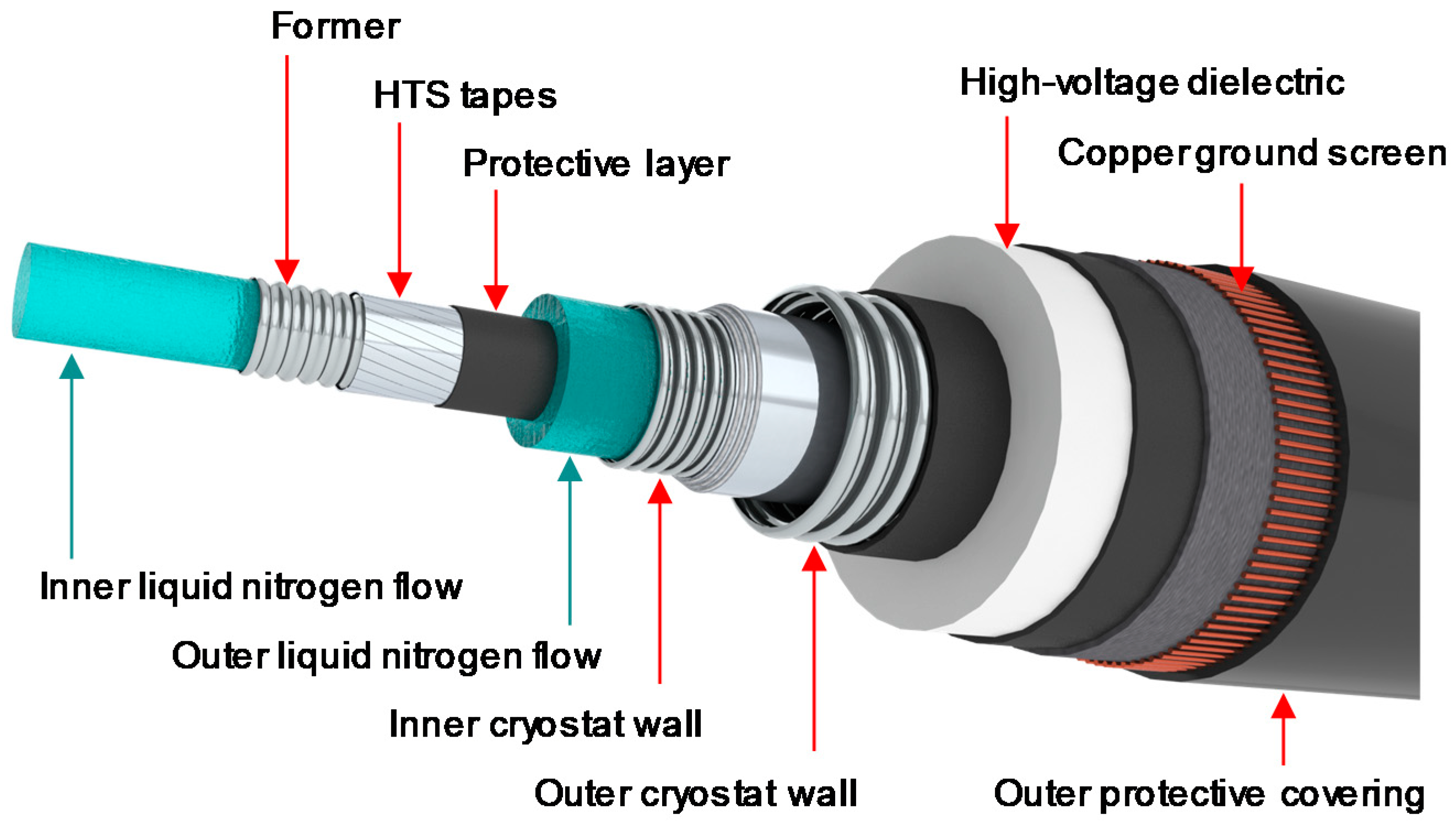
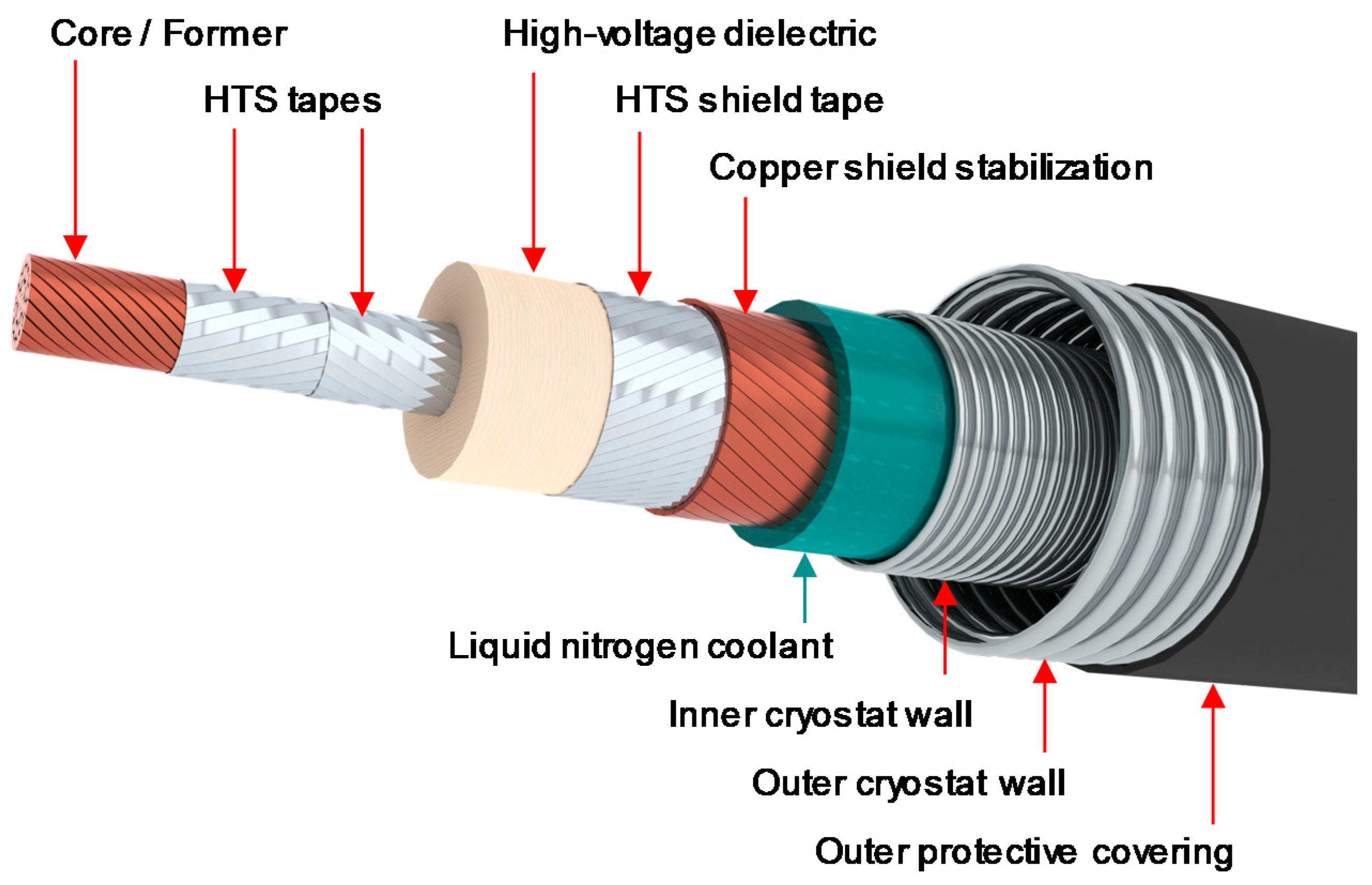
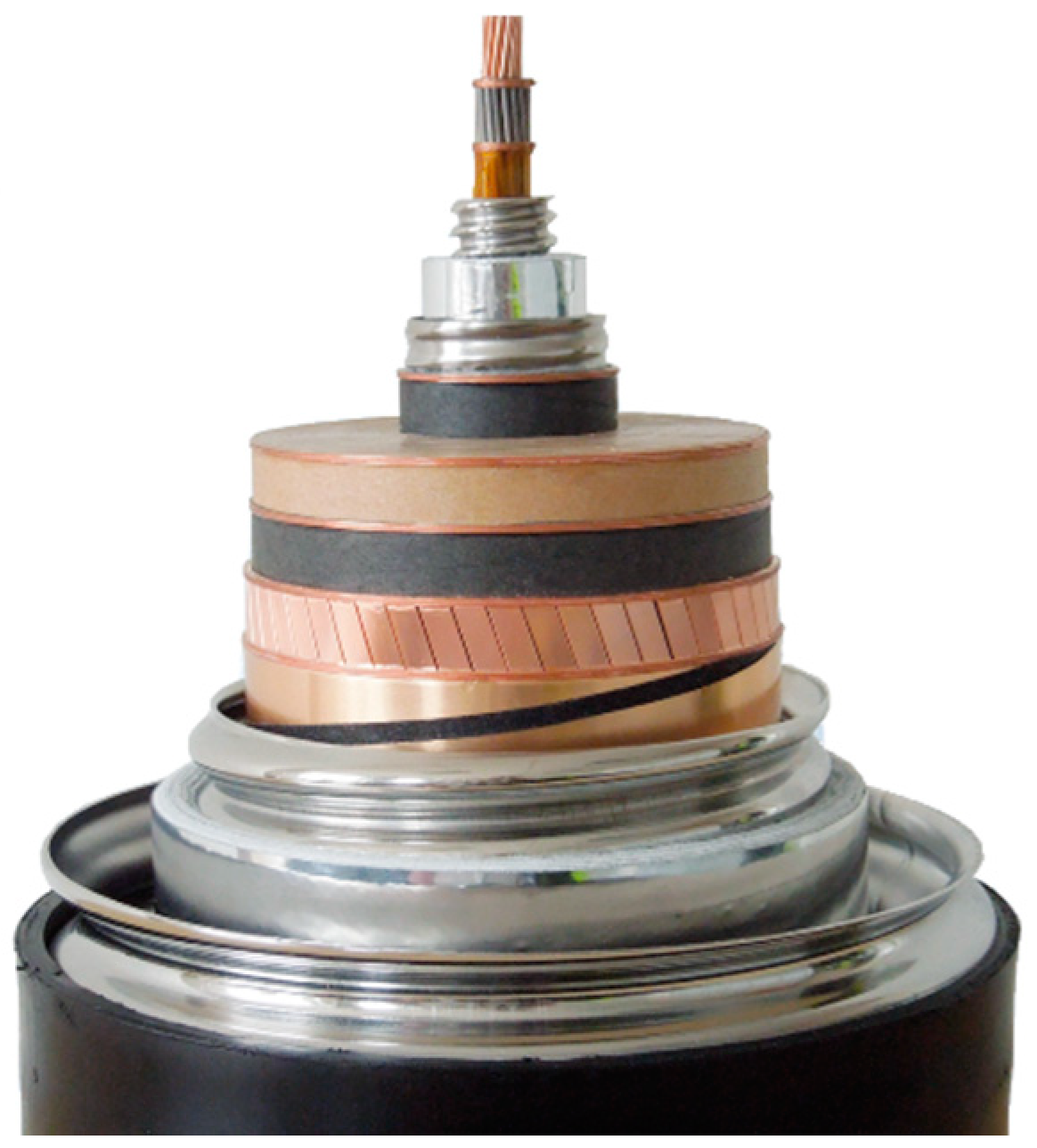
The superconducting material is directly wound on a central former that can be practically made with copper cable. This copper core helps to protect the cable during a possible short circuit or fault, where a huge current could suddenly overwhelm the system. To ensure the voltage insulation between the pole and ground, a thick dielectric material is required. This insulation could, for instance, be made out of polyethylene layers and be located outside the cable cryostat. In this case, the insulation operates at room temperature in a so-called “warm dielectric” design [23]. An alternative is to place the high-voltage insulation close to the cable conductor at cryogenic temperature, which constitutes a so-called “cold dielectric” design [24]. The return pole concept is identical.
The cable assembly is placed into a cryogenic envelope with low thermal losses, which maintains the adequate cryogenic operating temperature and prevents thermal exchanges with the surrounding environment. Figure 3 and Figure 4 show the two cable designs for the HVDC cable system. The proposed designs are versatile, allowing for different nominal currents and, therefore, different transmission capacities without an increase in size.
Figure 3. Warm dielectric concept for a high-temperature superconducting HVDC cable.
Figure 4. Cold dielectric concept for a high-temperature superconducting HVDC cable.
In addition to the cable itself, the system includes two terminations to connect to the electricity grid, some junctions associated with thermal shrinkage management to extend the cable length, and from place to place several cooling systems or refreshing units to recover the operating temperature.

4. Conclusions and Future Work

This article presents the application of a dichotomic decision process to achieve an optimized design for an HVDC superconducting link. This complex process is exemplified using the European project Best Paths, in which the first 3-gigawatt-class HVDC superconducting cable system was manufactured and successfully tested.
A number of different conceptual and technological options for the practical realization of high-power superconducting links are described in detail, even if they were not feasible within the scope of Best Paths. To begin with, superconducting links are placed into the landscape of available HVDC technologies in a detailed overview. Afterwards, the main part of the article focusses on the dichotomic possibilities related to some of the key components of the cable system, such as the superconductor, cooling fluid, cryogenic envelope, thermal shield, and high-voltage electrical insulation. The associated analysis should provide a good basis for designing a variety of configurations for superconducting links.
Superconducting links represent a technically realistic solution for bulk power transmission and could contribute to the necessary decarbonization of our society by reinforcing and increasing the efficiency of electricity grids with very limited environmental impact. Moreover, a whole panoply of concepts and technologies exist that can still enhance their efficiency and carbon emission footprint. Beyond electricity transmission, the use of superconducting cables also opens up the unique and promising possibility of simultaneous transport of two energy carriers, by combining both hydrogen and electricity.

Author Contributions

Conceptualization, J.M.-A., A.M. and C.-E.B.; methodology, A.M. and C.-E.B.; writing—original draft, J.M.-A., A.M., F.L. and C.-E.B.; writing—review and editing, A.M., F.L. and C.-E.B.; visualization, F.L.; project administration, A.M. and C.-E.B.; funding acquisition, C.-E.B. All authors have read and agreed to the published version of the manuscript.

Funding

This work was supported in part by the European Commission within the Seventh Research Framework Programme under Grant 612748. The Institute for Advanced Sustainability Studies is funded by the German Federal Ministry of Education and Research (BMBF) and the Brandenburg State Ministry of Science, Research and Culture (MWFK).

Acknowledgments

We are very grateful to all the Demo 5 partners who contributed over the years to the success of the project.

Conflicts of Interest

The authors declare no conflict of interest.

References

  1. Grant, P.M. Fantastic five—Top five applications of superconductivity. Phys. World 2011, 4, 23–25. [Google Scholar]
  2. Müller, K.A.; Bednorz, J.G. The discovery of a class of high-temperature superconductors. Science 1987, 237, 1133–1139. [Google Scholar] [CrossRef] [PubMed]
  3. Nishijima, S.; Eckroad, S.; Marian, A.; Choi, K.; Kim, W.S.; Terai, M.; Deng, Z.; Zheng, J.; Wang, J.; Umemoto, K.; et al. Superconductivity and the environment: A Roadmap. Supercond. Sci. Technol. 2013, 26, 113001. [Google Scholar] [CrossRef]
  4. Thomas, H.; Marian, A.; Chervyakov, A.; Stückrad, S.; Salmieri, D.; Rubbia, C. Superconducting transmission lines—Sustainable electric energy transfer with higher public acceptance? Renew. Sustain. Energy Rev. 2016, 55, 59–72. [Google Scholar] [CrossRef]
  5. EPRI. Superconducting Power Equipment: Technology Watch 2012; EPRI Report No. 1024190; Electric Power Research Institute: Palo Alto, CA, USA, 2012. [Google Scholar]
  6. Stemmle, M.; Merschel, F.; Noe, M.; Hobl, A. AmpaCity project—Worldwide first superconducting cable and fault current limiter installation in a German city center. In Proceedings of the 22nd International Conference and Exhibition on Electricity Distribution (CIRED 2013), Stockholm, Sweden, 10–13 June 2013; pp. 1–4. [Google Scholar]
  7. Nagamatsu, J.; Nakagawa, N.; Muranaka, T.; Zenitani, Y.; Akimitsu, J. Superconductivity at 39 K in magnesium diboride. Nature 2001, 410, 63–64. [Google Scholar] [CrossRef] [PubMed]
  8. Braccini, V.; Nardelli, D.; Penco, R.; Grasso, G. Development of ex situ processed MgB2 wires and their applications to magnets. Physica C Supercond. 2007, 456, 209–217. [Google Scholar] [CrossRef]
  9. Lucas, G.G. Road Vehicle Performance: Methods of Measurement and Calculation; Taylor & Francis: Milton Park, UK, 1986. [Google Scholar]
  10. Hull, D.G. Fundamentals of Airplane Flight Mechanics; Springer: Berlin/Heidelberg, Germany, 2007. [Google Scholar]
  11. Kröger, D.G. Air-Cooled Heat Exchangers and Cooling Towers; Pennwell Corp.: Tulsa, OK, USA, 2004. [Google Scholar]
  12. Schubel, P.J.; Crossley, R.J. Wind Turbine Blade Design. Energies 2012, 5, 3425–3449. [Google Scholar] [CrossRef]
  13. Ballarino, A.; Bruzek, C.E.; Dittmar, N.; Giannelli, S.; Goldacker, W.; Grasso, G.; Grilli, F.; Haberstroh, C.; Holé, S.; Lesur, F.; et al. The BEST PATHS project on MgB2 superconducting cables for very high power transmission. IEEE Trans. Appl. Supercond. 2016, 26, 5401705. [Google Scholar] [CrossRef]
  14. Marian, A.; Holé, S.; Lallouet, N.; Marzahn, E.; Bruzek, C.E. Demonstration tests of a 320-kV-class DC superconducting cable for transmission of high powers. IEEE Electr. Insul. Mag. 2020, 36, 30–40. [Google Scholar] [CrossRef]
  15. Marian, A.; Bruzek, C.E. Advancing Superconducting Links for Very High Power Transmission. Available online: https://doi.org/10.2312/iass.2018.017 (accessed on 14 December 2020).
  16. Zhong, J.; Qi, Q.; He, H.; He, H.; Ding, T.; He, J. Study on characteristics of slow-front overvoltage of ±1100 kV UHVDC transmission lines. J. Eng. 2019, 2019, 1726–1729. [Google Scholar] [CrossRef]
  17. Skog, J.E.; van Asten, H.; Worzyk, T.; Andersrød, T. NorNed—World’s Longest Power Cable. Available online: https://library.e.abb.com/public/22d1dc6a2e72fa27c1257dea00357f41/NorNed%20HVDC%20link%20-%20Worlds%20longest%20power%20cable.pdf (accessed on 14 December 2020).
  18. Mattsson, I.; Railing, B.D.; Williams, B.; Moreau, G.; Clarke, C.D.; Ericsson, A.; Miller, J.J. The Longest Underground HVDC Cable in the World. Available online: https://library.e.abb.com/public/bc4bec2a99068301c1256fda004c8cca/B4-103.pdf (accessed on 14 December 2020).
  19. Magier, T.; Tenzer, M.; Koch, H. Direct Current Gas-Insulated Transmission Lines. IEEE Trans. Power Delivery 2018, 33, 440–446. [Google Scholar] [CrossRef]
  20. McRobbie, D. Guidelines for limiting exposure to time-varying electric and magnetic fields (1 Hz–100 kHz). Health Phys. 2010, 99, 818–836. [Google Scholar]
  21. ICNIRP. Guidelines on limits of exposure to static magnetic fields. Health Phys. 2009, 96, 504–514. [Google Scholar] [CrossRef]
  22. Cigré Working Group B1.36, Life Cycle Assessment of Underground Cables, Cigré Technical Brochure 689. 2017. Available online: https://e-cigre.org/publication/689-life-cycle-assessment-of-underground-cables (accessed on 14 December 2020).
  23. Morandi, A.; Marzinotto, M.; Mazzanti, G. Feasibility of high voltage DC superconducting cables with extruded warm dielectric. In Proceedings of the 2014 IEEE Conference on Electrical Insulation and Dielectric Phenomena (CEIDP), Des Moines, IA, USA, 19–22 October 2014; pp. 796–799. [Google Scholar]
  24. Marian, A.; Holé, S.; Lesur, F.; Tropeano, M.; Bruzek, C.E. Validation of the superconducting and insulating components of a high-power HVDC cable. IEEE Electr. Insul. Mag. 2018, 34, 26–36. [Google Scholar] [CrossRef]
  25. Kobayashi, S. Development and Manufacture of Bi-2223 Wires. In Research, Fabrication and Applications of BI-2223 HTS Wires; Sato, K., Ed.; World Scientific Publishing Co. Pte. Ltd.: Singapore, 2016; pp. 137–150. [Google Scholar]
  26. Bruzek, C.E.; Allais, A.; Dickson, D.; Lallouet, N.; Allweins, K.; Marzahn, E. Superconducting DC cables to improve the efficiency of electricity transmission and distribution networks: An overview. In Eco-Friendly Innovations in Electricity Transmissions and Distribution Networks; Woodhead Publishing Series in Energy; Bessède, J.L., Ed.; Elsevier: Amsterdam, The Netherlands, 2016; Volume 72, pp. 135–167. [Google Scholar] [CrossRef]
  27. Claudet, S.; Gayet, P.; Lebrun, P.; Tavian, L.; Wagner, U. Economics of Large Helium Cryogenic Systems: Experience from Recent Projects at CERN. In Advances in Cryogenic Engineering; Shu, Q.-S., Ed.; Springer: Boston, MA, USA, 2000; pp. 1301–1308. [Google Scholar]
  28. Klöppel, S.; Marian, A.; Haberstroh, C.; Bruzek, C.E. Thermo-hydraulic and economic aspects of long-length high-power MgB2 superconducting cables. Cryogenics 2021, 113, 103211. [Google Scholar] [CrossRef]
  29. Linstrom, P.J.; Mallard, W.G. (Eds.) NIST Chemistry WebBook, NIST Standard Reference Database Number 69, National Institute of Standards and Technology, Gaithersburg, MD. Available online: https://webbook.nist.gov/chemistry/ (accessed on 14 December 2020).
  30. Cigré Working Group B1.32 Convened by B. Sanden, Recommendations for Testing DC Extruded Cable Systems for Power Transmission at a Rated Voltage up to 500 kV, Cigré Technical Brochure 496. 2012. Available online: https://e-cigre.org/publication/496-recommendations-for-testing-dc-extruded-cable-systems-for-power-transmission-at-a-rated-voltage-up-to-500-kv-this-tb-replaces-tb-219 (accessed on 14 December 2020).
  31. Goshima, H.; Hayakawa, N.; Hikita, M.; Okubo, H.; Uchida, K. Weibull Statistical Analysis of Area and Volume Effects on the Breakdown Strength in Liquid Nitrogen. IEEE Trans. Dielectr. Electr. Insul. 1995, 2, 385–393. [Google Scholar] [CrossRef]
  32. Bruzek, C.E.; Ballarino, A.; Escamez, G.; Giannelli, S.; Grilli, F.; Lesur, F.; Marian, A.; Tropeano, M. Cable conductor design for the high-power MgB2 DC superconducting cable project of BEST PATHS. IEEE Trans. Appl. Supercond. 2017, 27, 4801405. [Google Scholar] [CrossRef]
Publisher’s Note: MDPI stays neutral with regard to jurisdictional claims in published maps and institutional affiliations.

Article Metrics

Citations

Article Access Statistics

Multiple requests from the same IP address are counted as one view.