


Abstract
In modern business conditions, where competitiveness is evident across all operational segments, it is necessary to adopt a proactive management approach, i.e., to actively manage business performance. To keep pace with evolving trends and technologies, a daily presence on social networks and an adequate level of product promotion are necessary. This paper proposes a Fuzzy MCDM (Multi-Criteria Decision-Making) model to define the future direction of a perfumery regarding the application of digital marketing, using a two-phase group decision-making process. A total of ten digital advertising variants were considered, combining five social networks: Facebook, Instagram, TikTok, YouTube, and Threads. The results obtained through the application of the original Fuzzy MCDM model indicate that companies should focus their efforts on promoting designer and oriental perfumes via Facebook, Instagram, and TikTok in order to enhance growth and potentially expand their business operations.
1. Introduction
The importance of social networks in today’s modern business conditions, especially in the highly competitive “race” for every consumer, represents a great challenge, but also an opportunity for each individual company. Unlike traditional marketing, which focuses its business concept on advertising through print media, flyers, billboards, television, and radio [], digital marketing [], as a powerful tool of the 21st century, focuses on promotion via the Internet, as a fast, efficient and significantly more cost-effective channel of promotion and reaching “reliable” customers and service users []. The goal of using digital promotion channels is not merely a tool—it is a necessity. In conditions of highly changing consumer preferences [], there is a constant need to research their behavior and desires in the digital world, which offers a wider range of opportunities compared to traditional promotion []. The often-stated preferences are not just a matter of consumer sensitivity or changing personal demands, but also frequently represent a substitution of highly selective products with more affordable alternatives. Digital marketing does not require significant financial resources, as is the case with traditional marketing, which makes it an indispensable form of promotion that contributes to increased company revenue and, consequently, the personal income of those who provide these services [].
Living in a virtual world implies access to easily available platforms whose content is designed to facilitate the selection of certain products and services from the comfort of one’s home, through specific digital communication channels, such as social networks and other similar electronic communication tools. One of the most popular social networks today, with a broad reach to potential users of products and services, is undoubtedly Instagram []. Instagram, TikTok and similar social networks not only quickly reach users but also serve as effective tools for increasing a company’s revenue in the long term []. A company or independent entrepreneur may often have a fantastic business idea and a great product, but lacks a critical mass—consumers, who will recognize not only the quality of the product but also its price, which, again, will ensure a stable market placement of these products both locally and regionally, depending primarily on the business owner’s set goals. There is no universal tool or clear and precise strategy that can guarantee the achievement of such long-term goals or the realization of the targeted profit. Consumer behavior fluctuates both in the short and long term. Trends change, and consumer habits change with them. Impulsive buying [], especially during certain periods of the year (e.g., during holidays, when consumer spending typically increases and becomes more intense due to a perceived need to purchase items that are often not truly necessary), combined with well-designed promotion through key social networks, contributes to increased seller revenue. This, in turn, supports the expansion of product assortments, entry into new markets, and the hiring of new employees.
According to the We Are Social [] report, approximately 62% of the global population uses social networks, representing an increase by 5.6%—or 266 million new users—in 2024 compared to 2023. According to the same research, social network users spend an average of about 2.2 h per day on these platforms, of which approximately 1.4 h are spent reading books, professional journals, and other content for educational purposes. The remaining time is allocated to listening to music content (about 1.2 h), while about one hour a day is spent exploring various types of content such as games, posts of users whose content is followed on social networks, etc. The focus of the research, for the purposes of this paper, will be on the potential filtering of social network users who follow content related to product purchases and advertising. The ultimate goal is to boost product sales for advertisers and to build consumer trust in their offerings.
Therefore, through marketing channels—with a particular focus on the importance of social media within digital marketing—this research aims to identify the preferences of potential customers in Bosnia and Herzegovina when it comes to purchasing products via social media and digital communication channels. Among the most popular social networks in Bosnia and Herzegovina in 2024 were Facebook, with 2,015,800 users; Instagram, with 1,172,000; and TikTok, with 998,500 users []. These platforms are among the most frequently visited and are given the most attention by the majority of registered users on a daily, weekly and monthly basis.
In this case study, we will analyze a local perfumery from the city of Doboj (Bosnia and Herzegovina), which has been operating on the market for 25 years and specializes exclusively in the sale of original, designer and oriental perfumes. The aim of the research is to identify the optimal marketing strategy that, through digital promotional channels and within the available budget, will determine the most effective social network for presenting these products. The ultimate goal is to increase sales and expand the base of satisfied customers. Today, in conditions of increasing market instability—often accompanied by changes in consumer purchasing behavior—the primary goal is to retain existing customers and expand the customer base with new ones, all with the aim of maintaining positive business performance. Perfumery represents a sensitive category, where even top-selling brands can occasionally experience stagnation due to the emergence of new perfume groups. For this reason, it is necessary to achieve a balance between sales and marketing efforts. The seller often takes on the role of a “perfume psychologist,” needing to have a sense for each individual customer—their preferences and their satisfaction with the purchased products.
The contribution of this research lies in the development of an original Fuzzy MCDM model, which consists of the Fuzzy FullEX method for calculating the weights of seven defined influential criteria and the Fuzzy MARCOS method for ranking social networks, i.e., their combinations, for the purpose of promoting perfume brands. These methods were selected for several reasons, including the consideration of the expert competence coefficient and more precise criterion weights, the application of fuzzy extensions that allow for the mitigation of uncertainty, and the advantages offered by the highly popular MARCOS method. The use of various approaches for decision-making in the given field is not new, but the application of a fuzzy MCDM model that treats inputs in a methodologically precise manner, enhancing the greater accuracy of results through stronger correlations between inputs and outcomes, is very rare. This methodological approach fills that gap, which certainly represents a novelty and contribution.
Following the introduction, the paper is structured as follows. Section 2 provides a literature review of the most significant studies in the field of digital marketing and social media filtering, aimed at developing an optimal strategy for attracting end users and contributing to year-over-year revenue growth. Section 3 presents the steps and equations of the integrated MCDM model, while Section 4 contains a case study that includes key quantitative data and the obtained results. The final part, Section 5, offers concluding considerations.
2. Literature Review
Business digitalization [] and innovation represent one of the key components in building a company’s business environment, contributing to the achievement of long-term competitiveness on the target market, as well as to the establishment of a leadership position []. Numerous scientific studies [,,,] have demonstrated that business digitalization positively influences the improvement of company performance. Therefore, companies must continuously keep pace with the market “race”, particularly with the refined demands of consumers, which differ significantly today compared to those of yesterday—and even more so from those of a decade ago. Therefore, for a company that has been present on the market for several decades, it is assumed that it strengthens its leadership position year by year. However, it is necessary for such a company to also follow technological innovations [] and implement them in its business, whether they involve product innovations or intangible innovations.
Listening to the market and user needs represents the starting point for diagnosing market potential [] and developing a strategy that will be easily accepted, leading to the overall satisfaction of the target audience. A collection of purposeful data that forms useful and verified information in the digital world helps strengthen the connection between companies and consumers, i.e., users of their products, by addressing current topics on social media, which are often spread further through word-of-mouth communication []. According to the same research, social networks frequently filter user interests based on their recent posts and, through digital promotion channels, offer products that align with these interests, keeping user attention over the long term by continuously delivering new and relevant content that the target audience prefers.
On the other hand, social networks [] play a key role in the digital transformation of companies []. Digital marketing [] emerges at the right moment, enabling a turning point from the so-called “analog to digital” phase of market development potentials and sophisticated consumer demands []. Every company should pay attention not only to potential competitors but also to consumers, drawing a parallel between actual consumer demands, its own capabilities and the competition. Research [] has shown that each social network employs its own specific strategy for attracting its target audience. This means that while different social platforms may appear similar, which they often do, their marketing functions often overlap and the content does not reach its optimal visibility among the defined target group of potential customers []. Each social network has its own unique signature and style. If certain advertising content is published [] over the long term, and in most cases fails to elicit a positive user response, it raises a red flag in the form of a decreased number of story and post views. This also affects the potential reduction in the company’s revenue allocated for advertising purposes [].
We emphasize once again that each social network [] has its own unique signature, vision and long-term goal that it strives to achieve for the mutual benefit (of users and social network owners). This is done by creating content that will retain existing users, attract new ones and create satisfied users. According to research [], The Guardian increased its followers by 79% over 12 months on Instagram, while achieving a retention rate of 50% for story views on the same platform. On the other hand, the latest available research shows that companies using multiple available social media platforms, as opposed to those focusing on fewer platforms, significantly increase their total revenue on an annual basis, with a particular emphasis on online sales, which can go up to 5% []. Strengthening brand awareness, or the awareness of a specific product that is marketed [] across multiple platforms [], simultaneously increases the level of awareness and interest in the product among a larger group of followers of those networks [].
Social media platforms [] provide incredible and multiple benefits for their users, as well as for the networking of product sellers, whose information [] reaches potential buyers in the shortest possible time []. In the era of the Internet, which is widely accessible, information spreads at an extraordinary speed, at local and regional levels, as well as globally. Companies face the challenge of filtering social platforms [] on which they will advertise their products, as well as through e-commerce, with the ultimate goal of increasing revenue while minimizing the inputs required for that growth. Likewise, the influence of Instagram and TikTok is growing in attracting young people, who become “obsessed” with social networks and their content, which benefits advertisers and the products they offer [].
On the other hand, social media experts advise companies to focus on next-generation social networks, which have a wide range of users, attractive content that keeps users’ attention and to which they return daily []. Similarly, research [] has shown that combining multiple social platforms for e-commerce contributes to better efficiency, not only for the brand whose content is being sold, but also in raising awareness about the popularity of the seller []. It depends on sellers whether they will use local advertising space (regional principle) to promote a product or take it a step further (national level) by aiming to promote their own brand or coordinate between general importers and distributors [,].
Studies have shown that the active use of promotional marketing channels through social networks contributes to a broader range of benefits, such as brand recognition, acquiring new consumers and increasing profits from product sales [,,,]. On the other hand, business owners have recognized the power of well-known national influencers in capturing the attention of users who, in most cases, make purchases either out of inertia or based on the influencer who conveys a strong brand or manufacturer message [,,]. There is an increasing number of young users [] of social networks (aged 15–30) who follow specific influencers and, based on that, define their attitudes, preferences and motivation for purchasing certain products []. This usually refers to luxury clothing and footwear. Therefore, this involves following fashion trends, or it is a matter of prestige—such as luxury cosmetics and selective perfumes [].
Prestige, a sense of belonging and status characterize luxury products [], among which designer and oriental perfumes stand out. These products [] are often characterized by innovation and seasonal approach (manufacturers introduce new perfumes to the market with a seasonal character—spring–summer, autumn–winter), which makes the feeling of purchase more pronounced []. Therefore, these products must be attractive to customers and create a sense of recognition among all those who use them in order to create a widely accepted brand climate and further emphasize the matter of prestige [] for all its users. However, research [] has not provided a clear stance or conclusive evidence that there is a universal social media platform that can create a clear strategy for purchasing prestigious products. This further leads to the conclusion that there is no definitive digital medium that can provide accurate information or instructions as to why consumers buy certain products and not others []. Purchasing depends on multiple interconnected factors, so at a given moment, there may be greater interest in a product promoted on social networks than actual demand either online or in retail stores.
Instagram, Facebook, TikTok, and others post photos and stories of (luxury) products, reviews, and discussions on why certain products are given significant importance on specific platforms [], encouraging greater visibility and consumption trends of these products. For this reason, an increasing number of manufacturers, distributors and retailers are taking advantages of advertising and monitoring other people’s (competitors’) activities on social networks, with higher financial allocations for digital visibility purposes []. On the other hand, we are increasingly facing the challenge of a large, mass offering of perfume content on the market, along with a vast range of digital promotional channels, but also limitations in selecting the optimal digital channels that will increase visibility and boost sales []. The growth of a company’s revenue will depend on the type of content and the choice of the optimal digital channel for product promotion, which all again depends on the scope of the target audience []. Instagram has created a special circle of satisfied users across various age categories, whose photos, videos and other digital content are viewed and shared daily [], leading to loyalty toward the platform and increased brand purchases. According to the same study, the number of likes on posts and stories of certain products, especially prestigious brands, contributes to a sense of satisfaction and indicates potential trust from customers, triggering the “pink” alarm for potential purchases and the success of the chosen advertising strategy.
Although Facebook, as one of the older social networks in Bosnia and Herzegovina, primarily attracts a target audience aged 35 and above, it can be said that this represents a “financially” more mature population compared to the younger target group, which is more inclined toward Instagram (characterized by modern content visualization, trend tracking, a comprehensive platform for engagement and strong appeal to Generation “Z”). Therefore, while Facebook creates a sense of belonging among its users through discussions about prestigious products, Instagram establishes an even stronger connection with the observed target group through story posts and special campaigns via sponsored content, fostering a sense of preference and affiliation among potential users. On the other hand, TikTok [], like Instagram, is popular among the younger population because it emphasizes the effect of entertainment and leisure rather than the message of prestige conveyed by its posts. Therefore, from our perspective, its role is crucial for the defined target group (aged 15–30), as short video messages, especially from well-known influencers in the BiH and regional markets, capture attention and drive impulsive purchases of the luxury brands [] being advertised. Based on all of the above, the conclusion is clear: considering the demographically [] diverse population of BiH and its social media users, the combination of Instagram and TikTok, compared to Instagram and Facebook, contributes to a stronger sense of belonging and trust in advertising messages and influencers, making it more likely that the advertised product will actually be purchased.
On the other hand, the role of machine learning and artificial intelligence in the future is crucial [], as it will have significant applications in the field of digital marketing, with a particular focus on social networks and promotional channels that reach new users. The goal of machine learning is to gather information about potential users and target groups, their behavior, all with the ultimate aim of creating strategies to attract customers and improve their satisfaction []. Many marketing experts have been attracted by the influence of virtual reality, which aids in discovering products, and even in creating preferences for their purchase [,,]. Numerous studies have devoted particular attention to selecting models for evaluating the appropriate digital marketing channel, through which the selection of relevant variables for measuring business success is made [,,].
3. Methods
This section of the paper presents the all steps of the Fuzzy MCDM model, which consists of the Fuzzy M-FullEX method for determining the weight values of criteria based on experts’ preferences and the Fuzzy MARCOS method for ranking the evaluated variants.
3.1. Fuzzy M-FullEX
The Fuzzy M-FullEX method [] can be represented with the next steps.
Step 1. Create group of n criteria and define expert group of r members to access the criteria.
Step 2. Perform calculation of the competency level of the experts based on number of years of experience (YEi) and the degree of education (ETi). By introducing the coefficient of expert competence, both experience and the level of expertise are taken into account. This approach avoids equal treatment of all expert preferences and gives priority to the preferences of those experts who possess more years of experience in the field or a higher level of education.
Step 3. Perform calculation of competency weights of the experts (WEi):
Step 4. Create input fuzzy matrix using Fuller’s method. In order for the calculated values of the dominance of a criterion (b) in pairs to be presented in fuzzy form, it is needed to use:
If b = 0, then the TFN (1,1,1) is applied.
Step 5. Process of normalization of the initial fuzzy matrix.
By introducing , i.e., the maximum value of the sum of the elements from the initial fuzzy matrix, the normalized fuzzy matrix (the transformed initial matrix reduced to a comparable scale) is obtained and it accounts for the initial pairwise comparison of criteria.
Step 6. Weighting the normalized matrix with WEi.
Step 7. Calculation of the optimal value for each criterion.
Step 8. Creating the optimal fuzzy matrix.
By determining the maximum value of , it contributes to the alignment of expert evaluation and the final weights of the criteria.
Step 9. Determining the sum of the elements to compute the final weights wj.
Step 10. Calculation of the consistency degree CD (Equation (12)) after defuzzification and calulation of wj’ (Equation (11)):
where Pj marks the average value of expert evaluation in the second iteration because it is needed to re-engage the experts to perform the evaluation of the criteria, but this time assigning percentage values to the criteria so that their sum equals 100%.
3.2. Fuzzy MARCOS Method
Fuzzy MARCOS was created by Stanković et al. [] and the algorithm of the Fuzzy MARCOS method is shown below.
Step 1: Defining of an initial and extended fuzzy decision matrix:
(AI) and (ID) are obtained as follows:
where B is a set of max type, and C is a set of min type.
Step 2: Defining the normalized fuzzy matrix:
where , , i , , comprise the elements of the matrix .
Step 3: Determination of the weighted fuzzy matrix :
Step 4: Computation of fuzzy matrix :
Step 5: Computation of the utility degree of alternatives :
Step 6: Computation of the fuzzy matrix :
in order to calculate a new fuzzy number :
and after that, defuzzification (converting a fuzzy number into a crisp number) of the number is required using the following Equation (24):
obtaining a regular number dfcrisp.
Step 7: Determination of the utility functions of the AI and AAI solution:
In the next step, defuzzification should be made for , , , .
Step 8: Determination of the utility function of alternatives :
Step 9: Classification of alternatives.
4. Case Study
The influence of digital marketing is continuously growing, with aggressive advertising campaigns reaching target audiences of all age groups. Particularly notable are young people (aged 15 to 30), as well as the middle-aged population, who are increasingly turning to digital channels for advertising and promotion. Unlike traditional marketing strategies, the marketing mix in the digital world attracts an increasingly critical mass through its simple and often innovative advertising, which leads to a higher percentage of social media followers and, ultimately, more product buyers—resulting in more satisfied sellers, whose success is measured by the revenue generated through these channels.
In this case study, we analyze the impact of social networks on the digital promotion of prestigious perfume brands (designer and oriental), for a local perfumery with 25 years of experience and presence on the market (Doboj, Bosnia and Herzegovina). The aim is to allocate the existing budget, intended for promotion, to a digital medium that contributes to the best business performance, i.e., to increase the perfumery’s revenue. The research involved five experts in the field of digital marketing, cyber security and social media, all from Bosnia and Herzegovina. This team of five experts can be said to possess the most comprehensive knowledge of the subject area, integrating both theoretical and empirical approaches. The emphasis was on the team’s expertise in cybersecurity and their decades-long experience in digital marketing (representing the most influential professionals in this field in Bosnia and Herzegovina). Based on their experience and expertise, they evaluated which social network offers the most optimal results for the local perfumery. They also assessed predefined criteria, which were compared in pairs in order to determine their importance.
The first expert (a graduate economist) has 16 years of experience in the field of marketing management. A significant part of his professional career has been dedicated to social media security, developing innovative strategies to attract customers on online platforms, and measuring user satisfaction levels across the observed social media networks. The second expert is an engineer in digital certificate management (Senior Security Engineer) with 11 years of experience in the field. His professional focus is on internet network security, network testing, and ensuring safety for potential users. The third expert, who was engaged for the purposes of this study and whose support was of exceptional importance, is a senior network engineer (Head of Infrastructure), with 10 years of professional experience in the field. He oversees the security of the banking system and protects the network from unauthorized users at one of the largest banks in Bosnia and Herzegovina. His many years of experience in the field have been recognized with numerous international awards for his contributions to protection and security projects. The next expert, selected based on his significant contributions to science (with an impressive number of scientific papers published in internationally recognized journals), as well as his exceptional professional experience, is a graduate engineer in electrical engineering and a director of a multinational company specializing in digital network management and data security (CEO and Security Manager), with over 14 years of experience in the field. The fifth and final expert—no less important than the previous four—is a full professor, Doctor of Economic Sciences (with specialization in marketing management), at a prestigious public university in Bosnia and Herzegovina. With 23 years of professional experience, he has led numerous national projects in the field of digital security and data protection. He is also a recognized expert in digital marketing and a holder of international certificates for his contributions to science.
In order to successfully carry out the evaluation, the experts, drawing on their experience, skills, and knowledge, expressed their preferences regarding which social network, i.e., combination of networks would be most suitable for achieving optimal marketing impact and increasing product sales. The company decided to consider five social networks and, based on the available budget for promotion, opted to implement an integrated promotion strategy across two social networks. As a result, the following variants were formed: V1—Facebook and Instagram (FI), V2—Facebook and TikTok (FTT), V3—Facebook and YouTube (FYT), V4—Facebook and Threads (FT), V5—Instagram and TikTok (ITT), V6—Instagram and YouTube (IYT), V7—Instagram and Threads (IT), V8—TikTok and YouTube (TTYT), V9—TikTok and Threads (TTT), V10—YouTube and Threads (YTT).
On the other hand, the following criteria were defined for selecting the most suitable social network for product promotion. C1—Number of Registered Users (2024, BiH), C2—Number of Active Users (daily), C3—Content (stories and posts), C4—Analytics and Reporting, C5—Security Level (user privacy protection), C6—Clarity and Ease of Use, C7—Promotion Costs (daily) for Optimal Results.
4.1. Determining Criteria Weights Using the Fuzzy M-FullEX Method
A total of five experts participated in this group decision-making research. Their characteristics, which served as the basis for calculating the competence of each individual expert, are presented in Table 1.

Table 1.
Experts’ characteristics and calculated competencies.
The experts’ competencies were calculated as follows:
In the next step, the number of dominances in the mutual comparison of criteria was included, and the initial matrix for the Fuzzy M-FullEX method is presented in Table 2.
Table 2.
Initial fuzzy matrix in the Fuzzy M-FullEX method.
By applying the above-described methodology of Fuzzy M-FullEX, the weight values of the criteria were obtained, as presented in Table 3, along with the calculations from steps 8, 9 and 10.
Table 3.
Optimal fuzzy matrix in the Fuzzy M-FullEX method.
The overall weighting values, based on the calculations and ratings provided by the experts in the group decision-making process, are classified as follows: the most important criterion is C5—Security Level (user privacy protection), while C6—Clarity and Ease of Use is slightly less important in comparison to the most important criterion and holds the second position. The third most important criterion, according to the ratings of the five experts, is C3—Content (stories and posts), and the fourth is C2—Number of Active Users (daily). Generally speaking, none of the seven selected criteria can be considered negligible in value, as shown by the least important criterion, C1—Number of Registered Users (2024, BiH). It is important to note that a consistency check was also performed during the second phase of engaging the expert team, and the values obtained were P1 = 6.4, P2 = 13.4, P3 = 18.8, P4 = 9.8, P5 = 19.8, P6 = 18.6 and P7 = 13.2, with a final consistency level of 0.048.
4.2. Evaluation of Social Networks for Digital Marketing Purposes Using the MARCOS Method
Given that the Fuzzy MARCOS method has been widely used in the past through various studies, only the most important elements will be presented, focusing on the treatment of input parameters in the group decision-making process and the resulting outcomes. First, the initial matrix for all five experts who evaluated the digital marketing alternatives is provided in Table 4. The experts rated the alternatives based on a nine-point scale defined in []. It is important to emphasize that all criteria were modeled as a benefit group, as the experts first evaluated them according to linguistic values ranging from extremely poor to extremely good, after which they were assigned the corresponding quantitative fuzzy values.
Table 4.
Evaluation of digital marketing alternatives in group decision-making.
In order to define the integrated initial matrix for the Fuzzy MARCOS method, the geometric mean (GM) was applied, and the obtained values are presented in Table 5, which forms the basis for further calculations.
Table 5.
Initial matrix obtained with GM for the fuzzy MARCOS method.
Next, the steps of the Fuzzy MARCOS method were applied and the final results were calculated, obtaining the following ranking: V1-FI > V5-ITT > V2-FTT > V6-IYT > V3-FYT > V8-TTYT > V10-YTT > V7-IT > V4-FT > V9-TTT. The ranking implies that the combination of Facebook and Instagram is the best-ranked marketing strategy. Given the very small difference between the first and fifth-ranked alternatives, it is recommended to implement a promotional strategy through an integrated approach involving Instagram and TikTok.
Based on the opinions of the experts who participated in this research (Section 4.3), the strongest connections were identified between Facebook and Instagram, as well as between Instagram and TikTok, i.e., a very small difference was recorded between the first and fifth variables. Therefore, promotion via an integrated approach to social networks, encompassing Instagram and TikTok, is recommended. Furthermore, the expert team indicated that the selected social networks achieved the highest overall value across all defined criteria, particularly from the perspective of the following elements:
- The impressive number of active users and strong interaction with them, which further generates the greatest user trust in these two social networks;
- The visual content offered by these platforms, as well as their ability to maintain user attention;
- Optimization of promotion costs via these social networks in relation to their wide-reaching impact in the selected geographic area.
On the other hand, considering the combination of social networks that includes Facebook and YouTube, these platforms have shown potential in terms of reaching target groups for the promotion of prestigious designer and oriental perfumes. However, there is a noticeable lack of engagement among the younger target group (aged 15–30), which from this perspective is the most important for the long-term profitability of the perfumery under study. Furthermore, from the expert team’s perspective for the purposes of this research, Threads also has potential, but the number of users in Bosnia and Herzegovina is limited compared to Instagram, TikTok, and Facebook. As a result, marketing strategies and investments in digital marketing on this platform are currently negligible.
Accordingly, based on the above, the optimal allocation of the available budget for the purpose of promotion on social networks, according to expert findings, would be defined as follows:
- The key promotion channel (for prestigious designer and oriental perfumes) is the integration of Instagram and TikTok, for which it is necessary to allocate 70% of the budget. The primary goal is to reach the younger target group, which may currently be the most important (aged 15–30);
- Next, 20% of the budget, according to the expert team’s assessment, should be allocated to the integration of Facebook and TikTok, targeting a slightly older audience, while also retaining the previously defined target group;
- Finally, Instagram and YouTube should receive 10% of the budget for digital advertising, for the purpose of branding and long-term visual presence.
Considering the long tradition of the perfumery, which has operated for 25 years in the local market and can be regarded as a market leader despite the entry of numerous perfumery chains, its competitive pricing, daily promotions of the most sought-after perfumes, consumer engagement, and continuous training of sales staff have contributed not only to its growth but also to the sustained trust of consumers year after year. For the purposes of this study, we analyzed a 60-day period prior to the allocation of funds for investment in social media promotion through digital marketing channels. We aimed to determine the growth level and the effect of promotion 60 days after campaigns on Instagram and TikTok. The criteria we monitored included: the number of perfumes sold and units ordered from suppliers; total monthly revenue; the number of new customers (buyers); and the growth in the number of users on the aforementioned social networks (number of visits to the perfumery’s profile on Instagram and TikTok, as well as inquiries and orders placed directly via the platforms, with delivery via express mail). The results following the promotion on the selected social networks yielded numerous benefits and multiple advantages for the perfumery, as reflected in the following parameters:
- The number of perfumes sold increased as follows: designer perfumes by 28% and oriental perfumes by 31%;
- The total number of perfume units ordered (oriental + designer perfumes) increased by 21%;
- Monthly revenue increased by 30%;
- The number of new customers in the perfumery increased by 20%, while new customers via the platform (orders through direct communication on Instagram) increased by 8%;
- The number of new visitors on TikTok increased by 45%, which directly contributed to increased visits on Instagram as well.
As a conclusion of this analysis, it also emerges that during the observed period, when promotion via social networks was introduced, the perfumery owner decided to implement a continuous weekly promotion of the brands most preferred by the younger audience (young people aged 15–30), which proved to be the “key” to the success of this project. She, together with her sales staff, closely monitored the habits of the target group regarding current and globally sought-after perfume brands. She followed social networks and influencers to stay updated on the most important trends among young people. She benefited greatly from our expertise in digital marketing, taking into account every constructive suggestion and “critique” we provided. On the other hand, the remaining two comparative combinations of social networks, Facebook and YouTube, showed some potential for promotion, but their effect was significantly lower, with sales achieved as follows: designer perfumes by 6%, oriental perfumes by 4%, relative to the invested funds. Growth in interaction with new users via these platforms was also negligible, making analysis of that type irrelevant for the purposes of this study.
The selection of Instagram and TikTok over other social media combinations is based not only on realistic indicators within the context of the perfumery’s business strategy but also financial and strategic considerations. Given the perfumery’s decades-long tradition in the regional market (located at a crossroads and near smaller towns whose residents specifically visit the perfumery because the products offered are not available elsewhere nearby–in the city or municipality) and its visibility in the local market, combined with the fact that it has not yet allocated funds for digital advertising, there is a certain degree of apprehension about investing in online platforms that may not guarantee a “secure” increase in revenue.
Therefore, for the purposes of this study, we have concluded that the perfumery has a budget sufficient to cover sponsored advertising on only two social media platforms simultaneously, for a period of up to 60 days. Including more than two platforms would increase costs and raise concerns regarding investment in the procurement of new, trending products, as well as the replenishment of existing inventory. Consequently, the perfumery might not remain competitive in the market despite its long-standing tradition, product quality and pricing if it lacked the funds to order newly launched perfumes during the given period. If we were to choose only one social network, we would either limit the target audience or fail to reach a critical mass. The combination of the two selected platforms (Instagram—with its impressive number of new users belonging to the younger age group, and TikTok, whose short video content holds the attention of the same group over the long term) contributes to optimizing results in relation to the invested funds. According to our expert team, for the purposes of this study, using more than two social networks would lead not only to an overlap of the target audience but also to a reduction in potential engagement (e.g., the number of followers of stories or sponsored posts). This assertion is also supported by research [], which shows that companies with limited budgets most often use a combination of two social networks (one to attract potential service users and the other to strengthen brand awareness and the status through which the company positions itself in the market). According to other similar research [], it has been concluded that a combination of two digital networks enhances business growth, especially for companies with limited financial resources, whereas using too many digital channels would result in wasteful spending of the planned budget and an unclear strategy for developing luxury brand products.
4.3. Comparative Analysis and Calculation of Correlation Tests
This section presents a comparative analysis that involves the application of the following methods: Fuzzy OPARA (Objective Pairwise Adjusted Ratio Analysis) [], Fuzzy ROV (Range of Value) [], Fuzzy SAW (Simple Additive Weighting) [], and Fuzzy WASPAS (Weighted Aggregated Sum Product Assessment) []. Figure 1 shows the comparative analysis.
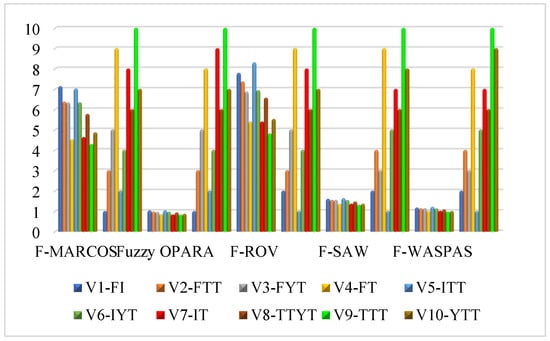
Figure 1.
Comparative Fuzzy MCDM analysis.
Based on the results obtained through this analysis, it can be concluded that the findings have been confirmed and that the variants involving Facebook and Instagram, as well as Instagram and TikTok, represent the best solutions the company should pursue by focusing its efforts on promoting its products through the integration of these networks. In general, the rankings from the comparative analysis are consistent with the previous results. However, it should be noted that in the Fuzzy ROV, Fuzzy SAW and Fuzzy WASPAS methods, the two best-ranked alternatives switch places, which is a consequence of a very small difference in final scores in the original model.
Furthermore, statistical correlation tests were conducted between the original model and the comparative analysis using two coefficients: WS (Wojciech Salabun) [,] and SSC (Spearman’s correlation coefficient) [,], as presented in Figure 2.
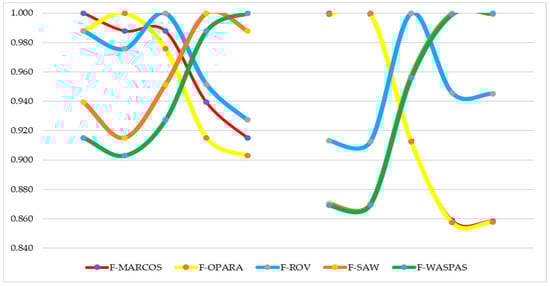
Figure 2.
Statistical correlation tests.
The values of the correlation coefficients range from 0.858–1.000, indicating a span from very high to full correlation. The lowest value of the WS coefficient is between Fuzzy MARCOS and Fuzzy WASPAS, while in several instances, the correlation is nearly full or full.
5. Discussion
We are daily witnesses to the rapid advancement and development of information and communication technology [], changes in consumer habits resembling a “roller coaster”, and increasingly sophisticated demands for obtaining the best value for money. Today’s consumer, whether purchasing a product physically at a store or online, seeks security and a sense of belonging. The level of security in terms of protecting users’ rights on social networks (online) represents one of the most important criteria in the field of digital marketing, particularly regarding preferences for purchasing luxury and prestigious products [].
After another round of in-depth interviews with the experts who participated in this research and whose many years of experience in the field of cybersecurity are of exceptional importance for Bosnia and Herzegovina, we place particular emphasis on the second expert, whose references are detailed in Section 4. Namely, both experts agree that among the seven criteria established in this study, cybersecurity (C5) is the most important. The increasing number of online attacks in Bosnia and Herzegovina creates problems for a large number of social media users, which not only leads to potential financial fraud, identity theft, and data breaches, but also, in the long term, impaired trust in institutions whose primary role is to protect users and ensure their safety in the virtual world. Recent studies [,,,] have shown that a higher level of user protection on social media is necessary, particularly in terms of safeguarding personal and financial data, as well as the user’s identity. A senior security engineer who actively participated in this study, from the perspective of expert recommendations, pointed out that over the past year we have faced the highest number of hacker attacks to date. He noted that hackers are always “one step ahead of us” and are so advanced that they are capable of decrypting even the most secure user passwords with ease. However, although their primary targets are large business systems, our expert emphasizes that we should never feel “too relaxed” or careless when accessing and spending time on social networks.
In Bosnia and Herzegovina, there is clear legal regulation regarding the protection of consumer rights, but fundamental changes are needed in the amendment and supplementation of laws on consumer protection on digital platforms. Recently, we have witnessed increasingly frequent abuses of personal data of social media users, going so far that they receive nearly authentic SMS messages on their mobile devices directing them to specific links where certain updates to personal data are requested, which in the background represents a potential cyber fraud and a threat to user integrity. This also leads to the emotional sensitivity of social media users and their potential distrust in the future use of these platforms. Furthermore, for luxury products, such as perfumes, an emotional connection with consumers and the perception of brand exclusivity are crucial []. A sense of belonging to a brand, without a doubt, must be accompanied by a high level of security for user data on digital platforms. Consumers will use an online platform if they feel confident in its security and in the reduced risk of potential fraud or identity theft.
Virtual communication between Generation Z and luxury brands reflects a sense of belonging and identity on the digital platform TikTok []. Luxury perfume producers combine strategies that, on the one hand, create general satisfaction among the younger generation, while, on the other hand, gradually and spontaneously increase the availability of content via the TikTok platform, maintaining exclusivity and consistently conveying an innovative, contemporary, and clear message to young consumers about the products they advertise []. The research conducted in this paper has shown a similar pattern to what is observed internationally, namely that young users of social networks (TikTok and Instagram), particularly when it comes to purchasing luxury perfume brands, are attracted by both the hedonistic and functional benefits these products provide [,]. Purchasing luxury products [] through online platforms, which reflect the preferences of young users of social networks [] such as Instagram and TikTok, contributes to the perception of immediate satisfaction. As the age range of social media users increases, there is a significant shift from one platform to another (for example, from Instagram and TikTok to Facebook). Moreover, research [] has confirmed our assertion that the role of luxury brand marketing via social networks, with particular emphasis on Instagram, contributes to consumer trust in the brand, especially among young users (aged 15–30), which in turn influences the degree of impulsive purchasing. Furthermore, another confirmation supporting our research is the fact that 92% of perfumeries in Bosnia and Herzegovina use Instagram, while 79% of them use TikTok []. Although Facebook remains among the most preferred social networks, the younger target group tends to favor social networks that offer more creative and visually authentic content. Influencers [] also have a significant impact on the preferences of young users of social networks (Instagram and TikTok), as their powerful messages create an immediate desire to own the promoted products in the shortest possible time. Additionally, research conducted by Berne-Manero and Marzo-Navarro [] highlighted the importance of influencers in persuading young followers to purchase products on Instagram. Followers follow their lives and hobbies, but the key to successfully conveying the advertising message is mutual benefit (the influencer reliably sells the product they promote—the customer is satisfied and likely to purchase the same product again).
6. Limitations and Future Research Directions
Although the topic of this paper is highly contemporary and relevant, there are certain challenges or limitations that will be discussed below, with the ultimate goal of ensuring both theoretical and empirical application in future academic research.
The lack of clear and accurate data on active users of the most significant social networks in Bosnia and Herzegovina (Instagram, TikTok, Facebook, YouTube, and others), as well as on advertising costs across these platforms, represents a challenge for creating a financial framework, both for the current year and on a long-term basis. The research is focused on Bosnia and Herzegovina, which has a population of 3.2 million. Since there is no exact data on the number of social media users, nor a clear and precise policy regulating behavior on these platforms (such as legal sanctions for violators of rules of behavior on digital platforms and similar issues), the question arises as to whether all the results obtained in this research can be fully applied to other countries in the region, as well as to the more developed parts of Europe and the world. Validation of the fuzzy MCDM model for ranking social networks for the purpose of perfumery promotion, which could potentially be applied in other sectors or industrial contexts, as well as in other geographic areas, would contribute to its broader application and deeper understanding, thereby setting the scale of contributions to a higher level. From the aspect of applicability, the proposed MCDM model can be fully utilized in any field and for any problem involving multiple factors and alternative solutions.
In this paper, we have limited ourselves to the opinions of five experts with decades of experience in the fields of digital marketing and cybersecurity, as well as to the personal opinions of the perfumery owner and her employees. Although we still claim that their opinions, expertise and experience were crucial for the pragmatic contribution of this paper, it would be desirable for future research to include a larger number of experts or to conduct a survey on customer satisfaction regarding premium products, which would be conducted directly at the point of sale. In this way, the objectivity of the research results would be enhanced from the perspective of the broader social community, which could also influence other business sectors that might apply this modality in their own operations.
Although this research was conducted on a micro level and with a small sample, it still provides valuable insights and offers guidance to perfumery chains (most of which operate within the European Union and have branches in the Western Balkans) on how to modify their business strategies according to the restrictive and sophisticated preferences of the younger population (aged 15–30) in the territory of Bosnia and Herzegovina, following the example of the perfumery that is the subject of this research and which has been successfully positioned at the local level in BiH for 25 years.
Therefore, the subject of this paper is the analysis of social networks and their contribution to the revenue growth of a local perfumery. Although social network platforms are constantly evolving (adapting to contemporary user demands and following the latest trends to maintain their market-leading positions), future research should focus on the analysis of larger datasets, which would provide a clearer validation and confirmation of the research conducted.
7. Conclusions
In this paper, the integration of the Fuzzy M-FullEX and Fuzzy MARCOS methods is carried out for the first time in order to evaluate social platforms for promotional marketing purposes of a company specializing in the sale of designer and oriental perfumes. Through a group decision-making process involving five experts with between 10 and 23 years of experience, the weights of seven influential factors have been calculated using the Fuzzy M-FullEX method, which takes into account the competences of the experts. Subsequently, the Fuzzy MARCOS method was applied, resulting in the ranking of a total of 10 alternatives, which represent a combination of two social networks aimed at achieving greater market penetration and reaching a larger number of potential users. Through digital marketing, as an unavoidable aspect of today’s modern marketplace, the company under study should stimulate sales growth, strengthen brand image, and increase overall revenue. The integrated Fuzzy MCDM model showed that the company should allocate its resources toward promoting its products via a combination of Facebook and Instagram, or Instagram and TikTok. The obtained results were confirmed through comparative and correlation analyses.
Author Contributions
Conceptualization, Ž.K. and B.N.; methodology, Ž.S.; validation, Ž.S., E.J. and Ž.K.; formal analysis, B.N.; investigation, B.N. and Ž.S.; data curation, B.N.; writing—original draft preparation, Ž.K. and E.J.; writing—review and editing, Ž.S.; visualization, Ž.K. and E.J.; supervision, Ž.S.; project administration, Ž.K. and E.J. All authors have read and agreed to the published version of the manuscript.
Funding
This research received no external funding.
Institutional Review Board Statement
Not applicable.
Informed Consent Statement
Not applicable.
Data Availability Statement
The original contributions presented in this study are included in the article. Further inquiries can be directed to the corresponding authors.
Conflicts of Interest
Author Boris Novarlić was employed by the company Communal Company Progres Doboj Waste Management Department. The remaining authors declare that the research was conducted in the absence of any commercial or financial relationships that could be construed as a potential conflict of interest.
References
- Lim, J.S.; Ri, S.Y.; Egan, B.D.; Biocca, F.A. The cross-platform synergies of digital video advertising: Implications for cross-media campaigns in television, Internet and mobile TV. Comput. Hum. Behav. 2015, 48, 463–472. [Google Scholar] [CrossRef]
- Dwivedi, Y.K.; Ismagilova, E.; Hughes, D.L.; Carlson, J.; Filieri, R.; Jacobson, J.; Jain, V.; Karjaluoto, H.; Kefi, H.; Krishen, A.S.; et al. Setting the future of digital and social media marketing research: Perspectives and research propositions. Int. J. Inf. Manag. 2021, 59, 102168. [Google Scholar] [CrossRef]
- Pavlović, N.; Savić, M.; Milanović, M. Digital marketing an efficient means of promotion. Ekon. Signali 2021, 16, 93–100. [Google Scholar] [CrossRef]
- Hilbert, M.; López, P. The World’s Technological Capacity to Store, Communicate, and Compute Information. Science 2011, 332, 60–65. [Google Scholar] [CrossRef]
- Trung, N.Q.; Thanh, N.V. Evaluation of Digital Marketing Technologies with Fuzzy Linguistic MCDM Methods. Axioms 2022, 11, 230. [Google Scholar] [CrossRef]
- Njegomir, V. Digital marketing. Civitas 2020, 10, 52–71. [Google Scholar] [CrossRef]
- Sanches, E.; Ramos, C.M.Q. Evaluating the Impact of Instagram Engagement Metrics on Corporate Revenue Growth: Introducing the Loyalty Rate. Information 2025, 16, 287. [Google Scholar] [CrossRef]
- Duffett, R. The YouTube Marketing Communication Effect on Cognitive, Affective and Behavioural Attitudes among Generation Z Consumers. Sustainability 2020, 12, 5075. [Google Scholar] [CrossRef]
- Chen, Y.; Zhuang, J. Trend Conformity Behavior of Luxury Fashion Products for Chinese Consumers in the Social Media Age: Drivers and Underlying Mechanisms. Behav. Sci. 2024, 14, 521. [Google Scholar] [CrossRef] [PubMed]
- We Are Social. Digital 2024: 5 Billion Social Media Users. 2024. Available online: https://wearesocial.com/us/blog/2024/01/digital-2024-5-billion-social-media-users (accessed on 7 April 2025).
- Lenka, S.; Parida, V.; Wincent, J. Digitalization Capabilities as Enablers of Value Co-Creation in Servitizing Firms. Psychol. Mark. 2016, 34, 92–100. [Google Scholar] [CrossRef]
- Oh, K.-S.; Cho, M.H.; Park, B.I. The Comparative Impact of Conventional and Digital Innovations on Driving Corporate Sustainability: The Case of Venture Firms in South Korea. Sustainability 2025, 17, 3226. [Google Scholar] [CrossRef]
- Javaid, M.; Haleem, A.; Singh, R.P.; Sinha, A.K. Digital economy to improve the culture of industry 4.0: A study on features, implementation and challenges. Green Technol. Sustain. 2024, 2, 100083. [Google Scholar] [CrossRef]
- Krstić, A.; Đurđević, B. Social media marketing. Marketing 2017, 48, 254–260. [Google Scholar] [CrossRef]
- Nambisan, S.; Lyytinen, K.; Majchrzak, A.; Song, M. Digital Innovation Management: Reinventing Innovation Management Research in a Digital World. MIS Q. 2017, 41, 223–238. [Google Scholar] [CrossRef]
- Rosenbusch, N.; Brinckmann, J.; Bausch, A. Is innovation always beneficial? A meta-analysis of the relationship between innovation and performance in SMEs. J. Bus. Ventur. 2011, 26, 441–457. [Google Scholar] [CrossRef]
- Barney, J. Firm Resources and Sustained Competitive Advantage. J. Manag. 1991, 17, 99–120. [Google Scholar] [CrossRef]
- Clemente-Almendros, J.A.; Nicoara-Popescu, D.; Pastor-Sanz, I. Digital transformation in SMEs: Understanding its determinants and size heterogeneity. Technol. Soc. 2024, 77, 102483. [Google Scholar] [CrossRef]
- Lambrecht, A.; Tucker, C.; Wiertz, C. Advertising to Early Trend Propagators: Evidence from Twitter. Mark. Sci. 2018, 37, 177–199. [Google Scholar] [CrossRef]
- Singh, P.; Dwivedi, Y.K.; Kahlon, K.S.; Sawhney, R.S.; Alalwan, A.A.; Rana, N.P. Smart Monitoring and Controlling of Government Policies Using Social Media and Cloud Computing. Inf. Syst. Front. 2020, 22, 315–337. [Google Scholar] [CrossRef]
- Kamyabi, M.; Özgit, H.; Ahmed, J.N. Sustaining Digital Marketing Strategies to Enhance Customer Engagement and Brand Promotion: Position as a Moderator. Sustainability 2025, 17, 3270. [Google Scholar] [CrossRef]
- Scott, D.M. (Ed.) The New Rules of Marketing & PR: How to Use Social Media, Online Video, Mobile Applications, Blogs, News Releases, and Viral Marketing to Reach Buyers Directly; John Wiley & Sons: Hoboken, NJ, USA, 2015. [Google Scholar] [CrossRef]
- Vaynerchuk, G.; Hopkinson, J. Jab, Jab, Jab, Right Hook: How to Tell Your Story in a Noisy Social World. J. Consum. Mark. 2014, 31, 403–404. [Google Scholar] [CrossRef]
- Dodson, I. (Ed.) The Art of Digital Marketing: The Definitive Guide to Creating Strategic, Targeted and Measurable Online Campaigns; John Wiley & Sons: Hoboken, NJ, USA, 2016. [Google Scholar] [CrossRef]
- Naik, P.A.; Raman, K.; Winer, R.S. Planning Marketing-Mix Strategies in the Presence of Interaction Effects. Mark. Sci. 2005, 24, 25–34. [Google Scholar] [CrossRef]
- Lee, D.; Hosanagar, K.; Nair, H.S. Advertising Content and Consumer Engagement on Social Media: Evidence from Facebook. Manag. Sci. 2018, 64, 5105–5131. [Google Scholar] [CrossRef]
- Malthouse, E.C.; Haenlein, M.; Skiera, B.; Wege, E.; Zhang, M. Managing Customer Relationships in the Social Media Era: Introducing the Social CRM House. J. Interact. Mark. 2013, 27, 270–280. [Google Scholar] [CrossRef]
- Mcdonald, E. Data, analytics and creative intuition: An analysis of how to optimise return on social media investment on Instagram. J. Digit. Soc. Media Mark. 2020, 8, 21. [Google Scholar] [CrossRef]
- Wang, X.; Bart, Y.; Netessine, S.; Wu, L. Impact of Multi-Platform Social Media Strategy on Sales in E-Commerce; D’Amore-McKim School of Business at Northeastern University: Boston, MA, USA, 2025. [Google Scholar] [CrossRef]
- Bharadwaj, A.; El Sawy, O.A.; Pavlou, P.A.; Venkatraman, N. Digital Business Strategy: Toward a Next Generation of Insights. MIS Q. 2013, 37, 471–482. [Google Scholar] [CrossRef]
- Aral, S.; Walker, D. Creating Social Contagion Through Viral Product Design: A Randomized Trial of Peer Influence in Networks. Manag. Sci. 2011, 57, 1623–1639. [Google Scholar] [CrossRef]
- Bapna, R.; Umyarov, A. Do Your Online Friends Make You Pay? A Randomized Field Experiment on Peer Influence in Online Social Networks. Manag. Sci. 2015, 61, 1902–1920. [Google Scholar] [CrossRef]
- Dlelengana, S.; Adebayo, R.; Chikukwa, T. Influence of social media on organizational communication and organizational culture at the South African Social Security Agency in South Africa. Probl. Perspect. Manag. 2024, 22, 433–442. [Google Scholar] [CrossRef]
- Rishika, R.; Ramaprasad, J. The Effects of Asymmetric Social Ties, Structural Embeddedness, and Tie Strength on Online Content Contribution Behavior. Manag. Sci. 2019, 65, 3398–3422. [Google Scholar] [CrossRef]
- Wu, L.; Hitt, L.; Lou, B. Data Analytics, Innovation, and Firm Productivity. Manag. Sci. 2020, 66, 2017–2039. [Google Scholar] [CrossRef]
- Rasel, M.A.B.; Islam, M.R.; Das, P.C.; Saini, S. User Influence, Hashtag Trends, and Engagement Patterns: Analyzing Social Media Network Dynamics in Tourism Using Graph Analytics. Tour. Hosp. 2025, 6, 60. [Google Scholar] [CrossRef]
- Unnava, V.; Aravindakshan, A. How does consumer engagement evolve when brands post across multiple social media? J. Acad. Mark. Sci. 2021, 49, 864–881. [Google Scholar] [CrossRef]
- Liang, C.; Wu, J.; Li, X. Do “Likes” in a Brand Community Always Make You Buy More? Inf. Syst. Res. 2024, 35, 1681–1700. [Google Scholar] [CrossRef]
- Zhang, X.; Kumar, V.; Cosguner, K. Dynamically Managing a Profitable Email Marketing Program. J. Mark. Res. 2017, 54, 851–866. [Google Scholar] [CrossRef]
- Asur, S.; Huberman, B.A. Predicting the Future with Social Media. In Proceedings of the 2010 IEEE/WIC/ACM International Conference on Web Intelligence and Intelligent Agent Technology, Toronto, ON, Canada, 31 August–3 September 2010. [Google Scholar] [CrossRef]
- Kudeshia, C.; Kumar, A. Social eWOM: Does it affect the brand attitude and purchase intention of brands? Manag. Res. Rev. 2017, 40, 310–330. [Google Scholar] [CrossRef]
- Leskovec, J.; Adamic, L.A.; Huberman, B.A. The dynamics of viral marketing. In Proceedings of the 7th ACM Conference on Electronic Commerce 2006, Ann Arbor, MI, USA, 11–15 June 2006; pp. 228–237. [Google Scholar] [CrossRef]
- Rudniy, A.; Rudna, O.; Park, A. Trend tracking tools for the fashion industry: The impact of social media. J. Fash. Mark. Manag. Int. J. 2023, 28, 503–524. [Google Scholar] [CrossRef]
- Aw, E.C.-X.; Chuah, S.H.-W. “Stop the unattainable ideal for an ordinary me!” fostering parasocial relationships with social media influencers: The role of self-discrepancy. J. Bus. Res. 2021, 132, 146–157. [Google Scholar] [CrossRef]
- Balaban, D.; Mustățea, M. Users’ Perspective on the Credibility of Social Media Influencers in Romania and Germany. Rom. J. Commun. Public Relat. 2019, 21, 31–46. [Google Scholar] [CrossRef]
- Dhun; Dangi, H.K. Influencer Marketing: Role of Influencer Credibility and Congruence on Brand Attitude and eWOM. J. Internet Commer. 2022, 22 (Suppl. S1), S28–S72. [Google Scholar] [CrossRef]
- Sun, Y.; Wang, R.; Cao, D.; Lee, R. Who are social media influencers for luxury fashion consumption of the Chinese Gen Z? Categorisation and empirical examination. J. Fash. Mark. Manag. Int. J. 2021, 26, 603–621. [Google Scholar] [CrossRef]
- Bower, A.B.; Landreth, S. Is Beauty Best? Highly versus Normally Attractive Models in Advertising. J. Advert. 2001, 30, 1–12. [Google Scholar] [CrossRef]
- Cheung, M.L.; Pires, G.D.; Rosenberger, P.J., III; De Oliveira, M.J. Driving COBRAs: The power of social media marketing. Marketing Intell. Plan. 2020, 39, 361–376. [Google Scholar] [CrossRef]
- Jackson, T. A contemporary analysis of global luxury brands. In International Retail Marketing; Routledge: Oxfordshire, UK, 2007; pp. 155–169. [Google Scholar]
- Pangarkar, A.; Patel, J.; Kumar, S.K. Drivers of eWOM engagement on social media for luxury consumers: Analysis, implications, and future research directions. J. Retail. Consum. Serv. 2023, 74, 103410. [Google Scholar] [CrossRef]
- Haines, S.; Lee, S.H. One size fits all? Segmenting consumers to predict sustainable fashion behavior. J. Fash. Mark. Manag. Int. J. 2021, 26, 383–398. [Google Scholar] [CrossRef]
- Mrad, M.; Majdalani, J.; Cui, C.C.; El Khansa, Z. Brand addiction in the contexts of luxury and fast-fashion brands. J. Retail. Consum. Serv. 2020, 55, 102089. [Google Scholar] [CrossRef]
- Das, M.; Habib, M.; Saha, V.; Jebarajakirthy, C. Bandwagon vs snob luxuries: Targeting consumers based on uniqueness dominance. J. Retail. Consum. Serv. 2021, 61, 102582. [Google Scholar] [CrossRef]
- Tussyadiah, S.P.; Kausar, D.R.; Soesilo, P.K.M. The Effect of Engagement in Online Social Network on Susceptibility to Influence. J. Hosp. Amp; Tour. Res. 2015, 42, 201–223. [Google Scholar] [CrossRef]
- Kim, A.J.; Ko, E. Do social media marketing activities enhance customer equity? An empirical study of luxury fashion brand. J. Bus. Res. 2012, 65, 1480–1486. [Google Scholar] [CrossRef]
- Brambilla, M.; Badrizadeh, H.; Malek Mohammadi, N.; Javadian Sabet, A. Analyzing Brand Awareness Strategies on Social Media in the Luxury Market: The Case of Italian Fashion on Instagram. Digital 2023, 3, 1–17. [Google Scholar] [CrossRef]
- Booth, N.; Matic, J.A. Mapping and leveraging influencers in social media to shape corporate brand perceptions. Corp. Commun. Int. J. 2011, 16, 184–191. [Google Scholar] [CrossRef]
- Phua, J.; Jin, S.V.; Kim, J. Gratifications of using Facebook, Twitter, Instagram, or Snapchat to follow brands: The moderating effect of social comparison, trust, tie strength, and network homophily on brand identification, brand engagement, brand commitment, and membership intention. Telemat. Inform. 2017, 34, 412–424. [Google Scholar] [CrossRef]
- Rodríguez Hernández, M.; Vázquez Sacristán, I.A. TikTok, the new social platform for luxury brands. Vis. Rev. 2024, 16, 197–211. [Google Scholar] [CrossRef]
- Okonkwo, U. Sustaining the luxury brand on the Internet. J. Brand Manag. 2009, 16, 302–310. [Google Scholar] [CrossRef]
- MajlesiRad, Z.; Haji pour Shoushtari, A.H. Analysis of the impact of social network sites and eWOM marketing, considering the reinforcing dimensions of the concept of luxury, on tendency toward luxury brand. Future Bus. J. 2020, 6, 19. [Google Scholar] [CrossRef]
- Mukul, E.; Güler, M.; Büyüközkan, G. Evaluation of Digital Solutions for Sustainable Cities with Fuzzy AHP-EDAS Methods. In Proceedings of the International Conference on Industrial Engineering and Operations Management 2022, Rome, Italy, 26–28 July 2022; pp. 2653–2661. [Google Scholar] [CrossRef]
- Samanlioglu, F.; Burnaz, A.N.; Diş, B.; Tabaş, M.D.; Adıgüzel, M. An Integrated Fuzzy Best-Worst-TOPSIS Method for Evaluation of Hotel Website and Digital Solutions Provider Firms. Adv. Fuzzy Syst. 2020, 2020, 1–10. [Google Scholar] [CrossRef]
- Mahdiraji, H.A.; Kazimieras Zavadskas, E.; Kazeminia, A.; Abbasi Kamardi, A. Marketing strategies evaluation based on big data analysis: A CLUSTERING-MCDM approach. Econ. Res.-Ekon. Istraživanja 2019, 32, 2882–2898. [Google Scholar] [CrossRef]
- Joshi, K.P.; Alur, S. Enhanced Selling on Digital Space via Matching Buyer and Seller Preferences Using Fuzzy MCDM Method. In Fuzzy Optimization and Multi-Criteria Decision Making in Digital Marketing; IGI Global Scientific Publishing: Palmdale, PA, USA, 2016; pp. 148–158. [Google Scholar] [CrossRef]
- Erdoğan, M.; Karaşan, A.; Kaya, İ.; Budak, A.; Çolak, M. A Fuzzy Based MCDM Methodology for Risk Evaluation of Cyber Security Technologies. In Intelligent and Fuzzy Techniques in Big Data Analytics and Decision Making; Springer: Cham, Switzerland, 2019; pp. 1042–1049. [Google Scholar] [CrossRef]
- Imanova, G.E.; Imanova, G. Digital Marketing Technologies Selection Under Z-Environment. In Proceedings of the 14th International Conference on Theory and Application of Fuzzy Systems and Soft Computing—ICAFS-2020, Budva, Montenegro, 27–28 August 2020; pp. 378–387. [Google Scholar] [CrossRef]
- Kwak, N.K.; Lee, C.W.; Kim, J.H. An MCDM model for media selection in the dual consumer/industrial market. Eur. J. Oper. Res. 2005, 166, 255–265. [Google Scholar] [CrossRef]
- Duan, Y.; Stević, Ž.; Novarlić, B.; Hashemkhani Zolfani, S.; Görçün, Ö.F.; Subotić, M. Application of the Fuzzy MCDM Model for the Selection of a Multifunctional Machine for Sustainable Waste Management. Sustainability 2025, 17, 2723. [Google Scholar] [CrossRef]
- Stanković, M.; Stević, Ž.; Das, D.K.; Subotić, M.; Pamučar, D. A new fuzzy MARCOS method for road traffic risk analysis. Mathematics 2020, 8, 457. [Google Scholar] [CrossRef]
- Chaffey, D.; Smith, P. Introduction to digital marketing. In Digital Marketing Excellence; Taylor & Francis Group: Abingdon, UK, 2017; pp. 1–49. [Google Scholar] [CrossRef]
- Sharma, K.; Kumar, P. Book review: Tracy L. Tuten and Michael R. Solomon, Social Media Marketing. Vis. J. Bus. Perspect. 2018, 22, 241–242. [Google Scholar] [CrossRef]
- Damjanović, S.; Katanić, P.; Zavadskas, E.K.; Stević, Ž.; Krsmanović, B.; Djalić, N. Novel fuzzy MCDM model for comparison of programming languages. Stud. Inform. Control 2024, 33, 5–14. [Google Scholar] [CrossRef]
- Ju, M.; Mirović, I.; Petrović, V.; Erceg, Ž.; Stević, Ž. A Novel Approach for the Assessment of Logistics Performance Index of EU Countries. Economics 2024, 18, 20220074. [Google Scholar] [CrossRef]
- Kabassi, K.; Karydis, C.; Botonis, A. Ahp, fuzzy saw, and fuzzy wpm for the evaluation of cultural websites. Multimodal Technol. Interact. 2020, 4, 5. [Google Scholar] [CrossRef]
- Turskis, Z.; Zavadskas, E.K.; Antucheviciene, J.; Kosareva, N. A Hybrid Model Based on Fuzzy AHP and Fuzzy WASPAS for Construction Site Selection. Int. J. Comput. Commun. Control 2015, 10, 113–128. [Google Scholar] [CrossRef]
- Sałabun, W.; Urbaniak, K. A new coefficient of rankings similarity in decision-making problems. In Computational Science—ICCS 2020, Proceedings of the 20th International Conference, Amsterdam, The Netherlands, 3–5 June 2020; Proceedings, Part II 20; Springer International Publishing: Berlin/Heidelberg, Germany, 2020; pp. 632–645. [Google Scholar]
- Więckowski, J.; Kizielewicz, B.; Shekhovtsov, A.; Sałabun, W. How Do the Criteria Affect Sustainable Supplier Evaluation?—A Case Study Using Multi-Criteria Decision Analysis Methods in a Fuzzy Environment. J. Eng. Manag. Syst. Eng. 2023, 2, 37–52. [Google Scholar] [CrossRef]
- Mousavi, M.N.; Ghalehteimouri, K.J.; Alizadeh, I.S.; Bahramijaf, S.; Shamsoddini, A. The Impact of Urban Governance on Enhancing Resilience in Informal Settlements: A Case Study from Jafarabad, Kermanshah. J. Urban Dev. Manag. 2024, 3, 95–108. [Google Scholar] [CrossRef]
- Tešić, D.; Božanić, D.; Radovanović, M.; Petrovski, A. Optimising Assault Boat Selection for Military Operations: An Application of the DIBR II-BM-CoCoSo MCDM Model. J. Intell. Manag. Decis. 2023, 2, 160–171. [Google Scholar] [CrossRef]
- Gündüzyeli, B. Cyber Resilience in Digital Marketing Within the Framework of Sustainable Management. Sustainability 2025, 17, 2080. [Google Scholar] [CrossRef]
- Durmuş Şenyapar, H.N. Digital Marketing in the Age of Cyber Threats: A Comprehensive Guide to Cybersecurity Practices. J. Soc. Sci. 2024, 8, 1–10. [Google Scholar] [CrossRef]
- Morić, Z.; Dakic, V.; Djekic, D.; Regvart, D. Protection of Personal Data in the Context of E-Commerce. J. Cybersecur. Priv. 2024, 4, 731–761. [Google Scholar] [CrossRef]
- Mahida, R. A study on the impact of digital marketing on the Indian economy. Vidya—A J. Gujarat Univ. 2024, 3, 24–34. [Google Scholar] [CrossRef]
- Morales-Sáenz, F.I.; Medina-Quintero, J.M.; Reyna-Castillo, M. Beyond Data Protection: Exploring the Convergence between Cybersecurity and Sustainable Development in Business. Sustainability 2024, 16, 5884. [Google Scholar] [CrossRef]
- Fernandez De Arroyabe, I.; Arranz, C.F.A.; Arroyabe, M.F.; Fernandez de Arroyabe, J.C. Cybersecurity capabilities and cyber-attacks as drivers of investment in cybersecurity systems: A UK survey for 2018 and 2019. Comput. Secur. 2023, 124, 102954. [Google Scholar] [CrossRef]
- Li, Q. The Transformation of Luxury Brands Marketing Strategies in Social Media. Adv. Econ. Manag. Political Sci. 2024, 105, 178–184. [Google Scholar] [CrossRef]
- Oszust, K. Tiktok as a method of brands’ communication with generation Z. Humanit. Soc. Sci. Q. 2023, 30 Pt 2, 233–242. [Google Scholar] [CrossRef]
- Adnane, D.; Wiwiek Rabiatul, A.; Siti Zulaikha, W. Impact of online buying behavioral tendencies of Generation Z on their parents’ consumption behavior: Insight from Indonesia. Innov. Mark. 2022, 18, 39–48. [Google Scholar] [CrossRef]
- Zhang, Y.; Liu, C.; Lang, C. What Makes Luxury Brands Win the Hearts of Gen Z on TikTok? An Exploratory Study. Int. Text. Appar. Assoc. Annu. Conf. Proc. 2022, 79. [Google Scholar] [CrossRef]
- Fakhriah; Anggarawati, S. The Influence of Social Media Influencers on the Purchase Intention of Fashion Products for Generation Z on the Instagram Application. Formosa J. Multidiscip. Res. 2024, 3, 389–402. [Google Scholar] [CrossRef]
- Shayeb, M.E.; Deeb, S.E. The mediating effect of luxury perception on the relationship between social media marketing and purchase intention of luxury jewellery brands. Int. J. Internet Mark. Advert. 2023, 18, 28. [Google Scholar] [CrossRef]
- Mahmud, N.; Lokman, A.N.M.; Khairuddin, N.; Samsul, N.N.; Norazizan, S.N.; Saifuddin, S.N. Effectiveness of TikTok Marketing on Students’ Purchase Intention Towards Fashion Products. Inf. Manag. Bus. Rev. 2024, 16, 198–204. [Google Scholar] [CrossRef]
- Jansom, A.; Pongsakornrungsilp, S. How Instagram Influencers Affect the Value Perception of Thai Millennial Followers and Purchasing Intention of Luxury Fashion for Sustainable Marketing. Sustainability 2021, 13, 8572. [Google Scholar] [CrossRef]
- List of Perfume stores in Bosnia and Herzegovina. 2025. Available online: https://rentechdigital.com/smartscraper/business-report-details/list-of-perfume-stores-in-bosnia-and-herzegovina? (accessed on 26 October 2025).
- De Veirman, M.; De Jans, S.; Van den Abeele, E.; Hudders, L. Unravelling the power of social media influencers: A qualitative study on teenage influencers as commercial content creators on social media. In The Regulation of Social Media Influencers; Edward Elgar: Cheltenham, UK, 2020. [Google Scholar] [CrossRef]
- Berne-Manero, C.; Marzo-Navarro, M. Exploring How Influencer and Relationship Marketing Serve Corporate Sustainability. Sustainability 2020, 12, 4392. [Google Scholar] [CrossRef]
Disclaimer/Publisher’s Note: The statements, opinions and data contained in all publications are solely those of the individual author(s) and contributor(s) and not of MDPI and/or the editor(s). MDPI and/or the editor(s) disclaim responsibility for any injury to people or property resulting from any ideas, methods, instructions or products referred to in the content. |
© 2025 by the authors. Licensee MDPI, Basel, Switzerland. This article is an open access article distributed under the terms and conditions of the Creative Commons Attribution (CC BY) license (https://creativecommons.org/licenses/by/4.0/).