
Topic Editors


2. Instituto Universitario de Investigación del Agua, Cambio Climático y Sostenibilidad (IACYS), Avda de la Investigación s/n, 06006 Badajoz, Spain




2. Centro De Estudios Ambientales y Dinamización Rural (CEADIR), Universidad de Salamanca, 37008 Salamanca, Spain
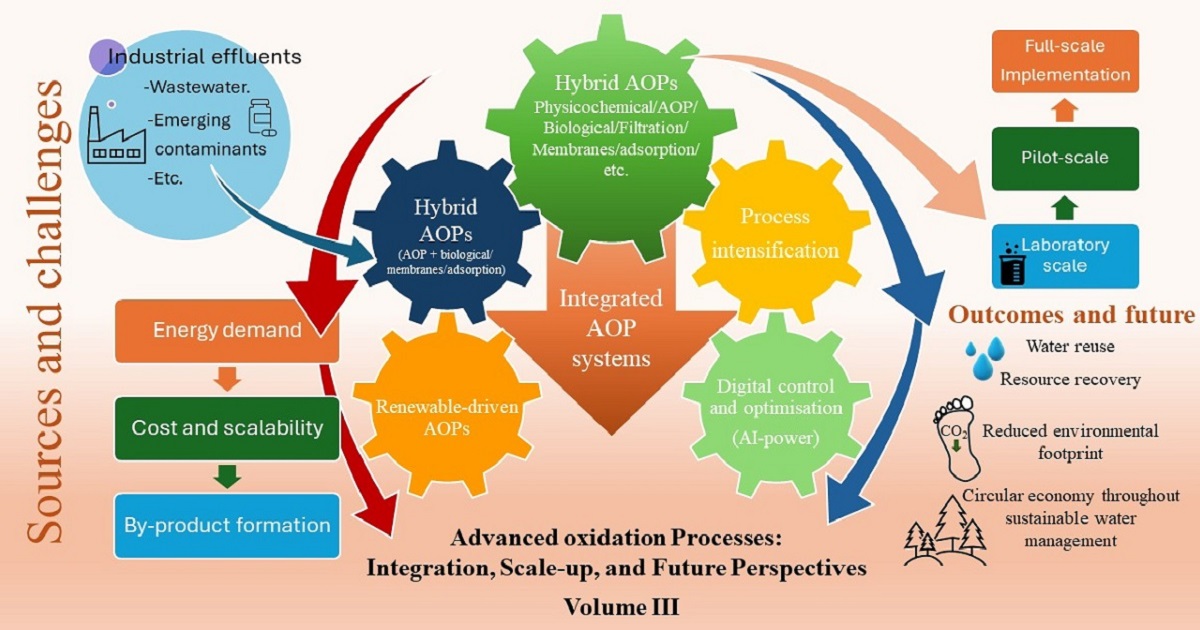
Advanced Oxidation Processes: Integration, Scale-Up and Future Perspectives, 3rd Edition
Topic Information
Dear Colleagues,
Advanced oxidation processes (AOPs) are increasingly recognized as green and highly efficient technologies, as their chemical nature allows reactions to be precisely controlled and tailored to specific treatment objectives. Their strong oxidation capacity enables the effective removal of various contaminants, often achieving high treatment efficiencies. Although AOPs have traditionally been regarded as emerging technologies with limited industrial application due to their perceived high costs, this view is not universally valid. In many cases, both capital and operating costs can be competitive when these technologies are properly designed and optimized. Their relative simplicity, with the appropriate selection of materials, reactors, and operating conditions, can make AOPs attractive from both technical and economic perspectives. Operating costs, mainly associated with energy and chemical consumption, depend strongly on geographical location and resource availability. Moreover, process optimization, hybridization, and integration within circular economy frameworks can significantly reduce costs while enhancing sustainability through water reuse, resource recovery, and energy efficiency. AOPs can be applied as standalone technologies or integrated into hybrid treatment schemes combining biological, membrane, or adsorption processes. In wastewater treatment, they may act as main treatments, pretreatment steps, or final polishing stages to meet regulatory requirements.
With the third volume of this Topic, we aim to present a multidisciplinary platform across Catalysts, Processes, Sci, Water, and Encyclopedia, aiming to advance knowledge on integrated systems, scale-up strategies, and future applications of advanced oxidation processes.
Prof. Dr. Gassan Hodaifa
Prof. Dr. Antonio Zuorro
Dr. Joaquín R. Dominguez
Prof. Dr. Juan García Rodríguez
Dr. José A. Peres
Dr. Zacharias Frontistis
Dr. Mha Albqmi
Dr. Paulo A. Augusto
Topic Editors
Keywords
- natural and artificial photolysis
- ozonation
- fenton reaction
- photo-fenton
- sonolysis
- electro-oxidation
- oxidants
- catalysts
- nanoparticles for oxidation
- economical assessment of advanced oxidation processes
- process modeling
- lifecycle assessment
- environmental footprint
- hybrid chemical and biological processes
- green technologies
- industrial application
Participating Journals
| Journal Name | Impact Factor | CiteScore | Launched Year | First Decision (median) | APC | |
|---|---|---|---|---|---|---|

Applied Sciences
|
2.9 | 6.1 | 2011 | 15 Days | CHF 2400 | Submit |

Catalysts
|
4.5 | 8.3 | 2011 | 13.3 Days | CHF 2200 | Submit |

Encyclopedia
|
- | 10.1 | 2021 | 25.3 Days | CHF 1200 | Submit |

Environments
|
4.3 | 5.7 | 2014 | 18.6 Days | CHF 1800 | Submit |

Processes
|
3.4 | 5.7 | 2013 | 14.7 Days | CHF 2400 | Submit |

Sci
|
4.1 | 5.4 | 2019 | 28.2 Days | CHF 1400 | Submit |

Water
|
3.5 | 6.7 | 2009 | 17.7 Days | CHF 2600 | Submit |

Preprints.org is a multidisciplinary platform offering a preprint service designed to facilitate the early sharing of your research. It supports and empowers your research journey from the very beginning.
MDPI Topics is collaborating with Preprints.org and has established a direct connection between MDPI journals and the platform. Authors are encouraged to take advantage of this opportunity by posting their preprints at Preprints.org prior to publication:
- Share your research immediately: disseminate your ideas prior to publication and establish priority for your work.
- Safeguard your intellectual contribution: Protect your ideas with a time-stamped preprint that serves as proof of your research timeline.
- Boost visibility and impact: Increase the reach and influence of your research by making it accessible to a global audience.
- Gain early feedback: Receive valuable input and insights from peers before submitting to a journal.
- Ensure broad indexing: Web of Science (Preprint Citation Index), Google Scholar, Crossref, SHARE, PrePubMed, Scilit and Europe PMC.
