


Abstract
Noroviruses (NoVs) are one of the emerging and rapidly spreading groups of pathogens threatening human health. A reduction in sporadic NoV infections was noted following the start of the COVID-19 pandemic, but the return of NoV gastroenteritis during the COVID-19 pandemic has been noted recently. Research in recent years has shown that different virus strains are associated with different clinical characteristics; moreover, there is a paucity of research into extraintestinal or unusual complications that may be associated with NoV. The genomic diversity of circulating NoVs is also complex and may vary significantly. Therefore, this short narrative review focuses on sharing the Taiwan experience of NoV infection including epidemiology, clinical features, and complications following suboptimal rotavirus immunization in Taiwan (after October 2006). We also highlight the unusual complications associated with NoV infections and the impacts of NoV infection during the COVID-19 pandemic in the literature for possible future research directions. To conclude, further research is needed to quantify the burden of NoV across the spectrum of disease severity in Taiwan. The evidence of the connection between NoV and the unusual complications is still lacking.
1. Introduction
Norovirus (NoV) is a nonenveloped virus with a single-stranded, positive-sense, polyadenylated RNA genome that encodes three major open reading frames (ORFs) [1]. ORF1 encodes a large polyprotein that is cleaved by the viral proteinase into six nonstructural proteins, which are involved in NoV replication in host cells. ORF2 encodes the major viral capsid protein (VP) 1 [2], whereas ORF3 encodes VP2, a minor capsid protein involved in viral packaging [3]. The capsid protein consists of a shell (S) domain encoded by conserved genetic lineages and two protruding (P) subdomains: the relatively conserved P1 and highly variable P2 subdomains. The P1 subdomain plays a role in viral-particle stability, whereas the outermost P2 subdomain contains epitopes recognized by neutralizing antibodies and the clefts required for binding to human histo-blood group antigen (HBGA) receptors [4,5,6]. Recombination at the junction of ORF1 and ORF 2 can result in the emergence of a novel viral strain, similar to other RNA viruses [7].
NoVs are highly diverse viruses that can be genetically grouped into 10 genogroups from GI to GX. Only the GI, GII, GIV, GVIII, and GIX genogroups can infect humans, and the GII genogroup is the most prevalent [8,9]. Variants (subgenotypes) are determined by sequence analysis of highly variable regions of the ORF2 and named according to the location and year they were first described [9]. NoV is an emerging pathogen that causes enteric infections in humans and has diverse clinical presentations. Genetic diversity of NoV indicates its rapid evolution with genotype polymorphism. NoV variants related to severe infection and complications have been reported sporadically, and the rapid genetic evolution of NoV is believed to drive changes in its clinical manifestations [10,11,12]. In addition to gastrointestinal (GI) symptoms, NoV infection is associated with several complications, including benign infantile convulsion [13], encephalopathy [14,15,16], necrotizing enterocolitis [17,18], dysregulation of the enteric nervous and immune system [19,20], exacerbation of inflammatory bowel disease [21], and chronic, serious outcomes in immunocompromised patients [22,23]. In Taiwan, human NoVs are the common cause of gastroenteritis outbreaks and the major cause of both all-age-group diarrhea and foodborne disease [24,25,26]. After suboptimal use of rotavirus vaccines in the private sector (after October 2006) in Taiwan, the increasing prevalence of severe NoV gastroenteritis was found. A study in Taiwan revealed a trend of reduced rotavirus to NoV ratio in prevalence, from 40% to 11.6% (2008 to 2009), 25.3% to 18.2% (2009 to 2010), and 22.2% to 25.9% (2010 to 2011) [27]. This short narrative review will focus on Taiwan experiences of NoV infection including epidemiology, clinical features, and complications. We also highlight the unusual complications associated with NoV infections beyond acute gastroenteritis and the impacts of NoV infection under the COVID-19 pandemic in the literature for possible future research directions.
2. Methods
We conducted a narrative review of the literature about the epidemiology, clinical features, and unusual complications of NoV infection in Taiwan. We searched original or review articles published after 1 January 1980, that related to NoV infection. PubMed was used for searching up to 25 January 2022, without language restriction. Search terms were “norovirus,” “clinical features,” “complications,” “vaccine,” and “rotavirus vaccine.” References listed within bibliographies of the retrieved records and personal files of the authors were also considered. Our team screened all identified titles and abstracts, and then full-text publications were reviewed for eligibility. The review period for eligible publications was from 4 October 2021, to 1 January 2022. We subjectively decided which studies to include according to our clinical experience in Taiwan. Any uncertainties were resolved through team discussions and consensus.
The suboptimal use of rotavirus vaccines in the private sector in Taiwan was after October 2006. We defined and divided the period into the early postvaccine period (January 2007 to December 2011) and the late postvaccine (January 2012 to December 2016) periods. The data shown in Table 1 are pediatric patients (<5 years old) with acute gastroenteritis, defined as acute-onset non-bloody watery diarrhea. The patients were all hospitalized at Chang Gung Children’s Hospital, a medical center located in northern Taiwan. The patients were enrolled without interest conflicts and medical difference and regardless of age, gender, ethnicity, social-economic level, and hospitalization ward. The distributions of enteric pathogens in the two periods were compared. The samples were analyzed with the Pearson χ2 test, and p values of <0.05 were considered to indicate statistical significance. All tests were performed using the SAS software (ver.8 for Windows).

Table 1.
Comparison of pathogen prevalence between the early and late postvaccine periods in hospitalized AGE children under 5 years old after rotavirus vaccine implementation. The dataset was from the research of Yu et al. [28].
3. The Molecular Epidemiology, Evolution and Recombination in Taiwan
3.1. The Change of Genotypes in Taiwan
In most areas of the world, GII.4 NoV predominated throughout the decade, and its role persisted even after rotavirus vaccine implementation [29,30]. During the era of post-rotavirus vaccination, considerable genetic diversity among NoVs was discovered worldwide. Although the genotypes varied among studies in different areas, GII.4 was still the most common over the recent 10 years [31,32,33,34,35,36,37,38,39]. The increasing prevalence of NoV infection is also associated with the recent change in global genotype distribution such as GII.4 [11,29,31,40,41]. Even from 2015 to 2020, based on the pooled prevalence of NoV infection among 120,531 children with gastroenteritis from 45 countries, the most common genotypes were still GII.4 (59.3%) and GII.3 (14.9%) according to the meta-analysis by Farahmand M. et al. [42].
In Taiwan, the significant increase in severe NoV gastroenteritis in children after suboptimal rotavirus immunization suggests an important role for the NoV genotype [27]. The data in Taiwan indicate that NoV GII.4 activity was high at the time of rotavirus vaccination introduction (late 2006 to early 2007), which was during a global epidemic. GII.4 NoV causes significant morbidity associated with gastroenteritis in infants [31,32,43]. The major genotypes GII.4 and GII.3 are responsible for the majority of NoV-associated gastroenteritis cases among children [25]. In early 2015, genotypes other than GII.4 were also evident such as GII.17, which emerged as it did in many other Asian countries [44]. However, a recent report in Taiwan from 2015 to 2019 showed that NoV GI.3 was the most common genotype detected in outbreaks of NoV gastroenteritis. These NoV outbreaks in Taiwan mainly occurred in preschool to secondary school students (0–18 years) [45]. The prevalence of NoV GI is also higher than that in previous studies undertaken other countries such as China, South Korea, and Thailand [46,47,48]. Since the next dominant genotype in Taiwan is unknown, continued surveillance for NoV typing is critical to monitor the emergence and impact of these GI.3 strains and other possible new NoV strains. Further research is required to discover or establish a model to predict possible NoV outbreaks.
3.2. The Change of Variants in Taiwan
The genomic diversity of circulating NoVs is complex and may vary by geographic area, age, or other variables. Previously predominant strains can be replaced by the emergence of new NoV variants every few years [42,49].
According to the reports in Taiwan, after rotavirus vaccination introduction (late 2006 to early 2007), the predominance of NoV GII.4 (75.7%) was similar to that reported in the United States (CaliciNet) (72%) and Finland (76%) [25,50,51]. The number of GII.4 2010 (the major subtype during the postvaccine period in Taiwan) infections was greater than that of GII.4 2006b [27]. The crucial amino acids in the human HBGA binding interfaces (interface I—S343, T344, R345, and H347; interface II—D374; interface III—C440–Y443) in VP1 are conserved in all GII.4 NoVs isolated in northern Taiwan. Therefore, the variations in the amino acid sequences adjacent to the amino acids that affect the physicochemical properties of the HBGA-binding interfaces of VP1 between the GII.4 2006b and 2010 subtypes are located in protruding domain 2 (P2 domain). The seven amino acids (T340, D357, A368, D372, N378, N412, and I413) in GII.4 2010 differing from those in GII.4 2006b are located in the P2-domain loops, which form the outer surfaces of the domain [52].
From late-2011, GII.4 2012 variants caused another community outbreak in northern Taiwan [53]. GII.4 2012 variants have been emerging since mid-2011 in northern Taiwan. These variants accounted for 54.7% of NoV infections, which is similar to the high rate of the GII.4 Sydney infections previously reported by the Centers for Disease Control and Prevention in the USA (53%) in children and adults [53,54]. The pandemic GII.4 variant, Sydney 2012—a new variant from a GII.e–GII.4 2010 recombination event—played an even more dominant role and became a prevalent strain worldwide [25,55,56,57,58,59,60]. The GII.4 variant, Sydney 2012, soon became the predominant circulating strain globally, replacing most other GII.4 variants [42]. In Taiwan, the GII.4 2012b variant, which evolved from GII.4 2006b, remained prevalent until NoV GI.3 outbreaks around 2018. It is seen that the GI.3 genotype accelerated in variation and showed transmission dynamics; variants are not identical to their parent strain in 2018, according to the research by Chiu et al. [25,45]. Due to multiple occurrences of different NoV lineages and their rapid evolution, timely interventions are critical to understand the complexity of norovirus gene variation and to monitor emerging norovirus strains.
4. Viral Gastroenteritis in Taiwan: From Rotavirus to Norovirus
In undeveloped countries, viral gastroenteritis is a notable cause of death in infants. In industrialized countries, gastroenteritis with diarrhea is usually self-limiting but morbidity is high among children and the elderly [61,62]. NoV and rotavirus are the most common viral causes of gastroenteritis. NoVs usually cause a short-term, self-limited illness with diarrhea and vomiting; however, the emerging new variants caused a distinct clinical syndrome of acute gastroenteritis with severe fever and a high prevalence of abdominal pain and intestinal hemorrhage, mimicking bacterial enterocolitis [25]. The estimated prevalence of NoV in acute gastroenteritis patients in developing countries was 17% [63]. Although the mortality rate caused by NoV or rotavirus in developed countries is low, there are still sporadic outbreaks that tend to occur in densely populated places [64].
In Taiwan, there is a long-term impact of rotavirus vaccines on acute gastroenteritis. A 10-year study in hospitalized children under 5 years old in Taiwan, which divided the study period into the early postvaccine period and the late postvaccine period, showed a significantly decreased prevalence of rotavirus infection (p = 0.002) and a significantly increased prevalence of NoV (p = 0.034) and enteric bacterial infections (p < 0.001) [28]. The comparison of pathogen prevalence between the early and late postvaccine periods and the distribution of enteric pathogens detection in hospitalized AGE children under 5 years old after rotavirus vaccine implementation from 2007 to 2016 in Northern Taiwan is shown in Table 1 and Figure 1.
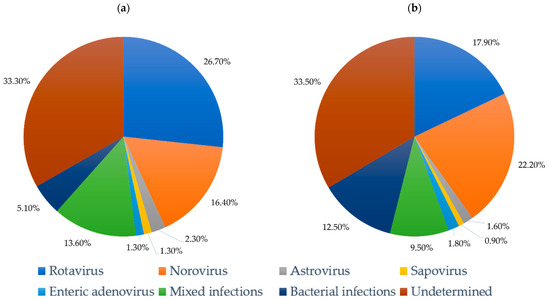
Figure 1.
The distribution of enteric pathogen detection among hospitalized AGE children under 5 years old after rotavirus vaccine implementation in (a) 2007–2011, the early postvaccine period; (b) 2012–2016, the late postvaccine period. The data were originally from the research by Yu et al. [28].
The burden of rotavirus disease remained important though its association with severe gastroenteritis was decreased. After introduction of the rotavirus vaccine, the prevalence of rotavirus in hospitalized children with acute gastroenteritis reduced from 26.7% in the early postvaccine period to 17.9% in the late postvaccine period. Sustained reduction of more than 30% was achieved versus the prevalence in the prevaccine period (27.8%; 2004–2006). The significantly increased NoV infection rates have replaced rotavirus as the leading cause of child hospitalizations for gastroenteritis [27,28,65,66]. In 2021, a study by Ballard et al. [67] in the US showed that NoV is well-recognized as the leading cause of pediatric gastroenteritis in settings with universal rotavirus vaccination. In Taiwan, active and continued studies on the burden of NoV are needed. There is a relative paucity of research into quantifying the burden of NoV across the spectrum of disease severity.
5. Associated Complications Related to Norovirus Infection
According to the volunteer challenge studies, the asymptomatic infections were estimated at 32.1% [68]. In Taiwan, from winter 2004 to winter 2005, the most common complications were electrolyte imbalance (14.3%) and hypoglycemia (11.4%). After the rotavirus vaccination introduction (from late 2006), the most common complications were convulsive disorder (28%) and hypoglycemia (20%) from winter 2006 to winter 2007. In the 2008/09/10 winters, major complications included GI hemorrhage (22.2%) and prominent hyperthermia (13.8%). From winter 2011 to winter 2012, hyperthermia (34.9%) and GI hemorrhage (23.3%) were the most prominent complications caused by NoV infection [26]. Figure 2 demonstrates the overall complications of NoV infection in different periods in northern Taiwan.
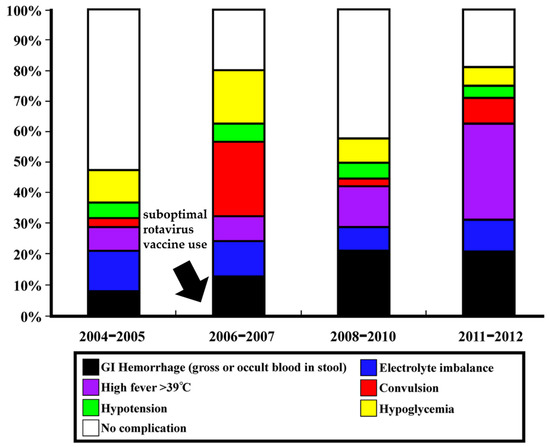
Figure 2.
Complications in different periods of NoV outbreaks in northern Taiwan before and after suboptimal rotavirus vaccine introduction from late 2006 (highlight by arrow). The figure has been modified and originated from the research by Wang et al. [26].
Although the specific NoV subgenotypes related to severe infection and complications were only sporadically reported, the rapid genetic evolution of NoV is believed to be the main factor driving the changing clinical manifestations in infected patients. In the 2006/2007 winters, the NoV subgenotype or variant GII.4 Den_Haag_2006b (40%) caused the most complications of convulsion (67.9%) in infected children. The major subgenotype in the 2008/09/10 winters, GII.4 2010 (New Orleans) (48.5%), caused GI hemorrhage (37.5%). Furthermore, GII.4 2012 subgenotypes (56.8%), the predominant NoV strains in the 2011/2012 winter, caused more high fever (57.1%) and GI hemorrhage (33.3%) [26]. Research in northern Taiwan for the clinical relevance and genotypes of circulating NoVs found that patients infected by NoV GII.4 2006b had a higher frequency of diarrhea, longer duration of diarrhea, and more frequent hypoglycemia and electrolyte imbalance compared with those with gastroenteritis caused by NoV GII.4 2010 [51].
Studies in the last 15 years have reported that NoV infection is also associated with a range of sequelae and complications other than gastroenteritis. A recently developed model for NoV infection contributed critical knowledge for extraintestinal or unusual complications. There is still a paucity of research into associated complications in Taiwan. The details of possible associated sequelae or complications with NoV are given below.
5.1. Chronic Gastroenteritis
Chronic NoV gastroenteritis is the major sequela of NoV infection in primary immune deficient and oncologic patients, transplant recipients, and those infected with the human immunodeficiency virus [22,23,69]. Chronic NoV gastroenteritis can present specific clinical challenges in immunocompromised patients. Immunosuppressed patients experience prolonged fecal NoV shedding [70]. NoV diarrhea in cancer patients can contribute to decreased quality of life, interruption of cancer care, malnutrition, and altered mucosal barrier function [71]; in primary immune deficient groups, it is associated with protracted diarrhea, weight loss, and the requirement of parenteral nutrition [72]. Transplant recipients have a similar risk for developing recurrent or chronic infection with NoV as other groups [73]. Immunocompromised patients with chronic NoV infection only have limited options beyond supportive care. For cancer or transplant patients, though only few data support this strategy, immunosuppression should be decreased [74]. There is currently no effective antiviral regimen for chronic NoV infections. Several treatments have been attempted, including serum-derived human immunoglobulin, Nitazoxanide, antiviral agents such as Favipiravir, adoptive T-cell therapy, fecal microbial transplantation, probiotics, and complex microbial communities with glycans with affinity to NoV [75,76,77,78,79]. Further studies are needed to determine if those strategies could be suitable therapies to treat chronic NoV.
5.2. Necrotizing Enterocolitis
The gut microbiota composition during infancy or early childhood is variable, dynamic, and influenced by both prenatal and postnatal factors [80]. Many studies have shown that intestinal viral infections may be associated with severe illness such as hemorrhagic enteritis and even necrotizing enterocolitis (NEC) [17,18,81,82]. Although studies mentioned previously indicated an episodic association of enteric viruses in NEC, one study by Skeath et al. [83] in 2016 for 17 NEC infants without detection of any related viruses may suggest that viral etiology is unlikely to be causative for most sporadic forms of NEC. Understanding of the mechanisms in microbiota-immunity-infectious agent axis is necessary to define potential preventive or therapeutic tools against significant infections in children [80].
5.3. Irritable Bowel Syndrome
Irritable bowel syndrome (IBS) is a prolonged and disabling functional GI syndrome that affects 9–23% of the population across the world [84]. Acute gastroenteritis is a risk factor for postinfectious irritable bowel syndrome. The pathophysiology of IBS includes several possible mechanisms, such as visceral hypersensitivity, irregular gut motility, abnormal brain–gut relations, and the role of infectious agents; a systematic review showed similar risks for bacterial pathogens and indicated that studies are still limited for viral and parasitic pathogens [85]. There are already many studies showing that a number of pathogens correspond with the IBS disease, such as Clostridium difficile, Escherichia coli, Campylobacter jejuni, Chlamydia trachomatis, Helicobacter pylori, Pseudomonas aeruginosa, Salmonella spp., and Shigella spp.; viruses, particularly NoV; and even parasites [86]. Innate and adaptive immune mechanisms are involved in control of human NoV infection. NoVs may serve as viral triggers for IBS in some environmental and genetic contexts and also indicate that the microbiota may be important for NoV pathogenesis [87]. This still needs further work for understanding interactions between NoVs and bacteria in the gut and understanding the phenotypic outcomes from NoV mutation and evolution.
5.4. Inflammatory Bowel Disease
Inflammatory bowel disease (IBD) includes ulcerative colitis and Crohn’s disease. The burden of IBD is rising globally, with substantial variation in levels and trends of the disease in different countries and regions. There are an estimated 6.8 million IBD cases worldwide, and the prevalence rates range from 79.5 to 84.3 per 100,000 individuals [88]. Although there is some evidence that NoV is involved in the dysregulation of enteric nervous and immune system [19,20] or exacerbation of IBD [21], IBD is influenced by gut microbiota, complex inflammatory pathways, and cell–virus interactions. IBD is also affected by confounding variables such as diet, age, smoking, or psychological stress, as demonstrated in monozygotic twins [89]. While the effect of cytomegalovirus infection on IBD has been confirmed, the role of other viruses in IBD pathogenesis or exacerbation of disease symptoms is still controversial [90,91]. A recent study by Tarris et al. [92] found a strong expression of sialylated Lewis a and Lewis x antigens and human NoV viral-like particles (VLPs) binding in the absence of ABO antigen expression in IBD regenerative mucosa. Further studies are required to explore the implications of NoV in the impairment of epithelial repair and dysregulation of inflammatory pathways [92]. Recent findings regarding human NoV replication in intestinal enteroids and organoids are promising [93,94]. The use of organoids derived from IBD patients might be useful to investigate the virus–host interactions and genetic responses related to NoV [95].
5.5. Convulsions and Encephalopathy
Some patients with acute gastroenteritis develop convulsions that may be febrile or afebrile convulsions [96]. Specific enteric pathogens have been linked to convulsions in children, such as rotavirus, NoV, Campylobacter, and Shigella [13,14,15,97,98,99,100]. The change in the prevalence of convulsions related to gastroenteritis might be associated with rotavirus vaccination [101]. Several reports have shown that NoV related to mild gastroenteritis causes convulsions without fever, severe dehydration, electrolyte imbalance, and hypoglycemia [13,102,103,104]. Severe central nervous system complications such as meningitis, encephalitis, and encephalopathy have been also described [14,15,16,105,106,107]. A study in the era of post-rotavirus vaccination in Taiwan for molecular epidemiology of NoV gastroenteritis showed that seizures occurred in 20.9% of children with NoV infection. GII.4 Den_Haag_2006b (42.3%) and GII.4 Sydney 2012 (19.2%) were major variants correlated with convulsions. Compared with GII.4 Den_Haag_2006b, the GII.4 Sydney 2012-associated convulsions had similar manifestations except without significant winter preponderance. The NoV infection with convulsions had less febrile course, specific genotype (GII.4) infections, and shorter instances of vomiting [52]. More studies and continuous surveillance are essential for uncommon convulsions associated with emerging NoV strain infections.
5.5.1. Benign Convulsions with Mild Gastroenteritis
Benign convulsions with mild gastroenteritis (CwG) were first reported by Morooka in 1982 [108]. CwG is characterized by afebrile convulsions within 5 days of acute viral gastroenteritis in previously healthy infants and children between the ages of 6 months and 3 years without electrolyte balance or abnormal blood sugar level or abnormal result of cerebrospinal fluid analysis. Several reports have broadened the range of definitions for children aged <6 years with CwG [103,104,109,110,111,112,113,114]. Convulsions in CwG are mostly generalized, usually clustered, and last less than 5 min. Although clustering seizures frequently occur in the acute phase of CwG, the prognosis is good and long-term treatment is usually not required [109].
After rotavirus vaccination, some changes in epidemiology and clinical characteristics occurred in NoV-associated CwG [103,104,112,113,115]. The ratio of NoV-associated CwG to NoV gastroenteritis and that of rotavirus-associated CwG to rotavirus gastroenteritis were different among studies [113,116]. One nationwide dataset from health insurance reviews and associated services in South Korea showed that the prevalence of rotavirus-associated CwG did not change (0.013–0.024%) but the annual prevalence of NoV-associated CwG is increasing by 1.790 times each year from 0.00001% [112,113]. However, these studies have limitations as they use diagnostic codes without compiling data directly from patient charts. Therefore, further studies are necessary to determine the actual prevalence after rotavirus vaccination.
There are many reports on the pathophysiological mechanism of CwG but most of them are for rotavirus [117,118,119,120,121,122]. Several studies have attempted to identify the mechanisms of NoV-associated CwG. NoV penetration into the gastrointestinal tract and RNA in the serum and cerebrospinal fluid have been observed [106,123]. There is still a paucity of studies on the pathophysiology of NoV-associated CwG.
5.5.2. Encephalopathy/Encephalitis
Encephalitis is associated with significant mortality despite intensive care [124]. There were few reports or case series, mainly from Japan, related to NoV-associated encephalopathy or encephalitis [16,106,107,125]. A nationwide survey of NoV-associated encephalitis/encephalopathy in Japan showed that the outcome of children with NoV-associated encephalitis was poor. Poor prognosis included early onset of neurological symptoms, an elevated serum creatinine level, and an abnormal blood glucose level [16]. Elevated concentrations of cerebrospinal fluid interleukin-6, interleukin-10, interferon-γ, and tumor necrosis factor-α indicated that the encephalopathy may be related to hypercytokinemia rather than direct viral invasion [125]. Future studies are required since there is no effective treatment and the definite pathophysiology of NoV-associated encephalitis/encephalopathy is still unknown.
5.6. Other Possible Associated Extraintestinal Complications
There have been reports that NoV infection is associated with Guillain–Barre syndrome and its variant Miller Fisher syndrome [126,127]. Although it is still unclear if NoV is the one of the antecedent infections in Guillain–Barre syndrome, it might be linked to the molecular mimicry [128]. As NoV serology is usually unavailable in routine clinical practice, further studies related to this response are needed.
6. The Impact of COVID-19 Pandemic on Norovirus Disease
The COVID-19 (SARS-CoV-2) pandemic emerged from a cluster of patients with pneumonia of an unknown cause linked to a seafood wholesale market in Wuhan, China, in December 2019 [129]. With personal hygiene awareness and strict public health or nonpharmaceutical interventions including social restrictions, physical distancing, and international and domestic border closures for the COVID-19 pandemic, decreased NoV infection was noted across the globe [130]. NoV infections dropped 49% in the United States post-COVID-19 lockdown in December 2020 [131]. A decrease in NoV infections was also noted in Germany (reaching near 0%) and Australia (declining by 49.0%) in 2020 [132,133]. Although a sustained reduction in NoV was temporally associated with COVID-19 mitigation processes, positivity rates for other common enteric pathogens, especially bacterial enteritis, were only intermittently reduced [134].
Since health systems have been focused on the COVID-19 pandemic, there have been reports describing underreporting of various diseases around the world, including NoV infection [135]. Recent studies from China showed the return of NoV-related acute gastroenteritis during the COVID-19 pandemic in cities with multiple nonpharmaceutical interventions during winter 2020/2021 [136,137]. Similar outbreaks were also reported in the United Kingdom (UK), caused mainly by NoV in educational and care home settings, with prevalence around 61% and 34%, respectively [138]. The initial benefit of COVID-19 countermeasures that reduced the viral gastroenteritis burden is unsustainable.
It is important to maintain epidemiological surveillance in Taiwan for viral gastroenteritis and increase awareness of NoV during the COVID-19 pandemic. Additional analysis on the route of transmission of cases would be helpful [136].
7. Discussion
Dominant NoV strains evolve divergently over time. The genomic diversity of circulating NoVs is complex and may vary by geographic area, age, or other variables. In Taiwan, from 2015, NoV GI.3 has become the most common genotype in outbreaks of NoV gastroenteritis. The prevalence of NoV GI is higher than that in previous studies undertaken other countries such as China, South Korea, and Thailand [46,47,48]. Even though NoVs usually cause a short-term, self-limited illness, the emerging new variants caused a distinct clinical syndrome of acute gastroenteritis with severe symptoms mimicking bacterial enterocolitis. The rapid genetic evolution of NoV is believed to be the main factor driving the changing clinical manifestations in infected patients. Complications from severe acute gastroenteritis by NoV do exist, but there are still some possible associated extraintestinal or unusual complications such as chronic gastroenteritis, necrotizing enterocolitis, irritable bowel syndrome, inflammatory bowel syndrome, convulsions, encephalopathy/encephalitis, and even Guillain–Barre syndrome. Further research is required to provide evidence of the connection between NoV and those extraintestinal or unusual complications. The mechanisms in the microbiota-immunity-infectious agent axis, virus–host interactions, and genetic responses related to NoV may be possible key points.
Even though a sustained reduction in NoV has been temporally associated with COVID-19 mitigation processes, it is important to maintain epidemiological surveillance for viral gastroenteritis and increase awareness of NoV outbreaks during the COVID-19 pandemic. According to the experience in China and the UK [136,137,138], NoV infection outbreak may spread very easily and quickly around the nation during the COVID-19 pandemic. It is essential to set an active and continued surveillance network in NoV typing to monitor the emergence of possible new NoV strains and the change in clinical features. Further multiyear studies are needed to quantify the burden of NoV across the spectrum of disease severity.
8. Conclusions and Limitations
The evidence of the connection between NoV and the range of unusual complications is still lacking. The mechanisms in the microbiota-immunity-infectious agent axis, virus–host interactions, and genetic responses related to NoV may be possible key points. Further research is needed to quantify the burden of NoV across the spectrum of disease severity in Taiwan. Finally, there is a limitation in this review. As it is a narrative review focused on the Taiwan experience, the nature of the method may be too subjective, especially regarding the determination of which studies to include and the conclusions drawn.
Author Contributions
Writing—original draft preparation, M.-C.L.; Conceptualization, M.-C.L. and S.-Y.C.; writing—review and editing, S.-C.L., Y.-H.H. and S.-Y.C.; supervision, S.-Y.C. All authors have read and agreed to the published version of the manuscript.
Funding
This review received no external funding.
Institutional Review Board Statement
Not applicable.
Informed Consent Statement
Not applicable.
Data Availability Statement
Not applicable.
Acknowledgments
We would like to thank Pediatric Research Work Team in Shuang Ho Hospital for advice about revising this manuscript. We also thank anonymous reviewers who helped improve the manuscript.
Conflicts of Interest
The authors declare no conflict of interest. The funders had no role in this review.
References
- Xi, J.N.; Graham, D.Y.; Wang, K.N.; Estes, M.K. Norwalk Virus Genome Cloning and Characterization. Science 1990, 250, 1580–1583. [Google Scholar] [CrossRef] [PubMed]
- Prasad, B.V.; Hardy, M.E.; Dokland, T.; Bella, J.; Rossmann, M.G.; Estes, M.K. X-Ray Crystallographic Structure of the Norwalk Virus Capsid. Science 1999, 286, 287–290. [Google Scholar] [CrossRef] [PubMed]
- Glass, P.J.; White, L.J.; Ball, J.M.; Leparc-Goffart, I.; Hardy, M.E.; Estes, M.K. Norwalk Virus Open Reading Frame 3 Encodes a Minor Structural Protein. J. Virol. 2000, 74, 6581–6591. [Google Scholar] [CrossRef] [PubMed]
- Bertolotti-Ciarlet, A.; White, L.J.; Chen, R.; Prasad, B.V.V.; Estes, M.K. Structural Requirements for the Assembly of Norwalk Virus-like Particles. J. Virol. 2002, 76, 4044–4055. [Google Scholar] [CrossRef] [PubMed]
- Lochridge, V.P.; Hardy, M.E. A Single-Amino-Acid Substitution in the P2 Domain of VP1 of Murine Norovirus Is Sufficient for Escape from Antibody Neutralization. J. Virol. 2007, 81, 12316–12322. [Google Scholar] [CrossRef]
- Tan, M.; Huang, P.; Meller, J.; Zhong, W.; Farkas, T.; Jiang, X. Mutations within the P2 Domain of Norovirus Capsid Affect Binding to Human Histo-Blood Group Antigens: Evidence for a Binding Pocket. J. Virol. 2003, 77, 12562–12571. [Google Scholar] [CrossRef]
- Martella, V.; Medici, M.C.; De Grazia, S.; Tummolo, F.; Calderaro, A.; Bonura, F.; Saporito, L.; Terio, V.; Catella, C.; Lanave, G.; et al. Evidence for Recombination between Pandemic GII.4 Norovirus Strains New Orleans 2009 and Sydney 2012. J. Clin. Microbiol. 2013, 51, 3855–3857. [Google Scholar] [CrossRef]
- Vinjé, J. Advances in Laboratory Methods for Detection and Typing of Norovirus. J. Clin. Microbiol. 2015, 53, 373–381. [Google Scholar] [CrossRef]
- Chhabra, P.; de Graaf, M.; Parra, G.I.; Chan, M.C.-W.; Green, K.; Martella, V.; Wang, Q.; White, P.A.; Katayama, K.; Vennema, H.; et al. Updated Classification of Norovirus Genogroups and Genotypes. J. Gen. Virol. 2019, 100, 1393–1406. [Google Scholar] [CrossRef]
- Buesa, J.; Montava, R.; Abu-Mallouh, R.; Fos, M.; Ribes, J.M.; Bartolomé, R.; Vanaclocha, H.; Torner, N.; Domínguez, A. Sequential Evolution of Genotype GII.4 Norovirus Variants Causing Gastroenteritis Outbreaks from 2001 to 2006 in Eastern Spain. J. Med. Virol. 2008, 80, 1288–1295. [Google Scholar] [CrossRef]
- Eden, J.-S.; Hewitt, J.; Lim, K.L.; Boni, M.F.; Merif, J.; Greening, G.; Ratcliff, R.M.; Holmes, E.C.; Tanaka, M.M.; Rawlinson, W.D.; et al. The Emergence and Evolution of the Novel Epidemic Norovirus GII.4 Variant Sydney 2012. Virology 2014, 450–451, 106–113. [Google Scholar] [CrossRef] [PubMed]
- Mahar, J.E.; Bok, K.; Green, K.Y.; Kirkwood, C.D. The Importance of Intergenic Recombination in Norovirus GII.3 Evolution. J. Virol. 2013, 87, 3687–3698. [Google Scholar] [CrossRef] [PubMed]
- Chen, S.-Y.; Tsai, C.-N.; Lai, M.-W.; Chen, C.-Y.; Lin, K.-L.; Lin, T.-Y.; Chiu, C.-H. Norovirus Infection as a Cause of Diarrhea-Associated Benign Infantile Seizures. Clin. Infect. Dis. 2009, 48, 849–855. [Google Scholar] [CrossRef] [PubMed]
- Hu, M.-H.; Lin, K.-L.; Wu, C.-T.; Chen, S.-Y.; Huang, G.-S. Clinical Characteristics and Risk Factors for Seizures Associated with Norovirus Gastroenteritis in Childhood. J. Child Neurol. 2017, 32, 810–814. [Google Scholar] [CrossRef] [PubMed]
- Ueda, H.; Tajiri, H.; Kimura, S.; Etani, Y.; Hosoi, G.; Maruyama, T.; Noma, H.; Kusumoto, Y.; Takano, T.; Baba, Y.; et al. Clinical Characteristics of Seizures Associated with Viral Gastroenteritis in Children. Epilepsy Res. 2015, 109, 146–154. [Google Scholar] [CrossRef] [PubMed]
- Shima, T.; Okumura, A.; Kurahashi, H.; Numoto, S.; Abe, S.; Ikeno, M.; Shimizu, T. Norovirus-associated Encephalitis/Encephalopathy Collaborative Study investigators A Nationwide Survey of Norovirus-Associated Encephalitis/Encephalopathy in Japan. Brain Dev. 2019, 41, 263–270. [Google Scholar] [CrossRef]
- Turcios-Ruiz, R.M.; Axelrod, P.; St John, K.; Bullitt, E.; Donahue, J.; Robinson, N.; Friss, H.E. Outbreak of Necrotizing Enterocolitis Caused by Norovirus in a Neonatal Intensive Care Unit. J. Pediatr. 2008, 153, 339–344. [Google Scholar] [CrossRef]
- Stuart, R.L.; Tan, K.; Mahar, J.E.; Kirkwood, C.D.; Andrew Ramsden, C.; Andrianopoulos, N.; Jolley, D.; Bawden, K.; Doherty, R.; Kotsanas, D.; et al. An Outbreak of Necrotizing Enterocolitis Associated with Norovirus Genotype GII.3. Pediatr. Infect. Dis. J. 2010, 29, 644–647. [Google Scholar] [CrossRef]
- Porter, C.K.; Faix, D.J.; Shiau, D.; Espiritu, J.; Espinosa, B.J.; Riddle, M.S. Postinfectious Gastrointestinal Disorders Following Norovirus Outbreaks. Clin. Infect. Dis. 2012, 55, 915–922. [Google Scholar] [CrossRef]
- Zanini, B.; Ricci, C.; Bandera, F.; Caselani, F.; Magni, A.; Laronga, A.M.; Lanzini, A. San Felice del Benaco Study Investigators Incidence of Post-Infectious Irritable Bowel Syndrome and Functional Intestinal Disorders Following a Water-Borne Viral Gastroenteritis Outbreak. Am. J. Gastroenterol. 2012, 107, 891–899. [Google Scholar] [CrossRef]
- Khan, R.R.; Lawson, A.D.; Minnich, L.L.; Martin, K.; Nasir, A.; Emmett, M.K.; Welch, C.A.; Udall, J.N. Gastrointestinal Norovirus Infection Associated with Exacerbation of Inflammatory Bowel Disease. J. Pediatr. Gastroenterol. Nutr. 2009, 48, 328–333. [Google Scholar] [CrossRef] [PubMed]
- Haessler, S.; Granowitz, E.V. Norovirus Gastroenteritis in Immunocompromised Patients. N. Engl. J. Med. 2013, 368, 971. [Google Scholar] [CrossRef] [PubMed]
- Woodward, J.; Gkrania-Klotsas, E.; Kumararatne, D. Chronic Norovirus Infection and Common Variable Immunodeficiency. Clin. Exp. Immunol. 2017, 188, 363–370. [Google Scholar] [CrossRef]
- Chen, M.-Y.; Chen, W.-C.; Chen, P.-C.; Hsu, S.-W.; Lo, Y.-C. An Outbreak of Norovirus Gastroenteritis Associated with Asymptomatic Food Handlers in Kinmen, Taiwan. BMC Public Health 2016, 16, 372. [Google Scholar] [CrossRef] [PubMed]
- Chen, S.-Y.; Feng, Y.; Chao, H.-C.; Lai, M.-W.; Huang, W.-L.; Lin, C.-Y.; Tsai, C.-N.; Chen, C.-L.; Chiu, C.-H. Emergence in Taiwan of Novel Norovirus GII.4 Variants Causing Acute Gastroenteritis and Intestinal Haemorrhage in Children. J. Med Microbiol. 2015, 64, 544–550. [Google Scholar] [CrossRef] [PubMed]
- Wang, P.-L.; Chen, S.-Y.; Tsai, C.-N.; Chao, H.-C.; Lai, M.-W.; Chang, Y.-J.; Chen, C.-L.; Chiu, C.-H. Complicated Norovirus Infection and Assessment of Severity by a Modified Vesikari Disease Score System in Hospitalized Children. BMC Pediatr. 2016, 16, 162. [Google Scholar] [CrossRef] [PubMed]
- Chen, S.-Y.; Tsai, C.-N.; Chen, C.-L.; Chao, H.-C.; Lee, Y.-S.; Lai, M.-W.; Chen, C.-C.; Huang, W.-L.; Chiu, C.-H. Severe Viral Gastroenteritis in Children after Suboptimal Rotavirus Immunization in Taiwan. Pediatr. Infect. Dis. J. 2013, 32, 1335–1339. [Google Scholar] [CrossRef]
- Yu, W.-J.; Chen, S.-Y.; Tsai, C.-N.; Chao, H.-C.; Kong, M.-S.; Chang, Y.-J.; Chiu, C.-H. Long-Term Impact of Suboptimal Rotavirus Vaccines on Acute Gastroenteritis in Hospitalized Children in Northern Taiwan. J. Formos. Med. Assoc. 2018, 117, 720–726. [Google Scholar] [CrossRef]
- Godoy, P.; Ferrrus, G.; Torner, N.; Camps, N.; Sala, M.R.; Guix, S.; Bartolomé, R.; Martínez, A.; De Simón, M.; Domínguez, A.; et al. High Incidence of Norovirus GII.4 Outbreaks in Hospitals and Nursing Homes in Catalonia (Spain), 2010–2011. Epidemiol. Infect. 2015, 143, 725–733. [Google Scholar] [CrossRef]
- Tu, E.T.V.; Nguyen, T.; Lee, P.; Bull, R.A.; Musto, J.; Hansman, G.; White, P.A.; Rawlinson, W.D.; McIver, C.J. Norovirus GII.4 Strains and Outbreaks, Australia. Emerg. Infect. Dis. 2007, 13, 1128–1130. [Google Scholar] [CrossRef]
- Motomura, K.; Yokoyama, M.; Ode, H.; Nakamura, H.; Mori, H.; Kanda, T.; Oka, T.; Katayama, K.; Noda, M.; Tanaka, T.; et al. Divergent Evolution of Norovirus GII/4 by Genome Recombination from May 2006 to February 2009 in Japan. J. Virol. 2010, 84, 8085–8097. [Google Scholar] [CrossRef] [PubMed]
- Chen, S.-Y.; Chiu, C.-H. Worldwide Molecular Epidemiology of Norovirus Infection. Paediatr. Int. Child Health 2012, 32, 128–131. [Google Scholar] [CrossRef] [PubMed]
- Sun, C.; Zhao, Y.; Wang, G.; Huang, D.; He, H.; Sai, L. Molecular Epidemiology of GII Noroviruses in Outpatients with Acute Gastroenteritis in Shandong Province, China. Arch. Virol. 2021, 166, 375–387. [Google Scholar] [CrossRef] [PubMed]
- Lucero, Y.; Lagomarcino, A.J.; Espinoza, M.; Kawakami, N.; Mamani, N.; Huerta, N.; Del Canto, F.; Farfán, M.; Sawaguchi, Y.; George, S.; et al. Norovirus Compared to Other Relevant Etiologies of Acute Gastroenteritis among Families from a Semirural County in Chile. Int. J. Infect. Dis. 2020, 101, 353–360. [Google Scholar] [CrossRef]
- Hossain, M.E.; Rahman, R.; Ali, S.I.; Islam, M.M.; Rahman, M.Z.; Ahmed, S.; Faruque, A.S.G.; Barclay, L.; Vinjé, J.; Rahman, M. Epidemiologic and Genotypic Distribution of Noroviruses Among Children With Acute Diarrhea and Healthy Controls in a Low-Income Rural Setting. Clin. Infect. Dis. 2019, 69, 505–513. [Google Scholar] [CrossRef]
- Motoya, T.; Umezawa, M.; Saito, A.; Goto, K.; Doi, I.; Fukaya, S.; Nagata, N.; Ikeda, Y.; Okayama, K.; Aso, J.; et al. Variation of Human Norovirus GII Genotypes Detected in Ibaraki, Japan, during 2012-2018. Gut Pathog. 2019, 11, 26. [Google Scholar] [CrossRef]
- Thanusuwannasak, T.; Puenpa, J.; Chuchaona, W.; Vongpunsawad, S.; Poovorawan, Y. Emergence of Multiple Norovirus Strains in Thailand, 2015-2017. Infect. Genet. Evol. 2018, 61, 108–112. [Google Scholar] [CrossRef]
- Makhaola, K.; Moyo, S.; Lechiile, K.; Goldfarb, D.M.; Kebaabetswe, L.P. Genetic and Epidemiological Analysis of Norovirus from Children with Gastroenteritis in Botswana, 2013–2015. BMC Infect. Dis. 2018, 18, 246. [Google Scholar] [CrossRef]
- Esteves, A.; Nordgren, J.; Tavares, C.; Fortes, F.; Dimbu, R.; Saraiva, N.; Istrate, C. Genetic Diversity of Norovirus in Children under 5 Years of Age with Acute Gastroenteritis from Angola. Epidemiol. Infect. 2018, 146, 551–557. [Google Scholar] [CrossRef]
- Vesikari, T. Rotavirus Vaccination: A Concise Review. Clin. Microbiol. Infect. 2012, 18 (Suppl. 5), 57–63. [Google Scholar] [CrossRef]
- Mans, J.; de Villiers, J.C.; du Plessis, N.M.; Avenant, T.; Taylor, M.B. Emerging Norovirus GII.4 2008 Variant Detected in Hospitalised Paediatric Patients in South Africa. J. Clin. Virol. 2010, 49, 258–264. [Google Scholar] [CrossRef] [PubMed]
- Farahmand, M.; Moghoofei, M.; Dorost, A.; Shoja, Z.; Ghorbani, S.; Kiani, S.J.; Khales, P.; Esteghamati, A.; Sayyahfar, S.; Jafarzadeh, M.; et al. Global Prevalence and Genotype Distribution of Norovirus Infection in Children with Gastroenteritis: A Meta-Analysis on 6 Years of Research from 2015 to 2020. Rev. Med. Virol. 2022, 32, e2237. [Google Scholar] [CrossRef] [PubMed]
- Schorn, R.; Höhne, M.; Meerbach, A.; Bossart, W.; Wüthrich, R.P.; Schreier, E.; Müller, N.J.; Fehr, T. Chronic Norovirus Infection after Kidney Transplantation: Molecular Evidence for Immune-Driven Viral Evolution. Clin. Infect. Dis. 2010, 51, 307–314. [Google Scholar] [CrossRef] [PubMed]
- Lee, C.-C.; Feng, Y.; Chen, S.-Y.; Tsai, C.-N.; Lai, M.-W.; Chiu, C.-H. Emerging Norovirus GII.17 in Taiwan. Clin. Infect. Dis. 2015, 61, 1762–1764. [Google Scholar] [CrossRef] [PubMed]
- Chiu, S.-C.; Hsu, J.-K.; Hu, S.-C.; Wu, C.-Y.; Wang, Y.-C.; Lin, J.-H. Molecular Epidemiology of GI.3 Norovirus Outbreaks from Acute Gastroenteritis Surveillance System in Taiwan, 2015–2019. BioMed Res. Int. 2020, 2020, 4707538. [Google Scholar] [CrossRef] [PubMed]
- Gao, Z.; Liu, B.; Yan, H.; Li, W.; Jia, L.; Tian, Y.; Chen, Y.; Wang, Q.; Pang, X. Norovirus Outbreaks in Beijing, China, from 2014 to 2017. J. Infect. 2019, 79, 159–166. [Google Scholar] [CrossRef] [PubMed]
- Kim, Y.E.; Song, M.; Lee, J.; Seung, H.J.; Kwon, E.-Y.; Yu, J.; Hwang, Y.; Yoon, T.; Park, T.J.; Lim, I.K. Phylogenetic Characterization of Norovirus Strains Detected from Sporadic Gastroenteritis in Seoul during 2014-2016. Gut Pathog. 2018, 10, 36. [Google Scholar] [CrossRef]
- Kumthip, K.; Khamrin, P.; Maneekarn, N. Molecular Epidemiology and Genotype Distributions of Noroviruses and Sapoviruses in Thailand 2000–2016: A Review. J. Med. Virol. 2018, 90, 617–624. [Google Scholar] [CrossRef]
- Cannon, J.L.; Lopman, B.A.; Payne, D.C.; Vinjé, J. Birth Cohort Studies Assessing Norovirus Infection and Immunity in Young Children: A Review. Clin. Infect. Dis. 2019, 69, 357–365. [Google Scholar] [CrossRef]
- Puustinen, L.; Blazevic, V.; Salminen, M.; Hämäläinen, M.; Räsänen, S.; Vesikari, T. Noroviruses as a Major Cause of Acute Gastroenteritis in Children in Finland, 2009-2010. Scand. J. Infect. Dis. 2011, 43, 804–808. [Google Scholar] [CrossRef]
- Vega, E.; Barclay, L.; Gregoricus, N.; Williams, K.; Lee, D.; Vinjé, J. Novel Surveillance Network for Norovirus Gastroenteritis Outbreaks, United States. Emerg. Infect. Dis. 2011, 17, 1389–1395. [Google Scholar] [CrossRef] [PubMed]
- Tsai, C.-N.; Lin, C.-Y.; Lin, C.-W.; Shih, K.-C.; Chiu, C.-H.; Chen, S.-Y. Clinical Relevance and Genotypes of Circulating Noroviruses in Northern Taiwan, 2006–2011. J. Med Virol. 2014, 86, 335–346. [Google Scholar] [CrossRef] [PubMed]
- Chen, Y.F.E.; Wang, C.Y.; Chiu, C.H.; Kong, S.S.; Chang, Y.J.; Chen, S.Y. Molecular Epidemiology and Clinical Characteristics of Norovirus Gastroenteritis with Seizures in Children in Taiwan, 2006–2015. Medicine 2019, 98, e17269. [Google Scholar] [CrossRef] [PubMed]
- Barclay, L.; Wikswo, M.; Gregoricus, N.; Vinjé, J.; Lopman, B.; Parashar, U.; Hall, A.; Leshem, E. Emergence of New Norovirus Strain GII.4 Sydney—United States, 2012. MMWR. Morb. Mortal. Wkly. Rep. 2013, 62, 55. [Google Scholar]
- Van Beek, J.; Ambert-Balay, K.; Botteldoorn, N.; Eden, J.S.; Fonager, J.; Hewitt, J.; Iritani, N.; Kroneman, A.; Vennema, H.; Vinjé, J.; et al. Indications for Worldwide Increased Norovirus Activity Associated with Emergence of a New Variant of Genotype II.4, Late 2012. Eurosurveillance 2013, 18, 8–9. [Google Scholar] [CrossRef]
- Eden, J.-S.; Tanaka, M.M.; Boni, M.F.; Rawlinson, W.D.; White, P.A. Recombination within the Pandemic Norovirus GII.4 Lineage. J. Virol. 2013, 87, 6270–6282. [Google Scholar] [CrossRef]
- Hoa Tran, T.N.; Trainor, E.; Nakagomi, T.; Cunliffe, N.A.; Nakagomi, O. Molecular Epidemiology of Noroviruses Associated with Acute Sporadic Gastroenteritis in Children: Global Distribution of Genogroups, Genotypes and GII.4 Variants. J. Clin. Virol. 2013, 56, 185–193. [Google Scholar] [CrossRef]
- Wang, X.; Wei, Z.; Guo, J.; Cai, J.; Chang, H.; Ge, Y.; Zeng, M. Norovirus Activity and Genotypes in Sporadic Acute Diarrhea in Children in Shanghai During 2014-2018. Pediatr. Infect. Dis. J. 2019, 38, 1085–1089. [Google Scholar] [CrossRef]
- Lim, K.L.; Hewitt, J.; Sitabkhan, A.; Eden, J.-S.; Lun, J.; Levy, A.; Merif, J.; Smith, D.; Rawlinson, W.D.; White, P.A. A Multi-Site Study of Norovirus Molecular Epidemiology in Australia and New Zealand, 2013-2014. PLoS ONE 2016, 11, e0145254. [Google Scholar] [CrossRef]
- Zhou, H.; Wang, S.; von Seidlein, L.; Wang, X. The Epidemiology of Norovirus Gastroenteritis in China: Disease Burden and Distribution of Genotypes. Front. Med. 2020, 14, 1–7. [Google Scholar] [CrossRef]
- Shane, A.L.; Mody, R.K.; Crump, J.A.; Tarr, P.I.; Steiner, T.S.; Kotloff, K.; Langley, J.M.; Wanke, C.; Warren, C.A.; Cheng, A.C.; et al. 2017 Infectious Diseases Society of America Clinical Practice Guidelines for the Diagnosis and Management of Infectious Diarrhea. Clin. Infect. Dis. 2017, 65, e45–e80. [Google Scholar] [CrossRef] [PubMed]
- Bresee, J.S.; Duggan, C.; Glass, R.I.; King, C.K. Centers for Disease Control and Prevention Managing Acute Gastroenteritis among Children: Oral Rehydration, Maintenance, and Nutritional Therapy. MMWR. Recomm. Rep. 2003, 52, 1–16. [Google Scholar]
- Nguyen, G.T.; Phan, K.; Teng, I.; Pu, J.; Watanabe, T. A Systematic Review and Meta-Analysis of the Prevalence of Norovirus in Cases of Gastroenteritis in Developing Countries. Medicine 2017, 96, e8139. [Google Scholar] [CrossRef] [PubMed]
- Harris, J.P.; Edmunds, W.J.; Pebody, R.; Brown, D.W.; Lopman, B.A. Deaths from Norovirus among the Elderly, England and Wales. Emerg. Infect. Dis. 2008, 14, 1546–1552. [Google Scholar] [CrossRef]
- Pollard, S.L.; Malpica-Llanos, T.; Friberg, I.K.; Fischer-Walker, C.; Ashraf, S.; Walker, N. Estimating the Herd Immunity Effect of Rotavirus Vaccine. Vaccine 2015, 33, 3795–3800. [Google Scholar] [CrossRef]
- Lin, F.-H.; Chou, Y.-C.; Chen, B.-C.; Lu, J.-C.; Liu, C.-J.; Hsieh, C.-J.; Yu, C.-P. An Increased Risk of School-Aged Children with Viral Infection among Diarrhea Clusters in Taiwan during 2011-2019. Children 2021, 8, 807. [Google Scholar] [CrossRef]
- Ballard, S.-B.; Requena, D.; Mayta, H.; Sanchez, G.J.; Oyola-Lozada, M.G.; Colquechagua Aliaga, F.D.; Cabrera, L.; Vittet Mondonedo, M.D.; Taquiri, C.; Tilley, C.D.H.; et al. Enteropathogen Changes After Rotavirus Vaccine Scale-Up. Pediatrics 2021, 149, e2020049884. [Google Scholar] [CrossRef]
- Miura, F.; Matsuyama, R.; Nishiura, H. Estimating the Asymptomatic Ratio of Norovirus Infection During Foodborne Outbreaks With Laboratory Testing in Japan. J. Epidemiol. 2018, 28, 382–387. [Google Scholar] [CrossRef]
- Fishman, J.A. Infections in Immunocompromised Hosts and Organ Transplant Recipients: Essentials. Liver Transplant. 2011, 17 (Suppl. 3), S34–S37. [Google Scholar] [CrossRef]
- Henke-Gendo, C.; Harste, G.; Juergens-Saathoff, B.; Mattner, F.; Deppe, H.; Heim, A. New Real-Time PCR Detects Prolonged Norovirus Excretion in Highly Immunosuppressed Patients and Children. J. Clin. Microbiol. 2009, 47, 2855–2862. [Google Scholar] [CrossRef]
- Kondapi, D.S.; Ramani, S.; Estes, M.K.; Atmar, R.L.; Okhuysen, P.C. Norovirus in Cancer Patients: A Review. Open Forum Infect. Dis. 2021, 8, ofab126. [Google Scholar] [CrossRef] [PubMed]
- Brown, L.-A.K.; Clark, I.; Brown, J.R.; Breuer, J.; Lowe, D.M. Norovirus Infection in Primary Immune Deficiency. Rev. Med. Virol. 2017, 27, e1926. [Google Scholar] [CrossRef] [PubMed]
- Abbas, A.; Zimmer, A.J.; Florescu, D. Viral Enteritis in Solid-Organ Transplantation. Viruses 2021, 13, 2019. [Google Scholar] [CrossRef] [PubMed]
- Boillat Blanco, N.; Kuonen, R.; Bellini, C.; Manuel, O.; Estrade, C.; Mazza-Stalder, J.; Aubert, J.D.; Sahli, R.; Meylan, P. Chronic Norovirus Gastroenteritis in a Double Hematopoietic Stem Cell and Lung Transplant Recipient. Transpl. Infect. Dis. 2011, 13, 213–215. [Google Scholar] [CrossRef] [PubMed]
- Gairard-Dory, A.-C.; Dégot, T.; Hirschi, S.; Schuller, A.; Leclercq, A.; Renaud-Picard, B.; Gourieux, B.; Kessler, R. Clinical Usefulness of Oral Immunoglobulins in Lung Transplant Recipients with Norovirus Gastroenteritis: A Case Series. Transplant. Proc. 2014, 46, 3603–3605. [Google Scholar] [CrossRef]
- Keeffe, E.B.; Rossignol, J.-F. Treatment of Chronic Viral Hepatitis with Nitazoxanide and Second Generation Thiazolides. World J. Gastroenterol. 2009, 15, 1805–1808. [Google Scholar] [CrossRef]
- Ruis, C.; Brown, L.-A.K.; Roy, S.; Atkinson, C.; Williams, R.; Burns, S.O.; Yara-Romero, E.; Jacobs, M.; Goldstein, R.; Breuer, J.; et al. Mutagenesis in Norovirus in Response to Favipiravir Treatment. N. Engl. J. Med. 2018, 379, 2173–2176. [Google Scholar] [CrossRef]
- Muftuoglu, M.; Olson, A.; Marin, D.; Ahmed, S.; Mulanovich, V.; Tummala, S.; Chi, T.L.; Ferrajoli, A.; Kaur, I.; Li, L.; et al. Allogeneic BK Virus-Specific T Cells for Progressive Multifocal Leukoencephalopathy. N. Engl. J. Med. 2018, 379, 1443–1451. [Google Scholar] [CrossRef]
- Barberio, B.; Massimi, D.; Bonfante, L.; Facchin, S.; Calò, L.; Trevenzoli, M.; Savarino, E.V.; Cattelan, A.M. Fecal Microbiota Transplantation for Norovirus Infection: A Clinical and Microbiological Success. Ther. Adv. Gastroenterol. 2020, 13, 1756284820934589. [Google Scholar] [CrossRef]
- George, S.; Aguilera, X.; Gallardo, P.; Farfán, M.; Lucero, Y.; Torres, J.P.; Vidal, R.; O’Ryan, M. Bacterial Gut Microbiota and Infections During Early Childhood. Front. Microbiol. 2021, 12, 793050. [Google Scholar] [CrossRef]
- Bagci, S.; Eis-Hübinger, A.M.; Yassin, A.F.; Simon, A.; Bartmann, P.; Franz, A.R.; Mueller, A. Clinical Characteristics of Viral Intestinal Infection in Preterm and Term Neonates. Eur. J. Clin. Microbiol. 2010, 29, 1079–1084. [Google Scholar] [CrossRef] [PubMed]
- Pelizzo, G.; Nakib, G.; Goruppi, I.; Fusillo, M.; Scorletti, F.; Mencherini, S.; Parigi, G.B.; Stronati, M.; Calcaterra, V. Isolated Colon Ischemia with Norovirus Infection in Preterm Babies: A Case Series. J. Med. Case Rep. 2013, 7, 108. [Google Scholar] [CrossRef] [PubMed]
- Skeath, T.; Stewart, C.; Waugh, S.; Embleton, N.; Cummings, S.; Berrington, J. Cytomegalovirus and Other Common Enteric Viruses Are Not Commonly Associated with NEC. Acta Paediatr. 2016, 105, 50–52. [Google Scholar] [CrossRef] [PubMed]
- Saha, L. Irritable Bowel Syndrome: Pathogenesis, Diagnosis, Treatment, and Evidence-Based Medicine. World J. Gastroenterol. 2014, 20, 6759–6773. [Google Scholar] [CrossRef]
- Svendsen, A.T.; Bytzer, P.; Engsbro, A.L. Systematic Review with Meta-Analyses: Does the Pathogen Matter in Post-Infectious Irritable Bowel Syndrome? Scand. J. Gastroenterol. 2019, 54, 546–562. [Google Scholar] [CrossRef]
- Shariati, A.; Fallah, F.; Pormohammad, A.; Taghipour, A.; Safari, H.; Chirani, A.S.; Sabour, S.; Alizadeh-Sani, M.; Azimi, T. The Possible Role of Bacteria, Viruses, and Parasites in Initiation and Exacerbation of Irritable Bowel Syndrome. J. Cell. Physiol. 2019, 234, 8550–8569. [Google Scholar] [CrossRef]
- Hassan, E.; Baldridge, M.T. Norovirus Encounters in the Gut: Multifaceted Interactions and Disease Outcomes. Mucosal Immunol. 2019, 12, 1259–1267. [Google Scholar] [CrossRef]
- GBD 2017 Inflammatory Bowel Disease Collaborators The Global, Regional, and National Burden of Inflammatory Bowel Disease in 195 Countries and Territories, 1990-2017: A Systematic Analysis for the Global Burden of Disease Study 2017. Lancet Gastroenterol. Hepatol. 2020, 5, 17–30. [CrossRef]
- Tarris, G.; de Rougemont, A.; Charkaoui, M.; Michiels, C.; Martin, L.; Belliot, G. Enteric Viruses and Inflammatory Bowel Disease. Viruses 2021, 13, 104. [Google Scholar] [CrossRef]
- Al-Zafiri, R.; Gologan, A.; Galiatsatos, P.; Szilagyi, A. Cytomegalovirus Complicating Inflammatory Bowel Disease: A 10-Year Experience in a Community-Based, University-Affiliated Hospital. Gastroenterol. Hepatol. 2012, 8, 230–239. [Google Scholar]
- Römkens, T.E.H.; Bulte, G.J.; Nissen, L.H.C.; Drenth, J.P.H. Cytomegalovirus in Inflammatory Bowel Disease: A Systematic Review. World J. Gastroenterol. 2016, 22, 1321–1330. [Google Scholar] [CrossRef] [PubMed]
- Tarris, G.; de Rougemont, A.; Estienney, M.; Charkaoui, M.; Mouillot, T.; Bonnotte, B.; Michiels, C.; Martin, L.; Belliot, G. Specific Norovirus Interaction with Lewis x and Lewis a on Human Intestinal Inflammatory Mucosa during Refractory Inflammatory Bowel Disease. mSphere 2021, 6, e01185-20. [Google Scholar] [CrossRef] [PubMed]
- Ettayebi, K.; Crawford, S.E.; Murakami, K.; Broughman, J.R.; Karandikar, U.; Tenge, V.R.; Neill, F.H.; Blutt, S.E.; Zeng, X.-L.; Qu, L.; et al. Replication of Human Noroviruses in Stem Cell-Derived Human Enteroids. Science 2016, 353, 1387–1393. [Google Scholar] [CrossRef] [PubMed]
- Zhang, D.; Tan, M.; Zhong, W.; Xia, M.; Huang, P.; Jiang, X. Human Intestinal Organoids Express Histo-Blood Group Antigens, Bind Norovirus VLPs, and Support Limited Norovirus Replication. Sci. Rep. 2017, 7, 12621. [Google Scholar] [CrossRef]
- Dotti, I.; Mora-Buch, R.; Ferrer-Picón, E.; Planell, N.; Jung, P.; Masamunt, M.C.; Leal, R.F.; Martín de Carpi, J.; Llach, J.; Ordás, I.; et al. Alterations in the Epithelial Stem Cell Compartment Could Contribute to Permanent Changes in the Mucosa of Patients with Ulcerative Colitis. Gut 2017, 66, 2069–2079. [Google Scholar] [CrossRef]
- Iflah, M.; Kassem, E.; Rubinstein, U.; Goren, S.; Ephros, M.; Cohen, D.; Muhsen, K. Convulsions in Children Hospitalized for Acute Gastroenteritis. Sci. Rep. 2021, 11, 15874. [Google Scholar] [CrossRef]
- Ma, X.; Luan, S.; Zhao, Y.; Lv, X.; Zhang, R. Clini.ical Characteristics and Follow-up of Benign Convulsions with Mild Gastroenteritis among Children. Medicine 2019, 98, e14082. [Google Scholar] [CrossRef]
- Kang, B.; Kwon, Y.S. Benign Convulsion with Mild Gastroenteritis. Korean J. Pediatr. 2014, 57, 304–309. [Google Scholar] [CrossRef]
- Hiranrattana, A.; Mekmullica, J.; Chatsuwan, T.; Pancharoen, C.; Thisyakorn, U. Childhood Shigellosis at King Chulalongkorn Memorial Hospital, Bangkok, Thailand: A 5-Year Review (1996–2000). Southeast Asian J. Trop. Med. Public Health 2005, 36, 683–685. [Google Scholar]
- Solomon, N.H.; Lavie, S.; Tenney, B.L.; Blaser, M.J. Campylobacter Enteritis Presenting with Convulsions. Clin. Pediatr. 1982, 21, 118–119. [Google Scholar] [CrossRef]
- Lu, M.-C.; Shia, B.-C.; Kao, Y.-W.; Lin, S.-C.; Wang, C.-Y.; Lin, W.-C.; Chen, S.-Y. The Impact of Rotavirus Vaccination in the Prevalence of Gastroenteritis and Comorbidities among Children after Suboptimal Rotavirus Vaccines Implementation in Taiwan: A Population-Based Study. Medicine 2021, 100, e25925. [Google Scholar] [CrossRef] [PubMed]
- Komori, H.; Wada, M.; Eto, M.; Oki, H.; Aida, K.; Fujimoto, T. Benign Convulsions with Mild Gastroenteritis: A Report of 10 Recent Cases Detailing Clinical Varieties. Brain Dev. 1995, 17, 334–337. [Google Scholar] [CrossRef]
- Kim, G.-H.; Byeon, J.H.; Lee, D.-Y.; Jeong, H.J.; Eun, B.-L. Norovirus in Benign Convulsions with Mild Gastroenteritis. Ital. J. Pediatr. 2016, 42, 94. [Google Scholar] [CrossRef] [PubMed][Green Version]
- Kim, B.R.; Choi, G.E.; Kim, Y.O.; Kim, M.J.; Song, E.S.; Woo, Y.J. Incidence and Characteristics of Norovirus-Associated Benign Convulsions with Mild Gastroenteritis, in Comparison with Rotavirus Ones. Brain Dev. 2018, 40, 699–706. [Google Scholar] [CrossRef]
- Bartolini, L.; Mardari, R.; Toldo, I.; Calderone, M.; Battistella, P.A.; Laverda, A.M.; Sartori, S. Norovirus Gastroenteritis and Seizures: An Atypical Case with Neuroradiological Abnormalities. Neuropediatrics 2011, 42, 167–169. [Google Scholar] [CrossRef]
- Ito, S.; Takeshita, S.; Nezu, A.; Aihara, Y.; Usuku, S.; Noguchi, Y.; Yokota, S. Norovirus-Associated Encephalopathy. Pediatr. Infect. Dis. J. 2006, 25, 651–652. [Google Scholar] [CrossRef]
- Sánchez-Fauquier, A.; González-Galán, V.; Arroyo, S.; Rodà, D.; Pons, M.; García, J.-J. Norovirus-Associated Encephalitis in a Previously Healthy 2-Year-Old Girl. Pediatr. Infect. Dis. J. 2015, 34, 222–223. [Google Scholar] [CrossRef]
- Morooka, K. Convulsions and mild diarrhea. Shonika 1982, 23, 131–137. [Google Scholar]
- Lee, Y.S.; Lee, G.H.; Kwon, Y.S. Update on Benign Convulsions with Mild Gastroenteritis. Clin. Exp. Pediatr. 2021. published online ahead of print. [Google Scholar] [CrossRef]
- Hung, J.-J.; Wen, H.-Y.; Yen, M.-H.; Chen, H.-W.; Yan, D.-C.; Lin, K.-L.; Lin, S.-J.; Lin, T.-Y.; Hsu, C.-Y. Rotavirus Gastroenteritis Associated with Afebrile Convulsion in Children: Clinical Analysis of 40 Cases. Chang. Gung Med. J. 2003, 26, 654–659. [Google Scholar]
- Uemura, N.; Okumura, A.; Negoro, T.; Watanabe, K. Clinical Features of Benign Convulsions with Mild Gastroenteritis. Brain Dev. 2002, 24, 745–749. [Google Scholar] [CrossRef]
- Kim, D.H.; Lee, Y.S.; Ha, D.J.; Chun, M.J.; Kwon, Y.S. Epidemiology of Rotavirus Gastroenteritis and Rotavirus-Associated Benign Convulsions with Mild Gastroenteritis after the Introduction of Rotavirus Vaccines in South Korea: Nationwide Data from the Health Insurance Review and Assessment Service. Int. J. Environ. Res. Public Health 2020, 17, E8374. [Google Scholar] [CrossRef] [PubMed]
- Kim, D.H.; Ha, D.J.; Lee, Y.S.; Chun, M.J.; Kwon, Y.S. Benign Convulsions with Mild Rotavirus and Norovirus Gastroenteritis: Nationwide Data from the Health Insurance Review and Assessment Service in South Korea. Children 2021, 8, 263. [Google Scholar] [CrossRef] [PubMed]
- Verrotti, A.; Nanni, G.; Agostinelli, S.; Parisi, P.; Capovilla, G.; Beccaria, F.; Iannetti, P.; Spalice, A.; Coppola, G.; Franzoni, E.; et al. Benign Convulsions Associated with Mild Gastroenteritis: A Multicenter Clinical Study. Epilepsy Res. 2011, 93, 107–114. [Google Scholar] [CrossRef] [PubMed]
- Lloyd, M.B.; Lloyd, J.C.; Gesteland, P.H.; Bale, J.F. Rotavirus Gastroenteritis and Seizures in Young Children. Pediatr. Neurol. 2010, 42, 404–408. [Google Scholar] [CrossRef]
- Chan, C.V.; Chan, C.D.; Ma, C.; Chan, H. Norovirus as Cause of Benign Convulsion Associated with Gastro-Enteritis. J. Paediatr. Child Health 2011, 47, 373–377. [Google Scholar] [CrossRef]
- Liu, B.; Fujita, Y.; Arakawa, C.; Kohira, R.; Fuchigami, T.; Mugishima, H.; Kuzuya, M. Detection of Rotavirus RNA and Antigens in Serum and Cerebrospinal Fluid Samples from Diarrheic Children with Seizures. Jpn. J. Infect. Dis. 2009, 62, 279–283. [Google Scholar]
- Nishimura, S.; Ushijima, H.; Nishimura, S.; Shiraishi, H.; Kanazawa, C.; Abe, T.; Kaneko, K.; Fukuyama, Y. Detection of Rotavirus in Cerebrospinal Fluid and Blood of Patients with Convulsions and Gastroenteritis by Means of the Reverse Transcription Polymerase Chain Reaction. Brain Dev. 1993, 15, 457–459. [Google Scholar] [CrossRef]
- Blutt, S.E.; Kirkwood, C.D.; Parreño, V.; Warfield, K.L.; Ciarlet, M.; Estes, M.K.; Bok, K.; Bishop, R.F.; Conner, M.E. Rotavirus Antigenaemia and Viraemia: A Common Event? Lancet 2003, 362, 1445–1449. [Google Scholar] [CrossRef]
- Weclewicz, K.; Svensson, L.; Kristensson, K. Targeting of Endoplasmic Reticulum-Associated Proteins to Axons and Dendrites in Rotavirus-Infected Neurons. Brain Res. Bull. 1998, 46, 353–360. [Google Scholar] [CrossRef]
- Díaz, Y.; Chemello, M.E.; Peña, F.; Aristimuño, O.C.; Zambrano, J.L.; Rojas, H.; Bartoli, F.; Salazar, L.; Chwetzoff, S.; Sapin, C.; et al. Expression of Nonstructural Rotavirus Protein NSP4 Mimics Ca2+ Homeostasis Changes Induced by Rotavirus Infection in Cultured Cells. J. Virol. 2008, 82, 11331–11343. [Google Scholar] [CrossRef] [PubMed]
- Yeom, J.S.; Kim, Y.-S.; Jun, J.-S.; Do, H.J.; Park, J.S.; Seo, J.-H.; Park, E.S.; Lim, J.-Y.; Woo, H.-O.; Park, C.-H.; et al. NSP4 Antibody Levels in Rotavirus Gastroenteritis Patients with Seizures. Eur. J. Paediatr. Neurol. 2017, 21, 367–373. [Google Scholar] [CrossRef] [PubMed]
- Medici, M.C.; Abelli, L.A.; Dodi, I.; Dettori, G.; Chezzi, C. Norovirus RNA in the Blood of a Child with Gastroenteritis and Convulsions--A Case Report. J. Clin. Virol. 2010, 48, 147–149. [Google Scholar] [CrossRef] [PubMed]
- Hon, K.-L.E.; Tsang, Y.C.K.; Chan, L.C.N.; Tsang, H.W.; Wong, K.Y.K.; Wu, Y.H.G.; Chan, P.K.S.; Cheung, K.L.; Ng, E.Y.K.; Totapally, B.R. Outcome of Encephalitis in Pediatric Intensive Care Unit. Indian J. Pediatr. 2016, 83, 1098–1103. [Google Scholar] [CrossRef]
- Obinata, K.; Okumura, A.; Nakazawa, T.; Kamata, A.; Niizuma, T.; Kinoshita, K.; Shimizu, T. Norovirus Encephalopathy in a Previously Healthy Child. Pediatr. Infect. Dis. J. 2010, 29, 1057–1059. [Google Scholar] [CrossRef]
- Eltayeb, K.G.; Crowley, P. Guillain-Barre Syndrome Associated with Norovirus Infection. BMJ Case Rep. 2012, 2012, bcr0220125865. [Google Scholar] [CrossRef]
- Shimizu, T.; Tokuda, Y. Miller Fisher Syndrome Linked to Norovirus Infection. BMJ Case Rep. 2012, 2012, bcr2012007776. [Google Scholar] [CrossRef]
- Ang, C.W.; Jacobs, B.C.; Laman, J.D. The Guillain-Barré Syndrome: A True Case of Molecular Mimicry. Trends Immunol. 2004, 25, 61–66. [Google Scholar] [CrossRef]
- Zhu, N.; Zhang, D.; Wang, W.; Li, X.; Yang, B.; Song, J.; Zhao, X.; Huang, B.; Shi, W.; Lu, R.; et al. A Novel Coronavirus from Patients with Pneumonia in China, 2019. N. Engl. J. Med. 2020, 382, 727–733. [Google Scholar] [CrossRef]
- Kraay, A.N.M.; Han, P.; Kambhampati, A.K.; Wikswo, M.E.; Mirza, S.A.; Lopman, B.A. Impact of Nonpharmaceutical Interventions for Severe Acute Respiratory Syndrome Coronavirus 2 on Norovirus Outbreaks: An Analysis of Outbreaks Reported By 9 US States. J. Infect. Dis. 2021, 224, 9–13. [Google Scholar] [CrossRef]
- Lennon, R.P.; Griffin, C.; Miller, E.L.; Dong, H.; Rabago, D.; Zgierska, A.E. Norovirus Infections Drop 49% in the United States with Strict COVID-19 Public Health Interventions. Acta Medica Acad. 2020, 49, 278–280. [Google Scholar] [CrossRef] [PubMed]
- Bruggink, L.D.; Garcia-Clapes, A.; Tran, T.; Druce, J.D.; Thorley, B.R. Decreased Incidence of Enterovirus and Norovirus Infections during the COVID-19 Pandemic, Victoria, Australia, 2020. Commun. Dis. Intell. 2021, 45, 1–10. [Google Scholar] [CrossRef] [PubMed]
- Eigner, U.; Verstraeten, T.; Weil, J. Decrease in Norovirus Infections in Germany Following COVID-19 Containment Measures. J. Infect. 2021, 82, 276–316. [Google Scholar] [CrossRef] [PubMed]
- Nachamkin, I.; Richard-Greenblatt, M.; Yu, M.; Bui, H. Reduction in Sporadic Norovirus Infections Following the Start of the COVID-19 Pandemic, 2019-2020, Philadelphia. Infect. Dis. Ther. 2021, 10, 1793–1798. [Google Scholar] [CrossRef] [PubMed]
- Douglas, A.; Sandmann, F.G.; Allen, D.J.; Celma, C.C.; Beard, S.; Larkin, L. Impact of COVID-19 on National Surveillance of Norovirus in England and Potential Risk of Increased Disease Activity in 2021. J. Hosp. Infect. 2021, 112, 124–126. [Google Scholar] [CrossRef] [PubMed]
- Chan, M.C.-W. Return of Norovirus and Rotavirus Activity in Winter 2020–21 in City with Strict COVID-19 Control Strategy, Hong Kong, China. Emerg. Infect. Dis. 2022, 28, 713–716. [Google Scholar] [CrossRef] [PubMed]
- Lu, Y.; Zhang, Z.; Xie, H.; Su, W.; Wang, H.; Wang, D.; Lu, J. The Rise in Norovirus-Related Acute Gastroenteritis During the Fight Against the COVID-19 Pandemic in Southern China. Front. Public Health 2021, 9, 785373. [Google Scholar] [CrossRef]
- Yasmin, F.; Ali, S.H.; Ullah, I. Norovirus Outbreak amid COVID-19 in the United Kingdom; Priorities for Achieving Control. J. Med. Virol. 2021, 94, 1232–1235. [Google Scholar] [CrossRef]
Publisher’s Note: MDPI stays neutral with regard to jurisdictional claims in published maps and institutional affiliations. |
© 2022 by the authors. Licensee MDPI, Basel, Switzerland. This article is an open access article distributed under the terms and conditions of the Creative Commons Attribution (CC BY) license (https://creativecommons.org/licenses/by/4.0/).