


Measured and Perceived Effects of Upper Limb Home-Based Exergaming Interventions on Activity after Stroke: A Systematic Review and Meta-Analysis
 ,
,  ,
, 
Abstract
1. Introduction
2. Materials and Methods
2.1. Search Strategy
2.2. Selection of Studies
2.3. Data Extraction and Management
2.4. Quality Assessment
2.5. Outcome Measurements
2.6. Meta-Analysis
3. Results
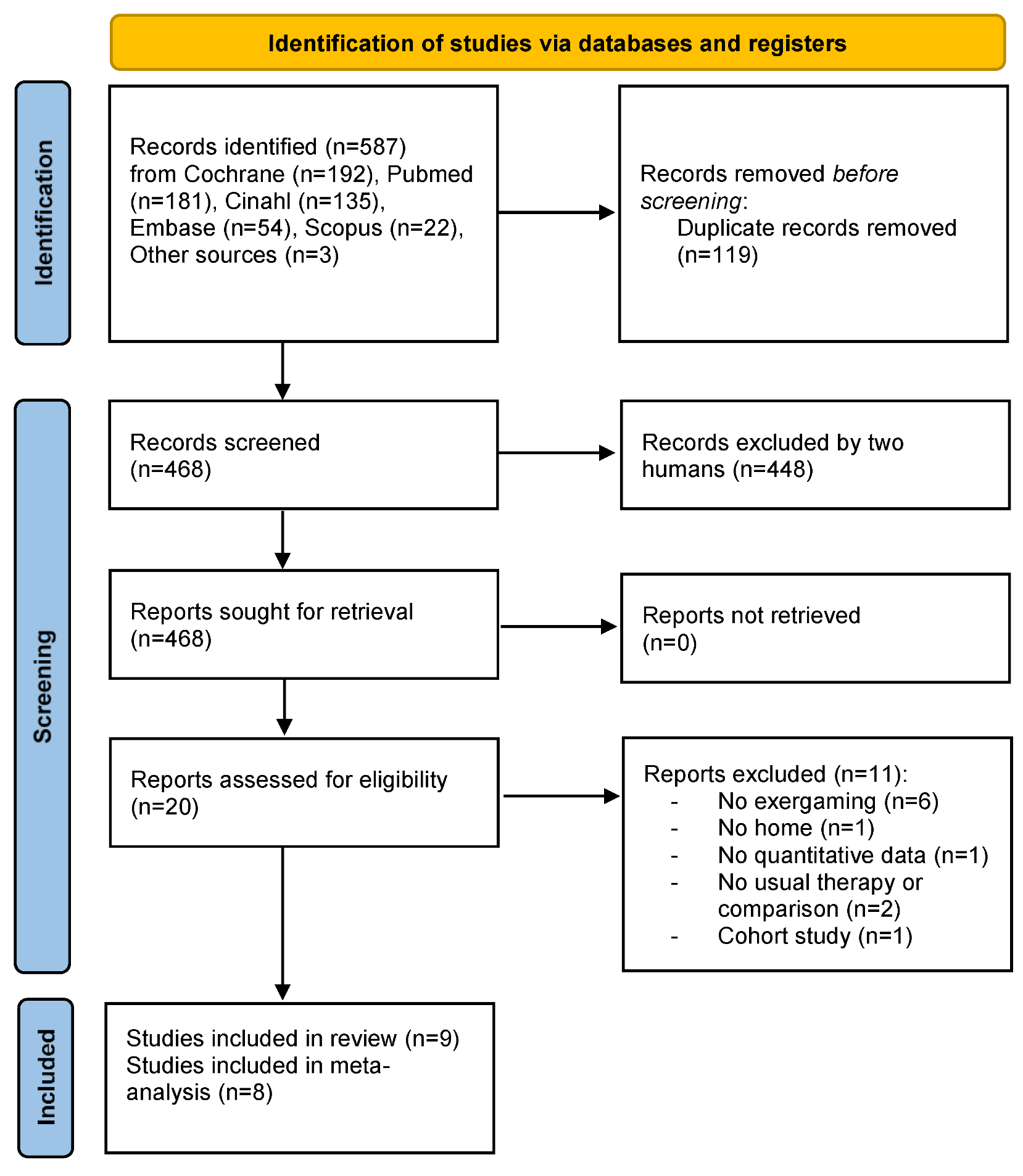
3.1. Study Identification
3.2. Participants
3.3. Interventional Group
3.4. Comparison
3.5. Training Settings
3.6. Outcome Measures
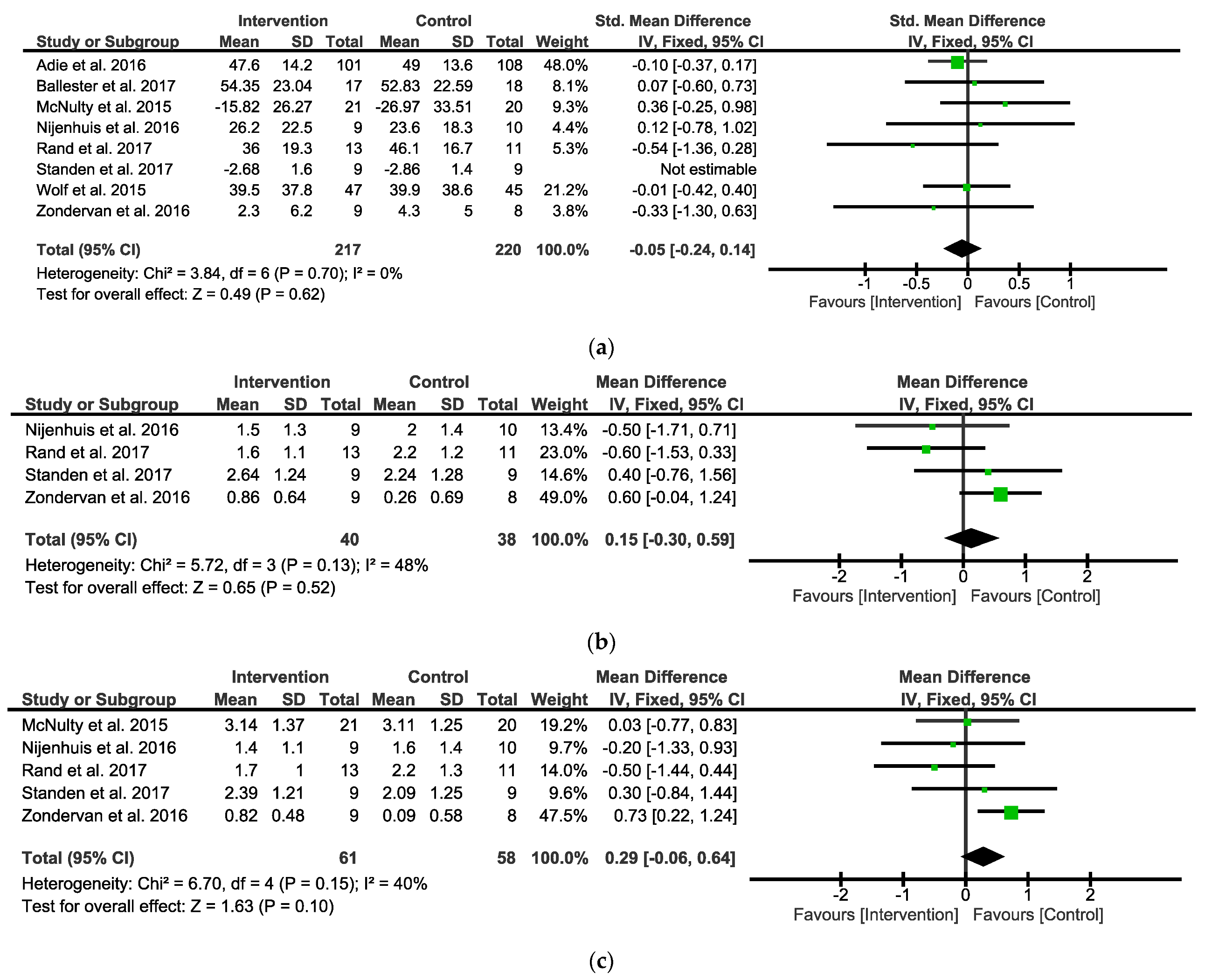
3.7. Immediate Effects on Upper Limb Activity
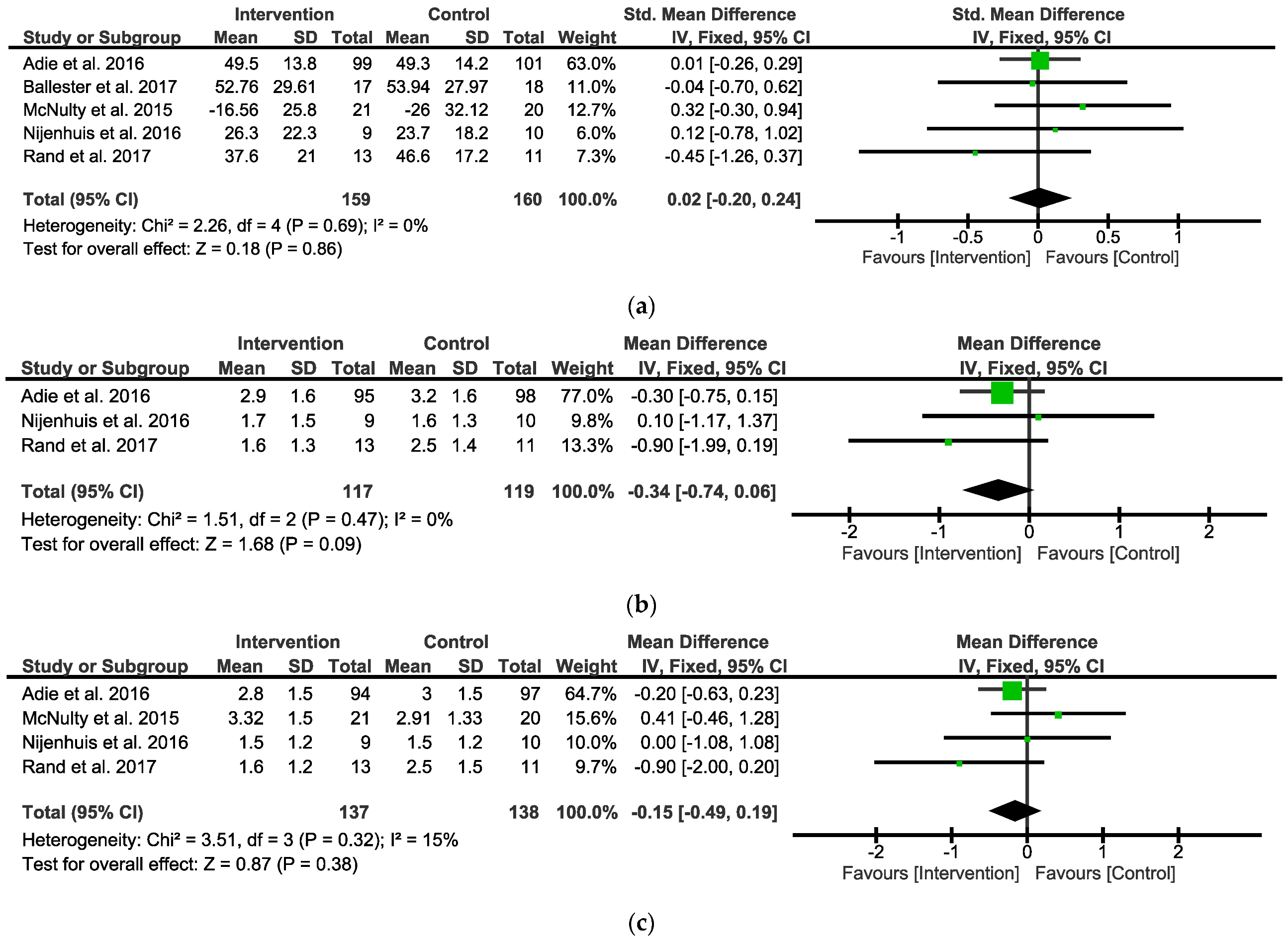
3.8. Long Term Effects on Upper Limb Activity
3.9. Quality Assessment
4. Discussion
4.1. Immediate Effects on Upper Limb Activity
4.2. Long Term Effects on Upper Limb Activity
4.3. Risk of Bias
4.4. Limitations
4.5. Perspectives
5. Conclusions
Author Contributions
Funding
Institutional Review Board Statement
Informed Consent Statement
Acknowledgments
Conflicts of Interest
Appendix A

| Section and Topic | Item # | Checklist Item | Location Where Item Is Reported |
|---|---|---|---|
| TITLE | |||
| Title | 1 | Identify the report as a systematic review. | 1 |
| ABSTRACT | |||
| Abstract | 2 | See the PRISMA 2020 for Abstracts checklist. | 12 |
| INTRODUCTION | |||
| Rationale | 3 | Describe the rationale for the review in the context of existing knowledge. | 29 |
| Objectives | 4 | Provide an explicit statement of the objective(s) or question(s) the review addresses. | 111 |
| METHODS | |||
| Eligibility criteria | 5 | Specify the inclusion and exclusion criteria for the review and how studies were grouped for the syntheses. | 125 |
| Information sources | 6 | Specify all databases, registers, websites, organisations, reference lists and other sources searched or consulted to identify studies. Specify the date when each source was last searched or consulted. | 120 |
| Search strategy | 7 | Present the full search strategies for all databases, registers and websites, including any filters and limits used. | 116 |
| Selection process | 8 | Specify the methods used to decide whether a study met the inclusion criteria of the review, including how many reviewers screened each record and each report retrieved, whether they worked independently, and if applicable, details of automation tools used in the process. | 138 |
| Data collection process | 9 | Specify the methods used to collect data from reports, including how many reviewers collected data from each report, whether they worked independently, any processes for obtaining or confirming data from study investigators, and if applicable, details of automation tools used in the process. | 144 |
| Data items | 10a | List and define all outcomes for which data were sought. Specify whether all results that were compatible with each outcome domain in each study were sought (e.g., for all measures, time points, analyses), and if not, the methods used to decide which results to collect. | 164 |
| 10b | List and define all other variables for which data were sought (e.g., participant and intervention characteristics, funding sources). Describe any assumptions made about any missing or unclear information. | 144 | |
| Study risk of bias assessment | 11 | Specify the methods used to assess risk of bias in the included studies, including details of the tool(s) used, how many reviewers assessed each study and whether they worked independently, and if applicable, details of automation tools used in the process. | 154 |
| Effect measures | 12 | Specify for each outcome the effect measure(s) (e.g., risk ratio, mean difference) used in the synthesis or presentation of results. | 179 |
| Synthesis methods | 13a | Describe the processes used to decide which studies were eligible for each synthesis (e.g., tabulating the study intervention characteristics and comparing against the planned groups for each synthesis (item #5)). | 180 |
| 13b | Describe any methods required to prepare the data for presentation or synthesis, such as handling of missing summary statistics, or data conversions. | 186 | |
| 13c | Describe any methods used to tabulate or visually display results of individual studies and syntheses. | 199 | |
| 13d | Describe any methods used to synthesize results and provide a rationale for the choice(s). If meta-analysis was performed, describe the model(s), method(s) to identify the presence and extent of statistical heterogeneity, and software package(s) used. | 179 | |
| 13e | Describe any methods used to explore possible causes of heterogeneity among study results (e.g., subgroup analysis, meta-regression). | 195 | |
| 13f | Describe any sensitivity analyses conducted to assess robustness of the synthesized results. | 154 | |
| Reporting bias assessment | 14 | Describe any methods used to assess risk of bias due to missing results in a synthesis (arising from reporting biases). | 154 |
| Certainty assessment | 15 | Describe any methods used to assess certainty (or confidence) in the body of evidence for an outcome. | 200 |
| RESULTS | |||
| Study selection | 16a | Describe the results of the search and selection process, from the number of records identified in the search to the number of studies included in the review, ideally using a flow diagram. | 202 |
| 16b | Cite studies that might appear to meet the inclusion criteria, but which were excluded, and explain why they were excluded. | 219 | |
| Study characteristics | 17 | Cite each included study and present its characteristics. | 287 |
| Risk of bias in studies | 18 | Present assessments of risk of bias for each included study. | 405 |
| Results of individual studies | 19 | For all outcomes, present, for each study: (a) summary statistics for each group (where appropriate) and (b) an effect estimate and its precision (e.g., confidence/credible interval), ideally using structured tables or plots. | 347,371 |
| Results of syntheses | 20a | For each synthesis, briefly summarise the characteristics and risk of bias among contributing studies. | 347,371 |
| 20b | Present results of all statistical syntheses conducted. If meta-analysis was done, present for each the summary estimate and its precision (e.g., confidence/credible interval) and measures of statistical heterogeneity. If comparing groups, describe the direction of the effect. | 347,371 | |
| 20c | Present results of all investigations of possible causes of heterogeneity among study results. | 347,371 | |
| 20d | Present results of all sensitivity analyses conducted to assess the robustness of the synthesized results. | 347,371 | |
| Reporting biases | 21 | Present assessments of risk of bias due to missing results (arising from reporting biases) for each synthesis assessed. | 347,371 |
| Certainty of evidence | 22 | Present assessments of certainty (or confidence) in the body of evidence for each outcome assessed. | 347,371 |
| DISCUSSION | |||
| Discussion | 23a | Provide a general interpretation of the results in the context of other evidence. | 411 |
| 23b | Discuss any limitations of the evidence included in the review. | 505 | |
| 23c | Discuss any limitations of the review processes used. | 505 | |
| 23d | Discuss implications of the results for practice, policy, and future research. | 525 | |
| OTHER INFORMATION | |||
| Registration and protocol | 24a | Provide registration information for the review, including register name and registration number, or state that the review was not registered. | |
| 24b | Indicate where the review protocol can be accessed, or state that a protocol was not prepared. | ||
| 24c | Describe and explain any amendments to information provided at registration or in the protocol. | ||
| Support | 25 | Describe sources of financial or non-financial support for the review, and the role of the funders or sponsors in the review. | |
| Competing interests | 26 | Declare any competing interests of review authors. | 576 |
| Availability of data, code and other materials | 27 | Report which of the following are publicly available and where they can be found: template data collection forms; data extracted from included studies; data used for all analyses; analytic code; any other materials used in the review. | |
Appendix B. Search Strategy
References
- Richmond, T.; Peterson, C.; Cason, J.; Billings, M.; Terrell, E.A.; Lee, A.C.W.; Towey, M.; Parmanto, B.; Saptono, A.; Cohn, E.R.; et al. American Telemedicine Association’s Principles for Delivering Telerehabilitation Services. Int. J. Telerehabilit. 2017, 9, 63–68. [Google Scholar] [CrossRef]
- Cramer, S.C.; Dodakian, L.; Le, V.; See, J.; Augsburger, R.; McKenzie, A.; Zhou, R.J.; Chiu, N.L.; Heckhausen, J.; Cassidy, J.M.; et al. Efficacy of Home-Based Telerehabilitation vs. In-Clinic Therapy for Adults after Stroke: A Randomized Clinical Trial. JAMA Neurol. 2019, 76, 1079. [Google Scholar] [CrossRef]
- Bettger, J.P.; Thoumi, A.; Marquevich, V.; De Groote, W.; Battistella, L.R.; Imamura, M.; Ramos, V.D.; Wang, N.; Dreinhoefer, K.E.; Mangar, A.; et al. COVID-19: Maintaining essential rehabilitation services across the care continuum. BMJ Glob. Health 2020, 5, e002670. [Google Scholar] [CrossRef]
- Smith, M.P. Estimating total morbidity burden of COVID-19: Relative importance of death and disability. J. Clin. Epidemiol. 2022, 142, 54–59. [Google Scholar] [CrossRef]
- Chi, N.-F.; Huang, Y.-C.; Chiu, H.-Y.; Chang, H.-J.; Huang, H.-C. Systematic Review and Meta-Analysis of Home-Based Rehabilitation on Improving Physical Function among Home-Dwelling Patients with a Stroke. Arch. Phys. Med. Rehabil. 2020, 101, 359–373. [Google Scholar] [CrossRef]
- Gelaw, A.Y.; Janakiraman, B.; Gebremeskel, B.F.; Ravichandran, H. Effectiveness of Home-based rehabilitation in improving physical function of persons with Stroke and other physical disability: A systematic review of randomized controlled trials. J. Stroke Cerebrovasc. Dis. 2020, 29, 104800. [Google Scholar] [CrossRef]
- Chen, Y.; Abel, K.T.; Janecek, J.T.; Chen, Y.; Zheng, K.; Cramer, S.C. Home-based technologies for stroke rehabilitation: A systematic review. Int. J. Med. Inform. 2019, 123, 11–22. [Google Scholar] [CrossRef]
- Laver, K.; Adey-Wakeling, Z.; Crotty, M.; Lannin, N.; George, S.; Sherrington, C. Telerehabilitation services for stroke. Cochrane Database Syst. Rev. 2020, 1, 80. [Google Scholar] [CrossRef]
- Mat Rosly, M.; Mat Rosly, H.; Davis OAM, G.M.; Husain, R.; Hasnan, N. Exergaming for individuals with neurological disability: A systematic review. Disabil. Rehabil. 2017, 39, 727–735. [Google Scholar] [CrossRef]
- Borghese, N.A.; Pirovano, M.; Lanzi, P.L.; Wüest, S.; de Bruin, E.D. Computational Intelligence and Game Design for Effective at-Home Stroke Rehabilitation. Games Health J. 2013, 2, 81–88. [Google Scholar] [CrossRef]
- Perrochon, A.; Borel, B.; Istrate, D.; Compagnat, M.; Daviet, J.-C. Exercise-based games interventions at home in individuals with a neurological disease: A systematic review and meta-analysis. Ann. Phys. Rehabil. Med. 2019, 62, 366–378. [Google Scholar] [CrossRef] [PubMed]
- Langhorne, P.; Bernhardt, J.; Kwakkel, G. Stroke rehabilitation. Lancet 2011, 377, 1693–1702. [Google Scholar] [CrossRef]
- Shamay, N.S.M.; William, T.W.N.; Patrick, K.W.H.; Philip, T.T.F.; Jefferry, W.C.H. Sensorimotor impairments of paretic upper limb correlates with activities of daily living in subjects with chronic stroke. S. Afr. J. Physiother. 2011, 67, 9–16. [Google Scholar] [CrossRef]
- Mayo, N.E.; Wood-Dauphinee, S.; Côté, R.; Durcan, L.; Carlton, J. Activity, participation, and quality of life 6 months poststroke. Arch. Phys. Med. Rehabil. 2002, 83, 1035–1042. [Google Scholar] [CrossRef]
- Lai, S.-M.; Studenski, S.; Duncan, P.W.; Perera, S. Persisting Consequences of Stroke Measured by the Stroke Impact Scale. Stroke 2002, 33, 1840–1844. [Google Scholar] [CrossRef] [PubMed]
- Bailey, R.R.; Birkenmeier, R.L.; Lang, C.E. Real-world affected upper limb activity in chronic stroke: An examination of potential modifying factors. Top. Stroke Rehabil. 2015, 22, 26–33. [Google Scholar] [CrossRef]
- Tollár, J.; Nagy, F.; Csutorás, B.; Prontvai, N.; Nagy, Z.; Török, K.; Blényesi, E.; Vajda, Z.; Farkas, D.; Tóth, B.E.; et al. High Frequency and Intensity Rehabilitation in 641 Subacute Ischemic Stroke Patients. Arch. Phys. Med. Rehabil. 2021, 102, 9–18. [Google Scholar] [CrossRef]
- Schneider, E.J.; Lannin, N.A.; Ada, L.; Schmidt, J. Increasing the amount of usual rehabilitation improves activity after stroke: A systematic review. J. Physiother. 2016, 62, 182–187. [Google Scholar] [CrossRef]
- Wong, Y.; Ada, L.; Wang, R.; Månum, G.; Langhammer, B. Self-administered, home-based, upper limb practice in stroke patients: A systematic review. J. Rehabil. Med. 2020, 52, jrm00118. [Google Scholar] [CrossRef]
- van Delden, A.L.E.; Peper, C.L.E.; Beek, P.J.; Kwakkel, G. Match and mismatch between objective and subjective improvements in upper limb function after stroke. Disabil. Rehabil. 2013, 35, 1961–1967. [Google Scholar] [CrossRef]
- van Lieshout, E.; Visser-Meily, J.; Nijland, R.; Dijkhuizen, R.; Kwakkel, G. Patients self-reported versus objective clinical measures of improvement of upper limb capacity after stroke: Are they matching? J. Rehabil. Med. 2020, 52, 7. [Google Scholar] [CrossRef] [PubMed]
- Chen, T.; Zhang, B.; Deng, Y.; Fan, J.-C.; Zhang, L.; Song, F. Long-term unmet needs after stroke: Systematic review of evidence from survey studies. BMJ Open 2019, 9, e028137. [Google Scholar] [CrossRef] [PubMed]
- Bai, Z.; Fong, K.N.K.; Zhang, J.J.; Chan, J.; Ting, K.H. Immediate and long-term effects of BCI-based rehabilitation of the upper extremity after stroke: A systematic review and meta-analysis. J. Neuroeng. Rehabil. 2020, 17, 57. [Google Scholar] [CrossRef] [PubMed]
- Page, M.J.; McKenzie, J.E.; Bossuyt, P.M.; Boutron, I.; Hoffmann, T.C.; Mulrow, C.D.; Shamseer, L.; Tetzlaff, J.M.; Akl, E.A.; Brennan, S.E.; et al. The PRISMA 2020 statement: An updated guideline for reporting systematic reviews. BMJ 2021, 10, n71. [Google Scholar] [CrossRef]
- Liberati, A.; Altman, D.G.; Tetzlaff, J.; Mulrow, C.; Gøtzsche, P.C.; Ioannidis, J.P.; Clarke, M.; Devereaux, P.J.; Kleijnen, J.; Moher, D. The PRISMA statement for reporting systematic reviews and meta-analyses of studies that evaluate health care interventions: Explanation and elaboration. J. Clin. Epidemiol. 2009, 62, e1–e34. [Google Scholar] [CrossRef]
- Maher, C.G.; Sherrington, C.; Herbert, R.D.; Moseley, A.M.; Elkins, M. Reliability of the PEDro Scale for Rating Quality of Randomized Controlled Trials. Phys. Ther. 2003, 83, 713–721. [Google Scholar] [CrossRef]
- Foley, N.C.; Teasell, R.W.; Bhogal, S.K.; Speechley, M.R. Stroke Rehabilitation Evidence-Based Review: Methodology. Top. Stroke Rehabil. 2003, 10, 1–7. [Google Scholar] [CrossRef]
- Duncan, P.W. Outcome measures in stroke rehabilitation. In Handbook of Clinical Neurology; Elsevier: Amsterdam, The Netherlands, 2013; Volume 110, pp. 105–111. [Google Scholar] [CrossRef]
- Higgins, J.P.T.; Thomas, J.; Chandler, J.; Cumpston, M.; Li, T.; Page, M.J.; Welch, V.A. (Eds.) Cochrane Handbook for Systematic Reviews of Interventions; John Wiley & Sons: Hoboken, NJ, USA, 2022; Version 6.3; Available online: www.training.cochrane.org/handbook (accessed on 6 May 2022).
- Bernhardt, J.; Hayward, K.S.; Kwakkel, G.; Ward, N.S.; Wolf, S.L.; Borschmann, K.; Krakauer, J.W.; Boyd, L.A.; Carmichael, S.T.; Corbett, D.; et al. Agreed definitions and a shared vision for new standards in stroke recovery research: The Stroke Recovery and Rehabilitation Roundtable taskforce. Int. J. Stroke 2017, 12, 444–450. [Google Scholar] [CrossRef] [PubMed]
- Adie, K.; Schofield, C.; Berrow, M.; Wingham, J.; Humfryes, J.; Pritchard, C.; James, M.; Allison, R. Does the use of Nintendo Wii SportsTM improve arm function? Trial of WiiTM in Stroke: A randomized controlled trial and economics analysis. Clin. Rehabil. 2017, 31, 173–185. [Google Scholar] [CrossRef]
- Wolf, S.L.; Sahu, K.; Bay, R.C.; Buchanan, S.; Reiss, A.; Linder, S.; Rosenfeldt, A.; Alberts, J. The HAAPI (Home Arm Assistance Progression Initiative) Trial: A Novel Robotics Delivery Approach in Stroke Rehabilitation. Neurorehabil. Neural Repair 2015, 29, 958–968. [Google Scholar] [CrossRef]
- Standen, P.J.; Threapleton, K.; Richardson, A.; Connell, L.; Brown, D.J.; Battersby, S.; Platts, F.; Burton, A. A low cost virtual reality system for home based rehabilitation of the arm following stroke: A randomised controlled feasibility trial. Clin. Rehabil. 2017, 31, 340–350. [Google Scholar] [CrossRef] [PubMed]
- Ballester, B.R.; Nirme, J.; Camacho, I.; Duarte, E.; Rodríguez, S.; Cuxart, A.; Duff, A.; Verschure, P.F. Domiciliary VR-Based Therapy for Functional Recovery and Cortical Reorganization: Randomized Controlled Trial in Participants at the Chronic Stage Post Stroke. JMIR Serious Games 2017, 5, e15. [Google Scholar] [CrossRef]
- McNulty, P.A.; Thompson-Butel, A.G.; Faux, S.G.; Lin, G.; Katrak, P.H.; Harris, L.R.; Shiner, C.T. The Efficacy of Wii-Based Movement Therapy for Upper Limb Rehabilitation in the Chronic Poststroke Period: A Randomized Controlled Trial. Int. J. Stroke 2015, 10, 1253–1260. [Google Scholar] [CrossRef]
- Rand, D.; Weingarden, H.; Weiss, R.; Yacoby, A.; Reif, S.; Malka, R.; Shiller, D.A.; Zeilig, G. Self-training to improve UE function at the chronic stage post-stroke: A pilot randomized controlled trial. Disabil. Rehabil. 2017, 39, 1541–1548. [Google Scholar] [CrossRef]
- Lamberto Piron, M.D.; Andrea Turolla, P.T.; Michela Agostini, P.T.; Carla Zucconi, P.T.; Feliciana Cortese, M.D.; Mauro Zampolini, M.D.; Mara Zannini, P.T.; Mauro Dam, M.D. Exercises for paretic upper limb after stroke: A combined virtual-reality and telemedicine approach. J. Rehabil. Med. 2009, 41, 1016–1102. [Google Scholar] [CrossRef] [PubMed]
- Nijenhuis, S.M.; Prange-Lasonder, G.B.; Stienen, A.H.; Rietman, J.S.; Buurke, J.H. Effects of training with a passive hand orthosis and games at home in chronic stroke: A pilot randomised controlled trial. Clin. Rehabil. 2017, 31, 207–216. [Google Scholar] [CrossRef] [PubMed]
- Zondervan, D.K.; Friedman, N.; Chang, E.; Zhao, X.; Augsburger, R.; Reinkensmeyer, D.J.; Cramer, S.C. Home-based hand rehabilitation after chronic stroke: Randomized, controlled single-blind trial comparing the MusicGlove with a conventional exercise program. J. Rehabil. Res. Dev. 2016, 53, 457–472. [Google Scholar] [CrossRef]
- Kwakkel, G. Impact of intensity of practice after stroke: Issues for consideration. Disabil. Rehabil. 2006, 28, 823–830. [Google Scholar] [CrossRef]
- Maier, M.; Rubio Ballester, B.; Duff, A.; Duarte Oller, E.; Verschure, P.F.M.J. Effect of Specific Over Nonspecific VR-Based Rehabilitation on Poststroke Motor Recovery: A Systematic Meta-analysis. Neurorehabil. Neural Repair 2019, 33, 112–129. [Google Scholar] [CrossRef]
- Coupar, F.; Pollock, A.; Rowe, P.; Weir, C.; Langhorne, P. Predictors of upper limb recovery after stroke: A systematic review and meta-analysis. Clin. Rehabil. 2012, 26, 291–313. [Google Scholar] [CrossRef] [PubMed]
- Cassidy, J.M.; Tran, G.; Quinlan, E.B.; Cramer, S.C. Neuroimaging Identifies Patients Most Likely to Respond to a Restorative Stroke Therapy. Stroke 2018, 49, 433–438. [Google Scholar] [CrossRef]
- Gauthier, L.V.; Nichols-Larsen, D.S.; Uswatte, G.; Strahl, N.; Simeo, M.; Proffitt, R.; Kelly, K.; Crawfis, R.; Taub, E.; Morris, D.; et al. Video game rehabilitation for outpatient stroke (VIGoROUS): A multi-site randomized controlled trial of in-home, self-managed, upper-extremity therapy. eClinicalMedicine 2022, 43, 101239. [Google Scholar] [CrossRef] [PubMed]
- Brouwer, B. Effectiveness of Client-Centered “Tune-Ups’’ on Community Reintegration, Mobility, and Quality of Life after Stroke: A Randomized Controlled Trial. Arch. Phys. Med. Rehabil. 2018, 99, 1325–1332. [Google Scholar] [CrossRef] [PubMed]
- Nagano, Y.; Ishida, K.; Tani, T.; Kawasaki, M.; Ikeuchi, M. Short and long-term effects of exergaming for the elderly. SpringerPlus 2016, 5, 793. [Google Scholar] [CrossRef] [PubMed]
- Chen, P.-W.; Baune, N.A.; Zwir, I.; Wang, J.; Swamidass, V.; Wong, A.W.K. Measuring Activities of Daily Living in Stroke Patients with Motion Machine Learning Algorithms: A Pilot Study. Int. J. Environ. Res. Public Health 2021, 18, 1634. [Google Scholar] [CrossRef] [PubMed]
- Mekbib, D.B.; Han, J.; Zhang, L.; Fang, S.; Jiang, H.; Zhu, J.; Roe, A.W.; Xu, D. Virtual reality therapy for upper limb rehabilitation in patients with stroke: A meta-analysis of randomized clinical trials. Brain Inj. 2020, 34, 456–465. [Google Scholar] [CrossRef] [PubMed]
- Ng, A.K.Y.; Leung, D.P.K.; Fong, K.N.K. Clinical Utility of the Action Research Arm Test, the Wolf Motor Function Test and the Motor Activity Log for Hemiparetic Upper Extremity Functions After Stroke: A Pilot Study. Hong Kong J. Occup. Ther. 2008, 18, 20–27. [Google Scholar] [CrossRef]
- Gallou-Guyot, M.; Nuic, D.; Mandigout, S.; Compagnat, M.; Welter, M.L.; Daviet, J.C.; Perrochon, A. Effectiveness of home-based rehabilitation using active video games on quality of life, cognitive and motor functions in people with Parkinson’s disease: A systematic review. Disabil. Rehabil. 2022, 44, 1–12. [Google Scholar] [CrossRef] [PubMed]
- Dalmazane, M.; Gallou-Guyot, M.; Compagnat, M.; Magy, L.; Montcuquet, A.; Billot, M.; Daviet, J.C.; Perrochon, A. Effects on gait and balance of home-based active video game interventions in persons with multiple sclerosis: A systematic review. Mult. Scler. Relat. Disord. 2021, 51, 102928. [Google Scholar] [CrossRef] [PubMed]
- Stolwyk, R.J.; Mihaljcic, T.; Wong, D.K.; Chapman, J.E.; Rogers, J.M. Poststroke Cognitive Impairment Negatively Impacts Activity and Participation Outcomes: A Systematic Review and Meta-Analysis. Stroke 2021, 52, 748–760. [Google Scholar] [CrossRef]
- Gadidi, V.; Katz-Leurer, M.; Carmeli, E.; Bornstein, N.M. Long-Term Outcome Poststroke: Predictors of Activity Limitation and Participation Restriction. Arch. Phys. Med. Rehabil. 2011, 92, 1802–1808. [Google Scholar] [CrossRef] [PubMed]
| Author (Year) [ref.] | Study Design Intervention Time Follow Up | Participants Sample Size n, Male/Female, Age Year, Months since Stroke Impairment (Min–Max) Mean (SD) or Median Mean (Interquartile Range) | Interventional Group (IG) Hardware Software Movements Control Group (CG) Type Movements | No of Sessions, Frequency and Length | Outcome Measures | Main Findings End of Intervention Effectiveness for IG Comparison with CG Follow Up Effectiveness for IG Comparison with CG | Risk of Bias (PEDro) |
|---|---|---|---|---|---|---|---|
| Adie et al. (2016) [31] | RCT, multicentric 6 wk. 24 wk. | 235 subacute patients IG: n = 117, 66/51, 66.8 (14.6) yr., 1.9 (1.6) ARAT score (0–57): 41.2 (15.9) CG: n = 118, 65/53, 68.0 (11.9) yr., 1.8 (1.6) ARAT: 41.0 (16.6) | IG: Wii™ remote control 4 Wii™ sports games Arm unilateral movements CG: Arm exercises based on the GRASP n.a. | 15 min warm-up, 45 min/d, 6 wk. | Observation:
| Both groups showed an improved arm function (ARAT) No significant difference in arm function (ARAT) between groups Both groups showed an improved arm function (ARAT) or occupational performance (COPM) No significant difference between groups | 8 |
| Ballester et al. (2017) [34] | RCT 3 wk. 12 wk. | 35 chronic patients IG: n = 17, 8/9, 65.1 (10.3), 35.3 (25.2) CAHAI-13 (13–91): 52.8 (23.1) CG: n = 18, 6/12, 61.8 (12.9), 26.2 (13.9) CAHAI-13: 53.5 (22.5) | IG: RGS system—Kinect™ motion capture device, a pair of data gloves (DGTech Engineering Solutions) 1 custom game with 3 subtasks Shoulder, elbow and finger bilateral movements CG: horizontal and vertical stacking and unstacking of plastic cups Shoulder, elbow and finger bilateral movements | 1–3 sessions, 5/wk., 3 wk. IG: 2min30 AEMF + 26min40 session (10 min per hand) CG: 20 min (10 min per hand) | Observation:
n.a. | Significantly greater in arm function (CAHAI-13) for the IG Significant difference between groups in favor of IG No retention of the improvements in arm function (CAHAI-13) No significant difference between groups | 6 |
| McNulty et al. (2015) [35] | RCT 2 wk. 24 wk. | 41 chronic patients IG: n = 21, 13/8, 59.9 (13.8), 11.0 (3.1) Motor classification (low:moderate:high): 3/8/10 CG: n = 20, 18/2, 56.1 (17.0), 6.5 (2.1) Motor classification: 5/7/8 | IG: WMT—Wii™ remote control (+ self-adhesive wrap if poor grip strength) 5 Wii™ sports games + game specific drills Arm and hand unilateral movements, standing CG: mCIMT—A mitt worn on the less-affected hand, shaping practice tailored Arm and hand unilateral movements | 60 min, 10 sessions, 2 wk. CG: Arm use 90% of the walking time + 15–20 min training tasks | Observation:
| Both groups showed an improved arm function (WMFT-tt) and perceived daily use (MALQOM) No significant difference between groups Both groups showed maintained improvements in arm function (WMFT-tt) No significant difference between groups | 7 |
| Nijenhuis et al. (2016) [38] | RCT, pilot 6 wk. 8 wk. | 20 chronic patients IG: n = 10, 7/2, 58 (48–65), 11 (10–26) ARAT score (0–57): 31.0 (3.5–50.0) CG: n = 10, 3/7, 62 (54–70), 12 (10–30) ARAT: 25.0 (3.8–30.8) | IG: SCRIPT (custom passive dynamic wrist and hand orthosis sensor), SaeboMAS (gravity compensation of the proximal arm) 3 custom games Arm and hand unilateral movements CG: Conventional exercises from an exercise book 34 exercises Arm and hand unilateral movements | 30 min, 6/wk., 6 wk. | Observation:
| No significant difference between groups IG showed moderate improvements for arm function (ARAT) No significant difference between groups | 5 |
| Piron et al. (2009) [37] | RCT 4 wk. 4 wk. | 36 chronic patients IG: n = 18, 11/7, 66.0 (7.9), 14.7 (6.6) n/a CG: n = 18, 10/8, 64.4 (7.9), 11.9 (3.7) n/a | IG: VRRS.net®: 3D motion tracking system (Polhemus 3Space Fastrack®), a magnetic receiver attached to a real object, videoconferencing system 5 virtual tasks Arm unilateral movements CG: Conventional physiotherapy in the center Arm unilateral movements + postural control | 60 min, 5/wk., 4 wk. | Observation: n.a. Self-report:
| Both groups showed significant improvements in patient’s perceived manual ability (ABILHAND) No significant difference between groups Both groups showed maintained improvements in patient’s perceived manual ability (ABILHAND) No significant difference between groups | 6 |
| Rand et al. (2016) [36] | RCT, pilot 5 wk. 4 wk. | 24 chronic patients IG: n = 13, 9/4, 59.1 (10.5), 19.6 (11.3) FMA-UE (0–60): 35.4 (11.0) CG: n = 11, 6/5, 64.9 (6.9), 13.0 (6.0) FMA-UE: 41.3 (10.7) | IG: Kinect™ (sensor) and EyeToy™ (camera) 6 commercial games: 3 Kinect™ and 3 EyeToy™ games Shoulder and elbow unilateral and trunk movements, standing CG: 15–25 exercises and activities of the GRASP Arm and hand bilateral movements, seated | 60 min, 6/wk., 5 wk. | Observation:
| Both groups showed significant improvements in arm function (ARAT), perceived daily use (MAL) and manual dexterity (BBT) No significant difference between groups Both groups showed significant improvements in arm function (ARAT) No significant difference between groups | 6 |
| Standen et al. (2017) [33] | RCT 8 wk. None | 27 subacute patients IG: n = 17, 8/9, 59 (12.03), 5.5 (4.0–14.9) Median WFMT (seconds): 2.60 (1.65, 6.00) CG: n = 10, 8/2, 63 (14.06), 4.0 (2.0–5.1) Median WFMT (seconds): 3.34 (1.9–4.9) | IG: Virtual glove with Wiimotes™ 3 custom games Arm and hand unilateral movements CG: Usual care n/a | IG: Max 20 min, 3/d, 8 wk. CG: n/a | Observation:
| IG showed significantly greater change in perceived daily use (MAL) A significant difference between groups in favor of IG n.a. | 6 |
| Wolf et al. (2015) [32] | RCT, multicentric 8 wk. None | 99 subacute patients IG: n = 51, 25/26, 59.1 (14.1), 3.8 (1.7) FMA-UE (0–66): 34.1 (12.1) CG: n = 48, 31/20, 54.7 (12.2), 4.2 (1.5) FMA-UE: 33.3 (12.0) | IG: HMP + HEP Robotic device with pneumatic artificial muscle, touchscreen, and Web-based monitoring (n/a) games HMP wrist and fingers unilateral movements + HEP shoulder/arm, elbow/forearm, wrist/hand, and task-based activities CG: classic home exercise program HEP shoulder/arm, elbow/forearm, wrist/hand, and task-based activities | 180 min, 5/wk., 8 wk. IG: 120 min of robotic-based exercises and 60 min of functional-based activities CG: 120 min of traditional impairment-based exercises and 60 min of functional activities | Observation:
n.a. | Both groups showed significant improvement in arm function (ARAT and WMFT) A difference between groups were observed for CG on WMFT n.a. | 8 |
| Zondervan et al. (2016) [39] | RCT, crossover 3 wk. 4 wk. | 18 chronic patients IG: n = 9, 5/3, 59 (35–74), 60.0 (48.0) FMA-UE (0–66): 56.4 (6.3) CG: n = 9, 5/4, 60 (45–74), 36.0 (12.0) FMA-UE: 53.8 (8.9) | IG: MusicGlove: an instrumented glove, laptop screen 1 custom game Fingers and thumb unilateral movements CG: a pamphlet of hand exercises Unilateral passive/active wrist, hand and fingers movements | 180 min, 3/wk., 3 wk. | Observation:
| Both groups showed significant improvement in dexterity (BBT) No significant difference between groups IG showed significantly greater improvements in perceived daily use (MAL) A significant difference between groups in favor of IG | 7 |
| Authors (Year) | C1 | C2 | C3 | C4 | C5 | C6 | C7 | C8 | C9 | C10 | C11 | PEDro Score |
|---|---|---|---|---|---|---|---|---|---|---|---|---|
| Adie et al. (2016) [31] | YES | YES | YES | YES | NO | NO | YES | YES | YES | YES | YES | 8 |
| Ballester et al. (2017) [34] | YES | YES | YES | YES | NO | NO | NO | YES | NO | YES | YES | 6 |
| McNulty et al. (2015) [35] | YES | YES | YES | YES | NO | YES | YES | YES | NO | YES | NO | 7 |
| Nijenhuis et al. (2016) [38] | YES | YES | YES | YES | NO | NO | NO | YES | NO | YES | NO | 5 |
| Piron et al. (2009) [37] | YES | YES | YES | YES | NO | NO | YES | NO | NO | YES | YES | 6 |
| Rand et al. (2017) [36] | YES | YES | NO | YES | NO | NO | YES | YES | NO | YES | YES | 6 |
| Standen et al. (2017) [33] | YES | YES | YES | NO | NO | NO | YES | YES | NO | YES | YES | 6 |
| Wolf et al. (2015) [32] | YES | YES | YES | YES | NO | NO | YES | YES | YES | YES | YES | 8 |
| Zondervan et al. (2016) [39] | YES | YES | YES | YES | NO | NO | YES | YES | NO | YES | YES | 7 |
Publisher’s Note: MDPI stays neutral with regard to jurisdictional claims in published maps and institutional affiliations. |
© 2022 by the authors. Licensee MDPI, Basel, Switzerland. This article is an open access article distributed under the terms and conditions of the Creative Commons Attribution (CC BY) license (https://creativecommons.org/licenses/by/4.0/).
Share and Cite
Gelineau, A.; Perrochon, A.; Robin, L.; Daviet, J.-C.; Mandigout, S. Measured and Perceived Effects of Upper Limb Home-Based Exergaming Interventions on Activity after Stroke: A Systematic Review and Meta-Analysis. Int. J. Environ. Res. Public Health 2022, 19, 9112. https://doi.org/10.3390/ijerph19159112
Gelineau A, Perrochon A, Robin L, Daviet J-C, Mandigout S. Measured and Perceived Effects of Upper Limb Home-Based Exergaming Interventions on Activity after Stroke: A Systematic Review and Meta-Analysis. International Journal of Environmental Research and Public Health. 2022; 19(15):9112. https://doi.org/10.3390/ijerph19159112
Chicago/Turabian StyleGelineau, Axelle, Anaick Perrochon, Louise Robin, Jean-Christophe Daviet, and Stéphane Mandigout. 2022. "Measured and Perceived Effects of Upper Limb Home-Based Exergaming Interventions on Activity after Stroke: A Systematic Review and Meta-Analysis" International Journal of Environmental Research and Public Health 19, no. 15: 9112. https://doi.org/10.3390/ijerph19159112
APA StyleGelineau, A., Perrochon, A., Robin, L., Daviet, J.-C., & Mandigout, S. (2022). Measured and Perceived Effects of Upper Limb Home-Based Exergaming Interventions on Activity after Stroke: A Systematic Review and Meta-Analysis. International Journal of Environmental Research and Public Health, 19(15), 9112. https://doi.org/10.3390/ijerph19159112

