



Journal Menu
► ▼ Journal Menu-
- Viruses Home
- Aims & Scope
- Editorial Board
- Reviewer Board
- Topical Advisory Panel
- Instructions for Authors
- Special Issues
- Topics
- Sections & Collections
- Article Processing Charge
- Indexing & Archiving
- Editor’s Choice Articles
- Most Cited & Viewed
- Journal Statistics
- Journal History
- Journal Awards
- Society Collaborations
- Conferences
- Editorial Office
Journal Browser
► ▼ Journal BrowserNeed Help?
Announcements
20 September 2019
MDPI Now Gives Scholars the Possibility to Endorse and Recommend Articles

MDPI is pleased to announce the release of a new functionality giving the possibility for researchers and scholars to endorse, and formally recommend articles to their colleagues.
MDPI was an early signatory of the San Francisco Declaration on Research Assessment (https://sfdora.org/read/) which calls for improvement in how quality and impact of scholarly research outputs are evaluated, especially in moving beyond journal-based citation metrics (journal Impact Factor, Scopus Citescore, etc.).
MDPI supports the establishment of article-level impact metrics, including citations, views, downloads, and Altmetric scores. These measures serve as an impact indicator for research articles on a case–by-case basis, assessing paper on its own merit. However, these metrics are also subjective and can give a biased picture of the article impact: they do not directly reflect the quality or the intrinsic scientific value of the article.
In our view, community engagement with publications based on community-driven metrics can help to overcome this limitation. We have therefore launched an option for scholars to endorse articles, indicating their own assessment of its content and making a recommendation to their community. This follows our implementation of the open source Hypothesis commenting tool, which has been available for all articles published by MDPI for over a year (https://www.mdpi.com/about/announcements/1397). Both endorsement and commenting are available for all previously published and forthcoming MDPI articles.
In addition to potentially serving as a sustainable solution to article assessment, endorsements will help scientific communities to identify the most relevant articles, independently of the journal in which it was published.
The code for the endorsing functionality, which relies on DOIs and ORCIDs, will be made available on GitHub with an open source license.
Dr. Shu-Kun Lin, President and Founder
Dr. Franck Vazquez, Chief Scientific Officer
Dr. Martyn Rittman, Publishing Director
11 September 2019
Create an Entry in Encyclopedia to Get a 100 CHF Voucher in Publishing in MDPI Journals
Encyclopedia is a free online reference created and curated by active scholars. It aims to highlight the latest research results as well as provide a comprehensive record of scientific development. If you have any suggestions or questions, please feel free to contact us via office@encyclopedia.pub.

6 August 2019
Preprints Reaches 10,000 Posted Articles Milestone
We are pleased to announce that Preprints has passed the milestone of 10,000 posted preprints. We are delighted to have reached this after just over three years of operation. Our congratulations and thanks go to our authors and advisory board who have supported growth of the platform and been crucial to its operation.
You can find further details at https://www.preprints.org/announcement/show/37.

2 August 2019
DeepGreen Partnering with Publishers and Universities in Distributing Open Access Content to Institutional Repositories
Last week, the DeepGreen initiative in Germany started into an advanced test phase with the publishing partners S. Karger AG, SAGE Publishing, MDPI, Frontiers and De Gruyter, as well as 27 universities from all over Germany, from Hamburg University of Applied Sciences to University of Konstanz.
DeepGreen aims at lowering the barriers for open access publishing by automatically delivering metadata and full text publications from participating publishers to authorized repositories at German universities.
In preparation for a later live operation, the advanced test phase serves to gain experience with extensive data deliveries from publishers and also handling different repository software (including OPUS4, DSpace, EPrints, MyCoRe). DeepGreen thereby acts as a sophisticated platform, receiving articles published by authors affiliated with German universities and depositing these articles to respective university repositories, based on the affiliation metadata. For more information about DeepGreen: https://deepgreen.kobv.de
Karger AG has been a close cooperation partner of the DeepGreen consortium since 2016. S. Karger has more than 80 subscription-based and around 20 open access journals covering a wide spectrum in health science. DeepGreen will assign S. Karger articles to authorized institutions on the legal basis of German alliance and national licenses.
SAGE Publishing was founded by Sara Miller McCune in 1965 to support the dissemination of usable knowledge and educate a global community. SAGE publishes more than 1,000 journals and over 600 new books each year, spanning a wide range of subject areas. Our growing selection of library products includes archives, data, case studies and video. SAGE remains majority owned by our founder and after her lifetime will become owned by a charitable trust that secures the company’s continued independence. Principal offices are located in Los Angeles, London, New Delhi, Singapore, Washington DC and Melbourne. SAGE Publishing has been a close cooperation partner of DeepGreen since 2016.
MDPI is a scientific open access publisher and has been a partner of DeepGreen since 2017. MDPI comprises 205 peer-reviewed journals of various disciplines. All articles are published under a CC-BY license and are freely available without embargo period.
Frontiers is a scientific open access publisher with 61 journals of over 600 academic disciplines. All articles are peer-reviewed and published freely available under CC-BY license.
De Gruyter is an academic publisher with more than 700 subscription-based and open access journals of 29 disciplines. Articles provided by De Gruyter will be assigned to institutions with German alliance and national licenses.
There is promising communication with other publishers.
DeepGreen is funded by the German Research Foundation (DFG) and the consortium comprises six institutions: the Cooperative Library Network Berlin-Brandenburg, Bavarian State Library, Bavarian Library Network, University Library of the Technische Universität Berlin, University Library of Erlangen-Nuremberg and the Helmholtz Open Science Coordination Office at the GFZ German Research Centre for Geosciences.
If you would like to know in more detail which institutions take part in the advanced test phase of DeepGreen, you can find more information here.
17 July 2019
First Basel Sustainable Publishing Forum
The University of Basel and the MDPI Sustainability Foundation are organizing the First Basel Sustainable Publishing Forum on 9th September 2019.
The aim of this event is to provide background and perspectives on Plan S to Learned Societies, which have to make well-informed decisions to transition their journals to Open Access (OA).
The BSPF will bring together several representatives of Learned societies, Plan S architects as well as representatives from various publishers and publishing platforms. After getting the big picture from cOAlition S, panel discussions will allow to better understand the diverse challenges that Learned societies are facing to transition their journals to OA as well as to identify sustainable, implementable and scalable solutions for successful Open Access transition.
For program details and registration, please follow the link below:
https://sciforum.net/conference/SustainableSolutionsToOpenAccess
28 June 2019
Meet Us at the 2019 ISV Annual Congress in Ghent, Belgium, 27–29 October 2019

We will be attending the 2019 International Society for Vaccines (ISV) Annual Congress in Ghent, Belgium on 27–29 October 2019. The ISV Annual Congress is the world’s largest non-commercial scientific conference for basic and clinical researchers interested in vaccines and their underlying sciences, with broad coverage of topics related to vaccines and immunotherapies ranging from basic research through to manufacturing and clinical trials for humans, and veterinary vaccines encompassing infectious diseases and cancer. The conference provides a platform to exchange ideas through lively discussions led by session chairs and through vibrant interactive poster sessions among the attendees. Representatives of the following MDPI open access journals will attend:
If you are also attending this conference, please feel free to stop by our booth (booth #6). Our delegates look forward to meeting you in person to answer any questions you may have. For more information about the conference, please visit https://isvcongress.org/#.
20 June 2019
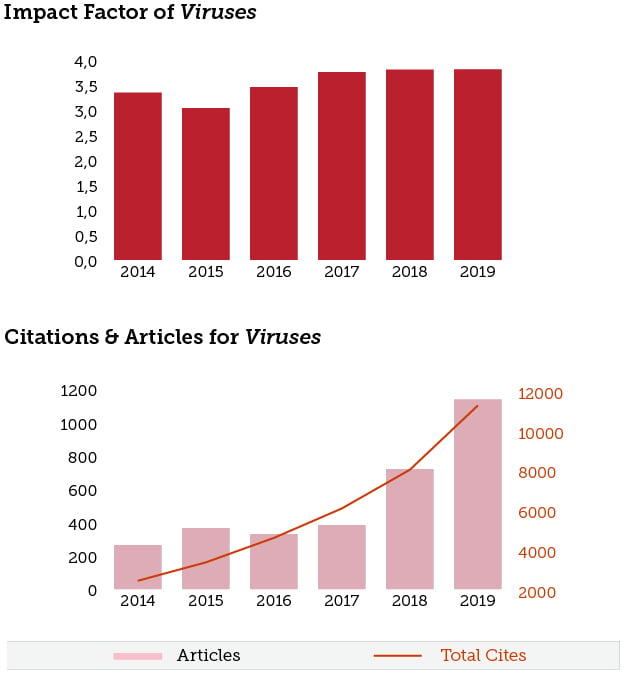
Viruses Receiving 2018 Updated Impact Factor of 3.811

We are pleased to inform that Viruses received an updated Journal Impact Factor of 3.811 in the June 2018 release of the Journal Citation Reports®. The journal's 5-Year Impact Factor is 3.916. Viruses now ranks 11/36 (Q2) in the 'Virology' category.
Evolution of Impact Factor, Citations and Publications for Viruses:
21 May 2019
The Swedish Society for Virology (SSV) is Now an Affiliated Society Member of Viruses
In April 2019, the Swedish Society for Virology (SSV) became affiliated to Viruses. As part of this collaboration, all members of SSV enjoy a discount on the article processing charges (APC) when submitting articles to Viruses.

The Swedish Society for Virology (SSV) was founded in 2008 to provide a forum for all interested in virology, including clinical, pre-clinical, environmental, veterinary, plant and/or microbial (phage) virology. The aim of the society is to promote the exchange of information and stimulate discussion and collaboration among scientists active in all aspects of virology. The society presents current information regarding upcoming events and meetings, grants, positions, and education opportunities.
SSV is a professional organization whose functions are highly relevant to the scope of Viruses. We look forward to collaborating with SSV and publishing state-of-the-art research from its members in this field.
2 May 2019
The Brazilian Society for Virology (BSV) is Now an Affiliated Society Member of Viruses
In March 2019, the Brazilian Society for Virology (BSV) became affiliated to Viruses. As part of this collaboration, all members of BSV enjoy a discount on the article processing charges (APC) when submitting articles to Viruses.

The Brazilian Society for Virology (BSV) was established in 1986 to support the development of basic and applied virology in South America. The society promotes the exchange of information and stimulates the collaboration among virologists.
BSV is a professional organization whose functions are highly relevant to the scope of Viruses. We look forward to collaborating with BSV and publishing state-of-the-art research from its members in this field.
2 April 2019
The German Society for Virology (GfV) is Now an Affiliated Society Member of Viruses

In March 2019, the German Society for Virology (GfV) became affiliated to Viruses. As part of this collaboration, all members of EMS enjoy a discount on the article processing charges (APC) when submitting articles to Viruses.
The German Society for Virology (Gesellschaft für Virologie, GfV) promotes the development of Virology as a research area in the life sciences, medicine and veterinary medicine. Founded in 1990, the society is the largest virological society in Europe with about 1’100 members, mainly from Germany, Austria and Switzerland, but also further countries.
GfV is a professional organization whose functions are highly relevant to the scope of Viruses. We look forward to collaborating with GfV and publishing state-of-the-art research from its members in this field.
