

Swine Nutrition and Feed

A special issue of Veterinary Sciences (ISSN 2306-7381). This special issue belongs to the section "Nutritional and Metabolic Diseases in Veterinary Medicine".

Deadline for manuscript submissions: 30 September 2026 | Viewed by 1769

Special Issue Editor


E-Mail Website
Guest Editor
Institute of Feed Research, Chinese Academy of Agricultural Sciences, Beijing 100081, China
Interests: pig; nutrition; gut health
Special Issues, Collections and Topics in MDPI journals

Special Issue Information

Dear Colleagues,

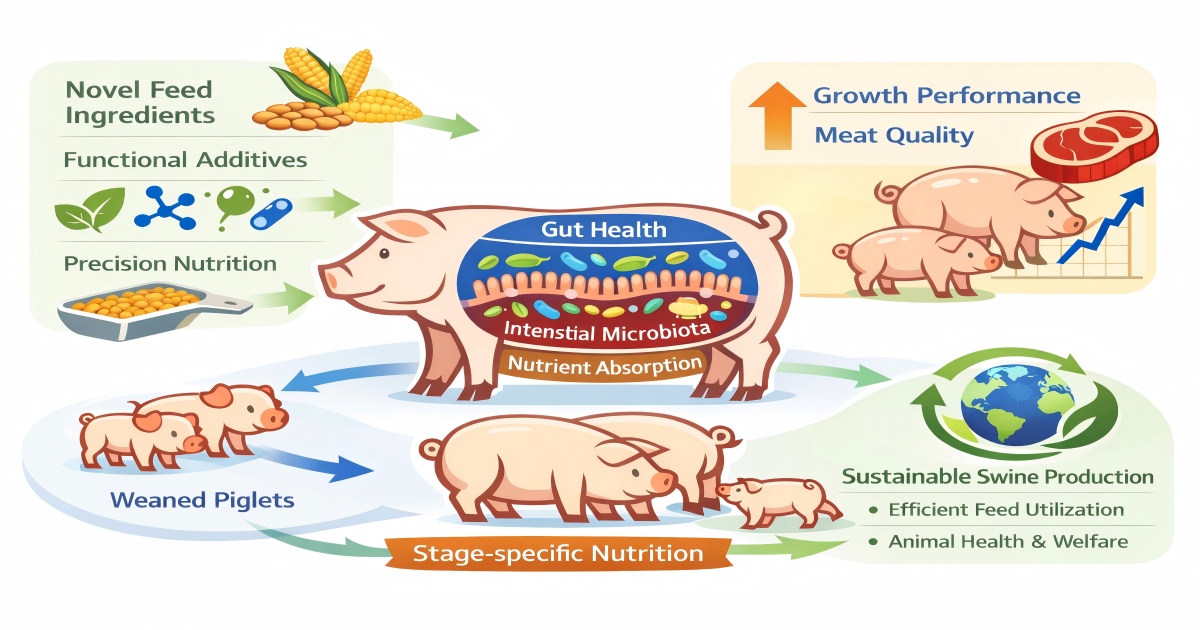
The Special Issue “Swine Nutrition and Feed” aims to showcase the latest research advances and innovative achievements in the field of pig nutrition and feed science. This Special Issue focuses on how precision nutrition strategies and novel feed resources can modulate gut health, growth performance, and overall health in pigs. Contributions may explore, but are not limited to, the following:

  • The development and functional evaluation of new feed ingredients and additives.
  • Nutritional regulatory mechanisms of porcine gut health.
  • Stage-specific nutritional strategies across different life phases of pigs.
  • The interplay between nutrition and meat quality.

This Special Issue seeks to bring together high-quality original research and review articles to promote breakthroughs in both fundamental knowledge and applied technologies. The goal is to provide scientific evidence and practical solutions for improving swine health, enhancing production efficiency, and achieving sustainable and efficient utilization of feed resources. We warmly welcome submissions from researchers worldwide and invite you to share your latest findings and valuable insights in this rapidly evolving field.

Prof. Dr. Xianren Jiang
Guest Editor

Manuscript Submission Information

Manuscripts should be submitted online at www.mdpi.com by registering and logging in to this website. Once you are registered, click here to go to the submission form. Manuscripts can be submitted until the deadline. All submissions that pass pre-check are peer-reviewed. Accepted papers will be published continuously in the journal (as soon as accepted) and will be listed together on the special issue website. Research articles, review articles as well as short communications are invited. For planned papers, a title and short abstract (about 250 words) can be sent to the Editorial Office for assessment.

Submitted manuscripts should not have been published previously, nor be under consideration for publication elsewhere (except conference proceedings papers). All manuscripts are thoroughly refereed through a single-blind peer-review process. A guide for authors and other relevant information for submission of manuscripts is available on the Instructions for Authors page. Veterinary Sciences is an international peer-reviewed open access monthly journal published by MDPI.

Please visit the Instructions for Authors page before submitting a manuscript. The Article Processing Charge (APC) for publication in this open access journal is 2100 CHF (Swiss Francs). Submitted papers should be well formatted and use good English. Authors may use MDPI's English editing service prior to publication or during author revisions.

Keywords

  • swine nutrition
  • functional additives
  • gut health
  • intestinal microbiota
  • growth performance
  • stage-specific nutrition
  • weaned piglets

Benefits of Publishing in a Special Issue

  • Ease of navigation: Grouping papers by topic helps scholars navigate broad scope journals more efficiently.
  • Greater discoverability: Special Issues support the reach and impact of scientific research. Articles in Special Issues are more discoverable and cited more frequently.
  • Expansion of research network: Special Issues facilitate connections among authors, fostering scientific collaborations.
  • External promotion: Articles in Special Issues are often promoted through the journal's social media, increasing their visibility.
  • Reprint: MDPI Books provides the opportunity to republish successful Special Issues in book format, both online and in print.

Further information on MDPI's Special Issue policies can be found here.

Published Papers (2 papers)

Order results
Result details
Select all
Export citation of selected articles as:

Research

19 pages, 2009 KB  
Article
Dietary Astragalus Crude Extract Boosts Piglet Growth and Mitigates Weaning Stress by Enhancing Antioxidant Activity, Improving Immunity, and Modulating Intestinal Microbiota
by Yuyan Che, Long Cai, Longlong Zhu, Lu Li, Lufang Deng, Guoshun Chen and Jing Wang
Vet. Sci. 2026, 13(3), 242; https://doi.org/10.3390/vetsci13030242 - 3 Mar 2026
Viewed by 601
Abstract
Astragalus is a traditional Chinese medicine that contains various bioactive compounds, which exert antioxidant and immunomodulatory properties. This research aimed to investigate the impacts of Astragalus crude extract on growth performance, nutrient digestibility, immune response, and intestinal health in weaned piglets. Sixty crossbred [...] Read more.
Astragalus is a traditional Chinese medicine that contains various bioactive compounds, which exert antioxidant and immunomodulatory properties. This research aimed to investigate the impacts of Astragalus crude extract on growth performance, nutrient digestibility, immune response, and intestinal health in weaned piglets. Sixty crossbred weaned piglets at 28 days of age (8.12 ± 0.14 kg) were allocated into three dietary treatments: a control group fed a corn–soybean meal-based diet (CON), an antibiotic group received the basal diet with 1000 mg/kg aureomycin (AN), and a treatment group administered the basal diet with 500 mg/kg Astragalus crude extract (CE), with 5 replicates per group, 4 piglets per replicate. The experimental trial lasted for 28 days. Feed intake and body weight were recorded to evaluate growth performance. Blood, intestine, and liver tissue samples were collected for the analysis of antioxidant capacity and gene expression. Compared to the CON group, supplementation with CE or AN significantly enhanced growth performance and decreased diarrhea incidence on days 0–14, whereas only CE tended to improve crude protein digestibility. Piglets supplemented with AN or CE showed improved antioxidant capacity and immune response relative to the CON group, as evidenced by increased liver and intestinal antioxidant enzyme activities, upregulated intestinal antioxidant gene expression, and enhanced plasma immunoglobulin A levels. Further, the upregulated intestinal tight junction protein expression was observed in CE or AN groups compared with the CON. Notably, dietary CE significantly modulated gut microbiota composition, particularly enriching the genera Blautia, Turicibacter, Agathobacter, and Clostridium. These findings indicate that dietary Astragalus crude extract promotes the gut health of weaned piglets by reducing oxidative stress and modulating gut microbiota composition, thereby decreasing diarrhea incidence and improving growth performance. Full article
(This article belongs to the Special Issue Swine Nutrition and Feed)
Show Figures

Figure 1

25 pages, 1250 KB  
Article
Effects of Enzymes or Fermented Feed on Nitrogen Balance, Meat Quality, Intestinal Microbiota Profile and Barrier Functions of Landrace × Rongchang Pigs Fed with a Diversified Low-Protein Diet
by Cunji Shui, Jiayao Liao, Jingjing Wang, Zhiru Tang, Renli Qi, Qi Wang, Sishen Wang, Yetong Xu and Zhihong Sun
Vet. Sci. 2026, 13(3), 219; https://doi.org/10.3390/vetsci13030219 - 26 Feb 2026
Viewed by 751
Abstract
Reducing the dependence on traditional protein sources, and decreasing feeding costs and nitrogen emissions, are important tasks in livestock production. A 5 × 5 Latin square nitrogen balance trial (five castrated male pigs) and an animal growth experiment with 120 Landrace × Rongchang [...] Read more.
Reducing the dependence on traditional protein sources, and decreasing feeding costs and nitrogen emissions, are important tasks in livestock production. A 5 × 5 Latin square nitrogen balance trial (five castrated male pigs) and an animal growth experiment with 120 Landrace × Rongchang pigs were performed and randomly divided into five diets: a normal crude protein level diet (CON); LP diet; diversified LP containing broken rice, rapeseed meal, and DDGS (DLP); DLP + 0.05% cellulase (DLP + CE); and DLP + 20% fermented feed (FDLP). The CON group showed higher nitrogen intake, urinary nitrogen, and total nitrogen excretion than the other four groups (p < 0.05). The fecal nitrogen was decreased with the LP, DLP + CE, and FDLP groups compared to the CON group (p < 0.05). The mRNA expression of jejunal fatty acid transport protein 1 was upregulated in the LP, DLP + CE, and FDLP groups compared to the CON and DLP groups (p < 0.05). The DLP + CE group showed a higher intramuscular fat content in pigs than the CON and DLP groups (p < 0.05). In the LD muscle, the FDLP and DLP + CE groups upregulated fatty acid synthase expression compared to the LP and DLP groups (p < 0.05). Colonic mRNA expression of zonula occludens-1 and claudin-1 was upregulated in the FDLP group compared to the CON and DLP groups (p < 0.05). These results suggest that the supplementation of cellulase and fermented feed in DLP diets improved nitrogen utilization and intestinal health without compromising growth performance or meat quality in Landrace × Rongchang pigs. Full article
(This article belongs to the Special Issue Swine Nutrition and Feed)
Show Figures

Figure 1

Back to TopTop